





1. Introduction
1.1. When children differ from adults
When children produce and interpret language differently from adults, the underlying cause can be unclear: do they have a non-adult-like representation of the target language, or do they simply deploy their representation in a non-adult-like way—or perhaps some of both? For instance, let us consider how someone might interpret a pronoun in context, such as she in Lisa hugged Iona and then she took a nap. Suppose we believe that adults know that the pronoun in this type of context is interpreted as the subject (e.g. she as Lisa) 80% of the time. However, suppose we observe a child interpreting the pronoun as the subject 60% of the time. Is this observed behavior because the child represents the relevant probability as 60% and has accurately deployed that 60% probability? If so, a non-adult-like representation (of probability) is the cause. Or is this observed behavior because the child has an adult-like probability representation (80%), but has inaccurately deployed that knowledge in the moment (perhaps due to cognitive limitations)? If so, non-adult-like deployment of the representation is the cause. Of course, both non-adult-like representations and non-adult-like deployment of those representations may cause non-adult-like behavior.Footnote 1
A traditional way to try separating out the effects of non-adult-like deployment is to use experimental designs and techniques that facilitate language deployment. If non-adult-like behavior persists, it is more likely due to children having a different representation from adults than to any difficulty deploying their representation; however, if adult-like behavior emerges when deployment is facilitated, this suggests that previous non-adult-like behavior was instead due to deployment difficulties. Deployment can be facilitated in a variety of ways, such as designing tasks with lower processing demands (e.g. Hartshorne et al. Reference Hartshorne, Nappa and Snedeker2015, Messenger & Fisher Reference Messenger and Fisher2018, Ud Deen et al. Reference Ud Deen, Bondoc, Camp, Estioca, Hwang, Shin, Takahashi, Zenker and Zhong2018) or more natural pragmatics (e.g. Conroy et al. Reference Conroy, Takahashi, Lidz and Phillips2009, Spenader et al. Reference Spenader, Smits and Hendriks2009), as well as using more sensitive behavioral measures, such as eye gaze (e.g. Brandt-Kobele & Höhle Reference Brandt-Kobele and Höhle2010) instead of pointing and verbal responses.
Still, it can be difficult to know how much facilitation is enough or if the behavioral measure is sensitive enough. Suppose a new task fails to reveal adult-like behavior in children even after the task has been improved and a more sensitive performance measure has been used; while that result is less likely due to deployment difficulties, deployment difficulties are nonetheless still possible. Children differ from adults in many ways that can affect their language deployment—probably in ways that have yet to be discovered—so it seems unwise to definitively dismiss deployment difficulties, based on data from behavioral studies. This uncertainty therefore makes it inherently more difficult to interpret children’s non-adult-like behavior than to interpret their adult-like behavior.
1.2. Computational cognitive modeling as a tool complementing behavioral techniques
Here, we show how computational cognitive modeling can be fruitfully used to analyze children’s non-adult-like behavior. We focus on the case study of Spanish subject pronoun interpretation by typically developing children. We first present a pronoun interpretation task showing that children acquiring Spanish as their first language interpret subject pronouns differently from adults. In particular, we find that some information about potential pronoun interpretations appears to matter less (or not at all) to children, in contrast with adults.
We next use computational cognitive modeling to explore the potential sources of children’s non-adult-like responses, because computational cognitive models allow us to evaluate hypotheses about the mental computations humans do in order to generate observable behavior (Pearl Reference Pearl and Sprouse2023). Here, we evaluate different hypotheses about how listeners generate their pronoun interpretation responses. These hypotheses involve (i) how listeners represent probability information in their input about pronoun interpretation, and (ii) how listeners deploy that represented information in the moment to interpret a pronoun in an experimental context.
More specifically, we investigate whether the patterns of behavior observed in children are more likely caused by children (i) inaccurately representing probability information available for pronoun interpretation, (ii) deploying accurate probability representations inaccurately, or (iii) both inaccurately representing pronoun probability information and inaccurately deploying those inaccurate probability representations. Importantly, we also use the same modeling techniques to capture adult behavior in the same task, and so identify the target state for children, both for representing probability information and for deploying that information. This allows us to identify more precisely what needs to change in children in order for them to develop adult-like ways of interpreting pronouns.
1.3. ‘Adult-like’ doesn’t necessarily mean accurate
Importantly, the observable target of development is adult-like behavior, whatever that happens to be. We might think that ‘adult-like’ always means accurate, such as adults giving correct responses on behavioral tasks. However, sometimes adult behavior is not accurate, such as when adults need to balance competing constraints. A classic example of balancing constraints in human cognition is the ‘speed–accuracy tradeoff’ (see Heitz Reference Heitz2014 for an overview): a participant’s reactions are limited in time, so the participant may sacrifice accuracy of a response in favor of making a speedier response.
So again, the acquisition target is adult-like behavior, even if that behavior is not accurate. One perspective on adult cognition is that adults have identified ‘optimal’ behaviors, where they achieve the optimal balance of competing constraints (e.g. balancing speed of a decision vs. the accuracy of that decision). More specifically, when it comes to how adults use information to make decisions, there is a rich literature exploring whether—and how—they may be optimal (e.g. see Lieder & Griffiths Reference Lieder and Griffiths2020 for a recent review). For instance, a long-standing hypothesis in cognitive psychology has been the idea of ‘bounded rationality’ (e.g. Gigerenzer Reference Gigerenzer2008, Simon Reference Simon1956, Zhang et al. Reference Zhang, Ren and Maloney2020), where humans intend to be optimal (i.e. ‘rational’ and therefore accurate), but cannot actually be optimal in practice because of human cognitive limitations. So, in practice, the optimality of human cognition is ‘bounded’ by the constraints imposed by the implementation of human cognition in the mind and brain. For example, the speed–accuracy balance that adults achieve would be impacted by the limitations of achieving that balance in the medium of the human mind.
More recently, this approach has been extended to the idea that humans may be ‘resource-rational’ (Lieder & Griffiths Reference Lieder and Griffiths2020, Vul et al. Reference Vul, Goodman, Griffiths and Tenenbaum2014): humans are optimal (‘rational’) when it comes to how they deploy their limited cognitive resources to accomplish a task. That is, the optimization that the human mind does may be targeted at optimizing cognitive constraints like energy efficiency or processing time (Friston Reference Friston2010, Markman & Otto Reference Markman and Otto2011, Martin Reference Martin2016). So, humans may appear to be suboptimal (i.e. ‘irrational’ and therefore inaccurate) when it comes to using available information if cognitive limitations are not considered; however, if we consider that optimization includes the efficient use of limited cognitive resources, then human behavior once again may be optimal.
1.4. Resource-rationality in language acquisition
Within language acquisition, optimizing with respect to cognitive resources is actually a cornerstone of at least two approaches we are aware of that investigate when a child would decide to adopt a rule or generalization. The first approach uses the Tolerance and Sufficiency Principles (Yang Reference Yang2005, Reference Yang2016, Reference Yang2018), both of which assume that a learner is trying to optimize the average retrieval time for any item that a potential rule or generalization could apply to. That is, this decision process is predicated on humans wanting to make retrieving information as efficient ‘time-wise’ as possible.
The second approach is Minimum Description Length (Chater et al. Reference Chater, Clark, Goldsmith and Perfors2015, Hsu & Chater Reference Hsu and Chater2010, Hsu et al. Reference Hsu, Chater and Paul2011, Reference Hsu, Chater and Paul2013, Li & Vitányi Reference Li, Paul and Ristad1994, Rissanen & Ristad Reference Rissanen, Ristad and Ristad1994, Stabler Reference Stabler1998), which assumes that the learner is optimizing the amount of space for storing information, with a preference for anything that makes storing information more compact. That is, this decision process is predicated on humans wanting to make information as efficient ‘space-wise’ as possible. In both cases, whether the goal is efficiency in terms of time or efficiency in terms of space, humans are assumed to optimize with respect to limited cognitive resources (e.g. processing time or mental storage space).
So, being inaccurate may in fact be optimal (or at the very least, a plausible adult-like thing to do) once limited cognitive resources are taken into account. More specifically, we might initially think that the optimal approach to pronoun interpretation in context would be to accurately use all information available from all relevant pronoun interpretation cues. However, in the face of cognitive resource limitations, the resource-optimal approach would be not to do this; instead, humans may optimize processing efficiency (either time-wise, space-wise, or some other way) to achieve ‘good enough’ pronoun interpretation (similar to ‘good enough’ language comprehension approaches more generally: Ferreira & Patson Reference Ferreira and Patson2007, Ferreira et al. Reference Ferreira, Karl and Ferraro2002, Traxler Reference Traxler2014).
1.5. Our findings: a preview
Our modeling results suggest that both child and adult pronoun interpretation behavior is best captured by inaccuracy somewhere in the pronoun interpretation process. Child behavior is best captured if children are doing one of two things: (i) always deploying inaccurate probability representations of their input, or (ii) selectively deploying accurate probability representations. Adult behavior is best captured if adults are always deploying inaccurate probability representations. Importantly, this means that adult-like behavior—the target of acquisition—is not accuracy: to become adult-like, children need to learn how to be inaccurate in the right ways for potentially both representation and deployment of probability information relating to pronoun interpretation.
More generally, this case study demonstrates how computational cognitive modeling complements existing behavioral techniques investigating language acquisition: modeling allows us to test specific hypotheses about the underlying cognitive computations that lead to observed behavior, in both children and adults. We conclude with a brief discussion of the promise and limitations of the computational cognitive modeling approach demonstrated here.
2. Behavioral data: child pronoun interpretation in Spanish
2.1. Pronoun interpretation in Spanish
Pronoun interpretation requires listeners to combine information from multiple sources in order to decide how to interpret that pronoun (i.e. what the pronoun’s antecedent is), and this information can conflict. For instance, Spanish listeners can interpret subject pronouns by attending to at least three different kinds of information in the current linguistic context:Footnote 2 (i) the pronoun’s form (Carvalho et al. Reference Carvalho, Orozco and Shin2015, Keating et al. Reference Keating, VanPatten and Jegerski2011, Otheguy et al. Reference Otheguy, Zentella, Livert, Norde, de Jonge and Hasselblatt2010), (ii) the relation (sometimes called ‘coherence’ or ‘rhetorical relation’) between the pronoun’s clause and other clauses in the surrounding discourse (Asher & Lascarides Reference Asher and Lascarides2003, Fukumura & van Gompel Reference Fukumura and van Gompel2010, Kehler Reference Kehler2002, Kehler et al. Reference Kehler, Kertz, Rohde and Elman2008), and (iii) the pronoun’s grammatical features (Clahsen et al. Reference Clahsen, Aveledo and Roca2002, Legendre et al. Reference Legendre, Culbertson, Zaroukian, Hsin, Barrière and Nazzi2014, Pérez-Leroux Reference Pérez-Leroux2005). Each kind of information can be extracted from one or more cues.
For pronoun form information, Spanish subject pronouns have two options: null (e.g. ∅ in 1) and overt (e.g. the form
él
‘he’ in 1). These pronoun forms serve as the cues listeners can attend to and have different interpretation preferences: the null form tends to be more strongly associated than the overt form with the preceding subject antecedentFootnote 3 (Carvalho et al. Reference Carvalho, Orozco and Shin2015, Filiaci Reference Filiaci2010, Keating et al. Reference Keating, VanPatten and Jegerski2011, Otheguy et al. Reference Otheguy, Zentella, Livert, Norde, de Jonge and Hasselblatt2010). So, the null pronoun ∅ in 1 is more likely to be interpreted as referring to the subject Juan than the overt pronoun
él
used in the same context (i.e. the probability that ∅ refers to Juan is greater than the probability that
él
refers to Juan).
(1)
Juan
llamó
a
Pedro
cuando
∅ /él
estaba
en
casa.
(p(∅ → Juan) > p(él → Juan))
Juan
called
a
Pedro
when
pro/he
was
in
house
‘Juan called Pedro when (he) was at home.’
For clausal relation information, Spanish has a range of syntactic and lexical cues that can be attended to, such as the Spanish connectives
y después
‘and then’ and
porque
‘because’ in 2. Temporal relations like those indicated by
y después
are biased toward maintaining continued reference to the topic (Asher & Lascarides Reference Asher and Lascarides2003). Because the subject is typically the topic, this biases the pronoun interpretation toward the subject: the pronoun in 2a is more likely to refer to the subject antecedent Juan than to the nonsubject Pedro (i.e. the probability that
y después
causes ∅ to refer to Juan is greater than the probability that
y después
causes ∅ to refer to Pedro).
(2)
Juan
le
dice
adiós
a
Pedro …
Juan
dat
says
bye
to
Pedro …
a.
…y después
∅
se va.
(p(
y después
→ Juan) > p(
y después
→ Pedro))
…and then
pro
leaves
b.
…porque
∅
se va.
(p(
porque
→ Pedro) > p(
porque
→ Juan))
…because
pro
leaves
‘Juan is saying bye to Pedro and then/because (he) is leaving.’
In contrast, causal sequences like those indicated with the connective porque can be biased in either direction, depending on the content of the specific predicates involved (Asher & Lascarides Reference Asher and Lascarides2003, Fukumura & van Gompel Reference Fukumura and van Gompel2010). In 2, the specific predicates lead to a bias for interpreting the pronoun as the object antecedent Pedro in 2b (i.e. the probability that porque causes ∅ to refer to Pedro is greater than the probability that porque causes ∅ to refer to Juan).
For grammatical feature information, Spanish subject-verb agreement is a cue that can be attended to. Notably, this cue is available even when the pronoun itself happens to be null, because verbs in Spanish must carry morphology that overtly signals the subject’s person and number. An example of this is in 3, with the third-person singular morphology on the verb
sale
‘leaves’.
(3)
Las
niñas
saludan
a
la
maestra,
y
después
∅
sale.
(p(sale → la maestra) ≈ 1)
the
girls
greet
a
the
teacher
and
then
pro
leave.3sg
‘The girls wave at the teacher, and then (she) leaves.’
In contrast to the probabilistic cues of pronoun form and lexical connective, number agreement is traditionally thought to be categorical when it comes to its effects on pronoun interpretation. In 3, the verb morphology aligns with the nonsubject antecedent: the singular morphology on the verb sale indicates that the null pronoun is also singular, which in turn indicates that the pronoun must be interpreted as the singular la maestra ‘the teacher’ (the object) rather than the plural las niñas ‘the girls’ (the subject). That is, the probability that sale causes ∅ to refer to la maestra is approximately 1. Note that this interpretation persists even though the other cues probabilistically favor the other interpretation. That is, the pronoun’s form is null and the connective is the temporal y después , both of which favor the subject antecedent ( las niñas ‘the girls’), yet the cue of agreement morphology forces the interpretation to be the nonsubject antecedent ( la maestra ‘the teacher’).
This last example demonstrates one of the main problems children must learn to solve when interpreting pronouns: how to interpret a pronoun when multiple conflicting cues are available. In particular, children must learn two key things.
First, they must learn the information each cue carries in an adult-like way—we refer to this as the pronoun cue’s representation. For example, the adult-like representation of a Spanish null subject pronoun could encode a bias toward subject antecedents. That is, the probability that the null form indicates a subject antecedent is greater than the probability that the overt form indicates a subject antecedent: p(∅ → subject) > p(overt pronoun él → subject). This probability is one example of the representation children might need to learn for this cue’s information.Footnote 4
Second, children must learn how to integrate the information from different cues in an adult-like way—we refer to this as the deployment of their representations. For instance, in 3, a null pronoun form and the connective y después are used, both of which favor the subject interpretation; however, since the accompanying number morphology is singular and the subject antecedent las niñas is plural, the pronoun should not be interpreted as referring to the subject. So, children must learn to prefer the antecedent that adults do (e.g. the subject) by integrating the conflicting cue information in an adult-like way.
It is currently unknown both when Spanish-learning children acquire adult-like pronoun cue representations and when they achieve adult-like deployment of these representations. That is, for the probability-based information discussed here, it is unknown when children would achieve adult-like probability representations for the different cue information and when children would integrate these probability representations in an adult-like way to achieve adult-like pronoun interpretation.
2.2. What we know about when children learn what
All three information sources illustrated above—pronoun form, clausal relations, and grammatical features—have been studied to different degrees on their own. We provide a synthesis of the relevant information reviewed in more detail in Appendix A. In particular, the evidence collectively suggests that by age four or five, children are capable of using a variety of cues to interpret pronouns in an adult-like way, including the pronoun’s form, the presence of various lexical and syntactic cues that reveal its semantic relation with surrounding clauses, and the morphological features of verbal agreement. However, children’s ability to deploy this knowledge can vary depending on how cognitively demanding the task is and whether these cues conflict with each other. The variation in children’s performance makes it unclear whether children’s representations of these pronoun cues are still developing at this age or are instead fully adult-like but simply obscured by problems with deployment.
2.3. Assessing child pronoun interpretation behavior when cues conflict
Here, we describe a forced-choice picture-selection task (see Figure 1) used to elicit preferred interpretations of subject pronouns, given each of the three cue types discussed above. This paradigm allows us to observe how children and adults change their preferred interpretations when each individual cue changes, such as switching from a null to an overt pronoun form, switching between different lexical connectives, or switching between subject-aligned vs. non-subject-aligned agreement morphology. The task is similar to earlier picture-selection tasks testing children’s comprehension of agreement (e.g. Pérez-Leroux Reference Pérez-Leroux2005) but incorporates two techniques that lessen the cognitive demand, in order to facilitate children’s deployment of their pronoun knowledge. First, both potential antecedents are explicitly mentioned in the clause immediately preceding the pronoun (Screen 1 in Figure 1: the teacher, the girls) in order to make them as prominent in the discourse context as possible.Footnote 5 Second, both potential interpretations are depicted side by side (Screen 2 in Figure 1: the teacher leaving, the girls leaving) in order to lessen working-memory demands.
Example picture-selection trial. Task: Listen to the story represented by the images in Screen 1 and choose one picture in Screen 2 that represents the rest of the story. In Screen 2, the subject interpretation is indicated on the lefthand side by the teacher leaving; the nonsubject interpretation is indicated on the righthand side by the girls leaving.

Figure 1. Long description
The illustration is divided into two main panels labeled a and b.
Panel a, Screen 1, shows a teacher on the right waving goodbye to three girls standing on the left. Below the characters is text in Spanish and English: La maestra les dice adiós a las niñas… ‘The teacher says goodbye to the girls…’.
Panel b, Screen 2, is divided by a thin vertical line into two possible story endings. Below both options is the text: …y después null se va a la casa '…and then pronoun goes home’.
* The left side of Screen 2 shows a two-story house at the top with the teacher walking toward the left, away from the house, representing the subject interpretation.
* The right side of Screen 2 shows the same two-story house at the top with the three girls walking toward the right, away from the house, representing the nonsubject interpretation.
All experimental items included one of two pronoun forms (null ∅ or overt ella(s) ‘she’/‘they (f)’), a discourse connective (temporal y después ‘and then’ or causal porque ‘because’), and an agreement morphology marker (third singular -∅ or third plural -n). To ensure that agreement morphology information was indicated only by the verb (rather than also on the pronoun if it was overt), experimental items were designed following the approach of Johnson et al. Reference Johnson, de Villiers and Seymour2005. This approach masks the number marking on specific overt pronoun forms like ella and ellas (i.e. whether the ending is -∅ or -s) and is described in more detail below in Section 2.3.2.
To test how strongly each cue affects pronoun interpretation, cues were alternately aligned with each other, as in 4a, or set up so that one was pitted against the others, as in 4b–d.Footnote 6
(4)
Example utterance opening for an experimental item
‘La
maestra
les
dice
adiòs
a
las
niñas
… ’
the
teacher
to.them
say.3sg
goodbye
a
the
girls
…
Possible utterance continuations:
a.
All aligned: all cues favor the subject
Form → subject, Connective → subject, Agreement morphology → subject
‘… y
después
∅
se
va
a
la
casa.’
… and
then
pro
self
go.3sg
to
the
house
b.
Form not aligned (it favors the nonsubject), while the other two cues favor the subject
Form → nonsubject, Connective → subject, Agreement morphology → subject
‘… y
después
ella
se
va
a
la
casa.
… and
then
she
self
go.3sg
to
the
house
c.
Connective not aligned (it favors the nonsubject), while the other two cues favor the subject
Form → subject, Connective → nonsubject, Agreement morphology → subject
‘… porque
∅
se
va
a
la
casa.’
… because
pro
self
go.3sg
to
the
house
d.
Agreement morphology not aligned (it favors the nonsubject), while the other two cues favor the subject
Form → subject, Connective → subject, Agreement morphology → nonsubject
‘… y
después
∅
se
van
a
la
casa.’
… and
then
pro
self
go.3pl
to
the
house
Recall from Section 2.1 that two of these cues (pronoun form, lexical connective) are probabilistic, while agreement morphology is assumed to be more categorical (that is, this cue’s probability is very near 0 or 1). We therefore expect adults to be much more strongly influenced by agreement morphology than by the other two cues. For example, we would expect a dramatic difference in subject interpretation responses between condition 4a, where all cues signal the subject, and 4d, where agreement morphology signals the nonsubject in opposition to the other two cues. However, we would expect a much smaller difference between 4a and 4b–c, where only the lexical connective and the pronoun form signal the nonsubject, respectively. How and when children differ from adults in these conditions can help us identify which cues children may be heeding.
2.3.1. Participants
Participants were recruited from a daycare in Mexico City, Mexico. Adult participants were all native speakers of Spanish working at the school. Children were typically-developing learners of Spanish as a first language. A total of forty-seven adults (forty-three women) and ninety-seven children (fifty-seven girls) ages 1;11 to 6;9 completed the task. One adult (n = 1) was excluded from analysis due to experimenter error (only half of the items were administered). Children were divided into three age groups for analysis: thirty-three children age three and under (≤ 3: 1;11–3;10; M = 3;3), thirty-five children age four (4: 4;0–4;11; M = 4;5), and twenty-nine children age five and older (≥5: 5;0–6;9; M = 5;8). Individual responses were excluded if the participant failed to choose one of the pictures, or if the experimenter read the prompt incorrectly. The following child responses were excluded for this reason: twenty-nine (of 1,225) age ≤3; twenty-two (of 1,308) age 4; twenty-one (of 1,081) age ≥5.
2.3.2. Design and procedure
Experimental stimuli were created by fully crossing the three cues of pronoun form (null, overt), discourse connective (temporal y después , causal porque ), and agreement number morphology (aligns with subject, aligns with nonsubject). That is, in addition to the condition in 4a, where all three cues favor the subject interpretation, and the three conditions in 4b–d, where two of three cues favor the subject, there were also three conditions where two of three cues favored the nonsubject, and one condition where all three cues favored the nonsubject.Footnote 7 These eight conditions were presented in both singular and plural forms, for a total of sixteen conditions.
Eight distinct experimental items were created by choosing pairs of verbs that were easily depicted and likely to be known by children under age three (e.g. sigue – sale : ‘follow’–‘go out’). In addition, as mentioned previously, we followed Johnson et al. Reference Johnson, de Villiers and Seymour2005 in masking agreement morphology information that could come from the singular -∅ or plural -s marking on the subject of the second clause (i.e. ella(s) ); we accomplished the masking by using /s/-initial predicates (e.g. sale ). This way, in overt pronoun conditions, number marking on the pronoun subject ella(s) ‘she’/‘they (f)’ would not provide participants with any additional number cues (e.g. ‘ ella sal… ’ is difficult to distinguish from ‘ ellas sal… ’). Instead, participants would need to rely on the agreement cue provided by the verbal agreement marker (e.g. sale(n) ).
Fillers were created by choosing an additional sixteen verb pairs, replacing the pronoun with the definite DP los niños ‘the boys’, and using either ‘the girls’ or ‘the teacher’ as a competing antecedent. The same sixteen fillers were presented in the same order across all versions of the experiment. See Appendix B for more details of the design and sample items.
Participants were randomly assigned to one of three versions of the experiment, with sixteen experimental trials and sixteen filler trials. Each version tested a different cue type (pronoun form, connective, morphology) by systematically aligning and pitting that cue against the other two. For example, participants assigned to the ‘morphology’ version were exposed to eight ‘congruent’ trials in which all cues favored the same antecedent (as in 4a) and eight ‘incongruent’ trials in which agreement morphology favored the opposite antecedent from that which the pronoun form and connective favored (as in 4d). The same protocol was used for participants assigned to the ‘pronoun form’ and ‘connective’ versions (pronoun form: 4a vs. 4b; connective: 4a vs. 4c). Thus, cue type was between-subject, while congruency (i.e. congruent, incongruent) was within-subject.
Within each version of the experiment, fillers and experimental items were presented in a fixed order that formed a coherent narrative arc about two consecutive days at a school with a teacher, a group of girls, and a group of boys. Each experimental item was presented twice, once in its congruent form and once in its incongruent form, which were randomly assigned to appear on either ‘day 1’ or ‘day 2’. Each pair of congruent/incongruent experimental items was randomly assigned to appear in the plural or the singular. The total experiment (three practice items, sixteen experimental items, and sixteen fillers) took about ten minutes to administer.
The task was administered on a 13-inch MacBook Air using Psychopy version 3.0.0b11 (Peirce et al. Reference Peirce, Gray, Simpson, MacAskill, Höchenberger, Sogo, Kastman and Lindeløv2019). The task began with an introductory screen introducing the characters (a teacher, three identically dressed girls, three identically dressed boys). Next, participants were given an explanation of the task and three practice trials. During each practice and experimental trial, participants saw an illustration of the first clause as it was read out loud by the experimenter (child participants) or a recording of her voice was played over headphones (adult participants), as in Screen 1 of Figure 1. Then, participants saw a blank screen and heard the second clause. Then, two illustrations appeared, one corresponding to the subject interpretation and one to the object interpretation (as in Screen 2 of Figure 1); participants chose the picture that matched their own interpretation by pointing (child participants) or by pressing the ‘4’ or ‘9’ key (adult participants).
Pictures were randomly placed on the left or right side of the screen. Upon completion, children received a piece of candy and adults received the equivalent of US$10.
2.4. Behavioral results
2.4.1. Practice and filler trials
For the practice trials, we used a one-sided t-test to evaluate whether the correct response rate in each age group was above chance and found that indeed it was (≤3: M = 0.68, t(32) = 4.37, p < 0.001; 4: M = 0.66, t(34) = 3.60, p < 0.01; ≥5: M = 0.71, t(28) = 4.12, p < 0.001; adults: M = 0.89, t(46) = 17.09, p < 0.001). For the filler trials, we again used a one-sided t-test to evaluate whether the correct response rate in each age group was above chance and found that indeed it was (≤3: M = 0.69, t(32) = 4.45, p < 0.001; 4: M = 0.67, t(34) = 3.34, p < 0.01; ≥5: M = 0.85, t(28) = 7.727, p < 0.001; adults: M = 0.94, t(46) = 19.71, p < 0.001).
Because participant performance on both the practice and filler trials was above chance, this suggested that the participants in all age groups understood the task and were capable of completing it as intended. However, because the mean score on the filler trials for children under age five seemed much lower (0.67–0.69 vs. 0.85), we report and discuss the child results only for children age five and older (≥5).
2.4.2. Results: experimental trials
Figure 2 shows the rate of subject antecedent responses (i.e. interpreting the pronoun to refer to the potential antecedent in the subject position) produced for each combination of cues (pronoun form, discourse connective, and agreement morphology) for both children and adults.
Rate of subject antecedent responses by children (≥5 years old) and adults interpreting Spanish pronouns in utterances where the pronoun form favors the subject (null) or the nonsubject (overt), the discourse connective favors the subject (y después) or the nonsubject (porque), and agreement morphology favors the subject or the nonsubject. Error bars represent 95% confidence intervals.

Figure 2. Long description
The y-axis represents the Proportion subject antecedent responses from 0.00 to 1.00. The x-axis is Antecedent favored by morphology with categories subject and non-subject. A horizontal dashed line marks the 0.50 chance level. Panels are organized by age group (columns: children greater than or equal to 5 years old, N=29; adults, N=47) and pronoun type (rows: null favors subject; overt favors non-subject).
Legend: Dark teal bars represent después (favors subject) and light teal bars represent porque (favors non-subject).
* Top-Left Panel (Children, Null Pronoun): For subject morphology, both connectives are above 0.50. For non-subject morphology, después is near 0.45 and porque is lowest at approximately 0.23.
* Top-Right Panel (Adults, Null Pronoun): For subject morphology, responses are high (después approx 0.92, porque approx 0.78). For non-subject morphology, después is near 0.42 and porque is approx 0.15.
* Bottom-Left Panel (Children, Overt Pronoun): For subject morphology, responses are above 0.50. For non-subject morphology, both connectives drop below 0.30.
* Bottom-Right Panel (Adults, Overt Pronoun): For subject morphology, responses remain high (después approx 0.84, porque approx 0.69). For non-subject morphology, both connectives drop significantly to near 0.10.
Error bars indicate 95 percent C I s.
In general, we can see that children appear to interpret pronouns differently from adults, even when all three cues favor the same antecedent. For instance, children have fewer subject interpretations in conditions with subject-favoring cues (the null pronoun form, the temporal connective y después , and agreement morphology that aligns with the subject). Also, child responses seem much less extreme than adult responses: when adults strongly prefer the subject antecedent, children prefer the subject less strongly; when adults strongly prefer the nonsubject antecedent, children prefer the nonsubject less strongly.
Interestingly, adult responses indicate that agreement morphology information is perhaps not as categorical at determining adult interpretations as previously thought. That is, there are some contexts where adults seem to ignore the information coming from agreement morphology and interpret the pronoun in a way that conflicts with this information. For instance, when agreement morphology favors the nonsubject, but the pronoun form and the discourse connective favor the subject (form = null, connective = y despuès ), adults interpret the pronoun as the subject 41.2% of the time (SE: 0.06), in spite of the agreement morphology. This adult interpretation behavior underscores how adult behavior is not always accurate behavior (in this context, ‘accurate’ behavior would always have the pronoun interpreted as the nonsubject, to align with the agreement morphology). While this adult interpretation behavior may be surprising at first glance, agreement attraction errors—where agreement morphology information appears to be disregarded—are well documented in adults (e.g. Acuña-Fariña et al. Reference Acuña-Fariña, Meseguer and Carreiras2014, Lago et al. Reference Lago, Shalom, Sigman, Lau and Phillips2015, Wagers et al. Reference Wagers, Lau and Phillips2009). This (mis)interpretation behavior occurs in certain contexts that provide conflicting cues to the agreement morphology information, just as the contexts here do. The question then is why inaccurate interpretation behavior occurs—that is, (as with children) it is unknown whether this behavior is caused by inaccurate representations of pronoun information, inaccurate deployment of accurate representations during the experiment, or both inaccurate representations and inaccurate deployment of those inaccurate representations.
To identify if each cue significantly affected the probability of interpreting the pronoun as referring to the subject antecedent (whatever the underlying reason), we analyzed the data using mixed-effects logistic regressions with the lme4 package in R (Bates, Mächler, et al. Reference Bates, Mächler, Bolker and Walker2015).Footnote 8 Following a data-driven approach that includes both fixed-effect and random-effect terms if they improve the model fit (Bates, Kliegl, et al. Reference Bates, Kliegl, Vasishth and Baayen2015, Matuschek et al. Reference Matuschek, Kliegl, Vasishth, Baayen and Bates2017, Sonderegger Reference Sonderegger2023), we selected the model structure in 5, which includes two-way interactions with age, by-participant and by-item random intercepts, and by-participant random slopes for agreement morphology (see Appendix C for details of the model selection process). Following Sonderegger Reference Sonderegger2023, all categorical predictors were coded using Helmert contrasts, which are centered and orthogonal. This coding allows main-effect coefficients to be interpreted as average effects across the levels of the other predictors in the model.
-
(5) Model with age interactions and by-participant random slopes for agreement morphology

The analysis in Table 1 suggests that the agreement morphology cue has the strongest effect (Agreement morph: β = 0.78, p < 0.001), which increases with age (Agreement morph × Age: β = 1.04, p < 0.001). In contrast, the other two cues either have a main effect that does not increase with age (connectives: Connective: β = 0.32, p = 0.025; Connective × Age: β = 0.28, p = 0.159) or no significant main effect, but one that does change with age (pronoun form: Form: β = −0.10, p = 0.504; Form × Age: β = 0.56, p = 0.006). To interpret the significant interactions with age for pronoun form and agreement morphology, we used the emmeans package (Lenth Reference Lenth2021) to conduct simple effects analyses. For each predictor showing a significant interaction with age, we tested (i) the effect of the predictor within each age group separately (simple effects), and (ii) whether these effects differed significantly between age groups (interaction contrasts).
Mixed-effects logistic regression results for model subj-antecedent ~ form * age + connective * age + morph * age + (1|item) + (1 + morph|participant), including β coefficients, standard error (SE), z-values, and p-values. Significant effects are reported at alpha level p < 0.05 *, p < 0.01 **, p < 0.001 ***. Note: N = 1,181 observations from seventy-six participants across eight items. Random-effects correlation between participant intercept and morphology slope = −0.18.

Table 1. Long description
The table is divided into two main sections: Fixed effects and Random effects.
Fixed effects section columns include beta, S E, z, and p values:
* (intercept): beta -0.33, S E 0.16, z -2.10, p 0.036.
* Form: beta -0.10, S E 0.14, z -0.67, p 0.504.
* Connective: beta 0.32, S E 0.14, z 2.24, p 0.025.
* Agreement morph: beta 0.78, S E 0.21, z 3.79, p less than 0.001.
* Age group: beta 0.32, S E 0.18, z 1.80, p 0.071.
* Form times Age: beta 0.56, S E 0.20, z 2.77, p 0.006.
* Connective times Age: beta 0.28, S E 0.20, z 1.41, p 0.159.
* Agreement morph times Age: beta 1.04, S E 0.27, z 3.84, p less than 0.001.
Random effects section columns include Variance and S D:
* Participant (intercept): Variance 0.09, S D 0.31.
* Participant: Morphology: Variance 0.77, S D 0.88.
* Item (intercept): Variance 0.07, S D 0.26.
Our analysis in Table 2 suggests that age moderated the cue effects of both pronoun form (β = 1.11, p = 0.006) and agreement morphology (β = 2.07, p < 0.001). Notably, only adults were sensitive to the null/overt pronoun form distinction (≥5 children: p = 0.504; adults: OR = 2.51, p = 0.001). In contrast, both children and adults were sensitive to agreement morphology (p < 0.001), but adults were markedly more sensitive (≥5 children: OR = 4.76; adults: OR = 37.70).
Simple effects and interaction contrasts from estimated marginal means analysis, reporting the estimate (Est.), standard error (SE), z-values, and p-values. Significant effects are reported at alpha level p < 0.01 ** or p < 0.001 ***. Note: Estimates on log-odds scale. Negative values indicate higher log-odds when predictor favors subject antecedent.

Table 2. Long description
The table contains six columns: Predictor, Contrast/Group, Estimate (Est.), Standard Error (S E), z-value, and p-value. It is divided into two main sections.
1. Pronoun form section:
- Simple effects (Null minus Overt): For Children, Est. 0.19, S E 0.29, z 0.67, p 0.504. For Adults, Est. minus 0.92, S E 0.28, z minus 3.25, p 0.001 (significant at 0.01 level).
- Interaction (Children vs. Adults): Est. 1.11, S E 0.40, z 2.77, p 0.006 (significant at 0.01 level).
2. Agreement morphology section:
- Simple effects (Non-subject-aligned minus Aligned): For Children, Est. minus 1.56, S E 0.41, z minus 3.79, p less than 0.001 (significant at 0.001 level). For Adults, Est. minus 3.63, S E 0.37, z minus 9.88, p less than 0.001 (significant at 0.001 level).
- Interaction (Children vs. Adults): Est. 2.07, S E 0.54, z 3.84, p less than 0.001 (significant at 0.001 level).
Note: Estimates are on a log-odds scale where negative values indicate higher log-odds favoring subject antecedent.
Taken together, our analysis suggests that child pronoun interpretations at age five are influenced by agreement morphology and discourse connectives, but not by pronoun form. To become adult-like, children’s pronoun interpretations must be influenced more strongly by agreement morphology, and must additionally be influenced by pronoun form.
2.5. Discussion
This pronoun interpretation task reveals that children behave differently from adults when it comes to using a combination of information to interpret pronouns, namely pronoun form, discourse connectives, and agreement morphology. Interestingly, the children tested here do not seem to use pronoun form during comprehension, in contrast to adults who choose a subject antecedent more often for a null form. We note that these results fail to replicate earlier work showing child sensitivity to the cue of pronoun form in both production (Forsythe et al. Reference Forsythe, Greeson, Schmitt, Colomina-Almiñana and Sessarego2020) and comprehension (Forsythe et al. Reference Forsythe, Greeson and Schmitt2022) by age four and a half. The current task may have been more difficult for children because it provided them with three relevant cues at once instead of two.
In contrast to pronoun form, children seem to use the discourse connective to guide their pronoun interpretation as adults do. These results align broadly with those of Forsythe et al. (Reference Forsythe, Greeson and Schmitt2022), who also found sensitivity to the cue of discourse connectives in children; these results also align broadly with those of Torregrossa et al. (Reference Torregrossa, Bongartz and Tsimpli2019), who found that discourse factors may matter more than grammatical factors during children’s pronoun interpretation.
For agreement morphology, children do use this cue, but not as much as adults do. These results align with previous findings that children’s early perception and production of agreement morphology does not automatically translate into adult-like use of this cue in comprehension tasks (Gxilishe et al. Reference Gxilishe, Smouse, Xhalisa and de Villiers2009, Johnson et al. Reference Johnson, de Villiers and Seymour2005, Legendre et al. Reference Legendre, Culbertson, Zaroukian, Hsin, Barrière and Nazzi2014, Pérez-Leroux Reference Pérez-Leroux2005, Rastegar et al. Reference Rastegar, Shirazi and Sadighi2012).
Importantly, when we see deviation from adult behavior (as we do in this pronoun interpretation task), the underlying cause is unclear. Perhaps the differences are due to an inaccurate representation of the information (e.g. children do not represent that a null pronoun form signals the subject antecedent more often); perhaps the differences are due to inaccurate deployment of a representation (e.g. children do not access the adult-like representation of what a null pronoun form signals); perhaps both inaccurate representations and inaccurate deployment are the cause. That is, children may fail to rely on the information available (or not rely on it as much as adults rely on it) for different reasons.
For instance, let us consider children’s non-adult-like use of pronoun form. One possibility is that children have an inaccurate representation of pronoun form. For example, perhaps children view the subject-favoring null form as being less indicative of the subject antecedent than it truly is. Suppose also that these children believe that the subject-favoring null form favors the subject less than other non-subject-favoring cues favor the nonsubject (like the discourse connective); then, when the null form signals the subject antecedent while the discourse connective signals the nonsubject antecedent, these children would favor the nonsubject antecedent (unlike adults). This non-adult-like behavior would be due to the inaccurate representation of pronoun form information.
Another possibility for children’s non-adult-like behavior with pronoun form is that they deploy its information inaccurately. For instance, perhaps children fail to notice in the moment whether the pronoun element was overt, so lose access to that form information. Or perhaps these children correctly perceive the pronoun form, but the information it carries decays too much in short-term memory before they can use it. If the information provided by the pronoun form is lost, then it cannot be deployed in the moment and integrated with the information from other cues. So a child could have an adult-like representation of pronoun form, where the null form favors a subject antecedent, but be unable to deploy that representation appropriately in the moment, due to misperception or memory decay. This deployment difficulty could cause these children to prefer the nonsubject, despite having an adult-like representation that the null form favors the subject.
The above possibilities are merely some of the potential underlying causes of non-adult-like behavior in this task. There may well be other cognitive limitations that prevent children from behaving like adults when it comes to interpreting pronouns in this context. While improved versions of this pronoun interpretation task may be able to probe underlying causes (particularly deployment issues), a complementary approach is to use computational cognitive modeling.
3. Using modeling to understand pronoun interpretation
Computational cognitive modeling is a technique that allows us to concretely implement specific cognitive theories in order to evaluate them (Pearl Reference Pearl and Sprouse2023). Here, we can use computational cognitive modeling to simulate how listeners use their input to generate the behavioral output in the pronoun interpretation task discussed in the previous section (i.e. the rate of choosing the subject antecedent as the pronoun’s interpretation in the experimental context). More specifically, we can implement how children or adults represent available probabilistic information for interpreting pronouns on the basis of the input encountered (i.e. the representation of pronoun probability information), as well as how they use those probabilistic cue representations in the moment to identify a pronoun’s interpretation in context (i.e. the deployment of those probability representations). In other words, we can model the decision a listener—whether child or adult—makes about how to interpret a pronoun in an experimental context, on the basis of (i) what that listener has learned from their input about pronoun interpretation, and (ii) how the listener uses that learned information at the moment of interpreting a particular pronoun. We can then compare these modeled decisions against the decision data we have from the individual adults and children who participated in the pronoun interpretation task.
In the model, we can also specify how listeners combine information of different kinds to generate a preferred interpretation. Here, we use a Bayesian modeling framework, which has been used to understand a variety of child language acquisition behaviors (e.g. speech segmentation: Pearl et al. Reference Pearl, Goldwater and Steyvers2011, Phillips & Pearl Reference Phillips and Pearl2014a,Reference Phillips and Pearlb, Reference Phillips and Pearl2015a,Reference Phillips and Pearlb; morphosyntax: Gagliardi & Lidz Reference Gagliardi and Lidz2014, Gagliardi et al. Reference Gagliardi, Feldman and Lidz2017; syntax: Mitchener & Becker Reference Mitchener and Becker2010, Nguyen & Pearl Reference Nguyen and Pearl2019, Orita et al. Reference Orita, McKeown, Feldman, Lidz and Boyd-Graber2013, Pearl & Mis Reference Pearl and Mis2016, Pearl & Sprouse Reference Pearl and Sprouse2019, Perfors et al. Reference Perfors, Tenenbaum and Regier2011), as well as adult language behaviors (e.g. for pronoun interpretation specifically: Haghighi & Klein Reference Haghighi and Klein2007, Kehler et al. Reference Kehler, Kertz, Rohde and Elman2008, Rohde & Kehler Reference Rohde and Kehler2014). Bayesian inference implements a particular mechanism of combining information (i.e. the inference mechanism), and models relying on this inference mechanism have been able to capture several child behavioral phenomena. Moreover, there is a considerable body of evidence suggesting that young children are capable of Bayesian inference (three years: Xu & Tenenbaum Reference Xu and Tenenbaum2007; nine months: Dewar & Xu Reference Dewar and Xu2010, Gerken Reference Gerken2006, Reference Gerken2010; six months: Denison et al. Reference Denison, Reed and Xu2011, among many others). So, Bayesian inference seems a plausible mechanism for a computational cognitive model meant to capture child and adult behavior.
Here, we use a Bayesian computational cognitive model to understand the most likely underlying cause of adult pronoun interpretation behavior in the experimental context discussed above, as this is the target state of acquisition; we can also use this model to understand children’s non-adult-like pronoun interpretation behavior in the same task. We follow the Bayesian inference approach of Gagliardi et al. Reference Gagliardi, Feldman and Lidz2017, adapting it to the task of pronoun interpretation. The modeled listener will have available the distribution of information found in Spanish input to children of the ages tested. The modeled listener will then use Bayesian inference to combine the information, in order to interpret subject pronouns in a specific experimental context; that is, the modeled listener will choose whether the pronoun refers to the subject antecedent or the nonsubject antecedent for a particular experimental item.
When making this inference, the modeled listener will (i) use either accurate or inaccurate representations of the available probability information, and (ii) either accurately or inaccurately deploy those probability representations. In particular, we compare four versions of this modeled listener: (i) a baseline model with accurate probability representations and accurate deployment, (ii) an inaccurate representation model with inaccurate probability representations but accurate deployment, (iii) an inaccurate deployment model with accurate probability representations but inaccurate deployment, and (iv) a model with both inaccurate probability representations and inaccurate deployment.Footnote 9
Below we first describe how Bayesian inference operates to determine a pronoun’s interpretation in context, on the basis of the available information. We then describe the corpus sample used to estimate how that information is distributed in Spanish input, which the modeled listener will use to represent relevant information. We then discuss the model implementations for the baseline, inaccurate representation, inaccurate deployment, and both-inaccurate modeled listeners. We then assess how well each model version is able to capture the observed pronoun interpretation behavior for children and adults.
3.1. Bayesian inference for pronoun interpretation
A Bayesian modeled listener calculates the probability of a hypothesis h ∈ H, given some data D (this is the posterior probability p(h|D)), as shown in equation 1. It does this calculation on the basis of both its prior beliefs about that hypothesis (the prior p(h)) and how well that hypothesis accounts for the data (the likelihood p(D|h)).

For pronoun interpretation, the hypotheses might be that the pronoun refers to each of the available antecedents α from the preceding clause. For example, if the preceding clause contains a singular subject and a plural object, then there are two hypotheses to consider (H = {α subj. sg , α¬subj. pl }). So, a posterior probability can be calculated for each hypothesis and used to estimate how the Bayesian listener would respond in a particular experimental context. In the example above, if p(α subj. sg | D) = 0.6 (and so p(α¬subj. pl | D) = 0.4), this Bayesian listener would prefer the pronoun to have the singular subject antecedent rather than the plural object antecedent. In addition, we might expect a group of these Bayesian listeners to select the subject antecedent 60% of the time and the nonsubject antecedent 40% of the time. In this way, we can map the posterior probabilities of a Bayesian listener to the group-level results from the pronoun interpretation experiment.
We can then use this framework to calculate the posterior probabilities for a particular experimental context. In this context, the ‘data’ D correspond to the pronoun information in that context (i.e. pronoun form form ∈ {∅, overt}, discourse connective con ∈ { y después , porque }, and agreement morphology mor ∈ {sg, pl}). So, we can calculate the posterior p(α subj. sg | form, con, mor), as in equation 2. If we assume each cue is independent,Footnote 10 then the likelihood calculation can be further divided as in equation 3.


In a specific experimental context, the pronoun probability information may or may not favor the singular subject antecedent—this is reflected in the likelihoods p(form | α subj. sg ), p(con | α subj. sg ), and p(mor | α subj. sg ). For instance, suppose we have an experimental context like 4, with a singular subject antecedent ( la maestra ) and a plural object antecedent ( las niñas ). Suppose then that the speaker uses the cues in 4a: a null pronoun (form = ∅), the discourse connective y después (con = y después ), and singular agreement morphology (mor = sg). The probability information in the likelihoods then reflects how much each of these values is associated with each antecedent. For example, our corpus analysis of child-directed speech (presented in more detail in Section 3.2 and summarized in Table 3 below) suggests the following values: p(form = ∅ | α subj. sg ) = 0.938, p(con = y después | α subj. sg ) = 0.324, and p(mor = sg | α subj. sg ) = 0.998.
Priors and likelihoods for different types of antecedents α (subject (subj) or nonsubject (¬subj), singular (sg) or plural (pl)) estimated from the pronoun information distributions in naturalistic child-directed speech. Each row corresponds to one antecedent type (e.g. the first row corresponds to α = subj, sg).

Table 3. Long description
The table is organized into nine columns. The first two columns define the Antecedent type alpha, categorized by grammatical role (S U B J or non-S U B J) and number (S G or P L). The third column lists the Prior probability p(alpha). The remaining six columns are grouped under Likelihoods, further divided into three categories: p(form | alpha) with sub-columns for null (represented by the empty set symbol) and overt; p(con | alpha) with sub-columns for ‘y después’ and ‘porque’; and p(mor | alpha) with sub-columns for S G and P L.
* Row 1: S U B J, S G. Prior: 0.362. Likelihoods: null 0.938, overt 0.062, y después 0.324, porque 0.676, S G 0.998, P L 0.002.
* Row 2: S U B J, P L. Prior: 0.071. Likelihoods: null 0.984, overt 0.016, y después 0.750, porque 0.250, S G 0.005, P L 0.995.
* Row 3: non-S U B J, S G. Prior: 0.438. Likelihoods: null 0.817, overt 0.183, y después 0.132, porque 0.868, S G 0.998, P L 0.002.
* Row 4: non-S U B J, P L. Prior: 0.129. Likelihoods: null 0.959, overt 0.041, y después 0.394, porque 0.606, S G 0.005, P L 0.995.
To calculate the probability that the pronoun refers to the subject vs. the nonsubject antecedent in this specific experimental context, we use equation 3 to calculate the posteriors: p(α subj. sg | form, con, mor) for the singular subject antecedent and p(α¬subj. pl | form, con, mor) for the plural nonsubject antecedent. Let us again consider the experimental context of 4a. To calculate the posterior probability p(α subj. sg | form = ∅, con = y después , mor = sg), we also need to know the prior probability p(α subj. sg ) of a pronoun referring to a singular subject antecedent like la maestra . Our corpus analysis of child-directed speech suggests this is 0.362 (i.e. this kind of antecedent tends to occur about a third of the time). If we use equation 3 (repeated below in equation 4), we can see the resulting posterior probability, which is fairly low. However, it is important to compare this probability to the posterior for the other antecedent, which in 4a is the plural object las niñas . Our corpus analysis of child-directed speech suggests the prior is p(α¬subj. pl ) = 0.129, and the likelihoods are p(form = ∅ | α¬subj. pl = 0.959, p(con = y después | α¬subj. pl ) = 0.394, and p(mor = sg | α¬subj. pl ) = 0.005. We then arrive at the posterior in equation 5, which is even lower.


Comparing the posteriors for the two antecedent options (i.e. normalizing the probabilities so they sum to 1), we can see that this cue combination would cause this Bayesian listener to significantly favor the subject antecedent in this experimental context (
$ \frac{0.110}{0.110+0.000244} $
 ≈ 0.998). This Bayesian implementation serves as our baseline modeled listener. It assumes accurate representation of the probability information about the pronoun form, connective, and agreement morphology, as based on the likelihoods,Footnote 11 as well as accurate representation of antecedent probability information, based on the prior for that antecedent type; this implementation also assumes accurate deployment of those probability representations, as these priors and likelihoods all contribute to the posterior calculation.
As we can see from this example, this modeled Bayesian listener requires estimates of relevant priors and likelihoods for a given experimental context. That is, the input to the modeled listener takes the form of the relevant priors and likelihoods used to calculate the posteriors. We turn next to how we estimate the priors and likelihoods from naturalistic child-directed speech corpora. In this way, our modeled Bayesian listener will have as input the same input that young Spanish-learning children encounter.Footnote 12
3.2. Modeled listener input
To estimate the input probabilities used for the priors and likelihoods in our modeled Bayesian listeners, we relied on samples of child-directed speech from the Schmitt–Miller corpus (Miller & Schmitt Reference Miller and Schmitt2012). These data were taken from spontaneous interactions between caregivers and their children (ages 1;6–5;11) born and raised in Mexico City, Mexico. Caregivers were recorded during two to four free-play sessions with their children, lasting around thirty minutes each, as well as one approximately thirty-minute session chatting with another adult. These probabilities are shown in Table 3, separated out by the type of antecedent (i.e. whether the antecedent was the subject or not, and whether the antecedent had singular or plural agreement morphology). See Appendix E for details about the corpus, including raw counts for each case in Table 3.
We can see from these probabilities that child-directed speech favors singular antecedents, wherever they occur (i.e. priors for singular antecedents = 0.362 and 0.438 vs. plural antecedents = 0.071 and 0.129). The likelihoods demonstrate that the null form of the pronoun is generally favored, irrespective of the antecedent type (the likelihoods for the ∅ form = 0.817–0.984). Agreement morphology nearly categorically favors the antecedent type with matching morphology: the likelihood for singular morphology given a singular antecedent is 0.998, and for plural morphology given a plural antecedent is 0.995 (irrespective of antecedent position). In contrast, the likelihood of a particular discourse connective seems sometimes to depend on the antecedent type: plural subject antecedents favor y después (0.750), while the other antecedent types favor porque (0.606–0.868).
3.3. Bayesian listener implementations
We first describe the baseline modeled Bayesian listener more fully, and then the implementations of modeled listeners with either inaccurate probability representations only, inaccurate deployment only, or both inaccurate probability representations and inaccurate deployment. In particular, we follow the approach of Gagliardi et al. (Reference Gagliardi, Feldman and Lidz2017) by modeling inaccuracy as noise: there is either noise in the modeled listener’s representation of the probability information available (about cues or antecedents) or noise in the modeled listener’s ability to reliably use that probability information in novel situations, such as an experimental task. So, the baseline Bayesian listener is adapted to incorporate noise in the probability representations (inaccurate representations), noise in the integration of information (inaccurate deployment), or both.Footnote 13
3.3.1. Baseline Bayesian listener incorporating antecedent type
As described above, our baseline Bayesian listener has accurate representations of both antecedent probability information and pronoun probability information (pronoun form, discourse connective, and agreement morphology) on the basis of its input. The modeled listener is also able to integrate this probability information accurately, using Bayesian inference.

Because priors and likelihoods vary depending on the number and position of the antecedent under consideration, equation 6 explicitly indicates that the precise value of the prior and each likelihood is different for different antecedent types. That is, the number of the antecedent is either singular or plural (α num ∈ {sg, pl}), and the position of the antecedent is either the subject position or some nonsubject position, like the object (α subj? ∈ {subj, ¬subj}). For instance, a singular subject antecedent (α subj. sg ) would have α num = sg and α subj? = subj. A plural object antecedent (α¬subj. pl ) would have α num = pl and α subj? = ¬subj.
Likewise, both the priors and the likelihoods depend on the values of these two variables; this accords with the probabilities from our corpus analysis in Table 3, which also varied by these properties of the antecedent. The posterior probability of a specific antecedent in a given experimental context can now be calculated by using the appropriate priors and likelihoods from Table 3. For example, to calculate the posterior for a potential singular antecedent in the subject position, the probabilities from the first row of Table 3 can be used (subj, sg).
3.3.2. Bayesian listener with inaccurate representations
Our listener implementation with inaccurate representations involves the listener calculating posterior probabilities the same way, but relying on inaccurate probability representations to do so. These probability representations correspond to the modeled listener’s priors and likelihoods: priors reflect the baseline probability of antecedents with different properties (e.g. singular antecedents in subject position); likelihoods reflect the probability of a particular pronoun cue value (e.g. a null form or singular morphology), given an antecedent with certain properties (e.g. a singular subject antecedent).
Inaccurate representations by incorporating noise. We use the same approach for implementing inaccurate representations of the probabilities corresponding to both the priors and likelihoods, which involves incorporating noise into these probability representations. The modeled listener uses the softmax function (e σln(probability) = probability σ), where σ serves as a ‘contrast’ parameter. When σ = 1, probabilities are kept the same (i.e. equal to the values in Table 3); when σ < 1, probabilities are made more uniform (i.e. relative contrasts are decreased, and so smoothed away); when σ > 1, probabilities are made more extreme (i.e. relative contrasts are increased, and so sharpened). Thus, our modeled learner can decrease the contrast between relative probabilities (e.g. using σ = 0.5 to smooth 0.324 vs. 0.676 into 0.409 vs. 0.591); it can also increase the contrast between relative probabilities (e.g. using σ = 2 to sharpen 0.324 vs. 0.676 into 0.187 vs. 0.813).
We note that the softmax function is a standard component of models of human decision-making tasks, including language tasks (e.g. Frank & Goodman Reference Frank and Goodman2012, Goodman & Stuhlmüller Reference Goodman and Stuhlmüller2013, and Scontras & Goodman Reference Scontras and Goodman2017). Here, we investigate contrast parameter values 0.0 ≤ σ ≤ 4.0.Footnote 14
Inaccurate priors. The prior has a single contrast parameter value (σα), which holds for all antecedents (i.e. σα is the same for all α num and α subj? values). This represents the same noise level for the prior on potential antecedents, irrespective of the number of the potential antecedent or its position.Footnote 15
Inaccurate likelihoods. Each pronoun cue has its own contrast parameter value (i.e. σ form, σ con, σ mor), representing (potentially) different noise levels associated with each cue representation.
Implementing inaccurate representations. Equation 7 shows how the modeled listener implements potentially inaccurate priors and likelihoods, using the different σ contrast parameters.

We can then determine the contrast parameter values that allow the modeled Bayesian listener to best match the child and adult behavior from our experiment. By doing so, we can get a sense of if and how the true probability representations would need to be distorted in order for this modeled listener to reproduce the behavior we observe. We note that if the best-fitting value is σ = 1 for any information type, then this implies that the accurate representation for that probability information (prior or likelihood) was the best fit, rather than a distorted representation. So this implementation of the inaccurate representations listener allows for the possibility of accurate probability representations. More generally, we can also determine if a better fit occurs when relative probability differences are decreased (σ < 1), increased (σ > 1), or left undistorted (σ = 1). This would then correspond to whether listeners smooth, sharpen, or transparently use the relative probability differences from their input.
3.3.3. Bayesian listener with inaccurate deployment
Inaccurate deployment by selective dropout. We use the same approach for implementing inaccurate deployment of the represented probabilities for both the priors and likelihoods, which involves selectively dropping out the information from these probability representations. More specifically, our implementation of a listener with inaccurate deployment involves the listener having accurate probability representations, but not always using them. That is, when the listener calculates the posterior probabilities, the listener has available accurate representations of the probabilities for the priors and likelihoods, but simply ‘misses’ the information from one or more of these probability representations in the moment of a particular experimental item.
Inaccurate deployment of priors. When the listener calculates the posterior probabilities, the listener has available an accurate probability representation of possible antecedents with the corresponding number and position information (i.e. the prior). However, as mentioned above, the listener simply ‘misses’ the probability information from the prior in the moment of a particular experimental item.
For example, a listener with inaccurate deployment like this might have an accurate representation of how probable it is to have a singular antecedent in subject position (i.e. an accurate prior p(α num = sg, α subj? = subj) = 0.362). Yet when calculating the posterior, this probability representation is unavailable; in this case, the listener defaults to an uninformative prior, which is a uniform distribution over the possible antecedents (i.e. if there are two possible antecedents, then p(α num, α subj?) = 0.5). So, the posterior calculation proceeds without that informative prior (which we indicate with p unif ). An example is shown in equation 8 when the listener uses all three cues of pronoun form, discourse connective, and agreement morphology, but does not use the prior; p(unif) represents a uniform (i.e. uninformative) distribution over possible antecedents.

In this way, the accurate prior information drops out and is effectively ignored by the listener for that particular experimental item—even though the modeled listener has an accurate representation of this prior information (and may even use it for other experimental items). Thus, inaccurate deployment of the prior is implemented via a selective dropout of the information from the prior. This means the listener’s posterior probability relies solely on the probability information coming from the pronoun form, the discourse connective, and the agreement morphology, represented by the likelihoods.
Inaccurate deployment of likelihoods. When the listener calculates the posterior probabilities, the listener has available accurate probability representations (i.e. likelihoods) for the different cues. However, as before, the listener simply ‘misses’ the probability information from one or more cues in the moment of a particular experimental item.
For example, a listener with inaccurate deployment like this might have an accurate probability representation of the agreement morphology cue (i.e. an accurate likelihood p(mor | α num, α subj?)), but be unable to use it when calculating the posterior. That is, the posterior calculation proceeds without that cue, as in equation 9, where only the probability information from the pronoun form and the discourse connective are used, along with the probability information from the prior.

In this way, the accurate probability information from the morphology cue drops out and is effectively ignored by the listener for that particular experimental item—even though the modeled listener has an accurate representation of this cue’s probability information (and may even use it for other experimental items). Thus, inaccurate deployment is again implemented via a selective dropout of probability information, this time from one or more cues.
Implementing selective deployment. We implement the frequency of this dropout process with a ‘use’ parameter β that encodes how often information for the prior or a particular cue’s likelihood is used. That is, with probability βα, the informative prior for that antecedent will be used in the posterior calculation; with probability (1 − βα), it will be ignored and an uninformative prior used instead. Similarly, with probability β cue, a particular cue will be used in the posterior calculation; with probability (1 − β cue), it will be ignored. Each cue therefore has its own β (β form, β con, β mor).Footnote 16 Each β ranges between 0 and 1 (0.0 ≤ β ≤ 1.0).
Because the prior could be used (βα) or ignored (1 − βα), this yields two possibilities for the prior for any particular experimental item. Similarly, because each cue could be used or ignored individually, there are eight possibilities for the cues for any particular experimental item: the pronoun form’s probability is used (β form) or ignored (1 − β form); the discourse connective’s probability is used (β con) or ignored (1 − β con); the agreement morphology’s probability is used (β mor) or ignored (1 − β mor). So, the posterior for a particular experimental item (p β(α | form, con, mor, α num, α subj?)) is a mix of these 2 × 8 possibilities.Footnote 17 We note that if all three cues are ignored, the modeled listener uses the prior over potential antecedents alone—whether informative (p(α num, α subj?)) or uninformative (p(unif)))—to calculate the posterior.
We can then determine the use parameter β values that allow the modeled Bayesian listener to best match the child and adult behavioral data on pronoun interpretation in our experiment. By doing so, we can get a sense of how noisy this integration process would need to be (and in what particular ways the process is noisy) in order to best account for participant behavior under this inaccurate deployment model. We note that if the best-fitting value is β = 1 for the prior or any cue’s likelihood, then this signals that accurate integration for that information (prior or likelihood) was the best fit, rather than noisy integration. That is, as with the inaccurate representation listener, the inaccurate deployment listener allows for the possibility of accuracy (in this case, for always deploying available information). More generally, we can also determine the best-fitting relative ‘use rate’ of the available information for both children and adults.
3.3.4. Bayesian listener with both inaccurate representations and inaccurate deployment
Our implementation of a listener with both inaccurate probability representations and inaccurate deployment of those representations combines the implementations of the listeners with only inaccurate probability representations and the listeners with only inaccurate deployment. More specifically, the softmax function with contrast parameter σ is used for the representations of the prior and likelihood probabilities, as shown in p σ in equation 7, using σσ, σ form, σ con, and σ mor; the selective dropout function with use parameter β is used for the deployment of the prior and likelihood probabilities, as shown in p β in equation A1 in Appendix F, using βα, β form, β con, and β mor. More concretely, the both-inaccurate listener calculates the posterior p σ,β, which uses the inaccurate representation posterior calculation p σ within the mixture model defined for the inaccurate deployment posterior calculation p β. So, p σ,β looks identical to p β, except that p σ(α | cues, α num, α subj?) is used in place of p(α | cues, α num, α subj?) in equation A1 in Appendix F; similarly, p unif,σ(α num, α subj? | cues) is used in place of p unif (α num, α subj? | cues), with equation 10 showing this implementation when all three cues are used.

3.3.5. Comparing Bayesian listeners
To sum up, we defined two ways that modeled Bayesian listeners can be inaccurate when it comes to the posterior calculation they use to decide how a pronoun is interpreted in a particular context. First, listeners can have inaccurate representations of the probabilities for the priors and likelihoods that go into the posterior calculation. Second, listeners can inaccurately deploy their represented probabilities when doing that posterior calculation, specifically by using only some (or none) of the probabilities. These two options lead to four modeled Bayesian listener types: (i) the baseline listener with accurate representations of probability information about potential antecedents and cues, who deploys those representations accurately; (ii) the listener with inaccurate representations of probability information about potential antecedents and cues, who deploys those probability representations accurately; (iii) the listener with inaccurate deployment of accurate probability representations; and (iv) the listener with both inaccurate probability representations and inaccurate deployment.
We can now compare these modeled listeners on their ability to best capture the child and adult data from the pronoun interpretation task (in particular, the responses summarized in Figure 2 that correspond to the subject and nonsubject responses provided by participants in each condition). More specifically, a modeled listener can generate the probability of a data point being produced (e.g. a subject or nonsubject response in a particular experimental context), given that listener’s implemented hypotheses about how judgments are generated in context; here, the context is a certain combination of pronoun form, discourse connective, and agreement morphology. The probabilities of all participant responses can then be aggregated together, representing the probability that the modeled listener would generate the entire set of responses. This will allow us to evaluate which hypothesis, as implemented by the different modeled listeners, provides the best explanation for children’s observed behavior and how this compares to the best explanation for adults’ observed behavior.
We can also look within the best-fitting modeled listener to find the parameter values that yield the best fit. This will give us an estimate of exactly how inaccurate participants’ probability representations are (i.e. how much σ differs from 1) and/or how inaccurate their deployment is (i.e. how much β differs from 1), and whether this changes as children become adults.
3.4. Results
3.4.1. Which modeled listener?
To fit each modeled listener type, we varied the value of the contrast parameters (0.0 ≤ σ ≤ 4.0) and/or the use parameters (0.0 ≤ β ≤ 1.0) in increments of 0.01 and chose the combination with the best log probability of the participant responses (i.e. log likelihood scoreFootnote 18) in the pronoun interpretation experiment.
To determine which of the fitted modeled listener types best matches participant pronoun interpretation behavior, we used the Bayesian information criterion (BIC) (Schwarz Reference Schwarz1978), shown in equation 11; the BIC balances a model’s ability to fit the data against the number of parameters m that it uses. Since models with more parameters have a natural advantage, the BIC rewards models with more parameters only if they provide a substantially better fit to the data than models with fewer parameters. In our case, this means that to have a better BIC score, the both-inaccurate listener (with four σ parameters and four β parameters, for a total of eight parameters) has to have a substantially better fit than the inaccurate representation listener (with four σ parameters) and the inaccurate deployment listener (with four β parameters). Similarly, all three inaccurate listeners have to have a substantially better fit than the baseline listener (with zero parameters) to have better BIC scores.

BIC evaluates a model’s fit to the data using the log likelihood of the data, and the best-fitting parameter values for that model.Footnote 19
The data in this case are the number of antecedent responses provided by participants in each condition (e.g. adults provided 736 responses); so, we calculate P (all participant responses across all conditions | best-fitting parameter values) for each modeled listener type and take the log—this is the log likelihood score. A better BIC score, which incorporates the log likelihood score, is closer to 0. BIC scores for all modeled listener types are shown in Table 4 for children ≥5 years old and adults.
BIC scores for modeled listeners with accurate representation and deployment (baseline), potentially inaccurate representations only (σ ≠ 1), potentially inaccurate deployment only (β ≠ 1), or both (σ ≠ 1, β ≠ 1). The best-performing modeled listener(s) for each age group are shown in bold. Scores within 2.0 of each other are considered equivalent, following Kass & Raftery Reference Kass and Raftery1995.

Table 4. Long description
The table consists of five columns and three rows.
Column headers from left to right are:
1. Age
2. Baseline
3. Inaccurate representation sigma is not equal to 1
4. Inaccurate deployment beta is not equal to 1
5. Both inaccurate sigma is not equal to 1, beta is not equal to 1
Row 1 (Age group greater than or equal to 5):
- Baseline: 1931.33
- Inaccurate representation: 590.04 (bold)
- Inaccurate deployment: 590.70 (bold)
- Both inaccurate: 607.12
Row 2 (Adults):
- Baseline: 1323.82
- Inaccurate representation: 642.48 (bold)
- Inaccurate deployment: 646.96
- Both inaccurate: 668.58
We see that the baseline modeled listener, with both accurate probability representations and accurate deployment, fares the worst (children ≥5 BIC: 1931.33 vs. < 607.12; adults BIC: 1323.82 vs. < 668.58); this result suggests that both children and adults are being inaccurate somewhere. That is, they are using inaccurate probability representations, inaccurately deploying accurate probability representations, or both using inaccurate probability representations and deploying those representations inaccurately. Importantly for the target state of acquisition, adult behavior is not best captured by a totally accurate listener. That is, becoming adult-like in pronoun interpretation does not mean that children should represent and deploy available pronoun probability information with total accuracy. Rather, children have to become more adult-like in how they inaccurately do these things.
We can see in Table 4 that children’s behavior is best captured by the modeled listener types that use either inaccurate probability representations (BIC: 590.04) or inaccurate deployment (BIC: 590.70), but not both (BIC: 607.12). These results suggest that children either (i) have inaccurate probability representations, but deploy them accurately, or (ii) have accurate probability representations, but deploy them inaccurately. Table 4 also suggests that adult behavior is best captured by the modeled listener type using inaccurate probability representations, but deploying those representations accurately (BIC: 642.48 vs. 646.96 and 668.58).Footnote 20
It could be that children are basically doing the same thing as adults: accurately deploying inaccurate probability representations. In this case, children would not need to qualitatively shift their approach to interpreting pronouns in order to become adult-like. However, our results are also compatible with children doing something fundamentally different from adults, by inaccurately deploying accurate probability representations. In this case, children would need to qualitatively shift their pronoun interpretation approach as part of development; more specifically, children would need to learn how to (perhaps strategically) distort their probability representations of available pronoun information, but accurately deploy those distorted representations in the moment.
3.4.2. What’s changing?
To better understand the potential change between children and adults, we can examine the best-fitting model parameters that yielded the BIC scores in Table 4. In particular, we can look at the best-fitting σ contrast values for the inaccurate-representations listener to understand what children and adults may be doing, as well as the best-fitting β use values for the inaccurate-deployment listener to understand what else children may be doing. These parameter values are shown in Table 5.Footnote 21
Best-fitting parameter values for the modeled listeners that best capture the pronoun interpretation behavior of children and adults, based on BIC scores. σ values are used for inaccurate probability representations, while β values are used for inaccurate deployment of representations. Accurate deployment in the inaccurate-representations listener uses β values of 1; accurate representations in the inaccurate-deployment listener use σ values of 1.

Table 5. Long description
The table consists of nine columns. The first column is unlabeled and identifies the age group. The subsequent columns are sigma sub form, sigma sub con, sigma sub mor, sigma sub alpha, beta sub form, beta sub con, beta sub mor, and beta sub alpha.
* Children: Inaccurate representations (Age greater than or equal to 5): sigma sub form 0.02, sigma sub con 0.28, sigma sub mor 0.11, sigma sub alpha 0.00. All beta values are 1.
* Children: Inaccurate deployment (Age greater than or equal to 5): All sigma values are 1. beta sub form 0.00, beta sub con 0.43, beta sub mor 0.30, beta sub alpha 0.00.
* Adults: Inaccurate representations: sigma sub form 0.25, sigma sub con 0.33, sigma sub mor 0.28, sigma sub alpha 0.00. All beta values are 1.
Inaccurate representations in adults and possibly in children. Adult behavior is best captured by a modeled listener with inaccurate probability representations, and this is one of the two modeled listener types that children’s behavior is also best captured by. In Table 5, we see that the way in which these probability representations are inaccurate is qualitatively the same between adults and children. In particular, the best-fitting σ values for both adults and children are all less than 1 (adults: 0.00–0.33, children: 0.00–0.28). These values mean that both adults and children tend to smooth away any relative probability differences that the pronoun information provides—and in some cases, to do so quite dramatically. For instance, a σ value of 0.33 (the highest among the adults’ σ values) would take a probability distribution of 0.75 vs. 0.25 and transform it into 0.59 vs. 0.41. Lower σ values have even stronger smoothing effects: a σ value of 0.28 (the highest among the children’s σ values) transforms 0.75 vs. 0.25 into 0.58 vs. 0.42; σ = 0.11 transforms 0.75 vs. 0.25 into 0.53 vs. 0.47; σ = 0.02 transforms 0.75 vs. 0.25 into 0.505 vs. 0.495 (i.e. nearly a uniform distribution). These results suggest that even the least-distorted representation information for both adults and children has smoothed away a great deal of the probability contrast in the input.
Interestingly, for some information, any probability contrasts present in the input are completely smoothed away, with σ = 0.00 (σα for adults and all children). This can be interpreted as participants completely ignoring this probability information, as a σ of 0.00 yields a uniform distribution. For both adults and children, the information in the prior is completely smoothed away, yielding a uniform distribution over potential antecedents. So, children would not need to change at all to become adult-like in this respect: it is adult-like to ignore how often a pronoun refers to a potential antecedent in general, irrespective of the cues available in the current context.
However, for the cue of pronoun form (represented by σ form), children would need to smooth away less of the probability contrast available from the input (adults: 0.25; children: 0.02). Similarly, children would need to smooth away less of the probability contrasts available for the information about discourse connectives and agreement morphology (adult σ con: 0.33, child σ con: 0.28; adult σ mor: 0.28, child σ mor: 0.11). More generally, under this view, acquisition involves tuning how much probability information is smoothed away, lessening the amount smoothed away to adult-like levels.
Inaccurate deployment possibly in children. Another possibility for children’s observable pronoun interpretation behavior is that they have accurate representations of pronoun probability information, but are inaccurately deploying them. In particular, children would completely ignore information about the prior (i.e. children use only probability information from the current pronoun context) and completely ignore probability information about the pronoun form, as βα = β form = 0.00. The other two pronoun information types, discourse connectives and agreement morphology, are ignored less (β con = 0.43, β mor = 0.30). In contrast, adults would be deploying their representations accurately (all βs = 1), rather than selectively deploying them.
So, to become adult-like in deployment, children would need to make a qualitative shift in how they interpret pronouns by accurately, rather than inaccurately, deploying those probability representations. We do note that adult-like smoothing of probability representations involves completely smoothing away information about the prior distribution over antecedents (σα = 0.00); this total smoothing is behaviorally equivalent to never using that probability information in the moment (βα = 0.00), because it means children completely ignore the probability information from the input. So for probability information about prior antecedents, children would not necessarily need to qualitatively change what they end up doing, which is to completely ignore that probability information.
Becoming adult-like: summary. Taken together, our modeling results suggest one of two options for children: they are either always using highly smoothed representations of the pronoun probability information available (inaccurate representations), or they are selectively using accurate representations of the pronoun probability information available (inaccurate deployment). Notably, the best-fitting inaccurate-representations listener for children completely smooths away all information in the prior distribution over antecedents (σα = 0.00) and nearly does so for pronoun form (σ form = 0.02); smoothing away all information in a listener relying on inaccurate probability representations yields a result for these information types that is equivalent to that of the best-fitting inaccurate-deployment listener that never deploys them (βα = β form = 0.00). That is, children’s behavior is best captured by ignoring information about the prior antecedent distribution and pronoun form (either by smoothing away all probability contrasts available in the input, or by never deploying that available information in the moment).
In contrast, adults are best fit by an inaccurate-representations listener that ignores only the information about the prior antecedent distribution (σα = 0.00), and thus completely smooths away any probability contrasts available from the input. So, to become adult-like, children need to pay attention to pronoun form—whether by smoothing an inaccurate probability representation less (to achieve adult-like σ form = 0.25), or by making a qualitative shift to always deploy (i.e. β form = 1) a probability representation that is itself inaccurate because it is smoothed (i.e. σ form = 0.25). Children also need to pay attention to information about the discourse connective and agreement morphology more than they currently do, again either by smoothing these probability representations less or by making a qualitative shift to always use a smoothed probability representation.
3.4.3. Comparison to behavioral findings
Recall that we observed some specific behaviors in children and adults (discussed in Section 2.4). In particular, the logistic regression analyses suggested that both discourse connectives and agreement morphology mattered for children age five and older, and all three cues (pronoun form, discourse connectives, and agreement morphology) mattered for adults. Our modeling results align with these findings, while additionally uncovering more specifically how these information types may matter for each group.
In particular, if we look at the modeling results for children, the best-fitting modeled listeners either (i) rely on inaccurate probability representations that are smoothed or (ii) inaccurately deploy accurate probability representations. Either option results in children ignoring specific types of probability information, in line with the logistic regression analysis from before. For children age five and older, both discourse-connective probabilities and agreement-morphology probabilities were either less smoothed (σ con = 0.28, σ mor = 0.11 vs. σ form = 0.02) or deployed more often (β con = 0.43, β mor = 0.30 vs. β form = 0.00). So, the information types whose representations were either less smoothed (thus more adult-like) or deployed more often (thus more adult-like) are the same ones our behavioral analysis identified as mattering for explaining children’s behavior.
If we look at the modeling results for adults, the best-fitting modeled listener relied on inaccurate representations that smoothed away some—but not all—of the probability contrasts available in the input for the three pronoun cues. So the modeled listener aligns with the behavioral results by showing that, for adults, all cue information mattered.
For both children and adults, what the modeling results additionally uncover is exactly how the probability information that mattered might actually matter. For children, either the representations of probability information perceived as relevant were relatively sharper (i.e. less smoothed), or they were deployed relatively more often than information that did not seem to matter to them. For adults, the representations of the probability information perceived as relevant were equally relevant (though smoothed) and were always deployed to interpret pronouns in context.
4. General discussion
Here, we have looked at a case study of pronoun interpretation in Spanish, where cues are available from pronoun form, discourse connectives, and agreement morphology about how to interpret the pronoun, and these cues can conflict with each other. Our behavioral data suggested that children and adults do indeed differ in interpretation behavior in these contexts, highlighting that children need to change something in order to become adult-like. Analyses of the experimental data suggested that children and adults differed in whether and how much each cue to pronoun interpretation mattered. By using a computational cognitive model of the pronoun interpretation process, we were able to specify more precise differences in how these cues may matter for children and adults.
More specifically, the modeling allowed us to identify potential differences in child and adult representations of probability information relevant for interpreting pronouns, as well as potential differences in child and adult deployment of that probability information. In this way, the modeling complemented the behavioral data analysis, providing a more detailed explanation for why we potentially observed the differences we did in child and adult pronoun interpretation behavior. This detail then allowed us to offer a more concrete, specific acquisition theory about what needs to change in children for them to become adult-like. In particular, children either need to change (i) only the way they represent probability information about pronoun cues (they learn to smooth the probabilities less) or (ii) both the way they represent probability information about pronoun cues (they learn to smooth the probabilities some) and the way they deploy that probability information (they always deploy it).
An important open question concerns how probabilistic information of this kind is represented and used in comprehension. In the current implementation, probabilistic biases (e.g. preferences associated with particular pronoun cues) are encoded in the representations themselves, and the model also allows for variability in how these representations are deployed. However, this is only one possible way to distribute probabilistic information across representation and deployment. An alternative is that such biases arise from deterministic representations that are variably deployed during interpretation, due to general preferences such as subject prominence or structural parallelism. More generally, probabilistic behavior could arise from different allocations of variability across representations and deployment mechanisms, and the present work explores only a subset of these possibilities. The present work does not distinguish among these alternatives. Instead, it demonstrates one way that probabilistic information of this kind could be incorporated into a computational model of a listener.
Within the subset of representational and deployment possibilities explored in the current model implementation, our results identify two concrete ways of accounting for children’s observed behavior. First, children could have probability representations that are both overly smoothed and unequally smoothed for pronoun-cue information, though they would deploy these representations all the time. This would mean that, to become adult-like, children would need to shift the way they inaccurately represent some pronoun probability information: they should smooth these probability representations less and do so equally. Notably, this shift would not be qualitative, as the basic way children interpret pronouns is similar to that of adults: smoothed representations of pronoun-cue probabilities that are always deployed. What changes is simply how much these probability representations are smoothed. More generally, what changes is not the fact that the probability representations are inaccurate, but the way in which they are inaccurate.
The other option is for children to have accurate probability representations that are inaccurately deployed (i.e. selectively used), rather than being used all the time. This would mean that, to become adult-like, children would need to make two qualitative shifts. First, they would need to make their probability representations inaccurate by smoothing away relative differences the same way adults do; second, they would need to make their deployment accurate, by always using these smoothed probability representations. As with the previous option, this again underscores that being adult-like does not mean being accurate; it means being inaccurate in an adult-like way.
So, in a broad sense, children are similar to adults when it comes to how they rely on probability information for interpreting a pronoun in context: both children and adults are inaccurate. Our findings for adult pronoun interpretation may seem surprising at first glance—specifically, that adults are not accurate in their representation of relevant probability information for interpreting pronouns. However, recall from the introduction how a resource-optimal approach to human cognition may lead adults to be strategically inaccurate. Below, we discuss the plausibility of the specific findings about how adults appear to be inaccurate in this case study of pronoun interpretation. We then discuss limitations of the current approach, open questions, and future directions.
4.1. How plausible is it for adults to be inaccurate this way?
As discussed in the introduction, being inaccurate may be optimal when limited cognitive resources are available. So, being strategically inaccurate may be a plausible adult-like strategy for deciding how to interpret a pronoun in context. More specifically here, being resource-optimal could well lead adults to inaccurate representations of relevant probability information for pronouns.
For the representation of pronoun cue probabilities, our results suggested that adults had fairly smoothed representations, with σ = 0.25 − 0.33 for the probability information about pronoun form, discourse connectives, and agreement morphology.Footnote 22 Within decision theory, it has long been assumed that decision makers would first ‘interpret’ available information (Kahneman & Tversky Reference Kahneman and Tversky1979), rather than using it accurately. Here, that would correspond to distorting the available probability contrasts in some way.
Some specific proposals for how humans seem to distort available probability information have suggested that probability distortion results from a limitation on the ‘dynamic range of the neural representation of probability’ (Zhang & Maloney Reference Zhang and Maloney2012, Zhang et al. Reference Zhang, Ren and Maloney2020). That is, there is a biological limitation in the human brain related to the representation of probability information. Thus, with this limited resource as the basis for information representation, the human mind must optimize. This particular limitation leads to probabilities near the endpoints (i.e. 0.0 and 1.0) being smoothed to values closer to 0.5, narrowing the range of represented probabilities. For relative probabilities (sometimes called ‘judged relative frequencies’), adults tend to narrow the range to something between 0.16 and 0.80 (Zhang & Maloney Reference Zhang and Maloney2012, Zhang et al. Reference Zhang, Ren and Maloney2020).
Our modeling results here seem to align with this idea. In particular, the specific smoothing that our modeling results suggest takes the more extreme probabilities observed in the input for each type of pronoun information and smooths them much closer to (and often into) the range of 0.16–0.80 (see Table 6). For example, agreement morphology probabilities (p(mor | α)) of 0.995–0.998 are smoothed to 0.815–0.851 with σ mor = 0.25, while values of 0.002–0.005 are smoothed to 0.149–0.185.
Original and smoothed input probabilities for different types of antecedents (subject (subj) or nonsubject (¬subj), singular (sg) or plural (pl)). The original input probabilities are estimated from the pronoun information distributions in naturalistic child-directed speech. The smoothed input probabilities are distorted based on the contrast parameter σ estimated for the best-fitting modeled listener for adult pronoun interpretation.

Table 6. Long description
The table is divided into two main sections: Original input probabilities and Smoothed input probabilities. Both sections use the same columns: Antecedent type (S U B J or not S U B J, S G or P L), Prior p(alpha), and Likelihoods for p(form | alpha), p(con | alpha), and p(mor | alpha).
Section 1: Original input probabilities
* S U B J, S G: Prior 0.362. Likelihoods: null 0.938, overt 0.062; y después 0.324, porque 0.676; S G 0.998, P L 0.002.
* S U B J, P L: Prior 0.071. Likelihoods: null 0.984, overt 0.016; y después 0.750, porque 0.250; S G 0.005, P L 0.995.
* Not S U B J, S G: Prior 0.438. Likelihoods: null 0.817, overt 0.183; y después 0.132, porque 0.868; S G 0.998, P L 0.002.
* Not S U B J, P L: Prior 0.129. Likelihoods: null 0.959, overt 0.041; y después 0.394, porque 0.606; S G 0.005, P L 0.995.
Section 2: Smoothed input probabilities (Adult best-fitting sigma values: Prior 0.00, Form 0.25, Con 0.33, Mor 0.28)
* S U B J, S G: Prior 0.250. Likelihoods: null 0.664, overt 0.336; y después 0.440, porque 0.560; S G 0.851, P L 0.149.
* S U B J, P L: Prior 0.250. Likelihoods: null 0.737, overt 0.263; y después 0.590, porque 0.410; S G 0.185, P L 0.815.
* Not S U B J, S G: Prior 0.250. Likelihoods: null 0.592, overt 0.408; y después 0.349, porque 0.651; S G 0.851, P L 0.149.
* Not S U B J, P L: Prior 0.250. Likelihoods: null 0.687, overt 0.323; y después 0.465, porque 0.535; S G 0.185, P L 0.815.
Our findings thus seem consistent with the idea that adults in a pronoun interpretation task would distort probability distributions that are more extreme, smoothing them into less extreme relative probabilities. That is, the resource-rational solution adults have arrived at, given the limited ability of their neural representations to encode the full range of probabilities, is to smooth their representations of the actual probabilities available in the input.
For the representation of the prior distribution over possible antecedents, our modeling results suggest that adults completely smooth away relative contrasts from the input, effectively ignoring this information (see Table 6, where σα = 0.00 yields an uninformative distribution). Within the realm of adult speech perception, this kind of selective ignoring has also been observed: Richardson et al. (Reference Richardson, Feldman and Idsardi2015) find that adult behavior in certain contexts is best captured by a modeled listener who attends only to the most salient phonetic feature of a phonetic category, rather than all available informative features. As Richardson et al. (Reference Richardson, Feldman and Idsardi2015) note, this strategy can allow the listener to generalize more efficiently by attributing observed variation to as few features as possible. In this way, the listener views the preferred feature(s) as ‘informative enough’ for efficient communication—and presumably achieves some cognitive resource savings by not needing to attend to, and integrate information from, other less informative features.
4.2. Limitations, open questions, and future directions
Our results here are predicated on both the data we had available and the specific implementation choices we made. So, it can be useful to note specific components that could benefit from future investigation in order to further validate—or refute, and thus refine—both the results found here and the acquisition trajectory we posited based on those results.
First, we used child-directed speech from the Schmitt–Miller corpus (Miller & Schmitt Reference Miller and Schmitt2012) as input to both the modeled child listeners and the modeled adult listeners. While adults do indeed hear child-directed speech, they also hear (presumably far more) adult-directed speech. We do not know if the probabilities we derived (i.e. the priors and likelihoods from Table 3) would change if they were instead derived from adult-directed speech; adult-directed speech is known to differ from child-directed speech in many ways (Ferguson Reference Ferguson1964, Fernald et al. Reference Fernald, Taeschner, Dunn, Papousek, de Boysson-Bardies and Fukui1989, Grieser & Kuhl Reference Grieser and Kuhl1988, Snow Reference Snow1977), though sometimes child-directed and adult-directed speech can be similar, especially for more complex representations (e.g. syntactic dependency distributions: Pearl & Sprouse Reference Pearl and Sprouse2013). Future work can examine adult-directed speech samples to derive more accurate estimates of adult pronoun interpretation priors and likelihoods, and then see if the modeling results based on those input probabilities qualitatively change.
More generally, our entire approach can be expanded to different dialects of Spanish and different languages for which we have reasonable estimates of child-directed and adult-directed speech, as well as the ability to collect behavioral judgment data in a pronoun interpretation task. We can then see if the specific hypotheses evaluated here about inaccuracy in the pronoun interpretation process hold for both children and adults.
Second, we assumed that the modeled listener believed that the cues to pronoun interpretation we investigated—pronoun form, discourse connectives, and agreement morphology—were independent. For instance, the listener assumed the form a pronoun took was not related to the discourse connective that was used or the agreement morphology available in context. We noted previously that this was an idealization, which had the effect of simplifying the calculation of the Bayesian baseline-model posterior probabilities. More specifically, in our implementation, this meant that the likelihood of a specific set of cue values (e.g. null form, porque , singular morphology) was simply the product of their individual likelihoods (e.g. the likelihood for the null form, multiplied by the likelihood for porque , multiplied by the likelihood of singular morphology). The modeled listener did not need to track all combinations of feature values and their potential interactions.
If instead the modeled listener did have to track all possible combinations, the information in the input would be much scarcer. For instance, to calculate the likelihood of the null form, porque , and singular morphology, the listener would need to estimate the following likelihood combinations from the input, in addition to the individual likelihoods noted before: (i) the likelihood of the null form and porque , (ii) the likelihood of the null form and singular morphology, (iii) the likelihood of porque and singular morphology, and (iv) the likelihood of the null form, porque , and singular morphology. One or more of these combinations may appear rarely, making accurate estimation from the input difficult. Even with estimates for all of these likelihoods in hand, the modeled listener would then need to aggregate the information from them in a principled way. This aggregation process would need to be specified, as it is part of the implemented theory of how the modeled listener integrates information from multiple cues.
We note here that assuming independence may be plausible for humans when multiple features are available; in the realm of visual perception, Vul and Rich (Reference Vul and Rich2010) find that human behavior is best accounted for by a modeled observer who considers the probability distribution of each potential feature independently, rather than probability distributions for collections of features. This strategy in turn may have its origin in being resource-rational: assuming features are independent may yield ‘good enough’ perception in the visual domain or ‘good enough’ comprehension in the language domain, while being frugal with cognitive resources. Still, assuming pronoun cues are independent may not be what adult humans actually do, and future work can look at the consequences of relaxing this idealizing assumption.
Another modeling assumption that could be relaxed in future investigations involves the treatment of agreement morphology. Here, the modeled listeners had a single parameter for both singular and plural agreement morphology. However, prior work has reported asymmetries in children’s use of singular vs. plural agreement morphology, so we conducted an additional exploratory follow-up analysis (see Appendix D) on only the child data to examine whether the agreement-morphology effect differed by number. We emphasize that this analysis is intended as a descriptive probe of a possible asymmetry, rather than as a second confirmatory model replacing the main analysis. Visual inspection of the child data indeed suggests that the influence of agreement morphology may differ for singular and plural forms, consistent with prior findings and motivating this exploratory analysis. So, it may be worthwhile to have one parameter for plural agreement morphology and another for singular agreement morphology. Such a distinction may allow those future modeled listeners to better fit the observed data and would correspond to the hypothesis that there could be separate processes affecting plural vs. singular agreement morphology in the listener’s mind. Importantly, such modeled listeners would also be more complex than the modeled listeners here because they would have more parameters. To offset that added complexity, those future modeled listeners would have to fit the observed data substantially better. It remains to be seen whether those modeled listeners would therefore better explain children’s interpretation behavior (and/or adults’ interpretation behavior).
In addition, as we noted when first introducing our implementations of modeled listeners with inaccurate representations, inaccurate deployment, or both, there are many other reasonable ways to implement these ideas concretely in modeled listeners. We aimed to make reasonable, cognitively motivated choices in our implementations, but there are surely many other options. Future work can investigate other cognitively motivated implementation options for inaccurate representations and inaccurate deployment and see if the results we found here about the differences between child and adult pronoun interpretation hold up.
One possibility is that children’s divergence from adult-like interpretation reflects developing sensitivity to the reliability and distribution of different cues in the input. For example, children may initially overgeneralize or unevenly weight cues such as agreement morphology if these cues are less consistently mapped to interpretations in their experience, or if they are more difficult to process in real time. Alternatively, children’s behavior may reflect limitations in integrating multiple sources of information during comprehension, leading them to rely more heavily on a subset of available cues. These kinds of hypotheses about the sources of children’s behavior can be made more explicit by linking them to concrete cognitive mechanisms within articulated computational frameworks.
For instance, the ACT-R computational cognitive modeling framework (Anderson Reference Anderson2009) can be used to concretely implement inaccurate deployment arising from specific cognitive factors, such as working-memory and processing-speed limitations. Vogelzang et al. (Reference Vogelzang, Guasti, van Rijn and Hendriks2021) have used this approach to investigate the explanatory power of inaccurate deployment alone for pronoun interpretation behavior by children and adults in Italian. Future work can investigate whether this same ACT-R implementation, which encodes specific causes of inaccurate deployment while maintaining accurate representations of relevant knowledge, can capture the child and adult pronoun interpretation behavior found here for Spanish. If so, this would support an explanation of child and adult behavior that rests on inaccurate deployment of accurate representations for both children and adults, due to the cognitive factors identified in the ACT-R implementation. More generally, future work can also investigate other cognitively motivated models, including other Bayesian and ACT-R implementations, that may be able to explain the observed differences between child and adult pronoun interpretation behavior in these contexts.
5. Conclusion
We used a combination of behavioral experiments and computational cognitive modeling to better understand the differences between child and adult pronoun interpretation in context; the findings from this combined methodological approach allowed us to propose a more concrete acquisition theory about pronoun interpretation. A key finding is that being adult-like does not mean being accurate when it comes to the information available for pronoun interpretation: our results suggest that adults are inaccurate in how they represent probability information relevant for interpreting pronouns in context. It is likely that the specific ways adults are inaccurate are useful for language comprehension, given that there are limited cognitive resources to deploy (even for adults); so, children must learn not to become accurate, but rather how to become strategically inaccurate.
We also hope to have shown how computational cognitive modeling, when empirically grounded, can complement behavioral studies. Here we used computational cognitive modeling to uncover the potential underlying causes of the behavior observed in children and adults. The modeling offered concrete explanations both for what potentially causes non-adult-like behavior in children and for what potentially causes adult-like behavior. Of course, just as with behavioral studies, computational studies involve making simplifying assumptions; how much we believe the results of those studies rests on the plausibility of the assumptions that went into them. More generally, we believe that behavioral and computational methods, when used together, can help us make significant progress when it comes to defining and refining our theories about what acquisition actually is in any particular domain. We hope to have done that here for pronoun interpretation.
Data availability statement
R code implementation of all statistical analyses and graphical plots is available at https://github.com/lisapearl/pronoun-interpretation. Python code implementation of all modeled learners described in Section 3.3 is also available at https://github.com/lisapearl/pronoun-interpretation.
Acknowledgments
The authors are especially grateful to the editors, and particularly to Morgan Sonderegger, for patient and constructive guidance that substantially improved the precision of the statistical analyses presented here. [Full editorial history: Received 13 August 2021; revision invited 01 August 2022; revision received 01 February 2024; revision invited 08 October 2024; revision received 12 December 2025; accepted pending revisions 14 March 2026; revision received 30 April 2026; accepted 13 May 2026.]
Competing interests
The authors declare none.
Appendix A: Children’s pronoun interpretation: Prior work
We briefly summarize the existing literature on children’s production and comprehension of the specific linguistic cues that Spanish-learning children can use to extract these different types of information: null and overt subject pronouns, clausal relations, and the grammatical feature of subject-verb agreement.
A1. Null vs. overt pronouns
In so-called ‘canonical null subject’ languages like Spanish (as well as Italian and Greek), adults are more likely to interpret subject pronouns as referring to the preceding subject antecedent when the form is null, in contrast to when the form is overt (Alonso-Ovalle et al. Reference Alonso-Ovalle, Fernández-Solera, Frazier and Clifton2002, Carminati Reference Carminati2002, Filiaci Reference Filiaci2010, Keating et al. Reference Keating, Jegerski and VanPatten2016). Adult learners of these languages are generally very slow to acquire this contrast (e.g. Jegerski et al. Reference Jegerski, VanPatten and Keating2011, Keating et al. Reference Keating, VanPatten and Jegerski2011, Pérez-Leroux & Glass Reference Pérez-Leroux and Glass1999), but for typically developing monolingual children, performance varies by task.
In spontaneous production, monolingual children as young as four to five years old respect this contrast (Forsythe et al. Reference Forsythe, Greeson, Schmitt, Colomina-Almiñana and Sessarego2020, Shin Reference Shin2016)—that is, they spontaneously use null pronouns more often when referring to subject antecedents than to other antecedents. In pronoun interpretation tasks like the one in A1, children begin displaying different antecedent preferences for null and overt pronouns by age four and a half to six in Spanish (Forsythe et al. Reference Forsythe, Greeson and Schmitt2022) and by age six to seven in Greek (Papadopoulou et al. Reference Papadopoulou, Peristeri, Plemenou, Marinis and Tsimpli2015).
(A1)
Juan
le
pega
a
Pedro
y
después
∅/él
se va.
Juan
dat
hits
a
Pedro
and
then
pro/he
leaves
Task: Choose one picture: (i) Juan leaving vs. (ii) Pedro leaving
That is, when asked to interpret sentences like A1, children select the subject antecedent Juan more often when the null pronoun is used, compared to when the overt pronoun él is used. Taken together, these results suggest that older children (four and a half to six in Spanish, six to seven in Greek) have the correct representation of the null form (i.e. it favors the subject antecedent) and can successfully deploy that representation in the moment.
However, in felicity judgment tasks like the one in A2, adult-like preferences are much slower to develop (Shin & Cairns Reference Shin and Cairns2012, Sorace et al. Reference Sorace, Serratrice, Filiaci and Baldo2009).
(A2)
[Context: María and José sing; María sings a ranchera; José sings the Pimpón song.]
a.
Investigator:
María
y
José
cantan
canciones.
María
canta
una
ranchera.
Maria
and
José
sing
songs
Maria
sings
a
ranchera
b.
Puppet A:
Luego
∅
canta
la
de
Pimpón.
then
pro
sings
one
about
Pimpón
c.
Puppet B:
Luego
él
canta
la
de
Pimpón.
then
he
sings
one
about
Pimpón
Task: Choose the more appropriate description (Puppet A or B).
In A2, the context establishes that José is the antecedent of the pronoun used by each of the puppets—this is because José is the one who sings the Pimpón song after María sings a ranchera. Importantly, José is not the subject of the preceding (second) sentence in A2a—María is. Therefore, it is not adult-like for Puppet A to use a null pronoun in A2b, since the null pronoun is biased toward María; so the child should choose the description provided by Puppet B in A2c.
Shin and Cairns (Reference Shin and Cairns2012) report that up until age eight, children acquiring Mexican Spanish failed to reliably choose the overt form in contexts like A2. Conversely, in contexts where María sings all three times and the pronoun therefore refers to the preceding subject María, the most appropriate choice would be to use a null pronoun, instead of the overt pronoun ella ‘she’. However, even up to ages fourteen and fifteen, children failed to reliably choose the puppet who used the null pronoun in these all-María contexts.
The dramatic difference in children’s performance across studies (and therefore, the inferred age of acquisition when it comes to the appropriate pronoun-cue representation) underscores the impact of an experimental task’s cognitive demands. Felicity judgment tasks like A2 seem much more cognitively demanding than pronoun interpretation tasks like A1; this is because the participant has to reason about what speakers are likely to say in a given context (e.g. that it is better—but not categorically required—to choose the overt pronoun when referring to the nonsubject antecedent José). This kind of pragmatic reasoning seems fairly sophisticated. Moreover, felicity judgment tasks place heavy demands on children’s working-memory load by requiring them to activate two utterances for as long as needed to decide which one is more appropriate for the scene.
In contrast, the pronoun interpretation task in A1 asks children to compare two different interpretations, both of which are presented visually. So, the child is reasoning about what the speaker was referring to (a more natural comprehension task), and the child does not have to maintain the two interpretations in memory while deciding which one to choose. These and other task differences could well be why we see such large age differences in adult-like pronoun interpretation behavior (i.e. eight and fourteen to fifteen years old in felicity judgment tasks vs. four to five years old in pronoun interpretation tasks).
Given these two very different tasks, it seems that children’s representation of Spanish subject pronouns is at least fairly mature (though perhaps not fully adult-like) by four to five years old, because they understand that null pronouns are more biased toward the subject antecedent than overt pronouns. However, children seem unable to deploy these representations in more cognitively demanding tasks until much later (i.e. eight or fourteen to fifteen, depending on the representation).
A2. Clausal relations
Pronoun interpretation can also be impacted by the relation between the clause containing the pronoun and other clauses in the discourse (Asher & Lascarides Reference Asher and Lascarides2003, Kehler Reference Kehler2002, Kehler et al. Reference Kehler, Kertz, Rohde and Elman2008). The relation can be signaled by a variety of syntactic and lexical cues. When these cues change, the underlying relation between clauses also changes, potentially triggering a change in the preferred pronoun interpretation.
For example, narrative relations arise when one event follows another, which can be signaled by the lexical connective then, as in Lisa sang to Lindy, and then she took a nap. Asher and Lascarides (Reference Asher and Lascarides2003) argue that this type of relation constrains pronoun interpretation by biasing clauses to maintain reference to the same topic. One way to mark a sentential topic is to mention it first and/or in the subject position, so either of these cues should bias the interpretation of the pronoun she toward the antecedent Lisa. More generally, the commonly observed ‘first-mention bias’ (Arnold et al. Reference Arnold, Eisenband, Brown-Schmidt and Trueswell2000, Crawley et al. Reference Crawley, Stevenson and Kleinman1990, Järvikivi et al. Reference Järvikivi, van Gompel, Hyönä and Bertram2005), in which listeners favor the antecedent mentioned first and/or in subject position, falls out naturally from this information about event sequences.
Syntactic structure can also serve as a clausal cue, with subject pronouns preferring subject antecedents and object pronouns preferring object antecedents (Chambers & Smyth Reference Chambers and Smyth1998); this tendency is heightened when clause-internal constituents have the same number and placement (Smyth Reference Smyth1994), as in A3. Here, both clauses include the structure subject–verb–object (Samuel threatened Justin …, he/Erin blindfolded Erin/him). So, when the pronoun in the second clause is in subject position, it is more often interpreted as the first clause’s subject Samuel; when the pronoun in the second clause is in object position, it is more often interpreted as the first clause’s object Justin (Kehler et al. Reference Kehler, Kertz, Rohde and Elman2008). Parallel syntactic structures are argued to induce maximally parallel interpretations (Asher & Lascarides Reference Asher and Lascarides2003, Kehler Reference Kehler2002), which is why the pronoun interpretation shifts this way.
(A3)
Parallel structure
(Kehler et al. Reference Kehler, Kertz, Rohde and Elman2008, experiment 1)
a.
Samuel threatened Justin with a knife, and he blindfolded Erin.
b.
Samuel threatened Justin with a knife, and Erin blindfolded him.
However, syntactic cues like parallel structure can be overcome by the pragmatic cue of real-world knowledge (typically signaled by specific lexical items), which causes listeners to pick the most situationally appropriate interpretation (Gor Reference Gor2020, Gor & Syrett Reference Gor and Syrett2018, Hobbs Reference Hobbs1979). An example is in A4 (Kehler et al. Reference Kehler, Kertz, Rohde and Elman2008), where the clauses again have parallel syntactic structure (i.e. subject–verb–object), but real-world knowledge (cued by the meaning of the specific lexical items involved) overrides those preferences. In A4a, the knowledge that the people who alert security are more likely to be the ones threatened (like the object Justin) causes the subject pronoun he to be interpreted as the object Justin. Similarly, in A4b, the knowledge that people who threaten other people are more likely to be the ones stopped (like the subject Samuel) causes the object pronoun him to be interpreted as the subject Samuel.
(A4)
Pragmatic context
(Kehler et al. Reference Kehler, Kertz, Rohde and Elman2008, experiment 1)
a.
Samuel threatened Justin with a knife, and he alerted security.
b.
Samuel threatened Justin with a knife, and Erin stopped him.
While there are few studies related to whether children are sensitive to discourse coherence in pronoun interpretation, we have some evidence that preschool children can leverage these lexical and syntactic cues to interpret pronouns. For clausal relation cues, children ages three to five have a ‘first-mention’ or subject-antecedent bias in a variety of contexts (Hartshorne et al. Reference Hartshorne, Nappa and Snedeker2015, Pyykkönen et al. Reference Pyykkönen, Matthews and Järvikivi2010, Song & Fisher Reference Song and Fisher2005, Reference Song and Fisher2007). For the syntactic cue of parallel structure, children as young as three tend to interpret pronouns in parallel syntactic contexts in the appropriate parallel syntactic position (Maratsos Reference Maratsos1974). For example, three-year-olds tend to act out sentences like Susie jumped over the old woman, and then Harry jumped over her in ways that show that they link the object pronoun her to the syntactic object old woman. For the pragmatic cue of real-world knowledge, five-year-olds can interpret pronouns in situationally appropriate ways in act-out tasks (Wykes Reference Wykes1981). For example, consider this utterance sequence: Jane needed Susan’s pencil. She gave it to her. Five-year-olds tend to act out this sequence by interpreting she as Susan (who possesses the pencil and could therefore give it to someone else) and interpreting her as Jane (who needs a pencil, and therefore would be a plausible recipient of pencil-giving).
Taken together, these studies suggest that children can apply adult-like pronoun interpretation strategies under a variety of discourse conditions, though of course much work remains to be done in this area. There is less evidence about what children do when clausal relation cues conflict with each other, as with the syntactic parallel structure cue and the pragmatic real-world knowledge cue in A4 above. (Recall in this case that adults override the syntactic cue in favor of the pragmatic cue.) However, Forsythe et al. Reference Forsythe, Greeson and Schmitt2022 offers some information about how children resolve conflicts between clausal relation cues and other cues to pronoun interpretation. In particular, Forsythe et al. (Reference Forsythe, Greeson and Schmitt2022) manipulated both pronoun form (null vs. overt) and lexical cues to clausal relations; the clausal relation was signaled either by the lexical item y después ‘and then’, a temporal connective that favors the subject, or the lexical item y por eso ‘and for that’, a result connective that does not. Children under four and a half paid attention to the contrast between lexical connectives, choosing more subject antecedents in the y después condition compared to the y por eso condition; children over four and a half paid attention to pronoun form, choosing more subject antecedents in the null-pronoun condition compared to the overt-pronoun condition. Neither group behaved like adults, who incorporated both contrasts into their pronoun interpretations. This result highlights how children’s deployment of representations may change over time. That is, children in the older group presumably have some representation of lexical connectives, given that younger children demonstrate adult-like use of that cue in their pronoun interpretations; however, the older children appear unable to deploy that representation when it conflicts with the cue of pronoun form. Children seem to resolve the conflict by ignoring one piece of information, rather than relying on both pieces of information together like adults do.
A3. Subject-verb agreement
Interestingly, there seems to be an asymmetry between children’s early adult-like perception and production of agreement and their apparent inability to use it in comprehension tasks. For example, English-learning children younger than two readily perceive a range of grammatical violations involving the verbal agreement marker /-s/, distinguishing between grammatical and ungrammatical sentence pairs like A team bakes/*bake bread (Soderstrom et al. Reference Soderstrom, Wexler and Jusczyk2002) and A boy does bake/*does bakes bread (Soderstrom Reference Soderstrom2002). English-learning children also spontaneously produce verbal /-s/ in over 90% of obligatory contexts by age 2;2–3;10 (Brown Reference Brown1973) and reliably produce it in elicited production tasks by age 3;5 (Theakston et al. Reference Theakston, Elena and Tomasello2003). However, English-learning children as old as five can fail to use the presence or absence of verbal /-s/ to interpret whether the speaker is referring to a singular vs. plural subject. For instance, the contrast between The X swims and The X swim would indicate whether X is a singular or plural subject (e.g. one duck swimming or multiple ducks swimming), yet in at least two different studies, five-year-olds did not seem able to make this inference in a picture-selection task (Johnson et al. Reference Johnson, de Villiers and Seymour2005, Legendre et al. Reference Legendre, Culbertson, Zaroukian, Hsin, Barrière and Nazzi2014).
Similarly, in Spanish, children correctly produce agreement morphology by age two (Clahsen et al. Reference Clahsen, Aveledo and Roca2002). Yet in picture-selection tasks using a null subject pronoun, they fail to use third-person plural agreement on the verb (e.g. nadan ‘(they) swim’) to reliably select a plural picture until age three and a half. Likewise, children fail to reliably use third-person singular agreement on the verb (e.g. nada ‘(it) swims’) to select a singular picture until age five or later (Legendre et al. Reference Legendre, Culbertson, Zaroukian, Hsin, Barrière and Nazzi2014, Pérez-Leroux Reference Pérez-Leroux2005). Similar production–comprehension asymmetries are found in Arabic (Rastegar et al. Reference Rastegar, Shirazi and Sadighi2012) and Xhosa (Gxilishe et al. Reference Gxilishe, Smouse, Xhalisa and de Villiers2009).
Yet there is also evidence that younger children (twenty-four months and thirty-six months: Kouider et al. Reference Kouider, Halberda, Wood and Carey2006, Wood et al. Reference Wood, Kouider and Carey2009) can use verbal agreement morphology for comprehension when it is accompanied by other agreement markers, such as those on nouns and quantifiers. For instance, these younger children could choose the correct picture in a preferential-looking task for There is a car vs. There are some cars, where the verbal morphology is/are is paired with the appropriate noun morphology -∅/-s and the appropriate quantifier a/some. Moreover, twenty-four-month-olds (Davies et al. Reference Davies, Rattanasone and Demuth2017) and thirty-six-month-olds (Kouider et al. Reference Kouider, Halberda, Wood and Carey2006) also seem able to use agreement morphology on the noun without other accompanying cues, particularly when the plural morphology variant is more perceptually salient (e.g. voiceless /s/, which has a longer duration) (Davies et al. Reference Davies, Rattanasone and Demuth2017).
One way to interpret these behavioral asymmetries is that children’s representation of (some) agreement morphology (e.g. verbal agreement morphology) matures earlier than their ability to deploy those representations in real-time comprehension. For example, English-learning five-year-olds may very well recognize that sentences like *The ducks swims are ungrammatical because the morphological /-s/ marker on the verb signals singular while the subject is plural; so, in a passive looking task (e.g. the headturn preference procedure used in work by Soderstrom and colleagues: Soderstrom Reference Soderstrom2002, Soderstrom et al. Reference Soderstrom, Wexler and Jusczyk2002, Soderstrom et al. Reference Soderstrom, White, Conwell and Morgan2007) children would show a preference for the grammatical version. However, when trying to use this knowledge in real time to infer which of two pictures the speaker is referring to (e.g. one duck vs. multiple ducks), children cannot deploy it accurately and/or quickly enough to select the target picture. Similarly, Spanish-learning five-year-olds may recognize that the singular agreement on nada is appropriate for a singular subject, but like the English five-year-olds, they might not deploy it accurately enough to select a picture with a single duck swimming.
In support of the idea that children inaccurately deploy the information from agreement cues (rather than having an inaccurate representation of what this cue signals), studies often find improved performance when experimental task demands are lessened. For example, a passive looking task reveals better performance than a more-demanding looking-and-pointing task among German three-year-olds (Brandt-Kobele & Höhle Reference Brandt-Kobele and Höhle2010). As another example, a picture-selection task with familiar words reveals better performance than one with nonce words among Spanish three- to five-year-olds (González-Gómez et al. Reference González-Gómez, Hsin, Barrière, Nazzi and Legendre2017).
Conversely, when tasks get harder, children do not perform as well. For instance, recall that children’s naturalistic production of agreement morphology is often more accurate than their use of agreement morphology to correctly comprehend an utterance’s meaning. Yet when Verhagen and Blom (Reference Verhagen and Blom2014) used an elicited production task, which is more cognitively demanding than spontaneous production, they did not find better production performance (compared with children’s comprehension). As another example of a harder task decreasing children’s performance with agreement morphology, Forsythe and Schmitt (Reference Forsythe and Schmitt2021) found that children’s performance was worse when the interpretation cues (which included agreement morphology) conflicted; in contrast, when the cues aligned (so the task was easier), children’s performance was better. These examples highlight the role of task difficulty, which can affect children’s deployment of relevant information.
Still, while the prior studies suggest that inaccurate deployment is one cause of children’s non-adult-like pronoun interpretation, children’s representations of some agreement morphology may also be inaccurate. This is because pronoun interpretation performance also varies based on the semantic and phonological characteristics of different agreement markers (Forsythe & Schmitt Reference Forsythe and Schmitt2021, Legendre et al. Reference Legendre, Barrière, Goyet and Nazzi2010, Reference Legendre, Barrière, Goyet and Nazzi2011, Legendre et al. Reference Legendre, Culbertson, Zaroukian, Hsin, Barrière and Nazzi2014, Pérez-Leroux Reference Pérez-Leroux2005).
Appendix B: Design of the picture-selection task
Eight distinct experimental items were created by choosing pairs of verbs that were easily depicted and likely to be known by children under age three: sigue–sube ‘follow–get up’, busca–se esconde ‘seek–hide’, sigue a X–sigue a Y ‘follow X–follow Y’, sigue–sale ‘follow–go out’, echa porra–salta la cuerda ‘cheer on–jump rope’, tapa–se acuesta ‘cover–sleep’, canta–saca pastel ‘sing–take out a cake’, and dice adiós–se va ‘say goodbye–leave’. In addition, as mentioned in the main text, we masked agreement morphology information that could come from the singular -∅ or plural -s marking on the subject of the second clause (i.e. ella(s) ) by using /s/-initial predicates (e.g. sale ). This way, in overt pronoun conditions, number marking on the pronoun subject ella(s) ‘she’/‘they (f)’ would not provide participants with any additional number cues (e.g. ‘ ella sal …’ is difficult to distinguish from ‘ ellas sal …’). Instead, participants would need to rely on the agreement cue provided by the verbal agreement marker (e.g. sale(n) ). Potential experimental stimuli were constructed as in Table A1.
Experimental item stimuli construction for an example item with the three cues of pronoun form (Form), lexical connective (Connective), and agreement morphology (Agr morph) on the verb. For instances with a singular subject (top), the utterance begins the same way ( La maestra les dice adiós a las niñas ‘the teacher to.them say.3sg goodbye a the girls’) and then continues in one of eight ways, depending on whether each cue instance favors the subject ( la maestra ‘the teacher’) or object ( las niñas ‘the girls’) in the previous clause as the pronoun’s antecedent. Cue instances that favor the subject are null form ∅, connective y después ‘and then’, and singular agreement morphology -∅. Cue instances that favor the object are overt form ella(s) ‘she’/‘they (f)’, connective porque ‘because’, and plural agreement morphology -n. The same structure applies for utterances that begin with a plural subject (bottom). Note that agreement morphology on the overt pronoun form ( ella -∅ vs. ellas -s) is masked because the following word begins with an s-.

Table A1. Long description
The table is divided into two main sections based on the utterance opening.
Top Section: Utterance opening with a singular subject: ‘La maestra les dice adiós a las niñas…’. It contains eight rows of utterance continuations categorized by three cues: Form, Connective, and Agr morph (agreement morphology).
- Row 1: '… y después null se va…’ where all three cues favor the subject.
- Rows 2 to 4: Continuations where one cue disfavors the subject, such as '… y después ella se va…’ (Form favors object), '… porque null se va…’ (Connective favors object), and '… y después null se van…’ (Agr morph favors object).
- Rows 5 to 7: Continuations where one cue disfavors the object, such as '… porque null se van…’ (Form favors subject), '… y después ellas se van…’ (Connective favors subject), and '… porque ella se va…’ (Agr morph favors subject).
- Row 8: '… porque ellas se van…’ where all three cues favor the object.
Bottom Section: Utterance opening with a plural subject: ‘Las niñas le dicen adiós a la maestra…’.
- Row 1: '… y después null se van…’ where all three cues favor the subject.
- Rows 2 to 4: One cue disfavors the subject, including '… y después ellas se van…’ (Form), '… porque null se van…’ (Connective), and '… y después null se va…’ (Agr morph).
- Rows 5 to 7: One cue disfavors the object, including '… porque null se va…’ (Form), '… y después ella se va…’ (Connective), and '… porque ellas se van…’ (Agr morph).
- Row 8: '… porque ella se va…’ where all three cues favor the object.
Below are the filler and experimental items used in the pronoun interpretation experiment. A stimulus set for a participant was constructed from a combination of fillers (sixteen) and experimental items (sixteen), with the fillers interleaved among the experimental items. The sixteen experimental items were selected by randomly choosing: (i) four items where all cues favored the subject, (ii) the corresponding items where one cue disfavored the subject (either pronoun form, discourse connective, or agreement morphology), (iii) four items where all cues favored the object, and (iv) the corresponding items where one cue disfavored the object (either pronoun form, discourse connective, or agreement morphology).
B1. Fillers
1.
Todos
saludan.
Las
niñas
saludan
a
los
niños,
y
los
niños
saludan
a
la
maestra.
everyone
greet.3pl
the
girls
greet.3pl
a
the
boys
and
the
boys
greet.3pl
a
the
teacher
Target: Boys greeting teacher
Distractor: Girls greeting teacher
2.
Cuando
llegan,
está
cerrado.
Encuentran
la
llave,
y
los
niños
abren
la
puerta.
when
arrive.3pl
is.3sg
closed
find.3pl
the
key
and
the
boys
open.3pl
the
gate
Target: Boys opening park gate
Distractor: Teacher opening park gate
3.
Ahora
van
a
comer.
Tienen
mucha
hambre,
y
los
niños
se acaban
la
comida.
now
go.3pl
a
to.eat
have.3pl
much
hunger
and
the
boys
eat.up.3pl
the
food
Target: Boys finishing their plates
Distractor: Girls finishing their plates
4.
Vuelven
a
la
escuela.
Se sientan
en
el
salón,
y
los
niños
enseñan
la
clase.
return.3pl
to
the
school
sit.3pl
in
the
classroom
and
the
boys
teach.3pl
the
class
Target: Boys teaching at a chalkboard
Distractor: Teacher teaching at a chalkboard
5.
Ay
no,
el
salón
quedó
sucio.
Hay
lodo
en
el
piso,
y
los
niños
se quedan
a
limpiar.
oh
no
the
classroom
got.3sg
dirty
there.is
mud
on
the
floor
and
the
boys
stay.3pl
a
to.clean
Target: Boys cleaning
Distractor: Girls cleaning
6.
Es
la
clase
de
arte.
Sacan
papel
y
colores,
los
niños
pintan
una
flor.
be.3sg
the
class
of
art
take.out.3pl
paper
and
colors
the
boys
paint.3pl
a
flower
Target: Boys painting a flower
Distractor: Teacher painting a flower
7.
Ya
acabó
la
siesta.
Se ponen
los
zapatos,
y
los
niños
se peinan.
already
finished.3sg
the
nap
put.on.3pl
the
shoes
and
the
boys
brush.3pl.their.hair
Target: Boys brushing their hair
Distractor: Girls brushing their hair
8.
Ahora
hay que
limpiar.
Limpian
la
mesa,
y
los
niños
se lavan
las
manos.
now
must.be
to.clean
clean.3pl
the
table
and
the
boys
wash.3pl
the
hands
Target: Boys washing their hands
Distractor: Teacher washing her hands
9.
Todos
saludan.
Las
niñas
saludan
a
los
niños,
y
los
niños
saludan
a
la
maestra.
all
greet.3pl
the
girls
greet.3pl
a
the
boys
and
the
boys
greet.3pl
a
the
teacher
Target: Boys waving to teacher
Distractor: Teacher waving to boys
10.
Camino
al
parque,
toman
la
comida
en
un
restorán.
Comen
sopa
de
fideos,
y
los
niños
the.walk
to.the
park,
take.3pl
the
food
in
a
restaurant
eat.3pl
soup
of
noodles
and
the
boys
piden
postre.
ask.for.3pl
dessert
Target: Boys asking for dessert
Distractor: Girls asking for dessert
11.
Cuando
vuelven
del
parque
están
embarrados.
Se lavan
las
manos,
y
los
niños
se lavan
when
return.3pl
from.the
park
be.3pl
muddy
wash.3pl
the
hands
and
the
boys
wash.3pl
la
cara.
the
face
Target: Boys washing their faces
Distractor: Teacher washing her face
12.
Ya
va
a
empezar
la
clase.
Entran
al
salón,
y
los
niños
se sientan.
already
go.3sg
a
to.start
the
class
enter.3pl
to.the
classroom
and
the
boys
sit.down.3pl
Target: Boys sitting down
Distractor: Girls sitting down
13.
Ay
no,
se olvidó
algo.
Dejaron
las
luces
encendidas,
y
los
niños
apagan
las
luces.
oh
no
forgot.3sg
something
left.3pl
the
lights
lit
and
the
boys
turn.off.3pl
the
lights
Target: Boys turning the lights off
Distractor: Girls turning the lights off
14.
Es
la
clase
de
música.
Cantan
una
canción,
y
los
niños
bailan.
be.3sg
the
class
of
music
sing.3pl
a
song
and
the
boys
dance.3pl
Target: Boys dancing
Distractor: Girls dancing
15.
Ya
acabó
la
fiesta.
Se despiertan,
y
los
niños
abren
las
cortinas.
already
finished.3sg
the
party
wake.up.3pl
and
the
boy
open.3pl
the
curtains
Target: Boys opening the curtains
Distractor: Girls opening the curtains
16.
Después
de
la
fiesta
hay que
ordenar.
Guardan
los
platos,
y
los
niños
limpian
la
mesa.
after
of
the
party
must
to.put.in.order
put.away.3pl
the
dishes
and
the
boys
clean.3pl
the
table
Target: Boys cleaning the table
Distractor: Girls cleaning the table
B2. Experimental item sets
1.
Opening:
Hoy
van
a
pasear
al
parque.
today
they.go
a
to.walk
at.the
park
Subject-favoring:
Las
niñas
corren
tras
la
maestra
…
the
girls
run
after
the
teacher
…
• All cues favor subject:
…
y
después
∅
suben
…
…
and
then
pro
get.3pl
…
• One cue disfavors the subject
–
Pronoun form:
…
y
después
ellas
suben
…
…
and
then
they
get.3pl
…
–
Discourse connective:
…
porque
∅
suben
…
…
because
pro
get.3pl
…
–
Agreement morphology:
…
y
después
∅
sube
…
…
and
then
pro
get.3sg
…
Object-favoring:
La
maestra
corre
tras
las
niñas
…
the
teacher
run.3sg
after
the
girls
…
• All cues favor object:
…
porque
ellas
suben
…
…
because
they
get.3pl
…
• One cue disfavors the object
–
Pronoun form:
…
porque
∅
suben
…
…
because
pro
get.3pl
…
–
Discourse connective:
…
y
después
ellas
suben
…
…
and
then
they
get.3pl
…
–
Agreement morphology:
…
porque
ella
sube
…
…
because
she
get.3sg
…
Closing:
…
al
camión.
…
on.the
truck
Picture 1:
Girls getting on truck
Picture 2:
Teacher getting on truck
2.
Opening:
En
el
parque,
juegan
al
scondite.
in
the
park
play.3pl
hide.and.seek
Subject-favoring:
Las
niñas
buscan
a
la
maestra
…
the
girls
look.for.3pl
a
the
teacher
…
• All cues favor subject:
…
y
después
∅
se esconden.
…
and
then
pro
hide.3pl
• One cue disfavors the subject
–
Pronoun form:
…
y
después
ella
se esconden.
…
and
then
they
hide.3pl
–
Discourse connective:
…
porque
∅
se esconden.
…
because
pro
hide.3pl
–
Agreement morphology:
…
y
después
∅
se esconde.
…
and
then
pro
hide.3sg
Object-favoring:
La
maestra
busca
a
las
niñas
…
the
teacher
look.for.3sg
a
the
girls
…
• All cues favor object:
…
porque
ellas
se esconden.
…
because
they
hide.3pl
• One cue disfavors the object
–
Pronoun form:
…
porque
∅
se esconden.
…
because
pro
hide.3pl
–
Discourse connective:
…
y
después
ellas
se esconden.
…
and
then
they
hide.3pl
–
Agreement morphology:
…
porque
ella
se esconde.
…
because
she
hide.3sg
Picture 1:
Girls hiding
Picture 2:
Teacher hiding
3.
Opening:
Ahora,
todos
bailan.
now
everyone
dance.3pl
Subject-favoring:
Las
niñas
siguen
a
la
maestra
…
the
girls
follow.3pl
a
the
teacher
…
• All cues favor subject:
…
y
después
∅
siguen
…
…
and
then
pro
follow.3pl
…
• One cue disfavors the subject
–
Pronoun form:
…
y
después
ellas
siguen
…
…
and
then
they
follow.3pl
…
–
Discourse connective:
…
porque
∅
siguen
…
…
because
pro
follow.3pl
…
–
Agreement morphology:
…
y
después
∅
sigue
…
…
and
then
pro
follow.3sg
…
Object-favoring:
La
maestra
sigue
a
las
niñas
…
the
teacher
follow.3sg
a
the
girls
…
• All cues favor object:
…
porque
ellas
siguen
…
…
because
they
follow.3pl
…
• One cue disfavors the object
–
Pronoun form:
…
porque
∅
siguen
…
…
because
pro
follow.3pl
…
–
Discourse connective:
…
y
después
ellas
siguen
…
…
and
then
they
follow.3pl
…
–
Agreement morphology:
…
porque
ella
sigue
…
…
because
she
follow.3sg
…
Closing:
…
al
líder.
…
a.the
leader
Picture 1:
Girls in a conga line with a man
Picture 2:
Teacher in a conga line with a man
4.
Opening:
Ya
terminó
la
clase.
already
finished.3sg
the
class
Subject-favoring:
Las
niñas
siguen
a
la
maestra
…
the
girls
follow.3pl
a
the
teacher
…
• All cues favor subject:
…
y
después
∅
salen
…
…
and
then
pro
go.out.3pl
…
• One cue disfavors the subject
–
Pronoun form:
…
y
después
ellas
salen
…
…
and
then
they
go.out.3pl
…
–
Discourse connective:
…
porque
∅
salen
…
…
because
pro
go.out.3pl
…
–
Agreement morphology:
…
y
después
∅
sale
…
…
and
then
pro
go.out.3sg
…
Object-favoring:
La
maestra
sigue
a
las
niñas
…
the
teacher
follow.3sg
a
the
girls
…
• All cues favor object:
…
porque
ellas
salen
…
…
because
they
go.out.3pl
…
• One cue disfavors the object
–
Pronoun form:
…
porque
∅
salen
…
…
because
pro
go.out.3pl
…
–
Discourse connective:
…
y
después
ellas
salen
…
…
and
then
they
go.out.3pl
…
–
Agreement morphology:
…
porque
ella
sale
…
…
because
she
go.out.3sg
…
Closing:
…
al
recreo.
…
to.the
playground
Picture 1:
Girls exiting to playground
Picture 2:
Teacher exiting to playground
5.
Opening:
Afuera,
están
jugando.
outside
be.3pl
playing
Subject-favoring:
Las
niñas
le
echan una porra
a
la
maestra
…
the
girls
to.her
cheer.on.3pl
a
the
teacher
…
• All cues favor subject:
…
y
después
∅
saltan
…
…
and
then
pro
jump.3pl
…
• One cue disfavors the subject
–
Pronoun form:
…
y
después
ellas
saltan
…
…
and
then
they
jump.3pl
…
–
Discourse connective:
…
porque
∅
saltan
…
…
because
pro
jump.3pl
…
–
Agreement morphology:
…
y
después
∅
salta
…
…
and
then
pro
jump.3sg
…
Object-favoring:
La
maestra
les
echa
una
porra
a
las
niñas
…
the
teacher
to.them
throw.3sg
a
baton
to
the
girls
…
• All cues favor object:
…
porque
ellas
saltan
…
…
because
they
jump.3pl
…
• One cue disfavors the object
–
Pronoun form:
…
porque
∅
saltan
…
…
because
pro
jump.3pl
…
–
Discourse connective:
…
y
después
ellas
saltan
…
…
and
then
they
jump.3pl
…
–
Agreement morphology:
…
porque
ella
salta
…
…
because
she
jump.3sg
…
Closing:
…
la
cuerda.
…
the
rope
Picture 1:
Girls jumping rope
Picture 2:
Teacher jumping rope
6.
Opening:
Es
la
tarde
y
todos
tienen
sueño.
be.3sg
the
afternoon
and
all
be.3pl
sleepy
Subject-favoring:
Las
niñas
tapan
a
la
maestra
…
the
girls
cover.3pl
a
the
teacher
…
• All cues favor subject:
…
y
después
∅
se acuestan
…
…
and
then
pro
go.3pl
…
• One cue disfavors the subject
–
Pronoun form:
…
y
después
ellas
se acuestan
…
…
and
then
they
go.3pl
…
–
Discourse connective:
…
porque
∅
se acuestan
…
…
because
pro
go.3pl
…
–
Agreement morphology:
…
y
después
∅
se acuesta
…
…
and
then
pro
go.3sg
…
Object-favoring:
La
maestra
tapa
a
las
niñas
…
the
teacher
cover.3sg
a
the
girls
…
• All cues favor object:
…
porque
ellas
se acuestan
…
…
because
they
go.3pl
…
• One cue disfavors the object
–
Pronoun form:
…
porque
∅
se acuestan
…
…
because
pro
go.3pl
…
–
Discourse connective:
…
y
después
ellas
se acuestan
…
…
and
then
they
go.3pl
…
–
Agreement morphology:
…
porque
ella
se acuesta
…
…
because
she
go.3sg
…
Closing:
…
a
dormir.
…
a
to.sleep
Picture 1:
Girls going to sleep
Picture 2:
Teacher going to sleep
7.
Opening:
Hoy
celebran
una
fiesta.
today
celebrate.3pl
a
party
Subject-favoring:
Las
niñas
le
cantan
a
la
maestra
…
the
girls
to.her
sing.3pl
to
the
teacher
…
• All cues favor subject:
…
y
después
∅
sacan
…
…
and
then
pro
take.out.3pl
…
• One cue disfavors the subject
–
Pronoun form:
…
y
después
ellas
sacan
…
…
and
then
they
take.out.3pl
…
–
Discourse connective:
…
porque
∅
sacan
…
…
because
pro
take.out.3pl
…
–
Agreement morphology:
…
y
después
∅
saca
…
…
and
then
pro
take.out.3sg
…
Object-favoring:
La
maestra
les
canta
a
las
niñas
…
the
teacher
to.them
sing.3sg
to
the
girls
…
• All cues favor object:
…
porque
ellas
sacan
…
…
because
they
take.out.3pl
…
• One cue disfavors the object
–
Pronoun form:
…
porque
∅
sacan
…
…
because
pro
take.out.3pl
…
–
Discourse connective:
…
y
después
ellas
sacan
…
…
and
then
they
take.out.3pl
…
–
Agreement morphology:
…
porque
ella
saca
…
…
because
she
take.out.3sg
…
Closing:
…
el
pastel
del
refri.
…
the
cake
from.the
fridge
Picture 1:
Girls taking out the cake
Picture 2:
Teacher taking out the cake
8.
Opening:
Ya
terminó
el
día.
already
finished.3sg
the
day
Subject-favoring:
Las
niñas
le
dicen
adiós
a
la
maestra
…
the
girls
to.her
say.3pl
goodbye
to
the
teacher
…
• All cues favor subject:
…
y
después
∅
se van
…
…
and
then
pro
go.3pl
…
• One cue disfavors the subject
–
Pronoun form:
…
y
después
ellas
se van
…
…
and
then
they
go.3pl
…
–
Discourse connective:
…
porque
∅
se van
…
…
because
pro
go.3pl
…
–
Agreement morphology:
…
y
después
∅
se va
…
…
and
then
pro
go.3sg
…
Object-favoring:
La
maestra
les
dice
adiós
a
las
niñas
…
the
teacher
to.them
say.3sg
goodbye
to
the
girls
…
• All cues favor object:
…
porque
ellas
se van
…
…
because
they
go.3pl
…
• One cue disfavors the object
–
Pronoun form:
…
porque
∅
se van
…
…
because
pro
go.3pl
…
–
Discourse connective:
…
y
después
ellas
se van
…
…
and
then
they
go.3pl
…
–
Agreement morphology:
…
porque
ella
se va
…
…
because
she
go.3sg
…
Closing:
…
a
la
casa.
…
to
the
house
Picture 1:
Girls going to the house
Picture 2:
Teacher going to the house
Appendix C: Statistical model selection for behavioral results
We analyzed the data using mixed-effects logistic regressions with the lme4 package in R (Bates, Mächler, et al. Reference Bates, Mächler, Bolker and Walker2015). Following a data-driven approach that includes both fixed-effect and random-effect terms when they improve model fit (Bates, Kliegl, et al. Reference Bates, Kliegl, Vasishth and Baayen2015, Matuschek et al. Reference Matuschek, Kliegl, Vasishth, Baayen and Bates2017, Sonderegger Reference Sonderegger2023), we began with a baseline model structure that included fixed effects of pronoun form (null = 1, overt = 0), connective ( porque = 0, y después = 1), agreement morphology (object-aligned = 0, subject-aligned = 1), and age (children ≥5 = 0, adults = 1). The baseline model also included by-item and by-participant random intercepts.
We then sequentially added theoretically motivated terms if they significantly improved fit according to likelihood ratio tests (α ≤ 0.05). Because prior studies (Arabic: Rastegar et al. Reference Rastegar, Shirazi and Sadighi2012; English: Johnson et al. Reference Johnson, de Villiers and Seymour2005, Legendre et al. Reference Legendre, Culbertson, Zaroukian, Hsin, Barrière and Nazzi2014; Spanish: Legendre et al. Reference Legendre, Culbertson, Zaroukian, Hsin, Barrière and Nazzi2014, Pérez-Leroux Reference Pérez-Leroux2005; Xhosa: Gxilishe et al. Reference Gxilishe, Smouse, Xhalisa and de Villiers2009) found an asymmetry in the use of morphological number (singular vs. plural), we considered morphology number as a potential factor.
Including a main effect of morphology number did not significantly improve fit over the baseline model (χ2(1) = 0.0849, p = 0.771). Two-way interactions with age group significantly improved fit over the baseline model (χ2(3) = 67.27, p < 0.001). Including morphology number (both as a main effect and all two-way interactions) on top of the model with interactions by age group did not significantly improve fit over the model with two-way interactions by age group (χ2(4) = 3.234, p = 0.520), although it did improve fit over the baseline model (χ2(7) = 70.503, p < 0.001). Given these analyses, we selected the model with two-way interactions by age group only, to reduce model complexity.
Turning to the random effects, by-participant random slopes for agreement morphology significantly improved fit (χ2(2) = 42.303, p < 0.001). Random slopes for other predictors either failed to converge or did not improve fit. The final model included random intercepts for participants and items and by-participant random slopes for agreement morphology, and it has the form given in 5 in the main text, repeated below in A5.
(A5) Model with age interactions and by-participant random slopes for agreement morphology

Appendix D: Exploratory analysis of agreement morphology number in children
Prior work has reported asymmetries in children’s use of singular vs. plural agreement morphology (e.g. Gxilishe et al. Reference Gxilishe, Smouse, Xhalisa and de Villiers2009, Johnson et al. Reference Johnson, de Villiers and Seymour2005, Legendre et al. Reference Legendre, Culbertson, Zaroukian, Hsin, Barrière and Nazzi2014, Pérez-Leroux Reference Pérez-Leroux2005, Rastegar et al. Reference Rastegar, Shirazi and Sadighi2012). Motivated by these findings, we conducted an exploratory follow-up analysis of the child data to examine whether the influence of agreement morphology differs by number.
Figure A1 shows child responses separated by morphology number. Visual inspection suggests that the effect of agreement morphology may differ for singular and plural forms.
Rate of subject antecedent responses by children (≥5 years old) interpreting Spanish pronouns in utterances where the pronoun form favors the subject (null) or the object (overt), the discourse connective favors the subject (y después) or the object (porque), agreement morphology favors the subject or the object, and the agreement morphology marker is either singular (sg) or plural (pl). Error bars represent 95% confidence intervals.

Figure A1. Long description
The graph consists of four panels arranged in a 2 by 2 grid. The vertical y-axis represents the proportion of subject antecedent responses from 0.00 to 1.00, with a dashed horizontal line at 0.50. The horizontal x-axis categorizes whether agreement morphology favors the subject or non-subject. A legend indicates that dark green bars represent the connective después (favors subject) and light grey bars represent porque (favors non-subject).
* Top-Left Panel (singular, null pronoun): For subject-favored morphology, después is near 0.45 and porque is near 0.28. For non-subject-favored morphology, después is near 0.62 and porque is near 0.26.
* Top-Right Panel (plural, null pronoun): For subject-favored morphology, después is near 0.76 and porque is near 0.68. For non-subject-favored morphology, después is near 0.27 and porque is near 0.18.
* Bottom-Left Panel (singular, overt pronoun): For subject-favored morphology, después is near 0.64 and porque is near 0.65. For non-subject-favored morphology, después is near 0.47 and porque is near 0.33.
* Bottom-Right Panel (plural, overt pronoun): For subject-favored morphology, después is near 0.84 and porque is near 0.50. For non-subject-favored morphology, después is near 0.15 and porque is near 0.14.
Error bars indicate 95 percent C I s for all data points.
Because morphology number was not retained in the primary model-selection analysis reported in the main text, we treat this pattern as exploratory and do not interpret it as evidence from a second confirmatory model. A fuller investigation of number-specific agreement effects is left to future work.
Appendix E: Corpus data used for modeled listener input
To calculate the prior and likelihood probabilities used as input by the modeled listeners, we examined samples of child-directed speech from the Schmitt–Miller corpus (Miller & Schmitt Reference Miller and Schmitt2012). For each cue (pronoun form, discourse connective, and agreement morphology), Table A2 reports (i) the number of child-directed utterances analyzed, (ii) the number of instances of a particular cue value, and (iii) the number of instances of a cue value that correspond to a particular antecedent type.
Rates of reference to different antecedent types in the presence of different connectives, pronoun forms, and agreement morphology in child-directed Spanish speech samples from the Schmitt–Miller corpus. For each cue type, the number of utterances analyzed (Utt. anal.) is shown, along with the number of instances of each cue value, and both the number and proportion of references to different antecedent types (antecedent instances).

Table A2. Long description
The table is organized into five columns: Cue, Utt. anal., Value (instances), and two sub-columns for Antecedent instances (proportion).
* Cue form: 7,332 utterances analyzed.
- Value null (2,365 instances): subject 1,091 (0.46); nonsubject 1,274 (0.54).
- Value overt (289 instances): subject 63 (0.22); nonsubject 226 (0.78).
* Cue conn: 65,087 utterances analyzed.
- Value después (54 instances): subject 29 (0.54); nonsubject 25 (0.46).
- Value porque (149 instances): subject 52 (0.35); nonsubject 97 (0.65).
* Cue morph: 13,371 utterances analyzed.
- Value singular (5,662 instances): singular 5,655 (greater than 0.99); plural 7 (less than 0.01).
- Value plural (1,336 instances): singular 9 (less than 0.01); plural 1,327 (greater than 0.99).
For pronoun form (null vs. overt), 7,332 child-directed speech utterances were analyzed. For the purposes of coding whether the subject pronoun referred to the subject antecedent vs. a nonsubject antecedent, we followed the methods of Forsythe et al. Reference Forsythe, Greeson and Schmitt2022 and included only those instances preceded by at least one other clause in the same speaker turn (2,667 found). A speaker turn was defined as the longest uninterrupted string of speech by the same person.
Of these, 2,654 were null and overt pronoun instances, and the following distributions were found: (i) antecedents: within the same sentence = 1,341 (0.51), extrasentential = 1,313 (0.49), (ii) person: 981 (0.37) first person, 1,116 (0.42) second person, and 557 (0.21) third person, and (iii) gender (of overtly marked third-person pronouns = 35 total): 19 (0.54) feminine and 16 (0.46) masculine.
For discourse connectives, the entire corpus of 65,087 utterances was searched to find all examples of después and porque (203 found). The subject phrase that immediately followed each connective instance (whether pronoun, noun phrase, or other) was analyzed for its antecedent (subject or nonsubject), with the idea that children could learn how often a discourse connective causes the subsequent subject to refer to the preceding subject, irrespective of the form of the subsequent subject.
For agreement morphology, 13,371 utterances were searched for instances of subject-verb agreement (6,998 found). When a verb was present, its number marking (singular or plural) was compared to the number marking (singular or plural) of the antecedent of the subject. As with the discourse connective, the idea is that children could learn how often agreement morphology on the subsequent clause’s verb aligns with the agreement morphology of the subject’s antecedent, irrespective of the form of the subject (i.e. pronoun, noun phrase, or other).
Appendix F: Inaccurate deployment implementation
Equation A1 shows how the modeled listener using selective deployment calculates the posterior probability for a particular experimental item with potential antecedent α. This equation represents a mixture of the sixteen possibilities for the four information types (prior and three cues) being either used (β) or ignored (1 − β).

Appendix G: Best-fitting parameter values for all modeled listeners
Table A3 shows the parameter values for the best-fitting version of each modeled listener type (inaccurate representation, inaccurate deployment, both inaccurate) for each age group whose behavioral results were presented in the main text (≥5 children, adults).
Best-fitting parameter values for all modeled listeners for age groups included in the behavioral results presented in the main text. Inaccurate-representations listeners have contrast parameter σ, inaccurate-deployment listeners have use parameter β, and listeners with both inaccurate representations and inaccurate deployment have both contrast (σ) and use (β) parameters. Modeled listeners with accurate deployment have β = 1, while modeled listeners with accurate representations have σ = 1. For the both-inaccurate type, if σx = 0.00, any βx value can be used and is listed as any; if βx = 0.00, any σx value can be used and is likewise listed as any.

Table A3. Long description
The table consists of nine columns. The first column is the age group (greater than or equal to 5, and adults). The next four columns are contrast parameters: sigma sub for, sigma sub con, sigma sub mor, and sigma sub alpha. The final four columns are use parameters: beta sub for, beta sub con, beta sub mor, and beta sub alpha.
Section 1: Inaccurate representations.
* Age greater than or equal to 5: sigma values are 0.02, 0.28, 0.11, 0.00; all beta values are 1.
* Adults: sigma values are 0.25, 0.33, 0.28, 0.00; all beta values are 1.
Section 2: Inaccurate deployment.
* Age greater than or equal to 5: all sigma values are 1; beta values are 0.00, 0.43, 0.30, 0.00.
* Adults: all sigma values are 1; beta values are 0.24, 0.65, 0.67, 0.00.
Section 3: Both inaccurate.
* Age greater than or equal to 5: sigma values are 0.0 (any), 4.00, 0.22, 0.0 (any); beta values are any (0.00), 0.25, 0.61, 0.00 (any).
* Adults: sigma values are 0.33, 0.66, 0.29, 0.0 (any); beta values are 0.78, 0.52, 1.00, 0.00 (any).
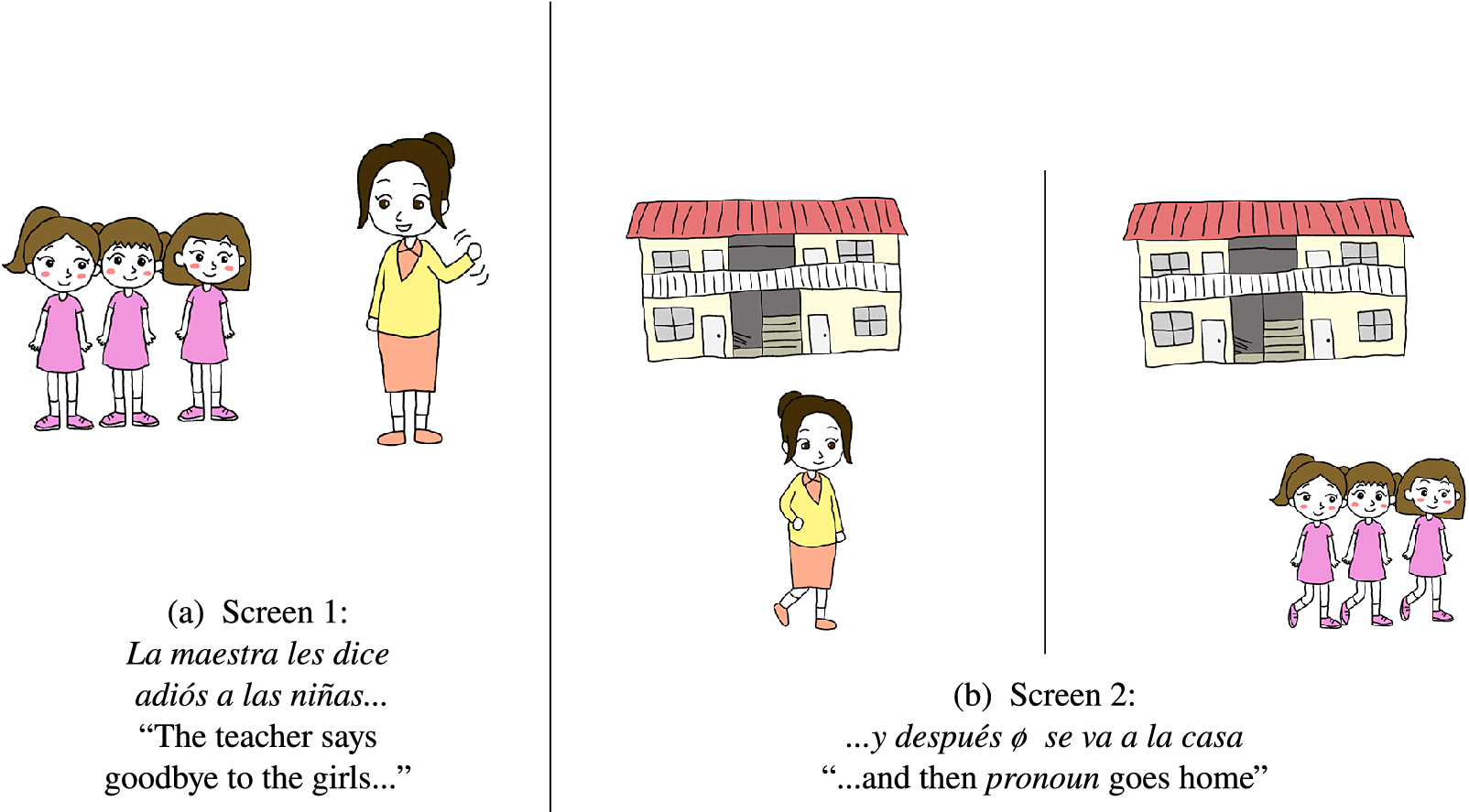
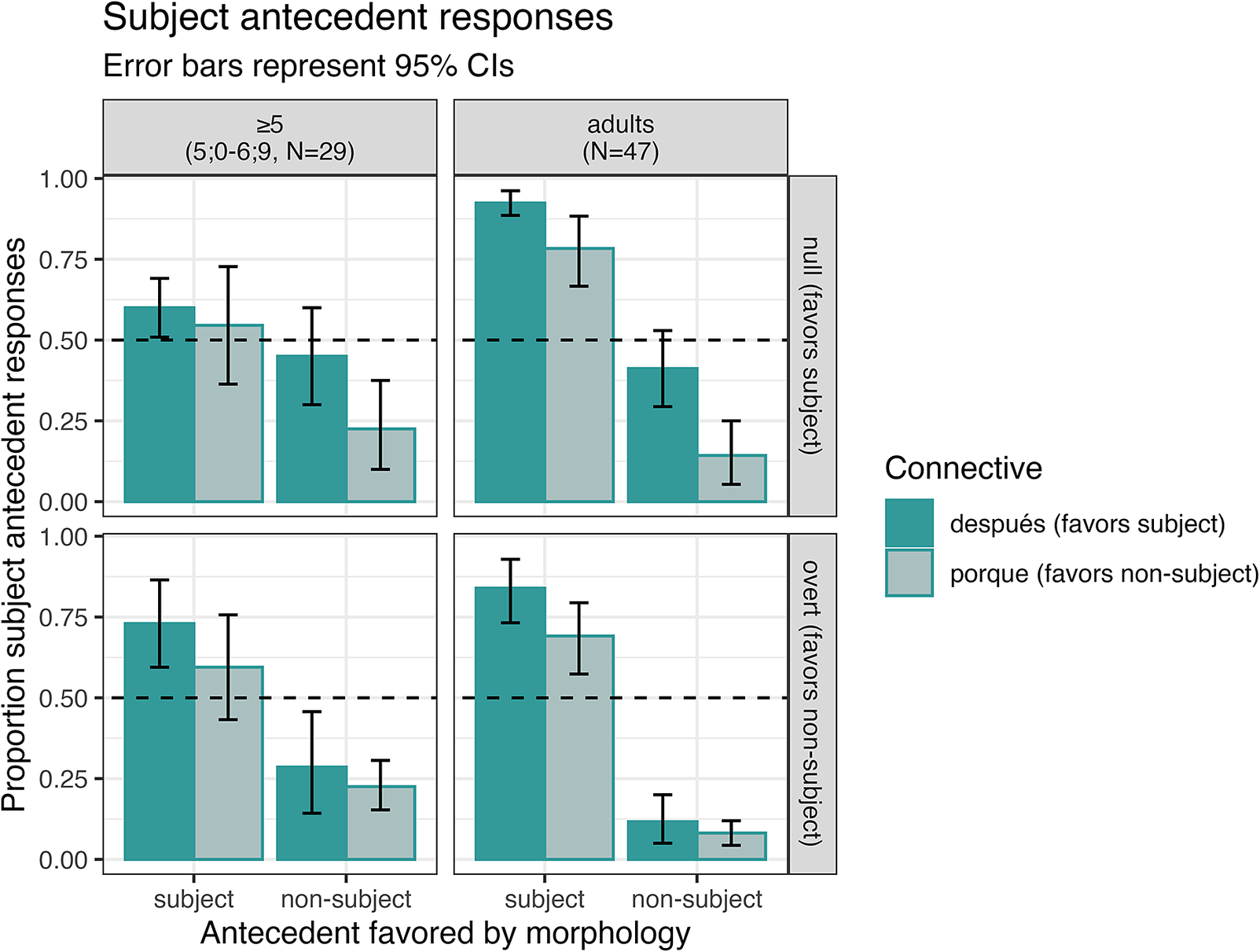
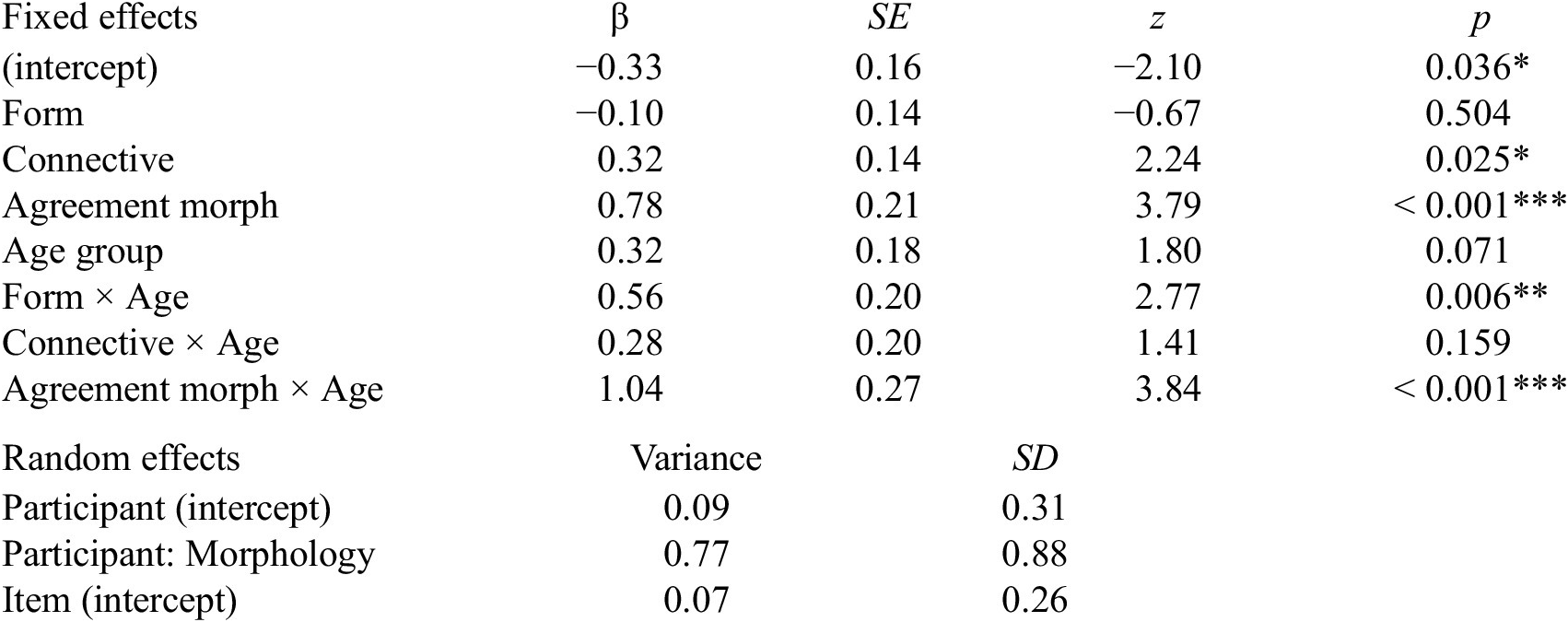
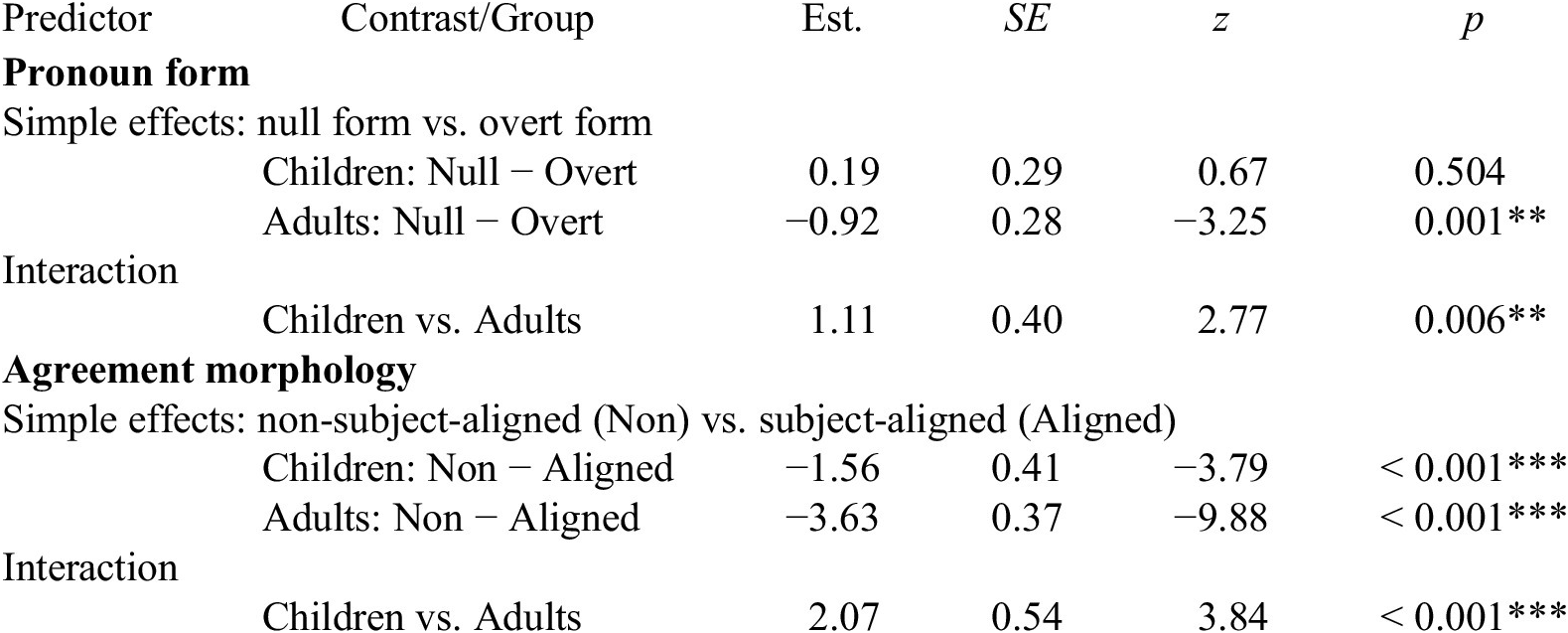



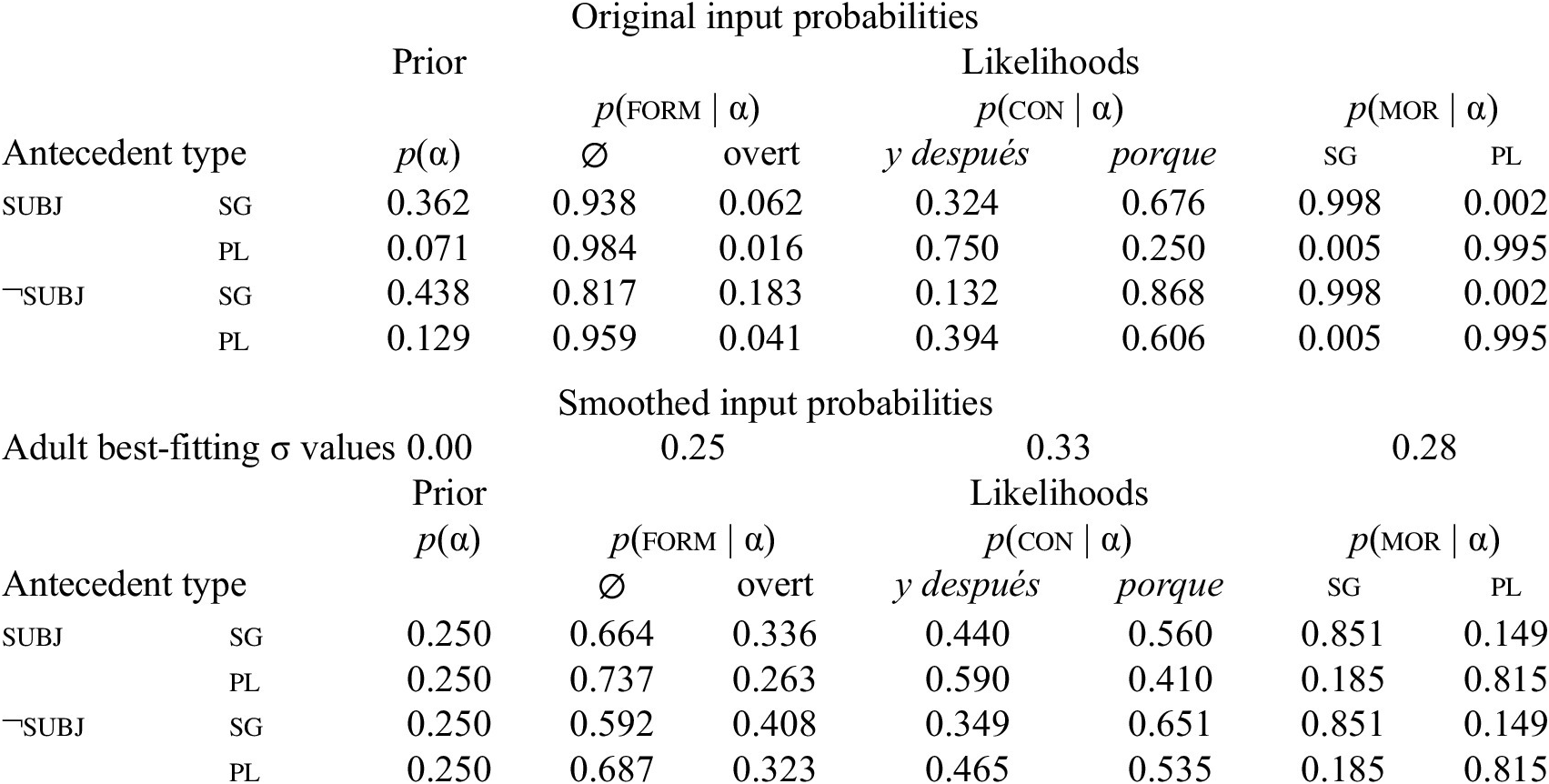
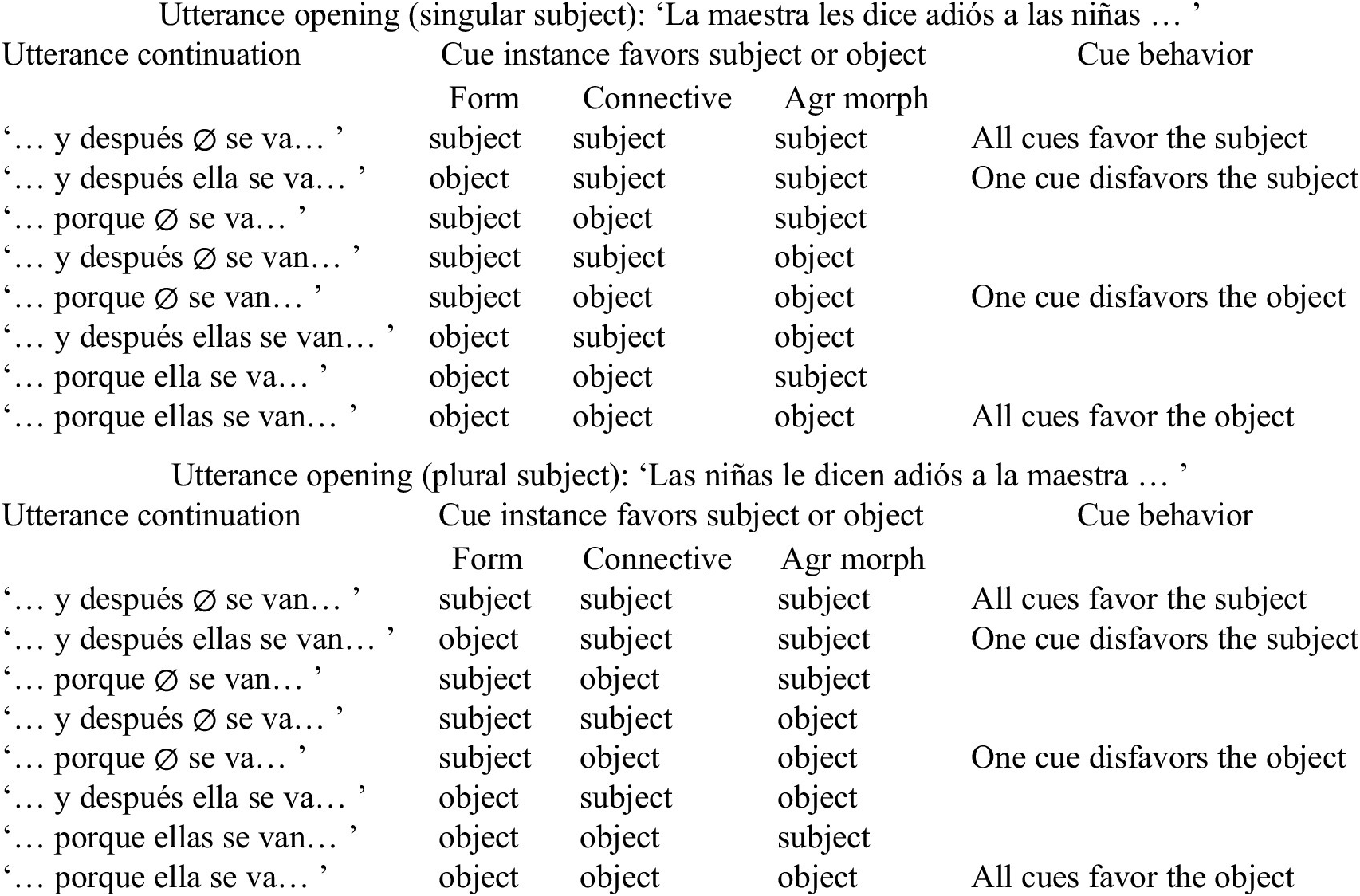
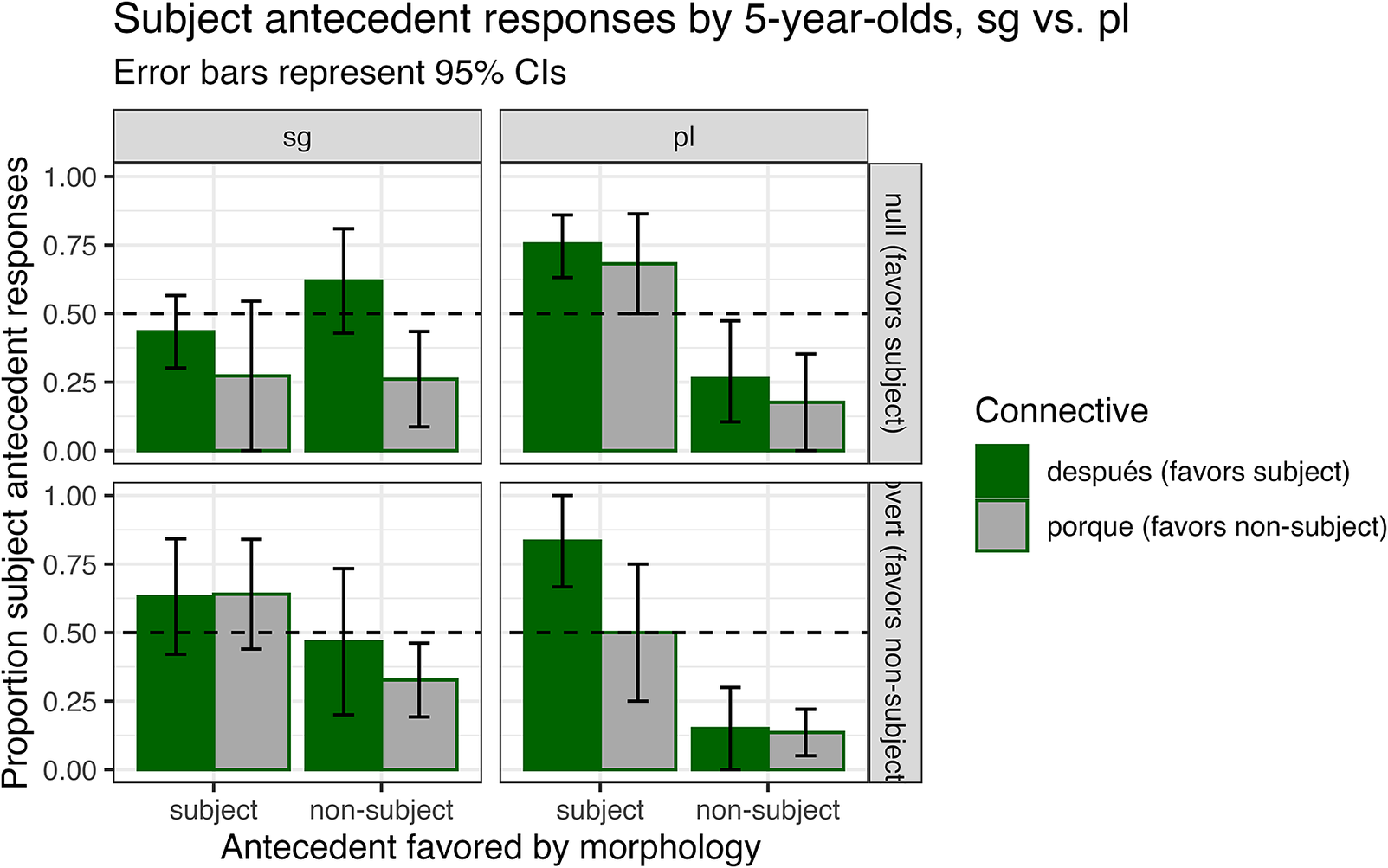
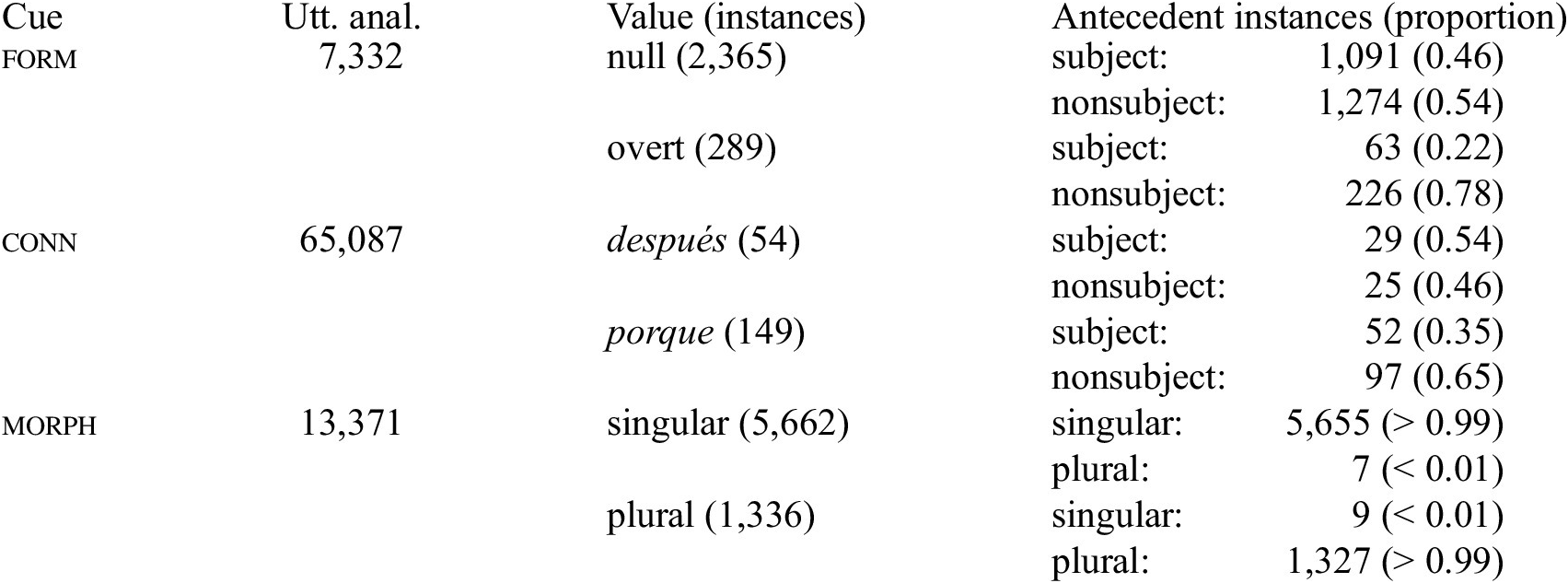
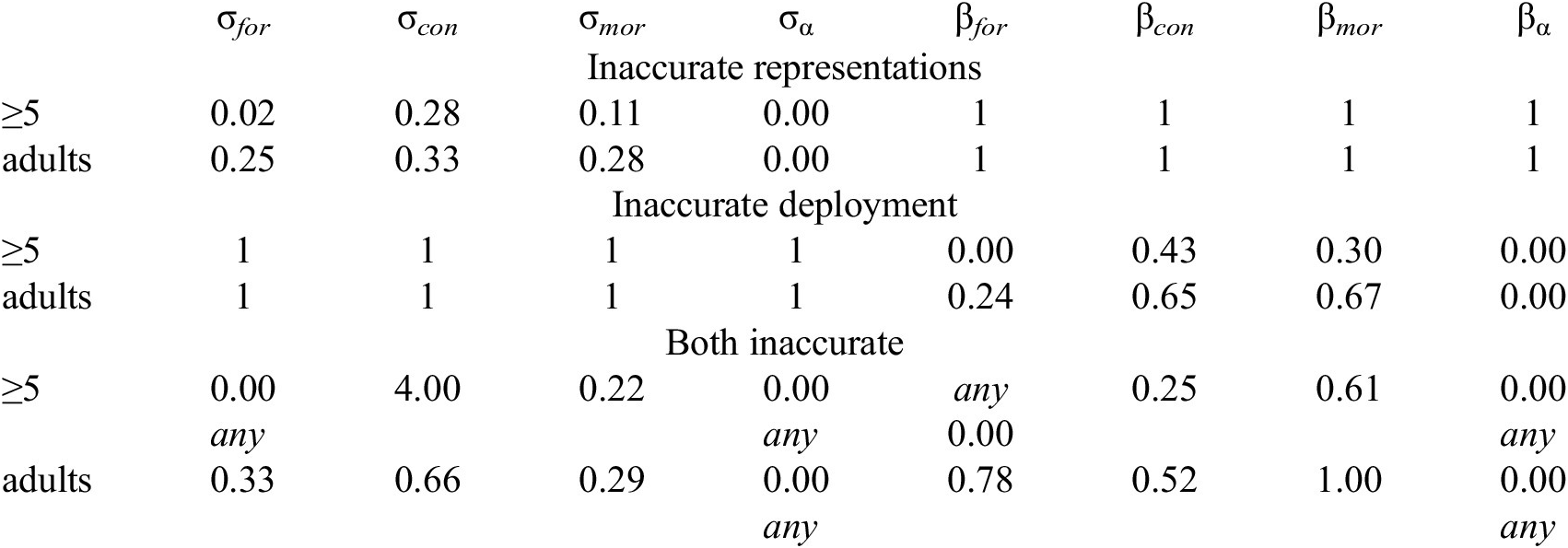

 Open access

