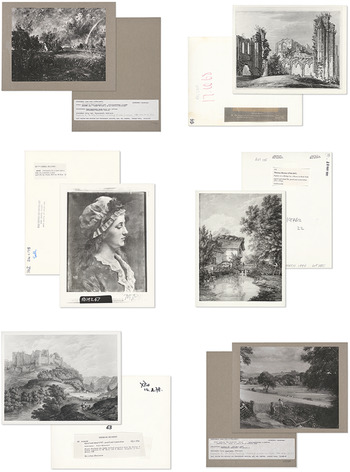
A photo archive may be described as a collection of photographic images, but students, staff and scholars that have worked with traditional art historical photo archives will recognize this as a deceptively simple description. Photographs in art historical photo archives have been collected, commissioned, copied, clipped, bought, traded or licensed by the photo archive itself, or the archive may consist of other archives and collections amassed by individuals or generated by public or private institutions in the course of their business. Photographs may be mounted to cards or may have clippings, labels or stamps attached; supplementary material may be related to the subject of the photograph, or to the creation or acquisition of the photograph itself. Image records are enriched by decades of research and scholarship, from handwritten annotations on card mounts to complex databases. While any individual item in a photo archive may tell a story about the work of art depicted, the photo archive as a whole has many stories of its own to tell about the history of representation, the history of photography, and the history of the field of art history itself.
Catalogued and uncatalogued photographs from the Yale Center for British Art Photo Archive. Courtesy Yale Center for British Art.

The PHAROS consortium is a collaboration among 14 such art historical photo archives across North America, Europe and the United Kingdom. This international consortium was formed in 2013, brought together by the collections’ belief in the distinctive value of the traditional art historical photo archive, the need to make these archives digitally accessible to new generations of scholars accustomed to online access to research material, and the potential that could be realized by doing so together and as freely and openly as possible.
From its origins, two characteristics have distinguished PHAROS from other online collaborations and aggregations of similar size and similarly open intent. The first is the consortium's commitment to maintaining and communicating the richness and depth of each individual institutions’ data, rather than simplifying it for search and presentation in a shared system. The consortium has, from its inception, imagined and endorsed the use of semantic frameworks (such as the open-source platform ResearchSpace, in conjunction with the CIDOC Conceptual Reference Model) in the service of maintaining its partners’ data in all its diversity, and representing complex metadata relationships within and across records. The second is the geopolitical scope of all 14 consortium partners and the contents of their collections, which extends across countries and continents.
With its cross-border membership and its commitment to make its complex combined resources freely and openly accessible, one of the longstanding and most difficult questions for the PHAROS consortium has always been the navigation of copyright. While it may be assumed by many that the majority of works of art depicted in the PHAROS partner collections are public domain, to provide open access, partners must be able to establish, record and communicate not only where materials are unrestricted, but to make provisions where restrictions do exist. Rights may persist in the originals or in the reproductions of some material in partner collections, whether by law or by contract. In the initiative's infancy, in a pragmatic but perhaps counterintuitive move, the consortium made a deliberate decision to table detailed intellectual property discussions in order to avoid distracting from the larger objectives of the initiative. With the collections focused initially on the digitization of their records, copyright was set aside for future examination.
Why, exactly, is the matter of copyright more intimidating than usual in the context of PHAROS? The same rich layers of information in each object that increase their scholarly potential also introduce complications to rights analysis. As described earlier, an analogue object or record in a photo archive collection is almost always more than a photograph, but a compound and complex object, whether considered before or after its digitization. Further, copyright may subsist or arise at any layer, analogue or digital, including the underlying work of art, the photograph of the work of art, the archival mount with its associated text and data, the digital reproduction of the photograph and/or the digital facsimile of the archival mount in full, and the data in the catalogue record describing the object. Add to this the often-overlooked fact that determining copyright status is often neither precise nor absolute, especially where there is uncertainty about the authorship, source, dates and places of creation, reproduction or publication of a work. Additional considerations which may complicate or in some cases supersede copyright in any layer include contractual restrictions, privacy implications, cultural permissions, and other ethical concerns. The circumstances under which the image at the heart of the record was created, captured, copied, acquired or licensed may be of as much concern, if not more, than the image itself.
The matter of whether or not copyright arises in the reproductive layer has differed over time and place, depending upon the law or interpretation of law of the countries or territories involved. The PHAROS consortium comprises 14 art historical photo archives in six countries - the United States, United Kingdom, Italy, France, Germany, and the Netherlands. Together these archives contain over 25 million photographic images culled from thousands of sources - originals and copies, published and unpublished - depicting cultural works created all over the world, from every historical period. Although overwhelming, understanding the similarities and differences across jurisdictions, and how these might play out in a shared PHAROS platform with a worldwide audience, was essential.
In 2017, most members of the consortium were well along in the digitization of their local collections. The consortium had also, by then, developed and launched its first collaborative project, a visual search database, to explore the possibilities in searching across a subset of Italian works of art represented in several PHAROS member collections. It was shortly after this point that the consortium made two decisions concerning images and intellectual property that would be important to realizing its goals. Representatives from the PHAROS institutions met in Rome at the Biblioteca Hertziana in June, at a meeting scheduled to follow the annual conference of the International Image Interoperability Framework (IIIF) community. IIIF is an open-source framework enabling viewing, comparing, and annotation of images across technical and institutional boundaries (allowing a user to, for instance, easily draw together images from separate museum online collections and view them side-by-side in a dynamic interface.) The IIIF consortium shares a common goal with PHAROS - to provide scholars with rich access to image-based resources around the world - and there is also overlap among membership (Getty, National Gallery, Yale Center for British Art.) At this meeting, the PHAROS partners agreed that their image contributions would be IIIF compliant moving forward. Finally, the consortium agreed to broach the bête noire of rights, and a copyright and intellectual property working group was formed to examine the issues and develop approaches.
In 2019, PHAROS received a grant from the Andrew W. Mellon Foundation to fund a 30-month Pilot Project to serve as a model for the consortium's goals to create a freely available common platform for research on works of art. Using ResearchSpace software, the Pilot Project will make over 1.5 million records of images and scholarly data available from at least five of the PHAROS member institutions. In the wake of this announcement, and spurred also by an effort to better understand recent developments, such as the copyright and related rights provisions in the EU's spring 2019 adoption of the Digital Single Market Directive, and the effect these might have on PHAROS’ efforts, the members of the Intellectual Property Working Group incubated an idea to accelerate and provide direction to its ongoing rights discussions by bringing together a symposium of legal and intellectual property experts from each of the jurisdictions represented within PHAROS to help the consortium address the rights issues important to the execution of the Pilot Project and the consortium's commitment to open access.
Supported by a grant from the Samuel H. Kress Foundation, the International Copyright Workshop brought together legal and cultural heritage experts from the United Kingdom, European Union and United States together with representatives from each of the 14 PHAROS partners to discuss cross-border copyright challenges and their resolution in the context of a common digital platform. The workshop took place on 3 and 4 March 2020 at the Paul Mellon Centre for Studies in British Art. Independent facilitators were engaged to help structure the workshop program and guide the live sessions, in order to provide all partner representatives the opportunity to participate equally in discussions, and a neutral voice to help the group navigate towards consensus and conclusions.Footnote 1
The discussions during the workshop and the resources and documents developed before, during and after these discussions fostered a clearer understanding amongst and across all partners on the cross-border copyright issues faced by PHAROS in the creation of an open access research platform; how to approach the assessment of rights; helped clarify the levels of risk, risk tolerance and strategies for mitigation; and generated concrete next steps for the consortium and its partners to address open issues. Decisions the consortium must make concerning whether it will establish itself as a legal entity and in what jurisdiction, as well as where the Pilot Project will be hosted, will affect the intellectual property notices required for the project, such as terms of use and take-down policy. The PHAROS Intellectual Property Working Group produced an openly-licenced reportFootnote 2 on the proceedings and outcomes of the workshop, which was made available to the public in October 2020 via the PHAROS consortium's website, www.pharosartresearch.org.
The workshop and analysis of the proceedings led to agreement among the PHAROS partners on two significant points: the definition of open access in the context of PHAROS and its Pilot Project, and the use of standardized tools and licences in the pilot project platform. The PHAROS consortium agreed that Open Access, with respect to its work and the Pilot Project platform, means Gratis Open Access, or free to access. There will be no financial or technical barriers to the PHAROS Platform; its records, assets and metadata will be accessible free of charge. While PHAROS partners intend to extend open access for use - also known as libre open access - whenever possible, given the cross-border nature of the consortium's membership and its collections, there will always be material subject to some restriction. Therefore, PHAROS members will need to clearly communicate when material available via the platform may not be free to reuse. Contributing PHAROS members will be required to assign a Rights Statement or Creative Commons license to appropriately communicate the particular rights status and extent of reuse permitted for any digital asset submitted to the platform. While assessing rights remains a complicated exercise for which each partner will be responsible, the existence of a standard like rightsstatements.orgFootnote 3 that accommodates a wide range of scenarios, clearly communicates whether or not a work may be reused, and is both human- and machine-readable, cannot be understated. To maintain interoperability, metadata must be designated as reusable without restriction under the Creative Commons CC0 tool. Metadata that cannot be labelled as CC0 may be excluded from the platform.
As the PHAROS consortium works toward representing and enriching the art historical photo archive experience online, its goals are aided by continued momentum in the cultural heritage community toward open access to images of works in the public domain, as well as by international policy and legal developments that discourage or prohibit claiming copyright in non-original reproductive media. Moreover, the consortium is fortunate to be able to implement and build upon the frameworks, standards and tools developed in the cultural heritage community that continue to make image access, image use and image rights easier to manage and to communicate across technical and political boundaries, allowing photo archives to retell their stories to new audiences in new ways.