Introduction
Only two native and one invasive species compose the flowering plant vegetation of Antarctica, whereas its bryophyte flora includes at least 111 species of mosses (Bryophyta) (Ochyra et al. Reference Ochyra, Lewis Smith and Bednarek-Ochyra2008). Despite the comprehensive treatment by Ochyra et al. (Reference Ochyra, Lewis Smith and Bednarek-Ochyra2008), the species diversity of mosses in Antarctica may remain incompletely known. Bryophyte species, particularly in the polar regions, are often difficult to identify due to their generally small size, relatively few and inconspicuous morphological characteristics, frequent absence of sporophytic characteristics, morphological plasticity in response to environmental factors (especially the harsh polar climates) and as yet unclear species delimitations and taxonomies in many groups (e.g. Hassel et al. Reference Hassel, Pedersen and Söderström2005, Lewis et al. Reference Lewis, Ickert-Bond, Biersma, Convey, Goffinet and Hassel2017). DNA sequence data have been increasingly employed to better understand species delimitations and relationships, evolutionary histories and patterns of geographic variation in polar mosses. In the Antarctic, molecular studies have helped to clarify the circumscription, relationships and intraspecific variation of both endemic species and species with a wider, particularly bipolar, distribution (e.g. Biersma et al. Reference Biersma, Jackson, Bracegirdle, Griffiths, Linse and Convey2018a, Reference Biersma, Jackson, Stech, Griffiths, Linse and Convey2018b, Câmara et al. Reference Câmara, Carvalho-Silva, Henriques, Guerra, Gallego, Rios Poveda and Stech2018a, Reference Câmara, Valente, Amorim, Henriques, Carvalho-Silva, Convey and Stech2018b).
The moss family Bartramiaceae ('apple mosses') is represented in Antarctica by three genera and four species: Conostomum Sw. with two species, Philonotis polymorpha (Müll. Hal.) Kindb. and Bartramia patens Brid. (Ochyra et al. Reference Ochyra, Lewis Smith and Bednarek-Ochyra2008). Bartramia is a cosmopolitan genus with 60 species (Frey & Stech Reference Frey, Stech and Frey2009) that is difficult to circumscribe due to its high morphological diversity (Ochyra et al. Reference Ochyra, Lewis Smith and Bednarek-Ochyra2008). Three main morphologically distinct groups have been described as sections: sect. Bartramia has strongly crispate leaves with recurved margins in the distal portion and transparent distal cells in the limb; sect. Pyridium Müll. Hal. (the correct name for sect. Vaginella Müll. Hal.; Ochyra et al. Reference Ochyra, Lewis Smith and Bednarek-Ochyra2008) has straight and rigid leaves with an abruptly expanded sheathing base, plane or weakly recurved leaf margins and obscure upper laminal cells; and sect. Strictidium Müll. Hal. has neither of these sets of characteristics (Fransén Reference Fransén2004a, Reference Fransén2004b, Ochyra et al. Reference Ochyra, Lewis Smith and Bednarek-Ochyra2008). Molecular data indicated that Bartramia might in fact not be monophyletic (Virtanen Reference Virtanen2003, Damayanti et al. Reference Damayanti, Muñoz, Wicke, Symmank, Shaw, Frahm and Quandt2012), with sections Bartramia and Pyridium resolved as being closer to the genus Leiomela (Mitt.) Broth. than to sect. Strictidium (Damayanti et al. Reference Damayanti, Muñoz, Wicke, Symmank, Shaw, Frahm and Quandt2012), but further analyses are necessary.
In addition to the problematic generic circumscription, morphological plasticity hampers establishing species boundaries in Bartramia in the (sub-)Antarctic (Ochyra et al. Reference Ochyra, Lewis Smith and Bednarek-Ochyra2008). From southern South America and the sub-Antarctic islands, many species have been described, but only five or six species are well known (Matteri Reference Matteri1984). Ochyra et al. (Reference Ochyra, Lewis Smith and Bednarek-Ochyra2008) considered four species to occur in the cool-temperate zone and the sub-Antarctic, namely B. ithyphylloides Müll. Hal., B. patens, B. robusta Hook.f. & Wilson and B. subsymmetrica Cardot, but they acknowledged that taxonomic problems remain. Cardot (Reference Cardot1907, Reference Cardot1908, Reference Cardot1911a, Reference Cardot1911b, Reference Cardot1913) reported four Bartramia species and one variety from Antarctica, but Robinson (Reference Robinson1972) and later Ochyra et al. (Reference Ochyra, Lewis Smith and Bednarek-Ochyra2008) suggested that there is only a single variable and widespread species, B. patens.
Bartramia patens (sect. Pyridium) has an amphiatlantic south-temperate distribution, including Juan Fernández, Patagonia, Tierra del Fuego, Isla de los Estados, the Falkland Islands (Malvinas), South Georgia, South Sandwich Islands, Prince Edward Islands, Kerguelen, Tristan da Cunha and Maritime Antarctica, where it is reported from South Orkney Islands, South Shetland Islands (Elephant, King George, Nelson, Robert, Greenwich, Livingston and Deception islands) and the Antarctic Peninsula (Matteri Reference Matteri1984, Reference Matteri, Guerrera, Gamundi de Amos and Rabinowich de Halperin1985, Virtanen Reference Virtanen2000, Ochyra et al. Reference Ochyra, Lewis Smith and Bednarek-Ochyra2008). It is one of the most conspicuous and common moss species in Antarctica that is easily recognizable in the field by its glaucous green colouration and rigidly erect leaves that are abruptly subulate, forming a white, sheathing base (Ochyra et al. Reference Ochyra, Lewis Smith and Bednarek-Ochyra2008). However, the species is highly polymorphic and variable concerning the shape and size of its leaves, which has led to the recognition of various phenotypes as separate species (Ochyra et al. Reference Ochyra, Lewis Smith and Bednarek-Ochyra2008). Bartramia patens is morphologically close to B. ithyphylla Brid., a species considered to be bipolar in distribution, occurring in the Northern Hemisphere and in southern South America (Schofield Reference Schofield1974, Matteri Reference Matteri1984, Reference Matteri, Guerrera, Gamundi de Amos and Rabinowich de Halperin1985). Ochyra (Reference Ochyra1992) doubted the status of B. ithyphylla as a bipolar species due to its much wider occurrence in the Southern Hemisphere, including also New Zealand, Australia and eastern Africa. Fransén (Reference Fransén2004b) reduced B. patens to a subspecies of B. ithyphylla, which comprised all Southern Hemisphere populations as opposed to a strictly Holarctic B. ithyphylla s.str. Both subspecies would thus only be distinguished by their geographic distribution, but not by morphology. Ochyra et al. (Reference Ochyra, Lewis Smith and Bednarek-Ochyra2008), in contrast, kept B. patens as a separate species and pointed out that it could be distinguished by the tristatose condition of its median leaf section and the stereid band of the costa with fewer than 15 cells, while B. ithyphylla has a bistratose median portion of the leaf and 20–30 stereid cells at the costa.
The aim of this study is to carry out a first molecular analysis of the genus Bartramia in Antarctica to infer: 1) whether Antarctic Bartramia specimens belong to a single species, B. patens, or to more than one species, and 2) how the Antarctic specimens are related to the Northern Hemisphere species B. ithyphylla.
Materials and methods
Sampling
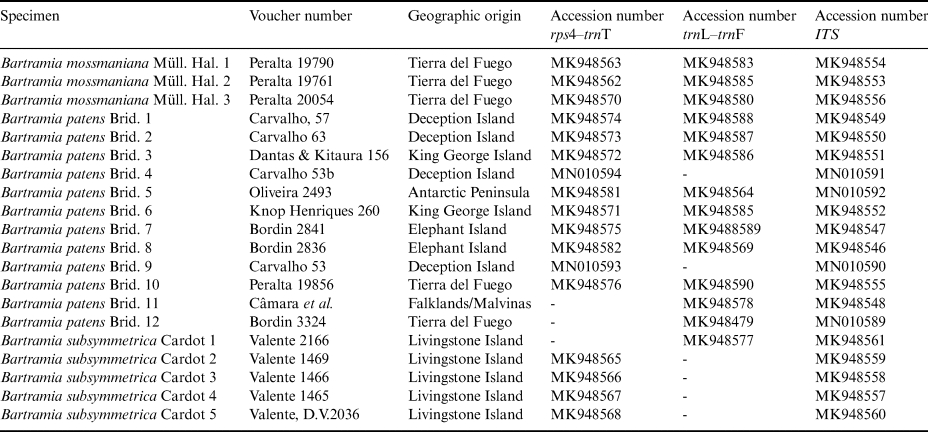
DNA sequences were obtained from fresh material of 20 Bartramia specimens collected during Antarctic expeditions under the Brazilian Antarctic Program (PROANTAR) and field trips to the Falkland Islands and Tierra del Fuego. Additional sequences belonging to seven Bartramia species and two Leiomela species were downloaded from the online databases GenBank and European Nucleotide Archive. One specimen of Philonotis fontana (Hedw.) Brid. was selected as an outgroup representative based on the availability of sequences of the employed markers and the phylogeny of Damayanti et al. (Reference Damayanti, Muñoz, Wicke, Symmank, Shaw, Frahm and Quandt2012). Specimen data of the newly sequenced Bartramia specimens (deposited in herbaria SP and UB) are given in Table I.
Voucher information and GenBank accession numbers of Bartramia specimens newly sequenced for the present study.

DNA extraction, polymerase chain reaction amplification and sequencing
Total genomic DNA was extracted using the CTAB protocol (Doyle & Doyle Reference Doyle and Doyle1987). We amplified and sequenced the chloroplast trnS–rps4–trnT–trnL–trnF region except for the trnT–trnL spacer (Hernandez-Maqueda et al. Reference Hernandez-Maqueda, Quandt, Werner and Muñoz2008) using the primers trnS, rps5', rps4-166F and A-Rbryo from Hernandez-Maqueda et al. (Reference Hernandez-Maqueda, Quandt, Werner and Muñoz2008), as well as C and F from Taberlet et al. (Reference Taberlet, Gielly, Pautou and Bouvet1991), and the nuclear ribosomal ITS (ITS1–5.8S–ITS2) region using the primers from Pisa et al. (Reference Pisa, Werner, Vanderpoorten, Magdy and Ros2013). The polymerase chain reaction (PCR) amplification mixture contained 5 μl of 5× thermophilic buffer, 5 μl of 50 mM MgCl2, 0.5 μl Taq (Promega), 2 μl of BSA (10 mg ml−1), 4 μl of 1 mM dNTPs, 2.5 μl of each primer (10 μM) and 2.0 μl of DNA, filled up to a total volume of 50 μl with distilled water. The PCR profile was: 1 min at 94°C, 1 min at 52–58°C and 1 min at 72°C for 35 cycles, preceded by an initial melting step of 2 min at 94°C and with a final extension of 7 min at 72°C. PCR products were purified and bi-directionally sequenced by Macrogen, Inc. (Seoul, Korea).
DNA sequence analyses
Sequences were assembled using Geneious v. 6.1.6 (www.geneious.com), initially aligned using Clustal X (Higgins & Sharp Reference Higgins and Sharp1988), manually adjusted in PhyDE v. 0.9971 (www.phyde.de) and exported as Nexus files. Phylogenetic analyses were carried out under maximum parsimony (MP), maximum likelihood (ML) and Bayesian inference (BI) for the chloroplast markers and ITS separately, and all of the markers were combined. MP analyses were carried out using PAUP v. 4.0b10 for Macintosh (Swofford Reference Swofford2002). Heuristic searches were performed with 1000 random addition replicates and tree bisection and reconnection branch swapping, saving a maximum of 10 000 trees. All characteristics were unordered and equally weighted, and gaps were either treated as missing data or coded as informative by a simple indel coding strategy (Simmons & Ochoterena Reference Simmons and Ochoterena2000) as implemented in SeqState (Müller Reference Müller2005). ML analyses were carried out using RAxML v. 7.2.6 (Stamatakis Reference Stamatakis2006). Clade support for MP and ML was assessed from bootstrap analyses with 1000 replicates. For ML and BI analyses, the best-fit model of evolution for each locus was obtained based on the Akaike information criterion using jModeltest 3.06 (Posada Reference Posada2008). BI analyses were carried out in MrBayes v. 3.2.5 (Ronquist et al. Reference Ronquist, Teslenko, Van Der Mark, Ayres, Darling and Hohna2012). Two runs with four Markov chain Monte Carlo chains were run for 5 000 000 generations. Chains were sampled every 1000 generations and the respective trees were written to a tree file. Convergence of runs was verified by ensuring that the average standard deviation of split frequencies was < 0.01. Tracer 1.5 (http://tree.bio.ed.ac.uk/software/tracer) was used to determine when the tree sampling stabilized. The first 25% of the trees were discarded as ‘burn-in’. A majority-rule consensus tree and posterior probabilities were calculated from the resulting trees. In addition to the phylogenetic analyses, we employed the Automatic Barcode Gap Discovery (ABGD) approach (Puillandre et al. Reference Puillandre, Lambert, Brouillet and Achaz2012) to investigate species delimitation within the DNA dataset using the online webserver with the default values.
Morphological analyses
Morphological characteristics from both gametophytes (colour, shoot length, tomentum, leaf base, leaf margins and leaf apex) and sporophytes (capsule surface) in addition to those listed by Ochyra et al. (Reference Ochyra, Lewis Smith and Bednarek-Ochyra2008) were investigated for all newly sequenced specimens from Antarctica, the Falkland Islands, Patagonia and Tierra del Fuego, as well as for additional specimens of B. ithyphylla from herbaria H, S, SP, and UB. Specimens were dissected under a dissecting microscope and examined under a compound microscope.
Results
Of the 20 Bartramia specimens from Antarctica, the Falkland Islands, Patagonia and Tierra del Fuego, 17 could be sequenced with trnS–rps4–trnT (of which 3 could be partially sequenced), 16 with trnL–trnF and all with ITS.
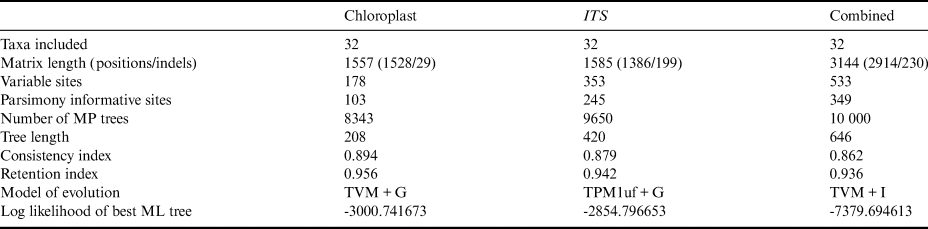
No PCR products could be obtained from additional specimens of B. ithyphylla from the Northern Hemisphere. In GenBank, ITS2 sequences of further specimens from northern Europe and the Arctic are available, which were identical to the ITS2 sequence of the single included specimen from Switzerland. However, the additional ITS2 sequences were not included in present analyses because the absence of the chloroplast markers and ITS1 would decrease the resolution of the phylogenetic reconstructions. Alignment statistics, best-fit models of evolution and tree scores are summarized in Table II. Trees based on the analysis of individual markers and different analysis methods differed only in the degree of resolution, but did not show statistically supported conflicting topologies (data not shown).
Alignment statistics, best-fit models of evolution and tree scores (maximum parsimony (MP) and maximum likelihood (ML)) for the separate and combined datasets used in the present study. Number of MP trees 10 000 indicates that the ‘maxtrees’ limit was reached.

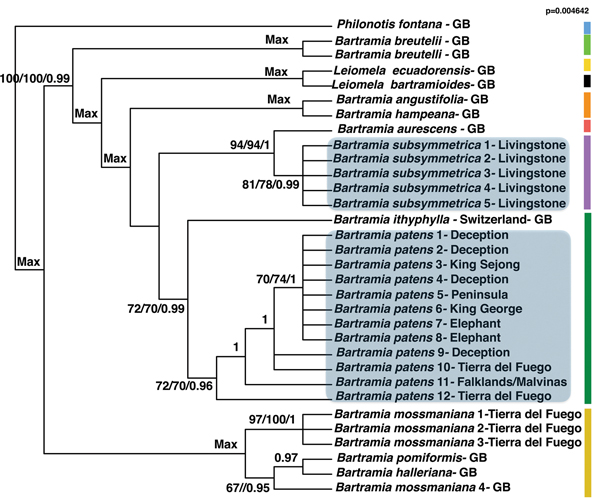
Phylogenetic analyses of the combined matrix resolved Bartramia as paraphyletic (Fig. 1) due to the nested position of Leiomela. A clade with maximum support (MP bootstrap support (MP-BS) 100%, ML bootstrap support (ML-BS) 100%, BI posterior probability (PP) 1.00) composed of B. mossmaniana Müll. Hal. from Tierra del Fuego. B. halleriana Hedw., B. pomiformis Hedw. and another B. mossmaniana specimen from GenBank (sect. Bartramia) were resolved as sister species to a clade of the remaining Bartramia and Leiomela specimens. Among the latter, Bartramia breutelii Schimp. ex Müll. Hal. (sect. Strictidium) branched off first, followed by Leiomela and the species of Bartramia sect. Pyridium, all with maximum support. Within sect. Pyridium, three main clades were resolved: 1) B. angustifolia Mitt. and B. hampeana Müll. Hal. (maximum support), 2) B. aurescens Dixon as a sister species (MP-BS 94%, ML-BS 94%, PP 1.00) to the clade of the B. subsymmetrica samples (MP-BS 81%, ML-BS 78%, PP 0.99), and 3) B. ithyphylla as a sister species (MP-BS 72%, ML-BS 70%, PP 0.99) to the clade of the B. patens specimens (MP-BS 72%, ML-BS 70%, PP 0.96). Within B. patens, all but one of the specimens from Antarctica were separated from those from the Falkland Islands and Tierra del Fuego on a clade with MP-BS 70%, ML-BS 74% and PP 1.00.
Cladogram obtained from Bayesian inference using a combined matrix of chloroplast trnS–rps4–trnT/trnL–trnF and nuclear ribosomal ITS sequences plus indels coded by simple indel coding. Numbers above branches are bootstrap support values for maximum parsimony (MP-BS) and maximum likelihood (ML-BS) and posterior probabilities (PP) based on Bayesian inference, respectively. ‘Max’ indicates nodes with maximum support (MP-BS 100%, ML-BS 100%, PP 1.00). ‘GB’ denotes sequences downloaded from GenBank. Coloured bars on the right indicate the species clusters from ABGD species delimitation analysis.

The ABGD species delimitation method revealed a barcode gap at P max = 4.64e-03, delimitating nine putative clusters (Fig. 1): 1) Philonotis (outgroup), 2) Bartramia breutelii, 3) Leiomela ecuadorensis, 4) L. bartramioides, 5) B. angustifolia plus B. hampeana, 6) B. aurescens, 7) B. subsymmetrica, 8) B. ithyphylla plus B. patens, and 9) B. mossmaniana plus B. halleriana plus B. pomiformis.
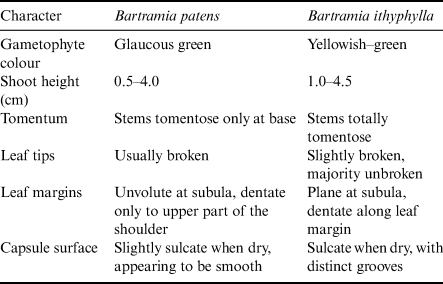
The results of the morphological comparison between B. patens and B. ithyphylla are shown in Table III. Shoot length is largely overlapping between both taxa, whereas tomentum, brokenness of leaf tips, leaf dentation and capsule surface differ in the degree to which the respective character states are expressed. Clearly different character states are found in gametophyte colour, involute or plane leaf subula and colour of the leaf base.
Morphological comparison of Bartramia patens and Bartramia ithyphylla as inferred from analysis of herbarium specimens.

Discussion
According to the present data, the species diversity of Bartramia in Antarctica, as currently perceived (one single species, B. patens; Ochyra et al. Reference Ochyra, Lewis Smith and Bednarek-Ochyra2008), is underestimated. The molecular phylogenetic reconstructions (Fig. 1) resolved two species of Bartramia in Antarctica, which both belong to the same section, Pyridium. Apart from B. patens, which we accept at the species level as being separate from the Northern Hemisphere B. ithyphylla (see discussion below), we report B. subsymmetrica as a new record for Antarctica.
Bartramia subsymmetrica was originally described from South Georgia, and has subsequently been reported from the Falkland Islands, Patagonia, Kerguelen and south-eastern Australia (Fransén Reference Fransén2004b). In Antarctica, the species is so far only known from our collections from Livingston Island, South Shetlands (present data). It might have long been present and more widespread in Antarctica, but misreported as B. patens; however, a recent introduction cannot be ruled out either. Fertile plants of B. subsymmetrica can be distinguished by the single peristome from the sister species in the molecular tree, B. aurescens (eperistomate) and the other Antarctic species, B. patens (double peristome). Gametophytically, B. patens differs from B. subsymmetrica by longer cells of the leaf limb with low mamillae and synoicous sexual condition (Fransén Reference Fransén2004b). In addition, B. subsymmetrica is characterized by often considerably longer shoots (up to 8 cm; Fransén Reference Fransén2004b) than those observed in other Bartramia species, and the costa has greater than 20 stereid cells and being visible at the back, in contrast with the costa having fewer than 15 stereid cells and not being visible at the back in B. patens.
Our data indicate that B. ithyphylla from the Northern Hemisphere is sister to a clade of the Southern Hemisphere B. patens. Unfortunately, no PCR products could be obtained from further specimens of Northern Hemisphere B. ithyphylla, but the comparison with ITS2 sequences from northern European and Arctic specimens in GenBank at least indicated that the single specimen included in the present phylogenetic analyses was correctly identified.
There have long been discussions on the similarities of B. ithyphylla and B. patens. Fransén (Reference Fransén2004b) concluded that it is not possible to separate both species based on morphology due to overlap in the traditionally used characteristics. He decided to treat them as subspecies of B. ithyphylla, whose sole difference is geographical distribution, meaning that if a specimen comes from the Northern Hemisphere, it would be named as subsp. ithyphylla, and as subsp. patens if it comes from the Southern Hemisphere. In this circumscription, B. ithyphylla is a bipolar species with differentiation at the subspecies level. Ochyra et al. (Reference Ochyra, Lewis Smith and Bednarek-Ochyra2008), in contrast, considered differences in leaf anatomy, originally reported by Matteri (Reference Matteri, Guerrera, Gamundi de Amos and Rabinowich de Halperin1985), to be sufficient for distinguishing both taxa as separate species, namely a tristratose limb in the median part and a rather flat costa in B. patens vs a bistratose limb and dorsally prominently convex costa in B. ithyphylla.
Our analysis of herbarium specimens confirmed the morphological differences in leaf cross-sections, and also revealed several further characteristics that allow, despite some overlap, B. patens to be distinguished from B. ithyphylla (Table III). Not only the sequenced B. patens specimens from Antarctica, but also the three samples from the Falkland Islands and Tierra del Fuego, which we originally identified as B. ithyphylla, and all further morphologically studied Southern Hemisphere specimens fit the current morphological concept of B. patens.
Consequently, the strict separation of a Northern Hemisphere taxon and a Southern Hemisphere taxon is confirmed. Both options (two species or two intraspecific taxa) are equally supported by the present phylogenetic reconstructions. The ABGD approach suggests that we should treat them as one species. However, several studies have demonstrated that ABGD has the tendency to overlump species (Renner et al. Reference Renner, Heslewood, Patzak, Schäfer-Verwimp and Heinrichs2017, Dellicour & Flot Reference Dellicour and Flot2018). Considering these observations, and given the re-evaluated morphological differentiation, we agree with Ochyra et al. (Reference Ochyra, Lewis Smith and Bednarek-Ochyra2008) that we should keep B. patens separate from B. ithyphylla at the species level. However, further molecular analyses based on extended specimen and marker sampling are desirable in order to study patterns of intraspecific molecular variation in B. patens and their possible correlation with morphological variation in this polymorphic species in more detail. Such analyses should reveal, for example, the distribution of the second genotype, now found in only one specimen from Deception Island, which would be important for future conservational measures to protect Antarctica's genetic diversity, especially considering that Maritime Antarctica is facing severe environmental and climate changes.
The present data on the species of sect. Bartramia (B. halleriana, B. mossmaniana and B. pomiformis) may present a similar case to the distinction of B. patens/B. ithyphylla. The ABGD approach suggested that they should all be treated as a single species, which may be supported by the division of the B. mossmaniana samples in two subclades and by the fact that, according to Fransén (Reference Fransén2004a), the characteristics used to separate those species are length of the seta and geographical range only. The Southern Hemisphere B. mossmaniana, in particular, is similar in several morphological characteristics to both Northern Hemisphere species, differing from B. halleriana due to the presence of rectangular laminal cells in B. mossmaniana and also by its distinct geographic range that differs from that of B. porniformis (Fransén Reference Fransén2004a). Under this scenario, the whole clade would represent either B. mossmaniana or - if the identification of B. halleriana and B. pomiformis is correct - B. halleriana, the type species of Bartramia. In either case, the clade would represent a bipolar species that has not yet been considered as such. However, ABGD may also overlump the species in this clade, and the three newly analysed specimens may represent the true B. mossmaniana. In any case, the identification of the GenBank specimens should be thoroughly checked. Considering that B. pomiformis includes 16 names in synonymy (Fransén Reference Fransén2004a, Reference Fransén2004b) and that B. pomiformis var. elongata Turner (included in B. pomiformis by Ignatov & Afonina Reference Ignatov and Afonina1992) was characterized as intermediate between B. halleriana and B. pomiformis, analyses of a larger number of specimens from all three species should be performed.
As discussed by Damayanti et al. (Reference Damayanti, Muñoz, Wicke, Symmank, Shaw, Frahm and Quandt2012), further research is necessary to address the circumscription of the genus Bartramia due to the nested position of Leiomela in the phylogenetic reconstructions. Leiomela has formerly been treated as a subsection of Bartramia and could be included in Bartramia again to keep the latter monophyletic. Otherwise, if Leiomela is to be recognized on the genus level, all three currently recognized sections of Bartramia should be treated as separate genera as well. Damayanti et al. (Reference Damayanti, Muñoz, Wicke, Symmank, Shaw, Frahm and Quandt2012) suggested that a larger taxon sampling may solve this issue. Our study, based on the same marker regions but a different sampling of Bartramia species as in Damayanti et al. (Reference Damayanti, Muñoz, Wicke, Symmank, Shaw, Frahm and Quandt2012), corroborates the nested position of Leiomela, but suggest partly different relationships (e.g. a basal position of sect. Bartramia). Consequently, a still more comprehensive analysis in terms of markers and taxa is necessary. Nevertheless, the present results corroborate other recent studies (e.g. Biersma et al. Reference Biersma, Jackson, Stech, Griffiths, Linse and Convey2018b) that a combined morphomolecular approach facilitates species detection, improves species delimitation and results in better knowledge of species diversity of mosses in Antarctica.
Acknowledgements
Financial support from the Brazilian Antarctic Program MCTI/CNPq – PROANTAR is gratefully acknowledged. We thank the Brazilian Navy and Air Force, the Spanish Polar Committee and the Bulgarian Antarctic station St Kliment Ohridski for logistical support. We thank Daiane Valente for her keen eye during collecting. The authors state no conflicts of interest or competing interests. We also thank the reviewers, who much improved our manuscript.
Author contributions
PEASC designed the study. PEASC, DKH, DFP and JB carried out the fieldwork. PEASC, AERS, DKH and MCS performed the lab work and sequence editing. PEASC and MS carried out the molecular analyses. DFP and JB carried out the morphological analyses. PEASC and MS wrote the manuscript with contributions from all co-authors.
Details of data deposit
DNA data are available at GenBank and accession numbers are provided in Table I.