Shrimps of the family Nematocarcinidae generally inhabit the continental slope and abyssal plain. The family consists of four genera out of which three are monotypic. The fourth genus Nematocarcinus is very diverse including about 47 valid species. This genus consists of middle size shrimps with carapace lengths ranging from 10–12 to 30–32 mm and body lengths (between the posterior-most part of the orbit to the tip of the telson) ranging from 5–6 to 13–14 cm (Burukovsky, Reference Burukovsky2003). The genus Nematocarcinus has almost a cosmopolitan distribution inhabiting all oceans except the Arctic and can be found from south-east Ireland, 52°N (N. exilis) to the Weddell Sea, 75°S (N. lanceopes) (Burukovsky, Reference Burukovsky2003). Shrimps of this genus are found at depths ranging from 350–5477 m (Burukovsky, Reference Burukovsky2003, Reference Burukovsky2006). Hence, the genus Nematocarcinus inhabits the continental slope from the continental edge to the ocean basin. Some species can even be found in the upper part of the abyssal zone (stratification according to Vinogradova, Reference Vinogradova and Vinogradov1977; Briggs, Reference Briggs1974; Kafanov & Kudryashov, 2000). To date only a few species from the genus Nematocarcinus, including N. romenskyi, have been recorded from open ocean seamounts or their adjacent bathypelagic zones. Recently, bottom dwelling nematocarcinids were observed from the submersibles near hydrothermal vents and cold water seeps. However, their catches are very limited (Martin & Haney, Reference Martin and Haney2005).
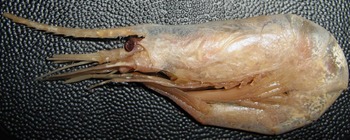
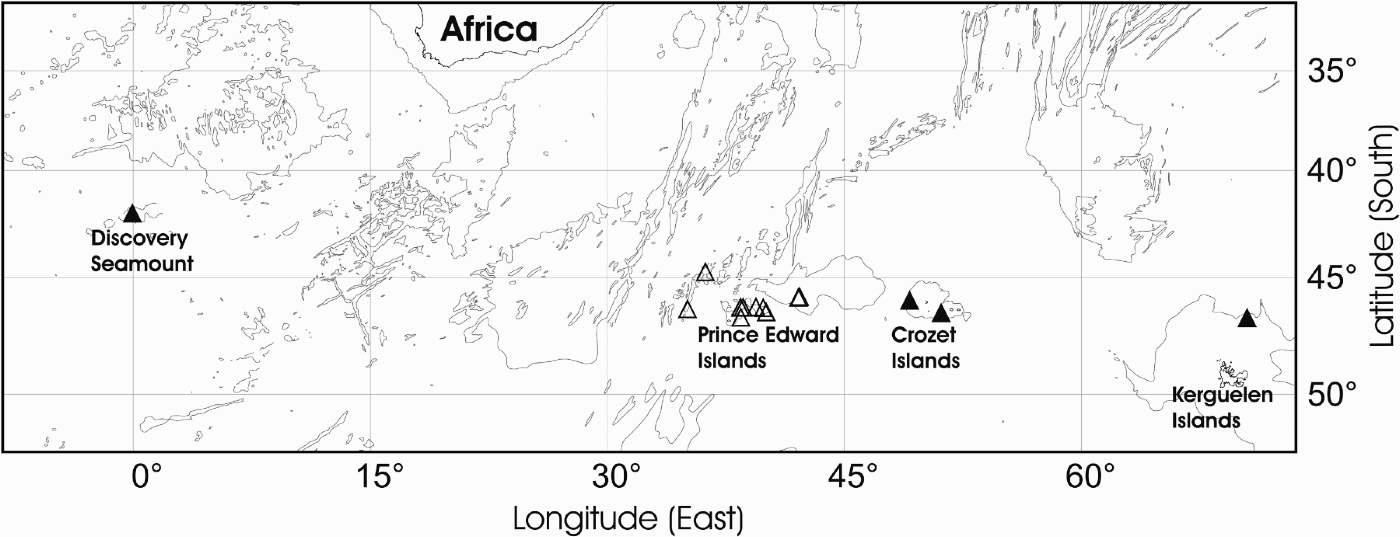
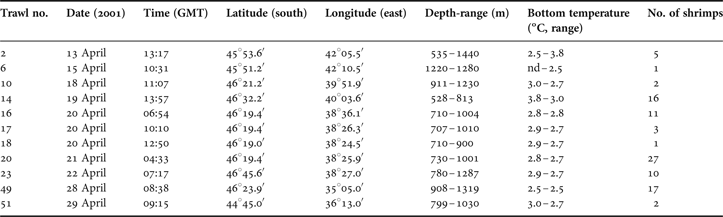
During a 2001 deep-sea survey in the vicinity of the Prince Edward Archipelago, a total of 95 specimens belonging to genus Nematocarcinus were collected. These specimens were preliminarily identified as Nematocarcinus lanceopes. To verify the field identification, two specimens were sent to Professor R.N. Burukovsky, Russia. Specimens were identified as Nematocarcinus romenskyi Burukovsky, 2000 (Figure 1). Although this species has been found to the west (South Atlantic) and east (mid-south Indian Ocean), this appeared to be the first finding of N. romenskyi in the vicinity of the Prince Edward Islands. Because it is considered a rare species (Burukovsky, Reference Burukovsky2003), the description of the examined specimens is provided below. This is accompanied by the records of shrimp catches (Table 1) and an updated map (Figure 2) of the species distribution.
Nematocarcinus romenskyi (27.1 mm CL) from the vicinity of the Prince Edward Islands. Photograph: D.V. Manakov.

Map illustrating previous (filled triangles) and new (open triangles) records of Nematocarcinus romenskyi in the sub-Antarctic Atlantic and Indian regions.

List of stations conducted in the vicinity of the Prince Edward Islands with Nematocarcinus romenskyi present.

nd, not determined.
The carapace length (CL) was measured from the posterior-most part of the orbit to the mid-dorsal point of the hind margin of the carapace with an accuracy of 0.1 mm. In this paper, terminology describing the distal–ventral organ of the sixth abdominal segment is adopted from Burukovsky (Reference Burukovsky2000a, Reference Burukovsky2003). Specimens are permanently stored in the collection of the Zoological Museum, Russian Academy of Science, St Petersburg, Russia.
MATERIAL
During April–May 2001, an exploratory survey in the proximity of the Prince Edward Islands was carried out onboard the fishing vessel MV ‘Iris’. In total, 52 stations between 200 and 1500 m depth were completed using a commercial bottom Arrow trawl, a bucket designed trawl for scooping fish off mountain slopes. The trawl had a wind span of 33 m, headline height of 9 m vertical and a cod-end mesh size of 112–115 mm (for full details of the sampling locations see Pakhomov et al., Reference Pakhomov, Bushula, Kaehler, Watkins and Leslie2006). Collectors were B.P. Watkins and E.W. Leslie from Marine and Coastal Management, Cape Town, South Africa. Shrimps belonging to the genus Nematocarcinus were identified in 11 trawls (Table 1). Two of the least damaged specimens out of a total of 17 specimens from trawl 49 were selected for identification and description. These included: (1) one female with eggs on pleopods, 25.8 mm CL; and (2) one female without eggs on pleopods, in the post-moulting condition, 27.1 mm CL.
DESCRIPTION
Both specimens had some degree of damage: e.g. the distal parts of their rostrums were missing. In addition, some pereiopods and the telsons were damaged. The remaining rostrum of the female with the 25.8 mm CL was 30.5 mm long. The rostrum was dorsally armed with 34 small spines and ventrally with 5 spines. However, judging by the form of the remaining rostrum the number of spines should be much higher. The eggs found on the pleopods were in the second stage of embryonic development. The eggs' size was 0.9 × 1.25 mm. For the second female of 27.1 mm CL, the remaining proximal part of the rostrum was 31.0 mm long. The rostrum had 45 and 7 spines on the dorsal and ventral edges respectively. It is likely that the rostrum should have had at least 50 and 9–10 spines on its dorsal and ventral edges. The telson of the first specimen was severely damaged. In the second specimen, the length of the sixth abdominal segment was equal to the length of the telson. The telson was armed with eight dorsal spines. Supplementary spine was absent. Thoracic legs were fragmented and as a consequence their arming could not be determined. However, the distal–ventral organ of the sixth abdominal segment as well as the pleura of the fifth abdominal segment fitted well with the description of N. romenskyi (Burukovsky, 2001, Reference Burukovsky2003).
Compared to other species of the genus, N. romenskyi has the longest rostrum. Even without the distal parts, the rostrum of the studied specimen extended beyond the distal edge of the scaphocerit, while the holotype had a rostrum length exceeding the carapace length by two fold. The rostrum of the holotype was armed with 46 dorsal and 8 ventral spines, while a specimen collected in the vicinity of the Kerguelen Islands had 10 ventral spines on its rostrum (Burukovky, 2000a, 2004). This is substantially higher than number of rostrum spines found in any other species of the genus Nematocarcinus. Compared to the morphologically and geographically closest N. lanceopes, N. romenskyi has larger and more closely spaced spots of the distal–ventral organ on the sixth abdominal segment. In N. romenskyi the length of the spot exceeds its width by a factor of 2 and the distance between spots is about double their maximum width. For comparison, in N. lanceopes the length of the spot exceeds its width by 1.5 and the distance between spots is 2.5–3 times their maximum width. Another species, N. sigmoides, inhabiting the continental slope of south-western Africa and the seamounts of Walvis Ridge, besides its rostrum armoury and the morphology of the distal–ventral organ on the sixth abdominal segment, differs from N. romeskyi by widely rounded off edges of the pleuras of the fifth abdominal segment (Burukovsky, Reference Burukovsky2000b). There is an even more obvious difference between N. romenskyi and N. proximatus that has been recorded at locations in the proximity of Marion Island (Bate, Reference Bate1888; Burukovsky, Reference Burukovsky2000a). Nematocarcinus proximatus has only a single ventral spine on its rostrum. Furthermore, uniquely, this species has two lines of setae in front of the spots of the distal–ventral organ. Lastly, this species is found at a deeper depth-range of 2520–3075 m.
DISTRIBUTION
Nematocarcinus romenskyi had been first described from the South Atlantic Ocean Discovery Seamount (42°03′S 00°03′E), from depths of 1030–1050 m (Figure 2; Burukovsky, Reference Burukovsky2000b). This concurred with catches from a similar latitudinal zone but further to the east in the Indian Ocean near the Crozet (46°01′S 49°08′E, depth 1000–940 m) and Kerguelen (46°47′S 70°30′E, depth 1218 m) Islands (Figure 2; Burukovsky, Reference Burukovsky2004). The current record was in the waters adjacent to the Prince Edward Archipelago and thus fills the gap between the previous records in the Atlantic (Discovery Seamount) and Indian (Crozet Islands) Oceans (Figure 2).
The distribution of N. romenskyi is thus located within the circum-temperate Kerguelen Subregion (Kafanov & Kudrjashov, Reference Kafanov and Kudrjashov2000), north of the Antarctic Convergence between the Discovery Seamount and the Kerguelen Islands. Geographically this coincides with the Kerguelen Province of the Kerguelen–New Zealand biogeographical region according to Zezina (Reference Zezina1973) or with the Marion–Kerguelen Province according to Kafanov & Kudrjashov (Reference Kafanov and Kudrjashov2000).
ACKNOWLEDGEMENTS
The authors would like to thank Drs B.P. Watkins and E.W. Leslie of the Marine and Coastal Management, Cape Town for collecting the specimens, and Professor O. Ja Mezenova for transferring shrimp specimens from Kaliningrad to the Zoological Museum in St Petersburg.