INTRODUCTION
The 1728 Musin Rebellion (Musillan 戊申亂, Yi Injwa's [?–1728] Rebellion 李麟佐의亂) was an attempt to overthrow King Yŏngjo's 英祖 government.Footnote 1 The court lost control of thirteen county seats in Kyŏnggi, Ch'ungch’ŏng and southern Kyŏngsang Provinces where rebels had support. Some regional officials abandoned their posts to the rebels without a fight, while others responded to overtures and joined the rebel side. An exception was Andong (安東, northern Kyŏngsang Province), which refused to fight against Yŏngjo. The rebellion was suppressed by government forces after thirteen days; however, the significant loss of territory represented the most serious military and political challenge to Yŏngjo's reign.
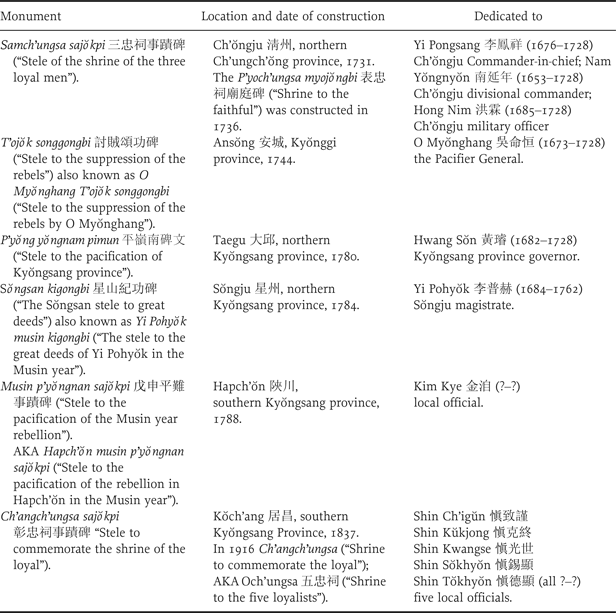
In the post-suppression period, the court produced many records describing the rebel challenge and the breakdown of provincial government. However, there is also a unique group of records that were not produced on paper, but inscribed on stone stelae in different provincial locations after the suppression of the Musin Rebellion (hereafter Musin Rebellion stelae). Between 1736 and 1837 six stelae were erected, dedicated to the memory of loyal subjects, mainly officials martyred in the rebellion or judged to have distinguished themselves in service to the crown, and in two cases shrines were constructed to the loyal subjects alongside the stelae. Most significantly, all stelae contain historical descriptions of the rebellion, its suppression, and the political aftermath. They present a physical textual interpretation of the events of the rebellion.
The Musin Rebellion stelae; locations and date of construction.

Despite being physical records of the 1728 violence, the texts of the stelae have rarely been used as a historical source by researchers. Most in-depth analysis has come from local Kyŏngsang Province historians like Cho Ch'anyong and the Kŏch'ang kunsa (“A history of Kŏch'ang county”), concerned with reassessing the role of the area or the author's ancestors condemned by Chosŏn historical narratives as disloyal.Footnote 2 Interest has also come from scholars like Yi Usŏng and Yi Wŏn'gyun, who argue that anger about central government discrimination against Kyŏngsang province elites caused the Musin Rebellion.Footnote 3 They focus on one stele, the P'yŏng yŏngnam pimun, that they argue is evidence of worsening discrimination and a central government campaign to crush the continued resistance of rebellious Kyŏngsang province elites culturally and politically.Footnote 4 Scholars also argue there was evidence of a campaign to change the factional allegiance of locals,Footnote 5 and the stele was a geographical marker to demonstrate that Kyŏngsang province was a “foreign country”, different from the rest of the kingdom.Footnote 6
The six stelae are different from other text-less monuments to victims of the Musin Rebellion which provide individual commemorative memorials or are shrines for Confucian mourning rites like the Yŏlnogak 烈女閣 (“Commemorative gate to the woman who died defending the honour of her husband”), and the P'yoch'ungsa myojŏngbi. Footnote 7 The stelae are meant to be read as historical narratives, and I argue their significance is not primarily about conflict between Kyŏngsang province and court officials, and, contrary to my initial expectations, neither are these stelae wholly about the Musin Rebellion. They were primarily constructed to address political conflict, and the texts inscribed on them reveal the political dynamics that existed at the time of their creation. It is, therefore, important to consider these stelae in relation to both the Musin Rebellion and the wider political context of the post-rebellion period (1728–1837). With this in mind, I analyse what these monuments indicate about the character of the political conflict of the time by investigating consistencies in the text, political connections between the subject and the authors of the stelae, and the choice of location and target audience, and by making comparisons with other official and unofficial histories.
POLITICAL BACKGROUND TO THE MUSIN STELAE: THE REBELLION AND FACTIONALISM 1722–1837
There has been significant scholarly disagreement about the causes of the Musin Rebellion; scholars have seen it as part of a growing resistance of the minjung (repressed people) against conservative elites, as conflict between Kyŏngsang Province and capital elites, and as a result of structural breakdown in the context of Korea's development.Footnote 8 However, there is also a strong argument that the Musin Rebellion grew directly out of the court-based factionalism that had dominated the Chosŏn court since the sixteenth century and which intensified during the reigns of Sukchong, Kyŏngjong and Yŏngjo.Footnote 9
Traditional explanations for the emergence of late-Chosŏn factionalism stressed the increasing competition between candidates for a fixed number of official positions. Some scholars highlight philosophical differences between different factions as the source of contention, while others ascribed factionalism to a national character flaw.Footnote 10 Its two-hundred-year dominance of Chosŏn political life indicates that factionalism was more likely a form of political contention that emerged from a complex combination of factors: notably idealistic elements of Confucian ruling ideology that conflicted with the practicalities of political rule, and a hereditary bureaucracy in unofficial competition for power with the throne.Footnote 11 Certain aspects of the political character of Chosŏn factionalism between 1728 and 1837 are salient to an understanding of my argument. Factions could rule by dominating the bureaucracy, and often gained power en masse at the expense of opponents by receiving the support of the king over important policy decisions (like succession issues). Factional conduct was often seen in black-and-white moral terms, which meant factions would often rather split into new factions than compromise over policy. One important method factions used to remove their opponents was controlling the censorate (responsible for monitoring officials) and removing factional opponents by besmirching their reputations.Footnote 12 At the same time, factional members sought the king's compliance in rehabilitating the names of their comrades whose reputations had been sullied by opponents. As Chosŏn scholar James Palais has argued:
The fear that one's name might be preserved in infamy through eternity provided a strong incentive for the alteration of historical fact … Campaigns frequently were waged by aggrieved descendants for the posthumous redress of punishments to their ancestors. And in like manner, the punishment of deceased enemies by the contemporary ruling group was regarded as a matter of prime importance. Old scores were settled in the pages of history.Footnote 13
The crisis that intensified factionalism in the 1720s originated in the controversy over which of Sukchong's two surviving sons should succeed him to the throne: the younger Yŏngjo or his sickly half-brother Kyŏngjong. Roughly, the Southerners (Namin 南人), the Disciple's faction (Soron 少論) with its two wings, the extremists (Chunso 峻少) and the moderates (Wanso 緩少) supported Kyŏngjong, while the Patriarch's faction (Noron 老論) supported Yŏngjo's candidacy for the throne.Footnote 14 Kyŏngjong took the throne following the death of Sukchong in 1720, but citing Kyŏngjong's poor health, the Patriarch's faction pushed for Yŏngjo to be made Regent. The leader of the Disciple's faction extremists, Kim Ilgyŏng 金一鏡 (1662–1724), counterattacked with the sinim sawha 辛壬士禍 or 1721–1722 purges in which he first accused senior Patriarch's faction supporters of slighting King Kyŏngjong and then accused them of plotting to kill Kyŏngjong so Yŏngjo could take power.Footnote 15 The resulting dismissals, exiling and executions of Patriarch's faction supporters created unbridgeable gaps in court and even within the Disciple's faction, which split over the regency issue and the punishment of the Patriarch's faction.Footnote 16 To make matters worse, Kyŏngjong died under mysterious circumstances and Kim Ilgyŏng and his Disciple's faction extremists accused Yŏngjo of having poisoned his half-brother to usurp the throne.
By the time Yŏngjo succeeded Kyŏngjong to the throne in 1724, the cycle of factionalism had grown so acrimonious that sensible government was becoming increasingly difficult. Yŏngjo attempted to introduce measures to reduce factionalism known as the Equalization policy (T'angp'yŏng ch'aek 蕩平策). Ostensibly, Yŏngjo refused to follow the black-and-white logic of factionalism, and instead of choosing one side over another, he selected officials from both the Patriarch's and Disciple's factions to rule. However, often Yŏngjo's Equalization policy appeared to be more of a divide-and-rule attempt to expand monarchical authority – clamping down on factional conflict and then using factionalism against his opponents when it suited him.Footnote 17
The rebellion erupted a few months after another attempt by Yŏngjo to divide and rule his court, the 1727 removal of the Patriarch's faction from power and the restoration of the Disciple's faction to office.Footnote 18 Most rebels were supporters of the Southerners and the Disciple's faction extremists, and during the rebellion they used a pro-Kyŏngjong and anti-Yŏngjo line in a propaganda campaign to mobilise popular support for their cause. Central to this propaganda campaign were allegations that Yŏngjo was unfit to govern, because his mother was low-born and he had Kyŏngjong killed to usurp the throne.Footnote 19 Thanks to the 1727 restoration, the Musin Rebellion was not a simple fight between two clearly identifiable factional sides; in fact, it had a fratricidal aspect, as Disciple's faction extremists fought to overthrow their former comrades. In the rebellion's early stages, the rebels scored some military successes, but they were annihilated by government troops. Significantly, although some provincial Patriarch's faction officials fought the rebels, it was not the Patriarch's faction that played the main role in the rebel suppression. For unclear reasons, but, one could speculate, because of his divide-and-rule strategy, Yŏngjo selected Disciple's faction court officials with strong kinship links to rebels to suppress the rebellion; Pacifier General (tosun musa 都巡撫使) O Myŏnghang 吳命恒 (1673–1728), and the Kyŏngsang Province Pacifier (Yŏngnam anmusa 嶺南按撫使) Pak Sasu 朴師洙 (1686–1739).Footnote 20 In addition, Disciple's faction supporters Yi Kwangjwa 李光佐 (1674–1740) and Pak Munsu 朴文秀 (1691–1756) actively created anti-rebel policy. Just as Yŏngjo had chosen Disciple's faction supporters to serve in his inner circle of most trusted officials and lead the anti-rebel suppression in 1728, so after the rebellion he chose Disciple's faction supporting officials, including Song Inmyŏng 宋寅明 (1689–1746) and Pak Sasu to edit the Musin kamnannok 戊申勘亂錄 (“record of the suppression of the rebellion of the Musin year”; hereafter, kamnannok) – the definitive history of the rebellion.Footnote 21
The rebellion increased Yŏngjo's resolve to rid court of “the evils of factionalism,” achieve political stability and provide more autonomy to the king.Footnote 22 Yŏngjo blamed the rebellion on factionalism that had blinded officials to their duty to the people and, most seriously, from loyalty to their king; a serious infraction of the notion of the Five Relationships (oryun 五倫) central to Confucian philosophy.Footnote 23
Factional conflict, however, was so entrenched that it continued. Yŏngjo empowered moderate Disciple's faction officials like Pak Munsu and Yi Kwangjwa who supported his anti-factional Equalization policy and who became particularly unpopular amongst Patriarch's faction opponents.Footnote 24 Yŏngjo remained faithful to these Disciple's faction officials, but his support for them did not end his problems with Disciple's faction extremists, who launched at least seven propaganda attacks on Yŏngjo between 1733 and 1752. These anti-Yŏngjo attacks accused him of regicide and were seen as evidence by the Patriarch's faction that the Disciple's faction was untrustworthy and unable to control extremists within their faction.Footnote 25 As a result, from this period onwards the Patriarch's faction began to dominate court politics.Footnote 26
Another source of conflict came from private academies (sŏwŏn 書院), which were often dedicated to scholars and schools of thought favoured by a particular faction so local elites could gain political support.Footnote 27 In 1738, serious conflict broke out when an academy dedicated to a scholar associated with the Patriarch's faction was planned for the Southerners’ stronghold of Andong, in northern Kyŏngsang Province. Reports alleged that a thousand people encircled the magistrate's buildings, insulted the officials and then destroyed a shrine dedicated to the Patriarch's faction scholar. The attempt was seen as a blatant Patriarch's faction challenge to the power of Southerners in Andong.Footnote 28
Another factional flashpoint arose after 1762 and concerned the fate of Yŏngjo's son, the Crown Prince Sado, and Sado's son and future king, Chŏngjo. In 1762, Yŏngjo ordered the death of Sado, for various violent transgressions.Footnote 29 Two factions rose out of the Sado affair from the dominant Patriarch's faction: the Dogmatists (Pyŏkp'a 僻派) and Realists (Sip'a 時派). The Realists sympathised with Sado and supported the right of Sado's son Chŏngjo to ascend the throne, and the Dogmatists thought the king had been indulgent with Sado and opposed Chŏngjo. This split crossed factional lines, but most Southerners supported the Realists.Footnote 30 Another change occurred after Chŏngjo took the throne and became increasingly uncomfortable with the Patriarch's faction; Chŏngjo restored some Southerners to official positions for the first time in a hundred years – threatening the Patriarch's dominance of power.Footnote 31
The T'ojŏksongongbi in Ansŏng, Kyŏnggi province (photograph by the author). (A colour version is available at journal.cambridge.org/ASI).
James Palais argues that Sado's death caused the “locus of power” to shift away from the bureaucracy with its entrenched factions and “toward the throne,” and a new breed of political players emerged. These were individuals with greater authority at court, more direct access to the king and links by marriage to the throne.Footnote 32 The gradual emergence of a new phenomenon of “in-law politics” (Sedo chŏngch'i 勢道政治) dominated the court for the next hundred years.Footnote 33 It is unclear why these changes overshadowed factionalism; perhaps it was the combination of anti-factionalism measures, the strong personal leadership of Yŏngjo and the rise of in-law politics.Footnote 34 It is with the above political context in mind that the texts of the Musin stelae need to be read, for it was within this political context that the stelae were created.
Rear view of the original Samch'ungsa sajŏkpi in the grounds of the P'yoch'ungsa myojŏngbi in Ch’ŏngju (photograph by the author). (A colour version is available at journal.cambridge.org/ASI).
IMPORTANT CONTENT OF THE MUSIN REBELLION STELAE
These stelae primarily celebrate the heroic role of individual officials who either fought or resisted the Musin rebels. The T'ojŏk songgongbi praises the deeds of O Myŏnghang, who leapt to the defence of his country and as pacifier general was principally responsible for crushing the rebels. Similarly, the Sŏngsan kigongbi celebrates the deeds of Yi Pohyŏk, the Sŏngju magistrate who helped suppress the rebellion. The Musin p'yŏngnan sajŏkpi features the account of local military officer Kim Kye who helped suppress the Hapch’ŏn rebels. The P'yŏng yŏngnam pimun celebrates the heroics of Hwang Sŏn, who helped organise the defence of Kyŏngsang province after local government had collapsed. The Ch'angch'ungsa sajŏkpi commemorates five Shin brothers, Shin Ch'igŭn, Kŭkjong, Kwangse, Sŏkhyŏn, and Tŏkhyŏn, all low-level local officials from Kŏch'ang, southern Kyŏngsang Province, who after hearing that the magistrate had fled and his deputy Yi Sulwŏn 李述源 (?–1728) had been brutally killed by the rebels
… with one heart joined their strength and with righteous indignation rallied troops together and formed a loyalist brigade. First of all, they ordered the sons and nephews to tear up their clothes and use them to wrap the corpse [of Yi Sulwŏn]. Then they made a flag written in their own blood, which they displayed and they cried out they would lay down their lives … Footnote 35
The stelae provide similar accounts of loyalty to the crown, however; the Samch'ungsa sajŏkpi commemorates not victors but victims – three officials killed by rebels during the seizure of Ch’ŏngju: Yi Pongsang, Nam Yŏngnyŏn, and Hong Nim. Prior to dying, each man is alleged to have remained loyal to the crown, a singular achievement when officials elsewhere capitulated or fled.Footnote 36 Hong Nim, in particular, tried to save Yi Pongsang's life, and when captured Hong resisted, injured several rebels, and
… the rebels who were gathered there praised him and said: “He is a loyal subject. We have to kill him, but later his son and heirs will be appointed to high office.” At this Hong shrieked back at them: “I have no son, but even if I had one, how on earth could I let him be employed by traitors like you?” Whereupon they killed him.Footnote 37
The three officials were killed by the rebels, but they demonstrated loyalty and represented the start of anti-rebel resistance, hence their significance. The six stelae also feature accounts of conflict between the rebels and government suppression forces. Some stelae focus on confrontations in areas near where they were erected, and to emphasize the scale of the deeds of the officials, the texts stress the scale of the rebel threat. For example, the Ch'angch'ungsa sajŏkpi claims that so fearful were the rebels when they marched into Kŏch'ang, that “even the birds and beasts hid themselves.”Footnote 38
The text of each stele includes details about its commissioning, the original motivation for its construction and about other monuments – especially shrines or altars – which honour the same officials mentioned on the stele. Many of the accounts stress the spontaneity, unanimity, collaboration and struggle of local people who felt so indebted to the heroism of the officials that they commissioned the construction of the stelae. The people of Sŏngju, twenty years after Yi Pohyŏk's death, dedicated the Sŏngsan kigongbi in his honour. Likewise, the people of Ansŏng commissioned the T'ojŏk songgongbi to O Myŏnghang, and the people of Hapch’ŏn commissioned the Musin p'yŏngnan sajŏkpi. The text of the Samch'ungsa sajŏkpi also states that non-elites and elites united to construct it.Footnote 39 Local gazetteers (ŭpchi 邑誌) report the existence of four of the stelae but do not shed light on whether these accounts of spontaneous support are true.Footnote 40
Entrance to the P'yoch'ungsa myojŏngbi in Ch’ŏngju (photograph by the author). (A colour version is available at journal.cambridge.org/ASI).
The six stelae are careful to list the names and qualifications of all those serving or former serving officials associated with their construction. The Samch'ungsa sajŏkpi, for example, was commissioned and written by Cho Munmyŏng 趙文命 (1680–1732), who had served as Third State Councillor (uŭijŏng 右議政) amongst other positions. The Taemyŏngnyul chikhae 大明律直解 (the direct translation of the Great Ming Code – and official legal code) includes regulations concerning the erection of stelae and indicates it was illegal for “incumbent officials” without “government achievements” to erect stelae or shrines without authorization. The implication is that incumbent officials with achievements or retired officials could erect stelae, and this might explain why the stelae texts include the aforementioned qualifications.Footnote 41 None of the six stelae was commissioned by the crown; they were non-state matters. However, the stories of stelae reveal official approval for the construction of associated shrines.
For example, the text of the Ch'angch'ungsa sajŏkpi also describes shrines that were constructed to commemorate the deeds of the same five Shin brothers mentioned on the stele's inscription. The text states that in 1778 Kŏch'ang people built a shrine to the men and gave it a title; when this was reported to the court, the king agreed to pay the costs of sacrificial ceremonies to be held there, conferring upon the shrine a degree of court approval.Footnote 42 This official recognition of the five men is confirmed in the 1788 Yŏngjo sillok 英祖實錄 (“Veritable records”, hereafter, sillok), where it is recorded that King Chŏngjo conferred honours upon the five men posthumously alongside over two hundred others, whose anti-rebel achievements had not previously been acknowledged.Footnote 43 There is no explanation of why Chŏngjo recognized the five men who had helped suppress the rebellion, and it is unclear whether factional members had led a campaign to have these men honoured (see below). In the case of the P'yŏng yŏngnam pimun, there is evidence of court opposition to the construction of shrines dedicated to Hwang Sŏn, a more controversial reaction that will be discussed below.
The Sŏngsan kigongbi in Sŏngju, northern Kyŏngsang Province (photograph by the author). (A colour version is available at journal.cambridge.org/ASI).
To stress the Confucian credentials of those officials commemorated, the stelae tell of the sympathy of local and central officials towards the local people; the T'ojŏk songgongbi explains that O Myŏnghang was touched by the poverty of the people he had encountered during military operations. The stelae also celebrate the loyalty of locals to the government. The Musin p'yŏngnan sajŏkpi, in particular, praises the solidarity of local people who liberated Hapch’ŏn from the rebels as an example to later generations.Footnote 44 According to the text, for years after the rebellion
the Hapch’ŏn scholars and commoners said to each other: “When the rebellion occurred, the rebels rose up and spread out all over Chŏlla, Kyŏngsang and Kyŏnggi Provinces. They seized Ansŏng, Chuksan 竹山 and Ch’ŏngju and in truth it was through the strength of the government forces that they [the rebels] were overcome. However, it was only our Hapch’ŏn which was recovered through the might of the locals and without the use of government troops three days after it fell to the rebels …”Footnote 45
The Ch'angch'ungsa sajŏkpi makes similar claims of loyalty and states that it was “only in Kŏch'ang where the loyal came forward to lay down their lives.”Footnote 46 The authors of both stelae claim that loyalty is peculiar to their particular county seat. Overall, the above information shows that the texts of the stelae pay great attention to justifying their own creation, claiming they had a popular mandate from both local elites and non-elites and stressing the qualifications of prestigious court officials who sponsored and constructed them, and also royal approval for associated monuments. The reasons for establishing the legitimacy of the monuments will become clearer below.
FACTIONAL CONNECTIONS, CONTROVERSIES, LOCATION AND AUDIENCE
There are some differences between the official accounts and the accounts featured on the stelae. For example, the kamnannok makes less of the heroism of officials like Kim Kye, Yi Pohyŏk and Hwang Sŏn, and there is no reference to the people of Hapch’ŏn independently liberating themselves from rebel control in the sillok. In the P'yŏng yŏngnam pimun it is claimed that the rebels in Kyŏngsang province were 70,000 strong.Footnote 47 In the sillok, these figures are mentioned as the unbelievable claims of rebel leaders.Footnote 48 The authors of the stelae did not attempt to reproduce official accounts of the suppression faithfully; they had their own spin on certain events. This is significant because it suggests that the stelae can be seen as private histories of the Musin Rebellion, standing in opposition to both official and private histories like the 1832 Yakp'a mallok 藥坡漫錄 (“Yakp'a’s record of trivia”), which provides a more partisan Patriarch's faction version of events.Footnote 49 The significance of these differences and the implicit, unstated function of the stelae only become clear when the texts are considered in relation to the factional allegiances of those who commissioned and erected the stelae and the subjects of these stelae.
The Samch'ungsa sajŏkpi was erected by two moderate Disciple's faction supporters, Yi Tŏksu 李德壽 (1673–1744) and Cho Munmyŏng, in honour of three officials connected with the Disciple's faction: Yi Pongsang, Hong Nim, and Nam Yŏngnyŏn.Footnote 50 Similarly, the T'ojŏk songgongbi was erected in 1744 by two important moderate Disciple's faction officials to celebrate the heroics of a political comrade, O Myŏnghang.Footnote 51 The authors of both texts are quick to distance themselves from the beliefs of Disciple's faction extremist Kim Ilgyŏng – who supported actions against Yŏngjo – and establish themselves as true loyalists; the T'ojŏk songgongbi states it was Yŏngjo who “received the command of heaven and was put on the throne.”Footnote 52 The T'ojŏk songgongbi celebrates O Myŏnghang's suppression of the rebellion, and the authors reveal how in court meetings with the king, O Myŏnghang heroically volunteered himself to save the nation.Footnote 53 The 1780 P'yŏng yŏngnam pimun was put up by two Patriarch's faction supporters to commemorate another Patriarch's faction supporter, Hwang Sŏn.Footnote 54 Hwang Sŏn had begun the defence of Kyŏngsang Province but did not reap the glory because of his sudden death. The Sŏngsan kigongbi was commissioned in 1784 by two central government officials, both associated with the Disciple's faction, and again the stele was erected to commemorate a local official associated with that faction.Footnote 55
There is some uncertainty surrounding the creation of the last two stelae. The 1788 Musin p'yŏngnan sajŏkpi was built to celebrate a local official Kim Kye, a Patriarch's faction supporter; however, the official who commissioned the stele came from a line of Southerners.Footnote 56 It is difficult to explain why a Southerner would dedicate a stele to a member of a normally antagonistic faction. One could speculate that this was an example of a Southerner converted to the Patriarch's faction, as scholars have argued happened in Kyŏngsang Province.Footnote 57 Perhaps officials were showing non-partisan support for a fellow official, or it could be factional differences were becoming more flexible in the light of the newly emergent cross-factional allegiances of the Dogmatists and Realists; it is difficult to generalise from a single example. The 1837 Ch'angch'ungsa sajŏkpi was dedicated to five anti-rebel officials whose factional allegiances were unclear, but was written by Song Ch'igyu 宋穉圭, who had strong Patriarch's faction connections since he was a descendant of its founder Song Siyŏl. The general rule appears to be that court officials from one faction built stelae to celebrate the deeds of local officials from the same faction.
The subjects of all six stelae were involved in controversies, which provide clues to another function of the stelae. The text of the Musin p'yŏngnan sajŏkpi reveals that local official Kim Kye initially fled his post during the rebel attack, but later redeemed himself and helped suppress the Hapch’ŏn rebels.Footnote 58 Kim Kye was almost killed “unfairly” as a result of his apparent cowardice, but was spared and later given a reward.Footnote 59
To justify its construction, the P'yŏng yŏngnam pimun features an explanation about the mysterious death of Hwang Sŏn following his involvement in the suppression of the rebellion. Hwang Sŏn died in a controversial manner, and this caused factional disputes. The Yakp'a mallok states bluntly that Hwang was poisoned by the rebels.Footnote 60 Some officials called for an investigation into his death, and according to the text the king gave permission but Disciple's faction supporting official Pak Munsu refused; the investigation was postponed and no action was ever taken.Footnote 61 According to the P'yŏng yŏngnam pimun, people thought this was strange, which is why thirteen years after Hwang's death, locals called for a shrine to be constructed in his honour, which the government later destroyed and removed.Footnote 62 Analysis of other sources reveal that Hwang Sŏn himself was no stranger to controversy during the suppression of the rebellion, and made reports to the court accusing officials serving under him of cowardice or illegal actions. All of these military failures occurred under his command. There were, thus, a number of officials who might have borne a grudge against Hwang.Footnote 63
The text of the Ch'angch'ungsa sajŏkpi makes specific references to apparent controversies surrounding the background of the five men it commemorates. Previous attempts had been made to recognise the achievements of the men by constructing a shrine in their honour. Although this is not stated, there were problems with the location of the shrine; the 1788 shrine was moved in 1811, and finally in 1837 a stele was constructed. The reason for the periodic changes of location for the shrine is unclear, but may be explained by local opposition indicated by one line towards the end of the text where the author complains about opposition to the celebration of the five men: “There are some people who criticize and ridicule their [the five heroes’] humble family backgrounds and this is petty and shallow.”Footnote 64 Considering the sizeable local support the rebels received, a post-rebellion feud between loyalists and rebel supporters and their descendants in Kŏch'ang is a possible explanation for this opposition, but it cannot be assumed. An analysis of local gazetteers provides details about the five Shin brothers as well as at least seven other loyalists who helped suppress the rebels by reporting rebel movements to the authorities, forming loyalist military brigades, mounting defences of strategic points and even attacking rebel positions and capturing rebel leaders.Footnote 65 The gazetteers repeat the claims of the stele that local people unanimously called for monuments to celebrate the five Shin brothers, but it is noteworthy that there are no reports of monuments dedicated to other loyalists whose deeds appear as worthy as those of the Shin brothers.Footnote 66 One could speculate that there was local jealousy over the dedication of monuments in the area. Whether the construction of this monument was the end of the controversy is unclear, but a visit to the site today shows that as late as 1917, descendants were concerned enough about the issue to construct another shrine, the Ch'angch'ungsa, close to the stele to commemorate their forebears.
The texts of two other stelae make no reference to any specific controversy, but an examination of other sources reveals questions about the historical accounts inscribed upon them. The Yakp'a mallok provides a less favourable account than the Samch'ungsa sajŏkpi of the actions of local officials during the seizure of Ch’ŏngju. Disciple's faction supporter Yi Pongsang was the official responsible for security, and a descendant of Yi Sunshin 李舜臣, the legendary admiral who had defeated the Japanese navy during the second Hideyoshi invasion in 1597 (Imjin waeran 壬辰倭亂). Yi Pongsang lacked his famous ancestor's military instinct and failed to make adequate preparations for the defence of Ch’ŏngju despite rumours of rebel movements. Yi Pongsang was asleep when rebels burst into his chamber. Unarmed, he was swiftly subdued but refused to cooperate with the rebels and was killed. The Yakp'a mallok even suggests he was drunk when the rebels arrived.Footnote 67
An examination of official sources also raises questions over the Sŏngsan kigongbi’s account of the heroism of Yi Pohyŏk in the suppression of the rebels. Yi Pohyŏk was rewarded for his role in the suppression; however, some sillok reports indicate discrepancies in the role he claimed in the suppression.Footnote 68 Controversy continued to haunt Yi Pohyŏk after the rebellion, and he was sacked in 1738 for doling out unfair punishments (these charges were later dropped). In most historical accounts, O Myŏnghang is most closely associated with the suppression of the rebellion; however, O was a divisive figure, perhaps because of his kinship links to rebels, and his contribution to the government campaign is not universally acknowledged. The P'yŏng yŏngnam pimun refers to a controversy involving O Myŏnghang, who clashed with Hwang Sŏn over the actions of one Kyŏngsang Province magistrate during the rebellion. Hwang Sŏn claimed the magistrate was a traitor and should be punished, but O supported the magistrate.Footnote 69 Musin Rebellion historian Yi Sang'ok also argues that claims made in unofficial histories cast doubt upon O Myŏnghang's contribution to the suppression of the rebels.Footnote 70 Of course, Patriarch's faction officials often questioned the loyalty of moderate Disciple's faction supporters and implied they were in league with extreme Disciple's faction rebels.Footnote 71 The fact remains, however, that moderate Disciple's faction supporters felt compelled to construct a stele not only to celebrate O Myŏnghang but also to defend his record.
These controversies are not just associated with individuals but with entire areas. The Ch'angch'ungsa sajŏkpi refers to the capitulation of locals to the rebels by stressing that it was “rare for places to the south of Ch'up'ung ridge [秋風嶺, between Ch'ungch’ŏng and Kyŏngsang Provinces] not to have made mistakes when the rebellion happened.”Footnote 72 The “mistakes” imply widespread local support for the rebels. The Musin p'yŏngnan sajŏkpi, in its discussion of Hapch’ŏn, makes much of its loyalty to the crown, yet according to official and secondary sources, Hapch’ŏn was the scene of one of the worst capitulations of the Musin Rebellion, in which the deputy magistrate expelled the magistrate, led government troops over to the rebel side, and a mob of locals besieged the gaol and demanded the release of rebel leaders.Footnote 73
A function of these stelae, then, is to set the historical record straight. In erecting them, both Patriarch's and Disciple's factions attempted to justify the actions of their officials during the conflict, actions that had been questioned by opponents. The conduct of officials reflected upon the loyalty of factions, and the loyalty of factions was evidence of their worthiness as Confucian scholars and their right to govern. This is perhaps why the stelae went to such lengths to stress the legitimacy of their construction. Seen in the context of factional tensions in the hundred-year period following 1728, both the Patriarch's and Disciple's factions felt the need to establish their own legitimacy by stressing their loyalty; especially in their service to the crown when it was threatened.
The timing of the construction of four stelae is particularly significant, and I argue that both the moderate Disciples and the Patriarch's faction had much to gain from erecting them in terms of political capital and their own political identity in specific historical contexts. The first two Disciple's faction stelae were built in a period (1731–1744) when Disciple's faction extremists had launched propaganda attacks upon Yŏngjo, and the survival of the moderate Disciple's faction in court was under threat. By building the T'ojŏk songgongbi to O Myŏnghang, the Disciple's faction was demonstrating that it, not the Patriarch's faction, had crushed the rebellion. By arguing that Hapch’ŏn had liberated itself, the Pro-Disciple's faction authors of the Musin p'yŏngnan sajŏkpi were distancing themselves from rebels associated with Disciple's faction extremists and the Southerners.Footnote 74 Their continued political survival depended upon both a differentiated political identity from the Disciple faction extremists and their own record of loyalty during the rebellion.
In addition, two stelae associated with the Patriarch's faction were erected after the enthronement of Chŏngjo, a period of greater pressure on the Patriarch's political position within court. The dedication of stelae to Patriarch's faction officials like Hwang Sŏn and Kim Kye was evidence of the role of the Patriarch's faction in the suppression of the 1728 rebels. By raising questions about Hwang's death, the Patriarch's faction was showing why Hwang had been unable to finish the suppression he had started. By stating that 70,000 rebels had been mobilised in Kyŏngsang Province, the Patriarch's faction authors of the P'yŏng yŏngnam pimun were showing the scale of the threat posed by Southerners, and the scale of Hwang Sŏn's achievement.
Another important function of the stelae can be seen by analysing their location and intended audience. The T'ojŏk songgongbi was built in Ansŏng (Kyŏnggi province) ostensibly because this was the site of O Myŏnghang's victory against the rebels.Footnote 75 But Ansŏng was not the only place O Myŏnghang fought. The choice of Ansŏng was deliberate, and one could speculate that the pro-Disciple's faction authors of the text were making a political point. Although there were Southerners and Disciple's faction supporters in Kyŏnggi and Ch'ungch’ŏng provinces, this area is generally thought to have been dominated by the Patriarch's faction.Footnote 76 The Pro-Disciple's faction authors of the text may have been deliberately erecting a potentially inflammatory pro-Disciple's faction stele in Patriarch's faction territory. There also appears to be an element of provocation in the construction of the P'yŏng yŏngnam pimun, and this is perhaps why this stele has attracted the most academic attention.Footnote 77 Hwang Sŏn was a Patriarch's faction supporter, and the stele was built on a main thoroughfare to maximise its exposure. The P'yŏng yŏngnam pimun is a stele dedicated to the pacification of southern Kyŏngsang province, and yet it was erected in Southerner-dominated northern Kyŏngsang province.Footnote 78 All of the stelae ostensibly celebrate the heroic actions of officials in their military conflict with the 1728 rebels, yet of the six stelae, two were built in northern Kyŏngsang province where no armed conflict actually occurred, and where local elites remained loyal to Yŏngjo. Yŏng-Ho Ch'oe, in his study of the proliferation of private academies in the mid- to late Chosŏn period, believes attempts by one faction to establish academies in enemy territory were a political tactic.Footnote 79 It is fully possible that the same could be said of the stelae, and that the Patriarch's faction was deliberately making a political point to those in northern Kyŏngsang province who had supported the rebels that there were others in the same area who supported the government, and to remind the Southerners of their defeat.
The target audience of the stelae was not just local, however; the erection of the stelae was directed towards the court. The authors of the Ch'angch'ungsa sajŏkpi and Musin p'yŏngnan sajŏkpi stress the loyal deeds of local people in an apparent attempt to cover up the capitulation of the populations of Kŏch'ang and Hapch’ŏn to the rebels. The Ch'angch'ungsa sajŏkpi states that Kŏch'ang people made up for their “mistakes” because they “alone” had sacrificed the first martyrs in the area.Footnote 80 Likewise, the Musin p'yŏngnan sajŏkpi claims Hapch’ŏn people liberated themselves from rebel rule. Both stelae establish their loyal credentials by showing that locals unanimously supported the erection of a stele to honour the loyal officials and therefore Hapch’ŏn and Kŏch'ang could be trusted by the court.Footnote 81 In this way, the actual erection of the stelae provides evidence to the crown of the loyalty of people from a specific area that fell to the rebels because people were acting according to Confucian precepts and honouring loyal officials. There is a self-reflexive element to the texts that pay homage to loyal men, and this homage is evidence of continuing loyalty.
Another stele appears to have been constructed as part of a campaign to receive royal recognition for the factional heroes of 1728. The text of the P'yŏng yŏngnam pimun refers to the destruction of a shrine in Hwang Sŏn's honour, suggesting that the shrine may have been illegally built or built in Southerner territory, and its destruction was an attempt to dampen factional strife. The construction of the illegal shrine as well as the erection of the stele to honour Hwang Sŏn should be seen as a part of an ongoing Patriarch's faction campaign to get official recognition of their man, Hwang Sŏn. It is noteworthy that in 1788, within eight years of the erection of the P'yŏng yŏngnam pimun, Hwang Sŏn was awarded an official prize for his actions in the suppression.Footnote 82 It is clear then that the architects of these stelae also wanted them to be noticed by the court.
In his analysis of the changing representations of the 1894–1895 Tonghak 東學 Peasants War in stelae constructed over a one-hundred-year period, Park Myoung-ku (Pak Myŏnggu) argues Tonghak stelae in Changhŭng 長興, Chŏlla Province were built to challenge the conclusions of previous stelae on the rebellion. For example, the history of a Changhŭng stele established in 1895 to commemorate those who had died fighting for the government against the Tonghak rebels was challenged one hundred years later by the erection of a stele celebrating rebel actions as part of a political context where the anti-elite, anti-Japanese actions of the rebels were celebrated.Footnote 83 According to Park, then, textual histories respond to previous texts and to changed political realities. There is some evidence of an ongoing dialogue between the histories contained in two particular Musin Rebellion stelae. The authors of the 1780 P'yŏng yŏngnam pimun are critical of Hwang Sŏn's factional enemies, Disciple's faction supporters Pak Munsu and O Myŏnghang; the same Pak Munsu who had written the 1744 T'ojŏk songgongbi text celebrating O Myŏnghang. In the main, however, the Musin Rebellion stelae challenge the conclusions of official paper sources like the kamnannok about which side, the Disciple's faction or the Patriarch's faction, had made the greatest contribution to the suppression of the rebels.Footnote 84
Two stelae, the P'yŏng yŏngnam pimun and the Musin p'yŏngnan sajŏkpi, have disappeared without a trace. The P'yŏng yŏngnam pimun was catalogued by the Japanese colonial authorities in 1919, but the Musin p'yŏngnan sajŏkpi was not, and the content of the original engraving of both stelae today survives only on paper. It is unclear what became of these two stelae, but there were many other intervening and potentially destructive events.Footnote 85 Other stelae survived, and there is no evidence or reports of defacement or the defilement of stelae (or the restoration after vandalism). It is unclear why this was the case when one function of the stelae is definitely provocative, although to demolish a stele established to celebrate loyalty would likely constitute an act of disloyalty, so it would not be done without justification. Given the apparently provocative character of the stelae, it is worthwhile speculating on their contrasting fates.
The construction of stelae appears to represent a more muted form of political provocation than the 1738 construction of the pro-Patriarch's faction academy in Southerner territory, or the construction of the shrines to Hwang Sŏn mentioned in the P'yŏng yŏngnam pimun. To our modern-day perspective, the erection of a historical text challenging local interpretations of history might seem an affront. But in Chosŏn, the significance of these constructions was perhaps understood differently, in ways related to the shrine's function as a site of ancestral worship or ritual and the academy's role as a site for education about correct ritual in Confucian thought. Academies were places where Confucian worthies were enshrined and in addition places where complex social and political interactions occurred that were important to the local community, and this may help explain the virulent reaction in 1736. The stelae on the other hand were there to be seen or ignored. Perhaps the reason for the survival of these monuments lies in their relatively restrained content. The authors of the Musin Rebellion stelae contested their opponents’ history in a more subtle manner by filling lacunae in the historical narrative and by celebrating the records of controversial officials. Perhaps these stelae are evidence of weaker factional struggles reflecting the gradually waning position of the Patriarch's, Disciple's and Southerner factions in the changing political environment of the late eighteenth and early nineteenth centuries.
CONCLUSION
Up to now, interest has focussed almost exclusively on the P'yŏng yŏngnam pimun, a stele that many local historians believe provides evidence of the domination of the Patriarch's faction and their victimization of Kyŏngsang Province elites. But this is only part of the story; three stelae, one each in Kyŏnggi, Ch'ungch’ŏng and Kyŏngsang Province, were built by Disciple's faction supporters, and this fact cannot be simply explained with the provincial victimization argument. Considering the six Musin Rebellion stelae in relation to the political context of their construction reveals a far more complex function in post-rebellion Chosŏn. Some stelae reveal a struggle for court recognition by loyalists in areas of rebel strength. Other stelae like the P'yŏng yŏngnam pimun were deliberately constructed in enemy territory in an attempt to rile opponents.
In her article about historical memory in Chosŏn Korea, Kim Sun Joo writes that: “… remaking the past is not a monopoly of modernity.”Footnote 86 The truth of this observation can be seen in the texts of the Musin Rebellion stelae. The significance of at least four of the stelae can only be understood in the context of the post-1728 struggle between the two victors of the Musin Rebellion, the moderate Disciple's faction and the Patriarch's faction. For members of both these factions, historical representations of the suppression of the rebellion served both as a political tool and as a weapon. Each faction attempted to remove any ambiguity from their version of events, ambiguity that their opponents had highlighted. By correcting history, the Disciple's and Patriarch's factions thought they could demonstrate their loyalty, gain prestige and re-affirm or regain their rightful place in government when they faced political pressure.
To see one of the surviving stelae standing in Kyŏnggi, Ch'ungch’ŏng or Kyŏngsang Province today, one might be forgiven for assuming that the monuments are simply honouring a loyal official. But the stelae are far more than this; they have a multiplicity of functions, one of which is as a form of political address to opponents, local communities and the court. These stelae should not be seen as irrelevant remnants of a bygone factional past either, for they speak volumes about the lure of the historical task. At the start of this article, I stated that these six stelae are not just about the Musin Rebellion, they are also about the uses of history. Each side attempted to make a viable history that could serve their perceived long-term, political interests. This serviceable history depended upon how acts of individuals and even towns like Hapch’ŏn were remembered and recorded. In this light, the interest of local historians (like Cho Ch'anyong) in these stelae and the Musin rebellion reveals a similar desire to lay claim to the memory of the past. One hundred and fifty years after the rebellion, these local historians are still reassessing the record of individuals and regions involved. In this way, these six small stelae with their historical texts deliver a powerful message about historiography to the present.