




No CrossRef data available.
Article contents
Cost-effectiveness of alternative methods of surgical repair of inguinal hernia
Published online by Cambridge University Press: 28 May 2004
Abstract
Objectives: To assess the relative cost-effectiveness of laparoscopic methods of inguinal hernia repair compared with open flat mesh and open non-mesh repair.
Methods: Data on the effectiveness of these alternatives came from three systematic reviews comparing: (i) laparoscopic methods with open flat mesh or non-mesh methods; (ii) open flat mesh with open non-mesh repair; and (iii) methods that used synthetic mesh to repair the hernia defect with those that did not. Data on costs were obtained from the authors of economic evaluations previously conducted alongside trials included in the reviews. A Markov model was used to model cost-effectiveness for a five-year period after the initial operation. The outcomes of the model were presented using a balance sheet approach and as cost per hernia recurrence avoided and cost per extra day at usual activities.
Results:Open flat mesh was the most cost-effective method of preventing recurrences. Laparoscopic repair provided a shorter period of convalescence and less long-term pain compared with open flat mesh but was more costly. The mean incremental cost per additional day back at usual activities compared with open flat mesh was €38 and €80 for totally extraperitoneal and transabdominal preperitoneal repair, respectively.
Conclusions:Laparoscopic repair is not cost-effective compared with open flat mesh repair in terms of cost per recurrence avoided. Decisions about the use of laparoscopic repair depend on whether the benefits (reduced pain and earlier return to usual activities) outweigh the extra costs and intraoperative risks. On the evidence presented here, these extra costs are unlikely to be offset by the short-term benefits of laparoscopic repair.
Information
- Type
- GENERAL ESSAYS
- Information
- International Journal of Technology Assessment in Health Care , Volume 20 , Issue 2 , April 2004 , pp. 192 - 200
- Copyright
- © 2004 Cambridge University Press
Inguinal hernia repair is the most frequently performed surgical procedure in the developed world with over 700,000 procedures performed each year in both the United States and Europe. Until the adoption of synthetic mesh in the 1990s, methods of hernia repair had changed little since the nineteenth century. Earlier methods relied on sutures to repair the hernia under tension, whereas newer methods involved placing a synthetic mesh over the defect without tension. Although the use of mesh appeared to reduce the risk of recurrence (9–11), the uptake of the newer techniques has varied between countries due to concerns about possible longer term complications of mesh (5) and, in some countries, because of the cost of the mesh itself.
Placement of the mesh can be accomplished in an open operation or by using minimal access laparoscopic techniques. Open mesh repairs can be further classified as flat mesh (including, for example, the Lichtenstein method of repair), plug and mesh (plug and patch), and preperitoneal mesh repair. The two most common types of laparoscopic repair are transabdominal preperitoneal (TAPP) repair and the totally extraperitoneal (TEP) repair. The TEP procedure differs from the TAPP in that placement of mesh is accomplished without entering the peritoneal cavity. The TEP approach is considered to be technically more difficult than TAPP, but it may lessen the risk of damage to the internal organs, which has been linked to TAPP (10).
The need for rigorous evaluation of the effectiveness and efficiency of the newer methods of repair using randomized controlled trials (RCTs) has been well recognized. However, the findings of individual trials are limited, as their sample sizes are usually modest leading to statistically imprecise estimates of differences in outcomes. Considering all similar trials together increases precision, because the data available for each measure of effectiveness of interest are greatly increased. Furthermore, robust data on effectiveness are also essential for the estimation of cost-effectiveness. Therefore, the data from such an overview can be used to derive more accurate estimates of cost-effectiveness than have hitherto been available (23).
In 1998, a group of surgical trialists who had participated in RCTs of groin hernia repair recognized the value of an overview and established The EU Hernia Trialists Collaboration. The expressed aim of the collaboration was to systematically determine, using individual patient data where possible, the effectiveness and cost-effectiveness of alternative methods of hernia repair. For this study, the relative cost-effectiveness has been evaluated for the four most commonly used techniques: open non-mesh, open flat mesh, TAPP, and TEP.
METHODS
Derivation of Model Parameters of Clinical Effectiveness
Data on recurrence rates, time to return to usual activities, proportion of people with long-term pain, and operation time were taken from a series of systematic reviews performed by the EU Hernia Trialists Collaboration (9–11). The reviews included randomized or quasirandomized controlled trials and compared the following: mesh (placed either laparoscopically or in an open procedure) with non-mesh repair, laparoscopic repair with open mesh repair, and open mesh with open non-mesh repair. The reviews followed the methods of the Cochrane Collaboration and included meta-analysis where appropriate (4) and are reported in detail elsewhere (9–11). In brief, the reviews involved the systematic searching of MEDLINE and the Cochrane Central Register of Controlled Trials. Further studies were identified from reference lists of known trials, relevant Web sites and through the EU Hernia Trialists Collaboration. Individual patient data were sought for all identified studies. Standard meta-analysis techniques were used to obtain overall estimates of effectiveness when appropriate. The reviews included a total of 58 RCTs and 11,174 patients. Individual patient data were available for 35 trials (6,901 participants) and additional aggregated data from a further 9 (2,390 participants). For the remaining fourteen trials (1,883 participants), published data only were available. As very few data were available for plug and mesh and preperitoneal mesh repair, these comparisons have not been considered for this article.
These reviews allowed direct comparison of both TAPP and TEP with both open flat mesh and open non-mesh, and open flat mesh with open non-mesh. Only indirect comparison between TAPP and TEP was possible as there have been few RCTs comparing them directly. The summary statistics were then used to estimate the transition probabilities and other rates required in the economic model. Absolute differences were derived by applying the relative rates obtained from the meta-analyses to estimates of the absolute rate for a baseline comparator. The latter were based on data from the open non-mesh arms of the included studies.
Weibull probability distributions around relative recurrence rates, relative risk of long-term pain, and normal distributions around differences in operation time and time to return to usual activities were constructed using the mean and 95% confidence intervals provided by the meta-analyses. These distributions were used in the probabilistic analysis performed using Monte-Carlo simulation.
A further probability used in the model was the mortality rates. It was assumed that each treatment would have equal mortality. Mortality data came from Scottish life tables (1), and a distribution was also attached to this parameter based upon mean annual mortality plus or minus 20%.
Data on Resource Use and Cost
Information on resource use and cost was requested from the investigators involved in the three trials alongside which an economic evaluation had been conducted (2;22;24). This strategy was specified on a detailed proforma. The original spreadsheets or detailed information on resource use and units costs were also requested. Very similar costing methodology had been used in these three studies but, as would be expected, the actual resources used to provide the different interventions did vary. To ensure that estimates of cost from the three studies were comparable, resource use packages for each treatment were constructed using the data from each study (2;22;24). This approach ensured that comparisons between studies were based on data collected under a consistent set of resource use headings. Unit cost data from the three studies were used to estimate the cost of the different packages of resource use (2;22;24). Capital costs were obtained by annuitizing unit costs over the lifetime of the capital at a 6% discount rate and dividing this figure by expected annual throughput. As the studies were conducted at different times, unit costs were all inflated to 2000/01 price levels and converted into Euros. An exchange rate of £1 to €1.59 was used for the data from the two UK studies (22;24) and a rate of fl to €0.45 was used for the third study (2).
After discussion within the EU Hernia Trialists Collaboration and the review of previous economic evaluations (24), several scenarios were developed. The principal scenario distinguished between laparoscopic surgery using disposable rather than reusable equipment as this is what had been used predominantly in the three trials. The implications of using reusable equipment instead were explored in sensitivity analyses as previous evaluations had shown cost to be very sensitive to the type of laparoscopic equipment used (23).
Cost-Effectiveness Model
A Markov model was developed to estimate the cumulative costs, recurrences, and time away from usual activities associated with each method of hernia repair. The model (Figure 1) follows a cohort of patients from their initial operation through their convalescence (operation state) to their return to usual activities (successful operation state). The patients may remain in this state until they die or they may suffer a recurrence and, therefore, have a re-operation and move to the re-operation state. The cohort of patients could continue to move between the states of the model until they all eventually die. However, for the purposes of the analysis, the cohort was only modeled for five years after this initial operation. This timeframe was chosen as it was believed to be the maximum length over which the data on effectiveness could be extrapolated reliably.

Markov model for the comparison of alternative methods of hernia repair.
A cost per patient was calculated for each state of health in the Markov model. The main cost components of the model were the costs of the operative period (that is, initial operation, hospitalization) and the costs of any subsequent re-operation. It was assumed that, if a recurrence occurred, then it would be repaired using the same technique as the initial operation. The impact of relaxing this assumption was also assessed. Costs of operative and postoperative complications were not explicitly modeled, as their effect would principally be captured through longer operating times and hospitalization. Likewise, costs of management in the community were also excluded as a recent systematic review of economic evaluations and cost analyses has shown that these are typically a small proportion of total costs in this context (23).
Cost-effectiveness
The central outcomes of the cost analysis and the systematic review are presented in terms of a balance sheet (19). The initial analysis was the incremental cost per recurrence avoided from the perspective of the health service sector. Costs and consequences were discounted at a 6% rate. As cumulative costs and outcomes over five years have been estimated, the analysis was repeated using the cost data from the individual studies rather than combining the cost data from the different economic evaluations (2;22;24).
Sensitivity Analysis
Probabilistic sensitivity analysis using Monte Carlo simulation using 5,000 iterations was then performed to generate a distribution for the incremental cost-effectiveness estimates provided by the Markov model. These sensitivity analyses were repeated for two scenarios. The first assumed that laparoscopic surgery was predominantly performed using reusable equipment (base case) and the second where predominantly disposable laparoscopic equipment was used (disposable equipment). Information on resource use was not available for one study (2). The results of the probabilistic sensitivity analysis are presented where appropriate in the form of cost-effectiveness acceptability curves.
RESULTS
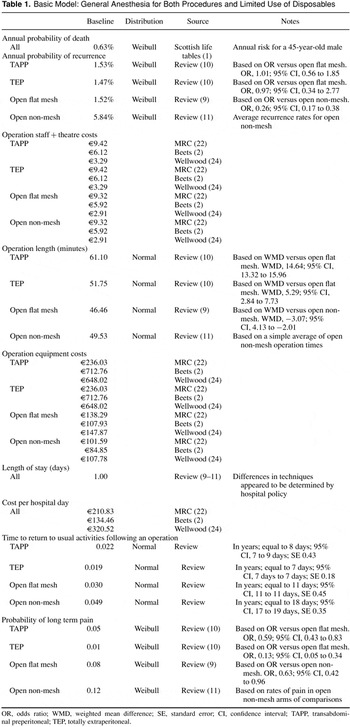
The values of the parameters used within the model are reported in Table 1 with notes explaining some of the assumptions. The findings are described below for the comparison of (i) open flat mesh with open non-mesh; (ii) laparoscopic with open flat mesh; (iii) TEP with TAPP laparoscopic repair.

Open Flat Mesh Versus Open Non-Mesh Repair
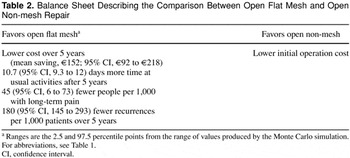
Table 2 shows the balance sheet comparing open flat mesh with open non-mesh repair procedures. Over a five-year period, open flat mesh provides greater benefits in terms of more time at usual activities, less persisting pain, and fewer recurrences at a cumulatively lower cost (open non-mesh, therefore, is dominated). This is because the costs of treating the additional recurrent hernias that occur after open non-mesh more than outweigh the increased material cost of open mesh repair. If the assumption that all recurrences result in a repeat procedure is relaxed open flat mesh remains less costly than open non-mesh except when fewer than 5% of those who have a recurrence have a re-operation.

Laparoscopic Versus Open Mesh Flat Repair
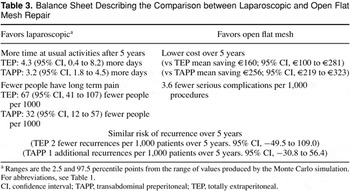
As open non-mesh is more costly and less-effective (dominated) compared with open flat mesh repair it is only relevant to compare the laparoscopic procedures with open flat mesh procedures. The balance sheet for this is shown in Table 3. Laparoscopic repair is associated with more time at usual activities and fewer people with long-term pain, but this is achieved at higher cost and an increased risk of rare but serious complications. The costs presented in Table 3 are based on reusable laparoscopic equipment. If disposable laparoscopic equipment were used the cost advantage enjoyed by open flat mesh would increase (mean cost saving versus TEP of €1112 [95% confidence interval €1022 to €1339]; mean cost saving versus TAPP of €1211 [95% confidence interval €1149 to €1337]).

In terms of recurrence rates, the evidence suggests no clear difference between open flat mesh and laparoscopic repair but the confidence intervals indicate that important differences could possibly exist. The results from the probabilistic sensitivity analysis indicate that there is a 34.5% chance that TEP (43.9% for TAPP repair) would prevent more recurrences and be more costly than open flat mesh repair. There is, however, only a 21.6% chance that the incremental cost per recurrence avoided for TEP compared with open flat mesh would be less than €10,000 when reusable laparoscopic equipment is used (when disposable equipment is used, the probability is less than 1.5%). Similarly, for the comparison of TAPP with open flat mesh, there are 10.4% and a 0.02% chances that the incremental cost per recurrence avoided would be less than €10,000 for reusable and disposable laparoscopic equipment, respectively. Relaxing the assumption that all recurrent hernias are surgically repaired had a very small impact on the difference in cost between laparoscopic and open mesh repair.
Figure 2 is an example of the effect of different sources of cost data on the estimates of cost-effectiveness when estimates of effectiveness are held fixed. The cost effectiveness acceptability curves for the incremental cost per recurrence avoided for the comparison of TEP with open flat mesh when reusable laparoscopic equipment were created using the data derived from each of the three sources of cost data (Figure 2) (2;22;24). The results based on costs derived from the MRC multicentre trial and the Beets trial were very similar (2;22), whereas the curve based on the data from Wellwood and colleagues was less likely to be considered cost-effective (24). There was, however, virtually no difference between the curves derived for the three trials when the cost estimates for disposable equipment were used. Overall, the results presented in Figure 2 indicate that there is only a small probability that TEP repair could be considered cost-effective in terms of recurrent hernias avoided.

Probability totally extraperitoneal repair is cost-effective compared with open flat mesh for different costs per recurrence avoided (reusable laparoscopic equipment).
The results presented in Table 2 indicate that laparoscopic repair is associated with an earlier return to usual activities. If a choice is made to adopt laparoscopic repair, then this places a suggested valuation on the time away from usual activities and avoids problems of whether and how such time should be formally valued. The probability that TEP is cost-effective for varying costs that society might be willing to pay for an additional day at usual activities is shown in Figure 3. It is highly likely that the cost per additional day at usual activities is less than €100 using the cost data derived from two of the studies (2;22) and less than €300 using data derived from Wellwood and colleagues (24).

Probability totally extraperitoneal repair is cost-effective versus open mesh for different costs per additional days at usual activities (reusables).
TEP Versus TAPP Laparoscopic Repair
Data from direct comparisons of the two laparoscopic techniques considered were not available from the systematic reviews. For this reason, an indirect comparison was drawn, based on each method's comparison with open mesh repair. There is a trend favoring TEP in terms of time to return to usual activities, pain, and cost, but none of this is definitive. Probabilistic sensitivity analysis suggests that, in terms of cost per recurrence avoided, there is nearly a 40% chance that TEP is dominant or is associated with an incremental cost per recurrence avoided of less than €1,000. In contrast, the probability that TAPP is dominant or is associated with a cost per recurrence avoided less than €1,000 is less than 0.1%.
TEP repair appears less costly than TAPP repair because the evidence available suggests that TEP repair takes less time. This comparison was made indirectly using data from the comparisons of these two procedures with open mesh. This type of indirect comparison might bias the results if the patient groups or processes of care differed between TAPP and TEP trials. Although the patients groups appeared to be comparable (9–11), it is possible that the surgeons involved in the trials comparing TEP with open mesh were more experienced, and, therefore, quicker than those involved in the trials of TAPP with open mesh. For surgeons with the same experience, the operation time and hence cost of TAPP and TEP may be similar.
Disposable Equipment
Using disposable laparoscopic equipment increases the cost of laparoscopic surgery. For TEP repair, the extra cost was estimated to be €953 (95% CI, €913 to €1,062). Several benefits have been suggested for disposable equipment, notably decreased risk of infection, but these have not been demonstrated. Choosing to perform TEP using disposable equipment in preference to reusable equipment (total cost €1123) suggests that disposable equipment provides at least 84% [((953)/1,123) × 100] more benefits than reusable equipment and that the health service is willing to pay the additional €953 per patient.
DISCUSSION
Open flat mesh repair is both less costly and provides superior outcomes than open non-mesh repair. In comparison with laparoscopic techniques, open flat mesh repair is more efficient in terms of recurrences avoided. However, laparoscopic repair is associated with less long-term pain and an earlier return to usual activities. Only tentative conclusions about which of the two laparoscopic techniques is optimal can be made as the results are not based on direct comparisons. There is a growing consensus that the TEP approach should be used to minimize the risks of serious complications, but it is not an easy technique and requires training. The results of this evaluation suggest that TEP is highly unlikely to be dominated by TAPP and may indeed be superior (greater than 30% chance that TEP is less costly and prevents more recurrences). These data may be used to develop clinical practice guidelines. Such guidelines would need to reflect local circumstances and should be implemented using strategies that have themselves been shown to be evidence based (20).
The analysis presented in this study has assumed that all patients would require general anesthesia. In practice, open repair may be performed under local or regional anesthesia whereas laparoscopic repair would mostly be performed under general anesthesia. For example, across the trials included in the systematic reviews (9–11) that reported this data, only 65 patients of the 3,392 allocated to laparoscopic repair received regional anesthesia, one had a local anesthesia, and the rest received general anesthesia (23). In terms of cost-effectiveness, if open repair were performed under local or regional anesthesia and laparoscopic repair under general anesthesia, the difference in cost between laparoscopic and open repair would increase and laparoscopic repair would be less cost-effective.
In the analysis, the operative and postoperative complications were assumed to act through longer operating times and hospitalization. Overall, there were fifteen (4.7 per 1,000) potentially serious visceral or vascular injuries in the laparoscopic groups (all following TAPP) compared with four (1.1 per 1,000) in the open groups (23). The modeling of these complications would make laparoscopic repair appear more costly, although the effect would be small due to the rarity of serious complications.
There have been several previous economic evaluations (2;3;6;7;12–18;21;22;24). These were each based on the results of a single study. This study reports an evaluation based on a series of systematic reviews. Considerable efforts were made to identify all relevant studies (reported in detail elsewhere, 9–11) and analysis was based on published, unpublished, and individual patient data using methods advocated by the Cochrane Collaboration, which were rigorously defined before the evaluation commenced (4). The reviews included data on 11,000 randomized patients, ten times more than the largest single trial. By combining these data, it can be argued that more precise and generalizable data are obtained. The pooled estimates produced by the systematic reviews were used for many of the models parameter estimates. Therefore, the conclusions reported are based on more robust data than were available for any of the earlier economic evaluations.
This evaluation also attempted to quantify the uncertainty surrounding the parameter estimates using stochastic methods for cost-effectiveness analysis. None of the earlier studies attempted this and instead relied on a variety of deterministic methods of sensitivity analysis that decision-makers may find difficult to interpret (2;3;6;7;12–18;22;24). The short time frame over which costs and benefits were assessed also hampered earlier studies. This finding is a particular disadvantage for open flat mesh compared with open non-mesh repair. The open non-mesh procedure is initially less costly, but over time, it is associated with more recurrences and, therefore, increased retreatment costs. In this study, a longer time frame was adopted that allowed more time for the initial cost advantage of open non-mesh to be removed. The use of systematic review techniques and particularly the use of individual patient data meta-analysis allowed the accumulation of data for a longer duration of follow-up; it also allowed consideration of the maximum length that the costs and effects should be modeled.
Due to lack of generalizable data on the opportunity cost of time away from usual activities, indirect costs were not formally incorporated into the analysis. Nevertheless, the model was used to explore the valuation of an additional day at usual activities that is suggested by the choice of the more costly but more effective laparoscopic techniques. These analyses allow decision-makers the opportunity to consider whether their valuation of an additional day at usual activities is likely. For example, compared with open mesh, TEP provides an additional day at usual activities at a cost of less than €100.
The costs of alternative methods of hernia repair have been assessed by several analysts (2;3;6;7;12–16;18;21;22;24). All of those studies that adopted rigorous methodology to estimate costs used methodologies that were very similar (23) and the primary data for three of them were used as the basis of cost estimates for this study. The other robust cost estimates used very similar methods. It is unlikely, therefore, that substantially different conclusions would have been drawn had data from these studies been used. However, it is worth noting that there is scope for variation in results. The difference in cost between laparoscopic and open mesh repair from Wellwood and colleagues was greater than when cost estimates were based on the MRC Collaborative study (22;24) As a result, laparoscopic repair appears less cost-effective when data from Wellwood and colleagues are used (24). These cost differences reflect the different hospital equipment policies for reusable equipment (the results when disposable equipment were used were virtually identical).
CONCLUSIONS
The results of the economic model, based on comprehensive systematic reviews that were unlikely to have missed any relevant trials (9–11), indicate that open flat mesh repair is more efficient than non-mesh repair. The role of laparoscopic repair is less clear, but there is no evidence that it is any more effective in terms of recurrences avoided than open flat mesh repair. Decisions about whether the use of laparoscopic repair should be increased depend on whether the benefits of laparoscopic repair (reduced pain and earlier return to usual activities) are worth the extra cost and the risk of rare but potentially serious intraoperative complications. The evaluation presented here provides information to assist policy makers in this decision.
POLICY IMPLICATIONS
Based on currently available evidence, laparoscopic repair is not cost-effective compared with open mesh repair in terms of cost per recurrence avoided. The greater complexity of the laparoscopic approach means it takes significantly longer to perform and requires more costly equipment. This finding makes it more costly. Decisions about the use of laparoscopic repair depend on whether the benefits outweigh the extra costs and intraoperative risks. On the evidence presented here, these extra costs are unlikely to be offset by the short-term benefits of laparoscopic repair.
There is clear evidence that the use of mesh in open repair reduces the risk of recurrence compared with more traditional sutured methods of open repair. Based on currently available evidence, a flat mesh method of open repair appears to be the preferable routine method of repair of inguinal hernia.
The EU Hernia Trialists Collaboration
The Steering Committee
Adrian Grant (Project Leader, UK), Peter Go (Chairman, The Netherlands), Abe Fingerhut (France), Andrew Kingsnorth (UK), Jesùs Merello (Spain), Paddy O'Dwyer (UK), John Payne (USA).
The Secretariat
Adrian Grant (UK), Sue Ross (Canada), Kirsty McCormack (UK), Neil Scott (UK)
Collaborators
Petri Aitola (Finland), Bo Anderberg (Sweden), Dag Arvidsson (Sweden), Jeffrey Barkun (Canada), Morten Bay-Nielsen (Denmark), Gerard Beets (The Netherlands), Reinhard Bittner (Germany), Sven Bringman (Sweden), Carlo Castoro (Italy), Gerard Champault (France), Charles Filipi (USA), Carmen Dirksen (The Netherlands), Robert Fitzgibbons (USA), Ricardo Girão (Portugal), Efthimios Hatzitheoklitos (Greece), Timo Heikkinen (Finland), Hans Jeekel (The Netherlands), Bo Johansson (Sweden), Anders Kald (Sweden), Henrik Kehlet (Denmark), Anton Klingler (Austria), Robert Kozol (USA), B. Leibl (Germany), Emma McIntosh (UK), Ian Macintyre (UK), Guy Maddern (Australia), Bertrand Millat (France), Erik Nilsson (Sweden), Par Nordin (Sweden), Alessandro Paganini (Italy), Giuseppe Pappalardo (Italy), Joan Sala Pedros (Spain), R Schmitz (Germany), Andreas Schwarz (Austria), Siegfried Shah (Germany), Robert Simmermacher (The Netherlands), Zbigniew Sledzinski (Poland), David Stoker (UK), Mark Sculpher (UK), Arthur Tanner (Eire), Robert Taylor (UK), Jürgen Treckmann (Germany), Jerome Tschudi (Switzerland), Francesc Vallribera (Spain), Petrouska Van den Tol (The Netherlands), Cees van Steensel (The Netherlands), Theo van Vroonhoven (The Netherlands), Wietske Vrijland (The Netherlands), James Wellwood (UK), Piotr Witkowski (Poland), Jürgen Zieren (Germany).
This study would not have been possible without the support of our colleagues in the Health Services Research Unit, The Health Economics Research Unit, and members of The EU Hernia Trialists Collaboration. The Health Services Research Unit and the Health Economics Research Unit are core funded by the Scottish Executive Health Department. The EU Hernia Trialists Collaboration was supported by a grant from the EU BIOMED II work program. The views expressed are those of the authors and not necessarily those of the funding bodies.
References
Anonymous. Office for National Statistics.
2001.
National Statistics.
Available at: http://www.statistics.gov.uk/statbase/xsdataset.asp last update May 5, 2001. Accessed June 9
Beets GL,
Dirksen CD,
Go PMNYH, et al.
1999
Open or laparoscopic preperitoneal mesh repair for recurrent inguinal hernia?: A randomized controlled trial.
Surg Endosc.
13:
323–
327.Google Scholar
Champault G,
Benoit J,
Lauroy J,
Rizk N,
Boutelier P.
1994
Inguinal hernia in adults. Laparoscopic surgery vs Shouldice's operation. Controlled randomised study in 181 patients. Preliminary results (French).
Ann Chir.
48:
1003–
1008.Google Scholar
Clarke M,
Oxman AD.
2000.
Cochrane reviewers' handbook 4.0 [updated July 1999].
In: The Cochrane Library [Database on CDROM]. Software update; 2000, issue 1, version 4.0.
Oxford:
The Cochrane Collaboration
Damamme A,
D'Alche-Gautier MJ,
Samama G, et al.
1998
Medicoeconomic evaluation of inguinal hernia repair: Shouldice repair vs laparoscopy.
Ann Chir.
52:
11–
16.Google Scholar
Dirksen CD,
Ament AJ,
Adang EM, et al.
1998
Cost-effectiveness of open versus laparoscopic repair for primary inguinal hernia.
Int J Technol Assess Health Care.
14:
472–
483.Google Scholar
Doubilet P,
Begg C,
Weinstein M,
Braun P,
McNeil N.
1985
Probabilistic sensitivity analysis using monte carlo simulations.
Med Decis Making.
5:
157–
177.Google Scholar
EU Hernia Trialists Collaboration.
2002;
Open mesh versus non-mesh repair of groin hernia meta-analysis of randomized trials leased on individual patient data.
Hernia.
6:
130–
136.
EU Hernia Trialists Collaboration.
2002;
Laparoscopic versus open groin hernia repair: Meta-analysis of randomised trials based on individual patient data.
Hernia.
6:
2–
10.
EU Hernia Trialists Collaboration.
2002;
Repair of groin hernia with synthetic mesh: Meta-analysis of randomised controlled trials.
Ann Surg.
235:
322–
332.
Heikkinen T,
Haukipuro K,
Leppala J,
Hulkko A.
1997
Total costs of laparoscopic and Lichtenstein inguinal hernia repairs: A randomized prospective study.
Surg Laparosc Endosc.
7:
1–
5.Google Scholar
Kald A,
Anderberg B,
Carlsson P,
Park PO,
Smedh K.
1997
Surgical outcome and cost-minimisation-analyses of laparoscopic and open hernia repair: A randomised prospective trial with one year follow-up.
Eur J Surg.
163:
505–
510.Google Scholar
Lawrence K,
McWhinnie D,
Goodwin A, et al.
996
An economic evaluation of laparoscopic versus open inguinal hernia repair.
J Public Health Med.
18:
41–
48.Google Scholar
Liem MSL,
Halsema JAM,
Van der Graaf Y, et al.
1997
Cost-effectiveness of extraperitoneal laparoscopic inguinal hernia repair: A randomized comparison with conventional herniorrhaphy.
Ann Surg.
226:
668–
676.Google Scholar
Paganini AM,
Lezoche E,
Carle F, et al.
1998
A randomized, controlled, clinical study of laparoscopic vs open tension-free hernia repair.
Surg Endosc.
12:
979–
986.Google Scholar
Payne J,
Izawa M,
Glen P, et al.
1996.
Laparoscopic or tension-free inguinal hernia repair? A cost benefit analysis of 200 prospective randomized patients.
Philadelphia:
SAGES
Payne JH,
Grininger LM,
Izawa MT, et al.
1994
Laparoscopic or open inguinal herniorrhaphy: A randomised prospective trial.
Arch Surg.
129:
973–
981.Google Scholar
McIntosh E,
Donaldson C,
Ryan M.
1999
Recent advances in the methods of cost-benefit analysis in healthcare. Matching the art to the science.
Pharmacoeconomics.
15:
357–
367.Google Scholar
NHS Centre for Reviews and Dissemination, Cochrane Effective Practice and Organisation of Care Group.
Getting evidence into practice.
Effective Health Care.
5:
1–
16.
Tanphiphat C,
Tanprayoon T,
Sangsubhan C,
Chatamra K.
Laparoscopic vs open inguinal hernia repair.
1998;
A randomized controlled trial.
Surg Endosc.
12:
846–
851.Google Scholar
The MRC Laparoscopic Groin Hernia Trial Group.
2001;
Cost-utility analysis of open versus laparoscopic groin hernia repair: Results from a multicentre randomized clinical trial.
Br J Surg.
88:
653–
661.
Vale L,
McCormack K,
Scott N,
Grant A.
2001.
Systematic review of the effectiveness and cost-effectiveness of laparoscopic versus open repair of inguinal hernia.
Available at: http://www. nice.org.uk/nice-web/pdf/Laphernias_HTAreppart1.pdf. Accessed April 25
Wellwood J,
Sculpher M,
Stoker D, et al.
1998
Randomised controlled trial of laparoscopic versus open mesh repair for inguinal hernia: outcome and cost.
BMJ.
317:
103–
110.Google Scholar

Markov model for the comparison of alternative methods of hernia repair.
Basic Model: General Anesthesia for Both Procedures and Limited Use of Disposables
Balance Sheet Describing the Comparison Between Open Flat Mesh and Open Non-mesh Repair
Balance Sheet Describing the Comparison between Laparoscopic and Open Flat Mesh Repair

Probability totally extraperitoneal repair is cost-effective compared with open flat mesh for different costs per recurrence avoided (reusable laparoscopic equipment).

Probability totally extraperitoneal repair is cost-effective versus open mesh for different costs per additional days at usual activities (reusables).
 You have
Access
- 21
- Cited by