1 Introduction
The concept of persistence as a feature of the grammaticalization process has been around in the literature ever since it was introduced by Hopper in his foundational article ‘On some principles of grammaticization’ (Hopper Reference Hopper, Traugott and Heine1991). In this article, Hopper aimed to supplement existing characterizations of grammaticalization focusing on the advanced stages (especially Lehmann Reference Lehmann1985) by proposing a number of features typical of the early, ‘incipient’ (Hopper Reference Hopper, Traugott and Heine1991: 21) stages of grammaticalization, viz. layering, divergence, specialization, persistence and de-categorialization. In this context, the Principle of Persistence is defined in the following way:
when a form undergoes grammaticization from a lexical to a grammatical function, so long as it is grammatically viable some traces of its original lexical meanings tend to adhere to it, and details of its lexical history may be reflected in constraints on its grammatical distribution. (Hopper Reference Hopper, Traugott and Heine1991: 22)
In other words, the original lexical meaning of the grammaticalizing element to a certain extent determines and remains visible in (1) the semantics of its later grammaticalized use as well as in (2) the distribution of this new use.
In this article, I will propose that these two aspects of the grammaticalization process of an item are determined not only by its source semantics, but also by the source structure it is originally part of and, hence, that Hopper's principle of lexical persistence has a structural equivalent which can be referred to as structural persistence. This notion hinges on the basic idea that individual lexical items typically occur as part of larger structural units (Halliday Reference Halliday1994: 12–16, Huddleston & Pullum Reference Huddleston and Pullum2002: 20–1). The view of structure that is invoked here is that found in functional grammatical frameworks such as Langacker (Reference Langacker1987, Reference Langacker1991) and Halliday (Reference Halliday1994). Langacker (Reference Langacker1987: 448–80) refers to the structure of linguistic predications as their composition, which he defines as ‘the relation between component structures and the composite structure that derives from them’ (Langacker Reference Langacker1987: 448). Within the composite structure, each component has a specific function (Halliday Reference Halliday1994; Huddleston & Pullum Reference Huddleston and Pullum2002) which motivates its structural relations with the other components making up the composite structure (Langacker Reference Langacker1987; McGregor Reference McGregor1997 elaborating on Halliday Reference Halliday1994). The interpretation of a composite structure is determined by three elements, viz. (1) the component structures, (2) their relations to each other and (3) their relations to the structure as a whole. A crucial point to the argument of this article is that even though the relation between a lexical item and the composite structure it is part of is not arbitrary, lexical items are to a certain extent autonomous and can therefore be used as components of more than one structure (Halliday Reference Halliday1994: 16).
Structures are further characterized by analysability (Langacker Reference Langacker1987: 448), which is the ability of speakers to recognize the component structures, their relations to each other and their relations to the structure as a whole. As noted by Langacker, composite structures can display different degrees of analysability, or ‘coactivation’, i.e. ‘the likelihood of the composite structure eliciting the activation of its components, as well as their prominence (level of activation) when elicited’ (Langacker Reference Langacker1987: 462). When a composite structure is characterized by a low degree of analysability, it can be reanalysed either as one noncomposite unit or as being made up of different component structures. Reanalysis is understood here as corresponding to rebracketing of the components within the structure (cf. Halliday Reference Halliday1994). In the case of reanalysis as a single unit, the original bracketing is no longer recognized, in the sense that the structure is not considered as having internal bracketing. Langacker (Reference Langacker1987: 313) characterizes this process in the following way: the composite structure has become ‘a thoroughly mastered routine, a structure that can be activated and manipulated more or less automatically, without attending to the details of its internal composition’. When the composite unit is reanalysed as consisting of different components, the original bracketing is no longer recognized either, but the unit is bracketed in a new way instead. In both cases, source structure and target structure of reanalysis hence involve different ways of bracketing the same syntagm.
The basis for this reanalysis is the structural ambiguity of the syntagm. This structural ambiguity is semantically motivated. Therefore, the structural process just sketched has to be supplemented with existing notions such as semantic bridging contexts, i.e. contexts in which two distinct meanings are plausible, and each is activated by elements from the context (Evans & Wilkins Reference Evans and Wilkins2000; see also Diewald Reference Diewald, Wischer and Diewald2002; Heine Reference Heine, Wischer and Diewald2002).Footnote 2 As pointed out by Evans & Wilkins, bridging contexts are the micro-stage preceding polysemy, and are hence mechanisms of semantic change and extension. So far in the grammaticalization literature, only the semantic ambiguity present in bridging contexts has been discussed. However, as noted by Diewald (Reference Diewald, Wischer and Diewald2002: 117), bridging contexts have a formal dimension as well. Besides being semantically plausible, the two interpretations also have to make sense formally within the existing structure.Footnote 3 This remark corresponds to the idea of structural ambiguity as a prerequisite for reanalysis and hence change proposed here. Bridging contexts should, in my view, be thought of as displaying a matching interplay of semantic and structural ambiguity. The processes of reanalysis plausible in these bridging contexts involve an integrated reinterpretation of both the functional-structural and the semantic compositionality.
It has to be noted that the principle of structural persistence, based on structural ambiguity, that will be proposed in the next paragraph does not entail that the target structure is the same as the source structure. When reanalysis has taken place, the item displays the structural characteristics associated with its new interpretation, which can be different from the properties of the source structure. Take for example the reanalysis of a lot of land from ‘a piece of land’, with lot as head noun and land as part of a postmodifying of-phrase, into ‘much land’, in which a lot of functions as a quantifier modifying land as head noun (see Brems Reference Brems2003, Reference Brems2007). The actual reanalysis originated in bridging contexts such as a lot of land, which are structurally ambiguous between a head noun + postmodifier and a quantifier + head noun interpretation. There are, however, clear differences between source and target structure. In the source structure, a and lot could be separated by other elements modifying the head noun lot, e.g. a beautifully situated, large lot of land. The target structure, by contrast, has the structural properties of quantifier + noun, viz. a lot of has become a single unit that occurs in first position in the noun phrase. It can hence no longer be interrupted or preceded by modifiers such as beautifully situated and large. Thus, source and target structures can have instantiations that do not show a matching structure and that allow only one of the two structural analyses. Diewald (Reference Diewald, Wischer and Diewald2002) and Heine (Reference Heine, Wischer and Diewald2002) discuss a similar phenomenon in relation to the semantic side of reanalysis: change arises in bridging contexts that are ambiguous between two readings, but the status of source and target readings as distinct meanings is only confirmed when they occur in contexts that allow only one of the two interpretations. Diewald (Reference Diewald, Wischer and Diewald2002: 104) refers to such contexts as ‘isolating contexts’.Footnote 4 The process of structural reinterpretation can be said to display a similar evolution: it arises in contexts that are structurally ambiguous, and is consolidated as a separate structural interpretation in contexts that are typical of one structure only.Footnote 5
In the previous paragraphs I have argued for the recognition of the fact that structure and meaning play a complementary role in reanalysis and processes of changes in general. The proposal to introduce a principle of structural persistence in addition to the well-known principle of lexical persistence in grammaticalization ties in with this claim. Structural persistence draws attention to the relation between the structure before reanalysis takes place, and the new composite structure that arises as the result of reanalysis in the grammaticalization process. It refers to the point that the source structure that a lexical item is part of in its nongrammaticalized use remains present in its new use. A newly emerging use developed by an item has to ‘fit in’ with its source structure, viz. it is ‘sanctioned’ by the structure of the original use, and is in some recognizable way structurally moulded by it.Footnote 6 The point of structural persistence can be illustrated with the well-known grammaticalization process involved in the change of prepositional phrases into either complex prepositions/conjunctions such as instead of, in view of (Schwenter & Traugott Reference Schwenter, Traugott and Jucker1995; Hoffmann Reference Hoffmann, Lindquist and Mair2004, Reference Hoffmann2006) or complex discourse markers such as in fact, indeed (Traugott Reference Traugott, Stein and Wright1995: 39–42). Structural persistence captures the fact that these two different developments are sanctioned by the structure of the original prepositional phrases. For complex prepositions/conjunctions, the prepositional phrases serving as source need to have the structure preposition + (determiner +) noun + particle of, whereas the structure enabling the development of complex discourse markers is simply preposition + (determiner +) noun. These different prepositional phrase-patterns hence give rise to different grammaticalized functions. The claim made in this article is that in earlier grammaticalization studies the role of the source structure as a sanctioning and shaping factor of the grammaticalization process, i.e. structural persistence, has gone unnoticed. Yet, as I will argue, structural persistence has to be recognized as an important feature of grammaticalization, which will help to elucidate the structural motivations of individual grammaticalization processes.
In the remainder of this article I will illustrate the mechanism of structural persistence on the basis of a particularly instructive example, viz. the development of the uses of a specific English lexical set, the adjectives of difference such as other, different, various, several, etc., in the noun phrase (henceforth NP).Footnote 7 The research referred to is a corpus-based investigation of a set of 200 synchronic data extracted from the COBUILD corpus for each of the adjectives other, different, divers(e), various, several, sundry (these are marked CB), as well as five historical data samples for each of these adjectives. The first two sets, covering the periods 1250–1500 and 1500–1710, were extracted from the Helsinki Corpus, and the other three sets, covering the periods 1710–80, 1780–1850, 1850–1920, were taken from the Corpus of Late Modern English Texts. A full report of the corpus study performed on these data is presented in Breban (Reference Breban, Facchinetti and Rissanen2006a, Reference Breban2006b, Reference Breban2008a).
These studies describe in detail the semantic changes involved in the grammaticalization of the adjectives of difference. Compare by way of illustration (1) and (2).
(1) Again, the weather report in Haifa is not my expertise at this exact moment, but Haifa's a very different city from Tel Aviv which is very flat and open and the dissipation of chemical agents will be much swifter. (CB)
(2) He said the witness had been secretly recorded confessing to the murder to an undercover policeman, had a cache of knives in his bedroom and had been convicted of a different stabbing in a Gold Coast restaurant. (CB)
In (1) different expresses the fully lexical meaning of representational (Traugott Reference Traugott1989) difference in the sense of ‘gradable unlikeness between two or more entities’. Concretely, different conveys that several qualitative features, flatness and openness, characterize Haifa and Tel Aviv to different degrees, which makes Haifa in these respects ‘unlike’ Tel Aviv. The submodifier very further grades the unlikeness as high. Different functions in this example as attribute in the NP: similar to flatter in a flatter city, it ‘attributes’ the abstract quality of unlikeness to the referent. This fully lexical meaning formed the starting point for the development of a later meaning, illustrated in (2), that is no longer lexical, but grammatical in nature. In (2), different does not invoke representational features such as ‘how much unlike each other the entities being compared are, in what respects they are unlike each other’. It merely conveys that the stabbing at the Gold Coast restaurant is not the incident that the man is currently suspected of. Rather than attributing unlikeness to two or more entities, different in examples such as (2) denies that two or more entities mentioned in the discourse are in fact the same referent, i.e. it conveys nonidentity of reference. In this meaning, different has a different function in the NP: it helps to establish the identity of the referent in relation to other referents mentioned in the discourse. It fulfils a postdeterminer function in the NP (see Collins COBUILD English Grammar 1990: 70; Halliday Reference Halliday1994: 183), viz. it provides additional referential information to that of the main determiner, e.g. the, a, zero, that helps the hearer to correctly identify the referent of the NP. The nonidentity meaning is text-grammatical, viz. it is concerned with the tracking and organization of discourse referents, rather than representational, viz. concerned with the description of the referent. The semantic development of the adjectives of difference (represented here by different) illustrates Traugott's (Reference Traugott, Axmaker, Jaiser and Singmaster1988, Reference Traugott, Stein and Wright1995) path of grammaticalization from representational to textual-grammatical meanings (see argumentation in Breban Reference Breban2006b).Footnote 8
What makes this particular case so interesting in the light of structural persistence is the fact that the same original meaning of qualitative unlikeness can be found in two different structural configurations. Attributing unlikeness to a referent always involves at least two entities that are compared and said to be unlike each other. These two entities can figure in the discourse in two different ways: they can either be expressed by two distinct NPs, as in (3), in which a very different life, associated with the speaker's grandmother, refers back to my life: ‘a very different life from mine’, or they can be the entities denoted by one and the same NP, as in (4), in which the visions that are professed to be unlike each other are all expressed by the NP profoundly different visions of America.
(3) I like to imagine that my life is a model of streamlined modernity. Today was an average shopping day for me: I had to buy enough food for five people for two days, printer ribbons, photographs for a visa and a new tape for my answering machine. My grandmother lived a very different life. She never ran her own office, or travelled abroad. (CB)
(4) ‘We have starkly different philosophies of government and profoundly different visions of America’, the 72-year-old Senate leader insisted. (CB)
I will refer to the former structure, in which the comparison pertains to the referent of the NP containing the adjective of difference and a separately coded second entity, as NP-external comparison, and to the latter, in which the entities compared are all denoted by a single NP, as NP-internal comparison.
In what follows I will show that even though adjectives of difference undergo the same semantic process of grammaticalization from unlikeness to nonidentity of reference described above in both structures, the outcomes of the grammaticalization processes differ in these two different structural environments. The specific form and type of the secondary referential value expressed by the postdeterminer uses of the adjectives are very different in the NP-external versus the NP-internal comparison structures. The motivation for the development of these different referential functions cannot be attributed to the semantics of the processes, which are the same, but has to be traced back to the differences between the source structures involved. As such, the case study of the grammaticalization of the adjectives of difference constitutes a prime piece of evidence for the recognition of structural persistence as a feature of grammaticalization processes.
In the next two sections, 2 and 3, I will describe which particular postdeterminer functions the adjectives of difference come to fulfil in the NP-external and the NP-internal structures respectively. In order to further strengthen my claim, I will also show that the different grammaticalized postdeterminer uses found in each structure constitute the starting point for distinct subsequent developments leading to a further separation of the different values conveyed by the adjectives in the two types of structural environment. Section 4 brings the findings of sections 2 and 3 together and discusses in detail how the development of the adjectives of difference constitutes a particularly clear example of structural persistence of the two distinct source structures, given that there are no differences in lexical persistence. In this section I will also make a plea for the general importance of structural persistence for the study of grammaticalization processes.
2 NP-external comparison
In the case of NP-external comparison, the two entities that are described as unlike each other are expressed by separate NPs. The NP containing the adjective of difference denotes the first entity and the NP denoting the second entity can either be found in the preceding discourse, as in (5), or it can be part of a prepositional phrase that is added as a postmodifier to the NP denoting the first entity, e.g. (6).
(5) Depardieu's car rolled into the encampment around 3 p.m. Gil Noir, his personal wardrobe woman for the past decade, was there to greet him, costume in hand. He spent twenty minutes in wardrobe and makeup and came out a very different man. Now Depardieu was clad in coarse wool pants, a wool vest, and a tattered old wool jacket. A rough moustache bristled across his upper lip, and his hands and face and neck were deeply ingrained with soot and ash. On his head was an old workman's cap, the bill pulled down in a way that made him look angry and menacing. (CB)
(6) In background, style and ideology, Mr Hurd is a very different politician from Mrs Thatcher. (CB)
In the NP-external configuration, the adjectives of difference undergo semantic grammaticalization from the lexical attribute use describing the referent as being unlike the separately coded entity, as in (5) and (6), to the grammaticalized postdeterminer use illustrated in (2) above and (7).
(7) If you have problems once you arrive at the cottage, the agency may be able to move you to a different house or solve the difficulty. (CB)
The grammaticalized meaning ‘nonidentity of reference’, which arises from the lexical meaning, also pertains to the referent of the NP and the separately coded second entity. For example, in (7) the house a different house refers to is ‘not the cottage’. In examples such as this, the adjective of difference contributes to the identification of the referent of the NP containing the adjective of difference by invoking another discourse referent (the second entity). It has hence acquired a phoric function, and the NP denoting the second entity can be viewed as its ‘antecedent’ (see amongst others Martin Reference Martin1992: 98; De Mulder Reference De Mulder, Verschueren, Östman, Blommaert and Bulcaen1998: 2) if it occurs in the preceding discourse, as in (7) or as its ‘postcedent’ if it is integrated in a postmodifying prepositional phrase, as in (8).Footnote 9
(8) Informal groups might have different leaders from those officially in charge and might set themselves different targets from those of the organization. (CB)
In (8), the leaders of the informal groups are ‘not the ones officially in charge’.Footnote 10
The particular type of phoricity that the grammaticalized adjectives of difference express is not the prototypical case. In the literature, phoricity is typically restricted to the most common type, viz. coreferentiality between referent and antecedent, which is illustrated in (9).
(9) A nurse brought me some bread and coffee, but the bread was stale and the coffee tasted of soap. (Macmillan English Dictionary 2002: 1486)
In (9) the same text referent is first introduced by the indefinite NP, viz. some bread, and it is then referred to by a second, definite, NP, the bread. The definite determiner indicates that the referent of this second NP is anaphorically retrievable and coincides with the referent of some bread. The phoric relation hence involves coreferentiality on the entity or ‘instance’ (Langacker Reference Langacker1991) level. In other words, the two NPs refer to the same instance of ‘bread’. The grammaticalized use of the adjectives of difference discussed here at first sight expresses exactly the opposite relation. It indicates that the antecedent is not the same instance as that denoted by the NP.Footnote 11
However, the situation is not that simple. As postdeterminers, the adjectives of difference do not function in their own right, rather, as argued in Breban (Reference Breban2006b, Reference Breban2008b) and Breban & Davidse (Reference Breban and Davidse2008), they are functionally a single determiner unit with the main determiner of the NP.Footnote 12 The determiner unit as a whole is responsible for the successful identification of the referent. The import of the primary determiner is to signal the basic identifiability status of the referent. Crudely put, definite identification signals identifiability of the instance and indefiniteness means nonidentifiability. The postdeterminer adjective of difference brings in the notion of nonidentity with an antecedent. As I will illustrate in the following paragraphs, in the determiner unit, the separate semantic imports of determiner and postdeterminer are combined into a single but complex phoric meaning. By definition, this relation differs depending on the definite/indefinite value of the primary determiner.
Let us first consider indefinite determiner units. A simple indefinite determiner such as a typically indicates the introduction of a discourse-new instance of a known type, i.e. type-identifiability (Gundel, Hedberg & Zacharski Reference Gundel, Hedberg and Zacharski1993; see also Langacker Reference Langacker1991, Reference Langacker2004; Davidse Reference Davidse, Achard and Kemmer2004), e.g. (10).
(10) There's a concert on Sunday night. (Macmillan English Dictionary 2002: 1)
A concert introduces a new instance of the type ‘concert’ with which the hearer is in some way already familiar. Note that the indefinite determiner does not specify how or where the hearer can identify the type involved. The addition of an adjective of difference, in its postdeterminer use, provides supplementary information for the retrieval of this type. Recall that at face value the postdeterminer adjectives of difference signal a relation of non-coreferentiality with an antecedent instance, i.e. they merely stress that the NP refers to a discourse-new instance. However, in doing so, the adjectives also draw attention to the fact that there is a previous instance of the same type and that the hearer hence has access to the type via this previous instantiation.Footnote 13 Take (11) for example.
(11) It was alleged he struck one prison officer with a pipe and hit another officer on the head with his fist. (CB)
Here, another officer signals that a new instance of the type ‘officer’ is being introduced into the discourse. This instance is not the previously mentioned one prison officer, but an instance of the same type. Some evidence supporting the idea that the complex determiner unit gives the instruction to retrieve the type of the antecedent is the fact that the head noun of the referring NP, which expresses the type, can be replaced by the lexically empty substitute one, e.g. he struck one prison officer with a pipe and hit another one on the head. The indefinite determiner + postdeterminer of difference unit instructs the hearer to set up a double phoric relation, one of nonidentity on the level of instance-identifiability (‘not the same instance’) and one of identity on the level of type-identifiability (‘of the same type’). The determiner unit indicates that the designated instance is a new instance of a phorically retrievable type and thus establishes type-anaphora (Davidse Reference Davidse2001: 21) in the discourse.
The determiner unit definite determiner + postdeterminer adjective of difference in a similar way expresses a new, more complex phoric relation by ‘filling in’ certain elements of the general dimensions of simple definite identification.Footnote 14 Definite determiners convey that speaker and hearer can both identify the specific instance denoted by the NP. This basic definition is further elaborated in Cognitive Grammar (see Langacker Reference Langacker1991: 97f., Reference Langacker2004: 96f.; Davidse Reference Davidse, Achard and Kemmer2004: 211f.): speaker and hearer can both establish mental contact with a predicated portion (P) of the instantial mass (MT), i.e. the mass containing all instances of the type instantiated by the referent (type T) that are available in the discourse. The determiner unit with a postdeterminer adjective of difference specifies one particular way in which identification or mental contact can be brought about. It identifies its referents as the ‘remaining’ instances of MT, i.e. as all instances of MT excluding those denoted by the antecedent.
(12) Yes, the visitors had included a Navajo boy who sometimes came by himself and sometimes came with a Zuñi boy. The other visitors were Belacani, mostly young, mostly long-haired. (CB)
For instance, in example (12) the other conveys that from the set of all visitors, i.e. the MT, two specific persons have already been mentioned, viz. the antecedents a Navajo boy and a Zuñi boy, and that the particular instances referred to by the NP the other visitors are hence the remaining persons of the original set of all visitors. The other thus identifies the actually predicated mass P or the referents of the NP by a subtraction relation, viz. MT minus the antecedents. The different phoric relations that underlie the complex referential value of the unit definite determiner + postdeterminer adjective of difference are hence the following. Firstly, the determiner unit establishes a relation of non-coreferentiality on the level of instance-identifiability. Secondly, it expresses a relation of identity at the type level, i.e. a type-anaphora relation. In addition to these two phoric relations, it sets up a third relation to the instantial mass MT: it puts this mass, which is always available as a reference point (Langacker Reference Langacker1991: 91), into profile and expresses a semantic relation of subtraction with respect to it. In summary, the grammaticalization of the adjectives of difference in the NP-external structure leads to the development of integrated determiner + postdeterminer units expressing complex phoric relations between the referent of the NP and an antecedent.
At the end of this section on the NP-external structure, I want to discuss a subsequent development particular to one adjective of difference, other, which takes its postdeterminer meaning in the indefinite determiner unit zero + other, resulting from the process described above, as input. In addition to examples in which the form other constitutes a complex determiner unit, the corpus data studied in Breban (Reference Breban2006b) also contain examples such as (13),
(13) Whether government plays a relatively minor role in the economy or is a pervasive influence can have important economic and other effects on racial matters. (CB)
in which the function of other is not to introduce new instances of a known type. Instead, other in (13) instructs the hearer to add new subtypes of ‘effects’ different from the previously mentioned subtype economic effects. Compare the paraphrases ‘have important economic and other types of effects’ versus *‘have important economic and other instances of effects’. Other is not concerned with instances of the type denoted by the head noun, but with its subtypes. Hence it functions as classifier in the English NP, viz. it conveys a subclass of the general type denoted by the head noun (Halliday Reference Halliday1994: 184–5). So far in the literature only a lexical classifier use is recognized, e.g. electric in the NP electric trains, which refers to a subclass by describing its characterizing feature, e.g. ‘working on electricity’ for electric trains. Even though other, like classifiers such as electric, identifies a subclass of the general type, it adds further subtypes without lexically specifying them.
The claim that I would like to put forward here is that this deviating classifier use of other is the result of an extension of its postdeterminer use, which can be illustrated on the basis of the examples (14–16).
(14) Mr Rosbrook said he was attracted to MBE because it was a unique concept with proven success in the US and other countries. (CB)
(15) Only the United States, it says, is successfully pursuing the guilty elderly men who took part in atrocities against Jews and other people in World War II. (CB)
(16) If he still believes that you ought to be able to manage on the current ‘housekeeping’ you could challenge him to take over the shopping and see whether he can do better. Unless you are, in fact, a poor manager, he'll either spend much more than you do on the grocery and other bills, or find that by the end of the week the fridge is empty following his attempt to keep within the present limits. (CB)
Example (14) is a postdeterminer example in which the NP other countries is coordinated to the antecedent NP by means of the conjunction and. It identifies the configuration that constitutes the basis for the semantic extension, viz. antecedent NP and other noun. Crucially, the head noun of the NP containing other stands in a hyponymic relation to the antecedent NP. Example (15) represents a bridging context in which the classifier use could have originated. Jews and other people is formally identical to the US and other countries, but the semantic relation between ‘Jews’ and ‘people’ is ambiguous: does ‘Jews’ refer to a (generic) instance of the type ‘people’ or to a subtype of ‘people’? This ambiguity is no longer present in example (16), grocery and other bills, in which apparently the same configuration noun and other noun only allows for an interpretation involving subtypes, viz. ‘grocery bills and further subtypes of bills’. The final step is the extension from antecedent-classifiers that are nouns to classifying adjectives such as economic in (13). In this way, other appears to have developed a phoric classifier use. On a more programmatic note, it can be observed that the extension from phoric postdeterminer to phoric classifier use of other illustrates the idea that the input for each step of change typically has particular structural and semantic features that, when co-occurring, allow ambiguity, paving the way for reanalysis.
This concludes the discussion of the grammaticalization of adjectives of difference in the first structural configuration, NP-external comparison. In the next section, I will discuss how the same semantic grammaticalization from lexical unlikeness to nonidentity of reference plays out for the second structure, viz. NP-internal comparison.
3 NP-internal comparison
In the NP-internal structure, all entities that are said to be ‘different’ are referents of one NP, e.g. the sharply different attitudes of African Americans, Hispanics, and Whites in (17).
(17) The results of a 1991 nationwide survey of youth in the United States ages fifteen to twenty-four offer insight into the sharply different attitudes of African Americans, Hispanics, and Whites. (CB)
The comparative relation hence remains NP-internal. When the adjectives of difference grammaticalize in this structure, they come to express nonidentity of referents with regard to the entities referred to by the one NP. In their postdeterminer use, the adjectives then signal that the referents of the NP are, usually contrary to expectation, not ‘the same ones’, but distinct instances of the same type. In (18), for example,
(18) I think when you analyse the fact that we won five Super Bowls and ’ve done it with different head coaches, different quarterbacks and different players and the only real constant has been team owner Ed Debartolo, it says something about the organisation. (CB)
the coaches with which the team won each of its Super Bowls are not the same one. In this particular example, the involvement of different coaches contrasts with the idea that we are dealing with the same team.Footnote 15
In the majority of the corpus data (Breban Reference Breban, Facchinetti and Rissanen2006a), however, no such contrast is present. Instead the notion of nonidentity between multiple referents in a plural set appears to be bleached further. Take for instance (19):
(19) The agreement resulted from the pledges signed by different countries in favour of the world ecology during the earth summit held in June 1992 in Brazil, which was attended by Mexican president Carlos Salinas De Gortari. (CB)
Here, different simply emphasizes the point that several distinct countries signed the pledges. The referential value of the adjectives of difference in examples such as this is to draw attention to the fact that the instantial set is composed of individual instances: each country signed one of the pledges. Put more technically, the addition of a grammaticalized postdeterminer of difference shifts the focus of the denotation of the NP from the instantial set as a whole to its distinct instances; it divides up the instantial set into different instances for separate conceptual awareness. The function of the grammaticalized adjective in the NP-internal configuration can hence be described as discretization (Langacker Reference Langacker2006: 114) or individualization of the instantial set. More generally, because the adjectives specify how the instantial set should be conceived of, as a group of instances or as a single unit, this use can be included in the category of nominal aspect markers (Rijkhoff Reference Rijkhoff2002: 103), i.e. ‘elements that specify the way the nominal property is represented in the spatial dimension’ (Rijkhoff Reference Rijkhoff2002: 103) or specify ‘what kind of set is involved’ (Rijkhoff Reference Rijkhoff2002: 104).Footnote 16 So, in the NP-internal comparison structure, the adjectives of difference grammaticalize from attributes conveying likeness into postdeterminers that pertain to the conceptualization rather than identification of the referent, viz. they instruct the hearer to conceptualize a plural instantial set in one particular way, as consisting of individual instances.
The process of grammaticalization of the adjectives of difference in the NP-internal structure does not end at this point. The nominal aspect marker use in plural NPs becomes the input for a process of ‘secondary grammaticalization’ (the development of a new grammatical use on the basis of an earlier grammatical use; cf. Hopper Reference Hopper, Traugott and Heine1991),Footnote 17 which gives rise to fully fledged quantifier uses such as that of several in present-day English, illustrated in (20).
(20) It is a light room with tall windows overlooking the patio and some far from industrious builders on the roof of a neighbouring building. There is a wall of mirror-doored wardrobes, an old, leather-topped desk, a freestanding mirror and several chintz-covered chairs over which are flung large, wool, deep-coloured paisley shawls. (CB)
As quantifiers, what adjectives of difference convey is that the instantial set consists of an unspecified, but not too large number of instances.Footnote 18 Specifically for several, Langacker (Reference Langacker1991: 84) observes that
the range for several begins with three, and although it has no precise upper limit, its use becomes tenuous if there are more component entities than one can simultaneously hold in mind as individuals.
This paraphrase is instructive for the semantic aspect of the grammaticalization process at work: it draws attention to the fact that the individualizing meaning of their postdeterminer uses determines the adjectives’ value as quantifier. This secondary grammaticalization process is thus characterized by lexical persistence.Footnote 19 This close association between the individualizing and quantifying meanings is also noted in the OED (s.v. several, a.; s.v. sundry, a.; and s.v. various, a.) and discussed by Denison (Reference Denison, van Kemenade and Los2006: 297–9).Footnote 20 The structural configuration that allowed for the reanalysis from postdeterminer to quantifier is the pattern adjective of difference + plural noun in which there is ambiguity with regard to the status of the adjective of difference: is it a postdeterminer added to the zero article or is it a primary determiner (in this case, a quantifier) in its own right? This illustrates once more the complementing factor of structural persistence in addition to lexical persistence: not only the source meaning ‘individualization of the instantial set’ but also the source structure zero article + adjective + plural has to be present in order for the new quantifier meaning to be able to arise.
4 Discussion and perspectives for future research
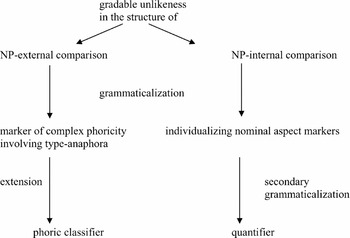
In the previous sections, I have charted the developments of the English adjectives of difference in the different structures of NP-external and NP-internal comparison. From this discussion, it can be concluded that with these adjectives, the same general process of grammaticalization from describing unlikeness to indicating referential nonidentity results in the development of distinct structure-specific grammaticalized functions. The developments in the two structures can be envisaged as two distinct grammaticalization paths, which are visualized in figure 1.
The two paths of grammaticalization of the English adjectives of difference

As shown here, the central grammaticalization process from descriptive to referential meaning results for each path in the development of a structure-specific postdeterminer function. In the NP-external structure, the postdeterminer adjective is incorporated in determiner units which express complex phoric relations combining nonidentity with other discourse referents on the instance level with identity on the type level (type-anaphora). In a next step, the phoric postdeterminer use of other is extended to a phoric classifier use. When the comparison is NP-internal, the semantics of nonidentity are further bleached and the postdeterminer uses function as individualizing nominal aspect markers. In plural NPs, this nominal aspect marker use constitutes the input for a secondary grammaticalization process towards quantifier use.
This case study hence shows how the occurrence of a single source meaning in two different structural configurations leads to the development of distinct paths of grammaticalization. The motivation behind the development of these two paths as well as behind the particular functions they involve has to be attributed to the difference between the structures in which they originate. The general semantic shift from describing unlikeness to indicating referential nonidentity, and the role of lexical persistence in it, are the same for the two paths. In consequence, only structural persistence allows us to account for the developments discussed here.
The case study of the adjectives of difference thus provides a very striking piece of evidence for the recognition of structural persistence in grammaticalization. However, this case might be viewed as an ‘exceptional’ one, in the sense that the grammaticalization process starts from two clearly different source structures. Nevertheless, it appears to me that structural persistence plays a role in other less striking examples, which do not involve separating paths of grammaticalization. As noted in section 1, structural persistence can also be observed in well-known cases of grammaticalization, such as the development of prepositional phrases into complex prepositions/conjunctions or complex discourse markers. Here, the presence or absence of an of-phrase modifying the head noun of the prepositional phrase is a crucial factor enabling the grammaticalization process, in the same way, I would argue, as the suitability of the source meaning. To give another example related to the adjectives of difference: even though the basic semantics of sundry and asunder are the same, viz. ‘separate, distinct’ (OED s.v. sundry, a.; s.v. asunder, a.), only sundry underwent grammaticalization into a nominal aspect marker and quantifier. Asunder did not – and could not – manifest this specific grammaticalization process because it does not occur in the structural environment that allows for this grammaticalization process to happen, viz. as attribute in the NP. Faced with examples such as these, I would like to suggest that the role of structure has been taken for granted in grammaticalization studies so far. I believe that in many cases, the source structure the grammaticalizing item is part of has both a licensing and/or shaping influence on the outcome of the grammaticalization process, in the same way that the source meaning has. It is from this perspective that I have proposed to introduce structural persistence as a principle of grammaticalization in addition to lexical persistence. The two principles are complementary in the sense that they concern two aspects of the grammaticalizing item. However, they operate in close interaction: only the right combination of source meaning and source structure can trigger a specific process of grammaticalization.