A significant amount of research has suggested that the election of members of traditionally underrepresented groups brings greater political attention to the group’s interests. Research on women in politics, for example, has shown that female legislators are more likely than male legislators to engage in an array of behaviors that promote women’s rights – introducing bills on women’s issues, sitting on women’s issues committees, and speaking on behalf of women in committees and in floor debates.Footnote 1 Research on ethnic and other minority group representation has reached similar findings. Black and Latino representatives in the United States are more likely to represent black and Latino issues in their voting patterns, legislative interventions, bill sponsorship, and budgetary spending priorities.Footnote 2 Studies from the United Klngdom, India, and Romania report similar findings for ethnic minorities in those countries.Footnote 3
To a large extent, all of these studies attribute enhanced representation of the group in question to the election of decision makers who are members of the group – in other words, to the elected official being descriptively representative. However, drawing the conclusion that two members of a legislative body vary in style and substance based on their ascribed traits as individuals or their shared heritage ignores the extensive amount of work showing that electoral rules are critical for understanding how and why elected representatives act as they do in office. A legislator’s freedom to focus on the concerns of a particular constituency, including a minority one, should be at least partly a function of whether the reputation earned by doing so is sufficient for re-election. The incentives for catering to a particular constituency vary across a wide array of electoral designs based on, for example, whether ballots allow voters to select an individual candidate (rather than a party list) and whether votes cast for one candidate will pool to elect others.Footnote 4 In addition, larger district magnitudes and lower thresholds for obtaining seats impact the proportionality of electoral rules, and greater proportionality has been associated with the ability to take more widely dispersed positions, including those in defense of niche interests.Footnote 5
In this article, we bring these two literatures together to explain when members of underrepresented groups in elected assemblies will uniquely represent their group’s interests once in office. Building on arguments from the literature on descriptive representation, we reason that the election of members from traditionally underrepresented groups is important because those members share a heritage and set of experiences that make them more likely to attend to the issues and concerns of their groups. At the same time, however, descriptive representation is, we argue, only likely to result in legislative actions on behalf of those groups when the electoral context incentivizes it – when it makes it a winning strategy. As we will detail below, there are two ways in which electoral provisions can do this and both apply, at least theoretically, to all types of underrepresented groups (e.g., women, racial minorities, ethnic and linguistic minorities). One is that electoral rules can group members together, to create ‘majority-minority’ districts and then employ disproportional electoral rules to ensure that the group’s presence is translated into seats and then into action on behalf of the group. The second route is to adopt highly proportional rules, thereby making it possible for even relatively small groups with geographically dispersed members to constitute a seat-winning support base.
After developing our theoretical reasoning, we test it empirically by analyzing representation of a traditionally underrepresented group – the Māori indigenous minority in New Zealand. In the country’s mixed-member electoral system, both Māori and non-Māori candidates can be elected to parliament under three sets of rules that, we argue, provide varying incentives for being responsive to the Māori’s unique interests. This allows us to test whether it is group membership, electoral incentives, or the combination of the two that produces representation of Māori interests. We also examine whether MPs seek to heighten the sense that they are a group member and that they are representing uniquely Māori interests as a function of the electoral incentives they face. We find that Māori MPs are not different from non-Māori MPs when the electoral system does not incentivize such a distinction.
GROUP MEMBERSHIP (OR BEING DESCRIPTIVELY REPRESENTATIVE)
Work on underrepresented groups has long identified descriptive representation as critical to getting a group’s interests onto the political agenda. Representatives from underrepresented groups may be more likely to empathize with the struggles of the group or to situate the group’s concerns as part of a broader context of problems to be solved by government, making them more willing to represent that group in the political arena.Footnote 6 In addition, legislators from traditionally underrepresented groups are likely to see their shared descriptive status as a strategic advantage in generating political support. If so, under the right circumstances, elected representatives may seek out opportunities to display their minority status – perhaps through unique forms of dress or speaking. Such displays will assure that the representative highlighting his or her minority status is the recipient of the support of those voters for whom shared group membership is salient.
There is systematic evidence supporting the argument that descriptive representation can increase efforts to invoke the group’s presence during political proceedings and to encourage the pursuit of its substantive interests, perhaps in the form of economic well-being, political rights, or cultural (ethnic, religious) freedoms. One underrepresented group on which a significant amount of this research has been conducted is women. Studies of racial and ethnic minority groups have produced similar arguments and findings, with the vast majority of this research studying Blacks and Latinos in the United States. Relatively recent research has established a connection between minority-group membership and a variety of legislative activities, such as bill sponsorship, public spending, and bureaucratic oversight hearing participation. A recent study from the United Kingdom found that minority Members of Parliament were more likely to ask questions related to minority-group issues during Question Time.Footnote 7 In Romania, reserved seats for ethnic minorities have allowed those groups to receive more distributive benefits from the state.Footnote 8 Likewise, political reservation in Indian states has increased redistribution of resources in favor of the groups singled out.Footnote 9
That said, empirical research has identified the importance of the electoral context for moderating how descriptive representatives act on behalf of their constituents.Footnote 10 In the next section of this article we develop a straightforward argument about how electoral incentives can be designed to encourage MPs to represent the groups of which they are members.
THE ROLE OF ELECTORAL INCENTIVES IN THE REPRESENTATION OF TRADITIONALLY UNDERREPRESENTED GROUPS
We reason that electoral rules are key to explaining whether MPs from traditionally underrepresented groups will more frequently advocate group-focused policies and more regularly invoke their group’s shared identity. Our argument rests on two electoral factors – the size of the group in the district and the proportionality of the electoral system. These two factors work together to make the underrepresented group decisive (i.e., capable of determining alone the election of candidates). This leads to enhanced representation of the group, both descriptively and substantively. We expect strong group-based representation under the two configurations of group size and electoral rules described below.
First, descriptively representative MPs should cater to members of their group when electoral rules produce a highly proportional translation of votes to seats – even when the group is a minority in the district. Proportional representation rules have been found to increase the representation of traditionally underrepresented groups, including women, ethnic minorities, and the poor.Footnote 11 Proportional electoral rules give small groups the chance to be decisive in deciding seats. Even if an underrepresented group is large, as in the case of women, for example, but only a subset of its members find group membership politically salient, under proportional rules they may be sufficient to elect like-minded representatives. What is more, rather than feeling constantly forced to reach out to the median voter, MPs can instead devote time and attention to the specific concerns of the traditionally underrepresented groups. The trend of moving from plurality electoral systems to mixed-member systems is in part motivated by the desire to obtain the consequences of greater proportionality.Footnote 12 The result is particularly marked when the electoral system includes a nationwide PR tier for awarding a significant proportion of the parliament’s seats is adopted (as was the case in New Zealand).
The second configuration leading to group representation is where members of an underrepresented group comprise the majority in a district (i.e., majority-minority districts) and disproportional rules exist. Single-member districts, including those composing a tier of a mixed-member system, create this disproportionality and institutionalize personal vote-seeking incentives. However, they are rarely dominated by voters who are members of a traditionally underrepresented group; but when they do have a majority-minority composition, disproportional rules encourage candidates and elected representatives to focus on the unique identity and interests of the subgroup.Footnote 13 These majority-minority districts can be ‘naturally’ concentrated or they can be constructed.
Another way to create majority-minority districts is to offer members of a, perhaps geographically less concentrated, subgroup the option of registering to vote via an alternative electoral roll. Alternative electoral roll districts may cover the entire nation – as they do for the Māori in New Zealand and Afro-Colombians in Colombia, for example – or they might be limited to designated parts of the country – as they are in Niger, India, Panama, and Bolivia.Footnote 14 In Rwanda the lower chamber reserves 30 percent of parliamentary seats for women, (indirectly) elected using highly disproportional plurality seat allocation rules and an electoral roll composed only of female voters. Optional rolls are likely to attract voters for whom group membership is a very salient political dimension. As a result, they are also likely to attract potential candidates for whom representing the group is a priority. Thus, MPs chosen through such institutional mechanisms are very likely to perceive of representing the group as a winning electoral strategy. Whether for minorities or women, the combination of the district’s group composition and disproportional rules strongly incentivizes cultivating a reputation for having looked after the group’s interests.
In sum, we expect legislators who are members of a traditionally under-represented group – whether defined by race, ethnicity, religion, sex, etc. – to be more likely to use their time in office defending the group’s unique substantive interests and establishing their credentials as a group member if and only if the electoral system gives them an incentive to do so. As we reasoned above, these electoral incentives are institutionalized both when the decisive group’s size is small in the district but electoral rules are highly proportional and when the group’s size is large (a plurality or majority) and highly disproportional rules are in place.
As we will detail below, New Zealand is the ideal laboratory for testing this theory. It has minority MPs elected in highly disproportional districts drawn to have a majority of minority-group voters. It also has minority MPs elected in a highly proportional (nationwide) district where the number of minority voters (by definition) is commensurate with their percentage of the population. Finally, it has minority MPs elected in highly disproportional districts drawn to have a majority of majority-group voters. Given New Zealand’s institutional design, we will be able to overcome the challenge many previous scholars have struggled with, namely how to distinguish whether the mechanisms of formal representation (electoral laws) have an effect on substantive representation beyond some indirect effect through their impact on descriptive representation.
GROUP MEMBERSHIP AND ELECTORAL INCENTIVES IN NEW ZEALAND
As we noted above, for parliamentary elections New Zealand currently uses a mixed-member system to choose 120 members of parliament. Just over half of the members (63) are chosen by voters of any racial or ethnic group registered on the General Roll in single-member districts with the seat rewarded by plurality (we will refer to this tier of the electoral system as GR-SMDP). Voters have the option to self-identify as Māori and to register on the Māori Roll. They then vote for members of parliament chosen in single-member districts decided by plurality (we will refer to this tier as MR-SMDP). The number of MR-SMDP districts determined by the proportion of the population registered on the Māori Roll currently stands at seven districts. Finally, 50 members are chosen, by both voters on the General Roll and the Māori Roll, in a single, nationwide district with seats allocated to parties proportionally (we will refer to this tier as PR-List). The electoral rules specify that candidates for seats in all three tiers can come from any racial or ethnic group. In a sense, it is a typical mixed-member proportional (MMP) system, with the important exception that it has two mutually-exclusive SMDP tiers that share a single PR tier.
Mixed-member systems have been characterized as ‘the best of both worlds’ because their nominal tier supplies the incentives of pure-SMDP systems while their proportional tier provides the incentives of pure-PR systems.Footnote 15 In order to test the implications of this reasoning, existing literature has contrasted the behavior of MPs elected in one tier with those elected in the other and compared behavior by MPs within a tier to one another as a function of the extent they have copartisans elected in the other tier.Footnote 16 While empirical results have not been universally in support of the hypothesized expectations, most of the existing literature suggests that MPs from the two tiers vary from one another in terms of representational style and substance.Footnote 17 For example, SMDP tier MPs are more likely to break party discipline, presumably in order to cultivate a personal vote with constituencies in their districts; more likely to have unique campaign messages; and more likely to, generally, look for other mechanisms for distinguishing themselves in the eyes of potential voters.Footnote 18 List MPs are not only on average more loyal but also more willing to take on ‘work horse’ duties, like committee work.Footnote 19
In New Zealand, we have the interesting twist of a mixed-member system with two disproportional SMDP tiers – one elected by Māori Roll voters and one elected by General Roll voters. These voters then come together to vote in a single, highly proportional PR tier. As we will flesh out below, our expectations complement those in the existing literature on mixed-member systems but with the electoral roll twist and the MP’s group membership in mind. We will make the case that group membership and electoral tier interact to help explain the behavior of MPs in office. The addition of an alternative roll gives (Māori) voters for whom Māori issues are highly salient the opportunity to place themselves in majority-minority districts. These districts then give potential candidates for whom Māori issues are highly salient an electoral environment in which to compete on the basis of those issues. As we will hypothesize explicitly below, this culminates with Māori MPs elected in Māori Roll SMDP contests who have all kinds of electoral incentives to pursue the group’s interest in parliament and to highlight their group membership while doing so.
According to Statistics New Zealand, the official statistics website of the New Zealand government, during the period of focus here, the Māori population was relatively steady, hovering around 14 percent of the total population, give or take a percentage point or two in either direction. Table 1 contains the ethnicity of MPs in the 42nd through 49th Parliaments. Elections were held under the pure SMDP, General Roll and Māori Roll, rules in 1987, 1990, and 1993 for the 42nd through 44th Parliaments. Elections were held under the MMP system in 1996, 1999, 2002, 2005, and 2008 for the 45th through 49th Parliaments. As the numbers make clear, the creation of a large magnitude (50 seat) district has put more Māori candidates in office than ever occurred under the exclusively SMDP system. In fact, the percentage of MPs who are Māori has increased by two-and-half fold during the MMP era – reaching a proportion of Māori MPs equivalent to the group’s size in the population. Some of that increase can be attributed to the institutional reform tying the number of Māori roll seats to the number of voters enrolled on it (12 more MR seats over five parliaments than would have been the case under the old system), but in terms of raw numbers, most of the increase has occurred through the PR-List tier in the Mixed-Member system.
Ethnicity of Members of the 42nd–44th and 45th–49th Parliaments (1987–2011)

Note: The Not Māori category almost exclusively consists of New Zealanders of European descent, but it also contains a very small number of MPs who identify as Asian or as non-Maori Pacific Islanders. The totals include members chosen in by-elections and those taken from a party’s list during a term to replace a list-seat MP who could not finish his or her term.
Thus, as we have already noted, traditionally underrepresented, minority-group MPs have been elected in highly disproportional districts drawn to have a majority of minority-group voters (MR-SMDP), in a highly proportional district where the minority-group’s presence is its size in the population (PR-List), and even in highly disproportional districts drawn to have a majority of majority-group voters (GR-SMDP). We expect ethnic Māori MPs to behave in ways that are meaningful to the Māori people and distinct from their non-Māori counterparts as a function of the tier through which they are elected.
We reason that Māori MPs elected by the Māori Roll (MR-SMDP) are the most likely to consistently represent Māori interests and to take the greatest pains to highlight their Māori identity. The disproportionality of the system makes them the sole focus of minority-group constituents – who have self-selected into majority-minority districts – seeking to determine whether they are being well-represented. This electoral arrangement almost certainly attracts a disproportional number of candidates for whom their ethnic identity is a highly salient political feature. In addition, we hypothesize that Māori MPs elected in the proportional representation tier of the electoral system are likely to make a somewhat reduced but discernible effort to take up Māori causes. We reason that proportionality allows party leaders to put candidates from traditionally under-represented groups on their lists to draw support from voters for whom group membership is a salient feature of candidates – mixing them in with majority-group candidates so as to avoid alienating voters for whom it is not (or for whom some group memberships might be a negative voting cue). Finally, we hypothesize that Māori MPs elected in the single-member districts voted in by voters on the General Roll (GR-SMDP) are least likely to have an interest in pursuing Māori interests and be least likely to have the ability or the desire to highlight their Māori identity. Māori are not the plurality of voters in any district voted on by voters on the General Roll. Given that only one seat is to be filled, party leaders cannot blend ethnic majority and ethnic minority candidates together on a single slate, and any heightened ethnic minority status of a candidate is unlikely to serve as a positive voting cue for a decisive portion of voters, especially given that many Māori voters for whom it would be a positive cue have instead opted to vote via the Māori roll.
We use the taking up of distinctly ‘Māori issues’ during Question Time or as the subject of a Private Member’s Bill as indicators of seeking to represent the unique interests of the minority group. There are other ways MPs may seek to curry the favor of a potential group of supporters, but we reason that these are two important acts associated with quality representation by law makers. Question Time is typically an opportunity to grill the government on its implementation of policy, and specifically whether it is being done without the interests of the Māori people in mind. In addition, of course, MPs can propose legislation of their own that deals directly with issues of particular interest to the Māori, and we will describe how that process works in New Zealand in particular below. According to our reasoning, descriptively representative MPs will be more likely to substantively represent Māori interests than non-Māori MPs, but among Māori MPs, again, we expect variation by electoral tier.
Hypothesis 1 The frequency with which distinctly Māori issues are taken up on the floor of parliament by posing a question during Question Time or by having one’s Private Member Bill selected for discussion will decrease across Māori MPs elected in the MR-SMDP tier, Māori MPs elected in the PR-List tier, Māori MPs elected in the GR-SMDP tier, and non-Māori MPs.
In addition to pursuing the substantive interests of the Māori minority, we also sought a systematic measure of MPs’ efforts to heighten the sense that they were members of the minority group. One effective mechanism for clearly signaling group membership to anyone who is listening would be the use of the Māori language – te reo Māori on the floor of the parliament. According to the website of the New Zealand Parliament, about 63 percent of Māori adults have high listening comprehension in ‘te reo Māori’. All MPs fluent in Māori (during the period under study) are perfectly fluent in English. Thus, for those able to speak te reo Māori fluently, it is certainly a matter of choice. While it might seem trivial that Māori MPs speak more te reo Māori on the chamber floor than non-Māori MPs, our main interest is in whether Māori MPs elected by the Māori Roll in Māori Electorates (MR-SMDP), Māori MPs elected from the PR-List (PR-List), and Māori MPs elected by the General Roll in SMDPs (GR-SMDP) are willing and able to invoke their minority status at different rates from one another.
Hypothesis 2 The frequency with which one’s identity as Māori is invoked on the floor of parliament through the use of the Māori language will decrease across Māori MPs elected in the MR-SMDP tier, Māori MPs elected in the PR-List tier, Māori MPs elected in the GR-SMDP tier, and non-Māori MPs.
In the subsequent sections we will test these two hypotheses, first describing our indicators of each key concept and then explaining our approach to analyzing them before offering an interpretation of whether there is support for our hypotheses.
PURSUING THE GROUP’S SUBSTANTIVE INTERESTS
Pitkin states that substantive representation means ‘acting for’ the represented and that ‘the test of representation is … how well he acts to further the objectives of those he represents’.Footnote 20 Our task, then, is to capture who is ‘acting for’ Māoris as a distinct ethnic group with unique interests in Parliament and to determine how their actions are related to the formal mechanism by which they arrived in office (electoral tier) and their descriptive attributes (ethnicity). As we noted above, to capture whether an MP is pursuing the group’s substantive interests, we will examine both Question Time and private member bill proposals. Admittedly, this is not an exhaustive list of parliamentary activities, but we think they are two very important duties of an elected representative. In addition, because they are systematically recorded by the parliament itself, they give us the opportunity to observe two important activities without concerns regarding sampling or selection bias.
‘Question Time’ is a time-honored practice in most parliaments, giving MPs, in a comparatively unregulated milieu, an opportunity to pursue the interests they hold most dear. While questioning the government is often a tool of the opposition, in New Zealand, MPs whether in or out of government can pose questions to other MPs. We observed 303 MP-terms outside the government, and 284 of those MPs posed at least one question for oral answer. On average, MPs from opposition parties asked twenty-nine questions per term. While the opposition dominates, more than one third of questions posed were posed by MPs while serving in government. More precisely, 5,157 out of 14,033 questions in our dataset were asked by MPs from the parties in government. Fortunately, the partisan composition of governments varied widely over the time under observation, assuring that no party was in government during the entire period. We restrict our analysis to a total of 489 MPs that asked at least one question for oral answer.
In New Zealand, questions for oral answer are included on the floor’s agenda every day parliament is in session. The Standing Orders allow for both Questions for Oral Answer and Questions for Written Answer. The latter are more numerous, but the parliament only has on-line records of them dating back to 2002. Thus, in order to cover the entire period under study, we report in the text models based on the more than 14,000 questions posed for oral answer between 1996 and 2011. Each morning (between 10:00 and 10:30 a.m.) that parliament is in session, members can submit questions to be answered orally during the day’s session, and twelve of those questions are placed on the agenda. MPs’ questions are selected proportionately to the size of their parties in parliament.
In order to determine whether a question was substantively representing Māori interests as a distinct ethnic group with unique needs, we created a three-part indicator. First, most simply, we coded every question that included the word ‘Māori’ as being concerned with Māori substantive interests. We also coded as being about Māori interests any question addressed to the Minister of Māori Affairs. Finally, the New Zealand National Library provides Index New Zealand (INNZ), which catalogs articles in over 1,000 newspapers and journals. We used these news articles to identify 128 issues of particular importance to Māori. More specifically, for the period 1987–2011 we searched newspaper article titles and synopses for the word ‘Māori’, identifying 13,372 articles. We then filtered that population by searching for the subject ‘Politics, Practical’, one of the predefined subject filters provided by the database. That resulted in a set of 286 articles with synopses, and we culled those for terms that could be considered Māori interests, generating a list of 128 terms or phrases (listed in our on-line appendix). In the text we report models where the dependent variable is coded as having to do with Māori interests if it meets any of these three criteria.Footnote 21
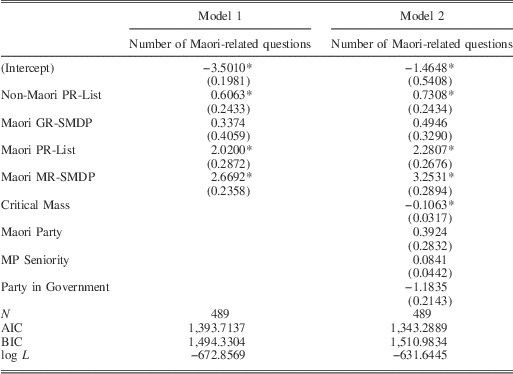
In Table 2, we provide two models testing Hypothesis 1 regarding the impact of group membership and electoral tier on the pursuit of Māori interests – via questions posed for oral answer – for members of the 45th through 49th Parliaments. We include a baseline model and a model with controls. We controlled for features which might increase or decrease a member’s willingness to or incentives for representing any particular constituency, and sometimes a Māori constituency in particular. ‘Critical Mass’ is a count of the total number of Māori MPs in that Parliament. Critical mass has been widely used in the gender and politics literature to determine whether female representatives behave differently as their total number increases. ‘Māori Party’ is an indicator of whether the MP belonged to the only party elected during this period whose manifesto was almost exclusively about how policy impacted the Māori population. We also control for ‘MP Seniority’, reasoning that secure, senior Members of Parliament might feel less need to engage in representative acts aimed at a particular constituency. Finally, we control for whether an MP’s party was in government. Being in government typically reduces the role of individual MPs and puts greater emphasis on party discipline and pursuit of the government’s policy program. We do not discuss the substantive impact of the controls at length below except to note where their inclusion or exclusion has an effect on the impact on our variables capturing the concepts of greatest theoretical interest.
Models on Representing Maori Interests –Maori-Related Questions

Note: Robust standard errors in parentheses. * Indicates significance at p<0.05.
Because these are models of counts, by the MP/term, we use a negative binomial modeling strategy with standard errors clustered by MP (models clustering by parliament are available in our on-line appendix).Footnote 22 , Footnote 23 As we expected, Māori MPs elected in single-member districts by Māori Roll voters (Māori MR-SMDP) are the most discernible from non-Māori MPs elected in GR-SMDP districts, our excluded category.Footnote 24 Māori MPs elected from PR-Lists are also distinguishable from their non-Maori counterparts, but, as expected, not to the same degree as Māori MPs elected in single-member districts by Māori Roll voters. The statistical insignificance of the coefficient for Māori MPs elected in single-member districts by General Roll voters (Māori GR-SMDP) indicates that they are not distinguishable non-Māori MPs elected in GR-SMDP districts. Finally, somewhat surprisingly, non-Māori MPs elected from the PR-list tier are distinguishable from their non-Māori GR-SMDP colleagues, though the substantive size of the effect is small.Footnote 25 Perhaps there is some sense of a list reputation, with even non-Māori list members feeling a need to contribute something to the list’s shared reputation.
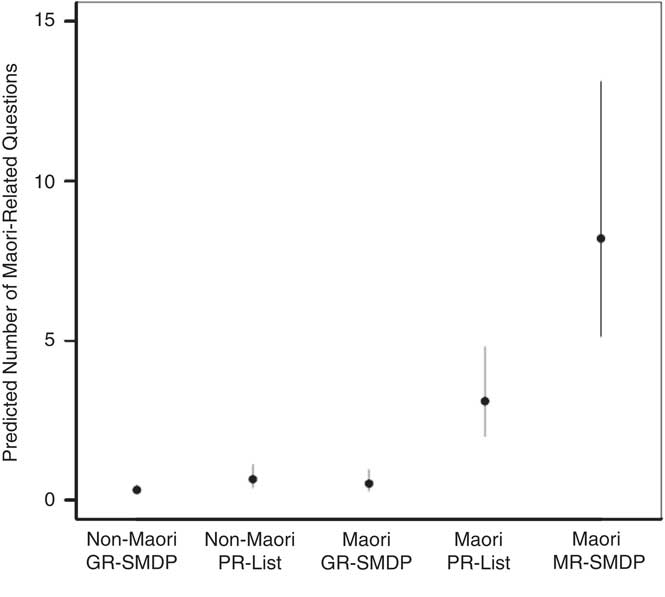
In Figure 1 we portray the results of the second model on questions in an intuitive manner. It illustrates the frequency with which Māori-related questions are asked across MPs by ethnicity and tier of election.Footnote 26 As something of a baseline, the average number of questions asked by an MP (who asked any questions at all) in a given term is about twenty-nine and the average number of questions asked by an MP about a Māori issues is about two. That the 95 percent confidence interval for the predicted count for non-Māori GR-SMDP MPs does not contain the predicted count for non-Māori PR-List MPs indicates that the two are statistically discernible, with the latter slightly more likely to ask a question about Māori issues. Yet, the predicted count for either type of MP is less than one question on Māori issues per legislative term. Similarly, the predicted count for Māori MPs elected by General Roll in a single-member district determined by plurality is also distinguishable from non-Māori GR-SMDP candidates (but not non-Māori PR List candidates), but, again, the predicted number of Māori questions per MP remains less than one. Māori PR-List MPs and Māori MR-SMDP MPs are widely discernible from all other types of MPs (and from one another). As the figure indicates, our model suggests that Māori PR-list candidates will ask about three questions per term regarding Māori issues. Māori MR-SMDP Members of Parliament are predicted to ask about eight questions per term regarding Māori, with our 95 percent confidence interval reaching more than thirteen questions per MP-term. This means that if a Māori MR-SMDP MP asked an average number of questions, almost 1/3rd of them would be explicitly devoted to raising Māori issues. Put another way, a Māori MR-SMDP MP is predicted to ask more than eight times as many questions about Māori issues than any non-Māori MP and, most tellingly, a Māori MP elected in a GR-SMDP seat.
Predicted number of Māori-related questions per MP-term, with 95 percent confidence intervals, based on Model 2

Beyond Question Time, initiating legislation that protects the rights and privileges of some subgroup is another means of representing the group’s interests. Unfortunately, in most parliamentary systems the legislative agenda is dominated by the government, and the bills it sponsors can rarely be attributed to individual MPs. The situation is exacerbated in New Zealand. All private and members’ bills are listed on a ‘ballot’, and only every other Wednesday (Members’ Day) can up to eight bills be selected randomly from that ballot to be put on the floor’s agenda (Order Paper).Footnote 27 The parliament’s website does not make available the titles of all the bills placed on the ballot (including those not selected for discussion) prior to the 49th Parliament – the last in the period under study (and bills for one year of even that parliament appear to be missing). However, for the entire period under study, we were able to obtain bill titles for all the bills randomly selected from the ballot and actually put on the floor’s agenda. Not surprisingly there were far fewer private and member’s bills discussed, 329, than questions posed, 14,033.
We coded those bills for whether they were instances of engaging representation of Māori as a group with unique interests using decision rules similar to those we used for coding questions. We could not use ‘posed to the Minister of Māori Affairs’, as bills are not directed to particular ministries. We did, however, employ the other two decision rules – ‘contains the word Māori’ or ‘contains a term found in news articles via findNZarticles’.Footnote 28 In Table 3, as with parliamentary questions, we report a baseline model, with only covariates regarding MP ethnicity and electoral tier, and a model with the same sets of controls justified above. Again, these are negative binomial regressions of a count – Māori interests bills per MP per term (models clustering standard errors by parliament are reported in the on-line appendix).
Models on Representing Maori Interests – Maori-Related Bills

Note: Robust standard errors in parentheses. * Indicates significance at p<0.05.
The average number of bills selected for discussion per MP-term between years 2003 and 2011 is only 0.52. In the models reported here, we restrict our analysis to those MPs who had at least one bill selected for discussion.Footnote 29 The models in Table 3 support the conclusion that the Māori MPs most distinguishable from their non-Māori colleagues in terms of bill initiation are those elected in the Māori Roll single member districts (MR-SMDP).Footnote 30 With controls included (Model 4), we see that Māori GR-SMDP MPs are also distinguishable from their non-Māori GR-SMDP colleagues, with the magnitude of the coefficient about one half that of Māori MR-SMDP MPs.Footnote 31 There is a well-developed literature illustrating that in Mixed-Member systems SMDP legislators are more likely to actively cultivate individual reputations while PR tier MPs play more of a ‘back bencher’ roll.Footnote 32 Further research is necessary to glean why this logic applies to private member bills but not to questions during Question Time.
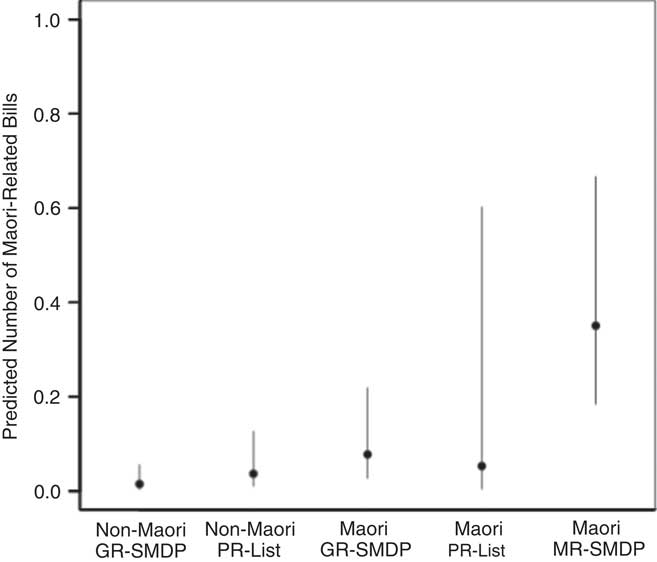
Using Model 4, in Figure 2 we depict the impact of electoral tier and ethnicity on bill initiation patterns.Footnote 33 The average Māori MR-SMDP MP initiates 0.35 bills per term that deals with Māori issues. At first glance, this number seems relatively small. However, it should be seen in the context of the facts that these are only the bills (randomly) selected for discussion – not all those proposed – and that the average MP has about 1.48 bills on any topic selected for discussion per term. Finally, our models indicate that no other type of MP has more than 0.08 bills on Māori issues selected for discussion per term.
Predicted number of Māori-related bills per MP-term, with 95 percent confidence intervals, based on Model 4

INVOKING GROUP MEMBERSHIP
Recall that we reasoned that MPs who were members of traditionally underrepresented groups would be most able and willing to stress their membership in the group if they thought it might hold some electoral payoff. When such payoffs exist, the MPs will seek to distinguish themselves from MPs who are not group members and from MPs who are group members but do not have the ability or incentives to distinguish themselves as such. Speaking the Māori language – te reo Māori – on the chamber floor is a particularly effective means of setting oneself apart. A shared language frequently distinguishes ethnic and racial minorities from the majority of the population. Often there is a history of efforts to suppress the use of a minority language or, at the very least, legal and social impediments to its use. As a result, use of the language in a place of political authority is a powerful statement of group rights and group membership. The speaker invokes the presence of the Māori people and encourages listeners to ponder Māoritanga or ‘Māoriness’ – and pointedly, for most listeners, their lack of Māoriness. According to Stephens, use of the Maori language on the floor of parliament is a ‘a type of political theatre whereby Māori Members seek to . . . create a “theatre of memory’” in order to “(re)connect with one another and reinforce connection with those people who have passed on”.’Footnote 34
From a variety of on-line resources, we gathered digital copies of floor minutes for the period 1996 to 2011. We obtained a dictionary of common Māori words, eliminating words that had the same spelling as English words from this list (leaving us a list 934 words). We then used machine reading technology to identify and count the Māori words being spoken in the minutes. Given the systematic formatting of the minutes, we were able to write code that was capable of identifying the speaker of all speeches. In the end, then, we are able to get a raw count of the number of words spoken by each MP per parliamentary period, distinguishing between English and Māori words. At one extreme, some MPs never used te reo Māori, but at the other extreme one quarter of the words spoken by an MP were te reo Māori.Footnote 35
In Table 4, we provide models testing Hypothesis 2 regarding the impact of group membership and electoral tier and the use of the Māori language by members of the 45th through 49th Parliaments, including a baseline model and a model with controls.Footnote 36 As above, we controlled for features which might increase or decrease a member’s willingness to or incentives to stress his or her membership in the group – Critical Mass, Māori Party Membership, MP Seniority, whether an MP’s party was in government. Models 5 and 6 are negative binomial models of the count of te reo Māori words spoken by an MP in a given term, and they show clear support for our reasoning in Hypothesis 2. As expected, Māori PR-List MPs and Māori MR-SMDP MPs are discernible from all other types of MPs – and from one another.Footnote 37
Models on Calling Attention to Group Membership – Speaking Maori

Notes: Negative binomial regression. Robust standard errors in parentheses. * Indicates significance at p<0.05.
It is not the case that Māori MPs, regardless of electoral tier, are universally more likely to make themselves conspicuous as group members. More specifically, Māori MPs elected in GR-SMDP districts are not discernible from their non-Māori colleagues. What is more, as we expected, Māori MPs are distinguishable from one another based on the electoral tier in which they were chosen. Among Māori MPs, those chosen by the General Roll in SMDP districts do the least to single themselves out as a member of the Māori people, and those chosen by the Maori Roll in SMDP districts engage do the most, while those elected by both General Roll and Maori Roll voters from a PR-list slot neatly in between.Footnote 38
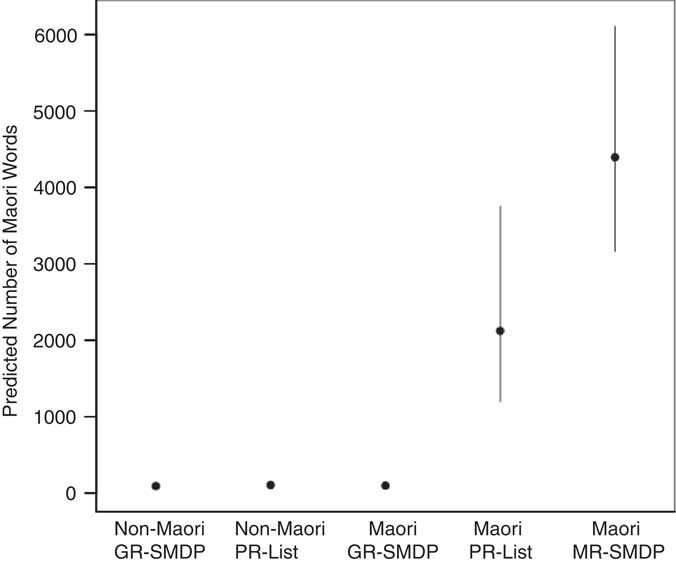
In Figure 3 we portray the results of Model 6.Footnote 39 On the one hand, non-Māori MPs, regardless of electoral tier, and Māori MPs elected by General Roll voters in single-member districts are not statistically discernible from one another. Our model predicts they will speak about 90 to 104 words in te reo Māori during the course of a parliamentary period. A Māori MP elected from the PR list, on the other hand, will call attention to himself or herself by speaking almost 2,100 Māori words, and a Māori MP elected in a Māori Roll SMDP district will more than double that, speaking nearly 4,400 words in Māori. It is unlikely that being fluent in te reo Māori is a (positive) voting cue for many General Roll voters. Therefore, if non-Māori MPs and Māori GR-SMDP MPs can speak te reo Māori, they clearly have no electoral incentive to do so. By way of anecdotal evidence, Simon Bridges, a Māori MP elected in a GR-SMDP, has noted that ‘Māori in general seats may tend to play down their Māori-ness, and more often than not have not been fluent in te reo’.Footnote 40 Being identified as a member of a traditionally underrepresented group, however, can serve as an effective vote earning strategy for Māori MPs in both the highly proportional PR-List tier elected by both General Roll and Māori Roll voters and the highly disproportional single-member districts elected by only Māori Roll voters.
Predicted number of Māori words per MP-term, with 95 percent confidence intervals, based on Model 6

CONCLUSION
We have shown that electoral systems can be designed to influence the degree to which a legislative body descriptively represents the population, especially historically excluded (or constrained) minorities, and, more importantly, we made the case that both the descriptive attributes of the elected official and electoral incentives are likely to influence the extent to which an official would undertake to represent the group and to stress his or her group membership. In other words, descriptively representative officials may arrive – at differential rates – in office through more than one electoral route, but they will not all behave the same once they have made it into parliament.
As we noted before, the challenge many previous scholars have been unable to overcome is how to distinguish whether institutions, namely electoral laws, have an effect on representation beyond some indirect effect through their impact on the choice of descriptively representative members of parliament. Where representatives of different groups arrive in office through mutually exclusive sets of formal mechanisms of representation – for example, reserved seats for the minority group and unreserved seats for the majority group – group identity of the representative and the institutional route to power are often synonymous and therefore impossible to untangle empirically. The fact that Māori MPs are elected to the New Zealand Parliament across three electoral tiers (and two electoral rolls) allowed us to make the distinction between group membership and electoral incentives.
Māori MPs are acutely aware of the fact they are diverse and that the type of representation carried out by a Māori MP in one tier will be almost necessarily different from the representation carried out by a Māori MP from another tier. Māori MP Simon Bridges, a member of the National Party elected in a GR-SMDP, writes:
Māori in general seats are different to Māori in Māori seats. We, I think as a general rule, want to be different, but even if we didn’t want to be, we have to be. I think the nature of general seats is such that we have to do things differently . . . . We’ve been selected by all ethnicities in our electorate. . . . In Māori seats one can run as being solely or mostly for Māori interests. Such a position is impossible in general seats where you represent everyone . . . . [B]y having both, we ensure all Māori across the spectrum are represented . . . .Footnote 41
We have shown that design of institutions is indeed important. Multiple routes to power can be designed to encourage distinct forms of representation, even across descriptively representative MPs. In the case of New Zealand, one group of voters is allowed to self select onto a distinct electoral roll, and it seems reasonable that those opting to utilize this formal path are not likely to share preference distributions (or even policy dimensions) with those who do not exercise this option. The ‘optional’ electoral roll often brings to office candidates from parties who are not proportionately selected at the same rate in the other tiers of the electoral system. While we do not have data on all candidates for office, it seems likely that even within a given party those candidates who stand in the optional electorate have different priorities and styles than those who stand for the same party in other tiers. What we have shown here in some detail is that MPs from an ethnic minority are not always distinguishable from their ethnic majority colleagues. Among ethnic minority MPs, the electoral tier through which one arrives in office is clearly related to the activities undertaken in pursuit of representing the interests of traditionally under-represented groups.
Māori MP Georgina Beyer from Labour nicely captures that both ethnicity (or other descriptive characteristics) and formal electoral tier are always at play and that MPs serving together in Parliament face distinct sets of incentives. While serving as an MP from a General Roll SMDP electorate, she says she did not mind letting a Māori Roll SMDP MP with an overlapping district utilize some of her office space to meet with constituents, but when it came to resources designated to serving her constituents, it was another matter – even for an MR-SMDP MP from her own party. Regarding the possibility of sharing financial resources or her personnel’s time, she notes, ‘I became very hard-nosed about that, and said, “Look, if my constituents were to ask me ‘Are we getting our full budget allocation?’ then I’d have to say, ‘No, you’re not’”’. Beyer was later elected from Labour’s PR List. Despite her strong feelings about the appropriate type of representation to be carried out by a GR-SMDP MP, Beyer noted that her experience as a list MP was:
Yes, I clearly had a constituency, but it didn’t interfere with the sensibilities of my general seat electorate anymore, so I could quite happily go out and champion things that a strict electorate didn’t let me champion, if you know what I mean. Obviously, I had significant minorities who I could claim to be a constituency – gender minorities, just as one example, and there are many others.Footnote 42
Electoral rules provide many opportunities for founders and reformers to incentivize particular electoral outcomes, including the choice of descriptively representative MPs and pursuit of group interests by those MPs once in office. Rules can be engineered with the representation of both majority and minority groups in mind. The proportionality of electoral outcomes are influenced by district magnitude, thresholds of representation, and seat allocation formulas. High levels of proportionality may be necessary to assure that groups in society are accurately reflected in the composition of the legislative assembly. Beyond mere numbers, proportionality means that MPs who reflect the interests of even a subset of some group can carry out representation in ways that make them stand out from the crowd.
Beyond permissive levels of proportionality, electoral rules can be more explicitly proactive by including quotas, reserved seats, race-conscious districting and, the closely related, multiple voter rolls (and electorates/districts). While any of these institutional choices can encourage descriptive representation, race-conscious districting and optional voter rolls seem the most likely to bring to power MPs who will stand out in terms of pursuing group interests. Voters’ decisions to exercise their right to enroll via an optional roll is almost certainly a signal that whatever defines the nature of the roll is a politically salient cleavage for them. It is not surprising then, that many of these voters would share an interest in electing candidates who are distinct from those being chosen by the majority roll. Like high levels of proportionality, such provisions can have negative consequences as well. Such mechanisms can involve politicized rules for determining which groups merit such provisions and that they can ultimately institutionalize divisive cleavages.Footnote 43 As a result, they bestow a political privilege and assure that the basis for the privilege remains salient. It is up to founders and reformers to determine whether acknowledging the interests of a particular subgroup in the design of political institutions is a desirable normative goal.
Appendix
Descriptive Statistics*

Models on Maori-related Questions/Maori-related Bills/Maori Words Spoken Measured as Proportions of All Questions, Bills, Words Spoken (OLS)†