Emerging adulthood is marked by significant transformations in sexual behaviour, attitudes, and self-perceptions (Tolman & McClelland, Reference Tolman and McClelland2011). Understanding these changes from an inclusive perspective that values the normative and healthy features of sexuality is increasingly recognised as critical for promoting positive development and sexual health (Harden, Reference Harden2014; Tolman, Reference Tolman2012). One core feature of healthy sexuality is sexual subjectivity, which refers to sexual self-perceptions and feelings about sex (Horne & Zimmer-Gembeck, Reference Horne and Zimmer-Gembeck2006; Martin, Reference Martin1996; Tolman, Reference Tolman1994). Although sexual subjectivity is a property of the individual, it is believed to shape and be shaped by relationship experiences (Hewitt-Stubbs, Zimmer-Gembeck, Mastro, & Boislard, Reference Hewitt-Stubbs, Zimmer-Gembeck, Mastro and Boislard2016; Horne & Zimmer-Gembeck, Reference Horne and Zimmer-Gembeck2005; Mastro & Zimmer-Gembeck, Reference Mastro and Zimmer-Gembeck2015; O'Sullivan & Brooks-Gunn, Reference O'Sullivan and Brooks-Gunn2005; Zimmer-Gembeck, Ducat, & Boislard-Pepin, Reference Zimmer-Gembeck, Ducat and Boislard-Pepin2011; Zimmer-Gembeck, Reference Zimmer-Gembeck2013; Zimmer-Gembeck & Helfand, Reference Zimmer-Gembeck and Helfand2008). As such, it is significant for relationship as well as individual functioning.
Research on sexual subjectivity has focused on its correlates with individual wellbeing and sexual development during adolescence and emerging adulthood. Less understood are the ways in which partners’ sexual self-perceptions come together to shape relationship functioning. Such information is important because each partner brings their sexual subjectivity to the relationship, and each partners’ sexual subjectivity has the potential to shape their own and the partner's relationship experiences. In this way, a dyadic perspective on sexual subjectivity has the potential to shed light on relationship experiences important to sexual development. The current study seeks to evaluate partner similarity in sexual subjectivity within dyadic relationships and the contributions of each partner's sexual subjectivity to relationship functioning.
Sexual Subjectivity
The self-concept includes beliefs about who one is as a person — an integration of the emotional, psychological, and behavioural selves across salient domains (Harter, Reference Harter2012). Social experiences, including romantic relationships, heavily influence how individuals define their self-concepts (Aron, Reference Aron, Leary and Tangney2003; Harter, Reference Harter2012; Slotter & Gardner, Reference Slotter and Gardner2009; Tice & Wallace, Reference Tice, Wallace, Leary and Tangney2003). One facet of the self-concept is a person's construction of the self as a sexual being, known as the sexual self-concept (Vickberg & Deaux, Reference Vickberg and Deaux2005). Sexual subjectivity is the dimension of sexual self-concept that encompasses thoughts, feelings, and sensations related to one's body, entitlement to sexual pleasure, sexual self-efficacy, and sexual self-reflection (Horne & Zimmer-Gembeck, Reference Horne and Zimmer-Gembeck2006). Drawing from initial work by Buzwell and Rosenthal (Reference Buzwell and Rosenthal1996), Cyranowski and Andersen (Reference Cyranowski and Andersen1998), Tolman (Reference Tolman1994, Reference Tolman2002), and Zimmer-Gembeck and colleagues developed an empirically validated conceptualisation and assessment of sexual subjectivity that incorporates five elements (Horne & Zimmer-Gembeck, Reference Horne and Zimmer-Gembeck2006; Zimmer-Gembeck et al., Reference Zimmer-Gembeck, Ducat and Boislard-Pepin2011; Zimmer-Gembeck & French, Reference Zimmer-Gembeck and French2016; Zimmer-Gembeck & Skinner, Reference Zimmer-Gembeck and Skinner2011). The first element, sexual body-esteem, refers to positive feelings about one's physical attraction and desirability. Two additional elements capture beliefs about experiencing bodily pleasure: entitlement to sexual pleasure from oneself and entitlement to sexual pleasure from a partner. Sexual self-efficacy refers to perceptions of one's ability to achieve sexual fulfillment with a partner. The fifth element, sexual self-reflection, captures the cognitive and emotional capacity to consider and evaluate sexual experiences and attitudes.
Sexual subjectivity has proved to be a useful construct for understanding how individuals consider and experience themselves as sexual beings. Various studies link greater sexual subjectivity to healthier psychological wellbeing and sexual adjustment. For example, higher sexual subjectivity is associated with greater attention to internal aspects of one's sexuality, safe sex self-efficacy, and general self-esteem (Hewitt-Stubbs et al., Reference Hewitt-Stubbs, Zimmer-Gembeck, Mastro and Boislard2016; Horne & Zimmer-Gembeck, Reference Horne and Zimmer-Gembeck2006; Rivera, Simon, Partridge, & Smith, Reference Rivera, Simon, Partridge and Smith2019; Zimmer-Gembeck et al., Reference Zimmer-Gembeck, Ducat and Boislard-Pepin2011). Among sexual minority emerging adults, sexual subjectivity is associated with lower levels of internalised homonegativity, a phenomenon characterised by the incorporation of negative attitudes towards homosexuality into one's self-concept (Berg, Munthe-Kaas, & Ross, Reference Berg, Munthe-Kaas and Ross2016; Rivera et al., Reference Rivera, Simon, Partridge and Smith2019). It is also sensitive to development, increasing with romantic and sexual experience as well as with age (Hewitt-Stubbs et al., Reference Hewitt-Stubbs, Zimmer-Gembeck, Mastro and Boislard2016; Zimmer-Gembeck et al., Reference Zimmer-Gembeck, Ducat and Boislard-Pepin2011). In fact, being in a romantic relationship, as well as having longer and higher quality relationships, are associated with higher sexual subjectivity (Zimmer-Gembeck et al., Reference Zimmer-Gembeck, Ducat and Boislard-Pepin2011).
The Need for a Dyadic Perspective on Sexual Subjectivity
Data linking sexual and romantic experiences with sexual subjectivity are consistent with theoretical suppositions that sexual subjectivity shapes and is shaped by relationship experiences. However, there is a dearth of data on its dynamics within relationships. Studying sexual subjectivity within a dyadic context could enrich our understanding of sexual subjectivity in several ways. First, a dyadic perspective on sexual subjectivity could offer insights into partners’ similarity in sexual subjectivity. Researchers have noted the presence of selection and socialisation effects within adolescent and emerging adults’ romantic relationships (e.g., Furman & Simon, Reference Furman, Simon, Prinstein and Dodge2008; Simon, Aikins, & Prinstein, Reference Simon, Aikins and Prinstein2008). These effects describe the ways in which romantic partners shape their own and each other's perceptions and experiences of the romantic relationship by selecting each other based on similar characteristics (i.e., selection effect) and influencing each other over the course of the relationship (i.e., socialisation effect). Although studies on established romantic dyads, including the current study, cannot disentangle selection from socialisation effects, examining sexual subjectivity within emerging adult couples can offer insights into partner similarities in sexual subjectivity.
Additionally, a dyadic perspective on sexual subjectivity moves beyond the study of individual level correlates to evaluate associations with current relationship quality. Findings from several studies of emerging adults indicate that individuals integrate characteristics of partners into their self-concepts to further closeness/intimacy goals (Aron, Reference Aron, Leary and Tangney2003). Focal outcomes of this study include sexual satisfaction and sexual communication, each of which has been associated with constructs similar to sexual subjectivity. For instance, higher sexual self- esteem and lower genital self-consciousness are each related to greater sexual satisfaction (Antičević, Jokić, & Britvić, Reference Antičević, Jokić and Britvić2017; Impett & Tolman, Reference Impett and Tolman2006; Ménard & Offman, Reference Ménard and Offman2009; Schick, Calabrese, Rima, & Zucker, Reference Schick, Calabrese, Rima and Zucker2010). Higher sexual self-esteem is also associated with greater sexual communication in romantic relationships (Oattes & Offman, Reference Oattes and Offman2007). The current study expands upon this work to examine how each of the five elements of sexual subjectivity are associated with sexual satisfaction and communication within current romantic relationships.
In addition to examining current relationship functioning, a dyadic perspective on sexual subjectivity offers insights into how each person's sexual subjectivity impacts their own and partners’ perceptions of the relationship. Whereas studies of individuals shed light on links between sexual subjectivity and their own reports of a relationship (i.e., actor effects), dyadic approaches also examine how each member of the dyad influences their partner's relationship experience (i.e., partner effects) while accounting for the interdependency between relationship members. The current study uses the actor-partner interdependence model (Kenny, Kashy, & Cook, Reference Kenny, Kashy and Cook2006) to evaluate the unique contribution of individual and partner sexual subjectivity to each person's sexual satisfaction and sexual communication.
Within heterosexual relationships, the estimation of actor and partner effects also sheds light on gendered aspects of sexual subjectivity within romantic relationships. To date, research on sexual subjectivity has largely focused on females. However, more recent studies by Zimmer-Gembeck demonstrate that males’ sexual subjectivity encompasses the same five domains as does females and shows similar patterns of correlations with general wellbeing, sexual wellbeing, and sexual experience (Hewitt-Stubbs et al., Reference Hewitt-Stubbs, Zimmer-Gembeck, Mastro and Boislard2016; Zimmer-Gembeck & French, Reference Zimmer-Gembeck and French2016).
Within mixed-gendered samples, gender differences in sexual subjectivity have also emerged. Zimmer-Gembeck and French (Reference Zimmer-Gembeck and French2016) found a large effect size for males’ greater sense entitlement to self-pleasure, an element of sexual subjectivity not measured by Hewitt-Stubbs and colleagues (2016). Women reported greater entitlement to pleasure with partners (Hewitt- Stubbs et al., Reference Hewitt-Stubbs, Zimmer-Gembeck, Mastro and Boislard2016; Zimmer-Gembeck & French, Reference Zimmer-Gembeck and French2016) but lower self-efficacy for sexual pleasure (Zimmer-Gembeck & French, Reference Zimmer-Gembeck and French2016). When women feel entitled to sexual pleasure but are less efficacious in achieving it, they may have more difficulty communicating their desires and be less satisfied with their sexual experiences (Impett & Peplau, Reference Impett and Peplau2003; Tolman, Reference Tolman2002).
The Current Study
The current study sought to provide a dyadic perspective on sexual subjectivity in heterosexual romantic relationships during emerging adulthood. Within developed Western societies, emerging adulthood refers to 18- to 25-year-olds who have left the dependency of childhood and adolescence, but who have not yet assumed the responsibilities typical of adulthood (Arnett, Reference Arnett, Arnett and Tanner2006). During this age period, romantic relationships become longer, more intimate, and more central to wellbeing as compared to adolescence (Furman & Winkles, 2012). Although commitment and marriage are not characteristic of this period, experiences with intimacy, including sexual intimacy, are important for the health of future long-term relationships (Collibee & Furman, Reference Collibee and Furman2015).
The current study had two primary aims. The first was to examine partner similarity in sexual subjectivity, and we expected that partners would share similar sexual self-perceptions. Our second aim was to assess the extent to which individuals’ sexual subjectivity was associated with sexual relationship functioning. Specifically, we examined how each partner's sexual subjectivity was associated their own and partner's perceptions of sexual satisfaction and communication, controlling for partner similarity in sexual subjectivity. Given findings linking the accumulation of sexual experience to greater sexual subjectivity, we also controlled for each partner's prior sexual experiences to focus on processes of mutual influence within the dyads (Hewitt-Stubbs et al., Reference Hewitt-Stubbs, Zimmer-Gembeck, Mastro and Boislard2016; Zimmer-Gembeck et al., Reference Zimmer-Gembeck, Ducat and Boislard-Pepin2011; Zimmer-Gembeck & French, Reference Zimmer-Gembeck and French2016; Zimmer-Gembeck & Helfand, Reference Zimmer-Gembeck and Helfand2008). We expected that sexual subjectivity would be positively associated with sexual communication and sexual satisfaction in the relationship, as reported by the individual (actor effects) and the partner (partner effects). However, developmental considerations led us to anticipate that actor effects would outnumber partner effects. Across emerging adulthood, transitions toward greater intimacy in romantic and sexual relationships prompt shifts in romantic and sexual self-concepts (Collins, Welsh, & Furman, Reference Collins, Welsh and Furman2009; Hewitt-Stubbs et al., Reference Hewitt-Stubbs, Zimmer-Gembeck, Mastro and Boislard2016; Lefkowitz & Gillen, Reference Lefkowitz, Gillen, Arnett and Tanner2006). Shifts in the sexual self-concept, including sexual subjectivity, are likely to follow a developmental path similar to that of the romantic self-concept, where self-referential self-perceptions gradually give way to more relationally oriented perspectives with maturity and experience (Connolly & Goldberg, Reference Connolly, Goldberg, Furman, Brown and Feiring1999; Feiring, Markus, & Simon, Reference Feiring, Markus and Simon2018; Seiffge-Krenke, Reference Seiffge-Krenke2003). Accordingly, late adolescents and emerging adults might be more focused on developing their own sexual selves than on integrating their sexual selves with those of their partners.
Method
Participants
Participants were 75 heterosexual, non-married, non-cohabitating romantic couples, aged 18 to 24, who had been dating for at least six months. Of the participating 75 couples, one couple was deleted from the analyses due to large discrepancies between partners’ reports of the demographic characteristics describing their romantic relationship (e.g., relationship length). The remaining 74 couples (N = 148) included an equal number of males and females. The racial composition of the sample was 38.4% White or European American, 31.5% Black or African American, 12.3% Asian-American or Pacific Islander, 1.4% Latino or Hispanic-American, 0.7% Native American, and 15.8% ‘other’. Romantic relationship length at the time of participation ranged from 6 months to 4 years and 11 months (M = 1 year, 8 months).
Study participants were recruited from a large public urban university in the Midwestern United States whose student body includes a large number of traditionally underserved students. That is, 87% of the undergraduate population are non-residential (i.e., ‘commuter’) students; 31% are part-time students; 43% identify as non-White; 27% have a family income of less than $30,000; and 69% receive substantial need-based financial aid. Students in a current romantic relationship were recruited using a web-based system that awards extra credit points for research participation. Consequently, at least one member of each couple was enrolled in a psychology course. Romantic partners who were not enrolled in psychology courses received a $5 retail gift card. Additionally, each couple member received a raffle entry for two larger prizes ($100 and $50 retail gift cards). The study was approved by the university's Institutional Review Board.
Procedure
Participants and their romantic relationship partners came to our research lab together for the study. Participants and partners provided separate informed consent and completed the study questionnaires in separate rooms, using an audio computer-assisted self-interviewing (ACASI) program. ACASI technology allows respondents to listen to prerecorded survey questions that also appear on the computer screen and then record their responses using a touch screen or keypad. Such programs have been demonstrated to yield more reliable reporting on sensitive information (Schroder, Carey, & Vanable, Reference Schroder, Carey and Vanable2003), including sexual behavior. After completing the questionnaires, participants were debriefed and compensated for their participation.
Measures
Demographics
Participants completed a demographic questionnaire that includes items on age, ethnicity, socioeconomic status, and length of current romantic relationship.
Sexual subjectivity
Participants completed the 20-item Sexual Subjectivity Inventory (Horne & Zimmer-Gembeck, Reference Horne and Zimmer-Gembeck2006). Participants use a 5-point scale to rate the extent to which statements are true of them (1 = not at all true for me; 5 = very true for me). Participants’ responses were summed to obtain five factor scores: sexual body-esteem, entitlement to sexual pleasure from self, entitlement to sexual pleasure from partner, self-efficacy in achieving sexual pleasure, and sexual self-reflection. Sample items for each factor include: ‘Physically, I am an attractive person’ (sexual body esteem); ‘I believe self-masturbating can be an exciting experience’ (entitlement to sexual pleasure from self); ‘If a partner were to ignore my sexual needs and desires, I'd feel hurt’ (entitlement to sexual pleasure from partner); ‘If I were to have sex with someone, I'd show my partner what I want’ (self-efficacy in achieving sexual pleasure); ‘I spend time thinking and reflecting about my sexual experiences’ (sexual self-reflection). Studies using the SSI have reported adequate internal consistency for the five factors (Cronbach's α = .72–.87; Horne & Zimmer-Gembeck, Reference Horne and Zimmer-Gembeck2006; Zimmer-Gembeck et al., Reference Zimmer-Gembeck, Ducat and Boislard-Pepin2011; Zimmer-Gembeck & French, Reference Zimmer-Gembeck and French2016), as well as reasonable reliability over time within samples of developing adolescents and emerging adults (Cronbach's α = .43–.75; Zimmer-Gembeck et al., Reference Zimmer-Gembeck, Ducat and Boislard-Pepin2011). Data across studies also support the convergent validity (Horne & Zimmer-Gembeck, Reference Horne and Zimmer-Gembeck2006; Rivera et al., Reference Rivera, Simon, Partridge and Smith2019) and concurrent validity (Rivera et al., Reference Rivera, Simon, Partridge and Smith2019; Zimmer-Gembeck et al., Reference Zimmer-Gembeck, Ducat and Boislard-Pepin2011; Zimmer-Gembeck & French, Reference Zimmer-Gembeck and French2016) of the measure across gender and sexual identity. In the current study, internal consistencies for the five factors ranged from 0.73 (sexual body esteem) to 0.83 (sexual self-efficacy).
Sexual communication
Sexual communication was assessed using three items from the Couples’ Communication Scale for emerging adult couples (CCS; Grello & Harper, Reference Grello and Harper2001), which asks respondents to rate the degree of sexual communication with their romantic partner on a 6-point scale ranging from strongly disagree to strongly agree. The internal consistency of this measure was acceptable in our current sample (males: α = 0.72; females: α = 0.78).
Sexual satisfaction
Sexual satisfaction was assessed using the 25-item Index of Sexual Satisfaction (ISS: Hudson, Harrison, & Crosscup, Reference Hudson, Harrison and Crosscup1981). Respondents used a 5-point scale to rate the extent to which they are satisfied with various aspects of their sexual relationship (1 = rarely or none of the time, 5 = most or all of the time). Because we wished to assess overall sexual satisfaction regardless of whether couples were engaging in sexual intercourse, the instructions for the scale were altered to define the term ‘sex’ as almost all physical aspects of romantic relationships, including, for example, kissing, making out, touching over or under clothes, and oral sex as well as intercourse. In the traditional ISS scoring, lower scores indicate higher satisfaction; however, we reversed the scoring (higher scores indicating greater sexual satisfaction) for ease of interpretation with our other measures. The ISS showed acceptable internal consistency in the current sample (males α = .87; females α = .78).
Number of prior sexual partners
Information about number of prior sexual partners was obtained using items from the Sexual Attitudes and Behavior Survey (Furman, Wehner, & Shaffer, Reference Furman, Wehner and Shaffer2005). Items asked about the number of partners of any type (e.g., romantic partners, friends, casual acquaintances) with whom respondents had engaged in various sexual behaviours. We used this measure to derive a cumulative sexual experience score representing the total number of partners with whom participants had engaged in any form of genital contact behaviour, inclusive of hand, oral, or penetrative stimulation. This score was assessed as a potential study covariate based on prior findings linking sexual subjectivity with similar indices of sexual experience (Hewitt-Stubbs et al., Reference Hewitt-Stubbs, Zimmer-Gembeck, Mastro and Boislard2016; Zimmer-Gembeck et al., Reference Zimmer-Gembeck, Ducat and Boislard-Pepin2011).
Results
Descriptive Statistics
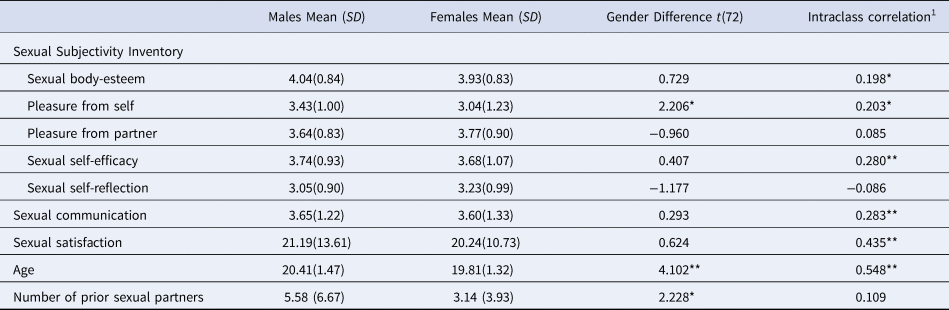
Means, standard deviations, and correlations of the independent, dependent, and covariate variables are presented in Table 1. Several variables were transformed due to significant skew or kurtosis. For males, sexual satisfaction was significantly positively skewed and transformed using the square root transformation. For females, sexual communication was significantly negatively skewed and transformed using the square root transformation.
Descriptive Statistics, Paired t Tests, and Correlation Coefficients for Study Variables by Gender

Note. *p < .05. **p < .01. 1Intraclass correlations of male and female partners’ scores. Pleasure from self = Entitlement to sexual pleasure from self; Pleasure from partner = Entitlement to sexual pleasure from partner; Sexual self-efficacy = Self-efficacy in achieving sexual pleasure.
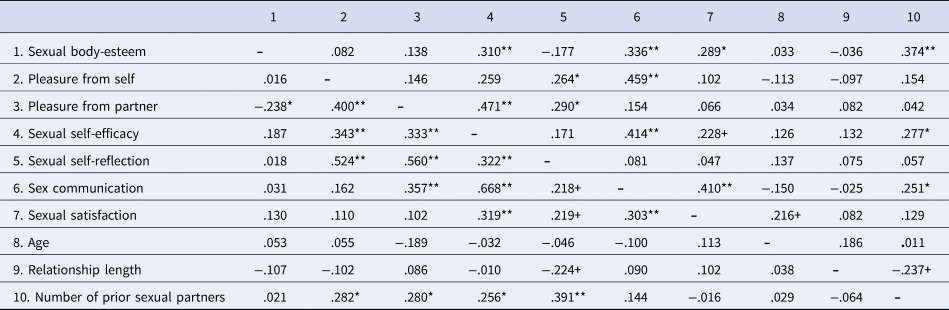
Table 2 shows the patterns of correlation coefficients among study variables within each gender. Consistent with prior research (Zimmer-Gembeck & French, Reference Zimmer-Gembeck and French2016), the five indices of sexual subjectivity were moderately interrelated for males and females. Sexual subjectivity was also associated with sexual relationship functioning. For males, greater sexual body esteem, sense of entitlement to sexual pleasure from self, and self-efficacy in achieving sexual pleasure were each associated with higher levels of sexual communication with current partners. Males’ sexual body esteem was also positively associated with greater sexual satisfaction in their current relationship. Additionally, sexual communication and sexual satisfaction were positively associated. For females, greater self-efficacy in achieving sexual pleasure in their current romantic relationship was associated with higher levels of sexual communication and sexual satisfaction with current partners. Females’ sense of entitlement to sexual pleasure from partner was also positively associated with higher levels of sexual communication.
Bivariate Correlations Between Study Constructs by Gender

Note. + p < .10. *p < .05. **p < .01. Correlations for males are above the diagonal. Correlations for females are below the diagonal. Pleasure from self = Entitlement to sexual pleasure from self; Pleasure from partner = Entitlement to sexual pleasure from partner; Sexual self-efficacy = Self-efficacy in achieving sexual pleasure.
Participant age, relationship length, and number of prior sexual partners were evaluated as potential covariates for the APIM models. Only participants’ number of prior sexual partners was significantly associated with study variables. For males, number of prior sexual partners was associated with greater sexual body-esteem, self-efficacy in achieving sexual pleasure, and sexual communication with one's partner. For females, a greater number of prior sexual partners was related to higher scores on all domains of sexual subjectivity except sexual body-esteem. With respect to relationship functioning, a greater number of prior sexual partners was associated with greater sexual communication for males but not females.
Similarities in Males’ and Females’ Sexual Subjectivity
Correlations and paired sample t tests revealed similarities between romantic partners’ sexual subjectivity (see Table 1). Intraclass correlations indicated similarity on three factors, sexual body-esteem, sense of entitlement to sexual pleasure from self, and self-efficacy in achieving pleasure. Pairwise mean comparisons revealed similarity on all factors except entitlement to sexual pleasure from self, where male partners reported greater entitlement to sexual pleasure from self than their female romantic partners (t = 2.21, p < 0.05).
Actor and Partner Effects of Sexual Subjectivity on Sexual Relationship Functioning
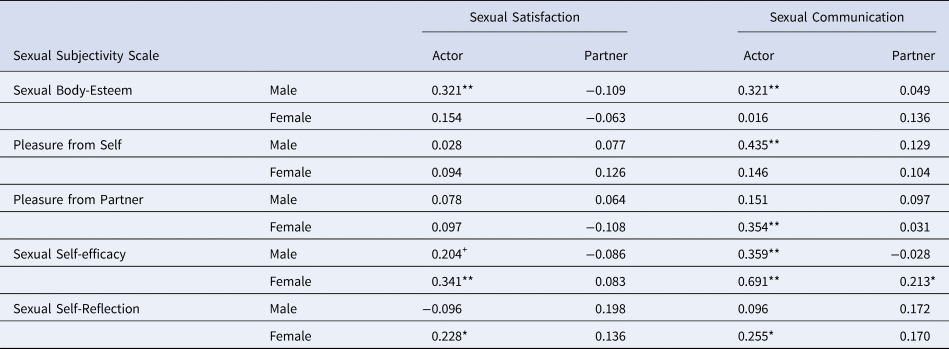
Associations between males’ and females’ sexual subjectivity and sexual relationship functioning were tested using the actor-partner interdependence model (APIM; Kenny et al., Reference Kenny, Kashy and Cook2006) in MPlus Version 6 (Muthèn & Muthèn, Reference Muthén and Muthén1998–2011). Figure 1 illustrates our general approach to the APIM analyses. Because the five domains of sexual subjectivity are viewed as distinct and not reducible to a single factor (Horne & Zimmer-Gembeck, Reference Horne and Zimmer-Gembeck2006), separate path models were computed to examine actor and partner effects for each of the five sexual subjectivity dimensions on dyads’ sexual communication and sexual satisfaction. All models included number of prior sexual partners and age as a covariate. Models run without any covariates revealed a similar pattern of findings. Model fit was assessed using the comparative fit index (CFI) and root mean square error of approximation (RMSEA). Results of the five models are reported below by sexual subjectivity factor, with standardised estimates for model pathways presented in Table 3.
The actor-partner interdependence model of sexual subjectivity and perceptions of sexual satisfaction and sexual communication within a romantic relationship.

Standardised Estimates of Actor/Partner Effects of Sexual Subjectivity on Sexual Functioning by Gender

Note: +p < .10, * p < .05, **p < .01. Pleasure from self = Entitlement to sexual pleasure from self; Pleasure from partner = Entitlement to sexual pleasure from partner; Sexual self-efficacy = Self-efficacy in achieving sexual pleasure. All models included number of prior sexual partners as a covariate. Models run without any covariates revealed a similar pattern of actor and partner effects.
Both actor and partner effects emerged in the sexual self-efficacy model. The overall model fit for this model was adequate, χ2(10) = 7.643, p = .66, CFI = 1.00, RMSEA = 0.00. With respect to actor effects, greater self-efficacy in achieving sexual pleasure was associated with higher levels of sexual communication for both males and females. For females, greater self-efficacy was also related to greater sexual satisfaction. In addition, females’ greater self-efficacy in achieving sexual pleasure was associated with partners’ reports of greater sexual communication in the current relationship. The remaining four models revealed actor but not partner effects. The model for sexual body esteem showed adequate fit, χ2(10) = 10.283, p = .42, CFI = 0.995, RMSEA = 0.020.
Significant actor effects emerged for males’ but not females’ sexual body esteem, such that males’ sexual body-esteem was positively associated with both their sexual satisfaction and sexual communication with current partners. The model for entitlement to sexual pleasure from self showed adequate fit, χ2(10) = 7.282, p = .70, CFI = 1.00, RMSEA = 0.00, and revealed male but not female actor effects. Males’ entitlement to sexual pleasure was positively associated with their sexual communication with current romantic partners. The model for entitlement to sexual pleasure from partner showed adequate fit, χ2(10) = 10.575, p = .39, CFI = 0.986; RMSEA = 0.028). Here, significant actor effects emerged for females but not for males, such that females’ greater sense of entitlement to sexual pleasure from partners was associated with higher levels of sexual communication in their current romantic relationship. The model for sexual self-reflection showed adequate fit, χ2(10) = 8.378, p = .59, CFI = 1.00, RMSEA 0.00, and significant actor effects for females but not for males. Higher levels of female sexual self-reflection were associated with females’ greater sexual satisfaction and greater sexual communication in their current relationships.
Discussion
The current study is the first we know of to examine sexual subjectivity from a dyadic perspective. We sought to broaden the research base linking sexual self-perceptions to patterns of sexual and romantic experiences by comparing romantic partners’ sexual self-perceptions and their associations with each person's perceptions of sexual relationship functioning. Our results are consistent with prior research linking sexual subjectivity to sexual wellbeing (Hewitt-Stubbs et al., Reference Hewitt-Stubbs, Zimmer-Gembeck, Mastro and Boislard2016; Horne & Zimmer-Gembeck, Reference Horne and Zimmer-Gembeck2006; Mastro & Zimmer-Gembeck, Reference Mastro and Zimmer-Gembeck2015; Rivera et al., Reference Rivera, Simon, Partridge and Smith2019; Zimmer-Gembeck & French, Reference Zimmer-Gembeck and French2016; Zimmer-Gembeck et al., Reference Zimmer-Gembeck, Ducat and Boislard-Pepin2011) while also pointing to the utility of a dyadic perspective. For example, partners had similar levels of sexual subjectivity on four of five elements, and their scores were significantly correlated on three of the five elements. Accounting for similarity and prior sexual experience, elements of sexual subjectivity were associated with men and women's sexual communication and, to a lesser extent, their sexual satisfaction with current partners.
It is well established that people tend to date those with similar demographic, cognitive, social and psychological characteristics (Bleske-Rechek & Remiker, Reference Bleske-Rechek, Remiker and Baker2009; Furman & Simon, Reference Furman, Simon, Prinstein and Dodge2008; Simon et al., Reference Simon, Aikins and Prinstein2008). The current results add to this literature to suggest that as early as late adolescence, couple members may share similar sexual self-perceptions of sexual body esteem, sexual self-efficacy, and entitlement to sexual pleasure from self. Because the couples in this study were in ongoing relationships, the extent to which observed similarities may also be due to socialisation effects cannot be determined. Identifying prospective dyads prior to the start of a relationship is the clearest means of disentangling selection from socialisation effects but is also methodologically challenging. Studying individuals over the course of consecutive relationships would also improve our understanding of how development intersects with relationship experience and partner characteristics. Nonetheless, observed similarities in this study are notable given the centrality of sexual attraction and behaviour to romantic relationships. Sexual self-perceptions and beliefs continue to develop with age and experience (Zimmer-Gembeck et al., Reference Zimmer-Gembeck, Ducat and Boislard-Pepin2011), and early selection (or socialisation) effects in sexual self-perceptions might increase the likelihood that fragile sexual self-concepts remain vulnerable over time. Prospective studies of adolescents and their partners are needed to assess potential reinforcement effects and mitigating factors across age and relationships. Such work will be important for understanding early indicators of sexual wellbeing, a neglected area of study, as well as potential targets of intervention for males and females. Longitudinal research may also shed light on the two dimensions of sexual subjectivity that were unrelated in our sample — sense of entitlement to sexual pleasure from partner and sexual self-reflection. As little is known about sexual subjectivity beyond early adulthood, it is unclear whether couples become more similar on these dimensions over time within or across relationships.
We found little evidence of gender differences in sexual subjectivity within dyads. The only difference was that men reported greater entitlement to sexual self-pleasure than women. This finding parallels the large effect size found in the only other mixed-gender study of this element of sexual subjectivity (Zimmer-Gembeck & French, Reference Zimmer-Gembeck and French2016). It is also consistent with international and meta-analytic findings of higher rates of autoerotic behaviour among men than women (Gerressu, Mercer, Graham, Wellings, & Johnson, Reference Gerressu, Mercer, Graham, Wellings and Johnson2008; Richters, Grulich, de Visser, Smith & Rissel, Reference Richters, Grulich, de Visser, Smith and Rissel2003). Like Hewett-Stubbs and colleagues (2016), but unlike Zimmer-Gembeck and French (Reference Zimmer-Gembeck and French2016), we found no gender differences in sexual self-efficacy. However, the effect size for difference reported by Zimmer-Gembeck and French (Reference Zimmer-Gembeck and French2016) for women's lower self-efficacy was modest, suggesting that there may be more variability within than between genders on this and other elements of sexual subjectivity. The current findings support this view and suggest that there may be more variability between than within heterosexual couples on most elements of sexual subjectivity. Given the modest sample size and novelty of the current study, replication with larger samples is needed to disentangle effects due to gender versus partner similarity.
After accounting for partner similarity, greater sexual subjectivity was associated with sexual relationship functioning. Men and women who were more confident in their ability to achieve sexual pleasure with partners also reported engaging in more sexual communication with their current partners. Sexual self-efficacy entails knowledge about sexual techniques one finds pleasurable and a willingness to share this information with partners. The current findings suggest that sexual self-efficacy may be more likely to manifest as sexual communication with romantic partners. When women had greater self-efficacy, their partners also reported engaging in more sexual communication. Surprisingly, greater self-efficacy was not associated with greater satisfaction. However, findings by Ménard and Offman (Reference Ménard and Offman2009) suggest that self-efficacy may increase satisfaction through its effects on sexual communication. Longitudinal dyadic work is needed to evaluate whether greater sexual subjectivity facilitates greater satisfaction by increasing sexual assertiveness.
Apart from sexual self-efficacy, other associations between sexual subjectivity and relationship functioning differed by gender. For males, self-focused constructs, such as body esteem and entitlement to self-pleasure were associated with engaging in more sexual communication and, in the case of body esteem, experiencing greater sexual satisfaction. For females, more relational aspects of the sexual self (i.e., entitlement to pleasure from partners and sexual reflection) were associated with engaging in more sexual communication and, in the case of sexual reflection, experiencing greater sexual satisfaction. These results are consistent with studies suggesting that women tend to have more relational orientations towards sexuality while men more often take a body-centered perspective (Crawford & Popp, Reference Crawford and Popp2003; DeLamater, Reference DeLamater and Kelley1987; Meston & Buss, Reference Meston and Buss2007; Petersen & Hyde, Reference Petersen and Hyde2010). Similar gendered patterns exist for sexual initiation, with men being more likely than women to view themselves taking the active role in sexual encounters and to initiate sexual activity in relationships (Impett & Peplau, Reference Impett and Peplau2003; Petersen & Hyde, Reference Petersen and Hyde2010). Gendered prescriptions about autoerotic pleasure also encourage males’ embodiment of sexual pleasure and females’ reliance on partners for sexual arousal. Accordingly, men's sexual relationship functioning is tied to the embodiment of body esteem and self-pleasure whereas women's is connected to their perceived entitlement to pleasure from partners and capacity to reflect upon these experiences for future sexual decisions and planning.
As expected, emerging adults’ sexual subjectivity was largely unrelated to their partners’ perceptions of relationship functioning. The relative absence of partner effects might be a function of participants’ developmental status. While sexual interest and behaviour is characteristic of even early romantic relationships, it is not until late adolescence and early adulthood that more intense sexual behaviours involving genital contact become common (Lindberg, Jones, & Santelli, Reference Lindberg, Jones and Santelli2008; Grello, Welsh, & Harper, Reference Grello, Welsh and Harper2006; Kaestle & Halpern, Reference Kaestle and Halpern2007). These and other changes in relationship intimacy during emerging adulthood give rise to transformations in romantic and sexual self-concepts (Collins et al., Reference Collins, Welsh and Furman2009; Lefkowitz & Gillen, Reference Lefkowitz, Gillen, Arnett and Tanner2006; Hewitt-Stubbs et al., Reference Hewitt-Stubbs, Zimmer-Gembeck, Mastro and Boislard2016). Such transformations in sexual self-concept may well follow a similar pattern as those of the self as a romantic partner, where early self-centred conceptions become increasingly relational in nature with maturity and experience (Connolly & Goldberg, Reference Connolly, Goldberg, Furman, Brown and Feiring1999; Seiffge-Krenke, Reference Seiffge-Krenke2003). Additionally, the incorporation of partners’ sexual subjectivity into one's own behaviours and attitudes with specific romantic partners requires a degree of perspective-taking that may be less characteristic of emerging adulthood (Arnett, Reference Arnett, Arnett and Tanner2006; Feiring et al., Reference Feiring, Markus and Simon2018; Lefkowitz & Gillen, Reference Lefkowitz, Gillen, Arnett and Tanner2006). As young adults become more motivated to engage in more serious relationships (Pasupathi, Monsour, & Brubaker, Reference Pasupathi, Mansour and Brubaker2007) and their motivations for sexual behavior become less self-oriented (Leveque & Pedersen, Reference Leveque and Pedersen2012), perceptions of sexual functioning may increasingly reflect the sexual selves of both relationship partners. Similar patterns of age-related partner influence have been observed for indicators of individual wellbeing, such as satisfaction, affect, and self-esteem (Orth, Erol, Ledermann, & Grobb, Reference Orth, Erol, Ledermann and Grob2018). Longitudinal investigation of sexual subjectivity within and across relationships over time is warranted to assess for mutual influence in sexual functioning.
The current study is the first to highlight the significance of a dyadic perspective on sexual subjectivity for emerging adult couples’ sexual functioning. Several methodological limitations are worth noting in interpreting and building upon our findings. Although the current sample was more diverse than prior studies of sexual subjectivity, the generalisability of the current findings may be limited to non-cohabitating heterosexual couples where at least one partner was a university college student enrolled in a psychology course. Given that approximately one third of emerging adults do not enroll in college (U.S. Bureau of Labor Statistics, 2019), additional studies with young adult couples where neither partner attends college (e.g., couples in the workforce) is needed. Research is also needed to understand the dynamics of sexual subjectivity within cohabitating couples, especially in light of secular trends towards increasing rates of cohabitation in early adulthood (U.S. Census Bureau, 2018). Likewise, research with non- heterosexual couples would enhance our understanding of gender and sexual identities intersect to shape sexual self-perceptions and couple functioning. Longitudinal research on sexual subjectivity within and across relationships of heterosexual and non-heterosexual couples would also add greatly to our understanding of how experiences with specific partners shape sexual development. Such work should move beyond the current study's exclusive reliance on self- report to incorporate other methodologies such as behavioral indices of couples’ functioning (e.g., observed sexual communication). Limitations notwithstanding, the current study offers a key step toward understanding sexual self-schema within the context of romantic dyads, both for the health of the sexual romantic relationship and the self-concepts of relationship partners.