In one of the most remarkable and effective series of advances in the history of medicine, the development and implementation of combinatorial antiviral therapy (ART) over a decade ago led to a marked decline in morbidity and mortality in HIV-1-infected individuals in the developed world (Ref. Reference Palella1). However, although sustained suppression of plasma viraemia to below clinically detectable limits at first led to hope that HIV-1 infection could be eradicated over time (Ref. Reference Perelson2), HIV-1 has not been cured by ART. Instead, the multifaceted nature of viral persistence has revealed new and daunting obstacles to further advances in therapy.
The foremost impediment in the eradication of HIV-1 is the establishment of viral reservoirs that provide a persistent source of recrudescent viraemia following the interruption of ART. HIV reservoirs have been characterised as cells or tissues that restrict virus replication and preserve replication-competent HIV for long periods of time (Ref. Reference Nickle3). Reservoirs contain infectious virus with greater stability (a longer half-life) than virus in cells where active viral expression is ongoing (Ref. Reference Blankson, Persaud and Siliciano4). Of these reservoirs, the latent proviral reservoir is conceptually the most difficult obstacle to viral eradication. The capacity of HIV-1 to establish latent infection within a population of infected but resting CD4+ T cells allows viral persistence despite immune surveillance or ART. Experiments suggest that the resting T cell reservoir is established early after infection and is extremely stable.
In parallel with the problem of HIV-1 persistence within resting CD4+ T cells, is the persistence of ongoing viral expression in other long-lived cell populations and in drug sanctuary sites. This is partially related to inadequate drug potency, suboptimal antiviral pharmacodynamics and HIV evasion of the immune response (Refs Reference Pierson, McArthur and Siliciano5, Reference Pomerantz6). Consequently, to clear HIV infection, improvements in both current antiviral therapy and the development of novel anti-latency therapies are required.
Dynamics of viral replication
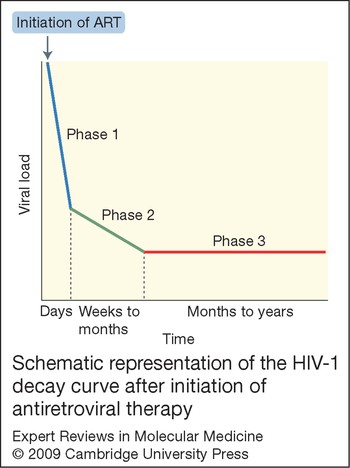
The mechanisms of viral persistence are intrinsically linked to the basic mechanisms that underlie viral replication. In the natural host, HIV replication is a highly dynamic process involving continuous rounds of infection with rapid turnover of both free virus and virus-producing cells. More than 99% of this replication occurs in activated and productively infected CD4+ T cells throughout the peripheral blood and lymphoid tissues. The half-life of a virion in plasma is less than 6 hours (Ref. Reference Perelson7) and that of infected cells is 1–2 days (Refs Reference Ho8, Reference Wei9). Upon initiation of ART in the patient who is naive to therapy, the plasma viral load follows a characteristic decay curve that occurs in three distinct phases (Fig. 1).
Schematic representation of the HIV-1 decay curve after initiation of antiretroviral therapy. Upon initiation of antiretroviral therapy (ART) in the therapy-naive patient, the plasma HIV-1 viral load follows a characteristic decay curve that occurs in three distinct phases. Phase 1 reflects clearance of free virions and the loss of productively infected cells, mainly short-lived CD4+ T cells. Phase 2 represents the turnover of a longer-lived cell population, which remains undefined but might include infected monocytes and macrophages and follicular dendritic cells. Phase 3 represents the stability of viral turnover of latently infected cells.

The initial phase of decay produces a rapid decline in plasma HIV-1 RNA, clearing the majority of circulating viruses in 1–2 weeks (Refs Reference Ho8, Reference Wei9). This initial phase is thought to reflect the clearance of free virions and the loss of productively infected cells, mainly short-lived CD4+ T cells (Ref. Reference Perelson2). The phase-one decay rate has historically been used to assess the efficacy of an ART regimen (Refs Reference Polis10, Reference Louie11, Reference Kuritzkes12).
The second phase of plasma viral load decay occurs at a slower rate. The half-life of this compartment is estimated to be 1–4 weeks, and has been interpreted as reflecting the turnover of a longer-lived cell population (Ref. Reference Perelson7). However, the nature of the responsible cellular reservoir(s) remains unclear. It is hypothesised, but unproven, that infected macrophages and monocytes contribute to this slower second phase. This population of cells has a slow turnover rate with a half-life of ∼2 weeks following differentiation (Ref. Reference Ho, Rota and Hirsch13). Infected macrophages and monocytes are also less sensitive to the in vitro cytopathic effect of HIV-1 gene expression (Refs Reference Gartner14, Reference Sonza15) and might continue to produce virus throughout their lifespan. Interestingly, raltegravir (MK-0518), a recently licensed inhibitor of HIV integrase, yielded a faster time to suppression of viraemia than that observed in patients undergoing a potent highly active antiretroviral therapy (HAART) regimen based on non-nucleoside reverse transcriptase inhibitors (NNRTIs) (Refs Reference Markowitz16, Reference Murray17). A second phase of decay was not observed.
This observation has led to the speculation that macrophages and/or monocytes might not be a distinct source of virus production during viral decay, and that similarly, cell cycle turnover of CD4+ T cells in a lesser state of activation produces virions during the second phase of decay. These T cells may carry the integrated provirus in a nonreplicative state until the activation process is complete, and this process may be more fully blocked by inhibitors of integration (Refs Reference Perelson7, Reference Murray17, Reference Bonhoeffer18, Reference Stevenson19, Reference Haase20, Reference Li21).
Another significant reservoir, which may also contribute to prolonged decay of viraemia during ART, is the follicular dendritic cell (FDC). FDCs are found in large quantities in the germinal centre of secondary lymphoid tissues and although FDCs are impervious to infection, they have thread-like tentacles that trap HIV virions in the form of immune complexes on their surfaces for display to the immune system. The entrapped virions are infectious despite their association with neutralising antibody (Ref. Reference Heath22). FDCs directly interact with resting CD4+ T cells through the cell surface adhesion proteins DC-SIGN (dendritic cell-specific intercellular adhesion molecule-3-grabbing non-integrin) of FDCs and ICAM3 (intracellular adhesion molecule 3) of resting T cells (Ref. Reference Geijtenbeek23). The transient adhesion of the T cells to FDCs induces proliferation of the resting T cells, and probably enables new infection to occur. A rapid biphasic decay of FDCs after the initiation of ART has been reported and this is followed by a slower third phase of decay, which clears after 6 months of successful therapy (Refs Reference Cavert24, Reference Hlavacek25). However, mathematical modelling suggests that some virus could be retained on FDCs for years (Refs Reference Garcia26, Reference Hlavacek27). Supporting this is a recent study (Ref. Reference Keele28) in which FDCs from lymph nodes were isolated and viral outgrowth studies performed. In two out of four patients, phylogenetic analyses of virus from these samples compared with virus obtained up to 22 months previously were similar. One interpretation of this result is that replication-competent virus might be archived in this reservoir for many months.
The third and final stage of viral decay occurs several months after initiation of ART, when plasma viraemia becomes clinically undetectable by current clinical assays (Ref. Reference Finzi and Siliciano29). However, a low level of viraemia that is detectable by ultrasensitive assays persists (Refs Reference Di Mascio30, Reference Dornadula31). The slow and decelerating decay pattern of the third phase is consistent with virus production by latently infected cells, which is governed by heterogeneous lymphocyte activation, clearance and a trend towards an increasing proportion of stable lymphocytes (Refs Reference Muller, Vigueras-Gomez and Bonhoeffer32, Reference Strain33). However, long-term studies of this low-level viraemia do not clearly demonstrate a positive slope of this final phase of decay (Refs Reference Maldarelli34, Reference Palmer35). Thus, the source from which this stable leak of viraemia originates is unclear, as are the mechanisms for its stability.
Mechanisms of viral persistence
Quiescent proviral infection in T cells
In 1997 three research groups definitively demonstrated that integrated, replication-competent HIV persists within the resting CD4+ memory T cells of HIV-infected patients (Refs Reference Chun36, Reference Chun37, Reference Chun38, Reference Finzi39, Reference Wong40). In patients who are able to maintain clinically effective ART, this reservoir of virus appears to be extremely rare. The frequency of infection of such resting CD4+ T cells is widely quoted as approximately one per million cells. Although this is a good approximation, in many patients who have been suppressed (<50 copies HIV RNA per ml) for several years, the frequency is up to 20 times lower, or 0.5–0.05 infected cells per million (Ref. Reference Chun41).
Regardless of the rarity of latent infection, the resting T cell reservoir is established early after infection and is extremely stable (Ref. Reference Siliciano42). Longitudinal clinical studies find a very slow decay of infection, and suggest that the half-life of these stably infected cells is approximately 44 months (Refs Reference Strain33, Reference Siliciano42, Reference Siliciano and Siliciano43). A daunting 60 years of continuous ART would be needed to eliminate infected resting T cells, making the eradication of infection by current ART impractical.
Recent work reports a more rapid decay of the latent reservoir in patients initiating ART during early or acute HIV infection. In these patients, the frequency of infection within CD8-depleted PBMCs (Ref. Reference Strain44) or resting CD4+ T cells (Ref. Reference Chun45) appeared to decline steeply. Strain and colleagues found that the number of infected CD4+ T cells recoverable from patients on ART is significantly less than 1 per million if therapy is initiated during the acute stage of infection, near the time of seroconversion, compared with those treated later in chronic infection (Ref. Reference Strain44). In a cohort of patients treated in acute or early HIV infection, serial long-term measurements of resting CD4+ T cell infection in seven patients receiving ART for 31–54 months was performed (Ref. Reference Chun45). The frequency of latent infection plummeted within the first 12–24 months to levels 10–100 times less than that typically seen (between 2.5 and 15 infected cells per billion resting CD4+ T cells). This corresponds to a half-life of the latent compartment of 4.6 months, which translates to a requirement of 7.7 years of ART to eradicate infection. But at least four of the seven patients studied appeared to exhibit a second and slower phase of decay, suggesting that the frequency of infection might not diminish to more than 1 cell per billion after years of therapy (Ref. Reference Margolis and Archin46). Nevertheless, these results are encouraging in that the initiation of ART during acute infection appears to dramatically limit stability of persistent infection. Studies in our laboratory of resting cell infection in patients treated before seroconversion and within the first 12 weeks of the estimated date of infection found that the frequency of infection was extremely rare (Archin, N.M. and Margolis, D.M. unpublished).
Latent infection of resting CD4+ cells results primarily when an activated T cell reverts to the resting state shortly after the completion of proviral integration. Nonactivated cells can support reverse transcription and integration, albeit less efficiently, but later steps of the viral lifecycle are significantly impaired while the cell is in the resting state (Ref. Reference Williams and Greene47). Ex vivo infections have also demonstrated that resting cells are susceptible to direct infection by HIV, although presumably this event occurs inefficiently and infrequently in vivo (Ref. Reference Swiggard48). In tissue culture systems, it has also been observed that HIV infection of macrophages can induce cytokine signals that result in a permissive state for HIV infection in unstimulated T cells (Ref. Reference Swingler49). Infection within the thymus might also occur (Ref. Reference Brooks50), although far fewer infected naive cells than memory cells can be detected in vivo (Ref. Reference Brenchley51). So, although the relative frequency of these events is unclear, several mechanisms might result in the stable, quiescent proviral infection of resting CD4+ T cells.
Persistent proviral infection in other cell types and compartments
To date, the resting CD4+ T cell compartment is the best-studied reservoir of persistent proviral infection and represents the majority of latent infection existing in patients who have received long-term suppressive ART. However, other potential cellular reservoirs have been proposed (Refs Reference Bailey52, Reference Chun53, Reference Zhu54).
Macrophages and monocytes are long-lived cells that might survive despite ongoing low levels of virus production, and serve as potential sites of persistent viral infection (Refs Reference Sonza15, Reference Lambotte55). Recently a minor subset of CD16+ monocytes has been shown to be more permissive to HIV-1 replication compared with the major CD14highCD16– compartment, and HIV-1 was identified within the CD16+ monocytes of patients after full suppression on HAART (Ref. Reference Ellery56). However, clear evidence that these cells carry quiescent provirus in vivo for many months, as observed in resting T cells, has not yet been provided. This is an important distinction, because viral persistence in a cell that is expressing viral proteins or particles might be addressed by improvements in ART or the antiviral immune response. Alternatively, integration of HIV-1 into the viral genome of bone marrow progenitor cells has been hypothesised to be a source of ongoing residual viraemia (Ref. Reference Bailey52). If this idea is verified, improvements in ART would not impact this persistent source of viraemia, and novel cell-targeting therapies might well be required.
Aside from persistence in specific cell types, specialised lymphoid compartments also retain replication-competent virus, as discussed previously. Recent measurements of persistence of HIV within FDCs (Ref. Reference Keele28) contrast with the absence of virus within circulating dendritic cells in patients on potent ART (Ref. Reference Otero57).
Persistent viral replication in the largest human lymphoid organ system – the gut-associated lymphoid tissue (GALT) – is also of current interest. This compartment contains the highest levels of activated CD4+ T cells, which efficiently support HIV replication (Ref. Reference Mowat and Viney58), and becomes profoundly depleted early in infection (Ref. Reference Veazey59). A recent study found persistence of HIV DNA within the GALT of patients while on drugs suppressing plasma viraemia. The researchers concluded that the replication in the GALT is disproportionately higher than in the peripheral blood (Ref. Reference Chun60). However, it should be noted that detection of HIV DNA within lymphocytes found in the GALT does not formally prove that HIV entered cells and replicated while in the GALT rather than trafficked to the GALT after infection. Whether there is a qualitative difference in replication within the GALT compared with the plasma or other tissues is not clear. It might be that at current concentrations ART is less effective in the gut tissue.
HIV might also persist in non-lymphoid cell types (Ref. Reference Polis61). Virus spread to the central nervous system (CNS) has been documented early in infection in several studies, and might persist in nervous tissue cells such as microglia and astrocytes, or in cells of the cerebrospinal fluid (Refs Reference Bell62, Reference Kramer-Hammerle63, Reference Lambotte64). Some of the antiviral drugs currently used in ART have limited penetration through the blood–brain barrier of the CNS, and this deficiency of therapy could be a major contributor to CNS persistence.
The genitourinary tract of aviraemic ART-treated patients has been shown to be a site of HIV replication, perhaps as a result of the limited penetration of antiretroviral drugs into this compartment. HIV has been found in seminal fluid, T cells and macrophages recovered from the semen of individuals on HAART (Refs Reference Craigo65, Reference Nunnari66).
Viral RNA has been detected by in situ hybridisation within kidney epithelial cells (Refs Reference Marras67, Reference Winston68). HIV mRNA was present in the kidney epithelial cells of a patient on HAART with undetectable plasma HIV RNA, however, particle production from these cells has not been reported. The group found that kidney epithelium might support the active replication of virus and phylogenic compartmentalisation of virus (Ref Reference Marras67). The mechanism by which virus infects kidney epithelial cells is not known, but is hypothesised to involve the fusion of viral glycoproteins with other unidentified receptors.
Thus, HIV-1 is able to persist in the body quietly within resting CD4+ T cells or in other lymphoid and non-lymphoid reservoirs. Regardless of either ongoing cryptic expression or intermittent reactivation from quiescent T cells, a continual source of virus subsists to replenish the long-lived latent pool. If estimates of the decay characteristics are true, then any addition of newly quiescent cells to this population, even rare events, could delay decay. If eradication of HIV-1 from the host is to be realised, the development of more potent ART to fully suppress any residual viraemia and achieve suppressive levels throughout the anatomical compartments in which HIV replicate, in parallel with new therapies to target and destroy cells that harbour HIV is crucial.
Therapeutic strategies towards eradication of HIV
Induction of T cell activation
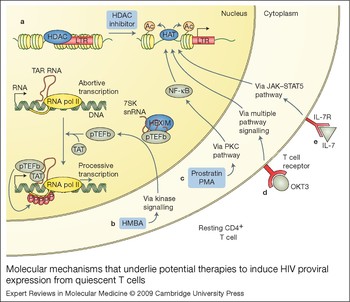
Shortly after the discovery of the persistence of HIV infection despite ART, several groups led the pursuit for HIV eradication in the infected individual (Ref. Reference Hamer69). The hypothesis tested was that induction of T cell activation would result in expression of HIV within cells that were latently infected, and that viral expression would result in clearance of virus through cell death. Several reagents were used in what was termed immune activation therapy. Interleukin-2 (IL-2), alone or in combination with the anti-T-cell-receptor antibody OKT3, was used to activate resting T cells via binding of the T cell receptor (Fig. 2). IL-2 therapy leads to an expansion and prolonged survival of the CD4+ T cells, as well as a transient expression of virus in infected patients (Refs Reference Siliciano and Siliciano43, Reference Davey70, Reference Kovacs71, Reference Kovacs72, Reference Simonelli73). However, if stimulation is sufficient to upregulate the high-affinity IL-2 receptor, cellular proliferation and proinflammatory cytokine secretion is induced (Ref. Reference Bich-Thuy74).
Molecular mechanisms underlying potential therapies to induce HIV proviral expression from quiescent T cells. (a) Inhibition of HDACs (histone deacetylases) leads to histone acetylation (Ac) by histone actetyltransferases (HATs) and chromatin remodelling, which allows expression of the viral long terminal repeat (LTR) promoter. (b) Via kinase signalling, hexamethylbisacetamide (HMBA) stimulates the release of positive transcription elongation factor b (pTEFb) from sequestration within a ribonucleoprotein complex containing HEXIM and 7SK snRNA (small nuclear RNA). Tat then recruits pTEFb to the TAR RNA structure at the 5′ end of the nascent HIV RNA allowing for phosphorylation and activation of RNA polymerase II and other factors, leading to processive transcription. (c) Prostratin and its analogue (PMA) stimulate HIV through protein kinase C (PKC)-mediated activation of nuclear factor kappa B, a transcription factor. (d) OKT3, an anti-T-cell-receptor (TCR) antibody, binds strongly to the TCR and induces global activation of the resting T cells via several pathways. This generalised activation also induces transcription from the HIV LTR. (e) Interleukin 7 (IL-7) is a cytokine essential for maintenance of T cell homeostasis. IL-7 can induce HIV expression from quiescent resting cells without global T cell activation, probably via the JAK–STAT5 signalling pathway. IL-2 functions similarly (not shown). Abbreviations: HIV, human immunodeficiency virus; HDAC, histone deacetylase; Ac, represents acetylation; HAT, histone acetyltransferase; LTR, long terminal repeat; HMBA, hexamethylbisacetamide; pTEFb, positive transcription elongation factor b; snRNA, small nuclear ribonucleic acid; TAR, HIV transactivation response element; PKC, protein kinase C; NF-κB, nuclear factor kappa B; OKT3, anti-T-cell-receptor antibody; IL-7, interleukin-7; IL-2, interleukin-2.

The first studies utilising IL-2 therapy in combination ART showed comparatively fewer latently infected resting CD4+ T cells in patients receiving IL-2 than seen in patients receiving HAART alone (Ref. Reference Chun75). Later studies in patients treated with both ART and IL-2 therapy within 6 months of symptoms of infection showed no decrease in the latently infected CD4+ resting T cell pool (Ref. Reference Dybul76). The administration of IL-2 therapy concurrently with early ART augmented CD4+ cell reconstitution (Refs Reference Kulkosky77, Reference Stellbrink78). In some of these patients, no HIV virus or RNA could be detected, but an interruption of therapy was followed by a rebound in viraemia.
Interestingly, IL-2 therapy induced the expansion of a subpopulation of T cells with intermediate phenotype between those of memory and naive cells that was less susceptible to apoptosis than memory cells. This population of cells also expressed high levels of the forkhead transcription factor P3 (FoxP3) and might have an important role in T cell homeostasis (Ref. Reference Sereti79). However, FoxP3 has also been shown to repress HIV expression (Ref. Reference Grant80) and it is conceivable that IL-2 exposure could result in the infection of some cells that resist apoptosis, and in which HIV expression is dampened – a situation that could create latently infected cells.
Later studies attempted to improve the result of therapy with IL-2 and ART by intensifying T cell activation and purging. Patients on ART and IL-2 were also treated with OKT3 antibody to globally deplete T cells. Unfortunately, these efforts also resulted in a cytokine-storm syndrome, with some patients suffering severe toxicities, such as seizures and acute renal failure requiring short-term haemodialysis (Ref. Reference Prins81). Depletion of CD4+ cells after ablative OKT3 therapy was not reversible (Ref. Reference van Praag82).
Some studies have attempted to avoid toxicity through the use of submaximal doses of OKT3 (Ref. Reference Kulkosky77). Although more tolerable, plasma viraemia returned several weeks after treatment interruption, despite no detection of replication-competent virus following treatment. The investigators did show that the spectrum of viral genotypes of rebounding virus differed significantly from isolates recovered at the start of the study, suggesting that a significant modulation of the viral pool had been effected, but the specific sources of rebound virus were difficult to identify.
Unfortunately, it is not possible to quantify progress towards eradication in such studies, as thus far we have only been able to seek absolute success and have measured only viral rebound. Nonetheless, these clinical experiments are vital to the future success of eradication. Instead of a full-frontal assault on global T cell activation, researchers have also attempted to induce proviral reactivation through gentler manipulation of T cell signaling pathways, and by removing innate barriers to proviral expression.
Induction of viral expression
Interleukin 7 (IL-7) is a cytokine essential for the maintenance of T cell homeostasis. Plasma levels of IL-7 increase as HIV viraemia increases and CD4+ T cell counts decline during HIV infection (Ref. Reference Napolitano83). After ART, levels of IL-7 again decline once CD4+ cell counts have recovered (Ref. Reference Llano84). HIV expression can be induced from quiescent resting cells probably via JAK–STAT5 signalling (Ref. Reference Ducrey-Rundquist, Guyader and Trono85) (Fig. 2).
Two studies show that IL-7 induces expression of latent virus ex vivo from resting CD4 T cells of HIV-infected individuals on ART (Refs Reference Lehrman86, Reference Wang87). Both studies found that IL-7 is a viable clinical candidate for this application, but the studies differed in the comparative measures of the efficiency with which IL-7 induced the expression of latent HIV. Lehrman and colleagues (Ref. Reference Lehrman86) compared the frequency of recovery from multiple limiting-dilution resting T cell outgrowth assays. Viral recovery was more frequent after mitogen activation than with IL-7, suggesting that global mitogen stimulation induced latent HIV expression from a larger proportion of latently infected cells than did IL-7. As the frequency of latent infection is rare, and the total number of infected cells studied relatively small, the differences observed were not statistically significant. Wang and colleagues (Ref. Reference Wang87) felt that IL-7 was a superior reagent for clinical use, because unique viral isolates were induced by IL-7. On the basis of clinical tolerability alone, it might prove to be an excellent candidate for combination therapies for reactivating different species of virus from latency. A small Phase I study (ACTG 5214) of single-dose IL-7 in HIV infection has been recently completed (Ref. Reference Sereti88).
An alternative path to the induction of latent proviral expression is signalling through protein kinase C (PKC) (Ref. Reference Trushin89). Prostratin, a nontumorigenic phorbol ester isolated from the Somoan medicinal plant Homolanthus nutans, has been shown to induce HIV expression in latently infected cell lines and primary cells from HIV-infected, ART-treated patients in the absence of cellular proliferation (Refs Reference Kulkosky90, Reference Kulkosky91). In cell-line models, prostratin stimulates HIV through PKC-mediated nuclear factor kappa B activation (Ref. Reference Williams92).
Not unexpectedly, PKC signalling has other widespread effects on the host cell. Remarkably, the ‘off-target’ effects of prostratin appear to be ideal: the compound also downregulates expression of the HIV receptors CD4 and CXCR4, inhibiting de novo HIV infection in culture. This bipolar effect offers the tantalising possibility that prostratin could induce ‘purging’ of the resting T cell viral reservoir while limiting de novo infection (Refs Reference Biancotto93, Reference Gulakowski94). Unfortunately, the limited supply of prostratin has hindered development. However, a recent breakthrough in the production of fully synthetic prostratin and analogues of prostratin has been reported (Ref. Reference Wender, Kee and Warrington95), and with this comes the potential for future human clinical trials.
Hexamethylene bisacetamide (HMBA) is another agent that was recognised to induce HIV expression via PKC modulation (Refs Reference Melloni96, Reference Zeichner97, Reference Zoumpourlis and Spandidos98). HMBA induction of HIV long terminal repeat (LTR) expression has been reported via the phosphatidylinositol 3-kinase pathway (Ref. Reference Contreras99), although our laboratory has also illustrated a role for signalling via the PKCμ pathway (Ref. Reference Choudhary, Archin and Margolis100). HMBA was initially developed as an anticancer drug (Ref. Reference Reuben, Rifkind and Marks101), following the recognition that it induced differentiation in leukaemia and solid tumour cell lines (Refs Reference Reuben, Rifkind and Marks101, Reference Gazitt102). However, although tolerated in Phase I and Phase II trials, it was found to lack antitumour efficacy (Ref. Reference Andreeff103). Like prostratin, we found that HMBA downregulated the surface expression of the CD4 receptor on T cells, did not enhance de novo cell infection, and suppressed HIV propagation in ex vivo primary blood mononuclear cell (PBMC) cultures (Ref. Reference Klichko104).
A unique property of HMBA is that it can activate proviral replication in the absence of the HIV viral transactivator protein, Tat, whereas prostratin acts via Tat (Ref. Reference Sung and Rice105). High-level HIV replication depends on the action of Tat, and the presence of sufficient quantities of Tat can significantly delay entry into latency (Ref. Reference Pearson106). Tat acts to alter the characteristics of transcription factors at the HIV promoter by recruiting the cellular kinase complex pTEFb to the HIV LTR (Ref. Reference Brady and Kashanchi107). pTEFb is tightly regulated in the cell, sequestered in a complex with the HEXIM proteins (Ref. Reference He, Pezda and Zhou108). When Tat is expressed, it outcompetes HEXIM, recruiting pTEFb to the HIV promoter (Ref. Reference He, Pezda and Zhou108). HMBA is able to activate LTR expression in the absence of Tat, by inducing the release of pTEFb from HEXIM. As a result HMBA specifically overcomes a major obstacle to the expression of latent HIV provirus, and can induce expression of latent HIV from the resting CD4+ T cells of patients (Ref. Reference Choudhary, Archin and Margolis100). As mentioned above, pilot human clinical trials suggest that HMBA or agents like it might be developed as therapeutics to target latent HIV provirus.
Induction of viral expression without host cell activation
T cell activation appears capable of inducing reactivation of latent HIV provirus within resting CD4+ T cells, but at a cost. Such induction of viral replication may increase the number of uninfected target cells, and the number of new viral particles produced may be beyond what can be contained by ART. Although multiple obstacles to full expression of latent HIV provirus are present, the virus appears to be able to make a very rapid and nearly biphasic transition from the off to the on state, primarily driven by the potent and multifunctional properties of the Tat transactivator (Refs Reference Arlen109, Reference Weinberger110). Accordingly, ideal antilatency therapeutics might nudge proviral expression over the edge of this kinetic hill, and selectively induce virus outgrowth, with a limited effect on host gene expression.
An ideal reagent for targeting latent proviral DNA would be one that specifically recognises unique HIV sequences. Pyrrole imidazole polyamides, developed by the Dervan laboratory at CalTech, are small-molecule DNA-binding reagents that recognise specific DNA sequences (Ref. Reference Cho, Parks and Dervan111). Polyamides targeted to specific sites within the HIV promoter specifically blocked recruitment of histone deacetylase (HDAC) to the LTR promoter and increased LTR expression (Ref. Reference Coull112). This suggested that HDAC activity at the LTR contributes to HIV latency. Indeed, exposure to any of four distinct and specific polyamides that block the recruitment of HDAC allowed the recovery of replication-competent HIV from cultures of resting CD4 cells in HIV-positive aviraemic ART-treated patients (Ref. Reference Ylisastigui113). HDAC recruitment to the LTR therefore has a central role in restricting HIV expression in vivo and allowing the persistence of integrated HIV. Although this demonstrated that therapeutics directed to specific DNA sequences are conceivable, polyamides are not yet ready for clinical testing.
We, and others, have suggested that HDAC inhibitors might be used therapeutically to disrupt HIV latency (Refs Reference Ylisastigui113, Reference Demonte114). Valproic acid (VPA) – a clinically available inhibitor of HDAC – has been used to test this hypothesis (Ref. Reference Phiel115). It is known that VPA is safe for use in HIV-infected patients, can be co-administered with ART and was previously shown to increase HIV gene expression and virus production in culture (Refs Reference Moog116, Reference Witvrouw117).
VPA induces HIV expression in resting CD4+ T cells of patients receiving ART, without fully activating the cells or enhancing de novo infection (Ref. Reference Ylisastigui118). In a small proof-of-concept clinical trial, VPA was added to enfuvirtide-intensified ART (Ref. Reference Lehrman119). Intensification with enfuvirtide was performed in an effort to stem any untoward spread of infection to uninfected cells. A significant decline in the frequency of replication-competent HIV in resting CD4+ T cells (infected units per billion cells) was measured and was attributable to the effect of VPA, enfuvirtide, or both, in three of four patients (Ref. Reference Lehrman119).
In an effort to extend this observation, we tested the ability of VPA to deplete resting CD4+ T cell infection in patients receiving standard ART without enfurvirtide intensification. In this study, a decline in resting cell infection above inter-assay variation (>50%) was seen in only four of eleven patients (Ref. Reference Archin120). This observation suggests that in the majority of patients receiving standard ART, VPA alone is insufficient to significantly deplete resting cell infection. Notably, when it was observed, there appeared to be an association of a decline in resting cell infection with the absence of low-level viraemia. It was recently suggested that intermittent low-level viraemia to levels above ∼7 copies/ml could prevent the decay of chronically infected cell populations, despite continuous ART (Ref. Reference Jones and Perelson121). Plasma viraemia was uniformly less than 5 copies/ml in three patients, in whom there was a significant decline in resting cell infection, and in whom single-copy assays were available (Ref. Reference Archin120).
Studies of differing design have failed to show an effect of the administration of valproate on the frequency of resting cell infection. Siliciano (Ref. Reference Siliciano122) measured resting cell infection in an observational clinic cohort of patients on ART receiving concomitant VPA for neurological or mood disorders. Measurements of resting cell infection were not significantly different when compared with patients receiving ART alone. Subsequent measurement of seven patients over a mean period of 5.1 months also failed to show a significant decrease of resting cell infection in patients receiving VPA. An ANRS (French National Agency for AIDS Research) study compared the quantity of HIV DNA recovered from cells and HIV RNA recovered from resting CD4+ cells in ten patients receiving ART and VPA for seizures, and ten control patients receiving ART alone (Ref. Reference Sagot-Lerolle123). The level of total and integrated HIV DNA, and of HIV RNA recovered, was similar in the two groups.
Taken together, these findings suggest that improved approaches are needed to substantially and rapidly deplete the resting cell pool in the majority of patients with stable suppression of viraemia. If therapies that induce remission or eradication of HIV are to be successful, they must be effective over periods of months rather than years. Alternative approaches to further suppress low-level viraemia by ART intensification and to utilise more-potent HDAC inhibitors (Refs Reference Archin120, Reference Marks and Breslow124) are in development.
Other novel therapeutic strategies
Although inducing proviral expression from the latent pool will be a necessary step in eradication of infection, other strategies to eliminate persistent expression in long-lived cells and drug sanctuary sites are crucial.
In a proof-of-concept study, we recently showed that the multivalent presentation of 12 molecules of TAK-779 – which were modified to exclude ammonium salt molecules and thus inactivate the parent TAK compound – to one gold nanocrystal (2 nm) restored the drug's ability to prevent HIV infection in cell culture and in PBMCs (Ref. Reference Bowman125). In this manner, other antivirals with limited potency could be presented in such an approach to increase their efficacy. Importantly, a single nanocrystal can present hundreds of ligands. Thus, combining molecules to target antivirals to particular cells or anatomical compartments might lead to vital improvements in the inhibition of HIV replication.
Another interesting approach is the detection and specific depletion of cells that harbour ongoing viral replication through the use of immunotoxins. Toxins engineered to target the HIV-1 envelope glycoprotein on the surface of productively infected cells represent such a strategy. For example, a recombinant derivative of the Pseudomonas aeruginosa exotoxin A [3B3(Fv)-PE38] and distinct targeting moieties against gp120 selectively killed HIV-1-infected cells in vitro, potently inhibited spreading HIV-1 infection in primary macrophages and had negligible toxicity in non-human primates (Ref. Reference Kennedy126). A challenge to this approach is that the gp120-targeting moiety must be designed for the specific gp120 molecule that is expressed within the host, potentially limiting its large-scale use. Similar immunotoxins that target the host cell, such as the CD4-PE40 (Ref. Reference Berger, Moss and Pastan127) and an anti-CD45RO ricin immunotoxin (Ref. Reference McCoig128), have been developed, but these are likely to be of limited use because of their nonspecific depletion of uninfected immune cells.
In addition, an explosion of interest in other emerging and novel approaches to the problem of HIV persistence is occurring. Currently, researchers are pursuing the potential role of small-interfering RNAs and micro RNAs in latency, and novel therapeutic approaches, such as Toll-like-receptor agonists, therapeutic vaccination and stem-cell modification via gene therapy. Each of these has the potential to add to the growing pool of anti-HIV strategies.
Future directions
The eradication of persistent HIV-1 cellular reservoirs remains a major therapeutic challenge. The intrinsic stability of the latent CD4+ T cell reservoir and long decay characteristics make viral eradication unrealistic with current ART. Eradication of HIV infection will most assuredly require a therapeutic assault on the virus from multiple angles in an approach analogous to those used in oncology. In future approaches, ART might be initiated early in infection to reduce latent reservoirs to the lowest possible levels, followed by targeting of the latent cell pool, sources of cryptic expression and current drug sanctuary sites.
The tools necessary to accomplish this Herculean task are growing daily. Therapies that target latent HIV infection, based on a better understanding of the factors that allow an active LTR to revert to a silent state, maintain established latency or emerge from latency, are beginning to be tested in preclinical and clinical studies. The parallel obstacle of residual viral replication must also be overcome. The emerging potency and decreased toxicity of ART provide optimism that ART will continue to evolve and improve. Novel therapeutic approaches should allow direct targeting of current drugs to sanctuary sites and cellular reservoirs. Advances in HIV vaccine development might also be used to enlist the body's own defences in the recognition and clearance of infected cells, or similar effects could be used by targeted immunotoxins.
As we continue to move forward in our efforts to further understand viral persistence and towards the ultimate goal of curing HIV-1, additional obstacles to clearance of HIV infection are likely to be unmasked. As they have in the past, these obstacles should spur us to new approaches, rather than to resignation. The progress made so far in deciphering HIV pathogenesis and developing treatment strategies gives hope that the eradication of established HIV infection might someday be achieved. Millions of HIV-infected patients await our efforts.
Acknowledgements and funding
We thank the members our laboratory for their contributions to this article, and the reviewers for their insightful comments and suggestions. Our research has been supported by grants from the National Institutes of Health (AI045297, AI064074) to D.M.M., a University of North Carolina at Chapel Hill Center for AIDS Research Developmental Award (AI50410) to M.C.B. and NIH training grant (AI07151) support to N.M.A.