The health care, emergency medical services (EMS), and public health systems have historically been poorly integrated with one another and with other community response partners (eg, public safety, government, business, civic organizations). 1–3 In many states and communities these systems function largely independently, with separate structures, communication systems, personnel requirements, procedures, and protocols. However, as demonstrated most recently by the response to Hurricane Katrina, large-scale public health emergencies require an interoperable and integrated health system to optimally mitigate excess mortality and morbidity.4–7 This entails creating a framework to enable public health, health care, EMS, and other response personnel to work as partners in a larger disaster response health system. Such a system will ensure adequate resources, facilities, and training to allow all of the respective partners to better coordinate their assigned tasks.
Over the past 3 years, 18 national organizations representing medicine, dentistry, nursing, hospital systems, public health, and EMS have worked together to create a framework for a national and regional disaster response health system that is scalable, multidisciplinary, and seamless, and based on an all-hazards approach. The following lists the collaborating organizations of the American Medical Association/American Public Health Association (AMA/APHA) Linkages Leadership Summit:
• American Academy of Pediatrics
• American College of Emergency Physicians
• American College of Surgeons
• American Dental Association
• American Hospital Association
• American Medical Association
• American Nurses Association
• American Osteopathic Association
• American Public Health Association
• American Trauma Society
• Association of State and Territorial Health Officials
• Emergency Nurses Association
• National Association of County and City Health Officials
• National Association of EMS Physicians
• National Association of Emergency Medical Technicians
• National Association of State EMS Officials
• National Native American EMS Association
• State and Territorial Injury Prevention Directors Association
METHODS
In July 2005 and June 2006 the American Medical Association (AMA) and the American Public Health Association (APHA) convened the AMA/APHA Linkages Leadership Summit, with funding from the Centers for Disease Control and Prevention under the Terrorism Injuries: Information Dissemination and Exchange (TIIDE) Program. As co-facilitators, Drs James and Benjamin met with leaders from 16 other national medical, dental, hospital, nursing, hospital, public health, and EMS organizations in Chicago and New Orleans, respectively, to discuss the deficiencies in the medical and public health disaster response system and the lack of necessary linkages between key components of this system—the health care, EMS, and public health sectors. Summit participants also met with federal, state, and local experts to explore the critical needs of, barriers to, and gaps in effective integration of public health and health care systems, as well as to address the enhancement of health system capacity to more effectively prepare for and respond to such events. The goal was to reach consensus on a set of overarching recommendations to improve and sustain health system preparedness and to combine each organization's advocacy expertise and experience to promote a shared policy agenda.
At the July 2005 meeting, each organizational leader presented 3 to 5 recommendations to improve health system preparedness for terrorism and mass casualty events with supporting rationale for discussion by the larger group. The recommendations were compiled and reviewed by a working group composed of 1 representative from each of the 18 collaborating organizations. The working group categorized the recommendations according to 8 subject areas and consolidated the recommendations, as appropriate, to eliminate duplication. The list of subject areas (in alphabetical order) is as follows:
• Collaboration, coordination, and planning
• Communications and information exchange
• Disaster recovery and health systems
• Education and training
• Funding
• Health system surge capacity
• Legislation and regulation
• Research
The list of recommendations was then submitted to all summit participants for prioritization (using a delphi methodology to prioritize recommendations within each category; 1 = highest priority).
AMA staff collated the responses and presented the results for discussion at the June 2006 summit meeting. The recommendations were revised and approved by consensus at that meeting, after which the list was again sent to all of the summit participants for reprioritization. During the next year, the recommendations were refined further at 3 meetings of the working group. During that time, the working group also identified and achieved consensus on the 9 most critical recommendations, which would form the basis of a 6-page “action brief,” and drafted a “pledge of commitment” as an expression of organizational support of this initiative. In March 2007 the full summit report, action brief, and pledge were submitted to all of the collaborating summit organizations for review and approval.
RESULTS
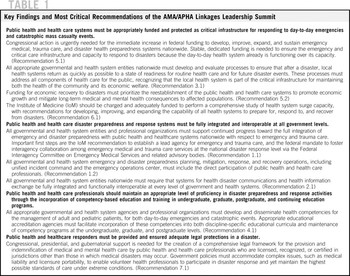
The full summit report (available at http://www.ama-assn.org/ama/pub/category/6206.html) contains 53 consensus-based recommendations, which will serve as the framework for a coordinated national agenda for strengthening health system preparedness for terrorism and other disasters. The summit report and pledge were released in July 2007 at a national media briefing in Washington, DC. Key messages and the most critical recommendations from the report are highlighted in Table 1. As of June 2007, all 18 summit organizations have approved the action brief and agreed to sign the pledge of commitment; 16 organizations approved the full report and complete list of 53 recommendations.
Key Findings and Most Critical Recommendations of the AMA/APHA Linkages Leadership Summit

DISCUSSION
Since the events of September 11, 2001, our nation has intensified its efforts to improve the systems responsible for protecting and ensuring the health, safety, and well-being of individuals and communities in a disaster; however, a great deal of work remains to fully integrate practicing health professionals into a comprehensive system that can provide the best possible response. The US emergency health care system faces significant challenges daily. Hospital overcrowding, an eroding trauma system, inadequate funding for enhanced 9-1-1 services, escalating liability costs, and rising numbers of uninsured patients represent just some of the baseline challenges.
In March 2007 the AMA and APHA met with state and local public health leaders in New Orleans to critically assess the relevance and utility of the summit report, considering their unique vantage point and experience with Hurricanes Katrina and Rita and their aftermath. Meeting participants acknowledged the timeliness and importance of the report but identified additional considerations and needs in the continued efforts to improve health system preparedness:
Policy, regulatory, and legal impediments that restrict the capacity to rapidly access federal funding to rebuild critical health infrastructure
The need for more regulatory flexibility to allow for rapid recovery of local health systems
The need for more flexible regulatory processes that allow for the rapid reopening of closed health care facilities
The need for urgent economic development assistance for practicing clinicians and other health providers in ways that accelerate the rebuilding of community infrastructure
The urgent need to address the ethical practice of health care delivery in mass casualty and other disaster situations to aid in medical decision making
Although the summit report presents important perspectives on the subject of preparedness for public health emergencies, with consensus recommendations that will move our nation forward, it must be understood that preparedness is a process and not a point in time, and that these recommendations must be reviewed and refined continually.
Authors' Disclosure
This project was supported by Centers for Disease Control and Prevention Cooperative Agreement No. U38/CCU624161-01-3107.