Introduction
On Sunday 25 November 1492Footnote 1, Christopher Columbus realised that the ‘pines’ he found in the mountains of Cibao, Hispaniola, were not true pines because they did not bear ‘pine cones’ but instead had fruits resembling olives (“Abunda la tierra aspera del Cibao (de Ciba, piedra) de pinos mui altos que no llevan piñas, por tal orden compuestos por naturaleza, que parecen azeytunos del Axarafe de Sevilla”: Herrera, Dec. I lib. II c. 4 p. 35, quoted in Humboldt, Reference Humboldt1837b: 24). Consequently, Columbus is credited by Alexander von Humboldt (Humboldt, Reference Humboldt1837a,Reference Humboldtb, Reference Humboldt and Otté1848, Reference Humboldt1850) as having distinguished what is now the genus Podocarpus L’Hér. ex Pers. from Pinus L. long before L’Héritier (in Persoon, Reference Persoon1807) provided the first formal botanical description of Podocarpus, based in part on a South African species (Podocarpus elongatus L’Hér. ex Pers.) that is now regarded as the nomenclatural type of the genus.
Columbus discovered the conifers belonging to what is now Podocarpus in the “Serrania de Haiti” near Cibao (Humboldt, Reference Humboldt1850: 322). This was the peak known as La Serrania in what is now the Dominican Republic, the eastern portion of Hispaniola – not part of modern political Haiti despite the name Columbus used for the locality. Two species of Podocarpus occur in that region, P. buchii Urb. in elfin forest and P. hispaniolensis de Laub. in tropical broad-leaved rainforest. It is ironic, therefore, that the species Columbus found might well have been the last one of the Caribbean species to have been formally described, by de Laubenfels (Reference de Laubenfels1984).
Following the scheme outlined in Appendix D of Dinerstein et al. (Reference Dinerstein, Olson, Graham, Webster, Primm, Bookbinder and Ledec1995), the Caribbean Islands, with the exception of Trinidad and Tobago, all belong to the Caribbean Bioregion. This is divided into 24 smaller units called ecoregions, 23 of them Neotropical and one (the Everglades of Florida, USA) Nearctic, representing five different biomes. Only the six Neotropical ecoregions of the ‘Tropical and subtropical moist broadleaf forest’ biome and two of the three Neotropical ecoregions of the ‘Tropical and subtropical coniferous forest’ biome harbour species of Podocarpus. Trinidad and Tobago belong in this scheme to the Orinoco Bioregion (although they, together with several other island groups off the coast of northern South America, were grouped in region 81 Caribbean in the TDWG geographical recording scheme: Brummitt, Reference Brummitt2001). Therefore, Podocarpus trinitensis J.Buchholz & N.E.Gray, an endemic species occurring on those islands, will be given a full taxonomic treatment in a different paper of this series. However, since it has been much confused with Podocarpus coriaceus Rich. of the neighbouring Leeward and Windward Islands, its distinguishing features are indicated in the key to species in the present paper.
All but two of the nine Caribbean species of Podocarpus are globally threatened. Two are reckoned to be Critically Endangered, four Endangered, and one Vulnerable. Rather little is known about plant–animal interactions for most of the species but they provide food sources and habitat for other endangered species. These may have included the various macaws, parakeets and Amazon parrots endemic to the Caribbean Islands, only about 20% of which are still extant, the remainder having become extinct through human activity in prehistoric and historic times (Williams & Steadman, Reference Williams, Steadman, Woods and Sergile2001).
Taxonomic History and Problems
The earliest species of Podocarpus to be described from the Caribbean Bioregion was P. coriaceus Rich., described by Richard (Reference Richard1826) from Montserrat. It is a well-marked species that cannot be confused with any other of this bioregion although it is very similar in appearance to Podocarpus trinitensis from Trinidad and Tobago, as mentioned above. The differences between these species are summarised in the key to species.
Next to be described was Podocarpus purdieanus Hook., described from Jamaica by Hooker (Reference Hooker1844). This is one of the two Jamaican endemic species of the genus, the other being Podocarpus urbanii Pilg., described by Pilger (Reference Pilger and Engler1903). These two species are easily separated from one another. However, Jamaican plants now treated as Podocarpus urbanii were in the 19th century inexplicably regarded as belonging to Podocarpus coriaceus which has very much larger leaves.
Grisebach (Reference Grisebach1866) described the first of several taxa from Cuba, Podocarpus angustifolius Griseb. from the west of the island, based on a specimen from Charco Azul numbered Wright 3188 (for lectotypification see Mill & Stark Schilling, 2010). Very soon afterwards, Parlatore (Reference Parlatore and De Candolle1868) described Podocarpus aristulatus Parl., based partly on material from the east of the island (Wright 1461) that is morphologically separable from P. angustifolius, but he also included an example of the Wright gathering (Wright 3188) from the west of the island upon which Grisebach (Reference Grisebach1866) had based his earlier name. Because both of these Wright numbers were used for several different collections made at different localities at different times, this raised very complex taxonomic and nomenclatural issues that were unravelled by Mill & Stark Schilling (2010). That paper listed all sheets of Wright 1461 and Wright 3188 that had been examined by me up till the date of its publication and the identification of each element on each sheet. Further examples of these two Wright numbers have since been seen in other herbaria and the information given by Mill & Stark Schilling (2010) is accordingly updated here.
Later, Urban (Reference Urban1922) described Podocarpus ekmanii Urb. from eastern Cuba, while Carabia (Reference Carabia1941) revised the Cuban species and recognised two further novelties from the east of the island, P. leonii Carabia from Sierra Imías (Baracoa region) and P. victorinianus Carabia which was based on part of a sheet of Wright 1461 from Monte Verde on which was also mounted material of P. aristulatus. The paper by Mill & Stark Schilling (2010) listed all examples of type material of Podocarpus victorinianus that had been seen up till then; the present one gives some additional citations of examples seen since.
Although Hispaniola may have been the first place in the world where Podocarpus was found (see Introduction), the two species occurring on that island, Podocarpus buchii and P. hispaniolensis, were not formally described until 1924 and 1984 respectively (Urban, Reference Urban1924; de Laubenfels, Reference de Laubenfels1984). Until that time they had been included in or confused with other Caribbean species of Podocarpus, although Florin (Reference Florin1932) had earlier recognised the distinctiveness of Podocarpus hispaniolensis from typical P. buchii when he described it under the name P. buchii var. latifolius Florin. De Laubenfels (1984) said that the nearest affinity of Podocarpus hispaniolensis was with the Jamaican P. purdieanus but, possibly because the paper was already in press, did not include it in his synoptic checklist published the following year (de Laubenfels, Reference de Laubenfels1985).
The Podocarpus angustifolius complex
The main taxonomic problems in the Caribbean species of Podocarpus concern the species in the Podocarpus angustifolius complex, viz. P. angustifolius itself, P. aristulatus, P. buchii, P. ekmanii, P. leonii and P. victorinianus, plus in some authors’ opinions P. urbanii from Jamaica and what is now known as P. hispaniolensis. Five of these taxa are Cuban and two are from Hispaniola. Podocarpus urbanii (Jamaica) was even synonymised with P. aristulatus of this group by Eckenwalder (Reference Eckenwalder2009) although no-one else before or since has taken that view. Eckenwalder’s taxonomy of the genus overall was exceptionally broad with other unusual views on species limits elsewhere in the world. The number of species in this group has varied widely according to the author. Florin (Reference Florin1932) treated three species from Cuba and Hispaniola; besides the two varieties of Podocarpus buchii on Hispaniola already mentioned (now regarded as Podocarpus buchii sensu stricto and P. hispaniolensis), he recognised two varieties of P. angustifolius (the typical one and var. wrightii Pilg.), as well as P. ekmanii. All five entities from Cuba were regarded as distinct species by Carabia (Reference Carabia1941) and in Brother Léon’s treatment for Flora de Cuba (Sauget y Babier, Reference Sauget y Babier1946); no discussion about their taxonomic and nomenclatural status was given in the latter work but the arguments had been given by Carabia (Reference Carabia1941). Buchholz & Gray (Reference Buchholz and Gray1948b) recognised six species and eight taxa in the complex, while de Laubenfels (Reference de Laubenfels1985) listed only three species with no infraspecific taxa. Staszkiewicz (Reference Staszkiewicz1988), on the other hand, in a morphometric study discussed in detail below, divided the complex into three species (Podocarpus ekmanii, P. angustifolius and P. urbanii) with P. angustifolius being divided into subsp. angustifolius with three varieties and two forms and subsp. buchii with two varieties – by far the most hierarchically complex of all studies of the group. Stark Schilling (Reference Stark Schilling2004), whose views are largely followed here, provided a tabular synopsis of the various differing classifications of the complex up till that time. Since then, there have been two further treatments of the group. Eckenwalder (Reference Eckenwalder2009) recognised Podocarpus angustifolius with two varieties; under var. aristulatus he synonymised no fewer than five species – P. aristulatus itself together with P. buchii, P. ekmanii, P. leonii, P. victorinianus and as mentioned above even the Jamaican P. urbanii. On the other hand, Farjon (Reference Farjon2010) took a more ‘conventional’ view and recognised five species (Podocarpus angustifolius, P. buchii, P. ekmanii, P. hispaniolensis, P. urbanii), but he synonymised Podocarpus aristulatus, P. leonii and P. victorinianus under P. angustifolius.
Staszkiewicz (Reference Staszkiewicz1988) used morphometric techniques to analyse the variation in leaf characters within the Caribbean species of Podocarpus. Based on an examination of 149 specimens he proposed a new classification that accepted Podocarpus coriaceus, P. purdieanus and P. urbanii in their usual circumscriptions but treated all other taxa as subspecies, varieties and forms of Podocarpus angustifolius. Within this complex infraspecific classification the primary division was between Podocarpus angustifolius subsp. angustifolius and P. angustifolius subsp. buchii (Urb.) J.Staszk., i.e. Cuban versus Hispaniolan taxa. Podocarpus angustifolius subsp. angustifolius contained three varieties, var. angustifolius, var. aristulatus (Parl.) J.Staszk. and var. “leonis (Car.) J.Staszk.”, correctly var. leonii and divided into two forms f. “leonis” (leonii) and f. victorinianus (Car.) J.Staszk. Full and direct basionym references were not indicated for any of these new combinations, in contravention of ICN Art. 41.5 (McNeill et al., Reference McNeill, Barrie, Buck, Demoulin, Greuter, Hawksworth, Herendeen, Knapp, Marhold, Prado, Prud’homme van Reine, Smith, Wiersema and Turland2012) and its predecessors in earlier versions of the Code, so none of them were validly published. In at least seven instances duplicates of the same collection number in different herbaria were assigned to different taxa. In one case (Wright 1461) the number is known to have been used for different specimens collected at different times that can belong to different taxa (Mill & Stark Schilling, 2010). However, in all the others there is no reason not to believe that the examples in different herbaria represent genuine duplicates of the same collection from the same tree. He also included results from 30 samples (López 1–30, all at HAC), that were collected from a forest growing on Pico Caracas in the Sierra Maestra in eastern Cuba (prov. Granma, mun. Bartolomé Maso). Fifteen of these samples were assigned the code Asar (= Podocarpus angustifolius var. aristulatus), seven the code E (= P. ekmanii), four the code Asan (= P. angustifolius var. angustifolius) and four the code Asle (= P. angustifolius var. leonii). This suggests that Staszkiewicz’s morphometric approach led to artificial taxonomic separation based on undue emphasis on certain characters. Examples of this include Ekman 12666 (NY specimen determined as Podocarpus angustifolius, S as P. aristulatus), Ekman 5999 (HAC, P. angustifolius; S, P. aristulatus), Ekman 9813 (NY, P. ekmanii; S, P. aristulatus), Ekman 9514 and 15832 (both NY, P. angustifolius; S, P. aristulatus) and Alain et al. 5645 (GH and one sheet at HAC, P. ekmanii; other sheet at HAC, P. aristulatus). In other instances, specimens were assigned to one species in his Table 2 but given another identification elsewhere in the paper. To give some examples of this, sample 11 (Ekman 10648 from the Sierra de los Órganos in Pinar del Rio in western Cuba) was illustrated among leaves of Podocarpus angustifolius subsp. angustifolius var. angustifolius in Photo 4, but given the code for P. ekmanii in Table 2, while sample 34 (Ekman 6730 from Sierra Nipe in eastern Cuba) was again illustrated on Photo 4 as P. angustifolius var. angustifolius but was (correctly) coded as being the eastern taxon Podocarpus angustifolius var. aristulatus (= P. aristulatus in the present treatment), and samples 26 and 28 (the HAC and S examples of Ekman 5999, respectively identified by him as P. angustifolius var. angustifolius and var. aristulatus in Table 2) were illustrated on Photo 6 depicting leaves supposedly all belonging to P. angustifolius var. leonii. Sample 52, Ekman 15891 from Sierra de Cristal, was coded and illustrated as being Podocarpus angustifolius var. leonii although it was collected at the type locality of Podocarpus ekmanii and whence Podocarpus victorinianus (in which P. leonii is synonymised in the present treatment) has never been collected. Although it is possible that more than one species can occur at a given locality, the only species of Podocarpus known from the Sierra de Cristal range is P. ekmanii. There is also at least one example (sample 20, Roig 162 at NY) where the published determination code (“Anan” for Podocarpus angustifolius subsp. angustifolius var. angustifolius) is different to his actual determination on the specimen’s determinavit slip (P. angustifolius subsp. angustifolius var. aristulatus, which agrees in taxonomy if not rank with all others before and since he examined the sheet). All this means that the results of the morphometric analysis and accompanying illustrative diagrams must be read with great care as some of the specimens were assigned by Staszkiewicz to the wrong taxon and consequently are in the wrong place in his diagrams. However, with careful interpretation, Staszkiewicz’s paper provides much useful information, particularly on anatomical characters such as the width of the resin canal and vascular bundle and their relative length : breadth ratios, that is not available elsewhere.
As part of a larger palynological study of Cuban gymnosperms, Stuchlick & Moncada (Reference Stuchlick and Moncada1983) studied the pollen morphology of three Cuban species of Podocarpus using light microscopy, namely P. angustifolius, P. aristulatus and P. ekmanii. They found that the pollen of these three species fell into two groups: in that of Podocarpus angustifolius and P. aristulatus the pollen body was more or less the same size as the sacci but in the P. ekmanii type the pollen body was about half the size of the sacci. Within the first type, the pollen of Podocarpus angustifolius and P. aristulatus was not identical: in P. angustifolius the exine was only weakly undulate but in P. aristulatus it was distinctly undulate. They used these results to argue that there were two species, or species groups, of Podocarpus in Cuba.
Stark Schilling (Reference Stark Schilling2004) approached the taxonomy of the group in a multidisciplinary manner, utilising cuticular micromorphology (Stark Schilling & Mill, Reference Stark Schilling and Mill2011), palynology and molecular phylogenetics as well as gross morphology. Taking all this evidence into account he came to the following conclusions:
1 All the species of the Greater Antilles share a common character, aristate or mucronate leaf apex, that separates them from all the species of mainland Central America and Mexico as well as from Podocarpus coriaceus of the Lesser Antilles and Puerto Rico. The character is constant (100% of leaves) in most species but inconstant (present in at least 60% of leaves) in Podocarpus hispaniolensis and P. urbanii.
2 Podocarpus buchii var. latifolius Florin is taxonomically the same as P. hispaniolensis.
3 Recognition of Podocarpus ekmanii as a distinct species is supported by palynological characters (confirming the previous finding of Stuchlick & Moncada, Reference Stuchlick and Moncada1983) and cuticle micromorphology as well as gross morphology.
4 Podocarpus aristulatus (called by Stark Schilling, Reference Stark Schilling2004, ‘P. victorinianus’ as the nomenclatural and typification problems surrounding the use of P. aristulatus vs. P. angustifolius had at that time not been properly resolved) was separable from P. buchii by its longer peduncles (on average 7 mm, compared with 4 mm), longer seeds, longer leaves (> 4.1 mm, compared with < 3.1 mm in the specimens he examined) and slightly larger terminal buds. The two species were also distinguishable by cuticular micromorphology (Stark Schilling & Mill, Reference Stark Schilling and Mill2011) and palynology. Stark Schilling (2004) included some narrower-leaved forms of Podocarpus aristulatus in P. angustifolius; they included Gardner et al. 7005 and 7006 from Sierra de Nipe (eastern Cuba, prov. Holguin) which are here placed in Podocarpus aristulatus together with all the other collections from Sierra de Nipe seen for the present revision. Several collections (Alain 6328 and several by Bécquer et al.) from central Cuba (prov. Sancti Spiritus) are, however, included in Podocarpus angustifolius both by Stark Schilling (2004) and in the present revision.
5 Podocarpus leonii was synonymous with his concept of P. victorinianus (i.e. also including most of P. aristulatus).
After examination of the same suite of specimens as studied by Stark Schilling I have in most cases reached similar conclusions to his. Podocarpus angustifolius is restricted to the species of western Cuba (now largely extinct there) and some native and planted populations in the central Sierra de Escambrey in Sancti Spiritus. The name Podocarpus aristulatus is here used for the plant from Monte Verde and some other parts of eastern Cuba while P. victorinianus as originally defined by Carabia (Reference Carabia1941) has been found to differ from it. Podocarpus leonii is here considered to be synonymous with P. victorinianus in Carabia’s original sense, not that of Stark Schilling, although there are certain differences between the two discrete populations to which these names apply and if more material of them can be obtained it might be possible to separate them at either species or infraspecific rank. For both Podocarpus aristulatus and P. victorinianus the descriptions need completion once fertile material of one or other sex becomes available; despite a large suite of specimens being available to me I have not seen female cones of P. aristulatus while male cones have not been seen in the fewer specimens of P. victorinianus (incl. P. leonii).
Materials and Methods
This revision, and other parts in the series, is based on a mixture of the examination of actual herbarium specimens, digital images of herbarium specimens, and database records where these represent duplicates of specimens seen or can otherwise be trusted. Database records or records in literature have not been used where there is any likelihood of doubt concerning their correct identification.
Actual herbarium specimens were examined using standard herbarium equipment (stereo dissecting microscope, Leitz ×6 or ×8 loupes with scales, etc.) and also photographed using a Panasonic Lumix TZ6 digital camera. In specimen citations, specimens seen as images are indicated as ‘image’ if the image is stored on an external website (e.g. P–image), and as ‘photo’ if it was a photograph (taken on either a film or digital camera) made available in some other way, e.g. mounted on a herbarium sheet or supplied by a colleague. Most measurements were made off the photographs using ImageJ software (from version 1.45m to version 1.48s: Rasband, [1997–]2011–2014); this allowed the quantitative data measured to be archived. Digital images of specimens not also physically examined were also measured with ImageJ if the image resolution was sufficiently high and if the image was provided with a scale. Measurements were all made on dried material and it should be noted that when fresh some organs (especially receptacles and seeds) may be larger; also, in many herbarium sheets of female material, the receptacles (and seeds) are not fully developed. Pollen cones in many species of Podocarpus, including at least some of those treated here, tend to lengthen with age, especially after pollen has been shed. Microsporophylls and microsporangia were, however, rehydrated when possible for drawing by the artist. ImageJ was also used to generate surface plots of regions of interest on the specimens such as leaf surfaces, midribs etc., some of which are illustrated.
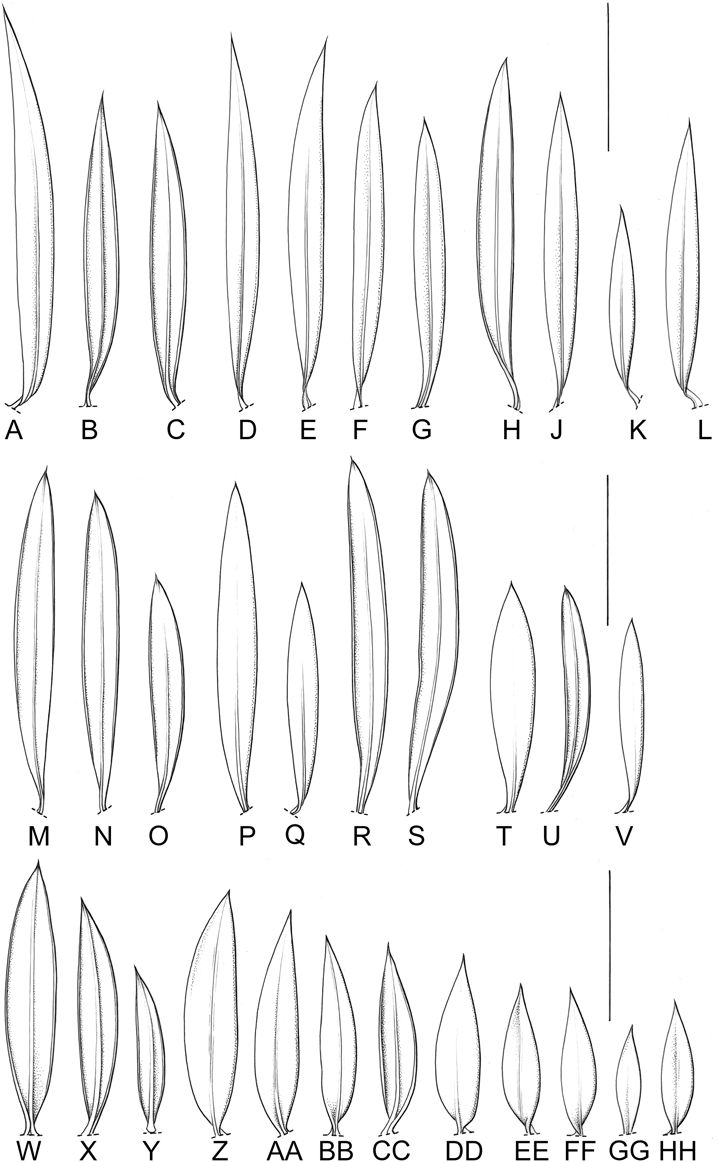
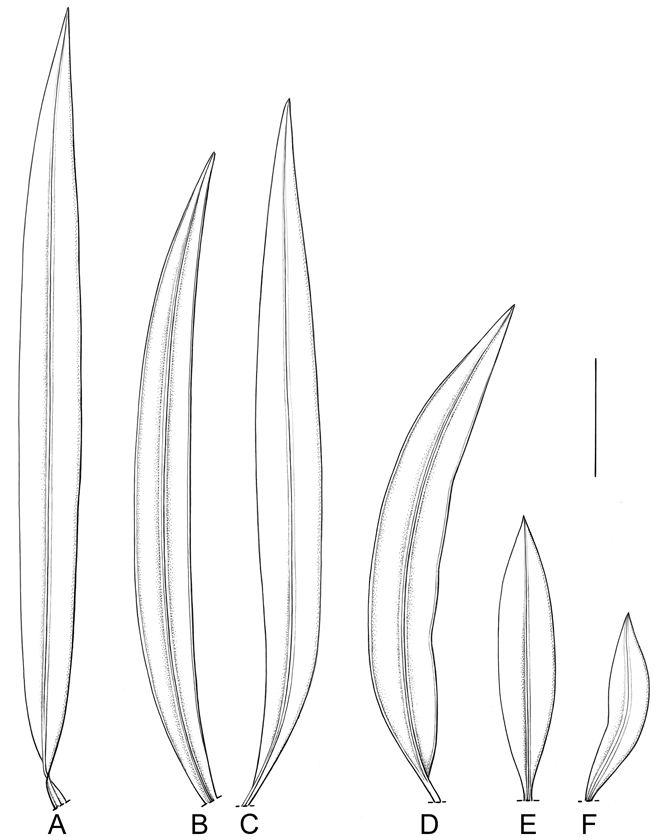
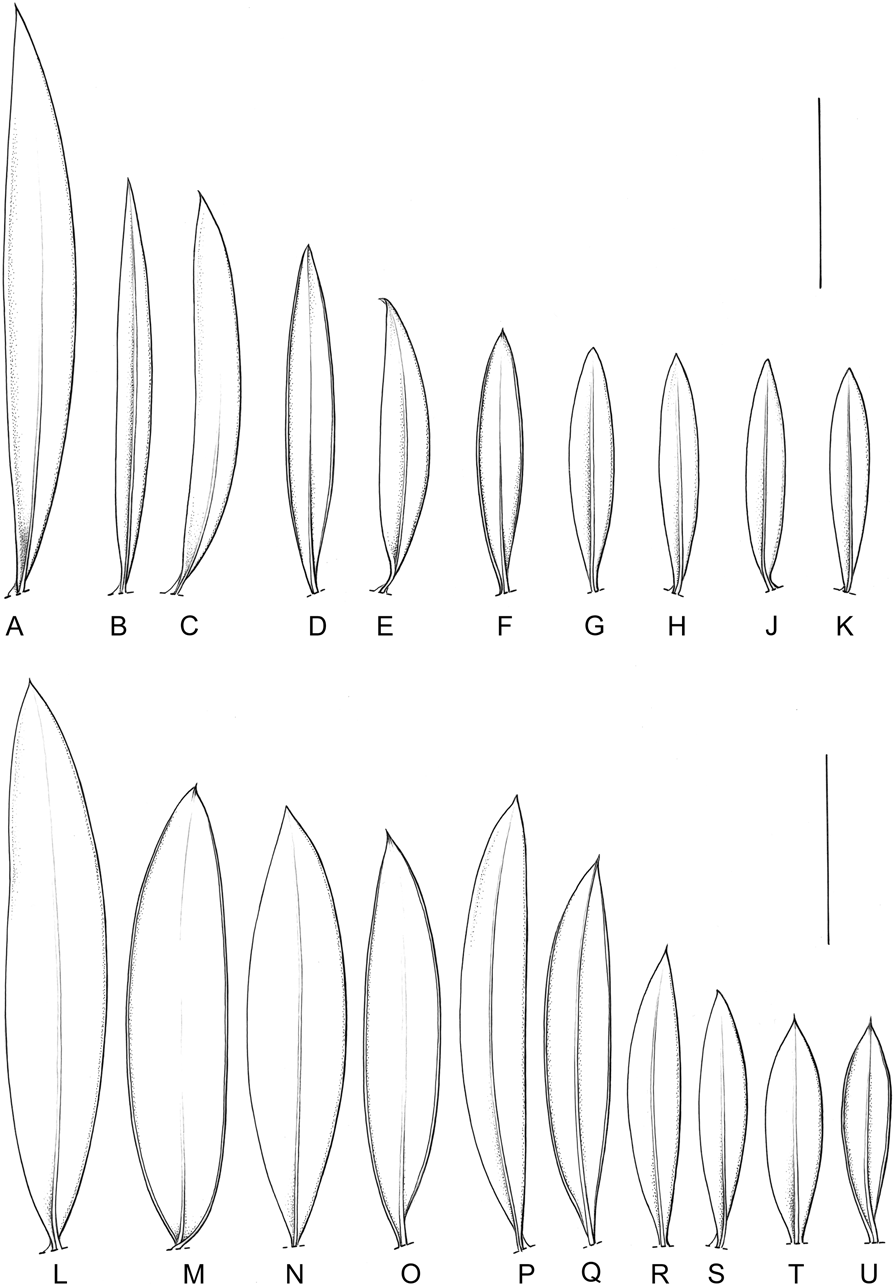
All species are illustrated by line drawings, many of them for the first time. As well as the usual drawings of habit and morphology of reproductive structures, there are series of comparative drawings of leaves to show the often considerable variation in leaf size and morphology within individual species, as well as surface plots of selected leaves generated by the Analyze – Surface Plot tool in ImageJ. To generate the plots, the polygon multiplier was set at the default of 100 and smoothing was on. The x axis is the width of the ‘TS’ of the leaf surface and the y axis its thickness (both in mm; thickness was always as near zero as possible). For the colour (online) version of the images the Fire LUT (look-up table) was used. The extent of the midrib in each plot is indicated by two white arrows. Colour/shading intensity is indicated on the z axis. The plots clearly show grooved or raised midribs and convex or concave leaves: lighter shading or hotter colours indicate higher elevations (peaks, e.g. a raised midrib or inrolled leaf margin) while darker shading or cooler colours denote lower elevations (valleys e.g. groove in midrib region).
References to Articles of the International Code of Nomenclature in the following taxonomic treatment are to those of the Melbourne Code (McNeill et al., Reference McNeill, Barrie, Buck, Demoulin, Greuter, Hawksworth, Herendeen, Knapp, Marhold, Prado, Prud’homme van Reine, Smith, Wiersema and Turland2012) unless indicated otherwise.
Distributions are summarised using the Level 3 and 4 names and codes of the Taxonomic Databases Working Group (TDWG) as compiled for the second edition of its World Geographical Scheme for Recording Plant Distributions (Brummitt, Reference Brummitt2001). In the TDWG scheme, the area covered by this paper is Region 81 Caribbean, exclusive of the following island units along the coast of northern South America: Aruba ARU, Netherlands Antilles NLA, Trinidad and Tobago TRT, Venezuelan Antilles VNA. These are all in the Orinoco Bioregion and any Podocarpus species occurring there will be treated in a subsequent paper. Podocarpus has been recorded native in the following Level 3 units of Region 81 Caribbean: Cuba CUB, Dominican Republic DOM, Haiti HAI, Jamaica JAM, Leeward Islands LEE, Puerto Rico PUE and Windward Islands WIN. The genus has not been recorded as native (at least since 1900) from the following other units of Region 81 Caribbean: Bahamas BAH (but unspecified species are cultivated: Below, Reference Below2005), Bermuda BER (but see discussion under Podocarpus coriaceus below), Cayman Islands CAY, and Turks-Caicos Islands TCI. When a Level 3 unit is not further subdivided in the scheme, it is here simply given the three-letter Level 3 code, e.g. CUB, not CUB-OO, but if subdivisions exist then the full 5-letter Level 4 code is given, e.g. HAI-HA. When the total distribution of a species extends beyond that covered by this paper (in this instance, only Podocarpus coriaceus), the countries or codes not covered are included within square brackets, while doubtful records are indicated by prefixing the code with a question mark (?), e.g. TDWG: 81 LEE-GU PUE WIN-SL [?BER TRT]. In the lists of material studied, countries are in Small Capitals, first-order subdivisions of countries (provinces in Cuba, Dominican Republic; départments in Haiti; counties in Jamaica) in Bold and second-order country subdivisions (municipalities in Cuba, Dominican Republic, Puerto Rico; arrondissements in Haiti; parishes in Jamaica) in Bold Italic. On Puerto Rico there are only second-order subdivisions because it is administered by the USA, which regards the entire island as a first-order administrative unit. Individual islands of the Lesser Antilles (Leeward Islands and Windward Islands) are here treated as first-order subdivisions but, although at least some of them are subdivided into secondary administrative divisions such as parishes, it has in many cases not been practical to indicate these (for example, on Nevis, all the island’s parishes intersect at the summit of Nevis Peak where Podocarpus coriaceus is present), although if they were given on the field label or if it has been possible to obtain the information in some other way they have been included. Assignments of Cuban specimens to provinces and municipalities follow the database compiled for certain Cuban plant families by Greuter & Rankin Rodríguez (Reference Greuter and Rankin Rodríguez2011); this differs in some cases from the information given on the specimen labels. Herbaria abbreviations follow Index Herbariorum (Thiers, continuously updated). Each species is mapped, with the reference to the map being given at the end of the distribution paragraph. The maps were generated in ArcGis version 9.3 (ESRI, 2008) after geospatial co-ordinates (if not included on the field label) had been added for each specimen. For the present paper, the main sources of geographical co-ordinates were GeoNames and Fuzzy Gazetteer and in a few cases the relevant Operational Navigation Chart (ONC) downloaded from the Perry-Castañeda Library Map Collection. Nomenclature and boundaries of tectonic plates follow Bird (Reference Bird2003).
Phytogeography is indicated according to three schemes: the global one of Takhtajan (Reference Takhtajan, Crovello and Cronquist1986) and the much more recent regional ones for Latin America and the Caribbean by Morrone (2001a,b, 2006 – the English names as given in Morrone, Reference Morrone2006, as opposed to the Spanish terms in Morrone, Reference Morrone2001b, are used here) and for the Caribbean Islands by Cano Carmona et al. (Reference Cano Carmona, Ramírez and Cano-Ortiz2010). The last-named is unclear about the position of Jamaica in the hierarchy below Central-Eastern Antilles Superprovince. In a slightly different, earlier version of their system (Cano et al., Reference Cano, Ramírez, Cano-Ortiz and Esteban Ruiz2009), Jamaica with Cuba formed the Cuba Province of the Western Antilles Superprovince but in Cano Carmona et al. (Reference Cano Carmona, Ramírez and Cano-Ortiz2010) Jamaica was transferred to the Central-Eastern Antilles Superprovince. These three systems are indicated towards the end of each distribution paragraph as Takhtajan, Morrone and Cano Carmona respectively.
Assignments to ecoregions were carried out using the ecoregion map on the Wildfinder website of Worldwide Fund for Nature (http://worldwildlife.org/science/wildfinder/).
Proposed conservation assessments have been made using version 3.1 (Second edition) of the categories and criteria of the International Union for the Conservation of Nature (IUCN), and version 10.1 of the guidelines for applying them (IUCN, 2012; IUCN Standards and Petitions Subcommittee, 2013).
Taxonomic Treatment
The generic description below is applicable to the whole genus and will not be repeated in subsequent papers of this series.
Podocarpus L’Hér. ex Pers., Syn. Pl. 2(2): 580 (Sept. 1807), nom. cons. – Type: Podocarpus elongatus (Sol.) L’Hér. ex Pers., loc. cit. (1807), typ. cons. – Taxus elongata Sol. in Aiton, Hort. Kew. ed. 1, 3: 415 (Aug.–Oct. 1789). – Type: South Africa: Cape of Good Hope, Masson s.n. (lecto BM, designated by Leistner, Reference Leistner1966a: 142 and 1966b: 39).
Typification. There has in the past been some controversy regarding the typification of the name Podocarpus elongatus, with some maintaining that the identity of the ‘type specimen’ was the Asian species Podocarpus chinensis Sweet. Gray (Reference Gray1953) tried to address this problem by selecting two types, one male and collected by Thunberg (preserved in UPS) and one female (preserved in P), but this practice was, and is, contrary to the ICN, the current version of which (McNeill et al., Reference McNeill, Barrie, Buck, Demoulin, Greuter, Hawksworth, Herendeen, Knapp, Marhold, Prado, Prud’homme van Reine, Smith, Wiersema and Turland2012: Art. 8.1) states that the type of a name is either a single specimen or an illustration. Leistner (Reference Leistner1966a) selected a Masson specimen at BM as the lectotype. This specimen was collected at Cape of Good Hope (South Africa), the type locality, and bears two branches with male cones; according to Leistner (1966a: 142), these “both represent the Cape plant”. A second sheet at BM that is labelled Taxus elongatus bears three specimens collected from various gardens between 1777 and 1788, all of which do belong to Podocarpus chinensis, and this is no doubt the source of the past confusion. However, Leistner’s choice of the Masson specimen has been followed by subsequent authors (e.g. Leistner, Reference Leistner, Codd, de Winter and Rycroft1966b; Farjon, Reference Farjon2010) and indeed the ICN (Art. 9.19) states that the original choice of lectotype must be followed, apart from certain exceptional circumstances none of which apply in this instance.
Etymology. Podocarpus is derived from Greek pŏus, a foot and karpŏs, a stalk and alludes to the usually but not always fleshy structure composed of two or more bracts that subtends the seed(s). The gender is masculine, being a compound of karpŏs (ICN Art. 62.2 Ex. 3), but the generic name was regarded as feminine in much of the earlier literature on the genus as indicated in the first paper of this series (Mill, Reference Mill2014).
Evergreen normally dioecious trees or shrubs. Three or more orders of branching; ultimate branches ending in terminal buds composed of small scales that in a few species enlarge and become foliaceous when new leaves flush. Leaves spirally arranged, entire, linear to lanceolate or obovate, bifacially flattened, attached to twig by a short narrowed ± decurrent base (here termed ‘petiole’) or ± sessile; juvenile leaves often larger (sometimes considerably so) and less thick than adult ones; hypostomatic (stomata on abaxial surface only) or occasionally unequally amphistomatic. Male strobili simple or compound, solitary or grouped, axillary to (usually) leaves, subtended by a group of scales similar to those forming the terminal vegetative buds. Female strobili solitary, pedunculate or ± sessile, the peduncle appearing naked, without or with a pair of small, narrow ± spreading bracts at the distal end (‘foliola’) subtending the reproductive structure. Female reproductive structure composed of two parts: a proximal podocarpium [here termed ‘receptacle’ following traditional usage as by Pilger (Reference Pilger and Engler1903), Buchholz & Gray (Reference Buchholz and Gray1948a,Reference Buchholz and Grayb) and de Laubenfels (Reference de Laubenfels1985), although in Podocarpus the term ‘receptacle’ is used in a different sense compared with its use in angiosperm morphology] and one or more distal ovule(s). Receptacle formed from two or more bracts that in most species (including all species in the Caribbean and South America) become fleshy, succulent and coloured when ripe, the bracts being sterile or fertile. Ovule(s) inverted, with base(s) immersed in receptacle, developing into a seed that is completely covered by the leathery ‘epimatium’ (fertile scale) and is composed of an outer sarcotesta, middle sclerotesta and inner endotesta. – Approximately 100 species, mainly in the southern hemisphere (South America, sub-Saharan Africa, Madagascar, Asia, Australasia), extending north of the Equator into the Caribbean, SE Asia, the Philippines, China, Taiwan, and Japan.
Infrageneric classification
Buchholz & Gray (Reference Buchholz and Gray1948a,Reference Buchholz and Grayb) included all the Caribbean species of Podocarpus in their informal subsect. C of sect. ‘Eupodocarpus’ (correctly Podocarpus sect. Podocarpus). This was one of four such informal subsections, A to D, that were initially recognised by them (a further two, E and F, were enumerated later in their series of papers) and included all species from the Caribbean and Central America as well as all but one (Podocarpus nubigenus Lindl.) of the South American species. Subsection C was distinguished from the others by absence of bracts (‘foliola’) below the receptacle of the female cone, presence of Florin ring around the stomatal complex, and presence of well-developed accessory transfusion tissue in the leaves.
Gaussen (Reference Gaussen1976) reordered the six subsections latterly distinguished by Buchholz & Gray and placed the Caribbean species in subsection 4 ‘Ameriques sauf Chili’. He utilised similar characters to Buchholz & Gray (Reference Buchholz and Gray1948a) to separate the subsections, mentioning additionally for subsection C the absence of resin canals in the mesophyll, and the hypodermis being discontinuous in all but two species, both from South America.
De Laubenfels (1985) divided the genus Podocarpus into two subgenera and 18 sections (nine sections in each subgenus). The species included in this paper were divided among three of the nine sections of Podocarpus subgen. Podocarpus delimited by de Laubenfels (Reference de Laubenfels1985): P. sect. Lanceolatus de Laub. (as ‘Lanceolatis’: Podocarpus coriaceus), P. sect. Pumilis de Laub. (P. angustifolius, P. aristulatus, P. urbanii and by inference from his synonymy also P. buchii, P. ekmanii and P. victorinianus), and P. sect. Nemoralis de Laub. (P. purdieanus; also P. hispaniolensis by inference from the discussion in its protologue: de Laubenfels, Reference de Laubenfels1984).
Knopf et al. (Reference Knopf, Schulz, Little, Stützel and Stevenson2012) recognised 26 subclades within the family based on molecular phylogeny combined with leaf anatomy; with one exception, species considered in this paper that were studied by them fell into their clade U, tropical American Podocarpus. The exception is Podocarpus angustifolius, which unexpectedly fell into a small subclade that otherwise only contained the temperate South American species P. salignus D.Don and was sister to the species of Podocarpus inhabiting New Zealand and Tasmania. A very similar relationship has been obtained by Little et al. (Reference Little, Knopf and Schulz2013) in a bar-coding study that used the same sample but a different set of genes. It is possible that the sample of Podocarpus angustifolius used in these two studies, which came from a Dutch botanic garden, was misidentified. Perhaps significantly, Knopf et al. (2012, in their fig. 4) commented that the leaf anatomy of their sample of ‘Podocarpus angustifolius’ was the same as in their subclade T, which comprised Podocarpus parlatorei Pilg., P. sprucei Parl. and P. lambertii Klotzsch ex Endl.; the latter species (from Brazil) has as one of its synonyms the name Podocarpus angustifolius Niederl., non Griseb. It would therefore be worth repeating the analyses using authentic material of Podocarpus angustifolius of known Cuban origin.
The two subgenera of Podocarpus are strongly supported by molecular phylogenetics data (e.g. Conran et al., Reference Conran, Wood, Martin, Dowd, Quinn, Gadek and Price2000; Sinclair et al., Reference Sinclair, Mill, Gardner, Woltz, Jaffré, Preston, Hollingsworth, Ponge and Möller2002; Biffin et al., Reference Biffin, Conran, Lowe, Turner and Cernusak2011, Reference Biffin, Brodribb, Hill, Thomas and Lowe2012; Knopf et al., Reference Knopf, Schulz, Little, Stützel and Stevenson2012) and will be recognised in this revision. However, with one or two exceptions the 18 sections recognised by de Laubenfels (Reference de Laubenfels1985) mostly receive little or no support from any of these phylogenetic studies and therefore species will not be assigned to them in this revisionary series. Instead, within each paper in the series the species will be listed in alphabetical order. Each species within a given paper will also be given a running number but these will be unique to that paper rather than continuous through the entire series. When each subgenus is fully revised, an attempt will be made to construct a new sectional classification that better reflects the relationships between the species.
Keys
Five keys are provided in order to facilitate species identification of the Caribbean Podocarpus species. The first one keys out the two subgenera. All species native to the Caribbean Bioregion belong to subgenus Podocarpus but other, exotic species may be encountered and some of these, including the widely cultivated P. macrophyllus (Thunb.) Sweet, belong to P. subgen. Foliolatus de Laub. The General Key includes all nine species revised in this paper, as well as Podocarpus trinitensis of Trinidad and Tobago (Orinoco Bioregion; to be treated in a future paper) which has been much confused with P. coriaceus. The remaining three keys are to the species native to Cuba, Hispaniola and Jamaica respectively. The special keys to particular islands should provide a shorter route to identification when the origin of the material is known. They will work for wild-collected material on each island. However, occasionally species native to one island are cultivated on another, and exotic species may also be encountered. Such instances are not catered for in the special keys. Therefore, if it is not possible to key out a specimen using the appropriate special key, the general key should be used. All keys were constructed using, as far as it was possible, vegetative characters for maximal utility when reproductive characters are unavailable. Nonetheless, where relevant, reproductive characters are added between square brackets.
1a. Stomata lacking a Florin ring; leaves never with a channel over the vascular bundle on the upper (adaxial) surface but often a ridge; marginal resin canals always absent; resin canals below or associated with vascular bundle frequently 3, less commonly 1 Subgenus Foliolatus (native to Asia and Australasia; species to be treated later. Podocarpus macrophyllus occurs as a rare exotic in the area covered by this paper)
1b. Stomata with Florin ring; other characters as in description below Subgenus Podocarpus (native to the Americas, Africa, Madagascar and Australasia; includes all species native to the Caribbean Bioregion)
The subgeneric description below is applicable to all members of Podocarpus subgenus Podocarpus and will not be repeated in subsequent papers of this series.
Subgenus Podocarpus. Stomata with a Florin ring. Marginal resin canals absent (American and Australasian species) or present (African and Madagascan species). Resin canals below the vascular bundle always 1 (American and Australasian species) or 1–5 (African and Madagascan species). – About 45 species: Caribbean, South and Central America, sub-Saharan Africa, Madagascar, New Zealand, New Caledonia, Australia (SE and Tasmania). Nine species are native to the Caribbean Bioregion.
General key to Caribbean Podocarpus species
1a. Leaf apex without a mucro or aristate point 2
1b. Leaf apex with a mucro or an aristate point 4
2a. Adult leaves less than 6 mm wide and less than 50 mm long [mature male cones less than 20 mm long; peduncles less than 3 mm long; Jamaica] 8. P. urbanii
2b. Adult leaves 7–14 mm wide, usually at least 50 mm long [Lesser Antilles or Trinidad/Tobago] 3
3a. Leaves with the midrib impressed in a groove beneath and raised above; terminal buds less than 3 mm long [Trinidad and Tobago: not given full treatment here, see under Podocarpus coriaceus] P. trinitensis
3b. Leaves with the midrib raised as a ridge beneath and obscure above; terminal buds more than 4 mm long [Puerto Rico and Lesser Antilles] 4. P. coriaceus
4a. Groove on the upper leaf surface present along the whole leaf or at the proximal end 5
4b. Groove on the upper leaf surface absent 6
5a. Leaves without a groove on the upper surface, or if groove present then only at proximal end; leaves 10–16 mm wide [peduncle of female cone 1.1–4 mm, much shorter than receptacle; receptacle 6.4–8.5 mm along longer edge; seeds 3.4–5 mm wide; Jamaica] 7. P. purdieanus
5b. Leaves with a groove on the upper surface, 5–11(–15) mm wide [peduncle of female cone 6–7 mm, equalling or longer than receptacle; receptacle 3.5–4.5 mm along longer edge; seeds 2.2–3.2 mm wide; Hispaniola] 6. P. hispaniolensis
6a. Leaf apex (excl. arista, apiculus or mucro) always acuminate [W & C Cuba only] 1. P. angustifolius
6b. Leaf apex (excl. arista, apiculus or mucro) normally acute, subacute or obtuse (in P. aristulatus sometimes shortly acuminate) [E Cuba or other islands of Caribbean] 7
7a. Leaves with the midrib impressed in a shallow but distinct groove abaxially, raised adaxially at least in proximal half of leaf [Jamaica] 8. P. urbanii
7b. Leaves with the midrib raised or ± flat abaxially (never in a groove) 8
8a. Leaves ovate or lanceolate (or narrowly so), broadest below the middle [Hispaniola] 3. P. buchii
8b. Leaves elliptic, oblanceolate or obovate (or narrowly so), broadest at or above the middle 9
9a. Largest leaves on the specimen not more than 35 mm long 10
9b. At least some leaves on the specimen > 35 mm (up to 60 mm) 11
10a. Leaves very sharply pungent-aristate, the arista 0.8–3 mm long; most leaves wider than 4.5 mm (to c.9 mm wide); midrib (0.4–)0.5–0.8 mm wide [pollen cones with c.12 scales at base and 50–70 microsporophylls; free tips of receptacle bracts not keeled; Hispaniola] 3. P. buchii
10b. Leaves pungent-mucronate or shortly pungent-aristate, the mucro or arista (0–)0.06–0.8(–1.6) mm; most leaves not more than 4.5 mm wide (maximum 5 mm); midrib (0.17–)0.25–0.50(–0.55) mm wide [pollen cones with 5–6 scales at base and 25–40 microsporophylls; free tips of receptacle bracts keeled; Cuba] 5. P. ekmanii
11a. Most leaves more than 5 × as long as broad and less than 6.5 mm wide; midrib ± prominently raised beneath and sometimes indistinctly so proximally above 2. P. aristulatus
11b. Most leaves less than 5 × as long as broad and more than 6.5 mm wide; midrib not raised (or indistinctly raised proximally) beneath, obscure or almost invisible above 9. P. victorinianus
Key to Cuban species of Podocarpus
1a. Leaves with the midrib only indistinctly raised beneath 2
1b. Leaves with the midrib ± distinctly raised at least beneath 3
2a. Leaves 2.3–4.8(–5.6) mm wide, mostly 7–17 × as long as broad 1. P. angustifolius
2b. Leaves (4.7–)6–11 mm wide, 3–4.7(–5.7) × as long as broad 9. P. victorinianus
3a. Leaves less than 30(–35) mm long with a thick and conspicuous midrib beneath; arista or mucro at leaf tip usually not more than 0.8 mm long and sometimes absent [microsporangia parallel] 5. P. ekmanii
3b. Leaves mostly > 30 mm long, the midrib thin and inconspicuous beneath except near the base; arista at leaf tip usually 0.8–2.5 mm [microsporangia convergent] 2. P. aristulatus
Key to Podocarpus from Hispaniola
1a. Leaves with a prominent ± deep groove above, adult and juvenile ones all normally 20–70(–100) mm long; terminal buds > 5 mm, subglobose or ovoid [peduncles more than 6 mm long; male cones more than 12 mm long] 6. P. hispaniolensis
1b. Leaves without or with an indistinct shallow groove above, adult ones < 35 mm, juveniles < 50 mm long; terminal buds usually less than 3.5 mm long, semi-globose to depressed-globose [peduncles less than 4 mm long; male cones less than 10 mm long] 3. P. buchii
Key to Jamaican species of Podocarpus
1a. Leaves 8–17 mm wide, almost always ending in a mucro or arista (0–)0.5–2.3(–3.6) mm long; buds 3.5–6.5 × 2.5–7 mm, of 9–12 scales, all of them aristate (arista of outer ones 1–1.5 mm, of inner 0.3–0.5 mm) [seeds more than 7.5 mm long; male cones more than 30 mm long] 7. P. purdieanus
1b. Leaves (1.7–)2.5–7 mm wide, some leaves ending in a mucro or arista (up to 0.6 mm long on adult leaves, to 1.4 mm on juveniles), some leaves without a mucro; buds 2–3.5 × 2–4 mm, of 12–16 scales, the outer ones minutely aristate (arista c.0.1 mm), the inner ones muticous [seeds less than 6 mm long; male cones less than 20 mm long] 8. P. urbanii
Species accounts
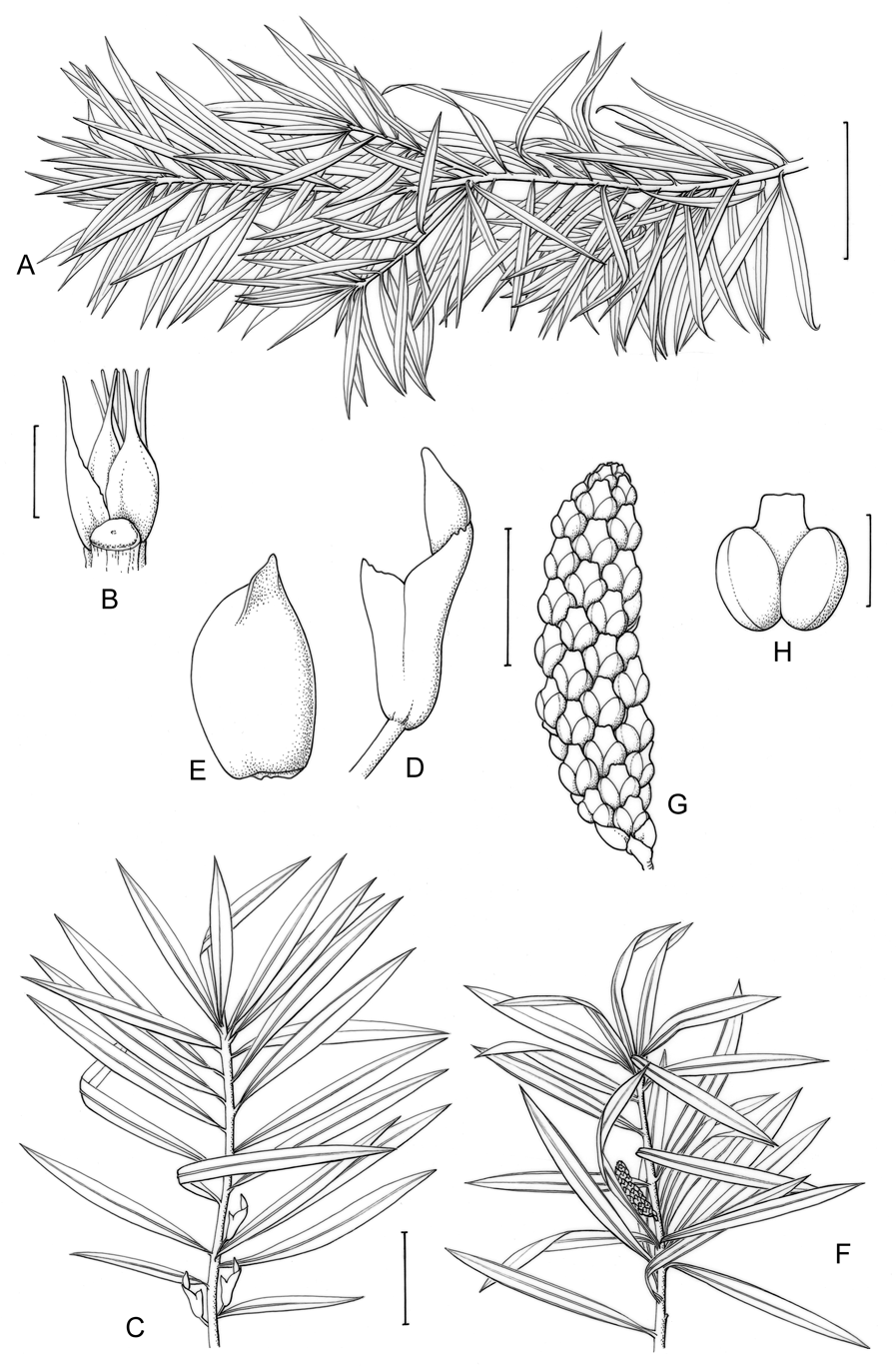
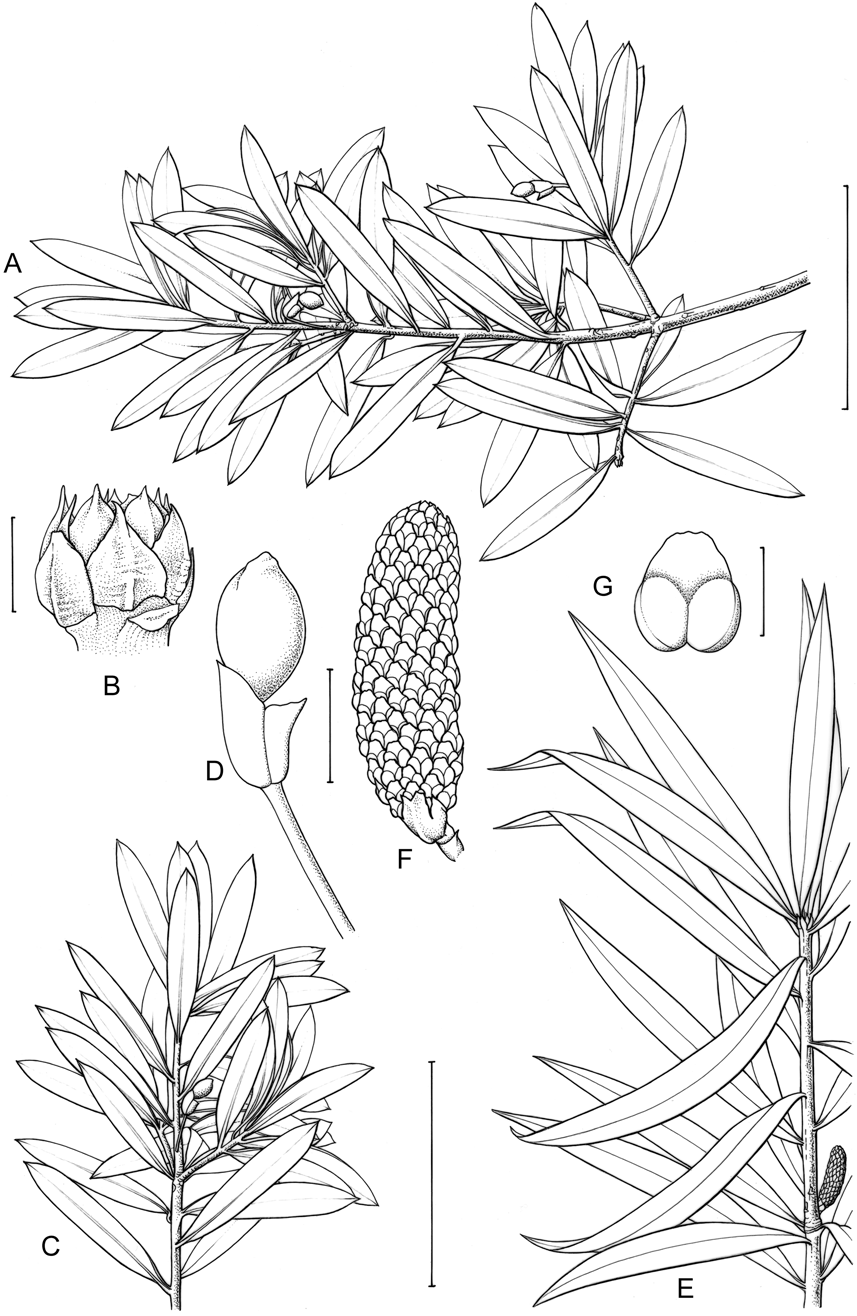
1. Podocarpus angustifolius Griseb., Cat. Pl. Cub. 217 (1866). – Lectotype (designated by Mill & Stark Schilling, 2010: 955): Cuba [prov. Artemisa, mun. Bahia Honda], Charco Azul, 23 Sep [no year given], Wright 3188 (GOET: two ripe seeds in packet only, assigned the identifier Wright 3188 A-1 by Mill & Stark Schilling, 2010: 955). Epitype (designated by Mill & Stark Schilling, 2010: 955): Wright 3188 (BM, right-hand female shoot, assigned identifier Wright 3188 A-2 by Mill & Stark Schilling, 2010). Figs 1, 5A–D, 8A–L.
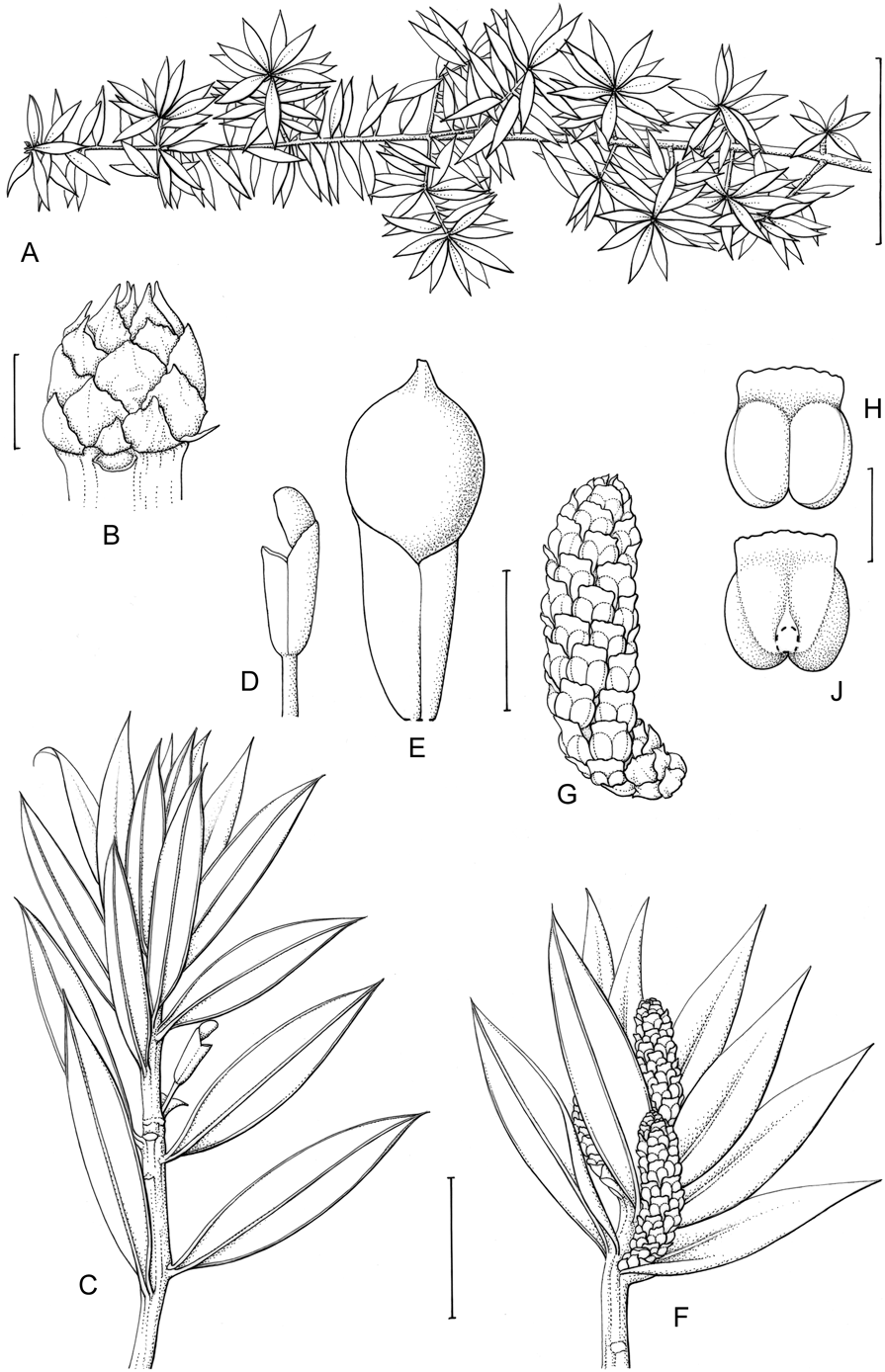
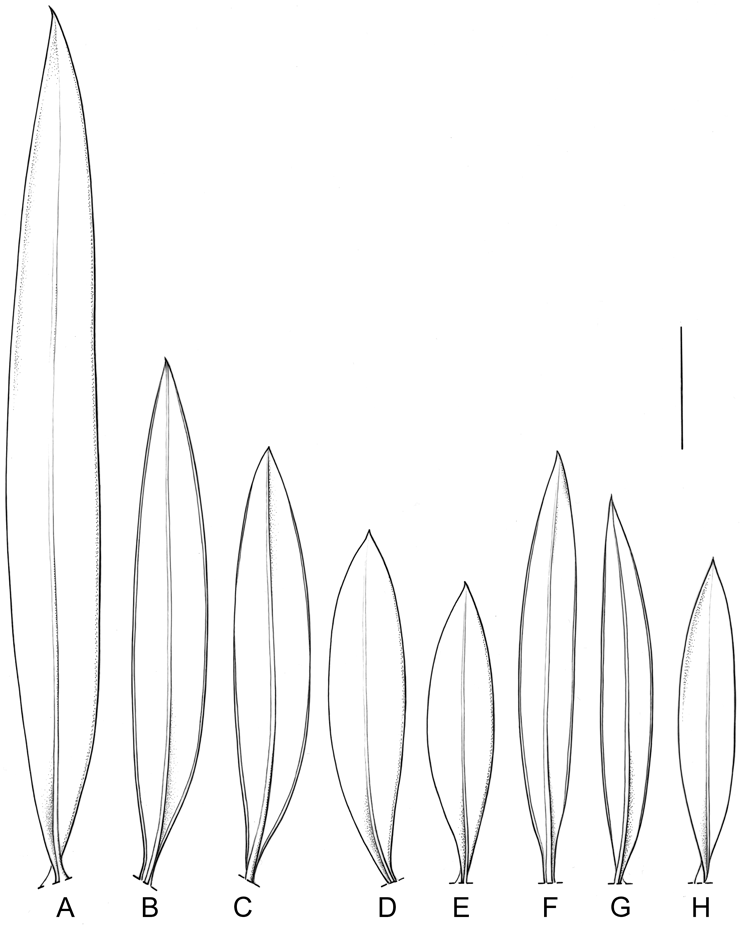
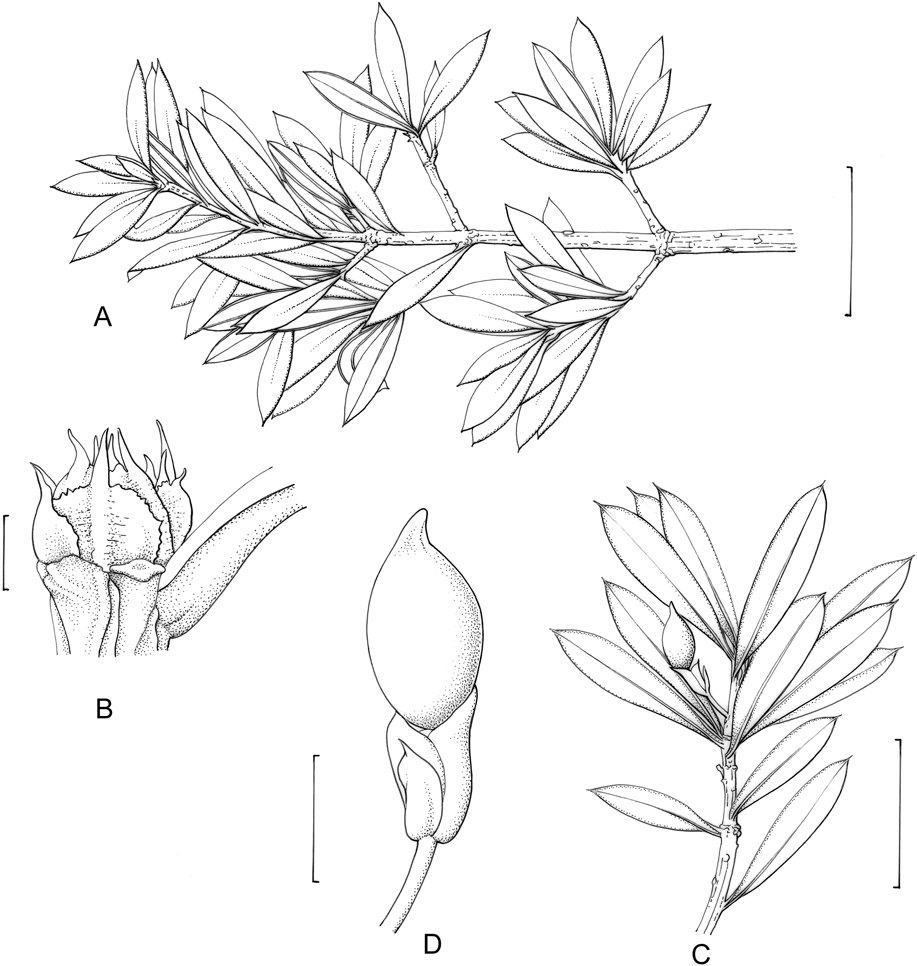
Podocarpus angustifolius. A, Branch, Wright 3188 C-3. B, Terminal bud, Alain 6328. C, Female branch showing immature cones, Wright 3188 C-2. D, Female receptacle and peduncle, Wright 3188 C-2. E, Seed (removed from receptacle), Wright 3188 A-1. F, Male branch, Wright 3188 B-4. G, Pollen cone, Wright 3188 B-4. H, Microsporophyll and microsporangia (dried), abaxial view, Wright 3188 B-4. Scale bars: A, 2 cm; B, 2 mm; C, F & G, 2 cm; D & E, 5 mm; H, 1 mm. Drawn by Claire Banks. For Wright 3188, the specimen number suffixes follow Mill & Stark Schilling (2010).

Etymology. The epithet angustifolius is Latin for ‘narrow-leaved’.
Vernacular names. Cuba: espuela de caballero, sabina cimarrona (Stark Schilling, Reference Stark Schilling2004, from herbarium specimens). The latter name has also been applied to Podocarpus ekmanii.
Distinguishing features. Of all the Cuban Podocarpus species, P. angustifolius has the most linear leaves with highest length : breadth ratio. Plants from Central Cuba (Sancti Spiritus), however, tend to have shorter leaves than those from Pinar del Rio and Artemisa and approach Podocarpus aristulatus of eastern Cuba. Podocarpus angustifolius has more acuminate leaf tips (excl. arista) than does P. aristulatus whose leaf tips, excluding the arista, are usually acute or only shortly acuminate.
Understorey tree, to 8 m tall and 30 cm d.b.h. (Bisse, Reference Bisse1988), slow-growing. Crown pyramidal when young. Bark smooth, peeling; outer bark greyish brown to light brown; inner bark reddish or purplish; wood straw-coloured. Three orders of branching; branches of each order in opposite pairs or whorls of 3, second- and third-order branches erecto-patent, second-order branches curved upwards at tips, ultimate branchlets usually rather dense (especially in western Cuba), diverging at (18–)37–60(–85)°, 10–105 mm, straight or slightly flexuous, none reduced to dwarf shoots. Twigs of first and second years greenish, of third year light greyish brown. Leaf scars orbicular to shortly transverse elliptic, greyish. Terminal buds ovoid, 2–4 × 1.1–2.6 mm, the base wider than the shoot apex; bud scales c.8 in two series, longer than bud diameter, all subequal in length, 1.5–2.5(–3.6) × (0.4–)0.5–0.7(–0.8) mm (outer broader than inner), oblong, ovate or lanceolate, greenish brown, tips erect and directed slightly inwards, all scales long-acuminate and shortly pungent-aristate [arista (0.1–)0.35–1.1 mm], not keeled, erose-margined, outer scales with extremely narrow, indistinct hyaline margins. Bud scales caducous and leaving circular to transversely elliptic, dark greyish scars at branchlet bases. Leaves (only adult ones are known) initially present on but later falling from first- and second-order branches, spirally arranged, (0.6–)2–4(–6) mm apart, with very short, indistinct, decurrent petiole, somewhat twisted at attachment (lamina and petiole appearing ‘crossed over’), spreading to erecto-patent at 30–60°, often appearing recurved when dried; lamina crimson or purplish when flushing, soon changing to yellowish green and finally greyish- or bluish green to dark green above and slightly paler beneath, linear-elliptic, narrowly elliptic or narrowly lanceolate-elliptic, (16–)22–60 × 2.3–4.8(–5.6) mm, (5.6–)7–17 × as long as broad, semi-coriaceous but flexible, margins not or slightly revolute or thickened, with vein-like striae alternating with stomata rows (× 50 lens), matt above and beneath; midrib raised proximally beneath but not above, obscure in distal 1/3 above, without associated grooves or ridges, similar in colour to lamina; apex asymmetric, acuminate, pungent-aristate (extreme tip of arista subacute), the arista (0.8–)1.2–3.3 mm; base asymmetric, attenuate.
Pollen cones not in definite zones, 1–3 per fertile branchlet, lateral on previous year’s growth near base of increment (just above bud scale scars), each subtended by a foliage leaf or arising just above one, solitary or paired in groups of 1 or much less commonly 2, ripe at leaf flushing. Pollen cone buds not seen. Basal scales c.6 in two series, caducous after shedding of pollen, brown, suberect, keeled, broadly rhombic or rhombic, c.0.8–1.1 × 0.5–0.7 mm, apex obtuse or broadly rounded, outermost ones pungent-aristate and erose- or denticulate-margined, inner ones not pungent and with undulate margin. Common peduncle absent; individual cones pedicellate, the pedicel narrow, very short (c.1 mm), straight, cones erecto-patent, brownish, purplish or violet, darker than and contrasting with foliage, narrowly cylindrical or narrowly ellipsoid, 7–12 × 2.1–2.6 mm, very slightly curved in distal half or almost straight, shedding from base to apex. Microsporophylls 45–60 per cone in 9–10 short / 5–6 long spirals with 2–3 per short half-spiral and 3–4 per long one; visible part of lamina viewed abaxially up-turned at apex, ovate, broadly ovate or oblong-rectangular, 0.3–0.6 × 0.3–0.6(–0.8) mm, glaucous, margins entire or very weakly undulate, apex broadly rounded, minutely aristate (arista < 0.1 mm). Microsporangia oblique and distally divergent, ± free, obovoid, c.(0.6–)0.7–1.1 mm, glaucous; stomium central on abaxial side, widely elliptic, microsporangia dehiscing longitudinally at sides. Pollen white or cream.
Dioecious. Seed cones borne on previous year’s growth, solitary but grouped together, lateral on ultimate branchlets, subtended by a foliage leaf or usually arising between leaves. Ovules inclined upwards at c.60° to receptacle and outwards with respect to branch, somewhat hidden amongst dense foliage, distinctly pedunculate; peduncle 4–6 mm, shorter than both total fruiting structure and receptacle, spreading at c.45° or less, ridged, winged or angled, compressed, broadened distally, enveloped by a cylinder of bracts; basal scales absent. Prophylls (foliola) absent. Receptacle of 1 sterile and 1 fertile bract, asymmetrical, obovoid, when immature 7.5–9 mm along longer edge, 5.5–6.5 mm along shorter edge, 5.2–6 mm along connation, 2.1–2.2 mm wide at base, 4–4.6 mm wide at apex; bracts fused but with unequal free tips; fertile bract very faintly keeled throughout, with median groove; free tip of fertile bract triangular-lanceolate, 3–4 × 1–1.5 mm, of sterile bract ovate-oblong, 1.5–2 × 1–1.7 mm, body and free tips of both fertile and sterile bract reddish violet, glaucous, free tips with minute stomata; apices of both free tips subacute, erose, narrowly scarious-margined. Epimatium stomatiferous, cleft at summit, violet and glaucous when immature becoming greenish olive to dark brown when ripe and rugose. Seed asymmetrically placed on receptacle, 8–8.5 × 4.3–4.5 mm, ellipsoid, laterally compressed, crested at topographically distal end; crest conical, flattened, 1–1.5 × 1.2–2.5 mm, truncate; seed not beaked at micropylar end.
Phenology. New leaves flushing from April to June (prior to and during early wet season); pollen cones shedding from April to June (early wet season), synchronised with leaf flushing; seed cones receptive March/April (and perhaps later), towards end of dry season; cones ripe January–March(–April) of following season, i.e. at least 12 months later (Osorio Chaud & Vichot, 2009) but from the evidence of the lectotype seeds persistent on tree for at least six months thereafter; maturation is towards the end of the dry season. Dispersal occurs from mid- to late April (Ferrandis et al., Reference Ferrandis, Bonilla and Osorio2011). The seeds are recalcitrant and appear to show non-deep, simple morphophysiological dormancy (Ferrandis et al., Reference Ferrandis, Bonilla and Osorio2011). They germinate about 30 days after sowing (Osorio Chaud & Vichot, 2009).
Taxonomy. Podocarpus angustifolius has had the reputation of being difficult to separate from P. aristulatus. This has not been helped by the key and species accounts given by Buchholz & Gray (1948b: 127, 147). In their key, the two leads in the couplet separating the two species were essentially identical. However, the quoted measurements do not agree with those given in the respective descriptions and in those one does find differences between the two:
(Podocarpus angustifolius) leaves 4–7 cm × 3–4.5 mm; pollen cones 10–15 × 3 mm; ovulate cones on peduncles 2.5 to 4.5 mm long; seed 7 mm long (no width given).
(Podocarpus aristulatus) leaves up to 4 cm × 5–7 mm; pollen cones 9–12 × 3–3.5 mm; ovulate cones on peduncles 2–3 mm long; seed 7–9 × 4–5 mm.
Therefore Buchholz & Gray (Reference Buchholz and Gray1948b) were not only differentiating these two species on the basis of leaf shape but also on a non-overlapping difference in leaf width (3–4.5 mm in Podocarpus angustifolius vs. 5–7 mm in P. aristulatus), the shorter leaf length of P. aristulatus and shorter female peduncles of the latter although with some overlap. Staszkiewicz (Reference Staszkiewicz1988) similarly used length : width ratio as the fundamental difference between his Podocarpus angustifolius var. angustifolius (i.e. P. angustifolius) and the other varieties he recognised.
Several infraspecific taxa have been described, namely var. wrightii Pilg., var. aristulatus J.Staszk. and var. leonii J.Staszk. [as ‘leonis’; with f. leonii (‘leonis’) and f. victorinianus (Carabia) J.Staszk.]. The first two of these are synonymous with Podocarpus aristulatus Parl. while P. angustifolius var. leonii and its two forms are here all treated as P. victorinianus Carabia. Another varietal ‘combination’, ‘Podocarpus purdieana var. nana Griseb.’, is apparently only mentioned by Gaussen (1976: 124); its nomenclatural status is not known as the original publication of the name (if any) has so far not been traced despite checking Grisebach’s principal publications on the Cuban flora.
Podocarpus ekmanii was synonymised with P. angustifolius by de Laubenfels (Reference de Laubenfels1985). However, it is here retained as a separate species that is in fact more similar to Podocarpus buchii and particularly P. aristulatus; for full discussion see under P. ekmanii.
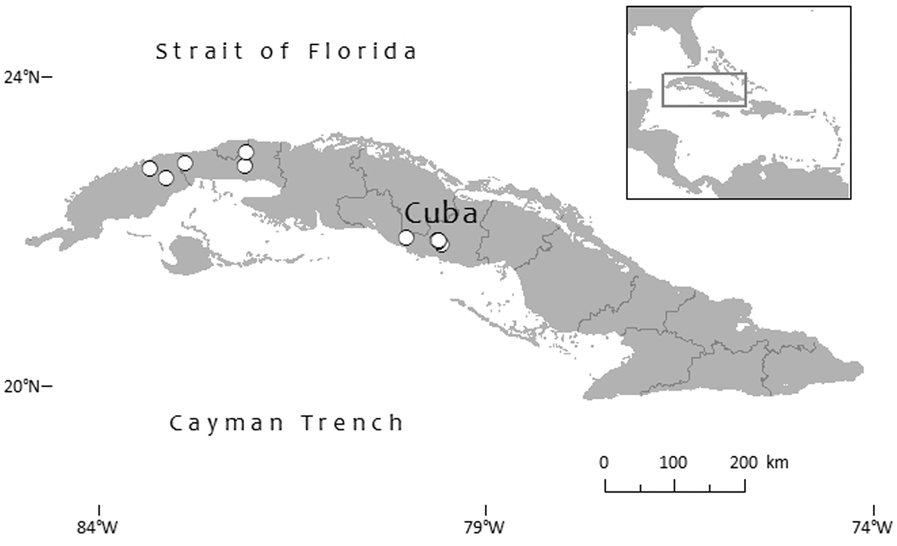
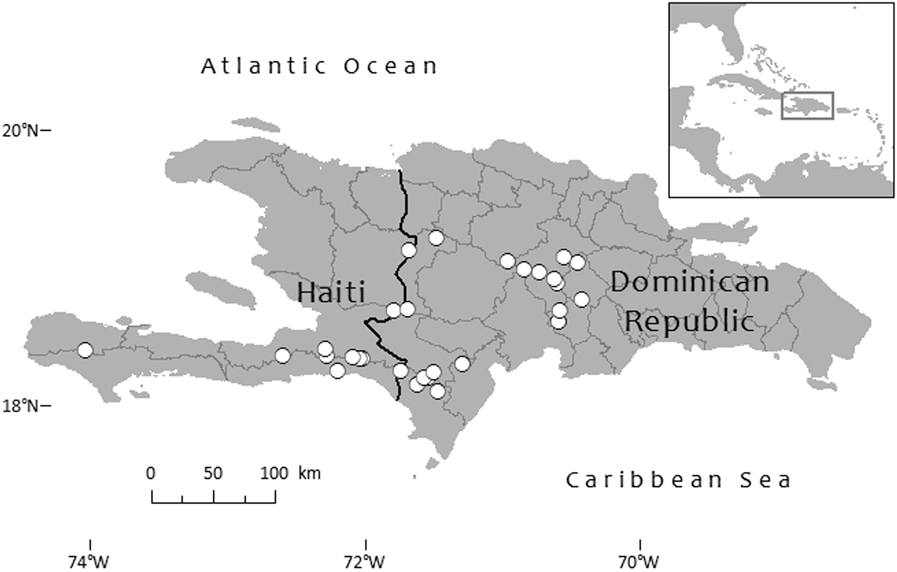
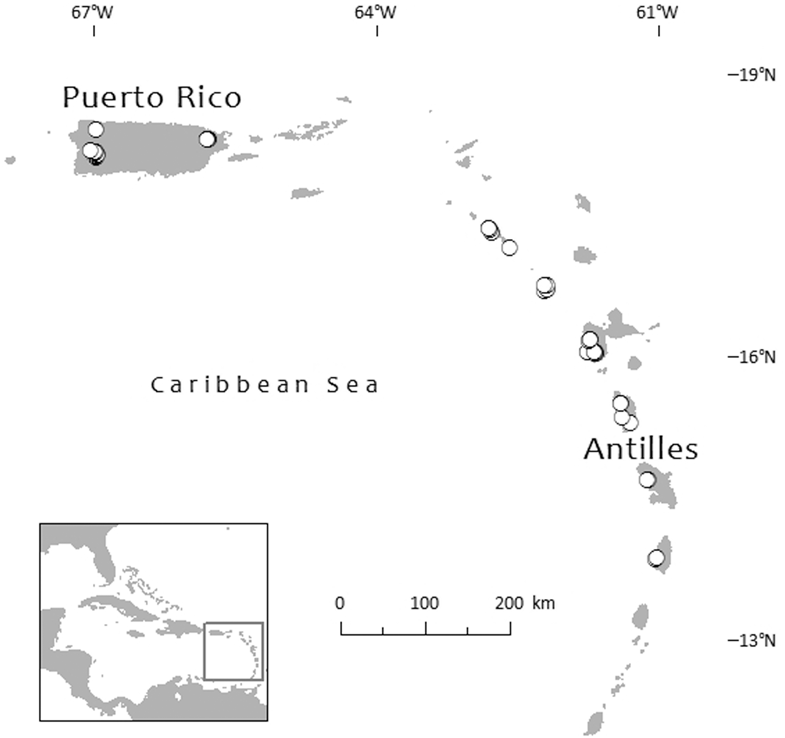
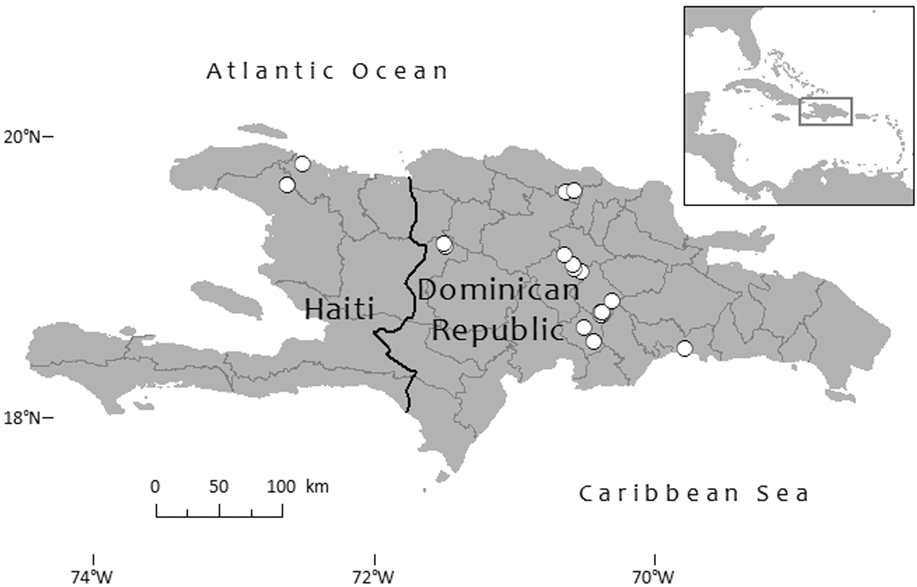
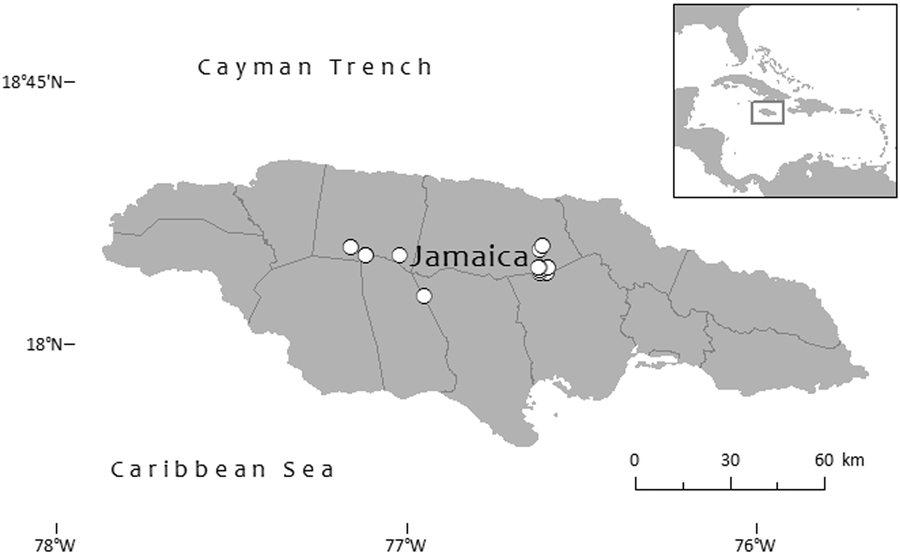
Distribution . Caribbean: Cuba (western and central; in provs. Pinar del Río (San Diego de Tapia & San Miguel), Artemisa (El Retiro, Grupo de Rosario, Charco Azul) and Sancti Spiritus; endemic. The species seems to be extinct now at most of its former localities in Pinar del Río and Artemisa, the latter being a province formed in January 2011 by the removal of three municipalities from eastern Pinar del Rio Province, including Bahia Honda, and the eight western municipalities of the former La Habana Province (Cuba Standard, 2010). It is now known from a 1999 collection at Cueva del Indio in Viñales municipality in Pinar del Rio (a previously unknown locality), a single tree in Sierra de Trinidad and a population in Sancti Spiritus, at least some of which has been planted as part of a restoration programme (see label of Gardner et al. 03 cited below). Records from Santiago de Cuba Province in eastern Cuba belong to Podocarpus aristulatus. Pleistocene macrofossils that most likely belong to this species are known from the Isla de la Juventud, Cuba (Graham, Reference Graham2003a: 360, Table II). Takhtajan: Caribbean Region (West Indian Province). Morrone: Neotropical region, Caribbean subregion, Antillean dominion, Cuba province. Cano Carmona: Western Antilles Superprovince, Cuba Province. TDWG: 81 CUB. Map: Fig. 2.
Global distribution of Podocarpus angustifolius.
Specimens examined and other records. Cuba. Unlocalised, [1822–1835], Ramón de la Sagra s.n. in herb. Triana 657 (P–image). Pinar del Rio:La Palma: Sierra de los Órganos, San Diego de Tapias, 3 iv 1920, E.L. Ekman 10648 (S–database). Sierra de los Órganos, Grupo del Rosario, San Diego de Tapias, edge of Rio Mané-mané (= Rio San Miguel), 21 xii 1920, E.L. Ekman 12666 (F, K–database, NY, S–database). Viñales: Cuevo del Indio, 19 ix 1999, Kuba-exkursion Uni Frankfurt M. 1999 247 (S–database). Artemisa: Bahía Honda: Charco Azul, 23 ix (year unknown), Wright 3188 p.p. (collection A of Mill & Stark Schilling, 2010: A-1, GOET, ripe seeds, lectotype; A-2, BM; A-3, G–DC; A-4, NY; A-5, FI; A-6, B; A-7, S, isolectotypes). San Cristóbal: Retiro, 10 vi (year unknown), Wright 3188 p.p. [collection B of Mill & Stark Schilling, 2010: 938: B-1, GOET; B-2, G–DC; B-3, GH; B-4, MO; B-5, BM; B-6, K; B-7, S–image; B-8, fragment FI–photo; B-9, fragment B–image; B-10 (seen since 2010, here designated), P, bar-coded P00748950, top left specimen): all male, isosyntypes]. Retiro, 21 iv (year unknown), Wright 3188 p.p. [collection C of Mill & Stark Schilling, 2010: 938: C-1, GOET; C-2, GH; C-3, MO; C-4, K; C-5, S–image; C-6 (seen since 2010, here designated), YU, right-hand specimen: all unripe female, isosyntypes]. Santa Cruz de los Pinos, border of Rio Taco-taco, “cult., but without doubt, from wild plants”, 5 iii 1924, E.L. Ekman 18628 (NY, S–database). Sancti Spiritus:Sancti Spiritus: El Naranjal, Lomas de Banao sur de Sancti Spiritus, vii 1932, A. Luna (hb. León) (NY). Sierra de Escambrey, Alturus de Banao, Filo de Caja de Agua, 21°52′31.7″N 79°36′50″W, 790 m, 14 xi 2003, E. Bécquer et al. 01 (E–2 sheets, K–database); ibid., 790 m, 14 xi 2003, E. Bécquer et al. 02 (E, K–database); ibid., E. Bécquer et al. 03 (E, K–database); ibid., 21°52′31.7″N 79°36′50″W, 790 m, 14 xi 2003, “planted as part of restoration programme”, E. Bécquer et al. 04 (E); Alturus de Banao, forest N of ‘Teta de Ivana’ [Tetas de Juana], Caja de Agua, 21°52′N 79°36′W, 700 m, 14 xi 2003, E. Bécquer et al. 05 (E); ibid., E. Bécquer et al. 06 (E); ibid., 21°52′N 79°36′W, 700 m, 14 xi 2003, E. Bécquer et al. 8 (E). Sierra de Escambrey, Sierra de Escambrey, Alturus de Banao, La Sabina Field Station, cultivated, “12 years old planted specimen”, 21°52′57.3″N 79°35′55.7″W, 14 xi 2003, E. Bécquer et al. 13 (E). Trinidad: Tope de Collantes, Trinidad Mts., 800 m, 17 vii 1957, Bro. Alain 6328 (GH, S–n.v. det. Staszkiewicz).
Bioregion: Caribbean. Ecoregions: NT0120 Cuban moist forests, NT0304 Cuban pine forests.
Ecology. Seasonally dry semi-deciduous mesophyll forest and wet humid montane rainforest, on limestone and shallow ferrolitic soils; 450–900 m. The ecological notes given by Farjon (Reference Farjon2010) do not necessarily apply to the species as circumscribed here since he treated the species in a very wide sense. The Sierra de los Órganos (limestone) and Sierra del Rosario (serpentine) share many genera and species in common (Borhidi, Reference Borhidi1991). In the latter, the native seasonal evergreen tropical forest was largely replaced by coffee plantations from the mid-1800s onwards (Borhidi, Reference Borhidi1991) and this has undoubtedly contributed to the apparent local extinction of Podocarpus angustifolius in Pinar del Rio. In Sancti Spiritus, where the only major extant population of this species is found, the forest occurs as two well-differentiated layers. The canopy layer comprises trees such as Cyrilla racemiflora L., Gordonia angustifolia (Britt. & Wils.) P.Keng, G. wrightii (Griseb.) H.Keng, Magnolia cubensis Urb. subsp. cubensis, Myrsine coriacea (Sw.) R.Br. ex Roem. & Schult., Ocotea cuneata (Griseb.) M.Gómez, O. floribunda (Sw.) Mez and O. leucoxylon (Sw.) Laness. The understorey layer includes Podocarpus angustifolius as well as the dominant angiosperm trees Alchornea latifolia Sw., Clusia tetrastigma Vesque, Garrya fadyenii Hook., Gomidesia lindeniana Berg., Miconia punctata (Desr.) D.Don and Matayba domingensis (DC.) Radlk. and the tree fern, Cyathea arborea (L.) Sm. (Ferrandis et al., Reference Ferrandis, Bonilla and Osorio2011). Borhidi (Reference Borhidi1991) comments that a peculiarity of the Sancti Spiritus/Alturus de Banao flora is its double origin, with the montane elements originating from eastern Cuba (former ‘Oriente’) and the limestone karstic elements partly from Pinar del Rio. This may explain the presence of Podocarpus angustifolius in this part of Cuba, disjunct from its former stronghold in Pinar del Rio. Associates of the Sancti Spiritus population include Beilschmiedia pendula (Sw.) Hemsl., Cojoba arborea (L.) Britton & Rose, Prunus occidentalis Sw., Magnolia cubensis subsp. cubensis, Matayba domingensis, Ocotea leucoxylon, O. nemodaphne Mez and O. wrightii (Meisn.) Mez (Bécquer et al. 06 etc., in sched., with correction of nomenclature).
Mycological associations. The myxomycete Stemonitopsis hyperopta (Meyl.) Nann.-Bremek. has been collected on a trunk of ‘Podocarpus sp.’ at Alturas de Banao where P. angustifolius is the only one known to occur (Camino et al., Reference Camino, Stephenson, Krivomaz, Wrigley de Basanta, Lado and Estrada-Torres2008).
Proposed IUCN conservation assessment (IUCN 3.1). Critically Endangered CR B2ab(ii,iii,iv) (following the recommendation of Berazaín Iturralde et al., Reference Berazaín Iturralde, Berazaín, Lazcano Lara and González Torres2005). Farjon (Reference Farjon2010) downgraded it to Endangered EN (B1+2c) and González Torres & Gardner (Reference González Torres and Gardner2013) have further downgraded it to Vulnerable VU B2ab(ii,iii,iv,v). However, both these assessments applied to a wider circumscription of the species, including two eastern taxa (here treated separately as Podocarpus aristulatus and P. victorinianus) and disagree with the CR grading recently awarded to P. angustifolius by Cuban conservation experts who know the status of the plant in the field (M.F. Gardner, pers. comm.). The species seems particularly vulnerable to ecological change and habitat degradation (Conifer Specialist Group, 2000). Populations have declined recently due to over-exploitation of the wood to make ornaments and other items (Ferrandis et al., Reference Ferrandis, Bonilla and Osorio2011). The species is listed in Section 7, Article 95 of the Ley Forestal [Forest Law] of Cuba (Republica de Cuba, 1999), which prohibits the logging of certain threatened species.
Uses. Podocarpus angustifolius is potentially useful for poles, posts and roundwood (Álvarez Brito, 2003), although there may have been confusion with either or both of P. aristulatus and P. ekmanii which are listed without uses in the same document.
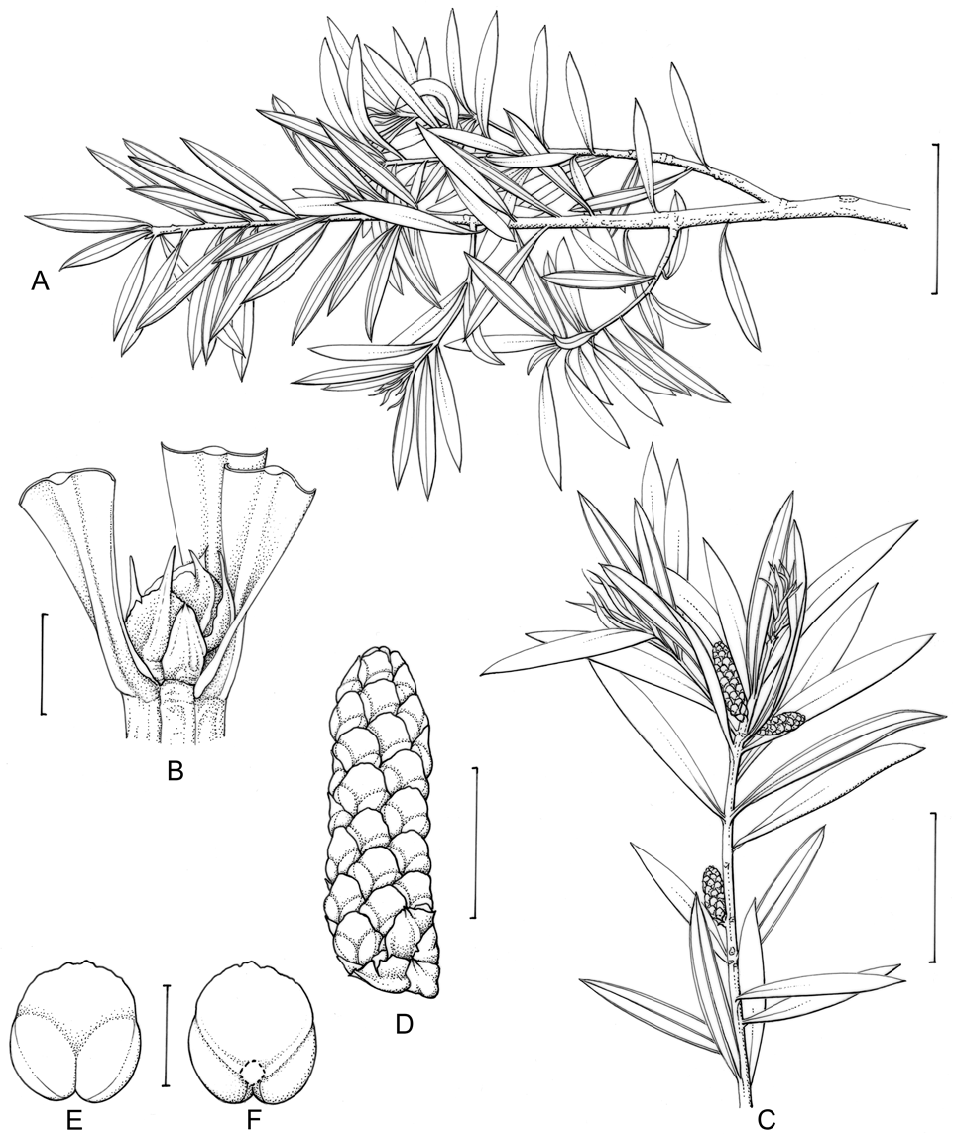
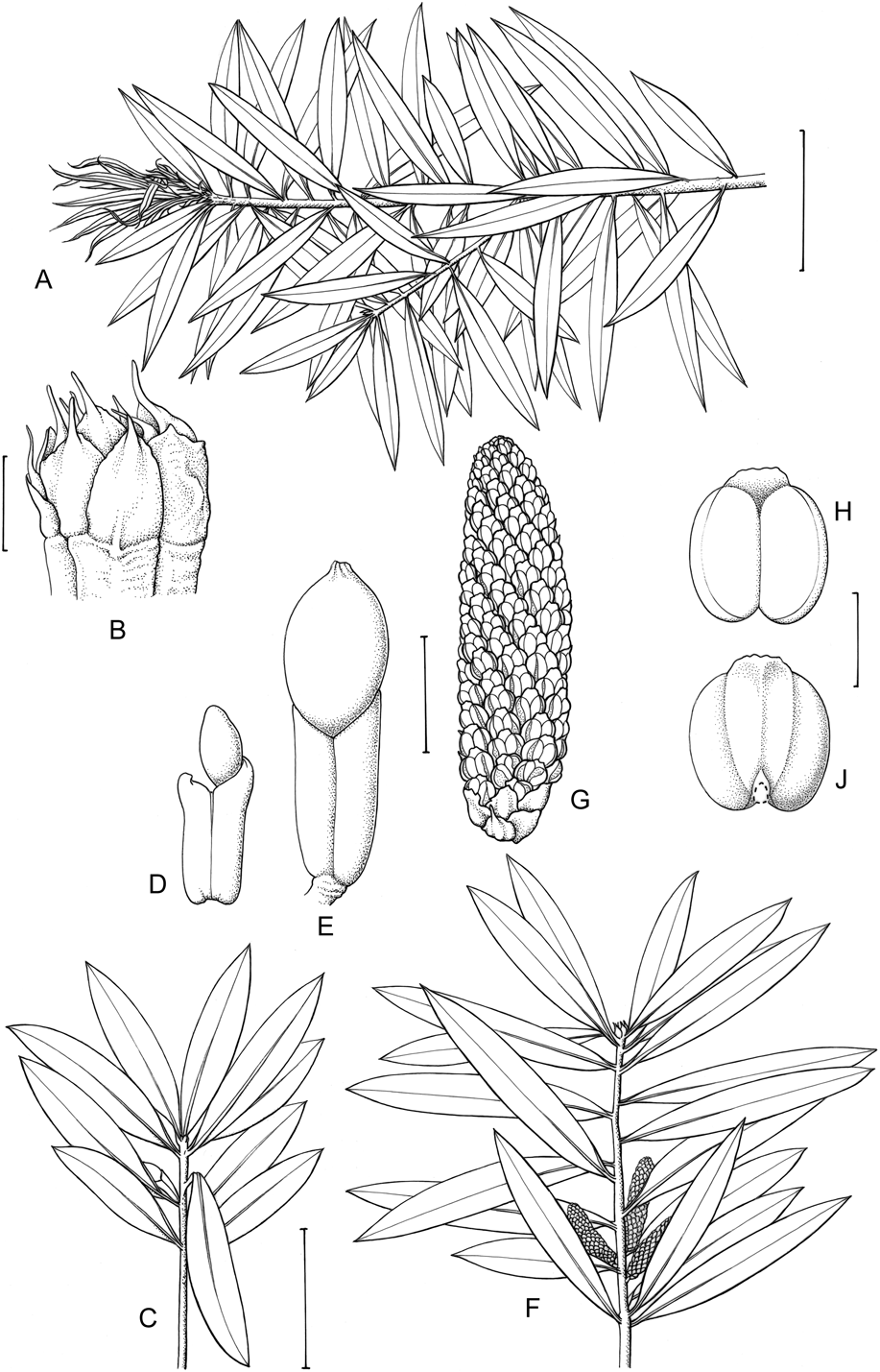
2. Podocarpus aristulatus Parl. in A.DC., Prodr. 16(2): 513 (Jul. 1868), ‘aristulata’. – Nageia aristulata (Parl.) Kuntze, Revis. Gen. Pl. 2: 800 (1891). – Podocarpus angustifolius subsp. angustifolius var. aristulatus J.Staszk., Fragm. Florist. Geobot. 33(1–2): 77 (1988) with indirect basionym ref. – Lectotype (designated by Mill & Stark Schilling, 2010: 955): [Cuba, prov. Guantánamo], “prope villam Monte Verde dictam”, i–vii 1859, Wright 1461 p.p. (G–BOIS, left-hand branch with male cone and base of removed male cone, designated Wright 1461 A-1 by Mill & Stark Schilling, 2010: 939); isolecto FI (Wright 1461 A-2 of Mill & Stark Schilling, 2010: 939), K (Wright 1461 A-3), B (centre of sheet bar-coded B10 0158049: Wright 1461 A-4; left-hand side of sheet bar-coded B10 0158050: Wright 1461 A-5), P (male specimen at bottom right of sheet bar-coded P00748951: seen since 2010, here designated Wright 1461 A-6), YU (male specimen at bottom left of sheet bar-coded YU000844: seen since 2010, here designated Wright 1461 A-7), GH (male specimen at right-hand side of sheet bar-coded Harvard University Herbaria 0022528: seen since 2010, here designated Wright 1461 A-8). Figs 3, 5E–H, 8M–V.
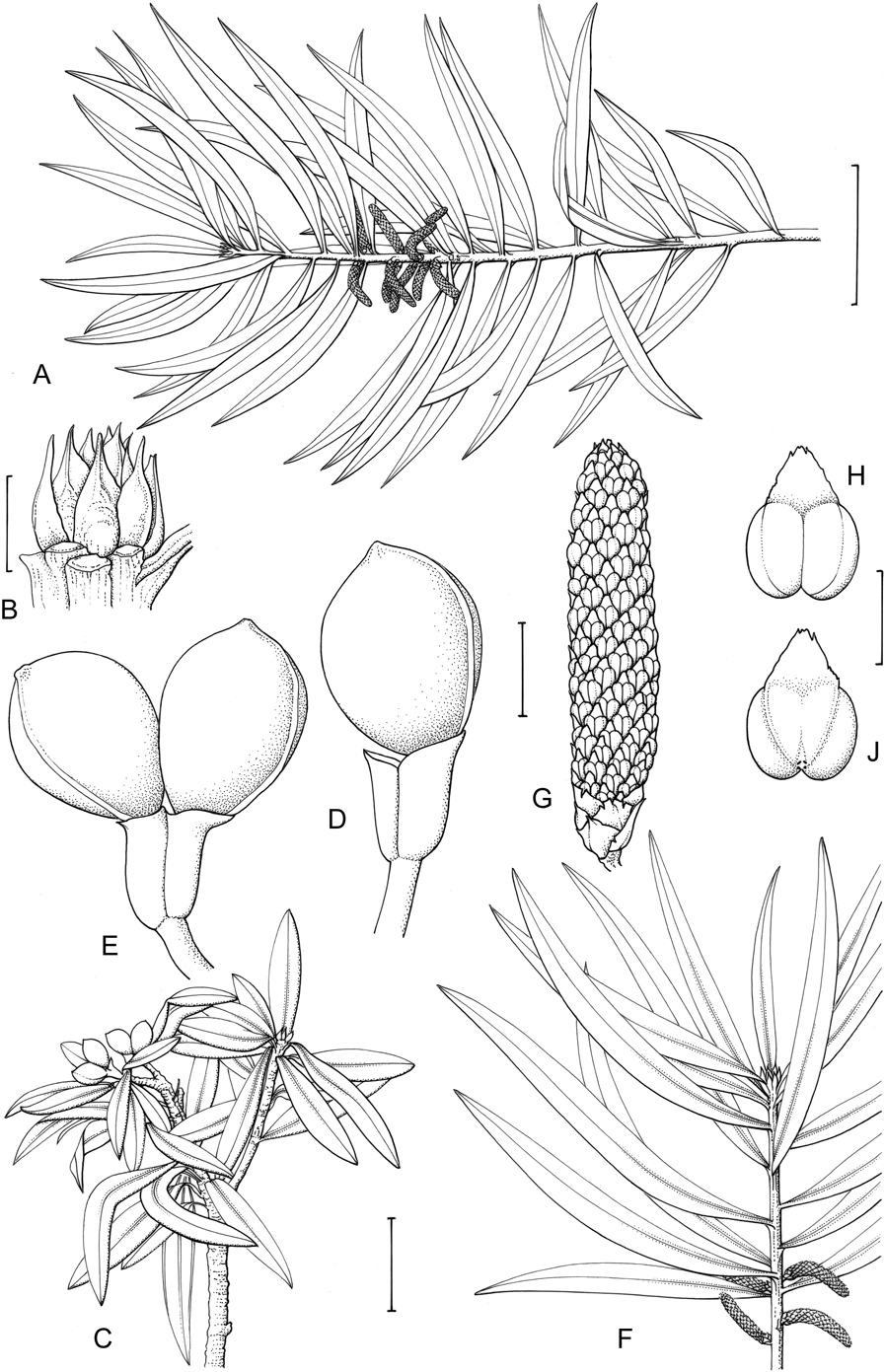
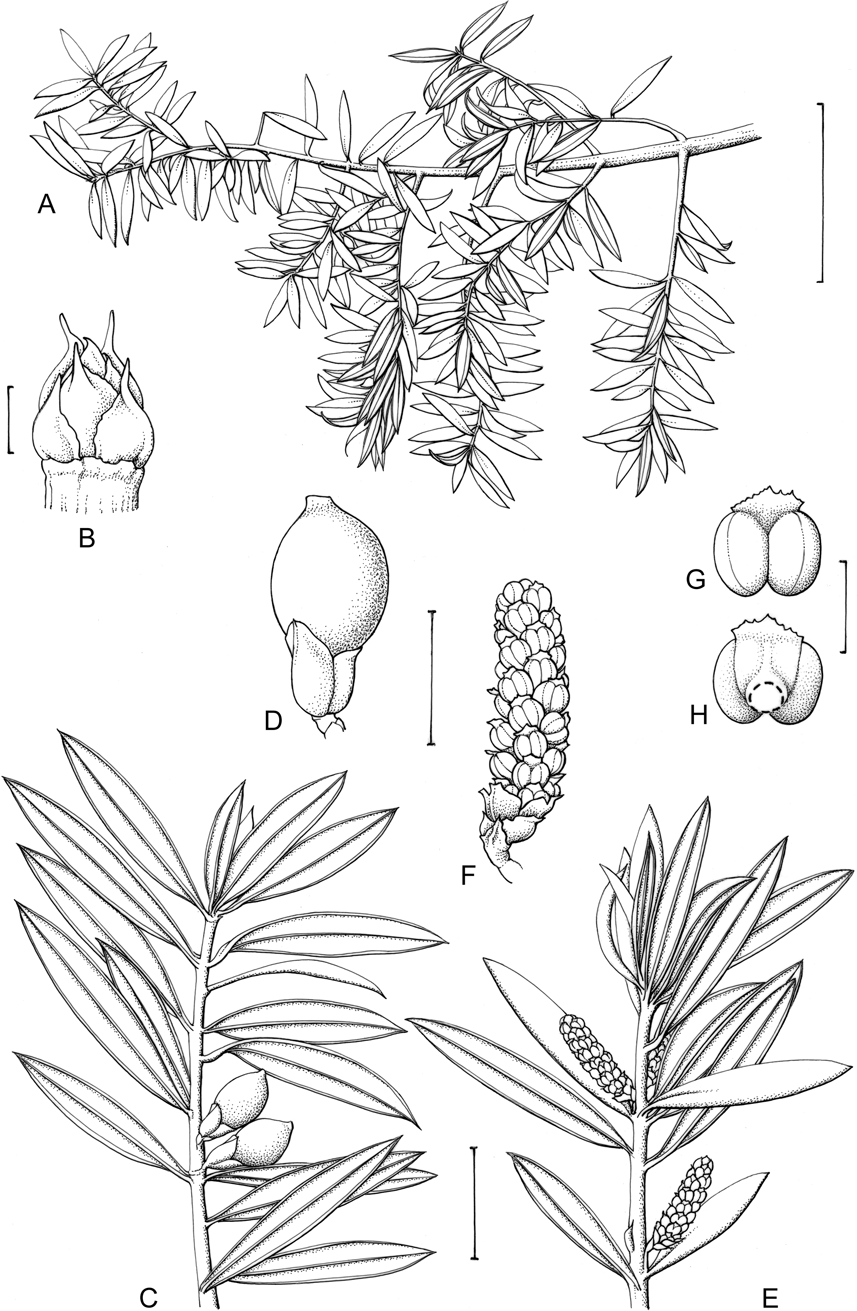
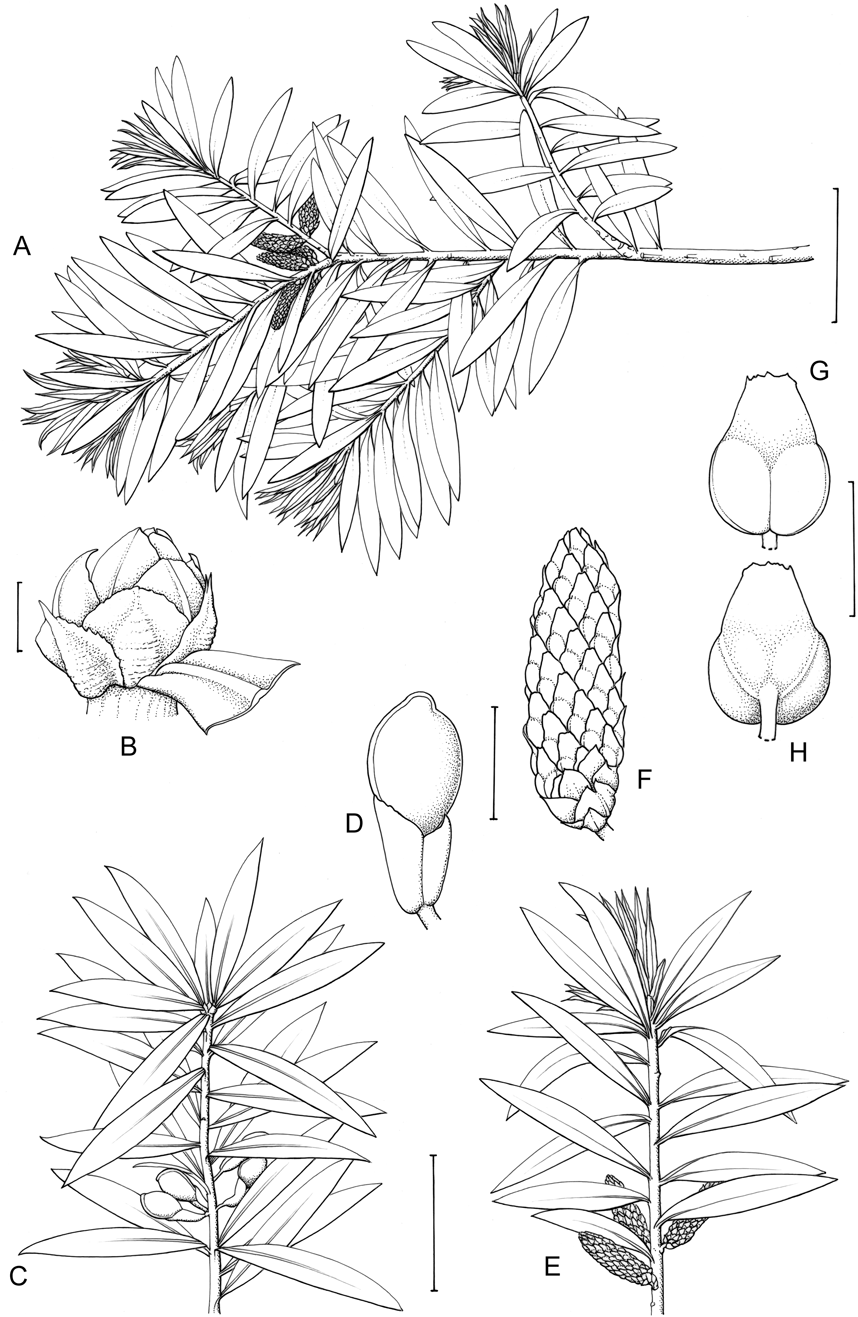
Fig.3.Podocarpus aristulatus. A, Branch, Bécquer et al. 7002. B, Terminal bud, Ekman 9813. C, Male branch with flushing leaves at tip, Bécquer et al. 7003. D, Pollen cone, Bécquer et al. 7003. E, Microsporophyll and microsporangia (rehydrated), abaxial view, Bécquer et al. 7003. F, Microsporophyll and microsporangia (rehydrated), adaxial view, Bécquer et al. 7003. Scale bars: A, 3 cm; B, 2 mm; C, 2 cm; D, 4 mm; E & F, 1 mm. Drawn by Claire Banks.

Podocarpus angustifolius Griseb. var. wrightii Pilg. in Engler, Pflanzenr. IV. 5 (Heft 18): 89 (1903). – Lectotype (Mill & Stark Schilling, 2010: 955): Wright 1461 p.p. (lecto B, the specimen denoted 1461 A-4 by Mill & Stark Schilling, 2010: 939, f. 4C at centre on the sheet bar-coded B10 0158049: also isolectotype of Podocarpus aristulatus).
[Podocarpus purdieanus Hook. ‘forma parvifolia’ Griseb., Mem. Amer. Acad. Arts Sci. n.s. 8(2): 530 (1862), nom. inval. (Art. 36.1(a))].
Podocarpus purdieanus sensu Grisebach (1866: 217, ‘purdieana’) p.p. non Hooker (Reference Hooker1844). – Misapplied to plants from eastern Cuba (Wright 1461 p.p.).
Podocarpus coriaceus sensu Sauvalle (1873: 151) p.p. non Richard (Reference Richard1826). – Misapplied to plants from eastern Cuba (Wright 1461 p.p.).
Etymology. From Latin aristulatus, ‘possessing a little awn’, from diminutive of arista, ‘an awn’.
Vernacular names. None applicable to this species are known; tachuela has been applied in the Dominican Republic to plants called Podocarpus aristulatus (Marcano, 2009–2010; Marcano, 2009–2013) but these belong to P. buchii.
Distinguishing features. Podocarpus aristulatus is one of three closely related species of the genus that occur in eastern Cuba although there is little overlap between their geographical ranges as delimited here. Podocarpus ekmanii can readily be separated by its small leaves never more than 35 mm long. Podocarpus aristulatus can be separated from P. victorinianus by the midrib being ± prominently raised beneath; the leaves are also typically narrower than the 6–11 mm wide leaves of P. victorinianus although there is some overlap.
Non-emergent, single- or multi-stemmed tree to 12(–20) m; d.b.h. rarely recorded (c.30 cm, one specimen). Crown shape not recorded. Outer bark greyish brown, fairly smooth; inner bark dark brown; wood greyish. Three orders of branching; first-order branches whorled, second- and third-order branches in irregular spiral arrangement, sparse, erecto-patent to suberect or erect; ultimate ones diverging from axis at (20–)40–60(–75)°, 50–150 mm (leaders often longer), with none reduced to dwarf shoots. Twigs of first and second years green, of third year greyish brown. Leaf scars circular or transversely elliptic, c.1 × 1 mm, greyish. Terminal buds depressed-globose (excl. aristae if present), 1.8–2.3 × 0.7–1.7(–2.1) mm, the base normally equalling or wider than the shoot apex. Bud scales c.10 or more in at least three series, longer than bud diameter, 1.3–2.1(–2.6) × 0.3–0.8(–1.1) mm, the inner ones slightly longer than the outer but all subequal in width, the outer ones ovate or broadly ovate-lanceolate, the inner narrowly ovate or ovate-lanceolate, greenish brown, spirally arranged, all with ± distinct keels but the keel sometimes indistinct especially on the inner scales; tips all erect, all scales acute or narrowly acute and ± pungent-apiculate at apex [apiculus when present 0.15–0.45(–0.6) mm, sometimes absent]; margins erose, not or very indistinctly hyaline; inner bud scales becoming foliaceous at leaf flushing. Bases (only) of bud scales persisting at branchlet bases for one year. Leaves initially present on but later (especially on adult trees) falling from first- and second-order branches and also from basal parts of ultimate branches, (0.8–)2–5(–8, exceptionally 12) mm apart, with decurrent petiole (0.6–)1.1–2.5(–3.6) mm in both adult and juvenile leaves, twisted at attachment, spreading to erecto-patent, diverging from axis at (24–)38–56(–74, exceptionally 84)°, frequently recurved. Leaf lamina purplish or violet when flushing, when mature dark green to olive-green above and grey-green beneath, horizontally spreading to erecto-patent, mostly linear-elliptic, narrowly elliptic or narrowly oblong-elliptic with a few adult leaves narrowly obovate or obovate, juvenile and adult leaves similar in size ranges (although juveniles in individual trees may be larger: Bécquer et al. 7006), (18–)27–48(–54) × (2.9–)3.9–6.7(–8.1) mm, (4.8–)5.4–8.7(–10.8) × as long as broad, mostly straight but occasionally falcate, fairly thick and stiffly coriaceous, semi-matt to somewhat glossy above and beneath; margins thickened to narrowly revolute; vein-like striae alternating with stomata rows (× 50 lens); midrib abaxially lacking evident striate bands on either side, (0.3–)0.4–0.7(–0.8) mm wide abaxially, ± prominently raised beneath and also indistinctly, inconstantly and only proximally above (most leaves with it not raised on upper surface), often with the central part of the lamina of adult leaves depressed above with the midrib not raised, without associated grooves or ridges, similar in colour to lamina; apex slightly asymmetric, acute or shortly acuminate, pungent-aristate (extreme tip of arista acute), the arista (0.4–)0.7–1.8(–2.5) mm; base slightly asymmetric, attenuate.
Pollen cones not in definite zones, 2 or 3(–6) per fertile branchlet, in middle or upper part of branchlet, when in middle sometimes with another cone near the apex, each solitary and lateral in leaf axils on previous year’s growth near middle of branchlet increment, ripe at leaf flushing. Basal scales c.6 in 2(?3) series, brownish olive, suberect, keeled, ovate, c.1 × 1 mm, apex acute, weakly and shortly pungent-aristate (arista c.0.3 mm) and entire or erose, very narrowly hyaline margin. Common peduncle absent; individual cones pedicellate, the pedicel narrow, 0.5–1.5 mm, very much shorter than cone, straight, erecto-patent; cones brownish with purplish bloom and pinkish brown microsporangia, darker than and somewhat contrasting with foliage, narrowly cylindrical, narrowly ellipsoid or ellipsoid, 9–17 × 3–4 mm, widened slightly distally, initially straight but finally curved from base, shedding from base to apex. Microsporophylls 45–60 per cone in 9–11 short / 9–13 long spirals, 2–3 in each short half-spiral and 3 in each long one; visible part of lamina viewed abaxially reddish violet with glaucous bloom, reddish brown after dehiscence, broadly ovate, transversely reniform or lunate, 0.42–0.63 × 0.44–0.55 mm, convex longitudinally, margins undulate towards apex, hyaline and scarious, apex broadly rounded to acute, not aristate. Microsporangia oblique and divergent distally, free, ellipsoid, 0.5–0.8 mm; stomium central on abaxial side, elliptic, dehiscing longitudinally up centre; microsporangial walls scarious-margined. Pollen cream.
Female cones not seen.
Phenology. Imperfectly known. Male cones and flushing leaves from mid-April to mid-June (during the wet season). Female cones have not been seen at any stage of their development.
Nomenclatural and taxonomic notes. Mill & Stark Schilling (2010: 955) lectotypified the name Podocarpus aristulatus and also proposed it for conservation with the same, conserved type in the event that the name was deemed illegitimate (Stark Schilling & Mill, 2010). The decision of the Nomenclature Committee for Vascular Plants, as reported by Brummitt (Reference Brummitt2011), was a majority vote declaring the name to be legitimate because Parlatore “did not necessarily include the type of [Podocarpus] angustifolius” and therefore that conservation was not considered necessary.
Podocarpus aristulatus has been given a variety of circumscriptions. Carabia (Reference Carabia1941) as well as Buchholz & Gray (Reference Buchholz and Gray1948b) regarded it as a species native to eastern Cuba, distinct from both Podocarpus angustifolius in the west of the island and the other three eastern species recognised by them, P. ekmanii, P. leonii and P. victorinianus. De Laubenfels (1985) again regarded it as distinct from Podocarpus angustifolius, but included within it not only P. leonii and P. victorinianus but also P. buchii from Hispaniola. Exactly the same circumscription was recently adopted by Acevedo-Rodríguez & Strong (Reference Acevedo-Rodríguez and Strong2012). Farjon (Reference Farjon2010) on the other hand sunk it, and Podocarpus leonii and P. victorinianus, into synonymy under P. angustifolius while keeping P. buchii separate. Eckenwalder (Reference Eckenwalder2009) took an even broader view, regarding Podocarpus aristulatus as a variety of P. angustifolius and included within the variety not only all Cuban taxa other than P. angustifolius var. angustifolius but also P. buchii and even P. urbanii from Jamaica.
The designated lectotype of Podocarpus aristulatus, part of Wright 1461 at G–DC as specified above, is male. Buchholz & Gray (Reference Buchholz and Gray1948b) based their description of Podocarpus aristulatus, which included details of female cones, on only four gatherings: Wright 1461 at GH, MO, NY and YU, Carabia 3843 (NY), Roig 162 (NY) and Shafer 8785 (US). I have not seen the US example of the latter number but Buchholz & Gray identified the NY example of Shafer 8785 as Podocarpus leonii and I have included it, as well as the sheet at A which Buchholz and Gray apparently did not see, under P. victorinianus, within which I have synonymised P. leonii. Carabia 3843 and Roig 162 are both sterile, while female material of Wright 1461 must belong to Podocarpus victorinianus (Mill & Stark Schilling, 2010), unless more than one collection is involved, which Mill & Stark Schilling (2010) concluded was not the case. Assuming that is correct, Buchholz & Gray (Reference Buchholz and Gray1948b) could not have seen any female material belonging to Podocarpus aristulatus as circumscribed here and their description of the female cone (and probably some of the leaf description) must in fact have been based on material of Podocarpus victorinianus that they did not realise belonged to it. All female material on sheets of Wright 1461 that they cited under Podocarpus aristulatus is here included under P. victorinianus. This includes female shoots of Wright 1461 at MO (seen by Buchholz and Gray) and B in which the receptacle is not swollen as in the type of Podocarpus victorinianus, and a packet of female cones on a sheet at YU that (like other sheets seen of Wright 1461) also bears material of P. aristulatus. Although I have seen considerably more material of Podocarpus aristulatus than Buchholz and Gray did, none of it is female (apart from the Wright material here excluded) and therefore I have not been able to provide a description of the female cones of this species. At least one sheet in Cuban herbaria that may belong to Podocarpus aristulatus (López Figueiras 2793, HAJB) bears female cones according to an unpublished list of specimens sent to me, but it has not been possible to examine it to confirm the identification or describe the cones.
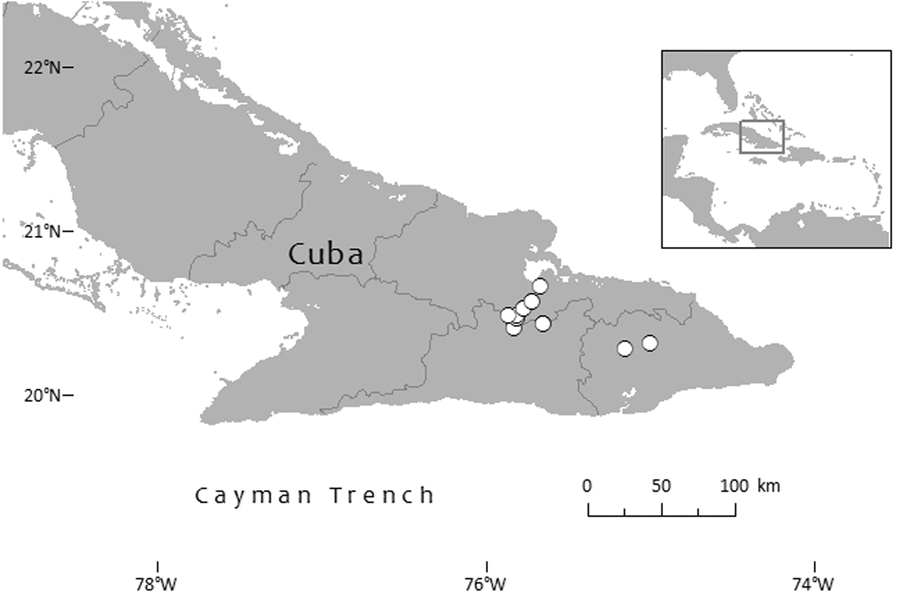
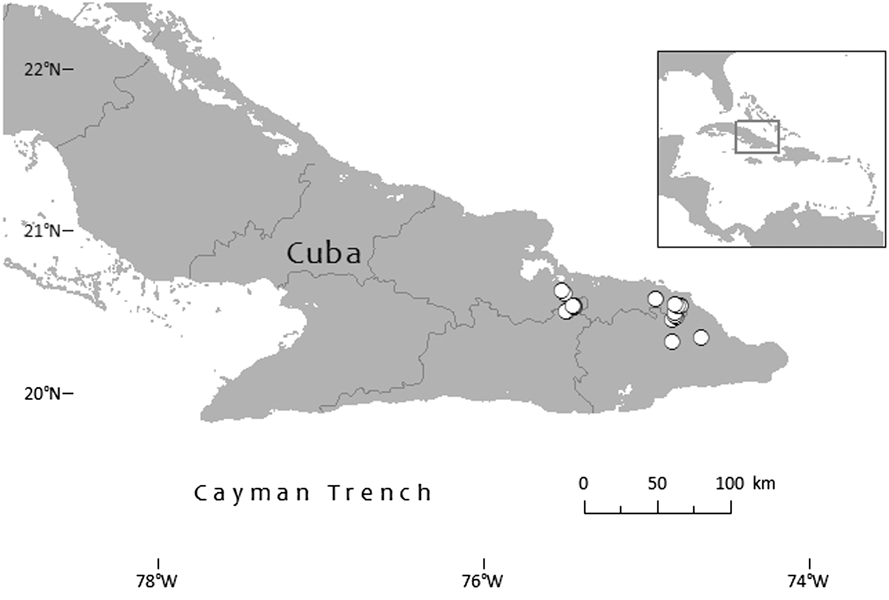
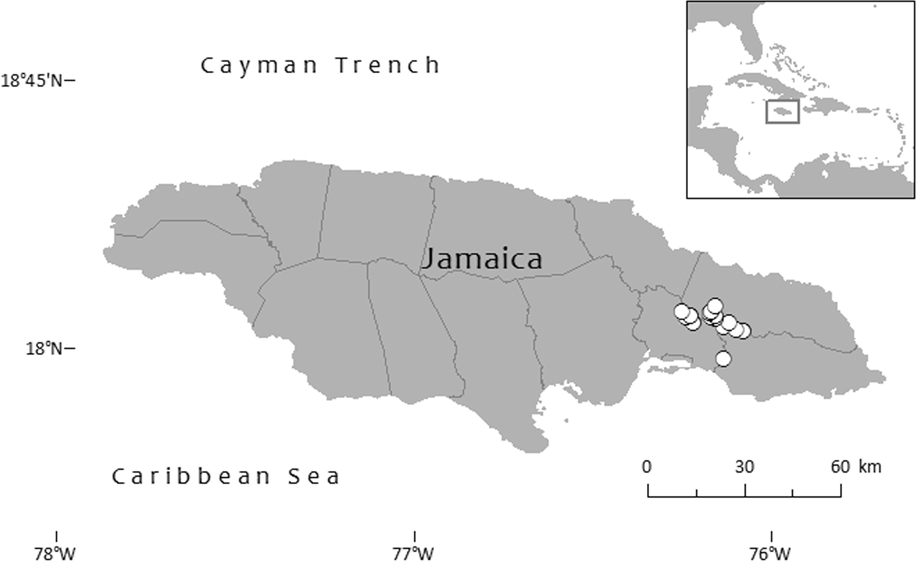
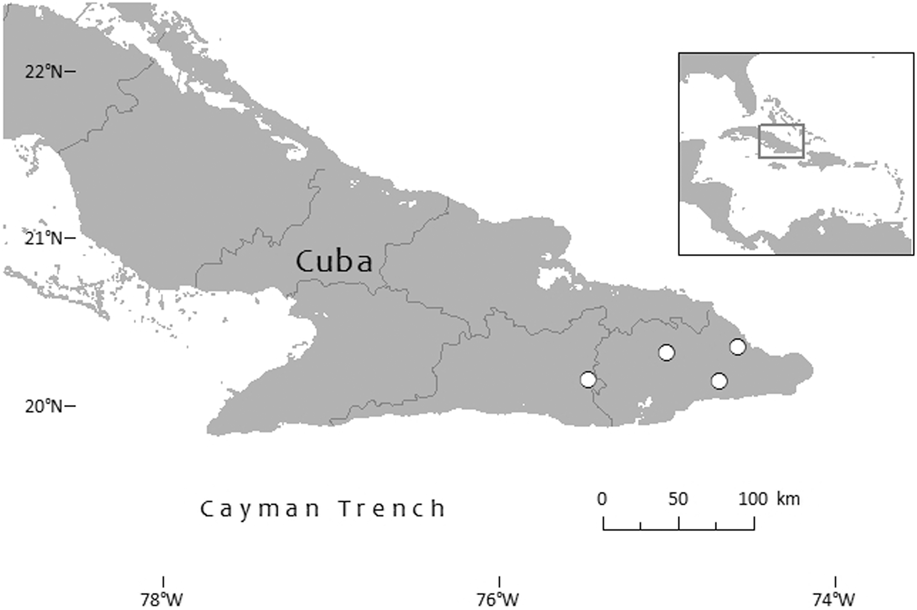
Distribution . Caribbean: eastern Cuba (Holguin and Guantanamo; endemic). Records from Sierra de Nipe (Piloto) assigned to Santiago de Cuba by Gardner et al. (in sched., E) are from Holguin (Mayarí). Two of these sheets were determined as Podocarpus ekmanii by Stark Schilling (on annotation slips) but these are here treated as misidentifications; only one species of Podocarpus appears to occur in Mayarí, namely P. aristulatus. Podocarpus aristulatus was at one time cultivated at the Jardin botanique de Saint-Pierre (Martinique) although it has not been collected from there recently (Fournet, Reference Fournet1978, as Podocarpus angustifolius var. wrightii). Takhtajan: Caribbean Region (West Indian Province). Morrone: Neotropical region, Caribbean subregion, Antillean dominion, Cuba province. Cano Carmona: Western Antilles Superprovince, Cuba Province. TDWG: 81 CUB. Map: Fig. 4.
Global distribution of Podocarpus aristulatus.
Specimens examined. Cuba. Holguin: Mayarí: Sierra de Nipe, Cabeza de Nipe, c. 850 m, 17 viii 1914, E.L. Ekman 2480 (S–database). La Plancha, Pinar de Mayari, 18 ix 1917, J. Roig 162 (NY, S–database with apparent mistyping of date as ‘18 xi 1917’). Sierra de Nipe, iv 1940, J.P. Carabia 3843 (GH); Monte La Plancha, Sierra de Nipe, 21 iv 1940, J.P. Carabia 3843 (NY, S–database); Sierra de Nipe, Mayarí, v 1940, J.P. Carabia 3843 (GH, apparently a different collection to the preceding two); ibid., J. Carabia s.n. (GH, 2 sheets, perhaps duplicates of one or more of the preceding three collections). Sierra de Nipe, 4 x 1919, E.L. Ekman 9813 (F, NY, S–database). Near Woodfred, Sierra de Nipe, Mayarí, 26 vii 1940, Bros. León & Alain 19168 (GH). Sierra de Nipe, Mayarí, iv 1941, Bros. León, Marie-Victorin, Clemente & Alain 19782 (GH). Sierra de Nipe, chemin de lamine Woodfred, 14–18 iii 1944, Marie-Victorin & Clément 22010 (GH). Sierra de Nipe, Parque Nacional La Mensura Pilotos, Loma Mensura, base of mountain 1.5 km from Hotel Pinares de Mayari, 20°28′56.6″N 75°48′35.7″W, 710 m, 24 iv 2004, E. Bécquer et al. 7000 (E); ibid., 20°31′48.0″N 75°46′3.0″W, 732 m, 24 iv 2004, E. Bécquer et al. 7002 (E, 2 sheets); ibid., 20°31′48.0″N 75°46′03.4″W, 732 m, 24 iv 2004, E. Bécquer et al. 7003 (E). Santiago de Cuba: Songo-La Maya: Sierra de Nipe, in carrascales at Rio Piloto, 30 vii 1914, E.L. Ekman 2300 (F, S–database); ibid., 10 vi 1915, E.L. Ekman 5999 (F, K–database as Podocarpus angustifolius, NY, S–database); ibid., 20 i 1916, E.L. Ekman 6730 (S–database, det. Staszkiewicz); ibid., 20 iv 1919, E.L. Ekman 9514 (K–database as Podocarpus angustifolius, NY, S–database). Sierra de Nipe, Piloto, La Forestal Los Chivera, 20°24′23.6″N 75°49′51.8″W, 491 m, 25 iv 2004, E. Bécquer et al. 7005 (E); ibid., same details, E. Bécquer, M. Gardner & A. Metos 7006 (E). Guantánamo:Yateras: Monte Verde, date unknown, Wright 1461 p.p. (collection A of Mill & Stark Schilling, 2010: 939: A-1, G–BOIS, lectotype; A-2, fragment [cone] FI; A-3, K; A-4, B–image; A-5, B–image; A-6 [seen since 2010, designated here], P–image, A-7 [seen since 2010, designated here] YU–image; A-8 [seen since 2010, designated here], GH–image, isolectotypes). Unloc., Wright 1461 p.p. (assemblage D of Mill & Stark Schilling, 2010: 939: D-1 & D-2, B–images; D-3 & D-4, NY; D-5, S–image; D-6 and D-7, YU (both here designated: respectively top left and top right of sheet YU000844 below packet containing seeds of Podocarpus victorinianus): unassignable duplicates of collections A and/or B). In Monte Libanon, near Monterús, 700–800 m, 28 xi 1922, E.L. Ekman 15832 (NY, S–database).
Bioregion: Caribbean. Ecoregion: NT0120 Cuban moist forests.
Ecology. Montane cloud forest (Caribbean Montane Wet Elfin Forest: CES411.455, of which it is one of the diagnostic species: Josse, undated a), dominant, or co-dominant with Schefflera tremula (Krug & Urb.) Alain (Araliaceae); 500–2500 m; on both limestone (e.g. Bécquer et al. 7005) and serpentine. Other associates recorded include Ficus trigonata L. and Svenhedinia minor Urb. According to Ekman’s field labels, Podocarpus aristulatus was frequently collected by him in what is known in the vernacular as charrascales or carrascales, which Carabia (Reference Carabia1945) defined as a semi-xerophytic community formed mainly of woody shrubs and small trees less than 6 m tall, with small, coriaceous leaves that are often spine-pointed and borne more-or-less perpendicular to the stem. However, Carabia (Reference Carabia1945) did not list it as one of the species of charasscales. Instead he stated that it formed part of the upper canopy of a different community of the Sierra de Nipe, termed monte, which is formed by a large number of tree species that grow so densely that little light gets through to the ground. Canopy constituents other than Podocarpus aristulatus include Calophyllum antillanum Britton, Calyptranthes syzygium Sw., Cedrela odorata L., Drypetes lateriflora Krug & Urb., Guarea trichilioides L., Juniperus barbadensis L., Krugiodendron ferreum Urb., Nectandra coriacea Meisn., and Tabebuia shaferi Britton among others. Carabia (Reference Carabia1945) commented that the climate of the Sierra de Nipe, where many of the collections of Podocarpus aristulatus have been made, is unusual in that the rainy season is October to February while the driest months are March, April and July, and that although the pine forests of Sierra de Nipe occur at altitudes of only c.600 m they are frequently covered by dense fog.
Plant–plant associations. Pinguicula lignicola Barnh. (Lentibulariaceae) grows epiphytically on the bark of unspecified Podocarpus species in the provinces of Guantánamo and Holguin in eastern Cuba (Shimai et al., Reference Shimai, Masuda, Panfet Valdés and Kondo2007), where this species occurs.
Mycological associations. The exceptionally rare fungus Corynelia jamaicensis Fitzp. is, or was, an obligate symbiont of Podocarpus aristulatus as well as P. coriaceus and P. purdieanus in the Caribbean. The last record from Cuba was in 1915 and the fungus may now be extinct (Benny et al., Reference Benny, Samuelson and Kimbrough1985a; Minter, Reference Minter2014a).
Proposed IUCN conservation assessment (IUCN 3.1). Vulnerable VU B2ab(i,ii,iii). Podocarpus aristulatus was assessed as VU B2ac by Berazaín Iturralde et al. (2005, as Podocarpus victorinianus). The species has been re-evaluated here because as circumscribed for the 2005 assessment it included Podocarpus victorinianus which is here kept separate. Podocarpus aristulatus as circumscribed here has a much larger Extent of Occurrence (EOO) and Area of Occupancy (AOO) than P. victorinianus and the subtraction of the latter’s very small EOO and AOO means that the residual EOO and AOO of P. aristulatus remain within the criteria for assessment as VU. Podocarpus aristulatus occurs in the following Caribbean Biodiversity Hotspot Key Biodiversity Areas (KBAs): Parque Nacional Armando Bermúdez, Sierra de Neyba and Valle Nuevo (Anadón-Irizarry et al., Reference Anadón-Irizarry, Wege, Upgren, Young, Boom, León, Arias, Koenig, Morales, Burke, Pérez-Leroux, Levy, Koenig, Gape and Moore2012).
Uses. None have been recorded.
3. Podocarpus buchii Urb., Repert. Spec. Nov. Regni Veg. 19: 298 (20 Feb. 1924); Florin, Ark. Bot. 25A, no. 5: 2 (1933) descr. ampl. – Podocarpus angustifolius Griseb. subsp. buchii (Urb.) J.Staszk. var. buchii (Urb.) J.Staszk., Fragm. Florist. Geobot. 33(1–2): 77 (1988). – Podocarpus aristulatus Parl. subsp. buchii (Urb.) Silba, J. Int. Conifer Preserv. Soc. 17(1): 20 (2010). – Type: “Hab. in Haiti prope La Bellefontaine”, W. Buch 2089b (holo B–image, iso S–image). Farjon (2010: 818) incorrectly assumed that the holotype was possibly destroyed. Figs 5J–M,6,8
Fig.5.ImageJ Surface Plots of Caribbean Podocarpus leaves. A–D, Podocarpus angustifolius, Wright 3188 B-4 (suffix designation follows Mill & Stark, Schilling, 2010). A, Adaxial surface ‘transverse section’. B, Abaxial surface ‘TS’. C, Midrib (adaxial) ‘TS’. D, Midrib (abaxial) ‘TS’. E–H, Podocarpus aristulatus. E, Adaxial surface ‘TS’ (Bécquer et al. 7005). F, Abaxial surface ‘TS’ (Ekman 9813). G, Adaxial midrib ‘TS’ (Bécquer et al. 7005). H, Abaxial midrib ‘TS’ (Ekman 9813). J–M, Podocarpus buchii. J, Adaxial surface ‘TS’ (Liogier 15479). K, Abaxial surface ‘TS’ (Zanoni et al. 33476). L, Midrib (adaxial) ‘TS’ (Liogier 15479). M, Midrib (abaxial) ‘TS’ (Zanoni et al. 33476). Arrows indicate extent of midrib.
Fig.6.Podocarpus buchii. A, Leafy shoot, Zanoni 22819. B, Terminal bud, Liogier 15479. C, Female shoot, Liogier 12172. D, Immature female cone, Liogier 12172. E, Mature female cone (without peduncle), Holdridge 1252. F, Male shoot, Jiménez et al. 3565. G, Pollen cone, Jiménez et al. 3565. H, Microsporophyll and microsporangia (rehydrated), abaxial view, Jiménez et al. 3565. J, Microsporophyll and microsporangia (rehydrated), adaxial view, Jiménez et al. 3565. Scale bars: A, 6 cm; B, 2 mm; C & F, 1 cm; D, E & G, 5 mm; H & J, 1 mm. Drawn by Claire Banks.
Fig.7.Global distribution of Podocarpus buchii.
Comparative leaf drawings of Caribbean Podocarpus species. A–L, Podocarpus angustifolius. A, Alain 6328, adaxial surface. B, C, Alain 6328, abaxial. D, Wright 3188 B-3, adaxial (suffix designation follows Mill & Stark Schilling, 2010). E–G, Wright 3188 B-1 & C-1, adaxial (suffix designations follow Mill & Stark Schilling, 2010). H, Ekman 12666, abaxial. J, K, Ekman 12666, adaxial. L, Ekman 18628, adaxial. M–V, Podocarpus aristulatus. M–O, Marie-Victorin & Clément 22010, all abaxial. P, Q, León & Alain 19168, adaxial. R, S, Ekman 5999, both abaxial. T, Ekman 15832, adaxial. U, Bécquer et al. 7003, abaxial. V, Bécquer et al. 7003, adaxial. W–HH, Podocarpus buchii. W, Holdridge 1252, abaxial. X, Y, Liogier 12172, both abaxial. Z, Ekman 3465, adaxial. AA, BB, Jiménez et al. 3565, both adaxial. CC, Liogier 15479, abaxial. DD, EE, Liogier 15479, both adaxial. FF, GG, Zanoni et al. 22819, both adaxial. HH, A. & P. Liogier 24946, adaxial. All scale bars 2 cm. Drawn by Claire Banks.
[Podocarpus aristulatus Parl. var. buchii Silba, J. Int. Conifer Preserv. Soc. 7(1): 31 (Feb. 2000, as ‘Podocarpus aristulatis var. buchii (Urb.) Silba, Comb. Nova’, non rite publ.] – Intended to be based on [Haiti] Massif de Matthews, 1850 m, Ekman H.5738 (holo location not given by Silba, Reference Silba2000; iso NY). This was intended by Silba (Reference Silba2000) to be a new combination at variety rank based on Podocarpus buchii, and a full, direct reference to that ‘basionym’ was given, but instead of indicating the type of that name (Buch 2089b) he cited only a different specimen, Ekman H.5738. Consequently his name becomes a new name based on a different type and, because it was published in 2000 and only an English description was given, it was not validly published. More recently, Silba (Reference Silba2010) raised the status of the ‘combination’ to that of subspecies, giving a full and direct reference to the basionym but without citing any specimen. For that reason, his subspecies combination is regarded as validly published although only the locality “Haiti, Massif de Matthews” (that of Ekman 5738) was indicated.
Podocarpus aristulatus sensu Judd (1986: 3, 7, 14, 60), Graham (1990: 917), Guerrero et al. (Reference Guerrero, Ramírez, Veloz, Peguero and Nuñez2002), Núñez (Reference Nuñez2002), Sherman et al. (2005: 309), Swartley & Toussaint (2006: 67), Martin et al. (2007: 1792–1806), Dalling et al. (2011: 45 p.p., 46, 49, quoad pl. Hispaniola) et Anadón-Irizarry et al. (Reference Anadón-Irizarry, Wege, Upgren, Young, Boom, León, Arias, Koenig, Morales, Burke, Pérez-Leroux, Levy, Koenig, Gape and Moore2012), non Parl. (1868).
Etymology. Urban (Reference Urban1924) named Podocarpus buchii after Wilhelm Buch (1862–1943), a pharmacist in Haiti who was also a plant collector. Wilhelm Buch sent much material from his base in Port-au-Prince to Urban in Berlin between 1898 and 1922. He collected the type specimen of Podocarpus buchii in September 1922. Farjon (2010: 818) wrongly stated that the species was named after the German botanist Christian Leopold von Buch (1774–1853), who specialised in collecting plants from Macaronesia and the Cape region of South Africa.
Vernacular names. Haiti: ‘bois-lubin’ and ‘coeur noir’ [black heart] (Grandtner, 1997–2010). Dominican Republic: ‘chicharron’ (field label of Liogier 12556, NY), ‘tachuela’ (field label of Liogier 12172, NY).
Distinguishing features. This is the only Caribbean species of Podocarpus that can have leaves that are broadest below the middle; any small-leaved Caribbean specimen of the genus with leaves ovate or lanceolate, rather than elliptic, oblong or obovate, is most likely to be this species and if the provenance is Hispaniola the identification is certain. However, not all specimens do have ovate or lanceolate leaves; elliptic or oblong leaves are equally frequent. Podocarpus buchii is one of only two species of the genus on Hispaniola; from the other one, P. hispaniolensis, it can be distinguished by the upper (adaxial) leaf surface not having a prominent groove, the smaller terminal buds usually < 3.5 mm long (as opposed to > 5 mm), the short female peduncles < 4 mm (not > 6 mm) and the smaller male cones (< 10 mm, not > 12 mm). It has been frequently confused with (or included in) Podocarpus aristulatus but can be separated from that species by its small leaves not more than 35 mm long – in specimens of P. aristulatus, some or all leaves are more than 35 mm long and can reach 60 mm.
Small non-emergent tree 5–8(–15, exceptionally 20) m tall, 20–50(–100) cm d.b.h. Crown irregular and poorly formed, much branched. Bark smooth, longitudinally striate on twigs, greyish brown on twigs; inner bark reddish or purplish; wood straw coloured. Up to four orders of branching, the first order whorled and horizontal, the second order whorled and erecto-patent, the third order (if penultimate) whorled or opposite in one plane and erecto-patent to divaricate. Twigs of final order dense, opposite in one plane or in flattened whorls of 3(–4, rarely 6), divergent at (20–)45–70(–110)° (typically 50–60°), erecto-patent, 30–130 mm on juvenile trees but very short (occasionally reduced to dwarf shoots) and only (5–)25–60 mm on adult trees, straight or very slightly curved (not flexuous), greenish brown in first year, pale grey-brown in second year. Leaf scars subcircular, pentagonal or shortly lozenge-shaped, pale greyish brown, similar in colour to surrounding bark. Terminal buds semi-globose, broadly ovoid-globose or occasionally depressed-globose, (1.1–)2.5–3.5(–9) × (1.2–)2–3(–5) mm. Bud scales 16–18, in three or four series, at most equalling diameter of bud, (0.7–)2.3–5.4(–6) × (0.2–)1.1–1.6(–2.5) mm, all overlapping, subequal or unequal in length, the outer wider than the inner, ovate to broadly ovate, green or brownish green, not keeled, the tips all erect; apex acute, outer ones pungent-aristate [arista 0.2–0.5(–0.9) mm], inner ones shortly mucronate (mucro c.0.1 mm), all with entire, hyaline margins. Most scales finally caducous; bud scale scars transversely rhombic, light grey, slightly paler than surrounding bark. Inner bud scales elongating and becoming foliaceous at flushing, the innermost pair finally becoming ± woody and lying adpressed parallel to branch base. New leaves reddish purple above and violet beneath, glaucous on stomata. Juvenile and adult foliage similar in shape but juvenile leaves usually slightly larger. Leaves present on ultimate and penultimate branchlets, 2–12 mm apart, very shortly petiolate to subsessile; petiole 1–2 mm, twisted and leaf base ‘crossed over’. Leaf lamina finally horizontally spreading or especially in juveniles slightly deflexed, diverging from axis at (38–)58–88(–125)°, narrowly elliptic, elliptic, narrowly lanceolate-elliptic, narrowly ovate-elliptic or ovate-elliptic, (10.8–)15–35 mm × 4.2–8.7 mm when adult, 20–50 × 4.5–6 mm when juvenile, 3–5(–6.5) × as long as broad, (0.9–)2–4(–6.7) mm apart, dark green or especially in juveniles greyish green above, similar or paler beneath, usually straight but occasionally falcate from halfway, thick, rigid and coriaceous, adaxially slightly transversely concave, abaxially flat, glossy above, matt beneath; margins revolute; midrib (0.4–)0.5–0.8 mm wide, without bordering striate bands abaxially, conspicuously raised throughout its length beneath but only proximally above, obscure throughout above and usually not impressed in a groove (sometimes an indistinct, very shallow groove present), same colour as leaf surface; apex asymmetric, acute, very sharply pungent-aristate, the arista 0.8–3 mm with the costa excurrent into it and ending in a subacute tip; base slightly asymmetric, cuneate or shortly attenuate.
Pollen cone zones in middle of an ultimate branchlet, 0–1.6 mm, comprising 1, 2 or 3 cones, leafy. Pollen cones subtended by a foliage leaf, lateral and axillary, individually solitary, ripe at same time as leaf flushing. Basal scales c.12 in three series, brown, suberect, keeled, rhombic, c.1.2 × 0.9 mm, obtuse or rounded at apex, muticous, their margins extremely narrowly white-hyaline. Common peduncle absent; individual cones sessile, erecto-patent, greenish yellow, appearing slightly darker than foliage when dried, narrowly cylindrical to narrowly ellipsoid, (7–)10–16 mm × 2.1–3.5 mm at anthesis but lengthening after shedding, usually slightly curved from base, less commonly straight, slightly tapered at apex, shedding from base to apex. Microsporophylls c.50–70 per cone, 1.3–1.5 mm, phyllotaxis with 3–4 microsporophylls per short half-spiral and 5–8 per long half-spiral, with usually c.9 short and 4–5 long spirals per cone; visible part of lamina viewed abaxially greenish yellow, transversely broadly quadrate or transversely oblong-or elliptic-rectangular, 0.3–0.8 × 0.2–0.9 mm, shorter than microsporangia, with broad subentire or very weakly erose-crenulate buff-coloured scarious edges and obtuse, shallowly and broadly retuse apex; adaxial surface of microsporophyll obtrullate with a rounded base, entire-margined. Microsporangia vertical and parallel at least initially, sometimes becoming somewhat divergent, broadly ellipsoid, 0.7–0.9 mm, the walls scarious-margined, dehiscing longitudinally by a central abaxial stomium. Pollen white.
Dioecious. Female cones receptive at same time as leaf flushing and pollen cone anthesis; receptive cones borne on current growth, each solitary but usually in subopposite pairs, each subtended by a caducous inner bud scale which is recurved at receptivity, sessile or very shortly pedunculate; peduncle absent or 1.2–1.5 mm, much shorter than cone, cone axis and receptacle, erecto-patent, broadening towards apex, compressed, stomatiferous, without apical bracts; basal scales absent. Prophylls (foliola) absent. Receptacle formed of 1 sterile and 1 fertile bract, obovoid to infundibular, ± straight, remaining herbaceous or becoming only slightly fleshy when ripe, asymmetric, up to 6 mm long along longest (abaxial) edge, up to 4.5 mm along shorter (adaxial) edge, up to 4 mm along connation, up to 2 mm wide at base and 1.8–3.2 mm wide at widest point near apex, purplish red when unripe, becoming crimson but the tips of both fertile and sterile bracts pale green; bracts connate and fused except for free tips, glaucous. Free tips of bracts unequal, pale green, not keeled, stomatiferous; free tip of fertile bract c.3 mm, shortly oblong-ovate, acute, shortly mucronate, with very distinct scarious margin; free tip of sterile bract c.1.2–1.5 mm, half as large as fertile bract, acute, muticous, the margin not hyaline. Epimatium cleft at summit ventrally, grey-violet and very glaucous at receptivity, greenish when ripe and then not glaucous, with several shallow longitudinal ridges dorsally and 3 more pronounced longitudinal ridges ventrally. Seed 1, inserted slightly asymmetrically on receptacle, ellipsoid, laterally compressed, 7–8 × 5–5.5 mm, with apical crest; crest broadly flat-conical, c.1.5 × 3 mm, erect, recurved with large gaping mouth, broadly acute.
Phenology. New leaves flush in late May or early June (onset of early wet season), with the male and developing female cones. Male cones and unripe female ones have been collected in late May; old male cones have also been collected in February so they would appear to persist for a long time after shedding of pollen. Well-developed but green (unripe) female cones have been collected in February and March, and ripe female cones in early June; therefore female cones must take approximately a year to mature. Most specimens seen have been sterile.
Taxonomy. Podocarpus buchii has received differing taxonomic treatments; it has been recognised at species rank (as here), at subspecies rank under P. angustifolius, at varietal rank under P. aristulatus, or synonymised with P. aristulatus (or P. angustifolius var. aristulatus: Eckenwalder, Reference Eckenwalder2009). The treatment here follows Stark Schilling (2004). Farjon (Reference Farjon2010) synonymised Podocarpus buchii var. latifolius under P. buchii on the grounds that the differences in leaf dimensions did not warrant taxonomic distinction. However, both Stark Schilling (2004) and I examined the original material of Podocarpus buchii var. latifolius and came to the conclusion that it is instead synonymous with P. hispaniolensis.
Distribution . Endemic to the island of Hispaniola. Haiti: Départements Centre, Artibonite, Ouest, Sud’est. Dominican Republic: provs. Elias Piña, Barahona, Distrito Nacional / Santo Domingo (Orr, Reference Orr1944: 48), Independencia, Pedernales, La Vega, San José de Ocoa and near the border of La Vega and Santiago. Orr’s reference to ‘Santo Domingo’ is difficult to locate precisely today since ‘Santo Domingo’ can apply both to Santo Domingo Province, split from Distrito Nacional in 2001 and which surrounds the latter on three sides, and the capital city Santo Domingo, situated in Distrito Nacional. (Also note Ekman 6320 cited below, collected at a place called Santo Domingo in Azua Province.) Following current provincial boundaries, Dominican Republic specimens labelled ‘Peravia’ are mostly from San José de Ocoa province while ones labelled ‘Estrellata’ are from Elias Piña province. Takhtajan: Caribbean Region (West Indian Province). Morrone: Neotropical region, Caribbean subregion, Antillean dominion, Hispaniola province. Cano Carmona: Central-Eastern Antilles Superprovince, Hispaniola Province. TDWG: 81 DOM HAI-HA. Map: Fig. 7.
Specimens examined and other records. Haiti. Centre: Massif de Matheux, c.1850 m, 16 iii 1926, E.L. Ekman H.5738 (S–database, unicate; NY, fragment – one leaf, wrongly thought by Silba to have been from the type collection of Podocarpus buchii; isotype of Podocarpus aristulatus var. buchii Silba). Artibonite: Dessalines: Montagnes Noires (gr. Grand Cahos), Pet. Riv. de l’Artibonite, Pérodin, in “Morne Nan Plaine”, 1600–1700 m, 7 iii 1925, E.L. Ekman H.3465 (NY, S–database). Ouest: Port-au-Prince: La Belle Fontaine, ix 1922, W. Buch 2089b (holo B–image, iso S–image). Grand’Anse: Jérémie: Massif de la Hotte, western group, Torbec, high ridge above La-Mare-Proux, 1780 m, 8 xii 1925, E.L. Ekman H.5332 (S–database). Sud’est: Jacmel: 1.5 km E of Mare Rouge on lumber road around Savane Jeunesse, going E toward Pic La Selle, 18°20′N 72°02′W, 6500 ft [1981 m], 18 ii 1981, R.P. Adams & T. Zanoni 11255 (NY); ibid. but 3.5 km E of Mare Rouge, 18°20′N 72°01′W, 7000 ft [2135 m], 18 ii 1981, T. Zanoni & R.P. Adams 11256 (NY). Massif de La Selle, Pétionville, M[orne] La Visite, 2000 m, 9 viii 1924, E.L. Ekman H.1403 (GH, S–database, US–database as Podocarpus aristulatus, 2 sheets). Massif de la Selle, Morne Tranchant, 1800–1920 m, 13 ix 1924, E.L. Ekman H.1884 (S–database). Massif de la Selle, Parc National Morne la Visite, on ridge between Belle Fontaine-Roche Cabrit and ‘Peak 2208’ (which is located to west), SE of Pic Cibao, 2210 m, 20 v 1984, W.S. Judd 4852 & J.D. Skean Jr. (NY, S–database as Podocarpus aristulatus; four separate branchlet tips on NY sheet, from at least 2 trees because both sexes present). Near Petite Source, Morne des Commissaires, 1550 m, 7 vi 1942, L.R. Holdridge 1252 (GH, NY, US–database as Podocarpus aristulatus).
Dominican Republic.Elias Piña: Hondo Valle: Sierra de Neiba, near La Doscientos, 1750–1850 m, 5–7 ix 1968, A.H. Liogier 12556 (NY, US–database as Podocarpus aristulatus). Sierra de Neiba, between Cerros de Planciquen and Loma El Hoyazo, 34 km from La Descubierta on the road to the border near Aniseto Martinez and Hondo Valle, 1800 m, 26 vii 1985, F.T. Grifo 235 & J.M. Matuszak (E). Sierra de Neiba: ladera occidental de la Loma El Hoyazo, entre el Puesto Militar ‘204’ y el Monumento ‘Km 204’ en la Carretera International (al ‘sur’ de Aniceto Martínez), 18°41′N 71°47′W, 1856 m, 15 vii 1987, T. Zanoni et al. 39888 (NY). Barahona:Fundación: En la cima de Morne La Jo (nombre actual y no Firme La Jo como tiene el mapa!), 18°18′N 71°17′W, 1550–1600 m, 6 vi 1984, T. Zanoni & R. García 30427 (NY); ibid., 6 vi 1984, T. Zanoni & R. García 30504 (NY). Independencia:Jimani: Jimani, 2000 m, 25 vii 1985, F.T. Grifo 199 & J.M. Matuszak (E ex MO). Mella: Sierra de Baoruco, 30.5 km al ‘sur’ de Puerto Escondido en el camino a Aceitillar (o 3.9 km al ‘sur’ de la Caseta No. 2 de Foresta), 18°14′N 71°30′W, 1875 m, 17 iii 1985, T. Zanoni et al. 33726 (NY). Sierra de Baoruco, en Charco de la Paloma, 37.4 km al ‘sur’ de Puerto Escondido en el camino a Aceitillar y continuando en el camino a Aguacate, 18°12′N 71°32′W, 1810 m, 19 iii 1985, T. Zanoni et al. 33936 (NY). Pedernales:Pedernales: [Hoyo de] Pelempito, 22 v 2004, P. Acevedo-Rodríguez 13917 et al. (NY–image as Podocarpus aristulatus and Prov. Independencia). 48 km from Alcoa Exploration Company port at Cabo Rojo on road to Las Mercedes and Las Abejas (2 km from end of road), 18°09′N 71°37′W, 1200 m, 15 ix 1981, T. Zanoni & M. Mejía 16621 (NY). Sierra de Baoruco: Las Abejas, 55 km al norte del Puerto de Cabo Rojo en la carretera de la Alcoa Exploration Company a Las Mercedes y Aceitillar, 18°09′N 71°37′W, 3600 ft [1097 m], 26 i 1987, T. Zanoni et al. 38027 (NY). Bahoruco Mts., Pedernales: Las Abejas, Aceitillar, 1200 m, 21 vi 1977, A.H. Liogier 26815 (NY). Above Los Arroyos, along the International Highway from Pedernales to Duvergé, 1500–1600 m, 8 xi 1969, A.H. Liogier 16778 (NY). La Vega:Constanza: Cordillera Central: al sureste del poblado de Pinalito, en el lugar que los campesinos llaman ‘Madre Vieja’, 18°55′N 70°37′W, 1400 m, 7 ii 1986, R. García & S. Peláez 996 (NY, S–database). Cordillera Central: 1 ½ hr caminado a pie al sur de Los Mañanguises, en el lugar llamado Sonador, 18°53′N 70°36′W, c.1300 m, 12 iv 1986, R. García et al. 1190 (NY). Cordillera Central: en el lugar llamado El Paragua, 18°58′N 70°44′W, 1680 m, 23 i 1986, R. García & S. Peláez 942 (NY). Cordillera Central: La Nuez, 41 km al N de San José de Ocoa, 19°02′N 70°27′W, 11 iii 1981, J. Pimentel & W. Bowers 731 (NY, S–database). Loma Redonda, Ciénaga de la Culata, 1600–1950 m, 23 ix 1969, A.H. Liogier 15996 (NY, US–database as Podocarpus aristulatus). Jarabacoa: Loma de la Sal, 1100 m, 24 v 1968, A.H. Liogier 11362 (NY). San José de Ocoa:Rancho Arriba: Cordillera Central: Loma “La Cuesta de La Vaca”, 4.5 km de Rancho Arriba (en la carretera a Piedra Blanca) y 8 km Norte en el camino a Rincón de Yuboa, 18°46′N 70°25′W, 1200 m, 20 viii 1982, T. Zanoni et al. 22819 (NY). Sabana Larga: En la carretera Constanza-San José de Ocoa, 4 km al S de la estación del Programa Nacional de Semillas de Papa de la Secretaría de Estado de Agricultura (SEA), 18°36.5′N 70°35.5′W, 2150 m, 5 xi 1992, A. Guerrero et al. 7 (S–database as Podocarpus aristulatus). Cordillera Central: San José de Ocoa, en el lugar denominado La Nevera, 32330 [18°36.5′] N, 2076462 [70°35.5′] W, 2200 m, 10 vi 2004, F. Jiménez et al. 3565 (E, 3 sheets). La Nevera, S José de Ocoa, 2100 m, 6 iv 1974, A. & P. Liogier 21553 (NY). San José de Ocoa, “La Nevera”, 25 km N of Los Arroyos de Ocoa, 18°36.5′N 70°35.5′W, “7000 m” [annotated “must be feet”: = 2135 m], 27 x 1980, M. Mejía & T. Zanoni 8712 (NY). Cordillera Central: en el bosque nublado de La Nevera, 43 km al norte de San José de Ocoa en la carretera a Constanza, 18°36.5′N 70°35.5′W, 2100 m, 22 xii 1984, T. Zanoni 32997 (NY). Cordillera Central: en La Nevera (no poblado), 18°41′N 70°35′W, 2270 m, 7 ii 1984, T. Zanoni et al. 28975 (NY). La Nevera, from Valle Nuevo to San José de Ocoa, 2100 m, 30 v 1969, A.H. Liogier 15479 (GH, NY–with original drawing of leaf section by Gaussen affixed, US–database as Podocarpus aristulatus). La Nevera, 2100 m, 7 iii 1976, A. & P. Liogier 24946 (NY). Santiago/La Vega border: slopes of La Rucilla, 1800–2000 m, 15 viii 1968, A.H. Liogier 12172 (NY, US–database as Podocarpus aristulatus).
Bioregion: Caribbean. Ecoregions: NT0127 Hispaniolan moist forests, NT0305 Hispaniolan pine forests.
Ecology. Podocarpus buchii occurs in all of Hispaniola’s main mountain ranges except the Cordillera Septentrional and Cordillera Oriental, at 1100–2500 m in cloud forest and broadleaf forest, sometimes with tree ferns, on karst limestone and red clay soils (Gardner, Reference Gardner2013b). It tends to occur at higher altitudes than its congener Podocarpus hispaniolensis although the lower end of its altitudinal range overlaps slightly with the latter species. It typically occurs on north-facing slopes in the absence of fire (Sherman et al., Reference Sherman, Martin and Fahey2005). In the cloud forest it is one of the dominant trees, together with Stenostomum oliganthum (Urb.) Borhidi, Clusia clusioides (Griseb.) D’Arcy, Schefflera tremula, Ditta maestrensis Borhidi and Magnolia pallescens Urb. & Ekman (Myers et al., Reference Myers, O’Brien, Mehlman and Bergh2004; Martin et al., Reference Martin, Sherman and Fahey2007). Podocarpus buchii is one of the diagnostic species for the Hispaniola Montane and Upper Montane Pine Forest ecosystem (CES411.470), the others being Pinus occidentalis Sw., Lyonia urbaniana (Sleuer) J.Jiménez Alm., Lyonia tuerkheimii Urb., Gaultheria domingensis Urb., Garrya fadyenii, Senecio L. spp., Oxandra lanceolata Baill., Hypericum pycnophyllum Urb., Weinmannia pinnata, Vaccinium cubense, Pithecellobium arboreum Urb., Juniperus gracilior Pilg. var. gracilior and var. ekmanii (Florin) R.P.Adams, Pteridium aquilinum (L.) Kuhn, Calamagrostis leonardii Chase, Agrostis hyemalis (Walter) Britton, Sterns & Poggenb., Danthonia domingensis Hack. & Pilg. and Verbena officinalis L. (Josse, undated b with nomenclatural corrections).
Guerrero et al. (Reference Guerrero, Ramírez, Veloz, Peguero and Nuñez2002) described in detail a Podocarpus buchii / Magnolia pallescens association found at several localities within the Parque Nacional Juan Baotista Pérez Rancier (Valle Nuevo). This occurs at altitudes of 1825–1950 m. Higher up, between 2000 and 2500 m, there is a transition to mixed Podocarpus buchii / Pinus occidentalis woodland. Podocarpus buchii is particularly dominant in the western Sierra de Neiba and the Valle Nuevo Scientific Reserve, between 1800 and 2200 m (Harcourt & Sayer, Reference Harcourt and Sayer1996). Other associates include Brunellia comocladiifolia Bonpl., Garrya fadyenii Hook., Myrsine coriacea (Sw.) R.Br. [listed as Rapanea ferruginea (Ruiz & Pav.) Mez], Pinus occidentalis Sw., Vaccinium cubense Griseb. and species of Calyptranthes Sw., Cestrum L., Daphnopsis Mart., Juniperus L., Lyonia Nutt., Miconia Ruiz & Pav., Persea Mill., Psychotria L., Sapium P.Browne and Senecio (Gardner, Reference Gardner2013b and specimen labels). Some of the information given by Farjon (2010: 819), specifically that referring to Podocarpus buchii var. latifolius, applies to P. hispaniolensis, not this species.
Mycological associations. Podocarpus buchii is or was one of the two known hosts of the fungus Corynelia portoricensis (F.L.Stev.) Fitzp. (Minter, Reference Minter2006b), which like its relative C. jamaicensis may now be globally extinct (Minter, Reference Minter2014b).
Conservation status. Endangered EN A2ac (Gardner, Reference Gardner2013a). Previously globally assessed as NT by Farjon (Reference Farjon2010) and in Haiti as VU (Swartley & Toussaint, Reference Swartley and Toussaint2006 as Podocarpus aristulatus). Some of the localities, in Haiti especially, were noted by the collectors as already largely cleared (e.g. Adams & Zanoni 11255 from Savanne Jeunesse: “area was broadleaf cloud forest, but now only meagre fragment left; cut for timber and agriculture”). However, at other sites, particularly in the Dominican Republic, it has been described as “very common” (e.g. Liogier 15996 from Ciénaga de la Culata). Podocarpus buchii occurs in the following Caribbean Biodiversity Hotspot Key Biodiversity Areas (KBAs): Parque Nacional Armando Bermúdez, Reserva Científica Ébano Verde, Sierra de Bahoruco, Sierra de Neyba and Valle Nuevo (Anadón-Irizarry et al., Reference Anadón-Irizarry, Wege, Upgren, Young, Boom, León, Arias, Koenig, Morales, Burke, Pérez-Leroux, Levy, Koenig, Gape and Moore2012).
Uses. None have been recorded.
4. Podocarpus coriaceus Rich. in A.Rich. (ed.), Comm. Bot. Conif. Cycad. 14, t. 1 f. 3 (Sep.–Nov. 1826), ‘coriacea’. – Nageia coriacea (Rich.) F.Muell., Select. Pl. ed. 2: 138 (1876). – Nageia coriacea (Rich.) Kuntze, Revis. Gen. Pl. 2: 800 (1891), nom. illegit. (Prin. III: McNeill et al., Reference McNeill, Barrie, Buck, Demoulin, Greuter, Hawksworth, Herendeen, Knapp, Marhold, Prado, Prud’homme van Reine, Smith, Wiersema and Turland2012). – Type: Montserrat [c.1780: Stearn, Reference Stearn1965], J. Ryan s.n. (holo BM, photo A with extensive annotations by J.T. Buchholz indicating that Richard’s drawings were most probably made from this sheet since no duplicate was located in P; iso S–database record); not cited in the protologue. Farjon (Reference Farjon2010), presumably due to a misreading of the label, wrongly attributed the collection to Robert Brown, who never collected in the Caribbean. John Ryan (1770–1808) was an English physician and an estate owner on Montserrat who made the earliest botanical collections there (Nielsen & Price, Reference Nielsen and Price2001; Clubbe et al., Reference Clubbe, Hamilton and Corcoran2009); his original material is at C, with much also at BM (Stearn, Reference Stearn1965). Figs 9,10A–F, 14A–D.
Fig.9.Podocarpus coriaceus. A, Branch, Luteyn & Lebrón-Luteyn 11531. B, Terminal bud, Velez 1102. C, Female shoot (St. Kitts, habit atypical), Wadsworth 660. D & E, Receptacles bearing respectively one and two seeds, Wadsworth 660. F, Male shoot, Luteyn & Lebrón-Luteyn 11531. G, Pollen cone, Luteyn & Lebrón-Luteyn 11531. H, Microsporophyll and microsporangia (rehydrated), abaxial view, Luteyn & Lebrón-Luteyn 11531. J, Microsporophyll and microsporangia (rehydrated), adaxial view, Luteyn & Lebrón-Luteyn 11531. Scale bars: A, 6 cm; B, 5 mm; C & F, 3 cm; D, E & G, 5 mm; H & J, 1 mm. Drawn by Claire Banks.
Fig.10.Comparative leaf drawings of Caribbean Podocarpus species. A–F, Podocarpus coriaceus. A, Stimson 1270, adaxial surface. B, Stimson 1270, abaxial. C, Luteyn & Lebrun-Luteyn 11531, abaxial. D, Wadsworth 660, abaxial. E, F, Wadsworth 660, both adaxial. Scale bar 2 cm. Drawn by Claire Banks.
[Podocarpus antillarum R.Br. ex Mirb., Mém. Mus. Hist. Nat. 13: 76 (1825), non rite publ. (Art. 38.1)]. – Indicated from Montserrat, without a validating description. The type specimen of Podocarpus coriaceus (holo BM) in fact bears the label “Podocarpus Antillarum Nob. R.” [Ryan], indicating that both the valid name and ‘Podocarpus antillarum’ are based on the same material.
Taxus lancifolia Wikstr., Kongl. Vetensk. Acad. Handl. 1827: 76 (1827). – Type: [Lesser Antilles, Guadeloupe] “Hab. in Guadalupa: Forsström.” (holo probably at UPS, iso S). From the label information in the S database, there are indications that the original material may consist of more than one syntype since the front of the sheet bears two labels reading respectively “E Guadalupa. Forsström” and “Ex Insula S:ti Christophori. Forsström” while the back of the sheet has further labels reading “Guadeloupe. Forsström. près La Suffrière. [Label 1:] Bois Vielon près Dalasoufriere (?) [Label 2:] Taxus (?) [+ unreadable in pencil]”. The “unreadable” text of label 2 may well be the epithet lancifolia and label 1 should be interpreted as “…près de la Soufrière”, i.e. near the volcano. There is a second Forsström collection of Podocarpus coriaceus at S from St. Kitts [= St. Christopher] which may also represent syntype material.
Podocarpus jamaicensis Nelson, Pinetum 159 (1866) p.p. – Type not indicated. A mixture of several species. See note under Podocarpus purdieanus (species 7 below).
Podocarpus coriaceus var. sulcatus Pilg. in Engl., Pflanzenr. IV.5 (Heft 18): 88 (1903). – Type: Guadeloupe, L’Herminier s.n. (holo B, possibly destroyed; iso P–image, bar-code P01636399).
Podocarpus salicifolius sensu Grisebach (1862b: 504) p.p. quoad pl. Dominica & Guadeloupe & syn. Taxus lancifolia, et sensu Mazé (1883: 109 & 1892: 95), Duss (1897: 608) et Questel (1951: 136), non Klotzsch & H.Karst. ex Endl. (1847).
Etymology. The epithet coriaceus refers to the thick leathery leaves.
Vernacular names. Puerto Rico: caobilla (Little et al., Reference Little, Wadsworth and Marrero2001), caoba del pais (Winters 582, A, NY; also Liogier & Martorell, Reference Liogier and Martorell2000 and Farjon, Reference Farjon2010), coabilla (Farjon, Reference Farjon2010 – probably a misprint for caobilla). St. Lucia: lowyé woz (Graveson, Reference Graveson2009). Dominica patois: raisinier mountayn (Rötzer, Reference Rötzer2001). Montserrat: Wild Pitch Pine (Little et al., Reference Little, Wadsworth and Marrero2001); resinier montayne (Young, Reference Young2008), wezinye moutayn (Hypolite et al., Reference Hypolite, Green and Burley2002), wézinyé moutayn (Malhotra et al., Reference Malhotra, Thorpe, Hypolite and James2007). Nevis: weedee (Little & Wadsworth, Reference Little and Wadsworth1964; Lindsay & Horwith, Reference Lindsay and Horwith1999). The name yacca, cited under this species by Endlicher (1847: 210) and Carrière (1867: 646), applies to the Jamaican species Podocarpus urbanii Pilg., although ‘yacca’ was cited by those and many other early authors under P. coriaceus. The names laurier-rose, laurier-rose-montagne and pinabete were cited by Schnee (Reference Schnee1944) but the plants to which the names were applied were Venezuelan, belonging to Podocarpus salicifolius.
Distinguishing features. This is the only species of Podocarpus native to Puerto Rico and the Lesser Antilles, and it occurs nowhere else except possibly in Trinidad and Tobago (this issue will be discussed in the paper on the species of the Orinoco Bioregion). Most specimens of Podocarpus coriaceus have large leaves > 100 mm long that are longer than any other species of the region although small-leaved forms do occur, especially in some of the more exposed elfin forests of the Lesser Antilles such as on St. Kitts (e.g. Wadsworth 660, Howard & Nevling 16887). The buds, and individual bud scales, are longer than in any of the species from the Greater Antilles, and the leaves lack the ± pungent, aristate point that is present, constantly or inconstantly, in all of those species. Podocarpus urbanii, which is endemic to Jamaica and is the only Greater Antilles species to inconstantly have the aristate leaf tip, has leaves less than 6 mm wide whereas those of P. coriaceus are 7–12(–14) mm wide.
Large shrub or small tree 3–10(–20) m tall, up to 50 cm d.b.h. Crown narrowly cylindrical or spreading (fide Eckenwalder, Reference Eckenwalder2009); branching often contorted in old trees but not dense. Bark smooth, later becoming fissured, fibrous, peeling in strips, brown or greyish brown, weathering grey; inner bark pink; wood pale brownish with darker streaks. Up to four orders of branching, those of the third (penultimate) and fourth (ultimate) orders alternate-spirally arranged and erecto-patent, diverging at (30–)50–60(–80)°, sometimes ± appearing to be in one plane, typically very gently curved throughout. Leaf scars transversely elliptic or circular. Terminal buds ovoid or ovoid-conical, 5–7 × 3–7 mm. Bud scales 8–10, in two or three series, longer than diameter of bud, most or all scales overlapping, subequal or the outer ones longer and wider than the inner and frequently becoming foliaceous, ovate (or narrowly ovate-rhombic when foliaceous), green, all keeled, the laminar portion of the scales sometimes somewhat rugose when dry, the scale tips all or most erect (occasionally some slightly recurved); apex acuminate (the outer ones often long-acuminate), aristate, the arista shorter than the body of the scale and soft, non-pungent; all with entire or subentire hyaline margins. Bud scales quickly falling, scars ± circular, greyish. New leaves dark red above and paler beneath. Juvenile and adult foliage similar in shape but juvenile leaves larger, especially on saplings. Leaves present on ultimate and penultimate branchlets, not crowded but evenly and ± densely distributed around the branchlets, (1–)3–9(–17) mm apart, persisting for 2–3 years, shortly petiolate; petiole (1.7–)2–5(–9.5) mm, twisted. Leaf lamina finally horizontally spreading, sometimes slightly drooping, diverging from axis at (17–)35–70(–95)°, narrowly elliptic, narrowly oblong-elliptic, narrowly oblong, elliptic, oblong-elliptic, oblong or, especially in juvenile phase, narrowly lanceolate-elliptic, (30–)50–130 (most frequently 100–120) × 7–12(–14) mm in adult leaves, up to 220 × 17 mm in juvenile leaves, greyish green to deep green above, paler beneath, straight or slightly falcate throughout, thick and coriaceous but especially when juvenile rather pliable, glossy above, matt beneath; margins not or only slightly revolute; midrib adaxially in a groove between two shallow ridges or obscure distally or throughout its length, abaxially rather prominent and somewhat raised, fairly broad; apex acute or often gradually acuminate, only slightly asymmetric, the extreme tip blunt, occasionally blackening when dried; base cuneate or shortly attenuate, slightly asymmetric.
Pollen cones in indefinite zones, variable in position, usually distal (sometimes just below terminal bud) or in middle part of branchlet but occasionally towards its base, (1–)3–11 cones (frequently but not always very close together) per fertile branchlet, each cone normally subtended by a foliage leaf, lateral and either axillary or arising below a leaf axil on previous season’s growth, individually solitary, ripe at same time as leaf flushing. Basal scales c.4, brownish, suberect, adpressed, imbricate, keeled, ovate, c.2.3–2.4 × 1.3–1.4 mm, acute at apex, muticous, their margins scarious and buff-hyaline. Common peduncle absent; individual cones subsessile, suberect, brownish, pinkish brown, violet or purple before shedding, darker than and contrasting with foliage, appearing white when shedding, typically obovoid and noticeably widened distally prior to full anthesis, cylindrical or narrowly cylindrical only at or after full anthesis, c.13 mm × 4–5 mm just before anthesis but lengthening during shedding and up to 24 mm, straight or curved from base, shedding very markedly from base to apex. Microsporophylls c.100–150 per cone, phyllotaxis with 10–15 short and 8–12 long spirals per cone, and 4–5 microsporophylls per short half-spiral, 6–7 per long one; visible part of lamina viewed abaxially dark brown or purplish brown, triangular or ovate, with broad pale entire margin and a short, narrower, rectangular tip with subacute, 3-fid or denticulate-erose apex, 0.6–1.1(–2.1) × 0.4–0.8(–1.5) mm, the apex slightly up-turned but finally becoming reflexed at full anthesis. Microsporangia vertical and parallel, ellipsoid, 0.7–0.9 mm, the walls not scarious-margined, dehiscing longitudinally by an elliptic, abaxial stomium that is positioned slightly laterally. Pollen white or cream.
Dioecious. Receptive female cones borne on current growth, subtended by a foliage leaf, pedunculate; peduncle 4–7 mm, relatively stout (stouter than in Podocarpus trinitensis), shorter than whole cone but equalling or shorter or occasionally longer than the receptacle, erecto-patent to spreading, broadening distally, ridged and compressed, without apical bracts; basal scales absent. Prophylls (foliola) absent. Receptacle formed of 1 sterile and 1 fertile bract, infundibular or cylindrical, becoming fleshy when ripe, very asymmetric, 5.8–8.3 mm along longer (abaxial) edge, 4.3–7.7 mm along shorter (adaxial) edge, 4.3–6.3 mm along connation, 1.6–3.3 mm wide at base and 2.5–4.5 mm wide at widest point near apex, reddish violet but the tips of both fertile and sterile bracts much paler and whitish; bracts connate and fused except for free tips, not glaucous when ripe. Free tips of bracts unequal, whitish, keeled, stomatiferous, triangular, acute, muticous; free tip of fertile bract 1.6–2.2 × 0.8–1.9 mm, of sterile bract 0.6–2 × 0.7–1.7 mm. Epimatium greenish turning reddish violet when ripe, rather mottled, wrinkled. Seeds 1 or occasionally 2 per receptacle, inserted ± symmetrically on receptacle, subglobose or obovoid, 5–8.5 × 3.5–6 mm, with apical crest; crest conical, c.0.5–1 × 0.5–1.6 mm, inclined away from fertile scale, subacute with rounded tip. Cotyledons linear-elliptic, with two veins (Duke, Reference Duke1965).
Phenology. Flushing leaves have been collected in April (Nevis: end of dry/onset of wet season), August (on the neighbouring island of St. Kitts, at the onset of its wet season) and January (Puerto Rico). Male cones shed pollen between April and October (Puerto Rico: during the local rainy season), and have been collected in September (Martinique) and February (Montserrat). Unripe cones, post-receptive but still very young, have been seen on specimens collected in both July and November while slightly older ones have been collected in December on Puerto Rico and in July on St. Kitts. Ripe cones have been collected in April (Nevis: end of dry season), July, August and January (St. Kitts: during dry season and beginning of wet season), September (Guadeloupe) and January (Puerto Rico). A very young seedling was collected on Puerto Rico in June.
Taxonomy. The name Podocarpus coriaceus has been misapplied to plants from Cuba [Wright 1461, which is a mixture of Podocarpus aristulatus and P. victorinianus: by Sauvalle (Reference Sauvalle1873)], Venezuela [Podocarpus salicifolius: by Knuth (Reference Knuth1926), Pittier (Reference Pittier1926), Buchholz (Reference Buchholz1941), and Schnee (Reference Schnee1944), the specimen concerned being the type of Podocarpus pittieri J.Buchholz & N.E.Gray], Colombia (possibly Podocarpus salicifolius: by Serrato Patiño, Reference Serrato Patiño1985) and Jamaica (Podocarpus urbanii, q.v.: by Hooker, Reference Hooker1842 and Pessin, Reference Pessin1922). It has perhaps also been misapplied to plants from Trinidad and/or Tobago (Podocarpus trinitensis) by Marshall (Reference Marshall1934), Longwood (1962 reprinted 1971), Zanoni (Reference Zanoni, Farjon and Page1999), Young (Reference Young2006) and Farjon (2010: 823). Acevedo-Rodríguez & Strong (Reference Acevedo-Rodríguez and Strong2012) in fact synonymised Podocarpus trinitensis with P. coriaceus. Beard’s record of Podocarpus coriaceus from Tobago (Beard, Reference Beard1944) is probably wrong as the only collection seen from that island at present (Cowan 1514, GH, NY) matches material of P. trinitensis from Trinidad much more closely than it does specimens of P. coriaceus from the Lesser Antilles and Puerto Rico. Podocarpus trinitensis had not been described at the time Beard’s paper was published. All specimens seen from Trinidad appear to be Podocarpus trinitensis. These specimens from Trinidad and Tobago will be treated in a later paper in this series. Conversely, plants of Podocarpus coriaceus from Dominica, Martinique and Guadeloupe have in the past been wrongly named P. salicifolius Klotzsch & H.Karst. ex Endl., a South American (chiefly Venezuelan) species that will, like P. trinitensis, be treated in a later paper in this series.
Distribution. Puerto Rico, Leeward Islands (Guadeloupe, Montserrat, Nevis, St. Kitts), Windward Islands (Dominica, Martinique, St. Lucia). Almost certainly endemic to the Caribbean Bioregion. Takhtajan: Caribbean Region (West Indies Province). Morrone: Neotropical region, Caribbean subregion, Antillean dominion, Puerto Rico and Lesser Antilles provinces. TDWG: 81 LEE-GU LEE-MO LEE-SK PUE WIN-DO WIN-MA WIN-SL [?BER ?TRT (fide Farjon, Reference Farjon2010: 823 but perhaps a confusion with Podocarpus trinitensis)]. Map: Fig. 11.
Global distribution of Podocarpus coriaceus.
Podocarpus coriaceus possibly formerly occurred on Bermuda; Britton (1918: 412) said that it was “recorded by Jones as growing in Bermuda prior to 1873”. Jones (Reference Jones1859, Reference Jones1873) published two lists of Bermudan plants; the earlier one did not list any species of Podocarpus but his 1873 work did list “P. salicifolius Kl. Karst.”. This was included in a long list of plants compiled by the Governor of Bermuda (at that time J. H. Lefroy) with the assistance of Sir Joseph Hooker. The vast majority of these were exotics. Podocarpus coriaceus has been confused with P. salicifolius Klotzsch & Karst. ex Endl. in the past (see synonymy, and notes above under Taxonomy) and, given the proximity of Bermuda to the Leeward Islands, it is not inconceivable that P. coriaceus might at one time have been native on Bermuda. However, in its native range in the nearby Leeward Islands, Podocarpus coriaceus entirely avoids the limestone islands and is only found on the volcanic ones. Although Bermuda is of volcanic origin, its volcanic core is now entirely well below sea level and is capped by limestones which form the surface topography (Iliffe et al., Reference Iliffe, Hart and Manning1983). It is also possible that genuine Podocarpus salicifolius (a native of Venezuela and other parts of northern South America) might have been introduced to Bermuda, as was the Asian P. macrophyllus (Thunb.) Sweet which Britton (Reference Britton1918) also included in his Flora of the island. In the absence of specimens to substantiate the record, it is not possible to settle this matter.
On Axelrod & Potter 9589 the longitude is wrongly given as ‘67’°58′W, which is in the sea between Puerto Rico and the Dominican Republic.
Specimens examined and other records. Puerto Rico. Isabela: Bosque Estatal de Guajataca, along Trail No. 1 en route to cave, 18°25′01″N 66°58′30″W, 5 i 1998, L. Raz 185 et al. (NY–database). Maricao: Prope Maricao in sylvis montis Alegrillo, 7 xii 1884, P. Sintenis 1884: 291 (F, GH, K–database, NY, P–image, US–database); ibid., 7 iii 1884 [sic], Sintenis 1884: 291 (US–database, ?transcription error of date). Rio de Maricao, 500–800 m, 2 iv 1913, N.L. Britton et al., West Indian Exploration 1913: 2462 (F, MO, NY, US–database). Monte Alegrillo, 3 iv 1913, N.L. Britton et al., West Indian Exploration 1913: 2598 (COL–photo, NY, US–database). Maricao, 29 i 1938, I. Vélez s.n. (NY). Trail from Vivero de Peces southward, 2800 ft [853 m], 13 vii 1950, E.L. Little Jr. 13363 (A, F, NY, US–database). Maricao State Forest, 800 m, 31 xii 1961, Bro. Alain 9047 (NY). Higher elevations in Maricao Forest, 2 vi 1970, S.R. Hill 109 (NY). Bosque insular de Maricao, Las tetas de Cerro Cordo, along boundary with Mun. de San German, near observation tower, 875 m, G.L. Webster et al. 8868 (S–database, US–database). Maricao Insular Forest, 8 viii 1944, J.I. Otero & L.E. Gregory 954 (A). Maricao Insular Forest, 9 iv 1947, M.A. Chrysler 6543 (CONN–database). Recreation area Monte del Estado, Maricao, 13 iv 1955, Winters 582 (NY). Monte del Estado, 29 iv 1963, R.O. Woodbury s.n. (NY). Monte del Estado, 17 i 1967, R.O. Woodbury s.n. (NY). Maricao Forest near Radar site, 22–30 i 1963, R.A. Howard & L.I. Nevling Jr. 15355 (A). PR 120 of Las Tetas de Cerro Gordo, Maricao, c.800 m, 29 iii 1973, D. Burch 6656 with BOT 613 class (NY). Maricao Insular Forest (“Monte del Estado”), c.1 mile E of stone observation tower, c.3000 ft [914 m], 22 vi 1965, W.R. Stimson 1270 (CAL–image, GH, MO, US–database). Reserva Forestal Maricao, along Hwy. 120, 3.5 mi S of junction with Hwy 105 at large pavilion, 5 mi S of Maricao, 3025 ft [922 m], 30 xi 1981, B. Hansen, R.P. Sauleda & M. Ragan 9493 (MO). Maricao State Forest, along Hwy. 120, 18°09′N 66°59′W, 800 m, 3 iv 1985, T.B. Croat 60951 (COL–photo, MO). Maricao State Forest, km 13–16.7 N of Sabana Grande along Rt. 120, c.18°08–09′N 66°58–59′W, 750–825 m, 3 iv 1985, J.L. Luteyn 11531 & M. Lebrón-Luteyn (NY). Maricao State Forest: W side of Rd. 120, km 14.1, at lookout tower, 880 m, 5 vii 1987, Proctor & McKenzie 43831 (US–database). Maricao, Reserva forestal Monte del Estado, c.1000 m, 28 ix 1987, P. Acevedo R. & D. Chines 2230 (NY, US–database). Barrio Caín Alto, along track 0.2–0.5 km due SE of Campamento Buena Vista, 750–780 m, 21 ix 1991, Proctor 47174 (US–database). Maricao, Bo. Tetas de Cerro Gordo, Maricao Stations Grounds, Road 120, km 14.8, 18°09′04″N 66°59′22″W, 800 m, 29 viii 1992, J.A. Cedeño et al. 5 (MO). Río Maricao, Bo. Maricao Afuera, NE of Hwy. 120, Km 14.8, 18°08′55″N 66°59′04″W, 860 m, 9 ix 1993, J.A. Cedeño 157 (MO). Bo. Maricao Afuera, steep slopes along Río Maricao, 0.25–1 km upstream from fish hatchery, 2 km (by air) SSW of Maricao, 18°10′N 66°59′W, 480–500 m, 5 xi 1993, M. Nee 44125 (MO, NY–image). Bosque Estatal de Maricao, 4.3 km S of Maricao, near summit, 890 m, 11 vi 1996, Thompson & Rawling 12565 (US–database). Maricao Forest Reserve, km 16 on Highway 120, 18°09′135 N 66°59′605 W, 800 m, 12 ii 2003, D.K. Christopher 72 et al. (NY–image). Maricao Forest Reserve, 20 mi [32.1 km] E of Mayagüez, 18°05′N 66°59′W, c.800 m, 4 iv 1985, A. Gentry & E. Zardini 50444 (NY). Sabana Grande: Maricao State Forest, 820 m, 3 iv 1985, G.T. Prance et al. 29390 (NY; female). Maricao State Forest, 820 m, 3 iv 1985, G.T. Prance et al. 29395 (NY; male). San Germán: Bosque Insular de Maricao, near Buena Vista, 2000–2700 ft [610–823 m], 12 vii 1950, E.L. Little Jr. 13343 (F, NY, US–database). Cerro Gordo, 5 iv 1937, I. Velez 1102 (NY). Maricao Forest Reserve, old road near stone house, 750–790 m, 16 i 1992, F. Axelrod 3669 et al. (NY). Cordillera Central, Reserva Forestal Maricao, near forest headquarters, just off Rt. 120, along trail past “the stone house”, S of Maricao (c.8 km S of jct. of Rt. 120 and 105), 750–790 m, 16 i 1992, W.S. Judd 6106 et al. (NY; leaves very narrow). Cordillera Central, c.12 km S of Maricao, Maricao Forest Reserve, near Forest Headquarters, just S off Hwy. 120, along trail past the “Stone House”, 18.1°N 67°W, 750–790 m, 16 i 1992, R.W. Sanders 1877 et al. (MO, leaves narrow). Maricao State Forest, vicinity of Campamente Buena Vista, 750–800 m, 17 x 1984, G.R. Proctor 40844 & R. Padrón (NY). Bo. Minillas, Maricao Forest Reserve, about 2 km down disused Rt 362 (S of Rt 120), 18°08′N 67° [sic: an error for 66°, see above] 58′W, 600 m, 15 i 1996, F. Axelrod 9589 & D. Potter (K–database, MO, NY, US–database). Maricao Forest Reserve, Rt 120, km 16.85, side dirt road and path to summit, 700–760 m, 8 ii 1992, F. Axelrod 3940 et al. (NY). Rio Grande: Near summit of El Yunque, x 1934, C.L. Horn 306 (NY). El Yunque, 10 iv 1938, F.H. Sargent 13343 (US–database). Caribbean National Forest, El Yunque, Luquillo Mts., 3400 ft [1036 m], 8 viii 1950, E.L. Little Jr. 13558 (F, NY, US–database). Luquillo Experimental Forest, trail to El Yunque, Luquillo Mts., 2800 ft [853 m], 9 vii 1966, E.L. Little Jr. 21609 (GH, NY, US–database). On trail to the Pinnacles, El Yunque, Luquillo Mts., 25 xi 1964, R.A. Howard 15724 (A). El Yunque trail to the Pinnacles, Sierra de Luquillo, 11–13 x 1964, R.A. Howard & G. Taylor 15728 (A, K–database, S–image). El Yunque on path to Pinnacles, Luquillo Mts., 24 viii 1966, R.J. Wagner 1036 (A). El Yunque, Sierra de Luquillo, c.1065 m, 5 ix 1967, T.G. Hartley 13347 (A, NY, US–database). Luquillo National Forest, La Mina recreation area, 25 iii 1967, H.W. Pfeifer 2779 (CONN–database, US–database); ibid., same date, H.W. Pfeifer 2780 (CONN–database, US–database); Municipio de Rio Grande, El Yungue [sic], 31 xii 1967, G.P. DeWolf Jr. 1920 (A). Luquillo National Forest, La Mina recreation area, 30 iii 1969, H.W. Pfeifer 2868 (CONN–database, 2 sheets). El Yunque, xi 1989, R. Woodbury s.n. (NY). Caribbean National Forest, El Yunque Trail between Los Picachos Tower and summit of El Yunque, 900–1065 m, 14 vi 1993, F. Axelrod 6438 & U. Lindgren (MO, US–database). Ponce: Bosque Estatal de Toro Negro (planted: Wadsworth, Reference Wadsworth2008).
Leeward Islands. Guadeloupe: Unloc., Père Duss 2397 (F, GH, MO, US–database; presumably duplicates of localised sheets cited below). Unloc., M. Parker s.n. (E, 2 19th century collections mounted on same sheet). Unloc., 1839, Beaupertuis s.n. (P–2 sheets, images). Unloc., 1944–46, P. Bena 1202 (P–image), 1204 (P–image). Vieux-Habitants, 600 m, 16 iii 1931, Grébert s.n. (Herbier Service Eaux Forêts 87) (P–image); ibid., 16 iii 1931, Grébert s.n. (Herbier Service Eaux Forêts 88) (P–image). Mamelles, sommet, 19 xii 1944, P. Bena 1203 (P–image). Sentier Mamelle Petit-Bourg, 28 iii 1984, F. Douvillez 106 (P–image). Sentier de la Mamelle de Pigeon, 16 ix 1988, Fournet 4447 (P–image); ibid., 16 ix 1988, Fournet 4448 (P–image); otherwise unloc., L’Herminier s.n. (P–image, type of Podocarpus coriaceus var. sulcatus); Basse-Terre, base de la Mamelle Pigeon, 600 m, 1 ii 1979, C. Sastre 6679 (P–image). Summit of Mamelle de Petit-Bourg, 16°11′N 61°43′W, 700–716 m, 1 iv 2003, M.J.M. Christenhusz & M.P.T. Paajanen 2741 (S–database). Bois des Bains Jaunes, 1892, Père Duss 78 (P–image). Bains Jaunes, 17–27 iv 1979, R.A. & E.S. Howard 19379 (A, NY). Near ‘Ajaupa’ [Ajoupa], ix 1824, anon. s.n. (GH). Basse Terre, Mont Soufrière, C.S. Parker s.n. (K–database). Basse-Terre, la Soufrière, above St. Claude, at Bains Jaunes, 750–1000 m, 17 vii 1959, G.L. Webster et al. 9012 (A; collected from near type locality of Taxus lancifolia). Bains Jaunes, anon. s.n. (P–image). Bains Jaunes, 1840s, Funck & Schlim 91 (P–image). Bains Jaunes et Matouba, 10 i 1893, Père Duss 2397 (NY, female); ibid., 1895, Père Duss 2397 (NY, male). Bains Jaunes, 850 m, 16 ii 1935, H. & M. Stehlé 7400 (P–image). Malanga, 680 m, 24 x 1934, H. & M. Stehlé 7401 (P–image). Forêt Bains Jaunes, 15 ii 1936, H. & M. Stehlé 885 (P–image, US–database mistranscribed ‘Banes Jonas’). Chemin Bain Jaune, 510 m, 12 x 1937, A. Questel 414 (P–image, US–database). Environs des Bains Jaunes, chemin de la Soufrière, R. Quentin 541 (P–image). La Soufrière, above Baine Jaunes, c.1100 m, 27 vi 1958, G. Degelius (GB–database as Podocarpus salicifolius). Forêt domaniale de la Basse Terre, Crête du Nez-Cassé, 950 m, 31 iii 1988, S. Barrier 3367 (P–image). Montserrat: Unloc., J. Ryan s.n. (BM, holotype; A–photo [of BM sheet]). St. Anthony: Chance’s Mountain, > 2000 ft [610 m], 26 i 1907, J.A. Shafer 611 (F, NY, US–database). Abundant on slopes of Chance’s Mt., c.2500 ft [762 m], R.A. Howard 11916 (A). Summit of Jubilee Mountain, 20 ii 1980, R.A. & E.S. Howard 19663 (A, NY). St. Peter: Olveston (Duberry) Mt., Centre Hills, 1500–1900 ft [457–579 m], 31 i 1959, G.R. Proctor 18957 (NY). St. Georges: Centre Hills, Katy Hill Trail, near top of Katy Hill, 27 ii 2006, K.S. Robbins SR 50 et al. (K–image). St. Kitts: St. Kitts, unloc., no date, Forsström s.n. (S–database n.v., see comments under type of Taxus lancifolia). St. Thomas Middle Island: Mt. Misery, 8 ix–5 x 1901, N.L. Britton & J.F. Cowell 372 (K–database, NY–2 sheets, US–database). Mt. Misery crater, 23 vi 1944, J.S. Beard 305 (K–database). Mt. Misery Crater, 2300 ft [701 m], 26 vi 1967, R.K. Wadsworth 347 (A). Dos d’Ans pond [nr Verchild’s Mt.], 3100 ft [945 m], 19–24 vi 1950, R.A. Howard 11940 (NY). Trinity Palmetto Point: Camp Crater Mountain, 600–700 m, 25 vii 1967, R.K. Wadsworth 512 & R.A. Howard (NY). Camp Crater Mountain, 600–700 m, 9 viii 1967, R.K. Wadsworth 660 (A). On trail up Camps Mt., SE range, > 3000 ft [914 m], 3 i 1968, R.A. Howard & L.I. Nevling Jr. 16887 (A). Nevis: Nevis Peak, S slope, 300–600 m, 11 iv 1956, A.C. Smith 10505 (NY, S–database, US, HAC–n.v.).
Windward Islands. Martinique: Unloc., 1879, Père Duss 2097 (F, GH, MO, S–database, US–database; presumably duplicates of localised sheet cited below). Piton Dumauzé, 580–770 m, 19 i 1979, C. Sastre 6610 (P–image). Crête des Pitons au Carbes, 25 ix 1879, Père Duss 2097 (NY–2 sheets). Piton de la Fontaine d’Absalom, iii 1869, Hahn 801 (P–image). Dominica: Unloc., 1000 m, 10 ix 1888, G.A. Ramage s.n. (MO, S–database; probably a duplicate of K sheet from Mt. Diablotin). Summit of Morne Nichols, 990 m, 10 iii 1940, W.H. & B.T. Hodge 1909 (GH, NY, US–database). Summit of Fon Pays, W ridge of Morne Diablotin, c.1000 m, 14 iv 1940, W.H. & B.T. Hodge 2862 (GH, US–database). N ridges of Morne Diablotin, 11 iv 1940, W.H. & B.T. Hodge 2834 (GH, US–database). Morne Diablotin, 16.50°N 61.33°W, 1372 m, 11 vi 1965, G.L. Webster 13354 (MO, US–database). St. Peter Parish, Morne Diablotins, Northern Forest Reserve, trail to summit, NW side of peak, 4300–4500 ft [1311–1372 m], 6 iii 1993, S.R. Hill 24634 (NY). Morne Trois Pitons, 23 ii 1940, W. Hodge 1378 (GH, NY, US–database); NW slope of Morne Trois Pitons, 1158 m, 17 i 1966, K.L. Chambers 2598 (MO, US–database). Upper NW ridge of Morne Trois Pitons, 15.25°N 61.42°W, 4 v 1964, Ernst 1229 (US–database). Morne Trois Pitons, N side, trail just NE of Pont Casse, 2500–4000′ [762–1219 m], 15°22′N 61°20′W, 9 xii 1993, S.R. Hill et al. 25327 (NY). Morne Courone, 15.42°N 61.35°W, 701 m, 4 vi 1965, G.L. Webster 13207 (US–database). W ridge of Morne Plat Pays, 3 iii 1940, W.H. & B.T. Hodge 1655 (GH, NY, US–database). St. Andrew: Morne Diablotin, 10 ix 1888, G.A. Ramage s.n. (K–database). Mt. Diablotins [sic], 31 i 1986, Whitefoord 5306 (US–database). Mt. Diablotin, 1903, F.E. Lloyd 914 (NY). Mt. Diablotin, 1100 m, 8 iv 1990, C. Pendry 317 (E, K–database). Morne Diablotin, 20 i 1994, J. Higgins & P. Paris 112 (K–database, MO, NY). Mt. Diablotin, 5 v 2007, C.M.S. Carrington & K. Sabir SC1985 (BAR–2 sheets, images; US–database). St. John: Morne Diablotin, 4 xi 1964, D.H. Nicolson 1923 (US–database); ibid., 4 xi 1964, D.H. Nicolson 1927 (GH, US–database). St. George: E Roseau, chemin conduisant à Valley of Desolation, 800 m, 20 vii 1983, J. Jérémie 1245 (P–image). St. Paul: Saint Paul, Pont Casse area, along road to Rosalie and Castle Bruce, 15.42°N 61.37°W, 518 m, 28 vii 1966, W.L. Stern 2555 (CONN–database without detailed locality; US–database, 2 sheets, one without detailed locality). St. Lucia: Hilltop 0.5 mile S of Piton Troumassée, c.2500 ft [762 m], 15 v 1958, G.R. Proctor 18013 (A). Morne Tabac, 16 vii 1945, P. Beard 1182 (GH, MO, S–database, det. Staszkiewicz, US–database). Morne Tabac, c. 1.75 miles due northeast of Soufrière, 2000–2400 ft [610–732 m], 4 iv – 12 vi 1958, G.R. Proctor 17993 (A, US–database). Piton Canaries, 900 m, 16 x 1888, G.A. Ramage s.n. (K–database, fr.).
Bioregion: Caribbean. Ecoregions: NT0155 Puerto Rican moist forests, NT0134 Leeward Islands moist forests, NT0179 Windward Islands moist forests.
Ecology. Dense humid montane or submontane tropical cloud forests and montane thickets on hills and wooded valleys; (457–)500–1100 m. On Puerto Rico it occurs in two disjunct areas in different habitats. In Maricao State Forest in the southwest of the island, it occurs in scrubby mountain forest on deep serpentine soils on rocky ridges; here, this forest type forms a nearly continuous canopy 15–20 m in height. Associates of Podocarpus coriaceus on these serpentine soils include Buchenavia tetraphylla (Aubl.) R.A.Howard, Magnolia portoricensis Bello, Matayba domingensis, Micropholis guyanensis (A.DC.) Pierre [M. chrysophylloides Pierre], Ocotea acunaiana Bisse, Sloanea amygdalina Griseb. and others listed by Tossas & Delannoy (Reference Tossas and Delannoy2001). Other species associated with Podocarpus coriaceus at Maricao are Clusia clusioides (Griseb.) D’Arcy, C. rosea Jacq., Guettarda pungens Urb. & Ekman, Randia aculeata L., Tabebuia haemantha (Bertol. ex Spreng.) DC. (field label, Axelrod 3940 et al.) and species of Calophyllum L., Comocladium P.Browne, Cyrilla L. and Ocotea Aubl. (field label, Sanders 1877 et al.). On Martinique it is associated with various species of Clusia L. such as C. major L., C. mangle Rich. ex Planch. & Triana and C. plukenetii Urb. in rainforest and also occurs on ridge-tops. In the former habitat it is an understorey tree under a sparser canopy of Cordia collococca L., Tovomita plumieri Griseb. and Pouteria chrysophylloides (Mart.) Radlk. Other understorey trees include Inga coruscans Humb. & Bonpl. ex Willd., Calyptranthes sericea Griseb. and Myrcia martinicensis Krug & Urb. (Portecop, Reference Portecop1979; Hoff et al., 1997). On Montserrat it grows as a rainforest dominant near the upper level of intermediate moist slopes together with other dominants such as Asplundia rigida (Aubl.) Harding, Beilschmiedia pendula (Sw.) Benth. & Hook., Cecropia peltata L., Ceiba pentandra (L.) Gaertn., Dacryodes excelsa Vahl, Schefflera attenuata (Sw.) Frodin [listed as Didymopanax attenuatus (Sw.) Marchal], Guatteria caribaea Urb., Ixora ferrea (Jacq.) Benth., Marcgravia umbellata L., Micropholis guyanensis, and Richeria grandis Vahl (Brussell, Reference Brussell2004; Young, Reference Young2008). On Guadeloupe it has been collected at Bains Jaunes in Dacryodes / Sloanea forest (Webster et al. 9012; numerous associates listed at this locality by Moret et al., Reference Moret, Müller and Charlier1996 including Anthurium hookeri Kunth, Schefflera attenuata [listed as Didymopanax attenuatum], Salpichlaena volubilis (Kaulf.) J.Sm., Senecio lucidus (Sw.) DC., Sloanea massonii Sw. etc.) and at Mamelle de Petit-Bourg in association with Philodendron Schott and Clusia mangle Rich. ex Planch. & Triana as well as Lobelia stricta Sw. [listed as L. flavescens (A.DC.) E.Wimm. (= L. areolata Rich. ex Juss.)], Epidendrum patens Sw., Pitcairnia bifrons (Lindl.) Read, Prestoea montana (Graham) G.Nicholson, Cyathea cf. arborea (L.) Sm., Utricularia alpina Jacq., Dichaea hookeri Garay & H.R.Sweet and Nephrolepis cf. rivularis (Vahl) Mett. (Christenhusz & Paajanen 2741; Moret et al., Reference Moret, Müller and Charlier1996). On St. Kitts it has been recorded as being dominant with Hedyosmum Sw. in mossy forest (Howard 11940, NY). Graveson (Reference Graveson2009) found that on St. Lucia it was the dominant species at two sites on Piton Troumassée summit and at the Mt. Gimie end of the Mt. Tabac ridge (possibly near where Beard had collected it in 1945 – see specimen list).
Podocarpus coriaceus grows at altitudes of (c.450–)500–1370 m with the highest records being on Morne Diablotin, Dominica. The species is late-successional, shade tolerant and shows low photosynthetic plasticity as well as only medium morphological plasticity in relation to variations in light levels (Ducrey, Reference Ducrey1992, Reference Ducrey1994).
A Podocarpus species has been recorded as Oligocene macrofossils from Puerto Rico (Graham, Reference Graham2003a: 360, Table II). This may have been Podocarpus coriaceus or, perhaps more likely, an ancestor of its lineage.
Plant–plant interactions. Podocarpus coriaceus supports many lichens and other epiphytes. On St. Lucia three species of orchid were found only growing on it (Graveson, Reference Graveson2009). On Guadeloupe, Podocarpus coriaceus is the only known phorophyte of the orchid Lepanthes aurea Urb. and also supports numerous other epiphytic orchids as listed by Meurgey et al. (Reference Meurgey, Guezennec and Guezennec2014).
Mycological associations. Podocarpus coriaceus is known to be parasitised by three species of Corynelia Ach. (Coryneliaceae): C. jamaicensis Fitzp., C. oreophila (Speg.) Starb. and C. portoricensis (F.L.Stevens) Fitzp., the lectotype of which was collected on the foliage of the species (Benny et al., Reference Benny, Samuelson and Kimbrough1985a; Crane & Jones, Reference Crane and Jones1997; Minter, Reference Minter2006a,Reference Minterb). The last records of Corynelia jamaicensis from Podocarpus coriaceus were in 1888 on St. Lucia and 1944 on St. Kitts and Nevis (Minter, Reference Minter2014a) and it may be globally extinct, as may be C. portoricensis which was also last recorded in 1944 (Minter, Reference Minter2014b). Exidiopsis calcea (Pers.) K.Wells and Lentinus crinitus (L.) Fr. were collected on Podocarpus coriaceus on Guadeloupe [Duss, Reference Duss1903, as Corticium calceum (Pers.) Fr., Panus wrightii (Berk & M.A.Curt.) Sacc. and Podocarpus salicifolius respectively].
Plant–animal interactions. The Podocarpus coriaceus mixed forest of Puerto Rico is by far the most important habitat type for the endemic, endangered Elfin Wood Warbler, Setophaga angelae (Kepler & Parkes), until recently known as Dendroica angelae Kepler & Parkes (Parulidae) (Anadón-Irizarry, Reference Anadón-Irizarry2006; Lovette et al., Reference Lovette, Pérez-Emán, Sullivan, Banks, Fiorentino, Córdoba-Córdoba, Echeverry-Galvis, Barker, Burns, Klicka, Lanyon and Bermingham2010). This bird was first discovered in the Sierra de Luquillo in the east (Kepler & Parkes, Reference Kepler and Parkes1972) while a second disjunct population was found soon afterwards in the Maricao State Forest (Gochfeld et al., Reference Gochfeld, Hill and Tudor1973). Its distribution therefore exactly matches the Puerto Rican distribution of Podocarpus coriaceus. It is most frequent in the Maricao State Forest where it is common in the Podocarpus forest between 700 and 900 m (Tossas & Delannoy, Reference Tossas and Delannoy2001) and gleans insects and other invertebrates from leaves in the canopy.
Three species of oribatid mite have been collected from Podocarpus coriaceus forest litter and logs on Guadeloupe: Perxylobates synlimes (Hammer), Genavensia longiseta Mahunka and Arthrovertex hauseri Mahunka (Balogh & Balogh, Reference Balogh and Balogh1990).
Conservation status (IUCN 3.1). Least Concern LC (Farjon, Reference Farjon2013).
Uses. Used for cabinet-making (Grébert s.n., Herbier Service Eaux Forêts 87 & 88, P).
5. Podocarpus ekmanii Urb., Repert. Spec. Nov. Regni Veg. 18: 17 (31 May 1922). – Type: “Hab. in Cuba prov. Oriente in Sierra de Cristal secus rivulum ad Rio Levisa affluentem in charrascales 800–900 m alt., m. Mart., fruct.”, 4 iii 1916, E.L. Ekman 6790 (?holo B–image; iso S–images, 2 sheets given herbarium numbers S03-6 and S12-19374). Figs 12,14E–H,15A–O.
Fig.12.Podocarpus ekmanii. A, Branching habit, Shafer 8058. B, Terminal bud, Shafer 8058. C, Female branch, Shafer 8058. D, Female cone, Shafer 8058. E, Male branch, Bécquer et al 7007. F, Male cone, Bécquer et al. 7007. G, Microsporophyll and microsporangia (dried), abaxial view, Bécquer et al. 7007. H, Microsporophyll and microsporangia (rehydrated), adaxial view, Bécquer et al. 7007. Scale bars: A, 6 cm; B, 1 mm; C & E, 1 cm; D & F, 5 mm; G & H, 1 mm. Drawn by Claire Banks.
Fig.13.Global distribution of Podocarpus ekmanii.
Fig.14.ImageJ Surface Plots of Caribbean Podocarpus leaves. A–D, Podocarpus coriaceus. A, Adaxial surface ‘transverse section’ (Axelrod & Potter 9589). B, Abaxial surface ‘TS’ (Alain 9047). C, Midrib (adaxial) ‘TS’ (Axelrod & Potter 9589). D, Midrib (abaxial) ‘TS’ (Alain 9047). E–H, Podocarpus ekmanii. E, Adaxial surface ‘TS’ (Shafer 8058). F, Abaxial surface ‘TS’ (Shafer 8058). G, Midrib (adaxial) ‘TS’ (Shafer 8058). H, Midrib (abaxial) ‘TS’ near base (Shafer 8058). J–M, Podocarpus hispaniolensis. J, Adaxial surface ‘TS’ (Liogier 11879). K, Abaxial surface ‘TS’ (Liogier 11879). L, Midrib (adaxial) ‘TS’ (Liogier 11879). M, Midrib (abaxial) ‘TS’ (Liogier 11879). Arrows indicate extent of midrib.
Fig.15.Comparative leaf drawings of Caribbean Podocarpus species. A–O, Podocarpus ekmanii. A, Bécquer et al. 7012, abaxial surface. B, C, Bécquer et al. 7014, both abaxial. D–G, Shafer 8058 sheet 1, all adaxial. H, J, Shafer 8058 sheet 2, both abaxial. K, Bécquer et al. 7007, abaxial. L, M, Léon et al. 22553, both adaxial. N, Shafer 4086, adaxial. O, Shafer 4086, abaxial. P–X, Podocarpus hispaniolensis. P, Zanoni et al. 22739, abaxial. Q, Zanoni et al. 22739, adaxial. R, Gardner et al. 7024, adaxial. S, T, Zanoni et al. 22498, both abaxial. U–W, Zanoni et al. 31446, all abaxial. X, Gardner et al. 7025, adaxial. Scale bars 2 cm. Drawn by Claire Banks.
Note on typification. Although the river is named Rio “Levisa” in the protologue, the labels of all three type specimens read “Lebisa”. Farjon (Reference Farjon2010) regarded the holotype as being one of the S specimens (without specifying which) but Urban was based at Berlin and worked on specimens sent to him by collectors including Ekman. It is therefore more likely that the extant Berlin specimen is the holotype, unless the actual holotype is now lost as a result of the bombing of B in 1943. The extant specimen at B bears a stamp, “acc. 10. VII. 1925”, which is three years after the date of publication of the name and could therefore prevent this specimen from being the holotype. It could, however, be the date the specimen was accessioned by the main herbarium at B; this would not prevent it from being the holotype since the Krug and Urban herbarium (whose label it bears) was kept separate for a long time, including when the name was published and some years after that. According to Hiepko (Reference Hiepko1987) the Krug and Urban herbarium was in fact augmented by Ekman’s specimens between 1915 and 1935 whilst Urban worked on them during his retirement. The various handwritings on the labels of the two sheets at S do not match samples of Urban’s (the words “Ekmanii Urb. (typus)” on sheet S03-6 are a particularly poor match).
Etymology. Named after Erik Leonard Ekman (1883–1931), who collected on Cuba (1914–1915 and 1921–1923) and Hispaniola (1924–1930) as well as in Argentina and Brazil.
Vernacular name. Cuba: sabina cimarrona (also applied to Podocarpus angustifolius).
Distinguishing features. The Cuban endemic Podocarpus ekmanii is one of two species in the Caribbean Bioregion whose leaves are never more than 35 mm long, and it is the only species on Cuba with such small leaves. The other species with leaves consistently less than 35 mm long is Podocarpus buchii which only occurs on Hispaniola. Because the two species are endemic to different islands in the Caribbean they are never going to be found together except in cultivation. Many specimens of Podocarpus buchii have ovate or lanceolate leaves that are broadest below the middle whereas Podocarpus ekmanii always has elliptic leaves. Podocarpus ekmanii can be distinguished from elliptic-leaved specimens of P. buchii by typically being narrower (mostly 1.3–4.5 mm, occasionally to 5 mm, vs. 4.5–9 mm in P. buchii) and with a much shorter and less pungent arista at the tip.
Small tree or large shrub, 3–7(–15) m. Three (occasionally four) orders of branching, all typically either whorled or opposite but often with some branches arising singly, the ultimate ones dense, diverging at (16–)45–60(–90)°, (10–)25–80 × 1–2 mm, patent, erecto-patent or suberect, often strongly curved upwards or occasionally downwards and usually ± zigzag, none reduced to dwarf shoots (< 5 mm) but sometimes some of them short (10–15 mm). Twigs of first and second years green or greenish, of third year dark grey to purplish brown. Leaf scars ± circular, 0.5–1.2 × 0.5–1 mm, pinkish grey, paler than surrounding bark. Terminal buds subglobose or shortly ovoid, 1.5–2.5 × 1.5–2 mm, the base wider than the subtending shoot apex. Bud scales c.8, in two series, the outer overlapping inner but themselves not overlapping, at most equalling or scarcely longer than diameter of bud, 1.5–2.2 × 0.8–1 mm, all ± equal in length, narrowly triangular, narrowly ovate or ovate-lanceolate, all keeled, brownish; tips all erect and somewhat pungent, the outer ones acute, shortly aristate (arista 0.2–0.6 mm), the inner ones acute and mucronate to very shortly aristate (point up to c.0.2 mm or absent); margins hyaline, those of outer scales entire, of inner ones erose. Bud scale scars circular to transversely elliptic, blackish or greyish black. Inner bud scales elongating and becoming foliaceous at flushing. New leaves pale yellow green, very glaucous beneath especially on stomata. Leaves crowded on ultimate and distal parts of penultimate branchlets, soon falling from penultimate and lower parts of ultimate branchlets, 1–6 mm apart, shortly petiolate [petiole (0.4–)0.8–2.2(–2.7) mm], diverging from axis at (20–)40–75(–92)°; petiole twisted (less so on juvenile leaves). Leaf lamina when flushing purplish red or yellow-green with adaxial surface glaucous especially proximally and abaxial surface very glaucous especially over stomatal bands, when mature greyish- or deep to medium green adaxially and paler beneath, horizontally spreading to erecto-patent, narrowly elliptic, narrowly oblong, oblong-elliptic, narrowly oblanceolate to oblanceolate or a few narrowly obovate, adult ones 11–31(–35) × (1.3–)2–4.5(–5) mm, (3.4–)4–9(–13) × as long as broad, mostly straight, juvenile ones (on evidence of few specimens) within the above size ranges, a few falcate throughout, stiff and thickly coriaceous and often becoming markedly curved when dried, ± distinctly convex both transversely and longitudinally when adult (juvenile leaves flatter longitudinally and slightly dorsally transversely concave), glossy above and matt beneath; margins revolute; vein-like striae alternating with stomata rows; midrib abaxially with striate bands on either side, the midrib itself (0.17–)0.25–0.50(–0.55) mm wide abaxially, raised beneath, obscure above with an indistinct ridge proximally; apex symmetric or slightly asymmetric, acute, subacute or subobtuse, pungent-mucronate or very shortly pungent-aristate, the mucro or arista (0–)0.06–0.8(–1.6) mm; base asymmetric, attenuate.
Pollen cones located just above bud scales of previous season or towards middle of branchlet, ripe at same time as leaf flushing, subtended by a foliage leaf, each solitary and axillary but 1–3 per branchlet and 2 of them often subopposite. Basal scales 5–6 in two series, olive-brown, strongly keeled, c.1–1.2 × 0.7–1 mm, the outer scales rhombic-cuneate, acute or subacute, the inner ones lanceolate and more obtuse, the outermost scales with pungent very shortly aristate apex (arista c.0.5 mm), others non-pungent, scale margins entire, not scarious. Common peduncle absent; individual cones very shortly pedunculate, spreading outwards, 8–11 × 2–3.5 mm, narrowly cylindrical, cylindrical or narrowly ellipsoid, straight or sometimes curved in distal half, shedding from base to apex. Microsporophylls 25–40 per cone; phyllotaxis 5/8, with 2 or 3 microsporophylls per shallower half-spiral and 3 or 5 per steeper half-spiral; stalk narrow from a broad base; lamina shield shaped adaxially, in abaxial view with the visible part much shorter than microsporangia, reniform or transversely elliptic-rectangular, 0.3–0.5 × 0.6–0.7 mm, with hyaline erose or erose-denticulate scarious margins and very broadly rounded, shallowly emarginate or bifid apex. Microsporangia vertical and parallel or nearly so, ellipsoid, glaucous on the very narrowly scarious walls. Pollen white.
Dioecious. Female cones receptive late April, maturing c.1 year later; peduncle very short (1–2 mm), erecto-patent, ± same thickness throughout, without apical bracts. Prophylls (foliola) absent. Receptacle formed of 1 sterile and 1 fertile bract, obovoid (broadly obovoid when swollen), infundibular when not swollen, sometimes becoming very fleshy and swollen when ripe, at other times remaining more herbaceous and scarcely fleshy or swollen, asymmetric, 4–5 mm along longer (abaxial) edge when not swollen (7–10 mm when swollen), 3.5–4 mm along shorter (adaxial) edge when not swollen (6.5–10 mm when swollen), 2.5–3 mm (c.6 mm when swollen) along connation, 1–1.5 mm (2–4 mm when swollen) wide at base, 2.5–3.5 mm (c.6 mm when swollen) wide at apex, purplish when unripe, red or crimson when ripe; bracts connate and fused except for free tips, very slightly glaucous when young but not when ripe. Free tips of bracts subequal, keeled, with very narrowly scarious margins and minute stomata on abaxial surface; free tip of fertile bract c.2 × 1.5 mm, pinkish turning pale purplish, triangular, convex transversely, apex narrowly obtuse; free tip of sterile bract c.1 ×1.5 mm, greenish turning pinkish white and finally purplish white, triangular, concave transversely, apex narrowly obtuse. Epimatium deeply cleft and smooth-margined at summit, greenish, rugose. Seed inserted ± symmetrically on receptacle, ellipsoid, 7–7.5 × 4–5 mm, with apical crest; crest conical, 1 × 1.5 mm, erect, obtuse or subacute.
Phenology. New leaves flushing in April. Male cones and flushing leaves (and presumably receptive female cones) from late March to April, at the end of the winter dry season. Female cones ripe March–April (following year).
Taxonomy. Podocarpus ekmanii was first described by Urban (Reference Urban1922); in his protologue he compared it only with P. urbanii from Jamaica which he stated had broader leaves (4–5 mm) with the midrib ± prominent above and scarcely so beneath (the reverse of Podocarpus ekmanii) and female cones on peduncles 1.5–2 mm long, as opposed to the sessile cones (“pedunculus nullus”) of P. ekmanii. It is curious that he did not diagnose Podocarpus ekmanii against any of the other Cuban species, particularly P. aristulatus. However, Podocarpus ekmanii was kept separate by Buchholz & Gray (Reference Buchholz and Gray1948b); they separated it from the other four Cuban species recognised by them by its very short leaves only 12–20 mm and the sessile or subsessile female cones, although their work was based on only four specimens representing three gatherings (Ekman 6790 from Sierra Cristal, Shafer 4086 and Shafer 8058 from the Sierra Moa area). The morphometric studies of Podocarpus ekmanii by Staszkiewicz (Reference Staszkiewicz1988) were based on a much larger suite of specimens and they also led him to conclude that it was sufficiently distinct to be separated at species rank from the rest of the Podocarpus angustifolius complex, which he otherwise treated broadly. Staszkiewicz (Reference Staszkiewicz1988) commented that the type of Podocarpus ekmanii was “a relatively extreme form with very small and narrow leaves”. On the other hand, Podocarpus ekmanii was synonymised with P. angustifolius by de Laubenfels (Reference de Laubenfels1985) and Farjon (Reference Farjon1998) followed him. Zanoni (Reference Zanoni, Farjon and Page1999) kept Podocarpus ekmanii separate, with a comment about Farjon’s synonymisation; the latter was however maintained in the second edition of Farjon’s work (Farjon, Reference Farjon2001) although in his most recent books (Farjon, Reference Farjon2010; Farjon & Filer, Reference Farjon and Filer2013) he has diverged from his earlier view and accepted the species as distinct from Podocarpus angustifolius. Eckenwalder (Reference Eckenwalder2009) treated Podocarpus ekmanii as a synonym of Podocarpus angustifolius var. aristulatus (Parl.) J.Staszk., along with three other Cuban taxa and P. buchii from Hispaniola. Acevedo-Rodríguez & Strong (Reference Acevedo-Rodríguez and Strong2012), unusually among the most recent works, have synonymised Podocarpus ekmanii with the western species Podocarpus angustifolius (perhaps following de Laubenfels, Reference de Laubenfels1985) while retaining Podocarpus aristulatus, in a wide sense including the other Cuban taxa and P. buchii, as a separate species. A critical reassessment of Podocarpus ekmanii was undertaken by Stark Schilling (2004) who found, using a combination of molecular evidence and cuticular micromorphology as well as traditional gross morphology, that it was clearly separable from P. angustifolius; that view is accepted here.
Distribution. Eastern Cuba: Baracoa (Hernández et al., Reference Hernández, Álvarez Brito and Mercadet Portillo2009), Sierra de Cristal, Sierra Moa, and Altiplanicie de Monte Iberia (Quesada, Reference Quesada2002); endemic. Takhtajan: Caribbean Region (West Indian Province). Morrone: Neotropical region, Caribbean subregion, Antillean dominion, Cuba province. Cano Carmona: Western Antilles Superprovince, Cuba Province. TDWG: 81 CUB. Map: Fig. 13.
Material at E from Sierra de Nipe collected by Bécquer et al. in 2004 and originally identified as this species has been re-determined during the present study as Podocarpus aristulatus, agreeing with identifications of other specimens from the same locality made at the same time.
Specimens examined. Cuba. Holguin:Moa: Moa Region, Breña woods, vi 1945, Bro. Clemente 4434 (GH). La Breña, Moa, 1 viii 1945, Bros. León, Clemente & Alain 22553 (GH–2 sheets). Camp La Gloria, S of Sierra Moa, 24–30 xii 1910, J.A. Shafer 8058 (NY). Camp La Gloria, S of Sierra Moa, N of Rio Jaguani, 24 xii 1910, J.A. Shafer 8058 (A–3 sheets, very minor differences in label details). Vicinity of Camp San Benito, 900 m, 24 ii 1910, J.A. Shafer 4086 (A, NY–with drawing by Gaussen of leaf anatomy affixed). Santiago de Cuba:Segundo Frente: Sierra del Cristal, Mayarí, banks of Arroyo Cristal, 2–7 iv 1956, Bro. Alain, J. Acuña & M. López Figueiras 5645 (A). Sierra de Cristal, Mayarí, on summit of El Cristal, 1325 m, 2–7 iv 1957, Hno. Alain, J. Acuña & M. López Figueiras 5807 (GH). Sierra de Cristal, secus rivulum ad Rio Lebisa affluentem, 800–900 m, 4 iii 1916, E.L. Ekman 6790 (B–image, S–2 sheets, images; type material). Sierra del Cristal, in manacales at the headwaters of Rio Lebisa, 600–700 m, 12 xii 1922, E.L. Ekman 15891 (S–database, as Podocarpus aristulatus, from near type locality of P. ekmanii). Sierra Cristal, 1100 m, 15 xii 1922, E.L. Ekman 15973 (NY, S–database). Sierra de Cristal, SW ridge of Pico Cristal, 20°31′50.0″N 75°26′8.0″W, 750 m, 25 iv 2004, E. Bécquer, M. Gardner & Anell Metos 7007 (E); ibid., 20°31′50.5″N 75°26′08.6″W, 750 m, 25 iv 2004, E. Bécquer, M. Gardner & Anell Metos 7008 (E; parasitised by Dendrophthora podocarpicola and filed in herbarium under that name); ibid., 20°31′59.0″N 75°26′22.9″W, 840 m, 26 iv 2004, E. Bécquer, M. Gardner & Anell Metos 7009 (E); ibid., 20°31′59.0″N 75°26′22.0″W, 840 m, 26 iv 2004, E. Bécquer, M. Gardner & Anell Metos 7010 (E); ibid., 20°32′7.0″N 75°26′35.0″W, 901 m, 26 iv 2004, E. Bécquer, M. Gardner & Anell Metos 7011 (E); ibid., 20°32′07.6″N 75°26′35.6″W, 901 m, 26 iv 2004, E. Bécquer, M. Gardner & Anell Metos 7012 (E, seedling). Sierra de Moa, road to La Melba, c.10 km along road (Moa to Baracoa road), 20°32′43.0″N 74°48′58.0″W, 207 m, 27 iv 2004, E. Bécquer, M. Gardner & Anell Metos 7014 (E). Guantánamo:Baracoa: Sierra Azul, 500–700 m, 23 i 1915, E.L. Ekman 4424 (S–database); Sierra Azul, Quibiján, 3 i 1960, Alain et al. 8041 (HAC–n.v. det. Staszkiewicz, HAJB–n.v.). Sierra de Moa: Parque Nacional Alejandro de Humboldt, road to La Melba, c.16 km along road (Moa to Baracoa road), 20°29′43.2″N 74°49′07.8″W, 467 m, 27 iv 2004, E. Bécquer, M. Gardner & Anell Metos 7015 (E). Sierra de Moa, Parque Nacional Alejandro de Humboldt, road to La Melba, c.17 km along road (Moa to Baracoa road), 20°28′39.0″N 74°49′00.9″W, 467 m, 27 iv 2004, E. Bécquer, M. Gardner & Anell Metos 7016 (E). Sierra de Moa, Parque Nacional Alejandro de Humboldt, road to La Melba, c.17 km along road (Moa to Baracoa road), 20°28′39.0″N 74°49′00.9″W, 467 m, 27 iv 2004, E. Bécquer, M. Gardner & Anell Metos 7017 (E, K–database). Sierra de Moa, Parque Nacional Alejandro de Humboldt, road to La Melba, c.17 km along road (Moa to Baracoa road), 20°28′02.6″N 74°48′50.5″W, 508 m, 27 iv 2004, E. Bécquer, M. Gardner & Anell Metos 7020 (E, K–database). Yateras: Near Pico Galano, Yateras, 1000–1200 m, woods, 1 i 1954, Bro. Alain 3739 (GH).
Doubtful record. Holguin: Mayarí: Bosques, Cayo La Plancha, 700 m, Alain et al. 8040 (HAJB–n.v., HAC–n.v. but det. Staszkiewicz, Reference Staszkiewicz1988 as Podocarpus ekmanii). – This record is from Sierra de Nipe, from which only Podocarpus aristulatus has been seen among the material I have examined.
Bioregion: Caribbean. Ecoregion: NT0120 Cuban moist forests.
Ecology. Tropical submontane serpentine rainforest dominated by Hieronyma nipensis Urb., and Bonnetia cubensis (Britton) R.A.Howard montane rainforest; apparently on both serpentine and limestone soils; (200–)450–900(–1100) m. The soil is sometimes rich in iron: Shafer 8058 from Camp La Gloria was collected at such a locality according to notes in his field books (Kallunki, Reference Kallunki1980). Podocarpus ekmanii forms part of the upper canopy layer of the Caribbean Montane Wet Serpentine Woodland ecosystem, together with Byrsonima coriacea (Sw.) DC., Calophyllum utile Bisse, Sideroxylon jubilla (Ekman ex Urb.) T.D.Penn. [listed as Dipholis jubilla Ekman ex Urb.], Ocotea leucoxylon Benth. & Hook.f. and endemics such as Bonnetia cubensis, Hieronyma nipensis, Pinus cubensis Sarg. ex Griseb., Spathelia pinetorum Vict. and Tapura cubensis (Poepp.) Griseb. (Borhidi, Reference Borhidi1991; Harcourt & Sayer, 1996; Rhind, Reference Rhind2010). In mogotes (limestone karst hills) between Yambeque and La Tagua in Guantánamo, it forms an association that has been described as Bactrio cubensis–Podocarpodetum ekmanii Reyes & Acosta (Reyes & Acosta Cantillo, 2013). This is a calcicolous microphyllous low evergreen forest that is three-layered, with Podocarpus ekmanii present in all three. Apart from Podocarpus ekmanii some of the characteristic plants of this association are the palm Bactris cubensis Burret, Guapira rufescens (Heimerl.) Lundell, Nectandra coriacea (Sw.) Griseb. [listed as Ocotea coriacea (Sw.) Britton], Coccoloba wrightii Lindau, Colubrina elliptica (Sw.) Brizicki & W.L.Stern and Tabebuia dubia (Wright & Sauv.) Britton ex Seibert; a full list is given by Reyes & Acosta Cantillo (2013).On the Sierra de Moa it was found growing with Bisgoeppertia scandens (Spreng.) Urb., Ceuthocarpus involucratus (Wernham) Aiello, Hedyosmum nutans Sw., Macrocarpaea pinetorum Alain, Miconia alternifolia (Griseb.) Alain, Morella shaferi (Urb. & Britton) Berazain & Falcón [listed as Myrica shaferi Urb.], Tapura cubensis, Weinmannia pinnata and a new species of box, Buxus braimbridgeorum E.Köhler (Köhler, Reference Köhler2006). It is a minor constituent of both subassociations of the Coccocypselo herbacei–Pinetum cubensis Reyes & Acosta association as defined by Reyes & Acosta Cantillo (2012). For details of other vegetation associations see Appendix I of Areces-Mallea et al. (Reference Areces-Mallea, Weakley, Li Xiaojun, Sayre, Parrish, Tipton and Boucher1999), and Reyes & Acosta Cantillo (2010, 2013).
Plant–plant associations. Podocarpus ekmanii is parasitised by a member of the Viscaceae that was originally described as Arceuthobium cubense Leiva (Leiva & Bisse, Reference Leiva and Bisse1983) and later renamed Dendrophthora podocarpicola Leiva (Leiva Sánchez, Reference Leiva Sanchez1987) and has also been regarded as synonymous with D. cupressoides (Macf.) Eichl. (Kuijt, Reference Kuijt1987). The carnivorous Pinguicula lignicola is often epiphytic (or at least hemiepiphytic) on mossy trunks and branches of Podocarpus spp. in the provinces of Holguin and Guantánamo (Shimai et al., Reference Shimai, Masuda, Panfet Valdés and Kondo2007); its type specimen was collected at Camp San Benito where only Podocarpus ekmanii has been collected, but it is apparently also epiphytic on at least one of the two other eastern Cuban species of Podocarpus, P. aristulatus.
Conservation assessment. Least Concern LC (Gardner & González-Torres, Reference Gardner and González-Torres2013). The population trend was deemed to be stable and is afforded some protection in two national parks, the Parque Nacional Alexander von Humboldt and the Parque Nacional La Mensura Pilotos. However, it should be noted that according to Ajete-Hernández et al. (Reference Ajete-Hernández, Álvarez-Brito and Mercadet-Portillo2009) and Ajete et al. (Reference Ajete, Álvarez and Mercadet2011), this is one of the tree species of the wet montane forest that is most threatened by global warming. Local nickel mining and deforestation are at present apparently posing little threat to the species.
Uses. Podocarpus ekmanii is apparently used medicinally in Cuba, although no details were given (Molinet et al., Reference Molinet, Duran and Baguet1998).
6. Podocarpus hispaniolensis de Laub., Moscosoa 3: 149 (17 Sep. 1984). – Type: Dominican Republic, Prov. Peravia, y sus límites con Las Prov. de San Cristobal y Bonao; nacimiento del Río Mahoma, 5 km al Sureste de “El 16”, por el camino a “Suardí”; Este do Rancho Arriba, próximo a la Finca de Los Suizos; bosque latifolio con muchas Manaclas, Prestoea montana; 18°43′N, 70°21′W, 1000 m, 28 ii 1983, M. Mejía & J. Pimentel 444 (holo JBSD–n.v., iso NY). Figs 14J–M,15P–X,16.
Fig.16.Podocarpus hispaniolensis. A, Branching habit, Zanoni et al. 22498. B, Terminal bud, Zanoni et al. 22739. C, Female shoot and sun leaves, Zanoni et al. 22498. D, Female cone and peduncle, Zanoni et al. 22498. E, Male shoot and shade/somewhat juvenile leaves, Gardner & Knees 7024. F, Pollen cone, Gardner & Knees 7024. G, Microsporophyll and microsporangia (dried), abaxial view, Gardner & Knees 7024. Scale bars: A, C & E, 5 cm; B, 3 mm; D & F, 5 mm; G, 1 mm. Drawn by Claire Banks.
Podocarpus buchii Urb. var. latifolius Florin, Ark. Bot. 25A, no. 5: 3 (8 Sep. 1932). – Lectotype designated here: Haiti, Massif du Nord, Gros Morne [published as “Eros Morne”], Morne Bellance, 1100 m, 26 ix 1925, Ekman H.4913 (lecto S–image, herb. no. S12-19372, isolecto K–database record, NY, S–image [herb. no. S-03-984], US bar-coded 00012006). – There are two sheets named Podocarpus buchii var. latifolius at S, both labelled “type” with no indication of which is the holotype and which the isotype. Both have printed labels with identical text that include the wording “det. R. Florin 1932”. That numbered S12-19372 bears an additional separate determinavit slip of Florin’s with the 0 of the printed year ‘1930’ substituted by ‘1’, indicating that he saw this sheet in 1931; it also bears more visible female cones than the other sheet numbered S-03-984, and there are additional field notes and a note in an envelope reading thus (as indicated in the S herbarium database): “compact, dark-green, c. 5–6 m, sometimes a big tree with [trunk] 1 m. diam. Very common. [From note in envelope:] ‘The Haitian, in whose poor little shack (the only one on the mountain above 6–700 m.) I slept, gave me the name of this as ‘Bois libain’. Nobody seems to be able to find out the ethymologie of the word, so I spell it [illegible] phonetically!’ ”. Florin’s citation of the type specimen in the protologue contains the phrase “sehr häufig” [very common], which could only have come from examining these additional field notes as it is not on the printed label of either sheet; similarly, his comments about colour, tree height and trunk diameter that begin the final paragraph of his protologue are a translation of these field notes contained on sheet S12-19372. Also, his paper was read in April 1932 and so, while it is probable that he saw both sheets before it was published later that year, it is certain that the one bearing the 1931 determinavit slip (sheet S12-19372) was seen before the paper was read. For these reasons, therefore, sheet S12-19372 at S is here designated lectotype of Podocarpus buchii var. latifolius Florin. Sheet S03-984 is an isolectotype and I confirm that Ekman 2843 (S) is a paratype as is currently (9 Jul. 2014) indicated, with a query, in the database of the Stockholm Herbarium (Swedish Museum of Natural History, no date). – When Staszkiewicz (Reference Staszkiewicz1988) published his hierarchical classification of the Podocarpus angustifolius group, it is clear that he intended to make this variety a variety within Podocarpus angustifolius subsp. buchii, but he failed to make the necessary combination, instead referring to it as “Podocarpus angustifolius Griseb. subsp. buchii (Urb.) J. Staszk. var. latifolius Florin, Arkiv Bot. 25A: 3 (1932)”.
Podocarpus angustifolius Griseb. var. wrightii sensu Urban (1920, 8: 4) non Pilg. (1903). – Misapplied to Nash & Taylor 1715 from Haiti, “inter Labrande et montem Bellance 1160 m”; also cf. synonymy under Podocarpus buchii var. latifolius in Buchholz & Gray (1948b: 148).
Podocarpus aristulatus sensu Holmes (2009: 264) non Parl. (1868). – Assigned here to Podocarpus hispaniolensis rather than P. buchii on the basis that Holmes used the vernacular name palo de cruz, which I have not seen used for P. buchii sensu stricto. Holmes’s ethnographical research was carried out in an altitudinal range of 900–1400 m, closer to that of P. hispaniolensis than P. buchii, although there is an overlap between the two. Both species could have been involved but only material of Podocarpus hispaniolensis has been seen by me from the Ebano Verde Scientific Reserve where Holmes’s research was carried out.
Etymology. The species is named after the island of Hispaniola to which it is endemic.
Vernacular names. Dominican Republic: palo de cruz (Nieto, Reference Nieto, Dilla and de Jésus Cedano2007; on account of the cross effect of the branching where the branches meet the main stem), palo cruz (used by Holmes, Reference Holmes2009 for plants of what he called ‘Podocarpus aristulatus’ from El Arroyazo in the Cordillera Central), palo de puntella (Grandtner, 1997–2010).
Distinguishing features. This is one of only two Podocarpus species native to the island of Hispaniola. From the other species (Podocarpus buchii), P. hispaniolensis can usually be distinguished by having leaves with a distinct groove on the upper (adaxial) surface although this is sometimes absent or inconspicuous.
Tree 4–20 m, d.b.h. 40–150 cm; sometimes emergent. Crown pyramidal when young, becoming irregular and elliptic to obovoid when older. Trunk sometimes divided above. Bark smooth, peeling in vertical strips, inconspicuously fissured on mature trees and striate on twigs, reddish brown; inner bark reddish or purplish; wood straw coloured. Three orders of branching, the lower two orders whorled and erecto-patent with the penultimate branchlets often divaricate; ultimate branchlets never reduced to dwarf shoots. Twigs whorled or opposite in one plane, typically widely erecto-patent or divaricate, diverging at (25–)45–70(–90)°, adult ones 30–130 mm, juvenile ones often longer (to 230 mm), straight or slightly flexuous but not zigzag, greenish- to purplish brown in first and second years, brownish in third year. Leaf scars circular to shortly transverse-elliptic or -rhombic, blackish, darker than surrounding bark. Terminal buds subglobose or ovoid, c.5.5 × 5.5 mm. Bud scales c.12, in three or four series, 2.6–5.3 × 0.6–1.6 mm, the outer usually shorter and narrower than inner, all overlapping and at most equalling diameter of bud, typically broadly ovate (outermost occasionally lanceolate and then longer than inner), the outer ones keeled, all green; tips of outer scales incurved, of inner ones erect, the outer ones subacute and with apiculus c.0.5 mm long, the inner ones obtuse or shortly mucronate; margins hyaline, entire or erose. Bud scale scars narrow, transverse-rhombic, light grey, paler than rest of twig. Inner bud scales elongating and becoming foliaceous at flushing. New leaves initially reddish purple above and violet beneath, soon becoming vivid green, glaucous beneath on stomata. Juvenile and adult foliage very similar in size and appearance. Leaves present on ultimate and penultimate branchlets, (0.5–)3–12(–15) mm apart, shortly petiolate; petiole 1–3.5 mm, that of most leaves twisted either clockwise or anticlockwise although some lack a basal twist. Leaf lamina finally horizontally spreading or widely erecto-patent, diverging from axis at 50–90°, narrowly elliptic, elliptic, narrowly oblong-elliptic, oblong-elliptic, narrowly lanceolate-elliptic, lanceolate-elliptic, narrowly ovate-elliptic or ovate-elliptic, adult ones (15–)20–70(–80, exceptionally 100) × 4–11(–15) mm, (2.7–)3.3–6.3(–7.5) × as long as broad, juvenile ones (few specimens seen) 30–70 × 6.5–11 mm, c.4–7 × as long as broad, mid-green above, paler beneath, mostly straight, occasionally falcate from halfway, thick and coriaceous, flat or slightly concave transversely when adult both adaxially and abaxially, glossy above, matt beneath; margins narrowly revolute; midrib with indistinct striate bands on either side abaxially, the midrib itself slightly raised beneath to almost flush with lamina surface, usually impressed in a groove above; apex asymmetric, acute or acuminate, pungent-aristate, the arista (0.2–)0.5–2(–2.9) mm long; base asymmetric, cuneate or shortly attenuate.
Pollen cones not in definite zones, 1 or 2 per fertile branchlet, situated just above branchlet base or in proximal third, each solitary and lateral but not axillary (situated just below a leaf and/or subtended by a bud scale scar), ripe at same time as leaf flushing. Basal scales c.4 in two series, brown, pressed outwards, keeled, rhombic, 1.4–2 × c.1.5 mm, shallowly rounded at apex and retuse at tip of keel, muticous; margins entire, very indistinctly scarious. Common peduncle absent; individual cones subsessile, erecto-patent, greenish yellow at first, later pinkish brown, appearing slightly darker than foliage when dried, cylindrical, 11–16 × 4–5 mm, straight or very slightly curved in distal half, slightly tapered distally, shedding from base to apex. Microsporophylls 120–160 per cone, 1.5–2 mm; phyllotaxis with c.6 microsporophylls per short half-spiral and 11–12 per longer half-spiral; visible part of lamina viewed abaxially broadly ovate, rhombic or broadly rhombic, 0.28–0.45 × 0.47–0.71 mm, shorter than microsporangia, greenish with pinkish red margin, with indistinct narrow subentire or very weakly erose-crenulate scarious margins and broadly rounded apex, becoming slightly reflexed at tip. Microsporangia vertical and parallel, ellipsoid, 0.6–0.8 mm, scarious-margined, dehiscing longitudinally by a wide, elliptic, abaxial stomium. Pollen white.
Dioecious. Female cones borne on previous year’s growth, each solitary but usually grouped in twos or fours, subtended by a bud scale scar, pedunculate; peduncle 6–7 mm, shorter to longer than both whole cone and cone axis and equalling or longer than receptacle, erecto-patent to spreading, slender but broadening towards apex, compressed, conspicuously stomatiferous, without apical bracts; basal scales absent. Prophylls (foliola) absent. Receptacle formed of 1 or 2 sterile bracts and 1 (rarely 2) fertile bracts, obovoid or infundibular, curved forwards distally, remaining ± herbaceous and only a little fleshy or swollen when ripe, asymmetric, 3.5–4.5 mm along longer (abaxial) edge, 3–4.2 mm along shorter (adaxial) edge, 2.7–3.5 mm along connation, 1.4–1.5 mm wide at base, c.3.2 mm wide at apex, purplish red when unripe, crimson when ripe (bract tips same colour as rest of receptacle); bracts connate and fused except for free tips, slightly glaucous especially distally. Free tips of bracts subequal, not keeled, stomatiferous (the fertile more so than the sterile); free tip of fertile bract(s) 1–1.5 × c.1.5 mm, triangular, acute, very minutely mucronate, with narrow but distinct hyaline margin; free tip of sterile bract(s) 0.8–1.3 × c.1.3 mm, triangular, subacute, muticous, the margin not or scarcely hyaline. Epimatium cleft at summit ventrally, violet with a glaucous bloom when unripe, greenish when ripe, fleshy, ± smooth dorsally but with three longitudinal ridges ventrally. Seed single (occasionally a second one forming, but always aborting in material seen), inserted slightly asymmetrically on receptacle, ovoid or ovoid-lozenge-shaped, laterally compressed, 4.4–6.5 × 2.2–3.2 mm, with apical crest; crest broadly conical, c.0.7 × 1.5 mm, erect, acute.
Phenology. Specimens have been collected in the Cordillera Central (Dominican Republic) with new leaves flushing in late June or early July, which is the local summer wet season. Male cones have been collected there in late June and new leaves flush at the same time. Female cones probably receptive in May or June with the male cones; unripe ones have been collected in early July and mid-August (Cordillera Central, San José de Ocoa) and nearly ripe ones in late August. Ripe female cones have been collected in February, i.e. about 8 months after pollen shedding and during the winter dry season. Many specimens seen are sterile.
Taxonomy. The nearest ally of this species on morphological grounds has been considered to be the Jamaican Podocarpus purdieanus (de Laubenfels, Reference de Laubenfels1984). Eckenwalder (Reference Eckenwalder2009) in fact regarded Podocarpus hispaniolensis as a synonym of that species. However, Farjon (Reference Farjon2010) kept them distinct. Molecular studies by Biffin et al. (Reference Biffin, Conran, Lowe, Turner and Cernusak2011) and by Stark Schilling (2004 and unpublished) have suggested that the affinities of Podocarpus hispaniolensis lie not so much with P. purdieanus as with P. oleifolius or P. urbanii respectively.
Podocarpus buchii var. latifolius Florin has received varying taxonomic treatments. Staszkiewicz (1988: 77) called it Podocarpus angustifolius var. latifolius Florin (an incorrect combination; Staszkiewicz was seemingly transferring Podocarpus buchii var. latifolius Florin to P. angustifolius but did not do so formally). It was accepted as a variety of Podocarpus buchii by Buchholz & Gray (Reference Buchholz and Gray1948b), but was not listed by de Laubenfels (Reference de Laubenfels1985). Farjon (Reference Farjon1998, Reference Farjon2001, Reference Farjon2010) and Acevedo-Rodríguez & Strong (Reference Acevedo-Rodríguez and Strong2012) treated it as a synonym of Podocarpus aristulatus. However, its status was recently re-assessed by Stark Schilling (2004) who found it to be synonymous with Podocarpus hispaniolensis rather than P. buchii or P. aristulatus.
Zanoni & Pimentel 31936 (NY), a cultivated specimen originating from Rancho Arriba, has unusually narrow leaves. It was originally named (on its label) as Podocarpus hispaniolensis, but this was later questioned (“possiblyPodocarpus hispaniolensis”: Zanoni, det. slip, 1994) and it was re-determined as P. angustifolius in 2000. However, the label states that the original material had been brought from Rancho Arriba in the Dominican Republic, where Podocarpus angustifolius (a Cuban endemic) does not occur. Both Podocarpus hispaniolensis (five collections seen) and P. buchii (one collection seen) have been found in Rancho Arriba municipality. Despite the narrow leaves this cultivated specimen more resembles Podocarpus hispaniolensis and so the original identification is here confirmed.
Distribution. Endemic to the island of Hispaniola. Haiti (Déps. Nord, Artibonite) and Dominican Republic (Provs. Elias Piña, La Vega, San José de Ocoa, Puerta de Plata). In Haiti Podocarpus hispaniolensis is restricted to the Massif du Nord where Podocarpus buchii is absent. In the Dominican Republic it is mainly restricted to the Cordillera Central with outlying isolated records in the Cordillera Septentrional where again it is the only species of Podocarpus. Takhtajan: Caribbean Region (West Indian Province). Morrone: Neotropical region, Caribbean subregion, Antillean dominion, Hispaniola province. Cano Carmona: Central-Eastern Antilles Superprovince, Hispaniola Province. TDWG: 81 DOM HAI-HA. Map: Fig. 17.
Global distribution of Podocarpus hispaniolensis.
Specimens examined. Haiti. Nord:Borgne: Massif du Nord, Bayeux, Morne Brigand, 800 m, 11 xii 1924, E.L. Ekman H.2843 (S–image, as ?paratype of Podocarpus buchii var. latifolius; paratype status here confirmed). Artibonite:Gros-Morne: La Branie to Mt. Balance, 3500 ft [1067 m], 15 viii 1905, G.Y. Nash & N. Taylor 1715 (NY). Massif du Nord, Morne Bellance, 1100 m, 26 ix 1925, E.L. Ekman H.4913 (S–images, lecto and isolecto of Podocarpus buchii var. latifolius; K–database; US, isolecto of Podocarpus buchii var. latifolius; NY, fragments from lectotype of P. buchii var. latifolius).
Dominican Republic.Elías Piña:Pedro Santana: Elías Piña, en “último” campamento en la subida del Río Vallecito (La Tayota) al firme de Loma Nalga de Maco, 19°14′N 71°30′W, 1620 m, 14 iii 1991, T. Zanoni et al. 44986 (NY). Loma Nalga de Maco, entre Pinar Claro y la cima de la loma, 19°13′N 71°29′W, 1700 & 1995 m, 21 v 1992, B. Santana et al. 962 (NY–image). La Vega:Jarabacoa: Cordillera Central, Reserva Cientifica Ebano Verde, Loma de la Sal, SE of Jarabacoa, E of Paso Bajito, 1200–1350 m, 26 v 1992, W.S. Judd 6636 et al. (NY). Jarabacoa, E of Loma de la Sal, toward headwaters of Camú river, 1300 m, 7–10 viii 1968, Bro. A.H. Liogier 12009 (NY). Jimenoa, mountains above (SW of) Jarabacoa, NW slope of the Loma La Sal, 1330 m, 21 v 1986, W.S. Judd 5151 et al. (NY). Cordillera Central, ladera del N de la Loma de La Sal, frente al Valle de Jarabacoa, 19°05′N 70°35′W, 1350 m, 21 v 1986, T. Zanoni et al. 36373 (NY). Cordillera Central, 8.6 km desde el poblado rural de La Sal en el camino a La Palma: este del poblado arriba Loma La Golondrina, 19°03.5′N 70°34′W, 1100 m, 13 iv 1982, T. Zanoni et al. 20009 (JBSD–n.v., paratype; NY isoparatype). San José de Ocoa: Rancho Arriba: Cordillera Central, “Dieciseis” (poblado rural), 9 km de Rancho Arriba en la carretera a Piedra Blanca, 18°44.5′N 70°23′W, 800–900 m, 19 viii 1982, T. Zanoni et al. 22739 (JBSD–n.v., paratype; NY, S–database, isoparatypes). Nacimiento del Río Mahoma, 5 km al Suresto de “El 16”, por el camino a “Suardi”, este de Rancho Arriba, próximo a la Finca de Los Suizos, 18°43′N 70°21′W, 1000 m, M. Mejía & J. Pimentel 444 (JBSD–n.v., holotype; NY, isotype). Cordillera Central, c.10 km de Rancho Arriba en la carretera a Piedra Blanca, en una ladera de la loma próximo al poblado rural “Dieciseis”, 18°45′N 70°22′W, > 800 m, 20 viii 1984, T. Zanoni et al. 31446 (GH, NY, US–database). El dieciséis de Juan Aldian, en route to area called ‘Suardi’, 18°43′39.7″N 70°22′32.0″W, 1080 m, 7 vii 2004, M.F. Gardner et al. 7024 (E, 2 sheets); ibid., same details, M.F. Gardner et al. 7025 (E, 2 sheets). San José de Ocoa: Cordillera Central, 12 km al este de San José de Ocoa, al sureste de la Finca Read en La Cienaga; tomando el camino del agua del batey hasta llegar al Tatón, 18°32′N 70°26′W, 1085 m, 28 vi 1984, M. Mejía et al. 990 (GH); ibid., 28 vi 1984, M. Mejía et al. 991 (NY). San José de Ocoa(Rancho Arriba) /San Cristobal(Los Cacaos) border: Cordillera Central, Mahoma 12 km noreste de Rancho Arriba (en la carretera a Piedra Blanca) y 4 km sur hasta Mahoma y Río Mahoma, 18°43.5′N 70°22′W, 800 m, 12 viii 1982, T. Zanoni et al. 22498 (GH, NY–2 sheets). Puerto Plata:Puerto Plata: Cordillera de Yaroa, limestone ridge facing the Yaroa valley, on the trail to Arroyo del Toro, 800–850 m, 28–29 vi 1968, A.H. Liogier 11879 (NY). Cordillera Septentrional, en la loma Cayo Ouemado, proximo a Pedro García (poblado): una parte de la Sierra de Yaroa, 19°36′N 70°38′W, > 750 m, 8 v 1984, T. Zanoni et al. 29823 (NY). Sabana Larga: Secondary road to granja “La Cueva de la Horma de Ocoa”, 3 km W from Carmona road, c.30 km N of San José de Ocoa, 18°38′N 70°30′W, 1200 m, 6 iv 1985, A. Gentry & T. Zanoni 50531 (MO, NY). Dominican Republic (cultivated). Distrito Nacional: ciudad de Santo Domingo, Jardin Botánico Nacional, Av. Los Próceres esquina Ave. Rep. de Colombia, 18°29′N 69°47′W, 50–60 m, 30 x 1984, T. Zanoni & J. Pimentel 31936 (NY).
Other probable records. Dominican Republic.Elías Piña:Pedro Santana: Santo Domingo, Cordillera Central, Loma Nalga de Maco, top of mountain, 1880 m, 9 vi 1926, E.L. Ekman H.6320 (S–database, as Podocarpus buchii). San José de Ocoa:Sabana Larga: Sierra de Ocoa, San José de Ocoa, Bejucal, c.1400 m, 6 iii 1929, E.L. Ekman H.11817 (S–database, filed under Podocarpus hispaniolensis but also with a ?previous determination of P. buchii. The altitude is within the range of both species although near the maximum for Podocarpus hispaniolensis). Monseñor Nouel:Piedra Blanca: Loma Campana, c.1036 m, 31 xii 1947, H.A. Allard 18236 (S–database, US–database).
Bioregion: Caribbean. Ecoregion: NT0127 Hispaniolan moist forests.
Ecology. High rainfall Magnolia pallescens/Schefflera tremula montane rainforests, and Coccoloba pauciflora/Podocarpus hispaniolensis cloud forests of the type known as ‘elfin woodlands’ (bosque enano); 800–1200(–1620) m. Podocarpus hispaniolensis has been collected on both limestone (e.g. Liogier 11879) and ferrolithic soils (e.g. Gardner et al. 7024). It occurs mostly at lower altitudes than Podocarpus buchii, although there is some overlap and according to Harcourt & Sayer (1996) it occurs in elfin woodland as high as 1800–1900 m at the top of Loma Nalgo de Maco, where it forms an association with Coccoloba pauciflora Urb. Bosque enano has a single-layered canopy. As well as the two dominants Coccoloba pauciflora and Podocarpus hispaniolensis, the canopy comprises other indicator species such as Brunellia comocladiifolia, Cecropia schreberiana Miq., Clusia clusioides (Griseb.) D’Arcy, Schefflera tremula, Garrya fadyenii Hook., Haenianthus salicifolius Griseb., Ilex impressa Loes. & Ekman, Magnolia pallescens Urb. & Ekman, M. hamorii R.A.Howard, Ocotea wrightii (Meisn.) Mez, Persea krugii Mez, Prestoea montana (Graham) G.Nicholson, Symplocos berteroi (A.DC.) Miers and Trema micrantha (L.) Blume (Latta et al., Reference Latta, Rimmer, Keith, Wiley, Raffaele, McFarland and Fernandez2006; Marcano, no date). Other recorded associates of Podocarpus hispaniolensis include Clusia rosea Jacq., Exothea paniculata Radlk., Gomidesia lindeniana O.Berg, and species of Arthrostylidium Rupr., Baccharis L., Cestrum L., Dicranopteris Bernh., Ilex L., Lobelia L., Palicourea Aubl., Psychotria L., Tabebuia Gomes ex DC. and Turpinia Raf. Regeneration within the cloud forest is good, although in the forest plots studied by May (2001) Podocarpus hispaniolensis was present as mature trees and as seedlings but not as understorey trees, suggesting an unequal-aged structure.
Conservation status (IUCN 3.1). Endangered EN B1ab(i,ii,iii,iv) (Gardner, Reference Gardner2013b). Podocarpus hispaniolensis occurs in the following Caribbean Biodiversity Hotspot Key Biodiversity Areas (KBAs): Loma Nalga de Maco y Río Limpio, Parque Nacional Armando Bermúdez, Sierra de Neyba and Valle Nuevo (Anadón-Irizarry et al., Reference Anadón-Irizarry, Wege, Upgren, Young, Boom, León, Arias, Koenig, Morales, Burke, Pérez-Leroux, Levy, Koenig, Gape and Moore2012). However, its forest habitat is severely threatened by logging as part of forest clearance for agriculture. The population of the species is severely fragmented and there are continuing declines in extent of occurrence, area of occurrence and habitat quality (Gardner, Reference Gardner2013b).
Uses. Holmes (Reference Holmes2009) records that Podocarpus hispaniolensis (called by him P. aristulatus and palo de cruz) is used for posts, axe handles and pestles, that unspecified parts of the plant are used to make medicinal teas, and that hanging a branch of P. hispaniolensis in a house door-frame is regarded as a reliable way of warding off evil spirits and witches – the latter perhaps from the cross-shaped arrangement of the branches on the shoot.
7. Podocarpus purdieanus Hook., Hooker’s Icon. Pl. 7: t. 624 (1844), ‘Purdieana’. – Nageia purdieana (Hook.) F.Muell., Select. Pl. ed. 2: 139 (1876). – N. purdieana (Hook.) Kuntze, Revis. Gen. Pl. 2: 800 (1891), comb. illegit. – Type: [Jamaica: Middlesex Co., parish of Manchester] “Woods on mountain ridges, on the estate of Dunrobin Castle, the property of J. Tasker, Esq. St. Mary in the East, Jamaica; at an elevation of about 2,500 to 3,500 feet above the level of the sea”, William Purdie s.n. (holo K, iso MPU–image, P–image). – Buchholz & Gray (Reference Buchholz and Gray1948b) did not indicate a type, although they did cite an unlocalised Purdie collection from Jamaica (F, UC) without indicating that it is, or is not, type material. Two Purdie specimens at E–GL labelled “St Martha” and “Nevada de St Martha” are from Colombia and belong to Podocarpus oleifolius sensu lato; they will be dealt with in a future paper. Figs 18,19A–H,23A–D.
Fig.18.Podocarpus purdieanus. A, Tip of vegetative shoot with flushing leaves, Gardner et al. 6310. B, Terminal bud, Harris 8716. C, Female shoot, Harris 8716. D, Immature female cone, Harris 8828. E, Mature female cone, Harris 8716. F, Male shoot, Gardner et al. 6310. G, Pollen cone, Gardner et al. 6310. H, Microsporophyll and microsporangia (rehydrated), abaxial view, Gardner et al. 6310. J, Microsporophyll and microsporangia (rehydrated), adaxial view, Gardner et al. 6310. Scale bars: A, 6 cm; B, 2 mm; C & F, 4 cm; D, E & G, 5 mm; H & J, 1 mm. Drawn by Claire Banks.
Fig.19.Comparative leaf drawings of Caribbean Podocarpus species. A–H, Podocarpus purdieanus. A, Harris 8716, adaxial surface. B, Gardner et al. 6310, abaxial. C, Britton & Hollick 2798, abaxial. D, E, Britton & Hollick 2798, both adaxial. F, G, Harris 8828, both abaxial. H, Evans 178, adaxial. Scale bar 2 cm. Drawn by Claire Banks.
Podocarpus jamaicensis Nelson, Pinetum 159 (1866) p.p. – Type not indicated. The description, like many of Nelson’s, is based on a mixture of several quite unrelated species; besides genuine Podocarpus purdieanus he also included in his concept of that species the New Zealand P. nivalis Hook. as well as P. coriaceus Rich. of the Lesser Antilles.
Etymology. Named after William Purdie (b. c.1817, d.1857), who trained as a gardener at the Royal Botanic Garden Edinburgh. In 1843 he was sent to Jamaica by William Hooker and in 1846 he became superintendent of the Botanic Garden on Trinidad, and collected extensively in the Caribbean and Mesoamerica especially Jamaica, Colombia, Panama and Venezuela. The type of Podocarpus purdieanus may not actually have been discovered by Purdie as is supposed; in a very revealing letter to Sir William Hooker of Kew, Rev. Thomas Wharton tells of how he was responsible for taking Purdie to the locations of many plants Purdie is supposed to have found himself, and that Wharton had “a great many plants” of P. purdieanus “established in pots” at the Botanic Garden in Bath, Jamaica (Wharton, Reference Wharton1845).
Vernacular or ‘book’ names. Jamaica: ‘Purdie’s Jamaica Podocarpus’ (Gordon, Reference Gordon1858: 281); St. Ann’s Yacca (Harris, Reference Harris1908); St. Ann Yacca (Forestry Dept., Jamaica, no date).
Nomenclature. On pp. 445 and 451 of the first edition of his Traité des Conifères, Carrière (Reference Carrière1855) listed ‘Podocarpus purdieanus hort. ex Carrière’, a nomen nudum, in synonymy respectively under Podocarpus salicifolius Klotzsch ex Endl. and P. parlatorei Pilg. In the second edition of his book, Carrière (Reference Carrière1867) regarded Podocarpus curvifolius, which he had first described in 1855, as being possibly a form of Podocarpus purdieanus, under which species he also synonymised another nomen nudum, ‘Podocarpus antarcticus hort. ex Carrière’, which in the first edition he had synonymised with Podocarpus parlatorei. These various actions have led to the name Podocarpus purdieanus being misapplied to various South American species of Podocarpus. It must be stressed that Podocarpus purdieanus is endemic to Jamaica in the Caribbean.
Distinguishing features. Podocarpus purdieanus is one of the two species of the genus endemic to Jamaica, the other being P. urbanii. These two species are easily told apart; Podocarpus purdieanus has broad leaves 8–17 mm wide while P. urbanii has denser, narrower leaves 2–7 mm wide. They also have different habitat and soil preferences; Podocarpus purdieanus always occurs on limestone whereas P. urbanii is always found on acid soils over shale, granodiorite, mudstone and conglomerate.
Tree, 10–20 m tall, d.b.h. up to 1 m. Ultimate and penultimate branchlets sparse, patent or a few erecto-patent, the ultimate ones divergent at (33–)50–70(–90)°, 70–255 × 2–4 mm, straight or slightly curved or flexuous; twigs green to greenish brown in first and second years, yellowish grey in third year. Leaf scars longitudinally rhombic or elliptic or shield-shaped, greyish, paler than twig. Buds broadly ovoid, 3.5–6.5 × 2.5–7 mm, with 9–12 scales in 2–3 series. Bud scales all subequal in length and width, 2.5–3.5 × 1.3–1.5 mm, all overlapping, ovate, greenish brown, not keeled; tips all erect or a few spreading; outer scales acute, pungent-aristate (arista 1.1–1.5 mm, shorter than scale body), inner scales acute, pungent-aristate (arista 0.3–0.5 mm, much shorter than scale body); margins hyaline, erose; inner bud scales enlarging and becoming foliaceous at leaf flush. Bud scale scars transversely rhombic, greyish. New leaves yellow-green. Leaves persistent to base of ultimate branchlets and for about 1 year on penultimate branchlets, fairly crowded, spirally arranged, adult ones 7–20 mm apart. Adult and juvenile leaves similar in shape, juvenile sometimes larger. Petiole not twisted but leaf base ‘crossed over’. Leaf lamina horizontally spreading to erecto-patent, diverging from axis at (20–)30–65(–90)°, narrowly elliptic, elliptic, narrowly oblong-elliptic or narrowly lanceolate or narrowly obovate, adult ones (18–)36–105 × 10–16 mm, juvenile ones 75–170 × 8–17 mm, straight or slightly falcate in distal half, coriaceous, moderately stiff; midrib raised beneath in proximal half, with a ridge above in proximal half or sometimes a groove between ridges, with a broad striate band on each side beneath; apex asymmetric, acute or narrowly acute (to shortly acuminate in juvenile leaves), pungent-aristate [arista (0.5–)0.7–2.3(–3.6) mm on adult leaves, 1.3–3.3 mm on juvenile leaves] or sometimes pungent-mucronate (mucro absent or 0.5–1 mm); base asymmetric, acute (in some juvenile leaves), cuneate or shortly attenuate; dorsal surface flat or sometimes slightly transversely concave, glossy, ventral surface matt.
Pollen cones not in definite zones, subtended by a foliage leaf, each solitary but occurring in groups of 2 or 3, lateral in leaf axils of previous year’s growth, ripe at same time as leaf flushing. Basal scales 6–7 in two series, 1.5–2 × 1.8–2.2 mm, olive brown, keeled, broadly ovate or shield shaped, apex acute, pungent, all with scarious, entire, hyaline margins. Common peduncle absent; individual cones sessile, suberect to erecto-patent, pinkish brown (dry), lighter than and contrasting with foliage, narrowly cylindrical, 14–23 × 2.7–6.5 mm, straight or very slightly curved from base, tapered distally when young but not when ripe, shedding from base to apex. Microsporophylls 135–170 per cone; phyllotaxis with 4 microsporophylls per short half-spiral and 8–11 per longer half-spiral; visible part of lamina viewed abaxially broadly oblong-rectangular, (0.1–)0.2–0.4 × (0.2–)0.3–0.4 mm, considerably shorter than microsporangia, slightly reflexed, scarcely glaucous at base or not at all, the margins undulate-crenate, hyaline, buff, the apex very obtuse, almost truncate and finely erose or sometimes appearing as if 2-horned. Microsporangia vertical and parallel, slightly obovoid, (0.7–)0.8–1 mm, pale brown, glaucous near microsporophyll lamina and much paler than it; stomium central on abaxial side, broadly elliptic, dehiscing longitudinally up centre; microsporangial walls narrowly scarious, whitish. Pollen white.
Female cones lateral, subtended by a foliage leaf; peduncle 1.1–4 mm, much shorter than both complete seed structure and receptacle, erecto-patent at less than 45°, angled, compressed, ± same thickness throughout or slightly narrower at distal end, stomatiferous; basal scales absent. Prophylls (foliola) absent. Receptacle fleshy, slightly swollen when mature and then crimson to violet, not glaucous, composed of 1 sterile and 1 fertile bract, ± symmetrical, obovoid, infundibular, 6.4–8.5 mm along longer edge, 4.8–6 mm long along shorter edge, 4.8–6 mm along connation, 1–1.7 mm wide at base, 1.8–4 mm wide at top; receptacular scales connate, both with free tips; free tips subequal or slightly unequal, keeled, that of fertile bract triangular with a slight narrowing at shoulder, 1.5–2.5 × 1.2–2 mm, paler purplish red in its distal half, acutely acuminate, stomatiferous, that of sterile bract triangular with slight narrowing at shoulder, 0.9–2 × 0.6–1.4 mm, greenish purple in its distal half (paler than fertile bract free tip), obtuse. Epimatium fleshy, not swollen, very shortly cleft at summit with smooth entire margin, drying violet or blackish blue in younger stages, greenish olive when ripe, nearly smooth. Seed ± symmetrical, asymmetrically inserted on receptacle, obovoid, 5.5–7 × 3.4–5 mm, crested; crest conical, 0.4–0.7 × 0.6–1 mm, obtuse to flat-topped.
Phenology. New leaves flushing in November (end of primary wet season). Male cones ripe November (end of wet season), with the new leaves. Receptive female cones not seen but presumably developing in November with male cones. Ripe cones March–April (end of winter dry season just before the May/June secondary wet season).
Distribution. Caribbean: endemic to Jamaica. Podocarpus purdieanus occurs mainly in central Jamaica (two main areas on Mt. Diablo and ‘the Cockpit Country’, with one outlying collection, the holotype, from the east of the island in St. Thomas parish, Surrey county). It has been introduced to and sometimes cultivated on Martinique (Fournet, Reference Fournet1978). It was cultivated in the botanic garden of Saint-Pierre, Martinique (Duss, Reference Duss1897 as Podocarpus salicifolius). Takhtajan: Caribbean Region (West Indian Province). Morrone: Neotropical region, Caribbean subregion, Antillean dominion, Jamaica province. Cano Carmona: Caribbean-Mesoamerican Region, Central-Eastern Antilles Superprovince. TDWG: 81 JAM. Map: Fig. 20.
Global distribution of Podocarpus purdieanus.
The scattered records of Podocarpus purdieanus across the island suggest a remnant distribution and that the species may have once been much more widespread on suitable substrate prior to the clearance of forest for agriculture, most of which has taken place since Columbus landed there in 1494 (Evelyn & Camirand, Reference Evelyn and Camirand2003). Records of Podocarpus purdieanus from Cuba (e.g. Asprey & Robbins, Reference Asprey and Robbins1953) are wrong and belong to Podocarpus aristulatus or P. victorinianus; they stem from the misapplication by Grisebach (Reference Grisebach1862a) of the name Podocarpus purdieanus to Wright 1461, which is a mixture of those two species. Grisebach (Reference Grisebach1862a) referred to the Cuban plant as “Podocarpus purdieanus forma parvifolia” but, as noted by Mill & Stark Schilling (2010), the expression “forma parvifolia” was not intended as an infraspecific epithet and was not validly published.
Specimens examined. Jamaica. Unloc., anon. (P–image, bar-code P001636400). Unloc., Purdie (F, MPU–image, NY, S–database [2 sheets]). Cornwall:Trelawny: hills overlooking Broadleaf Water, 1.5 miles NW of Litchfield, 2750 ft [838 m], 5 vii 1974, G.R. Proctor 34113 (GH). Wilson’s Run [near Troy], 2250 ft [686 m], 4 iv 1963, C.D. Adams 12441 (MO). Wilson Valley district, 1–1.5 miles N of Warsop, 1800–2000 ft [549–610 m], 12 i 1964, G.R. Proctor 24486 (A, NY). Crown Lands, near Troy, 2500 ft [762 m], 29 vi 1904, W. Harris 8716 (F, NY). Near Troy, 2500 ft [762 m], 7 xii 1904, W. Harris 8828 (NY). The Cockpit Country, near Troy at Sander’s Hill, 18°16′21″N 77°39′30″W, 670 m, 5 xii 2001, M.F. Gardner & S.G. Knees 6374 (E); ibid., same details, M.F. Gardner & S.G. Knees 6376 (E, seedling). Clarendon: Vicinity of Quaco Rock, near Ritchies, 2800–3000 ft [853–914 m], 24 iv 1974, G.R. Proctor 33818 (GH). St. Catherine: Mt. Diablo, Grier Mount, 20–31 xii 1953, R.A. Howard & G.R. Proctor 13598 (A); ibid., 29 viii 1954, G.L. Webster & G.R. Proctor 5628 (A). Holly Mount, 2500 ft [762 m], 10 viii [F] or 8 x [NY] 1896, W. Harris 6629 (F, NY; bearing holotype of Corynelia jamaicensis Fitzp.). Mt. Diablo, Holly Mount, 2800 ft [853 m], 18 viii 1905, W. Harris 8989 (F, NY). St. Ann / St. Catherine: Mt. Diablo, 1000–2000 ft [305–610 m], iv 1952, R.G. Robbins s.n. (NY). St. Ann: Mt. Diablo, iv 1952, R.G. Robbins 2517 (K–database). Mt. Diablo, 900 m, 2 iii 1987, D. Evans 178 (MO, NY). Along way to Hollymount, 2000–2500 ft [610–762 m], 18 ii 1958, T.G. Yuncker 18254 (NY, S–database). 4 km from Hollymount House on rough track to nearby bauxite mine, 18°13′02″N 77°07′21″W, 800 m, 29 xi 2001, Gardner & Knees 6312 et al. (E). Moneague, [540 m], 1850, R.C. Alexander s.n. (K–database, 2 sheets). Surrey:St. Thomas: Union Hill near Moneague, 700 m, 6–7 iv 1908, N.L. Britton & A. Hollick 2798 (F, NY). Forestry Dept. (Central Region) Arboretum at Moneague, 18°16′47″N 77°06′39″W, 350 m, ‘planted c.50 years ago, originating as seed or seedlings collected from nearby forests on Mt. Diablo’, 29 xi 2001, M.F. Gardner et al. 6310 (E); ibid., same details, M.F. Gardner et al. 6311 (E, collected from different tree from 6310). Woods on the estate of Dunrobin Castle, 8 mi [12.9 km] N of White Hall, [25 vii?] 1843, W. Purdie (K, holo).
Bioregion: Caribbean. Ecoregion: NT0131 Jamaican moist forests.
Ecology. Wet limestone seasonal forest and mountain ridges, chiefly (?always) on limestone; (550–)730–1200 m. Occurs on limestones of both White Limestone (e.g. Cockpit Country) and Yellow Limestone Formations (e.g. the exposure at the species’ type locality near Bath). Union Hill itself is of Hibernia Schist (Abbott et al., Reference Abbott, Bandy, Jackson and Scott2003) but there is limestone present between it and Moneague (see Murrill, Reference Murrill1910: 184, collecting locality no. 14), so perhaps Britton & Hollick 2798 cited above was not actually made on the Hill. Camirand & Evelyn (Reference Camirand and Evelyn2004b) classified the forest type typical of Podocarpus purdieanus as disturbed broadleaf type, in contrast to the closed broadleaf forest in which P. urbanii is found. Typical canopy associates in the wet limestone seasonal rainforest include Brosimum alicastrum Sw., Buchenavia tetraphylla, Cecropia peltata L., Cojoba arborea, Sideroxylon portoricense Urb. subsp. portoricensis [listed as Dipholis nigra (Sw.) Griseb.: Asprey & Robbins, Reference Asprey and Robbins1953], Manilkara excisa (Urb.) H.J.Lam [listed as Mimusops excisa Urb.: Asprey & Robbins, Reference Asprey and Robbins1953], Nectandra membranacea (Sw.) Griseb. and N. sanguinea Rol. ex Rottb., Prunus occidentalis Sw., Sloanea jamaicensis Hook., Zanthoxylum martinicense (Lam.) DC. and Ziziphus chloroxylon (L.) Oliv. The subcanopy is also dense and includes characteristic species such as Simarouba glauca DC., Trophis racemosa (L.) Urb. and Zanthoxylum flavum Vahl as well as endemic species including Antirrhoea jamaicensis (Griseb.) Urb., Comocladia pinnatifolia L., Lagetta lagetto (Sw.) Nash and Sapium laurifolium (A.Rich.) Griseb. (Asprey & Robbins, Reference Asprey and Robbins1953; Rhind, Reference Rhind2010).
Mycological associations. The holotype of Corynelia jamaicensis Fitzp. was collected from Podocarpus purdieanus at Holly Mount in 1896 (Fitzpatrick, Reference Fitzpatrick1920; Benny et al., Reference Benny, Samuelson and Kimbrough1985a). This collection represents both the first and last record of Corynelia jamaicensis from Jamaica and the fungus may be globally extinct (Minter, Reference Minter2014a).
Phytochemistry. Wang et al. (Reference Wang, Cai, Chang, Ho and Cassady1997) isolated three new cytotoxic norditerpenoid dilactones from this species, which they named purdilactones A, B and C. These compounds exhibited cytotoxicity against cells causing mouse leukaemia and human lung, breast and colon cancers. Earlier, Wenkert & Chang (Reference Wenkert and Chang1974) had isolated another norditerpenoid dilactone, nagilactone C, from Podocarpus purdieanus.
Conservation status (IUCN 3.1). Endangered EN B2ab(ii,iii,iv) (Campbell & Gardner, 2013). The Cockpit Country and Mount Diablo, where Podocarpus purdieanus occurs, are Key Biodiversity Areas (KBAs) within the Caribbean Biodiversity Hotspot (Anadón-Irizarry et al., Reference Anadón-Irizarry, Wege, Upgren, Young, Boom, León, Arias, Koenig, Morales, Burke, Pérez-Leroux, Levy, Koenig, Gape and Moore2012). However, according to Campbell & Gardner (2013) enforcement and monitoring of illegal logging in protected areas is problematic, and the main area of distribution corresponds to the area most threatened by bauxite extraction.
Uses. One of only thirteen “Class 1” native timber trees of Jamaica, together with Podocarpus urbanii (Camirand & Evelyn, Reference Camirand and Evelyn2004a). According to the field notes on Gardner et al. 6312, the wood of Podocarpus purdieanus is “said to be more valuable than mahogany for furniture making”.
8. Podocarpus urbanii Pilg. in Engl., Pflanzenr. 18 (IV.5): 89 (8 Dec. 1903). – Syntypes (Pilger, loc. cit., 1903): “JAMAICA (Bertero); am Gipfel der Blue-Mountains (O. Hansen; Prior Alexander); bei Cinchona, 1500 m ü. M. Harris n. 7798 – ♂Bl. im Dezember 1899; Cinchona (Coll. Bot. Dep. n. 8305 – fruchtend im Juni 1901); (id. n. 8489 u. 8490).” [B, some possibly lost because not found in search of herbarium, 19 June 2014]. – Lectotype (designated here): Jamaica, Saint Andrew Parish, near Cinchona, 9 xii 1899, “a tree 20 feet high, 5000 feet altitude”, W. Harris 7798 (B–image, bar-code B10 0591640; isolecto NY, bar-code 00001349). See note on typification below. – Figs 21,23E–H,25A–K.
Fig.21.Podocarpus urbanii. A, Branching habit, Gardner & Knees 6327. B, Terminal bud, Harris 11117. C, Female shoot, Harris 11117. D, Female cone, Harris 11117. E, Male shoot, Gardner & Knees 6327. F, Pollen cone, Gardner & Knees 6327. G, Microsporophyll and microsporangia (rehydrated), abaxial view, Gardner & Knees 6327. H, Microsporophyll and microsporangia (rehydrated), adaxial view, Gardner & Knees 6327. Scale bars: A, 3 cm; B, 1 mm; C & E, 2 cm; D & F, 5 mm; G & H, 1 mm. Drawn by Claire Banks.
Podocarpus coriaceus sensu Hooker (1842: 656, t. 21, ‘coriacea’), Endlicher (1847: 210), Grisebach (1862b: 504), Parlatore (1868: 509), Fawcett (1891: 64, 1893: 49), Orr (1944: 48), all p.p., non Richard (Reference Richard1826). – Orr’s use of Podocarpus coriaceus was to a mixture of at least two different species, Podocarpus urbanii from Jamaica and P. salicifolius from Venezuela, as well as material from Colombia.
Podocarpus jamaicensis Nelson, Pinetum 159 (1866) p.p. – Type not indicated. A mixture of several species. See note under Podocarpus purdieanus (species 7 above).
Typification. The NY example of Harris 7798 was suggested as lectotype of Podocarpus urbanii by de Laubenfels (undated, in sched.) but its designation as such has so far not been published. As the types of Podocarpaceae at B were apparently saved before the 1943 bombing (Hiepko, Reference Hiepko1987 and details on Berlin website: www.bgbm.org/en/general-herbarium/list-plant-families-b accessed 5 June 2014), the original syntypes were repeatedly searched for by me using the Berlin Herbarium online gallery of digital images (most recently 5 June 2014). None of Podocarpus urbanii were found during these searches but as the result of an enquiry (19 June 2014) the Berlin example of Harris 7798 was found and accordingly it is here designated lectotype of Podocarpus urbanii. The NY specimen of Harris 7798 thus becomes an isolectotype, as well as having isosyntype status (not ‘isotype’ or ‘syntype’, as stated by NY), and has been determined as Podocarpus urbanii by Buchholz & Gray (in 1946), de Laubenfels (undated) and E.A. Cope (in 1988).
As well as Harris 7798, one other syntype was located at B: that collected by Alexander (Prior) at the summit of the Blue Mountain Peak. Bot. Dept. 8305, 8489 and 8490 were not found but all are duplicated at NY with an additional duplicate of 8305 extant at F; on both sheets of 8305 the collector is given as Harris but on the other two simply as “of Botanical Dept.”. These are all isosyntypes, as are two sheets of O. Hansen s.n. present at S (one of them only bearing fragments of stem).
Farjon (2010: 910) wrongly stated that the holotype of Podocarpus urbanii was MacFadyen 27 (K). A MacFadyen specimen at Kew was the sole specimen studied by Hooker (Reference Hooker1842) when he misapplied the name P. coriaceus Rich.; this is no doubt also the source behind Farjon’s statement. However, Hooker merely misapplied an existing name, and although Pilger cited Hooker’s misapplication in his protologue of Podocarpus urbanii, he did not mention the MacFadyen specimen as having been seen. The lectotype of Podocarpus urbanii must be chosen from among the specimens Pilger cited in the protologue (or duplicates thereof) as these take precedence over uncited specimens (McNeill et al., Reference McNeill, Barrie, Buck, Demoulin, Greuter, Hawksworth, Herendeen, Knapp, Marhold, Prado, Prud’homme van Reine, Smith, Wiersema and Turland2012, Art. 9.12); MacFadyen 27 therefore has no type status for the name Podocarpus urbanii.
Etymology. Named after Ignatz Urban (1848–1931), plant collector in Brazil and author of various works on the botany of the Caribbean, notably Sertum antillanum (1914–1930) and Symbolae antillanae (1920–1921).
Vernacular names. Jamaica: Blue Mountain Yacca (Harris, Reference Harris1908; Forestry Dept., Jamaica, no date), Mountain Yacca (Forestry Dept., Jamaica, no date), yacca (West Indian native American: Endlicher, Reference Endlicher1847: 210 and other early authors, always under misapplied Podocarpus coriaceus; also Cassidy & Le Page, 2002 and McDonald et al., Reference McDonald, Hofny-Collins, Healey and Goodland2003).
Distinguishing features. The dense, narrow leaves (2–7 mm wide) and preference for acid soils distinguish Podocarpus urbanii from the only other Jamaican species of the genus, P. purdieanus, which always occurs on limestone and has larger, less dense, much wider leaves 8–17 mm wide.
Tree, normally 5–12 m (rarely to 25 m: Gentry & Kapos 28345); d.b.h. normally 0.6–1.5 m. Ultimate and penultimate branchlets fairly dense, erecto-patent, patent or almost divaricate, ultimate ones diverging at (30–)50–60(–90)°, 80–170 × 1.8–2.5 mm, straight or especially the ultimate ones slightly curved, greenish in first year, light brown or greenish brown in second year, grey-brown in third year. Leaf scars circular, diamond-shaped, transversely rhombic or broadly and obtusely trullate, 0.7–1.7 × 1.2–1.3 mm, greyish. Terminal buds globose, 2–3.5 × 2–4 mm, composed of 12–16 scales in 3–5 series; bud scales at most equalling diameter of bud, all subequal or inner longer than outer, greenish brown, all overlapping, tips all erect, margins all hyaline and erose, the scale body rugose. Outer bud scales suborbicular, keeled, 1–1.5(–2.7) × 0.7–1.2(–2.5) mm, apex very obtuse, minutely aristate (arista c.0.1 mm, very much shorter than scale body); inner bud scales oblong or broadly oblong, not keeled, 1.5–2(–3.5) × 1.5–2.2 mm, very obtuse, muticous. Inner bud scales becoming foliaceous at flushing. Bud scale scars transversely elliptic, transversely rhombic or shallowly triangular, blackish or chestnut with paler edge, ± strongly contrasting with bark. Leaves slowly deciduous on penultimate and lower-order axes, persistent for one or two (rarely three) years on ultimate branchlets (Shreve, Reference Shreve1914) then slowly deciduous; leaves of lower-order axes similar in size and shape to those of the ultimate branchlets but juvenile leaves larger than adult ones. New leaves yellow. Leaves densely crowded, 3–7 mm apart on branchlets and 5–10 mm apart on penultimate shoots, spirally arranged, petiolate; petiole 1–2 mm, not or only slightly twisted at attachment, when twisted the leaf base appearing ‘crossed over’. Leaf lamina horizontally spreading, diverging from axis at (15–)30–65(–90)°, grey-green above, similar colour beneath, glossy above, matt beneath, narrowly elliptic, narrowly oblong-elliptic or seldom narrowly obovate, adult ones (7–)12–45 × (1.7–)2.5–5.5 mm and (3.6–)4–7(–8.5) × as long as broad, juvenile ones 35–69 × 3.7–7 mm and 8.5–12.5 × as long as broad (but seedling leaves smaller, 12–25 × 2–4.1 mm), entirely straight or falcate from halfway, coriaceous, somewhat rigid; margin revolute (often quite strongly in adult leaves, less so in juvenile leaves), narrowly hyaline (× 12 binocular!); midrib bordered by narrow striate bands abaxially, in adult leaves raised adaxially at least in proximal half and often ± throughout the length of the leaf though usually fading at the distal end, impressed in a shallow but distinct groove abaxially, in juveniles slender and obscure throughout on both surfaces, raised above, impressed in a groove beneath at least distally but sometimes slightly raised in proximal half; lamina transversely concave in adult leaves but flat in juveniles; apex asymmetric, acute or occasionally subacute, pungent-aristate (arista 0.7–1.4 mm on leaves of saplings, 0.1–0.4(–0.6) mm on adult leaves, often breaking off and leaf then appearing blunt, and entirely absent in all leaves of some adult specimens and also in seedlings); base ± symmetric (more asymmetric in juveniles), shortly and gradually attenuate; dorsal surface transversely concave in adult leaves, flat in juveniles, glossy, ventral surface matt.
Pollen cones not in definite zones, each usually solitary (rarely 2 arising from same point on axis) but 1–3 together, subtended by a foliage leaf, lateral in leaf axils just above bud scales of previous season at base of that season’s growth, ripe at same time as leaf flushing. Basal scales c.9 in 2–3 series, 1.5–2 × 0.7–1.3 mm, the outer ones brown and keeled, small, broadly ovate with scarious entire margin, the inner pinkish brown and not keeled, ovate or broadly obovate with broad hyaline entire or erose margin, all acute, outermost with minute mucro c.1 mm, others muticous. Common peduncle absent; individual cones subsessile (pedicel < 1 mm), suberect or erecto-patent, pinkish brown (dry), narrowly cylindrical, 11–18 × 2.1–4 mm, straight or curved from base, shedding from base to apex. Microsporophylls 40–60 per cone; phyllotaxis with 3–4 per short half-spiral and (5 or 6) usually 7 per long half-spiral; visible part of lamina viewed abaxially broadly triangular, broadly ovate or broadly rhombic, 1–1.6 × 0.65–1.2 mm, nearly twice as short as microsporangia, up-turned, glaucous at base near microsporangia otherwise not, margins hyaline, scarious, erose-undulate at apex, buff to whitish buff, the apex obtuse to very obtuse, not bifid. Microsporangia vertical and parallel, ovoid-ellipsoid, 1–1.4 mm when shedding but shrivelling to 0.8–1 mm afterwards, pale brown, the walls very narrow, same colour as rest of structure, glaucous on walls otherwise not. Pollen white.
Female cones lateral, subtended by an inner bud scale, topographically suberect when receptive, shortly pedunculate; peduncle of more mature cones c.0.7 mm, shorter than both complete seed structure and its receptacle, spreading at 60–90° or descending, angled, compressed, ± same thickness throughout or broadened distally, stomatiferous; basal scales absent. Prophylls (foliola) absent. Receptacle fleshy, its body crimson to purplish when unripe, crimson or red when ripe, composed of 1 sterile and 1 fertile bract, asymmetric, obovoid, infundibular, 3.3–6.5 mm along longer edge, 2–4.2 mm along shorter edge, 2.2–4.5 mm along connation, (0.6–)1.5–2 mm wide at base, (1.8–)2.5–3 mm wide at top. Receptacular bracts connate, partly fused, each with a free tip. Free tips of bracts very unequal, pinkish white when unripe, losing the white tinge and becoming same colour as rest of receptacle when more mature, both stomatiferous and lacking keel or scarious margin; free tip of sterile scale triangular, 0.8–1 × c.0.8 mm, obtuse; free tip of fertile scale triangular with an abrupt but slight narrowing halfway up, 1.6–2 × 0.6–1.2 mm, obtusely acuminate. Epimatium stomatiferous, not swollen at maturity, shortly cleft at summit with smooth margin, greenish olive at all stages, seed coat/epimatium surface nearly smooth or slightly wrinkled. Seed symmetrical, symmetrically inserted on receptacle, ellipsoid, 4.4–7 × 3–4 mm, dark green initially but blackish when ripe, crested; crest conical, c.1 × 1 mm, erect with micropyle facing cone axis, apex obtuse.
Phenology. New leaves flushing typically November–January but one specimen seen flushing in September. Male cones ripe November–February (end of main wet season and into the dry season). Receptive female cones November–February, ripe female cones mid- to late June (beginning of summer dry season).
Taxonomy. Podocarpus urbanii has been recognised as a distinct species by students of the group ever since its first recognition, even by workers like Staszkiewicz (Reference Staszkiewicz1988) and Farjon (Reference Farjon2010) who have adopted wider concepts of other species. However, bizarrely, Eckenwalder (Reference Eckenwalder2009) included the species within an exceptionally broad concept of Podocarpus angustifolius, within which it was placed in the synonymy of what Eckenwalder called ‘var. aristulatus (Parl.) Staszkiewicz’ (an epithet that was not validly published since only an indirect reference to the basionym was given).
Distribution . Caribbean: eastern Jamaica (Blue Mts. and John Crow Range only). Endemic. Takhtajan: Caribbean Region (West Indian Province). Morrone: Neotropical region, Caribbean subregion, Antillean dominion, Jamaica province. Cano Carmona: Caribbean-Mesoamerican Region, Central-Eastern Antilles Superprovince. TDWG: 81 JAM. Map: Fig. 22.
Global distribution of Podocarpus urbanii.
Asprey & Robbins (Reference Asprey and Robbins1953) commented that Podocarpus urbanii also occurs in the Lesser Antilles and Central America but this was presumably based on failing to realise that Podocarpus coriaceus (which name has been misapplied to P. urbanii: see synonymy) is the species of the Lesser Antilles and that the same name has been misapplied to Central American material. The name Podocarpus urbanii itself has never been applied to material from outwith Jamaica.
Specimens examined and other records. Jamaica. Unloc., 1820, Bertero 2668 (S–database; possibly the earliest record of the species). Unloc., 1844, Purdie (K–database, NY). Unloc., 1846, anon. (hb. G. McNab) (E). Unloc., pre-1912, J.H. Hart s.n. (F). Cinchona, 30 iii 1903, Bot. Dept. 8489 (B, syntype not found; NY, isosyntype), 8490 (B, syntype not found; NY, isosyntype). Blue Mountains [between 6 and 12 vi 1843: Stearn, Reference Stearn1965], Purdie s.n. (P–image). Blue Mountains, MacFadyen 27 (K–database, incorrectly indicated as type; see note above). Blue Mountains, MacFadyen s.n. (4 sheets, S–database). Blue Mountains, 2 sheets dated 1850 and 28 iii 1850, R.C. Alexander (K–database). Summit of the Blue Mountains, 28 v 1850, Prior (= R.C. Alexander) s.n. (3 sheets, S–database, isosyntypes); ibid., no date, Alexander (Prior) s.n. (B–image, syntype). Blue Mountains, 11 iii 1885, C.S. Sargent s.n. (A). Blue Mountains, 1897, O. Hansen (2 sheets, S–database, isosyntypes, one sheet bearing only fragments [stem pieces]). Surrey:Portland: Hardwar Gap, trail up Mt. Horeb, 4500 ft [1372 m], 9 vi 1959, G.L. Webster et al. 8037 (GH, RB–image, S–database). Portland Gap, Blue Mts., 5000 ft [1525 m]., 18 vi 1926, A.F. Skutch s.n. (F). Saint Andrew: Port Royal, iii 1846, anon. (hb. G. McNab) (E). On falls trail at Hardwar Gap above Newcastle, 4380 ft [1335 m], 13 vi 1951, West & L.E. Arnold 101 (GH, labelled “Podocarpus usambarensis” which is the African species Afrocarpus usambarensis (Pilg.) C.N.Page). Blue Mts., Port Royal Group, Caledonia Peak and vicinity, 2 mi NW of Hardwar Gap, 18°16′[ sic: an obvious error for 18°06′] N 76°45′W, 4250–5400 ft [1295–1646 m], 4 vii 1954, K.A. Wilson & G.L. Webster 475 (A, S–database). Forest reserve area W of Hardwar Gap, 4000–4250 ft [1219–1295 m], 10 vii 1966, W.R. Anderson & D.C. Sternberg 3126 (MO). Hardwar Gap, 19 vii 1967, M.W. Lefor J246 (CONN–database, as Podocarpus coriaceus). W slope of Catherine’s Peak, c.3900–4750 ft [1189–1448 m], 1 iv 1979, E. Köhler 320 (B–image). Port Royal Mts., above Hardwar Gap on the Oatley Trail in the Hollywell Recreational Park, 18°05′14″N 76°43′33″W, 1311 m, 30 xi 2001, Gardner & Knees 6327 (E); ibid., Gardner & Knees 6328 (E: seedlings); ibid., Gardner & Knees 6329 (E); ibid., Gardner & Knees 6330 (E); ibid., Gardner & Knees 6331 (E). Blue Mountains, Bell View Peak, ridge to peak, 18°04′N 76°40′W, 1600 m, 30 xi 2001, Gardner et al. 6345 (E); ibid., Gardner et al. 6346 (E); ibid., Gardner et al. 6347 (E); ibid., Gardner et al. 6348 (E). Ridge top between Morce’s Gap and John Crow Peak, 1550–1600 m, 3 ii 1980, A. Gentry & V. Kapos 28345 (MO, NY). Near Morce’s Gap, 5000 ft [1525 m], 10 ii 1903, A. Rehder s.n. (A, NY). Summit of John Crow Peak, 6600 ft [2012 m], 18 viii 1939, W.R. Philipson 828 (MO). Blue Mts., Port Royal Group, SW slope of Mt. Horeb, 4250 ft [1295 m], 28 viii 1954, K.A. Wilson & J.C. Rattenbury 642 (A, S–database). Along trail up Mt. Horeb, 4000 ft [1219 m], 10 xii 1957, T.G. Yuncker 17695 (F, NY, S–database). Hardwar Gap, trail to Mt. Horeb, 4000 ft [1219 m], 9 vi 1959, G.L. Webster et al. 8028 (S–database). Trail up Mt. Horeb from Hardwar Gap, 1200–1500 m, 24 vii 1962, F.R. Fosberg 42866 (NY). W slope of Mt. Horeb near Hardwar Gap, 4300 ft [1311 m], 3 ii 1963, G.R. Proctor 23218 (NY). Near Cinchona, 9 xii 1899, W. Harris 7798 (B–image, lectotype; NY, isolectotype). Near Cinchona, 29 xii 1899, W. Harris 7798 (F; perhaps an isolectotype but the stated collection date is different). Cinchona, 21 vi 1901, W. Harris 8305 (B, syntype not found, perhaps destroyed; F, NY–isosyntypes). New Haven Gap, Cinchona, 5600 ft [1707 m], 6 iii 1906, W. Harris 9199 (A). Cinchona to New Haven Gap, 2–10 ix 1906, N.L. Britton 130 (NY). Cinchona, 23 ii 1912, W.H. Harris s.n. (K–database). Cinchona, 5000 ft [1525 m], 13 vi 1912, W. Harris 11117 (F, NY, S–database). Saint Thomas: Summit of Blue Mountain Peak, “8000 ft” [sic, = 2438 m; but the summit is actually 2256 m], 28 iii 1850, anon. (probably R.C. Alexander [Prior]) 274 (NY); unloc., 1850, R.C. Alexander [Prior] s.n. (NY, probably a duplicate of the preceding specimen). Summit of Blue Mt. Peak, 17 iii 1936, F.W. Hunnewell & L. Griscom 14107 (GH). Blue Mt. Peak, 7402 ft [2256 m], 19 vi 1951, West & Arnold 220 (FLAS–image); W slope of Blue Mt. Peak, 6000 ft [1829 m], 27 i 1956, R.A. Howard & G.R. Proctor 14820 (A). Blue Mts., 1950, G.F. Asprey 68 dup. (NY). Path from Whitfield Hall to summit of Blue Mountains, 5100–7400 ft [1554–2255 m], 21 iii 1974, D. Burch 7183 & G.R. Proctor (MO). Upper eastern ridge and summit of Mossman’s Peak, 1700–1925 m, 2 vii 1926, W.R. Maxon 9784 (S–database, 2 specimens). Other records: Surrey: St. Andrew: Guava Ridge, v 1951 (Cruz, Reference Cruz1976).
Bioregion: Caribbean. Ecoregion: NT0131 Jamaican moist forests.
Ecology. High montane, high-rainfall closed broadleaf forests, where locally dominant; 1160–2256 m (summit of Blue Mountain Peak, the highest point on Jamaica: McDonald et al., Reference McDonald, Hofny-Collins, Healey and Goodland2003; Dalling et al., Reference Dalling, Barkan, Bellingham, Healey, Tanner, Toro Murillo, Turner and Cernusak2011). Rainfall varies from c.2700 mm/yr at Cinchona, c.2900 mm/yr at New Haven Gap, c.4300 mm/yr on Blue Mountain and perhaps as much as 7500 mm/yr in parts of the John Crow Range (Grubb & Tanner, Reference Grubb and Tanner1976). Podocarpus urbanii is found on metamorphic shales, granodiorite, mudstones, sandstones and conglomerates. It does not occur on limestone outcrops, in contrast to the calcicole P. purdieanus; instead it is found on acid soils with a pH of between 3.0 and 5.0 (Dalling et al., Reference Dalling, Barkan, Bellingham, Healey, Tanner, Toro Murillo, Turner and Cernusak2011). It is one of the commonest trees at very high altitudes, but less so on steep or unstable slopes (Bellingham, Reference Bellingham1998). It is the fourth most abundant tree species in the Blue Mountains, on the basis of both stem density and basal area (Dalling et al., Reference Dalling, Barkan, Bellingham, Healey, Tanner, Toro Murillo, Turner and Cernusak2011 and sources cited therein), although it is apparently markedly decreasing in abundance in certain areas due largely to invasion of gaps by the alien Pittosporum undulatum Vent. (Chai et al., Reference Chai, Healey and Tanner2012). It occurs in several different forest types, being most abundant in slope forest and mull ridge forest and much less abundant in nearby mor ridge forest, which occurs on acidic soil (Dalling et al., Reference Dalling, Barkan, Bellingham, Healey, Tanner, Toro Murillo, Turner and Cernusak2011) and appears to be moderately shade tolerant (Sugden et al., Reference Sugden, Tanner and Kapos1985). Shreve (Reference Shreve1914) noted that, on what he referred to as the Windward Slopes, Podocarpus urbanii was the second most dominant species after Clethra occidentalis (L.) Kuntze, while in ridge forest it and Clethra alexandri Griseb. were the two most dominant species. In the wet montane forest Asprey & Robbins (Reference Asprey and Robbins1953) identified a ‘Podocarpus-Cyrilla Association’ in which the dominants were Podocarpus urbanii and Cyrilla racemiflora L. Other canopy trees of this association include Alchornea latifolia Sw., Brunellia comocladiifolia, Clethra occidentalis, Ficus harrisii Warb., Guarea glabra Vahl, Gordonia haematoxylon Sw. and Solanum punctulatum Dunal while the subcanopy is composed of Acnistus arborescens (L.) Schltdl., Clethra occidentalis, Cyrilla racemiflora, Eugenia biflora (L.) DC., Myrcianthes fragrans (Sw.) McVaugh, Podocarpus urbanii, Vaccinium meridionale Sw., Weinmannia pinnata L. and other species (Asprey & Robbins, Reference Asprey and Robbins1953). In elfin woodland, Podocarpus urbanii forms part of the single woody stratum together with the two dominants Clethra alexandri Griseb. and Clusia havetioides (Griseb.) Planch. & Triana and other subdominants that include Cyrilla racemiflora, Eugenia alpina (Sw.) Willd., Ilex obcordata Sw., Vaccinium meridionale and Weinmannia pinnata all of which are festooned with mosses and covered in liverwort mats that support many small epiphytic bromeliads, orchids, ferns and lichens (Asprey & Robbins, Reference Asprey and Robbins1953). Grubb & Tanner (Reference Grubb and Tanner1976) re-examined the work of Asprey & Robbins (Reference Asprey and Robbins1953) and noted that Podocarpus urbanii was one of six core species that occurred in at least six of the ten forest types that they differentiated in the Jamaican Blue, John Crow and Port Royal mountain ranges: the other five ‘core’ species were Alchornea latifolia, Clethra occidentalis, Clusia havetioides, Cyrilla racemiflora and Ilex macfadyenii.
Podocarpus urbanii has been said to benefit from gap formation (McDonald et al., Reference McDonald, Hofny-Collins, Healey and Goodland2003) and forms large numbers of sprouts on stems that become damaged, as after hurricanes. However, it seldom regenerates by seed (Bellingham et al., Reference Bellingham, Tanner and Healey1994) and sprouting appears to contribute little towards population maintenance, in contrast to sympatric angiosperm trees that form sprouts (Bellingham et al., Reference Bellingham, Tanner and Healey1994; Dalling et al., Reference Dalling, Barkan, Bellingham, Healey, Tanner, Toro Murillo, Turner and Cernusak2011). It maintains very high diameter growth rates, which may be an adaptation to survival in the hurricane-prone forests (Dalling et al., Reference Dalling, Barkan, Bellingham, Healey, Tanner, Toro Murillo, Turner and Cernusak2011). Reference Tanner, Rodriguez-Sanchez, Healey, Holdaway and BellinghamTanner et al. (2014), in a long-term study of survival after 1988’s Hurricane Gilbert on Jamaica, found that Podocarpus urbanii was the least susceptible to hurricane crown damage of the 48 studied species. The species produces one flush of new leaves per year and leaves may persist for up to seven years (Grubb, Reference Grubb1977; Tanner, Reference Tanner1980).
Cryptogamic associations. Podocarpus urbanii is one of the hosts of Lagenulopsis bispora (Sydow) Fitzp. (Benny et al., Reference Benny, Samuelson and Kimbrough1985b). On the label of the specimen concerned, Harris 9199 from Cinchona cited above, the fungus was wrongly named as Corynelia tripos Cooke [= Tripospora tripos (Cooke) Lindau], but was determined by Fitzpatrick as being Lagenulopsis bispora (Benny et al., Reference Benny, Samuelson and Kimbrough1985b). The lichen species Sticta swartzii D.J.Galloway, endemic to Jamaica, has Podocarpus urbanii as one of its phorophytes (Galloway, Reference Galloway1994). Pessin (Reference Pessin1922) recorded the algal genus Phycopeltis Millardet and the liverworts Lejeunea flava (Sw.) Nees and Crossolejeunea sp. growing on trunks of “Podocarpus coriaceus” (in reality P. urbanii; see misapplication in synonymy above) at Morce’s Gap and Blue Mountain Peak. The moss Anaptychia leucomelaena (L.) Vain was collected on Podocarpus ‘sp.’ [urbanii] at Cinchona by C. Bernard Lewis (Dix, Reference Dix1957).
Plant–animal interactions. The Rufous-Throated Solitaire, Myadestes genibarbis Swainson (Turdidae), has been recorded nesting in an unspecified Podocarpus tree that, from the locality Guava Ridge in the Blue Mountains, must have been this species (Cruz, Reference Cruz1976). Thirty-five species of booklice (Psocoptera) have been recorded occurring on this species by Turner (Reference Turner1974). The most abundant, in numbers, were (in descending order) Caecilius equivocatus Mockford, Caecilius pallidobrunneus Mockford, Indiopsocidus jamaicensis Turner, Peripsocus chekei Turner, Caecilius jamaicensis Turner, Hemipsocus roseus (Hagen) and Echemepteryx montana Turner. These six species together accounted for 21,416 (91.8%) of 23,325 individual Psocoptera recorded on Podocarpus urbanii between December 1970 and October 1971.
Phytochemistry. The previously known compounds sciadopitysin, sciadopitysin 7′′′-methyl ether, podocarpus flavone A, nagilactone B, nagilactone C, and an ecdysterol similar to but stereochemically not identical to ponasterone A were isolated from Podocarpus urbanii by Dasgupta et al. (Reference Dasgupta, Burke and Stuart1981), together with the new norditerpene compounds urbalactone and 2,3-dihydropodolide.
Conservation status (IUCN 3.1). Critically Endangered CR B1ab(i,ii,iii,v) (Campbell & Meikle, 2013). The extent of occurrence (EOO) at its single location has been estimated as only 50 km2. The Blue Mountains montane rainforest habitat of this species is being significantly threatened by an invasive Australian tree, Pittosporum undulatum, especially near Cinchona and Hardwar Gap (Goodland & Healey, Reference Goodland and Healey1996). Invasion by this tree has been shown to be accelerated by hurricane disturbance (Bellingham et al., Reference Bellingham, Tanner and Healey2005). In a 30-year study of forest recovery in the Blue Mountains, Chai et al. (2012) found that Podocarpus urbanii was the second most severely affected tree during forest recovery after gap formation, declining from 191 stems per hectare to 42.5 stems/ha and from a basal area of 5.2 m2/ha to only 0.1 m2/ha. They commented that Podocarpus urbanii had been previously classified as gap-benefiting because its seedling density was higher in gaps, but few of these seedlings actually developed into saplings and fewer still into trees. The habitat of Podocarpus urbanii is also threatened by deforestation by subsistence and commercial farmers, and the population trend is decreasing. The species has, however, been used in a forest rehabilitation programme at Mount Horeb and Catherine’s Peak (Otuokon & Chai, Reference Otuokon, Chai, McGregor, Dodman and Barker2009).
Uses. Podocarpus urbanii is one of only thirteen “Class 1” native timber trees of Jamaica (Camirand & Evelyn, Reference Camirand and Evelyn2004a); the other native Jamaican Podocarpus species is also included in the list as noted under P. purdieanus. Harrison, quoted by Fawcett (Reference Fawcett1891), wrote of Podocarpus urbanii (under the name P. coriaceus), “This is one of our most prized ornamental woods and much used in furniture and cabinet work”. Indigenous farmers regard it as very good for timber and fuel-wood and reasonable for fence posts, tool handles and sticks (McDonald et al., Reference McDonald, Hofny-Collins, Healey and Goodland2003).
9. Podocarpus victorinianus Carabia, Caribbean Forester 2: 92 (Jan. 1941). – [Podocarpus angustifolius subsp. angustifolius var. leonis J.Staszk. f. victorinianus (Carabia) J.Staszk., Fragm. Florist. Geobot. 33(1–2): 77 (1988) non rite publ. (Art. 41.5)]. – Type: Cuba, Guantánamo, Monte Verde, 17 ix 1860, C. Wright 1461 p.p. [holo GH, specimen mounted on left half of sheet bar-coded 22530 and designated Wright 1461 B-1 by Mill & Stark Schilling, 2010: 939; fragment of iso NY (bar-code 00001350, Wright 1461 B-2 of Mill & Stark Schilling, loc. cit. – the leaves originated from the bottom right specimen on MO 211994, not the GH holotype); iso BM (Wright 1461 B-6, Mill & Stark Schilling, loc. cit.), NY (no bar-code when seen, 3 shoots designated Wright 1461 B-3, B-4 and B-5 by Mill & Stark Schilling, loc. cit.), P (Wright 1461 P00748951, top right female specimen only; seen since 2010, here designated B-10), MO (sheet number 211994, female specimen at bottom right, image seen Feb. 2012 and here designated B-11; fragment at NY, see above: B-2), YU (sheet bar-coded YU000844, 2 seeds in packet top left, image seen July 2012, here designated B-12; the two shoots at top left and top right both appear to be Podocarpus aristulatus on account of the relatively narrow leaves although the image quality is very poor)]. The year of collection, not known at the time of writing by Mill & Stark Schilling (2010), is now given as 1860 on Harvard University Herbaria’s website listing of Podocarpaceae specimens (Harvard College, 2001–2014). Original material (perhaps further isotypes) at B [Wright 1461, sheet bar-coded B10 0158049, leaves at top left (below) and shoot at top centre, respectively B-7 and B-8 of Mill & Stark Schilling, loc. cit.), G–BOIS (Wright 1461, centre and right-hand specimens, sterile, designated E-1 and E-2 respectively by Mill & Stark Schilling, 2010: 939), FI (Wright 1461, sterile fragment, designated E-3 by Mill & Stark Schilling, 2010: 939), P (Wright 1461, P00748951, bottom left, sterile, here designated Wright 1461 E-4 and top left, sterile, here designated Wright 1461 E-5, MO, sheet number 211994, top left sterile specimen, here designated Wright 1461 E-6)], and S (sheet number S02-307, sterile, here designated Wright 1461 E-7: seen by Staszkiewicz, who determined it as Podocarpus angustifolius var. aristulatus but the leaves are wide as is typical in P. victorinianus). A further specimen at B (sheet B10 0158050, right-hand shoot, designated B-9 by Mill & Stark Schilling, loc. cit., was not regarded as being type material on account of the state of the receptacle, which is not swollen as in other examples of type material of Podocarpus victorinianus), but its wide leaves are typical for the species and so it is included within it. Figs 23J–M,24,25L–U.
Fig.23.ImageJ Surface Plots of Caribbean Podocarpus leaves. A–D, Podocarpus purdieanus. A, Adaxial surface ‘transverse section’ (Harris 8828). B, Abaxial surface ‘TS’ (Harris 8828). C, Midrib (adaxial) ‘TS’ (Harris 8828). D, Midrib (abaxial) ‘TS’ (Harris 8828). E–H, Podocarpus urbanii. E, Adaxial surface ‘TS’ (Rehder s.n.). F, Abaxial surface ‘TS’ (Gentry & Kapos 28345). G, Midrib (adaxial) ‘TS’ (Rehder s.n.). H, Midrib (abaxial) ‘TS’ (Gentry & Kapos 28345). J–M, Podocarpus victorinianus. J, Adaxial surface ‘TS’ (Léon 12192). K, Abaxial surface ‘TS’ (Wright 1461 E-7; suffix designation follows Mill & Stark Schilling, 2010). L, Midrib (adaxial) ‘TS’ (Léon 12192). M, Midrib (abaxial) ‘TS’ (Wright 1461 E-7; suffix designation follows Mill & Stark Schilling, 2010). Arrows indicate extent of midrib.
Fig.24.Podocarpus victorinianus. A, Penultimate and ultimate branches, Léon 12192. B, Terminal bud, Léon 12192. C, Female branch, Léon 12192 (reconstructed from separate branchlet and peduncle/receptacle + seed from same specimen). D, Female cone, Léon 12192 (NY). Scale bars: A, 3 cm; B, 1 mm; C, 2 cm; D, 5 mm. Drawn by Claire Banks.
Fig.25.Comparative leaf drawings of Caribbean Podocarpus species. A–K, Podocarpus urbanii. A, Sargent s.n., adaxial surface. B, Asprey 68, adaxial. C, Skutch s.n., adaxial. D, Gardner & Knees 6327, abaxial. E, Harris 7798, adaxial. F, Anderson & Sternberg 3126, abaxial. G, H, Rehder s.n., both adaxial. J, K, Harris 11117, both adaxial. L–U, Podocarpus victorinianus. L, Shafer 8785, adaxial. M, Shafer 8785, abaxial. N, Shafer 8785, adaxial. O, Shafer 8785, abaxial. P, Léon 12193, adaxial. Q, Léon 12193, abaxial. R, Léon 12193, adaxial. S, T, Léon 12192, both adaxial. U, Léon 12192, abaxial. Scale bar 2 cm. Drawn by Claire Banks.
Podocarpus aristulatus Parl. in DC., Prodr. 16(2): 513 (1868) p.p. excl. lectotyp. (Wright 1461 p.p.: see Mill & Stark Schilling, 2010 and this paper for precise details of specimens involved).
Podocarpus leonii Carabia, Caribbean Forester 2: 92 (Jan. 1941). – [P. angustifolius subsp. angustifolius var. leonis J.Staszk., Fragm. Florist. Geobot. 33(1–2): 77 (1988) with change of spelling of epithet and indirect basionym ref., non rite publ. (Art. 41.5)]. – Type: Cuba, Guantánamo, wooded crest of Puntón del Mate, 1230 m, Sierra de Imías, “small tree 6 m tall”, 17 vii–4 viii 1924, Fre. Léon 12192 (holo NY, iso GH, US).
Podocarpus purdieanus sensu Grisebach (1866: 217, ‘purdieana’) p.p. non Hook. (1844). – Misapplied to plants from eastern Cuba (Wright 1461 p.p.).
Podocarpus coriaceus sensu Sauvalle (1873: 151) p.p. non Richard (Reference Richard1826). – Misapplied to plants from eastern Cuba (Wright 1461 p.p.).
Etymology. The epithet victorinianus commemorates Prof. Frère Joseph-Louis Marie-Victorin, born Joseph Louis Conrad Kirouac (1885–1944), at one time director of the Montreal Botanic Garden and a relative of the American author Jack Kerouac. Marie-Victorin was one of the Brothers of the Christian Schools; on field trips to Cuba beginning in 1939 he met two others of the same Brotherhood, Brother Alain (Enrique E. Liogier; also known as Hermano Alain and Brother Liogier) and Brother Léon, born José Silvestre Sauget y Babier and also known as Hermano Léon, who, with Brother Alain, wrote Flora de Cuba published in 1946. Podocarpus leonii is named after Brother Léon.
Vernacular name. Cuba: sabina cimarrona (also applied to Podocarpus angustifolius and P. ekmanii).
Nomenclatural notes. Farjon (2010: 807) in his synonymy of Podocarpus angustifolius said that P. victorinianus was an illegitimate name quoting Art. 52 of the Code then in force (the Vienna Code: McNeill et al., Reference McNeill, Barrie, Burdet, Demoulin, Hawksworth, Marhold, Nicolson, Prado, Silva, Skog, Wiersema and Turland2006). That and the current Art. 52 (McNeill et al., Reference McNeill, Barrie, Buck, Demoulin, Greuter, Hawksworth, Herendeen, Knapp, Marhold, Prado, Prud’homme van Reine, Smith, Wiersema and Turland2012) deal with illegitimacy because of superfluity when published because the taxon to which the name was applied definitely included the type of another name that should have been adopted. However, although Wright 1461 did in part include the type of Podocarpus aristulatus Parl., as noted by both Carabia (Reference Carabia1941) and Mill & Stark Schilling (2010) Wright 1461 is a mixture of several (three or more) collections belonging to two different species. This problem was dealt with at length by Mill & Stark Schilling (2010) who assigned identification numbers to the individual sheets so that they could be assigned to one or other species; these have been repeated above with further identification numbers added to sheets seen since that paper was written.
In the original publication of the combination Podocarpus angustifolius subsp. angustifolius var. leonis J.Staszk. f. victorinianus (Carabia) J.Staszk., the place of publication of its basionym, Podocarpus victorinianus Carabia, was cited in full under P. angustifolius subsp. angustifolius but not at forma rank therefore the reference was indirect and the name not validly published. For similar reasons, the combination Podocarpus angustifolius subsp. angustifolius var. leonis J.Staszk., based on Podocarpus leonii Carabia, was also not validly published, and there was also an unacceptable change of orthography from leonii to leonis.
Distinguishing features. The best distinction of Podocarpus victorinianus from the other Cuban species of Podocarpus is its broad leaves normally 6–11 mm broad with correspondingly low length : width ratio, typically 3–5 : 1; it is the broadest-leaved of the four Cuban species of Podocarpus. The most similar species is Podocarpus aristulatus in which the midrib is ± prominently raised on the abaxial surface, whereas in P. victorinianus it is obscure on both surfaces. The other eastern species, Podocarpus ekmanii, has much smaller and narrower leaves while the western species P. angustifolius has long, very narrow leaves always less than 6 mm wide (typically 2–5 mm).
Small tree or large shrub, up to 10 m tall and 2 m d.b.h. Bark smooth to rough, flaking and forming thin vertical strips; outer bark greyish brown; inner bark purplish; wood pale brown, fibrous. Three orders of branching. Branches of second and third orders irregularly spirally arranged or sometimes opposite, sparse or very sparse and distant, erecto-patent to widely divaricate and often mainly in one plane, divergent at (31–)57–70(–84)°, up to 65 mm, the ultimate ones never reduced to dwarf shoots, straight or slightly zigzag. Twigs of first and second years greenish brown, of third year greyish brown. Leaf scars circular or elliptic (longitudinally or transversely), light brown to blackish grey, paler or darker than surrounding branchlet. Terminal buds globose or ovoid, c.3.5–4.2 × 1.8–2.5 mm. Bud scales 8 or 12 in two or three series, equalling diameter of bud or at least the inner ones longer than bud diameter, the inner scales longer (often considerably so) than the outer ones, lanceolate, ovate-lanceolate, broadly ovate or broadly ovate-cuneate or sometimes the outermost series suborbicular, not keeled, greenish brown, all erect or the outermost recurved or reflexed, acute or obtuse, outer ones aristate (0.6–0.7 mm: specimens formerly classified as Podocarpus leonii) or muticous (specimens formerly classified as P. victorinianus), inner ones aristate (arista c.0.6 mm: specimens formerly classified as P. leonii) or else muticous or very shortly apiculate (apiculus when present 0–0.1 mm, very much shorter than scale body: specimens formerly classified as P. victorinianus), outer ones without or with indistinct hyaline margins, erose or denticulate, inner ones entire, caducous leaving only the bases remaining; bud scale scars transversely rhombic, greyish or greyish black. Leaves on lower orders of branching caducous. Leaves (juvenile ones not currently known) spirally arranged, shortly petiolate to subsessile (petiole to 2 mm, twisted at base), spreading, erecto-patent or (at branch tips) suberect, 0.6–17 mm apart, diverging at 45–90°, deep green or olive green above, narrowly elliptic, narrowly oblong-elliptic or more rarely elliptic or narrowly oblong, those at shoot tips sometimes obovate, narrowly obovate-elliptic, obovate-elliptic or narrowly obovate, (18–)23–47(–59) × (4.7–)6–11 mm, (3–)3.5–4.7(–5.7) × as long as broad, straight or seldom distally falcate, thick and coriaceous, glossy above and matt beneath; margins narrowly revolute or thickened; vein-like striae absent between stomatal rows (×50); midrib 0.3–0.9 mm wide, with indistinct or very indistinct striate band on either side beneath, not or indistinctly raised proximally beneath and same colour as or paler than lamina, obscure and sometimes almost invisible above; apex almost symmetric, acute or subacute, pungent-aristate or -apiculate [arista (0.2–)0.7–2.7 mm, very occasionally absent perhaps due to damage]; base decurrent, asymmetric, cuneate to shortly attenuate.
Pollen cones unknown at present.
Dioecious; seed maturation one year after pollination. Seed cones borne on current growth, always solitary, lateral, subtended by a foliage leaf. Receptive cones unknown; mature cones inclined downwards, pedunculate; peduncle 3–4.5 mm, shorter than both whole cone and receptacle, erect or erecto-patent (with respect to branchlet bearing it), ridged, compressed, slightly broadened distally, enveloped by a cylinder of bracts; basal scales absent. Prophylls (foliola) absent. Receptacle fleshy and very obvious if becoming swollen but not always swelling at maturity, asymmetrical, obovoid or rather urceolate, 5–24 mm along longest edge, 4.5–15 mm along shortest edge, 4–14 mm along connation, 1–7 mm wide at base and 2.1–10 mm wide at top, formed from 1 fertile and 2 sterile scales, the lower sterile scale nearly free from other two, at least the lower sterile bract (or both) shortly pungent-aristate; both sterile bracts entire with non-hyaline margins and all three bracts with free tips. Free tips of fertile and upper sterile bracts triangular with acute or subacute, minutely mucronate apex, that of the fertile bract 1.5–3 × 0.7–4.3 mm, that of the lower sterile bract smaller (0.7–1.9 × 0.8–2 mm) and rounded with ± caudate tip, all keeled, purplish or blackish purple when dry and same colour as body of bracts, not or scarcely glaucous. Epimatium ± swollen, greenish. Seed symmetrically placed on receptacle though ± at an angle with respect to receptacle axis, 7.8–10 × 3.9–5 mm, ellipsoid or ovoid, laterally compressed, crested at topographically distal end; crest conical, c.1.4–2 mm high and c.1–1.5 mm wide at base, suberect to inclined, truncate or obtuse; seed not beaked at micropylar end; seed coat greenish, slightly wrinkled.
Phenology. Very imperfectly known; female cones have been collected between July and August (summer dry season) but the details of leaf flushing and formation of male cones are currently not known.
Taxonomy. Podocarpus victorinianus and P. leonii are both known from very few specimens. Buchholz & Gray (Reference Buchholz and Gray1948b) distinguished them by leaf width (10–13 mm in Podocarpus victorinianus, 7–10 mm in P. leonii), receptacle length (15–20 mm in P. victorinianus, 4–5 mm in P. leonii) and seed length (10 mm in P. victorinianus, 8–9 mm in P. leonii). Both (as well as Podocarpus aristulatus) were synonymised with Podocarpus angustifolius by Farjon (Reference Farjon2010), with P. angustifolius var. aristulatus by Eckenwalder (Reference Eckenwalder2009) and with P. aristulatus by Acevedo-Rodríguez & Strong (Reference Acevedo-Rodríguez and Strong2012). These represent essentially the same viewpoint, differing only in the rank at which Podocarpus aristulatus was recognised. Leaf length and width in Podocarpus leonii and P. victorinianus exhibit continuous variation (as noted by Staszkiewicz, Reference Staszkiewicz1988), although it has to be said that the leaves in the type of Podocarpus leonii are unusually small, being only 18–33 × 4.7–6.5 mm. Midrib width is variable but again shows continuous variation and overlap; although some midribs on leaves on specimens originally named Podocarpus leonii are narrower than the narrowest found on specimens named P. victorinianus, others are as wide and the maximum found in both sets of specimens is c.0.9 mm. Receptacle size varies greatly according to whether it swells up when mature or not. Particularly strongly swollen ones may also become distorted and appear larger than in reality after being subjected to compression in a plant press, as noted by Staszkiewicz (Reference Staszkiewicz1988). The type of Podocarpus victorinianus has swollen receptacles that are about three times as large as the unswollen ones on the type of P. leonii. An unswollen receptacle has been found among the material of Wright 1461 at B (Wright 1461 B-9 of Mill & Stark Schilling, 2010). All the rest of the fertile material of Wright 1461 designated collection ‘B’ by Mill & Stark Schilling (2010) bears swollen receptacles and represents type material of Podocarpus victorinianus. Specimen Wright 1461 B-9 may therefore also be type material of the species but because the receptacle is not swollen one cannot be sure, given the fact that Wright 1461 is a mixture of at least three different collections, of two species, from different localities and made on different dates (see Mill & Stark Schilling, 2010 for a detailed analysis). In its receptacle morphology Wright 1461 B-9 is more similar to the receptacles found in authentic material of Podocarpus leonii. In spite of the considerable difference between them, receptacle size is here not considered a good character by which to separate Podocarpus victorinianus s. str. from P. leonii. Specimens originally named Podocarpus leonii have more distinct midribs, both abaxially and adaxially, than Podocarpus victorinianus sensu stricto and in this respect are transitional to P. aristulatus.
Wright 1461 C-1 of Mill & Stark Schilling (2010), which is the left-hand specimen on GH sheet bar-coded 00022528, was in that paper stated to be of unknown sex; an image of this sheet has since been seen and the specimen is female but the receptacle is not as swollen as in the holotype. It is clear from a comparison of the two gatherings, however, that Wright 1461 C-1 is in fact another specimen of Podocarpus victorinianus, not P. aristulatus as stated by Mill & Stark Schilling (2010). However, it is not a duplicate of the ‘B’ series of specimens numbered Wright 1461 that includes the holotype of Podocarpus victorinianus, for its field notes label says “a large tree” whereas that of the holotype says “a small tree” and the dates of collection are different: 22 August for C and 17 September for B.
Staszkiewicz (Reference Staszkiewicz1988) saw four sheets of Léon 12193; those at NY (2) and HAC he determined as Podocarpus angustifolius var. leonii (as ‘leonis’) but he assigned the GH example to P. angustifolius var. aristulatus. I have also examined the GH sheet (which Buchholz & Gray, Reference Buchholz and Gray1948b for some reason did not see, as it does not bear their determinavit slip and was not cited in their paper) and I agree with Staszkiewicz (Reference Staszkiewicz1988) that that sheet of this number falls outside the normal range of variation of Podocarpus victorinianus (incl. P. leonii) on the basis of the other examples seen of the taxon. There is no way of knowing whether all the examples of Léon 12193 were collected from the same tree, or from different trees. If they were from the same tree it would mean that both Staszkiewicz and myself have assigned material from one tree to two different taxa and that the characters used to distinguish those taxa are unreliable. It is here assumed that the GH example of Léon 12193 was taken from a different tree to the others and that two taxa were growing sympatrically.
Podocarpus victorinianus and P. leonii occupy similar, perhaps almost sympatric, very narrow distributions in eastern Cuba and it seems best to treat them as one rather variable species. However, under this circumscription, bud and leaf scar characters are variable in the species. The holotype of Podocarpus leonii has narrowly ovoid buds with eight bud scales in two series, the outer longer than the inner, while the type of P. victorinianus has ovoid buds with c.12 scales in three series, the outer two series as long as bud diameter but the innermost longer, and the paratype of P. leonii has globose buds whose scales at most equal the bud diameter in length. In Podocarpus victorinianus the bud scales are muticous or the inner ones have an extremely short mucro scarcely longer than 0.1 mm, whereas in P. leonii the scales have a distinct arista. Leaf scars in the holotype of Podocarpus leonii are circular or transversely elliptic, whereas they are ± circular in the type of P. victorinianus but longitudinally elliptic in the paratype of P. leonii. More material is needed to assess the significance of this variation.
Distribution. Eastern Cuba (prov. Guantánamo); endemic. Takhtajan: Caribbean Region (West Indian Province). Morrone: Neotropical region, Caribbean subregion, Antillean dominion, Cuba province. Cano Carmona: Western Antilles Superprovince, Cuba Province. TDWG: 81 CUB. Map: Fig. 26.
Global distribution of Podocarpus victorinianus.
No new collections assignable to Podocarpus victorinianus as here defined seem to have been made since the 1920s. The specimens cited here are the same as those cited under Podocarpus victorinianus (one collection, the type of the name) and P. leonii by Carabia (Reference Carabia1941) and Buchholz & Gray (Reference Buchholz and Gray1948b).
Specimens examined. Cuba. Guantánamo:Yateras: Monte Verde, 17 ix 1860, C. Wright 1461 p.p. (collection B of Mill & Stark Schilling, 2010: 939; examples B-1, GH; B-2 [fragment of B-1], NY; B-3, B-4 and B-5, NY; B-6, BM; B-7 and B-8, B; B-10, P; B-11, MO; B-12, YU – seeds only); ibid., Wright 1461 p.p. (example B-9, B, with unswollen receptacle but otherwise similar to B-1–B-8); ibid., sterile, Wright 1461 p.p. (examples E-1 & E-2, G–BOIS; E-3, FI; E-4, P; E-5, P; E-6, MO; E-7, S). La Perla Farallones, date unknown, Wright 1461 p.p. (collection C of Mill & Stark Schilling, 2010: 939 under Podocarpus aristulatus: C-1, GH). Farallones de La Perla, 2300 ft [701 m], 14 ii 1911, J.A. Shafer 8785 (A, NY). Imías: Sierra de Imías, wooded crest of Puntón del Mate, 1230 m, 17 vii–4 viii 1924, Fre. Léon 12192 (GH, NY, US – type material of Podocarpus leonii); ibid., same details, Fre. Léon 12193 (GH, NY, S–image as Podocarpus leonii; see notes above).
Other records. Cuba. Guantánamo:Baracoa: El Yunque, 18 xii 1914, E.L. Ekman 3978 (S–database, determined as P. angustifolius subsp. aristulatus var. leonis (i.e. Podocarpus leonii) by Staszkiewicz, Reference Staszkiewicz1988). Yunque de Baracoa, Alain & López Figueiras 7239 (HAJB–n.v., det. Staszkiewicz as Podocarpus angustifolius var. leonii).
Bioregion: Caribbean. Ecoregion: NT0120 Cuban moist forests.
Ecology. Ridge forest on serpentine or limestone soils; c.700–1230 m. The ecology and biology of the species is very poorly known. Monte Verde and Farallones de La Perla are both in the Cuchillas del Toa, a range of hills north of Guantánamo (Kallunki, Reference Kallunki1980; Mill & Stark Schilling, 2010). According to Shafer’s habitat notes in his field books, as quoted by Kallunki (Reference Kallunki1980), the habitat around both localities is rich dense woods (sometimes secondary growth) on limestone.
Plant–plant interactions. Pinguicula lignicola occurs on mossy trunks and branches of the other two eastern Cuban Podocarpus species, P. aristulatus and P. ekmanii. It has also been collected in the Sierra de Imías (Casper, Reference Casper1987), but the phorophyte there was not given. Podocarpus victorinianus is the only species of Podocarpus known from the Sierra de Imías but the butterwort also grows on other bushes and trees (Casper, Reference Casper1987; Shimai et al., Reference Shimai, Masuda, Panfet Valdés and Kondo2007).
Proposed IUCN conservation assessment. Endangered EN B1&2(a,b(i,ii,iii)). The species is known from very few collections, all made at least 90 years ago. The collections have been made from only three different localities, all in Guantánamo province (Cuba) but scattered, suggesting that even then the population was severely fragmented. The extent of occurrence (EOO) cannot be much more than 500 km2 while the area of occupancy (AOO) is unknown but must be considerably less. Little is known about its biology, present status in the wild, or current threats. Because of the small EOO it has been assessed as Endangered.
Uses. None are known.
Cultivated Species
Podocarpus macrophyllus (Thunb.) Sweet, Hort. Suburb. Lond. 211 (1818). – Lectotype (Akiyama & Ohba in Bull. Nat. Mus. Nature Sci. Ser. B (Botany) 38: 126, 2012): Japan, Thunberg s.n. (UPS, microfiche no. 23781; illustrated in Akiyama & Ohba, Reference Akiyama and Ohba2012: 123, f. 2, right).
In its native range (East Asia) Podocarpus macrophyllus can become a tall tree (up to 20 m). The pollen cones are 30–50 mm long, longer than any of the native Caribbean species of the genus, and borne 3–5 together on very short peduncles. The bracts comprising the red or purplish red receptacle of the female cone lack the free tips found in all the Caribbean species but instead are completely fused from base to apex, and the receptacle is subtended by two small green bracts (foliola) that spread outwards and become slightly deflexed, unlike any native Caribbean species. Because of its large leaf size (usually 40–140 × 4–10 mm), the only Caribbean species with which Podocarpus macrophyllus could be confused is P. coriaceus. Sterile specimens of the two species can be distinguished by the leaf midrib, which is sharply raised adaxially in Podocarpus macrophyllus but adaxially in a groove between two narrow ridges or else ± flush with the leaf surface and obscure in P. coriaceus.
“Cultivated as an ornamental and persistent in Puerto Rico” (Liogier & Martorell, Reference Liogier and Martorell2000, who assigned the Puerto Rican plants to Podocarpus macrophyllus var. maki Siebold, which is probably the most widely cultivated taxon within the species).
Doubtfully Cultivated Species
Podocarpus elongatus (Sol. ex Aiton) L’Hér. ex Pers., Syn. Pl. 2(2): 580 (Sept. 1807). – Taxus elongata Sol. in Aiton, Hort. Kew. ed. 1, 3: 415 (1789). – Lectotype (Leistner, Reference Leistner1966a: 142): South Africa (Cape of Good Hope), Masson s.n. (lecto BM). – For additional notes see beginning of Taxonomic Treatment.
Podocarpus elongatus has been reputedly cultivated on Jamaica when in March 1894 it was said to be “growing apace very fast” from seed (Fawcett, Reference Fawcett1894). However, this needs confirmation because in the latter part of the 19th century the name Podocarpus elongatus was much misapplied to various species of another genus of Podocarpaceae, Afrocarpus (J.Buchholz & N.E.Gray) Gaussen ex C.N.Page, including A. falcatus (Thunb.) C.N.Page and A. usambarensis (Pilg.) C.N.Page. The latter species is known to have been cultivated at Cinchona, Jamaica (Gray, Reference Gray1953) and it is possible, especially given its rapid growth, that Fawcett’s cultivated plant may have been either this or Afrocarpus falcatus. All species of Afrocarpus differ from Podocarpus in having stomatal lines along the whole length of both sides of the leaf (equally amphistomatic, rather than hypostomatic – on the lower or abaxial surface only), while Podocarpus elongatus differs from all the native Caribbean species of the genus in having some stomata near the leaf apex (differentially amphistomatic). A specimen from Jamaica (Hardwar Gap, 4000 ft, 10 x 1957, Yuncker 17011, NY; S–database) that was originally named as the native species Podocarpus urbanii bears on the NY sheet a later annotation “Cult. Podocarpus elongatus!”. However, my examination of this specimen under the microscope revealed that the leaves have stomata throughout the length of both surfaces and it is therefore an exotic specimen of a species of Afrocarpus, probably A. usambarensis because the midrib is relatively prominent on both sides of the leaf (see key, Farjon, Reference Farjon2010) and the past history of cultivation of that species on the island, alluded to above. However, the specimen is sterile and seeds are required for certain identification although it is definitely neither Podocarpus elongatus nor P. urbanii.
Excluded Name
“Podocarpus tetrasperma Sw.”, otherwise known as ebano negro and used for a Haitian tree on the World Dictionary of Trees website (Grandtner, 1997–2010 accessed 3 April 2014), is an obvious error for Diospyros tetrasperma Sw. (Ebenaceae).
Discussion
Relationships between the Caribbean species of Podocarpus
Two recent large-scale phylogenetic studies of Podocarpaceae have included species of Podocarpus from the Caribbean Bioregion: Biffin et al. (2011: seven species out of nine) and Knopf et al. (2012: four species). In the latter analysis, Podocarpus angustifolius formed a curious sister relationship with P. salignus of temperate South America, suggestive of a misidentification of one of the two samples, while the remaining three species (Podocarpus coriaceus, P. purdieanus and P. urbanii) grouped with six other taxa to form the ‘tropical American Podocarpus subclade’ which could also be defined on the basis of leaf anatomy (single resin canal, continuous hypodermis on adaxial surface). Podocarpus angustifolius was by Knopf et al. (Reference Knopf, Schulz, Little, Stützel and Stevenson2012) found to have interrupted adaxial hypodermis and on that basis would fall into the ‘subtropical American Podocarpus subclade’ which comprised three species from the Andes and Brazil: Podocarpus parlatorei, P. sprucei and P. lambertii. This again suggests misidentification of the material studied by them because Buchholz & Gray (Reference Buchholz and Gray1948b) indicated that the normal state in the American Podocarpus species, including P. angustifolius and all other Caribbean Islands species, was continuous adaxial hypodermis; only in Podocarpus salignus, P. sprucei, P. guatemalensis Standl. and P. cardenasii J.Buchholz & N.E.Gray was the adaxial hypodermis found by Buchholz & Gray (Reference Buchholz and Gray1948b) to be interrupted, thus largely but not entirely agreeing with the other findings of Knopf et al. (Reference Knopf, Schulz, Little, Stützel and Stevenson2012). In the study by Biffin et al. (Reference Biffin, Conran, Lowe, Turner and Cernusak2011), Podocarpus urbanii, P. purdieanus, P. angustifolius, P. aristulatus and P. ekmanii formed a subclade of Caribbean Islands species within a larger clade of Caribbean and Central American species while P. coriaceus and P. hispaniolensis grouped with species from Central and South America.
Stark Schilling (2004) identified a Greater Antilles clade that (contrary to Biffin et al.’s study) included Podocarpus hispaniolensis as well as P. ekmanii, P. urbanii, P. angustifolius and P. purdieanus. Taking all three studies into account it is clear that the Podocarpus species of the Greater Antilles are all more-or-less closely related phylogenetically and none of them is more closely related to either Podocarpus coriaceus or the species from Central America than they are among each other. This is borne out by their relatively homogeneous morphology. There is no evidence in any of the three recent phylogenetic analyses that supports the classification of the Caribbean Islands Podocarpus species in three separate sections of the genus as in the revision by de Laubenfels (Reference de Laubenfels1985). Aristate leaf apex is a probable synapomorphy for the Greater Antilles species although it is poorly developed in Podocarpus hispaniolensis and particularly P. urbanii. The relationships between the Caribbean species of Podocarpus and Podocarpus roraimae Pilg. and its allies from northern South America, which were placed in the same section (Podocarpus sect. Pumilis) as some of the Caribbean species, require study.
Podocarpus in relation to the geology and geography of the Caribbean Bioregion
As here defined, nine species of Podocarpus occur in the Caribbean Bioregion: four in Cuba, two each on the islands of Hispaniola and Jamaica, and one on Puerto Rico and the Lesser Antilles. These islands or island groups will each be discussed in turn after a short commentary on the palaeogeography of the whole Caribbean archipelago.
Caribbean palaeogeography. Caribbean Plate geological history and evolution are very complex and controversial but fortunately most of the differences of opinion have no bearing on the possible history of colonisation of the islands by the genus Podocarpus. Since the formation of the first volcanic archipelago within the Caribbean (Jurassic/Cretaceous transition), several ephemeral land bridges, islands, shallow banks and ridges have existed. However, all the present islands of the Caribbean (both Greater and Lesser Antilles) have emerged as permanent lands only since the middle Eocene (< 40 Ma) (Iturralde-Vinent, Reference Iturralde-Vinent2006). Therefore, colonisation by Podocarpus (and other terrestrial biota) cannot have occurred until then, and in many cases much later dependent on the history of the particular landmasses. Many if not most of the present islands are the result of the accretion of different terranes at different times. According to the chronology of Graham (Reference Graham2003b), the precursors of the Greater Antilles emerged in the middle Eocene, c.49 Ma. Eastern Cuba, together with northern Hispaniola and Puerto Rico, were accreted to W and C Cuba in the early to middle Eocene. Later, in the late Eocene/early Oligocene, western Cuba (W of approximately Havana) was separated by a deep water gap from the eastern part of the island, which together with Hispaniola, Puerto Rico and the Aves Ridge in one recent hypothesis formed a long ‘landspan’ called Gaarlandia (or GAARlandia) which was connected at its southern end to northern South America (Iturralde-Vinent & MacPhee, Reference Iturralde-Vinent and MacPhee1999). Hispaniola and Puerto Rico separated again from eastern Cuba in the early to middle Miocene, after which Cuban palaeogeography much resembled today’s.
Cuba. Unlike the other Caribbean islands whose species of Podocarpus are treated in this paper, which all belong to the Caribbean Plate, Cuba is tectonically part of the North America Plate; the northern boundary between the two plates lies between Cuba and Hispaniola (Bachmann, Reference Bachmann2001). Its geology is probably the most complex in the entire Caribbean. Iturralde-Vinent (1994) proposed that the Cuban landmass could be divided into two major geological units, a fold-belt and a neo-autochthon. The fold-belt could be subdivided into continental units that were probably once attached to the Yucatán Platform, such as the SW Cuban terranes and Escambray as well as the Mesozoic Bahamanian Platform along the northeast coastline; and oceanic units that comprise the Northern Ophiolite Belt, the Cretaceous volcanic arc, and the Palaeocene/middle Eocene volcanic arc. Both of the latter arcs are overlain by a series of more recent (latest Cretaceous/middle Eocene) structures that Iturralde-Vinent (1994) termed ‘piggy-back basins’; these are scattered throughout the island, mainly in northwest, central and southern parts.
One of the most striking things about the distribution of Podocarpus in Cuba is that no collections at all have been seen from the highest mountains on the island, the Sierra Maestra in the extreme south (Granma and western Santiago de Cuba provinces). If present, it would appear to be very rare. None, for example, was listed in two recent rapid assessment surveys of Pico Mogote, a limestone karstic mountain in Santiago de Cuba (Maceira Filgueira et al., Reference Maceira Filgueira, Fong Grillo and Alverson2006) and the igneous Pico Bayamesa (Maceira Filgueira et al., Reference Maceira Filgueira, Fong Grillo, Alverson and Wachter2005), nor by Reyes et al. (Reference Reyes, Portuondo Ferrer, Vadell Novoa and Fornaris Gómez2010) in their account of the cloud forest of the Sierra Maestra. There is perhaps a population on Pico Caracas, as evidenced by the work of Staszkiewicz (Reference Staszkiewicz1988) and a collection of a fungus, Trametes sp., on material identified as Podocarpus aristulatus from Pico Caracas (Cybertruffle’s Robigalia, accessed 31 March 2014); however, no Podocarpus specimens have been seen from this locality. The mountains of the Sierra Maestra are mostly composed of a mixture of limestone and igneous rocks (mainly lava flows and tuffs) with some granitoid masses in the extreme south (Cazañas et al., Reference Cazañas, Proenza, Mattietti Kysar, Lewis and Melgarejo1998; Rojas-Agramonte et al., Reference Rojas-Agramonte, Neubauer, Bojar, Hejl, Handler and García-Delgado2006). Podocarpus species do occur on similar substrates elsewhere in the Caribbean (e.g. Podocarpus purdieanus on limestone and P. urbanii on igneous substrates respectively in Jamaica). None of the Cuban species is exclusively adapted to growing on limestone; however, all of them have been collected on it, despite the preference of all of them for ophiolitic substrates. All four occur on various massifs of the Northern Ophiolitic Belt as defined by Cobiella-Reguera (Reference Cobiella-Reguera2005): Podocarpus angustifolius on the Cajálbana massif in the northwest, P. aristulatus mainly on the Holguin massif, P. ekmanii mainly on the Mayarí-Cristal massif and P. victorinianus on the Moa-Baracoa massif and the Sierra del Convento massif (as defined by Lewis et al., Reference Lewis, Draper, Proenza, Espaillat and Jiménez2006). Podocarpus angustifolius also occurs on both the western Trinidad Dome and eastern Sancti Spiritus Dome of the Escambray massif, which are metamorphic in nature, mostly quartz-mica schists, and the largest metamorphic structure on the northern boundary of the Caribbean Plate (Stanek et al., Reference Stanek, Maresch, Grafe, Grevel and Baumann2006). Within these metamorphic rocks there are some serpentinite slices of Albian age (Cobiella-Reguera, Reference Cobiella-Reguera2005). Formation of the Escambray massif was not complete until after the “K/T event” of 65 Ma (Stanek et al., Reference Stanek, Maresch, Grafe, Grevel and Baumann2006). Of the serpentinite bodies on Cuba, part of the Holguin massif may be the oldest (?Early Cretaceous) while the emplacement of the Escambray serpentinite took place in the Late Cretaceous, the western bodies of Cajálbana and Habana-Matanza as well as the remainder (or all?) of the Holguin massif in the east in the Palaeocene to Eocene, and the Mayarí-Cristal and Moa-Baracoa massifs in the uppermost Cretaceous and Palaeocene (Lewis et al., Reference Lewis, Draper, Proenza, Espaillat and Jiménez2006; Laó-Dávila et al., Reference Laó-Dávila, Llerandi-Román and Anderson2012).
The fact that three taxa of Podocarpus, here regarded as species, occur in eastern Cuba is noteworthy since Borhidi (Reference Borhidi1991) described eastern Cuba as “the cradle of the Cuban flora” and considered it, together with western Hispaniola (see below) to be “the most prominent centre of speciation in the Antilles”. The close relationship between eastern Cuba and Hispaniola that he highlighted is echoed by the presence of two endemic Podocarpus species on Hispaniola; together, eastern Cuba and Hispaniola are home to five of the nine species treated in this paper.
Hispaniola. Politically, the island of Hispaniola includes the countries of Haiti (the western third of the island) and the Dominican Republic (the eastern two-thirds). Hispaniola, together with eastern Cuba, Puerto Rico and the Virgin Islands, comprise the Greater Antilles Orogenic Belt geological province as defined by Draper et al. (Reference Draper, Jackson and Donovan1994) although this is somewhat simplistic. There are at least two biogeographic schemes covering the island. Maurasse (1982) recognised ten distinct physiogeographic provinces on the island. From north to south, these are:
1 The Cordillera Septentrional or Monte Cristi Mts. plus the Llanura Costera del Atlantico and the Samana Peninsula as well as the island of La Tortue. Includes sandstones of the Mamey Group (Eocene–Miocene), and an ophiolitic mélange including serpentinised peridotites (Pérez-Estaún et al., Reference Pérez-Estaún, Hernaíz Huerta, Lopera, Joubert, Escuder Viruete, Díaz de Neíra, Monthel, García-Senz, Ubrien, Contreras, Bernárdez, Stein, Deschamps, García-Lobón and Ayala2007).
2 The Plaine du Nord (Haiti) and Cibao Valley (Dominican Republic). These are Miocene–Pleistocene basins (Pérez-Estaún et al., Reference Pérez-Estaún, Hernaíz Huerta, Lopera, Joubert, Escuder Viruete, Díaz de Neíra, Monthel, García-Senz, Ubrien, Contreras, Bernárdez, Stein, Deschamps, García-Lobón and Ayala2007).
3 The Massif du Nord (Haiti) and Cordillera Central (Dominican Republic) which together constitute the backbone of the island and includes the highest mountain of all the Caribbean islands, Pico Duarte (3087 m). In the southeast the mountain range bifurcates to form a southern branch (Sierra de Ocoa) and an eastern one (Sierra de Seibo or Cordillera Oriental). The southeastern parts exhibit karst features. The Cordillera Central includes the oldest rocks on the island, dated at 127–123 Ma (Kesler et al., Reference Kesler, Sutter, Jones and Walker1977). Most of the rocks are metamorphic and igneous types but ultramafics occur.
4 Lowland known as the Plateau Central (Haiti) and the Valle de San Juan and Llanura de Azua (Dominican Republic).
5 An S-shaped chain of mountains known as the Massif du Nord’Ouest and Montagnes Noires (Haiti) and Sierra de Neiba (Dominican Republic). The Massif du Nord’Ouest is chiefly limestone while the other two groups are a mixture of Tertiary limestones and volcanic rocks.
6 The Artibonite Plain, an alluvial depression between the Montagnes Noires in the north and the Chaîne des Matheux and Montagnes du Trou d’Eau to the south.
7 The mountains of the Chaîne des Matheux and Montagnes du Trou d’Eau, the latter joining with the Sierra de Neiba of the Dominican Republic.
8 A major depression known as the Plaine du Cul-de-sac (Haiti) and Hoya de Enriquillo (Dominican Republic). This contains two salt lakes lying below sea level.
9 The Massif de la Selle (Haiti) and Sierra de Baoruco (Dominican Republic) which together constitute the La Selle-Baoruco Block. This is a mixture of limestone karst and igneous rocks.
10 The Massif de la Hotte, which forms the backbone of the southwest peninsula of Haiti.
Podocarpus species have been collected at all the localities indicated in boldface in the list above.
By contrast, Cano Carmona et al. (2010) have proposed a simpler though more hierarchical scheme in which Hispaniola was regarded as the Hispaniola Province of the Central-Eastern Antilles Superprovince. The island (Hispaniola Province) was subdivided into the Central Subprovince (comprising one sector, the Central Sector), and the Caribbean-Atlantic Subprovince (comprising five sectors: Bahoruco–Hottense, Neiba–Matheux–Northwest, Azua–San Juan–Hoya Enriquillo–Port-au-Prince–Artiobonite–Gonaivës, Caribbean-Cibense and North). One or other of the two Hispaniolan Podocarpus species occurs in all Sectors recognised under this scheme.
According to Sykes et al. (Reference Sykes, McCann and Kafke1982), the present island of Hispaniola has been formed from at least four fragments that accreted together at different times within the last 50 Ma. First, during the middle to late Eocene, a large blueschist terrain that may have been part of the Bahama Bank or other Atlantic sea floor collided with the central core of the island. Then, Haiti’s southern peninsula, which represents uplifted Caribbean sea floor (Pindell & Kennan, Reference Pindell and Kennan2009 and references therein), accreted to the SW side of the central core of the island in the Pliocene between 10 and 9 Ma. Finally, within the last few million years, another small portion of the Bahama Bank was accreted off NE Hispaniola. Of these, the most important for biogeography was the accretion of the Massif de La Hotte and other parts of the southern part of the island to the remainder. Indeed, Skean (Reference Skean1993), in a monograph of the genus Mecranium Hook.f., refers to these two main components of modern Hispaniola as the “southern island” and “northern island” and in the case of that genus at least they are very different floristically. Interestingly, the two Hispaniolan Podocarpus species differ somewhat in their geographical occurrences with respect to these two components: both occur in the centre of the island, but P. hispaniolensis extends into the northern geological unit and is absent from the SW peninsula, whereas P. buchii shows the reverse pattern, being present in the SW peninsula and absent in the north (compare Figs 7 and 17).
Jamaica. Two-thirds of Jamaica is made up of highly dissected Tertiary limestone plateaux. Most of these are of the hard White Limestone Formation (upper Eocene–lower Miocene). Underlying these are softer rocks of the Yellow Limestone Formation (middle Eocene), which form the basis for the karst limestone terrains of the central and western parts of the island, as best exemplified in the ‘Cockpit Country’ of Trelawny parish (Sweeting, Reference Sweeting1958; Lyew-Ayee, Reference Lyew-Ayee and Migoń2010). Soils overlying the White Limestone are of terra rossa with pH of 6–8 and are rich in heavy metals including cadmium, although these may not be available to plants (Lalor et al., Reference Lalor, Rattray, Simpson and Vutchkov1998).
The Tertiary limestones overlie Cretaceous volcanic and sedimentary rocks that are exposed as a series of inliers. The largest of these is the Blue Mountains Inlier, which is largely composed of volcanic or volcaniclastic rocks of Campanian to Maastrichtian age (Draper, Reference Draper1986), although their final uplift began as recently as the Pliocene and continues today (Rodríguez & Córdoba, Reference Rodríguez and Córdoba2009). By contrast to other islands of the Greater Antilles, metamorphic rocks are rare (only in the SW and SE Blue Mountains: Abbott & Bandy, Reference Abbott and Bandy2008). The largest contiguous area of blueschist and greenschist metamorphic rocks is in the Union Hill area (Abbott et al., Reference Abbott, Bandy, Jackson and Scott2003), where Podocarpus purdieanus has been collected, supposedly on Union Hill itself according to the label but this is a calcicole, limestone-preferring species. Ultramafic rocks are virtually absent in Jamaica, being confined to a tiny area (2 km2) of the Blue Mountains (Scott et al., Reference Scott, Jackson and Dunham1999) and so play virtually no role in governing the distribution of Podocarpus on the island.
Iturralde-Vinent & Gahagan (Reference Iturralde-Vinent, Gahagan and Jackson2002) have proposed that present Jamaica is in fact made up of two major terranes, namely “western Jamaica” (the Clarendon and Hanover Blocks of Lewis et al., 1990) which was once connected to North America by the Nicaragua Rise, and the Blue Mountains terrane which has a very different geology that is similar to southern Hispaniola and eastern Cuba and is by those authors therefore regarded as having originated as part of the Greater Antilles. Rodríguez & Córdoba (Reference Rodríguez and Córdoba2009) proposed a similar but much more detailed scheme in which Jamaica was divided into two ‘mesoblocks’ (western and eastern, roughly corresponding to the two terranes of Iturralde-Vinent & Gahagan, Reference Iturralde-Vinent, Gahagan and Jackson2002) which were subdivided into a complicated hierarchy of 11 blocks, 29 ‘microblocks’ and 65 ‘nanoblocks’. According to Iturralde & Gahagan (2002), the two large terranes (mesoblocks) became conjoined in the Miocene to form the island as known today. However, although present day Jamaica was in part elevated above the sea in the Palaeocene and early Eocene, the whole island was submerged rapidly by the late middle Eocene (Buskirk, Reference Buskirk1985 and references therein) and the aforementioned White Limestone formations were laid down over much of the island between then and the middle Miocene, when the N and NE coasts began to emerge. (Iturralde-Vinent & MacPhee, Reference Iturralde-Vinent and MacPhee1999 believed that the Blue Mountains may have been subaerial since the latest Eocene.) Western Jamaica remained submerged until much later; maximum uplift of the island occurred during the Pliocene (Buskirk, Reference Buskirk1985; Iturralde-Vinent, Reference Iturralde-Vinent2006). There is one Podocarpus species on each of the two major terranes defined by Iturralde-Vinent & Gahagan (Reference Iturralde-Vinent, Gahagan and Jackson2002) with no overlap between them. Clearly, Podocarpus purdieanus, which occurs on the White Limestone, or its antecedents must be little older than Pliocene and possibly younger, although P. urbanii of the Blue Mountains could, in theory, have evolved earlier.
Puerto Rico. In Puerto Rico, Podocarpus coriaceus now occurs naturally only in two small areas at opposite ends of the island, the Maricao State Forest in the west and the Luquillo Mountains, culminating in El Yunque, in the east (Fig. 11). No specimens have been seen from the Cordillera Central, which in Toro Negro Commonwealth Forest has Puerto Rico’s highest peak and Podocarpus coriaceus would be expected to occur in the montane and/or cloud forest habitats. However, it has been planted at Toro Negro in government trials (Wadsworth, Reference Wadsworth2008). All the localities in Maricao State Forest are underlain by a huge mass of serpentinite (McIntyre, Reference McIntyre1975) which outcrops at many points along Route 120 where many of the Podocarpus collections have been made (Medina et al., Reference Medina, Cuevas, Figueroa and Lugo1994; Miller & Lugo, Reference Miller and Lugo2009). This is thought to have been formed between the Early Jurassic and Early Cretaceous. There are three separate bodies, of which the largest (Monte del Estado) and the Río Guanajibo serpentinites were emplaced in the Palaeocene and the Sierra Bermeja serpentinite earlier, in the latter part of the Early Cretaceous (Laó-Dávila et al., Reference Laó-Dávila, Llerandi-Román and Anderson2012). The substrates in the Luquillo Mountains are a mixture of volcaniclastic and intrusive rocks (Seiders, Reference Seiders1971).
Lesser Antilles. The present Lesser Antilles is a double arc system. The two arcs are superimposed in the southern islands of Grenada, the Grenadines, St. Vincent, St. Lucia and Martinique. North of Martinique, the arc bifurcates into an older outer arc, the Limestone Caribees (Marie-Galante, Grand-Terre of Guadeloupe, Antigua, Barbuda, St. Barthélemy, St. Martin, and Anguilla), and a younger inner one, the Volcanic Caribees (Dominica, Basse-Terre of Guadeloupe, Montserrat, Nevis, St. Kitts, St. Eustatius, and Saba) (Draper et al., Reference Draper, Jackson and Donovan1994; Armstrong, Reference Armstrong2013). Podocarpus coriaceus occurs on the islands of St. Kitts, Nevis, Montserrat, Guadeloupe (Basse-Terre only), Dominica, Martinique and St. Lucia. On all of them Podocarpus occurs on volcanic substrates; some of the islands (particularly Montserrat) are still volcanically active. It is noteworthy that the genus is entirely absent from the eastern arc (Barbuda, Antigua, Barbados etc.); this is particularly noticeable in Guadeloupe where it is absent from the eastern half of the island, Grand-Terre. As noted in the relevant species account, this makes the occurrence of Podocarpus coriaceus on Bermuda, another limestone island just to the east of the present limestone arc of the Lesser Antilles, improbable.
The present Lesser Antilles arcs are geologically very young. During the time of Cenozoic maximum land exposure in the region (latest Eocene/early Oligocene, 35–33 Ma), the present arc was submerged whereas to the west the Aves Ridge (now submerged) was in parts > 200 m above sea level while at least the lower-lying land (that < 200 m a.s.l.) formed a continuous connection with Puerto Rico, Hispaniola and Cuba to form a region called GAARlandia (Iturralde-Vinent & MacPhee, Reference Iturralde-Vinent and MacPhee1999). In the late Oligocene, subsidence and higher sea levels resulted in the severing of the connection between GAARlandia and mainland South America and also the southern part of the Aves Ridge became disconnected from Puerto and separated into islands; on the other hand, parts of the present Lesser Antilles began to emerge from the sea. By the early middle Miocene (16–14 Ma), however, further subsidence had taken place and the Aves Ridge had disappeared undersea; the Lesser Antilles were also almost entirely submerged again (Iturralde-Vinent & MacPhee, Reference Iturralde-Vinent and MacPhee1999). Briden et al. (Reference Briden, Rex, Faller and Tomblin1979) have published very extensive potassium-argon dating data for the volcanic rocks of most of the islands of the Lesser Antilles arc. Dates relevant to islands supporting populations of Podocarpus (P. coriaceus) are: Montserrat, 4.41–0.93 Ma, with the youngest sample being from the Soufrière Hills which are still volcanically active; Basse-Terre (Guadeloupe), 2.52–0.91 Ma, with the oldest samples in the northern half; Dominica, 1.77–1.12 Ma; Martinique, 10.6–1.23 Ma; St. Lucia, 18.3–0.26 Ma; St. Vincent, 2.74–0.36 Ma. According to the chronology of Graham (Reference Graham2003b), the Lesser Antilles emerged from the sea between the middle Eocene in the north and the Oligocene in the south.
Palaeohistory of Podocarpus on the Caribbean islands
Little is known about the palaeohistory of Podocarpus in the Caribbean islands. Since, as mentioned in the previous section, several of the islands (such as Jamaica) underwent partial or total submergence between the Eocene and Miocene or later, it is likely that the extant lineages arrived only recently in geological terms. Podocarpus pollen has been recorded from the Oligocene of Puerto Rico (Graham & Jarzen, Reference Graham and Jarzen1969), but was not recorded in the more recent late Miocene/middle Pliocene pollen flora of Artibonite, Haiti (Graham, Reference Graham1990). Megafossil remains of Podocarpus angustifolius dating from the Pleistocene have been recorded from the Isla de la Juventud off SW Cuba (Graham, Reference Graham2003a), where currently the species is apparently absent.
Distribution and phenology of Caribbean Podocarpus species in relation to climate and altitude
The Caribbean islands have a tropical to subtropical climate, and temperature is unlikely to be a major factor influencing their species of Podocarpus. Much more important is rainfall. The wetter months are from April to November but in the Caribbean, and also much of Central America, the monthly distribution of rainfall follows a bimodal pattern, with the first mode termed the Early Rainfall Season and the second one called the Late Rainfall Season (Chen & Taylor, Reference Chen and Taylor2002; Angeles et al., Reference Angeles, González, Ramírez-Beltrán, Tepley and Comarazamy2010). Papers such as Angeles et al. (Reference Angeles, González, Ramírez-Beltrán, Tepley and Comarazamy2010) tend to state that the Early Rainfall Season is from April to July and the Late Rainfall Season is from August to November but there is a well-recognised drier spell between the early and late rainfall maxima that has been termed the ‘Midsummer Drought’ or ‘Midsummer Dry Spell’ (MSD) (Magaña et al., Reference Magaña, Amador and Medina1999; Gamble & Curtis, Reference Gamble and Curtis2008). However, there are regional and indeed local variations that are of significance to the phenology of plants including Podocarpus. At a regional level, Curtis & Gamble (Reference Curtis and Gamble2008) and Gamble et al. (Reference Gamble, Parnell and Curtis2008) proposed six MSD regions within the Caribbean region, of which four are relevant to this paper: the NW Caribbean, Transition, Interior and Eastern Rim. Western Cuba falls within the NW Caribbean region, eastern Cuba and Jamaica in the Transition region, Hispaniola and Puerto Rico in the Interior region and the Lesser Antilles in the Eastern Rim. All of these except the Interior region also include parts of the Caribbean not covered by this paper. According to Gamble et al. (Reference Gamble, Parnell and Curtis2008), in both the NW Caribbean and Transition regions the MSD occurs in June–July but it is more intense in the Transition zone. In the Interior region, the MSD has the greatest magnitude of all six regions; it begins in May and lasts until July. The Eastern region has the smallest magnitude MSD of all the regions and it occurs in May–June.
However, the generalised statements of Curtis & Gamble (Reference Curtis and Gamble2008) and others mask considerable variations at the local level. Taking Hispaniola as an example, which is in the Transition zone where the MSD is supposed to fall in June–July, Alpert (1941) provided monthly rainfall figures for 162 weather stations scattered throughout Haiti and the Dominican Republic. Mean annual rainfall varied from 11.62″ (295 mm) at Anse-à-Pitres (Haiti, Dep. Ouest) to 122.38″ (3108 mm) and 122.45″ (3110 mm) at Samaná (Dominican Republic, prov. Samaná) and Mirebalais (Haiti, Dep. Ouest) respectively. As might be expected, the mountains receive the highest rainfall but the distribution of rainfall is very complex, reflecting the equally complex topography of the island. At some stations, the MSD occurs in July–August, not June–July, at others it lasts only a single month (usually June but sometimes May or July), while at a few it lasts three or even four months. Finally, at some stations, especially in Duarte province towards the north of the Dominican Republic, the rainfall pattern is not bimodal as is typical for the Caribbean, but trimodal with three definite maxima in May, July and November. These local variations in rainfall peaks on Hispaniola will have a profound effect on plant phenology, including the timing of Podocarpus female cone receptivity/pollen cone shedding and timing of ripe female cones.
The situation is similar with the other islands. In Cuba, which according to Gamble et al. (Reference Gamble, Parnell and Curtis2008) should have the MSD in June–July, its most intense spell actually occurs in July and August right across the island, but the interval between the early and late maxima varies from two months (maxima in June and September) over most of the central and western parts of the island, to four months in the eastern mountains which have their maxima in May and October (Seifriz, Reference Seifriz1943). In Puerto Rico, the Luquillo Mountains receive by far the highest rainfall amounts on the island (3000–4000 mm) and there is little or no MSD effect or other seasonality whereas the other mountain ranges, especially those in the west including the Maricao region, do show a marked seasonal rainfall pattern (Guariguata, Reference Guariguata1990; Daly et al., Reference Daly, Helmer and Quiñones2003).
There are indications that long term changes in the climate of the Caribbean, including the rainfall pattern, may be occurring. The mean annual temperature of Cuba, for example, is rising, the summer dry spell is intensifying while the winter rainfall is increasing significantly (Centella et al., Reference Centella, Gutiérrez, Limia and Rivero Jaspe1999). These changes appear to be particularly pronounced in the eastern, and especially the easternmost, parts of the island, which is where most of its Podocarpus species occur, and could adversely affect their habitat.
The serpentine and limestone soils on which all the Cuban and Hispaniolan species of Podocarpus occur, as well as P. purdieanus of Jamaica, are prone to rapid water run-off and therefore to be rather dry even when there is seemingly ample rainfall (Seifriz, Reference Seifriz1943). Soil porosity will therefore also affect the potential for water deficit even in high rainfall areas. This may explain why all the Cuban species as well as Podocarpus buchii of Hispaniola exhibit some apparently xeromorphic characteristics. Iturralde (Reference Iturralde2001) studied the effects of serpentine soil on the vegetation of Cuba and noted that many species had one or more of the following features: reduced growth form (shrubs or small trees), microphylly (leaves < 60 mm), narrow leaves with often revolute margins, and presence of spiny leaf apices or thorns. The Cuban Podocarpus species show all these features to varying degrees as does P. buchii. An apparent exception at first sight would seem to be the Jamaican Podocarpus urbanii which does not occur on either serpentine or limestone, and grows in an extremely high rainfall area (up to 7800 mm), but nevertheless shows stenophylly, microphylly and reduced growth form just as in the Cuban species. However, it is a high altitude species and the young lithosols of the Blue Mountains are extremely porous (Asprey & Robbins, Reference Asprey and Robbins1953). Therefore, it is in fact conforming to the rule that Caribbean Podocarpus species growing on highly porous soils have seemingly xeromorphic features. These features were regarded as examples of peinomorphism (adaptation to ‘hunger’ stress), rather than true xeromorphy, by Borhidi (Reference Borhidi1989) and Iturralde (Reference Iturralde2001). The remaining three Caribbean Podocarpus species (P. hispaniolensis, P. purdieanus and particularly P. coriaceus) do not show xeromorphic features as much, and in the case of P. coriaceus not at all.
Iturralde (Reference Iturralde2001) also described the Cuban serpentine areas as being ‘edaphic islands’ that were prone to speciation and endemism due to the specialisation brought about by edaphic stress. This is no doubt one reason why three closely allied but distinct Podocarpus species have evolved on the serpentines of eastern Cuba.
Acknowledgements
This work has made use of the 2004 MSc thesis on Caribbean and Central American Podocarpus by the late Darian Stark Schilling, for whom I was supervisor, but has greatly expanded on it with some minor changes in taxonomic viewpoints. The herbaria of A, F, GH, MO and NY are thanked for the loan of specimens. Jochen Heinrichs (GOET) kindly loaned the type material of Podocarpus angustifolius at GOET. Fernard Jacquemoud (G–DC) and Michelle Price (G–BOIS) sent images of types from their institutes, Aljos Farjon (K) sent images of type specimens at BM and K of Podocarpus angustifolius, P. aristulatus and P. victorinianus collected by Charles Wright, while Joe Kirkbride did the same at FI. Susy Fuentes Bazan and Robert Vogt of the B herbarium very kindly tracked down and arranged the digitising of the lectotype here designated of Podocarpus urbanii, as well as two other specimens of that species. I am also grateful to the herbaria of B, K, MPU, P, S, YU and to the JSTOR Global Plants repository for online digitised images of other specimens including types, and to CONN, GB, K, NY, S and US for online specimen databases. James Richardson photographed Podocarpus specimens at COL. Some specimen records were obtained through the portal of GBIF (Global Biodiversity Information Facility). Claire Banks drew the excellent illustrations, which were financed by the James and Eve Bennett Trust. The Royal Botanic Garden Edinburgh is supported by the Scottish Government’s Rural and Environment Science and Analytical Services Division (RESAS).
List of accepted names and synonyms
This list includes all accepted names and synonyms occurring in the text. It also lists autonyms and the publication in which they were first established, even if the autonym does not appear in the main text of the paper. Accepted names are in bold, synonyms in italic. Each accepted name or synonym is normally followed by a number in bold indicating the accepted species and its place in the sequence of species in this paper, e.g. Nageia aristulata is a synonym of species 2, Podocarpus aristulatus. Some synonyms are instead followed by the accepted name of the species in bold, when that is not one of the nine species of Podocarpus here treated; the family is also given if not Podocarpaceae. Names illegitimately or not validly published are so indicated, e.g. ‘comb. illegit.’ or ‘non rite publ.’
Nageia aristulata (Parl.) Kuntze – 2
Nageia coriacea (Rich.) F.Muell. – 4
Nageia coriacea (Rich.) Kuntze, comb. illegit. – 4
Nageia purdieana (Hook.) F.Muell. – 7
Nageia purdieana (Hook.) Kuntze, comb. illegit. – 7
Podocarpus angustifolius Griseb.–1
Podocarpus angustifolius Griseb. subsp. angustifolius (autonym established by Staszkiewicz, Reference Staszkiewicz1988: 77 by publication of subsp. buchii) – 1
Podocarpus angustifolius Griseb. subsp. angustifolius var. aristulatus (Parl.) J.Staszk., non rite publ. – 2
Podocarpus angustifolius Griseb. subsp. angustifolius var. leonis J.Staszk., non rite publ. – 9
Podocarpus angustifolius Griseb. subsp. angustifolius var. leonis J.Staszk. f. victorinianus (Carabia) J.Staszk., non rite publ. – 9
Podocarpus angustifolius Griseb. subsp. angustifolius var. leonis J.Staszk. f. victorinianus (Carabia) J.Staszk., non rite publ. – 9
Podocarpus angustifolius Griseb. subsp. buchii (Urb.) J.Staszk. var. buchii (Urb.) J.Staszk. – 3
Podocarpus angustifolius Griseb. subsp. buchii (Urb.) J.Staszk. var. latifolius (Florin), not combined, non rite publ. – 6
Podocarpus angustifolius Griseb. var. angustifolius (autonym created by Staszkiewicz, Reference Staszkiewicz1988: 77 by publication of var. leonii etc.) – 1
Podocarpus angustifolius Griseb. var. aristulatus J.Staszk. – 2
Podocarpus angustifolius Griseb. var. wrightii Pilg. – 2
Podocarpus angustifolius Griseb. var. wrightii sensu Urb. (1920: 4) non Pilg. – 6
Podocarpus angustifolius Griseb. f. angustifolius (autonym established by Staskziewicz, 1988: 77 by publication of f. victorinianus (Carabia) J.Staszk.) – 1
Podocarpus angustifolius sensu Orr (1944: 48) p.p. non Griseb. – Podocarpus parlatorei DC. (Bolivia)
Podocarpus antillarum R.Br. ex Mirb., non rite publ. – 4
Podocarpus aristulatus Parl. – 2
Podocarpus aristulatus Parl. p.p. excl. lectotyp. (Wright 1461 p.p.) – 9 (see Mill & Stark Schilling, 2010 and this paper for precise details of specimens involved)
Podocarpus aristulatus Parl. subsp. aristulatus (autonym established by Silba, Reference Silba2010: 20, by publication of subsp. buchii (Urb.) Silba) – 2
Podocarpus aristulatus Parl. subsp. buchii (Urb.) Silba – 3
Podocarpus aristulatus Parl. var. aristulatus (autonym established by Silba, Reference Silba2000: 31, by publication of var. buchii (Urb.) Silba) – 2
Podocarpus aristulatus Parl. var. buchii Silba, non rite publ. – 3
Podocarpus aristulatus sensu Anadón-Irizarry et al. (Reference Anadón-Irizarry, Wege, Upgren, Young, Boom, León, Arias, Koenig, Morales, Burke, Pérez-Leroux, Levy, Koenig, Gape and Moore2012) non Parl. – 3
Podocarpus aristulatus sensu Dalling et al. (2011: 45 p.p., 46, 49, quoad pl. Hispaniola) non Parl. – 3
Podocarpus aristulatus sensu Graham (1990: 917) non Parl. – 3
Podocarpus aristulatus sensu Guerrero et al. (Reference Guerrero, Ramírez, Veloz, Peguero and Nuñez2002) non Parl. – 3
Podocarpus aristulatus sensu Holmes (2009: 264) non Parl. – probably 6 (see discussion under the synonym)
Podocarpus aristulatus sensu Judd (Reference Judd1986) non Parl. – 3
Podocarpus aristulatus sensu Martin et al. (Reference Martin, Sherman and Fahey2007) non Parl. – 3
Podocarpus aristulatus sensu Núñez (Reference Nuñez2002) non Parl. – 3
Podocarpus aristulatus sensu Sherman et al. (2005: 309) non Parl. – 3
Podocarpus aristulatus sensu Swartley & Toussaint (2006: 67) non Parl. – 3
Podocarpus buchii Urb. – 3
Podocarpus buchii Urb. var. buchii (autonym established by Florin, Reference Florin1932: 3, by publication of P. buchii var. latifolius Florin) – 3
Podocarpus buchii Urb. var. latifolius Florin – 6
Podocarpus coriaceus hort. ex Carrière (1855: 512, pro syn., non rite publ.) non Rich. – Torreya nucifera Siebold & Zucc. (Taxaceae)
Podocarpus coriaceus Rich. – 4
Podocarpus coriaceus Rich. var. coriaceus (autonym established by Pilger, Reference Pilger and Engler1903: 88) by publication of var. sulcatus – 4
Podocarpus coriaceus Rich. var. sulcatus Pilg. – 4
Podocarpus coriaceus sensu Endlicher (1847: 210) p.p. excl. typ., non Rich. – 8
Podocarpus coriaceus sensu Fawcett (1891: 64, 1893: 49) p.p. excl. typ., non Rich. – 8
Podocarpus coriaceus sensu Grisebach (1862b: 504) p.p. excl. typ., non Rich. – 8
Podocarpus coriaceus sensu Hooker (1842: 656, t. 21) p.p. excl. typ., non Rich. – 8
Podocarpus coriaceus sensu Orr (1944: 48), non Rich. – 8 plus other non-Caribbean species
Podocarpus coriaceus sensu Parlatore (1868: 509) p.p. excl. typ., non Rich. – 8
Podocarpus coriaceus sensu Sauvalle (1873: 151) p.p., non Rich. – 2, 9
Podocarpus ekmanii Urb. – 5
Podocarpus elongatus (Sol. ex Aiton) L’Hér. ex Pers. – Doubtfully cultivated species
Podocarpus hispaniolensis de Laub. – 6
Podocarpus jamaicaensis hort. ex Gordon pro syn., non rite publ. – 7
Podocarpus jamaicensis Nelson, p.p. – 4, 7, 8 (plus various non-Caribbean species)
Podocarpus leonii Carabia – 9
Podocarpus macrophyllus (Thunb.) Sweet – Cultivated species
Podocarpus mucronatus hort. ex Carrière (1855: 446) pro syn., non rite publ. – 7 [In the second edition of his Traité des Conifères, Carrière (1866: 664), this was instead listed as a synonym of the Asian species Podocarpus macrophyllus (Thunb.) Sweet]
Podocarpus purdieanus Hook. – 7
Podocarpus purdieanus Hook. ‘forma parvifolia Griseb.’, nom. inval. – 2
Podocarpus purdieanus sensu Grisebach (1866: 217) non Hook. – 2, 9
Podocarpus purdieanus sensu Asprey & R.G.Robbins (1953: 368) p.p. non Hook. – 2, 5 or 9 (as well as correctly applied to Jamaican material)
Podocarpus salicifolius sensu Duss (1897: 608) non Klotzsch & H.Karst. ex Endl. – 4
Podocarpus salicifolius sensu Grisebach (1862b: 504) p.p. quoad pl. Dominica & Guadeloupe, non Klotzsch & H.Karst. ex Endl. – 4
Podocarpus salicifolius sensu Mazé (1883: 109, 1892: 95) non Klotzsch & H.Karst. ex Endl. – 4
Podocarpus salicifolius sensu Questel (1951: 136) non Klotzsch & H.Karst. ex Endl. – 4
“Podocarpus tetrasperma Sw.” – error for Diospyros tetrasperma Sw. (Ebenaceae)
Podocarpus urbanii Pilg. – 8
Podocarpus victorinianus Carabia – 9
Podocarpus yacca G.Don in Loudon (1830: 388), non rite publ. – 8
Podocarpus yacca G.Don in Sweet (1826: 622) non rite publ. – (?p.p.) Prumnopitys montana (Humb. & Bonpl. ex Willd.) de Laub. – Although the main text of the entry in Sweet’s Hortus Britannicus clearly refers to a synonym of Podocarpus coriaceus Rich., Sweet included Podocarpus taxifolius Kunth as a synonym of P. yacca and therefore his usage of P. yacca refers, at least in part, to Prumnopitys montana.
Taxus elongata Sol. – Podocarpus elongatus
Taxus lancifolia Wikstr. – 4
Index of Exsiccatae
The list below includes all specimens cited in this revision. Numbers in bold indicate the species identification, using the number assigned to the species in this paper. In a few instances where a specimen has not been seen and there is doubt over the identification, the bold number is followed by a bold question mark, e.g. Allard, H.A. 18236 (n.v.) – 6?. Collectors’ initials are enclosed in square brackets, e.g. [P.], if not given on the field label but ascertainable from other sources such as Index Herbariorum or herbarium databases. The same collection is occasionally listed more than once to facilitate easy reference, particularly when the collection is within another person’s numbering series, and/or when there could be doubt concerning what constitutes the principal surname. Thus, Ramón de la Sagra s.n. in herb. Triana 657 is listed under de la Sagra, R., Ramón de la Sagra, Sagra, de la, R., and Triana. Herbaria are only indicated for type material.
Acevedo R., P. & Chines, D. 2230 – 4; Acevedo-Rodríguez, P. et al. 13917 – 3; Adams, C.D. 12441 – 7; Adams, R.P. & Zanoni, T. 11255 – 3; Alain, Bro. 3739 – 5; 6328 – 1; 9047 – 4; Alain, Bro. & López Figueiras 7239 – 9; Alain, Bro., Acuña, J. & López Figueiras, M. 5645 – 5; 5807 – 5; Alain, Bro. et al. 8041 – 5; Alexander [Prior], R.C. s.n. (Moneague, 1850) – 7; s.n. (summit of Blue Mountain Peak) – 8 (B, syntype); s.n. (Blue Mountains, Jamaica, 1850) – 8; s.n. (Blue Mountains, Jamaica, 28 v 1950) – 8; Allard, H.A. 18236 (n.v.) – 6?; Anderson, W.R. & Sternberg, D.C. 3126 – 8; anon. (Jamaica, no date or locality, P, bar-code P001636400) – 7; anon. (hb. G. McNab: Port Royal, iii 1846) – 8 [1846, possibly collected by Purdie]; anon. (hb. G. McNab, unloc., no date) – 8; anon. (probably R.C. Alexander [Prior]) 274 – 8; anon. s.n. (ix 1824: Guadeloupe, Ajaupa) – 4; anon. s.n. (no date: Guadeloupe, Bains Jaunes) – 4; Asprey, G.F. 68 dup. – 8; Axelrod, F. 3669 et al. – 4; 3940 et al. – 4; Axelrod, F. 6438 & Lindgren, U. – 4; Axelrod, F. 9589 & Potter, D. – 4
Barrier, S. 3367 – 4; Beard, J.S. 305 – 4; Beard, P. 1182 – 4; Beaupertuis s.n. – 4; Bécquer, E. et al. 01 – 1; 02 – 1; 03 – 1; 04 – 1; 05 – 1; 06 – 1; 8 – 1; 13 – 1; 7000 – 2; 7002 – 2; 7003 – 2; 7005 – 2; Bécquer, E., Gardner, M. & Metos, A. 7006 – 2; 7007 – 5; 7008 (E, filed under Dendrophthora podocarpicola) – 5; 7009 – 5; 7010 – 5; 7011 – 5; 7012 – 5 (seedling); 7014 – 5; 7015 – 5; 7016 – 5; 7017 – 5; 7020 – 5; Bena, P. 1202 – 4; 1203 – 4; 1204 – 4; Bertero, [C.L.G.] 2668 – 8; Bot. Dept. 8489 – 8 (NY, isosyntype); 8490 – 8 (NY, isosyntype); Britton, N.L. 130 – 8; Britton, N.L. & Hollick, A. 2798 – 7; Britton, N.L. & Cowell, J.F. 372 – 4; Britton 130 – 8; Britton, N.L. et al., West Indian Exploration 1913: 2462 – 4; 2598 – 4; Buch, W. 2089b – 3 (B, holotype; S, isotype); Burch, D. 6656 with BOT 613 class – 4; Burch 7183 & G.R. Proctor – 8
Carabia, J.P. 3843 (iv 1940, Sierra de Nipe) – 2; 3843 (21 iv 1940, Monte La Plancha) – 2; 3843 (v 1940, Sierra de Nipe, Mayarí) – 2; s.n. (Sierra de Nipe, Mayarí) – 2; Carrington, C.M.S. & Sabir, K. SC1985 – 4; Cedeño, J.A. 157 – 4; Cedeño, J.A. et al. 5 – 4; Chambers, K.L. 2598 – 4; Christopher, D.K. et al. 72 – 4; Christenhusz, M.J.M. & Paajanen, M.P.T. 2741 – 4; Chrysler, M.A. 6543 – 4; Clemente, Bro. 4434 – 5; Croat, T.B. 60951 – 4
Degelius. G. s.n. (27 vi 1958) – 4; de la Sagra, R. s.n. (Triana 657) – 1; DeWolf Jr., G.P. 1920 – 4; Douvillez, F. 106 – 4; Duss (Père) 78 – 4; 2097 (1879, Martinique unloc.) – 4; 2097 (25 ix 1879, Martinique, Crête des Pitons au Carbes) – 4; 2397 (Guadeloupe, unloc. without date) – 4; 2397 (10 i 1893, female) – 4; 2397 (1895, male) – 4
Ekman, E.L. 2300 – 2; 2480 – 2; 3978 – 9; 4424 – 5; 5999 – 2; 6730 – 2; 6790 – 5 (type material, B and S); 9514 – 2; 9813 – 2; 10648 – 1; 12666 – 1; 15832 – 2; 15891 – 5; 15973 – 5; 18628 – 1; H.1403 – 3; H.1884 – 3; H.2843 – 6; H.3465 – 3; H.4913 – 6 (holotype S [with fragments at NY] and isotypes K, US of Podocarpus buchii var. latifolius Florin); H.5332 – 3; H.5738 – 3, not type, but isotype of Podocarpus aristulatus ‘var. buchii Silba’ non rite publ.; H.6320 (n.v.) – 6?; H.11817 (n.v.) – 6?; Ernst, [W.R.] 1229 – 4; Evans, D. 178 – 7
Forsström, [J.E.] s.n. (Guadeloupe) – 3 (S, syntypes of Taxus lancifolia Wikstr.); s.n. (St. Kitts) – 3 (possibly another syntype of Taxus lancifolia); Fosberg, F.R. 42866 – 8; Fournet 4447 – 4; 4448 – 4; Funck [N.] & Schlim [L.J.] 91 – 4
García, R. & Peláez, S. 942 – 3; 996 – 3; García, R. et al. 1190 – 3; Gardner, M.F. & Knees, S.G. 6327 – 8; 6328 – 8; 6329 – 8; 6330 – 8; 6331 – 8; 6374 – 7; 6376 – 7; 6310 – 7; 6311 – 7; Gardner, M.F. & Knees, S.G. 6312 et al. – 7; Gardner, M.F. et al. 6345 – 8; 6346 – 8; 6347 – 8; 6348 – 8; 7024 – 6; 7025 – 6; Gentry, A. & Zardini, E. 50444 – 4; Gentry, A. & Zanoni, T. 50531 – 6; Gentry, A. & Kapos V. 28345 – 8; Grébert s.n. (Herbier Service Eaux Forêts 88) – 4; Guerrero, A. et al. 7 – 3
Hahn, [L.] 801 – 4; Hansen, B., Sauleda, R.P. & Ragan, M. 9493 – 4; Hansen, O. s.n. (Blue Mountains, Jamaica, 1897) – 8; Harris, W. s.n. (23 ii 1912, Cinchona, Jamaica) – 8; 6629 – 7; 7798 (9 xii 1899) – 8 (B, lectotype; NY, isolectotype); 7798 (29 xii 1899) – 8, perhaps an isolectotype but the stated collection date is different; 8305 – 8 (isosyntypes F, NY); 8716 – 7; 8828 – 7; 8989 – 7; 9199 – 8; 11117 – 8; Hart, J.H. s.n. (Jamaica) – 8; Hartley, T.G. 13347 – 4; Higgins, J. 112 & Paris, P. – 4; Hill, S.R. 109 – 4; 26434 – 4; Hill, S.R. 25327 et al. – 4; Hodge, W.H. 1378 – 4; Hodge, W.H. & B.T. 1655 – 4; 1909 – 4; 2834 – 4; 2862 – 4; Holdridge, L.R. 1252 – 3; Horn, C.L. 306 – 4; Howard, R.A. 11916 – 4; 11940 – 4; 15724 – 4; s.n. (Chance’s Mt., Guadeloupe) – 4; Howard, R.A. & Howard, E.S. 19379 – 4; 19663 – 4; Howard, R.A. & Nevling Jr., L.I. 15355 – 4; 16887 – 4; Howard, R.A. & Proctor, G.R. 13598 – 7; 14820 – 8; Howard, R.A. & Taylor, G. 15728 – 4; Hunnewell, F.W. & Griscom, L. 14107 – 8
Jérémie, J. 1245 – 4; Jiménez, F. et al. 3565 – 3; Judd, W.S. 4852 & Skean Jr., J.D. – 3; Judd, W.S. 5151 et al. – 6; 6106 et al. – 4, narrow-leaved form; 6636 et al. – 6
Köhler, E. 320 – 8; Kuba-exkursion Uni Frankfurt M. 1999 247 – 1
Lefor, M.W. J246 – 8; León, Fre. 12192 – 9 (type material of Podocarpus leonii: holo NY, iso GH, US); 12193 – 9; León & Alain, Bros. 19168 – 2; León, Clemente & Alain, Bros. 22553 – 5; León, Marie-Victorin, Clemente & Alain, Bros. 19782 – 2; L’Herminier s.n. (Guadeloupe) – 3 (P, isotype of Podocarpus coriaceus var. sulcatus Pilg.); Liogier, A.H. (Bro.) 11362 – 3; 11879 – 6; 12009 – 6; 12172 – 3; 12556 – 3; 15479 – 3; 15996 – 3; 16778 – 3; 26815 – 3; Liogier, A. & Liogier, P. 21553 – 3; 24946 – 3; Little Jr., E.L. 13343 – 4; 13558 – 4; 13363 – 4; 21609 – 4; Lloyd, F.E. 914 – 4; Luna, A. s.n. (vii 1932, hb. Léon) – 1; Luteyn, J.L. 11531 & Lebrón-Luteyn, M. – 4
MacFadyen 27 – 8 (not type); s.n. (Blue Mountains, Jamaica, S) – 8; Marie-Victorin & Clément 22010 – 2; Maxon, W.R. 9784 – 8; Mejía, M. & Pimentel, J. 444 – 6 (JBSD, holotype; NY, isotype); Mejía, M. & Zanoni, T. 8712 – 3; Mejía, M. et al. 990 – 6; 991 – 6
Nash, G.Y. & Taylor, N. 1715 – 6; Nee, M. 44125 – 4; Nicolson, D.H. 1923 – 4; 1927 – 4
Otero, J.I. & Gregory, L.E. 954 – 4
Parker, C.S. s.n. (Guadeloupe) – 4; Parker, M. s.n. (Guadeloupe) – 4; Pendry, C. 317 – 4; Pfeifer, H.W. 2779 – 4; 2780 – 4; 2868 – 4; Philipson, W.R. 828 – 8; Pimentel, J. & Bowers, W. 731 – 3; Prance, G.T. et al. 29390 – 4; 29395 – 4; Proctor, G.R. 17993 – 4; 18013 – 4; 18957 – 4; 23218 – 8; 24486 – 7; 33818 – 7; 34113 – 7; 47174 – 4; Proctor, G.R. & McKenzie, [P.] 43831 – 4; Proctor, G.R. 40844 & Padrón, R.– 4; Purdie, W. s.n. (Jamaica, Dunrobin Castle, 1843) – 7 (K, holotype); s.n. (Jamaica, unloc., undated, F, MPU, NY and S) – 7 (possibly isotype material but no evidence); s.n. (Blue Mountains [6–12 vi 1843 fide Stearn, Reference Stearn1965]) – 8; s.n. (1844) – 8; s.n. (1846, hb.McNab) – 8; s.n. (no date, unloc.) – 7
Quentin, R. 541 – 4; Questel, A. 414 – 4
Ramage, G.A. s.n. (10 ix 1888, Dominica) – 4; s.n. (16 x 1888, Dominica) – 4; Ramón de la Sagra s.n. (Triana 657) – 1; Raz, L. 185 et al. – 4; Rehder, A. s.n. (10 ii 1903) – 8; Robbins, K.S. s.n. – 7; Robbins, K.S. SR 50 et al. – 4; Robbins, R.G. 2517 – 7; Roig, J. 162 – 2; Ryan, J. s.n. (Montserrat) – 4 (BM, holotype)
Sagra, R. de la s.n. (Triana 657) – 1; Sanders, R.W. 1877 et al. – 4, narrow-leaved form; Santana, B. et al. 962 – 6; Sargent, C.S. s.n. (Blue Mountains, Jamaica, 11 iii 1885) – 8; Sargent, F.H. s.n. – 8; 13343 – 4; Sastre, C. 6679 – 4; Shafer, J.A. 611 – 4; 4086 – 5; 8058 – 5; 8785 – 9; Sintenis, P. 1884: 291 (?7 iii 1884, see comment in main text) – 4; Sintenis, P. 1884: 291 (7 xii 1884) – 4; Skutch, A.F. s.n. (18 vi 1926, Portland Gap, Jamaica) – 8; Smith, A.C. 10505 – 4; Stehlé, H. & Stehlé, M. 885 – 4; 7401 – 4; Stern, W.L. 2555 – 4; Stimson, W.R. 1270 – 4
Thompson & Rawling 12565 – 4; Triana 657 (coll. Ramón de la Sagra s.n.) – 1
Velez, I. s.n. (29 i 1938) – 4; 1102 – 4
Wadsworth, R.K. 347 – 4; 660 – 4; Wadsworth, R.K. 512 & Howard, R.A. – 4; Wagner, R.J. 1036 – 4; Webster, G.L. 13207 – 4; 13354 – 4; Webster, G.L. & Proctor, G.R. 5628 – 7; Webster, G.L. et al. 8028 – 8; 8037 – 8; 8868 – 4; 9012 – 4 (collected from near type locality of Taxus lancifolia Wikstr.); West, [E.] & Arnold, L.E. 101 – 8; 220 – 8; Whitefoord, [C.] 5306 – 4; Wilson, K.A. & Webster, G.L. 475 – 8; Wilson, K.A. & J.C. Rattenbury 642 – 8; Winters, [H.F.] 582 – 4; Woodbury, R.O. s.n. (29 iv 1963) – 4; Woodbury, R.O. s.n. (17 i 1967) – 4; Woodbury, R.O. s.n. (xi 1989) – 4; Wright, C. 1461 A-1 (G–BOIS) – 2 (lectotype); 1461 A-2 (FI) – 2 (isolectotype); 1461 A-3 (K) – 2 (isolectotype); 1461 A-4 (B10 0158049, centre specimen) – 2 (isolectotype); 1461 A-5 (B10 0158050, left-hand specimen) – 2 (isolectotype); 1461 A-6 (P 00748951, male specimen at bottom right) – 2 (isolectotype); 1461 A-7 (YU 000844, male specimen at bottom left) – 2 (isolectotype); 1461 A-8 (GH, male specimen at right) – 2 (isolectotype); 1461 B-1 (GH 22530, left half) from Monte Verde – 9 (holotype); 1461 B-2 (NY 00001350: fragment of B-1) – 9; 1461 B-3, B-4, B-5 (NY, sheet not bar-coded when seen) – 9 (3 isotypes); 1461 B-6 (BM) – 9 (isotype); 1461 B-7 & B-8 (B) – 9 (isotypes); 1461 B-9 – 9 (B, receptacle not swollen but perhaps another isotype); 1461 B-10 (P 00748951, top right female specimen) – 9 (isotype); 1461 B-11 (MO 211994, female shoot at bottom right) – 9 (isotype); 1461 B-12 (YU000844, seeds in packet only) – 9 (isotype); 1461 C-1 from La Perla (GH) – 9 (syntype); 1461 D-1 & D-2 (B) – 2; D-3 & D-4 (NY) – 2; D-5 (S) – 2; D-6 & D-7 (YU) – 2; 1461 E-1 (G–BOIS, centre) – 9 (sterile original material); 1461 E-2 (G–BOIS, right) – 9 (sterile original material); 1461 E-3 (FI, sterile fragment) – 9 (sterile original material); 1461 E-4 (P 00748951, bottom left) – 9 (sterile original material); 1461 E-5 (P) – 9; 1461 E-6 (MO 211994, top left) – 9 (sterile original material); 1461 E-7 (S02-307) – 9 (sterile original material); 3188 A-1 (GOET, from Charco Azul, 23 ix) – 1, lectotype; A-2 (BM), A-3 (G–DC), A-4 (NY), A-5 (FI), A-6 (B), A-7 (S), isolectotypes; 3188 B-1 (GOET), B-2 (G–DC), B-3 (GH), B-4 (MO), B-5 (BM), B-6 (K), B-7 (S), B-8 (FI, fragment), B-9 (B, fragment), B-10 (P), from Retiro 10 vi – 1: syntype (B-1, GOET)/isosyntypes (all other examples); 3188 C-1 (GOET), C-2 (GH), C-3 (MO), C-4 (K), C-5 (S), C-6 (YU), from Retiro, 21 iv – 1, syntype (GOET) / isosyntypes (all other examples)
Yuncker, T.G. 17011 – Afrocarpus cf. usambarensis (Pilg.) C.N.Page; 17695 – 8; 18254 – 7
Zanoni, T. 32997 – 3; Zanoni, T. & Adams, R.P. 11256 – 3; Zanoni, T. & García, R. 30427 – 3; 30504 – 3; Zanoni, T. & Mejía, M. 16621 – 3; Zanoni, T. & Pimentel, J. 31936 – 6; Zanoni, T. et al. 20009 – 6 (JBSD, paratype; NY, isoparatype); 22498 – 6; 22739 – 6 (JBSD, paratype; NY, isoparatype); 22819 – 3; 28975 – 3; 29823 – 6; 31446 – 6; 33726 – 3; 33936 – 3; 36373 – 6; 38027 – 3; 39888 – 3; 44986 – 6