The incidence of sepsis appears to be rising, spurring new policies and procedures for clinicians and hospitals.Reference Martin, Mannino, Eaton and Moss 1 – Reference Hall, Williams, DeFrances and Golosinskiy 3 Clinicians are rallying to improve care through initiatives like the Surviving Sepsis Campaign.Reference Dellinger, Levy and Rhodes 4 Regulators have issued mandates to make hospitals report sepsis rates and to compel adoption of best practices. The accuracy of the data supporting rising sepsis rates, however, is unclear.Reference Rhee, Gohil and Klompas 5 The observed increase is based almost exclusively upon administrative data. Diagnosis codes are notoriously prone to bias, especially when used to measure and incentivize quality of care. It is therefore unclear whether the observed increase in sepsis coding is due to a true increase in sepsis incidence, more sensitive but appropriate coding, or increasing but inappropriate coding. We evaluated whether the characteristics of patients with sepsis codes have been changing over time by tabulating the clinical characteristics of patients in our hospital with sepsis codes between 2003 and 2013.
METHODS
We identified all patients assigned ICD9 codes for septicemia or sepsis (038, 995.91 and 995.92) at Brigham and Women’s Hospital, Boston, between 2003 and 2013. We randomly selected 20 patients from alternating years and reviewed their electronic and paper medical records for sepsis using Surviving Sepsis Campaign definitions.Reference Dellinger, Levy and Rhodes 4 We tabulated markers of severity of illness including lactate levels, mean arterial blood pressures, use of vasopressors, urine output, blood culture positivity, and mortality. We looked for changes in the frequency of sepsis and markers of illness severity amongst patients with sepsis diagnosis codes using unadjusted linear and logistic regression models. All analyses were computed using SAS version 9.3 (SAS Institute, Cary, NC). The study was approved by the Partners’ Healthcare Institutional Review Board.
RESULTS
The annual incidence of patients with sepsis codes rose from 11.8 per 1,000 admissions in 2003 to 22.3 per 1,000 admissions in 2013. All but 2 of the 120 admissions randomly selected for chart review met SIRS criteria within at least one 24-hour period; 85%–90% of patients per year had evidence of infection and 75%–80% per year met criteria for severe sepsis or septic shock.
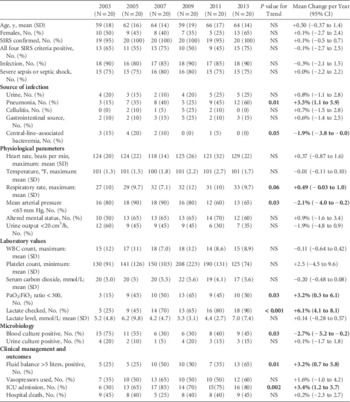
The frequency of clinical markers of sepsis and their trends between 2003 and 2013 are shown in Table 1. There were no changes in the proportions of patients with abnormal heart rates, temperatures, leukocyte counts, or organ dysfunction, but a small decrease in the proportion of patients with mean arterial pressures <65 mm Hg was observed (2.1% decrease per year; 95% CI, −4.0% to −0.2%; P=.03). There were no changes in the frequency of vasopressor starts, average number of vasopressors used, or average lactate levels. Significant increases were observed in the frequency of lactate measurements (6.1% increase per year; 95% CI, 4.1%–8.1%; P<.001), average volume of fluids administered (3.2% increase per year in fraction of patients given >5 liters; 95% CI, 0.7%–5.8%; P=.01), and the proportion of patients admitted to intensive care (3.4% increase per year; 95% CI, 1.2%–5.7%; P=.002). Mortality rates were stable.
Trends in Patient Characteristics and Clinical Markers of Sepsis Severity Among Patients with ICD9 Codes for Sepsis, Brigham and Women’s Hospital, 2003–2013.

NOTE. SD, standard deviation; SIRS, systemic inflammatory response syndrome; WBC, white blood cell count; ICU, intensive care unit.
A significant decrease was observed in the proportion of patients with positive blood cultures (2.7% decrease per year; 95% CI, −5.2% to −0.2%; P=.03). This decrease was paralleled by a decrease in the incidence of central line associated bloodstream infections (1.9% decrease per year; 95% CI, −3.8% to −0.02%; P=.05), and an increase in the incidence of pneumonia (3.5% increase per year; 95% CI, 1.1%–5.9%; P=.01). The increase in pneumonia was mirrored by a significant increase in the proportion of patients with PaO2:FiO2 ratios <300 (3.2% increase per year; 95% CI, 0.3%–6.1%, P=.03). There was no change in the proportion of cases with urosepsis, fungal infections, cellulitis, meningitis, GI infections, viral infections, or osteomyelitis.
DISCUSSION
In this single-center study, we observed a substantial increase in the frequency of admissions with sepsis codes over time but no changes in the proportions of patients with SIRS, confirmed infection, or severe sepsis. Almost all patients with sepsis codes had confirmatory evidence of sepsis on chart review. There were no clear changes in sepsis severity or mortality over time, but we observed some evidence of increasingly aggressive care.
We noted a decrease in the proportion of patients with bloodstream infections and a parallel increase in the proportion of patients with respiratory tract infections. The decrease in bloodstream infections mirrors national data demonstrating a substantial drop in central-line–associated infections attributed to better line insertion and maintenance practices.Reference Pronovost, Needham and Berenholtz 6 , 7 The increase in pneumonia may reflect the national trend toward preferentially assigning sepsis codes rather than pneumonia codes to patients with respiratory infections.Reference Lindenauer, Lagu, Shieh, Pekow and Rothberg 8
We observed increasing rates of lactate testing, higher average volumes of fluids administered, and more patients admitted to intensive care. These observations may reflect the success and increasing penetration of the Surviving Sepsis Campaign.Reference Rivers, Nguyen and Havstad 9 , Reference Levy, Rhodes and Phillips 10
Limitations of our study include the focus on a single medical center, the small number of charts reviewed per year, and the subjective nature of reading charts to determine whether infection is present. Nonetheless, the annual incidence of patients with sepsis codes in our hospital mirrored national data, and we were able to detect significant trends in sepsis etiology and care patterns.
In summary, the incidence of patients with sepsis codes is rising and these codes appear to be appropriate. We found evidence of increasingly aggressive care for sepsis patients but no clear evidence of changes in sepsis severity or mortality. Our study design could not determine whether the increase in sepsis coding is due to more disease or more sensitive coding. Further study is warranted.
ACKNOWLEDGMENTS
This work was supported by a grant from the Centers for Disease Control and Prevention. The authors have no conflicts of interest to declare.
Financial support: No financial support was provided relevant to this article.
Potential conflicts of interest: All authors report no conflicts of interest relevant to this article.