





Preventing episodes involving aggression and coercive measures in in-patient settings is an important goal in mental health services worldwide. Although staff may view coercive measures as necessary to maintain safety, Reference Doedens, Vermeulen, Boyette, Latour and de Haan1,Reference Efkemann, Lickiewicz, Doedens, Lantta, Bali and Husum2 these measures also cause harm and restrict patients’ autonomy and physical integrity. 3
Many of these episodes are preceded by interactions between patients and staff. Reference Papadopoulos, Ross, Stewart, Dack, James and Bowers4,Reference Weltens, Bak, Verhagen, Vandenberk, Domen and van Amelsvoort5 Nevertheless, patients and staff tend to hold contrasting views on how these episodes develop. Reference Butterworth, Wood and Rowe6–Reference Fletcher, Crowe, Manuel and Foulds8 Patients frequently highlight restrictions, loss of autonomy and poor interaction quality. Reference Fletcher, Crowe, Manuel and Foulds8–Reference Tingleff, Bradley, Gildberg, Munksgaard and Hounsgaard10 In contrast, staff often point to patients’ mental illness, safety and lack of resources. Reference Butterworth, Wood and Rowe6,Reference Fletcher, Crowe, Manuel and Foulds8,Reference Almutairi, Price, Alqahtani, Marsden and Lovell11 What staff therefore perceive as patient aggression may also be understood by patients as an assertion of rights or protest behaviour aimed at regaining control. Reference Tingleff, Bradley, Gildberg, Munksgaard and Hounsgaard10,Reference Gudde, Olsø, Whittington and Vatne12 Understanding what precedes episodes involving aggression and episodes involving coercive measures is necessary to identify relevant targets for prevention.
In the literature, the antecedents to episodes involving aggression and episodes involving coercive measures are inconsistently defined, conceptualised and rarely temporally specified. Reference Papadopoulos, Ross, Stewart, Dack, James and Bowers4,Reference Fletcher, Crowe, Manuel and Foulds8,Reference Tingleff, Bradley, Gildberg, Munksgaard and Hounsgaard10,Reference Gudde, Olsø, Whittington and Vatne12 This makes it difficult to compare across studies and, consequently, determine whether antecedents are specific to episodes involving aggression, episodes involving coercive measures or shared across both phenomena. Previous reviews have examined episodes involving aggression Reference Papadopoulos, Ross, Stewart, Dack, James and Bowers4,Reference Fletcher, Crowe, Manuel and Foulds8,Reference Salzmann-Erikson and Yifter9 and those involving coercive measures separately, Reference Tingleff, Bradley, Gildberg, Munksgaard and Hounsgaard10 using different methods and conceptualising antecedents differently, such as perceived causes or patients’ experiences.
Antecedents refer to situations, events and phenomena that precede episodes involving aggression or the use of coercive measures. Reference Rodgers13 Episodes involving aggression can be understood to include a range of behaviours or actions that can result in harm to another individual, regardless of whether aggression is behaviourally or verbally expressed, physical harm is sustained or the intention is clear. 14 Episodes involving coercive measures involve the use of seclusion, physical restraint, mechanical restraint or chemical restraint. 3
To our knowledge, no review has systematically mapped reported antecedents across episodes involving aggression and episodes involving coercive measures, or examined which appear shared and which appear specific to each phenomenon. Given the conceptual and methodological heterogeneity of the literature, a scoping review is warranted. Reference Munn, Peters, Stern, Tufanaru, McArthur and Aromataris15,Reference Peters, Godfrey, McInerney, Munn, Tricco, Khalil, Aromataris, Lockwood, Porritt, Pilla and Jordan16 Scoping reviews are well suited to mapping heterogeneous literature and examining how studies conceptualise, describe and report antecedents. Reference Peters, Godfrey, McInerney, Munn, Tricco, Khalil, Aromataris, Lockwood, Porritt, Pilla and Jordan16
This review aims to map reported antecedents to episodes involving aggression and episodes involving coercive measures in in-patient mental health settings, and to identify which antecedents appear shared and which appear specific to each phenomenon.
The following research questions are addressed: (a) What antecedents to episodes involving aggression are reported in the literature? (b) What antecedents to episodes involving coercive measures are reported in the literature? (c) Which antecedents appear shared across episodes involving aggression and episodes involving coercive measures, and which appear specific to each phenomenon?
Methods
This scoping review followed an a priori protocol, Reference Sterri, Lockertsen, Husum, Lockertsen, Siqveland and Senneseth17 the Joanna Briggs Institute (JBI) methodology for scoping reviews Reference Peters, Godfrey, McInerney, Munn, Tricco, Khalil, Aromataris, Lockwood, Porritt, Pilla and Jordan16 and the Preferred Reporting Items for Systematic Reviews and Meta-Analyses Extension for Scoping Reviews guidelines. Reference Tricco, Lillie, Zarin, OBrien, Colquhoun and Levac18
Eligibility criteria
Eligibility criteria were developed with the population, concept and context framework. Reference Peters, Godfrey, McInerney, Munn, Tricco, Khalil, Aromataris, Lockwood, Porritt, Pilla and Jordan16
Population and setting
The review included studies of adult patients aged 18 years or older and mental health professionals in acute and long-term in-patient mental health settings. Mental health professionals included nurses, nursing assistants, psychiatrists, psychologists, social workers and caregivers.
Clarification of concepts
Antecedents were defined operationally as dynamic, situational factors and sequences of events that precede episodes involving aggression or episodes involving coercive measures. Studies were included if they contained descriptions consistent with this definition, regardless of whether antecedents were the primary focus or reported as secondary findings.
Episodes involving aggression were defined as episodes involving a range of behaviours or actions that can result in harm to another individual, regardless of whether the aggression is behaviourally or verbally expressed, physical harm is sustained or the intention is clear. 14 Studies were not required to provide an explicit definition of aggression or to use a definition that aligned with the review’s definition.
Episodes involving coercive measures were defined as episodes involving seclusion or restraint, including involuntary segregation of a patient in a secure room or physical, mechanical or chemical restraint. 3
Types of evidence
Primary empirical studies in English that used qualitative, quantitative and mixed-methods designs were included.
Exclusion criteria
Studies reporting exclusively on geriatric, forensic and child or adolescent populations were excluded because of differences in regulations, practice, and management of aggression and use of coercive measures. Studies addressing informal coercion (intended to influence behaviour or treatment adherence) or perceived coercion (subjective experiences of coercion independent of formal or informal coercion), and behaviours unrelated to aggression or the use of coercive measures, were excluded. Grey literature was also excluded to ensure consistent extraction and comparison of antecedents. Studies published before January 2014 were excluded to reflect recent developments and practices in the field. Reference Bowers19,Reference Duxbury, Baker, Downe, Jones, Greenwood and Thygesen20 Non-English publications were excluded to ensure accuracy in interpretation.
Search strategy
A three-step search strategy was developed in collaboration with a senior health sciences librarian experienced in systematic and scoping reviews. Preliminary searches were piloted in June 2024, using controlled vocabulary and text words related to antecedents, aggression, coercive measures and in-patient mental health settings. Identified keywords and index terms were adapted for searches in Ovid Medline, APA PsycINFO and Scopus. Searches were limited to English-language publications from January 2014 to January 2025. A supplementary search in CINAHL was excluded from the final search strategy because of substantial overlap with the included databases. The final searches were conducted on 21 January 2025.
The first author searched the reference lists of all included studies, using a snowballing approach to identify any additional relevant sources. Full strategies for each database are provided in Supplementary Appendix 1.
Source of evidence screening and selection
The identified sources were exported, duplicates removed and remaining records were uploaded to Rayyan.ai (Rayyan Systems Inc., Cambridge, Massachusetts, USA; https:/www.rayyan.ai) for screening and additional duplicate removal. Reference Ouzzani, Hammady, Fedorowicz and Elmagarmid21 Before screening, all 6 reviewers independently screened a set of 20 selected articles, resolving disagreements through discussion to ensure a common understanding of the eligibility criteria.
All titles and abstracts were screened independently by two reviewers. The main author screened all titles and abstracts, and equal subsets were divided among the other reviewers. Disagreements were resolved through discussions or, if necessary, with a third reviewer. The remaining articles were assessed in full text using the same procedure, with reasons for exclusion recorded and reported.
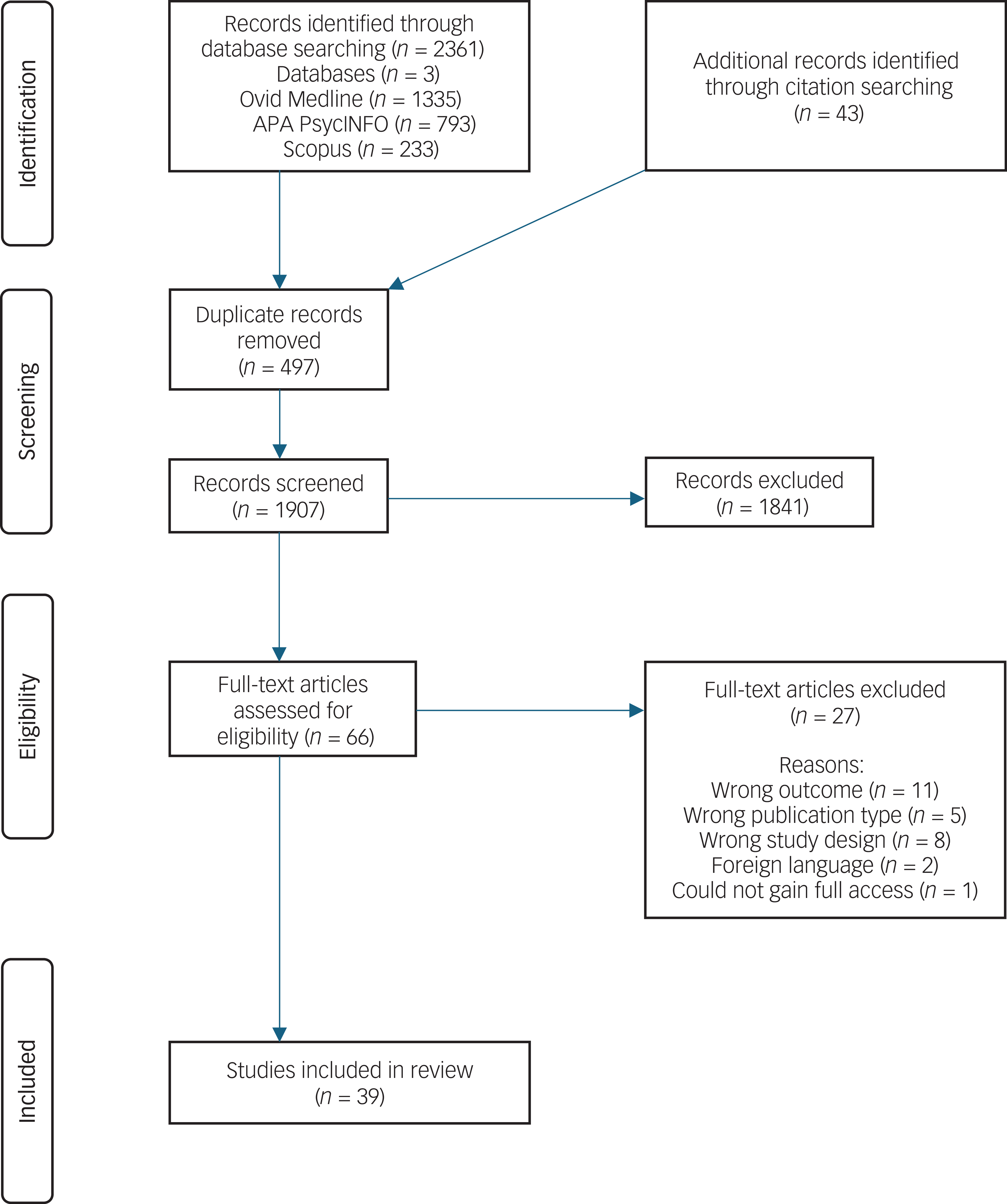
Thirty-nine studies were included in the final review. The study selection process is illustrated in Fig. 1.
Preferred Reporting Items for Systematic Reviews and Meta-Analyses Extension for Scoping Reviews flow diagram.

Data extraction
The data extraction sheet was developed collaboratively and adapted from JBI guidance for scoping reviews. Reference Peters, Godfrey, McInerney, Munn, Tricco, Khalil, Aromataris, Lockwood, Porritt, Pilla and Jordan16 It was piloted on a subset of included studies and refined before full data extraction. Ø.L., V.L., M.S. and N.H.E.S. extracted data independently, with disagreements resolved through discussion.
The included studies were categorised based on perspective represented (patient studies, staff studies or including both perspectives), and phenomenon examined (episodes involving aggression, episodes involving coercive measures or both). When studies reported antecedents to episodes involving both aggression and coercive measures, or included both patient and staff perspectives, these were extracted and mapped separately by perspective and phenomenon.
Extracted data included information about whether antecedents were episode-specific or described in general narratives, whether antecedents were explicitly stated or inferred, as well as how antecedents were temporally described at the study level. Temporal proximity was categorised as immediate (within the same interaction), proximal (within the same shift or day), distal (long-term contributor), mixed or unclear.
Study-level conceptualisations of antecedents were extracted. These included perceived reasons, sequences of events, thematic interpretations, risk factors and other descriptive framings with unclear conceptualisation. Antecedents were extracted verbatim from the included studies before any standardisation or categorisation. The data extraction sheet is available in Supplementary Appendix 2.
Analytical framework
Antecedents were examined at the level they were described to arise in the included studies, including relational processes, individual characteristics of patients or staff, and structural or contextual conditions of care delivery. Inspired by previous frameworks for understanding aggression, Reference Cutcliffe and Riahi22–Reference Nijman24 the analytical framework was developed to support structured descriptive mapping rather than causal interpretation.
Different descriptions that referred to the same underlying antecedent were standardised under common labels. Standardisation was conducted conservatively to retain the original meaning and scope of each description. Conceptually similar antecedents were not merged unless described at the same level of specificity. No new overarching antecedent categories were generated. The standardisation process is documented in Supplementary Appendix 3.
Standardised antecedents were iteratively grouped into six analytically distinct domains:
-
(a) interactional (relational exchanges between individuals)
-
(b) patient-related (individual-level internal states or characteristics of patients)
-
(c) staff-related (individual-level internal states or characteristics of staff)
-
(d) organisational (structural, procedural, or policy-driven conditions and organisational culture)
-
(e) ward-related (physical, material or sensory features of the ward)
-
(f) treatment-related (clinical decisions or care processes framed as treatment).
Domain definitions and categorisation rules were applied to ensure consistency and manage potential conceptual overlap. Antecedents were categorised according to how they were described in the included studies, rather than by their assumed causality. For example, when medication or treatment was described as a source of conflict in patient-staff interactions, it was categorised as interactional rather than treatment-related. Full domain definitions and categorisation rules are presented in Supplementary Appendix 4, and the categorisation process is presented in Supplementary Appendix 5.
Analysis and presentation of results
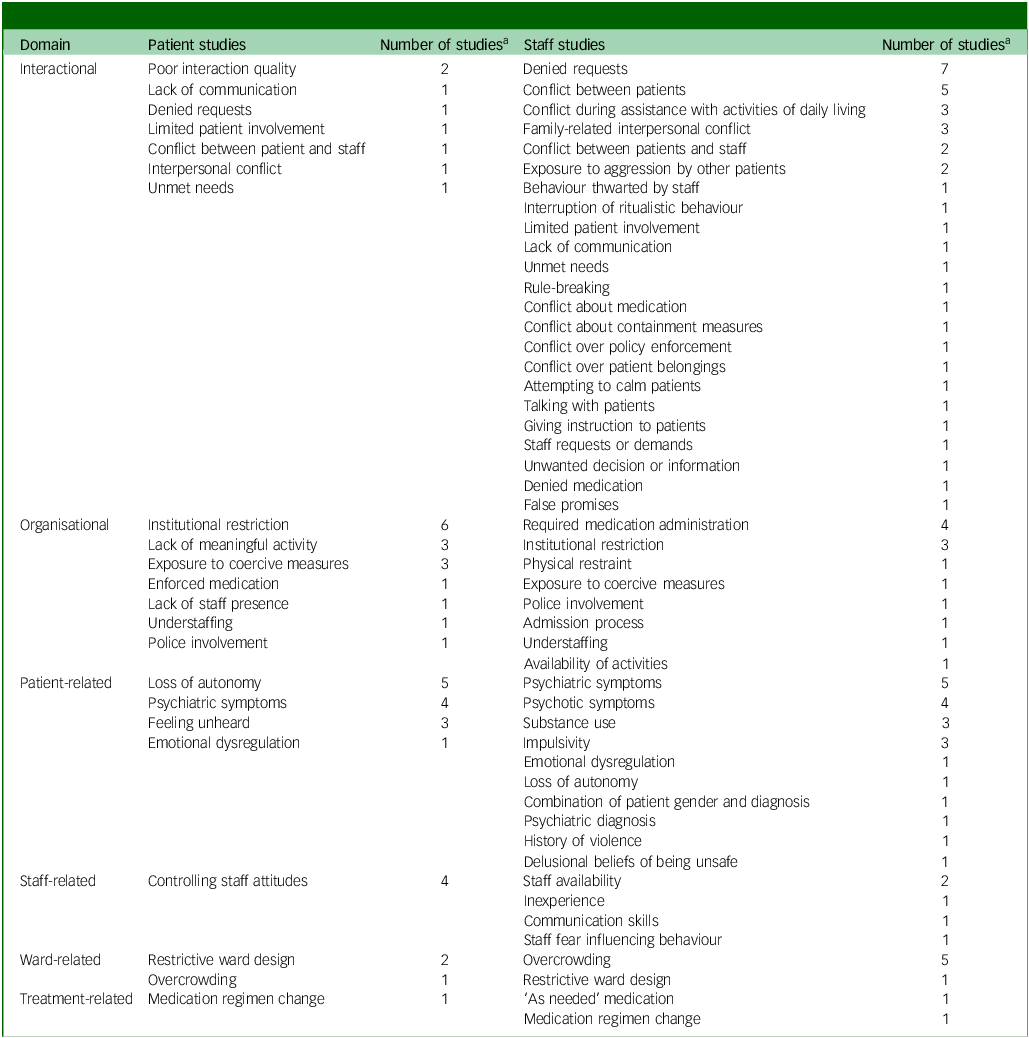
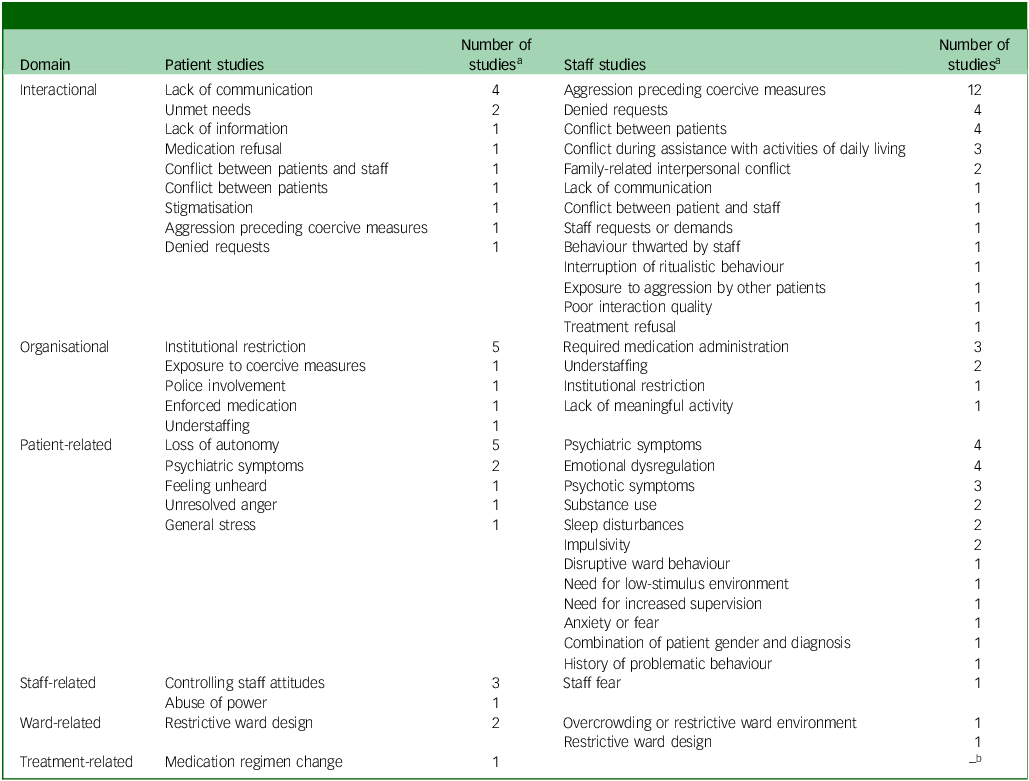
Standardised antecedents to episodes involving aggression and episodes involving coercive measures were mapped across the six analytical domains presented in the previous section. Tables 1 and 2 present standardised antecedents by domain and perspective represented, with narrative summaries describing the distribution and reporting patterns.
Reported antecedents to episodes involving aggression by domain and perspective represented

Table 1 Long description
A table categorizing antecedents to aggression by domain and perspective. The table has 6 rows and 4 columns. Column headers are Domain, Patient studies, Number of studies, Staff studies, and Number of studies. Row labels include Interactioal, Organisational, Patient-related, and Staff-related. The table lists various antecedents and the number of studies for each. For example, under the Interactioal domain, antecedents include Poor interaction quality, Lack of communication, Denied requests, Limited patient involvement, Conflict between patient and staff, Interpersonal conflict, and Unmet needs. The number of studies for these antecedents ranges from 1 to 7. The table provides a detailed breakdown of antecedents from different perspectives.
a. ‘Number of studies’ indicates the number of studies reporting each antecedent; each antecedent was counted once per study, and studies could report multiple antecedents.
Reported antecedents to episodes involving coercive measures by domain and perspective represented

Table 2 Long description
A table categorizing antecedents to coercive measures by domain and perspective. The table has four columns: Domain, Patient studies, Number of studies, Staff studies, and Number of studies. It is divided into four main domains: Interactional, Organizational, Patient-related, Staff-related, and Treatment-related. Each domain lists specific studies and the number of studies conducted. For example, under the Interactional domain, Lack of communication has 4 patient studies and 12 staff studies. The table provides a detailed breakdown of various antecedents and their frequency of study from different perspectives.
a. ‘Number of studies’ indicates the number of studies reporting each antecedent; each antecedent was counted once per study, and studies could report multiple antecedents.
b. ‘–’ indicates no antecedents reported for that domain.
Standardised antecedents were compared within patient studies and staff studies to examine which appeared shared and which appeared specific to episodes involving aggression and episodes involving coercive measures. Shared and phenomenon-specific antecedents were presented in domain-based tables.
Deviations from the scoping review protocol
The analytical approach to the third research question deviates from the a priori protocol. Reference Sterri, Lockertsen, Husum, Lockertsen, Siqveland and Senneseth17 A descriptive comparative mapping of antecedents that appeared shared or specific to episodes involving aggression or episodes involving coercive measures was conducted rather than a thematic analysis, aligning the analysis with the scoping review objective of systematic mapping. Reference Peters, Godfrey, McInerney, Munn, Tricco, Khalil, Aromataris, Lockwood, Porritt, Pilla and Jordan16
Results
The results are presented in four parts. First, an overview of the included studies. Second, reporting characteristics of the antecedents. Third, a mapping of antecedents to episodes involving aggression and episodes involving coercive measures across domains. Fourth, a comparison of reported antecedents that appeared shared or specific to each phenomenon.
Inclusion of sources of evidence
Figure 2 provides an overview of the included studies. Of the 39 studies, most were published between 2014 and 2019 (n = 24), and conducted in high-income countries, primarily in Europe. Qualitative designs predominated (n = 22), and most were staff studies (n = 23). Patient studies were fewer (n = 7), although some included both patient and staff perspectives (n = 9). Only one study documented patient involvement in the research process. Reference McKeown, Thomson, Scholes, Jones, Downe and Price25
Overview of included studies. PCC, Patient–Staff Conflict Checklist Shift Report; SOAS-R, Staff Observation Aggression Scale – Revised.

Most studies focused on either episodes involving aggression (n = 21) or episodes involving coercive measures (n = 15); fewer studies focused on both phenomena (n = 3). Antecedents were predominantly reported as secondary or incidental findings (n = 28), and most studies did not explicitly define antecedents to either phenomenon (n = 38). Temporal framing was often reported as mixed or unclear (n = 28). Across the included studies, 240 antecedents were reported. Of these, 133 related to episodes involving aggression and 107 to episodes involving coercive measures. Patient studies reported 84 antecedents, whereas staff studies reported 156 antecedents.
Reporting characteristics of antecedents
Reporting characteristics of antecedents to episodes involving aggression
Twenty-four studies reported antecedents to episodes involving aggression. Staff studies predominated (n = 17), whereas patient studies were fewer (n = 3). Some studies included both patient and staff perspectives (n = 4). Staff studies used quantitative (n = 9), qualitative (n = 6) and mixed-methods designs (n = 2), whereas patient studies were exclusively qualitative. Three studies also reported antecedents to episodes involving coercive measures, all of which were staff studies.
Studies predominantly conceptualised antecedents as perceived reasons reported by participants (n = 9) or as broader sequences of events (n = 7). Less frequently, antecedents were conceptualised as triggers, provocations operationalised through incident forms, thematic interpretations, risk factors or broader descriptive accounts lacking clear conceptualisation. Patient studies mainly conceptualised antecedents as perceived reasons, whereas staff studies showed greater variation.
No studies explicitly defined antecedents, and most reported them as secondary or incidental findings (n = 18). Narrative accounts predominated in patient studies, whereas staff studies more frequently used incident reports or structured instruments to describe antecedents explicitly. Temporal proximity was frequently mixed or unclear across both patient studies and staff studies.
Reporting characteristics of antecedents to episodes involving coercive measures
Twenty-one studies reported antecedents to episodes involving coercive measures. Most were staff studies (n = 12); fewer were patient studies (n = 4) or included both patient and staff perspectives (n = 5). Staff studies used quantitative (n = 4), qualitative (n = 6) or mixed-methods designs (n = 2), whereas patient studies were exclusively qualitative.
Studies most commonly conceptualised antecedents as sequences of events (n = 7) or perceived reasons reported by participants (n = 5). Less frequently, antecedents were conceptualised as triggers, thematic interpretations, risk factors or broader descriptive accounts lacking clear conceptualisation. Patient studies predominantly conceptualised antecedents as perceived reasons, whereas staff studies showed greater variation.
No studies explicitly defined antecedents, and most reported them as secondary or incidental findings (n = 16). Patient studies relied primarily on narrative accounts, whereas staff studies more frequently used incident reports or structured instruments. Temporal proximity was frequently mixed or unclear (n = 13).
Mapped antecedents to episodes involving aggression
Table 1 presents 133 standardised antecedents to episodes involving aggression, organised by domain and perspective represented. Fewer antecedents were derived from patient studies (n = 45) than from staff studies (n = 88).
Interactional antecedents were the most frequently reported domain. In patient studies, interactional antecedents primarily concerned poor interaction quality and lack of communication, including interactions where staff was perceived as unapproachable, judgemental or abusive, and situations where patients felt pressured or insufficiently informed (e.g. Reference van Wijk, Traut and Julie26–Reference Valimaki, Lantta, Lam, Cheung, Cheng and Ng28 ). Staff studies more frequently described denied requests and a range of interpersonal conflicts, including conflicts between patients and staff, conflicts during assistance with activities of daily living, family-related conflicts and conflicts between patients involving disputes over belongings or taunting (e.g. Reference Sato, Noda, Sugiyama, Yoshihama, Miyake and Ito29–Reference Lawrence, Rolin, Looney, Birt, Stevenson and Dragatsi37 ).
Organisational antecedents were reported across both patient and staff studies. Patient studies primarily reported institutional restriction and limited meaningful activity, such as strict house rules, feeling confined by locked doors and boredom (e.g. Reference van Wijk, Traut and Julie26,Reference Terkelsen and Larsen38–Reference Lamanna, Ninkovic, Vijayaratnam, Balderson, Spivak and Brook42 ).
Staff studies also reported institutional restriction, such as strict house rules and restrictions on personal items (e.g. Reference Lantta, Anttila, Kontio, Adams and Välimäki36,Reference Lamanna, Ninkovic, Vijayaratnam, Balderson, Spivak and Brook42,Reference Goulet and Larue43 ), but more frequently reported situations involving required medication administration (e.g. Reference Sato, Noda, Sugiyama, Yoshihama, Miyake and Ito29–Reference Danivas, Lepping, Punitharani, Gowrishree, Ashwini and Raveesh31,Reference Terkelsen and Larsen38 ).
Patient-related antecedents differed across patient and staff studies. Patient studies predominantly reported loss of autonomy and feeling unheard, including experiences of powerlessness, loss of individuality and being controlled by others (e.g. Reference McKeown, Thomson, Scholes, Jones, Downe and Price25,Reference Terkelsen and Larsen38,Reference Kontio, Anttila, Lantta, Kauppi, Joffe and Välimäki39,Reference Ling, Cleverley and Perivolaris44 ). Psychiatric symptoms were also reported (e.g. Reference Valimaki, Lantta, Lam, Cheung, Cheng and Ng28,Reference Terkelsen and Larsen38,Reference Jenkin, Quigg, Paap, Cooney, Peterson and Every-Palmer40 ). Staff studies more frequently reported clinical or behavioural characteristics of patients, such as psychiatric symptoms and substance use (e.g. Reference Abu Khait, Hamaideh, Aldalaykeh, A. and Lazenby33,Reference Abu Khait, Mrayyan and Algunmeeyn45–Reference Li, Tian, Chen, Li, Chen and Liu47 ).
Staff-related antecedents were less frequently reported. Patient studies only reported controlling staff attitudes, Reference Terkelsen and Larsen38 whereas staff studies highlighted staff inexperience and communication among nursing staff (e.g. Reference Stevenson, Jack, OMara and LeGris46,Reference Weltens, Drukker, van Amelsvoort and Bak48 ).
Ward-related antecedents were seldom reported, and generally concerned restrictive or unsafe ward designs and overcrowded environments (e.g. Reference Jenkin, Quigg, Paap, Cooney, Peterson and Every-Palmer40,Reference Stevenson, Jack, OMara and LeGris46 ).
Treatment-related antecedents were rarely reported and primarily involved medication changes and ‘as needed’ medication (e.g. Reference Abu Khait, Mrayyan and Algunmeeyn45,Reference Richardson, Brennan, James, Lavelle, Renwick and Stewart49 ).
Mapped antecedents to episodes involving coercive measures
Table 2 presents 107 standardised antecedents to episodes involving coercive measures, organised by domain and perspective represented. Fewer antecedents were derived from patient studies (n = 39) than from staff studies (n = 68).
Interactional antecedents were the most frequently reported domain. Patient studies commonly reported lack of communication and unmet needs, including being neglected, not understanding why situations escalated and not being allowed to explain oneself before coercive measures were used (e.g. Reference Allikmets, Marshall, Murad and Gupta27,Reference Valimaki, Lantta, Lam, Cheung, Cheng and Ng28,Reference Terkelsen and Larsen38,Reference Goulet and Larue43,Reference Ling, Cleverley and Perivolaris44,Reference Aluh, Ayilara, Onu, Pedrosa, Santos-Dias and Cardoso50–Reference Ezeobele, Malecha, Mock, Mackey-Godine and Hughes52 ). Staff studies also reported denied requests (e.g. Reference Valimaki, Lantta, Lam, Cheung, Cheng and Ng28,Reference Bowers19,Reference Bowers, Wright and Stewart34 ), yet more frequently reported patient aggression preceding the use of coercive measures, as well as interpersonal conflicts, including conflicts between patients. Reference Sato, Noda, Sugiyama, Yoshihama, Miyake and Ito29–Reference Danivas, Lepping, Punitharani, Gowrishree, Ashwini and Raveesh31,Reference Bowers, Wright and Stewart34,Reference Kang, Bushell, Lee, Berry, Hollander and Rauchberger35,Reference Goulet and Larue43,Reference Richardson, Brennan, James, Lavelle, Renwick and Stewart49,Reference Di Lorenzo, Miani, Formicola and Ferri53–Reference van de Sande, Noorthoorn, Nijman, Wierdsma, van de Staak and Hellendoorn56
Organisational antecedents were described differently across perspectives. Patient studies primarily described institutional restrictions, such as strict house rules and ward routines experienced as making patients feel inferior (e.g. Reference Valimaki, Lantta, Lam, Cheung, Cheng and Ng28,Reference Vermeulen, Doedens, Boyette, Spek, Latour and de Haan41,Reference Ezeobele, Malecha, Mock, Mackey-Godine and Hughes52,Reference McKeown, Thomson, Scholes, Jones, Baker and Downe57,Reference Larsen and Terkelsen58 ). Being brought to the ward by uniformed police officers before admission was also reported. Reference Larsen and Terkelsen58 Staff studies more frequently reported required medication administration and limited resources (e.g. Reference McKeown, Thomson, Scholes, Jones, Downe and Price25,Reference Sato, Noda, Sugiyama, Yoshihama, Miyake and Ito29–Reference Danivas, Lepping, Punitharani, Gowrishree, Ashwini and Raveesh31,Reference McKeown, Thomson, Scholes, Jones, Baker and Downe57 ).
Patient-related antecedents differed in emphasis across perspectives. Patient studies primarily described loss of autonomy through experiences of feeling unheard, powerless, incarcerated, dehumanised and controlled by others (e.g. Reference Terkelsen and Larsen38,Reference Goulet and Larue43,Reference Ling, Cleverley and Perivolaris44,Reference Aluh, Ayilara, Onu, Pedrosa, Santos-Dias and Cardoso50 ). Staff studies more frequently described clinical and behavioural patient characteristics, such as psychiatric symptoms (e.g. Reference Valimaki, Lantta, Lam, Cheung, Cheng and Ng28,Reference Bowers, Wright and Stewart34,Reference Poloni, Ielmini, Caselli, Lucca, Isella and Buzzi54,Reference Vruwink, VanDerNagel, Noorthoorn, Nijman and Mulder59 ).
Staff-related antecedents were infrequently reported. Patient studies primarily described controlling staff attitudes and abuse of power, especially concerning how rules were enforced in a top-down manner, Reference Ezeobele, Malecha, Mock, Mackey-Godine and Hughes52,Reference Larsen and Terkelsen58 and staff failing to recognise patients’ experiences and emotions. Reference Tölli, Kontio, Partanen and Häggman-Laitila51 One staff study reported staff fear. Reference Larsen and Terkelsen58
Ward-related antecedents were also rare. One patient study reported restrictive or unsafe ward designs. Reference Larsen and Terkelsen58 Staff studies reported restrictive ward designs and overcrowded environments. Reference McKeown, Thomson, Scholes, Jones, Downe and Price25,Reference Bowers, Wright and Stewart34 Treatment-related antecedents were scarcely reported, and limited to one patient study describing changes in medication. Reference Terkelsen and Larsen38
Shared and specific antecedents across episodes involving aggression and episodes involving coercive measures within patient and staff studies
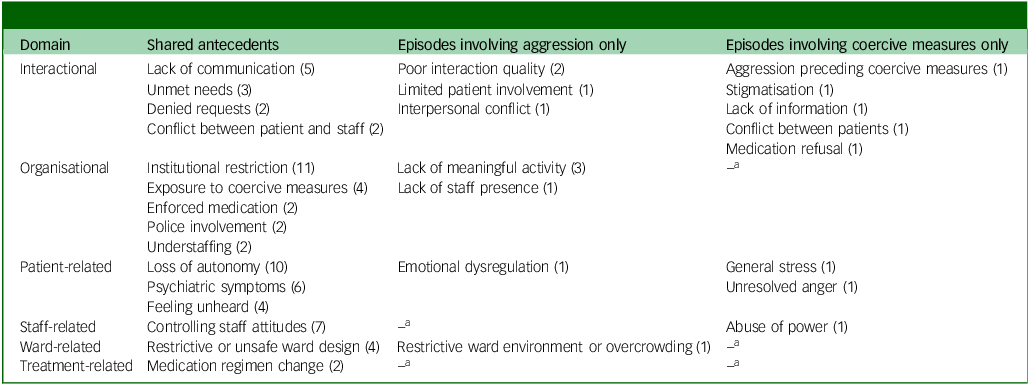
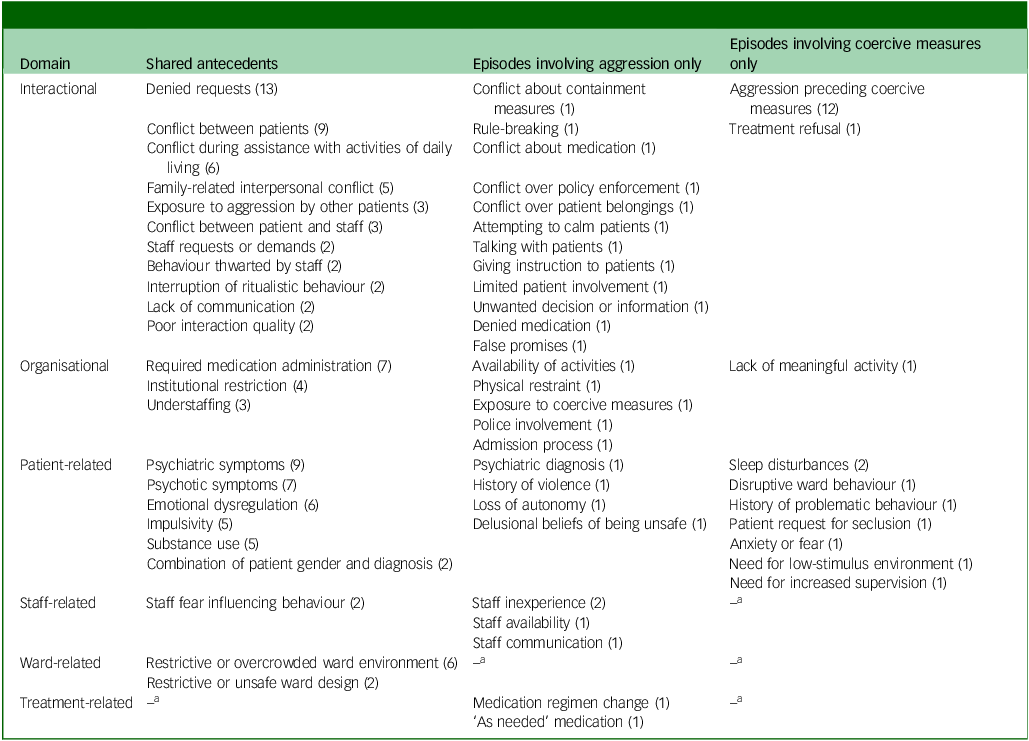
Tables 3 and 4 show which reported antecedents appeared shared across episodes involving aggression and episodes involving coercive measures, or specific to one phenomenon. Table 3 presents patient studies and Table 4 presents staff studies. Antecedents are organised by domain.
Shared and specific antecedents across episodes involving aggression and episodes involving coercive measures in patient studies

Table 3 Long description
A table comparing shared and specific antecedents across episodes involving aggression and coercive measures in patient studies. The table has 4 columns: Domain, Shared antecedents, Episodes involving aggression only, and Episodes involving coercive measures only. It lists antecedents organized by domain: Interactional, Organizational, Patient-related, Staff-related, Ward-related, and Treatment-related. Each row details specific antecedents under these categories. For example, under Interactional, shared antecedents include Lack of communication, Unmet needs, Denied requests, and Conflict between patient and staff. Episodes involving aggression only include Poor interaction quality, Limited patient involvement, and Interpersonal conflict. Episodes involving coercive measures only include Aggression preceding coercive measures, Stigmatization, Lack of information, Conflict between patients, and Medication refusal.
Numbers in parentheses indicate the number of studies reporting each antecedent. For shared antecedents, counts combine reports for both phenomena. Each antecedent was counted once per study for each phenomenon.
a. ‘–’ indicates no antecedents reported.
Shared and specific antecedents across episodes involving aggression and episodes involving coercive measures in staff studies

Table 4 Long description
A table comparing shared and specific antecedents across episodes involving aggression and coercive measures in staff studies. The table has 7 rows and 4 columns. Column headers are Domain, Shared antecedents, Episodes involving aggression only, and Episodes involving coercive measures only. Row 1: Domain, Shared antecedents, Episodes involving aggression only, Episodes involving coercive measures only. Row 2: Interactional, Denied requests (13), Conflict about containment measures (1), Aggression preceding coercive measures (12). Row 3: Interactional, Conflict between patients (9), Rule-breaking (1), Treatment refusal (1). Row 4: Interactional, Conflict during assistance with activities of daily living (6), Conflict about medication (1), -. Row 5: Interactional, Family-related interpersonal conflict (5), Conflict over policy enforcement (1), -. Row 6: Interactional, Exposure to aggression by other patients (3), Conflict over patient belongings (1), -. Row 7: Interactional, Conflict between patient and staff (3), Attempting to calm patients (1), -. Row 8: Interactional, Staff requests or demands (2), Talking with patients (1), -. Row 9: Interactional, Behaviour thwarted by staff (2), Giving instruction to patients (1), -. Row 10: Interactional, Interruption of ritualistic behaviour (2), Limited patient involvement (1), -. Row 11: Interactional, Lack of communication (2), Unwanted decision or information (1), -. Row 12: Interactional, Poor interaction quality (2), Denied medication (1), -. Row 13: Organisational, Required medication administration (7), Availability of activities (1), Lack of meaningful activity (1). Row 14: Organisational, Institutional restriction (4), Physical restraint (1), -. Row 15: Organisational, Understaffing (3), Exposure to coercive measures (1), -. Row 16: Organisational, -, Police involvement (1), -. Row 17: Organisational, -, Admission process (1), -. Row 18: Patient-related, Psychiatric symptoms (9), Psychiatric diagnosis (1), Sleep disturbances (2). Row 19: Patient-related, Psychotic symptoms (7), History of violence (1), Disruptive ward behaviour (1). Row 20: Patient-related, Emotional dysregulation (6), Loss of autonomy (1), History of problematic behaviour (1). Row 21: Patient-related, Impulsivity (5), Delusional beliefs of being unsafe (1), Patient request for seclusion (1). Row 22: Patient-related, Substance use (5), Anxiety or fear (1), Need for low-stimulus environment (1). Row 23: Patient-related, Combination of patient gender and diagnosis (2), Need for increased supervision (1), -. Row 24: Staff-related, Staff fear influencing behaviour (2), Staff inexperience (2), -. Row 25: Staff-related, -, Staff availability (1), -. Row 26: Staff-related, -, Staff communication (1), -. Row 27: Ward-related, Restrictive or overcrowded ward environment (6), -, -. Row 28: Ward-related, Restrictive or unsafe ward design (2), -, -. Row 29: Treatment-related, -, Medication regimen change (1), -. Row 30: Treatment-related, -, As needed medication (1), -.
Numbers in parentheses indicate the number of studies reporting each antecedent. For shared antecedents, counts combine reports for both phenomena. Each antecedent was counted once per study for each phenomenon.
a. ‘–’ indicates no antecedents reported.
Patient studies
In patient studies, antecedents appeared shared across episodes involving aggression and episodes involving coercive measures in all domains. Shared interactional antecedents primarily included unmet needs and lack of communication (e.g. Reference Allikmets, Marshall, Murad and Gupta27,Reference Ezeobele, Malecha, Mock, Mackey-Godine and Hughes52 ). Shared organisational antecedents commonly involved institutional restriction (e.g. Reference Kontio, Anttila, Lantta, Kauppi, Joffe and Välimäki39,Reference Lamanna, Ninkovic, Vijayaratnam, Balderson, Spivak and Brook42 ) and exposure to coercive measures (e.g. Reference Jenkin, Quigg, Paap, Cooney, Peterson and Every-Palmer40,Reference Aluh, Ayilara, Onu, Pedrosa, Santos-Dias and Cardoso50 ). In the patient-related domain, loss of autonomy and psychiatric symptoms were reported for both phenomena (e.g. Reference Valimaki, Lantta, Lam, Cheung, Cheng and Ng28,Reference Terkelsen and Larsen38 ). Controlling staff attitudes was the only shared staff-related antecedent across episodes involving aggression and coercive measures. Reference Terkelsen and Larsen38 Fewer shared antecedents were reported in the ward- and treatment-related domains.
Antecedents that appeared specific to episodes involving aggression were limited. Interactional antecedents primarily involved poor interaction quality and limited patient involvement. Reference Lamanna, Ninkovic, Vijayaratnam, Balderson, Spivak and Brook42 Organisational antecedents included lack of meaningful activity and limited staff presence, Reference van Wijk, Traut and Julie26,Reference Kontio, Anttila, Lantta, Kauppi, Joffe and Välimäki39 whereas patient-related antecedents included emotional dysregulation. Reference van Wijk, Traut and Julie26 Ward-related antecedents included restrictive ward environment or overcrowding. Reference van Wijk, Traut and Julie26
Antecedents that appeared specific to episodes involving coercive measures were less frequently reported and appeared primarily located in the interactional domain, including aggression preceding coercive measures, stigmatisation, lack of information, conflict between patients and medication refusal. Reference Valimaki, Lantta, Lam, Cheung, Cheng and Ng28,Reference Vermeulen, Doedens, Boyette, Spek, Latour and de Haan41,Reference Aluh, Ayilara, Onu, Pedrosa, Santos-Dias and Cardoso50,Reference Ezeobele, Malecha, Mock, Mackey-Godine and Hughes52 Patient-related antecedents included general stress and unresolved anger, Reference Tölli, Kontio, Partanen and Häggman-Laitila51,Reference Ezeobele, Malecha, Mock, Mackey-Godine and Hughes52 whereas the staff-related domain included abuse of power. Reference Ezeobele, Malecha, Mock, Mackey-Godine and Hughes52
Staff studies
In staff studies, antecedents appeared shared across all domains except the treatment-related domain. Interactional antecedents that were shared across both episodes involving aggression and coercive measures most commonly included denied requests and interpersonal conflicts (e.g. Reference Sato, Noda, Sugiyama, Yoshihama, Miyake and Ito29,Reference Iennaco, Whittemore and Dixon30,Reference Bowers, Wright and Stewart34,Reference Vruwink, VanDerNagel, Noorthoorn, Nijman and Mulder59 ). Shared organisational antecedents included institutional restriction and requirements related to medication administration. Reference Sato, Noda, Sugiyama, Yoshihama, Miyake and Ito29,Reference Bowers, Wright and Stewart34,Reference Lantta, Anttila, Kontio, Adams and Välimäki36,Reference Hazewinkel, de Winter, van Est, van Hyfte, Wijnschenk and Miedema60 In the patient-related domain, shared antecedents included patient characteristics, such as psychiatric symptoms, emotional states and substance use. Reference Bowers, Wright and Stewart34,Reference Stevenson, Jack, OMara and LeGris46,Reference Vruwink, VanDerNagel, Noorthoorn, Nijman and Mulder59,Reference Pelto-Piri, Warg and Kjellin61 Staff fear was the only shared staff-related antecedent, Reference Goulet and Larue43 whereas restricted ward designs and overcrowding were shared ward-related antecedents. Reference Bowers, Wright and Stewart34,Reference Weltens, Drukker, van Amelsvoort and Bak48
Antecedents that appeared specific to episodes involving aggression were numerous and primarily interactional and organisational. These commonly included poor interaction quality, limited patient involvement and conflicts related to medication and policy (e.g. Reference Sato, Noda, Sugiyama, Yoshihama, Miyake and Ito29,Reference Spaducci, McNeill, Hubbard, Stewart, Yates and Robson32,Reference Lamanna, Ninkovic, Vijayaratnam, Balderson, Spivak and Brook42 ). Additional antecedents included exposure to coercive measures and admission processes. Reference Abu Khait, Mrayyan and Algunmeeyn45,Reference Pelto-Piri, Warg and Kjellin61,Reference Akanni, Osundina, Olotu, Agbonile, Otakpor and Fela-Thomas62 In the patient-related domain, antecedents mostly included diagnoses and loss of autonomy, Reference Stevenson, Jack, OMara and LeGris46 whereas staff-related antecedents included staff inexperience and communication skills. Reference Stevenson, Jack, OMara and LeGris46,Reference Weltens, Drukker, van Amelsvoort and Bak48 The treatment-related domain was specific to episodes involving aggression and included ‘as needed’ medication and changes in medication regimens. Reference Abu Khait, Mrayyan and Algunmeeyn45,Reference Richardson, Brennan, James, Lavelle, Renwick and Stewart49
Antecedents that appeared specific to episodes involving coercive measures were fewer and mainly interactional, most notably involving patient aggression preceding the use of coercive measures, which was reported across several studies. Reference Sato, Noda, Sugiyama, Yoshihama, Miyake and Ito29–Reference Danivas, Lepping, Punitharani, Gowrishree, Ashwini and Raveesh31,Reference Bowers, Wright and Stewart34,Reference Kang, Bushell, Lee, Berry, Hollander and Rauchberger35,Reference Lawrence, Rolin, Looney, Birt, Stevenson and Dragatsi37,Reference Goulet and Larue43,Reference Richardson, Brennan, James, Lavelle, Renwick and Stewart49,Reference Di Lorenzo, Miani, Formicola and Ferri53–Reference van de Sande, Noorthoorn, Nijman, Wierdsma, van de Staak and Hellendoorn56 Additional interactional antecedents were treatment refusal. Reference Poloni, Ielmini, Caselli, Lucca, Isella and Buzzi54 Organisational antecedents were limited, whereas patient-related antecedents included sleep disturbances, anxiety and a range of behaviours unrelated to aggression. Reference Vruwink, VanDerNagel, Noorthoorn, Nijman and Mulder59,Reference Stepanow, Stepanow, Walter, Borgwardt, Lang and Huber63
Discussion
The included studies emphasised different antecedents to episodes involving aggression and episodes involving coercive measures based on the perspectives represented, the phenomenon examined and how antecedents were identified. These contrasts may provide insight into how episodes involving aggression and coercive measures are described to develop, where prevention efforts may be directed and how the reported antecedents may be influenced by characteristics of the evidence base.
Antecedents to episodes involving aggression
Patient studies primarily identified antecedents within negative experiences of care related to restriction, loss of autonomy and poor interaction quality (e.g. Reference Terkelsen and Larsen38,Reference Kontio, Anttila, Lantta, Kauppi, Joffe and Välimäki39,Reference Lamanna, Ninkovic, Vijayaratnam, Balderson, Spivak and Brook42 ), aligning with previous reviews. Reference Fletcher, Crowe, Manuel and Foulds8,Reference Gudde, Olsø, Whittington and Vatne12 In contrast, staff studies more frequently located antecedents within denied requests, interpersonal conflicts and psychiatric symptoms (e.g. Reference Bowers, Wright and Stewart34,Reference Renwick, Stewart, Richardson, Lavelle, James and Hardy55,Reference Pelto-Piri, Warg and Kjellin61 ).
Previous studies comparing patient and staff perspectives on antecedents to aggression suggest that this contrast may reflect that patients and staff draw on different explanatory models for understanding aggression. Reference Duxbury and Whittington7,Reference Fletcher, Crowe, Manuel and Foulds8,Reference Ilkiw-Lavalle and Grenyer64,Reference Omérov, Edman and Wistedt65 Findings show that patients tend to perceive poor communication and environmental conditions related to restrictions as antecedents to aggression, whereas staff often viewed the patient’s mental illness as the main reason for aggression. Reference Duxbury and Whittington7 A recent review also expands on these contrasts, emphasising staff perceptions of staffing and lack of resources as contributory to the development of aggression. Reference Fletcher, Crowe, Manuel and Foulds8 These differences in understanding aggression may influence which antecedents are perceived as important, and accordingly emphasised in patient studies and staff studies.
This contrast may also partly be explained by in-patient ward cultures, characterised by competing priorities of care, control and safety. Reference Duxbury and Whittington7,Reference Fletcher, Crowe, Manuel and Foulds8 Risk aversion is central to nursing care in mental health settings, Reference Slemon, Jenkins and Bungay66 and staff often need to weigh patients’ needs against organisational needs. Reference Manuel and Crowe67 Consequently, denied requests to maintain safety in staff studies may reflect situations perceived as restrictive in patient studies. Thus, when organisational needs are prioritised, these competing responsibilities may reinforce care experienced as restrictive, becoming points of tension in interactions between patients and staff. Reference Fletcher, Crowe, Manuel and Foulds8 As a result, the antecedents emphasised in patient studies primarily draw attention to negative experiences of care developing over time, whereas the antecedents emphasised in staff studies direct attention to situations in which these experiences become visible through interactions between patients and staff.
Prevention efforts may therefore benefit from preventing negative experiences of care from accumulating over time, contributing to episodes involving aggression. This may involve how institutional restrictions and denied requests are communicated and implemented, as well as being attentive to patients’ expressions of distress before situations escalate. A previous review on patients’ experiences found that patients may communicate warning signs before episodes involving aggression, but that these are often ignored or misinterpreted. Reference Gudde, Olsø, Whittington and Vatne12 Patient-centred communication and trauma-informed care may be relevant in this regard, as both emphasise choice, collaboration and trust, and encourage staff to consider how their actions may be perceived by patients. Reference Fletcher, Crowe, Manuel and Foulds8,Reference Sweeney, Filson, Kennedy, Collinson and Gillard68 However, staff also need appropriate training, sufficient time and organisational support to engage with patients and respond flexibly when safety concerns arise.
Antecedents to episodes involving coercive measures
The antecedents to episodes involving coercive measures were also differently emphasised in patient and staff studies. However, unlike episodes involving aggression, staff studies frequently reported patient aggression preceding the use of coercive measures. This contrast is highlighted in recent systematic reviews comparing patient and staff experiences of coercive measures. Reference Butterworth, Wood and Rowe6,Reference Almutairi, Price, Alqahtani, Marsden and Lovell11 Butterworth et al Reference Butterworth, Wood and Rowe6 found that patients emphasise communication, autonomy, relationships and human rights as important to these episodes, whereas staff emphasised safety and the necessity of coercive measures. A similar contrast has been interpreted as two different types of knowledge. Reference Almutairi, Price, Alqahtani, Marsden and Lovell11 Patients may draw on situated knowledge through experiences of care, which includes awareness of antecedents and their emotional sequelae, which may differ from the clinically and procedurally oriented knowledge typically found in staff studies. Reference Almutairi, Price, Alqahtani, Marsden and Lovell11 As a result, antecedents may be emphasised differently across patient and staff studies.
Patient studies mainly identified antecedents within patients’ negative experiences of care, including poor communication, institutional restriction, loss of autonomy and controlling staff attitudes (e.g. Reference Vermeulen, Doedens, Boyette, Spek, Latour and de Haan41,Reference Ling, Cleverley and Perivolaris44,Reference Ezeobele, Malecha, Mock, Mackey-Godine and Hughes52 ). This finding aligns with a previous review on patient experiences of coercion, noting that aggression was expressed as protest behaviour in response to loss of autonomy. Reference Tingleff, Bradley, Gildberg, Munksgaard and Hounsgaard10 In a more recent systematic review comparing patient and staff experiences on the use of coercive measures, Reference Butterworth, Wood and Rowe6 patient experiences highlighted that escalating behaviour was attributed to poor communication from staff. This suggests that patients experience episodes involving coercive measures as processes shaped by interactions, Reference Tingleff, Bradley, Gildberg, Munksgaard and Hounsgaard10 and indicates that patient studies identify antecedents extending beyond the immediate events preceding coercive measures (e.g. Reference Terkelsen and Larsen38,Reference Tölli, Kontio, Partanen and Häggman-Laitila51 ). Accordingly, attention should be drawn to how these episodes develop over time.
Conversely, staff studies primarily identified antecedents perceived as relevant to decisions about the use of coercive measures, including patient aggression, alongside denied requests, interpersonal conflicts and a wide range of patient characteristics (e.g. Reference Iennaco, Whittemore and Dixon30,Reference Bowers, Wright and Stewart34,Reference Kang, Bushell, Lee, Berry, Hollander and Rauchberger35,Reference Di Lorenzo, Miani, Formicola and Ferri53 ). These findings align with previous studies showing that staff primarily view coercive measures as undesirable, yet necessary, responses to situations perceived as dangerous. Reference Doedens, Vermeulen, Boyette, Latour and de Haan1,Reference Butterworth, Wood and Rowe6,Reference Almutairi, Price, Alqahtani, Marsden and Lovell11 Accordingly, the emphasised antecedents in staff studies may reflect the clinically and procedurally oriented knowledge available to staff when assessing the need for coercive measures. Reference Almutairi, Price, Alqahtani, Marsden and Lovell11 Consequently, staff studies seem to draw attention to the more immediate circumstances in which coercive measures are considered necessary, which may partly explain why antecedents related to restriction or autonomy that develop over time may be less visible in staff studies. It should also be noted that, although rare, some antecedents reported for episodes involving coercive measures concerned patients’ perceived needs, such as the need for rest or a low-stimulus environment. Reference Larsen and Terkelsen58,Reference Vruwink, VanDerNagel, Noorthoorn, Nijman and Mulder59 This suggests that staff studies do not consistently conceptualise coercive measures as responses to perceived risk, but also present them as therapeutic interventions.
The findings suggest that prevention efforts should focus on how episodes involving coercive measures develop over time and on the immediate circumstances in which coercive measures are considered necessary. Increased attention to patient needs and viewpoints during interactions, and providing patients sufficient time and the option to use personal coping strategies, may help prevent situations from escalating to the point where coercive measures are considered. Reference Butterworth, Wood and Rowe6,Reference Tingleff, Bradley, Gildberg, Munksgaard and Hounsgaard10 Additionally, if and when coercive measures are considered, staff need the capacity to respond with safer and less restrictive alternatives. Previous studies suggest that this may require de-escalation skills, knowledge of individual patients, adequate support and resources, and access to options that staff consider feasible. Reference Doedens, Vermeulen, Boyette, Latour and de Haan1,Reference Butterworth, Wood and Rowe6,Reference Almutairi, Price, Alqahtani, Marsden and Lovell11
Fostering therapeutic relationships and collaboration may help integrate patients’ situated knowledge with staff’s clinical and procedural knowledge. This could allow patients’ experiences of restrictions, needs, warning signs and preferred responses to inform how staff understand and respond to escalating situations. In turn, it may also narrow the gap between how patients experience situations as escalating and the circumstances in which staff consider coercive measures as necessary.
Shared and specific antecedents across episodes involving aggression and episodes involving coercive measures
Within patient and staff studies, many antecedents were reported in relation to episodes involving aggression and episodes involving coercive measures, suggesting that the literature often describes these episodes as intertwined. The close relationship between aggression and coercive measures Reference Wullschleger, Chieze, Courvoisier, Hurst, Sentissi and Kaiser69 also indicates potential for prevention by addressing shared antecedents before situations develop into aggression, or reach a point at which coercive measures are considered. The diversity and overlap of antecedents point to the need for comprehensive and multidimensional prevention efforts. Given that both episodes involving aggression and episodes involving coercive measures include patients and staff, prevention should draw on both perspectives while recognising the interplay between interactions, individual characteristics, structural conditions of care, and the policies and legal frameworks that guide them. Reference Cutcliffe and Riahi22,Reference Cutcliffe and Riahi23,Reference Gooding, McSherry and Roper70
These implications align with existing frameworks aimed at preventing the use of coercive measures, such as the Six Core Strategies, Reference Huckshorn71 ReSTRAIN YOURSELF Reference Duxbury, Baker, Downe, Jones, Greenwood and Thygesen20 and the Safewards model. Reference Bowers19 Safewards may be of particular interest, as it provides an explicit link between aggression as a form of conflict and coercive measures as forms of containment within a model of how conditions on in-patient wards give rise to escalating situations. Reference Bowers19 Accordingly, it provides a way of relating patients’ negative experiences of care involving loss of autonomy, restrictions and poor communication to the more immediate and observable circumstances emphasised in staff studies. Its interventions involve patient and staff and address their interactions, therapeutic relationships, collaboration and the ward environment. Reference Bowers19 Notably, evaluation studies suggest that patients and staff may experience these interventions in complementary ways that align with the contrasting antecedents emphasised in this review. Patients described increased respect, safety, hope and a sense of community with staff, Reference Fletcher, Buchanan-Hagen, Brophy, Kinner and Hamilton72 whereas staff described preventing conflicts differently, with a renewed sense of their impact on patients, while feeling safer and more
How the evidence base may influence which antecedents become visible
The review identified methodological characteristics of the evidence base that likely influenced which antecedents became visible in the included studies. Therefore, these characteristics should be considered when interpreting the findings of this review and when designing future studies. First, studies rarely held antecedents as the main focus, suggesting that the reported antecedents that emerged in studies may have addressed different research questions, not been explored systematically or not been explored in full depth.
Moreover, the reported antecedents in studies were seldom temporally specified. Some studies referred to broader experiences extending over time (e.g. Reference Terkelsen and Larsen38,Reference Ezeobele, Malecha, Mock, Mackey-Godine and Hughes52 ), whereas others referred to immediate situations in close proximity to episodes (e.g. Reference Sato, Noda, Sugiyama, Yoshihama, Miyake and Ito29,Reference Kang, Bushell, Lee, Berry, Hollander and Rauchberger35 ). Because studies define the beginning of episodes differently, this likely influences which antecedents become visible. The methods used to capture antecedents also likely influenced their visibility. Studies using quantitative methods based on data from incident reports primarily captured observable events occurring in close temporal proximity to episodes (e.g. Reference Iennaco, Whittemore and Dixon30,Reference Richardson, Brennan, James, Lavelle, Renwick and Stewart49 ), whereas studies using qualitative methods based on interviews more commonly captured broader experiences (e.g. Reference Lamanna, Ninkovic, Vijayaratnam, Balderson, Spivak and Brook42,Reference Ling, Cleverley and Perivolaris44 ).
The evidence base is also influenced by the imbalance between staff and patient studies and the near absence of patient involvement. Consistent with a previous review, Reference Papadopoulos, Ross, Stewart, Dack, James and Bowers4 the predominance of staff studies may lead to antecedents perceived through clinical and organisational lenses being more frequently represented than antecedents concerning negative patient experiences with care. Studies that rely exclusively on incident reports are illustrative. The included Staff Observation Aggression Scale – Revised (SOAS-R) studies Reference Sato, Noda, Sugiyama, Yoshihama, Miyake and Ito29–Reference Danivas, Lepping, Punitharani, Gowrishree, Ashwini and Raveesh31 rely on staff perceptions of a predefined set of provocations connected to the more acute and observable stages of episodes involving aggression. The studies therefore offer limited insight into how these episodes develop. These studies also report how aggression was managed, making aggression particularly visible as an antecedent to coercive measures. Because episodes involving aggression Reference Cutcliffe and Riahi22,Reference Cutcliffe and Riahi23 and episodes involving coercive measures Reference Bowers19 are interactional, multidimensional phenomena, future studies should draw on both patient and staff perspectives to inform practice, preferably within the same studies, while meaningfully involving patients throughout the research process.
Limitations of the evidence base
Limited patient involvement in studies may influence how antecedents are reported and interpreted in the literature. The predominance of staff studies limits balanced comparisons of antecedents and influences how shared and phenomenon-specific antecedents can be interpreted. Many studies report antecedents as secondary or incidental findings, obscuring whether shared and phenomenon-specific antecedents reflect conceptual variation or differences in reporting depth. Inconsistent conceptualisations and unclear temporal boundaries blur distinctions between immediate antecedents and broader situational conditions.
Limitations of the review
This scoping review has some notable limitations. First, no patients were involved in designing or conducting the review, which may have affected how the findings were interpreted. Second, antecedents were operationally defined to ensure consistency in study selection and data extraction because an explicit definition was rarely provided in previous reviews or the included studies. This operationalisation may have influenced how we identified and categorised antecedents. Although antecedents were categorised based on the level at which they were described to arise, this required prioritising one level of detail, which may have reduced nuance.
Third, restricting the review to English-language studies from the past decade may have excluded relevant literature. Most studies were conducted in a limited number of high-income countries, which may restrict generalisability. In accordance with JBI guidance, Reference Peters, Godfrey, McInerney, Munn, Tricco, Khalil, Aromataris, Lockwood, Porritt, Pilla and Jordan16 a critical appraisal of studies was not conducted. The findings therefore reflect reporting patterns rather than the strength of the underlying evidence.
Future recommendations
This scoping review shows that the reported antecedents to episodes involving aggression or coercive measures become visible depending on the perspectives represented in studies, as well as how studies conceptualise, temporally describe and examine them. Patient studies mainly emphasised broader negative experiences of care. In contrast, staff studies more frequently emphasised concrete situations related to risk management and decisions about the use of coercive measures. The predominance of shared antecedents across episodes involving aggression and coercive measures within patient and staff studies indicates that these episodes are often described as parts of the same escalating process. However, patient studies and staff studies appear to highlight different parts of this process.
Prevention efforts may benefit from addressing antecedents across this escalation process, from patients’ broader experiences of care to the immediate situations in which staff perceive intervention to be necessary. Attention should be directed toward early interventions that incorporate both patient and staff perspectives through communication and collaboration, as well as organisational strategies that provide staff with adequate training, and support and promote ward cultures that better balance the needs of patients with organisational needs.
This review identified methodological and conceptual challenges that future studies should address. As studies inconsistently defined, conceptualised and temporally described antecedents, future studies should define and operationalise them more clearly and specify their temporal boundaries. As reported antecedents depend on the perspectives represented, patient involvement should be prioritised, along with incorporating both patient and staff perspectives. Moreover, future studies should clarify whether antecedents specifically concern episodes involving aggression, episodes involving coercive measures or both. This may lead to a more comprehensive understanding of how these episodes are described to develop, and how they are related within the literature.
Supplementary material
The supplementary material is available online at https://doi.org/10.1192/bjo.2026.12123
Data availability
All data supporting the findings of this review are available in the article and its supplementary materials.
Acknowledgements
The authors would like to gratefully acknowledge the contributions of senior librarian Marie Susanna Isachsen of the Medical Library at the University of Oslo, for guiding the search strategy. Additionally, we thank Ms Tonje Granmo for her contributions in shaping the broader research agenda of this PhD project. ChatGPT (GPT-5.5; OpenAI, San Fransisco, California, USA; https://chatgpt.com) was used conservatively in preparing the original draft of the manuscript, to support text flow and language clarity. Relevant suggestions were carefully reviewed and manually adapted by the main author. No AI-generated content influenced the research design, analysis or interpretation.
Author contributions
N.H.E.S. served as the guarantor and authored the initial scoping review. Ø.L., T.L.H., V.L., J.S. and M.S. screened titles, abstracts and full-text articles for inclusion. Ø.L., V.L., M.S. and N.H.E.S. extracted and verified data. N.H.E.S. conducted the data analysis, and all authors verified it. All authors contributed to the interpretation of the findings, and critically reviewed and approved the final version of the manuscript.
Funding
This scoping review is supported and funded by the South-Eastern Norway Regional Health Authority (grant number [2023052] and awarded to Ø.L). The funders had no role in the design of the review, nor in the decision to submit the manuscript for publication.
Declaration of interest
None.



 Open access


eLetters
No eLetters have been published for this article.