

Introduction
Internationally, the incidence of traumatic brain injury (TBI) is increasing (James et al., Reference James, Theadom, Ellenbogen, Bannick, Montjoy-Venning, Lucchesi and Murray2019). Most TBIs (up to 95%) are classified as being mild in severity (Feigin et al., Reference Feigin, Theadom, Barker-Collo, Starkey, McPherson, Kahan and Ameratunga2013). Whilst many people recover well following mild TBI (mTBI), approximately one-third go on to experience persistent post-concussion symptoms that can impact on daily living for many years (Taylor, et al., Reference Taylor, Bell, Breiding and Xu2017; Theadom, Starkey, Barker-Collo, Jones, & Ameratunga, Reference Theadom, Starkey, Barker-Collo, Jones and Ameratunga2018). Symptoms may fluctuate in duration and persistence (Lange, Brickell, Ivins, Vanderploeg, & French, Reference Lange, Brickell, Ivins, Vanderploeg and French2013; Theadom, Starkey, et al., Reference Theadom, Starkey, Barker-Collo, Jones and Ameratunga2018) and can include blurred vision, change in sleeping patterns, dizziness, headaches, nausea or vomiting, extreme tiredness and sensitivity to light or sound (Broshek, et al., Reference Broshek, De Marco and Freeman2015). According to Tyerman (Reference Tyerman2018), emotional changes may include loss of behavioural control (lability/disinhibition), anxiety, depression, irritability, frustration and aggression.
One of the challenges when exploring the longer-term impacts of mTBI is that most post-concussion symptoms, such as headache and fatigue, are subjective (Kish & Koutures, Reference Kish and Koutures2016). Studies have shown that people change the number and nature of the post-concussion symptoms they report, depending on how they are asked to report them (Edmed & Sullivan, Reference Edmed and Sullivan2014; Iverson, et al., Reference Iverson, Brooks, Ashton and Lange2010; Nolin, et al., Reference Nolin, Villemure and Heroux2006; Sullivan & Edmed, Reference Sullivan and Edmed2012). Typical post-concussion symptoms may also commonly occur in other conditions (Gunstad & Suhr, Reference Gunstad and Suhr2004; Scholten, et al., Reference Scholten, Vasterling and Grimes2017), and in healthy (non-injured) people (Iverson & Lange, Reference Iverson and Lange2003; Voormolen et al., Reference Voormolen, Cnossen, Polinder, Gravesteijn, Von Steinbuechel, Real and Haagsma2019). Thus, if a headache is reported, the assessor must consider if this symptom fits the clinical picture of a post-acute effect of the mTBI, or if there is an alternative, more likely explanation (e.g., if it is due to another condition, other factors such as a poor nights’ sleep, or a maladaptive injury response; Donnell, et al., Reference Donnell, Kim, Silva and Vanderploeg2012; Scheenen et al., Reference Scheenen, Spikman, de Koning, van der Horn, Roks, Hageman and van der Naalt2017). Further, as there are no signs and symptoms that are specifically characteristic of mTBI symptoms, the attribution of symptoms to the injury requires careful consideration.
Because there are clinical challenges in the interpretation of chronic mTBI symptoms, several individuals, groups and organisations now strongly urge consideration of a validity check (Etcoff & Kampfer, Reference Etcoff and Kampfer1996; Heilbronner et al., Reference Heilbronner, Sweet, Morgan, Larrabee and Millis2009; Kaufman, et al., Reference Kaufman, Bush and Aguilar2019; Lippa, Reference Lippa2018). Approaches used include looking for indicators of potential over-reporting of signs and symptoms that may require further investigation. Significant effort has been invested to establish such indicators (Cooper, et al., Reference Cooper, Nelson, Armistead-Jehle and Bowles2011; Lange, Edmed, Sullivan, French, & Cooper, Reference Lange, Edmed, Sullivan, French and Cooper2013; Vanderploeg et al., Reference Vanderploeg, Cooper, Belanger, Donnell, Kennedy, Hopewell and Scott2014). This includes the embedding of validity indicator-items (‘atypical’ symptoms) into post-concussion symptom questionnaires (Cooper et al., Reference Cooper, Nelson, Armistead-Jehle and Bowles2011). Such items assess symptoms that would be unusual or uncommon following mTBI (Cooper et al., Reference Cooper, Nelson, Armistead-Jehle and Bowles2011).
Atypical mTBI symptoms have recently been proposed as a potential indicator of the injured person’s recovery prospects (e.g., Stubbs et al., Reference Stubbs, Green, Silverberg, Howard, Dhariwal, Brubacher and Panenka2020). This study showed that patients who presented to a trauma centre following a mTBI and who were rated as more disabled at 1-month had reported significantly more atypical symptoms in the acute phase after injury (Stubbs et al., Reference Stubbs, Green, Silverberg, Howard, Dhariwal, Brubacher and Panenka2020). This suggests that early atypical symptom reporting may be an important predictive factor of long-term functioning, potentially via the mechanism of somatisation (Green, Cairncross, Panenka, Stubbs, & Silverberg, Reference Green, Cairncross, Panenka, Stubbs and Silverberg2021). However, the degree of atypical symptom reporting in other settings, such as community-based medical settings and in contexts where health care is provided free of charge to the patient is not clear. It is also not known whether this link between atypical symptoms and later disability is significant for other outcomes, such as the injured person’s perception of recovery. Consequently, this study aimed to determine the level of reporting of atypical symptoms post-mTBI in a community-based sample, and to examine if the reporting of atypical symptoms at 1 month is predictive of self-reported recovery at 12 months post-injury. It was hypothesised that the reporting of atypical symptoms at 1 month post-mTBI would be a significant predictor of poorer self-reported recovery one year later.
Materials and Methods
The current study utilised a prospective cohort design via secondary analysis of data collected as part of the Brain Injury Incidence and Outcomes New Zealand in the Community, (BIONIC) study. Ethical approval was obtained from the Northern Y Health and Disability Ethics Committee of NZ (NTY/09/09/095) and the Auckland University of Technology Ethics Committee (09/265).
Participants
The BIONIC study identified patients who had experienced a brain injury in the Hamilton and Waikato Districts (173,205 urban and rural residents) in NZ between 1 March 2010 and 28 February 2011 (Feigin et al., Reference Feigin, Theadom, Barker-Collo, Starkey, McPherson, Kahan and Ameratunga2013). To capture the full spectrum of mTBI patients, TBIs were identified from multiple sources including the national accident compensation provider database, hospital admissions and discharges, community healthcare services such as general practitioners (GPs) and physiotherapists, sports clubs, concussion clinics and self-referrals (Theadom, Barker-Collo, et al., Reference Theadom, Barker-Collo, Greenwood, Parmar, Jones, Starkey and Feigin2018). Cases where the diagnosis of mild TBI was indicated in medical records but not confirmed were reviewed by a Diagnostic Adjudication Group. Data for those aged >16 years and who experienced a mTBI and consented to participate in the follow-up assessments were included in the analysis.
Measures
Data on typical post-concussion symptoms were assessed using the Rivermead Post-Concussion Symptoms Questionnaire (RPQ; King, Crawford, Wenden, Moss, & Wade, Reference King, Crawford, Wenden, Moss and Wade1995) at 1 month post-injury. The RPQ contains 16 symptoms commonly experienced after a TBI. Participants were asked to rate how much they experienced each symptom on a scale of 0 (not at all) to 4 (severe) compared with before the injury. Higher scores reflect an increased number and severity of symptoms.
Atypical symptoms 1 month post-injury were assessed by four items that were agreed by a group of clinicians (neurologist, neuropsychologists, and an occupational physician) to be atypical for adults with mTBI. The symptoms were hemiplegia, difficulty swallowing, digestion problems, and difficulties with fine motor tasks. These four symptoms were randomly interspersed within the RPQ items and were rated as for the RPQ items. The symptom profile for participants was categorised as “atypical” if it included at least one atypical symptom (rated as mild [1] to severe [4]) 1-month post-injury.
One year post-injury participants were also asked the extent to which they felt they had recovered from their injury using a 0 to 100 visual analogue scale, with 100 representing a complete recovery and 0 no recovery at all (Cook & Beaven, Reference Cook and Beaven2013). Recovery was classified as low recovery (0–80%), moderate recovery (80–99%) and total recovery (100%) based on distribution of the data. To check if classification of recovery into categories affected the results additional classification was made into full recovery (100%) and incomplete perceived recovery (<100%).
Sociodemographic data including age at injury, ethnicity (European or non-European descent) and sex were extracted from the database. Data on additional injuries were also assessed via a question at the initial assessment (“Did you sustain any additional injuries?”). This was followed by an open text field for describing additional injuries. Self-reported physical or mental health comorbidities were assessed at the 12-month follow-up via the question “Have you been diagnosed with any of the following conditions?” Participants were given a list of 18 common mental and physical conditions (e.g., learning disability, Alzheimer’s disease, diabetes, depression). This was followed by an additional item: “Are there any other conditions you have been diagnosed with?” The responses to the latter items were combined to create two variables. One variable was indicative of the presence or absence (classified as yes or no) as having at least one lifetime physical comorbidity and the other the presence or absence of having at least one lifetime mental comorbidity. Details of rehabilitation received were used to create a dichotomous variable to classify (yes or no) if the person had received any form of rehabilitation post-injury.
Procedure
Following identification and confirmation of diagnosis within the incidence study, participants were invited to complete a series of assessments about the nature and impact of the injury over the course of the year following their injury. The full assessment took approximately 2 h to complete. Participants were assessed at baseline (within 2 weeks of injury), and at 1-, 6- and 12-month follow-up. Data for those aged >16 years, who experienced a mTBI and consented to participate in the follow-up assessments were included in this analysis.
Analysis
Descriptive statistics were used to characterise the samples providing data at 1 and 12 months. For continuous variables, means and standard deviations (or median and interquartile range if the data showed a non-normal distribution) were used. For categorical data, the frequency and percentage were reported. The percentage of adults reporting at least one atypical symptom (mild to severe) at 1-month for each atypical symptom was calculated. As the recovery data did not meet parametric assumptions, an ordinal regression was conducted to determine the link between overall atypical symptom reporting at 1 month and recovery at 12 months. Given the low level of reporting for two of the four atypical symptoms, a composite categorical variable was created (the reporting of at least one atypical symptom) and used in the regression model. The following variables known to influence recovery from mTBI were entered into the regression model; age at injury, sex, ethnicity, mental and physical comorbidities at 1 year, rehabilitation received, typical symptoms (RPQ total score) at 1 month and additional injuries at the time of mTBI.
Results
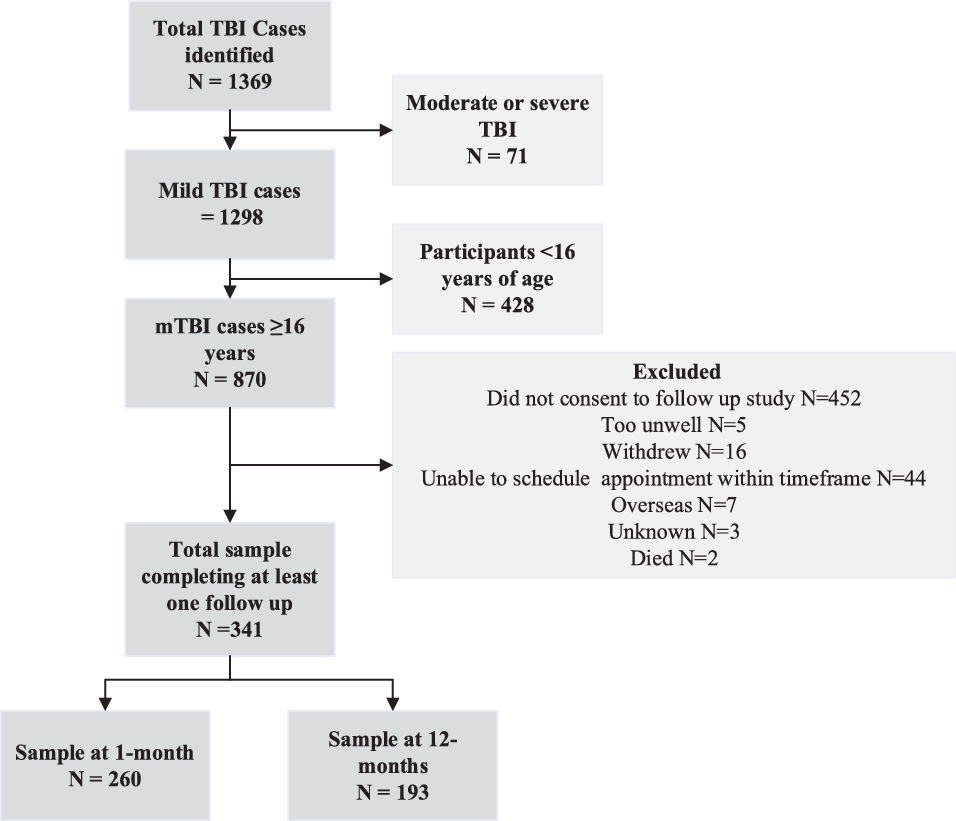
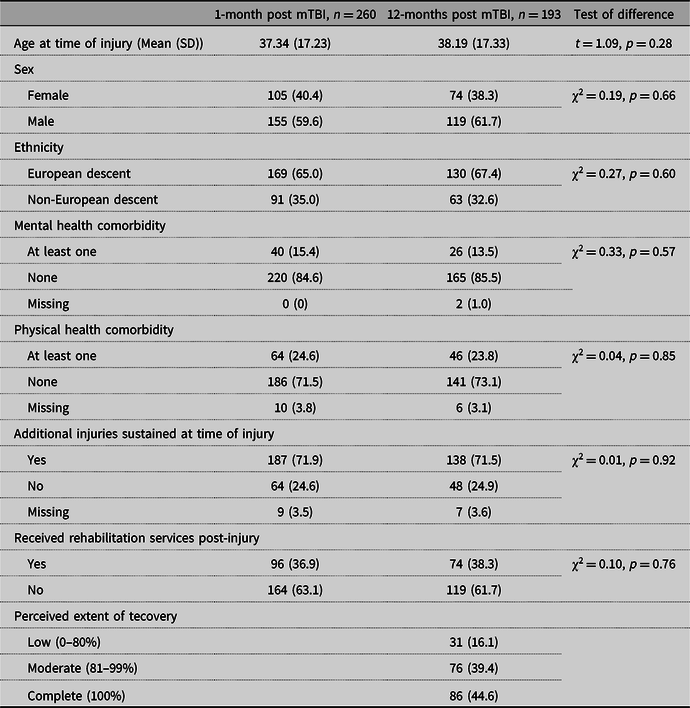
Data for (n = 260) the participants who completed the 1-month assessment, and the 12-month post-injury assessment (n = 193) were extracted from the parent data set (see Figure 1). The participant sample is described in Table 1. The sample characteristics of both groups were not significantly different, indicating that the time 1 sample is representative of the follow-up (time 2) sample on these characteristics. There were also no notable differences between the sample at 12 months and non-consenting cases identified in the original incidence study by sex (62.6% vs 61.7% male) and age (37.3 years vs 38.2 years), ethnicity (60.1% vs 67.4% European) and additional injury (76.0% vs 71.5%) at the time of sustaining a TBI (Theadom et al., Reference Theadom, Parag, Dowell, McPherson, Starkey, Barker-Collo and Feigin2016).
Participant flowchart.

Characteristics of the mTBI sample at 1 and 12-months post-injury

A quarter of the sample (n = 76, 29.1%) reported at least one of the four atypical symptoms at the 1-month timepoint. The most selected atypical symptom was difficulties with fine motor tasks (15.4% endorsement), followed by problems with digestion (10.0% endorsement), difficulties swallowing (5.4%) and hemiplegia (0.8%). As shown in Table 1, just under half (44.6%) of the sample reported being fully recovered at 12-month post-injury.
Regression analysis
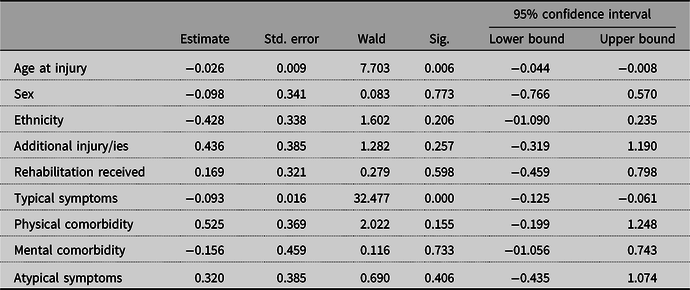
An ordinal regression analysis revealed that older age at injury and increased typical (not atypical) symptoms reported 1-month post-injury were significant independent predictors of poorer perceived recovery using the visual analogue scale at 12 months. The Pearson chi square test revealed that the model was a good fit with the data, χ2 = 318.55 p = 0.88, Nagelkerke Pseudo R2 = 0.38. Atypical symptoms did not significantly contribute to the model at the p < 0.05 level. A post hoc power calculation (using G * Power) revealed that using a two-tailed approach, with alpha = 0.05, a sample size of N = 193 with nine predictor variables, the model had 99% power to find a small effect of 0.10.
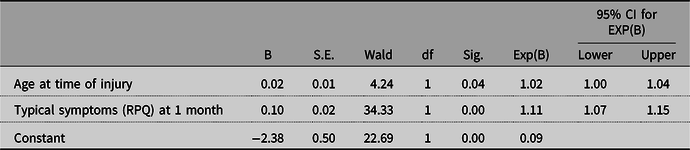
To explore if the way participants were categorised by outcome influenced the findings, a logistic regression was used to determine associations between atypical symptom reporting and longer-term, self-reported overall recovery (dichotomised as fully recovered 100%, or not recovered <100%), following control for pre-identified sociodemographic characteristics, comorbidities and injury related factors. The final model correctly classified 76.5% of participants as recovered or incompletely recovered at 12-month follow-up. Sex, ethnicity, presence of mental or physical comorbidities, receipt of rehabilitation, reporting of atypical symptoms and additional injuries did not significantly contribute to the model on entry (p > 0.05) and were therefore excluded from the final model. The Hosmer–Lemeshow Goodness-of-Fit test revealed that the model estimated the data at an acceptable level χ2(8) 7.49, p = 0.49. Only age and typical symptom reporting were linked to outcome as in the previous statistical model.
Discussion
There are many challenges for people who are recovering from mTBI and for the clinicians who support them. Atypical symptom endorsement has been proposed as a method for supporting the valid clinical interpretation of post-acute mTBI complaints (e.g., Cooper et al., Reference Cooper, Nelson, Armistead-Jehle and Bowles2011) and could predict an increased likelihood of poorer recovery (Stubbs et al., Reference Stubbs, Green, Silverberg, Howard, Dhariwal, Brubacher and Panenka2020). The current study, however, showed that the early report of at least one of the four atypical symptom was not a significant independent predictor of longer-term, self-reported recovery in a country that provides free healthcare to the injured person for all injuries through social insurance. This study shows that older age at injury and increased typical symptoms (RPQ total score at 1 month) were the key indicators for poorer self-rated recovery at 12 months.
The findings contrast with those in a study from Canada which reported a link between higher early reporting of atypical symptoms and poor recovery (Stubbs et al., Reference Stubbs, Green, Silverberg, Howard, Dhariwal, Brubacher and Panenka2020). The differences in reporting may reflect the differences in the study settings, e.g. community-dwelling in comparison with trauma centre populations as well as differences in compensation provision between the two countries. Evidence has shown that higher financial incentives are linked to higher symptom reporting (Bianchini et al., Reference Bianchini, Curtis and Greve2006). The context for the mTBI symptom assessment therefore requires careful consideration as it could contribute to reported symptoms. In our setting, for example, reporting of atypical symptoms at 1-month was 29% (<1% reported hemiplegia, 5.4% difficulty swallowing, 10% digestion problems and 15.4% difficulties with fine motor tasks) compared with 40% in a previous trauma centre study (Stubbs et al., Reference Stubbs, Green, Silverberg, Howard, Dhariwal, Brubacher and Panenka2020).
Another possible explanation for the observed differences in the reporting of atypical symptoms at 1 month, and their relation to functioning at 12 months, is the use of different atypical symptom items and outcome measures. For example, the outcome in the Canadian study included a clinician-rated categorical measure of global patient outcome (Glasgow Outcome Scale Extended), whereas this study used a continuous patient-reported measure of recovery (visual analogue scale), which was subsequently categorised for the ordinal regression. This study used untested items to assess atypical symptoms and this could have affected the endorsement of atypical symptoms in our study. Further, while the atypical item content was similar to the Canadian study (e.g., stomach pain; Stubbs et al., Reference Stubbs, Green, Silverberg, Howard, Dhariwal, Brubacher and Panenka2020), the items are dissimilar to later developed symptom tools (Armistead-Jehle et al., Reference Armistead-Jehle, Cooper, Grills, Cole, Lippa, Stegman and Lange2018; Cooper et al., Reference Cooper, Nelson, Armistead-Jehle and Bowles2011; Lange, Edmend, et al., Reference Lange, Edmed, Sullivan, French and Cooper2013; Lippa, et al., Reference Lippa, Axelrod and Lange2016) that now appear in a newly developed, multi-domain scale that was designed for use with the RPQ (Windle & Sullivan, Reference Windle and Sullivan2019). While there are conceptual and statistical limitations with the measurement of outcomes and predictors in these studies, the methodology of this study enabled exploration of the importance of atypical symptoms in relation to other potential factors influencing recovery. Indeed, the regression model only explained 38% of the variance in self-reported recovery. Further research is recommended using other patient- and clinician-reported outcomes and atypical symptoms.
This sample had a high rate of additional injuries (as brain injury often coincides with other injuries such as bruising, fracture or broken bones) or existing comorbid conditions as is expected of a mTBI population. In the checks for collinearity of independent variables entered into the model, neither comorbidities nor coincident injuries were highly correlated with atypical symptom reporting suggesting that reporting of atypical symptoms was not linked to other health conditions. Despite this, if a patient has comorbidities or a coincident injury, this should still be regarded as having the potential to influence reported atypical symptoms because it can be difficult for patients to distinguish the effects of mTBI from those of other conditions, or their treatments (Chan, Mollayeva, Ottenbacher, & Colantonio, Reference Chan, Mollayeva, Ottenbacher and Colantonio2017). There are several reasons why a person might report atypical symptoms in a mTBI assessment, including misattribution, but these reasons should be followed up.
In our study, nearly half of the sample rated themselves as 100% recovered at 12 months post-injury, yet up to 37% of these participants still reported typical mTBI symptoms such as headaches and fatigue. This finding may reflect that, as time passes following the injury a “new normal” is established (Theadom, Barker-Collo, et al., Reference Theadom, Barker-Collo, Greenwood, Parmar, Jones, Starkey and Feigin2018), and symptoms not experienced prior to injury can form part of the “new normal”. The presence of these symptoms might also be an artefact of the nature of post-concussion symptoms, which includes that they are non-specific and commonly reported in populations with or without brain injury (e.g., Iverson & Lange, Reference Iverson and Lange2003; Sullivan & Edmed, Reference Sullivan and Edmed2012; Voormolen et al., Reference Voormolen, Cnossen, Polinder, Gravesteijn, Von Steinbuechel, Real and Haagsma2019). Clinically the findings suggest that while “atypical” these symptoms are not unheard of in mild TBI samples and therefore their presence should not be used in isolation as an indication of symptom invalidity.
The regression model explained up to 38% of the variance, and the key predictors of outcome at 12 months were age at injury and more symptomatic (typical symptoms) at 1-month post-injury. This supports previous findings that acute post-concussion symptoms are one of the best predictors of longer-term symptom reporting and recovery (Iverson, Reference Iverson, Zasler, Katz, Zafonte, Arciniegas, Bullock and Kreutzer2012; McCrea, Reference McCrea2008; Rabinowitz et al., Reference Rabinowitz, Li, Mccauley, Wilde, Barnes, Hanten and Levin2015; Theadom et al., Reference Theadom, Parag, Dowell, McPherson, Starkey, Barker-Collo and Feigin2016). Treating these symptoms early on is crucial to assist people and to improve the rate of recovery (Real et al., Reference Real, Voormolen, von Steinbuechel, Diaz-Arrastia, Cnossen, Polinder and Haagsma2017). Other factors beyond the scope of this study may account for the remaining unexplained variance, such as poor lifestyle choices or low educational attainment (Broshek et al., Reference Broshek, De Marco and Freeman2015; Polinder et al., Reference Polinder, Cnossen, Real, Covic, Gorbunova, Voormolen and von Steinbuechel2018; Silverberg et al., Reference Silverberg, Gardner, Brubacher, Panenka, Li and Iverson2015), and further research is needed to model their impact on recovery.
This study aimed to determine the percentage of people reporting atypical symptoms 1-month post-mTBI and explore links to self-reported global recovery 12 months later in a community-dwelling mTBI sample. A strength of this research is that data were drawn from a cohort study with well-controlled assessment timeframes and included people who were fully recovered at 12 months, as well as those who were still experiencing difficulties. However, the attrition rate of 14% between the 1- and 12-month timepoints may have influenced the findings, even though this rate is lower than the rate for general clinical trials (Bell, et al., Reference Bell, Kenward, Fairclough and Horton2013). The study was also limited by its focus on self-reported outcomes. Different findings may have been observed using clincian-rated or objective measures. The findings revealed a low proportion of people reported atypical symptoms and that reporting of atypical symptoms was not signficantly linked to self-reported recovery at 1 year. Older age at injury and increased typical symptoms on initial presentation are the key factors influencing perceived poorer longer-term recovery. However, the study only studied four atypical symptoms and further research is needed using different atypical symptoms and outcome measures to confirm or refute these findings. Further research is recommended using other patient- and clinician-reported outcomes and atypical symptoms and to explore the somatisation hypothesis for prolonged mTBI recovery, and whether the endorsement of atypical symptoms can reliably predict such outcomes.
Ordinal regression model examining the associations between atypical symptoms at 1-month on recovery using a visual analogue scale at 12-months alongside covariates (n = 193)

Final logistic regression model predicting perceived recovery (full versus incomplete) at 12 months

RPQ = Rivermead Postconcussion Symptoms Questionnaire.
Acknowledgements
The authors would like to thank the research participants who took part in the BIONIC study.
Financial support
This work was supported by the Health Research Council of New Zealand Project Grant (Reference 09/063A and 11/192). Alice Theadom was supported by a Rutherford Discovery Fellowship administered by The Royal Society Te Apārangi.
Conflicts of interest
Authors have no conflicts of interest to disclose.
Ethical standards
The authors assert that all procedures contributing to this work comply with the ethical standards of the relevant national and institutional committees on human experimentation and with the Helsinki Declaration of 1975, as revised in 2008.