1. INTRODUCTION
In rainforest, navigation is an art combining several techniques, all of which have limitations. GPS signals can be blocked by a damp forest canopy or steep canyon walls, or be unavailable for technical reasons. Compass resection is limited by the difficulty of seeing and identifying suitable reference points. Dead reckoning becomes unwieldy when the path involves many changes in direction. In practice one may obtain a working average bearing by frequent reference to a magnetic compass, count paces to estimate the distance travelled and then guess how much shorter the direct line may be than the path which was followed. The more accurately this can be done the more quickly and reliably the estimated position can be updated by map reading. The present work applies some concepts adapted from Fisher (Reference Fisher1953) to provide a practical, statistically-based procedure for estimating the net bearing and distance. Propagation of experimental uncertainty is discussed in order to establish regions of validity for the method and the magnitude of the uncertainties incurred.
2. THEOREM
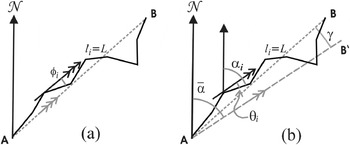
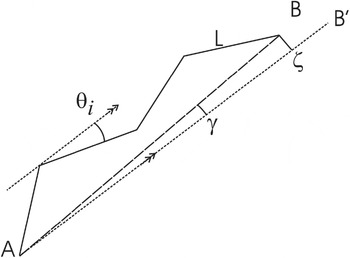
With reference to Figure 1, AB is the overall displacement which is required to be estimated, l i is the i th segment of the path travelled and the residual φi is the angle by which the ith segment departs from the overall direction of the line AB. If R is the length AB then:
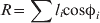
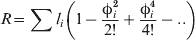

Referring to Figure 1, φi=αi−&alphamacr;+γ where αi is the bearing of the i th leg, &alphamacr; is the average value of αi, and γ is the small angular difference between &alphamacr; and the overall direction AB. If there are N segments, all of length L, equation 3 becomes:


 is zero by definition of &alphamacr;. Therefore:

Where

Irrespective of the underlying probability distribution, the variance of a set of samples x i is given by:
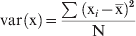
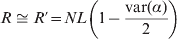
Therefore if the terms in γ2 and φ4 are negligible, equation 6 can be written:
Tortuous path and corresponding vector displacement: (a) showing φi, (b) showing θi and αi.

3. PRACTICAL APPLICATION
The var(α)/2 term in equation 9 represents a quantifiable correction to the path length. It is relatively straightforward to apply this correction because var(α), the variance in the bearings, can be calculated very readily using the statistical facilities on a modern pocket calculator. The terms in γ2 and φ4 in the brackets in equation 6 are fractional perturbations which decrease with the dispersion in path segment directions. They converge rapidly to zero if θ is constrained to be less than 1 rad (i.e. 57·3°). At the same time, the average bearing,  , which is a by-product of the same pocket-calculator computation, is expected to be a good approximation to the bearing of the line AB, thus providing a position estimate for the point B.
4. DRAWING-BOARD EXPERIMENT
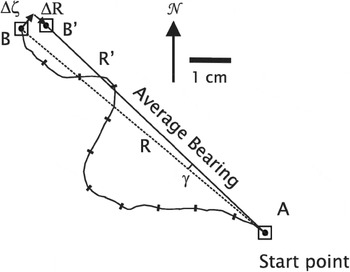
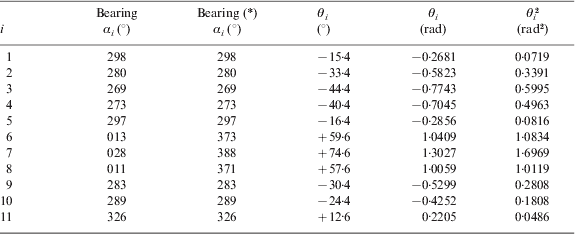
Figure 2 is a scaled drawing-board experiment to test the principle. It shows an arbitrarily drawn pathway, divided into eleven segments, each 1 cm long. The bearings αi of the segments are listed in Table 1, together with the residuals θi (relative to the mean bearing) and powers of θi. From this table:





The difference in bearing (γ) between the bearing of the line AB and the average of the bearings of each of the eleven segments is 3·3°. From equations 6 and 7 the estimate, R′, of distance R between the start and end points A and B is therefore:


Note that the second (i.e. var(θ)/2) term in equation 15 represents a correction of 27%, which is significant, and the term in θi4 represents a correction of 2%, which in many applications would be negligible. The other terms (arising from γ) are parts per thousand and smaller, and are therefore neglected entirely in the error analysis in the following paragraphs. The position estimate obtained by using only the average bearing for direction and only the var(α) term to adjust the distance measurement is shown in Figure 2 as the point B'. The misclose, (BB'), 0·65 cm, is 7·5% of the actual distance AB.
Drawing board experiment.

Drawing board experiment.
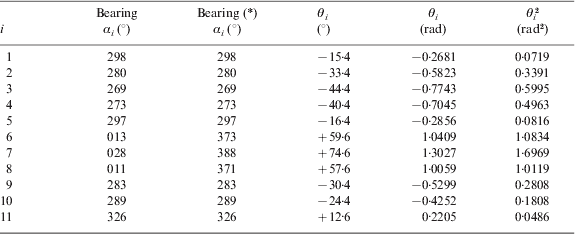
* In this column bearings in the NE quadrant have 360° added to circumvent the problem of incorporating unwanted multiples of 360° in the variance computation.
The purpose of the statistical “error analysis” in sections 5 to 9 below is merely to establish some rules of thumb regarding the accuracy of a routine procedure which will be outlined in section 10. An equivalent approach, which some readers may prefer, would be to go directly to sections 10, 11 and 12 and then establish the strengths and limitations of the method directly, by repeated experiments.
5. CASE OF A PATH FORMING THE ARC OF CIRCLE
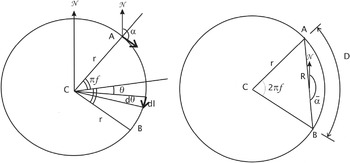
A continuous circular path (Figure 3) represents an interesting and mathematically tractable special case. Let r be the radius of the circular path and f the fraction of a circle subtended between the ends of the arc traversed. By symmetry, the mean bearing, &alphamacr;, is equal to the average of the start and finish bearings, i.e. &alphamacr;=(αB−αA)/2. The angle θ is given by θ=(α−&alphamacr;) and the variance in θ, which is the same as the variance in α, is given by:
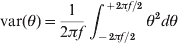

The arc length traversed is D=2πrf and the chord length is given by:
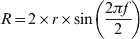

The estimate, R′, of the length of this cord which would be obtained by the method being discussed is:
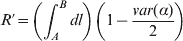

The fractional error incurred by substituting the expression in equation 22 for the chord length is:

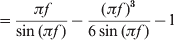
By evaluating this expression numerically, it is found that the magnitude of the fractional error, Δfr(R), remains below 10% so long as f is less than a half, i.e. so long as the path does not double back. For f larger than 0·5, Δfr(R) increases rapidly, becoming 19% for f=0·6 and 47% for f=0·7. At the same time, var(θ) increases as f increases, reaching a critical value of 1·0 close to f=0·5. This means that the procedure is likely to be useful in practice provided that the path does not double back significantly, a condition that is associated with large values of var(θ).
Special case of a circular path.

6. EFFECT OF TRUNCATING THE POWER SERIES
The fractional error in R′ caused by truncation of equation 6, ignoring the very small terms in γ, is:

Strictly speaking this is a systematic error and is one sided. Evaluating it would be equivalent to completing the full dead reckoning calculation, but rather than carry out such complicated arithemetic under field conditions, we will simply treat it as an error bound, and (conservatively) treat it as two sided.
If var(θ) is less than unity this will be dominated by the term in  , and under this condition
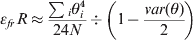
Now if θi are Gaussian-distributed,  , (see for example Martin, Reference Martin1971, p28) hence
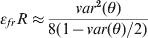
When this expression is evaluated numerically it is found to increase by about 0·03 (or 3%) for each increase of 0·1 in var(θ), and to pass through the critical value of 0·1 (or 10%) when var(θ) is slightly larger than 0·7. Thus the procedure can be expected to give a 10% accuracy in R so long as var(θ) is less than 0·7.
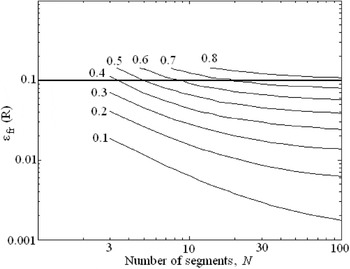
A more comprehensive picture is obtained from Figure 4, where the fractional error in truncating the power series is plotted as a function of N and var(θ). The graph has been obtained by:
• computing the approximation error
 minus N(1−(varθ)/2), where θi is drawn randomly from a Gaussian-distributed population having the prescribed variance and a mean of zero,
• iterating this calculation 1000 times,
• computing the mean of the 1000 results and plotting this as a single point on Figure 4 and
• iterating the process to plot 21 data points on each of 11 curves shown in Figure 4.
 minus N(1−(varθ)/2), where θi is drawn randomly from a Gaussian-distributed population having the prescribed variance and a mean of zero,
The figure is consistent with the abovementioned analytical result where N is large. Specifically, 10% accuracy is likely to be achieved in R, provided that N is greater than 20 and var(θ) is less than 0·7.
Effect of truncating the Power Series on the fractional uncertainty in R. Var(θ) is marked against each of the contours. 10% error threshold is highlighted.

7. UNCERTAINTY IN THE MEAN DIRECTION
In general the mean bearing of the segments (i.e. AB') does not coincide with the overall bearing of the vector AB. There is a small discrepancy, γ, (Figures 1, 2 and 5) which would disappear only if the cumulative residual,  , were equal to zero. Referring to Figure 5, for the line AB:


Hence:

and
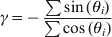
Of course γ could be evaluated from equation 30, which would be equivalent to completing the full dead reckoning calculation. For the present purpose we treat γ as a statistical fluctuation and determine error bounds for it using error propagation theory.
Misclose in bearing.

 , hence:

By definition  is zero. Neglecting the higher order terms, which will make a fractional contribution less than θi2/20:

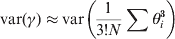
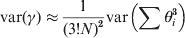
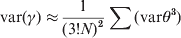
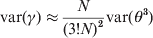
Var (θ3) is the sixth central moment, which for a normal distribution is also equal to 15 (var(θ))3 (see for example Martin, Reference Martin1971, p28). Hence, if we assume that the θi are normally distributed:
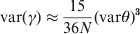
The uncertainty in γ can be taken as its standard deviation, which is the square root of the variance, hence:
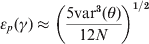
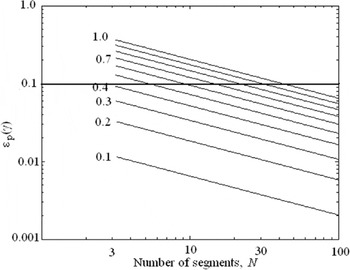
The subscript p, for procedure, is to distinguish this uncertainty from uncertainties discussed in section 8, below. εp(γ) is shown graphically in Figure 6 as a function of the number of segments, N. In particular it can be seen that if N is greater than 20 and var(θ) is less than 0·7 then εp(γ) is less than 0·1, i.e. ε(ζ) is less than 10% of the magnitude of R.
Uncertainty in γ. The contours are labelled with the var(θ) in rad2. 10% threshold is highlighted.

8. ERRORS INHERENT IN DEAD RECKONING
Quite apart from the errors discussed in sections 6 and 7, which are specific to the approximation procedure of this paper, uncertainties in bearing and distance will be accumulated in the same way as with any application of the dead reckoning technique.
The Law of Propagation of Errors (eg. Martin Reference Martin1971 p54), holds that if F=F(x 1, x 2,..), then

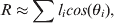
using subscript d to denote uncertainies inherent to the dead reckoning process, as distinct from the errors incurred by making approximations, it follows that:


Note that ε(θi) is the uncertainty in each of the angular measurements, eg. the compass reading error, which is much smaller than the standard deviation of the set of directions, σ(θ).




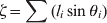
Likewise, if ζ is the accumulated error in the direction perpendicular to R:


9. CURVED PATH INCREMENTS
Up to this point the theory has been developed for the case of a journey comprising straight segments of equal length, because this is mathematically tractible. However, in many situations, particularly in the jungle environment, subdivision of the journey into strictly straight line segments of equal length may be impractical. One way of accommodating this would be to use lines of unequal length and use a weighted variance in equation 9, essentially treating the unit of measure (eg. the pace) as the segment length L. Alternatively, and much more conveniently, the bearing of the tangent to the path can simply be measured at regular intervals, L, and these bearings then treated as if they were the bearings of straight line segments. The tangent bearings α′i can be regarded as consisting of the bearing of an ideal straight line segment, (αi), plus a residual, δαi. The Law of Large Numbers (Martin, Reference Martin1971, p 46) implies that if N is large then the mean of (δαi) is zero. Moreover according to the Central Limit Theorem (Martin, Reference Martin1971, p48) var(α′)=var(α)+var(δα). This means that the standard deviation in δα, which is the square root of its variance, can be as large as one third of the standard deviation in α before it has a 10% influence on the value of var(α) and, propagated through equation 15 under the assumption that var(α) is less than 0·7, it will have less than 2% influence on the estimate of R.
This does not seem to be a difficult condition to meet in practice and indeed the overall accuracy which is achieved by the systematic use of bearings which may appear to be somewhat vaguely correlated with segment directions is quite remarkable.
PROCEDURE
On the basis of the foregoing, the following procedure is suggested for estimating overall bearing and overall distance from measurements made along a tortuous path:
• Divide the journey into segments which are of equal length (L). In practice the segments will follow the curvature of the path, but L should be chosen so that the chord lengths of the segments are in general not significantly different from the arc lengths.
• Measure the bearing (αi) tangential to the path at the end of each segment. These tangent bearings should be more closely correlated with the average bearings of the respective segments than the segment bearings are to the overall direction of the line, by a factor of three or more in standard deviation.
• Determine the variance in α, taking care to avoid introducing unwanted multiples of 360° into the calculation where the data span the 0°/360° direction.
• The overall direction of travel is now taken to be &alphamacr;, the mean value of αi.
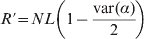
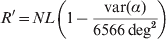
• If α is expressed in radians, the variance is in radians2 (which is dimensionless) the overall (straight line) distance (AB) is now taken to be:
(50)If α is kept in degrees, equation 50 becomes:(51)and if α is kept in mils it will be:(52)• (As a rule of thumb, if N is in the order of 20 and var(α) is less than 0·7 rad2, (standard deviation in α less than 48° or 853 mils), then the resulting position position estimate has an uncertainty which can be described by an error circle with a radius about 10% of the total length of the path.

FIELD TEST
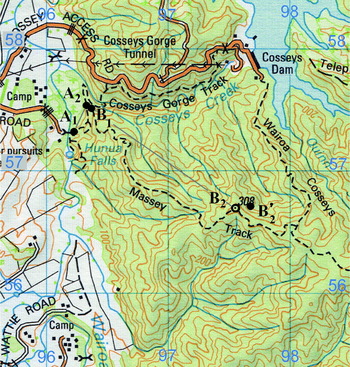
The procedure has been field-tested by following a path through dense sub-tropical rainforest on the western edge of the Hunua Ranges in northern New Zealand. The track, Figure 7, rises about 250m over a distance of about 2km and is a formed path with a gravelled surface about 1 metre wide, with steps in steep places to minimise damage by erosion and pedestrian traffic. The path has a more consistent gradient than the ridgeline which it mainly follows, and consequently it changes direction quasi-randomly and very frequently, so that it is rare to be able to see more than about 20m in any direction. The vegetation consists of dense indigenous forest, through which about 5% clear sky can generally be seen. At the outset it was established with the use of a 20m tape that, for the author, 100m was 130 paces on level ground and 160 paces on steeper parts of the path. The bearing of the track was measured (over a representative distance of about 10m), using an oil-filled prismatic compass, at the start point and thereafter at the end of every 100m interval. The 100m interval was determined by counting paces, stopping when a number between 130 and 160 was reached, according to the steepness of the slope. A counting device was used to tally every 10 paces, to minimise mistakes due to distractions. The first part of the journey trends northeast and the second part of the journey trends southeast. In order to avoid the variances in θ exceeding 0·7 rad2, the procedure is applied to each of the legs successively.
Hunua Falls area. Grid spacing is 1 km. Graticule is New Zealand Map Grid. Contour interval is 20m. Sourced from Land Information New Zealand (2006). Crown copyright reserved.

First leg
Magnetic bearings at 100 m intervals: 035° (395°), 062° (422°), 345°, 340°.
Average bearing 375·5°M+22°GMA=037·5°T
SD in bearing=34·4°=0·600rad.
Var(α)=0·360 rad2
Distance left over from complete 100m intervals=19m.
Corrected distance, R′=319m (1−0·360/2)=262m

By our rule of thumb, the error circle about this position estimate is about 10% of the linear distance, which is 26m.
We now look for a point on the map more or less within this error circle for which the topographical detail is consistent with what we can observe around us. In this case we are at the junction of three tracks, immediately to the NE there is a steep drop of about 20m to a stream and the track going SE rises abruptly. This description corresponds unequivocally to the point 96330mE, 57560mN (NZ Map Grid coordinates), to which we accordingly revise our estimated position, marked A2 on Figure 7. The closure errors were therefore Δ(R)=30m and Δ(ζ)=60m, which is somewhat larger than predicted by our error circle but it should be remembered that there is only approximately a 68% probability, not a 100% probability, of B falling within the error circle and moreover the rule of thumb is based on N being 20 or more.
Alternatively, using the more complicated error formulae, equations 46 and 49 and Figures 4 and 6, with N=3, ε(l i)=5m, ε(θi)=5°=8·73×10−2 rad and var(θ)=0·360 rad2:






Of course this complicated form of error analysis would not be carried out in the field, but is included here to show that it provides a similar result to the 10% rule of thumb. Moreover it shows that the error due to ordinary dead reckoning (subscript d) is a significant part of the total uncertainty, so the approximation could be described as “efficient”.
Second leg
Magnetic bearings at 100m intervals: 135°, 120°, 155°, 073°, 070°, 070°, 080°, 120° 205°, 190° 108°, 125° 97° 122° 068°, 086°, 135°, 093°, 070°, 088°, 093°, 018°, 358° (−002°), 070°.
Average bearing (&alphamacr;)=099·5°M+22°GMA=121·5°T. SD in bearing=45·6°=0·7959 rad. Var(α)=0·6344
Distance left over from complete 100m intervals=47m
Uncorrected distance=2447m
Corrected distance, R′=(24×100m+47m)(1–0·6344/2)=1604m

Implementing the 10% rule of thumb we would describe an error circle 160m in diameter around this position estimate (B′2).
The next step is to find on the map a point more-or-less within this error circle for which the topographic detail on the map corresponds to our actual location. This step is greatly simplified because the circle is fairly small and the range of alternative possibilities is severely restricted. An extensive flat area was seen to the SE of the track about 300m back, since when the track has (from the bearings listed above) been trending in a NE direction. We are now situated on a distinct knoll on the ridge. This means that we are at the 308m spot height marked on the map (Figure 7), which therefore becomes our revised position estimate, B2. The coordinates of point 308 are scaled from the map as 97547mE, 56698mN. The closure errors are therefore Δ(R)=126m (ΔfrR=8·5% ) and Δ(ζ) =−88m. In this case the position is clinched by the discovery of the 2-inch pipe once used as a trigonometrical station mark but now overgrown by trees. This mark is recorded as AJ45 and 638 with coordinates 97487·4mE, 56658·2mN (Source: LINZ database of geodetic marks. Crown copyright reserved). Note that the database coordinates for this (overgrown) triangulated point differ by some 70m from the coordinates scaled from the map, which serves as a reminder that plotting errors of this order are difficult to eliminate from a 50 000 scale map derived from aerial photography of heavily wooded terrain with sparse ground control.
If the more elaborate form of the error theory is applied using equations 46 and 49 and Figures 4 and 6, with N=24, ε(l i)=5m, ε(θi)=5°=8·73×10−2rad and var(θ)=0·6344 rad2, the error bounds calculated for the position B′2, are:






We note that these uncertainties are similar to those estimated by the 10% rule, and that moreover the error contribution arising from the approximation procedure (subscript p) is about four times larger than the uncertainty inherent to the dead reckoning method (subscript d) itself, so the approximation technique is “efficient”.
CONCLUSION
If the bearing α of a path is measured at N equal intervals of distance, L, then a good estimate of the overall bearing and distance is obtained from the mean of α and the distance NL[1-var(α)/2], where α is expressed in radians. The approximation is accurate within about 10% provided that N is greater than 20 and var(α)<0·7, which also means that the path does not double back significantly. This is a very useful level of confidence where the technique is used as an adjunct to map reading in the jungle, and is efficient because the errors incurred are only slightly greater than those inherent to the underlying pace-and-compass navigation technique in this environment. Moreover, at the same level of precision, it is a satisfactory expedient to use bearings tangential to the track at the ends of the segments to supply the parameter α, provided that the bearings so determined are reasonably well correlated with the average bearings of the segments. Care must be taken to avoid unwanted multiples of ±360° infiltrating the standard deviation calculation. It has been found in practice, in a rainforest environment, that the procedure is a useful adaptation of the technique of dead reckoning. It may have other applications, particularly to extrapolation routines in GPS systems under loss-of-lock conditions.
ACKNOWLEDGEMENTS
The author gratefully acknowledges the assistance of Peter Rollinson, Bill Tairi, Matthew Collett, Ron Keam and David Gauld in critical aspects of the work.
APPENDIX A: SYMBOLS. For consistency the following symbols are used throughout the paper:
A and B are the start and end points of the journey respectively. B' is the estimated position of B. R is equal to AB and R' is equal to AB'. αi are the bearings of the line segments and &alphamacr; is the average  . φi and θi denote residuals from the overall line AB and from the line of the average bearing AB' respectively. γ is the angular misclose between AB' and AB, i.e. the bearing AB' minus the bearing AB. ζ is the misclose in the direction perpendicular to R, i.e. ζ=Rγ. The symbol σ denotes standard deviation of a probability distribution. The symbol ε is adopted for an error bound. (i.e. for a determined parameter x, there should be a probability of 68% or greater that the actual value of x lies within the region x±ε(x)). The symbol Δ is used to denote a measured misclose between estimated and actual (i.e. map) positions. ΔR is the misclose in distance, and ζ is the misclose measured perpendicular to the bearing. Angles are measured clockwise. Distances are measured away from the start point of the journey.
Subscript fr means fractional, subscript p refers to the procedure discussed in this paper and subscript d refers to errors inherent in the dead reckoning procedure in the absence of any approximation procedure being superimposed. The error estimates are considered as perturbations. That is to say, the uncertainty in R is estimated under the assumption that γ is zero, and the uncertainty in ζ is estimated under the assumption that R′=R.