Background
Chloral hydrate has often been the drug of choice for moderate sedation in un-cooperative infants and toddlers requiring complete echocardiogram. Chloral hydrate has been demonstrated to be safe and effective in this setting. Reference Hill, Walbergh and Frommelt1 Although still approved for use in children, chloral hydrate is no longer commercially available in the United States. Dexmedetomidine is commonly used intravenously for sedation peri-operatively and in the pediatric intensive care unit with a low rate of serious adverse events. Reference Schwartz, Twite, Gulack, Hill, Kim and Vener2,Reference Banasch, Dersch-Mills, Boulter and Gilfoyle3 Dexmedetomidine may also be administered intranasally via an atomizer, which is ideal for patients without intravenous access. Ease of administration in un-cooperative patients as well as the relatively short half-life make this a potentially attractive option for procedural sedation in pediatrics, and several series have described its use for this purpose. Reference Cao, Lin and Xie4–Reference Li, Zhang and Huang6 However, there are no large series describing its use for pediatric patients undergoing transthoracic echocardiography.
This study sought to compare the safety and efficacy of intranasal dexmedetomidine to a historical cohort of pediatric patients sedated using chloral hydrate in a pediatric echo lab.
Methods
Patients undergoing echocardiography between 1 month and 2 years of age are routinely sedated under supervision of a cardiologist in the echo lab at Children’s Hospital of Wisconsin. Until September, 2018, patients were routinely sedated using chloral hydrate as has been previously described. Reference Hill, Walbergh and Frommelt1 Rarely, un-cooperative children older than 2 years of age are sedated at the treating physician’s discretion. Chloral hydrate dosing was as follows: infants ≤3 months were given 50 mg/kg, infants 4–9 months were given 75 mg/kg, and children ≥10 months were given 10 mg/kg with a maximum dose of 1000 mg. Patients who were not sedated after the initial dose of chloral hydrate were given midazolam 0.2 mg/kg as an adjunct. Because chloral hydrate is no longer commercially available in the United States, beginning in October, 2018, all patients were sedated in the echo lab using intranasal dexmedetomidine. Chart review was performed for all patients undergoing sedation in the pediatric echo lab with either chloral hydrate or intranasal dexmedetomidine between September, 2017 and October, 2019. Patients were sedated only with medication other than chloral hydrate or intranasal dexmedetomidine were excluded. Patients sedated outside of the pediatric echo lab, including all patients with shunt-dependent pulmonary blood flow, were excluded from the analysis. Dosing for intranasal dexmedetomidine was 3 mcg/kg administered using an atomization device (100 mcg/ml via MAD NasalTM). For example, a 10 kg would receive 0.3 ml. Doses >0.3 ml were divided between nares. If a patient given intranasal dexmedetomidine was not adequately sedated after 25 minutes, an additional 1 mcg/kg adjunct dose was given. All sedated patients were monitored by a dedicated sedation nurse during sedation and recovery. Per institutional protocol, vital signs were recorded every 5 minutes. Level of sedation was assessed using a modified version of the Ramsay score. Reference Ramsay, Savege, Simpson and Goodwin7 A modified Ramsay sedation scale is described in Figure 1.
Modified Ramsay scale.

Patient’s age, weight, primary cardiac diagnosis, need for adjunct dose of medication to achieve sedation, adverse events, and ability to perform complete echo were assessed. Vital signs (heart rate, respiratory rate, and oxygen saturation) and level of sedation were recorded at baseline and every 5 minutes after medication administration. Patients were considered to be sedated when achieving modified Ramsay level 3 (moderate sedation) and sedation was considered completed when the patient returned to level 5 (appropriately responsive) after sedation. Time to sedation was recorded as elapsed time from administration of the first dose of medication until the patient first achieved sedation level 3. Sedation failure was defined as not achieving modified Ramsay level 3. Clinical echo reports indicate whether the study was adequate in quality to answer all clinical questions. Vital signs were reported at baseline (prior to administration of medication) and both as minimum and mean values while sedated (sedation level 3). Adverse events related to sedation were defined as a significant escalation in care (such as administration of supplemental oxygen) or for admission related to sedation. Admission for other clinical reasons, including findings on echo, was not considered an adverse event. For all sedated echos, the clinical report indicates whether complete imaging was interrupted due to the patient waking during the exam. To assess whether sedation was adequate, echo reports were reviewed to determine if a complete echo was able to be obtained during sedation. Because the maximum dose of chloral hydrate is 1000 mg, patients >10 kg would be under-dosed using weight-based dosing. The percentage of patients >10 kg in each group who awoke during the study was calculated.
Comparison of patients sedated with chloral hydrate versus intranasal dexmedetomidine was performed for the entire cohort and separately for patients with complex heart disease (diagnoses expected to require surgical intervention in the first year of life) and those with cyanotic heart disease (oxygen saturation prior to sedation <90%). Data are presented as percent of total or mean ± standard deviation. Vital signs are compared between groups at baseline (pre-sedation) and during sedation (modified Ramsay level 3). Patients sedated with chloral hydrate were compared to those receiving intranasal dexmedetomidine by t-test or chi square with p < 0.05 considered significant.
Results
Patient characteristics are summarised in Table 1. The chloral hydrate group included 356 patients, and 376 patients were sedated using intranasal dexmedetomidine. Six patients sedated only with midazolam were excluded. Patient age and complexity of heart disease were similar. The mean weight was 8.2 kg (range= 3.5–35 kg) in the intranasal dexmedetomidine group and 7.8 kg (range = 3.2–16.8 kg) in the chloral hydrate group. Time to achieve sedation was shorter using intranasal dexmedetomidine than for chloral hydrate (24.3 minutes versus 26.3 minutes, p = 0.01), but the duration of sedation was similar between groups. An adjunct medication dose was given more often with intranasal dexmedetomidine than chloral hydrate (5.6 versus 0.3%, p < 0.001), but the rates of failed sedation for both were very low and similar. Duration of sedation was similar with a trend to shorter duration in for intranasal dexmedetomidine, and there was not a difference in the percentage of patients who awoke during the echocardiogram. Complete echocardiograms were able to be completed during sedation for >98% of patients in both groups (p = 0.54).
Patients undergoing sedation

Results are presented as mean +/− standard deviation or percentage of total
* Complex heart disease was considered diagnoses expected to require surgical intervention in the first year of life
** Cyanotic heart disease was defined as oxygen saturation prior to sedation <90%
A small number of patients greater than 24 months old underwent sedation. Two of four patients sedated with chloral hydrate had a complete echo prior to waking, whereas nine of 10 patients sedated with intranasal dexmedetomidine remained sedated throughout the study There were 62 patients sedated with chloral hydrate who were >10 kg, and 8% of those patients awoke during the echo. Similarly, 74 patients >10 kg were sedated with intranasal dexmedetomidine and 5% awoke during the echo.
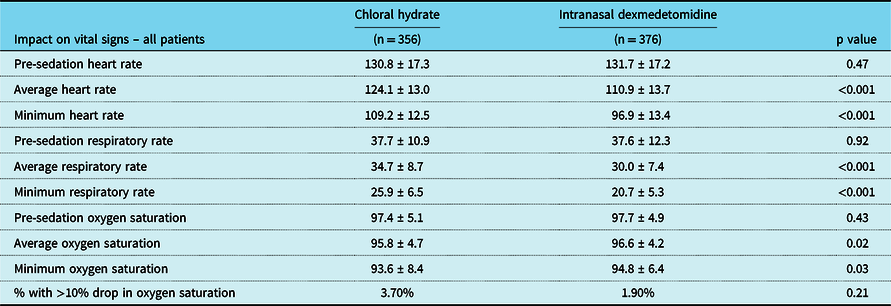
For the entire cohort of patients, baseline vital signs were similar between groups (Table 2). While at modified Ramsay level 3, intranasal dexmedetomidine patients had a lower average heart rate (110.9 versus 124.1 beats per minute, p < 0.001) and a lower average respiratory rate (30.0 versus 34.7 breaths per minute, p < 0.001) compared with those receiving chloral hydrate. Minimum heart rate and respiratory rate were also lower in intranasal dexmedetomidine patients (96.9 versus 109.2 beats per minute, and 21.0 versus 25.9 breaths per minute, p < 0.001 for both). While sedated, the average oxygen saturation was similar (chloral hydrate 95.8% versus intranasal dexmedetomidine 96.6%, p = 0.019), but the minimum oxygen saturation was slightly lower in those receiving chloral hydrate (93.6 versus 94.8%, p = 0.03). There was a low and similar rate of drop in oxygen saturation >10% (p = 0.21).
Impact on vital signs-all patients

Results are presented as mean +/− standard deviation or percentage of total. Average and minimum heart rate, respiratory rate, and oxygen saturation are observed while the patient is sedated
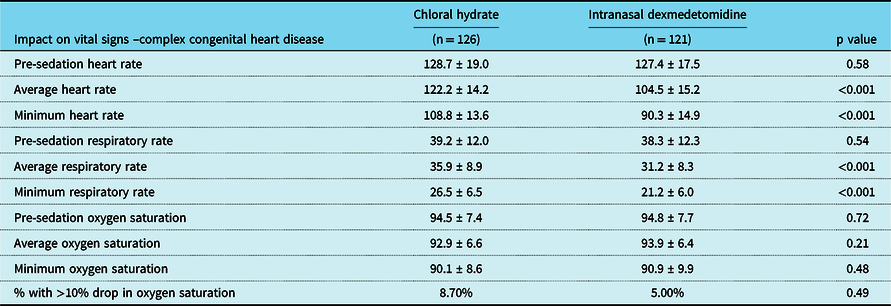
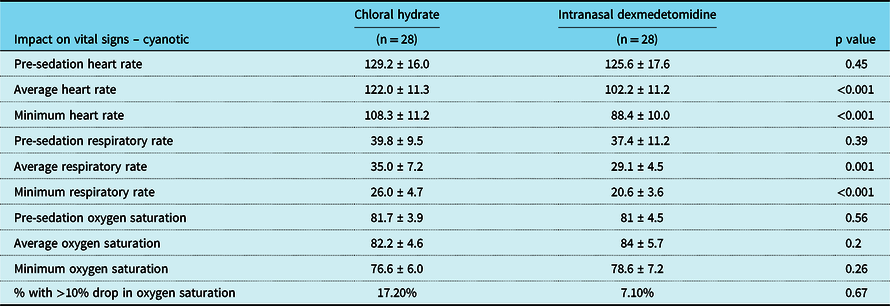
Findings for patients with complex congenital heart disease and cyanotic heart disease are summarised in Tables 3 and 4, respectively. In general, findings in these sub-groups were similar to the entire cohort. In both sub-groups, baseline vital signs were similar. Patients sedated with intranasal dexmedetomidine had lower average heart rate and respiratory rate and minimum heart rate and respiratory rate but no difference in saturation during sedation. Again, both groups had a similar rate of patients with drop in oxygen saturation >10% while sedated (p = 0.49 and p = 0.67, respectively), with the rate of significant desaturation among those given dexmedetomidine being low for patients with complex congenital heart disease (5%) and cyanotic heart disease (7.1%).
Impact on vital signs- complex congenital heart disease

Results are presented as mean +/− standard deviation or percentage of total. Average and minimum heart rate, respiratory rate, and oxygen saturation are observed while the patient is sedated
Impact on vital signs--cyanotic hear disease

Results are presented as mean +/− standard deviation or percentage of total. Average and minimum heart rate, respiratory rate, and oxygen saturation are observed while the patient is sedated
No adverse events occurred in either group. No patients in either group required oxygen administration. One patient in the chloral hydrate group and two in the intranasal dexmedetomidine had hypotension (>30% drop in blood pressure) but all recovered without intervention. There were no admissions related to sedation in either group.
Discussion
Chloral hydrate has been safely used for sedation in infants and toddlers undergoing transthoracic echocardiography but is no longer commercially available in the United States. This retrospective cohort study demonstrates that intranasal dexmedetomidine is a safe and effective alternative to chloral hydrate for patients requiring sedation in the pediatric echo lab. Intranasal dexmedetomidine resulted in adequate sedation and completion of the echocardiograms in 98.7% of patients. Patients with complex and/or cyanotic heart disease tolerated intranasal dexmedetomidine without adverse events and with similar success. No adverse events were reported for use of either chloral hydrate or intranasal dexmedetomidine.
While intranasal administration of dexmedetomidine has been described relatively recently, intravenous dexmedetomidine has been used routinely in the pediatric intensive care unit for sedation with low incidence of significant side effects. Some reports have suggested its use is associated with a decrease in opioid and benzodiazepine use. Reference Whalen, DiGennaro, Irby, Yanay and Zimmerman8–Reference Hayden, Breatnach, Doherty, Healy, Gallagher and Cousins10 Dexmedetomidine has increasingly been used in children undergoing surgery for congenital heart disease. Reference Schwartz, Twite, Gulack, Hill, Kim and Vener2 One recent meta-analysis found that patients with congenital heart disease treated peri-operatively with dexmedetomidine had decreased duration of mechanical ventilation and less need for narcotics. Reference Pan, Wang, Lin, Zhou, Hua and Mo11
Intravenous dexmedetomidine has also been used with good results for procedural sedation and is associated with decreased anxiety on emergence from anesthesia. Reference Sharma, Kumar and Gandhi12 A recent review described safe use of intranasal dexmedetomidine in un-cooperative pediatric patients for non-invasive diagnostic testing as well as during procedures requiring moderate sedation. In over 2000 patients, no significant adverse reactions requiring resuscitation were reported. Reference Poonai, Spohn and Vandermeer13 Only a few small series have assessed the use of intranasal dexmedetomidine for echocardiography. Reference Miller, Xue, Hossain, Zhang, Loepke and Jurth14–Reference Fett, Hackbarth, Boville, Olivero, Davis and Winters16 Patients with cardiac disease may be vulnerable to the alpha-agonist effects not seen in other patient populations. Consistent with the mechanism of action, patients sedated with intranasal dexmedetomidine did have a more significant decrease in heart rate than those sedated with chloral hydrate. This was well tolerated. No patient required any intervention or interruption of the echocardiogram for adverse events. Prior reports had limited numbers of patients with either complex or cyanotic heart disease. Reference Miller, Xue, Hossain, Zhang, Loepke and Jurth14 In our experience, patients with significant cardiac lesions tolerated intranasal dexmedetomidine well. It is important to note that, based on institutional practice, our cohort of patients sedated with intranasal dexmedetomidine did not include patients with shunt-dependent pulmonary blood flow who may be more vulnerable to changes in afterload and heart rate.
Doses of 1.5–4 mcg/kg/dose intranasal dexmedetomidine have been described for procedural sedation. Reference Poonai, Spohn and Vandermeer13–Reference Tug, Hanci and Turk17 Not surprisingly, higher doses have been found to result in longer duration of adequate sedation. Reference Tug, Hanci and Turk17 Our protocol was to administer 3 mcg/kg as an initial dose with an adjunct 1 mcg/kg dose if not sedated after 25 minutes. The initial dose resulted in adequate sedation for 94.4% of patients, while 85.7% of patients who required an adjunct dose were able to be adequately sedated. This approach was effective for patients less than 2 years old. Patients were sedated in an average of 24.3 minutes and remained sedated for 71 minutes.
Intranasal dexmedetomidine has several advantages over chloral hydrate for sedation. Although chloral hydrate was safe and effective for sedation in the echo lab, administration was often challenging due to the large volume needed to be administered orally and its bitter taste. Emesis has been reported in approximately 6% of patients receiving chloral hydrate and may result in inadequate sedation. Reference Napoli, Ingall and Martin18 Intranasal administration of dexmedetomidine circumvents the challenge of orally administering medication to a fussy child. Indeed, anecdotally nurses found administration of intranasal medication significantly easier than oral chloral hydrate.
Intranasal dexmedetomidine also facilitates more appropriate dosing for older children. The maximum dose of chloral hydrate is 1000 mg, meaning older children may be under-dosed. Intranasal dexmedetomidine does not have the same dosing restriction. Patients up to 33 kg would require no more than 1 ml using intranasal dexmedetomidine concentration of 100 mcg/kg. In a small number of patients >24 months old receiving intranasal dexmedetomidine, the rate of successful echo completion was similar to that of younger patients. This may allow successful sedation in older children with anxiety issues and developmental delays, though more study is needed in older children. Indeed, patients up to 35 kg were successfully sedated using intranasal dexmedetomidine in our cohort.
This study did have several limitations. This study did not address different dosing strategies for intranasal dexmedetomidine. Higher rates of echocardiogram completion prior to patients waking may be achieved with lower initial dosing strategies, although over 98% completed their study using 3 mcg/kg with only about 5% needed an adjunct dose. Additionally, transition between levels of sedation may be somewhat subjective, and so time to sedation and duration of sedation are subject to interpretation. Finally, the numbers of patients with cyanotic heart disease were small and as a result impact of sedation on oxygen saturation between groups may not have reached statistical significance. Additional study in patients with cyanotic heart disease is warranted.
Conclusion
Successful sedation with intranasal dexmedetomidine in un-cooperative infants and young children during echocardiography is comparable to chloral hydrate in regards to safety and efficacy. Consistent with its mechanism of action, patients receiving intranasal dexmedetomidine had a lower heart rate during sedation, but this did not result in any adverse events. Given the ease of dosing and lack of need for intravenous access or anesthesiology support, intranasal dexmedetomidine appears to be an ideal drug for sedation of pediatric patients undergoing echocardiography.
Acknowledgements
None.
Financial support
This research received no specific grant from funding agencies, commercial or not-for-profit sectors.
Conflicts of interest
None.
Ethical standards
All data involving human participants were collected in accordance with ethical standards of, and with approval from, the Children’s Wisconsin institutional review board.