INTRODUCTION
In Sweden, as in many other European countries, 8 out of 10 people in residential care are 80 years or older (SALAR, 2009), often with multiple diseases, among which dementia is common (Ernsth Bravell et al., Reference Ernsth Bravell, Westerlind and Midlov2011). The turnover during a 9-month period is almost 40% (National Board of Health and Welfare, 2010), and most of those living in residential care also end their life there. Even though WHO (2011) emphasizes that general palliative care can be applied independently of context, it is still only available to a limited number of residents (APRAC, 2006; WHO, 2011). In residential care, nurse assistants (NAs) are the main care providers, comprising 82% of the personnel (National Board of Health and Welfare, 2012). Thus, the practical provision of palliative care is mainly the responsibility of the NAs, even though they are a group with limited education.
Prerequisites to Provide Palliative Care in Residential Care
Palliative care aims to improve the quality of life for patients and their families facing the problems associated with life-threatening illness. It is an approach that emphasizes the importance of interdisciplinary teamwork in addressing the unique needs of patients and their families during the early and late stages of the illness and the period of bereavement (WHO, 2002). The prerequisites for teamwork in residential care, however, are limited. The NAs are on duty around the clock, while other professionals such as managers, registered nurses, physiotherapists, and occupational therapists work during the daytime on weekdays (SALAR, 2009). A physician is located offsite, at a primary healthcare center. Thus, the NAs bear the major responsibility for provision of practical palliative care even though they have only 2–3 years (or less) of nursing-care education at an upper secondary school level. In a previous study, we found that NAs believed that palliative care was mainly applicable during residents' final days of life, and once palliative care had been initiated, they felt able to focus on the aspects of the relationship. The NAs also underlined the fact that they were in need of recognition and support to cope with their work (Beck et al., Reference Beck, Törnquist and Broström2012a ). Thus, there seems to be an urgent need to develop supportive measures for staff working in residential care.
Edvardsson and coworkers (Reference Edvardsson, Sandman and Nay2009) reported that staff caring for people with dementia have a demanding and challenging work situation. However, Edberg et al. (Reference Edberg, Anderson and Orrung Wallin2009) reported that the most common feelings among NAs (n = 927) in their daily work were satisfaction and joy. Other studies on job satisfaction in nursing homes also report that caregivers overall were satisfied with their work (Brodaty et al., Reference Brodaty, Draper and Low2003; Castle et al., Reference Castle, Degenholtz and Rosen2006). A study among 225 NAs working in residential care found that the organizational prerequisites for providing person-centered care was associated with high general job satisfaction and satisfaction with nursing-care provision. High satisfaction with nursing-care provision was also found to be related to aspects of leadership (Orrung Wallin et al., Reference Orrung Wallin, Edberg and Jakobsson2012). A systematic review (van den Pol-Grevelink et al., Reference van den Pol-Grevelink, Jukema and Smits2012) of interventions in nursing homes showed that person-centered care had a positive effect on both staff job satisfaction and caregiver stress. It thus seems that the satisfaction and well-being of professional caregivers is related to the quality of care they are able to provide.
Support to Staff with Focus on Providing Palliative Care
Bolmsjö (Reference Bolmsjö2008), reviewed intervention studies focused on palliative care of older people, four of which concerned staff training and support. The review showed that training in communication skills, including end-of-life issues, appeared to be useful, and that palliative care meetings between team members fostered discussions with residents about end-of-life care. Furthermore, the integration of palliative care principles, support, and consultation with an expert nurse encouraged the staff to be more open to problems, and discussions on specialized care planning with a trained nurse yielded increased agreement between the end-of-life care preferences of patients and professionals. Since the Bolmsjö review, Phillips et al. (Reference Phillips, Davidson and Jackson2008) published and reported that a multifaceted intervention increased nurses' understanding and enhanced their competence and confidence in delivering palliative care. Studies on the support given to staff providing palliative care in residential facilities are thus scarce. The few that have been performed were carried out with other groups of professionals, and outside of Europe. More knowledge is therefore required on the support needed by NAs when adopting a palliative care approach in residential care.
BACKGROUND TO THIS STUDY
Based on the existing body of research, and the recommendations of NICE (2007) that changes in practice require small-scale meetings providing the opportunity for reflection and discussions, we designed an intervention focusing on relational, emotional, and existential issues in the palliative care approach. The aim of the intervention was to increase NAs' knowledge and understanding and to change practices in line with this approach. The leaders (i.e., managers and registered nurses) were involved in the intervention to increase their opportunity to support NAs. A participatory learning method in the form of study circles (see Westergren et al., Reference Westergren, Axelsson and Lilja-Andersson2009) for NAs and their leaders with cross-professional interactive workshops was employed.
In a previous study (Beck et al., Reference Beck, Jakobsson and Edberg2013), positive effects were seen concerning NAs' reports of care provision in that after the intervention they focused more on communicating with the residents about their lives and what gave them meaning. Post-intervention interviews with NAs showed that they felt the intervention to be positive and had encouraged them to provide more person-centered care within the framework of the palliative care approach. However, they also expressed frustration over obstacles to implementation of the palliative care approach, including a lack of supportive leadership (Beck et al., Reference Beck, Törnquist and Edberg2012b ). It is therefore important to investigate how the intervention affected job satisfaction and degree of strain among the NAs as well as their perceptions of their leaders.
Aim
The aim of the study was to investigate the effects of an intervention applying a palliative care approach in residential care upon nurse assistants' level of strain and job satisfaction, and on their view of leadership.
Research Questions
-
1. Does an intervention applying a palliative care approach in residential care have effects on job satisfaction and strain for nurse assistants?
-
2. Does an intervention applying a palliative care approach in residential care have effects on how NAs perceive the leadership?
METHOD
Design
The study was quasi-experimental, with a control group pretest/posttest design (Polit & Beck, Reference Polit and Beck2004). Primary outcome variables were satisfaction, strain, and view of leadership. As the groups differed at baseline, we decided to only perform comparisons within groups over time.
Setting and Participants
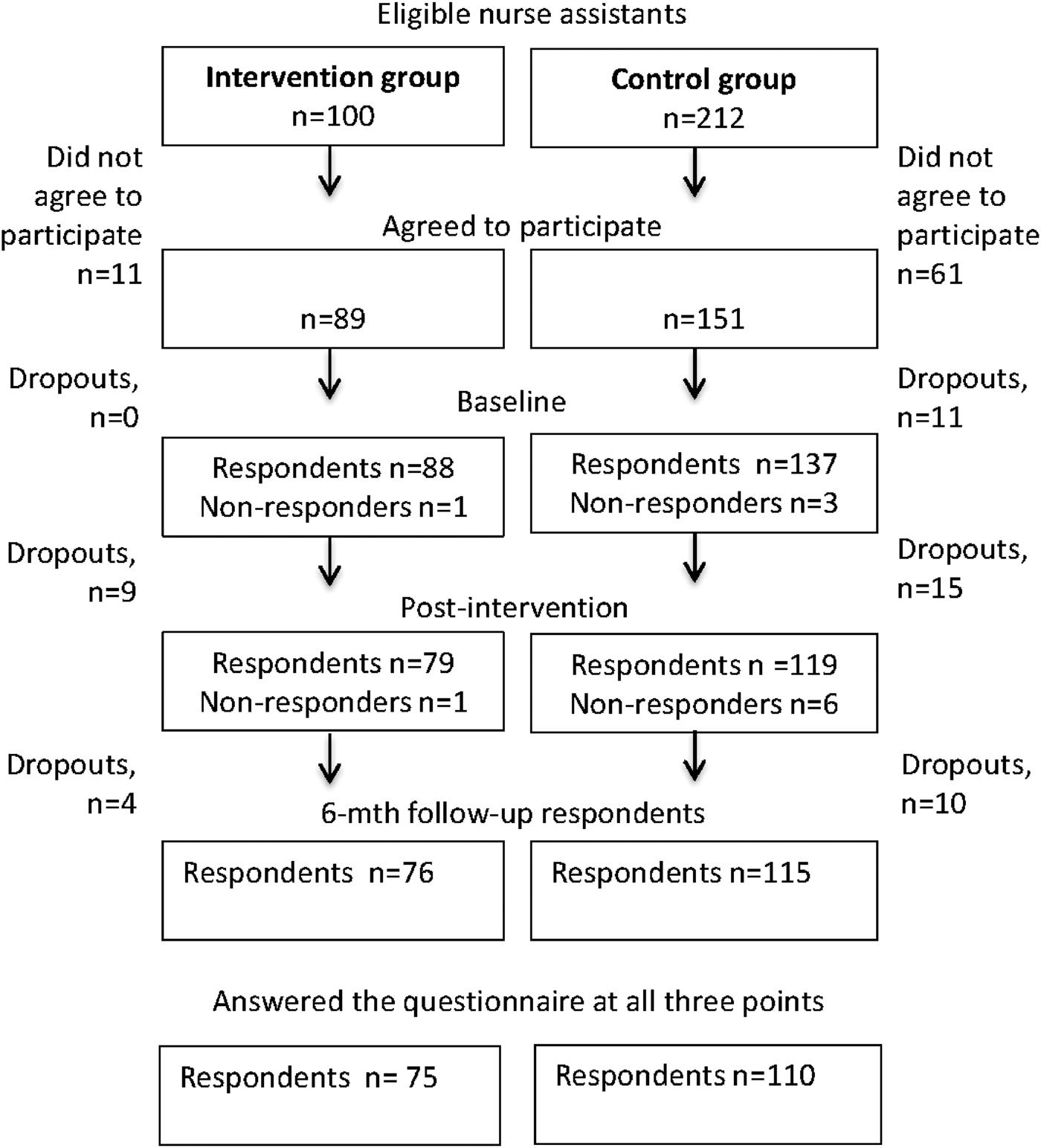
The study was performed at 9 residential care facilities in 3 out of 10 districts of a city in southern Sweden (~300 000 inhabitants). These districts were chosen as they had previously provided staff training concerning end-of-life care with an emphasis on physical symptoms. A power analysis for the main study was performed based on the Creative Climate Questionnaire (Ekvall et al., Reference Ekvall, Waldenström-Lindblad and Arvonen1983), which showed that at least 63 participants were required in each group. As we anticipated a higher dropout rate in the control group, twice as many participants were selected as controls. The facilities included were required to be stable and provide long-term care for not just people with dementia. The care manager in each respective district was involved in selection of suitable facilities in relation to the inclusion criteria. The care manager was also involved in decisions about eligible intervention and control units, which were then invited to participate. One coordinator in each district administered information and asked the NAs to participate in the study. All regularly employed NAs were asked to participate (n = 312) (see Fig. 1). The participation at baseline was 88% (n = 88) in the intervention group and 64.6% (n = 137) in the control group.
Flowchart of the participants and dropouts in the intervention and in control groups.

Intervention
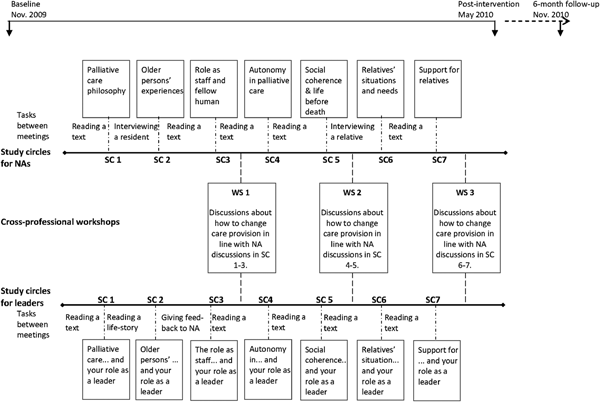
The intervention was carried out at the NAs' workplace and consisted of seven two-hour study circle sessions with three six-hour workshops in between. One study circle leader facilitated the study circle sessions and the workshops for the respective district. They previously participated in a study circle leader course, a three-day workshop with two follow-up days, focusing on planning and performing a study circle. The role of leaders was to facilitate the ability of participants to take an active part, rather than to perform as an expert. All study circle leaders were employed in the respective district, two as registered nurses and one as a specialized, licensed practical nurse (LPN), but none were working as nurses at the facilities included in the study. Each study circle meeting involved discussions and reflections based on texts or practical tasks carried out prior to the meeting, such as reading about the topic or interviewing a resident (Fig. 2). Each study circle group consisted of four to eight NAs, and the intention was to keep the work group together. Thirteen study circle groups were carried out, and a total of 82 NAs participated in the intervention, 61 of whom participated in at least 6 study circle sessions. The intervention is described in detail elsewhere (Beck et al., Reference Beck, Törnquist and Edberg2012b ).
Overview of the intervention showing timing and content. Seven study circles sessions were held for nurse assistants (NAs) and seven for their leaders. Three cross-professional workshops were held involving leaders and representatives of the NAs.

To help leaders to support the NAs, a similar study circle group was formed consisting of all the mangers and registered nurses working at the three intervention facilities. The content followed that of the NAs but was focused on how to support and guide the NAs (Fig. 2). In total, five registered nurses and four managers participated in the study circle group, three of whom participated in at least six study circle sessions.
One or two NAs from each study circle group and the manager and/or registered nurse at that facility took part in workshop sessions. Workshops were based on NAs' discussions during previous study circle sessions and focused on how practices could be changed in line with the discussions.
Data Collection
Data were collected when the NAs were on duty using a questionnaire, before the intervention started, directly after completion of the intervention, and after an additional six months (Fig. 2). Of the participants who answered the questionnaire at baseline, 13 in the intervention group (14.8%) and 27 in the control group (19.7%) did not participate at all three data collection timepoints. The most frequently stated reason was that they had left their place of employment or were on leave. An attrition analysis in the groups showed that the dropouts in the control group were more likely to be LPNs and part-time workers than those that who remained in the study.
Each coordinator administered and organized the data collection and was available for clarification of questions. Participants answered questionnaires during working hours. Completed questionnaires were returned to the coordinator in a sealed envelope to ensure confidentially.
For this study, data concerning demographics, instruments, and single items for measuring job satisfaction (general job satisfaction and satisfaction in nursing-care provision), strain (strain in nursing care and stress of conscience), and view of leadership were employed.
Demographics
The demographic data collected were age, gender, education, position at workplace, working hours, working experience in aged care, and years at the facility.
Job Satisfaction
General job satisfaction was measured using the Job Satisfaction Questionnaire (Ekvall, Reference Ekvall2001), consisting of 20 items measuring five factors. The response alternatives range from overall negative (0) to overall positive (3), high scores indicating high satisfaction. Mean scores are calculated for each factor and for the whole instrument, with a possible range from 0–3. Previous studies in a Swedish nursing-care context have shown values of Cronbach's alpha between 0.74 and 0.88 for the factors and 0.91 for the total score (Arnö & Tuvning, Reference Arnö and Tuvning2002; Sellgren et al., Reference Sellgren, Ekvall and Tomson2007). The corresponding values for our study were 0.72–0.86 and 0.94.
Nurse assistants' satisfaction with nursing-care provision was measured using the Psychosocial Aspects of Job Satisfaction scale (Engström et al., Reference Engström, Ljunggren, Lindqvist and Carlsson2006), consisting of 49 items measuring eight factors. The response alternatives range from never (0) to very often (4), a high score indicating a high degree of satisfaction. Since the factor criticism consists of several different aspects, the items in this factor were also analyzed separately. Factor scores were transformed into values that can vary between 0 and 100. A previous study in a similar context reported values of Cronbach's alpha between 0.52 and 0.86 for the factors, and 0.92 for total score (Engström et al., Reference Engström, Ljunggren and Lindqvist2005). The corresponding values in our study were 0.51–0.83 and 0.92.
Strain
Strain in nursing care was measured with the Strain in Dementia Care Scale (Edberg et al., Reference Edberg, Anderson and Orrung Wallin2013). For the present study, the instructions in the questionnaire were rephrased to address residential care in general, rather than dementia care only. The scale consists of 27 items, concerning potentially strenuous everyday situations. Each item consists of two questions: how often (1 = never/seldom to 4 = very often), and amount of stress caused (1 = none/nearly none to 4 = high). The scale consists of five factors: frustrated empathy, difficulty understanding and interpreting, balancing competing needs, balancing emotional involvements, and lack of recognition. The scores for the two questions in each item were multiplied together, and a mean score was calculated for each factor, and for the whole instrument, with a possible range from 1 to 16. A previous study in a similar context reported values of Cronbach's alpha between 0.75 and 0.89 for the factors, and 0.94 for total score (Edberg et al., Reference Edberg, Anderson and Orrung Wallin2013). The corresponding values for our study were 0.77–0.88 and 0.93.
Stress of conscience was measured using the Stress of Conscience Questionnaire (Glasberg et al., Reference Glasberg, Eriksson and Dahlqvist2006). This consists of nine items measuring two factors: internal motivation and external motivation. Each of the items consists of a question concerning how often a stressful situation occurs (0 = never to 5 = daily) and another on the amount of stress of conscience the situation causes (rated on a 10-cm visual analog scale converted to a 6-point scale ranging from 0 = not at all to 5 = yes it gives me a very troubled conscience). The scores from each question for each item are multiplied together, and the item scores for each factor are added, yielding a score with a possible range from 0 to 125. The total score ranges from 0 to 225. A previous study in a Swedish nursing-care context has shown values of Cronbach's alpha between 0.74 and 0.78 for the factors and 0.83 for total score (Glasberg et al., Reference Glasberg, Eriksson and Norberg2008). The corresponding values for our study were 0.70–0.74 and 0.83.
Leadership
To measure how NAs perceive the leadership of managers, we utilized the Leadership Behaviour Questionnaire (© Farax Group AB) (Ekvall & Arvonen, Reference Ekvall and Arvonen1994). This instrument consists of two subscales. We used only the “Leaders' perceived behavior” subscale, consisting of 24 items rated on a 6-point scale (1 = completely disagree to 6 = completely agree). This scale consists of three dimensions concerning the behavior of managers. Mean scores were calculated for each factor and for the whole instrument, ranging from 1 to 6. A previous study in a Swedish nursing-care context reported values of Cronbach's alpha between 0.93 and 0.95 for the factors (Sellgren et al., Reference Sellgren, Ekvall and Tomson2007). The corresponding values in our investigation were 0.90–0.92, and 0.96 for the whole score.
Additionally, three single items concerning support from the manager and the registered nurse were also used.
Ethical Considerations
The study design was reviewed by the Swedish regional Ethics Review Board and was judged to not require ethical approval based on Swedish legislation concerning research involving humans (reference no. 2009/527). Participants were informed in accordance with ethical guidelines (WMA, 2008), and they provided written informed consent to participate.
Data Analysis
Student's t test, a chi-square test, and the Mann–Whitney U test were employed for comparisons of the two groups. Friedman's test was used for comparisons between dependent variables over time, and a Wilcoxon signed rank test was used as a post hoc test for Friedman's test. The level of statistical significance was set at p < 0.05. In the post hoc tests the Bonferroni-adjusted alpha value (<0.017) was used to avoid mass significance. Effect size was calculated using Cohen's criteria for effect size: 0.1 = small, 0.3 = medium, and 0.5 = large (Reference Cohen1988). In cases of missing data, imputation was employed based on the mean value for the item in cases where 10% or less of the data was missing. In the analysis over time, data were only included from participants who had answered the questionnaire at all three points in time. An attrition analysis was carried out based on the demographic data and the main outcomes at baseline using Student's t test, the chi-square test, and the Mann–Whitney U test due to the level of data. PASW Statistics, version 18, was employed for all statistical analyses.
RESULTS
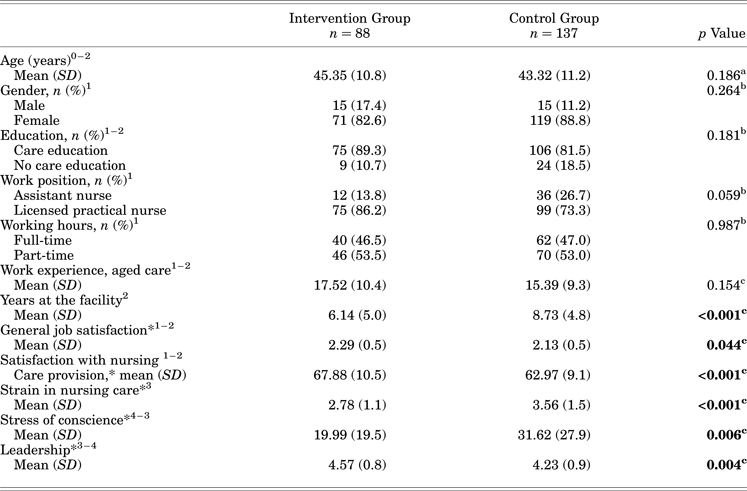
The participants in the intervention group had worked for a shorter time at the facility than those in the control group. No other significant differences concerning demographics were found. The intervention group showed significantly higher job satisfaction and satisfaction with nursing-care provision, and lower stress of conscience and strain in nursing care than the control group at baseline. They also perceived the leadership at their facility to be significantly better than the control group at baseline (Table 1). In total, 185 (82.2%) participants answered the questionnaire at all three timepoints.
Characteristics of the 225 nurse assistants in the intervention and control groups at baseline

Missing data: 10.1–4.5%; 25.1– 9.5%; 315.9–19.3%; 420.4–23.3%. *High value indicating high job satisfaction, strain, stress of conscience, and perceived leadership. aStudent's t test, bchi-square test, cMann–Whitney U test.
Job Satisfaction
In the intervention group, there was a significant difference over time for the factor competence in general job satisfaction (p = 0.034). The mean value (SD) was 2.22 (0.54) at baseline, 2.0 (0.68) at post-intervention, and 2.06 (0.63) at 6-month follow-up. The post hoc analysis showed a decrease between baseline and post-intervention. The effect size was 0.2.
Regarding changes in satisfaction with nursing-care provision, significant differences were found for the factor internal motivation (p = 0.034) and for the factor criticism (p = 0.019) in the intervention group. The mean value (SD) for internal motivation was 80.5 (13.1) at baseline, 75.5 (16.0) at post-intervention, and 76.8 (14.1) at 6-month follow-up. Post hoc analysis for internal motivation showed a decrease between baseline and both later measurements, the size of the effect ranging from 0.2 to 0.3. The mean value for criticism was 75.3 (14.9) at baseline, 75.9 (11.3) at post-intervention, and 78.8 (13.9) at 6-month follow-up (high value indicating low criticism). The post hoc analysis for criticism showed no significant changes. However, there were significant changes over time for perceived criticism from residents (p = 0.010) and superiors (p = 0.034). Post hoc analysis showed significant decreases between baseline and 6-month follow-up and additionally for perceived criticism from residents between post-intervention and 6-month follow-up. The sizes of the effects were 0.2–0.3.
In the control group, there was a significant difference over time for the factors cooperation (p = 0.011) and external motivation (p = 0.009). The mean value (SD) for cooperation was 71.0 (12.3) at baseline, 74.0 (11.3) at post-intervention, and 73.6 (12.9) at 6-month follow-up. For external motivation, the mean value was 53.5 (13.7) at baseline, 53.8 (14.6) at post-intervention, and 56.7 (13.6) at 6-month follow-up. The post hoc analysis showed an increase for cooperation between baseline and post-intervention and an increase for external motivation between post-intervention and six-month follow-up. The effect sizes were 0.2.
Strain
A significant difference was found for strain related to having difficulty balancing emotional involvement in the intervention group over time (p = 0.012). The mean value (SD) was 2.72 (1.21) at baseline, 2.89 (1.37) at post-intervention, and 2.55 (1.20) at 6-month follow-up. The post hoc analysis showed a decrease between post-intervention and 6-month follow-up, the effect size being 0.2. No significant changes were seen regarding stress of conscience, in total or factor score, between the three timepoints, in the intervention or in the control group.
Leadership
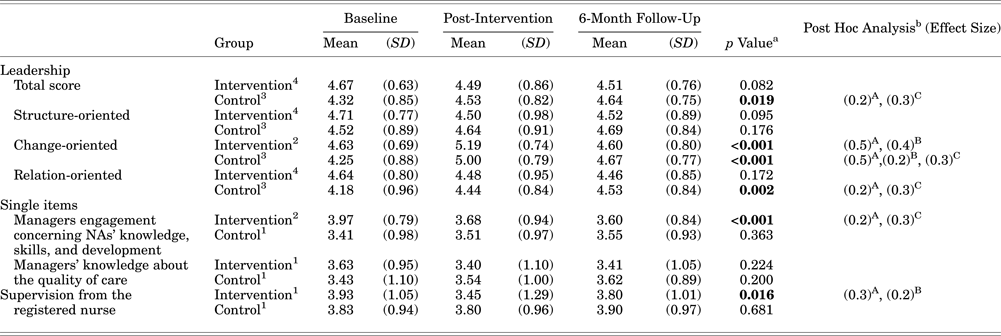
In the intervention group there was a significant difference over time in how they perceived their managers to be change-oriented, which increased between baseline and post-intervention and decreased between post-intervention and six-month follow-up. The intervention group perceived that their manager's engagement concerning NAs knowledge, skills, and development decreased between baseline and the two follow-ups. They also perceived that supervision from the registered nurse decreased between baseline and post-intervention and increased between post-intervention and six-month follow-up (Table 2).
Perception of leadership over time in the intervention group (n=75) and the control group (n = 110)

Missing data: 14.5–9.3%; 217.3%; 322.7–28.2%; 432.0–40.0%. aFriedman's test; bWilcoxon's signed rank test, with Bonferroni adjusted p value.
Comparison between: Abaseline and post-intervention, Bpost-intervention and six-month follow-up, Cbaseline and six-month follow-up.
In the control group, there was a significant difference over time in how they perceived their managers' leadership as a whole and in how they perceived it to be change- and relation-oriented, which all increased between baseline and the two follow-ups (Table 2).
DISCUSSION
Limitations
The findings of this study should be interpreted in the light of its methodological limitations. One possible threat to internal validity in a quasi-experimental study is the selection of intervention and control groups (Polit & Beck, Reference Polit and Beck2004). We did not have complete control over the choice of intervention and control facilities, which resulted in differences between the groups at baseline. We therefore decided to compare changes within groups over time, still being able to use the control group to capture “normal” variations within the organization.
In order to detect a relationship between variables, it is necessary to have a sufficient sample size (Polit & Beck, Reference Polit and Beck2004). As predicted, the dropout rate in the control group was higher than that in the intervention group, which was handled by including twice as many control facilities as intervention facilities. Although the power calculations were performed for the main study, the effect sizes of significant changes in the intervention group ranged from small (0.2) to large (0.5), indicating a sufficient sample size.
Another threat to internal validity is different attrition in the groups being compared (Polit & Beck, Reference Polit and Beck2004). Attrition in the control group was 19.7% compared to only 14.8% in the intervention group. The attrition analysis, however, showed no differences between those who dropped out and those remaining in the study in the intervention group.
There is also the risk of ceiling and floor effects in our study. The scores regarding overall job satisfaction were high, and scores for the strain in nursing care and stress of conscience were low at baseline, especially in the intervention group.
Findings
The results of our study indicated that the intervention initially had negative effects on NAs' well-being. The intervention group reported less competence and internal motivation after the intervention, while the changes in the control group were in the positive direction. These results could be understood in the context of the theory put forward by Lawton and Simon (Reference Lawton and Simon1968) about the interchange between the individual and the environment, stating that a change in competence occurs by decreasing or increasing pressure in the environment. Individuals with low competence, in this case NAs, are more vulnerable to environmental changes. Thus, most possibly the intervention increased the pressure on NAs, in that they became more aware of residents' and relatives' emotional and existential needs, while not receiving sufficient support from leaders to cope with the change in practice. The higher pressure from the environment most certainly resulted in that they experienced less competence and lower satisfaction with their work. This is in line with Stillman et al. (Reference Stillman, Strumpf and Capezuti2005), who found that, as a result of introduction of a palliative care program, staff were more able to identify the problems associated with providing palliative care. In a qualitative study involving NAs participating in the intervention (Beck et al., Reference Beck, Törnquist and Edberg2012b ), they described that, through the intervention, they had gained insight into their own importance in the quality of care, and this increased their awareness of and respect for residents and their relatives.
The strain experienced by NAs improved during the six months following the intervention. At the six-month follow-up, NA strain resulting from having difficulty in balancing their emotional involvement had decreased. One reason for this could be that it took some time for NAs to change their practices. This is supported by the decrease in criticism from residents and superiors at six-month follow-up compared to baseline. There is, however, a risk that the results also could be the effect of NAs returning to “old habits.” However, in the qualitative study involving NAs participating in the intervention (Beck et al., Reference Beck, Törnquist and Edberg2012b ), the NAs described frustration over a lack of resources and supportive leadership in implementing what they had learned during the intervention. Thus, the results most certainly arose from frustration over a lack of resources and support to offer the care they wanted to provide.
The NAs' perception of the leadership was affected by the intervention in the negative direction. Managers were perceived to be more change-oriented directly after the intervention, but at six-month follow-up they were perceived as less so. The NAs' perception of the manager's engagement concerning the NAs' knowledge, skills, and development decreased between baseline and the two follow-ups. They also perceived supervision from the registered nurse to decrease between baseline and post-intervention. These results could stem from the fact that the NAs felt they did not receive sufficient support from their leaders in implementing a palliative are approach (cf. Beck et al., Reference Beck, Törnquist and Edberg2012b ). Interviews with managers participating in the intervention (Augustsson et al., Reference Augustsson, Törnquist and Hasson2013) revealed that their intention was to support the NAs in implementing changes in line with what had been discussed at workshops. However, 14 months after the intervention was completed, they considered the intervention more as a means of individual development for the NAs, and most of the changes discussed had not been implemented. Even if we do not know how the intervention affected residents or their relatives, it is possible that the decreased strain and decrease in criticism from residents and superiors could also be an effect of changes in nursing-care provision.
One reason for the lack of supportive leadership from the registered nurses could be that they do not regard themselves as the NAs' superiors. This is in line with a study reported by Josefsson and Hansson (Reference Josefsson and Hansson2011), who found that only 59% of registered nurses (n = 213) working in residential care regarded themselves as leaders of “smaller groups,” while 28% did not consider themselves leaders at all. In addition, managers may not be used to focusing on transformation and relationship aspects in their roles as leaders. Swedish Government Official Reports (SOU, 2008, p. 51) emphasize that there is a need for more active and present leadership among managers in municipal aged care. Although our intervention focused on supporting the leaders in their role as facilitators for change, there seems to be a need to place greater emphasis on leadership responsibilities in future interventions.
CONCLUSION
The intervention, focusing on emotional and existential issues within the framework of a palliative care approach in residential care, initially seemed to influence NAs' job satisfaction in a negative way. However, six months after completion of the intervention, their strain and perceived criticism from superiors and residents decreased. This could be an effect of the fact that changes in practice take time to evolve, but there is also the risk that they returned to their “old habits.” More attention must thus be devoted to the important role of managers in implementing sustainable changes in practice.
ACKNOWLEDGMENTS
We are most grateful to the nurse assistants who participated in the study and to Helen Sheppard for revising the language. We would like to express our gratitude to the Swedish Institute for Health Sciences, the King Gustav V and Queen Victoria Foundation, Kristianstad University, and the Faculty of Medicine, Lund University, for financial support.