


Introduction
Paediatric cardiology is entering a period of profound transformation. The future of the discipline will be shaped by the convergence of three major forces: technological innovation, advances in biology, and an increasing sense of responsibility towards patients whose lives now extend far beyond childhood. Over the last three decades, the field has evolved from a primary focus on survival to an emphasis on long-term outcomes and quality of life. We have moved from isolated interventions to multidisciplinary care and from diagnostic uncertainty to increasingly precise anatomical and functional characterisation. Yet these achievements may represent only the beginning of a deeper transformation.
A useful question frames this discussion: how different will the life of a child born with CHD in 2045 be compared with that of a child born today? Equally important, how different will our role as paediatric cardiologists become?
Throughout my professional career, I have believed that paediatric cardiology is not only about treating disease but also about accompanying children and families throughout their journey. Technology, surgery, and innovation remain fundamental, but continuity, trust, and human presence are equally important. As we look towards the next two decades, the central question is not only what tools will become available but also what kind of physicians we will need to become.
From reactive to predictive cardiology
For most of its history, paediatric cardiology has been fundamentally reactive. Structural abnormalities were diagnosed, symptoms appeared, complications developed, and clinicians responded. Increasingly, however, the field is moving upstream, from reaction to anticipation.
Genomics, transcriptomics, proteomics, and other multi-omics approaches are revealing that CHD is not solely an anatomical condition but also a biological one. Distinct molecular pathways may explain why patients with apparently identical cardiac anatomy experience markedly different clinical trajectories. The integration of molecular information with advanced imaging and computational analysis is creating opportunities for more accurate risk stratification and earlier prediction of disease progression. Reference Fahed, Gelb and Seidman1–Reference Lee, Chung and Lin5
This shift from reactive to predictive medicine represents more than a technological advance. It fundamentally alters the responsibilities of clinicians. Anticipating disease progression requires decisions to be made earlier, often before clinical manifestations become evident. As our ability to foresee future outcomes improves, so too does our obligation to determine how and when intervention should occur.
Artificial intelligence and the future of clinical judgement
Artificial intelligence has rapidly become one of the most discussed developments in modern medicine. In paediatric cardiology, however, AI should not be viewed as a replacement for clinical expertise but as an extension of it.
Artificial intelligence is likely to become embedded throughout the entire continuum of care. Automated image analysis, advanced pattern recognition, and the integration of large multimodal datasets may enhance diagnostic accuracy and improve decision-making. Digital twins could enable simulation of interventions before they are performed, allowing clinicians to anticipate technical challenges and potential complications. Continuous monitoring through wearable technologies may transform follow-up, particularly among adolescents and adults with CHD, shifting care from episodic clinical encounters to continuous physiological surveillance. Reference Corral-Acero, Margara and Marciniaket6–Reference Niyogi, Nag and Swain10
Paradoxically, the expansion of available data increases rather than decreases the importance of human judgement. Data do not eliminate uncertainty; they merely change its nature. As complexity grows, the value of interpretation, communication, and ethical reasoning becomes even greater. The paediatric cardiologist of the future will require not only clinical expertise but also data literacy, technological competence, and a sophisticated understanding of the ethical implications of increasingly powerful predictive tools.
Technology will amplify our capabilities, but it will also demand greater responsibility and greater clarity about the limits of intervention. Reference Topol11,Reference Sarani Rad, Bitaraf and Jafarpour12
Beyond repair: regenerative and tissue-engineered solutions
While technological advances continue to improve diagnosis and intervention, some of the most important challenges in CHD remain biological.
For decades, paediatric cardiologists and surgeons have relied on prosthetic materials and devices originally designed for adults and subsequently adapted for children. Yet children are not simply smaller adults. Growth, remodelling, and changing physiological demands make CHD a dynamic condition, whereas most implanted materials remain inherently static.
This mismatch has driven increasing interest in regenerative medicine and tissue-engineered vascular grafts. Unlike conventional prostheses, tissue-engineered constructs have the potential to integrate with the host, remodel over time, and ultimately grow with the patient. Clinical studies have already demonstrated the feasibility of implanting tissue-engineered vascular grafts in children, providing proof of concept that regeneration rather than replacement may become a realistic therapeutic objective. Reference Shin’oka, Matsumura and Hibino13–Reference Best, Strouse and Hor16
From tissue engineering to patient-specific regeneration: the experience of the Institute of Pediatric Research of Padua
An example of this translational approach is provided by the ongoing research programme at the Institute of Pediatric Research (IRP) in Padua. The objective is to develop next-generation cardiovascular substitutes through the integration of tissue engineering, biomaterials science, stem cell biology, and regenerative medicine.
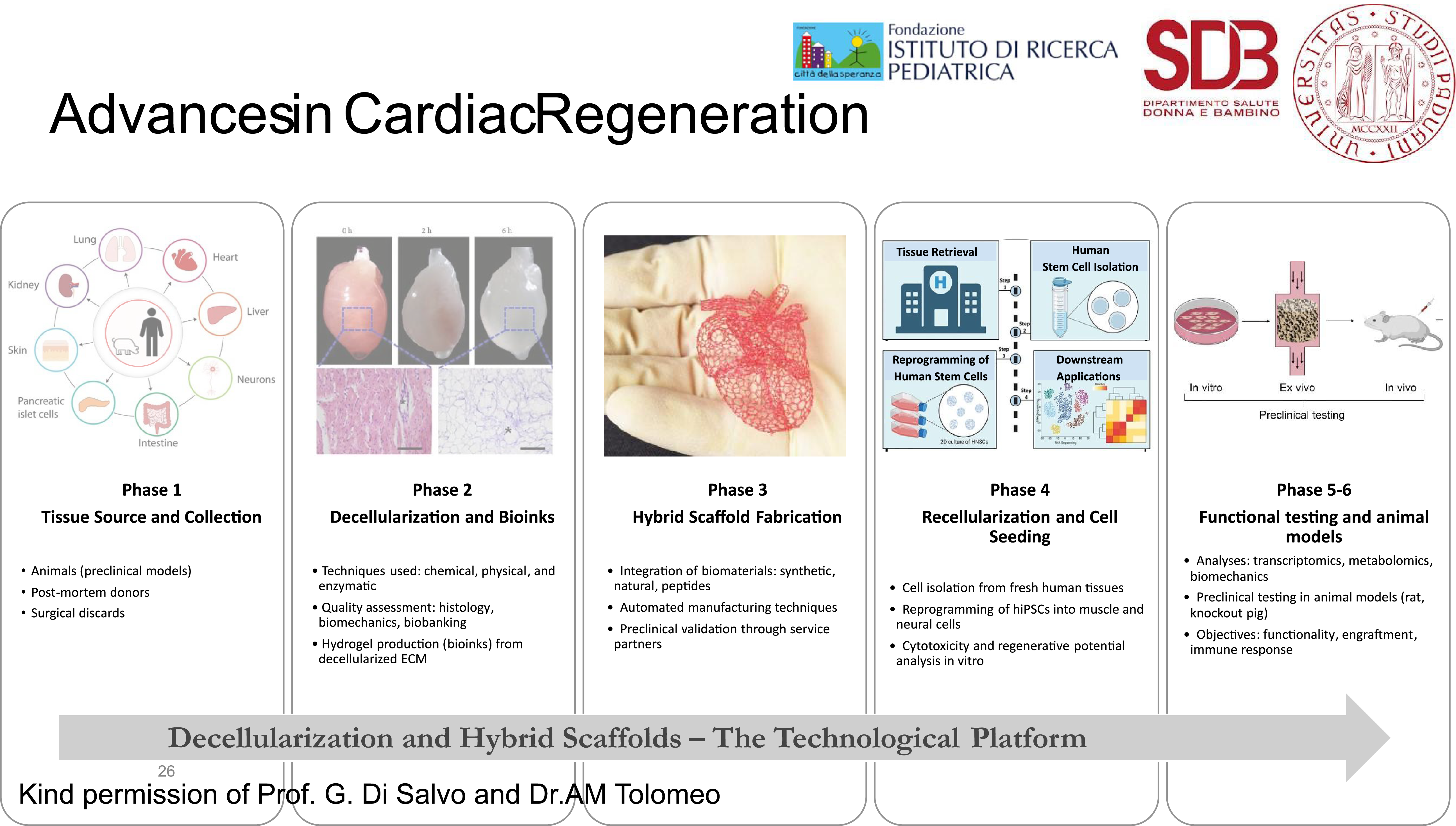
As summarised in Figure 1, the process begins with the collection of biological tissues from preclinical models, donor sources, or surgical specimens. These tissues undergo decellularisation to preserve the extracellular matrix architecture while removing immunogenic cellular components. The resulting matrix can be processed into hydrogels and bioinks suitable for advanced biofabrication techniques. Hybrid scaffolds are then generated through the combination of natural and synthetic biomaterials and subsequently recellularised using patient-derived cells, including induced pluripotent stem cell-derived cardiovascular lineages. Functional assessment is finally performed through in vitro characterisation and preclinical testing in relevant animal models.
Translational pipeline for regenerative cardiovascular engineering at the Institute of Pediatric Research (IRP), Padua. Biological tissues obtained from donor sources, surgical specimens, or preclinical models undergo decellularisation to preserve extracellular matrix composition and architecture. Decellularised matrices are processed into hydrogels and bioinks for the fabrication of hybrid scaffolds integrating natural and synthetic biomaterials. These constructs are subsequently recellularised using patient-derived cells, including induced pluripotent stem cell-derived cardiovascular lineages, and evaluated through in vitro characterisation and preclinical animal studies. This workflow illustrates the progressive transition from conventional prosthetic replacement towards personalised regenerative cardiovascular therapies.

Figure 1. Long description
A diagram of the process of cardiac regeneration. The diagram is divided into six phases, each representing a step in the regenerative process. Panel 1: Tissue Source and Collection. This phase involves obtaining biological tissues from animals (preclinical models), post-mortem donors, and surgical discards. Panel 2: Decellularization and Bioinks. This phase includes techniques such as chemical, physical, and enzymatic methods for decellularization. Quality assessment involves histology, biomechanics, and biobanking. Hydrogel production (bioinks) is derived from decellularized ECM. Panel 3: Hybrid Scaffold Fabrication. This phase integrates biomaterials, both synthetic and natural, using automated manufacturing techniques. Preclinical validation is conducted through service partners. Panel 4: Recellularization and Cell Seeding. This phase involves cell isolation from fresh human tissues, reprogramming of hiPSCs into muscle and neural cells, and cytotoxicity and regenerative potential analysis in vitro. Panel 5-6: Functional testing and animal models. This phase includes analyses such as transcriptomics, metabolomics, biomechanics, and preclinical testing in animal models (rat, knockout pig). Objectives include functionality, engraftment, and immune response.
Although many of these approaches remain at the preclinical stage, they exemplify the direction in which cardiovascular reconstruction is evolving: from static prosthetic replacement towards biologically active and potentially regenerative solutions. The ultimate goal is not simply to replace damaged cardiovascular structures but also to create living constructs capable of integration, adaptation, and long-term remodelling within the growing patient. Reference Muraca, Piccoli and Franzin17–Reference Tomas, Fabozzo and Ventrella21
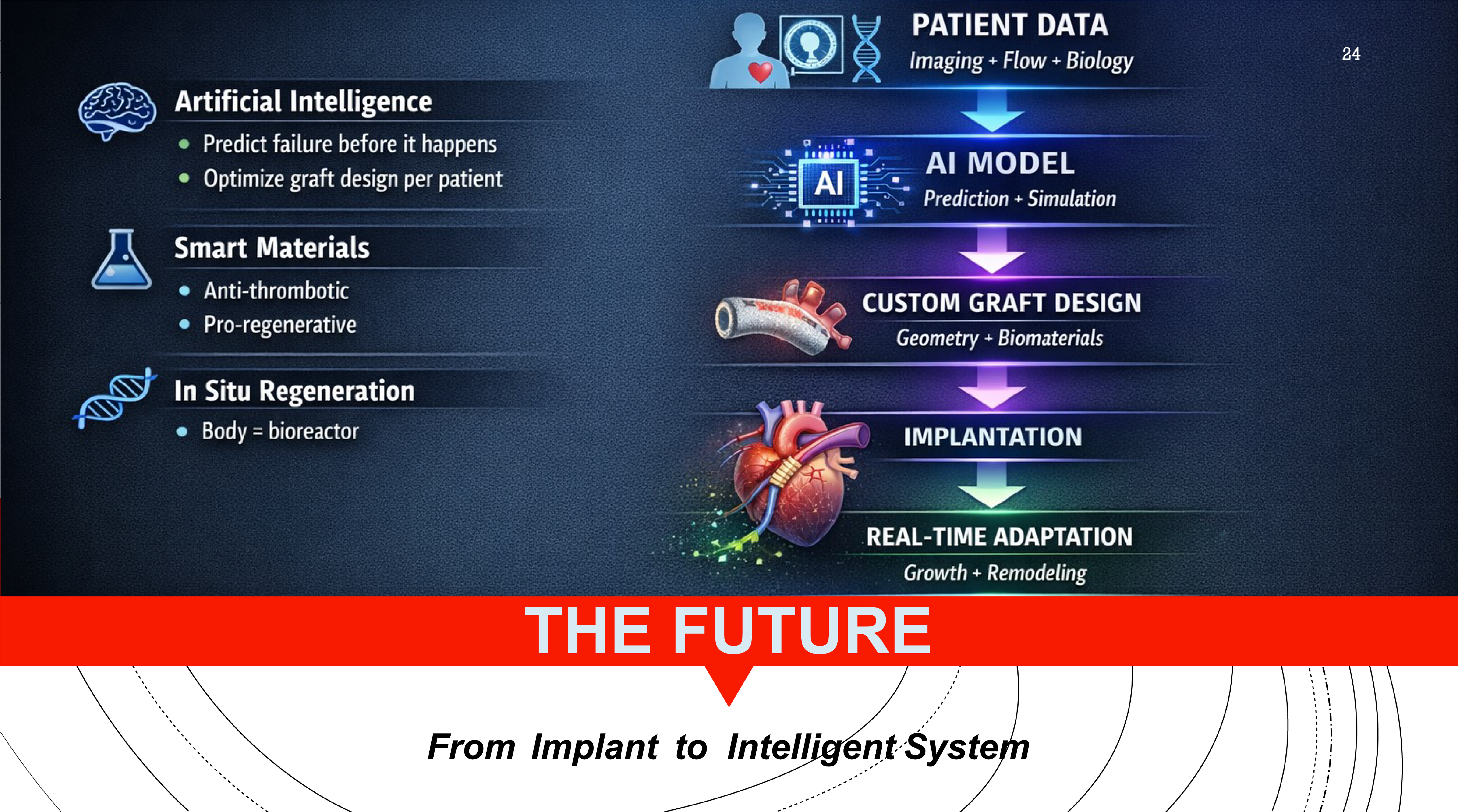
In conclusion, the future likely lies in the integration of biology, engineering, advanced imaging, computational modelling, and artificial intelligence (Figure 2). Patient-specific grafts could be designed using individualised anatomical and haemodynamic data, while predictive modelling could anticipate long-term performance before implantation. Such constructs would no longer function as passive implants but as living biological systems capable of adaptation.
Future grafts will not just replace heart structure—they will evolve with the child and his heart. This is how we should start thinking about the future. Not as a device but as a system. We start from the patient from imaging, flow, and biology. We use artificial intelligence to predict what will happen. We design a graft, not as a standard solution, but tailored to that specific patient. And then we implant it. But the real change happens here because the graft does not remain what we implant; it evolves, it remodels, and it grows with the child.

Although significant challenges remain—including thrombosis, small-calibre graft performance, long-term patency, and control of biological responses—the conceptual shift is already underway. The objective is no longer simply to replace damaged structures but to restore biological function through regeneration.
Genetics as a therapeutic platform
Even regenerative medicine may not represent the deepest transformation on the horizon. Most current approaches still attempt to address the consequences of disease rather than its origins.
CHD is increasingly understood as the phenotypic expression of altered molecular and genetic pathways. Historically, genetics served primarily as a diagnostic tool, helping clinicians establish aetiologies, estimate recurrence risk, and counsel families. Today, however, genetics is becoming a therapeutic platform.
Advances in gene-based therapies and targeted molecular interventions raise the possibility of modifying disease trajectories before irreversible structural damage occurs. The experience of other specialties illustrates the transformative potential of this approach. In spinal muscular atrophy type 1, a condition once associated with early mortality, gene-directed therapies have fundamentally altered outcomes when administered before significant disease progression. Reference Mendell, Al-Zaidy and Shell22,Reference Day, Finkel and Chiriboga23
Although CHD presents unique challenges, the principle remains highly relevant. If molecular pathways responsible for abnormal cardiac development or progressive myocardial dysfunction can be identified and modulated, intervention may eventually occur at a stage where disease can be prevented rather than merely treated. Reference McNally, Puckelwartz and Nóbrega24–Reference Farr III, Reid and Hasegawa26
Such possibilities fundamentally alter the relationship between timing and responsibility. Earlier intervention expands not only therapeutic opportunities but also the duration and scope of clinical responsibility, influencing developmental trajectories that extend across an entire lifetime.
Lifelong care and the challenge of transition
As survival improves, CHD increasingly becomes a lifelong condition. Consequently, the transition from paediatric to adult care has emerged as one of the most important challenges facing the field.
Transition is often described as a transfer of medical responsibility between healthcare providers. In reality, it represents a far more complex process. It is a period during which parental protection diminishes, autonomy increases, adherence becomes more fragile, and patients must learn to integrate their condition into their adult identity.
Many adverse outcomes during transition arise not from sudden physiological deterioration but from fragmentation of care, loss of trust, inadequate communication, or failures of continuity. As a result, success in paediatric cardiology can no longer be measured solely by survival or procedural outcomes. It must also be measured by the ability of patients to achieve fulfilling, productive, and meaningful lives.
If paediatric cardiology increasingly embraces earlier intervention and predictive medicine, it must also embrace longer-term responsibility. Care can no longer be episodic. It must become continuous, extending across the entire lifespan of individuals living with CHD. Reference McNally, Puckelwartz and Nóbrega24–Reference Sable, Foster and Uzark27
The future paediatric cardiologist
The future paediatric cardiologist will remain a clinician, but clinical expertise alone will no longer be sufficient.
Future practice will require the integration of biological knowledge, technological competence, data science, ethical reasoning, and communication skills. Clinicians will need to navigate increasingly complex information while maintaining a patient-centred perspective. They will be called upon not only to interpret data but also to guide patients and families through uncertainty, helping them make decisions in a landscape where possibilities continue to expand.
Importantly, this future cannot be built by individual physicians working in isolation. Paediatric cardiology will become increasingly interdisciplinary, requiring close collaboration among clinicians, surgeons, geneticists, developmental biologists, bioengineers, data scientists, and experts in artificial intelligence. Only through such integration will it be possible to translate scientific advances into meaningful improvements in patient outcomes. Reference Wartman and Combs28,Reference Ning, Teixayavong and Shang29
The future of paediatric cardiology is therefore not defined solely by innovation. It is defined by the capacity to integrate innovation with responsibility. Reference Baumgartner, De Backer and Babu-Narayan30–Reference Fuster33
Conclusion
The future of paediatric cardiology will be shaped by a transition from reaction to prediction, from replacement to regeneration, from diagnosis to biological intervention, and from episodic treatment to lifelong care. Technological innovation and biological discovery will undoubtedly transform what we can do for our patients. Yet the most important transformation may concern how we understand our role.
The paediatric cardiologist of the future will not simply diagnose defects, perform interventions, or interpret data. Rather, he or she will accompany patients throughout an increasingly long and complex life journey, integrating science, technology, and human judgement in service of a single goal: enabling children born with CHD not only to survive but also to thrive.
Ultimately, the most significant innovation may not be a device, an algorithm, or a genetic therapy. It may be our ability to preserve the human dimension of care while embracing the extraordinary possibilities of modern medicine. In paediatric cardiology, we do not simply repair hearts; we accompany lives.
Acknowledgements
None.
Financial support
This research received no specific grant from any funding agency in the public, commercial, or not-for-profit sectors.
Competing interests
All authors stated that there are no conflicts of interest regarding the publication of this article.
Ethical standard
The authors assert that all procedures contributing to this work comply with the ethical standards of the relevant national guidelines on human experimentation and with the Helsinki Declaration of 1975, as revised in 2008. All procedures contributing to this work have been approved by the appropriate committees at our institution.

 Open access

