The description of vocalic variation in Scotland is often presented as a bipolar phonological system ranging from “Scots” to “Scottish Standard English” (SSE) (Stuart-Smith, Reference Stuart-Smith, Corbett, McClure and Stuart-Smith2003). It has been claimed that within this system, there are two main kinds of vowels: those that are invariant across the Scots-SSE continuum, such as the vowel in the BET lexical set (Aitken, Reference Aitken and Trudgill1984), and those that have alternating variants such as the OUT vowel, where speakers can select either the Scots variant [ʉ] or the SSE variant [ʌʉ] (Stuart-Smith, Reference Stuart-Smith, Corbett, McClure and Stuart-Smith2003:117). Aitken notes that alongside those speakers who consistently select variants from the Scots end of the continuum, “there exists also a very large body of Scottish speakers who variously compromise … between the fully vernacular variety of Scots … and SSE” (1984:94).
The majority of studies that have discussed this “compromise” (see, for instance, Eremeeva & Stuart-Smith, Reference Eremeeva and Stuart-Smith2003; Macafee, Reference Macafee1994; Macaulay, Reference Macaulay1991; Macaulay & Trevelyn, Reference Macaulay and Trevelyan1973) have tended to describe the variation primarily in terms of the age, sex, and social class of the speaker. Eckert (Reference Eckert2002) describes these methods as “first wave” approaches. Studies that employ them tend to view variation as a reflection of membership in broad, predetermined demographic categories. The results of such studies have continued to develop our understanding of the “big picture” of linguistic variation. In Scotland, these results have shown that typically older working-class males are the heaviest users of variants from the Scots end of the continuum, but younger middle-class females tend to select variants from the SSE end of the continuum.
However, although first wave approaches can often reveal general patterns in a large data set, they are limited in their ability to explain these patterns of variation. This article argues that to reach a more comprehensive understanding of linguistic variation in a community, it is necessary to consider both social and cognitive factors influencing variation. By combining sociolinguistic methods of data collection and Cognitive Linguistic theory, this article attempts to expand the analysis of vocalic variation in Scottish English beyond that provided by other research.
The article begins with an overview of the data to be examined, including the methods used in collecting the corpus and some discussion of previous treatment of the variables in question. I then present an alternative approach (exemplified with the [au] variable), explaining how variation can be modeled in a Cognitive Grammar framework. This section also considers how research on frequency effects can facilitate a clearer understanding of the patterning of these two variables. Finally, I introduce evidence for the social meaning of these variants and propose that this too can be incorporated into the cognitive network.
THE DATA
The data presented here were collected from a group of 16 adolescents who form a community of practice (Lave and Wenger, Reference Lave and Wenger1991; Wenger, Reference Wenger2000) in west Fife, Scotland—they play together in a juvenile pipe band.Footnote 1 The speakers are between 12 and 18 years old and there are 12 males and 4 females in the group. With the exception of one informant, Kath (who I have categorized as middle class), the socioeconomic backgrounds of the speakers are fairly homogeneous and are all roughly upper working class. This assumption is based entirely on qualitative observations and no attempt was made to assign these speakers to a social class index.Footnote 2
Using the ethnographic technique of long-term participant observation (Eckert, Reference Eckert2000), I entered the community in June 2004 by attending pipe band practices, competitions, and fund-raising events while attempting to integrate with the group. These data represent two stages of collection and comprise a corpus of 11.5 hr of speech. The data on phonological variation are from recordings made with the group in January 2005. Evidence of attitudes and the social meaning of the variants were collected in a second batch of recordings in May/June 2005 that were partially transcribed but not analyzed for linguistic variation.
I did not question the informants by using a structured “sociolinguistic interview” because, following Moore (Reference Moore2003:43), I was aware that by assuming the role of an adult questioner, I could damage my relationship with the adolescents; instead, the informants were recorded chatting with me in small groups of friends.
The phonological variables selected for analysis in this article are (au) and (o). The variants for both of these variables show phonological distinctions between two main variants, one of which represents a local/Scots form and the other a supralocal/standard form.Footnote 3 However, despite sharing certain features, these variables appear to pattern quite differently in this community. The analysis of these variables is based on auditory transcriptions of the January sample, which amounts to 6 hr of recorded speech, roughly 80,000 words.Footnote 4
The (au) variable
The [ʉ ~ ʌʉ] variation in the OUT lexical set (Aitken, Reference Aitken and Trudgill1984) arose historically as a result of dialect contact between varieties in which the Middle English /u:/ vowel diphthongized in the Great Vowel Shift (such as Received Pronunciation) and those in which it did not (such as Scots) (Stuart-Smith, Reference Stuart-Smith, Corbett, McClure and Stuart-Smith2003:117). Modern reflexes of the OUT lexical set are often retained as high monophthongs in Scotland. The quality of the vowel in most present-day Scottish varieties is [ʉ], having fronted in a process Johnston terms “OUT-fronting” (1997:474).
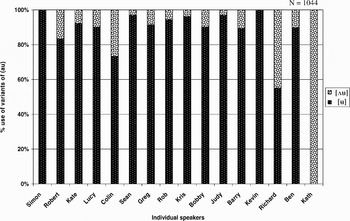
In recent years, the (au) variable has been widely investigated in sociolinguistics (particularly in Glasgow) to the extent that Jones (Reference Jones and Jones1997) claims it is “probably one of the most widely commented-upon characteristics of British English phonological phenomena” (1997:309). Figure 1 is a summary of each informant's percentage of use of the variants of (au). The phonetic variants of (au) represented in the graph are a high rounded monophthong [ʉ] (the Scots variant) and a diphthong [ʌʉ] (the standard variant). A third vowel [ʌ] also exists for these speakers but, based on the evidence from the corpus I collected, it was apparently restricted to variants of the lexeme GROUND when used as a noun (e.g., ground and playground); when used as a verb (e.g., grounded), either the [ʉ] or [ʌʉ] variants were selected.Footnote 5 As this form is lexically conditioned, it is not a true variant of the (au) variable and so has been excluded from the analysis. All other lexical items that display variation between [ʉ] and [ʌʉ] have been included in the analysis.
Percentage of use of variants of (au) in the community of practice.

The (o) variable
Though several studies have investigated the sociolinguistic patterning of (au), Jones (Reference Jones and Jones1997:304) notes that we still lack a quantitative analysis of the (o) variable in Modern Scots,Footnote 6 despite the fact that in the grammar guides and pronounciation dictionaries of the 18th and 19th centuries, this was “perhaps the most frequently commented-upon feature of pronunciation considered to be overtly Scottish” (1997:302).
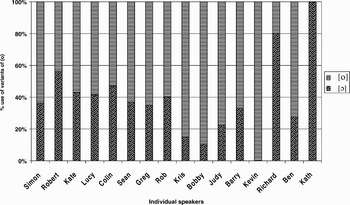
The vowel in, for example, cot is, in most Scottish dialects, a high mid [ο(:)] (Johnston, Reference Johnston and Jones1997:481). This [ο(:)] vowel is historically the result of a merger between the COT and COAT lexical sets. Johnston (Reference Johnston2000:62–63) claims that this merger began in Glasgow, perhaps during the Older Scots period. It then spread to the east of Scotland and diffused throughout the lexicon. Johnston (Reference Johnston2000:58–64) argues that the existing variation between [ɔ ~ ο] is the result of a near merger. However, this explanation does not recognize the sociolinguistic status of the variants. Macafee (Reference Macafee1994:229) explains the [ɔ ~ ο] variation in modern Scots as the result of dialect contact with SSE. Figure 2 displays the variation found in this group.Footnote 7 This graph charts the variation between the typically Scots variant [ο] and the standard variant [ɔ]. Even though other variants such as [ʌ] in dog and [a] in want also exist, these again are lexically specific and so are not true variants of the (o) variable.
Percentage of use of variants of (o) in the community of practice.

The first wave approach
As noted in the previous discussion, sociolinguistic studies of variation in Scotland have tended to employ first wave methods, describing the variation primarily in terms of the age, sex, and social class of speakers. Though it may be possible to explain Kath's consistent use of the standard variant in both variables as a consequence of her social class,Footnote 8 this cannot explain the variation in the speech patterns of the other members of the group. Similarly, age does not appear to be a motivating factor—Richard and Bobby are the same age, as are Colin and Simon. There is only a 6-yr gap between the youngest and oldest members of the group, and so it is impossible to draw any firm conclusions based on the age of the speaker; similarly, with only four females in the group, basing any assumptions on gender differences is problematic. It is, therefore, necessary to expand the analysis beyond that provided by other accounts.
A COGNITIVE GRAMMAR APPROACH
The schematic network
The discussion that follows attempts to provide an innovative account of this variation by interpreting these data in a Cognitive Grammar framework (hereafter CG; Langacker, Reference Langacker1987, Reference Langacker1991). The CG framework shares with other Cognitive Linguistic theories the basic assumption that linguistic structures and processes do not emerge from any specific language module of the mind. Consequently, “linguistic” knowledge is not considered to be an autonomous cognitive faculty; it is, instead, regarded as part of a larger system of interlocking networks of knowledge, including social and pragmatic knowledge (Hudson, Reference Hudson2007).
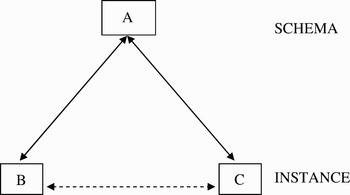
The variation in these variables can be represented in CG as an example of a categorization network. The role of categorization is especially important in CG because categorization is regarded as one of the most fundamental cognitive abilities of the human mind. As Lakoff explains, “there is nothing more basic than categorization to our thought, perception, action, and speech … without the ability to categorize, we could not function at all” (Reference Lakoff, Aarts, Denison, Keizer and Popova2004 [Reference Lakoff1987]:139–140). In CG, categorization is discussed in terms of the network relationships that exist between schemas and instances. Langacker represents this phenomenon graphically as a “categorisation triangle” (1987:373), as in Figure 3.
The categorization triangle.

Schema, in CG, is the term given to the more abstract category representation, which is specified in greater detail by an “instance” (Langacker, Reference Langacker1987:68). Schemas emerge in cognition through abstractions over instances. Speakers abstract over expressions and recognize commonality between different instances. The schema abstracts what is common to the instances and different instances instantiate the schema in different ways. The solid lines in Figure 3 indicate relationships of instantiation (i.e., more precise specification or elaboration) and the broken lines illustrate relationships of perceived similarity. These relationships form a schematic network of associations in cognition.
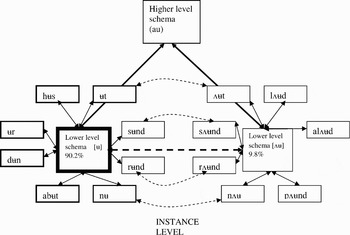
The variation in (au) can be represented in CG as an example of the network relationships that exist in cognition between a schema and its instances. This is diagrammed in Figure 4, where the nature of this relationship is based on the variation apparent in Lucy's data (see Fig. 1).
Lucy's (partial) schematic network for (au).

In Figure 4, there are two levels of abstraction in the network. The lower schema corresponds to the level of the allophone, the lowest level of abstraction over actual realizations in speech. Although the instances in Figure 4 share some common phonetic quality (the diphthong contains the same vowel quality as the monophthong), it is important to recognize that speakers who have abstracted this schema are also aware that these instances form a collection of variants that pattern according to various social factors. In other words, the commonality that is contained by the schema is not necessarily simply phonetic; the schema may also contain social information. Social knowledge can therefore be incorporated into the framework, a point to which I will return in greater detail.Footnote 9
The higher schema corresponds to the sociolinguistic variable that is the result of further abstraction over allophonic variation. I, therefore, equate the sociolinguistic variable with the concept of a schema in CG. However, it is important to note that although all sociolinguistic variables can accurately be characterized as schemas (because their existence necessarily implies some recognition of commonality and abstraction between variants on the part of the speaker), it does not necessarily follow that all schemas are analogous to sociolinguistic variables. The schema-instance relationship is much more widely applicable; it is a product of categorization that is apparent in all areas of the grammar (at both the phonological and semantic poles) and in cognition more generally.
It is also important to highlight the dynamic nature of this network model. The network metaphor implies a static structure, but Langacker is aware that thought is a complex neurological event and so explains the network as a dynamic construct that is constantly changing and adapting to the pressures of the usage event: “it is not something a speaker has, but rather what he does” (1987:382). Each relationship in the network is a cognitive routine, a comparison event assessing one node in relation to another, and the nodes and links of a network are described as having various degrees of entrenchment (Langacker, Reference Langacker1987:59). Entrenchment is the result of frequency of use. The occurrence of any cognitive activity leaves behind a neurological trace and the more this type of activity recurs, the more entrenched the trace will become in cognition. Entrenchment can be employed in CG as a probability measurement (Israel & Kemmer, Reference Israel and Kemmer1994:170). The more a particular instance or node is successfully activated, the more entrenched the node will become, which leads to a greater probability that it will be selected in another usage event. Figure 1 shows that Lucy displays a frequency of 90.2% usage of the monophthong variant. If entrenchment is the cognitive result of frequency of use, the monophthong variant is likely to be more entrenched in cognition than the diphthong variant for Lucy. Entrenchment is represented in the schematic network in Figure 4 as a heavy line around the node.Footnote 10
The account presented in Figure 4 is a description of the likely organization of these variants in only a fragment of Lucy's cognitive network and does not include social knowledge in the diagram. An exact description of the network is an impossible task. This limitation is less problematic than it seems, however: “in the present framework, much less hinges on the specific details of a network than one might think” (Langacker, Reference Langacker1987:377). This is because our inability to determine the exact nature of the network (for instance, whether the word forms presented in this schema are analyzed by the speaker as related lexical items or as variants of the same lexical item) is less important than the recognition that, at some level, speakers perceive similarity between these forms and, hence, abstract commonality to form a schematic network.
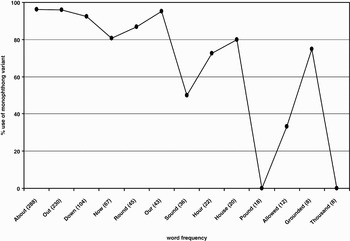
The ultimate aim is to also explain the existence of such variation. It seems from the patterns in Figure 4 that some words tend to occur more often with the monophthong variant than others, particularly that the monophthong variant is used more often in words that occur more frequently. Examining the patterning of this variation in the behavior of an individual speaker can reveal interesting trends, but there are too few instances on which to base any strong claims or to perform statistical analyses. It is, therefore, necessary to examine the variation across the corpus. Figure 5 charts the relationship between word frequency and the percentage of use of the (au): [ʉ] variant in the 13 most frequently occurring words in the corpus.
Lexical distribution of (au) across the corpus.

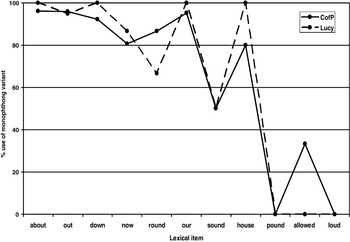
Only 28 words in the corpus contained an environment that was capable of displaying the [ʉ ~ ʌʉ] variation (I am not claiming that this list is exhaustive, only that these were the words that occurred in my corpus) and of these, 11 words occurred with more than 10 instances or tokens. In other words, there are very few words involved in this alternation and some of these occur much more frequently than others.Footnote 11 Although the pattern in the graph becomes more erratic as the number of instances decreases (as is typically the case when normalizing over small raw numbers), the general trend seems to be that the monophthong is selected more often in high frequency words than in low frequency words. In fact, as Figure 6 shows, this seems to be the pattern for Lucy and for the group.
Comparison of Lucy's data with the general trend in the corpus.

A Spearman's rank correlation was used to test the hypothesis that the monophthong is selected more often in high frequency words than in low frequency words. Table 1 details the results of the correlation across the corpus (excluding words that only occur once because these tend to skew the data). The correlation is significant at the level of 0.05.Footnote 12 Higher frequency words are, therefore, statistically more likely to occur with the monophthong variant than low frequency words for these speakers. The question is why. Why are the least frequent words in this corpus showing the most influence from the standard? A comparison of studies of (au) in Glasgow (Stuart-Smith, Reference Stuart-Smith, Corbett, McClure and Stuart-Smith2003) suggests that there may be some evidence that this is a change in progress, and so to answer this question, it is necessary to also situate these results against research on frequency effects in the progression of sound change more generally.
Result of Spearman's correlating words with more than one instance

*Correlation is significant at the 0.05 level.
Frequency effects in sound change
Recent work on sound change (Bybee, Reference Bybee, Kemmer and Barlow2000, Reference Bybee2001, Reference Bybee2002) provides evidence that it can be both phonetically gradual and lexically gradual, contrary to the classical positions espoused by the Neogrammarians and Lexical Diffusion theory (Labov, Reference Labov1994). Moreover, this research has found word frequency to be a significant motivating factor in the spread of sound change. Some examples of these include Bybee's (2002) investigation of t/d deletion in American English and [ð] deletion in Spanish; Philips' (Reference Philips1980) examination of the raising of Old English /a/ before nasals; and Leslau's (Reference Leslau1969) research on assimilation processes in Ethiopian languages. These results seem to support the generalization that high frequency lexical items undergo change first.
Paradoxically, there is also a small but significant body of literature (e.g., Philips, Reference Philips1981, Reference Philips, Bybee and Hopper2001) that claims the opposite to be true: change affects the least frequently used words in the language first. These conflicting sources of evidence have led Bybee (Reference Bybee, Kemmer and Barlow2000, Reference Bybee2001, Reference Bybee2002) to claim that there are two different types of sound change and that both display frequency effects.
Bybee (Reference Bybee2006) refers to changes that affect high frequency words first as a result of the Reduction Effect. The basic assumption of the Reduction Effect is that high frequency words undergo phonetic reduction at a faster rate than low frequency words. Based on the suppositions of Browman and Goldstein (Reference Browman and Goldstein1992), language production is regarded as a highly practiced neuromotor activity and as these neuromotor routines are repeated, their execution becomes more efficient, leading eventually to reduction or assimilation processes. Higher frequency words have more exposure to this reduction and, therefore, change more rapidly.
Bybee (Reference Bybee2006) argues that changes that affect low frequency words first (the Conserving Effect) are related to the morphosyntactic structure of a word. High frequency encourages phonetic change, but it “renders items more conservative in the face of grammatical or analogical change” (2001:12). High frequency words, therefore, become more entrenched in their morphosyntactic structure and resist change on the basis of more productive patterns. For instance, among English irregular verbs, the low frequency verbs are more likely to regularize (weep, weeped) but the high frequency verbs continue to maintain their irregularity (keep, kept). Bybee (Reference Bybee1985, Reference Bybee2001) explains that high frequency of successful use strengthens or entrenches the “cognitive representations of words or phrases” (which, in CG terms, equates to the instance level of the schematic network), making them easier to access whole and thus less likely to be subject to analogical reformation. Their frequency gives them a high level of “lexical strength” (Bybee, Reference Bybee1985), and so they can become entrenched and maintain their position in the language.
Bybee only invokes the Conserving Effect to explain morphosyntactic change, but, based on the evidence presented here for (au), it seems that the same principles can usefully be applied to explain phonological variation in these data. The word forms (or instances) that occur most frequently are heavily entrenched in cognition, and so they are capable of retaining the conservative Scots monophthong variant; whereas, low frequency words have a weaker representation in cognition and so are more susceptible to influence from general patterns of English. The variation in (au) does not pattern in the same way as the phonetic variation that Bybee describes with the Reduction Effect. Instead, the variation between [ʉ] and [ʌʉ] is comparable to the morphosyntactic variation between [swipt] and [swεpt] (the Conserving Effect) because it is not motivated by the articulatory overlap of gestures in the oral tract in the way that phonetically gradual processes of change (such as reduction and assimilation) often are. In other words, the variation in (au) is not “a physiologically-induced sound change” (Philips, Reference Philips, Bybee and Hopper2001:125); it involves the “abrupt substitution of one phoneme for another in words that contain that phoneme” (Labov, Reference Labov1994:542).
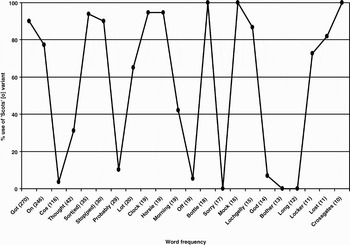
I have so far exemplified the relationship between variation and cognitive organization using evidence only from the (au) variable. Although it remains the case that variation in (o) can also be modeled in a similar schematic network, it seems that there are certain differences between the patterning of (au) and (o) that must be explained. For instance, it appears that most speakers show greater variability in their selection of the variants of (o) than (au). Furthermore, the variation in (o) does not appear to be motivated by word frequency, as Figure 7 shows. How can CG account for the differences in the patterning of these two variables and explain the variation that occurs when different nonstandard variants are used to different degrees?
Lexical distribution of (o) across the corpus.

Schema strength
It is possible to interpret these differences by invoking the CG notion of schema strength. According to Taylor (Reference Taylor2002:275), both schemas and instances vary in strength or entrenchment and a schema will become more entrenched in proportion to the number of instances that elaborates it. Taylor explains, “a schema which is elaborated by very many instances will tend to be highly entrenched” (2002:275). This seems to be the case with the (o) variable in this data. A total of 130 words in this corpus contained a variable environment, and 109 of these were fairly low frequency (i.e., they occurred less than 10 times in the corpus).Footnote 13 In other words, there were many words in the corpus that showed potential variation for (o) but the vast majority of these occurred fairly infrequently. The result is that each time a lower frequency instance of the (o) schema is activated, the schema itself becomes more entrenched, but the instances do not.
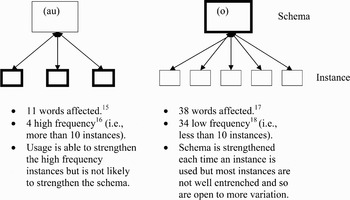
Taylor also explains, “a schema which has only a small, fixed number of instances will tend to be weakly entrenched” (2002:275). We find this pattern with the (au) variable. Only 28 words in the corpus contained a variable environment for (au) and 11 of these (40% of the total number of words) occurred with a fairly high frequency, more than 10 times in the corpus. Although usage of the higher frequency instances is likely to strengthen the entrenchment of these instances, this is unlikely to strengthen the schema because, although repeated use of very frequent words will strengthen the entrenchment of these instances, unless the speaker has a large number of instances from which to abstract commonality, the schema will be weakly entrenched. The higher frequency instances of the [ʉ] variant are, therefore, heavily entrenched in the minds of the speakers who use this variant, but the (au) schema is weakly entrenched.
This pattern of schema strength, diagrammed schematically in Figure 8, is again based on Lucy's data and, again, entrenchment is represented with a darker box. Not all of the variants of (o) are low frequency and, as with (au), there is still a tendency for certain words to occur more often with one variant than another; for instance, got occurs with the [ο] variant in 90% of all instances (243 tokens), and cos occurs with the [ɔ] variant in 96.6% of the instances (112 tokens). Interestingly, these two words are also the two highest frequency (o) words for these speakers (and are, therefore, the most entrenched).Footnote 14 In Taylor's account of linking /r/ in English, he explains that certain high frequency word combinations may be stored in cognition and retrieved as whole units (2002:258). Entrenchment can also explain variation in the patterning of the word off in this corpus. The construction fuck off occurred relatively frequently in this corpus and the [ɔ] variant is categorically selected by every speaker but in other less frequent (and so less entrenched) uses of the word off, speakers will vary among [ɔ], [ο], and [a].
(au) and (o) schema strength in Lucy's data.

The aim thus far has been to present on overview of the variation in two vocalic variables within the group and to reach a more detailed understanding of the patterning of this variation. Notions of schematic organization and entrenchment in a cognitive network have proved useful, but, as it stands, the analysis cannot yet account for the social meaning of these variants.
SOCIAL MEANING IN A CG FRAMEWORK
As explained in the introduction, the majority of sociolinguistic research on vocalic variation in Scotland has been carried out with first wave methodology, which is characterized by the use of predetermined social constructs such as class, age, and gender. Consequently, the approach has been to treat linguistic variation as a marker of such social category membership. This account of social meaning is problematic because it does not consider how linguistic variants acquire the social meaning that is locally relevant to speakers or, as Eckert asks, “how do variables mean?” (2002:4).
One way of attempting to uncover the meaning of linguistic variation within a particular community is simply to ask the speakers involved. When I did this with Colin and Sean, they expressed the opinion that frequent use of the [ʌʉ] variant of (au) is considered “proper” and the [ʉ] variant is characterized as “Scottish” or “slang.”
(1) Sean and Colin.
LC: Is hoose slang?
S: Aye.
C:/nuh hoose is Scottish.
S: Is it?
C: Aye cos abdy says hoose.
LC: What aboot folk that say house?
C: They're proper.
Simon and Robert feel that the frequent use of the diphthong is “posh,” but they would undoubtedly switch to using it in a job interview (i.e., adopting posh pronunciations is something these speakers do grudgingly).
(2) Simon and Robert
LC: So what aboot if ye were in a job interview?
S: Aye you'd hae tae speak proper then cos you're wantin, ken you're no wantin tae go in an be like “aye, how ye daen pal.”
LC: How no?
S: Cos yer wantin tae impress them eh. Ken you're no hink-no wantin them tae hink you've just crawled oot the gutter or nuhin.
LC: Give me an example eh how ye wid talk … would ye say “hoose” or “house”?
S and R: House.
…
LC: What dae ye hink eh people that say “house” instead eh “hoose” a' the time?
R: Posh.
Perhaps an even better indicator of the social meaning of linguistic variation can be found in examples of style shifting that can be described as “performance speech” (Schilling-Estes, Reference Schilling-Estes1998) such as in (3) where the speaker, Lucy, is describing an event that has taken place in her maths class and adopts the role of various actors in her performance of the event.
(3) Lucy and Kate
L: … Right [laughs] an then he came in tae ma class an he wiz like, “does it take ye ten minutes tae get tae this class?” an he sat doon [ʉ]. I went, “nah, he wiz ootside [ʉ] haen a fag” [laughs] an he went, “shurup” like this an awhing an he wiz total goin “shut it man” like this an a wiz like, “nae boer.” An then, an then Laura went, “aye he wiz haen a pash” like that cos in Dundee that's what they call a fag right cos aw the folk we met at the army they were goin, “comin for a pash” it means “comin for a fag” right.
LC: Right ok.
L: But he thought he said, “he wiz goin for a pish” right [laughing]. Right an he went, “Laura. Out! [ʌʉ]” and she's goin, “nuh a never meant it. a never even swore. What ye talking aboot? [ʉ]” an he's total goin “Out! [ʌʉ]” An she wiznae goin oot [ʉ], she's sitting like this an then a wiz total pu'en her back an a wiznae letting her go an a wiz hodin ontae her like under like that an she's, she's trying tae get up an she's goin, “it's Lucy, she's hodin on tae me” an am goin “no am no” like this an awhing. She-he's goin, em, an then Amy's sitting goin, sittin shoutin, “a pash, a pash” like trying tae get sent oot [ʉ] tae eh, an a wiz like, “aw right.” She's a total gimp. It wiz just so funny cos he thought she said pish an she didnae. She got sent oot [ʉ] total [laughs] … we iyewiz get sent oot [ʉ] me an her fir talking.
Traditionally, sociolinguists have tended to dismiss performance speech because their focus has been on understanding un-self-conscious “natural” speech or “the vernacular.” However, Schilling-Estes (Reference Schilling-Estes1998) has argued that valuable insights about language variation can be gained through investigating performance speech. For instance, this extract shows that Lucy has recognized a relationship of similarity between the diphthong variant of this variable and a particular instance of a social type: her maths teacher. In other words, performance speech shows that speakers are aware that certain linguistic variants are used by certain types of speakers in certain social situations or domains. This can easily be incorporated into the CG model if we assume (as CG does) that the processes of categorization discussed in the linguistic analysis (3) are not unique to language but that exactly the same principles and processes that govern linguistic categorization also govern social categorization. In CG terms, speakers abstract relationships of similarity between certain types of social and linguistic knowledge in their cognitive network. The repeated coactivation (and, hence, entrenchment) of particular (social and linguistic) nodes and links in the cognitive network enables the speaker to associate social knowledge with particular linguistic variants.
The association that speakers make between linguistic variation and social knowledge is not simply a tool that that can aid successful categorization of others; as Hudson (Reference Hudson1996:246) explains, speakers, as agents, can choose to select particular linguistic variants in order to project social meaning. In Lucy's case, although the monophthong variant is heavily entrenched, she nevertheless has the capacity to override this entrenchment, even in the high frequency word out (3), to signal social meaning. Again, this is not a problem for Cognitive Linguistic theories that assume that speakers are also capable of some degree of agency (Croft, forthcoming).
THEORETICAL IMPLICATIONS
The implications for this approach to “cognitive sociolinguistics” are twofold. First, sociolinguistics is often considered as an empirical subject with a wealth of factual data but which has arguably failed to “formulate any agreed central theory, so that the field seems to grow more complex all the time” (Spolsky, Reference Spolsky1997:78). The theory deficit is a common criticism of the sociolinguistic enterprise and one that was perhaps articulated most vehemently by Chomsky in earlier work in which he compares the study of sociolinguistic variationFootnote 19 with “butterfly collecting”: “If you like butterflies, that's fine; but such work must not be confounded with research …” (Reference Chomsky and Viertel1979:57). This criticism is no longer justified; there is a wealth of research literature that argues in favor of a synthesis between sociolinguistic data and accounts of linguistic theory. For instance, various attempts have been made in this direction within a generativist model, including Variable Rules (e.g., Labov, Reference Labov1969, Reference Labov1972), Optimality Theory (Anttila, Reference Anttila, Hinskens, van Hout and Wetzels1997; Bender, Reference Bender2000; Boersma & Haye, Reference Boersma and Hayes2001; Nagy & Reynolds, Reference Nagy and Reynolds1997), Principles and Parameters (Wilson & Henry, Reference Wilson and Henry1998), and Minimalism (Adger & Smith, Reference Adger, Smith, Cornips and Corrigan2005). However, these approaches all begin with a purely asocial theory of grammar and try to build in accounts of variation. In doing so, they only build in the results of such variation and do not incorporate the social meaning of the variation in the theoretical framework.
This article has argued, in line with recent research in Cognitive (socio) Linguistics (e.g., Geeraerts, Reference Geeraerts2003; Hudson, Reference Hudson2007; Kristiansen, Reference Kristiansen, Dirven, Frank and Putz2003) that the basic assumptions of the Cognitive Linguistics movement (and the CG framework in particular) are fundamentally compatible with a description of sociolinguistic variation, and that the key to this compatibility lies in the nonmodularity of the usage-based approach.Footnote 20 Cognitive Linguistic theories recognize that “linguistic” knowledge is inextricably entwined with “nonlinguistic” knowledge or, as Goldberg states: “knowledge of language is knowledge” (Reference Goldberg1995:5). If both are linked in cognition, then both should be incorporated into the same theoretical model.
Furthermore, any theory of linguistics that aims to be a comprehensive and realistic model of human language must incorporate the social facts of language use. The CG framework recognizes the variable nature of language; in fact, the model implies that linguistic variation between speakers is inevitable (Geeraerts, Reference Geeraerts2003:1). Yet, despite this, the theoretical assumptions of CG (and other Cognitive Linguistics theories) are often not supported with usage evidence: “language variation is still widely absent from cognitive linguistic research, whereas in fact it ought to be at the heart of its research agenda” (Dirven, Reference Dirven2004:21). As Dirven explains, even within the now growing field of “cognitive sociolinguistics,” most of the research has been either concerned with the merging of linguistic theory and ideology (Dirven, Frank, & Putz, Reference Dirven, Frank and Pütz2003) or with the link between language and culture in the development of Cultural Cognitive Models (see Morgan, Reference Morgan1997). It, therefore, seems that the disciplines of Cognitive Linguistics and sociolinguistics could potentially benefit from integration, and it is hoped that this article might encourage further investigation into this new research avenue.