Historians long argued that peasant smallholders put France on a path of slow economic growth qualitatively different from the dynamic capitalist expansion of England from the seventeenth through the nineteenth centuries. This standard argument, developed between the 1930s and 1970s in meticulous studies of the French countryside, became fully elaborated in Histoire économique et sociale de la France, a multivolume synthesis bringing together contributions of the leading historians of the time, which argued, as Pierre Goubert summarised, that ‘French agriculture . . . barely evolved whereas . . . the England of wheat developed into the England of pastures and of cattle in an overall capitalist process of eviction of the small peasantry and reinforcement of the large property’.Footnote 1
Over the last three decades, historians have revised this standard argument and now believe that the French path to development was just as successful as the English in raising the per-capita standard of living. Historians maintain that the French economy began to grow at an early date and expanded in a balanced fashion without a transformation of agriculture or industry. The relatively small urban population and the slow pace of demographic growth did not provide strong consumer demand, encourage heavy investment in farms and factories, or necessitate rapid economic advances. Producers instead made small improvements to husbandry, used conventional technology effectively, streamlined enterprises, and adapted to regional and town markets, especially demand from Paris. The market opportunity for trade with the towns is nowadays advanced as the basic explanation for gains in economic productivity.Footnote 2
Philip Hoffman, in particular, ascribes all of the distinctive traits of rural France to the influence of markets. Sharecropping, Hoffman argues, permitted landowners to gain value from poor peasants lacking the financial reserves to assume the costs of a fixed-term lease. It lent itself to more effective monitoring of the husbandry than did landlord/tenant relationships and became the logical form of rental agreement for proprietors residing near their holdings. When markets called for crops such as vines, which required meticulous husbandry, sharecropping helped the landowners to supervise the work closely. Farm sizes also responded to market stimuli, Hoffman maintains, as many proprietors had opportunities for profit in viticulture and established small plots to better focus on the careful husbandry it required. English proprietors had opportunities in livestock, which called for large farms and little labour. They extended their landholdings to reduce costs and obtain the full benefits of trade.Footnote 3
Hoffman developed original data to demonstrate the propensity of French farmers to increase productivity when they had access to markets. Prices for land, labour, leases, capital, and commodities permit a calculation of production minus the cost of its factors, or ‘total factor productivity’. The data show that productivity rose 7.7 per cent between 1650 to 74 and 1750 to 1774, and another 6.5 per cent (.3 per cent a year) between 1750 to 1774 and 1775 to 1789 in the Paris basin. These rates are ‘comparable or superior to those achieved across the English Channel’.Footnote 4 Overall, productivity rose in Bretteville in Normandy in the sixteenth century, the southeast and Paris basin in the seventeenth century, and the Albigeois, Beaujolais, and Paris basin after 1750. ‘Such growth matched the performance of farmers in England, and it could approach the best that could be achieved in early modern Europe’.Footnote 5 Labour productivity in agriculture rose twenty-seven per cent for France as a whole between 1500 and 1800.Footnote 6
Hoffman argues that French farmers did not achieve these gains through a transformation of the social structure or technology, radical changes to agricultural practices, or a wave of enclosures and rural depopulation as occurred in early modern England. The peasants enhanced productivity by tailoring their crops to the demand from urban markets and by improving their techniques to increase yields and earn income.Footnote 7
In what follows, I will put forward labour productivity as an alternative measure of economic development, and will offer early modern England as an illustration. This section of the article includes a critique of Hoffman's argument and a demonstration of the inability of his data to capture the tendency of the French economy toward stagnating or declining rates of labour productivity. This tendency, I argue, prevented France from achieving the same trend toward economic development as did England. In the bulk of the article, I analyse the economy of Languedoc, a microcosm of France as a whole, to show that the agrarian structure, rather than the particularities of the market, led to slow labour-intensive growth not suitable or appropriate for raising the standard of living.
Labour productivity: England and France
Labour productivity, the output of the inputs of work, constitutes the best measure of economic development. An economy develops as a population obtains greater returns from its exertions. Although the gains from increases in labour productivity accrue above all to the owners of capital, the gains nonetheless provide the margin for the improvement of the standard of living of the rest of the population. Increases in the productivity of the hours worked expand the entire economic pie so that some of the gains can go to the working population. If economic development has any broadly intelligible meaning, the meaning must be that a given population lives better (that is, works less and earns more, or at least earns more for the time it spends working) and such a scenario only arises out of the improvement of labour productivity.
In England, from the fifteenth century the feudal seigneurs asserted property rights over unusually large demesnes by European standards of the time and succeeded in undermining peasant tenures over the following centuries. The average size of landholdings amounted to thirty to thirty-five hectares in 1600, over sixty in 1700, and over one hundred in 1800. Family plots of fewer than five hectares, already a small minority in 1600, virtually ceased to exist by 1800. The yeoman tenant farmers of the large estates had the financial reserves to forego the immediate returns to be gained from planting grains on as much land as possible and instead were able to experiment with the floating of water meadows. This practice improved the quality of pasture, generated an early crop of hay, and expanded the feed available for cattle. It spread to the southern Welsh border, Dorset, Wiltshire and Hampshire early in the seventeenth century. The tenant farmers also had the wherewithal to invest in the expansion of grasslands and fodder crops, and in the construction of stables for farm animals. The periodic rotation of tillage, turnips, sainfoin, clover, and other artificial grasses yielded food for cattle and horses, as it replenished the fertility of the soil. Convertible husbandry, as this method of farming is known, appeared in Sussex, Oxfordshire, Leicestershire, Northamptonshire, Bedfordshire, and Buckinghamshire by 1700. It permitted farmers to amass a stock of well-fed healthy cattle and horses, as well as large amounts of manure to nourish the arable fields.Footnote 8
Most importantly, the systematic effort to augment the number of farm animals permitted agriculturalists to replace human labour with that of oxen and horses over the course of the eighteenth century. It stands out as the fundamental impetus for the improvement of agricultural productivity before the modern era, because it reduced the human labour needed to grow large quantities of food. Gentry landowners and tenant farmers took advantage of the breakthrough by enclosing villages, engrossing their holdings, establishing economies of scale in wheat production, and shedding the labourers they no longer needed. The singularity of the British economy of the eighteenth and nineteenth centuries was its tendency to augment the output of food with a decreasing rural workforce. The recent cliometric literature on English agriculture demonstrates its exceptional labour productivity compared to continental Europe.Footnote 9
East Anglia and the West Country lent themselves to convertible husbandry. Fodder crops took to the light soils of these regions, and farmers found the soils inexpensive to plough and drain. During the eighteenth century, the landowners of other regions moved into lines in which their costs of production were more competitive. Agriculturalists in regions of heavier soils such as the Midlands, which had been the granary of London in the early sixteenth century, began to specialise in animal rearing. The inhabitants of the Midlands and northern regions specialised in the manufacture of consumer goods for the internal market. Agriculture and industry emerged as geographically distinct enterprises, as producers specialised in economic lines in which they enjoyed a comparative advantage, lowered the costs of production, brought down the relative price of their output, and thus benefited from increased discretionary income among wide strata of the population and growing consumer demand. Agricultural improvements, economic specialisation, and gains in labour productivity resulted in relatively cheap food, rising real wages, growing consumer demand, and an enhanced overall standard of living during the eighteenth and nineteenth centuries.Footnote 10
In France, peasant communities gained possession of much of the land in the thirteenth and fourteenth centuries. Subsequent population growth and the concomitant sub-division of landholdings, periodic bad harvests, and the fiscal demands of the absolutist state in the early modern period led many peasant households into debt and permitted urban landlords, ecclesiastics, and seigneurs to use the judiciary and administration of the monarchy to appropriate their tenures. In the region known as the Ile-de-France, which provisioned Paris, the ploughmen of urban landlords consolidated farms over two hundred hectares in the deflationary crisis of the seventeenth century when small holders went into debt and lost much of their land. Large farms of 120 hectares covered as much as twenty-five or even forty per cent of the agricultural surface of the Ile-de-France in the eighteenth century. But contrary to England, the peasantry of France still owned about forty per cent of the agricultural land. Even in the Ile-de-France, where concentration went the furthest, nearly ninety per cent of landholdings amounted to fewer than 2.5 hectares at the end of the sixteenth century and almost seventy per cent amounted to fewer than 2.5 hectares at the beginning of the eighteenth century.Footnote 11
Hoffman argues that this agrarian landscape had the capacity for economic growth. He concedes that his data do not demonstrate the broad and sustained development of rural France along the lines of England. The growth of total factor productivity for France as a whole did not match the growth of the population. Hoffman contends rather that the increase of productivity in certain regions and periods demonstrates a propensity for growth. Periods of crisis and decline did not result from peasant agriculture but from exogenous causes such as war and heavy taxation.Footnote 12
In a recent round-table on Hoffman's work, George Grantham analysed the data and noticed that agricultural productivity rose, stagnated or fell in different regions and times in the absence of exogenous causes. He found the temporal and geographical disparities perplexing, as if agriculturalists raised productivity, then somehow forgot what had worked, and farmed less efficiently. The problem, Grantham argued, may lie with the data, and the difficulty of determining market prices in old regime France. Hoffman could not pull together all of the prices to calculate total factor productivity on farms of the Paris basin. He made up for the absent data by transposing prices from similar types of farms in different regions. This method left a wide margin for error.Footnote 13
A more serious weakness arises from the impossibility of calculating the market price of wages. The standard source on the rural labour market shows that in 1806, roughly seven and a half million people worked in agriculture, while twenty-four million lived in the countryside. The rural population surpassed that needed to grow a surplus for the towns. Labour abounded in rural France, and there was no effort to use it sparingly. Peasant households had supplies of family labour which they did not have to factor into their costs of production. They worked added hours on their parcels of land to increase the productivity by accepting returns below those paid on the labour market. These added hours made up much of the labour expended in pre-industrial France, but did not appear in contemporary documents, and do not appear in the tabulations of today's historians.Footnote 14
Rural households deployed this labour in two ways. First, rural families, with insufficient land to cover their subsistence, and with reserves of labour beyond what was needed to grow grains on their plots, moved into alternative economic lines in which their capacity for work gave them a competitive advantage and generated greater income. Second, many rural households produced for markets as ancillary activities and continued to devote most of their labour to farming grains for local consumption. They performed strenuous tillage on clayey and loamy soils where labour would have been more effectively employed rearing cattle on grasslands. Peasants had to prioritise the security of producing their subsistence locally in areas where the roads remained in a deplorable state and made specialisation in lines outside cereal production too risky.Footnote 15
The trends that appear in Hoffman's data result by and large from the price of renting land, as wages did not rise noticeably, and capital did not amount to a significant cost of production. The problem with using land rents in this way is that they reflected the relations of power between property-owners and the rural population much more than they did the productivity of farming. The agrarian structure inherited from the middle ages left an abundance of households insufficiently provided with land to secure their subsistence, either directly or through commercial sales, and thus left them reliant on the landlords of the towns for rental agreements. The landlords of the Paris basin, like those elsewhere in France, had the power to insert all sorts of restrictive stipulations that cannot possibly be calculated by economists, into the leases with their dependent tenants. They obliged tenants to collect seigneurial rights, perform services such as carting and harnessing horses, and provision their table in kind with wheat, eggs, wine, pigs, wood, and other agricultural products.Footnote 16
In periods of population growth, when peasants found themselves with insufficient lands to secure their subsistence, they offered their labour at rates sufficiently low to obtain employment and assure the survival of their households. Tenant farmers applied additional workers to the fields at low cost, often not even remunerated in wages and thus not amenable to calculation, increased output, and facilitated the rise of rents accruing to urban landlords. Furthermore, as population growth left many rural households with reserves of family labour, they competed with one another for leases by putting in extra hours of work, on their own plots as well as on the estates of urban landlords, increased output, and bid up the price of leases. Hoffman's calculations suggest that agricultural productivity increased precisely in the periods of demographic expansion such as the eighteenth century when growth in output came at the expense of the productivity of the labour.Footnote 17
Urban merchants had a tendency to put manufacturing out to semi-landless rural households ready to draw ever more heavily on their reserves of family labour, regardless of the returns, in order to make ends meet. Like the landlords, the merchants could count on profits from the peasants' toil without having to invest in labour-saving capital. Gains in the productivity of the land and in the output of textiles resulted from the concentrated meticulous effort of rural labour but accrued primarily to the well-to-do residents of the towns. Urban landowners and merchants acquired agricultural and manufactured goods from the countryside at low cost. Output rose while the returns to the rural producers stagnated or declined. Per capita production may have increased but this did not improve the standard of living for the vast majority of the population. The agrarian structure did not lend itself to economic development.Footnote 18
One must not reify the market as a force inevitably moving producers into the most remunerative economic lines, selecting out the inefficient ones, reducing the variance of prices, making people's existence secure and raising the standard of living. One should instead examine the market within its specific historical circumstances. In France, the market adapted to the agrarian structure inherited from the feudal past, one marked by an abundance of small-holding peasant households apt to augment their exertions in order to enhance the productivity of their plots, find employment, increase output, obtain leases, and assure their livelihood. Large landowners did not respond to market opportunities by producing more efficiently but rather by taking advantage of the unequal distribution of land, of the opportunities for unequal exchange, and redistributing income and wealth from others.Footnote 19
The point of this article is not to present the economic failings of the peasantry. On the contrary, the peasantry of the pays de Caux of Normandy accumulated cows and farm animals, extended artificial prairies of clover, raised the productivity of the land by thirty or even sixty per cent, generated additional food to cover the demographic growth of the eighteenth century, and permitted the large landowners to levy high rents and reap the benefits of the economic growth between 1720–29 and 1766–1787. In general, peasant households, in areas such as the Maine, Gâtinais, Bretagne, and the mountains of the Vosges and Ariège, developed grasslands and herds of cattle, increased the supply of manure to fertilise the soil, and generally outperformed the farmers of large open-field estates, typical of areas such as the Beauce, who sowed as much grain as possible but restricted the land for animals and the output of manure, and brought on low, even declining yields. France experienced considerable industrial growth, particularly in rural handicraft production, at a rate of 1.9 per cent a year over the course of the eighteenth century according to a recent estimate. The competitiveness of peasant households permitted them to increase their landholdings at the expense of large proprietors and thwarted the development of large-scale industry during the periods of rising prices in the eighteenth and nineteenth centuries.Footnote 20
The point of this article, more exactly, is that the agrarian structure, characterised by peasant possession of the land, led the producers to increase output in response to population pressure on the land through the intensification of labour and stagnating or declining returns to each additional hour of work. The tendency of the rural population to continue to supply labour inputs at declining rates of profitability seems to defy rational economic behaviour but made perfect sense to producers responding to a different, non-capitalist rationality prescribing first and foremost the survival and reproduction of the peasant family. Over the long period from 1600 to 1850, this rationality did not lead to the accumulation of capital and the improvement of the standard of living, and did not foster economic development.
Languedoc
If the opportunities for trade with the towns generated the impetus for rural development, then eighteenth-century Languedoc should have seen rising labour productivity and an improving standard of living. It was a relatively urbanised province containing 5.6 per cent of the French population and 9.09 per cent of the towns of 10,000 inhabitants or more. It had the diversity conducive to commercial growth: manufactures in Carcassonne, Montpellier, and Nîmes, vineyards in Mediterranean Languedoc, and large grain-producing farms (akin to those of the Paris basin) appropriate for the latest techniques of husbandry within the region delimited by Albi, Toulouse, and Carcassonne. The provincial administration brought these areas together in the seventeenth and eighteenth centuries by sponsoring one of the best networks of roads and the Canal du Midi to link the Atlantic Ocean to the Mediterranean Sea. Languedoc did not go through ruinous wars or excessive fiscal demands capable of suffocating the enterprise of inhabitants.Footnote 21
Mediterranean Languedoc
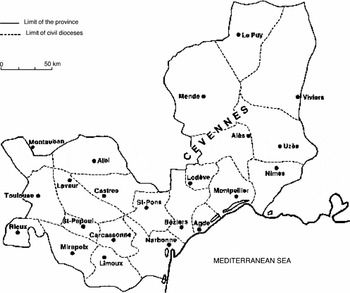
The population of the diocese of Montpellier (see Figure 1) grew sixty-seven per cent between 1750 and 1789. In previous centuries, such growth had led to economic crises. Emmanuel Le Roy Ladurie finds that the peasants planted grain on hardscrabble land in the fifteenth and sixteenth centuries as population growth put pressure on resources. Yields declined with each new hectare brought under cultivation until the economy collapsed. In the eighteenth century, peasants and artisans reacted to demographic growth by creating vineyards near towns and on the hilly and pebbly soils common to the diocese. Vines grew well on these marginal lands and generated income with which the peasants purchased more bread than they could have obtained by opening new lands to grain cultivation. Viticulture permitted the peasants to farm extensively and raise the productivity of the land. In Pignan, the growth of the population, the subdivision of landholdings among heirs, the reduction of farm sizes, and the extension of vineyards onto the scrublands augmented the number of parcels by over thirty per cent between 1750 and 1762, and the area of vineyards by almost forty-five per cent between 1750 and 1791.Footnote 22
Civil dioceses of Languedoc before 1789.

A royal edict of 1766, extended to Languedoc in 1770, encouraged this trend by granting farmers fifteen-year exemptions from taxes and tithes for land brought under cultivation for the first time in forty years. Most of Languedoc's resultant land clearances took place in dioceses such as the Montpelliérain containing a burgeoning peasant population and lands suited to vineyards. The inhabitants of the neighboring Narbonnais doubled the cultivated surface of the diocese in the second half of the eighteenth century. The production of wine thus increased from 2 to 2.5 million hectolitres in Languedoc between 1774 and 1788.Footnote 23
Attacks on seigneurial rights during the Revolution accelerated the pace of economic growth. In the past, the peasants had hesitated to clear and cultivate new plots for fear that the lords would assert rights over them and extract a portion of the produce. Once the Revolution weakened the seigneurs' position, the peasantry set about clearing local scrublands in an organised and egalitarian fashion, creating parcels for all strata of the rural population. The peasants increased arable land by over twenty per cent in some parts of Mediterranean Languedoc during the 1790s.Footnote 24
The spread of viticulture should not obscure the fact that landowners still devoted the best soils of Mediterranean Languedoc to cereal culture as late as 1855. The farming of these soils improved over the course of the eighteenth century, as agricultural labourers and small proprietors of the Narbonnais purchased mules to replace their stock of donkeys. Mules pulled ploughs more effectively and increased the profitability of farming. The context for farming further improved as a result of the Revolution. The agricultural societies, set up on the initiative of the crown in the 1760s, never amounted to more than circumscribed aristocratic discussion groups. But as the social orientation of the country changed under the impact of the Revolution, the societies developed into popular meetings suitable for disseminating new techniques among the local farmers. The modern swing plough came into widespread use in the 1790s and early 1800s as a result.Footnote 25
On the whole, however, the landowners of Mediterranean Languedoc discouraged innovations capable of upsetting the stable returns available from grain markets. Urban rentiers of the Narbonnais, owners of most of the arable land of the diocese, put their holdings out in sharecropping agreements nearly identical to those of the seventeenth century. The agreements specified strict two-field rotations, the exclusive cultivation of wheat, and bans on experimentation with fodder crops such as sainfoin. A contemporary noted the standard use of two-field rotations and light centuries-old ploughs in the Montpelliérain at the end of the old regime.Footnote 26
Wine production, the main source of growth in Mediterranean Languedoc, did not require investment in fertiliser, horses, carts, stakes, or ploughs. Rather, it required a full year of intensive work hewing, using vine shoots to multiply the stocks, ploughing several times with the hoe, entering stakes for the shoots deeply into the arid soils of the Mediterranean, preparing vessels and basins, harvesting, fermenting, and pressing the wine. An administrator in the diocese of Montpellier observed that vines required two and a half times more labour per hectare than wheat. Peasant micro-proprietors had an advantage in viticulture, because they could draw on family labour below the market rate and obtain additional output and value from the land. It is not surprising that vines appeared in far greater numbers on peasant parcels than they did on the farms of urban landowners. Peasant households could reduce their costs of production by cutting labour costs (exploiting themselves to be precise) further than the large proprietors. An administrative memorandum written in 1768 stated that the vineyards of the hilly parts of the Montpelliérain were farmed by owner operators with the economic capacity to deprive themselves of all but the strict necessities of life to make ends meet.Footnote 27
The extension of vineyards onto the scrublands, then, was not a lucrative business. The royal edict of 1770, granting fifteen-year tax exemptions for property brought under cultivation for the first time in forty years, sufficiently lowered the threshold of economic gain to make land clearances worthwhile to peasant families. The additional income permitted the growing population to eke out a living but can hardly be considered a source of wealth and development. About half of the parcels of the Narbonnais were of such poor quality that they were abandoned by 1800 when they became liable to taxation. The land clearances may actually have diverted attention and investment from the best lands which remained within the traditional crop rotations.Footnote 28
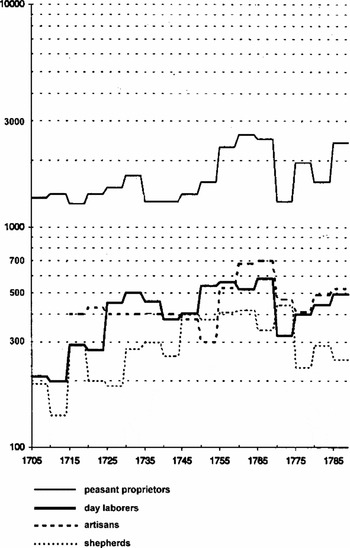
In the Narbonnais and Corbières regions of Mediterranean Languedoc, the dowries of day labourers, shepherds, artisans, and peasant proprietors grew over the course of the eighteenth century (see Figure 2). The dowries of peasant proprietors seem to have grown far more than did those of the labourers, shepherds, and artisans. In reality, these separate professional groupings obscure all they shared in common. Rural artisans often tilled parcels of land, and small holders became farm labourers, at certain times of the year. The family members of day-labourers and peasant proprietors often worked in the textile industry for ancillary income.Footnote 29 Accordingly, Figure 2 suggests that on the whole, the dowries of the rural inhabitants of the Narbonnais and Corbières grew by more than one hundred per cent and that the inhabitants founded their households with more capital, invested more in agriculture, and lived better in 1760 to 1775 than they had in 1705 to 1715.
Dowries in the Narbonnais and Corbières (in livres).

Then again, Figure 2 begins in a period of rural immiseration, indebtedness, and the transfer of property to the well-to-do townspeople. Measured by the sums collected in tithes, the years 1700 to 1710 constituted the most depressed decade of the entire period from 1530 to 1788. The depression culminated in the harvest failures of 1709 to 1712. The growth of the eighteenth century did not equal the high points of output reached in the middle of the seventeenth century. Hoffman makes the case, based on the price of leases in the area of Béziers in Mediterranean Languedoc, that total factor productivity stagnated from the end of the sixteenth through the seventeenth centuries and declined after 1680. It thus seems more correct to read the dowries as an indication of recovery than as indication of capital accumulation. The peasantry created vineyards on the lands abandoned in the period of penury of the last two decades of Louis XIV's reign.Footnote 30
The recovery of the standard of living proved fragile in the long run, because it was based on the hazards of reliance on viticulture. Agricultural prices rose sixty per cent in France as a whole between 1716 to 1720 and 1784 to 1788. The price of grain rose about forty per cent between 1752 to 1761 and 1779 to 1788 in the markets of Montpellier, Béziers, and Toulouse. The available evidence suggests that the price of manufactured goods also increased albeit at a slower rate. The prices of wine and grain increased at about the same rate until 1778. This year ushered in a precipitous decline in wine prices amid continuing high prices for grain. The effort of so many peasants to clear land for vineyards saturated the wine market and drove the price down. Grain made up the principal article in the budgets of the majority of rural households, and as the price rose, consumers had less income to sustain the demand for wine. The price of grain peaked in 1770 to 1771 and probably caused the decline in the value of dowries observable in Figure 2. The decline concerned the entire range of the rural population and abruptly reversed the recovery of the preceding five decades. Wine regained value between 1786 and 1789, and Figure 2 shows that dowries regained value between 1775 to 1780 and 1790. But the high price of grain and the overproduction of wine continued to depress the income of vintners throughout the 1780s and 1790s. The early 1790s saw a severe economic depression in Mediterranean Languedoc.Footnote 31
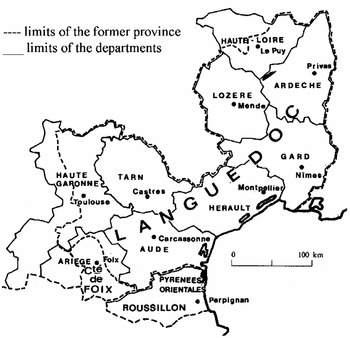
Worse still, the clearance of so much land for vineyards damaged the ecological balance sustaining the local husbandry. Clumps of woods, bushes, and greenery on the hillsides retained water and kept the temperature above freezing. Once the peasantry cleared this vegetation away, vines and olive trees were recurrently wiped out by frosts and entire harvests by rainstorms. The appointee of the central government, the Prefect of the department of the Aude (see figure 3), wrote in 1818 that the hillsides of Mediterranean Languedoc no longer retained any wood, soil, pasture, or water, and had become totally unsuited to agriculture.Footnote 32
Departments into which the old regime province of Languedoc was divided.

The Southern Massif Central
The same sort of labour intensive growth took place in the mountainous region north of Montpellier known as the southern Massif central. The peasants of this region possessed a larger share of the soil than they did in other parts of Languedoc. They owned well over fifty per cent of the land in the diocese of Le Puy-en-Velay. The Vivarais was a labyrinth of properties, over two-thirds of which belonged to the peasantry.Footnote 33
The population of the Vivarais grew almost fifteen per cent between 1759 and 1789 and twenty-six per cent over the entire period between 1715 to 1720 and 1801. The stagnation of grain yields would have made the peasants' lives precarious had they not introduced new crops such as chestnut trees. These yielded nearly as much fruit on hillsides as they did on arable fields and allowed the inhabitants to acquire more resources from the land. Peasants introduced potatoes in response to dearth in the northern Vivarais at the end of the seventeenth century. Potatoes yielded more calories per hectare than did grains. The peasants planted potatoes in the rest of the diocese as the population grew in the eighteenth century.Footnote 34
The rearing of silk worms for the textile industry centered in Nîmes was an even more significant development. The inhabitants nourished the silk worms with the leaves of mulberry trees. The growth of the regional textile industry raised the value of mulberry trees to twenty times that of wheat per hectare. Mulberries also maintained soil on the hillsides and prevented it from washing into the basins and harming the arable fields. They grew like chestnut trees, on almost any terrain, and permitted the peasants to push the ancestral practice of terraced agriculture to its physical limit and obtain extra income from the land. The peasants planted mulberries throughout the dioceses of Uzès, Viviers, and Alès after the 1730s.Footnote 35
Potatoes, chestnut and mulberry trees helped put an end to the centuries-old problem of dearth in the Vivarais in the last decade and a half of the old regime, yet also formed a precarious and arduous type of growth. As in Mediterranean Languedoc, the clearing of hillsides for agriculture harmed the ecological balance sustaining the local population. The land clearances, which had become common in the second half of the eighteenth century, accelerated between 1789 and 1795, as the revolutionary upheaval deprived landlords and the state of the authority to monopolise woodlands. According to the minutes of the central administration of the Gard at the end of 1799, the mania (fureur) for land clearances led to the depletion of wood for heating and construction. The Prefect of the department of the Lozère reported that local residents aggravated a fuel shortage by clearing local forests.Footnote 36
Moreover, the land clearances and soil preparation that were required to introduce the new crops into the arid heaths and sterile top layer of the ground surface of the region entailed an immense increase of physical exertion. A study of Sardan, a village north of Montpellier in the department of the Gard, shows that land clearances augmented the cultivated surface by thirty-five per cent between 1666 and 1791, as the population of the area grew in the middle decades of the eighteenth century. Peasants cultivated grain on about eighty per cent of the arable land in 1666, and barely over fifty per cent in 1791. Yet the area sowed in grains actually increased and occupied parcels throughout the village. Much of the land cleared in Sardan went to mulberry trees. These appeared after 1666 and claimed more hectares than did any crop except wheat in 1791. They permitted the villagers to obtain additional income within a customary system of poly-culture and subsistence farming. The departmental archives of the Gard contain scores of cahiers de doléances written in rural parishes in the spring of 1789. These cahiers listed the products of the soil and read like a monotonous list of peasant poly-culture: variety of crops within each parish, yet uniformity between parishes. Villages contained mulberries, grain, fodder, vines, woods, pasture, and sometimes olive trees.Footnote 37
The crop mixes and techniques employed in this system of subsistence farming diminished the productivity of labour. Potatoes generated more calories per hectare than did other crops such as oats, but also required more hours of farming. Potatoes had lower rates of profitability measured in income per labour unit. What is more, the inhabitants turned the soil over manually with picks, spades and hoes rather than with ploughs and draft animals. The peasants' capacity for work gave them little incentive to acquire farm capital and economise on labour costs. Buying ploughs and draft animals, and disbursing revenue to prevent the depreciation, must have seemed a senseless loss of income to local peasants capable of performing all of the necessary work themselves.Footnote 38
Growing mulberries and breeding silk worms for ancillary revenue also required further intensive expenditures of human energy. The king's appointee in Languedoc, the intendant Ballainvilliers, stated that the commercial breeding of silkworms for their silk generated income in proportion to the labour applied to it. Sericulture required assiduous attention to the cultivation of mulberry trees, feeding the silkworms, and reeling the raw silk. The whole process involved nearly twenty times more labour per hectare than did wheat. Peasant households had an advantage in this economic line because of their reserves of surplus labour. They had the time and energy to clear land for mulberry trees and perform the tireless labour of sericulture.Footnote 39
The overall result of this sort of economic growth was that the productivity of labour did not improve and the standard of living remained at the same low level of former epochs. Calculations of the available foodstuff per capita, including what may have been imported into the region, at the end of the seventeenth and eighteenth centuries demonstrate that the inhabitants of the Vivarais enjoyed a constant level of calorie consumption rarely surpassing seventy-five per cent of what is today considered an optimal provision of food to sustain a human being.Footnote 40
A disproportionate share of this agricultural produce accrued to the seigneurial classes of the region. Given the difficulties they faced in providing for their subsistence, the peasants had to accept onerous terms from the landlords to secure farmland and assure the livelihood of their families. The evidence shows that the seigneurs of the southern Massif central seized on the occasion to gain additional income from their domains, multiply the clauses of leases – for corvée labour, fixing buildings, providing goods for the proprietor's use, etc. – and all but reduce their sharecroppers to the condition of serfdom.Footnote 41
Upper Languedoc
At the other end of the province, in the middle of Albi, Toulouse, and Carcassonne, a region within the departments of the Tarn, Haute-Garonne, and Aude, the soil and topography were conducive to the latest forms of husbandry. The region had a landholding structure suitable for large grain-producing farms. Noble and bourgeois proprietors of the towns possessed eighty per cent of the farmland in the Toulousain and about seventy-five per cent in the surrounding dioceses.Footnote 42
These proprietors took steps to profit from the economic opportunities of the eighteenth century. The Canal du Midi provided access to markets in lower Languedoc, neighbouring provinces, French colonies, and Spain. The price of wheat rose forty-two per cent in Toulouse, a grain depot along the canal in upper Languedoc, as opposed to twenty-one per cent nationally between 1758 to 1770 and 1771 to 1789. The noble judges of the Parlement of Toulouse presided over a legal jurisdiction covering much of southern France and used their influence to lead local landowners in a campaign to implement physiocratic doctrines on free trade. The magistrates repeatedly came into conflict with the crown over the legality of grain exports in times of high prices and potential shortages. One of its rulings from 1784 declared that free trade was intrinsic to natural law and the sacred right of property, and was essential to the local economy.Footnote 43
The rising price of grain encouraged landlords to buy peasant parcels and add to their holdings. Seigneurs found pretexts to foreclose on peasant tenures when poor harvests forced sharecroppers to borrow money, grain, and seed, and sink into debt. Nobles made use of the seigneurial right of retrait féodal to buy land sold on their domains. They made use of the royal edict of 1770 granting fifteen-year exemptions from taxes and tithes for lands cultivated for the first time in forty years. Dioceses of lower Languedoc with a growing population of small holders, extensive viticulture, and cottage textile production saw the most land clearances. But in upper Languedoc, the nobles sponsored the largest projects of land reclamation. They could afford teams of oxen to clear tracts of land suited to commercial cereal farms. A royal administrator in Albi wrote to the intendant in 1786 that the high grain prices had led proprietors to prepare unsown lands for agriculture.Footnote 44
Nevertheless, one must not confuse the pursuit of commercial profit with the competitive imperative of capitalism to improve productivity incessantly. Official reports from the end of the old regime through the 1840s demonstrate that the landowners of upper Languedoc did not invest in capital. The Intendant Ballainvilliers wrote in 1788 that the farmers of the Toulousain were either ignorant of the latest techniques or attached to customary practices. They did not cultivate fodder crops to maintain a stock of farm animals. The landowners did not use mules or horses to plough the fields. The Prefect of the Tarn reported to Paris in 1800 to 1801 that the fertile plains of the department lacked farm animals, fodder crops, and artificial prairies. The Prefect of the Aude reported to the Minister of the Interior in 1803 that agriculturalists rarely used horses, fed them poorly, and did nothing to increase the number or improve the stock. Another Prefect observed in 1818 that the farmers of the Aude did not maintain prairies, provide adequate nourishment for their cattle, or selectively breed horses to improve the race. They overworked their mares rather than rear the mares for breeding, and the mules remained a pallid breed as a result.Footnote 45
Government inspectors, in a monograph on the Haute-Garonne for the Ministry of Agriculture and Commerce in 1843, wrote that proprietors did not accord importance to artificial prairies, rear farm animals, or amass fertiliser. They did not develop a system of husbandry based on the growing of fodder. The inspectors for the Tarn wrote in 1845 that proprietors shunned the risks of investment in improved agricultural techniques such as fodder crops, prairies, fertiliser, and livestock. The inspectors of the Aude reported in 1847 that the farmers of the department's fertile plains did not employ sufficient capital. They did not integrate artificial prairies into crop rotations, build up stocks of fodder, or properly nourish and rear any cattle or farm animals.Footnote 46
The soil, geography, and climate of the region do not explain this failure to invest in agriculture. The Intendant found that the diocese of Toulouse had fertile soil and excellent transportation facilities. The agricultural inspectors noted nearly a half century later that the Haute-Garonne had excellent clayey soils well suited to wheat and corn. The Prefect of the Tarn expressed certainty that clover, sainfoin, and alfalfa took to the soils of the department. The agricultural inspectors observed that fodder crops grew well in the Tarn and that the natural richness of many of its soils permitted agriculture to be brought to a high value. The Prefect of the Aude observed that clover, turnips, and alfalfa grew well in only a few parts of his department but insisted that sainfoin took well to the regional soils. The agricultural inspectors observed that the plains of Alzonne, Bram, and Coursan, the lands around Villepinte, and the flood plains of the Aude were fertile and rich, ‘. . . lands truly exceptional where nature has done everything and which wait only for the intelligent support of the farmer to produce the most beautiful harvests’.Footnote 47
A few proprietors took advantage of these conditions to improve their funds. The Prefect of the Aude stated that artificial prairies with sainfoin became more numerous by the day, whereas they had not even existed fifty years earlier. A successor, writing in 1818, believed that the decline of local manufacturing and the political storms of the Revolution had led the proprietors to seek shelter in devoting time and resources to their fields. They extended the area of fodder crops, nourished their livestock well, augmented the supply of fertiliser, and improved the soil. Some thirty years later the agricultural inspectors observed that great strides had been made in the cultivation of fodder crops and that artificial prairies had begun to form part of the crop rotations of the Aude. The inspectors stated that artificial prairies became more common by the day in the Haute-Garonne and that clover gained a foothold in the crop rotations of the Tarn. Yet on the whole, the prefects and inspectors concluded that the proprietors of the region preferred to trust in the sure profits of routine rather than add value to the land through investment in fodder crops, farm animals, and fertiliser.Footnote 48
These sure methods, the government agents noted, entailed an over-reliance on the labour of the peasantry. The Intendant observed that the landlords of the diocese of Lavaur, within the future department of the Aude, foisted such egregious terms on their sharecroppers that these had absolutely no means of amassing fertiliser. The Prefect observed over a decade later that the principal landowners of the department refused to make any outlays to improve their landholdings. They paid their agricultural agents poorly, continued to rely on outmoded instruments, and made do with the strict minimum of farm animals. Most landlords, the Prefect stated, spent time in the towns pursuing their interests and speculations, and placed as few assets as possible in agriculture.Footnote 49
The agricultural inspectors observed in 1845 that the husbandry in the Tarn remained poor on account of the indebtedness of the sharecroppers. These completed the term of their leases worse off than when they started. The proprietors obliged the sharecroppers to cultivate cereals for immediate monetary returns and prevented them from accumulating capital. The inspectors argued that a preferable system, one capable of begetting innovations, although never adopted, would permit the agricultural agents to share in the profits of the farms. But on the contrary, according to the agricultural inspectors of the Aude, the landlords treated their agents like agricultural instruments and extracted as much work from them as possible. The landlords did not encourage them to improve agriculture or build up capital.Footnote 50
The landowners' reluctance to invest in farming seems to have resulted from the secure returns of customary practices. The agrarian structure made available large quantities of cheap peasant labour which landlords could tap into to obtain grain for lucrative markets. In the last decades of the old regime, most of the landholdings of the Toulousain amounted to between one and twenty hectares and belonged to village micro-proprietors and independent peasants. Most of the land, however, consisted of properties of ten to one hundred hectares and belonged to bourgeois and noble residents of Toulouse. The population of this region, within the triangle formed by Albi, Toulouse, and Carcassonne, grew between thirty and sixty per cent over the course of the eighteenth century. Many of the peasant parcels resulted from the subdivision of holdings among heirs. Proprietors of fewer than four hectares rose from sixty to ninety per cent of the population of the area of the Aude between 1661 and 1789. Upper Languedoc brimmed with semi-landless peasant households whose labour could not be fully employed on their parcels of land.Footnote 51
Peasant owners of parcels too small to make ends meet had no choice but to intensify their labour and compete with one another in an effort to get hold of tenancies and obtain supplementary income. The proprietors of ten to one hundred hectares had no reason to consider investments in farm animals to cart hay, move manure and marl, draw heavy loads, plough the fields, and till and cultivate the soil when they could count on sharecroppers to put in all of the labour necessary to enhance the returns to their lands. Nobles were in a position to add conditions to sharecropping agreements such as fees, carting services, and tax obligations. They were also in position to increase their share of the harvests. The division of crops accorded an average of sixty-two per cent to the landowners in the last decades of the eighteenth century.Footnote 52
The landlords would have had to forgo these profitable rental agreements to invest in sainfoin, alfalfa, pasture, animal rearing, and the accumulation of fertiliser. Sainfoin had to grow on a given plot for at least two years and usually for about five or six, or even twelve years to bring the land to its optimal productivity for wheat. Alfalfa improved the soil in proportion to the number of years it remained on a given plot. A good crop of alfalfa lasted for about eight years. To cultivate sainfoin and alfalfa, proprietors would have had to permit their sharecroppers and agricultural agents to interrupt the traditional crop rotations, reduce the amount of land sown in wheat, and sacrifice the profits to be made from the rising price of grain for a number of years. To experiment with the new husbandry and enhance the productivity of the labour on their estates, proprietors would have had to forego the lucrative rents obtained from their tenants.Footnote 53
The improvement of agricultural rotations would also have obliged the proprietors to reduce, or even suppress, the fallow land set aside for their sheep to graze. Sheep provided landowners with reliable revenue from wool, meat, milk, tallow, and leather. Rather than enlarge the area devoted to grasses and fodder for cattle, the landlords actually enlarged the area of fallow for sheep. The number sheep per hectare in the Haute-Garonne and Tarn increased from between .5 and .74 in 1810 to between .75 and .99 in 1850, and remained at one sheep per hectare in the Aude. Sheep still supplied more fertiliser for the fields than did horses or mules in the Aude and Tarn as late as the 1840s.Footnote 54
Maize, by contrast, was an innovation that made sense to proprietors given the social relations of the time. It represented the principal modification of the husbandry of upper Languedoc. Maize covered between twelve and twenty-five per cent of the farmland of upper Languedoc, more than any other crop except wheat, between the 1780s and 1840s. It required intensive weeding and hoeing, but yielded three to five times more per hectare than did wheat. The Prefect of the Aude remarked that maize was the most common food for the people of the countryside. By intensively farming maize for their subsistence, the peasants made wheat available for the market down the Canal du Midi where it fetched high prices in Narbonne, Béziers, Montpellier, Lunel, and Aigues-Mortes. Maize permitted the peasants to augment food production and earn income with their plentiful supply of family labour.Footnote 55
It has been argued that the growth of production, brought about by the cultivation of maize and vines, outstripped the growth of the population, and augmented the income of the inhabitants of Languedoc. The renowned English observer Arthur Young remarked that maize enlivened the villages and towns of the province. The introduction of maize may have brought about the rising value of land sales in the Albigeois from which Hoffman calculated gains in total factor productivity in the diocese. It permitted peasants to employ their reserves of family labour to raise additional crops for local subsistence, make wheat available for the market, gain income and bid up the price of leases.Footnote 56
It is doubtful, however, that maize increased the standard of living for the greater part of the population. The agricultural inspectors began to realise by the 1840s that in the crop rotations of the Southwest, maize served as a poor preparation for wheat and did not improve the quality of the soil. One of the inspectors stated that maize was the scourge of local farming. Yet the agricultural agents and sharecroppers of the landed classes continued to prefer it to fodder crops because of its high yields of sustenance.Footnote 57
Most of the benefits obtained from the high yields accrued to the landlords. Maize permitted the peasantry to subsist at low cost, and thus permitted the tenants to pay higher rents and sharecroppers to enhance the owners' share of harvests. Agricultural agents augmented the profits of the landowners, not by labour-saving improvements and increases in the productivity of work, but by holding down the wages of day labourers capable of subsisting at low cost on maize. Data on the wages of the region show that they did not keep pace with the rate of inflation, typically measured by historians through the price of wheat. In the diocese of Toulouse, the price of wheat rose from an index of 100 in 1722 to 1726 to one of 162 in 1784 to 1788, whereas salaries only rose to an index of 125. In the diocese of Lavaur, wheat prices rose from a base of 100 in 1710 to 1719 to an index of 185 in 1780 to 1789, whereas salaries rose to one of 140. Salaries declined fifteen per cent in the Albigeois, fifty-five per cent around Alet, forty-six per cent near Castelnaudary, and three per cent in the Castrais between 1722 to 1726 and 1784 to 1788. These figures come from the region of upper Languedoc in which large landowners gained revenue from wheat rather than vines or other crops.Footnote 58 They indicate a decline in the marginal productivity of labour over the course of the eighteenth century.
The trend brought about difficult economic conditions for the peasantry. Population growth ground to halt in the region of Toulouse and the Midi-Pyrénées in 1770. Thereafter, disease and bad harvests precipitated a demographic crisis which culminated between 1789 and 1792 and undermined progress made in the eighteenth century. People simply did not have enough to eat and some even died of hunger. The economic hardship of the period had not been seen since the calamitous years of Louis XIV's reign at the end of the seventeenth and the beginning of the eighteenth centuries.Footnote 59
Languedocien Manufacturing
The merchants of Languedoc presided over the growth of some of the most extensive manufacturing networks in France in the eighteenth century. The businessmen of Nîmes coordinated the manufacture of wool and silk stockings over an area encompassing the southern Massif central. The syndic of the stocking manufacturers reported that the number of looms situated in the countryside around Nîmes increased almost six-fold between 1713 and 1754. The merchants provided mulberry leaves, premises, tools, and half the silk eggs and fuel, and later divided the finished silk with rural artisans. The inhabitants used the same term (métayage) for these relations of production as they did for sharecropping. The merchants then brought the silk and wool cloth from the countryside into urban shops, where artisans turned it into commodities for foreign markets. The productive capacity of Nîmes grew substantially without displacing any of the rural population.Footnote 60
Merchants of Carcassonne and Montpellier did nearly as much business as their counterparts in Nîmes. Manufacturers put wool out to villages in the Black Mountain (Montagne Noire) and the environs of Carcassonne for carding and weaving. A royal administrator reported in 1787 that ten per cent of the 30,000 workers in the drapes industry of Carcassonne put down their tools three months of the year to work in the harvest, and another forty per cent divided the year equally between farming and manufacturing. Merchants of Montpellier put the spinning of handkerchiefs and cotton cloths out to about 10,000 rural artisans. The merchants set up workshops for weaving and dying on the outskirts of Montpellier, where hundreds of craftsmen supplemented their wages by farming vines and gardens. These semi-urban peasants made up about two fifths of Montpellier's taxpayers.Footnote 61
Lodève, Mazamet, and Bédarieux were smaller, more vibrant, textile-producing towns. While they avoided the deindustrialisation that overtook the regional textile industry in the 1770s and 1780s, their success did not derive from different business practices. The merchant manufacturers of Lodève began to concentrate production in urban factories but still put most tasks involved in producing cloth out to rural households. Peasants made up about a quarter of the 9,500 inhabitants of Lodève at the end of the old regime. Mazamet, which was even smaller than Lodève, witnessed a sevenfold increase in output during the eighteenth century. Bédarieux was the smallest of the three. The children and the elderly of its rural hinterland spun wool all year round, while the active population switched to agriculture during the summer months.Footnote 62
The peasantry of non-industrial areas also produced textiles. The royal administrator in Tournon reported in 1786 and 1787 that half of the population of the upper Vivarais divided its time between wool production and agriculture. Women and children of the diocese of Le Puy produced lace all year round and were joined by men during the six or seven months of the agricultural off season. The royal administrator in the Albigeois reported in 1786 that ‘Almost all the women and girls of the countryside busy themselves spinning hemp and flax when they are not engaged in agriculture’.Footnote 63
The growing mass of micro-proprietors, anxious to supplement their income no matter how poorly paid the work, induced merchants to put manufacturing out to the peasantry. Any entrepreneur seeking to concentrate production would have faced ruinous competition from merchants putting cloth production out to the large rural population possessing parcels too small to occupy its labour economically. The Prefect of the Aude noted in 1818 that large industries simply could not survive without state subsidies. They could not compete against the small manufactures where the tasks were performed in the homes of the workers.Footnote 64
These small manufacturers ran up against a structural barrier to growth in the 1770s and 1780s. At a time when English manufacturers began setting up factories around the key technological advances of the industrial revolution, Languedoc's manufacturers entered into terminal decline. Fifty-eight per cent of looms fell into inactivity and 11,000 artisans lost their work in Nîmes in the 1780s. A simultaneous crisis in wool manufacturing reduced thousands of workers to beggary in Carcassonne. The Montpelliérain textile industry began to wane around 1770.Footnote 65
The royal administrators of Nîmes and Carcassonne ascribed the crisis to the loss of export markets. They argued that the competition of English manufactures, political and social turmoil in the Levant, and the closing of Spanish frontiers to imports in 1778 dealt a heavy blow to local manufacturing. The Prefect of the Aude noted that many of the workers of Carcassonne left the city prior to the Revolution, as consumers in the Levant purchased fewer local drapes. Some found work in Limoux, Chalabre, Bédarieux, Bize, Lodève, and Montolieu, where merchants oriented production towards the interior market. Lodève later saw a boom in textile production under the July Monarchy. These manufacturing villages pointed the way toward the future development of the national economy but remained negligible compared to the eighteenth-century export businesses of Carcassonne, Montpellier, and Nîmes.Footnote 66
From a broader perspective, it is evident that the weakness of Languedocien industry stemmed from the paucity of investment. To relaunch the textile industry after the loss of export markets and the political turmoil of the previous twenty-five years, nineteenth-century manufacturers would have had to adopt the latest technology and methods of production to increase their competitiveness. Some merchants made these efforts. Others invested in the production of chemical products. Chemical industries concentrated hundreds of workers in large units of production in lower Languedoc at the end of the eighteenth century and became significant poles of growth at the end of the nineteenth and the first half of the twentieth centuries.Footnote 67
But on the whole, the province went through a period of disinvestment and industrial decline. The syndic of the stocking manufacturers reported in 1786 that it was rare for textile concerns of Nîmes to have more than twelve looms under one roof. The manufacturers increased efficiency year by year through piecemeal ameliorations in their shops but never envisioned investments that would fructify over the long term. The merchants of Languedoc did not have before them an internal market to induce investment in manufacturing. They did not engage in a two-way exchange between town and country. The merchants received wine, grain, and cloth from the peasants but did not sell them much in return, as the little discretionary income they had for the goods of viticulture and manufacturing dried up amid the rising grain prices. Consumers in the towns, rentier landowners and merchants benefited from the efforts of peasant households to augment agricultural and manufacturing output, but they did not constitute an internal market capable of sustaining much industry. The loss of export markets ruined the local merchants, because the bulk of potential consumers inside France did not have to buy their necessities on the market and sustain manufacturing output.Footnote 68
In the last three decades of the 1700s, the decline of manufacturing combined with the depression of the wine market and the steady rise of grain prices to create an acute social crisis. The latest tabulation of all the popular disturbances of eighteenth-century France demonstrates a sharp rise in grain riots. These resulted no doubt from the peasants' growing reliance on markets for their subsistence. In Languedoc, peasants with little land joined suburban inhabitants in grain riots around Narbonne in 1766 and in the southern Massif central in 1783. The same groups rioted in Carcassonne, the area of the Garonne, and the Albigeois after a bad harvest in 1773 and 1774, and again in the dioceses of St.-Pons, Toulouse, and Rieux in 1778. Prices on the fourteen principal markets of Languedoc soared between about forty and seventy per cent following a bad harvest in 1788. The area of Languedoc then saw 103 separate subsistence revolts in town and country between 1789 and 1793.Footnote 69
The crisis did not result from declining agricultural output but from the population's inability to acquire it. The peasants actually increased production by intensifying their labour, as demographic growth led them to subdivide their landholdings and left them with parcels ever more inadequate for their subsistence and labour power. Peasants put their surplus capacity for work to use in labour-intensive lines offering them an economic advantage. They cultivated vines, raised silk worms, produced textiles, worked for wages, and leased land. The benefits of economic growth accrued to urban proprietors and merchants with land and employment to offer. Urban consumers benefited from the production of wine, wheat, and textiles. But the rural inhabitants, the great majority of the population, became increasingly dependent on grain markets in a period of rising prices. Commercialisation did not improve the standard of living and sustain economic growth. It ushered in a general social crisis.
Conclusion
Current historiography holds that the French path to economic development differed from the English but compared favourably to it. The French economy grew slowly, while the population grew even more slowly, and the per capita income increased. Hoffman's work holds a distinguished place in this historiography for its bold thesis that the social structure, peasant agriculture and village traditions had little to do with the French path to development and that to understand this path, one should instead study the market opportunities available to rural inhabitants. Peasants increased agricultural productivity by planting crops with value in urban markets and by making a series of slight improvements in cultivation of these crops to gain the full benefits of trade.Footnote 70
The issue taken up in this article is whether such improvements enhanced labour productivity, raised the standard of living, and modernised the economy. To resolve the issue, this article has examined changes in agriculture aimed at gaining value from the market. The evidence concerns only one province and may not be representative of France as a whole. Yet Languedoc seems ideal for testing the hypothesis that the opportunities for trade with the towns supplied the impetus for rural development. It was the second largest province of the realm and had attributes of a market economy such as good roads and waterways, vast manufacturing networks, a comparatively high level of urbanisation, and soil types conducive to variety of crops such as vines and wheat.
The peasants took advantage of economic opportunities in precisely the manner described by Hoffman. They planted vines and mulberry trees to obtain income from wine and silk markets. They introduced maize, potatoes, and chestnut trees to cover their subsistence and free up commercial crops for the market. The peasants produced textiles for consumers in foreign lands. Yet all these components of growth required additional labour. The peasants' parcels of land did not offer enough employment and resources for their growing numbers. To secure their livelihood, the peasants moved into the labour-intensive lines such as sericulture and viticulture in which they enjoyed an advantage. They worked additional hours clearing land and farming high-yield crops such as potatoes and maize for household consumption. Rentier landowners reaped the benefit by maintaining wages at low levels and by obtaining extra produce and work from their sharecroppers and agricultural agents. Merchants secured marketable cloth from the peasantry at low cost. Landlords and merchants profited from the peasants' propensity to intensify their labour. Progress resulted from drudgery and did not benefit most of the population. The growth of the market coincided with a general social crisis in Languedoc at the end of the eighteenth century.
Hoffman criticises the standard argument of Marc Bloch, Le Roy Ladurie, Goubert and especially Robert Brenner that the English economy embarked on a capitalist path of sustained growth, whereas the French remained on a traditional path of peasant agriculture and stagnation. Brenner's error, Hoffman writes, is to argue that the peasant communities and small holders of France preferred the security of subsistence agriculture to specialisation and the risk of the market. This error, Hoffman holds, led Brenner to mistakenly conclude that the peasants retarded investment, innovation, and productivity. Hoffman, in contrast, contends that the peasantry was thoroughly integrated into labour and rental markets and embraced the opportunity to trade with the towns.Footnote 71 But as this article has demonstrated, the analysis of markets offers only a partial understanding of the differences between England and France, one left incomplete without placing the countries in their social and historical contexts.
Brenner's comparative approach offers the best model for understanding these contexts. It shows that in the thirteenth and fourteenth centuries, the peasants' struggles against the lordly classes of England to put an end to feudal constraints such as forced labour services and the prohibition on leaving the seigneurial domains, resulted in a set of circumstances not found anywhere else in Europe. The lords lost their authority over the peasants yet gained the right to levy variable fees for the use of the lands of their domains. As a result, the lords had to compete with one another to attract the farmers apt to pay the highest fees, the peasants had to compete with one another to obtain the right to farm the lords' lands, and the majority, unable to afford the leases of the lords' lands, had to compete with one another, and show commitment to meticulous agricultural work, to find employment. The landlord/tenant relationship characteristic of capitalism came to the fore in early modern England. All strata of the population systematically had to maximise their price/cost ratio by means of specialisation, reinvestment of surpluses, and adoption of the latest techniques. This context paved the way for the breakthrough to convertible husbandry, the extension of pasture, capital intensive agriculture, the augmentation of food output, and the decline of the rural workforce. English agriculture laid the basis for the overall development of the economy.Footnote 72
Brenner shows that in France, by the end of the thirteenth century, the seigneurial classes failed to maintain large demesnes and failed to maintain their rights to the labour services of the peasants. These gained de facto proprietary rights over much of the realm, as rents and dues became immutable, and as their value gave way to inflation. The peasants' position on the land subsequently deteriorated as the growth in their numbers led to the subdivision of landholdings into parcels inadequate for their subsistence. From the sixteenth century, with the consolidation of the absolutist state, the nobility used the royal judiciary to foreclose on the peasants' tenures when they went into debt paying dues and taxes, or purchasing agricultural supplies. By the seventeenth and eighteenth centuries, the countryside abounded with peasants inclined to intensify their labour in order to assure their subsistence. They produced textiles, grew cash crops on small plots, and worked for large landowners as tenants, sharecroppers, and day labourers. France's historical evolution placed it on a path of slow, labour-intensive growth with little accumulation of capital and a relatively low standard of living.Footnote 73