We agree with Archer that sex differences in physical aggression during infancy observed in recent longitudinal studies support the sexual selection theory rather than the social role/biosocial theory. We first emphasize that the physical aggression developmental trajectory trends observed in these studies are still more strongly at odds with the “social role/biosocial” and “social learning” theories of physical aggression. Second, we suggest that in societies with low levels of physical violence females may play a more active role in maintaining physical aggression sex differences than generally concluded from sexual selection theory.
Trends in physical aggression development
Results from large longitudinal studies on the development of anger and physical aggression during early childhood became available only recently. These studies clearly confirmed Darwin's (Reference Darwin1872/1989) observations that humans use physical aggression to fight for property as soon as they have the required motor control to push, slap, hit, and kick (Alink et al. Reference Alink, Mesman, van Zeijl, Stolk, Juffer, Koot, Bakermans-Kranenburg and van IJzendoorn2006; Tremblay et al. Reference Tremblay, Japel, Pérusse, McDuff, Boivin, Zoccolillo and Montplaisir1999).
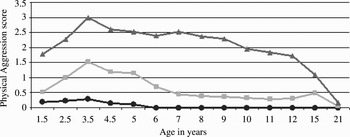
As illustrated in our Figure 1, analyses of physical aggression developmental trajectories during early childhood showed that frequency of aggression increases dramatically for most children from its onset at the end of the first year after birth until it reaches a peak between the third and fourth year (Côté et al. Reference Côté, Boivin, Nagin, Japel, Xu, Zoccolillo, Junger and Tremblay2007). If this general increase is driven by social learning of aggression (Bandura Reference Bandura1973), it is unlikely to be from imitation of virtual violent models. Still, it could be learned from parents, siblings, and peers. Yet, reliance on social learning theory of aggression poses major challenges to account for life-span sex differences. The main challenge comes from the observation, as illustrated in Figure 1, that the peak frequency of physical aggressions between 3 and 4 years is followed by a steadily decreasing trend for most children until adulthood (Côté et al. Reference Côté, Vaillancourt, LeBlanc, Nagin and Tremblay2006; Loeber et al. Reference Loeber, Lacourse, Homish, Tremblay, Hartup and Archer2005; Nagin & Tremblay Reference Nagin and Tremblay1999; National Institute of Child Health and Development [NICHD] 2004). Counterintuitively, the frequency of physical aggression declines during periods (middle childhood and adolescence) when exposure to physical aggression in the neighborhood and the media increases dramatically.
Developmental trajectories of physical aggression from 17 months to 21 years based on two Québec population samples: 17 months to 5 years (N = 1758), 6 to 21 years (N = 2000).

This observation was totally unexpected from the “social learning of aggression” and “social role/biosocial” perspectives. Why would children suddenly reverse the developmental trend presumably set by their family environment during the first three years of life? To our knowledge no “social role” or “social learning” theorist has suggested that the majority of infants learn to aggress from their parents and unlearn from the mass media and the neighborhood. The fact that boys are more physically aggressive than girls by 17 months (Alink et al. Reference Alink, Mesman, van Zeijl, Stolk, Juffer, Koot, Bakermans-Kranenburg and van IJzendoorn2006; Baillargeon et al. Reference Baillargeon, Zoccolillo, Keenan, Côté, Pérusse, Wu, Boivin and Tremblay2007) points to the powerful role of biological factors (Dionne et al. Reference Dionne, Boivin, Tremblay, Laplante and Pérusse2003), as Archer points out. However, these biological factors can be the product of early environmental conditions as well as genetic inheritance.
Epigenetic effects of maternal care
Developmental trajectory studies from childhood to adulthood show that a small group of children maintain high frequencies of physical aggression (see Fig. 1). This exception to the rule is useful to search for the environmental and genetic differences between the majority who learn not to physically aggress from early childhood onwards and the minority that maintains an atypically high frequency of physical aggression. As argued by Archer, males are more likely to be on the high trajectory. There is also accumulating evidence that specific genetic profiles, especially for males, are involved in neurological deficits which handicap learning alternatives to physical aggression (Buckholtz & Meyer-Lindenberg Reference Buckholtz and Meyer-Lindenberg2008). However, much of the variance in physical aggression is accounted for by environmental factors related to maternal characteristics such as the mother's history of behavior problems during adolescence; low levels of education; childbearing during adolescence; smoking during pregnancy; depression; and coercive parenting early after birth (Côté et al. Reference Côté, Vaillancourt, LeBlanc, Nagin and Tremblay2006; Nagin & Tremblay Reference Nagin and Tremblay1999; NICHD 2004).
Research on nonhuman primates has shown the importance of early maternal care on the development of unregulated aggression (Suomi Reference Suomi, Tremblay, Hartup and Archer2005), while rodent work on early maternal behavior shows differential sex effects on play-fighting, sexual behavior, and reproductive success (Cameron et al. Reference Cameron, Fish and Meaney2008; Parent & Meaney Reference Parent and Meaney2008). There is also growing evidence from human studies of early environmental genetic programming effects which can explain differences in brain development and regulation of behavior, including aggression and suicide (McGowan et al. Reference McGowan, Sasaki, D'Alessio, Dymov, Labonté, Szyf, Turecki and Meaney2009 Tremblay Reference Tremblay2008). From this perspective a key proximal mechanism for sex differences in aggression may be strongly based on maternal behavior during the perinatal period through its impact on infant gene expression, brain development, and behavior development, and eventually on the next generation through reproductive behavior (Gluckman & Hanson Reference Gluckman and Hanson2005; Meaney Reference Meaney2001).
The link between maternal behavior and frequent male physical aggression appears important to understand the reason we observe relatively large physical aggression sex differences in modern societies despite the fact that the use of this form of aggression to resolve conflicts is largely condemned for males and females. Indeed, frequency of physical aggression is one of the best predictors of male school failure and exclusion from the labor market (Kokko & Pulkkinen Reference Kokko and Pulkkinen2000; Vitaro et al. Reference Vitaro, Brendgen, Larose and Tremblay2005). Longitudinal studies of females with physical aggression problems during childhood show that, although they do not maintain high levels of physical aggression during adolescence and early adulthood, they tend to fail in school, suffer from depression, are likely to mate with behavior problem males, to become pregnant during adolescence, to smoke during pregnancy, and to use coercive behavior towards their children (Fontaine et al. Reference Fontaine, Carbonneau, Barker, Vitaro, Hébert, Côté, Nagin, Zoccolillo and Tremblay2008; Serbin et al. Reference Serbin, Cooperman, Peters, Lehoux, Stack and Schwartzman1998). In other words, they have all the risk factors needed to place their male children on a trajectory of chronic physical aggression. From this perspective males who mate with well-adapted females should in the long run contribute to the reduction of physical aggression sex differences among humans. It can also be argued that helping maladjusted females adapt to the modern environment will increase the likelihood that their male children will be less physically aggressive and thus reduce sex differences in physical aggression.