The differences between the sexes have been extensively studied for decades (Kimura, Reference Kimura2000; Mealy, Reference Mealy2000; Zell, Krizan, & Teeter, Reference Zell, Krizan and Teeter2015), and language-related sex differences have attracted considerable scientific attention (Dindia & Canary, Reference Dindia and Canary2006). Research on the topic has revealed that, to gain and maintain status, men's verbal behavior is oriented more than women's toward competition, dominance, self-assertion, and hierarchy, especially in all-male groups (Eckert & McConnell-Ginet, Reference Eckert and McConnell-Ginet2003; Guiller & Durndell, Reference Guiller and Durndell2007; Lange, Reference Lange2011; Locke & Bogin, Reference Locke and Bogin2006). By contrast, women show more sociability in their communication (e.g., Haas, Reference Haas1979).
Another branch of such research has revealed that women slightly outperform men on several language tasks, though the difference is usually small and robust for only some verbal fluency tasks (Hyde & Linn, Reference Hyde and Linn1988; Kimura, Reference Kimura2000; Maccoby & Jacklin, Reference Maccoby and Jacklin1974; Wallentin, Reference Wallentin2009). In terms of language acquisition, girls also seem to have a slight advantage over boys (Ullman, Miranda, & Travers, Reference Ullman, Miranda, Travers, Becker, Berkley and Geary2008), as Stern and Stern (Reference Stern and Stern1987/1907) proposed in the early twentieth century.
The younger the child and the more basic the linguistic domain, the stronger this language-related sex difference seems (Wallentin, Reference Wallentin2009). At the age of 8–16 months, girls outperform boys in word comprehension, and at age 8–30 months, in word production as well (Fenson et al., Reference Fenson, Dale, Reznick, Bates, Thal and Pethick1994). Feldman et al. (Reference Feldman, Dollaghan, Campbell, Kurs-Lasky, Janosky and Paradies2000) have shown a female advantage in vocabulary production at the age of 1–2 years, which Galsworthy, Dionne, Dale, and Plomin (Reference Galsworthy, Dionne, Dale and Plomin2000) and Szagun, Stumper, and Schramm (Reference Szagun, Stumper and Schramm2009) have supported with similar findings. In a Swedish sample, Berglund, Eriksson, and Westerlund (Reference Berglund, Eriksson and Westerlund2005) revealed a female advantage in both vocabulary production and vocabulary comprehension at the age of 18 months, a result that Bleses et al. (Reference Bleses, Vach, Slott, Wehberg, Thomsen and Madsen2008) similarly found in a Danish sample. The findings of another study involving French-speaking Canadian children aged 8–30 months were also comparable (Bouchard, Trudeau, Sutton, Boudreault, & Deneault, Reference Bouchard, Trudeau, Sutton, Boudreault and Deneault2009). Furthermore, as Bornstein Hahn, and Haynes (Reference Bornstein, Hahn and Haynes2004) have demonstrated, at the age of 2–5 years females have an advantage over males in several linguistic domains, including vocabulary production, verbal comprehension, sentence complexity, and use of expressive language. Girls also reach the milestone of possessing a productive vocabulary of at least 50 words sooner than boys (Nelson, Reference Nelson1973). It is important that this last threshold is used to distinguish so-called late talkers and children of nondelayed linguistic development (Rescorla, Hadicke-Wiley, & Escarce, Reference Rescorla, Hadicke-Wiley and Escarce1993; Rescorla & Schwartz, Reference Rescorla and Schwartz1990).
By contrast, concerning sex differences in the acquisition of morphosyntactic aspects of language and grammar, results show either far less consistency or small effect sizes (Bornstein et al., Reference Bornstein, Hahn and Haynes2004; Fenson et al., Reference Fenson, Dale, Reznick, Bates, Thal and Pethick1994). The general heterogeneity of such findings suggests that, regarding grammar and in later childhood, sex differences are especially minor, if not nonexistent (Bornstein et al., Reference Bornstein, Hahn and Haynes2004; Hayiou-Thomas, Dale, & Plomin, Reference Hayiou-Thomas, Dale and Plomin2012; Wallentin, Reference Wallentin2009). Altogether, the various findings arguably support that girls’ language acquisition is quicker than boys’, though this advantage fades around school age at about 6 years (Beltz, Blakemore, & Berenbaum, Reference Beltz, Blakemore, Berenbaum, Tager-Flusberg, Rakic and Rubenstein2013; Bornstein et al., Reference Bornstein, Hahn and Haynes2004; Wallentin, Reference Wallentin2009).
However, it is important that all of the above sex differences refer to mean values, even though the sexes might also differ in variability (Feingold, Reference Feingold1992, Reference Feingold1995), as the male sex generally shows greater phenotypic variance than the female sex for several traits. Greater variance among males than females has been found, for instance, in terms of verbal proficiency (e.g., Hedges & Nowell, Reference Hedges and Nowell1995; Strand, Deary, & Smith, Reference Strand, Deary and Smith2006). Men seem to be overrepresented at both ends of the distribution of language competence. On the one hand, nearly all areas of life in which verbal proficiency facilitates social success and status are somewhat dominated by men. Most writers are men (Lange & Euler, Reference Lange and Euler2014; Miller, Reference Miller, Dunbar, Knight and Power1999), for example, an overrepresentation that also characterizes other verbally oriented occupations, such as those in law, journalism, politics, higher education, and public speaking (Burling, Reference Burling1986, Reference Burling2005; Halpern, Reference Halpern2000).
On the other hand, regarding poor verbal abilities at the other end of language competence, evidence of men's overrepresentation, even during childhood, is more convincing (Zubrick, Taylor, Rice, & Slegers, Reference Zubrick, Taylor, Rice and Slegers2007). It is well known that language impairments, disorders, and pathologies, including dyslexia, stuttering, and developmental language disorders, are more prevalent in males than in females (Andrews, Reference Andrews1964; Arden & Plomin, Reference Arden and Plomin2006; Ardila, Rosselli, Bateman, & Guzmán, Reference Ardila, Rosselli, Bateman and Guzmán2000; Bloodstein, Reference Bloodstein1995; Canning & Lyon, Reference Canning and Lyon1989; Felsenfeld et al., Reference Felsenfeld, Kirk, Zhu, Statham, Neale and Martin2000; Halpern, Reference Halpern2000; Thomson & Polnay, Reference Thomson and Polnay2002). Such findings indicating that more males than females are affected by language problems are furthermore quite robust, as research has long shown (Eme, Reference Eme1979; Fairweather, Reference Fairweather1976; Ingram, Reference Ingram, Lenneberg and Lenneberg1975; Jespersen, Reference Jespersen1922).
These examples of greater variance among males than females with respect to language are moreover supported by statistical analyses. For instance, Strand et al. (Reference Strand, Deary and Smith2006) demonstrated greater male than female variance regarding verbal classification, sentence completion, and verbal analogies. In addition, Hedges and Nowell (Reference Hedges and Nowell1995) found greater variance among males in terms of vocabulary, reading, and writing, similar to what Reynolds, Hewitt, Erickson, and Silberg (Reference Reynolds, Hewitt, Erickson and Silberg1996) found in terms of oral reading ability.
To our knowledge, however, only Eriksson et al. (Reference Eriksson, Marschik, Tulviste, Almgren, Pérez Pereira and Sonja Wehberg2012) have studied sex differences according to variance in the language acquisition of children (aged 1–2 years). Moreover, the study did not find any evidence to suggest greater variance among males than females, at least not at such a young age. It is therefore possible that sex differences in variance do not emerge until around the age of 3 years (Arden & Plomin, Reference Arden and Plomin2006; Eriksson et al., Reference Eriksson, Marschik, Tulviste, Almgren, Pérez Pereira and Sonja Wehberg2012). At the same time, it could simply be too difficult to measure such young children's language competence to sufficiently detect sex differences in variance before the age of 3 years.
Because language-related sex differences in variance have been widely ignored, especially regarding early language development, the objective of this study was to assess sex differences, in terms of both means and variance, in language acquisition in several linguistic domains (e.g., vocabulary and grammar) among a representative sample of German preschool children aged 3–6 years. In so doing, we sought to discover whether sex differences not only in mean values but also in variance emerged in different domains of language development. The age range in our research (3–6 years) seemed more appropriate based on previous research on sex differences in language acquisition, as reported above.
METHODS
Participants
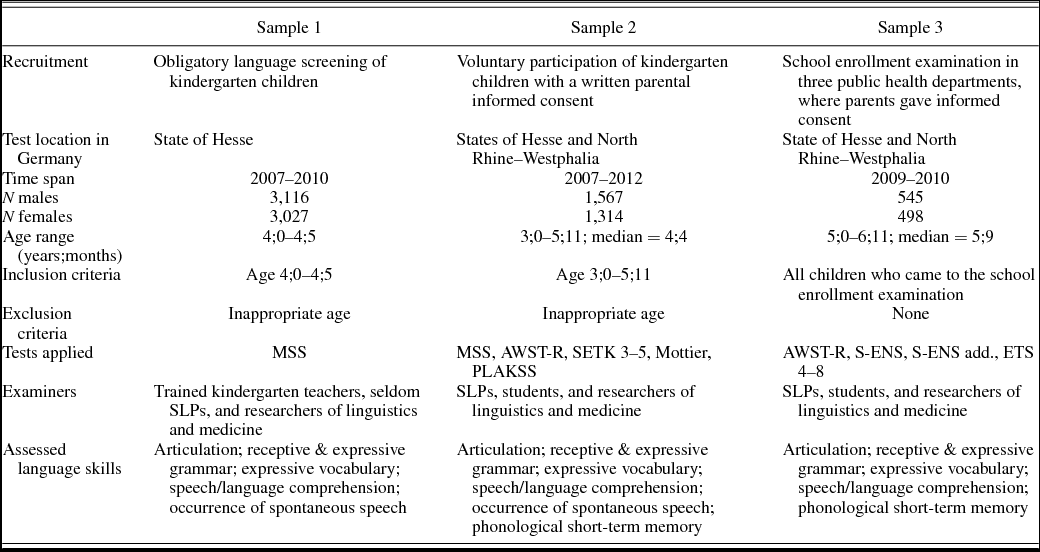
The present study is a retrospectively conducted analysis of all available data originally collected during the development of a language screening test (Euler et al., Reference Euler, Holler-Zittlau, van Minnen, Sick, Dux and Zaretsky2010; Neumann, Holler-Zittlau, et al., Reference Neumann, Holler-Zittlau, van Minnen, Sick, Zaretsky and Euler2011). Data were collected in several towns and rural areas in the states of Hesse and North Rhine–Westphalia in Germany during 2007–2012. As Table 1 shows, there were three parts with different test batteries and samples: Sample 1, Sample 2, and Sample 3. The study thus consisted of three samples because data were collected on several occasions during the construction of the language screening test.
Description of the samples

Note: MSS, Marburger Sprachscreening (revised version, Euler et al., Reference Euler, Holler-Zittlau, van Minnen, Sick, Dux and Zaretsky2010; Neumann et al., Reference Neumann, Holler-Zittlau, van Minnen, Sick, Zaretsky and Euler2011); AWST-R, Aktiver Wortschatztest für 3- bis 5-jährige Kinder—Revision (Kiese-Himmel, Reference Kiese-Himmel2005); SETK 3–5, Sprachentwicklungstest für drei- bis fünfjährige Kinder (Grimm, Reference Grimm2001); Mottier, Mottier Test (Kiese-Himmel & Risse, Reference Kiese-Himmel and Risse2009; Mottier, Reference Mottier1951); PLAKSS, Psycholinguistische Analyse kindlicher Sprechstörungen (Fox, Reference Fox2005); S-ENS, Screening des Entwicklungsstandes bei Einschulungsuntersuchungen (Döpfner et al., Reference Döpfner, Dietmair, Mersmann, Simon and Trost-Brinkhues2005); S-ENS add., additional validated S-ENS items (Neumann et al., Reference Neumann, Holler-Zittlau, van Minnen, Sick, Zaretsky and Euler2011b); ETS 4–8, Entwicklungstest Sprache für Kinder von 4 bis 8 Jahren (Angermeier, Reference Angermeier2007); SLPs, speech–language pathologists.
For Sample 1, speech and language tests were administered in daycare centers in Hesse as part of a universal language screening. Participants were therefore recruited regardless of variables such as socioeconomic or ethnic background and the native language of parents. Because nearly all children in Germany attend daycare centers (2010 data shows percentages ranging from 89% for 3-year-old to 96% for 4- and 5-year-old children; Statistisches Bundesamt, 2012), Sample 1 can be considered unselected.
Contrary to Sample 1, participation in Samples 2 and 3 was not obligatory and required the informed consent of parents or caregivers. For Sample 2, letters were written to more than 1,000 daycare centers. Both the daycare centers and families were contacted without any preselection, though some facilities (e.g., Catholic ones) and parents (e.g., those with a very limited command of the German language) tended to abstain from participation in the study. The number of participants per daycare center varied greatly, from 1 to 60, depending on its size and enrollment of children of the required age group. For Samples 1 and 3, dropout from the study was rare because children were tested and, if necessary, retested until they completed the entire battery.
Participation in the study for Sample 2 was predominantly organized by the University Hospital of Frankfurt am Main, Germany, whereas that for Sample 1 was mostly organized by various public health departments. Therefore, although most children were tested in Hesse, the geographical overlap between the test locations of Samples 1 (predominantly Frankfurt am Main) and 2 (predominantly beyond Frankfurt am Main) was minimal.
For Sample 3, the parents of all children who had been invited to three public health departments for the nationally mandatory school enrollment examination were contacted. The tests administered in Sample 3 were selected to improve the typically brief and thus unreliable screening tests of language skills in the school enrollment examination. Accordingly, parents who gave their informed consent to participate in the study for Sample 3 might have been more concerned with the language development of their children than those in Samples 1 and 2. Some indirect evidence supports this assumption, namely, that the rate of children who stuttered was, at least on a descriptive level, greater in Sample 3 (5%) than in Samples 1 (1%) and 2 (2%). All samples consisted of both monolingually German and bi- or multilingual children.
Although children in Sample 1 did not reappear in either Sample 2 or Sample 3, 158 children from Sample 2 had also been invited to the public health departments for their school enrollment examination because tests for Sample 3 were being conducted there. As such, these children (94 males, 64 females) were retested for Sample 3. The time span between participation in the tests in Samples 2 and 3 ranged from 0 to 33 months, with a median of 15 months.
Language tests and questionnaires
All participating children were tested with several language tests. The diversity of tests employed was because data used in the current study originated during the development of the above-mentioned language screening test, for which several different language tests were used. All available tests were reused for the statistical analysis of sex-related differences in language competence because it was possible that two tests addressing the same linguistic domain would yield contradictory results. The same reasoning motivated the use of not one, but all three available samples for this retrospective study.
Depending on their respective sample, children were tested with a validated and modified version of the language test Marburger Sprachscreening (MSS; Euler et al., Reference Euler, Holler-Zittlau, van Minnen, Sick, Dux and Zaretsky2010; Neumann, Holler-Zittlau, et al., Reference Neumann, Holler-Zittlau, van Minnen, Sick, Zaretsky and Euler2011) or other validated speech and language tests or both. Pronunciation (i.e., phonetic and phonological skills) was tested with the common German-language tests MSS, the Psycholinguistische Analyse kindlicher Sprechstörungen (Fox, Reference Fox2005), and the Screening des Entwicklungsstandes bei Einschulungsuntersuchungen (S-ENS; Döpfner, Dietmair, Mersmann, Simon, & Trost-Brinkhues, Reference Döpfner, Dietmair, Mersmann, Simon and Trost-Brinkhues2005). The MSS includes, among others, a spontaneous speech task with two items: children were asked to describe what they see on the MSS picture, and some items later, they were allowed to ask the language tester anything they wanted in regard to the same picture. Grammar was also examined with the MSS, as well as the Sprachentwicklungstest für drei- bis fünfjährige Kinder (SETK 3–5; Grimm, Reference Grimm2001), additional validated S-ENS items (S-ENS add.; Neumann, Zaretsky, & Euler, Reference Neumann, Zaretsky and Euler2011), and the Entwicklungstest Sprache für Kinder von 4 bis 8 Jahren (ETS 4–8; Angermeier, Reference Angermeier2007). Meanwhile, tasks concerning vocabulary were part of the MSS, the Aktiver Wortschatztest für 3- bis 5-jährige Kinder—Revision (AWST-R; Kiese–Himmel, Reference Kiese-Himmel2005), and the S-ENS add. Subtests addressing speech comprehension were part of the MSS, ETS 4–8, and SETK 3–5. The MSS, S-ENS, S-ENS add., SETK 3–5, ETS 4–8, and AWST-R use color illustrations of many child-relevant activities and objects to initiate utterance and test various abilities. The MSS was excluded from the test battery for Sample 3 because it was designed for younger children.
The MSS and S-ENS also examine phonological short-term memory by way of the repetition of sentences and nonce words. For Sample 1, however, the repetition of sentences and nonce words was not part of the MSS. At the same time, the Mottier (Reference Mottier1951) test, which examines phonological short-term memory and speech-motoric coordination and consists of nonce words that children have to repeat, was used in its updated version (Kiese–Himmel & Risse, Reference Kiese-Himmel and Risse2009).
For the AWST-R, two different short versions with partly different items were designed and validated: one for Sample 2 (i.e., younger children) and one for Sample 3 (i.e., older children). The original German version of the AWST-R contains 75 items and is thus too extensive to be part of a test battery for preschool children. The most appropriate items were selected for inclusion on the basis of data collected in previous studies. The internal consistency of the abbreviated test AWST-R showed a Cronbach α of 0.94 (cf. α = 0.95 for a full-test version in our sample of 208 children). For further details on the included samples, see Table 1.
Questionnaires for parents (Samples 2 and 3) and daycare center teachers (Samples 1 and 2) were also developed during the construction of the above-mentioned language screening test (see Appendix A). Apart from addressing the demographic and sociolinguistic characteristics of children, these questionnaires sought the subjective judgments of daycare center teachers and parents regarding children's language competence (e.g., whether the child uses articles correctly).
Children's compliance was tested using a 3-point ordinal scale (good, average, and poor) with the MSS in Samples 1 and 2 and with the S-ENS add. in Sample 3. Poor compliance indicated that the child did not cooperate with the examiner and that it was almost impossible to complete all tasks with the child.
Expert panels were also held for all samples to assess the children's language development based on questionnaires and language tests, including audio records. Experts such as speech and language pathologists, researchers in linguistics, and professors classified participants as (a) needing or not needing additional education support (e.g., language courses) in acquiring and learning German; and (b) needing or not needing additional medical help in acquiring and learning German.
Demographic and sociolinguistic characteristics of the samples
The age difference between boys and girls in Samples 2 and 3 was not significant according to the Mann–Whitney U test (ps ≥ .263). For Sample 1, no exact information regarding the age of participants was available, though children were normally tested within 2–3 months after reaching 4 years of age.
To control whether the sociolinguistic background of boys and girls was comparable in Samples 2 and 3 (no such information was available for Sample 1), several variables from the questionnaires for parents and daycare center teachers were compared using cross tables. There were no significant differences in the chi-square values of variables that might have influenced the language development of participants (ps ≥ .13). This group contained several variables: whether the child attends the daycare center for a half or whole day; attended nursery school during the first 2 years of life; receives educational support (e.g., language courses) in learning German; plays after daycare with peers who speak German, or if not a native German speaker, plays with peers who speak the same other language; attends the daycare center regularly; enjoys coming to the daycare center; likes to play with other children; and is involved in extracurricular activities (e.g., clubs). The proportion of immigrant children was not significantly different between boys and girls (ps ≥ .480), and there were no significant differences in the length of contact with the German language between boys and girls in this group according to the Mann–Whitney U test (ps ≥ .309). Similarly, no significant differences were identified between boys and girls in Samples 2 and 3 in terms of length of daycare center attendance (ps ≥ .467).
To control whether medical variables were comparable for both sexes, further information provided by the questionnaires from Samples 2 and 3 was analyzed. No significant differences emerged in the following variables describing children as examined in cross tables using chi-square tests (ps ≥ .06): has a mental handicap, has a permanent hearing disorder, has a permanent sight disorder, has frequent inflammations of the middle ear, has an auditory processing disorder, takes medication, receives therapy, has considerable or severe illness, was a premature baby or had a difficult birth, and has a disorder or illness influencing language development. However, in Sample 3, boys showed significantly (5%) more disorders and illnesses that can influence language development than did girls, χ 2 (1) = 6.06, p = .014, Ns = 396 males, 365 females, while in Sample 2, boys more often showed problems with hearing than did girls; the proportion of boys with such problems was often or always 2.3% greater, χ 2 (4) = 47.82, p < .001, N = 958 males, 793 females. However, this result is not surprising, because boys are generally overrepresented among children with language deficits, as explained earlier, and hearing disorders (Commission of the European Communities, 1979; Finck-Krämer, Spormann-Lagodzinski, & Gross, Reference Finck-Krämer, Spormann-Lagodzinski and Gross2000). Furthermore, there were no significant differences in the following family-related variables as cross tables using chi-square tests showed (ps ≥ .082): parents with problems with reading and writing, family member with a language disorder, and family member who stutters.
For Sample 2, total scores of correct answers on the language screening MSS were compared for three different age groups: 3-year-olds (N = 115 males, 114 females; median age = 3 years, 8 months [3;8]), 4-year-olds (N = 1,288 males, 1,062 females; median age = 4;3), and 5-year-olds (N = 148 males, 127 females; median age = 5;4). Again, sociolinguistic and demographic characteristics of children were compared on the basis of questionnaires for parents and daycare center teachers. For the subsample of 3-year-old children, no statistically significant differences between boys and girls were identified regarding any demographic or sociolinguistic variables. Meanwhile, 4-year-old boys more often than girls did not hear well according to our data, χ2 (4) = 48.62, p < .001, N = 860 males, 691 females, though there were no further differences between the sexes. By greater contrast, according to our data, 5-year-old boys suffered more often than girls from language-related disorders or illness, χ2 (1) = 5.63, p = .018, N = 18 males, 23 females, and from hearing disorders, χ2 (4) = 11.32, p = .023, N = 21 males, 23 females, as well as significantly more often received some kind of therapy, χ2 (1) = 5.54, p = .019, N = 104 males, 80 females. After the application of either Bonferroni or Bonferroni–Holm adjustment and considering the low size of Sample 3, only results with p < .001 are considered statistically significant. In Sample 1, boys and girls were not significantly different according to the proportion of mental handicaps, hearing disorders, and family language disorders, as cross tables using chi-square tests showed (ps ≥ .065). Because no further demographic or sociolinguistic variables were available, the sexes in Samples 1–3 were assumed to be widely comparable, and medical or socioeconomic confounding factors were assumed to not exist.
A small subgroup in Sample 2 also participated in the Colored Progressive Matrices (CPM) intelligence test (Raven, Reference Raven2009). The difference between boys (n = 105, M = 16.07, SD = 4.11) and girls (n = 70, M = 16.76, SD = 3.39) was not significant (p = .138), though girls scored numerically higher and boys showed numerically greater variance, as could be expected (Arden & Plomin, Reference Arden and Plomin2006). Both for the CPM test and for all language tests, only the total scores of correct answers were used in calculations, without any transformation of data or weighting of test items. The CPM test had a total of 29 items; the total numbers of items on the language tests and subtests appear in Tables 2–4.
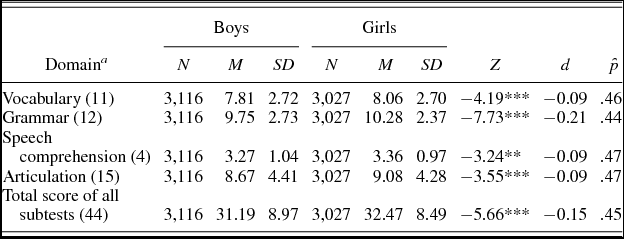
Sex differences in various linguistic domains in Sample 1 according to a modified version of the language test Marburger Sprachscreening
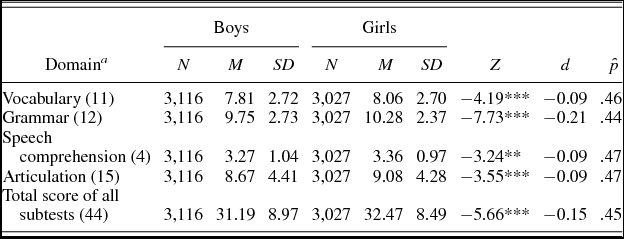
Note: Marburger Sprachscreening (Euler et al., Reference Euler, Holler-Zittlau, van Minnen, Sick, Dux and Zaretsky2010; Neumann et al., Reference Neumann, Holler-Zittlau, van Minnen, Sick, Zaretsky and Euler2011). The d and
 values are effect sizes.
a Number of items or max. raw score.
**p < .01. ***p < .001.
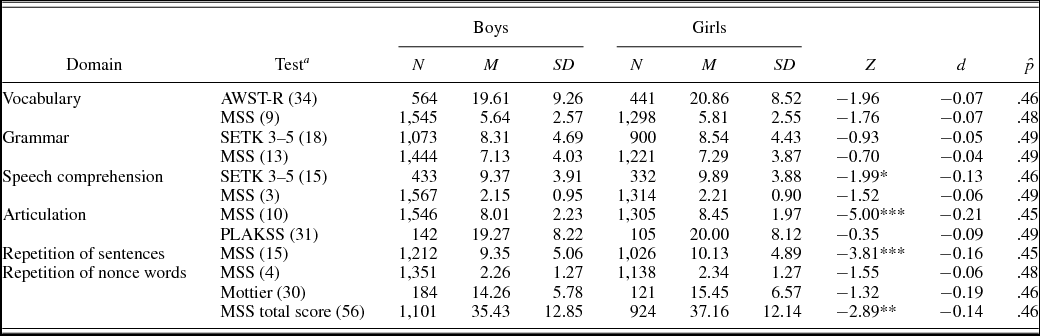
Sex differences in various linguistic domains in Sample 2

Note: AWST-R, Aktiver Wortschatztest für 3- bis 5-jährige Kinder—Revision (Kiese-Himmel, Reference Kiese-Himmel2005); MSS, Marburger Sprachscreening (revised version, Euler et al., Reference Euler, Holler-Zittlau, van Minnen, Sick, Dux and Zaretsky2010; Neumann et al., Reference Neumann, Holler-Zittlau, van Minnen, Sick, Zaretsky and Euler2011); SETK 3–5, Sprachentwicklungstest für drei- bis fünfjährige Kinder (Grimm, Reference Grimm2001); Mottier, Mottier Test (Kiese-Himmel & Risse, Reference Kiese-Himmel and Risse2009; Mottier, Reference Mottier1951); PLAKSS, Psycholinguistische Analyse kindlicher Sprechstörungen (Fox, Reference Fox2005); Mottier, Mottier Test (Kiese-Himmel & Risse, Reference Kiese-Himmel and Risse2009; Mottier, Reference Mottier1951). The d and
values are effect sizes.
a Number of items or max. raw score.
*p < .05. **p < .01. ***p < .001.
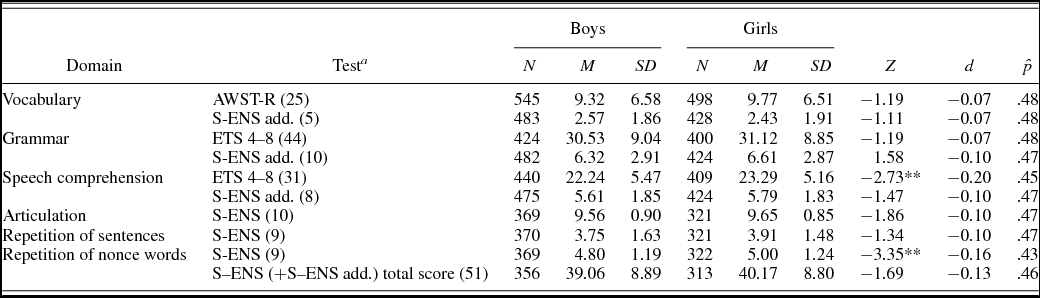
Sex differences in various linguistic domains in Sample 3 (school enrollment tests)

Note: AWST-R, Aktiver Wortschatztest für 3- bis 5-jährige Kinder—Revision (Kiese-Himmel, Reference Kiese-Himmel2005); S-ENS, Screening des Entwicklungsstandes bei Einschulungsuntersuchungen (Döpfner et al., Reference Döpfner, Dietmair, Mersmann, Simon and Trost-Brinkhues2005); ETS 4–8, Entwicklungstest Sprache für Kinder von 4 bis 8 Jahren (Angermeier, Reference Angermeier2007); S-ENS add., additional validated S-ENS items (Neumann et al., Reference Neumann, Holler-Zittlau, van Minnen, Sick, Zaretsky and Euler2011b). The d and
values are effect sizes.
a Number of items or max. raw score.
**p < .01.
Statistical analyses
According to Kolmogorov–Smirnov tests, data were not normally distributed (p < .05), which recommended the use of nonparametrical tests. In most cases, differences between boys and girls were assessed with Mann–Whitney U tests, for which a nonparametric effect size value
(probability of superiority [PS]) was provided (Grissom & Kim, Reference Grissom and Kim2012). If both groups did not differ, then
= .50, and if all values of one group were less or greater than all values of the other, then
= 1 (
= 0). A result of
= .50 is comparable to a Cohen d = 0.00, whereas a result of
= .05 or .95 corresponds more closely to an exceptionally high negative or positive d effect size. Because nonparametric effect sizes are not widely known, the Cohen d value (Cohen, Reference Cohen1988) was also calculated, though it applies strictly to parametric comparison. Negative d values indicate higher scores among females. For dichotomous or categorized variables (e.g., compliance and stuttering), cross tables with chi-square values were calculated. To analyze whether boys demonstrated greater variance than girls in their language test scores, F tests were used. For all tests, sample sizes were reported as number of boys versus number of girls. All calculations were performed using the Statistical Package for the Social Sciences version 20.
RESULTS
Sex differences in mean values among the samples
Table 2 presents the differences between boys and girls in Sample 1. Despite significant results in all linguistic domains, the effect sizes were small, as all values for Cohen d were roughly 0.1–0.2. Exclusion of immigrant children, who generally scored lower than German children on all MSS subtests (ps < .001), did not change the results substantially shown in Table 2. Differences in vocabulary, grammar, articulation, and total score remained significant on the MSS (Zs ≤ –2.55, ds ≤ –0.09,
s ≤ .49, ps ≤ .011), while differences in speech comprehension on the MSS were barely statistically significant (d = –0.06,
= .49, p = .051, N = 2,146 males, 2,133 females). Effect sizes remained almost the same (Table 2).
As shown in Tables 3 and 4, the same linguistic domains and the two additional repetition tasks (i.e., sentences and nonce words) that examined short-term phonological memory were assessed for Samples 2 and 3.
In most tests, girls showed numerically better performance than boys. Four of these differences (speech comprehension, pronunciation, repetition of sentences, and total MSS score) were statistically significant in Sample 2, and two (speech comprehension and repetition of nonce words) were significant in Sample 3, though again with small effect sizes.
Sex differences in mean values among three age groups in Sample 2
In Sample 2, for children aged 3 years, girls scored significantly higher than boys on the MSS subtest for articulation (Z = –2.33, p = .02, d = –0.30,
= .41, N = 113 males, 111 females). Concerning the MSS subtest for vocabulary, the difference was statistically significant by a slim margin (Z = –1.93, p = .053, d = –0.26,
= .42, N = 114 males, 109 females). Among children aged 4 years, girls significantly outperformed boys on the MSS subtests for articulation, repetition of sentences, and nonce words, as well as in terms of total MSS score (Zs ≤ –2.02, ps ≤ .044,
s ≤ .48, ds ≤ –0.09, Ns ≥ 1,004 males, 835 females). However, the sample size was considerably larger, and the effect sizes were minimal. For 5-year-old children, no significant differences were found (ps ≥ .270). The median of the effect size values (Cohen d) of differences between boys and girls in terms of MSS scores was –0.3 for 3-year-olds (girls scored higher) as well as –0.1 for 4-year-olds and 0.0 for 5-year-olds, which indicates that sex differences decreased with age.
Sex differences according to language experts’ judgments and questionnaires
Poorer results for male participants are reflected in the greater proportion of boys classified as requiring educational support (e.g., language courses) according to the judgments of expert panels based on results of two of the three samples: Samples 1 and 2: χ2s (1) ≥ 5.26, ps ≤ .022, Ns ≥ 1,407 males, 1,181 females; Sample 3: p = .114. Furthermore, in all three samples, the proportion of boys who stuttered according to the university language experts was significantly greater than that of girls (1.6%–6.7% for boys, 0.6–2.8% for girls), χ2s (1) ≥ 3.87, ps ≤ .049, Ns ≥ 338 males, 306 females. The judgment on stuttering was based on the audio records of the test situation (Samples 1 and 3), judgments of language testers (MSS item “stuttering: yes/no”; Samples 1 and 2), and questionnaires for parents (Samples 2 and 3) and for daycare center teachers (Samples 1 and 2). In addition, boys in all age groups were judged to show language impairments, pathologies, and disorders significantly more often than girls, according to parental report (see Demographic and Sociolinguistic Characteristics of the Samples section).
Though very few significant differences emerged in this respect according to the questionnaires, in all three samples boys were classified by university language experts as requiring medical examination significantly more often than girls, χ2s (1) ≥ 6.57, ps ≤ .010, Ns ≥ 363 males, 319 females. This result indicates that expert panels assumed, based on language tests including audio records and questionnaires, that children could have an illness, impairment, or disorder that harmed their language development. This does not mean, however, that these children had a diagnosed language-related medical issue. Furthermore, boys were more often in speech and language therapy according to the questionnaires from all three samples, χ2s (1) ≥ 6.94, ps ≤ .008, Ns ≥ 397 males, 362 females. However, according to both testers and questionnaires, in no sample did boys have a voice disorder significantly more often than girls (ps ≥ .084). Voice disorder was defined as a frequently or permanently hoarse voice. Dichotomous items on the hoarseness (yes/no) were included both in MSS (Samples 1 and 2) and in questionnaires for parents (Samples 2 and 3).
Some clues regarding sex-specific differences can be extracted from the questionnaires, in which parents and daycare center teachers provided additional information concerning the language development of the children tested. No sex differences emerged for three variables, namely, that everybody could understand what the child says, that the child can speak in complete sentences, and that, if not German speaking, then the child speaks his or her native language normally. However, boys were described significantly more often than girls as being unable to speak German appropriately according to their age: Sample 2: χ2 (1) = 6.35, p = .012, N = 316 males, 287 females; Sample 3: p = .157. Boys were also more often reported to have communication or speech comprehension problems, χ2 (1) = 9.70, p = .002, N = 149 males, 114 females; to not understand questions and requests: Sample 2: χ2 (4) = 12.43, p = .014, N = 818 males, 689 females; Sample 3: p = .546, or sophisticated tasks, χ2 (4) = 17.18, p = .002, N = 617 males, 481 females; to not have an age-appropriate vocabulary, χ2 (4) = 18.58, p = .001, N = 476 males, 359 females, or pronunciation, χ2 (4) = 19.98, p = .001, N = 478 males, 363 females; and to be unable to use articles properly, χ2 (4) = 9.94, p = .041, N = 610 males, 476 females.
Only one finding supported the assumption that girls speak out more often than boys. Boys were less talkative in groups than were girls according to a questionnaire from Sample 2 completed by daycare center teachers (item “The child speaks out during group activities” from the questionnaire for daycare center teachers), χ2 (4) = 12.04, p = .017, N = 484 males, 374 females. Neither in Sample 1 nor in Sample 2 were significant sex differences on MSS tasks for spontaneous speech found (ps ≥ .606).
It is possible that the differences found between boys and girls in the subjective (questionnaires) and objective (language tests) assessment of language skills could have been influenced by the lower compliance shown by boys than by girls in the test situation. The compliance values (good, average, and poor) of boys were significantly lower than those of girls in all three samples, χ2s (2) ≥ 6.82, ps ≤ .033, Ns ≥ 421 males, 384 females.
Sex differences in variance
The result that boys were described by parents, daycare center teachers, and university language experts as suffering from language abnormalities more often compared to girls might be linked to the expected greater variance among males than among females in verbal proficiency.
Higher male than female variance in verbal proficiency was measured objectively based on total number of correct answers in the language tests. Only total scores from the MSS and S-ENS, including the S-ENS add., the tests which examined all important linguistic domains (i.e., speech comprehension, vocabulary, grammar, phonological short-term memory, and pronunciation), were used for examining differences in variance between boys and girls.
Our data show that boys demonstrated significantly greater variance than girls regarding total MSS performance in both Sample 1 (SD = 8.97 vs. 8.49), F (3,115, 3,026) = 33.30, p < .001, and Sample 2 (SD = 12.85 vs. 12.14), F (1,100, 923) = 9.63, p = .002, but not for the S-ENS, including the additional tasks in Sample 3 (SD = 8.89 vs. 8.68), F (355, 313) = 2.67, p = .103. We also examined the proportion of the sexes in the lower and upper tails of the distribution by sorting participants into three different groups according to their total MSS score, namely, the upper 10% and lower 10%, with 80% in the middle. The sex differences within these groups were significant, χ2 (2) = 37.82, p < .001, which resulted from the overrepresentation of boys in the lower tail (1.41 boys to 1 girl). Furthermore, girls were overrepresented in the upper tail (1.42 girls to 1 boy) of the distribution. The overrepresentation of boys in the lower tail and of girls in the upper tail also surfaced in terms of the lower and upper 5% and the lower and upper 3%.
DISCUSSION
In the current study, we examined sex differences in the language development of German preschool children, primarily aged 4–6 years. In accordance with previous research (Bornstein et al., Reference Bornstein, Hahn and Haynes2004; Hayiou–Thomas et al., Reference Hayiou-Thomas, Dale and Plomin2012; Wallentin, Reference Wallentin2009), we found a slight female advantage over boys in several linguistic domains. As previous research also suggests, this sex difference seemed to vanish around school age (i.e., 6 years).
The relatively small developmental sex differences in verbal abilities found could be explained, for instance, by sex-different maturational rates. Females seem to mature faster than males, especially at young ages, and early maturation is correlated with better verbal abilities (Galsworthy et al., Reference Galsworthy, Dionne, Dale and Plomin2000; Waber, Reference Waber1976). Accordingly, language-related sex differences seem to be affected by biological factors, as can be observed by referring to genetic aspects (see below), as well as to hormonal effects. Transsexuals, for instance, experience a large decrease in performance in verbal fluency tests after androgen therapy (Kimura, Reference Kimura2000). Women seem to have greater verbal abilities (e.g., verbal fluency) in the middle of their menstrual cycle, when progesterone and estradiol levels are high (Halpern, Reference Halpern2000; Hampson & Kimura, Reference Hampson and Kimura1988; Kimura, Reference Kimura2000).
More important for our purposes, sex differences in language acquisition can also be partially caused by hormones. Albores-Gallo, Fernández-Guasti, Hernández-Guzmán, and List-Hilton (Reference Albores-Gallo, Fernández-Guasti, Hernández-Guzmán and List-Hilton2009) found that prenatal testosterone, measured via second-to-fourth digit ratios (2D:4D), was negatively correlated with vocabulary development in preschoolers. In a similar vein, Lange (Reference Lange2015) reports correlations between 2D:4D and performance in language comprehension and verbal interaction in German kindergarteners, in that high 2D:4D ratios (i.e., low prenatal testosterone) were positively correlated with language performance. As such, fetal testosterone could explain boys’ disadvantages, and thus girls’ advantages, in lexical acquisition, as findings by Lutchmaya, Baron-Cohen, and Raggatt (Reference Lutchmaya, Baron-Cohen and Raggatt2002) have also shown. These authors found that girls have larger vocabularies than boys when aged 18–24 months, an advantage that is negatively correlated with fetal testosterone. Consequently, Lutchmaya et al. (Reference Lutchmaya, Baron-Cohen and Raggatt2002) assume that fetal testosterone partially shapes neural mechanisms. More precisely, testosterone is likely responsible for advanced development of the right hemisphere in males, which could facilitate deficits and pathologies in the left hemisphere, where language functions are concentrated (Geschwind & Galaburda, Reference Geschwind and Galaburda1987; Lust et al., Reference Lust, Geuze, van de Beek, Cohen-Kettenis, Groothuis and Bouma2010). However, it is also possible that a high level of estradiol, and not necessarily a low level of testosterone, is associated with better language development (Wermke, Hain, Oehler, Wermke, & Hesse, Reference Wermke, Hain, Oehler, Wermke and Hesse2014). The question that remains is why sex differences in mean values vanish around the age of 6 years. To claim that this vanishing contradicts biological explanations would neglect the very nature of biological factors, which are well known to work differently depending on age (e.g., puberty). The vanishing sex difference might still be explained by biological factors (e.g., maturational factors). Still, it might also be that around 6 years of age, which is strikingly the age when the children in our sample enter school, specific social factors increasingly take the reins with the result of a similarity of boys and girls in language skills. Future research needs to focus on identifying the biological and social factors (and their interaction) that cause this approximation of the sexes regarding language skills.
Along with sex differences according to means, we also assessed sex differences according to variance. Based on both theoretical and empirical work, we assumed that boys would be more variable than girls in their language competence. Ultimately, this assumption was mostly supported by our data. Our results suggest that boys could simply be overrepresented among children with poor verbal abilities. This does not mean that low test scores are necessarily equivalent with language impairment.
That boys show greater variance than girls but are overrepresented only at the lower tail of the distribution could be explained by slightly greater female means. Taking former research (e.g., Eriksson et al., Reference Eriksson, Marschik, Tulviste, Almgren, Pérez Pereira and Sonja Wehberg2012) into consideration while interpreting our data, it is possible to conclude that sex differences in variance emerge around the age of 3 years.
As to why variance among males is greater than among females, reference to only social factors falls short of a sufficient explanation. Social factors cannot solely and consistently cause greater phenotypic variance among males than among females because this pattern can be found at young ages, which complicates explaining it only by environmental variables (Arden & Plomin, Reference Arden and Plomin2006; Ardila et al., Reference Ardila, Rosselli, Bateman and Guzmán2000). Furthermore, if social factors could explain sex differences in variance, then for boys a broader variety of social factors than for girls, that is, more or more diverse environmental factors, would have to be assumed. This seems unlikely. However, it cannot be ruled out that boys and girls differ on multiple social factors or that the same factors influence both sexes differently. Especially the latter argument, however, does not contradict biological explanations. Furthermore, the biological causation of language-related pathologies, which constitute one side of sex differences in variance, is evident (Alarcón et al., Reference Alarcón, Abrahams, Stone, Duvall, Perederiy and Bomar2008; Dworzynski, Remington, Rijsdijk, Howell, & Plomin, Reference Dworzynski, Remington, Rijsdijk, Howell and Plomin2007; Hayiou-Thomas, Reference Hayiou-Thomas2008; Jenkins, Reference Jenkins2000; Stromswold, Reference Stromswold2001, Reference Stromswold and Cutler2005). Moreover, such language pathologies are highly heritable in early life (Dale et al., Reference Dale, Simonoff, Bishop, Eley, Oliver and Price1998; Hayiou-Thomas et al., Reference Hayiou-Thomas, Dale and Plomin2012), and sex-specific genetic factors responsible for language and language deficits have been reported. Galsworthy et al. (Reference Galsworthy, Dionne, Dale and Plomin2000) conducted a study with children aged 3 years in order to identify sex-specific genetic factors in language development. They concluded that heritability of verbal abilities is greater in males than in females and that the etiology of vocabulary development might also differ between the sexes, thereby indicating sex-specific genetic factors regarding verbal abilities. This conclusion was based on a difference in correlations between dizygotic same-sex and dizygotic opposite-sex twins.
It is more notable that the results showing greater variance among males corroborate findings regarding the evolutionary psychology of sex differences in general and the evolution of language in particular. From an evolutionary perspective, it can be assumed that a greater phenotypic variance among males than among females mirrors the larger reproductive variance in males compared to females (Archer & Mehdikhani, Reference Archer and Mehdikhani2003; Lange, Reference Lange2012; Lange, Zaretsky, Schwarz, & Euler, Reference Lange, Zaretsky, Schwarz and Euler2014). Sex differences in variance have been reported for somatic traits as well (Lehre, Lehre, Laake, & Danbolt, Reference Lehre, Lehre, Laake and Danbolt2008), which also undermines explanations citing environmental factors. Sex differences in variance, in which males show greater variance, are reflected in sex differences in reproductive strategies (Archer & Mehdikhani, Reference Archer and Mehdikhani2003), in reproductive variance (Brown, Laland, & Borgerhoff Mulder, Reference Brown, Laland and Borgerhoff Mulder2009), and, as reported above, in heritability (Galsworthy et al., Reference Galsworthy, Dionne, Dale and Plomin2000). Nevertheless, further research is needed to explain why linguistic sex differences in variance exist and why they seem to emerge only around the age of 3 years (Eriksson et al., Reference Eriksson, Marschik, Tulviste, Almgren, Pérez Pereira and Sonja Wehberg2012).
A greater variance in language development among males than among females and a greater overrepresentation of males among children with a rather poor language acquisition, respectively, pose practical implications. It suggests that more boys may need to be offered educational support and, if necessary, special intervention regarding language. Though several biological factors influencing verbal abilities and high heritability estimations for verbal abilities have been reported, at least one third of variance in several verbal abilities is explained by environmental factors (Stromswold, Reference Stromswold2001, Reference Stromswold and Cutler2005), thus suggesting that intervention can have an effect.
Because our database included numerous demographic variables, we could confirm that no major sex differences regarding extra- or sociolinguistic variables appeared that could have confounded our results. Our samples, at least Sample 1, could furthermore be deemed unselected. We therefore conclude that the findings regarding sex differences are valid. However, our effect sizes were relatively small, and statistical significance was thus found only due to relatively large sample sizes. Simply put, the sexes are more alike than they are different (Zell et al., Reference Zell, Krizan and Teeter2015).
Future studies should aim to replicate our findings by focusing on sex differences in variance, which seems to be a neglected field of research compared to research on sex differences according to mean values. Further research should also seek to identify the causes of sex differences in language development. For sex differences in mean values, both social (e.g., sex-different rearing) and biological factors (e.g., prenatal testosterone and sex-different evolutionary selection pressures) seem to be possible explanations. Regarding sex differences in variance, genetic or chromosomal factors on a proximate level and evolutionary selection pressures linked to reproduction on an ultimate level (Archer & Mehdikhani, Reference Archer and Mehdikhani2003; Lange, Reference Lange2012) might be worth further examination, but social/sociolinguistic factors should also be taken into consideration.
APPENDIX A
Available demographic and sociolinguistic characteristics of children (questionnaires for parents and daycare center teachers)
Sample 1: (1) The child is mentally handicapped (yes/no), (2) The child undergoes/underwent a language therapy (yes/no), (3) Immigration background (yes/no), (4) The child has a permanent hearing disorder (yes/no), (5) The parents of the child have problems with reading and writing (yes/no), (6) Somebody in the family has a language disorder (yes/no).
Sample 2: (1) The child is mentally handicapped (yes/no), (2) Only for immigrants: How often the child plays with peers speaking the same (non-German) language (never–seldom–sometimes–often–always), (3) The child undergoes/underwent a language therapy (yes/no), (4) The child speaks out during group activities (never–seldom–sometimes–often–always), (5) Immigration background (yes/no), (6) The child attends daycare center for a half a day/whole day, (7). . .attended day nursery in the first 2 years of life before attending the daycare center (yes/no), (8). . .receives educational support in learning German (yes/no), (9). . .plays after daycare center time with German children (yes/no), (10). . .attends daycare center regularly (yes/no), (11). . .likes to go to the daycare center (never–seldom–sometimes–often–always), (12). . .likes to play with other children (never–seldom–sometimes–often–always), (13). . .is involved in extracurricular activities (clubs etc.) (yes/no), (14) Length of contact with the German language (since birth–1st year of life–2nd year–3rd year–4th year–5th year), (15) Length of daycare center attendance in months, (16) The child has a permanent sight disorder (yes/no), (17). . .has frequent inflammations of the middle ear (yes/no), (18). . .has auditory processing disorder (yes/no), (19). . .has a permanent hearing disorder (yes/no), (20). . .takes medication (yes/no), (21). . .receives therapy (yes/no), (22). . .has some considerable/severe illness(es) (yes/no), (23). . .was a premature baby/had a difficult birth (yes/no), (24). . .does not hear well (never–seldom–sometimes–often–always), (25). . .has some disorder or illness influencing language development (yes/no), (26) The parents of the child have problems with reading and writing (yes/no), (27) Somebody in the family stutters (yes/no), (28) The parents of the child have problems with reading and writing (yes/no), (29) Somebody in the family has a language disorder (yes/no), (30) Somebody in the family has a hoarse voice (yes/no).
Sample 3: (1) Only for immigrants: How often the child plays with peers speaking the same (non-German) language (never–seldom–sometimes–often–always), (2) Immigration background (yes/no), (3) The child attends daycare center for a half a day/whole day, (4). . .attended day nursery in the first 2 years of life before attending the daycare center (yes/no), (5) Length of daycare center attendance in months, (6) The child does not hear well (never–seldom–sometimes–often–always), (7) Somebody in the family has a language disorder (yes/no).
Subjective judgments of daycare center teachers and parents on children's German skills
Sample 2: (1) The child speaks his/her mother tongue, if not German, age appropriately (yes/no), (2) The child speaks German age appropriately (yes/no), (3) The child stutters (never–seldom–sometimes–often–always), (4) The child has a hoarse voice often or always (yes/no), (5) The child can use articles correctly (never–seldom–sometimes–often–always), (6) The child understands sophisticated tasks (never–seldom–sometimes–often–always), (7) The child uses an age-appropriate vocabulary (never–seldom–sometimes–often–always), (8) Child's speech can be understood by everyone (never–seldom–sometimes–often–always), (9) Child's pronunciation is age appropriate (never–seldom–sometimes–often–always), (10) The child can speak in full sentences (never–seldom–sometimes–often–always), (11) The child can understand questions or requests correctly (never–seldom–sometimes–often–always), (12) The child has communication or speech comprehension problems (yes/no).
Sample 3: (1) The child speaks German age appropriately (yes/no), (2) The child stutters (never–seldom–sometimes–often–always), (3) The child has a hoarse voice often or always (yes/no).