Old age, which is exposed to so many accidents and which too often is resented by those eagerly awaiting the death of the old, will be protected from vicissitudes. The Tontine will oblige those whose interest it is to prolong the life of the old, to treat them with respect and care because of the advantage they will find and will hope to increase . . . It will motivate husbands and their wives to take extremely good care of each other.
Lorenzo de Tonti (Reference Tonti, Gasseau-Dryer, Haberman and Sibbett1654)I
Policymakers and public economists in the early twenty-first century are coping with the financial and economic implications of an aging society in an era of declining corporate and government pension coverage. At the same time, there is a growing awareness that financial instruments and strategies that can and should be used by individuals to help manage personal longevity risk are limited in scope and popularity. Indeed, there is much discussion around the best way to innovate and expand the market for longevity-contingent claims.Footnote 1
Three centuries ago, the menu of products available to manage longevity risk was quite robust offering many ways to speculate and/or insure against longevity risk. One of them was the tontine, first proposed by Lorenzo de TontiFootnote 2 in 1653, and adopted in France, Holland and England and eventually (a variant) in the United States.Footnote 3 And yet, by the mid twentieth century tontines were extinct. Today, the consensus among economic historians is that English tontines, and especially the first one launched in 1693, were undersubscribed, very narrowly held and overall failures.Footnote 4
However, I believe there is more economics to the story. The previous (historically motivated) literature focuses on the national and cultural origins of long-term debt financing within the context of the financial revolution. That strand ignores the more subtle decision that thousands of wealthy tontine investors had to make in 1693 about whether to stay in the ‘riskier’ tontine or exercise an option to switch to a ‘safer’ and higher-yielding annuity. The financial economics literature labels this a portfolio choice problem. While this terminology is usually reserved for the choice between risky stocks and safe bonds, it applies equally to the different ways of managing personal longevity risk; or the risk of living longer than expected – and hence depleting one's financial resources. In this article I will examine the financial decisions around the first English tontine launched in 1693. I provide some new evidence, review the available data sources, and employ a different methodology to analyze the portfolio choice decision facing investors in this tontine.
How does a tontine work? Boiled down to its essence, a tontine is a group-purchased term-certain annuity in which the periodic payments are divided amongst survivors. For example, if each member of a group of 100 investors contributes £100 to participate in a tontine paying 5 per cent per year, then £500 is split amongst survivors each year until the last participant receives the entire £500. The issuer (or sponsor) of the tontine is obligated to pay £500 until the last of the investors dies. The exposure (to the issuer) is quite similar to the liability generated from selling a portfolio of zero-coupon bonds (or issuing self-amortizing debt) with a maturity horizon equal to the longest-living life.
In the case of government-issued tontines, the Exchequer or Treasury makes (constant) coupon payments that are divided among the survivors. In the seventeenth and eighteenth centuries, governments, cities or municipalities would issue tontines as a precursor to long-term bonds, knowing that when the last participant died they had no further debt obligations. In fact, this is probably why Alexander Hamilton advocated a tontine scheme to pay off revolutionary war debt in 1790; when the last tontine member died, the US would be debt free.Footnote 5
How does a tontine differ from a life annuity? The tontine might sound very similar to a (pension) life annuity sold by life insurance companies, but the mechanics are quite different. Conventional life annuity payouts are quite low (since they are linked to bond yields), most are fixed in nominal terms, and finding a version which will increase (to protect against inflation) can be costly.Footnote 6 More importantly, when an insurance company guarantees fixed lifetime payments and regulators impose capital requirements, the cost of the longevity guarantee (or longevity risk premium) inevitably makes its way to the consumer. In contrast, the tontine custodian (or government who issues them) divides the variable X (coupons received) by the variable Y (participants alive) and sends out the dividends. It's cleaner, less capital-intensive and results in an increasing payment stream for the participant over time, that is so long as the individual is alive.
From the individual's perspective the choice between a tontine and a life annuity (or between combinations of the two) is a portfolio choice problem and also depends on subjective longevity beliefs. The classical tontine pays more later but less earlier and is generally riskier – in the sense of standard deviation or variability of the (present value) of cash flows – while the annuity pays (usually) a constant deterministic amount and can be viewed as safer when compared with the tontine. Thus, for example, if you are certain you will live longer than your cohort and peers, then the tontine is the optimal choice.
This article combines two distinct strands of economic literature: portfolio choice in the presence of longevity risk and the actuarial topic of tontines, all against the background of the financial revolution in the late seventeenth century. I believe the contribution of the article is to examine one strand (tontines) through the prism of the other (portfolio choice). I also take the opportunity to properly document a number of features and decisions around the first English tontine, launched in 1693, that are not well known.
Ever since Menahem Yaari's (Reference Yaari1965) classic paper, economists have been aware that life annuities (a.k.a. mortality-contingent claims) have an important role to play in the optimal retirement portfolio, especially with the decline in corporate pension coverage and the increasing uncertainty in longevity. There is a robust debate in the literature on the optimal allocation to annuities, the age at which to annuitize and products that should be on the retirement income menu, among other elements.Footnote 7
The purchase of either a tontine or a life annuity is a hedge against longevity risk, entitles the investor to mortality credits and enables individuals to smooth consumption in the lifecycle sense. So, the fact that investors in late seventeenth-century England had to choose between the two should be of interest to scholars and researchers who study decision-making in the presence of longevity risk. In fact, perhaps lessons for product design in the twenty-first century can be gleaned from original tontines of the late seventeenth and early eighteenth century.
The remainder of this article is organized as follows: Section II describes King William's (first English) 1693 tontine and reviews and reconciles existing sources of information about the tontine. Section III reports on the results of a Monte Carlo Simulation used to value the tontine relative to prevailing interest rates at the time. Section IV examines the option to convert the tontine to a 14 per cent life annuity and the characteristics of those who exercised this option. Section V describes what is known about the above-average survival pattern of tontine participants.Footnote 8 In this section I argue that while anti-selection might have been a factor in the decision to remain in the tontine vs switching to the annuity, it is quite likely that a fraction of the reported high survival rate was actually the result of fraud. Section VI concludes the article.
II
As part of the early attempts to float long-term debt, prior to the establishment of the Bank of England in 1694, the British government experimented with a number of life-contingent and lottery-based loansFootnote 9 – one of which revolved around a tontine scheme.
In January 1693,Footnote 10 during the fifth year of the reign of King William and Queen Mary, the British Parliament passed the Million Act, designed to raise one million pounds towards carrying on the war against France. The Act specified that prior to 1 May 1693 any British native or foreigner could purchase a tontine share from the Exchequer for £100 and thus gain entry into the first British government-run tontine scheme.Footnote 11
For £100 a contributor (annuitant) could select any nominee of any age – including the contributor himself – on whose life the tontine would be contingent. Dividend payments would be distributed to the investor as long as the nominee was still alive.Footnote 12 To put the magnitude of the £100 investment in perspective, the average annual wage of a building laborer in England during the latter part of the seventeenth century was approximately £16 and a few shillings per year.Footnote 13 Thus the entry investment in the tontine pool far exceeded the average industrial wage and the annual dividends alone might serve as a decent pension for a common laborer. The 1693 tontine was clearly an investment for the wealthy, compared to lower-priced shares in French tontines.
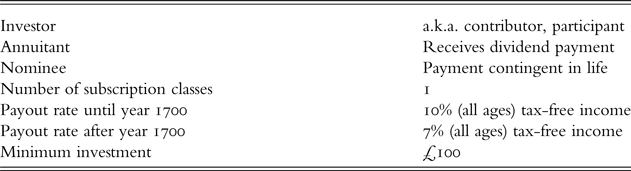
King William's 1693 tontine was slightly different from the original tontine scheme envisioned by Lorenzo de Tonti in 1653. The original scheme involved multiple classes, which serves to reduce the transfer of wealth from older to younger participants. In King William's tontine, each share of £100 entitled the investor to an annual dividend of £10 for seven years, after which the dividends would be reduced to £7 per share. These 10 and 7 per cent tontine dividend rates exceeded prevailing (private sector, short-term) interest rates in England at the end of the seventeenth century, which were officially capped at 6 per cent.Footnote 14 It is worth noting the declining structure of the interest payments in the 1693 tontine, which is closer to the optimal structure of a tontine.Footnote 15 Perhaps in an attempt to reduce moral hazard, the Million Act establishing the 1693 tontine also stipulated that payments would be frozen when a total of seven nominees remained. Table 1 offers a high-level summary description of King William's tontine and how it differs from subsequent schemes.
High-level description of King William's 1693 tontine

Source: Raithby (Reference Raithby1819). Compiled by the IFID Centre.
King William's 1693 tontine was simple and crude. There was a single share class for all nominee ages, paying a guaranteed dividend of £10 (semi-annually) until June 1700 and then £7 thereafter. When seven nominees remained the payments were frozen. The nominee (upon whose life the payment was contingent), the annuitant (who received the payment) and the contributor (original investor) didn't have to be the same person.
Interestingly, nowhere within the Statutes of the Realm (which reproduces the Million Act) was the word tontine mentioned nor was Lorenzo de Tonti ever referenced. Rather, the Act stated innocuously: ‘And so, from time to time upon the death of every nominee, whatsoever share of dividend was payable during the life of such nominee shall be equally divided amongst the rest of the contributors.’Footnote 16 However, subsequent writers, such as Finlaison (Reference Finlaison1829), referred to this as ‘King William's tontine’ and by 1789 the tontine issued during the reign of King George III (the last British government tontine) was also officially referred to as a tontine.
Although the planFootnote 17 was to use the money raised by the tontine to fund the war, the Million Act also introduced a new excise tax on beer, ale and other liquors for a period of 99 years – with the intent to use this new tax to cover the dividends on the tontine scheme. This is an early example of funded debt or securitization, by borrowing against future tax revenues.Footnote 18
To further entice investors to participate in the tontine scheme, the Act also included a unique ‘sweetener’ or bonus provision. It stipulated that if the entire £1,000,000 target wasn't subscribed by May 1693, those who had enrolled during the six-month subscription period (starting in February 1693) would have the option of converting their £100 tontine shares to a life annuity paying £14 per year. Under this alternative, the 14 per cent dividend payments were structured as a conventional, single-premium life annuity with no group survivorship benefits or tontine features.
This ‘option-to-convert’ feature leads to the portfolio choice problem at the core of this article. Why this extra option was added to the Million Act is unclear. Part of what entices speculators to join a tontine is the large potential payout accruing to the last survivor, which is the lottery effect. More participants provide a bigger jackpot, but participants aren't likely to join unless the jackpot is big enough to begin with. So the option to convert was most likely added to give investors a possible exit strategy if they were disappointed with the number of subscribers (i.e. the size of the potential jackpot). According to Weir (Reference Weir1989), the (exit) option to convert is what doomed the 1693 tontine.
As it happens, the funds raised by early May 1963 fell far short of the million-pound target. According to Dickson (Reference Dickson1967), a total of only £377,600 was subscribed and approximately 3,540 people were nominatedFootnote 19 to the tontine between February and May 1693. The low subscription numbers and resulting missed target triggered the option for investors to exchange their tontine shares into a 14 per cent life annuity.
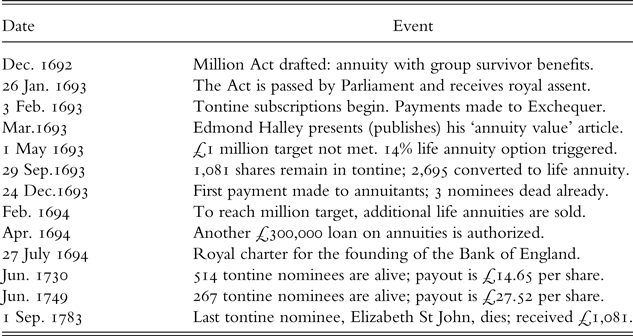
A careful count of Heyrick's (Reference Heyrick1694) list indicates that a total of 1,013 nominees (representing 1,081 tontine shares) remained in the original 10 per cent/7 per cent tontine, while the other two-thirds elected to convert their shares into a 14 per cent life annuity contingent on the same nominee. Table 2 provides a summary of the timeline of events. In an attempt to reach their funding target the government passed another Act in June 1693 which made the 14 per cent life annuity available to anyone, with no restrictions placed on the nominee's age for either the tontine or the annuity. From the perspective of the twenty-first century the actuarial pricing and structure is bizarre.
King William's tontine of 1693: timeline of major events around the Million Act
Source: Heyrick (Reference Heyrick1694), King (1730), Anonymous (1749), Dickson (Reference Dickson1967), Finlaison (Reference Finlaison1829). Compiled by the IFID Centre.
£377,600 was contributed to the tontine by 1 May 1693, which was the deadline before the option to convert to a 14 per cent life annuity came into effect. In the end, 1,081 shares (= £108,100) remained in the tontine scheme and 2,695 shares worth £100 each were converted to the 14 per cent life annuities. Although most (71 per cent) of the shares were switched to the higher-yielding life annuity paying £14, the appeal of the (riskier, higher skewness) £1,081 probably tempted those who stayed.
In fact, at first pass it is puzzling why anyone would stay in the tontine pool instead of switching to the life annuity. On an expected present value basis, a cash flow of £10 for seven years and £7 thereafter is actuarially less valuable compared to £14 for life. The expected actuarial present value of the 10 per cent/7 per cent combination at the 6 per cent official interest rate was worth approximately £142 at the (modal nominee) age of 10, whereas the value of the life annuity was worth about £188. (Remember, the original investment was £100.) The British government was (really) losing money on these 14 per cent annuities, as claimed over a century and a half later by Finlaison (Reference Finlaison1829).
It's not just twenty-first-century financial logic (and hindsight) that dictates that a 14 per cent life annuity would have been a better deal than the tontine alternative on an expected value basis. In fact, none other than the astronomer Edmond Halley, writing in the January 1693/1694 editionFootnote 20 of Philosophical Transactions of the Royal Society, opined on the matter:
This shows the great advantage of putting money into the present fund granted to their majesties, giving 14 per cent per annum, at the rate of seven years purchase for a life, when [even] the young lives at the annual [6 per cent] rate of interest, are worth above 13 years purchase.
(The phrase years purchase is an early actuarial term for the number of years before the entire investment is returned to the investor. It's another way of quoting a price.Footnote 21)
To financial economists, an interesting research question is, why did a full third of the subscribers decide to stay in the tontine pool, while two-thirds switched to the life annuity? Were the investors who remained in the tontine pool irrational or ignorant, while the life annuity investors took the better financial terms – or was this outcome a reflection of differing risk aversion and longevity expectations among individual participants?
Note that although very careful records must have originally been maintained for the purpose of administrating the tontine pool, today we only have access to the following original source documents, as per Leeson (Reference Leeson1968):
(i) a list of every tontine nominee and their age, gender, and place of abode in 1693, as well as the person assumed to be the investor. (This is referred to as the Heyrick (Reference Heyrick1694) document or list.)
(ii) a list of tontine nominees alive in the year 1730, their ages in 1693, plus a separate list of nominees that died prior to 1730. (This is referred to as the King (1730) document or list.)
(iii) a list of tontine nominees alive in the year 1749, their ages in 1693 and a certificate number next to their name. (This is referred to as the Anonymous (1749) document or list.)
These are the three primary documents at our disposal. In addition, there is a fourth document used in this analysis – not mentioned by Leeson (Reference Leeson1968) – which is a Journal of the House of Commons (JHC) extract that reports a running tally of nominee deaths from 1693 to 1745. The longest-living nominee of the 1693 tontine – who was 10 years of age at the time of initial nomination – lived to the age of 100, surviving for 90 more years to 1783. This female nominee spent her senior years in Wimbledon and earned a dividend of £1,081 in her last year of life.Footnote 22 Although her payout was capped once only seven survivors remained in the tontine pool, her final yearly payment was over ten times the original investment of £100. Note that had she switched over to the life annuity – it was most likely her father who made the decisions and nominated her – and then lived to 1783, her yearly dividend would have been a mere £14. This is a good (cherry-picked) example of someone who selected the riskier asset – and won.
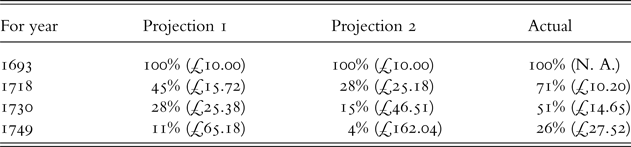
The period between the drafting of the Million Act tontine scheme in December 1692 and the date at which the final list was closed in late May/early June 1693 was quite busy and interesting. The London-based promoters of the tontine published an advertisement in early 1693 showing a low expected number of survivors and a correspondingly high dividend payout rate over the next 100 years. These initial projections were most likely viewed as unattractive because the resulting subscription rate was much, much lower than the 10,000 target. A few months later, the promoters published a follow-up table showing an even lower expected mortality rate for the group and a correspondingly higher projected dividend payout rate for survivors.Footnote 23 These projections, together with the actual experience of the 1,013 nominees who remained in the tontine, are displayed in Table 3.
King William's Tontine of 1693: projections of survivors and investment returns
Sources: Lewin (Reference Lewin2003), Walford (Reference Walford1871), Heyrick (Reference Heyrick1694), King (1730), Anonymous (1749). Compiled by the IFID Centre.
Surviving nominees are listed as a percentage of initial nominees. For the years 1730 and 1749, the exact numbers of active shares are known. For the year 1718, only the number (but not the names) of surviving nominees is available. To calculate the dividend, I took the average of £9.87 (if the maximum possible number of nominees is alive) and £10.52 (if the minimum number of nominees is alive). Promoters of the tontine scheme made projections regarding the (unknown) nominee's mortality rates and an investor's expected payout. Clearly, the initial projections made by the promoters in late 1692 were too optimistic. The revised projections made in mid 1693 to increase subscriptions were even more optimistic. In reality the payments to survivors were much lower.
For example, the promoters claimed (in their second projection) that only 4 per cent of nominees would survive to the year 1749 and therefore those (few) survivors would be entitled to a dividend of £162 per each £100 investment. This was extremely optimistic when compared with reality: we know that 26 per cent of the original nominees were still alive in the year 1749 and their dividend was a mere £27. This was obviously more than the guaranteed £10, but much less that what was projected – which actually led to accusations of fraud.
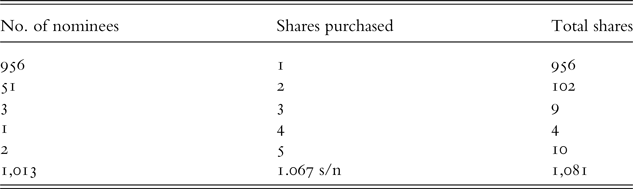
Table 4 displays the number of nominees who remained associated with the tontine vs the number of shares outstanding in the tontine, both after the switch to the life annuity had been concluded. According to the original Heyrick (Reference Heyrick1694) records, a total of 1,013 nominees were named and 1,081 shares were purchased in the tontine. Note that 956 nominees had only one share (of £100) in their name, 52 nominees had two shares purchased in their name, three nominees had three shares purchased in their name, one nominee had four shares and two nominees had five shares. In other words, there were two nominees with £500 of contributed capital contingent on their survival. It is worth noting that the nominees with multiple tontine shares contingent on their life actually died earlier and did not live as long as those nominees with single shares. This should not be viewed as puzzling or evidence of nefarious activity because the average age of nominees with multiple shares was higher (almost 14 years) compared to the average age of nominees with single shares (11 years). Naturally this group of 57 nominees died earlier than the others. They were older.
King William's tontine of 1693: shares vs nominees
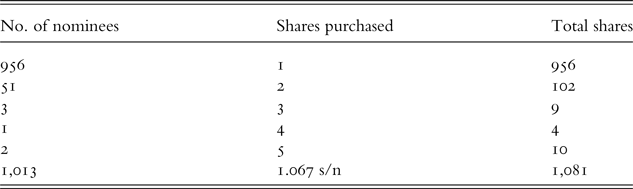
Source: Data as reported in Heyrick (Reference Heyrick1694). Compiled by the IFID Centre.
The difference between the number of tontine nominees (1,013) and the number of tontine shares (1,081) purchased has been the source of confusion over the years. A variety of sources have reported different values for the original number of nominees. On average, each nominee had 1.067 shares contingent on their life. The average age of nominees with multiple shares (13.7 years) was higher than the average age of one-share nominees (10.7 years) by three years. So naturally, nominees with multiple shares (and more money) contingent on their life died earlier (on average), but their deaths were unrelated to nefarious motives.
Finally, the number of nominees was much larger than the number of investors, also known as contributors or annuitants. Fifty-seven annuitants invested more than £100 and purchased more than one share. They perhaps diversified their risk by selecting multiple nominees, for example parents naming multiple children.
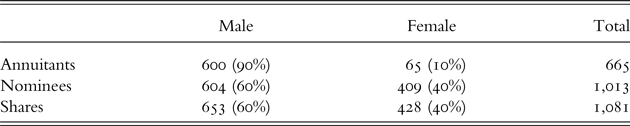
Table 5 provides a summary of the number of nominees vs the number of annuitants, as well as their gender. In the Heyrick (Reference Heyrick1694) list there are a total of 665 annuitants (i.e. the names associated with a group of nominees, who are assumed to be the investors) of whom 90 per cent were male and 10 per cent were female. It should be no surprise that the majority of investors were male. For the nominees, the gender mix was more balanced: 60 per cent were male and 40 per cent were female. From the perspective of someone writing in the twenty-first century, the rational choice would be for all nominees to be young (although not too young) females. From the perspective of the seventeenth century, though, the high mortality rate (for females) during childbirth might have counteracted the lower (younger) mortality rate, so it is unclear which choice – (young) male nominee or (young) female nominee – would have been optimal. It is worth noting that the 65 female annuitants (i.e. investors) predominantly selected young female nominees.
King William's tontine of 1693: gender of annuitants vs nominees
Source: Heyrick (Reference Heyrick1694). Compiled by the IFID Centre.
This is a tally of the annuitants vs the nominees in King William's 1693 tontine and the number of shares purchased relative to gender composition. It is implicitly assumed that the annuitant (who receives the payments) was the original contributor to the tontine because the Heyrick (Reference Heyrick1694) list doesn't distinguish between annuitants and contributors. Interestingly, most (72%) female annuitants (i.e. contributors who are the investors) selected female nominees, who would live longer.
III
Regardless of the actual payout rates, the cash-flow profile of a tontine is quite different from the profile of a life annuity. The tontine starts off making relatively low payments and then, contingent on the survival of the nominee, payments are expected to increase and are stochastic. In contrast, a life annuity generates fixed predictable payments that might be constant in nominal or real (inflation-adjusted) terms. So, even if both the tontine and the life annuity are fairly priced with an actuarially equivalent present value, the stochastic present values (SPV) of the two are distinct and will appeal to different individuals with different risk preferences. This is a key insight from portfolio choice theory: expected cash-flows are only a part of the story. To understand and appreciate this with greater precision, I now present the following formal framework. Let L denote a random variable that is the remaining lifetime of a representative nominee, with a survival probability to any given age denoted by Pr[L ≥ i] = p(i).
A life annuity that pays a constant percentage α (e.g. 14 per cent) of the contributed investment capital W, for life, will have a stochastic present value that is denoted by and defined equal to:
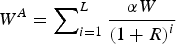 $${ W}^A = \mathop \sum \nolimits_{i = 1}^{ L} \displaystyle{{\alpha W} \over {\left({1 + R} \right)^i }}$$
The summation of discounted cash-flows at the rate of R per period (a.k.a. internal rate of return or IRR), takes place from time period i = 1 until the (random) time of death L. And, although strictly speaking one should not place a random variable (lifespan) at the upper range of a summation sign, this does serve to remind the reader that the present value W A itself is random. One can then examine the expected PV of W A, which is denoted by E[W A] or the standard deviation of W A, the coefficient of skewness, how its payoff correlates with other background risk, etc. All of these are important to an individual contemplating how much wealth to allocate to the annuity because they impact and drive utility.
In some special and unique cases when the law of mortality governing L is simple, one can actually express the probability density function (PDF) of W A in closed form. The above-mentioned moments would then be available analytically as well, which makes the computation of expected utility easier too. But, even if one can't obtain an analytic expression for W A, one can always simulate W Aj, j = 1..n by generating n values of L j, and then computing the required moments and expectations. A life annuity is said to be fairly priced, relative to a rate R, if E[W A] = W, for a given mortality curve p(i). (See technical Appendix A for more details.)
One can use a similar approach to model the SPV of a tontine scheme. Now, in addition to the remaining lifespan of the nominee, one must keep track of the number (or at the very least, fraction) of other nominees who are still alive at time period i. This number will be denoted by M i, with the understanding that M 0 is the original number of nominees and M i+1 ≤ M i, since no resurrections are allowed. There is also an understanding the M i = 0 for some sufficiently large value of i.
If τi denotes the tontine payout rate (for example, τi = 10 per cent for seven years and then τi = 7 per cent thereafter) and W denotes the initial cost per tontine share, then the equivalent expression for the stochastic present value of the tontine would be:
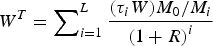 $${ W}^T = \mathop \sum \nolimits_{i = 1}^{L} \displaystyle{{\lpar \tau _i W\rpar { M}_0 /{ M}_i } \over {\left({1 + R} \right)^i }}$$
Note the double stochasticity in the definition of W T. First, there is uncertainty around the number of survivors at time period i as well as the uncertainty of the life status of the representative nominee. And, while analytic expressions for the probability density of W T are rather hopeless, simulation values can be generated just as easily. So, as in the case of the life annuity, one can compute the expected PV, which is E[W T] of the tontine scheme, as well as higher moments. The tontine scheme would be considered actuarially fair if E[W T] = W, or in other words, if the expected value of cash flows is exactly equal to what was paid (e.g. £100) to purchase a share in the tontine. Again, Appendix A describes how such a simulation is constructed.
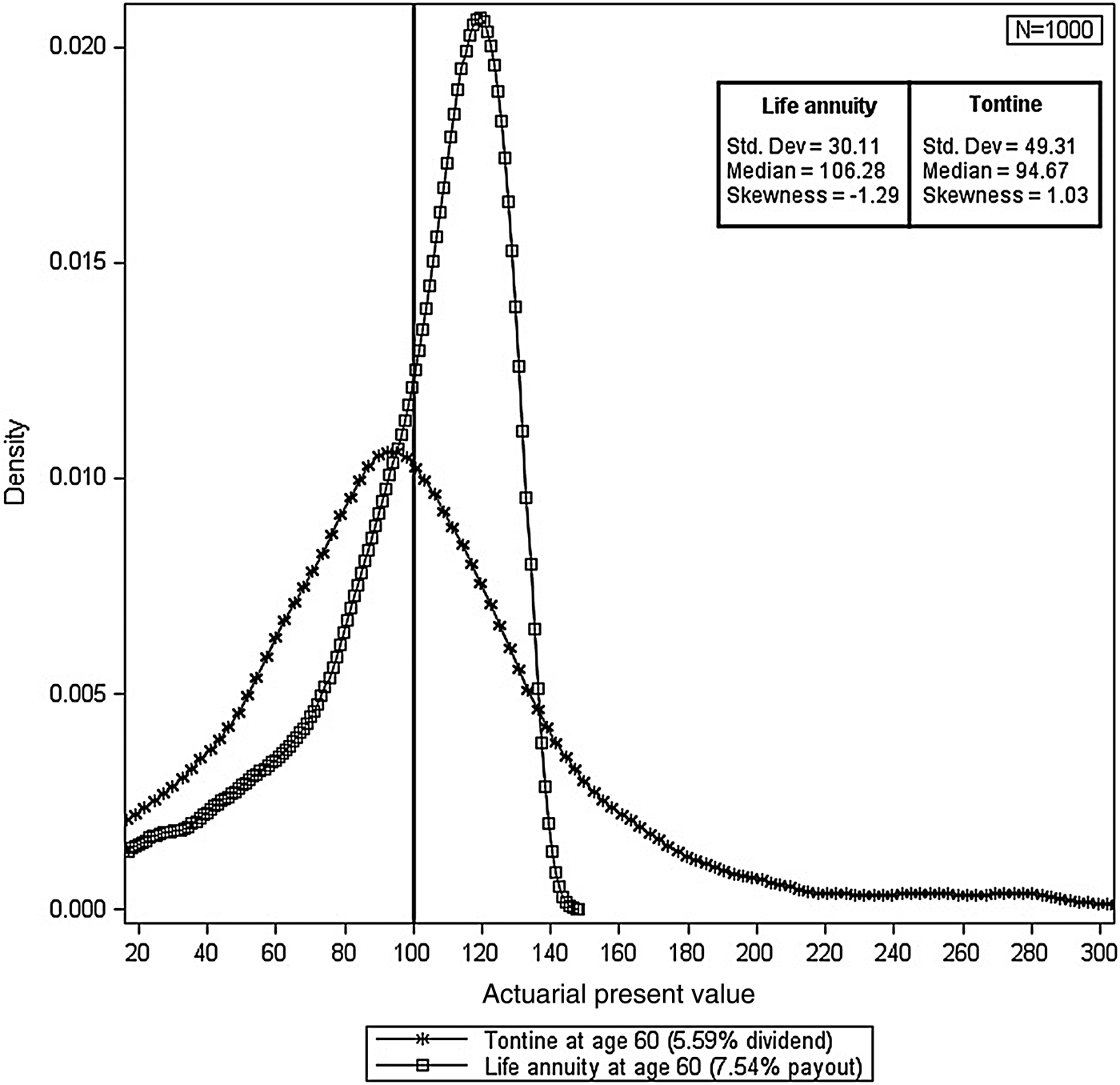
Figure 1 displays the SPV of a (hypothetical) fair tontine and life annuity issued at the age of 60. The initial payment (or contribution) to the tontine and annuity is exactly £100. The fair payout on the life annuity is 7.54 per cent and for the tontine it is 5.59 per cent. By fair I mean that the expected value of (the stochastic) W is exactly equal to £100. More specifically, in the simulations I used a Gompertz law of mortality in which m = 89.81 years (i.e. the modal value of life) and b = 11.61 years (i.e. the dispersion value).Footnote 24
Actuarial present value of fair tontine vs fair life annuity (5 per cent interest rate)
Notice how at the age of 60 (in Figure 1) the standard deviation of the life annuity SPV is 30.1, while the standard deviation of the tontine SPV is a much higher 49.3; and the tontine is riskier in a mean-variance sense, in addition to having a different time-series profile of cash flows. However, the third moment and in particular the skewness of the tontine is a positive 1.03 versus the skewness of the annuity which is a negative −1.29. So, while mean variance optimizers might shun the tontine, investors with a preference for skewness, whether they are rational or not, would select the tontine. Once again, the payouts were constructedFootnote 25 so that the expected value of W is exactly £100, but the standard deviation and skewness are higher. This tells us that if both plans are fairly priced, the tontine scheme is a riskier investment compared to the life annuity. This is not the case with the 1693 tontine, for which the present value was higher than £100.
At this juncture it is worth stressing one of the main points of this article, namely that a rational utility-maximizing investor might decide to contribute to a given tontine as opposed to given annuity, even if objectively E[W T] < E[W A] and the tontine is actuarially unfair or has a lower expected internal rate of return (IRR) compared to a life annuity.
Formally speaking, the portfolio choice between a tontine and a life annuity depends on the utility of the investor as it relates to the other assets and liabilities they may have on their personal balance sheet, as well as their subjective survival probabilities and their preference for more skewness. The value of R that makes E[W] = W is not sufficient, in isolation, to determine whether a given product receives an allocation. An investor who is deciding whether to contribute £100 to a tontine scheme in which the dividend rate is τ to survivors, or whether to purchase a life annuity paying a constant α income instead would be solving:
 $${\max }_x \left[{EU\left({x{ W}^T + \left({1 - x} \right){ W}^A + { Z}} \right)} \right]$$
where x is the fraction of investable wealth allocated to the tontine, (1 − x) is the fraction allocated to the annuity, Z is the stochastic present value of all the other assets and liabilities in the personal portfolio and EU denotes the expected utility function.
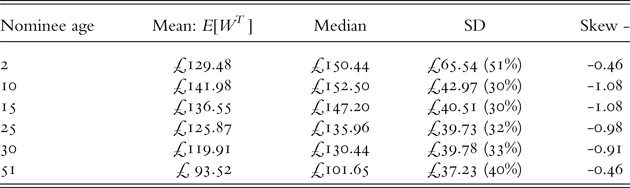
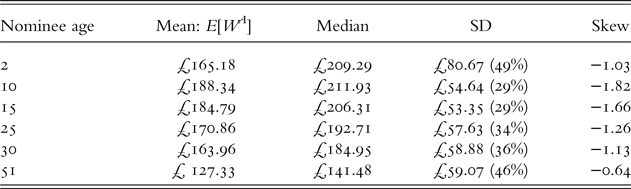
Simulating the 1693 tontine. Table 6 displays the results of the simulation of the entire distribution of W T assuming a variety of entry ages, using the proper age distribution of all other members in the tontine pool. (A reminder that the methodology is described in Appendix A.) Thus, for example, the results listed at age 2 assume a representative nominee who is exactly 2 years of age, when all the other 1,012 nominees are the ages listed in the Heyrick (Reference Heyrick1694) list. The mortality rates used to simulate W T and in particular the values of L are based on the Halley (Reference Halley1693) mortality rates,Footnote 26 which theoretically would have been available at the time.
King William's tontine of 1693: simulation of the present value (PV) of payouts
Sources: Halley (Reference Halley1693), Heyrick (Reference Heyrick1694). Computed by the IFID Centre.
The baseline simulation model assumes a 6 per cent (risk-free) interest rate, which was the prevailing (capped) interest rate in England in the late seventeenth century as reported by Homer and Sylla (Reference Homer and Sylla2005). The mortality rates used in the simulation are based on the (unisex) life table created and published by Halley (Reference Halley1693). In the simulation, the 1,081 shares are carefully linked to their respective 1,013 nominees and each nominee's starting age is rounded to the nearest year. The results indicate that the tontine was a good deal (PV > £100) relative to 6 per cent interest rates for all nominees aged 30 and under. The optimal age (highest PV) for a nominee would have been 10, which coincidentally is the exact age of Elizabeth St John of Wimbledon who was the last survivor of the tontine. Yes, the tontine skewness is negative, but it is higher relative to the annuity skewness reported in Table 8.
Here is how to interpret the results. At the nominee entry age of 10, the expected present value of the tontine is £142, which is £42 more than the initial subscription fee of £100. This assumes a constant R = 6 per cent interest rate across the entire term structure. The expected present value declines with age. For the representative nominee who is 51 years old (there was one such person in the 1693 tontine) the EPV is a mere £93, or £7 less than the original investment. Note that the results take into account the entire distribution of nominees, the Halley (Reference Halley1693) mortality rates and a 6 per cent valuation rate. The conclusion we are presented with is that the tontine was a good deal relative to the prevailing rate of 6 per cent on alternative loans.
One might argue that it is wrongheaded to talk about a stable, long-term valuation rate in the year 1693, especially considering the circumstances under which King William and Queen Mary seized the throne. But, once again, 6 per cent was the rate used by Halley (Reference Halley1693) himself to value the annuity and is the interest rate cited by Homer and Sylla (Reference Homer and Sylla2005) in reference to government debt in the late seventeenth century. Obviously, higher discount rates would reduce the expected present value of both the tontine and the life annuity, but the skewness of the tontine would always be greater than the annuity.
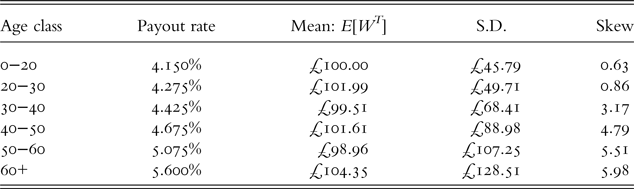
As a confirmation, I carried out a simulation for the present value of an alternate tontine, issued in 1789 during the reign of King George III (also known as the tontine of William Pitt). This tontine offered dividends with payouts ranging from 4.1 to 5.6 per cent, depending on which of the six classes of shares was chosen and the age of the nominee. For my simulation I used a 4 per cent interest rate (in contrast to the 6 per cent rate used for 1693) to reflect prevailing interest rates according to Homer and Sylla (Reference Homer and Sylla2005). The mortality tables were also revised and updated to reflect those used in the late eighteenth century.
Table 7 displays the results. The expected present values are all statistically indistinguishable from the £100 cost to participate in the tontine, which makes it a fair tontine. For the age classes between 30 and 60 the numbers are precisely £100 and the value of the tontine to someone who was in the highest class (>60) was approximately £4 more than the purchase price. The fact that E[W] = 100 for the 1789 tontine, using the same methodology, provides some additional confidence in the results for 1693.
A comparison: King George III's tontine of 1789: simulation of the present value (PV) of payouts
Source: Huntington (1792). Compiled by the IFID Centre.
As a comparison and confirmation, the 1789 (last, great) British tontine was valued using the same methodology. For this case the simulation was based on a 4 per cent discount rate, as per Homer and Sylla (Reference Homer and Sylla2005) during that period. The reported number of nominees in each age-band category and the mortality rates for the time period are listed in Huntington (1792) and the so-called Chatham Papers. These were mortality tables included with the 1789 tontine proposal located at the National Archives (catalogue no. 30/8/277). The expected present value for all age classes is around £100, which indicates a fair price (but not much better.) King William's 1693 tontine was a better deal than King George III's 1789 tontine.
IV
In this section I address the issue of portfolio choice head on. In particular, I examine the stochastic present value (SPV) of the 14 per cent life annuity and compare it with the SPV of the tontine described in the previous section.
Using the same simulation methodology described in the previous section I generated the distribution of the SPV for the 14 per cent annuity and the results are displayed in Table 8. Here is how to interpret the results: for a nominee who was 10 years of age in 1693 (recall that the average age of the 1,013 nominees was approximately 11 years) the expected present value of the 14 per cent annuity was £188, which is £88 more than the subscription cost of £100 and approximately £46 more than the tontine. In other words, on an expected present value basis, the 14 per cent annuity dominated the tontine scheme. Indeed, this is confirmation of Edmond Halley's claim that from the English government's perspective, the 14 per cent life annuity was underpriced.Footnote 27
Simulation of 14 per cent life annuity present value (PV)
Source: Computed by the IFID Centre.
Using the same methodology employed for the 1693 tontine, the life annuity simulation assumes a 6 per cent discount rate as per Homer and Sylla (Reference Homer and Sylla2005) and is based on the life table reported by Halley. Indeed, just as Edmond Halley wrote in 1693, the 14 per cent annuity was a better investment compared to the tontine on an expected present value basis.
However, the relative mispricing of the tontine (compared to the annuity on an expected present value basis) doesn't necessarily imply that every one of the original 3,000 or so investors would have been better off switching to the life annuity. Indeed, some investors might have a preference for the SPV of the tontine despite the lower objective expected present value. As the portfolio choice literature would argue, the optimal choice will depend on the other assets and liabilities in the investor's portfolio, as well as how those asset and liabilities interact (correlate) with the present value of the tontine income stream. The expected internal rate of return (IRR) is just one dimension of the problem.
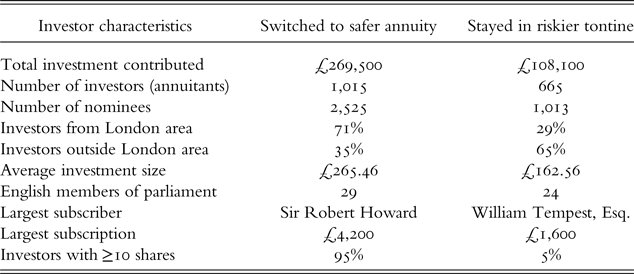
For example, those investors with a preference for higher relative skewness – and much higher longevity expectations – might have opted for the 10 per cent and then 7 per cent tontine vs the 14 per cent annuity, in order to gain access to the lottery aspects of the scheme. This conclusion is more than hypothetical or conjecture. Recall that over 1,013 nominees remained in the tontine and Table 9 summarizes what is known about this group and the investors who selected them.Footnote 28
King William's tontine of 1693: the option to convert from tontine to a life annuity
Source: Heyrick (Reference Heyrick1694), Dickson (Reference Dickson1967), History of Parliament Trust (2013). Compiled by the IFID Centre.
The average holding of subscribers in the tontine pool before the switch-date was £236, as reported by Dickson (Reference Dickson1967, pp. 255). This is based on 79 per cent of the sample and extrapolated to the entire group. The average investment for those who stayed in the tontine and didn't switch to the life annuity was £162.56 (£108,100/665). So, the average investment of those who switched was approximately £265 and approximately 1,015 subscribers (£269,500/£265) switched. The number of nominees that switched was estimated based on the ratio of totals contributed. Note that of the 53 members of parliament assumed to have originally subscribed (42 known to have subscribed/0.79) more than half switched to the life annuity. The concluding message appears to be that the ‘smart’ (risk-averse) money moved to the life annuity.
First, the amount of money (shares) that were switched from the tontine to the annuity during the period from May to September 1693 was approximately £269,500 (or 2,695 shares), and only £108,100 (which is 1,081 shares) remained in the tontine. These numbers are known with reasonable certainty and appear in multiple sources. The number of investors is slightly harder to confirm with accuracy and is estimated to be 1,015 to the life annuity and 665 to the tontine. In other words, 665/(665 + 1015) = 40 per cent of investors stayed in the tontine and 60 per cent switched to the life annuity. Finally, 1,013 nominees remained and 2,525 were switched to the annuity, which is 29 per cent in the tontine. Note the larger percentage of investors (40 per cent) versus the smaller percentage of nominees (29 per cent) who stayed in the tontine. This is an indication that the contributors with the larger investments (greater number of shares) switched to the life annuity.
In fact, working backwards from the numbers provided by Dickson (Reference Dickson1967), the average investment by contributors who switched to the life annuity was £265 compared to a much smaller £162 in the tontine. In terms of their background characteristics, I also have compiled a list of Members of Parliament (during the 1692 to 1693 period) who enrolled in the tontine (initially) as well as those who switched to the annuity. It seems that from (at least) 53 members who initially enrolled in the tontine, a slight majority (29) switched to the annuity. Moreover, the largest single subscriber in the tontine, Sir Robert Howard, had invested £4,200 (42 shares) in the tontine and he switched to the life annuity. As a result, the largest remaining investment in the tontine was much smaller, made by William Tempest at £1,600 (16 shares.) It is also possible to back-out the percentage of investors (annuitants) who resided in the greater London area (including Middlesex, Surrey and Hertfordshire) and switched to the life annuity. Approximately 29 per cent of this group stayed in the tontine, while the remaining 71 per cent switched to the life annuity. For those who lived outside greater London, the percentages were almost reversed. In this group, 65 per cent stayed in the tontine and 35 per cent switched to the annuity. Table 9 also displays the percentage of large investors (defined as those holding 10 or more shares) switching to the life annuity; an overwhelming 95 per cent.
All of this seems to be pointing in the same direction; namely, that the ‘smart local money’ concluded that the 14 per cent life annuity was a better deal than the 10 per cent and 7 per cent tontine and decided to switch. It would be delightful to be able to prove that these decisions were based upon the investment advice of the one of the greatest astronomers of all time, Edmond Halley, after his mid-March presentation to the Royal Society in 1693. The circumstantial evidence is certainly there.Footnote 29 But not everyone was convinced: some investors exercised the option to switch to the safer life annuity and some decided to stay in the riskier tontine. This is one of the earliest examples of what today we might call asset allocation with mortality-contingent claims.
V
In a recent paper, economists Lange, List and Price (Reference Lange, List and Price2007) notedFootnote 30 that tontines have been banned in Britain and the United States due to the incentives to murder other participants. However, there is little, if any, evidence that foul play ever occurred in practice; namely, that any of the last few surviving nominees in a tontine pool tried to murder another member of the pool, notwithstanding the use of tontines as a plot device in murder mysteries. Actually, most government tontines froze payments once a small number of survivors remained in the pool. In the 1693 tontine the limit was seven participants, which would further reduce any incentive for murder.
The current ban on tontine insurance in the US, established in 1904, is discussed (and criticized) in Ransom and Sutch (Reference Ransom and Sutch1987) and actually has more to do with excessive management fees and over-reaching insurance regulators. And in France, according to Weir (Reference Weir1989) tontine annuities were banned in 1763 because they were perceived as a very expensive way of funding the national debt. This is a question of dividend and interest rates paid, not the structure of the tontine per se.
Indeed, if the incentive to murder tontine nominees was powerful enough, one would expect to see evidence in the survivorship data. Older tontine survivors would experience (ex post) shorter lifespans compared to regular annuitants or the rest of the population. At the very least one might observe higher mortality rates at advanced ages or towards the end of the tontine's life. In contrast, the fact that nominees with a greater number of shares (and hence more money contingent on their life) died earlier, compared to the remainder of the nominees (in the 1693 tontine), is simply due to the fact that their average age at the time of nomination was higher, as noted in Table 4. Their earlier death is to be expected.
In fact, the survival rates suggest a contrary story. Tontine nominees actually lived longer than average – especially nominees who were very young when they were initially named by the annuitant or original investor. It appears that something about being a tontine nominee kept people (or at least their names) alive longer, perhaps echoing Jane Austen's famous quote: ‘People always live for ever when there is an annuity to be paid them.’
Of course, most insurance economists would interpret this as early evidence of anti-selection, similar to the well-documented phenomenon of annuitants living longer compared to the rest of the population,Footnote 31 but I argue that it is unlikely to provide a completely satisfactory explanation for high reported survival rates amongst tontine nominees.
In this section I will suggest that if tontine participants were involved in some nefarious activities, it wasn't murder, but perhaps its opposite – resurrections. In particular, it is possible that tontine contributors would select a given child as a nominee and then if that child happened to die at a young age, the parent would select another (younger) child, possibly even a newborn infant, and name them after their deceased sibling. The nominee's namesake would assume the identity of the nominee and tontine dividend payments would continue from the Exchequer based on the same name, but different person. This would have the effect of increasing reported survival rates. After all, this was the late seventeenth and early eighteenth century, when documents used for identification purposes were crude and unreliable. The incentive was certainly there.
The data in fact suggest that survival rates were unbelievably high. Note that infant mortality rates in the late seventeenth century were on the order of 25 per cent in the first few years of life and between 30 and 40 per cent prior to age 10. This implies that the survival probability to age 10 was between 60 and 70 per cent. And yet, of the 519 children under the age of 10 who were nominated to King William's 1693 tontine, 288 (or 55 per cent) of them survived 37 years to the year 1730. The entire list of survivors (and their original ages) is available for the year 1730 and this can be easily compared to the original list in 1693. Formally, I reject the null hypothesis that death rates of nominees were consistent with (population) mortality tables at the time.
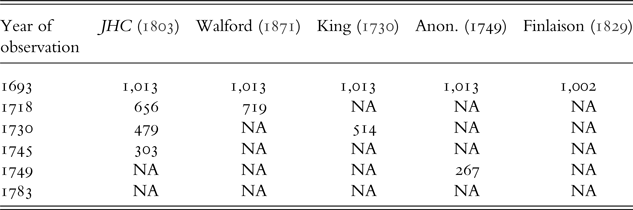
First, though, I must acknowledge some difficulties in determining the exact number of nominees who survived to various ages. There are optimistic (high) and pessimistic (low) projections depending on different historical sources and accounts. Table 10 summarizes the state of affairs with the different sources.
King William's tontine of 1693: discrepancies and information sources for surviving nominees
Source: Compiled by the IFID Centre.
Sources for the surviving nominees of the 1693 tontine often contradict each other. However, most of them agree that there were 1,013 nominees, with King (1730) and Anonymous (1749) providing a full list of names and starting ages of all surviving nominees. These are probably the two most reliable sources as they also include detailed dividend calculations. Leeson (Reference Leeson1968) claims that there were 175 nominees as of 1749, yet Anonymous (1749) lists all 267 individual nominees and the 275 shares contingent on their lives. Note that the Journal of the House of Commons (JHC) reports a running tally of all nominee deaths from 1693 to 1745, but seems to indicate fewer survivors compared to other (more reliable) sources and also adds them up incorrectly. Also, JHC (1803) is not included in Leeson's (Reference Leeson1968) British tontine sources.
As far as the number of nominees is concerned, the original list in Heyrick (Reference Heyrick1694) is available in the British Library. It clearly shows a collection of 1,013 names and is consistent with the follow-up list and dividend calculations presented in King (1730). The number 1,013 also appears in Walford (Reference Walford1871), Dickson (Reference Dickson1967) and in the Journal of the House of Commons (JHC, 1803). So, it is quite reasonable to conclude that 1,013 is the correct number despite the (incorrect) report of 1,002 nominees in Finlaison (Reference Finlaison1829) which also appears in Hargreaves (Reference Hargreaves1930), Leeson (Reference Leeson1968), Weir (Reference Weir1989), Poitras (Reference Poitras2000) and most recently Lewin (Reference Lewin2003). I suspect that all of these (incorrect) sources never actually counted the names on the Heyrick (Reference Heyrick1694) list. Interestingly, Jennings and Trout (Reference Jennings and Trout1982) correctly list the number of nominees as 1,013 and footnote an alternative account supposing 1,002 nominees.
As far as future years are concerned, the data are somewhat murkier. The only years in which the names of actual (surviving) nominees are available are 1730 and 1749. These are available in the British Library and are referred to in King (1730) and Anonymous (1749). For other years between 1694 and when the final nominee died in 1783, all we have are reports of the total number of surviving nominees or the number of deaths, but not the names themselves. Moreover, as might be expected given the discrepancy in the number of nominees, many of these reports contradict each other. For example, the number of annual deaths reported in JHC (1803) leads to 656 surviving nominees in the year 1718, which is a 65 per cent survival rate over 25 years. In contrast, Walford (Reference Walford1871) reports a much higher count of 719 nominees, which is a 71 per cent survival rate. In general it appears that JHC (1803) reports a larger number of deaths and a correspondingly lower number of survivors. I test the ‘fraud hypothesis’ and conduct the statistical tests using the lower number of survivors listed in JHC (1803), which would reduce the bias in statistical terms.
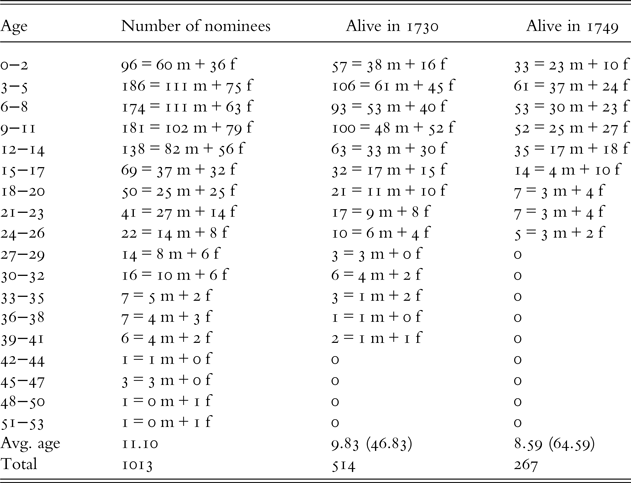
Even if one relies exclusively on the 1730 and 1749 (tontine) documents listing the actual names of the surviving tontine nominees, it is clear that of the 282 nominees between the ages of 0 and 5, a total of 163 (=58 per cent) survived for 37 years to the year 1730 and a total of 94 (=33 per cent) of the young children nominees survived for 56 years to the year 1749. These survival rates might not appear out of line with demographics of the twenty-first century but they are remarkably high for the early eighteenth century.
Table 11 provides a much more granular view of the survival rates. It divides the 1,013 confirmed nominees into two-year age bands and examines their survival patterns over time. Note here the many nominees above the age of 30, and some as high as age 50. Clearly, few of them survived to the years 1730 and 1749. Rather, and not surprisingly, it was the younger nominees who made it to the advanced years. And, while the 1730 and 1749 tontine documents do not provide the best data for a formal comparison with child mortality rates, the list of surviving nominees for each year between 1693 and 1730 from JHC (1803) does provide us with some data for a formal test.
King William's tontine of 1693: age, gender and survival
Sources: Raw data from Heyrick (Reference Heyrick1694), King (1730) and Anonymous (1749).
There were 519 nominees under the age of 10, of whom 55 per cent survived for 37 years to 1730. It is puzzling that so many tontine nominees were older. Why were they nominated? (Didn't the investor realize that a younger age was optimal?)
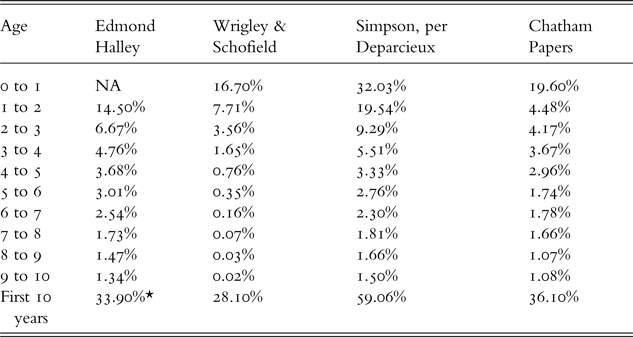
One of the leading demographic authorities, Wrigley and Schofield (Reference Wrigley and Schofield2002), report that the cumulative mortality rate during the first nine years of life was 27 per cent in early eighteenth-century England. The estimates were obtained by comparing death certificates to baptismal records for 12 different parishes. This would imply that if tontine nominees were representative of these parishes, slightly more than 70 per cent of infants would survive to the age of 10. In a separate study by the same authors, Wrigley and Schofield (Reference Wrigley and Schofield2002) estimate that the survival rate to the age of 15 years for infants was 70 per cent in the early part of the eighteenth century and 73 per cent in the latter part of the same century. Once again, recall that almost 60 per cent of tontine nominees survived 37 years to 1730. And, while estimates differ as to the exact magnitude of infant mortality rates, Table 12 compares four different sources for year-by-year mortality rates during the period in question. The first column shows the original values reported by Edmond Halley in 1693, the second is extrapolated from the values reported by Wrigley and Schofield (Reference Wrigley and Schofield2002), the third is known as the Simpson mortality table, which is reported by Deparcieux (Reference Deparcieux1746), and the final column was used to price the last British tontine in 1789. They all tell the same story: a third of newborns didn't survive to double digits.Footnote 32
Child mortality rates in the late seventeenth to eighteenth century
Sources: Halley (Reference Halley1693), Wrigley & Schofield (1983), Deparcieux (Reference Deparcieux1746), Huntington (1792). Compiled by the IFID Centre.
Halley's mortality rate (9q 1) of 33.90 per cent is for the age band 1 to 10, because he didn't report mortality rates for q 0. Mortality rates are based on expected (or observed) survivors at age x + 1 divided by the expected (or observed) survivors at age x, starting at age x = 0. The Wrigley and Schofield (Reference Wrigley and Schofield2002) mortality rates are based on the quoted survival rates to ages 1, 5 and 10 during the 1650 to 1699 time period and then smoothed exponentially to produce annual rates, which is why the later years are lower. Deparcieux (Reference Deparcieux1746) reports Simpson tables relevant to England. The Chatham Papers were tables included with the 1789 tontine proposal located at the National Archives (catalogue 30/8/277). Even under the most optimistic assumptions, less than 72 per cent of live births survived to age 10.
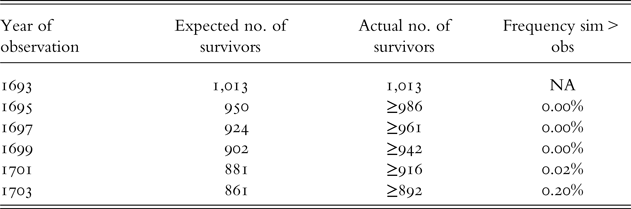
To test whether mortality rates for the period in question differed substantially from what was observed amongst the tontine nominees, I compared a Monte Carlo Simulation similar to the one described in the previous section. Instead of computing the present value of the tontine payments across thousands of paths, I focused instead on the date of death and computed the number of tontine survivors in the years 1695, 1697, 1699, 1701 and 1703. I then counted the number of scenarios in which the simulated survivors exceeded the observed number of survivors (rare) vs the number of scenarios in which the simulated survivors were less than the actual number of survivors (quite common). I present this as a probability. Table 13 is a summary of the results.
King William's tontine of 1693, surviving nominees: fraud or anti-selection?
Source: Halley (Reference Halley1693), Heyrick (Reference Heyrick1694), JHC (1803). Compiled and computed by the IFID Centre.
The simulation is based on the 1693 mortality rates as computed and derived by Halley (Reference Halley1693) and the 1,013 nominees with starting ages rounded to the nearest full year. The algorithm counted the frequency with which (out of 10,000 simulation runs) the simulated number of survivors was higher than the actual number of live nominees reported; a rare event overall. Note that the number of survivors year-by-year was based on JHC (1803), which is biased towards underestimating the number of surviving nominees when compared against other sources. All of this points in the same direction: The (reported) survival rate of nominees is abnormally high.
For example, 986 survivors were reported by JHC (1803) for the second year of the tontine (in 1695). In other words, 27 nominees (out of the original 1,013) had died in the first 24 months of the scheme, which is a mortality rate of 2.6 per cent – or approximately 1.3 per cent per year. But, using the mortality rates computed by Edmond Halley and the exact age distribution of all 1,013 nominees, one would expect 63 deaths in this 24-month period. The probability of observing (only) 27 deaths when 63 were expected is 0.00 per cent and the null hypothesis (Normal Death Rates) can be rejected at the 10 per cent, 5 per cent and 1 per cent levels.
The same very low probabilities are observed for the years 1697, 1699 and 1701. The cumulative number of deaths is much less than expected and the cumulative number of survivors is far greater than expected, even when relying on the JHC (1803) source (which is biased towards under-reporting deaths). For example, for the year 1703, which is 10 years after the tontine was established, there are 892 survivors listed. In 10 years (only) 121 nominees died. The probability of this event, assuming the Halley mortality tables, is 0.20 per cent. Once again the null hypothesis (Normal Death Rates) can be rejected at the 10 per cent, 5 per cent and 1 per cent levels.
There is yet another way to analyze the matter. Although the three primary documents do not have dates of death for any of the tontine nominees (and using Ancestry.com only provided a handful of reliable records), there is one possible source that can be used to estimate death dates and hence estimate implied mortality rates. In this subsection I briefly describe this approach and the results, which are broadly consistent with the earlier claim of possible fraud.
On the very last page of the King (1730) document there are two pages listing the name of all nominees that died, or were presumed dead, on the eve of the dividend payment of June 1730. Recall that at that point in time there were 514 surviving nominees and 544 remaining shares. The dividend payment per share listed on the third page of King (1730) was £7 2s 6d.
The list of deceased nominees in King (1730) is not in alphabetical order and does not seem to contain any specific pattern. If, however, we assume that list is given in a chronological order of (reported) deaths then one can extract or solve for the implied mortality rates by using the information from the JHC (1803) document about the number of nominees that died in each year. Each document alone is not enough to extract this information. I believe that it's reasonable to assume the (presumably) deceased nominees are recorded in the order in which their death was noted because some of the death dates for well-known nominees are consistent with this order. For example, the Duke of Gloucester, William, the son of Queen Anne and King George of Denmark, was a nominee in the 1693 tontine and he died on 30 July 1700 (as noted in the London Gazette on 1 August 1700). His name is eighty-seventh on the King (1730) list, which falls in the proper range. Moreover, the first three names on the list (Sarah Rose, Robert Eyre and John Fulford) are all listed as having died prior to Christmas 1693 in the original Heyrick (Reference Heyrick1694) document.
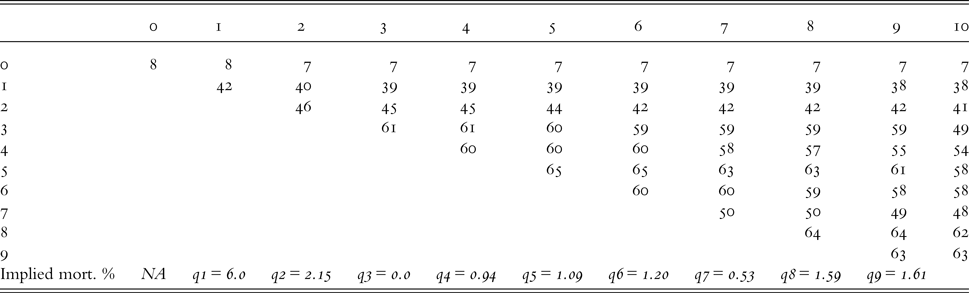
If, in fact, these 499 names are listed in the order in which they died – combined with their ages in 1693 – then we have a much more robust data set of (censored) lifespans that can be used to imply mortality rates, using the methodology suggested by Alter (Reference Alter1983). More broadly, the 514 nominees who survived to the year 1730, plus the length of lifespans of the 499 nominees who did not, together form a rich data set of 1,013. And, while the purpose of this study is not a demographic analysis, I did examine the implied mortality rate of the nominees aged 0 to 9 and compared against some of the mortality rates from that period.
The row at the very bottom of Table 14 can be compared to any of the four mortality vectors listed in Table 13. King William's 1693 tontine nominees died at a (much) lower rate at younger ages. And, while this isn't a formal hypothesis test – and the limited number of data points is quite low and imprecise – these results are consistent with the prior analysis. Tontine nominees seemed abnormally healthy and long-lived, which ipso facto raises the possibility of fraud. Moreover, if these numbers form the basis of demographic studies for the period, for example the numbers listed by Wrigley and Schofield (Reference Wrigley and Schofield2002), then some level of caution is warranted.
Graphic representation of the lives of nominees of 1693 tontine: vertical axis represents age at entry and horizontal axis represents number alive at age
Using the technique described in Alter (Reference Alter1983), the table displays the process behind the computation of implied mortality rates for King William's 1693 tontine, for nominees under the age of 10. For example, there were 46 nominees at age 2 (in 1693) and 42 of them survived to the age of 10 (in the year 1703). A total of two deaths divided by 94 exposed lives is 2.13 per cent.
Ardent supporters of anti-selection theoryFootnote 33 might not be convinced by these numbers and will attribute any evidence of longer-lived nominees to the ability of investors (contributors) to select, monitor and protect these children.Footnote 34 While I agree that the evidence doesn't necessarily imply fraud directly, I would argue that an alternative explanation to anti-selection deserves to be heard. This is especially important considering the fact that actuarial tables used in the eighteenth and nineteenth centuries in England to price annuities were based (in part) on the experience of tontine nominees. In fact, Finlaison (Reference Finlaison1829) himself did not display mortality rates for ages 0 to 2 in his (famous) report to the House of Commons on the underpricing of annuities even though he (claimed to have had) the entire series of tontine nominee survivorship data. Perhaps he too had doubts about the veracity of his data.Footnote 35
There is much anecdotal evidence in the early eighteenth century that tontine fraud was a major concern. Newspapers in the mid eighteenth century printed letters from investors complaining about the low dividends from their tontines, relative to what had been claimed when the tontine was launched. Walford (Reference Walford1871) quotes from an anonymous pamphlet published c.1720 and titled New Proofs in the Supposed Frauds in the Survivorship. The document reviews the mortality rates computed by Edmond Halley and William Petty and compares them to the much lower mortality rates reported for the nominees of the 1693 tontine. Here is one telling quote:
Children of six years of age and under are swept away a great deal faster than younger men aged 16 to 30 and 35 years, by reason of the many dangerous sicknesses and infirmities which infancy is obnoxious [sic] to. This is the constant, certain, general, course of nature. But in this case you will see it is quite inverted. Were the disproportion but small, I should suspect no fraud, but it is so vast that for that very reason it is incredible.
The pamphlet goes on to accuse specific groups and ethnicities with the lowest mortality rates of being the main source of the fraud and concludes with: ‘All those concerned in this fund are desired to meet in person or by their agent at Tom's Coffee House in St Martins Lane, London, at 4 o'clock on Monday the 24th of November, 1718 to consider methods to prevent this fraud.’
Finally, it is worth noting that in the (last) British tontine launched in 1789, the founding Act stipulated a long and complicated process for proving that a nominee was still alive. And, the Act ended with the following ominous warning: ‘If any person shall counterfeit any certificate or shall personate any nominee with a fraudulent intent, he shall on conviction suffer death.’ (Quite appropriate for a tontine, one might add.)
And, if this wasn't enough, in 1808 parliament passed the British Life Annuity Act. The Act reintroduced government-issued life annuities to the public with more appropriate (and actuarially fair) pricing. But the Act effectively prohibited the sale of life annuities to nominees under the age of 35.
For more information and much detail about the economic implications of the 1808 Act, see the excellent paper by Rothschild (Reference Rothschild2009). Indeed, the evidence of anti-selection at advanced age (above age 65) is quite clear, especially for annuities that were held by investors. At these advanced ages fraud is unlikely and of minimal concern.
In sum, it very well may be that part of the negative perception towards tontines was not the result of motives for murder amongst older-aged participants, but due to concerns about fraud at younger ages. At the very least, one lesson from this research that is relevant to historians is that one must exercise caution when extracting (or solving for) mortality rates from the reported survival of (young) tontine nominees. Consider incentives when gauging the data's accuracy.
VI
In the last decade a number of companies around the world – encouraged by a few scholars and journalists – have attempted to resurrect the tontine as an alternative to the conventional life annuities offered by the private sector. The designs all share the same idea: insurance companies (not government) would act as tontine custodians and guarantee very little. This arrangement would require less capital compared to life annuities, which make explicit and implicit guarantees regarding longevity, and would thus provide more affordable pricing for the consumer. Moreover, non-government custodians might utilize and invest in underlying assets other than simple bonds. For example, the tontine pool administrator could purchase an SP500 Index Fund and share the dividends, or a real estate investment trust and share the rent. In fact, a number of government-run pension plans have quietly adopted a tontine-like structure for social security programs by periodically adjusting payouts to account for unexpected changes in longevity.
So, against this background of nascent interest in modernized tontine schemes, this article looks back to the first English tontine of 1693 and examines its design, pricing and the various decisions made through the modern prism of portfolio choice theory. Although the general consensus or verdict amongst economic historians is that English tontines, particularly this one, were failures or, at the very least, not very popular, this article argues that the story is more nuanced. The choices made around the various mortality-contingent alternatives are interesting in and of themselves and especially to those who study portfolio choice decisions.
Here is the bottom line: a tontine's present value of cash flows is ‘riskier’ to the annuitant relative to the corresponding cash flows from a simple life annuity, regardless of whether or not the tontine and annuity are fairly priced. Moreover, the choice between the two – when they are fairly priced – revolves around longevity risk aversion, consumption preferences and personal discount rates.
King William's tontine of 1693 offered participants a guaranteed dividend of 10 per cent for seven years and then 7 per cent thereafter. The parallel annuity promised a 14 per cent annuity for life without any survivorship benefits or extra dividends. As anticipated, I confirm that the expected present value (EPV) of King William's tontine was lower than the EPV of the life annuity. So naturally, risk-neutral investors who focused only on expected cash flows should have rightfully selected the annuity. But given the difference in the distribution of the stochastic present value (SPV) itself, contingent on personal beliefs, there might have been some investors who preferred the risk profile of the tontine scheme.
The statement that some people prefer tontines while others prefer annuities is more than speculative or theoretical. I document and discuss the characteristics of the over 30 per cent of investors who – after being given the option to switch to the higher-yielding annuity – decided to stay in the tontine. And, while there are many behavioral reasons that can be suggested for staying in the tontine, including ignorance and misguided expectations about longevity, I offer that there might be a rational explanation as well. Recall that the longest living survivor earned £1,081 in her final year of life, which is almost 80 times more than what the life annuity of £14 would have paid her. The tontine had a much lower expected EPV and expected IRR compared to the annuity, but the (extreme) right tail was much greater as well.
One conclusion is clear: some of the earliest portfolio choice decisions in the presence of longevity risk took place over 300 years ago and revolved around mortality-contingent claims that are no longer available to investors.
Appendix A: Description of tontine simulation
I start with a pool of N = 1013 homogenous individuals who assume the role of both the investor and nominee, each of age x with maximum life ω = 105, at which point everyone is killed. These N individuals contribute £w to the tontine pool for a total of £wN. I use the symbol triplet L(x, i, t) to denote the life state of the i'th individual in year t ≤ ω − x. Formally, L(x, i, t) = 1 while the i'th nominee is still alive and L(x, i, t) = 0 once the nominee is dead. We start with L(x, i, 0) = 1. The next value of L(x, i, t) is obtained by simulating a standard uniform [0,1] ‘killing’ random variable u, and then setting the variable L(x, i, t) = 0 whenever u < q(x + t) where q(x + t) is the mortality rate applicable at age (x + t). So, for example, if the mortality rate at age 30 is q(30) = 15%, and the random variable outcome for u = 0.2, then the individual survives. But, if u = 0.1, the individual is killed and all future L(x, i, t) values are set to zero. (No resurrections allowed!) Obviously, the greater the value of q(x + t), the higher the probability (and realization) of death. In sum, for each simulation run denoted by j, this process generates a (big) matrix L(j) with N rows and (ω − x + 1) columns. The first row is set to be all ones – everyone starts alive – and all rows slowly decay to zeros over time. Finally, the last column is (forced) to be all zeros. I start with M = 10,000 simulations so that: 1 ≤ j ≤ 10000, and the initial age will be x = 10.
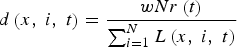
At the end of each year a total of £wNr(t) is distributed as a dividend to the survivors, where r(t) denotes the promised interest rate at time t. For the 1693 tontine for example, r(t) = 10% for the first seven years (to the year 1700), and then r(t) = 7% thereafter. This then generates a new matrix d(x, i, t) which denotes the dividend to the i'th individual in the t'th year. Note that d(x, i, t) = 0, whenever L(x, i, t) = 0. (Dead people share no dividends.) The process of computing d(x, i, t) is rather simple, assuming nominee (x, i) is alive in time period t. Namely, divide wNr(t) which is the total interest payable to the surviving pool members, by the number of people alive, which is sum of L(x, i, t) from i = 1 to i = N. Here it is formally:
 $$d\left({x\comma \; i\comma \; t} \right)= \displaystyle{{wNr\left(t \right)} \over {\mathop \sum \nolimits_{i = 1}^N L\left({x\comma \; i\comma \; t} \right)}}$$
Now, the main quantity I'm interested in exploring is the variable PV(x, i|j), which is the present value of the tontine payout to nominee (x, i), in simulation run number j. Formally it is defined as:
 $$PV\left({x\comma \; i{\rm \vert }j} \right)= \mathop \sum \nolimits_{t = 1}^{\omega - x} \displaystyle{{d\left({x\comma \; i\comma \; t} \right)} \over {\left({1 + R} \right)^t }}$$
where R is the valuation rate (assumed to be 6%). Algorithmically, the entire numerator vector is simulated: first, based on the number of other survivors, then discounted to arrive at a present value for the tontine payoff to nominee (x, i), in one particular simulation run. Notice that once L(x, i, t) is zero (the nominee is dead), then d(x, i, t) is zero as well so the entire summation is valid. Every simulation run j, will generate a value for PV(x, i|j) for a total of M = 10,000 present values for a given representative nominee (x, i).
Finally, we are interested in the sample mean, standard deviation, skewness and kurtosis of these M = 10,000 (simulated) present values. For further clarity of notation, note that the (simulation) sample mean is defined as:
 $$EPV\left({x\comma \; i} \right)= \displaystyle{1 \over M}\mathop \sum \nolimits_{\,j = 1}^M PV\lpar x\comma \; i\vert j\rpar$$
The (simulation) sample standard deviation is:
 $$SDPV\left({x\comma \; i} \right)= \sqrt {\displaystyle{1 \over M}\mathop \sum \limits_{\,j = 1}^M \left({PV\left({x\comma \; i{\rm \vert }j} \right)- EPV\left({x\comma \; i} \right)} \right)^2 }$$
The sample skewness and kurtosis is defined in a similar manner. The entire histogram (for a generic simulation) is displayed in Figure 1.
A few other things are worth remembering. First, assuming everyone starts off at age x, the distribution of the random variable PV(x, i) will be identical for all i, given the symmetry of the problem. Second, PV(x, i) implicitly depends on a number of variables, and especially the size of the tontine pool N. Intuitively, the larger the value of N for any given mortality table [q], the greater the chances of earning a (spectacularly) high present value. So, the skewness of PV(x, i) will most definitely be affected by N, even though the median value of PV(x, i) is unlikely to change by much. One would expect that PV(x, i) will be very close to w = £100, which is the initial investment. Results are contained in the body of the article.