Introduction
Sleep benefits emotional learning in various tasks, such as learning negative memories (Pace-Schott et al. Reference Pace-Schott, Milad, Orr, Rauch, Stickgold and Pitman2009), habituation to emotional stimuli (Pace-Schott et al. Reference Pace-Schott, Shepherd, Spencer, Marcello, Tucker, Propper and Stickgold2011), or retention of previously encoded emotional pictures or texts (Wagner et al. Reference Wagner, Gais and Born2001; Payne et al. Reference Payne, Stickgold, Swanberg and Kensinger2008; Nishida et al. Reference Nishida, Pearsall, Buckner and Walker2009). Effects of a 3-h nap following emotional learning are even detectable 4 years later (Wagner et al. Reference Wagner, Hallschmid, Rasch and Born2006). In addition to strengthening of the content of the emotional memory, sleep plays an important role in reducing the degree of emotional arousal associated with the memory (Walker & van der Helm, Reference Walker and van der Helm2009; Pace-Schott et al. Reference Pace-Schott, Shepherd, Spencer, Marcello, Tucker, Propper and Stickgold2011; van der Helm et al. Reference van der Helm, Yao, Dutt, Rao, Saletin and Walker2011b ). Collectively, these studies indicate that sleep plays an important role in modulation and integration of emotional memories (Walker, Reference Walker2008, Reference Walker2009; Wamsley & Stickgold, Reference Wamsley and Stickgold2010). More specifically, sleep-dependent memory processing relies on an offline reactivation and consolidation during which new and initially labile memories encoded during wakefulness are transformed into more stable representations and gradually integrated in cortical networks of pre-existing long-term memories (Diekelmann & Born, Reference Diekelmann and Born2010). Significant effects of sleep on memory occur after naps of 1–2 h (Mednick et al. Reference Mednick, Nakayama and Stickgold2003; Diekelmann et al. Reference Diekelmann, Wilhelm and Born2009), and even after ultra-short naps of 6 min (Lahl et al. Reference Lahl, Wispel, Willigens and Pietrowsky2008; Nishida et al. Reference Nishida, Pearsall, Buckner and Walker2009). A recent study demonstrated significant memory enhancements following a 90-min, but not following a shorter 40-min sleep interval compared with wakefulness (Diekelmann et al. Reference Diekelmann, Biggel, Rasch and Born2012). Concerning sleep stage contributions, non-rapid eye movement sleep is associated with the strengthening of hippocampus-dependent declarative memories (Stickgold, Reference Stickgold2009), whereas rapid eye movement (REM) sleep has been implicated in the modulation of emotional memories and arousal (Walker & van der Helm, Reference Walker and van der Helm2009; van der Helm et al. Reference van der Helm, Yao, Dutt, Rao, Saletin and Walker2011b ) and the extinction of conditioned fear (Spoormaker et al. Reference Spoormaker, Sturm, Andrade, Schroter, Goya-Maldonado, Holsboer, Wetter, Samann and Czisch2010, Reference Spoormaker, Schröter, Andrade, Dresler, Kiem, Goya-Maldonado, Wetter, Holsboer, Sämann and Czisch2011).
Here, we test the beneficial effect of sleep on memory consolidation following treatment of phobic anxiety with exposure therapy. Exposure therapy is a prime exemplar of a learning situation during which new memory traces are formed that need to be consolidated and integrated with pre-existing memories and experiences. It has consistently been shown to be effective in the treatment of phobia, which represents one of the most frequent types of mental disorders (Magee et al. Reference Magee, Eaton, Wittchen, McGonagle and Kessler1996; Ruhmland & Margraf, Reference Ruhmland and Margraf2001; Choy, 2007; Norton & Price, Reference Norton and Price2007). However, some patients do not respond to this form of treatment, achieve only partial symptom remission, or fear often returns following initially successful therapy (Mystkowski et al. Reference Mystkowski, Craske and Echiverri2002, Reference Mystkowski, Craske, Echiverri and Labus2006; Craske & Mystkowski, Reference Craske, Mystkowski, Craske and Vansteenwegen2006). Consequently, the development of novel and innovative approaches to increase therapeutic effectiveness is a primary challenge in current research on treatment of anxiety disorders (Ressler et al. Reference Ressler, Rothbaum, Tannenbaum, Anderson, Graap, Zimand, Hodges and Davis2004; McNally, Reference McNally2007; De Quervain, 2011).
One promising candidate for enhancing therapeutic effectiveness is sleep and its potential beneficial influence on memory formation. There is now preliminary evidence that a period of sleep following a simulated version of exposure therapy may promote retention and generalization of extinction learning in individuals with phobic anxiety (Pace-Schott et al. Reference Pace-Schott, Verga, Bennett and Spencer2012). To the best of our knowledge, the current study is the first to extend the result of sleep-induced memory consolidation to a clinical context of patients afflicted with specific phobia according to the Diagnostic and Statistical Manual of Mental Disorders; Fourth Edition (DSM-IV; APA, 1994) employing a one-session virtual exposure therapy. We treated 40 patients with one-session virtual exposure to spiders. Virtual reality (VR) treatment of phobias effectively reduces phobic fear (Emmelkamp et al. Reference Emmelkamp, Bruynzeel, Drost and van der Mast2001; Powers & Emmelkamp, Reference Powers and Emmelkamp2008; Wamsley & Stickgold, Reference Wamsley and Stickgold2010), and previous studies indicate that 1-day exposure sessions may be sufficient in order to markedly reduce phobic fear (Ost, Reference Ost1996; Ost et al. Reference Ost, Brandberg and Alm1997). In concordance with the hypothesized role of sleep in offline consolidation of emotional memories, we hypothesized that sleep following an exposure therapy session compared with wakefulness leads to greater reductions in subjective anxiety and catastrophic spider-related cognitions, as well as greater increases in behavioral approach towards a live spider.
Method
Subjects
Inclusion criteria were a diagnosis of specific phobia according to DSM-IV (APA, 1994), including a subjective interference score of at least 3 out of 10 (0 = not at all interfering; 10 = extremely interfering), no current sleep problems, and no alcohol or drug dependence. Of 80 subjects recruited via newspaper advertisements, 20 failed to meet these inclusion criteria, six chose not to participate, and four wished to discontinue following the initial assessment. A total of 50 individuals underwent the one-session VR exposure treatment. Of these, however, five produced a faulty electroencephalogram (EEG) signal and could not be included as sleep was not recorded, two subjects did not return for any follow-up, and three subjects were excluded following an outlier analysis indicating implausible questionnaire scores. Data from 40 subjects were included in the analyses. Subjects received 50 Swiss francs (approximately US$55) as compensation for their participation.
Procedure
The ethics committee of the University of Basel approved the study. Participation included three appointments: an initial screening session to assess phobia symptoms, absence of depression, psychosis and sleep-related variables, including medication intake that could interfere with sleep, and behavioral approach towards a live spider before treatment (pre-treatment assessment), a single VR exposure treatment session (treatment), and an assessment at the laboratory 7 days following treatment (1-week follow-up). Pre-treatment assessments took place at the laboratory 1 week prior to the scheduled exposure session. After describing the study to participants, written informed consent was obtained. Participants then completed a structured clinical interview in order to assess whether they fulfilled diagnostic criteria for specific phobia and performed a behavioral approach task (BAT, see Mystkowski et al. Reference Mystkowski, Craske and Echiverri2002). During the BAT, they were asked to approach a caged tarantula. The widely used measure of self-reported fear, the Subjective Units of Distress Scale (SUDS; Wolpe, Reference Wolpe and Lazarus1966) was used. This was a 100-point scale on which participants rated their level of fear/anxiety. Using the same scale, they rated the severity of their personal most catastrophic spider-related cognition. A behavioral avoidance measurement, i.e. closest distance in cm to a spider, was also taken. In addition, participants filled in questionnaires, and were then all set up for a 45-min nap in the laboratory in order to get accustomed to the laboratory setting. Before they left, they received some psychoeducative material, i.e. a short description about exposure therapy.
VR exposure therapy session
Exposure treatments took place at a standardized time for all participants (12.15 hours) in a temperature-controlled, sound-attenuated and darkened room connected to an adjoining control room. Prior to the session, physiological sensors, head-mounted display and headphones were adjusted. Via the display, participants were exposed to spiders in a VR environment (Virtual Reality Medical Center, San Diego, CA, USA) that was simulated by a computer program. A sensor registered head movements and altered the display to reproduce a change in gaze direction. The therapist controlled the treatment via a computer in the control room and adapted a standardized therapy protocol depending on each participant's strength of self-reported fear. Participants were guided through a VR environment with different rooms of an apartment that contained various spiders. They were systematically guided through the environment and had to pass the same predefined locations. Participants were instructed to move their heads and look around at various points. They started the exposure session by entering the virtual apartment. Participants stayed in a given location for 60 s, or until their SUDS, taken every 30 s, were reduced by 20%. A maximum of 13 stations was available and participants spent a total of 45 min in the virtual environment. This highly standardized exposure protocol was similar to the one used in a study of VR exposure in height phobia (De Quervain et al. 2011).
Following the exposure session, participants were randomly assigned by a pre-generated list of random assignments to either sleep or wake condition by a third person blind to therapy procedures and outcome. These experimental groups differed marginally in their spider phobia severity, and there were no differences in trait anxiety or depression. They were then set up to either sleep (sleep group) or to watch a neutral video (documentary of European Cities by The National Geographic Society, wake group), both for 90 min (see Diekelmann et al. Reference Diekelmann, Biggel, Rasch and Born2012), in a different room at the laboratory. Finally, all participants completed a BAT approximately 5 min following the sleep period or watching the neutral video, respectively.
Follow-up assessment
Patients returned to the laboratory 1 week following the exposure session, where they completed another BAT and filled in questionnaires.
Sleep recordings
Sleep was recorded using a portable EEG machine (SOMNOscreen EEG 10/20; SOMNOmedics, Germany). EEG was recorded for 90 min in both conditions (sleep, wake) on Fz, Cz, Pz and Oz channels according to the international 10/20 system. Sleep parameters and architecture were determined using a validated automatic scoring algorithm (Anderer et al. Reference Anderer, Moreau, Woertz, Ross, Gruber, Parapatics, Loretz, Heller, Schmidt, Boeck, Moser, Kloesch, Saletu, Saletu-Zyhlarz, Danker-Hopfe, Zeitlhofer and Dorffner2010) according to standard criteria of the American Association of Sleep Medicine. EEG recordings were examined individually to assess the occurrence of sleep during both conditions.
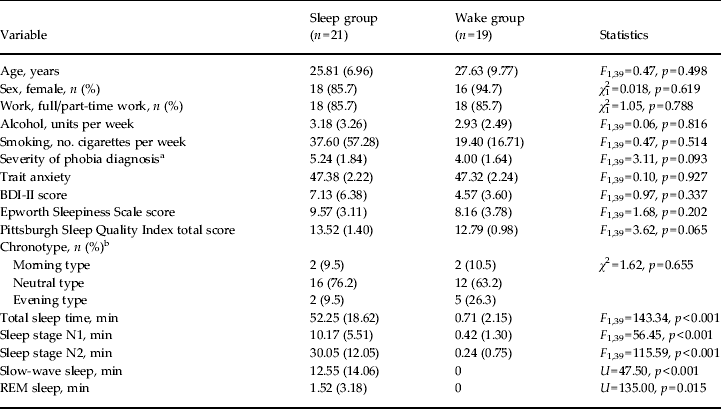
Sleep recordings revealed that only one participant fell asleep in the video control group (time in stage N2 sleep: 11 min), and he was transferred to the sleep group. In the sleep group, two subjects were unable to reach stable sleep for more than 5 min (time in stage N2 sleep: 1 and 3 min, respectively), and they were transferred to the wake group. Thus, in our analysis, the sleep group consisted of 21 participants (18 female, three male participants) and the wake group consisted of 19 participants (16 female, three male participants). The groups did not differ significantly in terms of age, sex and other demographic and clinical characteristics, including trait anxiety, depression and initial behavioral approach scores (all p > 0.20, see Table 1). There was a marginal difference in initial severity of phobia symptoms (p = 0.093). Importantly, there were no significant group differences in self-reported exposure to spiders in participants' everyday lives during the follow-up period, neither in frequency of any spider exposure (p = 0.430) nor in active exposure seeking (p = 0.635).
Pre-treatment sociodemographic, clinical and sleep characteristics of the sleep versus the wake group

Data are given as mean (standard deviation) unless otherwise indicated.
BDI, Beck Depression Inventory; REM, rapid eye movement.
a Phobia symptom severity from clinical interview.
b Chronotype was assessed with the German version of the Morningness–Eveningness Questionnaire.
Interview and questionnaire measures
Diagnostic criteria for specific phobia were assessed by graduate-level clinical psychologists using a structured Diagnostic Interview for Mental Disorders (DIPS; Schneider & Margraf, Reference Schneider and Margraf2006). The DIPS is a reliable interview, with good construct validity (Suppiger et al. Reference Suppiger, In-Albon, Herren, Bader, Schneider and Margraf2008). It is based on a German translation and extension of the Anxiety Disorders Interview Schedule for DSM-IV, and is designed to assess the most relevant mental disorders according to DSM-IV, text revision (DSM-IV-TR). A sum score was calculated indexing phobia severity. This score summed answers to questions on subjective spider anxiety, physiological arousal, avoidance, and interference with respect to spider anxiety. The following self-report questionnaires were administered: chronotype was assessed with the German version of the Morningness–Eveningness Questionnaire (Horne & Ostberg, Reference Horne and Ostberg1976); excessive daytime sleepiness was assessed using the Epworth Sleepiness Scale (Johns, Reference Johns1994); and sleep quality was assessed using the Pittsburgh Sleep Quality Index (Buysse et al. Reference Buysse, Reynolds, Monk, Berman and Kupfer1989). The Spider Phobia Beliefs Questionnaire (Arntz et al. Reference Arntz, Lavy, Van den Berg and Van Rijsoort1993) assessed catastrophic spider-related cognitions (e.g. ‘The spider is deadly’, or ‘The spider will attack me’). Depressive symptoms were assessed with the Beck Depression Inventory (BDI-II; Beck & Steer, Reference Beck and Steer1987). Presence in the virtual environment, i.e. the level of connection an individual feels with the virtual environment, is a critical construct for the experience of anxiety and for successful response to the VR (Price et al. Reference Price, Mehta, Tone and Anderson2011) and was assessed with the Immersive Tendencies Questionnaire (Scheuchenpflug, Reference Scheuchenpflug, Smith, Salvendy and Kasdorf2001).
Statistical analysis
Statistical analyses were performed with PASW 19.0 for Macintosh (SPSS Inc., USA). Group differences in demographic, clinical and sleep-related variables, and initial BAT scores were analysed with analysis of variance, χ 2 or Mann–Whitney U tests. Separate general linear models (GLM) were calculated as multivariate tests for repeated measures to assess the effect of group and time on BAT outcome variables (immediate and 1-week change scores in fear, cognition, avoidance), controlling for initial phobia severity and subjective presence in the virtual environment. In an explorative analysis, we correlated selected sleep indices with subjective anxiety and catastrophic cognition change scores. Effect sizes were calculated for significant results.
Results
Effects of one-session VR exposure
In the overall sample, we found a significant reduction of self-reported fear from pre- to post-exposure and 1-week follow-up assessment in several variables. First, subjective anxiety when approaching a live tarantula was reduced (SUDS rating, range 0–100): mean (s.d.)pre = 50.08 (26.86) v. mean (s.d.)post = 25.17 (22.61) (F 1,39 = 39.94, p < 0.001); mean (s.d.)follow-up = 20.08 (22.52) (F 1,39 = 41.79, p < 0.001, v. pre). The effect size from pre-treatment to post-treatment assessment was d = 1.01, and from pre-treatment to follow-up was d = 1.22. Spider-related negative beliefs, as measured during the BAT and by the Spider Phobia Beliefs Questionnaire significantly decreased during treatment: BAT – mean (s.d.)pre = 34.17 (31.87) v. mean (s.d.)post = 24.15 (27.79) (F 1,39 = 3.43, p = 0.071); mean (s.d.)follow-up = 18.72 (24.10) (F 1,39 = 10.18, p = 0.003); questionnaire – mean (s.d.)pre = 20.64 (3.96) v. mean (s.d.)follow-up = 16.51 (4.38) (F 1,38 = 39.94, p < 0.001, d = 1.0). Subjects also moved closer to the spider (distance to terrarium in cm) from pre- to post-exposure: mean (s.d.)pre = 95.05 (80.09) v. mean (s.d.)post = 51.1 0 (48.06) (F 1,39 = 33.61, p < 0.001, d = 0.68), and to follow-up, mean (s.d.)follow-up = 39.30 (48.83) (F 1,39 = 40.24, p < 0.001, d = 0.87).
Sleep following VR exposure
Total sleep time during the assigned 90 min in the sleep group was 52.25 min (s.d. = 18.62 min), with a mean sleep latency of 19.55 min (s.d. = 9.81 min). Average stage 2 sleep duration was 30.05 min (s.d. = 12.05 min); average slow-wave sleep duration was 12.55 min (s.d. = 14.06 min). Mean duration of REM sleep was 1.5 min (s.d. = 3.18 min).
Effects of sleep on VR exposure outcome
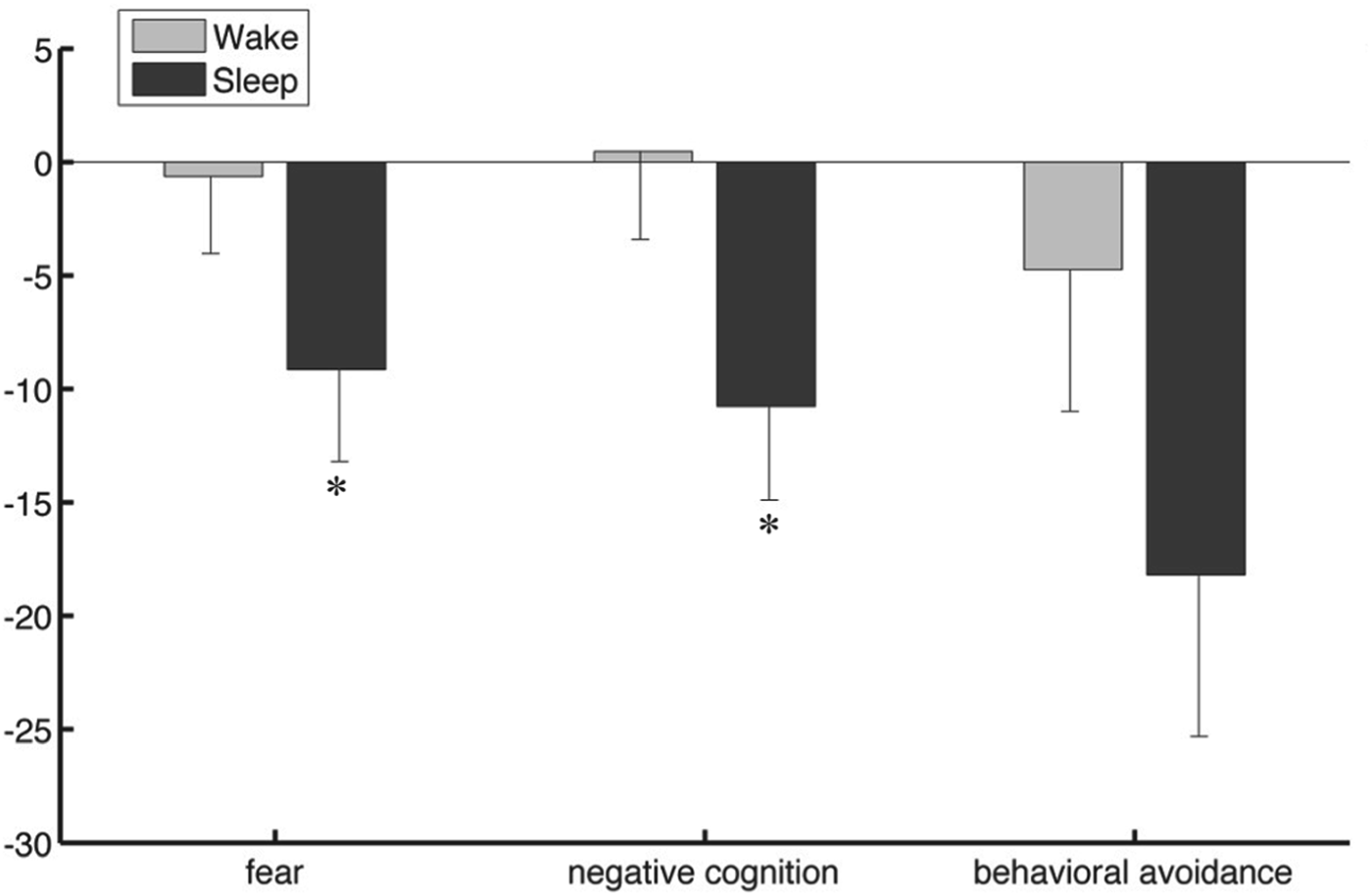
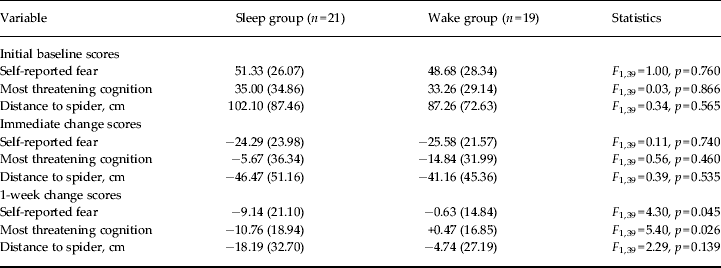
The GLM testing the effect of group and time on fear change scores revealed a significant effect of time (F 1,36 = 6.84, p = 0.013), with greater reductions at 1-week compared with immediate follow-up, as well as a significant interaction between group and time (F 1,36 = 4.30, p = 0.045). For cognition change scores, the GLM revealed a marginally significant effect of time (F 1,36 = 3.22, p = 0.081), and a significant interaction between group and time (F 1,36 = 45.40, p = 0.026). For behavioral avoidance, the effect of time was non-significant (p = 0.478), and the interaction between group and time was marginally significant (F 1,36 = 2.29, p = 0.139). We followed up the significant interactions with post-hoc tests and found that sleep did not affect immediate changes in subjective anxiety, severity of catastrophic spider-related cognitions or distance in approaching a live tarantula (all p values > 0.46). However, with regard to the long-term effects, participants in the sleep group showed a stronger reduction in subjective anxiety from post-exposure assessment to follow-up assessment after 1-week as compared with the wake group; reduction scores: mean (s.d.)sleep = − 9.14 (21.10) v. mean (s.d.)wake = − 0.63 (14.84) (F 1,36 = 4.30, p = 0.045, d = 0.47). The sleep group also showed greater reductions in catastrophic cognitions at follow-up compared with post-exposure; reduction scores: mean (s.d.)sleep = − 10.76 (18.94) v. mean (s.d.)wake = 0.47 (16.85) (F 1,36 = 5.40, p = 0.026, d = 0.53). The reduction in approach to the live spider (cm) was marginally significant; reduction scores: mean (s.d.)sleep = − 18.19 (32.70) v. mean (s.d.)wake = − 4.74 (27.19) (F 1,36 = 2.29, p = 0.139). Initial scores, as well as immediate and 1-week change scores and tests for group differences, are reported in Table 2. Reductions of subjective anxiety and catastrophic spider-related cognitions for the sleep versus the wake group are displayed in Fig. 1.
Enhanced reduction in self-reported fear (range 0–100), fear-related negative cognition (range 0–100) and behavioral avoidance (distance to a spider in cm) in the sleep compared with the wake group. The 1-week change scores were calculated by subtracting immediate follow-up scores from 1-week follow-up scores. Values are means, with standard errors represented by vertical bars. * Mean value was significantly different from that for the wake group (p < 0.05).

Initial self-reported fear, negative spider-related cognition and behavioral avoidance scores, and immediate and 1-week change scores a

Data are given as mean (standard deviation).
a Initial baseline scores were assessed 1 week prior to the exposure session. Immediate change scores were calculated by subtracting pre-exposure scores from immediate follow-up scores (assessed minutes after sleep/wake period); 1-week change scores were calculated by subtracting immediate follow-up scores from 1-week follow-up scores; ranges for fear and cognition scores were 0–100.
The difference between changes in subjective anxiety and negative cognition was not significantly different in either group (all p values > 0.770). Neither sleep quality, as indexed by the Pittsburgh Sleep Quality Score, nor level of immersion in the VR setting was significantly related to any of the outcome scores (all p values > 0.210).
Sleep indices and VR exposure outcome
In an exploratory analysis, contributions of sleep stage 2, slow-wave sleep and REM sleep to long-term reductions in self-reported fear and catastrophic cognitions in the BAT (change score from post-exposure to follow-up assessment) were investigated. Those with greater reduction in self-reported fear from post- to follow-up assessment had greater percentages of stage 2 sleep, again controlling for phobia severity and presence in the VR environment (r = 0.35, p = 0.03). Reduction of catastrophic cognitions was also related to more stage 2 sleep (r = 0.41, p = 0.016). There was no significant correlation between percentage of slow-wave sleep or REM sleep with change in self-reported fear and catastrophic cognitions (all p > 0.12).
Discussion
It is generally established that sleep after learning benefits memory consolidation, but this knowledge has not yet been applied to the context of emotional learning in psychotherapy. Here we show that sleep after VR exposure therapy improves the therapeutic effectiveness in spider phobia. Patients who napped after exposure therapy showed greater reductions in subjective anxiety and catastrophic spider-related cognitions at follow-up testing (after 1 week) as compared with patients who stayed awake after the therapeutic intervention. No differences were observed immediately after sleep or waking. The enhancing effects of sleep after 1 week correlated with greater percentages of stage 2 sleep, pointing to the importance of stage 2 sleep for this type of memory consolidation.
To our knowledge, this is the first empirical test of whether and how patients are able to sleep immediately following exposure therapy. Exposure sessions tend to have substantial anxious arousal properties, so that it might have been expected that sustained arousal would prevent individuals from falling asleep after therapy. Our results demonstrate that this was not the case: mean sleep onset latency was around 20 min, and individuals slept 50 min on average during the assigned 90-min period just after the exposure session. It is conceivable that our specific session format was strenuous and thus tiring for participants. Concentration on the head-mounted VR display may have contributed to this effect. Nevertheless, our findings clearly warrant further investigation of the effects of post-therapy sleep for all kinds of different therapeutic settings.
The most crucial finding of our study was that sleep facilitated the effects of exposure therapy in the long run. Not only did participants who slept show less fear at 1-week follow-up, they also reported a greater drop in their most severe spider-related cognition compared with those who remained awake. In contrast, the wake group did not show any reduction in these indices following the post-exposure measurement.
Exposure-based psychotherapy of phobia is thought to rely on extinction of fear responses (Ressler et al. Reference Ressler, Rothbaum, Tannenbaum, Anderson, Graap, Zimand, Hodges and Davis2004; McNally, Reference McNally2007), a learning mechanism that has been shown to be significantly delayed in phobias and other anxiety disorders. In animals, the important role of sleep for extinction learning is well established. In honeybees, sleep after extinction learning improved extinction memory as compared with sleep deprivation (Hussaini et al. Reference Hussaini, Bogusch, Landgraf and Menzel2009). Similarly in rats, particularly REM sleep deprivation after extinction learning had an impairing effect on extinction (Silvestri et al. Reference Silvestri, Pace-Schott, Gersh, Stickgold, Salzman and Hobson2001; Silvestri & Root, Reference Silvestri and Root2008). Also in humans, REM sleep deprivation increased skin conductance responses to previously extinguished fear cues (Spoormaker et al. Reference Spoormaker, Schröter, Andrade, Dresler, Kiem, Goya-Maldonado, Wetter, Holsboer, Sämann and Czisch2011). In addition, undisturbed sleep after extinction learning (compared with wakefulness) in a classical conditioning paradigm promoted the generalization of extinction of conditioned fear, but did not directly affect extinction recall tested immediately after a sleep or waking interval (Pace-Schott et al. Reference Pace-Schott, Milad, Orr, Rauch, Stickgold and Pitman2009). The lack of immediate effects of sleep or waking after extinction learning on extinction recall is consistent with the results of the current study and might be partly due to after-effects of prior sleep or wakefulness on emotional reactivity during the testing and recall phase (van der Helm et al. Reference van der Helm, Gujar, Nishida and Walker2011a ; van der Helm & Walker, Reference van der Helm and Walker2011; Baran et al. Reference Baran, Pace-Schott, Ericson and Spencer2012). Sleep inertia may deteriorate arousal and several cognitive performances in the post-awakening period (Wertz et al. Reference Wertz, Wright, Ronda and Czeisler2006) and may thus have influenced our results for the immediate post-sleep measurement. Future studies should thus employ additional tests to preclude such effects. Most importantly, however, we show that sleep after extinction learning during exposure therapy is particularly beneficial for long-term reduction of fear to the phobic stimulus. A possible explanation is that sleep after extinction learning initiates a process of stabilization of the new extinction memory trace, which continues to fully develop over multiple nights. Beneficial effects of sleep on emotional learning have been observed up to 4 years (Wagner et al. Reference Wagner, Hallschmid, Rasch and Born2006). In addition, the immediate effect of sleep on generalization of extinction (Pace-Schott et al. Reference Pace-Schott, Milad, Orr, Rauch, Stickgold and Pitman2009) might help to transfer the positive effects of exposure treatment to the real world and ‘real’ spiders, resulting in most pronounced effects during follow-up testing. Finally, the follow-up testing is not confounded by differences in prior sleep or wakefulness, allowing testing both experimental groups in similar states.
To shed light on the mechanism of action of sleep, we explored the relationship between sleep indices and reductions in fear and cognition. We found a specific relationship between fear and cognition reduction and stage 2 sleep, but not REM sleep. As we examined short naps in this study, the amount of REM sleep was rather small in our sleep group (mean duration 1.5 min), which might obscure possible relationships between REM sleep and reductions in fear. While studies support a role for REM sleep in emotional learning processes (Silvestri et al. Reference Silvestri, Pace-Schott, Gersh, Stickgold, Salzman and Hobson2001; Wagner et al. Reference Wagner, Gais and Born2001; Silvestri & Root, Reference Silvestri and Root2008; Spoormaker et al. Reference Spoormaker, Schröter, Andrade, Dresler, Kiem, Goya-Maldonado, Wetter, Holsboer, Sämann and Czisch2011) and have reported correlations with emotional memory measures and REM sleep (Nishida et al. Reference Nishida, Pearsall, Buckner and Walker2009), others have also failed to find such relationships (Baran et al. Reference Baran, Pace-Schott, Ericson and Spencer2012). An involvement of stage 2 sleep in consolidation processes has been proposed, particularly for simple motor tasks (Walker et al. Reference Walker, Brakefield, Morgan, Hobson and Stickgold2002, Reference Walker, Brakefield, Seidman, Morgan, Hobson and Stickgold2003; Smith et al. Reference Smith, Aubrey and Peters2004), whereas sleep spindles characterizing stage 2 sleep are believed to play a crucial role in consolidation of several different types of memories during sleep and are supposed to promote plastic changes in cortical networks together with hippocampal memory reactivations (e.g. Rasch et al. Reference Rasch, Buchel, Gais and Born2007; Diekelmann & Born, Reference Diekelmann and Born2010; Mölle & Born, Reference Mölle and Born2011). Thus, further studies are required to specify the role of stage 2 sleep and sleep spindles in memory processes related to fear extinction learning occurring during sleep.
From a clinical perspective, our results indicate that napping after therapy facilitates the effects of VR exposure therapy. This is important, as not all patients benefit from exposure therapy, and for those who benefit, fear often returns following initially successful therapy (Craske & Mystkowski, Reference Craske, Mystkowski, Craske and Vansteenwegen2006). Napping post-therapy may thus be one method for enhancing exposure-based interventions in order to increase response rates. Advising patients to nap following psychotherapy may be beneficial, as novel memories are formed during a session and sleep may increase their consolidation and possibly generalization (Nishida et al. Reference Nishida, Pearsall, Buckner and Walker2009; Pace-Schott, 2012).
Our study is an initial foray into an important clinical application of recent memory research and not without limitations. Future studies will be needed to replicate the beneficial effect of sleep, as well as to extend it to other forms of psychotherapy. In particular, it may be important to study multiple-session rather than single-session therapies, and to investigate the beneficial effects of sleep on specific therapies for different forms of psychopathology, e.g. depression rather than anxiety disorders. It may also be crucial to clarify the exact mechanisms by which memory consolidation post-therapy takes place, and whether and how this may be interacting with psychopharmacological treatment. This may be particularly important, as we did not assess possible interactions between post-therapy sleep with night sleep following therapy. The present study did not employ physiological measures of arousal during the BAT and future studies should include such measures. Finally, the relatively short sleep period in our study may have precluded longer REM periods. The lack of association between REM sleep and reduction in anxiety may therefore reflect a type II error.
Despite these limitations, our study has a number of strengths. We demonstrated that individuals afflicted with anxiety disorder are able to nap following one-session exposure treatment, and that this short nap benefits emotional memory consolidation post-therapy and thus enhances the effect of psychotherapy. These findings offer an important non-invasive alternative to recent attempts to facilitate therapeutic memory extinction and consolidation processes with pharmacological interventions. Our findings help to understand the memory processes in fear reduction. Given replication with longer follow-up time points and extension to other samples and therapeutic settings, our data may open new avenues for further increasing the effectiveness of psychological therapies for anxiety and possibly other disorders.
Acknowledgements
We thank Mary Princip and Deborah Widmer for help with data acquisition and conducting VR therapies, and Ursula Kirmse for help with technical setup in the psychophysiology laboratory. The present study was supported by a young investigator grant from the University of Basel (no. DPE2069 to B.K.). B.K. and B.R. are supported by the Swiss National Science Foundation (grant no. PZ00P1-126597 to B.K. and PP00P1-133685 to B.R.).
Declaration of Interest
None.