Introduction
Amyloid-β (Aβ) positron emission tomography (PET) has been used in clinical trials as a robust biomarker to detect potential Alzheimer's disease (AD) at the pre-clinical stage (Sperling et al., Reference Sperling2011; Reiman et al., Reference Reiman2016). Nevertheless, there remains significant debate over the ethical issues of delivering the results of amyloid imaging because there has been no clinical pharmacological treatment to prevent or delay the development of AD symptoms up to today (Witte et al., Reference Witte2015). Only two studies suggesting the safe disclosure of PET results have been conducted in the USA (Lim et al., Reference Lim, Maruff, Getter and Snyder2016; Burns et al., Reference Burns, Johnson, Liebmann, Bothwell, Morris and Vidoni2017). However, the authors did not make reference to “subjective” complaints and the population of these studies was limited in ethnic diversity.
Among asymptomatic adults, those with subjective cognitive decline (SCD) can be distinguished from those who are cognitively healthy (Jessen et al., Reference Jessen2014). Mounting research has shown that the abnormal accumulation of cerebral Aβ combined with SCD predicts cognitive decline (Perrotin et al., Reference Perrotin, Mormino Ec Fau - Madison, Madison Cm Fau - Hayenga, Hayenga Ao Fau - Jagust and Jagust2012; Amariglio et al., Reference Amariglio2015). Some studies have suggested that individuals with SCD may have more depressive and anxiety symptoms than healthy adults (Balash et al., Reference Balash, Mordechovich, Shabtai, Giladi, Gurevich and Korczyn2013); thus, care should be taken to avoid exacerbating such affective symptoms when disclosing biomarker results.
In Japan, more than 4.6 million people are living with dementia and the number is expected to rise to 7 million (one in five people aged 65 years or over) by 2025 (Ministry of Health, 2015). Nevertheless, no empirical studies have been conducted to examine the safety of diagnostic disclosure of AD, mild cognitive impairment due to AD, or preclinical AD on Japanese older adults. In spite of the circumstances, some institutions in Japan have started using Aβ imaging for clinical diagnosis, as well as research purposes. It is urgent to develop appropriate guidelines regarding such procedures.
This study aimed to examine the short-term psychological impact of delivering Aβ PET results to asymptomatic Japanese elderly with SCD, and to provide an empirical basis for promoting culturally sensitive communication.
Methods
Participants were recruited from the memory clinic at Keio University Hospital from May 2015 to September 2016 as a part of our institutionally approved study to reveal clinical and cognitive features of preclinical AD with SCD. We recruited SCD patients in accordance with a conceptual framework of the working group of SCD-initiative (SCD-I): (a) normal level of objective performance, (b) self-perceived cognitive decline, and (c) medical help-seeking for SCD (Jessen et al., Reference Jessen2014).
The other inclusion criteria were as follows: age 65–85 years, Mini-Mental State Examination score of ≥27, Logical memory subtest (I) of the Wechsler Memory scale score within normal range (education adjusted cut-off scores), Clinical Dementia Rating = 0, Hachinski Ischemic Score ≤ 4. No abnormalities were detected on magnetic resonance imaging (MRI), and single photon emission computed tomography (SPECT) of the brain. Patients diagnosed with neurological or neurodegenerative disorders other than preclinical AD, or any medical conditions that are known to affect cognitive functions, were excluded.
Before obtaining informed consent, psycho-education was provided in both written and verbal form by the psychiatrists on the research team, including details about (a) the concept of preclinical AD, (b) the hypothetical effect of Aβ deposition on cognitive decline, and (c) how to interpret PET results. It was mentioned that Aβ positivity does not always mean to develop AD, and negativity does not indicate to have no risk of developing AD. We verbally confirmed that all potential participants adequately understood the implication of Aβ positivity and negativity before the study began.
Forty-three people who met the inclusion criteria agreed to participate in the study. All the participants requested disclosure of their amyloid PET status using florbetaben (18F). Visual assessment of the PET scans was conducted by nuclear medicine experts certified by the manufacturer. Aβ positivity or negativity was determined by assessing tracer uptake in the gray matter in accordance with Neuraceq® guidelines (Neuraceq®). Two experienced psychiatrists disclosed the PET results to each participant.
Outcome measures were obtained at enrollment (pre-disclosure) and at 6 weeks after disclosure (post-disclosure) on anxiety and depression levels as assessed by the State-Trait Anxiety Inventory (STAI) and the Beck Depression Inventory-II (BDI-II). The Impact of Events Scale-Revised (IES-R) was administered at the 6-week follow-up (post-disclosure) to measure test-related distress.
An analysis of variance (ANOVA) was conducted on the STAI and BDI-II scores with time (pre- and post-disclosure) as a within-subject factor and PET results (Aβ positive and negative) as a between-subjects factor. In addition, an ANOVA was performed to examine differences in IES-R scores between Aβ positive and negative groups at 6 weeks. All statistical tests were two-tailed, and p < 0.05 was considered to indicate statistical significance.
The study was approved by the ethics committee of Keio University School of Medicine (IRB number: 20130509).
Results
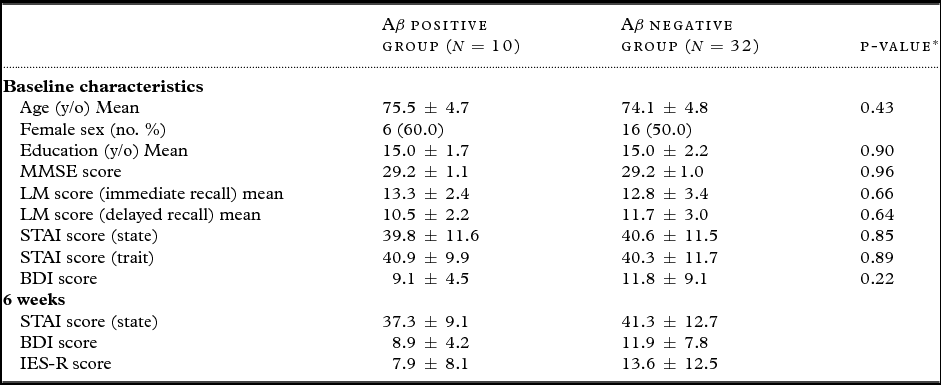
Among 43 participants, 42 received the results of Aβ imaging; one participant voluntary dropped out because of personal health issues. The 42 participants entered a 6-week follow-up phase without dropping out. They were divided into either an Aβ positive (n = 10) or an Aβ negative (n = 32) group. Demographic data at baseline and scores at the 6-week follow-up are shown in Table 1. No significant differences were observed for any item between groups at baseline.
Demographic data at baseline (pre-disclosure) and results of follow-up assessment at 6 weeks after disclosure (post-disclosure)

Abbreviations: Aβ = Beta-amyloid; MMSE = Mini-Mental State Examination; LM = logical memory subtest of the Wechsler Memory Scale; STAI = State-Trait Anxiety Inventory; BDI = Beck Depression Inventory-II; IES-R = Impact of Events Scale-Revised.
*Independent t-test.
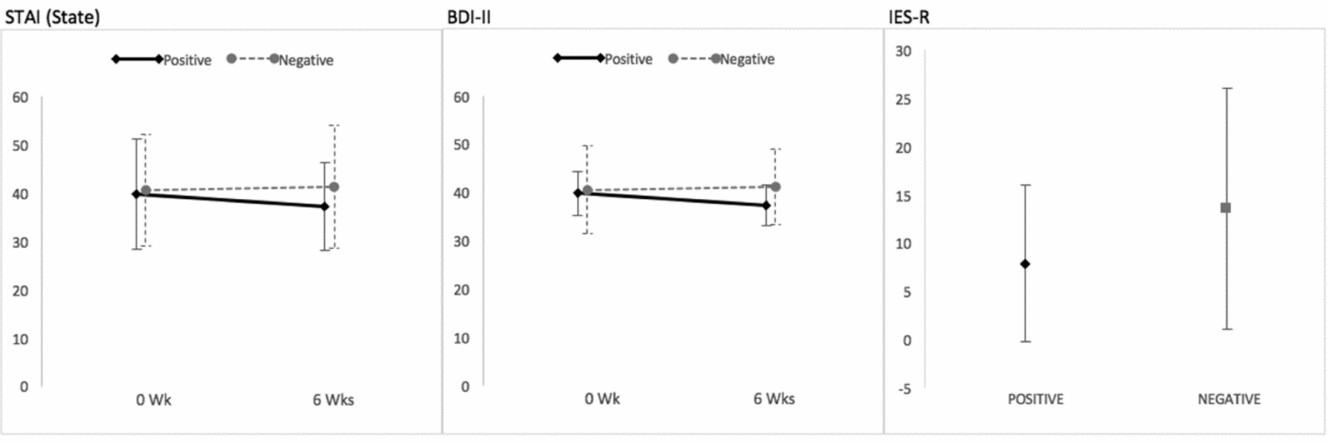
As shown in Figure 1, the ANOVA revealed no significant main effect. State anxiety did not change over time, F (1, 40) = 0.84, p = 0.37, and was not different between groups, F (1, 40) = 0.38, p = 0.54. Depression did not change over time, F (1, 40) = 0.02, p = 0.90, and was not different between groups, F (1, 40) = 1.31, p = 0.26.
Mean scores of the STAI (State anxiety), BDI-II, and IES-R at each time point. Abbreviations: STAI = State-Trait Anxiety Inventory; BDI-II = Beck Depression Inventory-II; IES-R = Impact of Events Scale-Revised. *Positive, Aβ positive group (N = 10); negative, Aβ negative group (N = 32).

The IES-R means at 6 weeks in the Aβ positive and negative groups were well below the cut-off score (7.9 and 13.6, respectively). No significant differences were observed between groups, F (1, 40) = 1.81, p = 0.19.
Discussion
The present study showed that the disclosure of Aβ PET results to asymptomatic Japanese individuals with SCD did not cause significant short-term psychological harm. In addition, Aβ positive results did not cause greater mood disturbances than Aβ negative results. These results are consistent with those from previous studies (Lim et al., Reference Lim, Maruff, Getter and Snyder2016; Burns et al., Reference Burns, Johnson, Liebmann, Bothwell, Morris and Vidoni2017).
Taking into account that no treatment is currently available to completely cure AD, the guideline of the Amyloid Imaging Taskforce (AIT) concludes it inappropriate to use amyloid PET in asymptomatic individuals or those with a cognitive complaint but no objective confirmation of impairment (Johnson et al., Reference Johnson2013). Also, a working group consisted of the Japan Society for Dementia Research and the two other societies specified a guidance in consistent with the AIT criteria (Japan Society for Dementia Research, 2015). In reality, however, amyloid imaging is used in such populations all over the world for the purpose of clinical trials or diagnosis, and no clinical trials have produced promising results on developing anti-amyloid drugs thus far (Editorial, 2017). As such clinical trials continue to be conducted in the future and more and more inappropriate candidates for amyloid imaging have to be disclosed the PET results, it is important to evaluate the psychological impact of delivering amyloid PET results on asymptomatic people with SCD, which has not yet been examined.
Although the ethnic and cultural backgrounds of the participants in the present study differed from those of the participants in previous studies, they yielded similar results that suggested no change in anxiety and depression after receiving disclosure of amyloid status (Lim et al., Reference Lim, Maruff, Getter and Snyder2016; Burns et al., Reference Burns, Johnson, Liebmann, Bothwell, Morris and Vidoni2017). This may support the increasing preference of Japanese people to receive full diagnostic information; some studies have shown that the majority of Japanese people would want full disclosure if they were at risk of developing AD (Umegaki et al., Reference Umegaki, Onishi, Suzuki, Endo and Iguchi2007). In addition to the preference of full disclosure, investigating the psychological effect is essential to address the safety of disclosing a diagnosis. In order to examine such ethical issues of diagnosis disclosure of AD, qualitative and quantitative studies have been conducted mainly in Western countries. However, it is intriguing that the debate in Japan regarding whether to tell truth about AD at any stage has continued without empirical data. The results of the present study demonstrate for the first time the safety of disclosing a preclinical AD diagnosis to Japanese individuals.
This study did have some limitations. First, we only examined ways of disclosing results in terms of short-term psychological safety. Second, the sample size was relatively small; long-term safety up to 1 year after disclosure will need to be investigated in a future follow-up study. Third, we were unable to determine whether STAI and BDI-II scores at pre- and post-disclosure fell within normal limits. In the future, data will need to be collected not only from cognitively healthy adults without SCD but also from nondisclosure group (individuals who will not receive the Aβ PET results) for comparison. Furthermore, a specific measurement should be employed to more precisely clarify the level of understanding among participants regarding the Aβ PET results.
Conflict of interest
This work was funded by PIRAMAL Imaging S.A., Matran, Switzerland.
Description of authors’ roles
T. Wake, H. Tabuchi, K. Funaki, D. Ito, B. Yamagata, and T. Yoshizaki contributed to drafting/revising the manuscript for content, the study concept or design, analysis or interpretation of data, recruitment of participants, acquisition of data, and statistical analysis. M. Kameyama, T. Nakahara, and K. Murakami contributed to drafting/revising the manuscript for content, the study concept or design, analysis or interpretation of data, and evaluation of image. M. Jinzaki and M. Mimura contributed to discussion and reviewed and edited the manuscript.
Acknowledgments
The authors wish to thank all of the participants and staff at the Department of Radiology and the Department of Microbiology and Immunology for their support in the administration of PET, MRI, and SPECT.