Introduction
Depression is a disorder characterised by increased levels of immune and inflammatory components, both in subjects diagnosed with concurrent inflammatory processes and in those with no detectable inflammation of known aetiology Reference Raison, Capuron and Miller(1). In the periphery, increased activities of neutrophils, monocytes and macrophages, among others, are observed Reference Maes(2), whereas in the central nervous system, there is an increase in microglial cell activity Reference Leonard(3).
Myeloperoxidase (MPO) is a myeloid-specific enzyme, characteristic of neutrophils, monocytes and microglial cells Reference Nauseef(4,Reference Yap, Whiteman and Cheung5). While MPO expression has been showed in hippocampal neurons Reference Green, Mendez and Jacob(6), the presence of MPO in the brain can also be because of the infiltration of neutrophils and monocyte/macrophages Reference Yap, Whiteman and Cheung(5). MPO is an enzyme involved in systemic defence Reference Hansson, Olsson and Nauseef(7); however, it is also known to be involved in cell damage processes, such as those observed in chronic inflammation Reference Malle, Furtmüller, Sattler and Obinger(8). MPO is a catalyst for the reaction, yielding potent oxidants such as hypochloric acid (HOCL) Reference Spickett, Jerlich and Panasenko(9) and reactive oxygen species (ROS) that are involved in the induction of neurodegenerative changes Reference Yap, Whiteman and Cheung(5). The observed associations among MPO, its reaction products, oxidative stress and neurodegenerative changes should be emphasised in view of the processes that indicate the presence of oxidative stress in depression (Reference Khanzode, Dakhale, Khanzode, Saoji and Palasodkar10–Reference Yanik, Erel and Kati12), together with the volumetric reduction of the cerebral cortex and hippocampus structures Reference Monkul, Malhi and Soares(13) that occurs in depressive disorders (DD), a change that may result from neurodegeneration Reference Bachis, Cruz, Nosheny and Mocchetti(14). Additionally, MPO induces the production of proinflammatory cytokines and ROS Reference Lefkowitz and Lefkowitz(15), which, in turn, are involved in the inhibition of neurogenesis Reference Ekdahl, Claasen, Bonde, Kokaia and Lindvall(16), another feature of depression Reference Xu, Chen and He(17). Moreover, proinflammatory cytokines bring about neurobiological changes in depression Reference Leonard(18) and stimulate the generation of ROS, which results in damaged cell membranes and disturbed neurotransmitter receptor functions Reference Maes and Smith(19,Reference Peet, Murphy, Shay and Horrobin20).
MPO has a tetrameric structure with a molecular weight of approximately 150 kDa. The gene for this enzyme is mapped on chromosome 17 Reference Hansson, Olsson and Nauseef(7), which is a candidate region for the development of mental disorders Reference Tomàs, Cañellas and Rodríguez(21). Piedrafita et al. described a single nucleotide polymorphism (SNP) G-463A of the MPO gene, characterised by a G-to-A transition and affecting MPO expression. The presence of -463G allele, which occurs with high frequency, increases the expression of the enzyme. In contrast, the -463A allele decreases the enzyme expression by destroying the transcriptional factor binding site Reference Piedrafita, Molander, Vansant, Orlova, Pfahl and Reynolds(22). The functional polymorphism of MPO is associated with inflammatory processes Reference Hoy, Trégouët and Leininger-Muller(23) and neurodegenerative diseases Reference Hoy, Leininger-Muller, Kutter, Siest and Visvikis(24).
In view of increased MPO activity, observed by Vaccarino et al. Reference Vaccarino, Brennan and Miller(25) in depressive patients, as well as of the associations between this disorder and inflammatory processes and the rich evidence for enhanced pro-oxidative processes, it was decided to assess the correlation between G-463A MPO gene polymorphism and the risk of recurrent DD.
Materials and methods
The study involved 149 patients, treated for recurrent DD (91 females – 61.07% and 58 males – 38.93%). The diagnosis was established according to ICD-10 criteria (F33.0–F33.8) (26). Medical history was obtained and qualified using the standardised Composite International Diagnostic Interview (CIDI) form (26). Additionally, the number of depressive episodes, disease duration and patient age at disease onset were recorded for each patient. The control group (CG) consisted of 149 healthy subjects (83 females – 55.7% and 66 males – 44.3%) with a family history negative for psychiatric disorders. Healthy controls included community volunteers, enrolled in the study on the basis of a CIDI psychiatric interview (26). Both patients and controls with other psychiatric diagnoses among the axis I and II disorders were excluded from the study. No significant differences were found in either DD or CG groups with respect to age and gender (p > 0.05). The following correlations were observed between genotype distribution and Hardy-Weinberg equilibrium in DD patients and the CG: DDχ 2 = 4.046; CG χ 2 = 7.375, respectively. Severe or chronic diseases with confirmed inflammatory or autoimmune aetiology were considered exclusion criteria in either group. All patients and control subjects were native, unrelated Poles that were inhabitants of the central Poland. Informed consent was obtained from all participants of the study, the protocol of which had been approved by the local Bioethics Committee (no. RNN/566/08/KB).
PCR products were generated using 0.1 µg of genomic DNA as a template, the forward primer 5′-CCGTATAGGCACACAATGGTGAG-3′ and the reverse primer 5′-GCAATGGTTCAAGCGATT CT TC-3′. The PCR reaction was carried out using a 20-µl reaction with a final concentration of 50 µm of each dNTP, 1.5 mM MgCl, 0.1 µM of each primer and 1 unit of GoTaq polymerase (Promega, Madison WI, USA). After denaturation at 95 °C for 5 min, the cycling conditions were as follows: 35 cycles at 94 °C for 30 s, 56 °C for 30 s and 72 °C for 30 s, with a final extension at 72 °C for 7 min. PCR products were then digested with five units of AciI overnight at 37 °C and separated on a 6% polyacrylamide gel in TBE buffer containing 90 mM borate acid and 2.5 mM ethylenediamine tetraacetic acid (EDTA). The G-to-A substitution at position 463 leads to the loss of an AciI restriction site. The -463A allele thus produced an undigested product of 289 bp, while the -262 G allele resulted in two products: fragments of 169 and 120 bp.
The results are reported as means with standard deviations (SDs) or percentages (%). In order to examine the association between the MPO polymorphism and recurrent DD, allele and genotype frequencies were compared between the study patients and the controls using the χ 2 test. Post hoc power analysis was performed using a non-central χ 2 distribution. The analysis of association was based on 95% confidence interval (CI) for the disease odds ratios (ORdis) calculated according to Bland and Altman Reference Bland and Altman(27). Departures from Hardy-Weinberg equilibrium were determined by comparing the observed genotype frequencies with expected genotype frequencies, while including the observed allele frequencies in performed calculations. In all analyses, p≤ 0.05 was accepted as the threshold for statistical significance.
Results
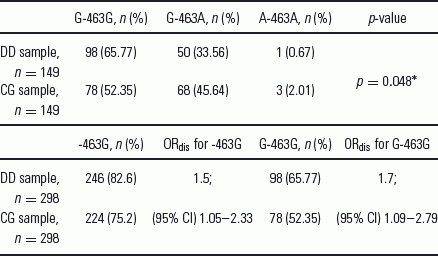
Data and statistical analyses regarding genotype distribution, allele frequency and ORdis values determined with respect to the G-463A MPO polymorphism in DD patients and the CG are presented in Table 1. A statistically significant difference was observed in genotype distribution between healthy and DD-affected subjects. A statistically significant difference was also showed in allele frequency between CG and DD (p = 0.027). ORdis interval estimation for the presence of G-463G homozygosity performed for the remaining genotypes (A-463A + G-463A), analysed as one group, showed that the presence of the -463G allele in the MPO gene increased by 1.5-fold the risk of DD, whereas the presence of homozygosity increases the risk of DD development 1.7-fold, in comparison with subjects lacking either the allele or the genotype.
Genotype distribution, allele frequency and ORdis values in the G-463A MPO polymorphism in DD and CG
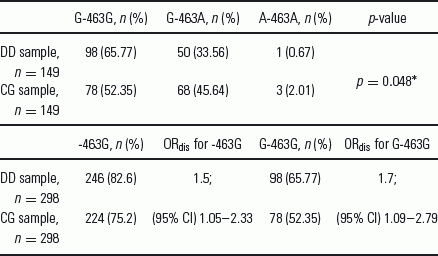
ORdis, odds ratio of disease; DD, patients with recurrent depressive disorder; CG, control group.
* χ 2 = 60,806; df = 2.
Post hoc power analysis showed a moderate effect size w = 0.27 (Cohen's classification) and high-power of testing 1 −β = 99% (n = 298).
No statistically significant differences were observed either in genotype distribution or in allele frequency related to the assessed clinical variables in the analysed groups (patient age at onset in years, p = 0.248; disease duration in years, p = 0.363; the number of episodes, p = 0.491).
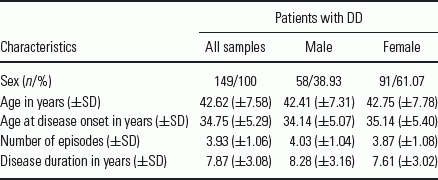
Sociodemographic and clinical variables in the DD patient group are presented in Table 2.
Sociodemographic characteristics and clinical variables (patient age at onset, disease duration and the number of episodes) in the DD patient group
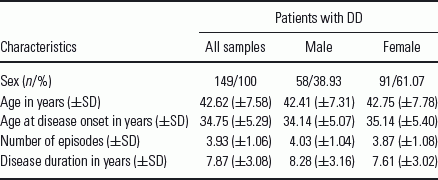
n, number of patients, %, percentage of patients, ±SD, standard deviation, DD, depressive disorder.
Discussion
Our study is the first attempt to assess the correlation between the risk of recurrent DD and SNP G-463A of the gene encoding MPO. Additionally, our results draw attention to the role of SNPs in the pathophysiology of depression Reference Shi, Hu and Dong(28,Reference Lee, Kang and Han29). MPO, and the gene encoding it, may be a marker of inflammatory and pro-oxidative processes in depressive patients. The obtained results show differences in genotype distribution and in allele frequency of an MPO polymorphism between DD patients and CG subjects, specifically showing that genotype G-463G and allele -463G are significantly more frequent in the DD group. This finding confirms the correlation between the presence of G-463G genotype and the -463G allele and the risk of recurrent DD. However, we did not find any correlations between the studied polymorphism and patient age at disease onset, the number of episodes or disease duration. It should be noted that the -463G allele determines MPO expression much more strongly than the -463A allele, and thus may provide protection against the onset of recurrent DD. Considering the obtained results, it seems logical to expect increased lipid peroxidation in depressive patients Reference Khanzode, Dakhale, Khanzode, Saoji and Palasodkar(10), as higher MPO activity results in production of a potent oxidant, HOCL, that is known to be involved in lipid peroxidation Reference Yap, Whiteman and Cheung(5). Our results may also explain the increased MPO activity found in the serum of depressive patients by Vaccarino et al. Reference Vaccarino, Brennan and Miller(25). The role of MPO should also be emphasised with respect to the reduction of serotonin – an important neurotransmitter in the pathophysiology of depression, as serotonin is a favoured substrate of MPO in oxidation reactions Reference Hallingbäck, Gabdoulline and Wade(30).
The G-463A polymorphism of the MPO gene promoter region has been assessed in many diseases that are often coincident with depression and characterised by inflammation and oxidative stress. One such pathology is Alzheimer's disease (AD), which has been confirmed by rich evidence to have many common features with depression. Additionally, depression often precedes the onset of AD Reference Leonard(3). Studies of AD have reported varying correlations between the risk of the disease development and the studied polymorphism. Crawford et al. Reference Crawford, Freeman and Schinka(31) presented a correlation between G-463G homozygosity, patient gender and AD development in a Caucasian population, but failed to show such a correlation in Hispanics. Reynolds et al. Reference Reynolds, Rhees and Maciejewski(32) showed that there were more cases of AD among Finnish males as well as an increased incidence of AD associated with -463A allele. A correlation between the risk of AD and the presence of G-463G homozygosity was observed by Zappia et al. Reference Zappia, Manna and Serra(33). In contrast, Usui et al. Reference Usui, Shibata and Ohnuma(34) and Combarros et al. Reference Combarros, Infante, Llorca, Peña, Fernández-Viadero and Berciano(35) failed to show any correlation between the risk of AD and G-463A polymorphism distribution. However, despite the common features between them, any comparison of the aetiology of depression and AD carries certain limitations because of the fact that depression does not in all cases develop into AD. The correlation with G-463A SNP was assessed in patients with impairment in cognitive function, which is a central symptom in depression Reference Gohier, Ferracci and Surguladze(36). The results of Pope et al. Reference Pope, Kritchevsky and Ambrosone(37) indicate that the presence of an A-463A allele poses a risk for disturbances in cognitive function. No correlation between cognitive function disturbances and G-463A MPO gene polymorphism have been observed in multiple sclerosis (MS) Reference Manna, Valentino and La Russa(38), despite the fact that MS is often accompanied by depression Reference Marrie, Horwitz, Cutter, Tyry, Campagnolo and Vollmer(39). Likewise, Kantarci et al. Reference Kantarci, Atkinson, Hebrink, McMurray and Weinshenker(40) showed no correlations between MS development and the G-463 polymorphism. However, a potential role for this polymorphism in MS was shown by Nagra et al. Reference Nagra, Becher and Tourtellotte(41) in a study that associated it with an early onset of the disease in women. A correlation between the analysed polymorphism of MPO and the risk of developing the disease has been observed for coronary artery disease (CAD) Reference Nikpoor, Turecki, Fournier, Théroux and Rouleau(42), which has also been linked to depression Reference Wulsin and Singal(43,Reference McCaffery, Frasure-Smith and Dubé44). Moreover, inflammation and oxidative stress are the central mechanisms involved in the risk of CAD development Reference Carr, McCall and Frei(45). Polymorphisms of the genes involved in inflammation, which might be candidates for the pathogenesis of depression, have been assessed in many studies. A relationship has been showed between the risk of depression and the G-308A SNP of the TNF-alpha gene Reference Jun, Pae and Hoon-Han(46), as well as with a SNP of the gene encoding chemoattractant-1 protein (MCP1), which is essential in monocyte immune response regulation Reference Pae, Yu and Kim(47). Susceptibility to depression has also been showed to correlate with SNPs of the genes important for T-cell differentiation and antigen response Reference Wong, Dong, Maestre-Mesa and Licinio(48).
The relationship between the polymorphism of MPO with recurrent DD may be regarded as another piece of evidence supporting a model in which inflammation plays a role in the pathophysiology of depression.
It should be noted that the authors take much care while drawing these conclusions, because of the limitations regarding both the study itself and the obtained results. The study was performed in a relatively small group of patients, and the statistical significance of the obtained results is not high (p = 0.048). It is also important that while interpreting data showing an association of SNPs with various diseases, one takes into account the possibility of false-positive results, as emphasised in the study by Sullivan Reference Sullivan(49). Additionally, the authors want to note the large diversity (from 42.4 to 71%) in the incidence of MPO G-463G homozygosity in the European population (Reference Zappia, Manna and Serra33,Reference Combarros, Infante, Llorca, Peña, Fernández-Viadero and Berciano35,Reference Atzeni, Boiardi and Casali50–Reference Rajp, Adu and Savage53).
With this in mind, the results obtained in this study point to an association with the polymorphism of MPO, an enzyme involved in inflammatory processes and oxidative stress, with the development of recurrent DD.
Our results provide the basis for further research aimed at assessment and confirmation of the biological significance of MPO and various SNPs of this enzyme in the development and course of depression, with studies to be carried out on larger cohorts of patients and in various ethnic groups.