The Responsibility to Protect (RtoP) has become a prominent feature in international debates about preventing genocide and mass atrocities and about protecting potential victims. Adopted unanimously by heads of state and government at the 2005 UN World Summit and reaffirmed twice since by the UN Security Council, the principle of RtoP rests on three equally weighted and nonsequential pillarsFootnote 1: (1) the primary responsibility of states to protect their own populations from the four crimes of genocide, war crimes, ethnic cleansing, and crimes against humanity, as well as from their incitement; (2) the international community's responsibility to assist a state to fulfill its RtoP; and (3) the international community's responsibility to take timely and decisive action, in accordance with the UN Charter, in cases where the state has manifestly failed to protect its population from one or more of the four crimes. The principle differed from the older concept of humanitarian intervention by placing emphasis on the primary responsibility of the state to protect its own population, introducing the novel idea that the international community should assist states in this endeavor, and situating armed intervention within a broader continuum of measures that the international community might take to respond to genocide and mass atrocities. As agreed to by states, the principle also differed from the proposals brought forward by the International Commission on Intervention and State Sovereignty by (among other things) emphasizing international assistance to states (pillar two), downplaying the role of armed intervention, and rejecting criteria to guide decision-making on the use of force and the prospect of intervention not authorized by the UN Security Council. Five years on from its adoption, RtoP boasts a Global Centre and a network of regional affiliates dedicated to advocacy and research, an international coalition of nongovernmental organizations (NGOs), a journal and book series, and a research fund sponsored by the Australian government. More important, RtoP has made its way onto the international diplomatic agenda. In 2008, UN Secretary-General Ban Ki-moon challenged the UN membership to translate its 2005 commitment from “words to deeds.”Footnote 2 This challenge was taken up by the General Assembly in 2009, when it agreed to give further consideration to the secretary-general's proposals.Footnote 3 RtoP has also become part of the diplomatic language of humanitarian emergencies, used by governments, international organizations, NGOs, and independent commissions to justify behavior, cajole compliance, and demand international action.
For all this apparent progress, however, disagreement abounds. Much as they did before 2005, critics typically argue either that the RtoP is a dangerous and imperialist doctrine that threatens to undermine the national sovereignty and political autonomy of the weak or, quite the reverse, that it is little more than rhetorical posturing that promises little protection to vulnerable populations. To further complicate matters, profound disagreements persist about the function, meaning, and proper use of RtoP, and the principle has been inconsistently applied. For example, France (in relation to Myanmar) and Russia (in relation to Georgia) used RtoP to justify the actual or potential use of coercive force in contexts where there was no apparent manifest failure to protect populations from genocide and mass atrocities. Conversely, the principle has not been used by governments and diplomats in the context of Somalia, Afghanistan, and Iraq despite the commission of many atrocities against the populations of these countries.
This article takes stock of the past five years and uses this experience to address three basic questions: (1) What is RtoP's function?; (2) Is it a norm, and, if so, what sort?; and (3) What contribution has RtoP made to the prevention of genocide and mass atrocities and the protection of vulnerable populations? It proceeds in three parts. The first two parts assess the effort to implement RtoP within the UN system and the use of RtoP in humanitarian crises since 2005, respectively. The third section explores what these stories can tell us in relation to the three questions posed above. In concluding, I argue that RtoP should be seen less as a normative vocabulary that can catalyze action, and more as a policy agenda in need of implementation.Footnote 4
IMPLEMENTATION IN THE UN
Debates about implementing RtoP through the UN got off to an inauspicious start. Thanks largely to lingering concerns about RtoP's potential to legitimize interference in the domestic affairs of states and other fears about abuse, several states displayed what Gareth Evans labeled “buyer's remorse” and launched a revolt to prevent the principle's development.Footnote 5 Despite the commitment to RtoP at the World Summit, it took six months of intense debate for the Security Council to unanimously adopt Resolution 1674, “reaffirming” the World Summit's provisions “regarding the responsibility to protect.”Footnote 6 Russia, China, and three non-permanent Security Council members (Algeria, the Philippines, and Brazil) initially argued that the World Summit had only committed the General Assembly to deliberation on RtoP and that it was premature for the Security Council to take up the matter.Footnote 7 Changes in the council's non-permanent membership and the softening of the language endorsing RtoP helped forge agreement, but it was a hard-won consensus.Footnote 8 This experience persuaded some of the council's RtoP advocates to refrain from pushing the body to make greater use of the principle, for fear of creating opportunities for skeptics to challenge the 2005 agreement.Footnote 9
Since the passage of Resolution 1674, the council has reaffirmed its position (Resolution 1894, 2009) but has referred to RtoP only once in relation to a specific crisis—in Resolution 1706 (2006) on the situation in Darfur. Several council members expressed concern (China abstained on Resolution 1706) about the diplomatic pressure brought to bear to secure this reaffirmation, and subsequent resolutions on Darfur have shied away from reiterating it. Thus, a paragraph indirectly referring to RtoP was deleted from a draft of Resolution 1769 (2007) on Darfur; and Resolution 1814 (2008) on Somalia pointedly referred to the protection of civilians and Resolution 1674 without referring to RtoP.Footnote 10 This combination of actions points toward a clear trend. Initially, the council displayed a willingness to use RtoP in its consideration of ongoing crises, albeit reluctantly. It has shifted, however, to referring to RtoP only in thematic resolutions, perhaps recognizing that it is not appropriate for the council to use the principle ahead of further consideration by the General Assembly. Resistance to implementing RtoP was also evident in other UN bodies. For example, when the UN Human Rights Council's High-Level Mission to Darfur reported in 2007 that the government of Sudan was failing in its responsibility to protect Darfuris, the Arab Group, the Asia Group, and the Organisation of the Islamic Conference all questioned the report's legitimacy and tried to prevent deliberation on its findings.Footnote 11
Promising signs began to emerge with the election of the South Korean foreign minister Ban Ki-moon as UN secretary-general in October 2006. Although Ban has been criticized by some RtoP advocates for lacking charisma and leadership skills and for negotiating with governments that have poor human rights records, he has proven to be an effective norm entrepreneur and has succeeded in forging a wider and deeper consensus on the principle.Footnote 12 Campaigning under the slogan of “promise less and deliver more,” Ban argued that the UN needed to close the gap between its lofty rhetoric and its often less-than-lofty performance.Footnote 13 In August 2007 the secretary-general indicated his intention to appoint UN expert Edward Luck as his special adviser on RtoP, though Luck was not confirmed in his new position till December of that year.
Luck's appointment, which was not without its controversies, represented a turning point in the fortunes of post-2005 RtoP at the UN. Basing his approach on a detailed dissection of the 2005 agreement, the special adviser engaged in extensive consultation with member states. Vital to this approach was Luck's sharp distinction between what states had actually agreed to in relation to RtoP and a variety of alternative formulations—such as recommendations of the International Commission on Intervention and State Sovereignty (ICISS).Footnote 14 These consultations encouraged the secretary-general to identify a “narrow but deep” approach (one that strictly limited RtoP to what was agreed to in 2005, but “utilized the whole prevention and protection tool kit” available to the United Nations system, regional arrangements, states, and civil society groups) and to develop the idea of RtoP comprising three equally weighted and nonsequential pillars, as described above.Footnote 15
In early 2009 the secretary-general released his report, “Implementing the Responsibility to Protect.”Footnote 16 The report clarified the nature of the 2005 agreement and outlined a wide range of measures that individual states, regional organizations, and the UN system might consider in order to implement RtoP's three pillars. Ban saw the ensuing General Assembly debate as an opportunity for it to consider whether and how to conduct periodic review of what member states have done to implement RtoP and to determine how best to exercise oversight over the secretariat's efforts to implement the principle. As a first step toward implementation, the secretary-general revived his plan for a joint office for RtoP and the prevention of genocide and repackaged the proposal as a means of strengthening the UN's early-warning and assessment capacity—something specifically called for in the World Summit agreement.
While Luck privately expressed cautious optimism that a consensus could be reached, many advocates of RtoP expressed doubts about the secretary-general's approach, fearing that a General Assembly debate could “provide the opportunity for skeptical governments to renegotiate the norm.”Footnote 17 They also expressed concern that by distinguishing RtoP so sharply from the ICISS recommendations and humanitarian intervention, the secretary-general risked weakening the principle by diverting attention away from what they saw as the main issue—persuading governments to intervene forcefully in the event of future cases of genocide and mass atrocities.
Despite the best attempts of the President of the General Assembly (PGA), Father Miguel d'Escoto Brockmann (Nicaragua), to persuade the General Assembly to adopt a critical stance and not commit to implementing the principle, the 2009 General Assembly debate vindicated Luck's cautious optimism and revealed a broad consensus around the secretary-general's approach.Footnote 18 Ninety-four speakers, representing some 180 governments (including the Non-Aligned Movement) participated in the debate.Footnote 19 Of those, only four (Cuba, Venezuela, Sudan, and Nicaragua) called for a renegotiation of the 2005 agreement. The General Assembly largely agreed with the secretary-general's interpretation of the principle's fundamental elements. In particular, most governments welcomed the secretary-general's report, noted that the 2005 World Summit represented the international consensus on RtoP, and agreed that there was no need to renegotiate that text.Footnote 20 The challenge, the General Assembly agreed, was to implement RtoP, not renegotiate it. The overwhelming majority also indicated their support for the secretary-general's identification of the three pillars and the “narrow but deep” approach to implementing the principle. After heated debate among RtoP's “group of friends” about the merits of pursuing an assembly resolution, in which some of them argued that a resolution was unnecessary and dangerous because it presented an opportunity for opponents to revise the 2005 agreement, Guatemala led an effort to secure a General Assembly resolution supporting the secretary-general's position on RtoP. Although a small group of skeptics (Venezuela, Cuba, Syria, Sudan, Iran, Ecuador, and Nicaragua) forced the resolution's endorsement of the secretary-general's report to be toned down, the end product acknowledged the report, noted that the assembly had engaged in a productive debate, and decided that the General Assembly would continue its consideration of the matter.Footnote 21 In addition, the resolution lent tacit legitimacy to the secretary-general's proposal for the establishment of a joint office for RtoP and the prevention of genocide, though it remains to be seen whether this will be sufficient to overcome potential political and bureaucratic roadblocks.
The debate helped identify a broader consensus than was thought possible in the immediate aftermath of 2005, but it also exposed some concerns and a small group of determined opponents. Concerns were expressed about four issues in particular. The first of these is the modalities and need for an early-warning capacity. Several member states worried that information gathering and assessment by the UN violates sovereignty and can be easily politicized. The second concerns the respective roles of the Security Council and General Assembly, including the question of reform of the Security Council. Several of RtoP's most prominent critics maintained that expanding the council's membership should be a prerequisite to the principle's implementation, and that the General Assembly should formally oversee the council's work in this area. Third, the perennial question of the potential for RtoP to legitimize coercive interference and the lack of clarity about the triggers for armed intervention was raised. Fourth, concerns were voiced about the potential for RtoP to draw resources away from other UN programs without adding additional value. Footnote 22
These concerns notwithstanding, it is fair to conclude that the secretary-general succeeded in stemming the tide of the post-2005 revolt against RtoP, in presenting an account of RtoP that commands a high degree of consensus, and in articulating a manifesto for implementing the principle, which, in line with his overall philosophy, represents a modest but tangible first step. Bearing in mind the state of play when Ban took office in 2007, the rate of progress has been rapid. Through the efforts of the secretary-general and his special adviser, consensus has been built, the General Assembly engaged, and a plan for implementation set out.
RTOP IN PRACTICE
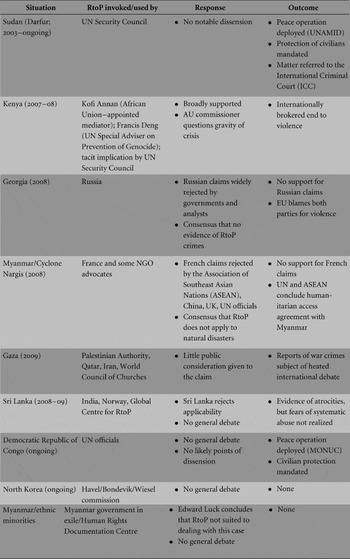
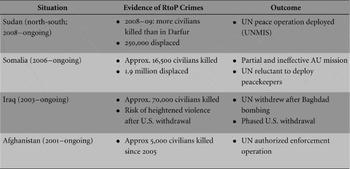
Concurrent with the General Assembly's consideration of RtoP, the principle has been referred to in relation to nine crises (Table 1). Ranging from postelection violence in Kenya, where RtoP was employed by Kofi Annan as part of a diplomatic strategy, to the Russian invasion of Georgia, where the principle was invoked to justify unilateral armed intervention, RtoP has been applied inconsistently. Some of this inconsistency, however, may actually help to clarify the principle's scope. There were four additional cases (Table 2) where one or more of the four RtoP crimes (genocide, war crimes, ethnic cleansing, and crimes against humanity) were committed or credibly threatened but where RtoP has not been invoked. This section focuses on a handful of these cases in order to understand how RtoP is used. First, I consider two cases that have tested the boundaries of the principle's scope and the types of situations to which it applies (Georgia and Myanmar/Cyclone Nargis). Second, I examine two cases where the application of RtoP was relatively uncontroversial (Darfur and Kenya). Finally, I consider a case (Somalia) where the state has manifestly failed to protect its population from three of the four crimes but where RtoP has nevertheless not been part of the surrounding diplomatic discourse.
RtoP and Humanitarian Crises Since 2005

Crises Involving Commission or Threat of Genocide, War Crimes, Ethnic Cleansing, and/or Crimes Against Humanity and the Absence of RtoP

Debating the Limits of RtoP: Georgia and Myanmar/Cyclone Nargis
In each of these cases, a permanent member of the Security Council (Russia and France, respectively) invoked RtoP to legitimize the deployment or threat of coercive force to stem what it alleged to be the commission or imminent commission of one or more of the four RtoP crimes. The debates provoked by the two cases have helped elucidate the scope of the principle and the limits on its use. In the case of Georgia, the debate focused on the factual veracity of Russia's claims about Georgia's abuse of civilians in South Ossetia. The debate over Myanmar, however, hinged on the applicability of RtoP to situations where a government fails to provide or permit sufficient humanitarian relief in the wake of a natural disaster. In both cases, the claims advanced were roundly rejected by international society, effectively placing two limits on the use of RtoP for coercive purposes: (1) a requirement that the use of coercion be preceded by compelling evidence of genocide or mass atrocities; and (2) a relatively narrow interpretation of “crimes against humanity” that excludes crimes not associated with the deliberate killing and displacement of civilians.
In early August 2008, Georgia's nationalist government launched a military assault aimed at restoring “constitutional order” in the breakaway region of South Ossetia. Russia responded by quickly routing and pushing the Georgian army back into Georgia proper, taking the city of Gori. A cease-fire brokered by France's President Sarkozy provided for the cessation of hostilities and the staged withdrawal of Russian forces from Georgia proper. Shortly afterward, Russia unilaterally recognized the independence of South Ossetia and that of Georgia's other breakaway province, Abkhazia. The Russian leadership argued that intervention was justified by the commission and imminent commission of mass atrocities by Georgian troops, which President Medvedev and Prime Minister Putin insisted amounted to “genocide.”Footnote 23 Foreign Minister Sergei Lavrov referred explicitly to RtoP in justifying the intervention.Footnote 24 Russia again implied that its actions were consistent with RtoP during a heated exchange with Georgia in the General Assembly.Footnote 25 These arguments won little support. Two of RtoP's Canadian progenitors described it as the “misappropriation” of RtoP, and the Global Centre argued that the protection of nationals in foreign countries goes beyond the scope of the RtoP, that the scale of Russia's intervention was disproportionate, and that RtoP does not provide a justification for the use of force without UN Security Council approval.Footnote 26 In addition, a special commission set up by the EU found that Russia had acted disproportionately, and there has been little support for Russia's recognition of South Ossetia.Footnote 27
On May 3, 2008, Cyclone Nargis struck Myanmar, devastating the Irrawaddy delta area and leaving much of the region under water. Approximately 138, 000 people were left dead or missing and 1.5 million were displaced.Footnote 28 Despite the massive scale of the humanitarian catastrophe and the government's obvious inability to respond effectively, Myanmar's military regime initially denied access to humanitarian agencies, inhibiting the delivery of urgently needed supplies and medical assistance. While offers of assistance poured in, Myanmar was slow to issue visas and insisted on distributing aid itself—raising fears that much of the materials would be siphoned off for other uses, including by and for the military.Footnote 29 Frustrated by the slow progress, French Foreign Minister Bernard Kouchner proposed that the UN Security Council invoke RtoP to authorize the delivery of aid without Myanmar's consent, arguing that the denial of humanitarian assistance constituted a crime against humanity. The proposal was flatly rejected by China and ASEAN, which argued that RtoP did not apply to natural disasters. ASEAN governments also maintained that Myanmar must not be coerced into accepting humanitaria assistance. This view was shared by senior UN officials, who recognized the danger that Kouchner's argument posed to both the relief effort (which required Asian cooperation) and the emerging consensus on RtoP.Footnote 30 The British government rejected Kouchner's argument as “incendiary” and agreed that RtoP did not apply to natural disasters.Footnote 31 In the end, ASEAN and the UN secretary-general used diplomacy to secure the regime's acquiescence to the delivery of international aid and organized a joint UN-ASEAN relief effort. There is speculation that the “threat” of RtoP encouraged the regime to relent, and anecdotal evidence points in this direction.Footnote 32 If this was indeed the case, it was more likely the regime's paranoid fear of a unilateral Western invasion rather than concern about a multilateral RtoP response that prompted this shift, given that there was little likelihood that coercion would be authorized by the Security Council.Footnote 33 Although painfully slow, uncoordinated, and ad hoc, the diplomatic effort secured humanitarian access and delivered relief that helped avoid a much-predicted second round of deaths due to disease and malnutrition.
Had one or both of these countries been successful in using RtoP to legitimize their defense of intervention, they would have further confirmed the view that RtoP is a “Trojan horse” that legitimizes great power interference in the affairs of the weak—a view that was fueled by the use of RtoP-related arguments to justify the invasion of Iraq in 2003. However, the failure of Russia and France to legitimize their positions by using RtoP suggests that while great powers might be tempted to pursue this avenue, RtoP does not confer automatic legitimacy on coercive interference in the event of a political or humanitarian crisis. This would seem to suggest that fears about RtoP being used as a Trojan horse are unwarranted. In addition, the debates generated by Russian and French claims helped to clarify the burden of proof that needs to be satisfied in order to successfully invoke the principle to justify coercive behavior.
RtoP in Action: Darfur and Kenya
While the applicability of RtoP to the situations in Georgia and Myanmar was hotly disputed, there was broad agreement of its relevance to the crises in Darfur and Kenya. Yet assessments of the contribution made by RtoP to these two cases could not be further apart. In relation to Darfur, RtoP is typically rated an abject failure in that it failed to galvanize international action or, worse, exacerbated the situation by distracting the relevant actors. In contrast, RtoP is widely credited with having helped diplomatic efforts to stave off the escalation of violence in Kenya.
The crisis in Darfur, which erupted in 2003, has been viewed more than any other crisis through the prism of RtoP. For many, Darfur represents RtoP's primary test case, one that it is generally reckoned to have failed.Footnote 34 Although critics are right to point out that RtoP has not propelled powerful states to contribute peacekeepers to undertake complex and dangerous tasks in strategically unimportant regions, this criticism needs to be tempered somewhat. Indeed, much of the killing occurred in 2003–04, prior to the world's commitment to RtoP. In addition, the Darfur crisis is closely interrelated with the peace process that delivered the 2005 Comprehensive Peace Agreement (CPA) between the government of Sudan and the Sudan People's Liberation Movement/Army (SPLM/A), which ended a decades-old civil war that had claimed some two million lives. Key Western governments feared that taking a robust line on Darfur would jeopardize these peace negotiations and undermine the CPA.Footnote 35 The conflict is also connected to the situations in Chad and the Central African Republic, meaning that responses were calibrated for their impact on these crises as well. However, and perhaps more important, since 2004 the Security Council has been actively seized of the matter and has responded with a raft of measures, including targeted sanctions, referral of the situation to the ICC (leading to the indictment of Sudan's president), and the authorization of a large peace operation (UNAMID) with a civilian protection mandate. The key problem is that these measures were slowly implemented and have proven insufficient to protect vulnerable populations.
This persistent gap between what is needed and what is delivered cannot be primarily ascribed to the situation's complexity, but instead reflects the limited extent to which RtoP has the capacity to generate “compliance pull” in international society. Currently, there is no consensus in the council about the hierarchy of relevant norms (with China insisting on Sudanese consent as a prerequisite for the deployment of peacekeepers) and about what ought to be done (explaining the lack of punishment and follow-up). There is also insufficient willingness on the part of member states to commit forces and resources to implement the council's will (explaining the under-resourced UNAMID mission).
In sharp contrast to the treatment of Darfur, the diplomatic response to the ethnic violence that erupted in the aftermath of the disputed December 2007 elections in Kenya is widely trumpeted as the best example of RtoP in practice.Footnote 36 While up to 1, 500 people were killed and 300, 000 displaced, a coordinated diplomatic effort by a troika of eminent persons mandated by the African Union (AU), spearheaded by Kofi Annan, and supported by the UN secretary-general persuaded the country's president, Mwai Kibaki, and his main opponent, Raila Odinga, to conclude a power-sharing agreement and rein in the mobs. This prevented what many feared could have been the beginning of a much worse campaign of mass atrocities. Reflecting on his successful diplomatic mission, Annan later observed that he
saw the crisis in the R2P prism with a Kenyan government unable to contain the situation or protect its people. I knew that if the international community did not intervene, things would go hopelessly wrong. The problem is when we say “intervention,” people think military, when in fact that's a last resort. Kenya is a successful example of R2P at work.Footnote 37
Ban Ki-moon was also quick to characterize the situation as relevant to RtoP and to remind Kenya's leaders of their responsibilities.Footnote 38 And the secretary-general's special adviser for prevention of genocide, Francis Deng, also called upon Kenya's leadership to exercise their responsibility to protect, reminding them that if they failed to do so they would be held to account by the international community.Footnote 39 These efforts were supported by the Security Council, which issued a Presidential Statement reminding the leaders of their “responsibility to engage fully in finding a sustainable political solution and taking action to immediately end violence.”Footnote 40 However, there was little evidence of support among council members for more robust measures should diplomacy fail, and the African members in particular expressed the view that the AU should play a leadership role.Footnote 41
While many contend that Kenya provides an illustration of what RtoP can deliver in terms of preventive action, others argue that RtoP itself played a marginal role.Footnote 42 It is fair to say that it was the AU's emerging, but still frail, peace and security architecture—which predates 2005—that provided the immediate catalyst for international engagement, not RtoP per se. Another note of caution was sounded by AU Commissioner Jean Ping, who questioned the appropriateness of RtoP in this case on the grounds that the killing had been relatively small in scale.Footnote 43 Moreover, while the Security Council was content to support AU-led mediation, it is not at all clear that had the process failed and violence escalated, it would have found the consensus and willingness to step up its engagement.
In sum, in cases where there has been little dispute about the applicability of RtoP, the principle has established a patchy track record. Nevertheless, both cases elicited a consensus that the international community has a legitimate role to play. Debates on Darfur and Kenya have hinged not on whether international actors should intervene in one way or another, but how. Less promising, though, are the limits that were exposed by these two cases. Consensus on Kenya was possible because engagement was limited to diplomacy and had host-state consent. There is little evidence to suggest that the council would have been prepared to adopt a more robust stance had one been required, with African members especially insisting that the AU play the primary role. In relation to Darfur, there have been serious problems in relation to consensus about the relative weight that should be afforded to different norms relating to the protection of civilians, the principle of noninterference and host-state consent, and about what ought to be done; and there has been a discernible lack of willingness to implement the council's decisions. Although RtoP was utilized in both cases, in neither did it provide a catalyst for decisive action. The capacity (or incapacity) of RtoP to serve as a catalyst for action is brought into sharper relief by considering episodes of actual or imminent mass killing that have not inspired the use of RtoP. The most prominent among these is Somalia.
RtoP Missing in Action: Somalia
While the international response to the crisis in Somalia in the early 1990s is often referred to as an important precursor to RtoP, the crisis that has befallen that country since the December 2006 U.S.-backed Ethiopian intervention that deposed the Union of Islamic Courts (UIC) and ushered in a new period of conflict has not commonly been viewed through the prism of RtoP, despite the commission of war crimes, crimes against humanity, and ethnic cleansing, as well as the very real threat of further escalation.Footnote 44 Instead, international attention has focused more on some of the crisis's symptoms—maritime piracy and some elements of support for Islamism—rather than the crisis itself. In the two years after December 2006, approximately 16, 500 civilians were killed; and in 2007 alone up to 1.9 million Somalis were newly displaced, a higher level of death and displacement than in Darfur and Kenya combined.Footnote 45 Despite widespread attacks on civilians, international actors have remained reluctant to link the situation to RtoP. Indeed, ICISS co-chair Gareth Evans suggested that Somalia was not a “classic [RtoP] situation” but that the imminent threat of mass atrocities warranted its placing on a watch list of countries of RtoP concern.Footnote 46 The international response to the crisis has been slow and hesitant. The international community has responded to events as they have unfolded and has tended to prioritize the interests of external actors over those of Somali civilians.
After months of diplomatic wrangling, in November 2006 the United States introduced a draft resolution authorizing the deployment of peacekeepers under the auspices of the Intergovernmental Authority on Development (IGAD), a subregional organization in East Africa. The proposed mission was tasked with supporting the Transitional Federal Government (TFG) based in Baidoa and defeating the UIC, which had established a firm hold on Mogadishu and had encircled Baidoa. Although the resolution won the support of China, Russia, and African members, European governments expressed concern that such an obviously biased mission could escalate the crisis.Footnote 47 There were also concerns about IGAD's capacity to deploy and fund an effective peace operation, given a gap of almost $300 million between its projected annual cost and Western donations, the absence of a viable political process, disagreements within IGAD itself (Djibouti and Eritrea opposed the deployment), and concerns about the availability of peacekeepers.Footnote 48 However, the TFG's imminent defeat at the hands of the UIC prompted Ethiopia to intervene with U.S. backing and forced the council to authorize the IGAD deployment, despite the misgivings of several council members. When IGAD proved incapable of deploying peacekeepers, the Security Council instead turned to the AU, which deployed a small and ineffectual peacekeeping force (AMISOM) in 2007. The AU's Peace and Security Council insisted that AMISOM would be a temporary deployment (initially six months) that would be followed up by a UN peace operation, but neither the council nor the secretariat ever endorsed the idea of a UN mission. AMISOM's obvious incapacity generated renewed calls—from the United States (the Bush administration), China, Italy, and the AU especially—for the UN to take over peacekeeping duties, though none couched their pleas in RtoP terms, and the United States especially was motivated more by “war on terror” concerns than RtoP concerns. Given the fragile security situation and in the absence of a viable peace process or clear commitments of troops, equipment, and financial support from the West (or elsewhere), the secretary-general was reluctant to endorse the deployment of UN peacekeepers. The United Kingdom, France, and Russia shared the secretary-general's view that the conditions were not right for the deployment of peacekeepers, that peacekeepers would face significant threats, that the UN would not be able to generate a sufficiently robust force, and that in the absence of a viable political process there was no clear end state.Footnote 49 As such, the secretary-general recommended that UN peacekeepers only be deployed once the security situation had improved, a viable political process had begun, and the state had proven capable of performing basic functions. The Security Council accepted this recommendation in Resolution 1814 (May 15, 2008), and there has been little movement since.
In the case of Somalia, therefore, the commission of war crimes, ethnic cleansing, and crimes against humanity has not prompted outsiders to view the problem through the prism of RtoP, to take “timely and decisive action,” or to prioritize the protection of Somali civilians. Where governments have called for and supported intervention, this has been motivated more by strategic concerns than by humanitarian concerns; and it is fairly clear that in terms of civilian protection, the Ethiopian intervention did more harm than good, that AMISOM has been relatively ineffectual, and that the council has not been proactive in trying to create conditions that are conducive to the deployment of UN peacekeepers. As such, this case highlights RtoP's limited capacity to act as a catalyst for action by helping to manufacture political will. In the absence of states choosing to use RtoP either as a diplomatic tool or to legitimize coercive intervention, the norm has simply not been part of the international political discourse about how to respond.
FUNCTION, STATUS, AND CONTRIBUTION
Over the past five years RtoP has become a key part of the language used to debate and frame responses to humanitarian emergencies, however selectively and imperfectly. The challenge now is to consider what these efforts to implement RtoP through the United Nations, and to work with it in responding to crises, have to tell us about the state of the principle itself. This section poses three basic questions about RtoP: (1) What is its function?; (2) Is it a norm, and, if so, what sort of norm?; and (3) What contribution has RtoP made to the prevention of genocide and mass atrocities, and to the protection of vulnerable populations?
RtoP's Function
RtoP is commonly conceptualized as fulfilling two functions, but the two are not complementary. The first is to use RtoP to describe a political commitment to prevent and halt genocide and mass atrocities accompanied by a policy agenda in need of implementation. This is how RtoP is most commonly referred to by the secretary-general and diplomats at UN headquarters. Based largely on a plain text reading of paragraphs 138–39 of the “World Summit Outcome” document, this position rests on two general propositions. First, as agreed by member states, RtoP is universal and enduring—it applies to all states, all the time. From this perspective, there is no question of whether RtoP “applies” to a given situation because RtoP does not arise and evaporate with circumstances. As such, much of the debate about RtoP in practice, focused as it is on the question of whether RtoP applies to a given situation, poses the wrong question. The question should not be whether it applies, but how it is best exercised. Second, it follows that as a universal and enduring commitment, RtoP gives rise to a policy agenda that needs to be identified, articulated, and implemented. The secretary-general's 2009 report “Implementing the Responsibility to Protect” and the ensuing General Assembly debate marks the first step toward defining that agenda, but, as the secretary-general recognized, there is much more work to be done in this field. The report and debate mark out a framework in terms of the principle's three pillars, but implementation has yet to begin in earnest. Precisely what should be included in this policy agenda is still to be debated. The secretary-general's report sets out some of the parameters; and while academics dispute the precise contours, there is broad agreement around a dozen or so key factors that ought to be addressed as part of a comprehensive strategy to prevent genocide and mass atrocities, and about the most effective forms of protection that might inform the development of capacities to better exercise the three pillars.Footnote 50 The effect of this approach is to emphasize RtoP as a broad-based policy agenda focused on the “upstream” prevention of genocide and mass atrocities through capacity-building and international cooperation, and to focus attention on developing the institutions and capacities for effective response within the prevailing normative framework, while keeping in mind the need to marshal “timely and decisive” responses to atrocities when needed.
This interpretation of RtoP's function accurately reflects what was agreed to by states in 2005, and it is therefore no surprise that this view has been most commonly expressed by governments, especially the global South. Critics, however, complain that it weakens the principle's capacity to mobilize action. For example, Gareth Evans has argued that the preventive component of RtoP should be limited to situations where mass atrocities are imminent and should not extend to longer-term prevention efforts.Footnote 51“To widen the focus” of RtoP in this way, he argues, “is dangerous from the perspective of undermining R2P's utility as a rallying cry. If too much is bundled under the R2P banner, we run the risk of diluting its capacity to mobilize in the cases where it is really needed.”Footnote 52 The problem with this critique, in my view, is that most scholars who work on the prevention of genocide and mass atrocities seem to agree that prevention requires action well before a “rallying cry” has been made.Footnote 53 Moreover, in most cases, by the time mass atrocities are apprehended as imminent, the window for prevention has been closed. The oft-touted case of Kenya, where late-in-the-day prevention succeeded, is a rare exception.Footnote 54
Evans's argument brings us to the second function of RtoP language. Drawing on Copenhagen School theories of securitization, Eli Stamnes has shown that the intention behind the RtoP principle is to generate a speech act (that is, words and sentences that perform specific communicative functions, such as promises and warnings), which has the effect of elevating certain issues above normal politics as a catalyst for decisive international action.Footnote 55 In other words, RtoP is a label that can be attached to particular crises in order to generate the will and consensus necessary to mobilize a decisive international response. According to Evans, “the whole point of embracing the new language of ‘the responsibility to protect' is that it is capable of generating an effective, consensual response in extreme, conscience-shocking cases, in a way that ‘right to intervene’ language simply was not.”Footnote 56 This is clearly how RtoP has predominantly been used in relation to humanitarian crises. For example, in the case of Darfur, advocates used RtoP to generate the political will to intervene; in Myanmar, Kouchner invoked the principle as a catalyst for forcible aid delivery; in Kenya (and to a lesser extent Sri Lanka), it was used by mediators and foreign governments to persuade the country's political leaders to step back from the brink and also to galvanize international attention; and in relation to Gaza, the World Council of Churches referred to RtoP to generate international attention to the commission of war crimes. It is this mode of thinking that frames debates as being about the applicability of RtoP rather than about the most appropriate manner of realizing the principle in a given situation. Although many commentators and some diplomats switch between the first mode (RtoP as policy agenda informed by commitment to normative principles) and the second (RtoP as speech act and catalyst for action), the two are in fact incompatible, causing much of the confusion about the way RtoP is used. One cannot sustain a commitment to the long-term prevention of genocide and mass atrocities as part of RtoP while also conceptualizing RtoP as primarily a speech act that acts as a catalyst for action.
While the second account dominates discussions about RtoP and humanitarian crises, and may certainly be consistent with the concerns that animated the ICISS, it is hard to find support for it in paragraphs 138–39 of the “World Summit Outcome” document. On the one hand, the commitment made by states was open-ended, not time- or context-sensitive; on the other, the agreement made it plain that RtoP-related crises would be dealt with through the UN's normal peace and security mechanisms, and did not require “exceptional” measures. I will return later to the question of how effective RtoP is as a call to action. For now, it is important to note that actors have a choice about the way in which they employ RtoP language, that the two options cannot be used conjointly with coherence, and that this choice affects how we understand the principle's role and impact.
RtoP as a Norm
Is RtoP a norm, and, if so, what sort of norm is it and what does it require? Norms, recall, are shared expectations of appropriate behavior for actors with a given identity.Footnote 57 There is general consensus that RtoP is a norm, but much less agreement on what sort of norm it is.Footnote 58 There are two elements to this particular problem. First, RtoP is not a single norm but a collection of shared expectations that have different qualities. On the one hand, RtoP involves expectations about how states relate to populations under their care. These expectations predate RtoP and are embedded in international humanitarian and human rights law.Footnote 59 Although there are arguments about their scope (especially concerning crimes against humanity) and the extent to which they are embedded or habitual, the basic proposition that states are legally and morally required not to intentionally kill civilians is well established.Footnote 60 RtoP's first pillar is therefore best understood as a reaffirmation and codification of already existing norms. However, RtoP also places demands on states as members of international society: to assist and encourage their peers in the fulfillment of their RtoP (pillar two), and to take timely and decisive action in cases where a state has manifestly failed in its RtoP (pillar three). It is much less certain that pillars two and three constitute norms, and, if they can be so called, there is a serious question as to whether they exert sufficient compliance-pull.Footnote 61
The test of whether pillars two and three are properly called norms is the extent to which there is a shared expectation that 1) governments and international organizations will exercise this responsibility, that 2) they recognize a duty and right to do so, and that 3) failure to act will attract criticism from the society of states. There is some evidence to support the view that such positive duties exist. First, in Bosnia vs. Serbia, the International Court of Justice (ICJ) found that states have a legal obligation to take all measures reasonably available to them to prevent genocide.Footnote 62 Second, common Article 1 of the Geneva Conventions (1949) requires that states “ensure respect” for international humanitarian law as well as obey it themselves. Third, the International Law Commission's (ILC) Draft Articles on the Responsibility of States for Internationally Wrongful Acts give states a duty to cooperate to bring an end to breaches of the law.Footnote 63 Fourth, following an independent inquiry, the secretary-general recognized the organization's failure to prevent the Rwandan genocide as a failure of the whole UN system—implicitly recognizing a shared expectation that the organization should act to prevent and halt genocide.Footnote 64 Combined with international society's commitment to RtoP, these legal developments have given rise to claims that a positive duty to prevent genocide and mass atrocities is emerging.Footnote 65 But this claim requires a liberal interpretation of the relevant law, and has been disputed.Footnote 66 Moreover, the state practice documented in the previous section suggests that mutual recognition of a positive duty to exercise pillars two and three is inconsistent at best. While there is evidence of RtoP at work in creating expectations about the world's responses to the crises in Kenya and Myanmar/Nargis, states were not criticized by their peers for failing to do more to protect civilians in Darfur and Somalia.
Even if pillars two and three can be described as norms, they are weakened by the problem of indeterminacy. Whereas norms shape shared understandings and limit the behaviors that can be justified by reference to them, such that actors will be inhibited from acting in ways that cannot be plausibly justified, what a norm prescribes in a certain situation is never fixed and absolute.Footnote 67 The more precisely a norm indicates the behavior it expects in a given situation, the stronger its compliance-pull.Footnote 68 RtoP's first pillar, for example, is a relatively determinate norm: it expects that states refrain from perpetrating four specific crimes. By comparison, the specific demands imposed by pillars two and three are indeterminate. It is seldom—if ever—clear what RtoP requires in a given situation. This is partly because of the indeterminacy of the norm itself and its place relative to other norms, such as noninterference. Indeterminacy is produced by a combination of uncertainty about what is expected, disagreements about what ought to be expected, and an interest in preserving flexibility for the future.Footnote 69 Uncertainties and disagreements were evident in the 2009 General Assembly debate on RtoP discussed earlier. The problem is amplified by the inevitable effects of intervening variables, such as competing judgments about the facts of the case (for example, about the cause, existence, and scale of mass atrocities) and different assessments about the most prudent response. As a result, it is plausible to legitimize both sides of the debates about forceful intervention and no-fly zones in Darfur; the indictment of Omar al-Bashir; the deployment of IGAD, AU, or UN peacekeepers in Somalia; heaping criticism and sanctions upon Sri Lanka; criticizing Israel and/or Hamas; the deployment of Western troops to the DRC, Sudan, and Somalia; sanctions, engagement, or the status quo in relation to Myanmar; and much else by reference to RtoP. The indeterminacy of what RtoP requires of external actors in these cases weakens its compliance-pull, and therefore the extent to which actors are satisfying shared expectations of appropriate behavior. Of course, as Quentin Skinner argues, actors “cannot hope to stretch the application of the existing principles indefinitely; correspondingly, [the actor] can only hope to legitimate a restricted range of actions.”Footnote 70 It is therefore fair to say that active support for genocidaires and defense of complete inaction in the face of mass atrocities would be obviously inconsistent with RtoP. But once states agree that something ought to be done, RtoP grants the international community a relatively free hand to determine what. This indeterminacy severely restricts RtoP's compliance-pull, and hence its ability to encourage states to find consensus and commit additional resources to the protection of civilians.
RtoP's Effectiveness
To date, assessments of RtoP's effectiveness have tended to fall into one of three camps. The most extreme, put forth by Alan Kuperman, holds that RtoP has actually “caused” genocidal violence that would not have otherwise occurred by encouraging rebels into risky armed uprisings that provoke genocidal responses from governments.Footnote 71 A less radical variant on this theme suggests that RtoP can encourage external actors to pay undue attention to military responses to mass atrocities rather than more promising political solutions.Footnote 72 An alternative critique suggests simply that the indeterminacy of RtoP's second and third pillars limit the extent to which it can exert tangible effects on behavior.Footnote 73 On the other hand, as noted earlier, some point to Kenya as a good example of RtoP in practice, and argue that in this case RtoP helped galvanize international attention and bring diplomatic pressure to bear on that country's political leaders.
Systematic analysis of RtoP's effectiveness should be premised on a clear understanding of what it is that RtoP is meant to achieve. This takes us back to the principle's function. The “RtoP as policy agenda” approach lends itself to the view that the primary aim of RtoP is to prevent genocide and mass atrocities from occurring in the first place. For this approach, while it is important that the world responds to mass killing in a timely and decisive manner, the key long-term test is whether there are fewer cases of mass killing to respond to. Although it is too early to offer a definitive answer to this question, indications are mainly positive: the Uppsala Conflict Data Program recorded a sharp reduction in the number of fatalities caused by one-sided violence between 2004 and 2008;Footnote 74 a survey of episodes of mass killing involving the intentionally caused deaths of more than 5, 000 civilians shows an equally sharp decline, with no new episodes after 2005.Footnote 75 However, this data needs to be tempered by acknowledging that the number of ongoing episodes has remained relatively static, and the fact that more civilians than combatants tend to be killed in modern conflict.Footnote 76 At the same time, the downward trends in relation to attacks on civilians are particularly important because they come within a context of an increase in the number of armed conflicts overall between 2004 and 2008, suggesting that armed belligerents are generally less likely to resort to atrocities than they were previously.Footnote 77 Taken together, this data suggests that the period since the adoption of the RtoP has been associated with a general decline in mass atrocities. But we cannot conclude that RtoP caused this effect, because each of the trends was evident prior to 2005; it is impossible to know from global figures whether international activism was prompted by RtoP; and it is unclear whether it was this activism or local factors that encouraged actors to refrain from mass atrocities.
One way around this problem of uncertainty would be to analyze cases individually. Of the thirteen cases identified in tables 1 and 2, five (Kenya, Myanmar/Nargis, Sri Lanka, Gaza, and Sudan/CPA) were/are crises characterized by credible fears of mass atrocities. In three of these cases (Kenya, Myanmar/Nargis, and Sri Lanka), diplomats reminded governments of their responsibility to protect and of the fact that the world was paying attention to their behavior. Although compliance was neither complete nor unhindered, the feared mass atrocities did not eventuate. Of course, in the case of Myanmar, the invocation of RtoP by France was widely rejected and criticized, so it would be difficult to credit the principle with fulfilling a useful function in that case. Although there were calls for the Security Council to step into the fray in all three situations, in no case did the situation get so bad that the costs associated with nonconsensual measures were outweighed by the gravity of the situation. RtoP has, therefore, been associated with the use of diplomacy to prevent crises sliding into mass atrocities, and those attempts have enjoyed a reasonable degree of success. There is, however, little evidence to suggest that international concerns about RtoP persuaded either Israel or Hamas to moderate their behavior. Finally, it is too early to tell whether international engagement with the CPA will help prevent the potential slide back into civil war in Sudan.
This approach captures only part of the contribution that RtoP might make to preventing mass atrocities. The further upstream we go in terms of structural prevention, the more difficult it is to demonstrate RtoP's impact; yet this is where the principle might have its greatest effect if it succeeds in galvanizing efforts to strengthen early warning, build preventive capacity, and minimize root causes. Upstream, RtoP may prevent mass atrocities in three principal ways: by encouraging the internalization of the principle of discrimination within armed forces; by helping states and societies to build the capacities they need to resolve differences without recourse to violence and atrocities; and by persuading political leaders that they are likely to pay costs for the commission of mass atrocities, thereby encouraging them to adopt alternative strategies. These three factors may deter potential belligerents from committing atrocities in the first place. This is an inevitably long-term agenda that involves changing cultures and identities, and it is impossible to draw a direct causal connection between these processes and the prevention of specific atrocities at a later date. Moreover, these upstream effects are contingent on RtoP's implementation. For these reasons we should not expect to see moderating effects so soon. That said, there are numerous examples of armed conflicts in the past five years that have not produced mass atrocities—including, among others, Chad, Mali, Pakistan, Guinea-Bissau, Cote d'Ivoire, and Timor-Leste. In these cases, a combination of international observation and engagement, and rational calculations influenced by expectations about international engagement prompted by RtoP, encouraged actors to refrain from committing widespread atrocities in situations where doing so might have secured short-term gains. That RtoP and associated norms are having some effect here is supported by the fact, noted earlier, that the incidence of mass killing is declining while the number of armed conflicts increases, suggesting that active belligerents are more often choosing not to commit atrocities.
This brings us to the second function of RtoP—as a speech act that provides a catalyst for timely and decisive international action in response to the commission, or imminent commission, of one or more of the four RtoP crimes. The effects of RtoP in this regard are easier to measure, but the results are less promising and suggest that the principle has had little success in mobilizing timely and decisive international action. Since 2005 the largest crises in terms of the numbers of civilians intentionally killed are (in order of the approximate number of civilians killed in this period) Iraq, Somalia, Sudan (Darfur and south), the Democratic Republic of the Congo, Afghanistan, and Kenya. Of these, Iraq and Afghanistan have not been widely viewed through the prism of RtoP. In relation to Somalia, there has been little RtoP talk, the UN and AU have proven reluctant to act decisively, and the West tends to focus more on the situation's external symptoms (piracy and links to Islamist terrorism) than its civilian protection dimension. Despite talk of operating through the prism of RtoP, international engagement with Sudan (UNAMID and UNMIS) and the DRC (MONUC) has not perceptibly changed as a result of RtoP, where the most significant development—the ICC's indictment of Omar al-Bashir—needs to be balanced against continued under-resourcing of the UN's peace operations, such that MONUC/DRC forces have thus far failed to bring the murderous Hutu FDLR to heel, UNAMID continues to struggle to protect itself and civilians in its care, and UNMIS has proven unable to stem the tide of local conflicts. Finally, although Kenya is a notable success for RtoP, it is not clear that RtoP itself caused the intense international engagement. More general data seems to support these assessments. In the past few years, the RtoP's Western champions have proven less, not more, willing to contribute to UN peace operations, and have almost uniformly tightened their domestic regimes governing asylum for people displaced by violence.Footnote 78 The most charitable conclusion one can draw from all this is that it is too early to tell whether RtoP can operate as a speech act that provides an effective catalyst for timely and decisive action in the face of mass atrocities. But even this assessment may be too generous in the face of the principle's consistent inability to generate heightened international activism.
The best explanation as to why RtoP's third pillar has thus far failed to generate additional political will relates to the problem of indeterminacy, discussed earlier. Given that it is difficult to determine with any degree of certainty what RtoP's third pillar requires in any given situation, it is unlikely that—without requisite transformation of national interests and institutional reforms that reduce the costs associated with enhanced engagement by improving efficiency and effectiveness—the principle will “pull” actors toward larger and more effective commitments to protecting civilians in danger. It is important to recognize that there are different reasons why actors want to legitimize their behavior by reference to a shared norm. At one end of the spectrum, norm compliance is caused by instrumental decisions: actors obey a norm not because they think it has inherent value (that is, because it is “internalized”), but because they believe that norm violation will impose prohibitive costs. Close to this is “noninstrumental conformism” or “mimicry,” where compliance is generated not by overt calculations of costs in relation to particular actions, but by a more generalized concern about social exclusion.Footnote 79 When a norm is indeterminate, actors who comply for these instrumental reasons are unlikely to be pulled into changing their behavior. Instead, they are likely to adopt the norm's language while persisting with established patterns of behavior. They are able to do so precisely because it is so difficult for other members of the society to determine whether or not they are acting in a manner consistent with the norm. In none of the RtoP-related cases whose origins predated the principle have actors—be they RtoP supporters or critics—adjusted their behavior to take account of the new norm, lending support to the view that RtoP's indeterminacy permits states to formally commit to the principle without having to change their practice. Alarmingly, this suggests that even RtoP's most ardent supporters have not internalized the norm to the extent that it affects the way they actually behave.
Given that indeterminacy makes it unlikely that RtoP will act in the near future as a catalyst for international action in response to genocide and mass atrocities, it seems reasonable to argue that the most prudent path is to view the principle as a policy agenda in need of implementation rather than as a “red flag” to galvanize the world into action. This view would certainly be consistent with the evidence thus far that RtoP is best employed as a diplomatic tool, or prism, to guide efforts to stem the tide of mass atrocities, and that it has little utility in terms of generating additional international political will in response to such episodes. Over the long term, if national, regional, and global institutions support the behaviors and build the capacities envisaged by the UN secretary-general, it will be easier and less costly to prevent and respond effectively to genocide and mass atrocities, reducing the tendency of states to view prevention and protection work as inimical to national interests and increasing the likelihood that they will undertake prevention work as a matter of habit and make use of the response capacities they have created when needed. Of course, the prevention work should also reduce the overall number of cases to respond to. We need to recognize that, by itself, RtoP is unlikely to stimulate greater international activism in response to immediate crises in Darfur, Somalia, the DRC, or, indeed, the next Rwanda, but that if the agenda outlined by the UN secretary-general is implemented, there is a good chance of reducing the likelihood of future Rwandas and ensuring that future responses are indeed “timely and decisive.” For this reason, it may be more important that the UN Secretariat establish a joint office for RtoP and the prevention of genocide—thus embedding RtoP within the UN system—than that the Security Council refers to the principle in the next resolution it passes on the protection of civilians.