Among the many historical and analytical questions regarding Bach's vocal music, those concerning form loom large. How can we account for the great variety of formal solutions in Bach's settings of words to music? How might we describe movements that do not fit into the usual categories? Understanding and appreciating Bach's arias, duets, terzettos and choruses require an approach that values each item for its unique features as well as those features it shares with others. The prevailing view of Bach's arias has been that they fall into a handful of formal categories, the most frequent being those known as da capo or ‘strict’ da capo (ABA), ‘modified’ (or ‘free’) da capo (ABA′) and ‘bipartite’ (AB). A frequent historiographical assumption is that Bach regarded strict da capo form – Italian in origin, and widely practised elsewhere in Europe during Bach's lifetime – as the norm for setting rhymed poetry. Yet, as David Schulenberg has recently argued in the pages of this journal, ‘Bach, at Weimar or before, did not necessarily know or care that a simple ternary form was already the routine way of treating such a text elsewhere. For him, the so-called modified design was a normal procedure, or rather one of several equally valid procedures, none of which ever became standard or routine within his output.’Footnote 1
Schulenberg offers a fresh perspective on the analysis of modified da capo form, which he prefers to call ‘through-composed’ – an apt term, since it underscores the fact that ‘Bach followed no one scheme in his arias’.Footnote 2 The present study focuses on a procedure that several scholars, including Schulenberg, have identified as peculiar to certain movements in this form (though it occurs in other forms as well), namely the ‘subdominant return’. Because of its relative rarity, it might be tempting to think of a subdominant return as a mere departure not just from the strict da capo, but also from other modified da capo forms by Bach. Yet such returns are more frequent in his vocal music than existing literature suggests, and should be valued as more than just variations on a formal convention of Bach's time.
Malcolm Boyd first pointed out a strict version of this formal procedure in his landmark survey of Bach's life and works. Boyd noted that, while the da capo most often begins in the tonic, ‘occasionally Bach introduces the da capo in the subdominant, anticipating a procedure sometimes found in sonata movements by the young Schubert and his immediate Viennese predecessors’.Footnote 3 In the two examples cited by Boyd – the opening duet from the cantata Du wahrer Gott und Davids Sohn, bwv23/1, and the terzetto from Part 5 of the Christmas Oratorio, bwv248/51 – Bach adopts the ‘lazy’ solution of transposing the entire A section down a fifth or up a fourth. According to Boyd, Bach's motivation for doing so ‘may have been prompted by the desirability of exchanging the [vocal] parts in the da capo… . But subdominant da capos are present also in perhaps half-a-dozen solo arias.’Footnote 4 In the thirty years since those brief, telling remarks, few scholars – with the notable exceptions of Miriam Whaples and David Schulenberg – have shown more than passing interest in subdominant returns.Footnote 5 As it turns out, Bach employed them in a variety of formal contexts, and with varying degrees of exactness – a fact that Schulenberg has noted, and whose implications I shall explore further.Footnote 6
By ‘subdominant return’ I mean any concluding section (reprise) that begins in the subdominant and/or recapitulates, down a fifth or up a fourth, a significant portion of the opening thematic material of a movement. There is no single type of subdominant return, but rather a range of solutions answering this description. While most do in fact begin in the key of the subdominant, a few begin in some other key (such as VI, the relative of iv in a minor tonality). Subdominant returns are to be found in both instrumental and vocal works by Bach.Footnote 7 Vocal examples most often occur in modified da capo forms; but they can also occur in other forms, such as ‘parallel’ or ‘binary’ form (AA′) and the so-called Bar with reprise (German Reprisenbar, AABA′). Moreover, a vocal subdominant return, as defined here, may or may not coincide with a return of the opening text.Footnote 8 In some instances, to be examined in due course, Bach may make the onset of A′ ambiguous, either by setting the original music to different text (for example, a line of the B section that may or may not have been set previously) or by setting the returning text to music that is transitional in quality, not yet strictly ‘recapitulatory’. A survey of Bach's vocal oeuvre reveals a broad range of musical forms that – to a greater or lesser degree – balance an opening tonic thematic statement with a concluding one that at the outset is oriented to the subdominant. The off-tonic nature of the subdominant return lends it an unstable quality (even when the thematic parallelism between A and A′ is strict), and that instability may cast a textual return in a new light or enhance the sense of textual difference between musically corresponding sections if the return of text is delayed or absent altogether.
In exploring here Bach's various uses of the subdominant return, my purpose is not to fit Bach's forms into rigid categories but rather to expand our awareness of Bach's many formal options, and thus enrich our sense of the relative peculiarity or rarity of each solution.Footnote 9 To that end, I shall begin with a survey of the phenomenon, and later offer detailed readings of several movements, including two (bwv245/24 and bwv244/1) that have been the subject of close readings by Laurence Dreyfus and Karol Berger respectively.Footnote 10 Both scholars have argued that Bach's music is primarily cyclic (as opposed to linear) in nature. And while this notion has elicited considerable scholarly debate, the time is ripe for further reassessment of this issue in the light of the formal and tonal effects of subdominant returns – a facet of Bach's compositions that has been relatively neglected.
ASPECTS OF THE RETURN: SYMMETRY AND PARALLELISM
Let us now review some essential terminological and analytical matters pertaining not only to arias, but also to many other vocal movements (except those strictly based on a chorale cantus firmus).Footnote 11 As mentioned above, modified da capo form – which apparently no contemporary of Bach practised until around 1740 – provides the most frequent context for subdominant returns.Footnote 12 In this case, unlike strict da capo form, the initial A section concludes in a key other than the tonic (most often the dominant) and must therefore be modified upon its return, so as to conclude in the tonic. The relation of A to A′ is, at least in tonal terms, akin to the relation between the exposition and recapitulation of a sonata form – a fact that prompted Miriam Whaples to coin the term ‘recapitulation aria’ as an alternative to the more widely used terms ‘free’ and ‘modified’ da capo aria.Footnote 13 More recently, as noted above, Schulenberg has proposed the term ‘through-composed da capo form’ – one with greater appeal than Whaples's more obviously anachronistic term.Footnote 14 Not only does his term remind us that ‘Bach followed no one scheme in these arias’, it also points to a quality of these forms that sets them apart from most strict da capo forms: the element of harmonic continuity across formal boundaries. I shall address this aspect later with reference to specific movements.
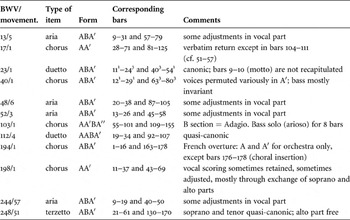
Boyd's example, the opening duet from bwv23, ‘Du wahrer Gott und Davids Sohn’, provides a useful basis for comparison with other subdominant returns. Besides being perhaps the earliest vocal example by Bach, this movement embodies a seemingly unique case of a complete and nearly literal restatement of opening material, notwithstanding differences resulting from transposition and inversion of parts. In Schulenberg's view, ‘symmetry as precise as in bwv23/1 … does not seem to recur’.Footnote 15 But close study of a wider range of forms than those within Schulenberg's purview – including not only ABA′, but also AA′ and AABA′ forms – reveals several examples of comparably precise symmetry in movements with a subdominant return (Table 1 lists these examples). With a few exceptions, all noted in the far right column, these movements involve no durational or thematic differences between the corresponding passages; in other words, they exhibit the same proportional and thematic symmetry as a strict da capo. But that symmetry is enhanced by means that are foreign to their strict da capo cousins: through tonal symmetry (that is, the balancing of the key scheme I–V with IV–I) and, in some cases, through contrapuntal symmetry resulting from the exchange of parts. Interestingly, no two movements on this list are quite alike in design.
Vocal movements by Bach with a complete subdominant return

Note: Where relevant, the beat of a particular bar is indicated by a superscript numeral.
The most distinctive movement in Table 1 – which is perhaps unique in Bach's choral output – is the opening chorus from the organ-consecration cantata bwv194, written for performance on 2 November 1723, and later revived as a Trinity cantata. It takes the form of a French overture, with orchestral music in the A and A′ sections framing a fugal chorus in the B section. The overall form is highly symmetrical, since the B section itself is in modified da capo form, with a bass solo near its midpoint (bars 101–112). The strikingly sparse texture of this passage provides a contemplative focus for the entire movement, which exemplifies Bach's way of articulating form through contrasts of sonority and texture no less than through thematic and tonal contrast. And yet, despite that strict symmetry, the movement does not conclude as it began, with orchestra alone; rather, Bach punctuates the ending with three bars of choral insertion. The choir has the final say after all.
Bach integrates complete subdominant returns into other symmetrical designs besides the uniquely arch-like one in bwv194. One is the so-called ‘parallel’ or ‘binary’ form (AA′), which Bach occasionally employs in arias and choruses.Footnote 16 Yet according to Whaples, Bach only treats the A′ as a ‘more or less complete transposition of A’ in choral settings of this form. Two examples are shown in Table 1, one fugal (bwv17/1), the other more homophonic in texture (bwv198/1).Footnote 17 In both cases, as in the other movements for two or more voices, Bach permutes the vocal parts during the return – though not always predictably. It is in the duets (bwv23/1 and 112/4) and the terzetto (bwv248/51) that contrapuntal inversion is most audible as a form-enhancing feature.
Parallelism between sections is seldom so precise as in the pieces listed in Table 1 (except, of course, in a strict da capo). But parallelism in a broader sense is arguably a fundamental characteristic of Bach's forms. In Joel Lester's view, many (if not most) of Bach's forms, throughout his career and in virtually every genre, can be heard as ‘parallel-section constructions’.Footnote 18 Lester's concept of a ‘parallel section’ is quite flexible, and applies to a wider range of forms than those commonly described as parallel or binary (AA′). He defines ‘parallel sections’ as ‘portions of a movement that begin with a thematic presentation parallel to the beginning of a movement and end with a clear-cut authentic cadence’. Lester relates this principle of organizing a movement through concatenation of parallel sections to two other principles: (1) the principle of thematic unity, whereby ‘a core of material’ stated at the opening is ‘worked with throughout the composition’ and (2) the principle whereby ‘recurrences of material almost invariably exhibit a heightening level of activity in some or all musical elements’.Footnote 19 The applicability of Lester's principles varies from one piece to another. The principle of thematic unity, for example, does not easily apply to pieces with a thematically differentiated B section, such as bwv194/1 and numerous other da capo forms, modified or otherwise. Yet the principles of parallel construction and heightened activity – or intensification, if you will – are relevant to many of the examples in Table 1, and to other pieces to be discussed below. For the very fact of bringing back the opening material at a new pitch level (in other words, beginning in the subdominant key) creates a heightened awareness on the part of both listeners and performers that the returning music is not only parallel, but also different. The adjustments that singers, in particular, must make are perhaps the most palpable differences resulting from a subdominant return, but they are not the only ones. The redistribution of musical material among the performers (which may include both instrumentalists and singers), as well as the occasional alteration of melodic lines, can also add to that sense of difference or ‘heightening level of activity’, however subtle it may be.
A complex question surrounding many of these pieces (except bwv194/1, where the voices are absent from the return except at the conclusion) is the relation between text and music. To what extent, if any, might Bach's decision to write a subdominant return be a response to some aspect of the text that he sets? I doubt that one can draw meaningful connections in most cases – not because the subdominant returns are musically insignificant, but because rhetorical or metaphorical aspects of the text are often projected or patterned in musical ways that are separate, or at least distinct, from the tonal plan as such. (After all, many tonal plans – with or without subdominant returns – are common to both Bach's vocal and his instrumental music, where text was not a factor.) But one can speculate about Bach's rationale for writing a subdominant return in bwv23/1, to take just one example from Table 1. The text of the A section of this duet (by an unknown librettist) reads:

These lines contain striking dualities: Christ's dual nature as both God and the Son of David, and the distance between Him (who is eternal) and the speaker (who suffers earthly pain). These dualities have musical analogues in the pairs of singers and oboists, who along with the basso continuo form a quintet. The canonic part-writing – strictly maintained for seven bars in the vocal parts of both A sections, but freer in the oboe parts – may be understood as a symbol of God's Law, and, by extension, eternity.Footnote 21 Meanwhile, the plaintive suspensions and rising chromatic semitones in the vocal lines evoke the suffering of the penitent speaker. Seeking a rationale for this subdominant return (and others) may, in the end, amount to a sort of chicken-and-egg question (something Boyd hinted at): did Bach write the transposition to facilitate the exchange of parts, or vice versa? But, whatever the rationale, the dualities or oppositions in the poem find tonal, contrapuntal and performative analogues in the music itself.
RECONCILING SAMENESS AND DIFFERENCE IN THE RETURN
We may imagine Bach's forms in general (da capo or otherwise), and those with subdominant returns in particular, as existing on a spectrum. At one end of this spectrum are pieces, such as those listed in Table 1, that exhibit precise symmetry between the corresponding sections. At the other end are a handful of pieces that are through-composed in the strongest sense of the term: pieces in which predictable repetition or parallelism of sections plays a much less important role, if at all. Such pieces are, in Schulenberg's view, more often found in the music of Bach's Weimar period than in his later works.Footnote 22 Most of Bach's subdominant returns occupy a position near the centre of this spectrum, partaking of both the cyclic qualities engendered by symmetrical recurrence of section(s) and those through-composed qualities that, like Lester's principle of ‘heightening levels of activity’, often direct the listener's attention forward rather than backward in time. We shall consider Bach's way of balancing these two qualities with reference to specific pieces later. But, for now, let us take brief stock of the entire spectrum of possibilities.
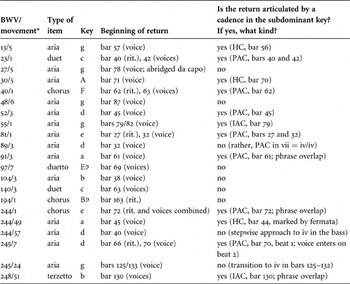
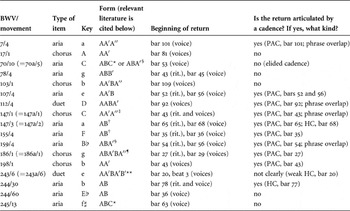
Table 2 lists all the examples of subdominant returns in Bach's vocal oeuvre, including, for ease of reference, the examples previously listed in Table 1. Table 2 is divided into two groups: (1) pieces in what commentators have traditionally called modified da capo form and (2) those in other forms. For each item in Group 2, a formal scheme is given in the fourth column, with the caveat that these types are, in many cases, mere labels requiring qualification (provided, where appropriate, in the notes beneath the table). It is immediately evident that, while Bach slightly favoured ABA′ form as a locus for this procedure, his propensity to recapitulate opening material down a fifth or up a fourth was far-reaching – more than just an occasional practice. There are twenty-one pieces in ABA′ form (Group 1) and seventeen in other forms (Group 2). The examples range chronologically from 1716 to 1738, though most of them date from Bach's first four years at Leipzig (1723–1727) – if we accept the hypothesis that the St Matthew Passion (bwv244) was first performed in 1727. I single out the latter work for attention, since it contains, remarkably, five movements with some kind of subdominant return. Until the composition of this work – his largest yet – Bach's interest in subdominant returns was, indeed, occasional. Yet they occur with greater frequency here than in any previous work (the St John Passion comes closest, with three examples), and in contexts ranging from the monumental opening chorus to the aria-plus-chorus that opens Part 2 (bwv244/30) and three intimate arias near the end of Part 2 (bwv244/49, 57 and 60).Footnote
23
While I doubt that the recurrence of this formal device within the Passion is arbitrary, it is probably prudent to assess each instance of it in its local context, rather than to try to identify a shared symbolism in these movements.
Vocal movements by Bach containing a subdominant return Movements in modified da capo form (ABA′) Key to abbreviations used in Tables 2 and 3 rit.=ritornello PAC=perfect authentic cadence (ending on I with scale degree 1 in the melody) HC=half cadence (ending on V) IAC=imperfect authentic cadence (ending on I with scale degree 3 or 5 in the melody) * References to individual movements in the Passions follow the numbering in NBA II/4 (bwv245) and II/5 (bwv244). Movements in other forms Note: These movements contain a modified return of the opening music in the subdominant key, but set to different text. Exceptions are BWV147/1, 159/4 and 186/1, in which the opening music and text return together. * Crist, ‘Bach's Aria Forms’, 255.
†
Crist, ‘Bach's Aria Forms’, 237.
‡
Dürr, The Cantatas of J. S. Bach, 674, calls it a free da capo, in which the middle section is assimilated to the outer ones. § Dürr, The Cantatas of J. S. Bach, 253 and 647, calls these arias ‘quasi-da capo’ forms.
¶
Dürr, The Cantatas of J. S. Bach, 443; see also Jones, The Creative Development of Johann Sebastian Bach, volume 1, 292. ** Crist, ‘Bach's Aria Forms’, 285. Note: the second A′ in this scheme begins on V/iv.

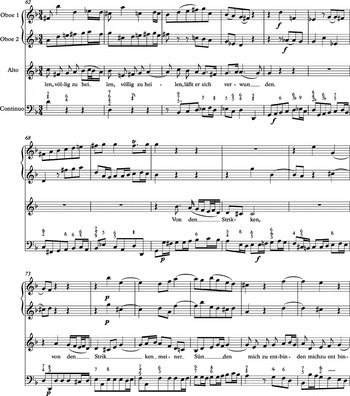
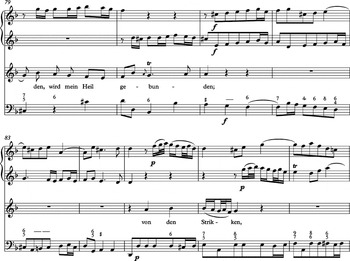
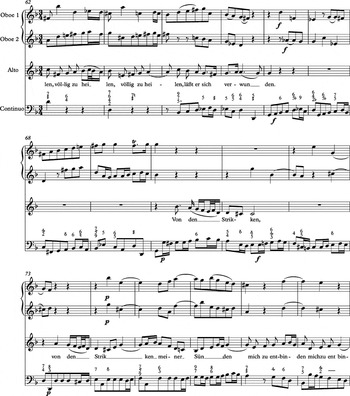
A feature that sets many of Bach's subdominant returns apart from their tonic-oriented counterparts is instability at the onset of A′, which may last for just a few bars. The alto aria ‘Von den Stricken meiner Sünden’ from the St John Passion, bwv245/7, includes a subdominant return that resembles that of bwv23/1 in certain respects yet differs markedly in others. Example 1 reproduces the end of the B section and the start of the A′. Three events should be noted here: (1) the vocal cadence in bar 66, which marks G minor, the subdominant, as the harmonic goal of the B section; (2) the instrumental ritornello in bars 66–70, which reiterates G minor, and may be understood as an appendix to the B section (that is, not yet A′); (3) the start of A′ in bar 70 by means of a vocal motto not present in the A section. But this ‘new’ motto is easily recognized as the onset of the return, since it closely resembles the tune with which the voice entered in bar 9.Footnote 24
J. S. Bach, ‘Von den Stricken meiner Sünden’, bwv245/7, bars 62–87. After the edition by Arthur Mendel (Neue Bach-Ausgabe, series 2, volume 4 (Kassel: Bärenreiter, 1973)). Used by permission
continued

Once the tonic returns, in bar 73, the A′ exactly parallels the A section for fourteen bars (bars 73–86=9–22; see Example 1). Given the tonal instability of this passage, one might be inclined to regard the vocal motto (bars 70–731) as transitional rather than part of the return. Yet by introducing the motto over subdominant harmony, Bach is able to single out the return for attention by means of a melodic variant – B♭ instead of A – thus exemplifying Lester's principle of ‘heightening levels of activity’. From bar 87 on, A′ takes a ‘new’ turn compared to A. At this point, the instrumental parts are the same as in bar 23, except that F is altered to F♯ in the bass on beat 3. Meanwhile the alto soloist is silent in bar 87, in contrast to the setting of ‘seiner’ in bar 23. In bars 88–106 Bach brings back the music of bars 21–39, transposed up a fourth (or down a fifth).Footnote 25 Although the instrumental parts in this passage deviate very little from the model, Bach freely alters the contour and rhythmic details of the vocal part, creating another heightened level of activity. Bach judiciously balances those passages that return transposed up a fourth (see bars 88–92 and 96–103) with those that return down a fifth (bars 92–96 and 103–106). Of particular note is the way Bach sets e♭2, the alto's highest pitch, in relief in bars 88–89, 98 and 102. (Further to this point: in bar 98 f2, the expected analogue to c2 of bar 31, is avoided in favour of f1, thus maintaining e♭2's status as the alto's highest pitch.)
In sum, ‘Von den Stricken meiner Sünden’ exhibits neither a continuous subdominant return, like that of bwv23/1, nor a tonic return that is modified only at the end, such as one finds in most modified da capo forms. Instead, this aria combines the two procedures, such that the subdominant return starts at bar 70 with a motto, is interrupted by a tonic return (bars 73–87), then resumes during the transposed continuation (bars 88–106) and concludes with the definitive tonic cadence in bar 106. This cadence resolves tension on two levels. On the global level, the cadence on d1 in bar 106 resolves the corresponding cadence on a1 in bar 39 (the interval of resolution being ‘down a fifth’ both literally and in the abstract). On the local level, the A′ section sets up – and ultimately resolves – a different conflict between the subdominant and tonic regions. To underscore that conflict, the vocal line asserts and reiterates e♭2 as a focal point of tension in this passage, before ultimately coming to rest in bar 106 on d1, a minor ninth below that focal point.
The unstable or transitional quality of the A′ section's beginning is by no means unique to ‘Von den Stricken meiner Sünden’. In five other arias listed in Table 2, Group 1 (bwv27/5, 48/6, 140/3, 244/49 and 245/24), all in minor keys, Bach treats this formal boundary in a similar manner. In every case but one (bwv244/49, to be discussed later), the B section concludes with a vocal cadence not in the subdominant but in the submediant, followed by a ritornello segment in that key. The difference in key choice is not so great, since (in any minor tonality) the subdominant and submediant are relative keys, and may be regarded as a single region on the circle of fifths. Since no two arias enact the progression from VI through iv to i in precisely the same way, I shall examine two realizations of this possibility in some detail.
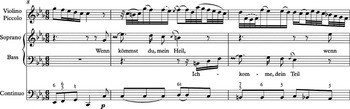
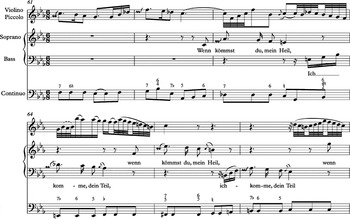
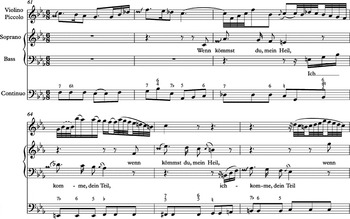
In the duet ‘Wenn kömmst du, mein Heil?’, bwv140/3, an exquisite dialogue between the Soul (soprano) and Jesus (bass), the soprano's initial question is set to a harmonically open gesture (originally stated by the violin in bars 1–2). The bass answers with a gesture that resolves onto tonic harmony, thus completing a miniature antecedent–consequent construction (Example 2a, bars 9–10). The modified da capo begins in bar 63 with a transposition of bars 9–10 to the subdominant, F minor (see Example 2b). Although Bach leaves the vocal contours intact, he alters the accompanying instrumental parts to great effect. The basso continuo, in particular, begins not on F, as it would in a straightforward transposition, but on D♭, thus postponing F minor harmony until bar 642. Then, in bars 65–66, Bach repeats the vocal material of bars 9–10 at the original pitch, but over a new, more urgent bass line, which rises chromatically through F♯ to G (V of C minor), and continues to rise diatonically until it finally clinches the tonic. Bach thus expands the original two-bar idea (bars 9–10) to four bars, and in the process creates a strong sense of directed motion to the delayed arrival of the tonic in bar 66.Footnote 26 The remainder of the A′ section closely follows A, but omits the modulating passage (bars 17–22). Thus bars 67–70 recapitulate 13–16 (at the same pitch) and bars 71–80 recapitulate 23–32 (transposed down a fifth).
‘Wenn kömmst du, mein Heil?’, bwv140/3, bars 8–10. After the edition by Alfred Dürr (Neue Bach-Ausgabe, series 1, volume 27 (Kassel: Bärenreiter, 1968)). Used by permission

‘Wenn kömmst du, mein Heil?’, bwv140/3, bars 61–66
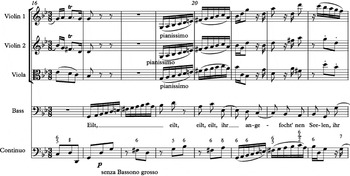
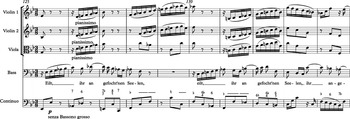
The formal ambiguities in ‘Von den Stricken’ and ‘Wenn kömmst du, mein Heil?’ are significant, but not extreme. A more radical departure from the norm occurs in the dialogue aria for bass and chorus ‘Eilt, ihr angefochtnen Seelen’, bwv245/24. The irregularity of the da capo is evident already in its first eight bars, which only vaguely resemble the first vocal phrase of the aria. (The passages are aligned in Example 3.) The lack of a tight thematic and tonal ‘fit’ between these passages may have prompted Laurence Dreyfus, in his well-known analysis of the aria, to ignore the da capo form altogether.Footnote 27 He takes the opening ‘ideal’ ritornello to be the inventive matrix for the whole aria, and builds his argument on the idea that repetitions or transformations of that ritornello, in whole or in part, and transposed to different keys, serve to reinforce the allegorical meaning of the text, an exhortation to penitent sinners to go to Golgotha. By the end of the aria, according to Dreyfus, the sinners have realized the importance of getting to Golgotha, but have not yet arrived there. He claims that the ‘repetition [of musical figures] is not structured by the passage of time: it is rather a constant reinterpretation of the same idea over and over again’ and that ‘to speak of the perception of the entire aria as a primarily temporal event, a movement from point A to point B on a temporal axis, trivializes the experience’.Footnote 28
‘Eilt, ihr angefochtnen Seelen’, bwv245/24, bars 16–23. After the edition by Arthur Mendel (Neue Bach-Ausgabe, series 2, volume 4 (Kassel: Bärenreiter, 1973)). Used by permission

‘Eilt, ihr angefochtnen Seelen’, bwv245/24, bars 125–134

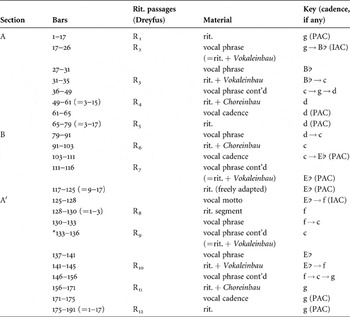
As in most of the analyses in his book, Dreyfus focuses here on recurrences and transformations of ritornello material, while downplaying the formal role of episodic material.Footnote 29 He accurately identifies the operations or functions Bach applies to the opening ritornello over the course of the aria – functions he calls segmentation, modeswitch and array. Table 3 aligns the ritornello formations identified by Dreyfus (in the third column) with the three sections of the da capo form (in the first column).
bwv245/24, aria: ‘Eilt, ihr angefochtnen Seelen’. Formal chart

* Bars 133–175 recapitulate bars 23–65 up a perfect fourth.
That the da capo starts ambiguously at bar 125 does not conceal the extensive formal correspondence between bars 133–175 and bars 23–65 (transposed up a fourth).Footnote 30 Rather, the ambiguity enhances the effect of the da capo, since it maintains the mood of striving toward a goal that pervades the whole aria. The bass soloist's melody in bars 125–133 only loosely resembles his original beginning in bars 17–23 (compare Examples 3a and 3b). The rising scale-figure is reduced to half its original length, and what had been a single seven-bar phrase clearly anchored in G minor is now restructured as a group of three short, tonally unstable phrases (or phrase segments): (1) a false start or motto (bars 125–128) beginning in E flat major and modulating to F minor; (2) a ritornello segment in F minor (identified by Dreyfus as a transposed Vordersatz segment, cognate with bars 1–3); and (3) a second vocal ‘phrase’ (bars 130–133) leading from F minor to C minor, the subdominant. As Schulenberg points out, the quasi-sequential aspect of this passage, with its imitative treatment of the ascending principal motive and ‘ascending’ modulation, ‘reinforces the textual exhortation “hurry”’.Footnote 31
As I suggested earlier, one can conceive of E flat major (VI) and C minor (iv) as a single region governing the harmonic events at the start of the da capo. Bach withholds the subdominant proper until bar 133 because he had already passed through that key in the B section (bars 97–105), though without actually cadencing there. Meanwhile, Bach uses F minor (iv/iv, the flattest key in the whole aria) as a jumping-off point for the journey home to G minor (Golgotha?) by way of a lengthy subdominant ‘recapitulation’ (bars 133–175).Footnote 32
Unlike Dreyfus, I would not scorn to hear in this music ‘a movement from point A to point B on a temporal axis’. For the effect here of departure from and return to the tonic is not merely like the complete turn of a wheel on its axle. The modulations – like the abundant syncopations and jagged melodic contours – are purposeful and require effort, or striving, on the part of both the composer and the performers. Even though the music after bar 133 is not new, thematically speaking, it covers tonal ground not previously traversed by the performers. In short, the performers act out a drama whose ending is not merely asserted but achieved. For Dreyfus, this music shows not ‘the slightest interest’ in ‘change, in the sense of a sequence of events leading to an altered state. The goal, rather, is contemplative understanding, which entails of course its own, more subtle form of changes.’Footnote 33 An implicit assumption here is the notion that, in the late Baroque, an aria expresses a single emotive state (or Affekt), whilst recitative alone (whether in the context of an opera by Handel or a Passion by Bach) carries the action forward. While that assumption holds up adequately when applied to strict da capo arias, it does not do justice to through-composed da capo forms – even if, as in this case, identical ritornellos frame the aria. To my mind, we need not hear the tonal action of this aria, with its many twists and turns, as the imitation of a single, unchanging mental state. Rather, we may hear it as an allegory of the mental and spiritual growth of the penitent sinners – something that the poetry alone cannot adequately express. The text stresses the importance of hurrying to Golgotha, not resting content with one's present state. Judging from the relative clause in the passage quoted above (‘contemplative understanding, which entails of course its own, more subtle form of changes’), Dreyfus and I agree on one point: this music models changes implicit in the text. The question remains: Are the changes modelled in this aria too ‘subtle’ to justify hearing this music as goal-directed?
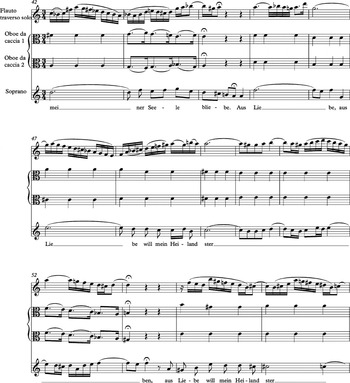
In this aria, as in so much of his music, Bach unites several formal principles – da capo, ritornello and dialogue – with a tonal plan that symmetrically balances the modulations in the A and A′ sections. This plurality of principles, far from causing it to spin out of control, actually strengthens its expressive power. A challenge for the analyst is to appreciate the delicate balance between what convention demands and what the piece seems to demand of itself, as if oblivious to convention.Footnote 34 A case in point is the soprano aria ‘Aus Liebe will mein Heiland sterben’ from the St Matthew Passion, bwv244/49. The presence of a subdominant return may be unusual by baroque standards, but it is not at all a rarity in the context of the Passions. And yet, as John Butt has recently pointed out, Bach's treatment of the border between the B and A′ sections (Example 4) almost defies convention. Butt's eloquent description of bars 42–49 (his Example 1.8) resonates with a claim I made earlier about ‘Eilt, ihr angefochtnen Seelen’, and for that reason I quote extensively from it here:
The vocal line's independence is especially evident in the way it straddles the junction between the central section and the modified da capo (bb. 44–5). Although the opening text (‘Aus Liebe’) returns, the voice continues a descending line (from g″) that was prepared in the central section (b. 43). The instruments return, appropriately, to the initial figuration, but in a considerably modified form, now in the subdominant (D minor). We almost get the sense of a singer performing in wilful ignorance of the conventions of da capo form, rendering the return of the opening text and its accompanying music continuous with the central section.Footnote 35
‘Aus Liebe will mein Heiland sterben’, bwv244/49, bars 42–55. After the edition by Alfred Dürr (Neue Bach-Ausgabe, series 2, volume 5 (Kassel: Bärenreiter, 1974)). Used by permission

In this description, Butt correctly identifies what one might call the non-congruence of linear and formal aspects – a frequent phenomenon in Bach's music. A Schenkerian analyst would call the large-scale soprano line a ‘structural line’ or ‘linear progression’ (Schenker's word is Zug), bridging the formal gap marked by the D minor half cadence (itself rhetorically reinforced by the fermata).Footnote 36
I would amplify Butt's point about continuity by noting that the subdominant return provides the impetus for continued motion beyond the endpoint of his Example 1.8 (bar 49) toward the goal of this phrase, the A minor half cadence in bar 53. Linear continuity and formal discontinuity are on equal footing in this aria, and the tension between them heightens the expressive effect. Each of the seven fermatas marks a cadence or quasi-cadential stoppage on V4 2 or viio7; the cumulative effect of these open-ended gestures is a mood of contemplation fraught with expectation. (Significantly, the cadence in bar 44 is the only one on a root-position dominant.) The aria's arresting effect has partly to do with the fact that five of the seven fermatas are set in A minor. But there is no question of monotony here, since Bach selects two contrasting keys for the all-important internal cadences: C major, the goal of the A section, and D minor, which has a double function as both the goal of the B section and the initial key of the A′.
The contexts for subdominant returns range from the intimate, introspective milieu of this aria to some of Bach's most jubilant music, such as the opening chorus of the cantata Herz und Mund und Tat und Leben, bwv147. The original version of this cantata, bwv147a, which included this chorus, was composed at Weimar for the Fourth Sunday in Advent 1716, and was revived at Leipzig in an expanded version for the Feast of the Visitation (2 July 1723). It was at Weimar that Bach first developed his skill at combining formal procedures (such as ritornello, fugue and da capo form) in his vocal music. As Richard Jones has demonstrated, one can witness a decisive growth in his combinative powers by comparing the opening choruses from the three cantatas Bach wrote for Advent 1716.Footnote 37 A brief summary of that evolution at this point will permit a proper appraisal of the formal peculiarities of bwv147.
In Wachet! betet! betet! wachet!, bwv70a (revived as bwv70), Bach uses ‘choral insertion’ (German Choreinbau) for the first time in a large-scale choral movement that fuses ritornello and da capo forms.Footnote 38 This new technique involves the superimposition of voice parts over a partial or complete reprise of the instrumental ritornello, enriching that reprise in several ways at once – contrapuntally, textually, timbrally and in volume. A week later, for the Third Sunday in Advent, Bach applied the same technique to the opening chorus of bwv186a (likewise revived as bwv186), only now in the context of a ‘rondeau’ (or ‘compound reprise form’) ABA′BA″.Footnote 39 In this chorus, Bach begins each reprise in a key other than the tonic: A′ starts in the subdominant while A″ starts in the dominant. The movement thus differs formally and in its tonal plan from the free da capo forms examined in the present study, yet resembles them with respect to the positioning of the subdominant. For here, as in all the movements listed in Table 2, the subdominant key appears after the movement's midpoint, at bar 27 out of a total of forty-nine bars. Although the relative position of the return between the movement's midpoint and conclusion can vary considerably within this sample, the subdominant's consistent occurrence after the midpoint is by no means coincidental. And on the rare occasions when Bach modulates to the subdominant prior to the midpoint, there may be a special motivation for doing so, such as an overall symmetrical plan whereby an initial modulation from I to IV is balanced by a modulation from V back to I.Footnote 40
As Jones observes, the opening chorus of Herz und Mund und Tat und Leben ‘goes beyond its predecessor [bwv186a] in incorporating significant elements of fugue and motet style within its ritornello-reprise structure’ and ‘unites the outstanding features of the choruses from the two preceding cantatas’, thereby ‘surpassing them both’.Footnote 41 The movement resembles an ABA′ form, except that the entire text is set in each section and, as Alfred Dürr puts it, ‘Bach's setting to a striking extent assimilates the middle section to the outer sections’.Footnote 42 The ambiguity inherent in the form disappears if one views it as a parallel-section form, in Lester's sense. Bach's strategy is clear: he uses perfect authentic cadences (PACs) exclusively at the ends of the sections (bars 9, 27, 43, 58 and 66). Moreover, Bach always sets these cadences – except at the end of each instrumental ritornello (or sinfonia) – just for the voices and continuo. Another important aspect of the design is the phrase overlap that each PAC (except the final one in bar 66) marks between the end of one section and the start of the next. Lower-level half cadences (HCs) occur in bars 23 and 34. The perception of form in this movement depends very much on the relative stability of the cadential goals: the harmonies at the ends of sections sound more stable than the internal points of rest. A strong cadence signals the start of both returns, if one views the form as AA′A″. What makes the cadence in F major at bar 43 stronger than the one in A minor at bar 27 is the tonally circuitous – even arduous – path required to attain it. Not only are bars 34–43 more than twice the length of the passage upon which they are thematically based (bars 23–27), but the later passage also ‘climbs’ through several keys (albeit fleetingly) before finally ‘landing’ in F major.
The effect at the start of A″ (bar 43) is one of relaxation – a quality often associated with motions to the subdominant – and Bach underscores that effect by having the voices enter from low to high rather than from high to low, as in bars 9–15.Footnote 43 This chorus is thus set apart from its predecessors, bwv70a and 186a, not only by the fugal writing (as noted by Jones), but also because of the symmetrical relation between the two fugal expositions. No one acquainted with Bach's later music should be surprised by the paired symmetries in this movement: the mirrored ordering of the voices enhances the perception of the nearly symmetrical relation between the tonal plans of the expositions (C–G–C–G in bars 9–14 versus F–C–G–C in bars 43–48).Footnote 44 For this and other reasons, one can scarcely overstate Jones's point that this chorus marks a watershed in Bach's ‘creative development’.
RE-EXAMINING ‘KOMMT, IHR TOöCHTER, HELFT MIR KLAGEN’, BWV244/1
During the Leipzig period Bach consolidated and refined a mastery that he fully possessed by 1716. I should like to specify some of the ways in which Bach did this by taking a closer look at the opening chorus from the St Matthew Passion, a movement whose formal peculiarities are the focus of a single chapter of Karol Berger's recent book on temporality in the music of Bach and Mozart. Berger draws attention to ‘Bach's sophistication in treating the da capo form’ and makes the following observation: ‘Although the da capo lasts only nineteen measures, whereas the initial A section had fifty-seven, there is no sense of imbalance, no sense that the end does not match the expansive beginning, no sense of something missing.’Footnote 45 He rightly asks why Bach conceived the da capo as he did ‘when he had more conventional ways at his disposal to bring the chorus to a close’.Footnote 46 But, in seeking to understand the da capo's peculiarities, Berger focuses on its temporal aspect without pointing out, let alone probing, the striking fact that it starts in the subdominant key. Berger concludes his reading with a provocative claim: ‘What [Bach] does is to make simultaneous what normally is (and earlier had been in the chorus) successive, and to abolish the succession of past, present, and future for the simultaneity of the present – in short, to abolish the flow of time in favor of the eternal Now.’Footnote 47
This da capo does have a simultaneous aspect, in so far as the final nine bars recapitulate the consequent phrase of the opening instrumental ritornello (bars 9–17), now sonically and textually amplified by means of Choreinbau (choral insertion). But I disagree with Berger's view that the nature of form in Bach's music in general, and in this chorus in particular, is primarily cyclic. Rather, I would contend that Bach mediates between cyclic and goal-directed principles of form. To understand how these principles interact, one must attend not only to the cyclic impression arising from thematic recurrence in his music but also to the kinetic aspect of tonal structure. The use of the subdominant key to mark the start of the da capo (or A′ section) actually enhances the ‘flow of time’ and the impression of a goal-directed, through-composed form.Footnote 48
In ‘Kommt, ihr Töchter, helft mir klagen’, Bach takes the idea of fusing formal principles that he had achieved in bwv147/1 and uncovers even richer possibilities. For he not only unites such principles as ritornello, da capo and fugue, but also creates a complex dialogue between the due chori (each chorus consisting of a choir and an orchestra), and even superimposes the chorale ‘O Lamm Gottes’, sung by the soprano in ripieno (a small group of high voices separate from the two SATB choirs). The chorale poses a special challenge of its own, since it is in G major, and thus has to be subordinated to the E minor tonality governing the whole movement. Despite the richness of this formal tapestry, the baroque conventions of ritornello and da capo are fairly easy to detect. And yet one is left wondering why the da capo starts in the subdominant and is so drastically shortened. To explain these peculiarities, I shall examine three aspects of the movement: (1) the manipulation of ritornello modules (or segments); (2) the articulation of form through cadences; and (3) the relation of the chorale to the overall harmonic plan.
The opening ritornello is a single large period, articulated by a half cadence at its midpoint, bar 9, and by a perfect cadence at its conclusion, bar 17. Although every segment of the ritornello recurs later in the movement, both transposed and at the original pitch level, the entire ritornello is never restated – thus going against the norms of da capo form. There are two main reasons for this, the first being the sheer length of the ritornello. The other is the fact that the chorale melody never coincides with ritornello material, so that the presentation of all seven lines of the chorale scarcely leaves room for a complete restatement of the ritornello, either internally or at the end. The situation is different in bwv147/1, where the ritornello is relatively brief and thus poses no obstacle to the convention of repeating it in its entirety at the end.
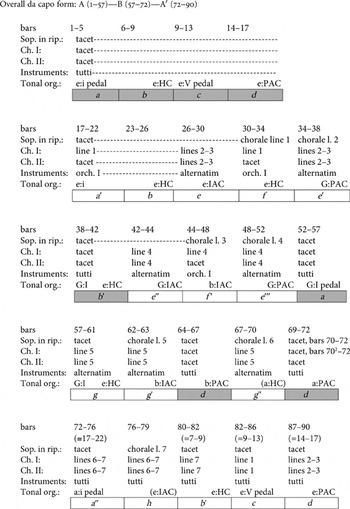
It is instructive to consider the form of bwv244/1 in terms of its organization into modules of three to five bars’ length. (See Table 4; the modules are represented by boxes labelled a, b, c and so on.) The modular approach taken here is partly inspired by Jeanne Swack's analyses of ritornello form in the Brandenburg Concertos.Footnote 49 Like Swack, I seek to understand how and why episodic (or simply ‘non-ritornello’) segments or modules interact as they do with material derived from the ritornello. The opening ritornello consists of four modules, all of which recur later, sometimes enhanced through choral insertion. Shaded boxes here and elsewhere in Table 4 indicate ritornello passages that are set for instruments only.
bwv244/1, ‘Kommt, ihr Töchter, helft mir klagen’. Formal chart
Overall da capo form: A (1–57)—B (57–72)—A′ (72–90)

Note: the ‘modules’ referred to in the main text are indicated by the boxes; shaded boxes indicate instrumental passages.
Some important facts about the modules can be gleaned from Table 4. First, modules a and d occur more often (four times) than b (three times, all in the first half) and c (twice). Second, certain modules permit both transposition and a change of mode while others do not. Here it makes sense to describe Bach's choices using the analytical language proposed by Dreyfus: one can say that the functions array (transposition) and modeswitch (changing from minor to major) are both applied to modules a and b, whereas modeswitch does not work for modules c and d.Footnote 50 Owing to the prominence of modules a and d throughout the movement, it is instructive to compare their formal functions and inherent qualities.
The primary functions of modules a and d are ‘beginning’ and ‘ending’ respectively. The lengthy pedal point in a makes it suitable not only for beginning a movement, but also for establishing the solemn and epic tone of the whole Passion. Because of the pedal point's equally conventional association with endings, Bach readily adapts a to the function of an appendix to the A section in bars 52–57.Footnote 51 Module d, by contrast, is devoutly wedded to its ending function. From a formal standpoint, it is a conventional four-bar progression leading to the first perfect cadence in the movement. But Bach makes it sound special – anything but routine – by infusing it with striking chromatic figuration (see the parallel 6 3 chords in the upper parts) and introducing dialogue texture. As Butt observes, ‘the entire orchestra suddenly breaks into two, creating a dialogue which is predicted at no previous point in the ritornello’.Footnote 52 The orchestras come back together in bar 16 on a Neapolitan sixth, a harmony that is unique to this module and signals imminent closure on the tonic. That closure brings us to the topic of cadential articulation.
Much as he did in bwv147/1, Bach uses PACs to articulate the ends of sections in bwv244/1. Also similar to bwv147/1 is the fact that every PAC (except the last) marks a phrase overlap, thus announcing a new beginning even as it provides closure for a phrase or section.Footnote 53 The particular module used to achieve each cadence depends on the mode: module d is used for all the PACs in minor keys (bars 17, 67, 72 and 90), while module e is used for those in major (bars 38 and 52). (We should recall here that module d works in minor but not in major.) In bwv244/1, the B section contains two iterations of module d almost back-to-back, the first in B minor (bars 64–67), the second in A minor (bars 69–72). These two statements of a module that had not been heard since bars 14–17 lend a particular urgency to the onset of the da capo in A minor at bar 72. This subdominant return has the effect not so much of relaxation, as of a calm before a storm. Just a few bars later (bar 75) the movement reaches and then sustains its peak of emotional intensity, a thrilling tutti passage that includes the first and only setting of modules c and d (bars 82–90) for voices as well as instruments.
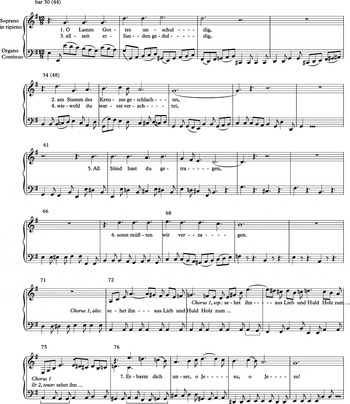
This brings us to an aspect of the movement that – perhaps to a greater extent than modular organization and cadential articulation – sheds light on Bach's decision to begin the da capo in the subdominant: the relation of the chorale melody to the large-scale harmonic plan. Example 5 shows the chorale, as presented in this movement, together with the supporting organo continuo part. (For reasons that will soon be clear, the example also shows some thematic material from bars 72–75, preceding the final phrase of the chorale.) Like many Lutheran chorales, ‘O Lamm Gottes’ is in Bar form: A (Stollen, lines 1–2), A (Stollen, lines 3–4), B (Abgesang, lines 5–7). While Bach respects the chorale's G major tonality in his harmonization of both Stollen, he departs from that tonality in the Abgesang. By creating – or at least suggesting – cadences in B minor (bar 63), A minor (bar 69) and E minor (bar 79), Bach ‘fits’ the chorale into the E minor tonality of the surrounding da capo form.
‘Kommt, ihr Töchter, helft mir klagen’, bwv244/1: passages with the chorale ‘O Lamm Gottes’, shown with the supporting continuo part. After the edition by Alfred Dürr (Neue Bach-Ausgabe, series 2, volume 5 (Kassel: Bärenreiter, 1974)). Used by permission
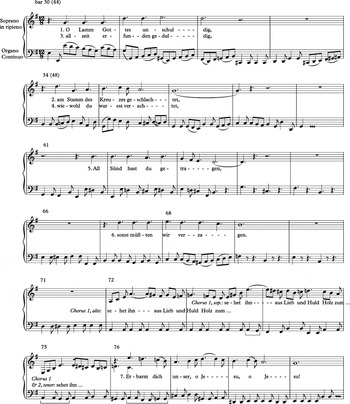
The final line of the chorale is nestled between two formal junctures: the musical da capo beginning in bar 72 in A minor, and the textual da capo, which does not start until bar 82. (In bars 72–82 the choirs continue to sing lines 6–7 of the ‘aria’ text – text that would typically be set in the B section only.) If one attends closely to the bass, starting at bar 72, one notices that the pitch A (the local tonic in bars 72–73) has a tendency to fall to G. In the first two instances (highlighted by brackets below Example 5) the G supports an E minor 6 3 chord; in the third instance, bar 76, it supports a root-position G major chord. In no case does A function as harmonic preparation for V in E minor. Rather, Bach saves that preparation for bars 80–81, where the (now familiar) bass pattern C–B–A♯ prepares the V chord of bar 82, launching module c and the textual da capo.
The harmonic sequence at the start of the final chorale phrase (bar 76) echoes a progression that Bach used in both Stollen (bars 31 and 45) to point up the melodic peak e2. The model for this sequence is a tonicizing progression, V6 5–i of A minor, which is replicated a step lower ‘in’ G major. From a global perspective, A minor and G major function as iv and III of E minor. But locally – and especially in view of the chorale's implicit G major tonality – these harmonies function as ii and I of G major. By the end of the phrase (bars 78–79), however, it is clear that G major is a temporary key, and that an E minor tonality ultimately governs the harmonies of this passage. Just as the innocent lamb of God must be crucified, so too must G major yield to E minor.Footnote 54
By harmonizing the chorale's highest pitch, e2, with an A minor chord in three out of four instances, Bach creates a kind of motive based on the consistent association of a prominent melodic note with a particular harmony. (The exception, the C major chord supporting e2 in bar 68, is actually related to the others through the tonicization of A minor later in the same bar.) To my ears, the A minor harmony that Bach so carefully selects for the start of the chorale's final phrase resonates with the subdominant return that precedes it by four bars.Footnote 55
CONCLUSION
The present study grew out of a desire to sketch a context in which to understand Bach's apparently eccentric use of a subdominant return in this chorus. It turns out that this procedure occurs in numerous works written prior to the St Matthew Passion, and indeed recurs several times in that same work. It is not an anomaly, but rather one option among many in Bach's compositional toolbox. Yet close study of the score also indicates that certain aspects of this subdominant da capo are piece-specific – the relation of the key of A minor to the tonicized A minor chords in Bach's harmonization of the chorale being one example.
It bears repeating that analysts must explain formal peculiarities by considering their effects. And these effects are largely measured against norms or conventions established by the composer or a group of composers working in the same genre. While I concur with Berger's characterization of the effect of the da capo as a ‘synthesizing culmination’, I disagree with his claim that by ‘conflating in a single phrase what normally is presented in successive ones’, Bach ‘abolishes the flow of time’.Footnote 56 It seems to me that Bach rather intensifies the flow of time toward the final cadence through several means. One is the use of subdominant return in bars 72–75 as a tonal foil to the culminating tutti passage (bars 75–90) in E minor. The return acts as a foil not only with respect to the harmony, but also with respect to the use of the choirs (still separate in bar 72) and text (the return of the opening line being delayed until bar 82). The conflation of phrases mentioned by Berger also contributes to the flow of time, since it involves a new scoring of familiar material, achieved by means of ‘choral insertion’ during the restatement of ritornello modules c and d in bars 82–90. Bach uses a procedure that he himself had been assiduously cultivating since 1716 – choral insertion – to put a spotlight, so to speak, on the abbreviated da capo.Footnote 57
There is, of course, no definitive answer to how one ought to understand time in this chorus, or in Bach's music generally. I do agree, however, with John Butt's reflections on this issue in his recent book on Bach and modernity. In his chapter 2, ‘Bach's Passions and the Textures of Time’, Butt contrasts the two Passions with respect to the ‘attitudes towards time’ found not only in their texts, but also in Bach's musical setting of them. The opening choruses are set in distinct kinds of da capo form: a strict da capo in the St John Passion versus a highly modified da capo in the St Matthew Passion. Butt compares the choruses in detail, arguing that they ‘suggest two senses of time, the John Passion's more rounded and the Matthew Passion's more linear (or at least progressive)’.Footnote 58 In particular, Butt counters Berger's view of the latter chorus, ‘Kommt, ihr Töchter’, as a composition in which ‘the linear model becomes subservient to the cyclical’. Butt notes that the exclamation of ‘Sehet!’ (bar 72) by the singers of chorus 2 is indicative of a linear view of time: ‘It represents a moment when things seem to fall into place as the result of a learning process in time, something complementing the linearity of this Passion narrative as a whole.’Footnote 59
As I have sought to show in this study, cyclic and linear principles of form both shape Bach's music, if not always in equal measure. In his strict da capo forms, and in those pieces with a strictly parallel subdominant return (shown in Table 1), the cyclic aspect predominates. But in his through-composed da capo forms, including those with a subdominant return, the linear aspect looms larger. Yet the two aspects are never entirely divorced from each other. While the hearings proposed above represent a challenge to Berger's thesis that Bach and Mozart projected fundamentally different conceptions of time through their music, a full assessment of that thesis exceeds the scope of this study. It is none the less safe to say that students of Bach's vocal music ought to pay increased attention to the many contexts in which Bach emphasized the subdominant when recapitulating opening material – notwithstanding the wider debates about temporality in eighteenth-century music.
Appendix. Subdominant returns in instrumental movements by Bach