1. Introduction
First language (L1) acquisition studies of the count–mass distinction are numerous (Gordon, Reference Gordon1985; Soja, Reference Soja1992; Bloom, Reference Bloom and Levy1994; Nicolas, Reference Nicolas1997; Imai and Mazuka, Reference Imai, Mazuka, Gentner and Goldin-Meadow2003; Barner and Snedeker, Reference Barner and Snedeker2005; Papafragou, Reference Papafragou, Cohen and Lefebvre2005). Similarly, there have been second language (L2) acquisition studies of the count–mass distinction (Hiki, Reference Hiki1990; Yoon, Reference Yoon1993; Hua and Lee, Reference Hua, Lee, Dekydtspotter, Sprouse and Liljestrand2005; Athanasopoulos, Reference Athanasopoulos2006). The present paper investigates the acquisition of the count–mass distinction and types of definites in L2 English, by adopting the proposal by Chierchia (Reference Chierchia1998a, Reference Chierchia, Guasti and Gualminib) for a Nominal Mapping Parameter. The first aim of the paper is to test the Nominal Mapping Parameter (hereafter NMP) in L2 acquisition by testing two different L1 groups; under Chierchia's account, Japanese lacks a count–mass distinction and Spanish has a count–mass distinction, but does not really allow the use of bare nouns. It is predicted that L2 learners will have to reset the NMP to the English setting. The second aim is to see whether certain types of definites, as defined by J. Hawkins (Reference Hawkins1978), are more difficult because of the type of definite (i.e. anaphoric, encyclopaedic) and/or because of the type of noun (singular, plural and mass).
2. The Nominal Mapping Parameter
Chierchia (Reference Chierchia1998a, Reference Chierchia and Rothsteinb) provides a cross-linguistic account of NPs with regard to the mapping between syntactic categories and semantic types.Footnote 1 He proposes that there is a Nominal Mapping Parameter with a three-way parametric distinction that divides languages. This is illustrated below:
a. NP[+arg, +pred]
English, German
• L1s with (in) definite articles.
• Number marking on Ns.
• Allow bare mass Ns and plural Ns in argument position.
b. NP[+arg, -pred]
Japanese, Chinese
• L1s lacking DP (no articles).
• No number marking on Ns.
• All Ns are mass.
• Generalized classifier system.
c. NP[-arg, +pred]
Spanish, Italian
• L1s with (in) definite articles.
• Number marking on Ns.
• Do not allow bare mass Ns in argument position. adapted from Schmitt and Munn, Reference Schmitt, Munn, Tamanji, Hirotani and Hall1999, p. 3)
All languages have a mass domain for noun denotations, but languages that have bare NPs are argumental or names of ‘kinds’ i.e. languages like Japanese, only have a mass semantic domain. Therefore, it has the NMP setting [+arg, −pred] as there is no singular/plural distinction. All nouns in Japanese appear as ‘kinds’. Languages such as Spanish and English have a count semantic domain and a mass semantic domain. All nouns need to be licensed to appear as arguments hence a functional Determiner head always projects. Romance languages have the NMP setting [−arg, +pred]. However, English is a mixed language which allows argumental NPs (bare NPs) but predicative NPs (count NPs) require licensing. This gives English the NMP setting [+arg, +pred]. Examples of the count–mass distinction in English are presented in (1).
- (1)
a.

b.
c. *Boy bought book
d.
e.

Count nouns in English like boy and book are predicates that are licensed by overt articles the or a or plural -s marking, as in (1a) and (1b); otherwise they are ungrammatical, as in (1c). However, English also allows kind-denoting nouns which are bare plurals, as with boys and girls in (1d) (a generic reading), and mass nouns with a mass-type reading, as with money in (1e), to be argumental. Unlike Romance languages where all nouns are licensed by a phonologically overt or covert article filling an obligatory D position,Footnote 2 Chierchia argues that this is not the case for English.Footnote 3 He proposes a type-shifting device to shift the semantic type of the NP as a last resort. This allows him to propose that the count–mass distinction exists in English as plural -s licenses the noun as an argument and mass nouns are always arguments that do not project D, hence there is no null (covert) article in English.Footnote 4
3. The Nominal Mapping Parameter in L1 acquisition
According to Chomsky (Reference Chomsky1965) there is an innate component to language acquisition. Universal Grammar (UG) is part of the innate language faculty which constrains L1 acquisition. All L1 grammars conform to the principles and parameters of UG. However, as White (Reference White2003b) states, the logical problem of language acquisition or poverty-of-the-stimulus is that there is a mismatch between the input the child is exposed to and the output (unconscious grammatical knowledge that the child acquires).
The Nominal Mapping Parameter is UG-determined. Chierchia, Guasti and Gualmini (Reference Chierchia, Guasti and Gualmini1999) claim that children start off initially with the Japanese setting of the NMP, which is a [+arg, −pred] type language. This means, universally, that every child starts off with a nominal system resembling Japanese. On the basis of innate grammatical knowledge and input, a Spanish child will have to reset the NMP and gradually project DP for argumenthood. However, an English child “will have to figure out item by item whether a noun refers to a kind (and hence is mass and can be a bare argument) or to a predicate (and hence is count and in the singular, cannot be a bare argument)” (Chierchia, Reference Chierchia1998a, p. 401). This process of learning item by item will naturally take time, but it is uncertain how much time the lexical classification of nouns takes for an English child to work out which nouns are bare nouns and which nouns need to be licensed by a determiner. The point here is that the English child eventually resets the NMP for English. The L1 learner of that language then has to determine, based on positive evidence alone, whether all nouns like dog are always count and nouns like furniture are always mass. This depends on how much flexibility individual nouns are allowed, which is governed by their lexical semantics.Footnote 5
Studies of the NMP in L1 acquisition have concentrated on the ability of children to distinguish between count and mass nouns conceptually and/or linguistically. Gualmini (Reference Gualmini2000) set out to explore the classification process of count and mass nouns in child language with three Italian-speaking children's spontaneous speech. The results revealed that even at a late stage of acquisition there is still omission of articles, around 20% for each child. It could be that many nouns are still linguistically classified as mass. Gualmini (Reference Gualmini2000) concluded that the Italian children in his study correctly set the NMP from an early stage and were correctly using articles, but the classification for each noun was not yet fully adult-like.Footnote 6
Guasti and Gavarró (Reference Guasti, Gavarró, Beachley, Brown and Conlin2003) set out to test the NMP by looking at child speakers of Catalan. One of the hypotheses tested was whether child speakers of Catalan would behave as other children of Romance languages such as Spanish and Italian in the mapping between syntactic categories and semantic types. Catalan is similar to Italian in that there are no bare nouns. Nouns are predicates which require articles to turn them into arguments. They concluded from the data of the Catalan-speaking and Italian-speaking children that the NMP is compatible with an account of article acquisition. Children have to reset the NMP, meaning that the initial setting of the NMP is the wrong value for Catalan and Italian. Subsequently, in their developing grammar they realize that the Germanic parameter setting [+arg, +pred] is not valid for their L1, so they switch to the Romance setting [−arg, +pred].
4. Previous L2 studies of the count–mass distinction in English
Previous studies of the count–mass distinction in L2 English are not extensive as they tended to focus on the acquisition of articles. However, there are a few studies that have investigated L2 acquisition of articles and the problems L2 learners encounter with count and mass nouns (Hiki, Reference Hiki1990; Yoon, Reference Yoon1993; Young, Reference Young, Bayley and Preston1996; Hua and Lee, Reference Hua, Lee, Dekydtspotter, Sprouse and Liljestrand2005). I review one of the studies on the count–mass distinction in section 4.1.
4.1 Hua and Lee (Reference Hua, Lee, Dekydtspotter, Sprouse and Liljestrand2005)
A recent study of Chinese L2 learners of English has been conducted by Hua and Lee (Reference Hua, Lee, Dekydtspotter, Sprouse and Liljestrand2005). In one of three studies, they administered a count–mass grammaticality judgement task involving 20 nouns in total. The 20 nouns appeared in two types of count contexts (i) preceded by a numeral and (ii) preceded by the fuzzy quantifier many. The same nouns also appeared in mass noun contexts preceded by the fuzzy quantifier much. This produced a total of 60 test sentences (20 nouns × 3 contexts) as in the following examples:
- (2)
a. Count nouns in count-selective contexts (many)
Not many computers in the private study area exploded this afternoon, but a number of students were injured.
b. Count nouns in mass-selective contexts (much)
*Not much computer in the private study area exploded this afternoon, but a number of students were injured.
c. Mass nouns in mass-selective contexts (much)
The neighbours did not see much smoke coming out of the chimney of Mr. Ramsey's house; this suggests that he was often away from home.
d. Mass nouns in count-selective contexts (many)
*The neighbours did not see many smokes coming out of the chimney of Mr. Ramsey's house; this suggests that he was often away from home.
The authors tested three groups of ESL learners: (i) senior high-school students in Shanghai (n = 9), (ii) first- and third-year university students in Shanghai (n = 15 for each group) and (iii) a group of first- and second-year university students in Hong Kong. There was also a group of six English native speakers. Learners tended to accept count nouns in mass contexts (using the mass quantifier much) more often than when they were abstract nouns. There was a significant difference in acceptance between abstract and concrete nouns in mass contexts < T/S: GLOBALLY: Please insert a small # before and after the symbol = .> (t = 4.43, p = 0.001 for U1 students; 1.13 vs. 0.20, t = 4.53, p = 0.000 for U3 students; 1.24 vs. 0.47, t = 3.49, p < 0.005 for HKU students). For mass nouns occurring in count contexts (using the quantifier many) the learner judgements were more accurate for the mass concrete nouns. Hua and Lee claim that the results show that L2 learners of a language without a count–mass distinctionFootnote 7 are able to conceptualize what is countable versus what is uncountable in L2 English. But Hua and Lee do not discuss the resetting of the NMP, though they do refer to Chierchia (Reference Chierchia1998a). They simply argue that “the Chinese learner will have to unlearn the UG option that bare nouns can denote kinds in some languages, an option available in their L1” (Hua and Lee, Reference Hua, Lee, Dekydtspotter, Sprouse and Liljestrand2005, p. 140). However, it is not clear what ‘unlearn’ means here, as I will argue in section 6 below that learners whose L1 lacks the count–mass distinction must acquire the syntactic category DP along with the associated features of DP. They must also acquire an uninterpretable number feature on count nouns as they require licensing by an article in English.
5. Previous L2 English studies of article acquisition
There are numerous studies of L2 English learners acquiring articles (Parrish, Reference Parrish1987; Tarone and Parrish, Reference Tarone and Parrish1988; Chaudron and Parker, Reference Chaudron and Parker1990; Shin-ichi, Reference Shin-ichi1991; Shirahata, Reference Shirahata1995; Takahashi, Reference Takahashi1997; Robertson, Reference Robertson2000; Kowaluk, Reference Kowaluk2001; White, Reference White2003a) but there are fewer studies where one group of L2 learners from a language without articles is compared with a group of learners whose L1 has articles (Thomas, Reference Thomas1989; Murphy, Reference Murphy1997; Wakabayashi, Reference Wakabayashi1998; Liu and Gleason, Reference Liu and Gleason2002; Trademan, Reference Trademan2002; Snape, Reference Snape and Snape2005).
5.1 Wakabayashi (Reference Wakabayashi1998)
Wakabayashi (Reference Wakabayashi1998) proposes that there is an optional/obligatory parameter, which is termed the D parameter. English and Spanish have setting (a) obligatory (D)eterminer and (Num)ber in every NP and Japanese has setting (b) which is to use D and Num optionally. Japanese speakers must acquire the specification of English D from ‘scratch’. Therefore, the appearance of a/-s comes later for Japanese speakers and there are persistent L1 transfer effects due to parameter setting (b). He examined the use of the definite article by 55 Japanese speakers. In a gap-filling task the 55 participants were asked to supply the definite or indefinite article in a text extracted from a Japanese textbook used in high schools. The objective of his study was to test whether Japanese speakers would transfer the optional setting of D to their interlanguage grammars (hereafter ILGs). He also hypothesized that the demonstrative sono “that” in Japanese, at initial stages of acquisition, may be used as a translational equivalent to the definite article the in anaphoric contexts. However, he claimed that it is equally possible that Japanese speakers develop knowledge of the use of the definite article independent of their L1 grammar. The types of definite employed in the task are in (3).
Types of definiteness
- (3)
a. Anaphoric Use
Fred was wearing trousers. The trousers had a big patch on them.
b. Immediate Situation Use (Visible Situation Use)
[There is only one bucket in the visible situation] Pass me the bucket, please.
c. Immediate Situation Use (Immediate Situation Use)
[Opening conversation to a passenger, when you cannot see a dog] Don't go in there, chum. The dog will bite you.
d. Larger Situation Use (specific, with presupposed knowledge)
[In Britain, among British people] The Prime Minister has just resigned.
e. Larger Situation Use (general, without any specific presupposed knowledge)
[When invited to a wedding] Have you seen the bridesmaids?
f. Associative Anaphoric Use
The man drove past our house in a car. The exhaust fumes were terrible.
(3) (from Wakabayashi, Reference Wakabayashi1998, based on J. Hawkins, Reference Hawkins1978)
For analysis of results, (3d) and (3e) uses of the definite article are placed into two different categories because Wakabayashi claims that they are associated with culturally specific uses. He found that the culturally specific uses of the definite article were the most difficult along with the anaphoric associative use. He also found that the Japanese speakers were more successful in supplying the definite article when the NPs were [singular] rather than [uncountable]. Hiki (Reference Hiki1990, Reference Hiki1991) reported similar results in his study. Wakabayashi concluded that the Japanese speakers do independently acquire the definite article and do not directly transfer the demonstrative sono “that”. A possible explanation for greater accuracy in suppliance of a definite article in [singular countable] NPs is Japanese speakers believe that it is obligatory but optional when the NP is either [plural] or [uncountable]. He suggests that in the Japanese speakers' ILGs “the definite article is not only associated with [+definite] but also with the number feature of the noun phrase” (Wakabayashi, Reference Wakabayashi1998, p. 103). This is due to L1 transfer of the D parameter which has the [optional] value in Japanese.
5.2 Liu and Gleason (Reference Liu and Gleason2002)
In a study similar to Wakabayashi (Reference Wakabayashi1998), the use of the definite article by L2 learners of English was tested by using a cloze test. Liu and Gleason decided to collapse the types of definite in (3) above into four main types:
- (4)
a. Cultural, where the is used with a noun that is a unique and well-known referent in a speech community.
We went hiking in (the) Lake District last autumn.
b. Situation, where the is used when the referent of a first-mention noun can be sensed directly or indirectly by the interlocutors or the referent is known by the members in a local community, such as the only dog in a family or the only bookstore in a town.
A woman, with her hands full, says to a man standing in front of the office, “Open (the) door for me, would you?”
c. Structural, where the is used with a first-mention noun that has a modifier.
(The) movies that are shown here now are all rated R.
d. Textual, where the is used with a noun that has been previously referred to or is related to a previous mentioned noun.
We rented a boat last summer at a lake. Unfortunately, (the) boat hit another boat and sank.
(4) (from Liu and Gleason, Reference Liu and Gleason2002, p. 7)
The test instrument consisted of 91 sentences in total. There were 15 types of each definite article per category in the cloze test. Sixty obligatory uses of the definite article were deleted from 51 of the sentences. The remaining sentences were distracters or control items. The participants were asked to supply a definite for each sentence.Footnote 8 Data were collected from three levels of proficiency (low, intermediate and advanced) from students attending intensive English programs at several universities in the USA. The participants came from 18 different L1 backgrounds, though the majority were Chinese, Korean and Japanese (n = 101) and the remaining participants (n = 27) were of Indo-European languages.Footnote 9 Liu and Gleason found that there were significant differences between the two groups in omission of the in the cultural and situation uses. However, the overall results revealed that the L2 learners seem to acquire definite article types in order of difficulty. Firstly, the situation use, then the structural and textual uses and lastly the cultural use. They concluded with some pedagogical implications for teaching practice and instructional material writing.
The results from the L2 studies show that Chinese L2 learners are able to distinguish between count and mass. Japanese L2 learners continue to have difficulty with articles because of the count–mass distinction and the definite article is difficult due to the type of NP context (countable vs. uncountable) and the type of definite article.
6. The Nominal Mapping Parameter in L2 acquisition
White (Reference White2003b, p. 23) argues that in order to support the poverty-of-the-stimulus situation for L2 acquisition, one would have “to demonstrate convincingly that interlanguage grammars are constrained by principles of UG”. Three conditions should hold: (i) the property in question should not be available in the L1, (ii) it must be underdetermined by input, and (iii) it should not be known through instruction or other metalinguistic means. For the Japanese learners to successfully reset the parameter to the L2 setting they must be able to distinguish between countable and uncountable nouns. The properties in question are features of determiners and nouns which are absent in Japanese (see (5) below). The more input the learners receive the more likely it is that they will perform better on a count–mass grammaticality judgement task. However, the crucial point here is that even learners who have received little input should be able to reset the NMP if their ILGs are constrained by UG. Footnote 10, Footnote 11
If L2 learners are unable to reset the NMP to the English setting, we may expect Japanese learners to transfer the L1 setting and treat all count nouns (a car) and mass nouns (furniture) in English as a “kind” (mass-like), because Japanese cannot individuate (no singular/plural distinction).Footnote 12 Spanish learners may differ as Spanish is a language with count nouns and no bare NPs. Mass nouns in English may be accepted as countable by the Spanish learners as mass nouns such as furniture appear to be countable in Spanish (e.g. los muebles).Footnote 13 Therefore, we might expect to find differences between L2 learners who have the NMP setting [+arg, −pred] (Japanese) and L2 learners who have the setting [−arg, +pred] (Spanish).
To consider the detail of the acquisition of the [+arg, +pred] (English) setting of the NMP by Japanese and Greek speakers, Hawkins et al.(Reference Hawkins, Al-Eid, Almahboob, Athanasopoulos, Chaengchenkit, Hu, Jaensch, Jeon, Jiang, Leung, Matsunaga, Ortega, Rezai, Sarko, Snape and Velasco-Zarate2005) adopt a syntactic analysis of the English DP that involves the notion of ‘Agree’ defined by Adger (Reference Adger2003). The set of assumptions based on Radford (Reference Radford2000) is given in (5) for singular count nouns:
(5) a boy
[+singular] [noun, animate, masc, 3pers, unum:] →
[+singular] [noun, animate, masc, 3pers, unum: +singular]
Japanese does not have articles (lacks the functional category DP) and nouns do not enter into the derivation carrying an uninterpretable number feature [unum:] as all nouns have an argumental interpretation i.e. are “kinds”. Spanish has articles and all nouns enter into the derivation with an uninterpretable feature which has to be valued and deleted by an article, as shown in example (5) above. English differs from Japanese and Spanish as it allows count nouns and bare nouns. Since mass nouns are inherently plural under Chierchia's (Reference Chierchia1998a, Reference Chierchia and Rothstein1998b) account, there is no need to claim that mass nouns carry an uninterpretable feature. This is sketched in (6).
(6) The syntactic three-way parametric distinction according to the NMP
English: count nouns: [num, sing:pl] [N, unum:] mass nouns: [N]
Japanese: all nouns: [N] “kinds”
Spanish: all nouns: [num, sing:pl] [N, unum:]
The approach adopted in my study is to claim that L2 learners have difficulty with the count–mass distinction because of the different L1 NMP settings. The task of resetting the NMP may be more difficult for learners of an L1 with the setting [+arg, −pred] because Japanese lacks the functional category DP (Wakabayashi, Reference Wakabayashi1998) and the uninterpretable number feature as there is no number marking on nouns. But, it is assumed, under the Full Transfer/Full Access Hypothesis (Schwartz and Sprouse, Reference Schwartz and Sprouse1996), that “learners can acquire new functional categories, features and feature values, together with their associated consequences, thus, implicating parameter resetting” (White, Reference White2003b, p. 148).
In order to find out whether Japanese and Spanish learners can reset the NMP to the English setting, two tasks were administered. The first was a count–mass grammaticality judgement task and the second was a forced-choice elicitation task. These are discussed in section 7.
7. Method
7.1 Predictions and hypotheses
Hypothesis 1 (H1) was formulated in order to test parameter resetting using a count–mass grammaticality judgement task:
H1 L2 learners from different L1 backgrounds can reset the NMP to the English setting [+arg, +pred].
Spanish is a language with articles and number marking on nouns; therefore it has the NMP setting [−arg, +pred]. Japanese is a language, according to Chierchia (Reference Chierchia1998a), where all nouns are argumental [+arg, −pred] (mass-like). Chierchia et al. (Reference Chierchia, Guasti and Gualmini1999) suggest parameter resetting can be very fast as it only takes a few occurrences of articles and plural morphology to trigger resetting. If the L2 groups differ in performance then (i) L1 transfer may be persistent even though the parameter has been reset (ii) it may be due to their proficiency level in English. The more advanced the learners are the better they should perform overall. Hypothesis 2 (H2) was formulated in order to test definite article types in count and mass contexts using a forced-choice elicitation task.:
H2 Japanese L2 learners can reset the NMP, but there may be a difference in the suppliance of definites in singular, plural and mass noun contexts due to the different pragmatic uses of the definite article.
Perhaps frequency of the different contexts is a factor in acquiring definite article use, but as L2 learners from article-less languages have a persistent problem, not L2 learners from article languages, I argue that frequency is not the only factor.
7.2 The participants
All participants were students at the University of Essex and were tested on campus (see Appendix for further information on participants). In total, 75 participants took part in the study. There were 15 native speakers of English, 30 native speakers of Japanese and 30 native speakers of Spanish. All participants (apart from the native controls) were asked to complete the Oxford Quick Placement Test (OQPT; Syndicate, Reference Syndicate2001). The participants were then placed into intermediate or advanced groups depending on their OQPT scores. Factors such as age and length of stay in English-speaking countries were not included in the final analysis.
7.3 The tasks
The count–mass grammaticality judgement task was de-signed with four conditions: (i) count singular, (ii) count plural, (iii) mass, and (iv) *mass plural (* means ungrammatical), and is based on a task used by Hawkins et al.(Reference Hawkins, Al-Eid, Almahboob, Athanasopoulos, Chaengchenkit, Hu, Jaensch, Jeon, Jiang, Leung, Matsunaga, Ortega, Rezai, Sarko, Snape and Velasco-Zarate2005). Some examples of the conditions with nouns are in Table 1.Footnote 14 The items were randomized and included in short contexts. An example of a context is in (7).
(7)
Each participant was required to choose which continuations produce a possible sentence of English (that is, one that you could say), and tick those continuations. If they thought a continuation was not possible they were instructed to place a cross next to it. Before the main study was administered, a pilot study was conducted with a small group of Japanese, Spanish and native English control participants.Footnote 15 It was found that L2 learners and native controls accepted the quantifier some with count singular nouns e.g *some ticket, *some train as it was being used as a determiner. As a result, the count singular nouns co-occurring with some were removed from the task.Footnote 16
Adnominal quantifiers and nouns used in the grammaticality judgment task.

The forced-choice elicitation task consists of 92 short dialogues in total. Generic contexts (singular, plural and mass) were included in the task as distracters. The test instrument was designed to incorporate three definite contexts based on J. Hawkins (Reference Hawkins1978). The three types of definite were anaphoric, encyclopaedic and larger situation uses in combination with singular (12 items), plural (12 items) and mass (12 items) nouns. All the target definite articles were removed from the short dialogues. Instead, a blank space remained, which the participants were asked to fill with an article. The dialogues were designed in order to avoid any priming effects, so no definites or indefinites appear before the blank space. Each short dialogue had either a count or a mass noun following the article. Based on previous studies it was believed that the L2 learners would have difficulty selecting the correct article due to the type of definite and/or the type of noun.
The short dialogues in (8)–(9) are designed to test hypothesis 2 above.
(8) Types of definiteness (count singular nouns)
a. Anaphoric Use (specific, with presupposed knowledge)
A: I left my wallet behind this morning.
B: That's terrible! What did you do?
A: I returned home to get ____ wallet.
b. Larger Situation Use (encyclopaedic, obligatorily unique or cultural knowledge)
A: Jason isn't taking his boat out tomorrow.
B: Isn't he?
A: He has seen ____ ocean, and he thinks it is too rough.
c. Larger Situation Use (general, without any specific presupposed knowledge)Footnote 17
A. Are you interested in our internship programme?
B. Yes, I would like to work in your Colchester bank.
A. OK, then, I will contact ____ branch manager for you.
(9) Types of definiteness (mass nouns)
a. Anaphoric Use (specific, with presupposed knowledge)
A: Jason just asked me for some more cash!
B: I don't understand why he is always so short.
A: He says he will use ____ cash to pay off his credit card bill.
b. Larger Situation Use (encyclopaedic knowledge)
A: I went to Italy on holiday last summer.
B: Did you enjoy it?
A: Yes. In particular, I enjoyed ____ sunshine.
c. Larger Situation Use (general, without any specific presupposed knowledge)
A: I've just finished our new patio.
B: That must have been hard work.
A: Not really. Mixing ____ cement was difficult, though.
7.4 Procedure
The count–mass grammaticality judgement task appeared as one of a series of four tasks of which I discuss two in this paper. There were two versions of the task so as to avoid any ordering effects. The two versions differed in terms of the order of the AdnQ + noun combinations. The task was given to the participants after they had completed the OQPT. There was no time limit to complete the task. The instructions for the task were in English and the researcher was present in the room in case the participant had any questions concerning the task.
The forced-choice elicitation task was administered directly after the first task. There were two versions of the task so as to avoid any ordering effects. The dialogues appeared in a different order in each version of the task. There were four items for each type of stimulus, apart from the definite encyclopaedic plural, which had three. One item from the definite encyclopaedic plural context was removed because there is potentially two readings with the plural “colours” in the short dialogue in (10) below. It can have the encyclopaedic interpretation “the colours” meaning all the colours in German, which is the desired interpretation, or it can be interpreted as the word “colours” in German, which does not require the use of a definite article:
- (10)
A: I started learning German just last week.
B: Have you learnt anything interesting yet?
A: Yes, I know how to say ____ colours in German!
The task was not timed, but all participants were encouraged to read each short dialogue and choose from four possible items that could fill the gap provided. They were asked to choose the item that they felt was most appropriate to fill the gap and put a circle around it. They were asked not to take too long in deciding which article should be inserted. Rather, they should choose the article that they thought was the most appropriate article to fill the gap. The average amount of time to complete the task was forty five minutes. Written instructions for completion of the task were given and once each participant had read the instructions the researcher then asked each of them if they had clearly understood what they were being asked to do.
7.5 Results
For the count–mass grammaticality judgement task an item analysis was conducted before examining the scores for each group. Certain items were not included in the analysis of results as they proved to be problematic for the native controls, such as *some breads and much rain. Both the Spanish and Japanese groups had difficulty with item 24 (*many evidences), so it was not included in the analysis.Footnote 18 After removing certain items the responses were scored as number of correct responses versus number of incorrect responses. To see whether the L2 groups behave differently across the different adnominal quantifiers an item analysis was conducted. Across the 33 items in the task the Spanish groups had difficulty with one particular item *few sunshines. They were accepting sunshines as countable. There was only one token of the adnominal quantifier few with a mass plural. The native controls and the Japanese also had some difficulty with this item. However, the Japanese groups had difficulty across all the quantified mass N contexts (mass and *mass plural). No differences were found between the two versions of the task.
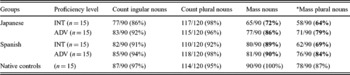
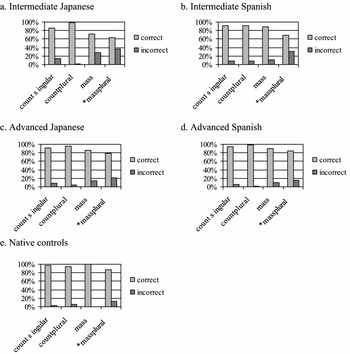
The scores from individual quantifiers were collapsed for each group and were converted into percentages. All the groups' performances in the four conditions – count singular, count plural, mass and *mass plural are reported in Table 2. In order to give a clearer overview, the results are presented as graphs in Figure 1.
Total number of correct responses. (Three count singular, three mass and three mass plural nouns were removed from the final analysis.)

Total percentages of correct and incorrect judgements.

To examine whether there are differences between the L2 groups, repeated measures ANOVAs (with Language as a between-subjects factor and Count and Mass as a within-subjects factor) were performed between the intermediate groups and between the advanced groups. For the intermediate groups there is an interaction between language and the count condition (F(1,28) = 4.805, p < 0.05) and an interaction between language and the mass condition (F(1,28) = 5.888, p < 0.05). Separate paired sample t-tests for count and mass conditions were performed. The Japanese performed significantly better in the count plural condition (t(14) = −4.119, p < 0.05) as there were more errors in the count singular condition. No difference was found in the mass conditions. The Spanish performed significantly better in the count conditions (t(14) = −.192, p > 0.05) than in the mass conditions (t(14) = 3.154, p < 0.05), as more errors were found in the mass plural condition. A repeated measures ANOVA was conducted for all three language groups. Both L2 intermediate groups are significantly different to the native control speakers in the count condition (F(2,42) = 11.167, p < 0.05) and the mass condition (F(2,42) = 4.066, p < 0.05). Post-hoc Tukey tests revealed that significant differences were found between the intermediate Japanese learners and native controls and the intermediate Spanish learners and native controls.
For the advanced groups, no interaction was found between language and the count condition (F(1,28) = 0.498, p > 0.05) and language and the mass condition (F(1,28) = 0.033, p > 0.05). Separate paired sample t-tests for count and mass conditions were performed. The Japanese group performed well in both the count singular and count plural conditions (t(14) = −1.006, p > 0.05) and in the mass conditions (t(14) = 1.065, p > 0.05). The Spanish group performed well in both the count singular and count plural conditions (t(14) = −1.080, p > 0.05) and in the mass conditions (t(14) = 1.160, p > 0.05). A repeated measures ANOVA was conducted for all three language groups. Post-hoc Tukey tests revealed that both L2 advanced groups did not differ significantly to the native control speakers in the count or mass conditions.
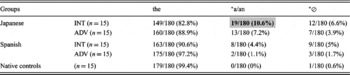
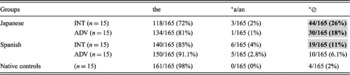
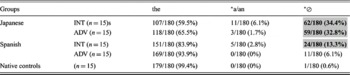
The results from the forced-choice elicitation task are presented in Tables 3–5. They show the total percentage of articles supplied by each group. No differences were found between the two versions of the task.
Definite singular contexts.

Definite plural contexts.

Definite mass contexts.

Repeated measures ANOVAs were performed within the intermediate L2 groups and within the L2 advanced groups on the use of the for definites (anaphoric, encyclopaedic and larger situation) in the singular, plural and mass conditions. For the intermediate Japanese group, a significant difference between definites in the singular condition was found (F(2,28) = 3.540, p < 0.05); a significant difference was found between definites in the plural condition (F(2,28) = 5.021, p < 0.05); and a significant difference was found between definites in the mass condition (F(2,28) = 11.645, p < 0.05). For the intermediate Spanish group, a significant difference was found only between definites in the plural condition (F(2,28) = 23.725, p < 0.05). A separate ANOVA was conducted for all three language groups. Post-hoc Tukey tests revealed that both the Japanese and the Spanish groups differed significantly to the native controls in each condition. Repeated measures ANOVAs were also performed within the advanced L2 groups. For the advanced Japanese group, no significant differences between definites in the singular condition was found (F(2,28) = 0.067, p > 0.05); a significant difference was found between definites in the plural condition (F(2,28) = 9. 900, p < 0.05); and a significant difference was found between definites in the mass condition (F(2,28) = 12.005, p < 0.05). For the advanced Spanish group, a significant difference was found only between definites in the plural condition (F(2,28) = 14.913, p < 0.05). A separate ANOVA was conducted for all three language groups. Post-hoc Tukey tests revealed that there were significant differences between the Japanese and native controls in the definite singular condition; significant differences between both L2 groups and the native controls in the plural condition, and a significant difference between the Japanese and native controls in the definite mass condition.
In order to find out which definites (anaphoric, encyclopaedic and larger situation uses) the Japanese L2 learners had difficulties with, one-way ANOVAs with planned comparisons were performed on the use of the between the native controls and L2 groups. The ANOVAs with planned comparisons were conducted to address hypothesis 2.
Comparison between intermediate groups
Definite singular conditions
For the Japanese group there is a significant difference between the native controls and Spanish group in the encyclopaedic use (t = −2.191, p < 0.05) and larger situation use (t = −3.011, p < 0.05). All groups performed equally in the anaphoric use (t = −1.131, p > 0.05).
Definite plural conditions
A one-way ANOVA with planned comparisons revealed that the Japanese group are significantly different to the native controls and the Spanish group in the encyclopaedic use (t = −3.552, p < 0.05) and larger situation use (t = −3.428, p < 0.05), but all groups performed equally in the anaphoric use (t = −787, p > 0.05). Post-hoc Tukey tests revealed significant differences between the native controls and the Spanish group in the larger situation use (p < 0.05).
Definite mass conditions
For the definite mass condition significant differences were found in the anaphoric (t = 7.290, p < 0.05), encyclopaedic (t = 2.477, p < 0.05) and larger situation uses (t = 4.320, p < 0.05) between the native controls and the Japanese group. Post-hoc Tukey tests revealed significant differences between the native controls and the Spanish group in the anaphoric use (p < 0.05).
Comparison between advanced groups
Definite singular conditions
In the definite singular condition no significant differences were found between the L2 groups and the native controls in anaphoric, encyclopaedic and cultural uses.
Definite plural conditions
Significant differences were found between the Japanese group and the native controls in the encyclopaedic (t = 3.154, p < 0.05) and larger situation (t = 3.713, p < 0.05) uses. No significant difference was found in the anaphoric use (t = –.651, p > 0.05). Post-hoc Tukey tests revealed a significant difference between the native controls and the Spanish group in the larger situation use only (p < 0.05).
Definite mass conditions
Significant differences were found between the Japanese group and the native controls in all three definite mass conditions: anaphoric (t = 4.015, p < 0.05), encyclopaedic (t = 2.269, p < 0.05) and larger situation uses (t = 7.651, p < 0.05).
7.6 Summary
The results from the grammaticality judgement task show that the Japanese groups seem to be incorrectly rejecting grammatical mass contexts and accepting ungrammatical mass plural contexts. The Spanish groups seem to be behaving like the Japanese groups in the mass plural contexts. The Japanese speakers overall do not have problems with count nouns but they do have difficulty with mass nouns. The Spanish speakers have fewer problems with mass nouns.
The Japanese groups can generalize what is countable and what is uncountable. Given the results from the grammaticality judgement task it looks as though the Japanese and the Spanish speakers can reset the NMP. However, a continuing difficulty with definites may lie in the types of definites (e.g. anaphoric, encyclopaedic, situation) that co-occur with nouns in context rather than a representational deficit (Hawkins et al.Reference Hawkins, Al-Eid, Almahboob, Athanasopoulos, Chaengchenkit, Hu, Jaensch, Jeon, Jiang, Leung, Matsunaga, Ortega, Rezai, Sarko, Snape and Velasco-Zarate2005). The results from the forced-choice elicitation task show that the Japanese speakers have difficulty with definite plural and mass NP contexts, whereas the Spanish speakers have difficulty with mass NP contexts. One explanation for the difficulty with definite encyclopaedic plural is that the Japanese groups, not the Spanish groups, are treating the items as proper nouns e.g. Houses of Parliament, Twin Towers in New York and Pyramids. However, no such explanation can be offered for any of the other items in the task. For the definite larger situation use there was a significant difference found within the intermediate Japanese group of substitution of a for the in the singular condition. Substitution of a for the was also found in the advanced Japanese group, but no significant difference was found within the group across the three types of definite in the singular condition. Greater accuracy in the definite anaphoric singular condition of the use of the is predicted as the context is obligatorily specific.Footnote 19
Overall, the results reveal similar patterns of use across types of definites as found in the studies by Wakabayashi (Reference Wakabayashi1998), Liu and Gleason (Reference Liu and Gleason2002), and Ionin et al. (Reference Ionin, Ko, Wexler, Liceras, Zobl and Goodluck2008). The advanced Japanese are less accurate in the use of all definite article types in the plural and mass contexts, as Wakabayashi (Reference Wakabayashi1998) found in his study of Japanese speakers.
8. Discussion
A couple of questions recently posed by Inagaki and Barner (Reference Inagaki and Barner2006, p. 163) is “How do morphological and syntactic representations of language affect our conceptual representations of objects and events? Do all humans share a universal conceptual repertoire that is made explicit to differing extents by natural language, or do the morpho-syntactic structures of language actually supply certain concepts?”. These questions have also recently been discussed by Nisbett (Reference Nisbett2003), who reviews much of the research into the differences between Western and Eastern cultures. The answers to these questions are of great interest to scholars from a number of disciplines e.g. philosophy, psychology and linguistics. How do learners of a first language acquire conceptual knowledge and how does this relate to components of linguistic representations such as syntax and semantics? Work by Imai and Genter (Reference Imai and Gentner1997), who investigated the differences between L1 English child speakers and L1 Japanese child speakers, found that there are differences, which are perhaps due to language. Inagaki and Barner (Reference Inagaki and Barner2006), who investigated the differences between L1 English adult speakers and L1 Japanese adult speakers, claim that they found evidence for a universal semantics underlying linguistic quantification. The Japanese essentially access the same meanings as speakers of languages like English, but lack the syntax for disambiguating these meanings when they have to interpret whether the NP is count or mass. One way of distinguishing between the world's languages is by claiming that there is a Nominal Mapping Parameter. The question I have tried to address in this paper is whether adult L2 learners with a different L1 parameter setting are able to reset the parameter to the L2 setting.
The findings from the tasks support hypothesis 1, repeated here:
H1 L2 learners from different L1 backgrounds can reset the NMP to the English setting [+arg, +pred].
Japanese learners did not judge count nouns in mass contexts to be acceptable, but instead judged mass nouns to be acceptable as count nouns. This is unexpected unless certain mass nouns are seen as countable as they are used with measure phrases e.g. a pat of butter. The Japanese learners did not have difficulty with count nouns. The findings lend support to hypothesis 1 as it seems that the parameter has been reset. The Japanese learners are able to acquire the functional category DP and the uninterpretable number feature associated with count nouns. The fact that they accepted mass plural nouns as countable nouns and rejected count nouns as uncountable may be because certain AdnQ + noun combinations are more acceptable to them than others. The results have to be treated with caution as it seems that part of the difficulty may have to do with adnominal quantifiers. The Spanish learners successfully reset the parameter as expected, because DP and the uninterpretable number feature on nouns is part of the L1 grammar. However, there is some persistent L1 transfer effects as some mass plural nouns were acceptable to some of the Spanish learners.
The results from the forced-choice elicitation task support hypothesis 2, repeated here:
H2 Japanese L2 learners can reset the NMP, but there may be a difference in the suppliance of definites in singular, plural and mass noun contexts due to the different pragmatic uses of the definite article.
The intermediate Japanese group continued to omit definites in encyclopaedic and larger situation singular, plural and mass noun contexts, but the advanced Japanese group only continued to omit definites in plural and mass noun conditions.
The results from the two studies suggest that the Spanish and Japanese L2 learners of English do reset the parameter to the English setting. The problem Japanese learners have with definites is not due to an inability to reset the NMP. If omission of the was persistent across all the types of definites and conditions, then it could be argued that the learners have failed to reset the parameter. But, as they are more accurate in supplying definites in the anaphoric use in singular and plural conditions,Footnote 20 it appears that the advanced Japanese learners continue to have difficulty with certain types of definites i.e. encyclopaedic and larger situation uses due to a problem with the mapping between information of the pragmatic component and how this links to information of the syntax component (Bos, Hollebrandse and Sleeman, Reference Bos, Hollebrandse and Sleeman2004).Footnote 21
9. Conclusion
I originally set out to test the NMP in L2 acquisition by administering a count–mass grammaticality judgement task and a forced-choice elicitation task. The findings are consistent with the claim that Japanese learners have full access to UG and can acquire the uninterpretable number feature of nouns along with features associated with DP. Therefore, it can be argued that the Spanish and Japanese learners have successfully reset the Nominal Mapping Parameter,Footnote 22 but the continued difficulty for advanced Japanese learners is the different pragmatic uses of the definite article.
Appendix. Profiles of participants in the count–mass grammaticality judgement task
Intermediate Japanese subjects

Intermediate Spanish subjects

Advanced Japanese subjects

Advanced Spanish subjects