INTRODUCTION
In Africa cowpea (Vigna unguiculata, [L.] Walp.) is estimated to occupy over 11 million ha (4 million ha in Nigeria alone) with mean grain yields between 0.45 and 0.50 Mg ha−1 (FAOSTAT, 2015 − data for 2013). In Ghana, the crop occupies approximately 200,000 ha with mean grain yield of ~0.45 Mg ha−1. Cowpea is a hardy crop, tolerant to high temperatures and low soil fertility. Rhizobium bacteria nodulate this legume and can promote large N2 fixation inputs (Belane and Dakora, Reference Belane and Dakora2009, Reference Belane and Dakora2010; Nyemba and Dakora, Reference Nyemba and Dakora2010; Summerfield et al., Reference Summerfield, Dart, Huxley, Eaglesham, Minchin and Day1977). It nodulates well in almost all soils of the tropics and other regions.
Ahmad et al. (Reference Ahmad, Eaglesham, Hassouna, Seaman, Ayanaba, Mulongoy and Pulver1981) evaluated the response of over 400 cowpea cultivars to N fertilizer at two sites in Nigeria (Onne, south-eastern region and Ibadan, western region) and one site at Maradi, in southern Niger. The majority of cultivars gave higher yields with N addition than when solely dependent on nodulation by native rhizobium populations. The authors concluded that there was ‘a potential for improvement by use of inoculant'. A follow-up field study at Ibadan by Awonaike et al. (Reference Awonaike, Kumarasinghe and Danso1990) with three varieties and two rhizobium strains planted in soils labelled with 15N showed little or no response to inoculation and the proportion of N derived from the air (%Ndfa) via N2 fixation ranged from 50% to 70% of the total.
There was a reluctance to investigate or promote rhizobium inoculation of cowpea as the conservation and distribution of inoculants, which at that time needed to be refrigerated, as it was thought to be beyond the infrastructure existing in rural areas of West Africa. This belief also motivated the selection and breeding of soybean genotypes at IITA capable of nodulating with native rhizobium strains (Pulver et al., Reference Pulver, Kueneman and Ranga Rao1985).
More recently, there have been several studies in Ghana on many different cultivars of cowpea to estimate total N accumulation and %Ndfa determined using the 15N natural abundance technique. In most cases, the %Ndfa was high even on farmers’ fields where no P or K fertilizers were added, suggesting that inoculation of rhizobium was unnecessary (Adjei-Nsiah et al., Reference Adje-Nsiah, Kuyper, Leeuwis, Abekoe, Cobbinah, Sakyi-Dawson and Giller2008; Belane and Dakora, Reference Belane and Dakora2009, Reference Belane and Dakora2010; Naab et al., Reference Naab, Chimphango and Dakora2009).
However, the belief that inoculating cowpea with selected rhizobium strains was unlikely to increase crop yield has been challenged from experiments performed in Brazil. In the semi-arid northeast region, it was shown that cowpea could respond to inoculation with rhizobium strain BR 3267 and increase grain yields by up to 30%, approximately the same response as to the application of 50 kg N ha−1 (Martins et al., Reference Martins, Xavier, Rangel, Ribeiro, Neves, Morgado and Rumjanek2003). In the south of the State of Minas Gerais, cowpea yield responses to inoculation of similar magnitude were achieved (Lacerda et al., Reference Lacerda, Moreira, de Andrade and Soares2004; Soares et al., Reference Soares, Pereira, Ferreira, do Vale, Lima, de Andrade and Moreira2006). In Roraima in the Amazon region, increases in grain yield of cowpea from 20% to 35% due to inoculation with rhizobia were achieved in crops with a high grain yield of 1.4 Mg ha−1 (de Melo and Zilli, Reference de Melo and Zilli2009; Zilli et al., Reference Zilli, Marson, Marson, Rumjanek and Xavier2009). The success of trials in both semi-arid and more humid regions of Brazil (Roraima and Piauí) led to a collaboration to test the inoculation of cowpea in Africa, the continent of its origin.
The objective of the present study was to test in northern Mozambique and northern Ghana inoculation of cowpea with strains of rhizobium selected in Brazil with inoculants made with either traditional peat carrier (Mozambique) or a starch/CMC polymer carrier (Ghana).
MATERIALS AND METHODS
Northern Mozambique
The experiment was planted on 27th January 2014 at the field station of the Instituto de Investigação Agrária (15°15ʹS, 39°30ʹE, 360 m above sea level) near the town of Muriaze, 27 km southeast of the Provincial capital of Nampula in northern Mozambique. A Brazilian cowpea variety was used (BRS Guariba) and seven treatments were imposed: T1 – no inoculation (control); T2 – no inoculation and addition of 100 kg N as urea; T3 – no inoculation and addition of 200 kg N as urea; T4 – inoculated with rhizobium strain UFLA 3 84 (SEMIA 6461); T5 – inoculated with rhizobium strain BR 3267 (SEMIA 6462); T6 – inoculated with rhizobium strain INPA 03 11B (SEMIA 6463); and T7 – inoculated with rhizobium strain BR 3262 (SEMIA 6464). The treatments were arranged in a randomized complete block design with four replicates. At planting, the seeds were inoculated with peat-based inoculants containing between 108 and 109 CFU per g fresh inoculant. Seeds were planted by hand on 27th January 2014, with three seeds per planting hole. After germination, the crop was thinned to one plant per hole (five plants per linear metre).
The soil was a quartz sand low in clay (90 g kg−1), pH 6.0, organic matter of 11 g dm−3, 7.5 mg P dm−3, 82 mg K dm−3, and Al 0.0 cmolc dm−3, Ca 1.33 cmolc dm−3, Mg 0.41 cmolc dm−3, H+Al 1.7 cmolc dm−3 and CEC 5.6 cmolc dm−3. Lime (100 kg ha−1), triple superphosphate (26 kg P ha−1) and potassium chloride (50 kg K ha−1) were applied to the whole area. Each plot was 7 m long and 3.55 m wide and consisted of seven rows of plants with inter-row and interplant distances being 45 cm and 20 cm, respectively. On 18th March 2014, the whole area was sprayed with the insecticide Biomiprid (5 mL L−1).
The only harvest conducted (a 1 m length of the three central rows) was for final grain yield on 25th April 2014. The pods were dried in the open laboratory and then weighed. Seeds were separated and their weight recorded. Final grain yields were expressed at 13% moisture.
Northern Ghana
On-station experiments
In the wet season of 2012, two experiments were planted on 17th June and 26th August, on sites where rhizobium inoculant had not been used before, on the Experimental station of the Savanna Agricultural Research Institute (SARI), at Nyankpala (9°24ʹN, 01°00ʹW, 185 m above sea level), 16 km west of Tamale, the capital of the northern region of Ghana. The soil at this site had coarse texture, pH 6.6, organic matter 12 g dm−3, 1.8 mg P dm−3, 59 mg K dm−3 and Al 0.0 cmolc dm−3, Ca 3.6 cmolc dm−3, Mg 1.1 cmolc dm−3, H+Al 1.4 cmolc dm−3 and CEC 5.6 cmolc dm−3. The variety of cowpea planted was Padi Tuya developed by SARI and widely cultivated by farmers in the region. Both experiments consisted of seven treatments with five replicates arranged in a randomized complete block design with plots of 5 × 10 m. The entire area was amended with 26 kg P ha−1 as triple super phosphate. The treatments were as follows: T1 – no inoculation (control); T2 – no inoculation and addition of 40 kg N as ammonium sulphate; T3 – no inoculation and addition of 80 kg N as ammonium sulphate; T4 – inoculated with rhizobium strain BR 3262 (SEMIA 6464); T5 – inoculated with rhizobium strain BR 3267 (SEMIA 6462); T6 – inoculated with rhizobium strain BR 3299; and T7 – inoculated with a mixture of rhizobium strains BR 3267 and BR 3299. The inoculants were prepared using the starch/CMC polymer substrate as described by Silva Junior et al. (2012).
At 35 days after planting (dap), 10 plants were carefully removed from each plot with a spade with the root system as intact as possible. Nodules were collected from these plants, dried at 65 °C in a forced-air oven for at least 72 h and then weighed. At physiological maturity (70 dap), all shoot tissue was harvested from a central area of 4 × 4 m of each plot, weighed using a field balance, and all pods removed to assess total yield. A sub-sample of all shoot biomass was taken and the fresh weight was recorded. This sub-sample was dried (65 °C) and re-weighed to estimate total shoot dry matter. Final grain yields were expressed at 13% moisture.
On farm trials
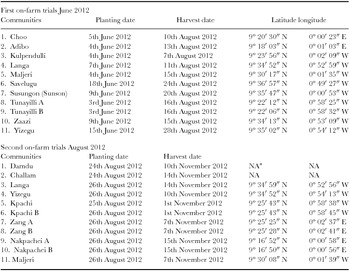
In 2012, on-farm experiments were planted on 16 properties on two occasions (between 6th and 17th June and between 16th and 24th August) consisting of the same four treatments using the same cowpea variety Padi Tuya (Table 1). The on-farm trials consisted of four treatments: T1 – inoculated with rhizobium strain BR 3267; T2 – inoculated with rhizobium strain BR 3299; T3 – no inoculation (control); and T4 – no inoculation and addition of 40 kg N ha−1 as ammonium sulphate. Plot size was 25 × 20 m and four plots were established at each site, one for each treatment (no replication). In all trials 26 kg P were added per ha; otherwise the trials followed standard practice of the smallholders. At both planting periods, at five sites, the trials were compromised by drought or pest problems and the list of the 11 successful trials is given in Table 1.
The planting and harvest dates, and coordinates of the sites of the on-farm trials conducted in 2012.

*Data not available.
At 35 dap ten plants were carefully removed with intact root systems for collection of root nodules, which were counted, dried at 65 °C for at least 72 h and then dry weight determined. At the final harvest, at the mature grain stage, three areas of 4 × 4 m were harvested and fresh weight determined with a field balance. Sub-samples of this material from each plot were taken and treated as described above for the field station experiments. The dates of planting and final harvest are given in Table 1.
Data processing
All data were analysed using standard ANOVA procedures using the statistical package SISVAR (Ferreira, Reference Ferreira2011). Each set of on-farm trials was analysed using each trial as a replicate (11 replicates for both sets of trials in 2012).
RESULTS
Northern Mozambique
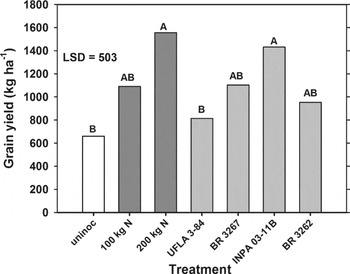
At this site, only a final harvest was made for grain yield. At the mature grain stage, virtually all plants were parasitized by yellow witchweed (Alectra vogelii), which is common in many parts of Africa (Alonge et al., Reference Alonge, Lagoke and Ajakaiye2001). The weed infestation and damage by insect pests were responsible for an uneven plant stand with a coefficient of variation reaching 30%. Despite this, grain yields ranged from 0.66 to 1.56 Mg ha−1 and there were similar significant increases (p < 0.05) in grain yield when comparing the inoculation of INPA 03–11B or the addition of 200 kg N ha−1 fertilizer to the non-inoculated control (Figure 1).
Grain yield at 13% moisture of cowpea variety BRS Guariba inoculated or not with peat-based inocula of four different strains of rhizobium of Brazilian origin in comparison with non-inoculated treatments with 0, 100 or 200 kg N ha−1 N fertilizer applied as urea. Columns topped by different letters are significantly different using the least significant difference at p < 0.05 (Student LSD test).

Northern Ghana
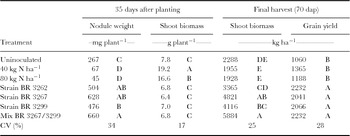
On-station experiments: Regarding the first planting in June 2012, dry weight of nodules at 35 dap averaged 267 mg plant−1 without inoculation, but nodule dry weight was greatly increased by the inoculation of any of the rhizobium strains (Table 2). As expected, the addition of N fertilizer depressed nodulation. At harvest, shoot dry matter accumulation was reduced by N fertilizer and significantly increased by inoculation, except with the BR 3262 (Table 2). With the mixed inoculant (BR 3267 + BR 3299), dry matter accumulation increased by over 150%. Grain yield without inoculation was over 1.0 Mg ha−1 and there was no significant increase in yield with the addition of N fertilizer. However, the addition of any of the inoculants caused significant increases in grain yield, producing over 2.0 Mg ha−1 (Table 2).
Effects of N fertilizer application and rhizobium inoculation on nodule dry weight and shoot biomass at 35 dap and grain yield at 70 dap of cowpea grown on-station at Nyankpala, Northern Region of Ghana in June, 2012.

Values are means of five replicates. Means within the same column followed by the same letter are not different at p < 0.05 (Student ‘LSD’ test).
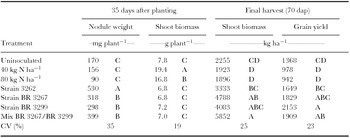
At the second planting (August 2012), dry weight of nodules at 35 dap averaged 170 mg plant−1 without inoculation, somewhat lower than in the first field station experiment. The nodule weight was once again greatly increased by the inoculation of any of the rhizobium strains, and more than tripled for the strain BR 3299 (530 mg plant−1) whereas the other inoculants increased nodule dry weight to over 300 mg plant−1 (Table 3). Again, the addition of N fertilizer depressed nodulation. At the final harvest, the plant biomass was significantly increased by inoculation, with exception of BR 3262. With the mixed inoculant (BR 3267 and BR 3299) biomass was increased by over 150%. Grain yield even without inoculation was very good (>1.3 Mg ha−1) and there was no significant decrease in grain yield when adding N fertilizer. However, there were significant increases in grain yield when the plants were inoculated with rhizobium strain BR 3299 or the mixture of BR 3267 with BR 3299 (Table 3).
Effects of N fertilizer application and rhizobium inoculation on nodule dry weight and shoot biomass at 35 dap and shoot biomass and grain yield at 70 dap of cowpea grown on-station at Nyankpala, Northern Region of Ghana in August, 2012.

Values are means of five replicates. Means within the same column followed by the same letter are not different at p < 0.05 (Student ‘LSD’ test).
On farm trials
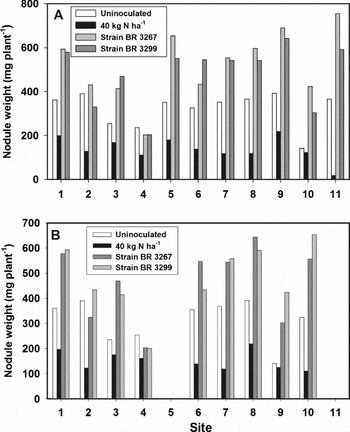
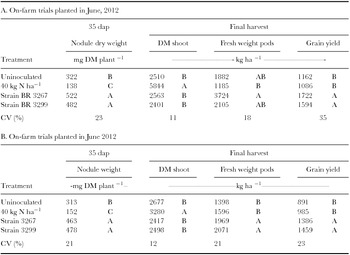
Considering the first set of trials planted in June 2012, at all sites nodule weight decreased with the application of N fertilizer and at most sites increased with inoculation (Figure 2A; Table 4). At final harvest shoot dry matter was greatly increased at all sites in response to the addition of N fertilizer without any significant effect on grain yield. On the other hand, grain yield was increased on average by 0.43–0.56 Mg ha−1 by inoculating the rhizobium strains BR 3267 and BR 3299, respectively, reaching a mean for all trials of over 1600 kg ha−1 (Table 4). At the second planting, results were very similar. Nodulation was depressed by the application of N fertilizer and significantly increased by inoculation (Figure 2B). Once again, there was a large and significant increase in total dry matter accumulation with application of N fertilizer but grain yield was not increased (Table 4). Inoculation with rhizobia increased grain yield by more than 0.50 Mg ha−1, with yields reaching 1.38–1.45 Mg ha−1.
Effect of N fertilizer (40 kg N/ha) application and rhizobium (BR 3267 and BR 3299) inoculation on nodule dry weight at approximately 35 days after planting of cowpea variety Padi Tuya at eleven on-farm sites in the Northern Region of Ghana in June (a) and August (b), 2012. Names of sites and planting and harvesting dates are given in Table 1.

Effects of N fertilizer application and rhizobium inoculation on nodule dry weight at 35 dap, shoot biomass, pod fresh weight and grain yield at 70 dap of cowpea grown on-farm in the Northern Region of Ghana. Values are means of unreplicated plots from the 11 sites listed in Table 1. Dates of planting and harvest also given in Table 1.

Values (means of 11 replicates) within the same column followed by the same letter are not different at p < 0.05 (Student ‘LSD’ test).
DISCUSSION
In both experiments conducted at the SARI field station in northern Ghana, inoculation with rhizobium promoted large and statistically significant increases in nodule weight and grain yield (Tables 2 and 3). Although no data were collected on nodule weight at the field station in Muriaze, Mozambique, grain yield was doubled by the application of 200 kg N as urea or inoculating with the Brazilian strain INPA 03–11B (Figure 1). In the first experiment at Nyankpala in Ghana, all strains promoted similar grain yield increases (Table 2), whereas in the second trial the strain BR 3262 seemed to be less effective than the others (Table 3).
In the on-farm trials at most sites, the inoculants were successful in improving nodulation and increasing grain yield. For the two sets of 11 sites harvested in 2012, the inoculants significantly increased nodule mass and grain yield. One surprising result that was not apparent for the field station experiments was that the application of N fertilizer promoted large amounts of vegetative growth but did not increase grain yield. Although the inoculated treatments caused large increases in grain yield, the application of N fertilizer only increased shoot biomass and had little effect on grain yield. This may best be explained by the fact that N fertilizer promotes large increases in leaf biomass and total N accumulation but, unlike N derived from N2 fixation, it is not transferred efficiently from leaves to grain. Although this has been suggested for soybean in earlier studies at Embrapa Agrobiologia (Neves et al., Reference Neves, Didonet, Duque and Dobereiner1985), further investigation should be done on this issue. It is not clear why this effect was not observed in the experiments at the SARI field station.
The results indicate that cowpea can respond remarkably to inoculation with rhizobium when highly effective rhizobium strains are used. The decision to use a mixed inoculum (e.g. BR 3267/3299) would seem to be a good strategy to maximize inoculation responses, as recommended in Brazil for soybean inoculants (Hungria and Vargas, Reference Hungria and Vargas2000). When the proper strains are used, rhizobium inoculation can be used to boost cowpea productivity among smallholder farmers in northern Ghana and also in Mozambique.
Acknowledgements
This work was funded by the Africa/Brazil Agricultural Innovation Marketplace, an initiative organized by Embrapa and funded by many international organizations (http://www.mktplace.org/site/index.php).