The onset of lactation places such a large demand on calcium homeostasis mechanisms that most cows develop some degree of hypocalcemia at calving (Goff et al., Reference Goff, Horst and Reinhardt1987; Horst et al., Reference Horst, Goff and Reinhardt1994). Periparturient hypocalcemia is associated with potential detrimental effects on health and production and, in severe cases, it can be life-threatening (Goff, Reference Goff2008). Hypocalcemia is considered as a gateway disease, as it predisposes affected cows to various metabolic and infectious disorders in early lactation (Goff, Reference Goff2008), such as metritis (Martinez et al., Reference Martinez, Risco, Lima, Bisinotto, Greco, Ribeiro, Maunsell, Galvao and Santos2012) and mastitis (Curtis et al., Reference Curtis, Erb, Sniffen, Smith, Powers, Smith, White, Hillman and Pearson1983).
The incidence of clinical hypocalcemia (blood calcium <5.0 mg/dl) is 5% or less, while subclinical hypocalcemia (SCH) (blood calcium <8.0 mg/dl) has been shown to occur in 47% of cows entering their second or greater lactation and in 25% of primiparous animals (Reinhardt et al., Reference Reinhardt, Lippolis, McCluskey, Goff and Horst2011). Based on literature review, blood calcium concentration reaches a nadir at approximately 12 to 24 h after calving (Goff, Reference Goff2008) and 10–50% of cows may remain subclinically hypocalcemic during the first 10 d postpartum (Goff and Horst, Reference Goff and Horst1998).
The ability to assess the calcium levels of fresh cows on the farm could be an important tool towards the achievement of lower incidence of SCH, as it allows one to evaluate the efficacy of preventive strategies and to identify cows in need of intervention (Sweeney et al., Reference Sweeney, Martens, Felippe and Overton2014). Although potentially effective treatment options for SCH are available, methods for identifying affected cows in time to successfully apply these treatments are not widely implemented (Oetzel and Miller, Reference Oetzel and Miller2012).
Formerly, on-farm ancillary exams have been considered as needless in cattle practice and only few analyses could be performed in the field, with inaccurate, slow or expensive results. New, more accurate and cost-effective devices are now available on the market for cow-side testing and the goal of these ancillary tests is not only to provide a better diagnosis, but also to improve communication between vets and owners and to give a quick therapeutic answer or a prognosis (Guyot, Reference Guyot2015). Field-tests provide several benefits, as they are essentially time-saving, and for some assays, also cost-effective, with relatively accurate analyses. In addition, they can be done at an individual or herd level as screening tools for demonstrating subclinical conditions such as SCH.
On-farm application of total blood Ca measurement has been implemented only minimally, because of the lack of studies validating more accurate, rapid and economical methods compared with methods typically employed in veterinary diagnostic laboratories (Leno et al., Reference Leno, Martens, Felippe, Zanzalari, Lawrence and Overton2017). Measurement of blood ionized calcium concentration represents the most accurate method of diagnosing hypocalcemia, as it expresses the actual amount of metabolically active (ionized) calcium in blood. However, ionized calcium determination may be expensive, it may not be available in commercial laboratories and, in addition, it requires anaerobic collection of whole blood samples in heparinized syringes and refrigeration of the sample followed by rapid analysis (Lincoln and Lane, Reference Lincoln and Lane1990; Roeder and Clark, Reference Roeder and Clark1995) or use of a test card for each sample. Total blood calcium determinations include protein-bound calcium or complexed calcium; these forms of calcium do not affect neuromuscular function. Total blood calcium is highly correlated to ionized calcium when acid – base balance and protein metabolism are not disturbed (as is typically the case in uncomplicated milk fever; Oetzel, Reference Oetzel, Fuquay, Fox and McSweeney2011).
The use of a water hardness test kit (WHTK), marketed to analyze water, as a point of care instrument for calcium measurement on blood and for calcium carbonate on mammary secretions has been tested before in veterinary medicine (Ley et al., Reference Ley, Bowen, Purswell, lrby and Greive-Crandell1993; Matsas et al., Reference Matsas, Warnick, Mechor, Seib, Fatone, White and Guard1999; Aktas et al., Reference Aktas, Kaynar, Ozkanlar and Ozkanlar2010). Aktas et al. (Reference Aktas, Kaynar, Ozkanlar and Ozkanlar2010) tested it on ewes with at least one clinical sign of hypocalcemia, while Matsas et al. (Reference Matsas, Warnick, Mechor, Seib, Fatone, White and Guard1999) used the kit on cattle that displayed clinical signs of hypocalcemia during the entire lactation. Both studies tested around 30 subjects. A study used the WHTK for the measurement of calcium carbonate's changes in diluted prefoaling mammary secretions in mares, finding it sensitive and specific (Ley et al., Reference Ley, Bowen, Purswell, lrby and Greive-Crandell1993).
Our study aimed at measuring blood total calcium concentration using the abovementioned WHTK in postpartum cows at risk of hypocalcemia without clinical signs under field conditions, and to compare the results to a reference method at a veterinary diagnostic laboratory. This could allow testing its potential on-farm application as a rapid and cost effective screening tool to demonstrate a subclinical disease or to evaluate the efficacy of preventive measures.
Materials and methods
Animals
The study design was reviewed and approved by the University of Sassari Veterinary Research Ethics Committee (reference 50679). The study was carried out between November 2017 and February 2018 in three commercial dairy farms in the north of Sardinia (Italy).
A total of 107 pluriparous Holstein Friesian cows were enrolled during routine examinations performed weekly by the veterinary practitioner. Blood samples were collected from cows ≤7 d from calving from coccygeal vein into 10 ml Vacutainer tubes without additives (BD, Plymouth, UK). In detail, the cows were from parity 2 (n = 20, 18.7%), 3 (n = 30, 28.0%), 4 (n = 31, 29.0%) and from parity ≥5 (n = 26, 24.3%).
Serum calcium analyses
After collection, the samples were centrifuged (2000 rpm for 15 min) on farm using a portable centrifuge and sera were collected. Each sample was divided into two aliquots: one aliquot (6.7 ml) was used to determine total serum calcium concentration with a commercial water hardness test kit (CHEMetrics. Inc Cat. No: K-1705 Calcium. Midland, VA, USA) and one aliquot (2 ml) was transported from the farm to a climate-controlled (20–22°C) laboratory in a portable cooler with ice packs (approximately 4°C).
The test method to determine serum calcium concentration using the WHTK is the following: Calcium in the test sample reacts with a zinc salt (ethyleneglycol-bis(2-aminoethylether)-N,N,N’,N’-tetraacetic acid (EGTA)) in the presence of a color indicator (zincon), releasing zinc. The endpoint of the reaction is when the color of the liquid changes to blue (zinc-zincon complex). According to the manufacturer, the test range for the kit is between 50 to 500 ppm (2 to 20 mg/dl). Kit contains a glass ampoule with a scale filled with the reagent, with valve assembly, an indicator solution, titrator and a 25 ml sample cup. The test was performed as follows: 1 drop of indicator solution was dropped in 6.7 ml of serum sample and mixed. The content turned to an orange color. The sample was drawn into the ampoule by using the titrator and the content of the ampoule was shaken gently back and forth until the color of the content changed to blue or blue-green. The ampoule was filled with the sample using the given scale marks and adding midpoints between the scale marks, that allowed to read variations of 0.5 mg/dl. The calcium carbonate concentration (ppm) was inversely correlated to the volume of serum reaching the endpoint titration on the scale of the ampoule or in the midpoints. The result was further multiplied by 0.04 to calculate total calcium concentration in mg/dl.
To estimate the intra-assay precision coefficient of variation (CV), a total of 5 samples from 5 different cows was collected. Each sample was divided into a set of 5 aliquots and each aliquot of the same sample was assayed immediately. To calculate the inter-assay precision, 5 aliquots of the same sample were assayed on 5 consecutive days. The CV, the mean and the standard deviation of the subset of 5 results were calculated.
At the reference laboratory, the second aliquot (2 ml) of each sample was allowed to warm to room temperature for at least 30 min. It was then analyzed to determine total serum calcium concentration using an automatic biochemical analyzer (Dimension RxL Max Integrated Chemistry System; Siemens Healthcare Diagnostics, Milan, Italy). The samples were analysed within 3 h after collection.
Statistical analysis
Data were analysed using R software (Version 3.4.2). Spearman's rank correlation test was used to determine the relationship between the results obtained from the laboratory and the ones obtained from the water hardness test kit. Simple linear regression was determined using the results obtained by the two methods as variables. Sensitivity, specificity, negative and positive predictive values were calculated based on actual test kit measurements using as cut-off value a total serum calcium concentration of ≤8.0 mg/dl for hypocalcemia. P < 0.001 was considered significant.
Results
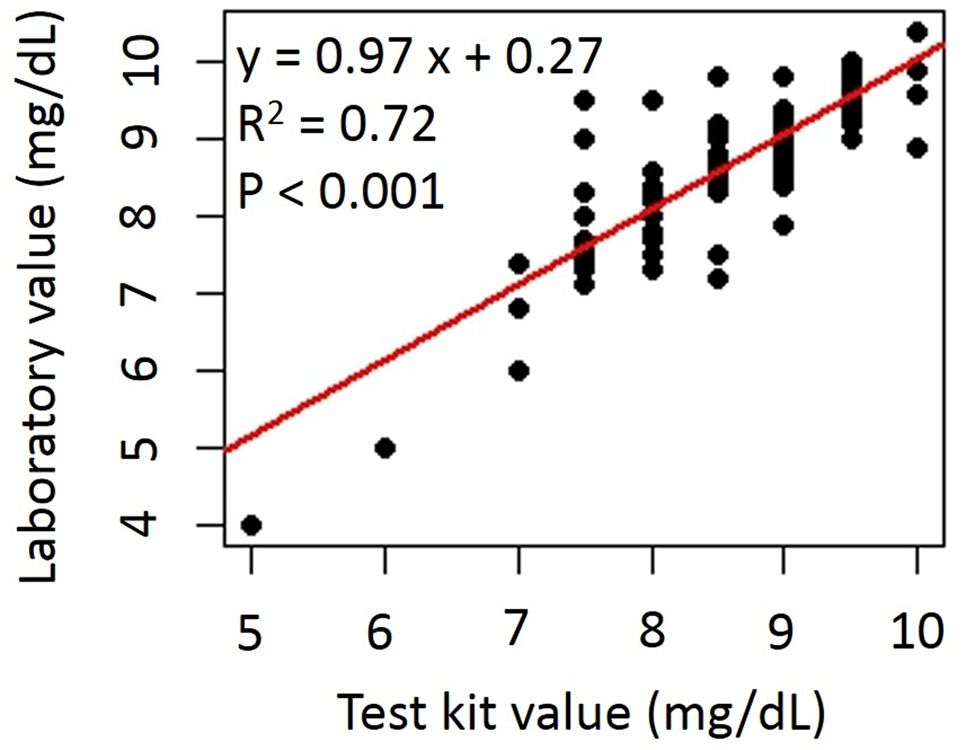
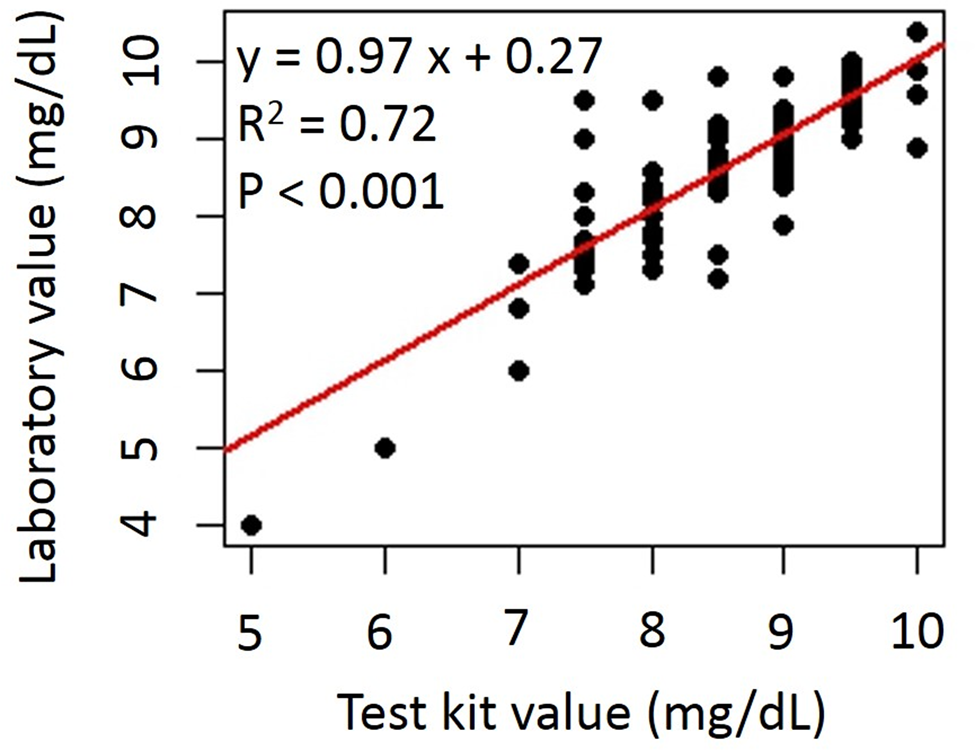
The results obtained from the laboratory showed total calcium concentrations ranging from 4.0 to 10.4 mg/dl (median, 8.6 mg/dl), while the WHTK ones ranged from 5.0 to 10.0 mg/dl (median, 8.6 mg/dl). Among all the cows, 25 (23.4%) showed hypocalcemia (total calcium concentration ≤8.0 mg/dl) with the reference method, whereas 36 (33.6%) were identified as hypocalcemic by the WHTK. The measurements obtained using the two methods were found to be significantly correlated (Spearman's ρ = 0.81, P < 0.001). There was a significant (P < 0.001) linear relationship between laboratory-derived and test kit-derived calcium concentrations (R 2 = 0.72). The 95% confidence intervals for the regression equation intercept and slope were – 0.74 to 1.29 and 0.86 to 1.09 respectively (Fig. 1). Sensitivity, specificity, negative predictive value and positive predictive value of the test were respectively 88% (22/25), 83% (68/82), 61% (22/36) and 96% (3/71), while intra-assay and inter-assay CV were 7.3 and 11.3% respectively.
Linear regression of total serum Calcium concentration derived by reference laboratory method and by water hardness test kit for 107 dairy cows.
Discussion
In the present study, a WHTK was compared to a reference laboratory-based method, to assess its effectiveness in measuring total blood calcium level in post-partum dairy cows on field conditions.
Determination of total serum calcium concentration can allow practitioners to detect SCH during the early postpartum period. Unfortunately, no on-farm cost-effective diagnostic methods are available for individual blood calcium concentration measurement, thus, it is often unknown if interventions in the immediate postpartum period are actually prevention or treatment of hypocalcemia (McArt and Oetzel, Reference McArt and Oetzel2015). As SCH has great health and economic importance, it is important to develop more effective screening tools, that are easy to implement in the actual management system and with lower costs. The ability to monitor calcemia at the herd and cow level can be an important management tool, enabling veterinary practitioners to identify the subjects that need interventions and farm personnel to regularly monitor the efficacy of preventive strategies (Leno et al., Reference Leno, Martens, Felippe, Zanzalari, Lawrence and Overton2017).
The results show that the values obtained with the WHTK were highly correlated with the ones obtained by the laboratory (R 2 = 0.72, P < 0.001), which is in accordance with Matsas et al. (Reference Matsas, Warnick, Mechor, Seib, Fatone, White and Guard1999), who tested the same kit on cattle with clinical signs of hypocalcemia. Based on the data obtained in this study, the WHTK was identified as a potential on-farm tool to monitor calcium status at herd level. Furthermore, it is easy to use and low cost when compared with other portable tools.
The diagnosis of SCH is commonly based on the measurement of total serum calcium concentration, which is comprised of the sum of ionized calcium and protein-bound calcium. Ionized calcium is important for immediate metabolic functions (Aktas et al., Reference Aktas, Kaynar, Ozkanlar and Ozkanlar2010), however, the analysis of ionized calcium in the field (for instance through portable biochemical analyzers) is not practical due to the high costs involved (Radostits et al., Reference Radostits, Gay, Hinchcliff, Constable, Radostits, Gay, Hinchcliff and Constable2007). Serum ionized calcium concentration is clearly a more accurate measure of functional alterations of calcium metabolism in cows (Lincoln and Lane, Reference Lincoln and Lane1990), but this analysis is reserved to off-site laboratories or more expensive portable clinical analyzers. Portable biochemical analyzers are used successfully, but the disadvantage of their high cost limits common use of these devices in the field. In addition, in an on-farm setting, collecting blood from the animal with suspected SCH, delivering the sample to the laboratory and waiting for the result are cumbersome and time-consuming activities (Aktas et al., Reference Aktas, Kaynar, Ozkanlar and Ozkanlar2010). In practice, studies show that measurement of ionized calcium is not necessary due to its correlation with total calcium concentration (Lincoln and Lane, Reference Lincoln and Lane1990; Hunt and Blackwelder, Reference Hunt, Blackwelder and Smith2002; Radostits et al., Reference Radostits, Gay, Hinchcliff, Constable, Radostits, Gay, Hinchcliff and Constable2007). The monitoring of herd-level SCH and implementation of preventative strategies appears more successful when low-cost calcium testing is done on-farm (Neves et al., Reference Neves, Stokol, Bach and McArt2018). In the present study, we decided to test all the cows in the sample at risk for subclinical hypocalcemia (0–7 d after calving) that, by definition, do not display typical clinical signs and we found a sensitivity and specificity of respectively 88 and 83% for the WHTK. A good specificity of a test is required while looking for a diagnosis, whereas for a screening approach, a good sensitivity is preferred (Guyot, Reference Guyot2015). For this reason, these data strengthen the idea that the test can be used as a screening tool to monitoring early postpartum calcium concentrations in a herd and/or to check blood calcium levels after starting any preventive treatment. Moreover, the WHTK is a rapid (less than 5 min) and inexpensive method (1.4 € per test).
The prevalence of SCH and milk fever among the subjects of the study was 10% higher when measured with the WHTK, as it reads the borderline values as positive. This overestimation is, in our opinion, considered acceptable, because it does not influence the application of preventive strategies for subclinical hypocalcemia. For practitioners or consultants, using the WHTK might be an adequate approach to screen a herd for the presence of subclinical hypocalcemia. Also, the use of WHTK limits the costs related to the use of more precise and accurate devices as portable blood gas analyzers, to single individuals that require a more precise determination of ionized calcium for therapeutic decisions. The assay range of WHTK (2 to 20 mg/dl) is wide enough to measure total calcium level in cattle serum samples. The main disadvantage of the kit is the volume of the serum required to perform the test, which is approximately 7 ml to reach the endpoint of the test. It is difficult and time-consuming obtaining this amount of serum without centrifugation on farm settings, so a veterinary practitioner using this screening test also needs a portable centrifuge, or has to perform the test in facilities equipped with a centrifuge.
In conclusion, the WHTK provides reliable values of serum total calcium concentration, it is rapid and cost effective and in our opinion, it can be used as a screening test at herd level during the early post-partum period. However, ionized calcium concentration is a more accurate measure of functional alterations of calcium metabolism in dairy cattle, so it is advisable to use ionized calcium analyzers in single cases when a test of higher diagnostic value is needed.
Acknowledgements
The authors sincerely thank the owners and farm staff for their assistance during the work. This work was supported by Fondazione di Sardegna (Sardinia Foundation, Sassari, Italy) [Prot. U868.2017/AI.796.BE].