INTRODUCTION
Phylogenies are powerful tools for studying broad patterns of parasite diversification. For example, there have been many studies in recent years exploring the degree of congruence between parasite and host phylogenies and inferring from this the frequency of co-speciation (Page, Reference Page2003). Phylogenies of parasites can also be used to study the evolution of parasite traits and their correlation with environmental or host factors. Here we use a phylogenetic approach to explore the conventional wisdom that parasites evolve increased specialization over time.
Co-evolutionary processes between hosts and parasites are thought to select for increasing host specialization through selection on parasites to use host resources more efficiently and reciprocal selection on hosts for improved defence against parasites. In extreme cases, parasites evolve to the point where they can only survive and reproduce on a single host species. This extreme specialization is often considered to be an irreversible evolutionary ‘dead end’ (Cope, Reference Cope1896; Huxley, Reference Huxley1942; Mayr, Reference Mayr1963; Poulin, Reference Poulin2007).
Here we focus on one aspect of host specialization: host specificity. The simplest measure of host specificity is the number of host species used by a species of parasite. Extreme host specialists use a single species of host, whereas host generalists parasitize two or more host species (Humphery-Smith, Reference Humphery-Smith1989). Much of the attention to host-specialization has focused on herbivorous insects. For example, in bark beetles, host specialists are derived from generalists several times independently over a phylogenetic tree of this group (Kelley and Farrell, Reference Kelley and Farrell1998). A broader evaluation across multiple groups of phytophagous insects (Nosil, Reference Nosil2002) revealed a propensity for specialists to evolve from generalists, though this was not universally the case.
Far less attention has been given to patterns in the evolution of host specificity of the parasites of vertebrates. In monogenean parasites of fish, generalist parasites are derived from specialists several times independently, contrary to conventional wisdom (Simkova et al. Reference Simkova, Verneau, Gelnar and Morand2006). Ectoparasitic fleas exhibit a similar pattern, with a general trend toward the evolution of increasing host generalization (Poulin et al. Reference Poulin, Krasnov, Shenbrot, Mouillot and Khoklhova2006). Host specificity is determined both by the ability of parasites to disperse among host species and by the ability of parasites to survive and reproduce (i.e. establish) on multiple host species. In some cases, the limited ability of parasites to disperse among host species might be responsible for their specificity, and in other cases limitations to survival and reproduction may be more important. To understand evolution of variation in host specificity, both of these factors must be considered.
Both dispersal and establishment as determinants of host specificity have been well studied in the feather lice (Insecta: Phthiraptera: Ischnocera) of birds (Aves). Lice are ectoparasites of birds and mammals and 67% of all species are confined to a single host species. However, there is considerable variation in host specificity and several species parasitize dozens of host species (Price et al. Reference Price, Hellenthal, Palma, Johnson and Clayton2003). Two major groups of feather lice occur on pigeons and doves (Columbiformes) throughout the world: wing lice and body lice. Most species of pigeons and doves are parasitized by these two groups of lice, both of which eat the downy portions of the body feathers. The two groups of lice also have very similar life cycles. In short, wing and body lice are ‘ecological replicates’ that use the same hosts (Johnson and Clayton, Reference Johnson, Clayton and Page2003).
Overall, wing lice are significantly less host specific than body lice (Johnson et al. Reference Johnson, Williams, Drown, Adams and Clayton2002); however, both groups show variation in host specificity. Many species in each group parasitize only a single host species, although some species in each group parasitize more than one host species (Price et al. Reference Price, Hellenthal, Palma, Johnson and Clayton2003; Johnson et al. Reference Johnson, Malenke and Clayton2009). These differences in host specificity may, in part, be determined by differences in dispersal ability. Wing lice frequently attach to hippoboscid flies (a winged parasite of birds) and move between individual birds of the same and different host species (Harbison et al. Reference Harbison, Bush, Malenke and Clayton2008, Reference Harbison, Jacobsen and Clayton2009). Body lice, on the other hand, are generally incapable of this behavior, which is known as ‘phoresis’ (Keirans, Reference Keirans1975; Harbison et al. Reference Harbison, Bush, Malenke and Clayton2008, Reference Harbison, Jacobsen and Clayton2009).
Limitations to survival and reproduction across multiple host species also restrict host specificity in these parasites (Clayton et al. Reference Clayton, Bush, Goates and Johnson2003). Both wing and body lice can survive and reproduce when experimentally transferred to hosts that are similar in body size to their native host. However, wing and body lice transferred to hosts that are much larger or smaller than their native host are not able to establish viable populations (Clayton et al. Reference Clayton, Bush, Goates and Johnson2003; Bush and Clayton, Reference Bush and Clayton2006).
The wing and body lice of Columbiformes present an opportunity to study the evolution of host specificity in a parasite group where the ecological determinants of host specificity are well understood. A recent study of the wing lice of pigeons and doves revealed several cases of generalists derived from specialist ancestors (Johnson et al. Reference Johnson, Malenke and Clayton2009). Interestingly, these multiple origins of host generalists were correlated with the presence of a potentially competing species of wing louse (Columbicola) on the same species of host. These results suggest that competition may favour dispersal to competitor-free hosts, which may, in turn, lead to the evolution of host generalists. These results are counter to conventional ecological wisdom, which suggests that specialists evolve from generalists and that specialization is often an evolutionary ‘dead-end’. Competition is also usually thought to promote the evolution of specialists, not generalists. However, in cases where there is a competition-colonization tradeoff (Tilman, Reference Tilman1994), selection for parasite dispersal, because of competition with other parasites, may actually favour generalist parasites.
The main goal of the current study was to reconstruct the evolution of host specificity in the body lice of pigeons and doves. We explored the relationship of host specificity to (1) the presence of potentially competing species of lice and (2) differences in host ecology. Competition between wing and body lice is normally weak because of microhabitat partitioning in the face of host preening, which keeps the populations of both groups relatively small (Bush and Malenke, Reference Bush and Malenke2008). In contrast, competition between different species of wing lice is strong when two species are found on the same host (Johnson et al. Reference Johnson, Malenke and Clayton2009; Malenke et al. Reference Malenke, Newbold and Clayton2011). Although interspecific competition in body lice has not yet been tested, it could conceivably be a factor influencing the evolution of host specificity in body lice. Since body lice are less capable of phoresis than wing lice (Harbison et al. Reference Harbison, Jacobsen and Clayton2009), body lice presumably have fewer opportunities to escape from competition (Johnson et al. Reference Johnson, Bush and Clayton2005).
The evolution of host specificity may also be influenced by features of host ecology. For example, if lice periodically get dislodged from their hosts, then proximity of different host species might increase the probability of host switching, assuming lice on the ground are capable of climbing onto a new host from the ground. Terrestrial species of pigeons and doves often forage in close proximity (del Hoyo et al. Reference del Hoyo, Elliot and Sargatal1997). By comparison, it is probably less likely for lice dislodged from arboreal doves to be picked up by another species of host.
We used a recently published phylogeny, based on DNA sequences (Johnson et al. Reference Johnson, Weckstein, Meyer and Clayton2011), to reconstruct evolutionary changes in host specificity in the body lice (Goniodidae) of pigeons and doves. We addressed four specific questions: (1) is there directionality in the evolution of host specificity? (2) how evolutionarily labile is this trait? (3) are the evolutionary changes in host specificity related to the presence of potentially competing species of lice? and (4) are the evolutionary changes in host specificity related to host ecology?
MATERIALS AND METHODS
Comparative Methods
For phylogenetic character reconstruction, we used a recently published phylogeny for the body lice of pigeons and doves (Johnson et al. Reference Johnson, Weckstein, Meyer and Clayton2011). This phylogeny was based on DNA sequences from two mitochondrial genes and one nuclear gene. We performed reconstructions over phylogenies constructed using both parsimony and Bayesian methods, to test the sensitivity of our results to alternative tree topologies.
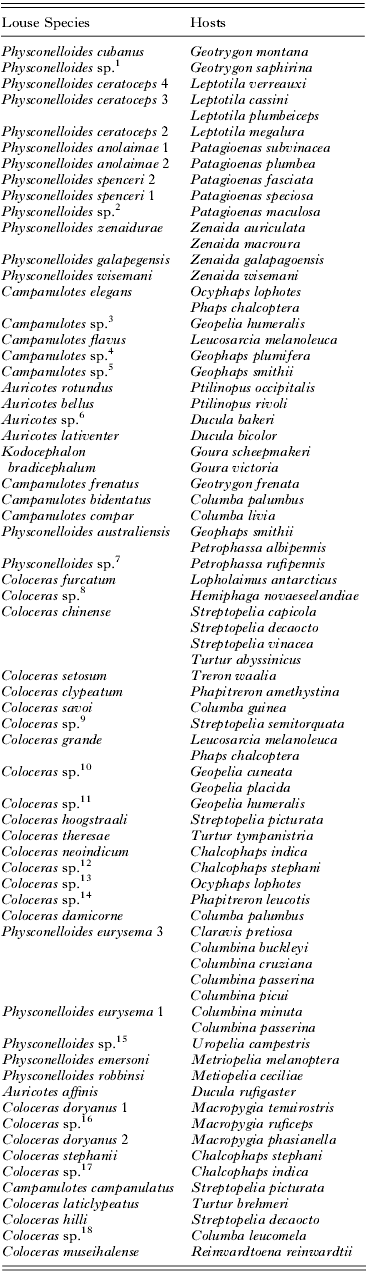
Using the criteria of Humphery-Smith (Reference Humphery-Smith1989), a species was coded as a host specialist if is known from only one species of host or as a host generalist if it is known from more than one species of host (Table 1). For lice, we feel that this coding most effectively captures the nature of the variation in host specificity among species. If a species is a host generalist, it must not only disperse among host species but it must also survive and reproduce on more than one host species. In contrast, host specialists do not disperse and/or establish on more than one host species. We coded the presence of a potentially competing species following Johnson et al. (Reference Johnson, Malenke and Clayton2009), using host association records from Price et al. (Reference Price, Hellenthal, Palma, Johnson and Clayton2003) and additional associations represented in the published molecular data set (Johnson et al. Reference Johnson, Weckstein, Meyer and Clayton2011).
Species of body lice and their hosts included in this study. Numbers after named species indicate cryptic species following Johnson et al. (Reference Johnson, Weckstein, Meyer and Clayton2011). Superscripts after un-named species correspond to branches labeled with the same superscripts in Fig. 1

To reconstruct the evolution of host specificity and the presence of potentially competing species of body lice, we used both parsimony and maximum likelihood reconstruction techniques (following Johnson et al. Reference Johnson, Malenke and Clayton2009). We also evaluated the phylogenetic signal in host specificity using the randomization test of Maddison and Slatkin (Reference Maddison and Slatkin1991). We then evaluated whether changes in host specificity are correlated with the presence of a potentially competing species of body louse using the concentrated changes test (Maddison, Reference Maddison1990) as implemented in MacClade (Maddison and Maddison, Reference Maddison and Maddison1999). We used the same approach to evaluate whether changes in host specificity of body lice are correlated with host ecology (coding species as terrestrial or arboreal, based on Gibbs et al. Reference Gibbs, Barnes and Cox2001). Finally, for comparison, we used data from Johnson et al. (Reference Johnson, Malenke and Clayton2009) to evaluate whether changes in host specificity of wing lice are related to host ecology.
Experimental Methods
We conducted an experiment using wild caught Rock Pigeons (Columba livia) to test whether lice are dislodged from preening hosts. Eight adult pigeons were captured using walk-in traps baited with grain at several sites in Salt Lake City, Utah. The birds were maintained on a 12-hour photoperiod in our animal facility at room temperature and 50% relative humidity. The pigeons were housed individually in wire mesh cages (30×30×56 cm) and provided ad libitum pigeon mix, grit and water. In Salt Lake City, only about half of the Rock Pigeon population is infested with lice (Moyer et al. Reference Moyer, Drown and Clayton2002); therefore, we ‘seeded’ each bird with body and wing lice from a culture stock of infested Rock Pigeons to ensure that they all had lice by the start of the experiment. Each bird was then fitted with an ‘Elizabethan collar’ to prevent preening so that their louse populations would increase.
After several months the population sizes of body and wing lice on each bird were estimated by counting the number of lice seen during timed visual examinations of different body regions. The total number of lice on each bird was then estimated using a multiple regression model that accurately predicts louse population size from the numbers observed during the visual examination (Clayton and Drown, Reference Clayton and Drown2001). Next, birds were transferred to modified cages covered with sheets of plexiglass and paper, which allowed passage of air and light, while ensuring that lice removed by preening fell directly into a tray beneath the cage. The collars were then removed from the birds to restore their preening ability. To simulate the full range of natural preening ability, we also removed the tiny (1–3 mm) upper mandibular overhang from half of the birds. This is a painless procedure that reduces preening efficiency (Clayton et al. Reference Clayton, Moyer, Bush, Gardiner, Rhodes, Jones and Goller2005). The overhang grows back in 7–10 days.
The tray beneath each bird was examined at 48 and 96 hours after the experiment was started. Each tray was searched repeatedly in a grid-like fashion until no more lice were removed over three consecutive searches. Care was taken to look under the seeds and faeces, which had also accumulated in the tray. Bush (Reference Bush2004) tested the accuracy of this approach by placing known numbers of lice in trays below louse-free birds. Although only a fraction of the lice put in the trays was recovered (47·8% of body lice and 68·3% of wing lice), regression models were constructed that accurately predict the total number of lice in the tray (body lice y=1·57X, R 2= 0·86, P<0·0001; wing lice y=1·27X, R 2=0·90, P<0·0001, where X is the number of body lice or wing lice recovered from the tray; Bush, Reference Bush2004). We used these regression models to estimate the percentage of lice dislodged from each bird in our experiment.
RESULTS
Comparative Results
Parsimony reconstruction of changes in host specificity over a phylogenetic tree for the body lice of pigeons and doves indicate that host specialization was the ancestral condition in this group. Host generalists evolved from host specialists several times independently (9 times over the parsimony tree and 8 times over the Bayesian tree, Fig. 1). Reconstructing host specificity using the mk1 maximum likelihood model produced a similar result; the marginal probability that the ancestor was a host specialist was 0·99 over either the parsimony or Bayesian phylogenetic trees.
Parsimony reconstruction of host specificity over Bayesian phylogenetic tree for columbiform body lice. Single representatives of terminal taxa are included and numbers after named species indicate cryptic species following Johnson et al. (Reference Johnson, Weckstein, Meyer and Clayton2011). Superscripts after un-named species indicate species with host associations as indicated in Table 1. Branches are shaded gray for host specialists and black for host generalists. The first column indicates the presence (black) or absence (gray) of potentially competing species of body lice. The second column indicates terrestrial (black) or arboreal (gray) hosts.

Change in host specificity did not correlate with phylogeny. Eight (Bayesian tree) or nine (parsimony tree) changes in this character were not less than expected by chance alone (P=0·10 and 0·43 respectively), when the host specificity character was randomly shuffled among taxa (Maddison and Slatkin, Reference Maddison and Slatkin1991). This result indicates the host specificity character does not contain phyogenetic signal per se, meaning that specificity is not a phylogenetically conservative trait in this group.
Origins of host generalists were not correlated with the presence of a potentially competing species of body louse; only four of the eight or nine gains of host generalists occurred on branches with a potentially competing species present (concentrated changes test P=0·67). Body lice in different genera differ substantially in body size (Johnson et al. Reference Johnson, Bush and Clayton2005). Thus different genera may specialize on different host microhabitats, reducing the strength of competitive interactions. To further explore the role of competition, we also examined the correlation between host-specificity and the presence of a potential congeneric competitor. Only one of the many gains in host generalists occurred in lineages for which these potential competitors were present (concentrated changes test P=0·95). Thus, the evolution of host generalists is not correlated with the presence of potential competitors, either among or within genera of body lice.
In contrast, when we examined the changes in host specificity in relation to host ecology (Fig. 1), we found that all gains of host generalists occurred in louse lineages found on doves that spend most of their time on the ground (concentrated changes test P=0·037 over Bayesian tree, P=0·022 over parsimony tree). There was no such correlation (P=0·26) for wing lice when we repeated the analysis using data from Johnson et al. (Reference Johnson, Malenke and Clayton2009).
Experimental Results
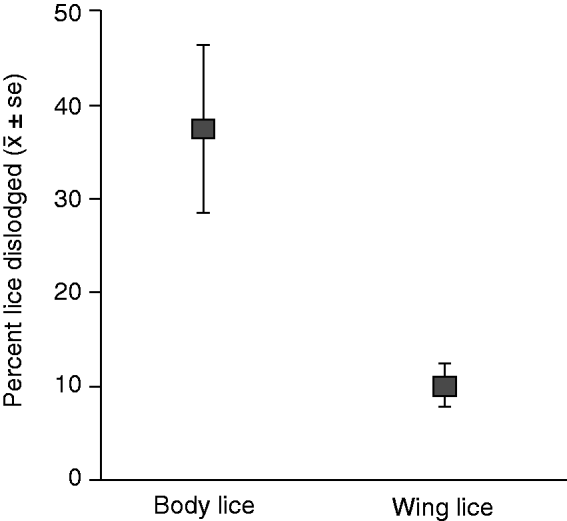
Immediately prior to the removal of collars the mean number of body lice on the pigeons was 1,817 (range 264–5,456). The mean number of wing lice on the same birds was 260 (range 29–873). These population sizes are within the range of those occurring naturally on Rock Pigeons (Clayton et al. Reference Clayton, Lee, Tompkins and Brodie1999). Many lice were dislodged from pigeons over the course of the 96-hour experiment. We determined the percentage of body lice that were dislodged relative to the total number of lice on each bird. We also calculated the percentage of wing lice that were dislodged. A significantly higher fraction of body lice than wing lice was dislodged (Wilcoxon signed-rank Z=−18·0, P=0·008; Fig. 2). Indeed, a higher proportion of body lice than wing lice was dislodged from every one of the eight birds in the experiment. The percent of body lice dislodged ranged from 20·6%–93·6%, whereas the percent of wing lice dislodged ranged from 0%–18·8%. The mean proportion of dislodged body lice was nearly four times greater than that of wing lice (Fig. 2). Many of the lice recovered from the trays were still alive (486–30·8%) and could therefore conceivably have infested another bird.
Fraction of body and wing lice dislodged from the bodies of captive preening Rock Pigeons.

DISCUSSION
Like the wing lice of pigeons and doves, the ancestor of body lice is inferred to be a host specialist, parasitizing a single host species. Host generalists were derived from host specialists several times independently in body lice (at least 8 times). Interestingly, there are no clear cases of a host specialist being derived from a host generalist. Although counter to the conventional wisdom that host specialization is an evolutionary dead end, our results are in line with a growing number of studies of vertebrate parasites suggesting that host generalists may often be derived from host specialists (Poulin et al. Reference Poulin, Krasnov, Shenbrot, Mouillot and Khoklhova2006; Simkova et al. Reference Simkova, Verneau, Gelnar and Morand2006; Johnson et al. Reference Johnson, Malenke and Clayton2009).
Unlike the wing lice of pigeons and doves, there appears to be no phylogenetic conservation in the host specificity of body lice. Host generalists do not typically form clades of species, but are derived from specialists repeatedly. Generalists occur in 4 of the 5 body louse genera, spanning a wide range of parasite body sizes (Johnson et al. Reference Johnson, Bush and Clayton2005). Again, unlike the case in wing lice, changes in host specificity of body lice were not correlated with the presence of a potential competitor. This was true whether the potential competitor was a member of the same or a different genus of body louse. This result suggests that factors other than competition may underlie evolutionary changes in host specificity in body lice.
Interestingly, changes in host specificity in body lice were correlated with host ecology. In every case, host generalist body lice evolved on hosts that spend most of their time on the ground. In contrast, the evolution of host specificity in wing lice was not correlated with host ecology. The results of our experimental work show that a much higher proportion of body lice than wing lice are dislodged from preening birds. Together, these results suggest that the ground may facilitate dispersal of body lice between terrestrial host species. Additional experimental work is needed to further test this hypothesis.
Wing and body lice differ in the way they escape from preening, which is the first line of host defence (Clayton et al. Reference Clayton, Koop, Harbison, Moyer and Bush2010). These differences may help to explain why more body lice then wing lice are dislodged from preening birds. Wing lice (Genus: Columbicola), which have a long slender body shape, escape from host preening by inserting into the spaces between the barbs of the large wing or tail feathers, where they are well protected (Bush et al. Reference Bush, Sohn and Clayton2006). In contrast, body lice (several genera in the family Goniodidae), which have a shorter more rounded body shape, escape from host preening by (1) burrowing into the downy matrix of abdominal contour feathers or (2) dropping from one feather to another (Clayton, Reference Clayton, Loye and Zuk1991). This mode of escape does not appear to protect the lice as well, thus helping to explain why more body lice than wing lice are dislodged by preening.
It is unclear how frequently, if at all, body lice are able to attach to new hosts once those lice have fallen to the ground. However, it is not uncommon for the feathers of terrestrial pigeons and doves to contact the ground when birds are crouching. Even rare dispersal events could be sufficient to maintain louse populations as generalists over evolutionary time. Our results will hopefully motivate additional experiments to test this possibility and to evaluate the relative importance of different dispersal mechanisms in maintaining generalist louse populations across multiple host species.
ACKNOWLEDGEMENTS
We thank David Gardner and Chris Harbison for assistance. We thank Tim Littlewood, Vince Smith, and an anonymous reviewer for helpful comments on the manuscript.
FINANCIAL SUPPORT
This study was supported in part by NSF PEET DEB-0118794 to DHC and KPJ, NSF DEB-0816877 to DHC, NSF DEB-0107891 and DEB-0612938 to KPJ, NSF DEB-0515672 to JDW, and The Field Museum's Emerging Pathogens Project, funded by the Davee Foundation and the Dr. Ralph and Marian Falk Medical Research Trust.