Since the first description of the coronavirus disease 2019 (COVID-19) in China in December 2019, Reference Semple and Cherrie1 the disease has spread widely worldwide, affecting more than 28 million people and causing global death of more than 917,000 cases as of September 13, 2020. 2 The transmission of severe acute respiratory syndrome (SARS-CoV-2) occurs essentially through respiratory droplets generated by coughing and sneezing from the infected people and through contact with contaminated surfaces. Reference Semple and Cherrie1,Reference Wu, Chen and Chan3,Reference Singhal4
Evidence from previous outbreaks, such as severe acute respiratory syndrome (SARS) and Middle East respiratory syndrome coronavirus (MERS), showed that health-care workers (HCWs) are at high risk of being affected as the percentage of affected HCWs reached 21% during SARS outbreak (1706 of 8096 SARS cases worldwide between November 2002 and July 2003), and 18.6% during MERS outbreak (415 of 2223 cases of MERS reported to World Health Organization-WHO as of June 2018). 5,Reference Elkholy, Grant and Assiri6 At the end of February 2020, more than 3000 HCWs were reported to be infected by COVID-19 in China, Reference Gan, Lim and Koh7 and more than 9200 until mid of April in the United States. 8 On March 19, 2020, a guideline was published by the WHO for the optimal use of personal protective equipment (PPE) in health-care facilities. The guideline included recommendations about the appropriate use of PPE based on the setting, personnel, and type of activity. 9 Based on methods used by some countries to fight infectious disease, Reference McDonald, Simor and Su10 many studies were conducted to determine the optimal protective and preventive measures. To minimize risk of infection and maximize prevention, many strategies, such as the triage strategy, were implemented within observational units. Reference Schwartz, King and Yen11 In the meantime, the Centers for Disease Control and Prevention (CDC) launched a guideline for infection prevention and control, which included recommendations covering many fields, such as triage, isolation, and environmental infection control. 12 HCWs were required to respond to the COVID-19 outbreak, despite being at high risk of contracting infectious diseases, respiratory-transmitted diseases in particular, and lacking information and means on correct methods of protection and prevention. Reference Gan, Lim and Koh7,Reference Yassi, Zungu and Spiegel13 For these reasons, the possibility of infection among HCWs increased significantly. Syria is a low-income country that suffered and is still suffering from an almost a decade-old conflict. This has led to a chronic shortage in PPE and to a regression in health system capacity and quality. With the threat of COVID-19, there is a real concern about HCWs contracting COVID-19 in Syria. As of September 1, 2020, the Ministry of Health in Syria has reported 2830 confirmed cases of COVID-19, 90 cases of which were among HCWs. These confirmed cases, however, are suspected by some to be only the tip of the iceberg of COVID-19 cases in Syria. 2,Reference Omar14,15 This study aimed to evaluate the knowledge and application of protective procedures among HCWs (generalist and specialist medical practitioners, in addition to nursing professionals) in Syria.
Methods
Targeted Population and Criteria
An online cross-sectional questionnaire was administered to 294 participants. As Damascus was the first and the most affected area at the time of the study’s establishment, the targeted population was HCWs from all functioning medical departments in 5 hospitals in Damascus, which were the functional hospitals with the initial and rapid response to the COVID-19 pandemic. However, with the continuous and fast spread of COVID-19 between the time of study design and questionnaire launching, answers from other governorates were also accepted. The actual number of doctors and nurses who have been exposed directly to COVID-19 through their contact with the infected patients is hard to be accurately defined; yet, it may be estimated, based on the monthly shift lists of doctors and nurses, to be around 1350 HCWs. According to the Statisticians Borg and Gall publication, a sample size of 366 is needed for a population of 7500 in survey-based studies Reference Delice16 ; which means that the sample size in this study fulfilled these criteria with 294 responses from doctors and nurses. While the targeted population consisted of medical doctors (including general and specialist medical practitioners) and nursing professionals in Damascus, other workers in the medical facilities (cleaning/disinfecting staff) were allowed to answer the questionnaire. Doctors and nurses who met the following criteria were included in this study: medical residents, general and specialist medical doctors, nursing professionals, and working in the functioning hospitals in Syria (under the limited-access COVID-19 health-care services action). The following exclusion criteria were applied: basic medicine faculty students, basic nursing students, less than 18 yof age. Withdrawal participations were excluded from the statistical analysis.
Study Design and Instrument
The questionnaire was launched on multiple online platforms, such as Facebook®, Instagram, Twitter®, and WhatsApp®, from April 1, 2020, to May 21, 2020. The use of online platforms was chosen to achieve the best possible reachability to the targeted population, especially in the absence of united professional email listings or even official networks for the targeted hospitals in Syria. Specific individuals, especially nursing staff, were invited to participate, and the questionnaire was sent per email and by means of other communications means. The questionnaire was tested on several versions of Internet browsers and on different personal computers, tablets, and smartphones with various software systems. As described in previous work, Reference Alsuliman, Alasadi and Mouki17 a 2-step strategy was used to validate the questionnaire. Briefly, the first step included building multiple-choice questions by 3 members of the team. While the second step included evaluating of the questions by 12 volunteers. These volunteers included a key nation-wide practitioner in infectious diseases, a university professor, and internal medicine doctors in university hospitals. The volunteers were asked to provide feedback on the questions’ content and construction. Appropriate changes were made based on the feedback.
Study Tools
The questionnaire was established using Google Forms® and was based on a series of 5 Java®/Javascript® pages, which contained 41 questions. The first 5 questions were mutual questions asked of all subgroups (doctors, nurses, and disinfecting staff), eg, demographic questions, while questions 6-21, 22-34, and 35-41 targeted doctors, nurses, and cleaning/disinfecting staff, respectively. The questionnaire was designed to automatically transfer the participant to the assigned question section based on his chosen work title on the first page (eg, doctor, nurse, etc.), and only the corresponding section is displayed for the participant. Moreover, it was obligatory for the respondent to answer all the questions to submit the final response, and any attempt of double filling was blocked by using digital identification.
The questions were designed to evaluate the HCWs’ application of safety, hygiene, and necessary protection considerations while dealing with suspected or proven COVID-19 patients. The scientific content was built based on the WHO and CDC recommendations and guidelines. 9,12
Data Processing and Statistical Analysis
The data were imported securely into a protected Microsoft Excel file. Then analyzed using R software, 18 version 3.5.3, and the R studio environment. Data visualization was obtained by Seaborn, Reference Waskom, Botvinnik and O’Kane19 which is a Python Reference Oliphant20 data visualization library based on matplotlib. Reference Hunter21 Shapiro-test was used to verify the normal distribution of the data, and unpaired t-test or 1-way analysis of variance (1-way ANOVA) with post hoc correction using Tukey’s honest significant difference (HSD) test were used to compare group-wise data. Statistical significance was set at P ≤ 0.05.
Ethical Considerations
Participation in this questionnaire was completely voluntary. The first page of the questionnaire contained a written informed consent from each participant. Their participation was anonymous, and they could be drawn-out at any time. Anonymity was achieved through the strictly designed questionnaire that did not include any identifying information and by blinded processing of data. Ethical approval was granted to the study by the Scientific Committee of the Faculty of Medicine at Damascus University.
Results
Participants Characteristics
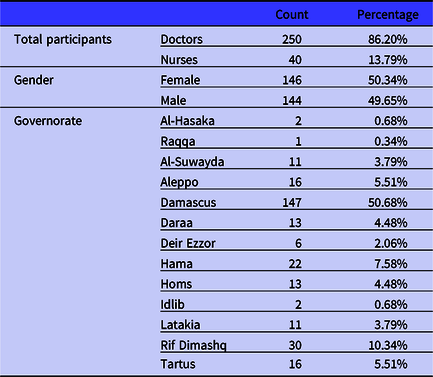
A total of 294 responses were received, and 100% of respondents gave their consent to participate in the questionnaire. Of 294 participants, 250 (85%) were medical doctors, while 40 (13.6%) were nursing professionals, and 4 (1.4%) were cleaning/disinfecting staff. The very small number of responses from the cleaning staff was due to technical and connection problems (better connection quality is available to those with better financial status, while accessible connection options for poorly paid professionals are of mediocre quality). Moreover, the answers from cleaning staff included lots of conflicting answers, which hindered interpretable analysis; therefore, their answers were not included in the statistical analysis. The characteristics and scores of the cleaning staff participants are reported in (Supplementary Materials, Table 1S and 2S). A total of 290 valid responses, 147 from Damascus and 143 from other Syrian governorates, were fully analyzed. The characteristics of the participants are summarized in Table 1. Of the participants, 155 (53.4%) were on the frontlines and exposed to suspected or confirmed COVID-19 patients, while 135 (46.5 %) were not on the frontlines.
Participants’ characteristics

Patients Triage, Isolation, and Examination
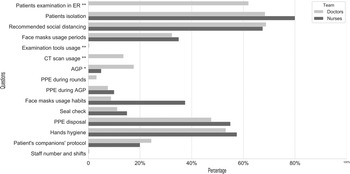
The participants were asked about the practiced isolation protocol when a suspected COVID-19 patient first arrived at the emergency room (ER). Of 290 participants, 203 (70%) reported that they isolate each of the suspected patients in a separate room, which is the best isolation practice, while 55 (19%) reported that suspected cases are isolated together in a shared room. The rest of participants (32; 11%) applied no isolation measures. Nursing professionals were more adherent (32 of 40; 80%) to the best isolation practice (isolating each patient in a single room) than medical doctors (171 of 250; 68.4%) as shown in Figure 1. On the other hand, 199 (68.6%) of the 290 participants chose 1 meter as the recommended social distance between patients in the ER, which is the recommended distance. In detail, this answer was chosen by 27 (67.5%) of 40 nurses and 172 (68.8%) of 250 doctors. Moreover, medical doctors were asked about their practices regarding physical examination in the ER and the examination equipment. Of 250 doctors, 155 (62%) performed the examination in a separate room, while 72 (28.8%) performed the examination in any available place in the ER, and 23 (9.2%) performed the examination in the general ER. A total number of 123 (49.2%) of 250 medical doctors reported that examination equipment, for example, stethoscope, pulse oximeter, and sphygmomanometer, are shared between patients but they are disinfected after use. On the other hand, only 37 (14.8%) of the medical doctors reported that they use specified equipment for each patient.
Percentage of best practice answers (consistent with global recommendations) reported by 290 participants of Syrian doctors (n = 250) and nurses (n = 40) between April 1 and May 21, 2020.
**These questions were only asked of the medical doctors.

Protective and Hygiene Measures
Regarding face mask use, the data showed that of the 290 participants, 124 (42.7%) used the same face mask for several patients. The best practice answer, that is, using 1 mask per time for each patient, was chosen only by 37 (12.7%) participants. In detail, the latter answer was chosen by 22/250 doctors and 15/40 nurses. Participants were also asked about the recommended masks use periods: 95 (32.7%) of the 290 participants chose 4 h for the surgical masks, and 8 h for the N95 respirators, which are the recommended periods. The recommended periods were chosen by 81 (32.4%) of 250 doctors, and by 14 (35%) of 40 nurses. Regarding the N95 respirator seal check test, data indicated that 34 (11.7%) of 290 participants have always done the seal check test, while 213 (73.4%) respondents did not know about the seal check test. In detail, only 28 (of 250; 11.2%) doctors and 6 (of 40; 15%) nurses reported that they perform the seal check regularly.
The participants were also asked to identify aerosol-generating procedures and required PPE during these procedures. Of 290 participants, only 46 (15.8%), were able to identify all the aerosol-generating procedures, most of whom were doctors (44 of 46; 95.6%). Moreover, only 23 (7.9%) of 290 participants used all the recommended PPE during these procedures most of them were also doctors (19 of 23; 82.6%).
Various PPE practices were also reported during routine daily rounds, and only 8 (2.8%) of the participants, all of them were doctors, used all the required PPE during these rounds, while the rest reported either insufficient or more than required PPE, that is, sterile gloves (103; 35.5%) or coveralls (106; 36.6%). Appropriate PPE disposal was reported by 141 (48.6%) participants, with nursing professionals being slightly more adherent (22 of 40; 55%) to disposal recommendations than doctors (119 of 250; 47.6%). Finally, best practice answers about performing hand hygiene, that is, washing hands before and after touching the patient and after touching any of the equipment around the patient, were reported by 156 (53.7%) of the participants, with nursing professionals being also slightly more committed (23 of 40; 57.5%) than doctors (133 of 250; 53.2%).
CT Scan Performing
When asked about the potential CT scan role in transmitting the infection, that is, the possibility of transmission of COVID-19 if the CT scan location was sterilized or was not, before and after the use of the CT scan machine, and the matter of preplanning the route from and to CT scan location, 93 (37.2%) participants among medical doctors (n = 250) answered positively. They also responded that they make sure that the scanning area is disinfected. A total of 123 (49.2%) participants answered “yes,” but they could not always make sure that the scanner area was disinfected. Moreover, 112 (44.8%) participants said that the patient’s path to the CT scan must be preplanned to reduce the possibility of the infection. This question was not asked for the nursing professionals because nursing professionals are not responsible for preplanning or accompanying patients to the CT scan nor for disinfection of the CT scan area in the targeted hospitals.
General Health-Care Instructions
Results showed that only 137(47.2%) participants of 290 had specific instructions on how to perform cardiopulmonary resuscitation (CPR) on COVID-19 patients. It was also noticed that 180 (62.1%) participants reported that the staff changed continuously according to shifts’ schedules, and only 55 (19%) participants have fixed teams for each patient with a known daily visited schedule. On the other hand, 104 (35.9%) participants reported that they go under quarantine after dealing with suspected or confirmed COVID-19 cases. When the participants were asked if they think the number of medical doctors and nursing professionals is enough to deal with COVID-19 patients, 126 (43.4%) thought that the number of the medical doctors and nursing professionals was proportional to the number of patients, while 67 (23.1%) thought that the number of staff is less than appropriate to deal with patients, and 37 (12.8%) think that the number of staff is more than appropriate to deals with patients.
Patient companion’s appropriate protocol, ie, allowing only certain and fixed companions with appropriate explanation and protective measure, was reported by 69 (23.8%) participants (61 doctors and 8 nurses). Most participants (213 of 290; 73.4%) reported that they explain all the protective measures to the companions, while 169 (58.3%) allow only certain and fixed visitors per patient.
Assessment of Medical Doctors’ Practices of Protective Measures
Fifteen questions were used to assess the medical doctors’ practices. All the questions were of equal importance, and each question was given 1 point if all best practice answers were chosen, that is, participants can score either 1 if they chose all the right answers for a given question, while the score will be 0 if they missed all or any of the right answers, with a maximum score of 15 points. The answers were normally distributed (P = 0.33). The scores of the medical doctors ranged between 0 and 9 points. Only 16 (6.4%) of 250 doctors answered more than 50% of the questions (8 ≤ of 15) correctly (Supplementary Materials Figure 1S).
Further analysis revealed a significant correlation between the doctors score and working on the frontlines, as those who were not on the frontlines and were not exposed to suspected or confirmed COVID-19 patients (141 of 250 doctors) had a significantly higher score (mean [m] = 4.69 points) than those who were on the frontlines (109 of 250 doctors; m = 3.8 points; P < 0.001). A significant correlation was also found between the medical doctors’ score and the governorate (P = 0.02). The linear model showed that this correlation is particularly significant for each of Aleppo (P = 0.0104), Daraa (P = 0.0418), and Lattaqia (P = 0.0156) governorates. However, post-hoc analysis with Tukey’s HSD test showed no significant differences between the governorates.
Assessment of Nursing Professionals’ Practices of Protective Measures
Twelve questions were used to assess the nursing professionals’ practices. All the questions were of equal importance, and each question was given 1 point if all correct answers were chosen. The answers were normally distributed (P = 0.46). The highest score achieved was 7 of 12 points. Only 7 of 40 (17.5%) of nurses answered correctly 50% or more of the questions (6 ≤ of 12) (Supplementary Materials Figure 2S). Further analysis revealed that there was no significant difference in the score between nurses who worked on the frontlines (14 of 40 nurses; m = 3.1 points) and those who did not work on the frontlines (26 of 40 nurses; m = 4.1 points; P = 0.09). Moreover, there was no significant correlation between the score and the governorate of the nurse (P = 0.24).
Discussion
There were 290 participants of an unknown, but estimated to be 1350, pool of doctors and nurses in this study to assess and evaluate the application of protective procedures based on the WHO and CDC guidelines. The results show that the frontline doctors had a lower score than their coworkers who were not in direct contact with suspected or confirmed COVID-19 patients (3.8 vs 4.69 points, respectively; P < 0.001).
Medical practice according to universal guidelines may protect HCWs against COVID-19 and prevent them from spreading the infection to other patients, their colleagues, or their families. This study showed that only 16 (6.4%) doctors answered more than 50% of the questions (8 ≤ of 15) correctly, while only 7 (17.5%) nurses answered correctly 50% or more of the questions (6 ≤ of 12). These results differ from other studies: Zhang et al. from China and Saqlain et al. from Pakistan, showed high and convergent proportions following the correct practices against COVID-19. Reference Zhang, Zhou and Tang22,Reference Saqlain, Munir and Rehman23 Moreover, Ahmed et al. and Olum et al. reported better practicing score among HCWs in following the guidelines compared with the results in this study. Reference Ahmed, Shakoor and Vohra24,Reference Olum, Chekwech and Wekha25 This poor practice score among Syrian HCWs compared with other countries may be due to lack of proper training and courses on how to follow the recent guidelines, or due to the lack of resources to follow such guidelines in a low-income war-torn country. Conversely, most of the hitherto mentioned studies, in contrast to this study, did not raise in depth, objective questions to assess the COVID-19 protection practices.
PPE remains the most important method of protection for HCWs on the frontlines, that is why the WHO issued guidelines about the correct way to use PPE based on several parameters, such as setting, activity, or procedure. 26 When it comes to face mask use, this study showed mixed practices, with 124 (42.7%) participants reported using the same face mask for several patients, while only 37 (12.7%) participants used the mask once and for 1 patient only. In a study that was performed in Pakistan, 20.2% of HCWs participants reused face masks among patients. Reference Kumar, Katto and Siddiqui27 Face mask re-use was common among doctors and nurses in another study from Vietnam, which assessed the use of face masks among HCWs in emergency outbreaks between 2010 and 2011. Reference Chughtai, Seale and Dung28 The CDC recommends in case of emergencies to extend the use of face masks if low supplies are expected, and to reuse face masks if low supplies are confirmed. 29 Kumar et al. and Chughtai et al. suggest that it is difficult for low-income countries to use face masks for 1 time only, Reference Kumar, Katto and Siddiqui27,Reference Chughtai, Seale and Dung28 and as a previous study suggested, low- and middle-income countries face challenges when it comes to following strict guidelines that are more tailored toward high-income countries. Therefore, guidelines tailored toward low- and middle-income countries are needed. Reference Zimmerman30
When assessing the proper use of the N95 respirators, this study showed that 73.4% did not know about the seal check test, and only 11.7% said they always did a seal check. These results suggest the need for more training courses and videos to demonstrate how to properly use N95 respirators to ensure the safety of HCWs and patients. Moreover, a seal check test should be included and detailed within the occupational safety protocols. In fact, a seal check test is mandatory in the occupational safety and health administration’s regulations in the United States. 31
The CT scan is an important tool in evaluating patients suspected or with COVID-19 and in guiding their treatment Reference Alsuliman, Sulaiman and Ismail32,Reference Machnicki, Patel and Singh33 ; therefore, it is crucial to disinfect the machine, plan the patient’s pathway to the CT scan machine, and protect doctors and technicians working in the radiology department. 34 Additionally, this study showed good awareness among HCWs that the scanning area must be disinfected before and after each patient. On the other hand, it showed ignorance to the impact of preplanning patients’ path to the CT scan on reducing the possibility of transmission. In countries like China, where they have multiple CT scanners inside the hospital, they assigned a CT scan (fever CT) for patients with suspected COVID-19. The patient’s path is preplanned as follows: fever tent, fever access, then fever CT; all these areas are considered contaminated areas and they differ from regular patients’ entry. The radiologists in the fever CT are notified before the patient arrives to prepare the room and disinfect the equipment. Reference Huang, Zhao and Li35 In a low-income country like Syria where hospitals are equipped with only 1 CT scanner, efforts should be made to disinfect the equipment in the CT room and preplan the patient’s path. In a published Chinese study, researchers offered several suggestions to avoid spreading the infection in the radiology department. These suggestions included: putting a cover on the patient’s head and upper body while transferring, using a disposable exam table paper, and disinfecting the CT equipment with 2000 mg/L chlorine or 75% ethanol. Reference An, Yw and Chen36
CPR is considered an aerosol-generating procedure. 29,37 HCWs performing such procedures should wear N95 respirators, eye protection, gloves, and gowns, 29,37 and receive specific instructions on how to perform CPR on COVID-19 patients. This study recorded concerning results regarding participants’ knowledge about which PPE to wear during aerosol-generating procedures, and only 47.2% mentioned that medical doctors have specific instructions on how to perform CPR on COVID-19 patients. A study in Singapore trained doctors and nurses on how to perform a protected CPR on COVID-19 patients using 6 sessions and assessed their performance at the end of these sessions. Within 2 wk, there was an improvement in their performance and their timing. Reference Foong, Ng and Khoo38 This result highlights the importance of having simulation training to manage patients effectively and safely.
Of interest, this study showed that doctors who were on the frontlines had a higher score than doctors who were not on the frontlines (3.8 vs 4.69 points, respectively; P < 0.001). This paradoxical result might suggest 2 possibilities; first, there is insufficient training and courses on protective measures and precautions in the hospitals dealing with COVID-19 patients in Syria, and so HCWs are depending on their knowledge. Second, high workload could prevent HCWs from following all safety measures. Moreover, nurses were more committed to hand hygiene than doctors in this study, which is consistent with previous studies that showed that nurses are more compliance to hand hygiene. Reference Karaaslan, Kepenekli Kadayifci and Atıcı39 This might be an alarming message for doctors in general, and Syrian doctors in particular, to be more adherent to hand hygiene protocols.
Limitations
This study is limited by several factors. First, it is self-reported data due to the lack of a viable system at that time, for this particular type of data, and so the estimation of exposure to COVID-19 was based only on participant’s evaluation of the symptoms and/or test results of the patients that the participant has dealt with. Second, this study was designed as an online questionnaire to be more accessible, and so it is subject to different kinds of bias, particularly; sampling error, and response bias. Reference Stratton40 Only 290 HCWs participated in this study, and although the potential number of participants could not be accurately defined, it was estimated to be approximately 1350 HCWs, taking into consideration that most of nonurgent surgeries, procedures, explorations, and consultations were postponed, and that only departments considered as COVID-19 frontline and supporting wards were given the priority and permitted to stay functional. As for the response bias, multi-choice questions were chosen for the questionnaire instead of open-answer questions to make the responses more precise and direct. Moreover, the score was built to further obtain a more objective and comprehensive evaluation and minimize the effect of individual biased answers. Finally, due to technical and connection problems, the participants from the cleaning staff were far less than expected, which hindered interpretable statistical analysis. Because no personal information was collected to ensure participants’ privacy, it was impossible to reach these participants for a re-submission, and face-to-face appointments were avoided due to COVID-19 restrictions.
Conclusions
This study showed poor protection practice among Syrian HCWs. More courses, training sessions, and strategies are needed to mitigate the spread of COVID-19 infection and to properly manage patient treatment. This study highlighted potential causes of this poor practice (poor knowledge, lack of PPE), suggested solutions (training sessions, preplanning patient’s path), and strongly recommended establishing new guidelines that are specific to low-income countries so they can follow these more-specific guidelines more adequately. New awareness tools may also be needed in such circumstances.
Supplementary material
To view supplementary material for this article, please visit https://doi.org/10.1017/dmp.2021.356
Acknowledgments
The authors thank Danah El-Refaie, University of Houston, USA, for the proofreading of this manuscript.
Author Contributions
Drs. Alsuliman, Alasadi, and Alrstom have contributed equally to this article. T.A., L.A., and A.A. should be considered as first author of the manuscript. L.A., A.R., R.A., J.S., and G.A. co-authored the manuscript. T.A., L.A., and A.R. participated in the design of this study. All authors read and approved the final manuscript and agreed to be accountable for all aspects of the work.
Declaration of Conflicting Interests
The authors declare no potential conflicts of interest with respect to the research, authorship, and/or publication of this article.