Introduction
Antestia bugs (Antestiopsis spp.) are serious pests of coffee in Africa with a distribution in most of the producing countries of the continent (Greathead, Reference Greathead1966). Both nymphs and adults attack all vegetative and fruiting parts of the coffee tree leading to low yield and poor bean quality. By feeding on developing green berries, they disturb fruit development, causing premature fruit fall and necrosis of the mature beans (Cilas et al., Reference Cilas, Bouyjou and Decazy1998). Feeding punctures also allow the stigmatomycosis fungi Nematospora spp. to colonize the beans, resulting in endosperm rotting (Le Pelley, Reference Le Pelley1942). Yield loss in coffee due to these pests in East Africa is estimated to be up to 45% (McNutt, Reference McNutt1979; Craves, Reference Craves2012). Due to the importance of damage, the economic threshold for these pests is as low as one or two bugs per tree on average, depending on the country (Bigirimana et al., Reference Bigirimana, Njoroge, Gahakwa and Phiri2012; Mugo et al., Reference Mugo, Kimemia and Mwangi2013).
Greathead (Reference Greathead1966) gives the taxonomy and distribution of antestia bug species in Africa. The species A. thunbergii (Gmelin 1790) (Hemiptera: Pentatomidae), previously known as A. lineaticollis Stål and A. orbitalis (Westwood) (Rider, Reference Rider1998), is mostly found on arabica coffee at medium to high elevation in the highlands of eastern Africa. In addition to the damage described above, A. thunbergii has been reported to be involved in the ‘potato taste’ defect on arabica coffee, especially in the Great Lakes region, reducing its quality and competitiveness in foreign markets (Jackels et al., Reference Jackels, Marshall, Omaiye, Gianan, Lee and Jackels2014; Gueule et al., Reference Gueule, Fourny, Ageron, Le Flèche-Matéos, Vandenbogaert, Grimont and Cilas2015). In this region, the potato taste defect in coffee beans rose from 18% in 2012 to 51% in 2013 (MOAAR, 2014), underscoring the economic importance of antestia bugs in the coffee industry.
Most previous studies on A. thunbergii dealt with pest ecology under field conditions to improve its control. A study by Cilas et al. (Reference Cilas, Bouyjou and Decazy1998) described spatial distribution of the pest (referred to as A. orbitalis) and defined a method of sampling for infestation assessment. A recent study in Kenya showed higher infestation levels of antestia bugs in shaded coffee compared to unshaded plantations, contrary to other key insect pests of coffee that thrived under full sunlight exposure (Mugo et al., Reference Mugo, Kimemia and Mwangi2013; Jonsson et al., Reference Jonsson, Raphael, Ekbom, Kyamanywa and Karungi2014). An interesting finding suggests that current promotion of coffee agroforestry to curb negative global warming effects may favour antestia bugs. However, a lot still needs to be known on the biology of A. thunbergii to better understand the pest distribution and seasonal variations on coffee.
Developing effective pest management methods requires a good knowledge of the pest population dynamics under different environmental conditions (Chi and Yang, Reference Chi and Yang2006; Culik et al., Reference Culik, Fornazier, Martins, Zanuncio, Ventura, Peronti and Zanuncio2013). Life tables have been widely used for insect pests as tools to generate synthetic and comprehensive information on insect growth capacity, based on development, survival and fecundity (Chi and Yang, Reference Chi and Yang2003; Naranjo and Ellsworth, Reference Naranjo and Ellsworth2005; Haghani et al., Reference Haghani, Fathipour, Talebi and Baniameri2007). Kirkpatrick (Reference Kirkpatrick1937) studied the life history of A. thunbergii. However, crucial demographic parameters such as longevity, fecundity and development time are poorly documented. Our aim was to investigate the development time, longevity and reproduction of the pest reared at four different constant temperatures under laboratory conditions. Using life table analysis, population growth rates were estimated.
Materials and methods
Insects
Insects used for this study were collected from small holding coffee farms located on the Mount Kilimanjaro, near Moshi, Tanzania (sampling area located between S3.3499°–E37.4623° and S3.2827°–E37.4539°, with elevation between 1100 and 1600 masl). Land cover in this area is dominated by agrosystems known as Chagga home gardens, including small coffee plots, often associated with banana and other food crops and sparsely sprayed with insecticides (Hemp, Reference Hemp2006). The antestia bugs collected from these farms were identified as A. thunbergii using the morphological identification key proposed by Greathead (Reference Greathead1966). Adult males and females were gently collected from coffee trees and kept on coffee berries and leaves in aerated plastic boxes for transportation to the laboratory, at the International Centre of Insect Physiology and Ecology (icipe), Nairobi, Kenya. To initiate a colony, collected insects were introduced to aerated Plexiglas cages (20 × 20 × 20 cm3) and maintained on fresh coffee berries and leaves as food source and egg laying substrate. The main colony was maintained at a constant temperature in an incubator at 25±0.5°C with 80±5% RH and a photoperiod of 12 h:12 h light:dark. Food was changed every three days.
Egg and nymph development and survival
Freshly laid eggs obtained from adults of the reared A. thunbergii colony were gently removed from substrate with a fine camel hair brush. Eggs were individually placed on an absorbent paper towel placed on the bottom of aerated plastic containers (3.5 cm depth × 3.9 cm diameter). Each container had one egg. The containers were placed in four respective incubators set at constant temperatures of 20±0.5, 25±0.5, 30±0.5 and 35±0.5°C. The choice of these temperatures was based on the temperature range of coffee producing areas (DaMatta, Reference DaMatta2004; DaMatta and Ramalho, Reference DaMatta and Ramalho2006). The number of eggs used for experimentation was 150, 127, 178 and 210 for temperatures 20, 25, 30 and 35°C, respectively. In incubators, the RH was kept at 80±5%, with a photoperiod of 12 h:12 h light:dark. Eggs were monitored daily to determine incubation period and egg survival. After egg hatching, two to three arabica coffee green berries and small sections of coffee leaves were introduced to the containers to feed the emerging nymphs. The development and survival of nymphs were monitored daily until adult emergence. Fully developed coffee green berries were chosen according to Le Pelley (Reference Le Pelley1942), who found this substrate optimal for feeding and reproduction. Unlike previous rearing methods, we also added sections of coffee leaves which significantly improved nymph survival in our rearing conditions. Berries and leaves were replaced with fresh ones every 3 days.
Adult longevity and reproduction
Once they emerged from monitored nymphs, adults less than 24 h old were placed as couples for mating in the plastic containers described above, with the same substrate and temperature as those used for immature stages. Since the presence of males is known to stimulate oviposition in several insect species (Gillott, Reference Gillott2003), we maintained the males in the container until the females died. If the male died before the female, then it was replaced with one of a similar age from the main colony. Adult survival and egg-laying were monitored daily until all the males and females died. Pre-oviposition, oviposition and post-oviposition periods, and adult longevity were calculated from daily records. Newly laid eggs (less than 24 h old) were gently removed from the substrate with a fine camel brush and maintained under the same conditions as described above to assess their viability.
Life table parameters
The life table parameters were calculated using the method of Birch (Reference Birch1948): the age of individuals in days was designated as x in the life table. The proportion of individuals surviving at age x was used as lx . The age specific fecundity is the mean number of female offspring produced per day by a female of age x and was designated mx . The mx value was obtained by dividing the mean number of eggs per day by the sex ratio. The sex ratio was obtained based on emerging adults at the given temperature and it was calculated by dividing the total number of adults by the number of females. The GRR is the average number of daughters produced by a living female throughout her entire reproductive period and was calculated as the sum of mx . The net reproductive rate (R 0) is the rate of multiplication per generation and it was calculated as R 0 = Σlxmx . The mean generation time in days (Tc ) is the mean time between the birth of parents and birth of offspring and this was estimated as Tc = Σ xlxmx /Σlxmx . The intrinsic rate of increase (r) is the maximum population growth, also known as the intrinsic rate of natural increase or the innate capacity for increase. This was estimated using the formula: Σ e−rx lxmx = 1, while the doubling time (Td ) (the number of days required by a population to double) was obtained as: ln(2)/r.
Statistical analysis
To assess the impact of temperature on A. thunbergii developmental biology, the data for development time (in days), fecundity and adult longevity (in days) at different temperatures were checked for normality using the Shapiro–Wilk test in R (version 2.14.0, R Development Core Team, 2011). Data were log-transformed if necessary to satisfy the assumptions of analysis of variance. Data were then submitted separately to an analysis of variance (ANOVA) in R. Once significant differences were detected, data were subjected to post hoc analysis in R for means comparison using Tukey test at P = 0.05.
Results
Development time and survival rate of immature stages
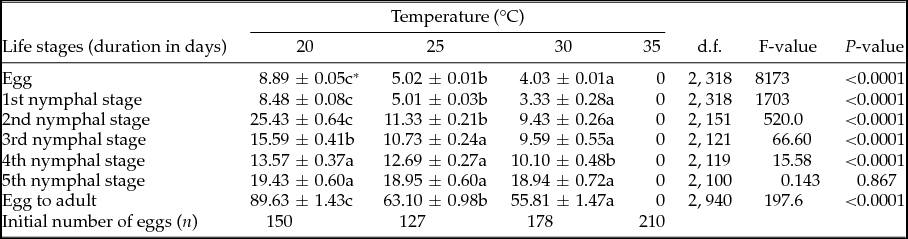
An increase in temperature significantly shortened the developmental time of immature stages of A. thunbergii from egg to fourth nymphal stage, as well as the total development time from egg to adult (P < 0.0001) (Table 1). However, temperature did not influence significantly the development time of the fifth nymphal stage (P = 0.867). Whereas the total developmental time from egg to adult was 89.6 days at 20°C, it was 63.10 days at 25°C and 55.81 days at 30°C, and no development at 35°C.
Mean (± SEM) duration in days of the egg and nymphal stages, and total developmental time of Antestiopsis thunbergii reared at four constant temperatures

*Means within a row followed by the same letter are not significantly different (Tukey test, with P < 0.05).
Stage-specific survival
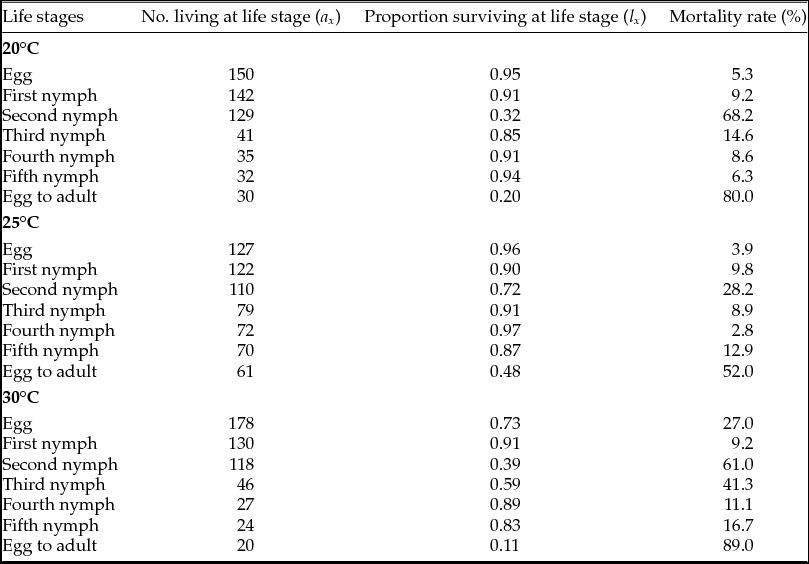
The life stage-specific survival and mortality are given in Table 2. The mortality rate of the egg was the lowest at 25°C, with 3.9%, and increased to 27% at 30°C. At 35°C, egg mortality was 100% as no hatching occurred. The mortality rate was relatively low for first nymph stage, with around 10% for all temperatures. The highest mortality occurred in the second nymph stage at all temperatures, with values of 68.2, 28.2 and 61% at 20, 25 and 30°C, respectively. The lowest mortality from egg to adult stage was recorded at 25°C, with 52%, while it was 80 and 89% at 20 and 30°C, respectively.
Stage specific survival and mortality rate for Antestiopsis thunbergii

Adult longevity, fecundity and oviposition
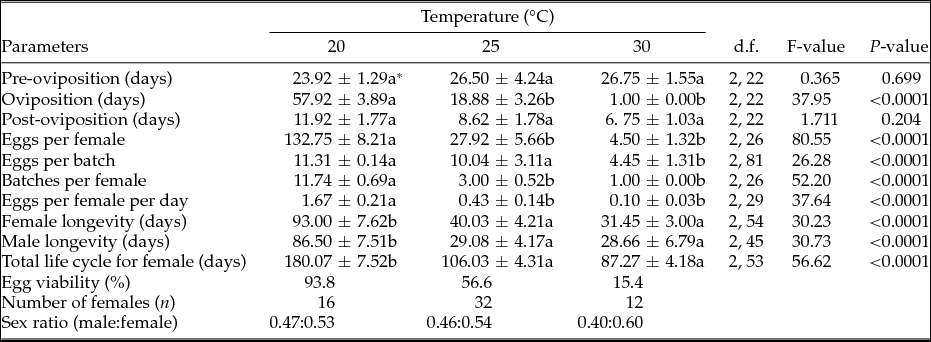
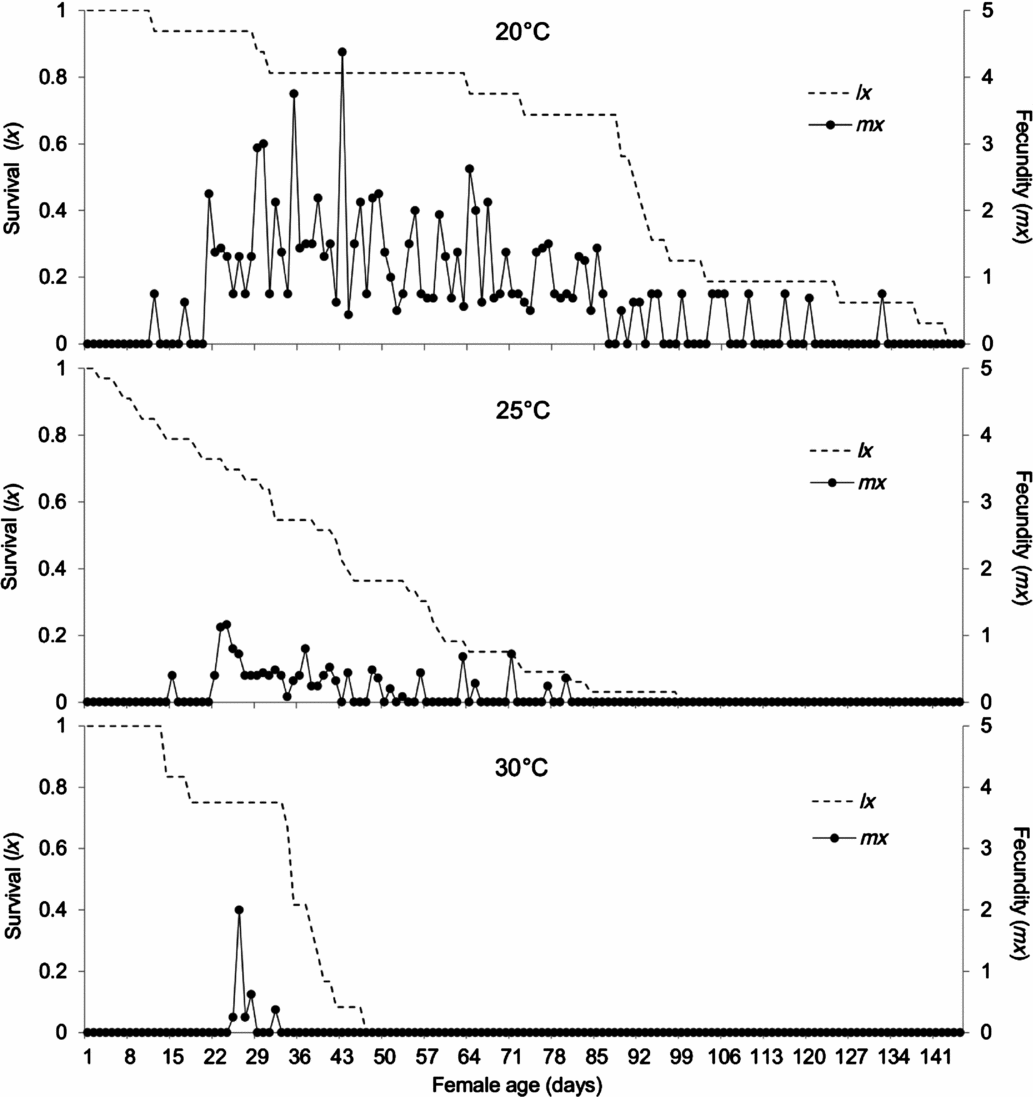
Longevity of A. thunbergii female, including the pre-oviposition, oviposition and post-oviposition periods was maximal at 20°C, with 93 days, and decreased significantly with an increase in temperature (P < 0.0001) (Table 3). Female longevity was higher than male longevity for all temperatures. Temperature did not show any significant effect on the pre-oviposition period of A. thunbergii (p = 0.699). By contrast, the oviposition period was significantly longer at 20°C, with 57.9 days, compared to other temperatures (P < 0.0001). The eggs were laid in batches and the number of eggs per batch significantly varied with temperature (p < 0.0001). The number of batches laid by a female was significantly higher at 20°C, with an average of 11.8 batches. The total number of eggs laid per female decreased significantly with an increase in temperature (P < 0.0001), with the highest fecundity at 132.8 eggs per female at 20°C. The same was true for daily fecundity which was significantly higher at 20°C, with 1.67 eggs per female per day (Table 3, Fig. 1). Egg viability was maximal at 20°C, with 93.8% of eggs hatching at this temperature. The sex ratio was unbalanced with more females than males at all temperatures. Female proportion was 53, 54 and 60% at 20, 25 and 30°C, respectively.
Mean (± SEM) duration in days of oviposition period and adult lifespan, and mean (± SEM) fecundity of Antestiopsis thunbergii reared at different constant temperatures

*Means within a row followed by the same letter are not significantly different (Tukey test, with P < 0.05).
Age specific survival (lx ) and mean daily fecundity (mx ) (daughters per female) for Antestiopsis thunbergii reared at three constant temperatures.

Demographic parameters
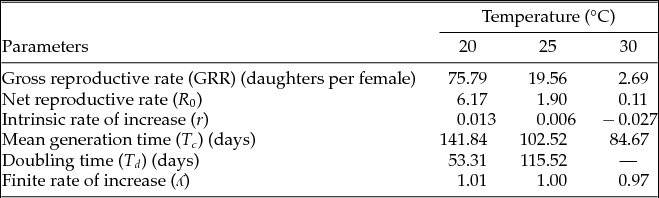
The life table parameters of A. thunbergii computed for three constant temperatures are given in Table 4. Since eggs did not hatch at 35°C, life table was not calculated at this temperature. The GRR was maximal at 20°C with 75.79 daughters per female, compared to 19.56 and 2.69 daughters per female at 25 and 30°C, respectively. The intrinsic rate of increase r was maximal at 20°C, with 0.013 and negative at 30°C. The mean generation time was 141.84 days at 20°C. The finite rate of increase (ʎ) ranged from 0.97 at 30°C to 1.01 at 20°C. The population doubling time (Td ) was minimal at 20°C, with 53.31 days (Table 4).
Life table parameters of Antestiopsis thunbergii reared at three constant temperatures

Discussion
Our study aimed at providing information on A. thunbergii development and survival at different constant temperatures. We introduced a new rearing method, combining coffee leaves to coffee green berries as rearing substrate, unlike previous studies that used green berries only (Le Pelley, Reference Le Pelley1942). Nymph mortality was as high as 100% when only coffee green berries were used as food source, at 20°C in our rearing conditions. This motivated the addition of coffee leaves to the rearing substrate, thus considerably decreasing nymph mortality. The role of coffee leaves in nymph development still eludes us, since berries were the main feeding source. Coffee leaves may improve relative humidity in the containers or provide nymphs with hiding places, helping them to escape from intense light in incubators.
As far as we know, there is no recent literature on the thermal biology of A. thunbergii. As for other true bugs, A. thunbergii has incomplete metamorphosis development with six immature stages, namely egg and five nymphal stages. In our study, the egg incubation period ranged from 4 to 9 days, depending on the temperature. Once emerged, the first nymph stage usually stayed on the egg shell for 1 to 3 days before starting to feed on berries. Complete development from egg to adult took between 2 and 3 months, which concurs with Kirkpatrick (Reference Kirkpatrick1937) for the same species. Female lifespan was longer than male lifespan and the complete female life cycle ranged between 3 and 6 months, depending on the temperature. A recent study on the biology of the closely related antestia bug species, A. intricata Ghesquiere and Carayon, reports a much longer life cycle of 7 months at 27°C (Mendesil and Abebe, Reference Mendesil and Abebe2004). This suggests distinct relationships of these two species with temperature and may be related to different geographical distribution, A. thunbergii being found at higher elevation than A. intricata (Greathead, Reference Greathead1966).
The pre-oviposition period we observed (23–26 days) was much longer than the records of Abasa (Reference Abasa1973), who assessed a pre-oviposition period of 9.6 days at 22–23°C for the same species in Kenya. Our result is more in agreement with records of Kirkpatrick (Reference Kirkpatrick1937) who reported a pre-oviposition period of 13 to 36 days, with temperatures between 19 and 24°C for A. thunbergii in Tanzania. The pre-oviposition period is the time required by the female for ovary maturation and initiation of egg production and it is known to be influenced by several factors acting during nymph development and sexual maturation, such as food source (Ruberson et al., Reference Ruberson, Tauber and Tauber1986). Thus, variation in pre-oviposition period may be linked to rearing conditions.
With 58 days on average, the oviposition period we observed at 20°C was similar to the findings of Abasa (Reference Abasa1973), who recorded a period of 60 days for the same species reared at 22–23°C. With our rearing method, eggs were mostly laid in batches of 12 eggs, which is in agreement with reports of Kirkpatrick (Reference Kirkpatrick1937) and Abasa (Reference Abasa1973). Similar results are reported for other species of antestia bugs such as A. intricata in Ethiopia and A. facetoides in Kenya (Mugo and Ndoiru, Reference Mugo and Ndoiru1999). Although smaller than A. thunbergii and with a distribution limited to few countries of eastern Africa, A. facetoides has a life history similar to that of A. thunbergii and the two species can be found together in coffee plantations (Greathead, Reference Greathead1966).
Temperature is a crucial factor in understanding of insect life histories. We established that temperature clearly impacted on the developmental time, survival and reproduction of A. thunbergii. Whereas the bug can complete its development and survive at a temperature range of 20–25°C, an increase in mortality at 30°C indicates the proximity of the upper thermal threshold. Indeed, A. thunbergii eggs did not hatch at 35°C. In our study, high mortality was recorded during immature life stages. This result is in agreement with record of Greathead (Reference Greathead1966), who obtained 48% as the highest survival rate in his laboratory study, as well as with report of Kirkpatrick (Reference Kirkpatrick1937), who recorded high mortality rates in rearing under field conditions. The high mortality of immature life stages could explain the low density of field populations (e.g. Cilas et al., Reference Cilas, Bouyjou and Decazy1998; Mugo et al., Reference Mugo, Kimemia and Mwangi2013), despite a relatively high fecundity of females. In the present study, the highest mortality was observed for the second nymph stage at all temperatures, when compared to other life stages, suggesting that this life stage is the most susceptible and could be targeted in pest management measures. Our findings for upper thermal threshold are consistent with those reported for other true bugs of the family Pentatomidae. In recent studies, the eggs of the brown stinkbug Halyomorpha halys Stål successfully developed at temperatures between 17 and 33°C. However, above 33°C, none of immature stages was able to complete its development (Nielsen et al., Reference Nielsen, Hamilton and Matadha2008; Haye et al., Reference Haye, Abdallah, Gariepy and Wyniger2014). The same was true for the spined soldier bug Podisus maculiventris (Say) which could not complete its development above 32.2°C (Baek et al., Reference Baek, Son and Park2014). Unlike A. thunbergii which is a tropical species, H. halys and P. maculiventris thrive in temperate regions. Similarities in upper thermal threshold may be attributed to the adaptation of A. thunbergii to coffee grown in medium and high elevations, where temperatures are more similar to those of temperate countries.
Our results also show that temperature highly impacts reproduction of A. thunbergii. Among the three distinct reproductive phases of female lifespan (pre-oviposition, oviposition and post-oviposition periods), temperature had a significant effect on the oviposition period only, leading to a longer lifespan for females at 20°C. The duration of oviposition period was closely linked to the fecundity, which was also highly affected by temperature in our study. With our rearing method, A. thunbergii fecundity was highest at 20°C with a mean of 132 eggs per female, which was 5 and 30 times higher when compared with 25 and 30°C, respectively.
As far as we know, this is the first demographic study for antestia bugs Antestiopsis spp., which will be invaluable in elucidating pest population dynamics in coffee plantations. In our study, the net reproductive rate (R 0) was maximal at 20°C, with 6.17 females produced per female. This parameter indicates the growth rate of a population from a generation to the next one. In our study, R 0 was low and this is mainly attributed to high level of mortality of immature stages. The intrinsic rate of increase (r) is an important synthetic parameter; it notably indicates which temperature results in highest population growth (Satar et al., Reference Satar, Kersting and Uygun2005). In our study, r was maximal at 20°C, with 0.013, while it was half that value at 25°C and it was negative at 30°C. This result shows the major role played by fecundity in the relationships between population growth and temperature, since fecundity was able to compensate the 80% mortality rate of immature stages at 20°C, compared to 52% at 25°C. The relationship between the intrinsic rate of natural increase of A. thunbergii and temperature contrasts was reported by Prado et al. (Reference Prado, Golden, Follett, Daugherty and Almeida2009), who recorded for the green stink bug Nezara viridula L. (Pentatomidae) an increase of r from 0.01 to 0.02 between 20 and 25°C and a negative value of −0.01 at 30°C. The mean generation time we obtained was longer at 20°C (141.84 days), as a result of low development rate of immature life stages. But the results showed that the pest can have at least two generations per year at 20°C and the number of the generations may increase to three per year at 25°C. The time that the population requires to double was shorter at 20°C and increased at 25°C up to 115 days. At 30°C, the population is unable to double as a result of a negative population growth for the next generation. Taking all these parameters into account, the results indicate that an elevation in temperature, as suggested by the different climate change predictions, may affect the bug ecological niche and may change its distribution on coffee. This should lead to serious damage in previously unaffected arabica coffee plantations, as it has been demonstrated for the major pest of coffee worldwide, the coffee berry borer Hypothenemus hampei (Jaramillo et al., Reference Jaramillo, Muchugu, Vega, Davis, Borgemeister and Chabi-Olaye2011).
Our study clearly shows that temperature is a crucial factor that influences immature stage survival and reproduction of A. thunbergii. Our results suggest that the optimum constant temperature for A. thunbergii development ranges between 20 and 25°C. This range of temperatures, relatively low for a tropical species, may be explained by A. thunbergii adaptation to coffee grown at medium to high elevations (van der Meulen and Schoeman, Reference van der Meulen and Schoeman1990). This information will be useful in IPM programmes to develop successful management methods for A. thunbergii. However, to develop phenological models based on temperature for the pest, further investigations are needed with more temperatures tested between 10 and 30°C. Phenological models can be useful for understanding the current distribution of A. thunbergii and predict the distribution of the pest under different climate change scenarios.
Acknowledgements
The authors gratefully acknowledge the financial support provided by the CHIESA project (Climate Change Impacts on Ecosystem Services and Food Security in Eastern Africa) funded by the Ministry of Foreign Affairs of Finland. The authors thank the technicians Dickson Mwenda and Ephantus Guandaru in the coffee laboratory at icipe for the support they provided during this research.