


INTRODUCTION
The evidence that the provision of incumbent performance information helps hold governments to account is mixed.Footnote 1 This article investigates the extent to which these mixed results might reflect differences in the prevalence of connected social networks, which have significant capacity to influence how voters respond to the provision of information about incumbent party performance. We argue that social network connectedness can moderate the effect of information provision on a community’s electoral sanctioning by serving as a coordination device that enables voters to synchronize their voting behavior, independently of how more connected networks may stimulate belief updating by better diffusing the information. Specifically, providing information may induce explicit discussion about, and agreement on, voting for a better candidate (e.g., Larson Reference Larson2017), or induce the tacit understanding that others will respond similarly (e.g., Bernheim Reference Bernheim1994; Morris and Shin Reference Morris and Shin2002; Putnam, Leonardi, and Nanetti Reference Putnam, Leonardi and Nanetti1993).
As Sinclair (Reference Sinclair2012, 1) notes, “Politics are incredibly contagious in social networks.” Indeed, networks could moderate the effect of incumbent performance information on electoral sanctioning in two main ways: by facilitating voter learning through information diffusion or by inducing voters to coordinate on voting for the better candidate.Footnote 2 A robust body of evidence highlights the importance of networks in transmitting information to connected individuals (e.g., Alatas et al. Reference Alatas, Banerjee, Chandrasekhar, Hanna and Olken2016; Alt et al. Reference Alt, Jensen, Larreguy, Lassen and Marshall2017; Ames, Baker, and Smith Reference Ames, Baker, Smith, Victor, Lubell and Montgomery2016; Larson and Lewis Reference Larson and Lewis.2017; Schaffer and Baker Reference Schaffer and Baker2015). Various studies also highlight the potential role of coordination within social networks by suggesting that even without transmitting information that alters voters’ beliefs, networks can help coordinate connected individuals to turn out (e.g., Bond et al. Reference Bond, Fariss, Jones, Kramer, Marlow, Settle and Fowler2012; Nickerson Reference Nickerson2008; Sinclair, McConnell, and Green Reference Sinclair, McConnell and Green2012) or participate in protests (e.g., Enikolopov, Makarin, and Petrova Reference Enikolopov, Makarin and Petrova2016; Larson et al. Reference Larson, Nagler, Ronen and Tucker2017; Steinert-Threlkeld Reference Steinert-Threlkeld2017). Such coordination is typically postulated to be either explicit (arising from direct discussion with others leading to agreement to act in a particular way) or tacit (i.e., arising from the common knowledge that others are likely to act in a particular way). However, these studies typically struggle to distinguish whether social networks’ diffusion or coordination mechanisms drive their findings. In Nickerson’s (Reference Nickerson2008) influential study, for example, it is not clear whether a get-out-the-vote campaign reaching single individuals increased the turnout of other members of their household because those members became better informed indirectly or because targeted individuals and other household members were induced to coordinate (e.g., through discussion, arranging to vote together, or social pressure).
The difficulty of distinguishing between information diffusion and coordination functions of networks reflects their generally reinforcing effects. We illustrate this broader point in our empirical context of electoral accountability by developing a simple two-party model in which voters receive utility from (1) voting for their preferred party, which reflects both expected malfeasance in office and an individual’s bias toward the incumbent party (e.g., partisanship or incumbents’ greater vote-buying capacity) and (2) voting together with others they are connected to for the less malfeasant party. In our model, information provision both leads voters to directly update their beliefs about party malfeasance and enables voters embedded in more-connected networks to work together to coordinate around the less malfeasant party. While we do not explicitly model the coordination process, we assume that voters discuss and agree to, or believe that others will respond similarly to information provision by, voting for the less malfeasant candidate.
We show, in general, that information provision can induce networks’ coordination and diffusion mechanisms to reinforce or oppose each other. Information that induces voters to (un)favorably update their perception of incumbent malfeasance will complement the coordination effect when voters also believe the incumbent to be less (more) malfeasant than the challenger. In this case, larger effects of information provision among voters embedded in more-connected networks could reflect either coordination or the greater diffusion of information in such networks. In contrast, this observational equivalence between networks’ potential coordination and diffusion functions breaks down if voters, despite (un)favorably updating about the incumbent, still believe that the incumbent is more (less) malfeasant than the challenger. In this case, the information diffusion channel via learning and updating instead has the opposite effect on vote choice to that of coordination.Footnote 3
To empirically separate the coordination and diffusion mechanisms through which networks moderate the effects of information provision, we exploit an instance in which this particular condition holds and information was disseminated widely enough to feasibly coordinate voters. Specifically, we build on an experiment previously conducted by Arias et al. (Reference Arias, Larreguy, Marshall and Querubín2019), which randomized the provision of audit report scorecards detailing misallocated municipal spending before the 2015 municipal elections in four Mexican states where voters believed incumbents to be highly malfeasant. They show that, on average, voters rewarded incumbent parties after receiving this information, and—consistent with belief updating in a context where voters already expected substantial incumbent malfeasance—rewarded the incumbent most where the reported malfeasance was lower than expected. Crucially for this study, voters generally believed the incumbent to be more malfeasant than challenger parties, even after receiving the audit report information. In other words, while the informational intervention led some voters to believe that the incumbent party was less malfeasant than expected, it did not change the fact that voters, on average, still believed the incumbent party to be more malfeasant than challengers. Consequently, this context allows us to distinguish whether coordination or diffusion is the driving force behind any moderating role of social networks: while networks’ coordinating role should decrease support for the incumbent after malfeasance information is provided, the information diffusion function should increase support for the incumbent.
Combining field experimental variation in the provision of incumbent performance information with network data, we show that network structure can play a significant role in inducing coordination following information provision. First, precinct-level electoral returns demonstrate that the increase in support for the incumbent party caused by information provision is lower where a precinct’s network is more connected. Network connectedness is measured using several approaches implied by our theoretical model that aggregate individual-level networks—constructed from family ties among the beneficiaries of Prospera, Mexico’s nationwide conditional cash transfer program—within rural precincts, where many voters are Prospera beneficiaries (see also Angelucci et al. Reference Angelucci, De Giorgi, Rangel and Rasul2009; Cruz, Labonne, and Querubín Reference Cruz, Labonne and Querubín2017).
Second, we use detailed survey data to substantiate the mechanisms underpinning precinct-level voting behavior. In particular, we find that voters in more-connected precincts engaged more with the information provided and were also significantly more likely to know that others in their community received the information. Crucially, and consistent with our theory of voter coordination within networks, these voters report that discussion with others about the information induced coordination that changed their vote choice, since it led them to believe that other voters would change their vote. Robustness checks suggest that these findings are unlikely to reflect other factors correlated with network connectedness, our measurement of networks, or social desirability bias. Furthermore, we provide evidence that our estimated effect of network connectedness is not explained by networks altering individual beliefs or behavior, whether through information diffusion within or across precincts, or by information provision increasing political engagement. Alongside the voter updating previously documented by Arias et al. (Reference Arias, Larreguy, Marshall and Querubín2019), we thus find clear evidence indicating that information provision can also induce voter coordination against candidates generally believed to be more malfeasant than their opposition.
This study makes two main contributions. First, by leveraging an uncommon feature of our empirical setting to show that networks can facilitate coordination around information provision, we provide a proof of concept for the widely held belief that social networks can stimulate voter coordination. Our findings thus add credence to Putnam, Leonardi, and Nanetti’s (Reference Putnam, Leonardi and Nanetti1993, 167) argument that “features of social organization, such as trust, norms, and networks, can improve the efficiency of society by facilitating coordinated actions.” They are also consistent with the documented role of information dissemination in facilitating coordination in a variety of contexts, such as Collier and Vicente’s (Reference Collier and Vicente2014) claim that an antiviolence campaign served as a coordination device to help Nigerian communities reach an equilibrium in which peaceful participation became the norm. More generally, our findings add nuance to the mechanisms underpinning previous studies attributing network effects to information dissemination or social pressure absent coordination. Separating between these theoretical mechanisms, and identifying the conditions under which they are complements, may also have important implications for policy-makers seeking to optimize information campaigns.
Second, we provide a lens—beyond belief updating—through which the mixed evidence regarding information’s influence on electoral accountability can be interpreted. Because networks’ coordination and information diffusion functions can either reinforce or oppose each other, the effect of information provision may not be obvious a priori. Consequently, the absence of average informational treatment effects found in some studies may not be indicative of an unresponsive electorate. Adida et al. (Reference Adida, Gottlieb, Kramon and McClendon2017) similarly suggest that tacit coordination is a necessary condition for information to support electoral accountability, but lack direct evidence of voter coordination. Furthermore, the coordination function could help explain why the effects of information provided by the media (Ferraz and Finan Reference Ferraz and Finan2008; Larreguy, Marshall, and Snyder Reference Larreguy, Marshall and Snyder2018) or in public settings (Bidwell, Casey, and Glennerster Reference Bidwell, Casey and Glennerster2017; Fujiwara and Wantchekon Reference Fujiwara and Wantchekon2013) are notably larger than interventions that privately distribute leaflets to voters (Chong et al. Reference Chong, De La O, Karlan and Wantchekon2015; Dunning et al. Reference Dunning, Grossman, Humphreys, Hyde, McIntosh and Nellis2019).
MUNICIPAL MALFEASANCE, POLITICAL COMPETITION, AND SOCIAL NETWORKS IN MEXICO
Mexico’s federal system is divided into 31 states and the Federal District of Mexico City, which contain more than 2,500 municipalities and 67,000 electoral precincts. Municipal governments account for 20% of total government spending, and mayors are responsible for delivering basic public services and managing local infrastructure. Mayors are generally elected to three-year nonrenewable terms.Footnote 4
Audits Reporting Municipal Malfeasance
A key discretionary program at a mayor’s disposal is the Municipal Fund for Social Infrastructure (FISM), which constitutes 24% of the average municipality’s budget. According to the 1997 Fiscal Coordination Law, FISM funds are direct federal transfers earmarked exclusively for infrastructure projects benefiting citizens living in localities designated as impoverished.Footnote 5 Eligible projects include investments in water supply, drainage, electrification, health and education infrastructure, housing, and roads.
Mayors’ use of FISM transfers has been subject to independent audits by the Federal Auditor’s Office (ASF) since 1999. The ASF has constitutionally enshrined autonomy to audit federal funds spent by federal, state, and municipal governments, and is generally perceived to be neutral, autonomous, and professional (De La O and Martel García Reference De La O and Martel García2015). Each year, the ASF selects approximately 150 municipalities for audit based on the relative contribution of FISM transfers to their municipal budget, their history of malfeasance, factors that increase the likelihood of mismanagement, and whether the municipality has recently been audited (Auditoría Superior de la Federación 2014). ASF audits cover spending from the previous year, and are announced after spending has occurred. Audit reports are presented to Congress in February of the year after the audit was conducted (i.e., two calendar years after the spending occurred) and are publicly available on the ASF’s website.
Although ASF reports examine various aspects of performance, we focus on the two main dimensions of mayoral malfeasance: the share of FISM funds spent on infrastructure projects that do not directly benefit the poor (the program’s intended beneficiaries), and the share of funds diverted to unauthorized projects (e.g., personal expenses and election campaigns, or expenditures that cannot be accounted for). The latter constitutes what is often regarded as corruption (e.g., Ferraz and Finan Reference Ferraz and Finan2008). Our study’s sample consists mostly of rural precincts with high rates of poverty, and thus both measures capture misallocation away from the majority of voters.
While many municipal governments comply with the FISM rules, malfeasance can often be substantial. Between 2007 and 2015, 8% of audited funds were spent on projects that did not benefit the poor and 6% on unauthorized projects. For example, the municipal government of Guadalajara used most of its audited FISM funds to cover projects that did not benefit the poor in 2009.Footnote 6 Regarding instances of unauthorized spending, municipal governments across the state of Tabasco diverted significant FISM resources to fund the 2012 electoral campaigns of their parties’ candidates,Footnote 7 and the mayor of San Pedro Pochutla used millions of FISM pesos in 2008 to make unjustified payments to his wife and others, as well as to buy furniture for his house.Footnote 8 According to Chong et al. (Reference Chong, De La O, Karlan and Wantchekon2015), 45% of voters do not believe that municipal governments use public resources honestly and 54% are dissatisfied with public services.
Municipal Political Competition
Most municipalities in Mexico’s party-centric political system are characterized by competition between two of the country’s three largest parties. Due to its local strength and relatively nationwide appeal, the populist Institutional Revolutionary Party (PRI) typically competes against either the right-wing National Action Party (PAN) or the PRI’s left-wing offshoot, the Party of the Democratic Revolution (PRD). The two dominant parties in the municipality often subsume smaller parties on their electoral ticket. Accordingly, most elections are de facto two-party races; the average effective number of party coalitions in municipal elections is 2.5.
Most voters are poorly informed about the resources available to mayors and their responsibility to provide public services (see Chong et al. Reference Chong, De La O, Karlan and Wantchekon2015). Awareness of ASF malfeasance revelations is relatively low, and concentrated in urban areas (Larreguy, Marshall, and Snyder Reference Larreguy, Marshall and Snyder2018). Nevertheless, the vast majority of voters know the party of the incumbent mayor and, while reelection is not possible, are willing and able to hold incumbent parties to account for their performance in office (Chong et al. Reference Chong, De La O, Karlan and Wantchekon2015). Consequently, there is significant scope for voters to respond to the provision of incumbent malfeasance information, which is likely to be novel to them.
The Importance of Social Networks
A burgeoning literature argues that interactions within social networks shape political outcomes across the globe. For example, networks have been shown to influence turnout in the United States (Bond et al. Reference Bond, Fariss, Jones, Kramer, Marlow, Settle and Fowler2012; Gerber, Green, and Larimer Reference Gerber, Green and Larimer2008; Nickerson Reference Nickerson2008; Sinclair, McConnell, and Green Reference Sinclair, McConnell and Green2012), electoral performance and the targeting of public services in the Philippines (Cruz, Labonne, and Querubín Reference Cruz, Labonne and Querubín2017), and protest participation in Russia, France, and the Middle East and North Africa (Enikolopov, Makarin, and Petrova Reference Enikolopov, Makarin and Petrova2016; Larson et al. Reference Larson, Nagler, Ronen and Tucker2017; Steinert-Threlkeld Reference Steinert-Threlkeld2017).
In many contexts, social networks are built around family ties. This is particularly true of Mexico, where the notion of family is much more extensive and inclusive than in other cultures. Grandparents, uncles, and aunts play an important role in the upbringing of younger generations, and the extended family meets regularly (Belausteguigoitia Reference Belausteguigoitia2007). The structure of the Mexican family initially followed the Spanish tradition of an extended family, which assigned uncles and cousins on both sides of the family a similar degree of closeness as parents and siblings. This structure persisted over time, especially in rural areas like those that this article focuses on (Sabau García and Jovane Reference Sabau García and Jovane1994). According to the 2014 wave of the World Values Survey, 97.6% of respondents stated that the family is “very important,” and Mexico ranked sixth among the 40 countries included in the survey and second within Latin America in this measure.
The strength of extended family ties is particularly prevalent in Mexican politics. For example, the 2009 Comparative Study of Electoral Systems (CSES) survey found that 47% of respondents discussed politics with their household members during the week before being interviewed. Moreover, the 2012 CSES survey indicates that, out of the 20% of respondents that reported attempts to persuade them to vote for a specific political party or candidate, 42% identified family members as the source of those attempts. We report evidence below that electoral precincts where extended familial networks exhibit high connectedness experience greater civic participation and political efficacy. This suggests that extended family ties are relevant and may signal greater community connectedness more generally.
Recent work in Mexico similarly highlights the important role that social networks play in explaining individual behavior. Examples include the effect of social networks on incentives to migrate (McKenzie and Rapoport Reference McKenzie and Rapoport2010), remittance flows (Woodruff and Zenteno Reference Woodruff and Zenteno2007), and on student academic performance (Ramirez Ortiz, Caballero Hoyos, and Ramírez-López Reference Ramirez Ortiz, Caballero Hoyos and Ramírez-López2004). Of particular relevance to our study, Angelucci et al. (Reference Angelucci, De Giorgi, Rangel and Rasul2009) use data from Prospera beneficiaries to show that—consistent with the extended family being a source of informal insurance to its members—localities with more extensive family networks experience lower levels of out-migration and inequality.
INFORMATION PROVISION, SOCIAL NETWORKS, AND VOTE CHOICE
We develop a simple two-party model to analyze how a common signal of incumbent performance can affect voting behavior through two mechanisms: the well-established idea that voters learn from new information and our more novel insight that information provision may serve as a coordination device around candidates that voters regard as better. The model predicts that the nature and extent of voter coordination depend on network connectedness and the difference in the posterior beliefs about the quality of incumbent and challenger parties. To clearly illustrate this insight, our model abstracts from information diffusion within networks by examining the extreme case where all voters receive the signal. However, since network connectedness could also increase voter learning by facilitating information diffusion in a more general model where the signal is not common, we clarify the conditions under which the diffusion and coordination mechanisms generate different voting behavior in connected networks.
Setup
Political Parties, Voters, and Information Provision
Two candidates, from the incumbent party I and the challenger party C, compete for office. Candidate types are defined by their level of malfeasance, which may be either high (H) or low (L) and are described by states of the world S p ∈ {L, H} for party p ∈ {I, C}. We take these candidate types as given, although voters have incomplete information about candidate malfeasance.
Any given community contains a continuum of voters with unit mass. Voters possess common prior beliefs about whether candidates of I and C are high-malfeasance types. Specifically, all voters believe with probability π 0 := Pr(I = H) ∈ [0, 1] that I’s candidate is highly malfeasant. Voter prior beliefs about C’s malfeasance are: λ0 := Pr(C = H) ∈ [0, 1].Footnote 9
Information provision is informative about the malfeasance of party I’s candidate. We assume that all voters receive a common signal  $s \in \left\{ {\emptyset,l,h} \right\}$ indicating the likelihood that I’s candidate is of type L or H.Footnote 10 With the exception of the null signal
 $\emptyset$, which is not informative, the common signal is informative about I’s malfeasance. Specifically, the probability σSI := Pr(s = h|S I) ∈ [0, 1] that the signal indicates that I’s candidate is a high-malfeasance type H is greater when the incumbent is actually of type H than when they are of type L, i.e., σH > σL. After information about I’s performance is revealed, voters form common posterior beliefs about the malfeasance of I’s candidate, π1(s), following Bayes’ rule. Intuitively, because σH > σL, it follows that π1(h) > π1(l).Footnote 11 If the signal is uninformative, voters retain their prior beliefs (i.e.,
 ${\pi ^1}\left( {\emptyset} \right) = {\pi ^0}$).
Voter Preferences and Actions
Voters derive utility from three sources. First, they receive expressive disutility from voting for malfeasant politicians. Specifically, the expressive disutility that a risk-neutral voter receives from voting for party p ∈ {I, C}, after receiving a signal s, is given by:
 $${e^I}\left(s \right) = {\pi ^1}\left(s \right){\theta ^H} + \left[ {1 - {\pi ^1}\left(s \right)} \right]{\theta ^L},$$
 $${e^{\rm{C}}} = {\lambda ^0}{\theta ^H} + \left( {1 - {\lambda ^0}} \right){\theta ^L},$$
where θS > 0 represents the disutility that a candidate of type S yields to voters, and θH > θL. To ease notation, we define Δe(s): = e I(s) − e C as the expected difference in expressive disutility of voting for I’s candidate relative to C’s candidate. Since information provision can only affect e I(s), lower values of Δe(s) indicate a relatively stronger preference for voting for I’s candidate because voters believe that party I contains less malfeasant candidates than they originally believed.
Second, voters are connected within a politically engaged social network and can coordinate with those they are connected to in response to receiving an informative signal (either s = l or s = h). We clarify our notions of individual connectedness below. Information provision could serve as a coordination device within social networks in two ways. First, information provision through networks could induce voters to discuss the information and politics more generally, and stimulate agreement upon a common response (Larson Reference Larson2017). Second, even without such explicit coordination, communication with others may reveal to voters that others also received the signal, and believe that this common signal will stimulate coordinated behavior (Morris and Shin Reference Morris and Shin2002). We assume that uninformative signals (i.e.,  $s = \emptyset$) do not facilitate coordination.Footnote 12
When voters coordinate, we assume that they do so around the party that they believe to be less malfeasant. In our model, this is manifested in voters receiving utility  $\sum\limits_{j \in {N_i}} {{{\tf="Geostar-Regular (OpenType)"\char"006C}}\left[ {\Delta}} {u_j}\left( {p|s} \right) \ge 0} \right]}$ from voting for the party p that they believe is less malfeasant (party I if Δe(s) ≤ 0 and party C if Δe(s) > 0), where
 ${{\tf="Geostar-Regular (OpenType)"\char"006C}}\left[ \cdot \right]$ denotes the indicator function, N i is the set of voters connected to voter i, and Δu j(p|s) := u j(p|s) − u j(p′|s) is the difference in voter j’s utility from voting for party p over party p′. We fully characterize u j(p|s) below, but for now Δu j(p|s) ≥ 0 implies that voter j votes for party p’s candidate. This formulation captures the idea that voters gain utility from coordinating around (what they perceive to be) a less malfeasant candidate with the voters they are connected to, where such utility increases with the number of other voters—i.e.,
 $\sum\limits_{j \in {N_i}} {{{\tf="Geostar-Regular (OpenType)"\char"006C}}\left[ {\Delta {u_j}\left( {p|s} \right) \ge 0} \right]}$—with whom they are coordinating their vote. This is in line with rule-utilitarian models in which individuals derive utility from acting according to a strategy that maximizes social welfare (Feddersen Reference Feddersen2006).
Our model does not take a specific stance on the micro-foundations of voters’ utility derived from coordination. However, it could reflect a lower probability that parties will sanction individual voters when a group of voters deviates from a party’s preferred behavior (e.g., Medina Reference Medina2007), a desire to be part of a group signaling discontent (e.g., Lohmann Reference Lohmann1993), or simply a preference to conform (e.g., Bernheim Reference Bernheim1994). None of these interpretations requires that voters believe that their community’s voting behavior will change the election outcome.
We consider two common notions of network connectedness—average degree and the largest eigenvalue (see Alatas et al. Reference Alatas, Banerjee, Chandrasekhar, Hanna and Olken2016). Intuitively, average degree is the average number of other voters that a voter i is locally connected to and can directly coordinate with. In turn, the largest eigenvalue defines the extent to which the average individual is central in the sense that they are connected to other central individuals, with centrality being recursively determined. The largest eigenvalue then captures the extent to which the information required for coordination can flow from and to the average individual in the network. The largest eigenvalue lies between the network’s average degree and its maximal degree. Section A.3 in in the Online Appendix provides technical definitions of both measures. To significantly simplify computations, we restrict our analysis to regular graphs, where average degree n is constant and coincides with the largest eigenvalue. This is reasonable in our empirical context, where the correlation between the average degree and largest eigenvalue is 0.98. In our model, we thus interpret n as the number of other voters in—or the cardinality of—the set N i.
Third, voters are also subject to a (possibly negative) partisan bias δi toward I’s candidate. In particular, δi is an independently and identically uniformly distributed shock across the electorate over support 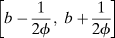 $\left[ {b - {1 \over {2\phi }},\;b + {1 \over {2\phi }}} \right]$, with density
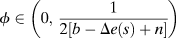 $\phi \in \left( {0,\;{1 \over {2\left[ {b - \Delta e\left(s \right) + n} \right]}}} \right)$.Footnote 13 Although this distribution is common knowledge, each realization is private information for individual voters. The average voter thus has a bias b > 0 toward I’s candidate, which could reflect material inducements—such as vote buying or targeted future transfers—that I can better provide (e.g., Magaloni Reference Magaloni2006).Footnote 14 For simplicity, we assume perfect enforcement such that individuals voting for I’s candidate receive b, regardless of the election outcome. This could reflect voters’ reciprocity or brokers’ willingness to target only those that they have learned are likely to reciprocate (e.g., Duarte et al. Reference Duarte, Finan, Larreguy and Schechter2018; Finan and Schechter Reference Finan and Schechter2012; Lawson and Greene Reference Lawson and Greene2014).
Combining these sources of utility, and abstracting from the decision to turn out,Footnote 15 voters then decide whether to vote for party I’s or party C’s candidate. The utility of voting for I for individual i receiving signal s is:
 $$\eqalign{{u_i}\left( {I{\rm{|}}s} \right) = - {e^I}\left(s \right) + {\delta _i} + {{\tf="Geostar-Regular (OpenType)"\char"006C}}\left[ {s \in \left\{ {l,h} \right\}} \right]{{\tf="Geostar-Regular (OpenType)"\char"006C}}\left[ {\Delta e\left(s \right) \,\le \,0} \right]\cr\mathop\sum\limits_{j \in {N_i}} {{{\tf="Geostar-Regular (OpenType)"\char"006C}}\left[ {\Delta {u_j}\left( {I{\rm{|}}s} \right) \,\ge \,0}\right]} .$$
Similarly, voting for C yields:
 $$\eqalign{{u_i}\left( {C{\rm{|}}s} \right) = - {e^C} + {{\tf="Geostar-Regular (OpenType)"\char"006C}}\left[ {s \in \left\{ {l,h} \right\}} \right]{{\tf="Geostar-Regular (OpenType)"\char"006C}}\left[ {\Delta e\left(s \right) > 0} \right]\cr\mathop\sum\limits_{j \in {N_i}} {{{\tf="Geostar-Regular (OpenType)"\char"006C}}[\Delta {u_j}\left( {C{\rm{|}}s} \right) > 0]} .$$
A voter votes for I when u i(I|s) ≥ u i(C|s).
Timing
The game’s timing is summarized as follows:
1. Candidate types S p ∈ {L, H} are realized.
2. All voters in a community receive a common signal
 $s \in \left\{ {\emptyset,l,h} \right\}$.
3. If s = l or s = h, then voters can coordinate around the candidate they believe to be least malfeasant.
4. Each voter’s individual partisan bias δi is privately realized.
5. Voters privately vote for I or C.

Equilibrium and Comparative Statics
We solve for a rational expectations equilibrium by first calculating I’s vote share as a function of its expected vote share,  ${\mathbb{E}}\left[ {{v_I}\left(s \right)} \right]$. We then set expectations to the true vote share to recursively derive equilibrium behavior under rational expectations about the behavior of other voters.
Integrating over partisan biases, the vote share among voters that receive signal s is implicitly defined by:
 $$\eqalign{ {v_I}\left(s \right) \cr= & {1 \over 2} + \phi \left( {b - \Delta e\left(s \right) + {{\tf="Geostar-Regular (OpenType)"\char"006C}}\left[ {s \in \{ l,h\} } \right]{{\tf="Geostar-Regular (OpenType)"\char"006C}}\left[ {\Delta e\left(s \right) \,\le \,0\,} \right]n{\mathbb{E}}\left[ {{v_I}\left(s \right)} \right]} \right. \cr & \left. { - {{\tf="Geostar-Regular (OpenType)"\char"006C}}\left[ {s \in \{ l,h\} } \right]{{\tf="Geostar-Regular (OpenType)"\char"006C}}\left[ {\Delta e(s) > 0} \right]n{\mathbb{E}}\left[ {1 - {v_I}\left(s \right)} \right]} \right) }$$
which follows from  ${\mathbb{E}}\left[ {\scriptstyle\sum\limits_{j \in {N_i}} {{{\tf="Geostar-Regular (OpenType)"\char"006C}}\left[ {\Delta {u_j}\left( {I{\rm{|}}s} \right) \,\ge\, 0} \right]} } \right] = n{\mathbb{E}}\left[ {{v_I}\left(s \right)} \right]$ and
 ${\mathbb{E}}\left[ {\scriptstyle\sum\limits_{j \in {N_i}} {{{\tf="Geostar-Regular (OpenType)"\char"006C}}\left[ {\Delta {u_j}\left( {C{\rm{|}}s} \right) > 0} \right]} } \right] = n{\mathbb{E}}\left[ {1 - {v_I}\left(s \right)} \right]$, by virtue of partisan biases being distributed independently across voters. Due to voter coordination, I’s support increases (decreases) with I’s vote share when voters’ posterior beliefs about I’s malfeasance are below (above) their belief about C’s malfeasance.
We then derive the equilibrium vote shares by applying rational expectations (i.e.,  ${\mathbb{E}}\left[ {{v_I}\left(s \right)} \right] = {v_I}\left(s \right)$), and solving recursively. This yields:
Proposition 1. In a rational expectations equilibrium, the candidate of incumbent party I receives the following vote share in a given community:
 $$\eqalign{{v_I}\left(s \right) = \cr\left\{ {\matrix{ {{1 \over 2} + \phi \left( {b - \Delta e\left( {\emptyset} \right)} \right)} \hfill & {\rm{if}}{\;s = \emptyset} \hfill \cr {{{{1 \over 2} + \phi \left( {b - \Delta e\left(s \right)} \right)} \over {1 - \phi n}}} \hfill & {\rm{if}}{\;s \in \left\{ {l,h} \right\}\;\quad{\rm{and}}\quad\;\Delta e\left(s \right) \le \,0} \hfill \cr {{{{1 \over 2} + \phi \left( {b - \Delta e\left(s \right) - n} \right)} \over {1 - \phi n}}} \hfill & {\rm{if}}{\;s \in \left\{ {l,h} \right\}\;\quad{\rm{and}}\quad\;\Delta e\left(s \right) > 0} \hfill \cr} } \right.$$
for any  $s \in \left\{ {\emptyset,l,h} \right\}$.
Proof: follows from derivation in the text. ■
Unsurprisingly, party I’s equilibrium vote share increases with the partisan bias in their favor and the extent to which voters update their posterior beliefs to believe that I is less malfeasant than they originally believed (i.e., when Δe(s) decreases). When coordination is around C’s candidate, the final component of the numerator in the last case captures coordination against I’s candidate. The denominator also illustrates coordination’s multiplier effect, such that the preceding effects in the numerator are inflated by the capacity to coordinate vote choices with n others.
We focus on the comparative statics that motivate our empirical analysis. In particular, in line with our empirical specification, we compare the case in which voters receive an informative signal (s ∈ {l, h}), which corresponds to voters in treated experimental precincts, to the case in which they do not  $\left( {s = \emptyset} \right)$, i.e., control precincts. For any given informative signal s, the difference in vote share between these cases is given by:
 $$\eqalign{{v_I}\left(s \right) - {v_I}\left( {\emptyset} \right) \cr= \left\{ {\matrix{ {{{ - \phi \left[ {\Delta e\left(s \right) - \Delta e\left( {\emptyset} \right)} \right] + \phi n\left[ {{1 \over 2} + \phi b - \phi \Delta e\left( {\emptyset} \right)} \right]} \over {1 - \phi n}}} \hfill & {\rm{if}}{\;s \in \left\{ {l,h} \right\}\;{\rm{and}}\;\Delta e\left(s \right) \le \,0} \hfill \cr {{{ - \phi \left[ {\Delta e\left(s \right) - \Delta e\left( {\emptyset} \right)} \right] - \phi n\left[ {{1 \over 2} - \phi b + \phi \Delta e\left( {\emptyset} \right)} \right]} \over {1 - \phi n}}} \hfill & {\rm{if}}{\;s \in \left\{ {l,h} \right\}\;{\rm{and}}\;\Delta e\left(s \right) > 0} \hfill \cr} } \right..$$
Regardless of the party that voters coordinate around, the effect of providing information is ambiguous. This reflects two potentially competing forces. Through the first term in the numerators, voters update their beliefs about I’s malfeasance, becoming more favorable toward I when their posterior belief that I is malfeasant is below their corresponding prior belief. This is more likely when voters initially believed I to be malfeasant, which could reflect an accurate assessment of I’s malfeasance (i.e., high σH − σL) or generally low expectations (i.e., high π 0), and when the signal suggests low malfeasance (i.e., s = l). The second term in the numerators captures an individual’s coordination incentives, which vary depending on whether Δe(s) ≤ 0. Intuitively, coordination benefits (harms) I when Δe(s) ≤ (>)0, and is increasing in n, ϕ, and the baseline (i.e., uninformative signal) vote share of the party around which voters coordinate. This may or may not agree with the direction of belief updating about I because learning depends on the change in beliefs, while coordination depends on comparing the levels of posterior beliefs. Both effects are multiplied by the incentive to bandwagon within social networks.Footnote 16
While the sign of the difference depends on the relative roles of belief updating and coordinated behavior, the difference changes unambiguously with n:Footnote 17
 $$\eqalign{{{\partial \left[ {{v_I}\left(s \right) - {v_I}\left( {\emptyset} \right)} \right]} \over {\partial n}} \cr= \left\{ {\matrix{ {{{\phi \left[ {{1 \over 2} + \phi b - \phi \Delta e\left(s \right)} \right]} \over {{{\left[ {1 - \phi n} \right]}^2}}} > 0} & {{\rm{if}}\;s \in \left\{ {l,h} \right\}\;{\rm{and}}\;\Delta e\left(s \right) \,\le \,0} \cr {{{ - \phi \left[ {{1 \over 2} - \phi b + \phi \Delta e\left(s \right)} \right]} \over {{{\left[ {1 - \phi n} \right]}^2}}} \lt \,0} & {\rm{if}}\;s \in \left\{ {l,h} \right\}\;{\rm{and}}\;\Delta e\left(s \right) > 0} \cr} } \right.$$
Intuitively, an increase in network connectedness n accentuates the coordination component, and thus increases the reward to (punishment of) I when voters believe that I is less (more) malfeasant than C. This is because coordination in more-connected networks increases the expectation that others will decide to coordinate on the less malfeasant candidate, which in turn increases the return for any individual to do so. Again, the direction of this effect does not necessarily match the direction of voters’ belief updating. For example, voters could become less likely to believe that I is malfeasant yet still believe that I’s candidate is more malfeasant in general, and thus coordinate more on C. However, for sufficiently large changes in beliefs, the learning and coordination effects will coincide, and coordination will compound learning.
Empirical Implications of Coordination within Social Networks
Various studies have shown that belief updating can drive voting behavior, including in the Mexican context that we study (Arias et al. Reference Arias, Larreguy, Marshall and Querubín2019). We instead focus on testing whether information provision can also generate voter coordination. To understand the model’s predictions relating to coordination in a particular context, we must first determine whether voters are more likely to coordinate around the incumbent or challenger party: we must identify whether Δe(s) ≤ 0 or Δe(s) > 0.
A crucial element of our particular empirical context is that voters believe challenger parties are less malfeasant than the incumbent party (i.e.,  $\Delta e\left( {\emptyset} \right) > 0$). Comparing average voter posterior perceptions of incumbent party malfeasance on a five-point scale with the analogous perception for the challenger party that came second in the previous election, 65% of treated precincts in our sample believed the challenger to be less malfeasant.Footnote 18
Because challenger parties are generally perceived to be less malfeasant than incumbent parties, when the voters in our sample coordinate, our model predicts that they will usually do so against the incumbent party. The analysis above thus implies that, if networks indeed moderate the effect of providing information about incumbent malfeasance by facilitating voter coordination, the provision of information should increasingly harm incumbent parties as network connectedness (i.e., n) increases. The comparative static in equation (8) entails:
Hypothesis 1 (H1). The effect of information provision on the incumbent party’s vote share decreases with network connectedness.
Although this heterogeneous effect is well-defined for our sample of precincts, the average effect of providing information—which reflects countervailing updating and coordinating forces—remains ambiguous. However, in our specific empirical context, where voters often update favorably about the incumbent party but still believe the challenger to be less malfeasant, equation (8) establishes that information provision can reduce the incumbent’s vote share in sufficiently connected networks.
Furthermore, we can directly test several of the model’s key assumptions using survey data. First, we assumed that networks facilitate voter coordination around the information provided by our informational treatment. If this is indeed the case, we expect to observe that voters in communities with more-connected networks will report higher levels of individual and collective engagement with, and understanding of, the treatment information:
Hypothesis 2 (H2). The effect of information provision on voter engagement with the information provided increases with network connectedness.
Second, given that H2 is not unique to the coordination mechanism, a more direct test examines our expectation that network connectedness increases both tacit and more explicit coordination among voters after information is provided:
Hypothesis 3 (H3). The effect of information provision on voter coordination increases with network connectedness.
Although the model assumes, for simplicity, that all voters receive the common signal, our theory also implies that coordination should be greater where a larger share of the voters received the information treatment. This is because networks are more likely to explicitly coordinate around the information and there is greater common knowledge of information provision. We thus hypothesize that:
Hypothesis 4 (H4). The magnitude of the differential effects predicted by H1, H2, and H3 increases with the share of voters that received the information.
Before turning to the research design, we also highlight how the defining features of our empirical context help us to empirically differentiate voter coordination from the potentially confounding effects of belief updating amplified by information diffusion through social networks. While our model abstracted from information diffusion within networks by assuming that all voters received the common signal, network connectedness is likely to increase the diffusion of information within communities where some voters do not receive the information. In the context of our model, this could entail seeding the information with a subset of voters that probabilistically transfer the information to those they are connected to. The diffusion mechanism thus implies effects that are observationally equivalent to the effects of voter coordination where voters, on average, update unfavorably about an incumbent party already believed to be more malfeasant than the challenger. This is because diffusion increases the probability that voters receive unfavorable information and update their posterior beliefs about the incumbent party’s malfeasance accordingly. However, because malfeasance information in our empirical context at least as often causes voters to update favorably about the incumbent party, even though they continue to perceive the incumbent party as relatively more malfeasant than challengers, networks’ diffusion and coordination functions produce opposing or orthogonal predictions. Similarly, information diffusion within networks predicts the opposite of H4, given that there are fewer opportunities for diffusion where more voters already have access to the information.
DATA AND EMPIRICAL DESIGN
We test the model’s implications in rural Mexican electoral precincts by combining experimental variation in the provision of information with precinct-level measures of network connectedness.
Sample of Rural Mexican Precincts
The experiment was conducted over the month before Mexico’s municipal elections held on Sunday 7th June 2015. The study covered 26 Mexican municipalities from the central Mexican states of Guanajuato, México, San Luis Potosí, and Querétaro. These states were selected for three reasons: (1) they held local elections in 2015, (2) they vary in their incumbent parties, and (3) they satisfied our safety and logistical protocols. The 26 municipalities were selected from among the 56 municipalities in these states for which an audit report was released in 2015. We oversampled municipalities for which reported incumbent malfeasance was particularly high or low and contrasted with that of other parties in the state. Figure 1 maps the location of these municipalities.
Municipalities Included in Our Experimental Sample

We selected 356 rural and 322 urban electoral precincts—Mexico’s smallest electoral unit—for our experimental sample.Footnote 19 This sample prioritized accessible rural precincts, where informational spillovers are least likely and where voters are unlikely to receive the information from other sources, and precincts in municipalities with high or low levels of incumbent malfeasance and stark contrasts with other parties. To minimize effects on municipal election outcomes, at most one-third of electoral precincts were treated in any municipality.
In this article, we focus on the almost-exclusively rural 296 precincts for which reliable social network data are available (see network construction details below). The 17 municipalities containing this final sample of precincts are shown in blue in Figure 1. Of these, four were governed by the PAN, 12 by the PRI, and one by the Citizen’s Movement. The summary statistics in Table 1 show that, compared to the national average, this sample has a lower population density and is less economically developed.
Precinct-Level Comparison of 2010 Census Characteristics Between Our Sample and the Nation

Note: All variables are unweighted.
Provision of Information on Incumbent Malfeasance
Our informational treatment, which was designed in partnership with the nonpartisan transparency nongovernment organization (NGO) Borde Político, sought to inform voters of ASF audit report outcomes for their municipality. We provided citizens with information about either the share of FISM expenditures that did not benefit the poor or the share of unauthorized FISM expenditures. Figure 2 shows a sample leaflet from the municipality of Guanajuato. The leaflet explains that the municipal government received 29.2 million pesos from the FISM fund to spend on social infrastructure projects benefiting the poor, and that (in this case) 28% of funds were spent on projects that did not benefit the poor. Figure 3 shows the distribution of reported malfeasance in our final sample of precincts. To minimize the risk that the information was perceived as political propaganda, the leaflet emphasized Borde Político’s nonpartisan status and explained the data source, referred to the government rather than particular parties, and used black and white to avoid colors associated with particular political parties.
Example of Local Information Leaflet in Salamanca, Guanajuato

Distribution of Incumbent Malfeasance in Our Final Sample

Although this core information was constant across treatment conditions, we also subtly varied the mode of information dissemination along two dimensions. First, in some precincts we provided a comparison with the average malfeasance of incumbents from different parties in the state. Second, to facilitate common knowledge about the information treatment, leaflet delivery was accompanied by a loudspeaker announcing the information’s dissemination. There is no evidence that either treatment variant influenced voters,Footnote 20 so we henceforth pool all information treatments. As discussed below, the lack of differential effects between treatment variants suggests that information provision serves primarily as a coordinating device in more-connected precincts.
Treatments were randomly assigned using a block randomization procedure in which four precincts from blocks containing six or seven precincts received an information treatment. Blocks include only rural or only urban precincts from within a particular municipality, and were otherwise assigned to maximize within-block similarity.Footnote 21 Within our 53 predominantly rural blocks, malfeasance information pertains to the same municipal incumbent party for all precincts within a block. Table A.1 in the Online Appendix shows that receiving an information treatment remains well balanced across precinct- and individual-level covariates for our subsample where reliable social network data are available. This indicates that the sample restriction maintains the randomization.
In each treated precinct, up to 200 leaflets were delivered to households by hand during the month before the election—either in person, or left in a mailbox or taped to the door if nobody was home—on behalf of Borde Político. Delivery occurred with few problems.Footnote 22 The exact locations where leaflets were delivered were logged, enabling enumerators to only visit leaflet recipients in treated precincts to administer the postelection survey.
Measuring Network Connectedness
A key challenge for researchers studying social networks is accurately mapping ties between individuals (Chandrasekhar and Lewis Reference Chandrasekhar and Lewis.2016). We address this challenge by using family ties to construct individual-level networks, which are aggregated to produce precinct-level proxies for a precinct’s connectedness. Unlike other societies, where friends and colleagues represent the primary sources of social interaction (e.g., Alt et al. Reference Alt, Jensen, Larreguy, Lassen and Marshall2017), extended families capture a substantial component of social interaction in rural Mexico, as noted above.
Following Angelucci et al. (Reference Angelucci, De Giorgi, Rangel and Rasul2009), we exploit Spanish naming conventions to link individuals from the list of Prospera beneficiaries. Prospera is a major nationwide conditional cash transfer program (previously called Oportunidades, and based on Progresa), that provides cash to around seven million impoverished beneficiaries in exchange for meeting school attendance and health requirements for their children. We obtained the list of individual Prospera beneficiaries and their localities for the first quarter of 2017 from catalogo.datos.gob.mx. Like other Spanish-speaking countries, Mexicans typically have two last names: a paternal last name passed on by their father and a maternal last name passed on by their mother.
We denote a node as an individual Prospera beneficiary, and define two nodes as connected if they share at least one last name and reside in the same precinct. As illustrated in Figure 4, a beneficiary named Juan López Fernández is connected to a second beneficiary named María Medina López, who indirectly connects Juan López Fernández to Pedro Pérez Medina. While our baseline specifications consider individuals as nodes, we show that our findings are robust to defining family names as nodes instead.Footnote 23
Example of Three Linked Individual Prospera Beneficiaries

To link the localities of Prospera beneficiaries to electoral precincts, we use 2010 Census data on the spatial distribution of all individuals living in each locality and the boundaries of electoral precincts. The procedure explained in Section A.2 in the Online Appendix ensures that Prospera beneficiaries are only used to characterize social networks when there is a sufficiently large voter overlap between their localities and an electoral precinct. Ultimately, this procedure yielded maps of linked individuals for 296 predominantly rural precincts containing 95,199 beneficiaries.
This approach to mapping social networks is appropriate for the rural precincts that we examine. First, because 31% of registered voters in our final sample of precincts are Prospera beneficiaries, our network maps are relatively comprehensive. While the use of sampled networks can upwardly bias estimates from network-level regressions due to nonclassical measurement error, this bias declines dramatically once sampling rates reach 30% (Chandrasekhar and Lewis Reference Chandrasekhar and Lewis.2016). Second, since rural communities are generally more tight-knit and experience lower levels of migration than urban areas, a shared surname in a rural area is more likely to indicate a genuine family tie. Nevertheless, like most network studies, there remains a risk of measurement error arising from false or missing connections between individuals. Fortunately, measurement error is likely to be reduced by aggregating our network measures at the precinct level, and there is little reason to believe that common surnames producing false ties are correlated with political behavior (e.g., Cantú Reference Cantú2014), or that political behavior is systematically associated with the probability of within-community marriage. To further mitigate the concern that the results reflect spurious ties, we control for the share of Prospera beneficiaries sharing a common surname as a robustness check.
To test our hypotheses, we use the network data to construct the two aforementioned precinct-level measures of network connectedness—average degree and the largest eigenvalue of the adjacency matrix describing the network. We standardize both measures to facilitate interpretation. Despite differences in their definitions, the high correlation suggests that these measures capture a similar underlying dimension, as our model assumed. Figures A.1 and A.2 in the Online Appendix provide examples of two similarly sized networks that vary significantly in their average degree and largest eigenvalue, respectively. Figure 5 shows the distribution of network connectedness in our sample.
Histogram of (Standardized) Measures of Network Connectedness

We validate that these measures of network connectedness indeed capture characteristics of the locality that are likely to support voter coordination by matching our network measures to survey data from the 2006 and 2011 National Social Capital Surveys (ENCAS).Footnote 24 The two cross-sectional ENCAS waves comprise 219 questions gauging different aspects of community life and include a special module for respondents who identify themselves as Prospera beneficiaries. Our main outcome—an index of overall community connectedness—is based on subindices capturing two aspects of connectedness: participation and efficacy.Footnote 25 The participation index is composed of up to three variables: participation in social organizations, participation in social activities with other Prospera beneficiaries (if a Prospera beneficiary), and informal associations with other Prospera beneficiaries (if a Prospera beneficiary). The efficacy index is composed of up to four variables: perceived influence, cooperation, problem-solving involvement (if a Prospera beneficiary), and problem-solving experience. Due to the rural nature of our final sample, we restrict attention to the 376 rural localities across the country sampled in the ENCAS, and construct family networks of individual beneficiaries at the locality level comprising almost a million individuals.
Table 2 reports a strong positive correlation between average degree and the largest eigenvalue and the community connectedness index, as well as the participation and efficacy subindices. In all instances, these associations are statistically significant and suggest that our network measures based on family ties among Prospera beneficiaries meaningfully capture broader features of communal life that may help sustain cooperation and coordination in political behavior. By contrast, we show in Table A.2 in the Online Appendix that other common network metrics—such as average clustering, average path length, closeness, and link densityFootnote 26—are uncorrelated with the community connectedness index. For this reason, we focus throughout on our two theoretically-driven measures of network connectedness that positively correlate with proxies for the strength of social ties and coordination capacity—average degree and largest eigenvalue.
Correlation Between Locality-Level Network Connectedness Measures and Locality-Level Community Connectedness
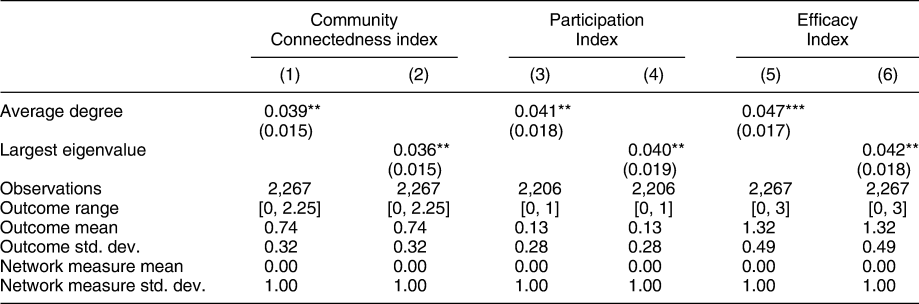
Notes: All specifications are estimated using OLS. Both measures of network connectedness are standardized. Standard errors clustered by municipality are in parentheses. * p < 0.1, ** p < 0.05, *** p < 0.01.
Outcomes
We use two data sources for our main outcomes: official electoral returns and a survey we conducted in the three weeks following the election. First, we use precinct-level election results from state electoral institutes to measure the incumbent party’s vote share, both as a share of those that turned out and as a share of registered voters in the precinct. Second, precinct-level electoral outcomes are supplemented by individual-level survey data gauging beliefs about different parties, engagement with the treatment, and coordinated vote choices. These variables, which test the central mechanisms underpinning the model, are introduced later on when we present evidence on mechanisms. We conducted surveys with ten randomly sampled voters who received a leaflet in all treated precincts, and ten surveys of randomly selected voters in one control precinct per block.Footnote 27
Empirical Strategy
To test hypotheses H1, H2, and H3, we estimate baseline specifications of the following form:
 $$\eqalign{\displaylines{ {Y_{pbm}}{ \,= \beta_1}\;Information\;provisio{n_{pbm}} \cr+ {\beta _2}\;Networ{k_{pbm}}} \cr + \,{\beta _3}\left( {Information\;provisio{n_{pbm}} \,\times\, Networ{k_{pbm}}} \right) \cr+ \,{\mu _{bm}} + {\varepsilon _{pbm}}, \cr}$$
where Y pbm is an outcome for electoral precinct p within randomization block b in municipality m. For individual-level survey outcomes, Y ipbm includes an i subscript. Information provision pbm and Network pbm are, respectively, a randomized precinct-level information provision indicator and one of our two measures of network connectedness. The block fixed effects, μbm, adjust for the differential treatment assignment probabilities across blocks arising from different block sizes, and enhance efficiency by exploiting variation in treatment assignment only within blocks of similar precincts. Standard errors are clustered at the municipality-treatment level, and precinct-level observations are weighted by the share of registered voters that received a leaflet (or would have received a leaflet, among control precincts). Additional specifications control for the interaction between information provision and the following (standardized) variables that could potentially confound the interaction between information provision and network connectedness: (log) population density; an urban indicator; an index of socioeconomic development; the distance from the precinct’s center to the municipality head; the share of Prospera beneficiaries; and the PAN, PRD, and PRI, and incumbent vote shares in 2012.
Since we are principally interested in how social networks moderate the effects of providing voters with information about incumbent performance, our main coefficient of interest is β3. This captures the heterogeneous effect of information provision by network connectedness. Given that voters generally perceive challenger parties to be less malfeasant than the incumbent party, the model’s prediction in H1 implies that β3 < 0. In other words, provision of information concerning incumbent malfeasance should have a decreasing effect on incumbent party vote share as network connectedness increases. In contrast, following H2 and H3, we expect β3 > 0 for outcomes related to engagement with and coordination around the information. This implies that voters’ reaction to the treatment should increase with network connectedness.
To test H4, we include a further interaction with the share of registered voters that received the information in equation (9). In such regressions, we expect that the share receiving the leaflet would accentuate the interaction between information provision and network connectedness, because a greater share of the network is aware of our treatment leaflet and that other voters also received it.
RESULTS
We now present our main finding that providing information about an incumbent’s performance can cause voters to coordinate around parties believed to be less malfeasant.
Precinct-Level Electoral Returns
We first test H1 and H4 by examining whether networks moderate the effect of providing information about incumbent malfeasance on precinct-level incumbent party electoral support in a manner consistent with voter coordination. The results are shown in Table 3.
Effect of Information Provision on Incumbent Party Vote Share, by Network Connectedness

Notes: All specifications include block fixed effects and are estimated using OLS. Observations in columns (1)–(5) are weighted by the share of the precinct that received a leaflet (or would have received a leaflet, for control precincts); observations in columns (6)–(10) are unweighted. Lower-order interaction terms are omitted. Both measures of network connectedness are standardized. Controls interacted with the treatment in columns (3), (5), (8), and (10) include: precinct population density, urban indicator, level of development, distance to the municipality center, share of Prospera beneficiaries, and the PAN, PRD, PRI, and incumbent vote shares in 2012. Standard errors clustered by municipality-treatment are in parentheses. * p < 0.1, ** p < 0.05, *** p < 0.01.
Before turning to our main hypotheses, we first confirm that the baseline finding in Arias et al. (Reference Arias, Larreguy, Marshall and Querubín2019)—that voters, on average, reward incumbent parties after learning of the malfeasance revealed by the ASF’s audit—also holds in our predominantly rural sample. Indeed, column (1) of panel A shows that information provision increases the incumbent party’s vote share, as a share of turnout, by an average of 3.8 percentage points. Panel B shows that incumbent vote share, as a share of registered voters, similarly increases by 2.1 percentage points. Moreover, Table A.3 in the Online Appendix shows that information provision does not significantly affect turnout. These findings are consistent with the explanation that audit report information caused voters to positively update their posterior beliefs about the incumbent party relative to challenger parties or to reduce their uncertainty about the incumbent party, and in turn cease voting for the challenger party or start voting for the incumbent party. This further implies that, if the predominant role of networks is to help diffuse information within a precinct, we should expect to observe a positive interaction with network connectedness.
Our first main finding pertains to H1, which hypothesizes that providing information should reduce the incumbent party’s vote share by coordinating voters against the incumbent party in precincts with high levels of network connectedness. As hypothesized, the interaction between information provision and average degree in column (2) of panels A and B shows that information provision has a significantly smaller positive effect in precincts characterized by a higher average degree. Column (4) shows that a similar relationship holds when using the largest eigenvalue to measure network connectedness. These negative coefficients are consistent with social network connectedness reducing incumbent support by coordinating voters against incumbents generally perceived to be more malfeasant than challengers. This contrasts with the positive interaction we would expect to observe if networks were primarily serving to diffuse information, given that information dissemination led voters to, on average, reward incumbent parties in this context.
The magnitudes of these heterogeneous effects, which are statistically significant at the 5% level, are also sizable. A one standard deviation increase in network connectedness reduces the positive effect of information provision by between 2.3 and 3.4 percentage points (or seven and 10% of the incumbent vote share). Figure 6 displays the marginal effect of information provision for each network connectedness measure. Both graphs indicate that the largely positive effects of information provision on incumbent support in the least connected precincts are fully offset in sufficiently connected precincts.
Effect of Information Treatment on Incumbent Party Vote Share (Share of Turnout) Across Precincts With Varying Network Connectedness (95% Confidence Interval)
Notes: Estimates derive from columns (2) and (4) in Table 3. Both measures of network connectedness are standardized. The gold density plot represents the sample distribution of the corresponding network connectedness measure.

Columns (7)–(10) test H4 by examining whether the magnitude of the negative interaction shown above also increases with the share of voters within the precinct who received the information. Consistent with voter coordination, whether through explicit discussion and agreement or tacit coordination, the negative triple interactions show that the largest negative effects of information provision occurred in precincts where a substantial fraction of voters received the information. The estimates imply that, for a given level of network connectedness, increasing the share that received the information treatment from 0% to 100% would decrease the incumbent party’s vote share (as a share of turnout) by around seven percentage points. This casts further doubt on the possibility that information dissemination drives the decline in incumbent party support among the most-connected networks. Nevertheless, to more directly establish that these results are indeed driven by voter coordination, we next examine the mechanisms using survey data.
Individual-Level Evidence of the Voter Coordination Role of Networks
If networks indeed facilitate voter coordination around the provision of incumbent performance information, we expect voters’ engagement with, and their coordination around, information provision to be greater in more connected precincts. We test these claims in hypotheses H2–H4 using our postelection survey. While we focus on indexes of voters’ engagement and coordination that average across multiple indicators, Section A.7 in the Online Appendix reports similar results for the indexes’ constitutive items.
Voters in More-connected Networks Engage More with Information Provision
To test H2, we create an additive index of voters’ engagement with the information provided. This index includes four (standardized) indicators of whether voters: (1) report that they remember receiving the information leaflet, (2) report having read the leaflet, (3) correctly recall the types of spending to which the leaflet pertained, and (4) declare that the leaflet influenced their vote. The index sums each item, with a Cronbach’s alpha of 0.83.Footnote 28 Panel A in Table 4 shows the interaction between information provision and our measures of network connectedness for this outcome. Moreover, to test H4, panel B shows the corresponding estimates when we further interact these variables with the share of registered voters that received the treatment. If engagement with the information provided indeed increases with network connectedness, we should also expect greater effect when the share of the treated population is larger.
Effect of Information Provision on Voters’ Engagement With the Information, by Network Connectedness

Notes: All specifications include block fixed effects and are estimated using OLS. Lower-order interaction terms are omitted. Both measures of network connectedness are standardized. Controls interacted with the treatment in columns (3) and (5) include: precinct population density, urban indicator, level of development, distance to the municipality center, share of Prospera beneficiaries, and the PAN, PRD, PRI, and incumbent vote shares in 2012. Standard errors clustered by municipality-treatment are in parentheses. * p < 0.1, ** p < 0.05, *** p < 0.01.
Across panel A of Table 4, we find evidence suggesting that in highly connected treated precincts, voters are significantly more likely to report engaging with the information. On its own, the treatment induces more than a standard deviation increase, on average, in engagement with the treatment among those who received a leaflet. A standard deviation increase in network connectedness implies that the effect of information provision becomes one quarter of a standard deviation larger. Moreover, panel B suggests that such effects are driven by precincts where large shares of community members received the treatment.Footnote 29
Although networks’ role in facilitating voters’ engagement with the information is not unique to coordination mechanisms, these findings nevertheless demonstrate that information provision generated the responses likely to be necessary for voter coordination.
Network Connectedness Facilitates Voter Coordination
We next test H3 by examining whether networks facilitate coordination around the treatment information. To do so, we again compute an additive index containing five (standardized) indicators of coordination, namely whether voters: (1) identified that a large proportion of their community also received the information, (2) discussed the leaflet with other voters, (3) coordinated their vote for a particular party during this discussion, (4) changed their vote due to this discussion, and (5) changed their vote since this discussion led them to think that other voters would change their vote. This array of variables captures both explicit and tacit coordination; the Cronbach’s alpha is 0.75. We again examine the heterogeneous effects of information provision by network connectedness.
The results in Table 5 demonstrate that information provision served as an effective coordination device for voters. Again, the lower-order effect of information provision indicates that it significantly increased coordination on average—by more than half a standard deviation in the index among control respondents. The heterogeneous effects further show that such coordination was substantially greater in precincts with high network connectedness, using either measure. In particular, the estimates in panel A show that a standard deviation increase in network connectedness increases the average effect of information provision by almost a further 30%. Panel B also suggests that such effects are driven by precincts where a larger share of the community received the leaflet. Taken together, these estimates suggest that information provision facilitated coordination, especially in highly connected precincts. Tables A.6 and A.7 in the Online Appendix break the index down into its constitutive items, and show that information provision increased measures of both tacit and explicit coordination as a response to the treatment. Indeed, voters in treated precincts with more connected networks are significantly more likely to report both that they were aware that many others received the leaflet and that discussion with others led themselves and other voters to change the party that they voted for. Our findings are thus consistent with explicit interpersonal agreements and higher-order beliefs both driving coordination against the incumbent party.
Effect of Information Provision on Voters’ Coordination Around the Information, by Network Connectedness

Notes: All specifications include block fixed effects and are estimated using OLS. Lower-order interaction terms are omitted. Both measures of network connectedness are standardized. Controls interacted with the treatment in columns (3) and (5) include: precinct population density, urban indicator, level of development, distance to the municipality center, share of Prospera beneficiaries, and the PAN, PRD, PRI, and incumbent vote shares in 2012. Standard errors clustered by municipality-treatment are in parentheses. * p < 0.1, ** p < 0.05, *** p < 0.01.
Combined with the findings in Table 4, our survey data show that information provision stimulated voter engagement with information provided and coordination around it in more-connected precincts. Table 3 shows reduced support in those same precincts for incumbents who are, on average, perceived to be more malfeasant than challengers in this empirical context.
Robustness Checks
We buttress our precinct- and individual-level findings using a variety of robustness checks. We first address the concern that our main findings are confounded by alternative explanations unrelated to the role of social networks. We then address alternative—i.e., noncoordination—interpretations of our finding that network connectedness moderates the effects of information provision on support for incumbent parties.
Potential Confounds
First, we show that the results are robust to controlling interactively for variables that could instead explain the heterogeneous effects of information provision. In particular, we simultaneously include controls to address four key sources of potential bias: (1) we include (log) population density, an indicator of urban precinct and the distance from the precinct centroid to the municipal city center to ensure that the results do not simply reflect differences in responses to malfeasance revelations between more and less rural areas; (2) we include the share of Prospera beneficiaries to address the concern that the results reflect the availability of network data or the incidence of poverty; (3) we include an index capturing socioeconomic development to control for differential responses to information across richer and poorer and more- and less-educated respondents, which could also correlate with network connectedness; and (4) we include linear controls for the PAN, PRD, PRI, and incumbent vote shares in 2012 to address the concern that network connectedness is correlated with partisanship (Sinclair Reference Sinclair2012), which could affect how voters process the information provided or induce ceiling or floor effects.Footnote 30 As columns (3) and (5) in Tables 3–5 show, the lower effects of information provision on support for the incumbent party, engagement with the information, and coordination around the information in more-connected precincts do not appear to reflect such confounds. Columns (1) and (2) of Table 6 further show that the survey results are robust to including individual-level interactive controls for age, gender, education, and income. To save space, we only present the results from our baseline specifications for our two network measures; complete results analogous to Tables 3–5 are provided in Tables A.20–A.30 in the Online Appendix.
Robustness Checks Against Potential Confounds

Notes: All specifications include block fixed effects and are estimated using OLS. Lower-order interaction terms are omitted. All observations in panel A are weighted by the share of the precinct that received a leaflet (or would have received a leaflet, for control precincts). Both measures of network connectedness are standardized. Individual-level controls are age, gender, education, and income, and are interacted with information provision; specifications including individual-level controls are not relevant for the electoral outcomes in panel A. Standard errors clustered by municipality-treatment are in parentheses. * p < 0.1, ** p < 0.05, *** p < 0.01.
Second, our results are not driven by our approach to network construction. Given that links in our networks are defined by family names, an alternative approach to calculating network statistics would be to treat families—rather than individuals—as nodes. Encouragingly, the point estimates in columns (3) and (4) in Table 6 show that these two approaches yield similar results. Another potential concern is that our measures of network connectedness reflect common surnames, such as López, rather than genuine family ties; accordingly, the results could be spurious. Although it is not clear why the effects of information provision would be lower in precincts containing clusters of unrelated individuals with shared surnames, we nevertheless examine the sensitivity of our findings to this concern by controlling for the interaction between information provision and the share of Prospera beneficiaries within the precinct with a surname that represents 1% or more of all Prospera beneficiaries.Footnote 31 Columns (5) and (6) show that our main findings remain robust.
Third, another possibility is that our survey-level results—which provide the most direct evidence of voter coordination—could reflect social desirability bias. In particular, voters may seek to please enumerators by falsely claiming to be politically active in treated precincts. Such experimental demand effects could be accentuated in connected networks. To address these concerns, we use self-reported turnout in 2012 as a placebo test: previous turnout should not be affected by information provision, but if social desirability bias is present then treated respondents may nevertheless report previously turning out after receiving the treatment. Indicating that experimental demand is unlikely to be driving our survey findings, Table 7 shows that neither information provision, nor its interaction with network connectedness, predict self-reported turnout in the 2012 election.
Effect of Information Provision on Self-Reported Voters Turnout in 2012, by Network Connectedness

Notes: All specifications include block fixed effects and are estimated using OLS. Lower-order interaction terms are omitted. Both measures of network connectedness are standardized. Controls interacted with the treatment in columns (3) and (5) include: precinct population density, urban indicator, level of development, distance to the municipality center, share of Prospera beneficiaries, and the PAN, PRD, PRI, and incumbent vote shares in 2012. Standard errors clustered by municipality-treatment are in parentheses. * p < 0.1, ** p < 0.05, *** p < 0.01.
Alternative Interpretations
The preceding checks support our key findings with respect to the interaction between information provision and network connectedness. However, even taking the moderating effect of networks as given, changes in vote share could still reflect a network-based channel other than coordination around less malfeasant parties. We address this concern by seeking to dismiss three plausible alternative interpretations that rely on individual, rather than coordinated, action: that networks enhance belief updating by facilitating information diffusion, within or across precincts, and that networks encourage further information acquisition.
The most important alternative interpretation is that connected social networks could help diffuse incumbent malfeasance information within a precinct without inducing voter coordination. However, three features of this interpretation are inconsistent with the data. First, in contrast with coordination around the less malfeasant party—which is generally challengers, rather than incumbents, in this sample—diffusion through social networks should increase the number of voters who receive the information and respond similarly to it. We should then expect the positive effect of information provision on incumbent party vote share to be greater in more-connected precincts. As noted above, Table 3 clearly shows that—consistent with the coordination mechanism—the opposite holds.
Second, if information diffusion were the dominant force driving our findings, then we should find that more-connected networks accentuate the voter updating proposed in equation (1) of our model.Footnote 32 In contrast, coordination will generally be far less sensitive to how information signals relate to prior beliefs—particularly in cases like ours, where the extent of belief updating is relatively limited—because a switch in coordination requires that voters reverse their perception of which party is less malfeasant, rather than update on the margin. We test this implication of the information diffusion channel by examining how voters’ posterior beliefs about the incumbent party’s level of malfeasance vary with information provision, information content, prior beliefs and updating,Footnote 33 as well as network connectedness. Arias et al. (Reference Arias, Larreguy, Marshall and Querubín2019) show that voters indeed update their perceptions of parties based on the information provided: they believe incumbents to be more malfeasant when more funds were spent in an unauthorized manner or not spent on the poor than voters anticipated, and ultimately adjust their vote choices accordingly. Column (1) of Table 8 shows that this broadly continues to hold in our rural subsample.
Effect of Information Provision on Posterior Beliefs, by Information Content, Prior Beliefs, and Network Connectedness

Notes: All specifications include block fixed effects and are estimated using OLS. Lower-order interaction terms are omitted. Both measures of network connectedness are standardized. Controls interacted with the treatment in columns (3) and (5) include: precinct population density, urban indicator, level of development, distance to the municipality center, share of Prospera beneficiaries, and the PAN, PRD, PRI, and incumbent vote shares in 2012. The smaller sample in columns (2)–(5) of panels B and C reflects the lack of data on prior beliefs about the incumbent party in Apaseo el Alto. Standard errors clustered by municipality-treatment are in parentheses. * p < 0.1, ** p < 0.05, *** p < 0.01.
However, columns (2)–(5) report no systematic evidence that the interaction effect of information provision with voters’ prior beliefs, voters’ updating, or the content of the information provided, on voter perceptions of the incumbent party’s malfeasance (where larger values on this five-point scale represent greater perceived malfeasance) differed in more-connected precincts. Although network connectedness generally does not significantly moderate belief updating, the few statistically significant triple-interaction coefficients in panel D point in the opposite direction to that predicted by the information diffusion mechanism.Footnote 34 Thus, while voters update their beliefs based on the new information, such belief updating does not appear to be accentuated by greater network connectedness in this context.
Third, the treatment variant results in Tables A.13–A.17 in the Online Appendix further suggest that information diffusion within precincts does not drive the results. Most notably, the consistent lack of differential effects between the treatment variants indicates that all forms of treatment served as similar focal points for coordination. Within networks, this suggests that information provision principally served as a coordination device, rather than a source of specific information. Furthermore, the finding that benchmarked information—which generally showed challengers to be outperforming incumbents, which could in principle have been reinforced by networks’ diffusion function—did not elicit different responses from treated voters that only received information about their incumbent implies that voters did not collectively update from performance comparisons.
A related alternative interpretation suggests that information diffuses across precincts. Given that precincts with high levels of network connectedness are often neighbors, information diffusion across neighboring precincts could account for the lower effect of information provision in such precincts by reducing differences in behavior between them. However, Arias et al. (Reference Arias, Larreguy, Marshall and Querubín2019) show that precincts that neighbor treated precincts do not exhibit any changes in voting behavior or a greater likelihood of recalling or acting on information provided to their neighbor.
Another possibility is that the discussion of the information induced voters in more-connected networks to acquire further political information. This could result in voters being exposed to unfavorable information (or information framed as such) about the incumbent party through the media, and then deciding—without considering others’ vote choices—to reject the incumbent party. We assess this possibility by examining whether voters increase their engagement with politics. The results in Table 9 again offer little support for this alternative interpretation, suggesting that voters in more-connected treated precincts did not become significantly more likely to consume political news through the media.
Effect of Information Provision on Political News Consumption, by Network Connectedness

Notes: All specifications estimated using OLS. Both measures of network connectedness are standardized. Controls interacted with the treatment in columns (3) and (5) include: precinct population density, urban indicator, level of development, distance to the municipality center, share of Prospera beneficiaries, and the PAN, PRD, PRI, and incumbent vote shares in 2012. Standard errors clustered by precinct are in parentheses. * p < 0.1, ** p < 0.05, *** p < 0.01.
CONCLUSION
This article substantiates the claim that the provision of incumbent performance information can facilitate electoral sanctioning by stimulating voter coordination within social networks. Guided by a simple theoretical model, and leveraging an empirical context in which the effects of networks’ coordination and information diffusion roles diverge, we use precinct- and individual-level data to demonstrate that information provision can help voters in more-connected networks to coordinate around less malfeasant candidates. We thus more generally show that, given an effective coordinating device, social networks can play a key role in helping voters pursue potentially superior political outcomes that unconnected voters could not attain.
Our findings suggest that previous studies emphasizing the information diffusion role of networks may have underestimated the role that voter coordination can play in electoral behavior. This is because networks’ coordination and information diffusion mechanisms are complementary and observationally equivalent in many contexts. A key contribution of this study is to highlight how these mechanisms can be distinguished and demonstrate that coordination plays an important role in voters’ responses to information provision. This in no way implies that belief updating arising from information diffusion is not also a key driver of voter behavior (e.g., Alatas et al. Reference Alatas, Banerjee, Chandrasekhar, Hanna and Olken2016; Ames, Baker, and Smith Reference Ames, Baker, Smith, Victor, Lubell and Montgomery2016; Larson and Lewis Reference Larson and Lewis.2017; Schaffer and Baker Reference Schaffer and Baker2015). However, distinguishing between social networks’ coordination and diffusion functions can have important implications. For example, NGOs seeking to optimize information dissemination campaigns may wish to design their campaigns to complement opportunities for coordination, e.g., by providing information at (or just prior to) public events or in communities where collective action is common.
Given the potential of coordination to support collective action and participatory democracy more broadly, we must better understand how differences in social structure can complement coordination devices to support such democratic foundations. Beyond information provision, networks could induce similar coordination dynamics following other common signals such as public meetings, protests, media reports, and advertising campaigns. Further research is also required to probe the conditions under which explicit and tacit coordination flourish, the role of leadership in organizing communities, optimal network structures for facilitating coordination, whether and how voters decide which challenger parties to coordinate around when several alternatives exist, and whether it is possible to discourage coordination around bad equilibria that could induce or perpetuate development traps.
SUPPLEMENTARY MATERIAL
To view supplementary material for this article, please visit https://doi.org/10.1017/S0003055419000091.
Replication materials can be found on Dataverse at: https://doi.org/10.7910/DVN/8IWRBI.


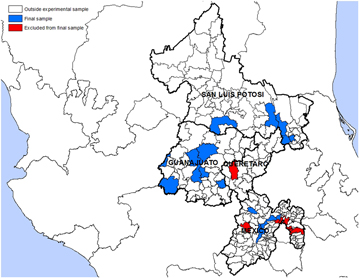
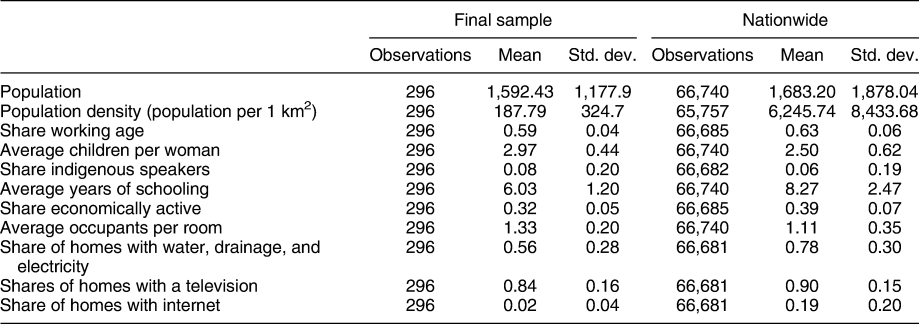

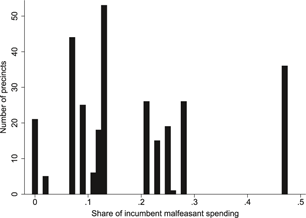
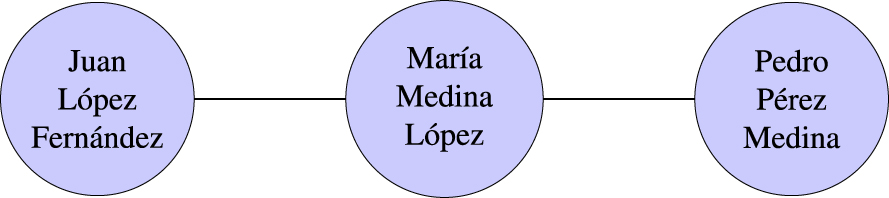
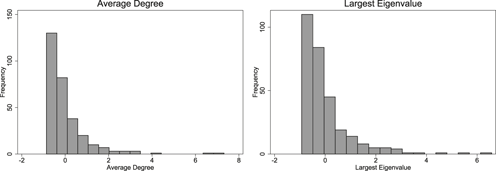
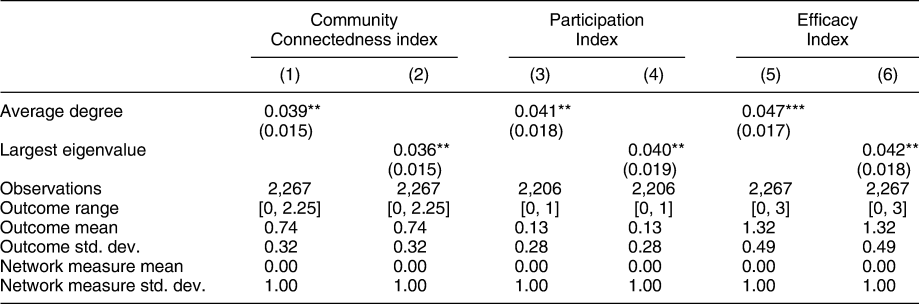
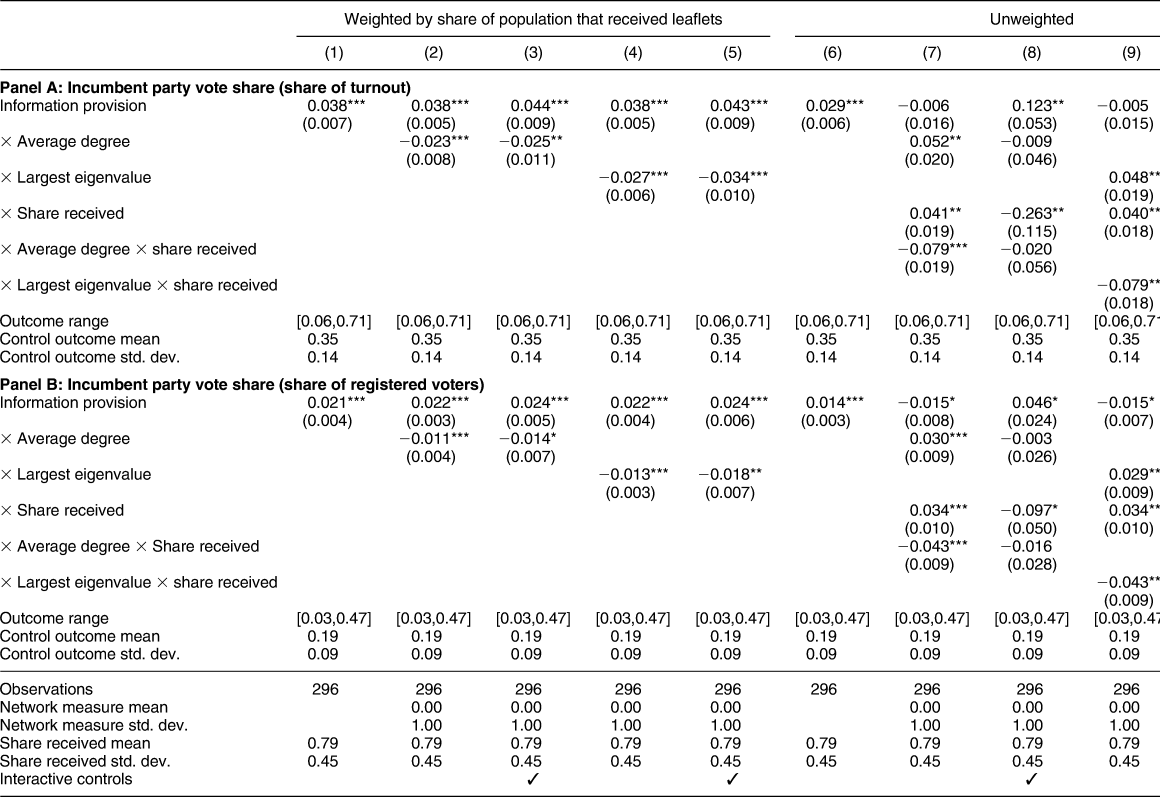
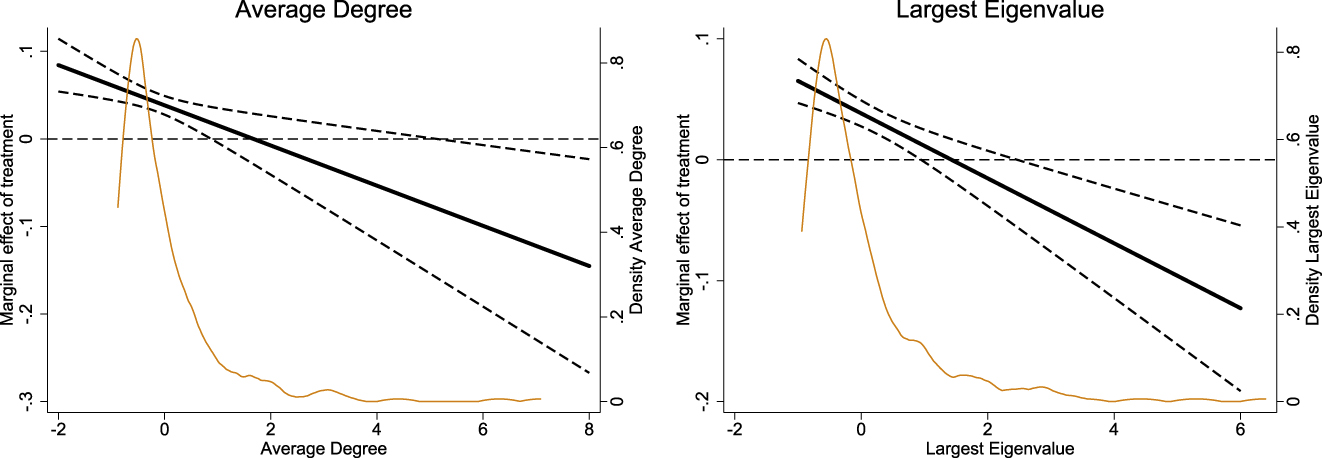
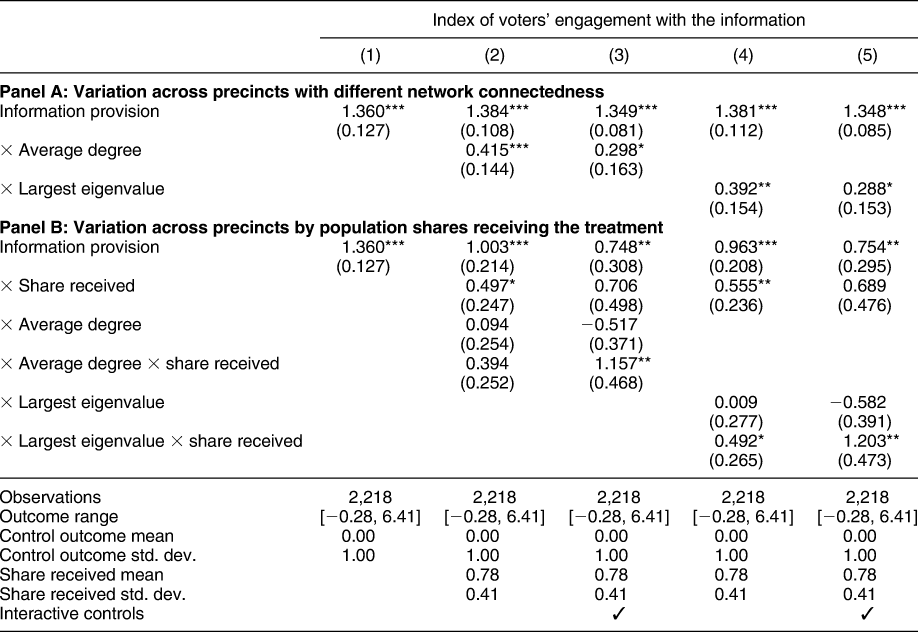
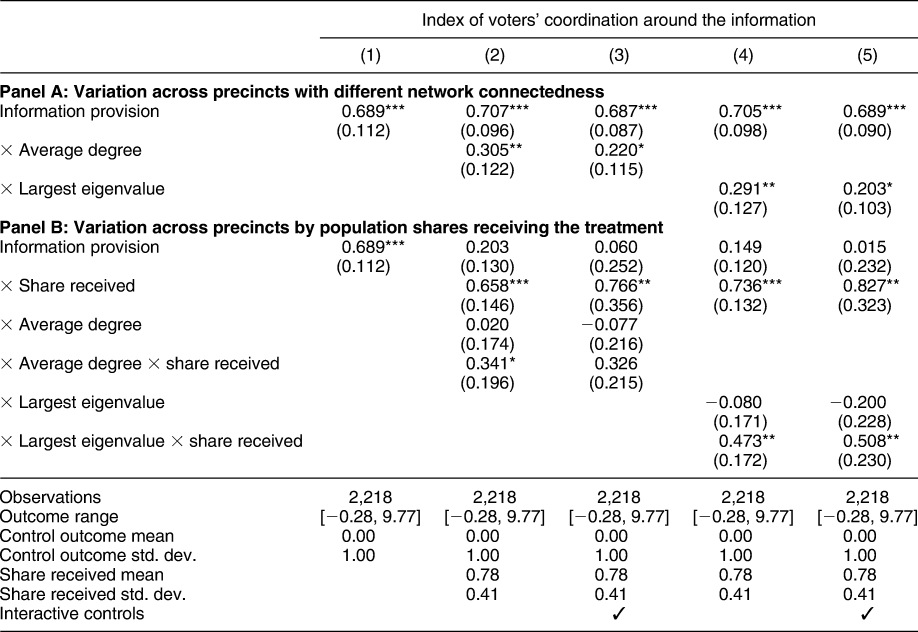
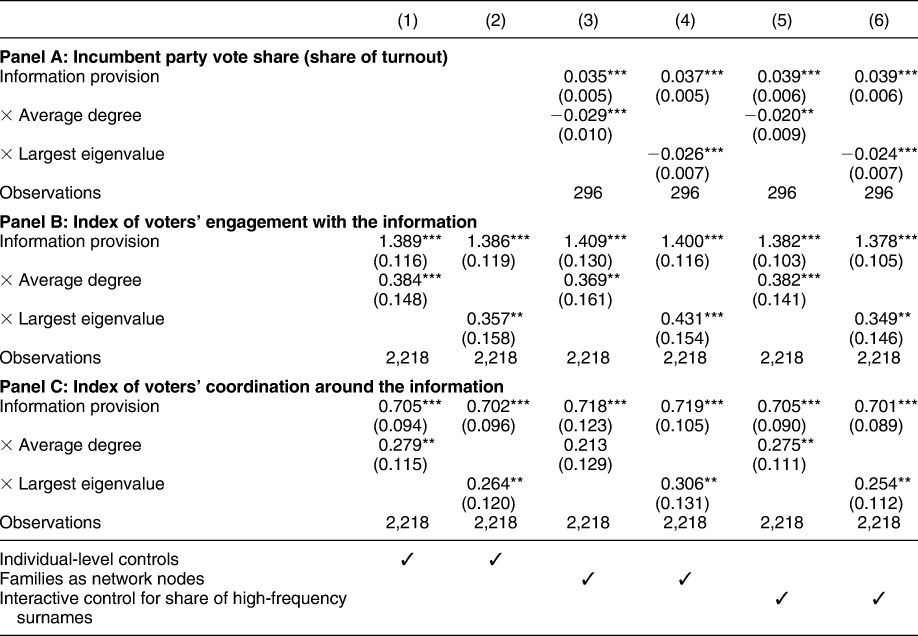
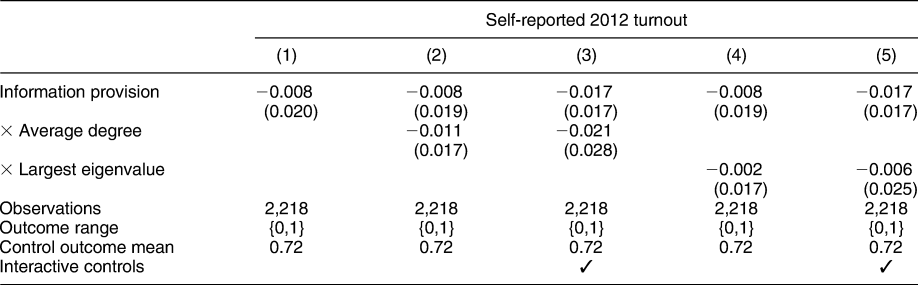
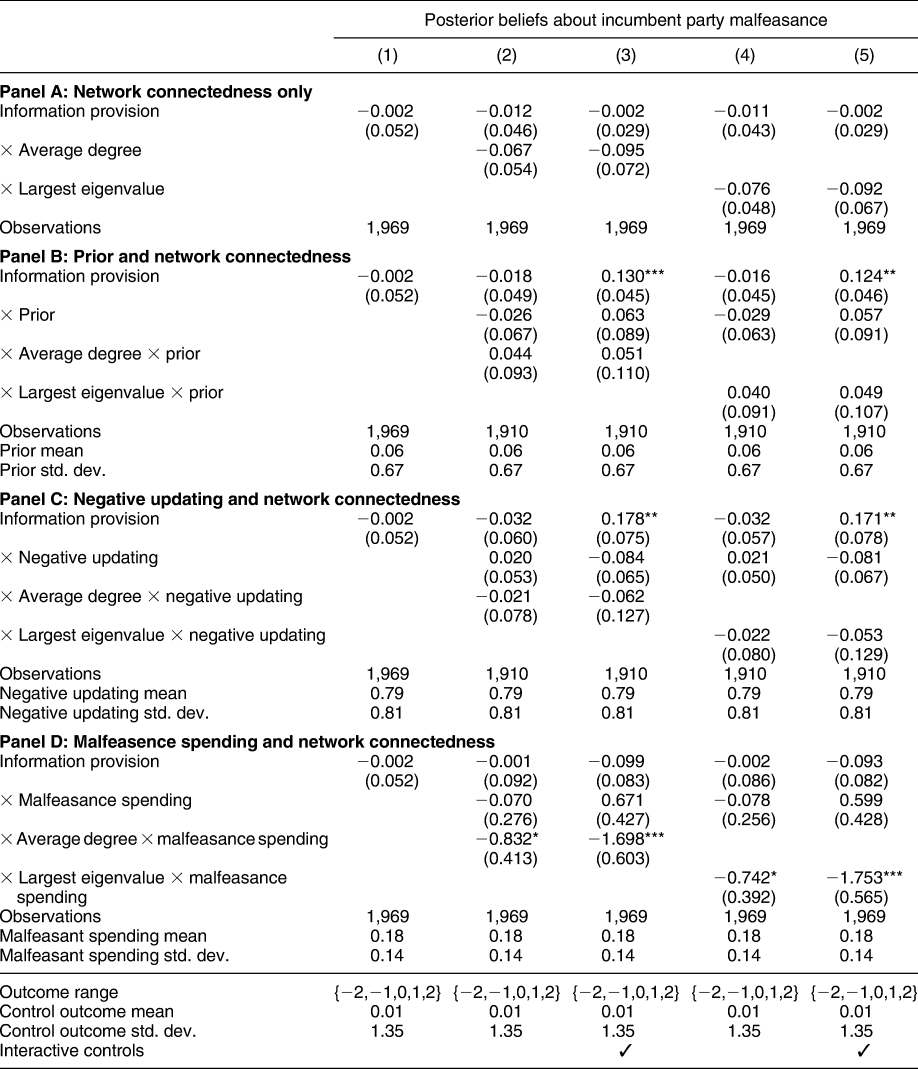
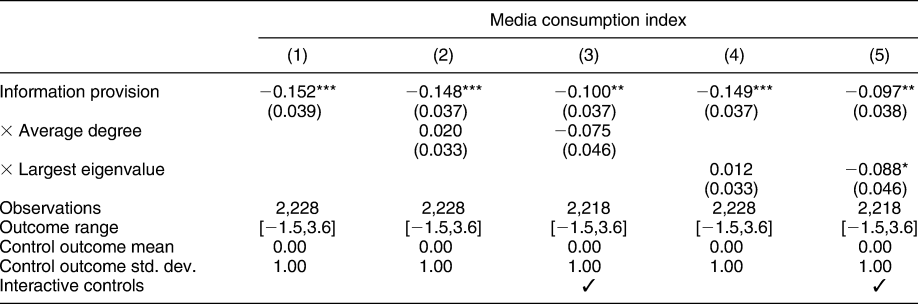




Comments
No Comments have been published for this article.