Introduction
The Canadian Longitudinal Study on Aging (CLSA) is a national multidisciplinary study that will follow 50,000 men and women between the ages of 45 and 85 years of age for at least 20 years. While the CLSA focuses on healthy aging, resiliency, and adaptation as people age, it will also track the natural history of chronic diseases, which are the leading causes of death and disability among adult Canadians, and explore how exposure to various risk factors influences disease incidence and outcomes. Despite their importance, it is not feasible, however, to apply standard clinical diagnostic criteria for many of these diseases in large population-based studies. In epidemiological studies, imprecise information affects the interpretation of the associations among risk factors and specific conditions. Misclassification of disease status can lead to an attenuation of the magnitude of the risk factor and disease relationships. To reduce the potential for bias, large population-based studies often employ standardized methods of ascertaining diseases. Many longitudinal studies have developed and/or used disease-specific algorithms to identify the presence or absence of major chronic diseases and conditions. These algorithms combine different types of information such as self-reported diagnoses, questionnaires, medical records, anthropometric measures, physician examination, medications, and laboratory and clinical tests to determine an individual’s disease status.
The CLSA will include a face-to-face home interview, a non-physician administered physical assessment, and clinical tests. The face-to-face interview will provide most of the information on self-reported disease status, condition-specific questionnaires, and medication use. The physical assessment will include physiological and anthropometric measurements, non-invasive clinical examinations (e.g., vision and hearing), laboratory tests, and diagnostic procedures such as electrocardiograms and dual-energy x-ray absorptiometry. For feasibility and methodological reasons, our physical assessments will not be conducted by physicians nor will we undertake chart reviews of medical records.
With these constraints in mind, we conducted a systematic review of observational population-based studies to identify algorithms, criteria, and tools used to ascertain chronic diseases. In addition, we present our assessment of the feasibility of ascertaining the presence or absence of selected diseases in a large population-based study such as the CLSA.
Methods
Identification of Chronic Diseases
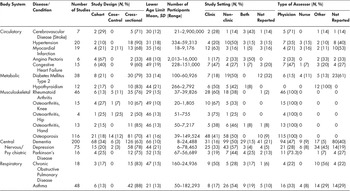
We assembled expert working groups to identify important clinical research questions and associated disease outcomes to be addressed in the CLSA. The groups were composed of clinical epidemiologists, methodologists, and subspecialists with clinical expertise in the circulatory, metabolic/endocrine, musculoskeletal, nervous, and respiratory systems. In each clinical area, the group proposed diseases that would be a priority for the CLSA based on the following criteria: (a) relevance to adult populations and the process of aging, (b) an identified gap in the literature, (c) diseases that could be reliably studied in a large sample of adults in a population-based study, and (d) feasibility of ascertainment without a physician examination. Table 1 lists the 17 chronic diseases considered for the CLSA.

Literature Search
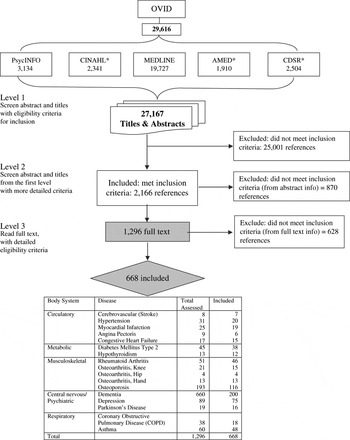
A medical-research librarian identified studies by searching electronic databases including MEDLINE, Allied and Complementary Medicine (AMED), Cumulative Index to Nursing and Allied Health Literature (CINAHL), Cochrane Database of Systematic Reviews (CDSR), and PsycINFO. Figure 1 describes the search strategy. A listing of the exact search terms and a more complete description of the literature search is reported elsewhere (Reference Raina, Kirkland, Wolfson and Keshavarz1). The searches were limited to English-language studies of human subjects published between January 1, 1990, and the end of November 2005. We chose 1990 as the first year in order to capture more recent diagnostic criteria and technology. The second step involved hand-searching reference lists of relevant articles for additional appropriate citations. Finally, local, national, and international experts were asked to identify other relevant citations.
Flow diagram of search strategy and selection process, *CINAHL: Cumulative Index to Nursing and Allied Health Literature, AMED: Allied and Complementary Medicine, CDSR: Cochrane Database of Systematic Reviews

Inclusion and Exclusion Criteria
Standard systematic review methodology was employed to screen the studies for eligibility (Reference Cook, Mulrow and Haynes2,Reference Cook, Sackett and Spitzer3). To be eligible for inclusion in the review, the studies had to (a) focus on the diagnosis of one or more of the 17 selected chronic diseases using any explicitly described diagnostic tools, criteria, or algorithm; (b) be of an observational-study design; and (c) be conducted on the adult population. Abstracts were excluded if the publications were (a) published before 1990; (b) written as letters, biographies, case reports, comments, congresses, editorials, or patient education handouts; (c) written in languages other than English; (d) pharmacokinetic and pharmacodynamic studies; (e) animal, in vitro, or tissue-level studies; (f) studies unrelated to, or not specific for, diagnosis of the selected diseases; or (g) a population under 18 years old or pregnant; in addition, publications were excluded if they lacked information related to diagnostic tools, criteria, or a disease-ascertainment algorithm; included inpatients as a population; or had outcomes that were not extractable. We excluded reports of randomized clinical trials because they used specific clinical diagnostic criteria requiring physician assessment of the disease.
Study Screening
Two unblinded reviewers with training in medicine, nursing, and/or epidemiology independently assessed the titles and abstracts of all the studies; if either reviewer thought the study might be relevant, it was retrieved for full-text screening. Screeners then reviewed the text of potentially relevant articles using a priori inclusion and exclusion criteria just described. Disagreements were resolved through discussion until consensus was obtained. We did not calculate agreement statistics; however, disagreements were rare.
Data Extracted
Data were extracted from each article by a single extractor with medical training, and the data extraction was verified by a senior epidemiologist. Four types of variables were abstracted from each included article: (a) study characteristics, (b) study participants, (c) diagnostic procedures, and (d) diagnostic tools and criteria. Study characteristics included country, setting, and design. Participant characteristics defined the type of participants enrolled (i.e., from community or clinic) and their age. For diagnostic tools and criteria, we abstracted information on the person who administered the tool (e.g., nurse, health professional, physician, medical specialist, trained personnel). We then described the type of diagnostic tool (e.g., questionnaire, medical records/history, physical examination, laboratory assessment, medication, clinical test).
Results
Identification of Diagnostic Algorithms, Tools, and Criteria
The number of abstracts obtained from searches in different databases is displayed in Figure 1. The final searches yielded 29,616 citations. After 2,449 duplicates were identified, a total of 27,167 abstracts were downloaded into systematic review management software, TrialStat SRS (Reference O’Blenis and Garritty4,5). Of these, a total of 2,166 unique titles and abstracts qualified for the second stage of title and abstract screening. This resulted in 1,296 retrieved full-text papers that had passed the first two levels of screening to ensure compliance with eligibility criteria. We then excluded articles that did not provide sufficient information to determine the methods for diagnosis of the disease. We included articles that used or developed diagnostic tools, diagnostic criteria, diagnostic algorithms, or clinical algorithms to identify any of the 17 selected chronic diseases and which met all inclusion and exclusion criteria. After the three levels of screening, a total of 668 studies met all eligibility criteria. (Reference Raina, Kirkland, Wolfson and Keshavarz1) Figure 1 is a flow diagram of the study selection process.
Studies Using Diagnostic Tools and Criteria
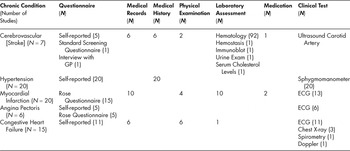
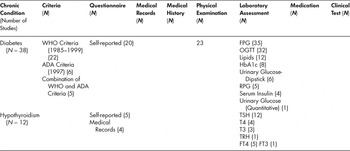
Full details and references for included studies are available online as part of a larger study and are organized by disease (Reference Raina, Kirkland, Wolfson and Keshavarz1). We identified 668 studies in this systematic review (Reference Di Bari6): 479 (72%) studies were cross-sectional, 158 (24%) were cohort, and 31 (4%) were case-control studies. The sample size ranged from 6 to 2,900,000. Non-clinical centres (e.g., community centre) were the most common settings, and physicians (55%) acted as assessors in most of the studies (see Table 1). Tables 2–6 describe the diagnostic tools and criteria used in 668 studies by body system and disease. Researchers generally used a combination of tools and criteria to diagnose each condition. Most circulatory system conditions were diagnosed using a combination of questionnaire-based information and laboratory or clinical tests (see Table 2). For many circulatory system conditions, especially hypertension, medical records and/or medical history were also used. Diabetes was diagnosed most often with a combination of questionnaire and laboratory assessment, while hypothyroidism was diagnosed exclusively with laboratory tests (see Table 3). Studies of musculoskeletal diseases most often used questionnaires, assessment by a physician and clinical investigations (i.e., x-ray and dual-energy x-ray bone density [DEXA]) for diagnosis (see Table 4). Studies of central nervous system and psychiatric conditions almost always used questionnaires for diagnosis; for Parkinson’s disease and dementia, a physical examination conducted by a physician was also used (see Table 5). Studies diagnosing respiratory conditions relied most often on questionnaires and either medical records or clinical investigations such as spirometry (see Table 6).
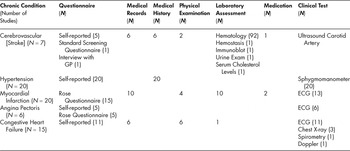
Tools/criteria used for diagnosis of circulatory system conditionsFootnote *
Tools/criteria used for diagnosis of metabolic conditionsFootnote *

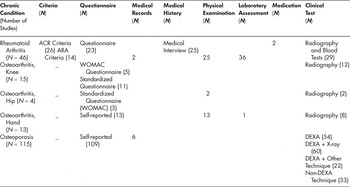
Tools/criteria used for diagnosis of musculoskeletal conditionsFootnote *

Selected abbreviations and acronyms for proposed chronic diseases in CLSA
ACR Criteria American College of Rheumatology
ARA Criteria American Rheumatology Association
DEXA Dual-energy x-ray absorptiometry (DXA, previously DEXA)
WOMAC Western Ontario and McMaster Universities index
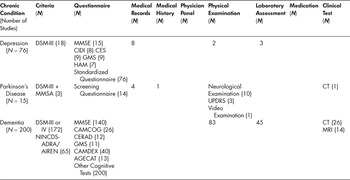
Tools/criteria used for diagnosis of central nervous system/psychiatric conditionsFootnote *

Abbreviations and acronyms for proposed central nervous system/psychiatric conditions in CLSA
AGECAT Automated Geriatric Examination for Computer Assisted Taxonomy
CAMCOG Cognitive and self-contained part of the Cambridge Examination for Mental Disorders of the Elderly
CAMDEX Cambridge Examination for Mental Disorders of the Elderly
CERAD Consortium to Establish a Registry for Alzheimer’s Disease
CES Center for Epidemiological Studies
CIDI Composite International Diagnostic Interview (CIDI)
DSM-III R Diagnostic and Statistical Manual of Mental Disorders, Third Edition, Revised
GMS Geriatric Mental State
HAM Hamilton Depression Scale
IADL Instrumental Activities of Daily Living
MMSA Mini-Mental State Adjusted
MMSE Mini-Mental State Examination
NINCDS-ADRA/AIREN National Institute of Neurological and Communication Disorders and Stroke – Alzheimer’s Disease and Related Disorders Association
Tools/criteria used for diagnosis of respiratory conditionsFootnote *

Diagnostic Algorithms
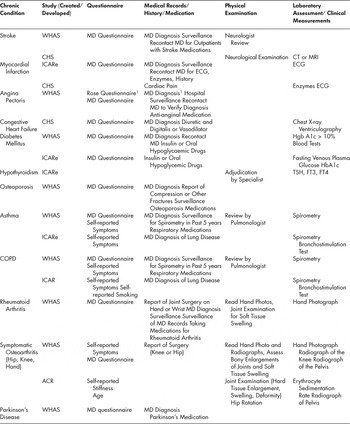
Only 18 relevant diagnostic algorithms were identified (see Table 7). Of these, only 3 were published in peer-reviewed journals; the others were acquired through personal communication with researchers of large population-based studies (Reference Di Bari6–Reference Guralnik, Fried, Simonsick, Williamson, Skinner and Morris12). Although diagnostic algorithms were identified for 14 of the 17 chronic conditions of interest, all included either a physician examination or abstraction of medical records, neither of which are planned for the CLSA. Thus, without adaptation none of the algorithms could be used directly.
Tools/criteria used in diagnostic algorithms in adult population-based longitudinal studies

ACR American College of Rheumatology CHS Cardiovascular Health Study
ICARe Diacomano Study = Insufficienza Cardiaca negli Anziani Residenti a Dicomano WHAS Women’s Health and Aging Study
Tools and Criteria
All studies related to hypertension incorporated self-reported high blood pressure, history of a physician diagnosis, and blood pressure measurements to enable the researcher to arrive at a diagnosis of hypertension. The criteria for diagnosing hypertension differed slightly among studies in terms of the number of visits and the blood pressure levels used to define hypertension. Participants in most of the reviewed studies were initially interviewed or evaluated during a 30-minute to 1-hour visit in clinical or non-clinical settings. Information on health conditions and associated risk factors related to hypertension or general cardiovascular health were obtained.
Most studies diagnosed acute myocardial infarction (AMI) using the World Health Organization Multinational MONItoring of trends and determinants in CArdiovascular disease (WHO MONICA) and/or Gillum criteria (chest pain, elevated enzymes, and evolving ECG). Some used additional criteria such as necropsy reports (Reference Volmink, Newton, Hicks, Sleight, Fowler and Neil13), biochemical markers (Reference Sato, Yoshinouchi, Sakamoto, Fujieda, Murao and Sato14), myoglobin, or total CK-MB (Reference Zimmerman, Fromm, Meyer, Boudreaux, Wun and Smalling15). Four studies used diagnostic algorithms to ascertain old myocardial infarctions (OMI). Despite some minor differences, all used or adapted the algorithm used in the Cardiovascular Health Study (CHS) (Reference Psaty, Kuller, Bild, Burke, Kittner and Mittelmark10). The components of this algorithm are self-reported history, the Rose angina questionnaire, clinical examination, ECG, and medication use.
The diagnosis of angina pectoris was based largely on self-reported medical history and ECG. The most common questionnaire was the Rose angina questionnaire (Reference Margolis, Gillum, Feinleib, Brasch and Fabsitz16), which was developed in 1962 as a standardized method of ascertaining angina in general populations (Reference Rose17).
A major challenge for the diagnosis of congestive heart failure is the lack of a simple, sensitive, and specific diagnostic tool or a set of criteria. This likely accounts for the fact that CHF is one of the most under-reported cardiovascular conditions (18). In the studies that we reviewed, the diagnosis of CHF was often confirmed through a medical record review or medical examination, both of which can lack diagnostic precision.
Most studies diagnosing circulatory conditions and stroke used tools that are planned for inclusion in the CLSA: self-reported diagnosis, standardized questionnaires, and ECGs. Current cardiovascular guidelines, however, are designed to diagnose acute events and not prior conditions that will be required for the CLSA. There is no current guideline for diagnosing stroke that does not include the results of neuroimaging tools (e.g. CT scan, MRI) (Reference Toole, Lefkowitz, Chambless, Wijnberg, Paton and Heiss19). The ascertainment of stroke is most often limited to self-reported symptoms or examination of medical records. Some studies also used laboratory tests and physical examination (see Table 2), and a questionnaire used to exclude prior stroke has demonstrated high specificity (Reference Asplund, Bonita, Kuulasmaa, Rajakangas, Feigin and Schaedlich20,Reference Del Brutto, Idrovo, Santibanez, Diaz-Calderon, Mosquera and Cuesta21).
Diabetes was diagnosed most often with a combination of questionnaire and laboratory assessment. About 90 per cent of the studies used a two-phase procedure in which the total population or a random sample was screened, and those who screened positive went on to additional testing. The remaining 10 per cent of studies used a three-phase approach with a final confirmatory test. During at least one of the phases all studies measured blood glucose, mostly by a test for fasting plasma glucose (FPG) or an oral glucose tolerance (OGTT) test. Most studies also included either a clinical examination or a standardized interview. Diagnosis was based on either the World Health Organization (WHO) or American Diabetes Association criteria. Nurses or physicians performed the assessments in all studies (see Table 3).
All diagnoses of hypothyroidism were based solely on laboratory testing. Researchers used thyroid-stimulating hormone (TSH) as a screening test, usually followed by free T4, and free T3 estimations. Cut-off points differed among studies depending on geographical area, age, and type of commercial assay used (see Table 3).
All studies diagnosing musculoskeletal conditions (rheumatoid arthritis, osteoarthritis, and osteoporosis) relied upon clinical examination or tools that are either not proposed to be collected in the CLSA (x-ray for rheumatoid arthritis [RA] and osteoarthritis [OA]) or that require a physician’s interpretation (DEXA for osteoporosis). Most studies adopted a two-stage population-based tool to ascertain RA. The screening stage used a validated self-reported questionnaire that was administered by a nurse or other trained personnel. The questionnaire varied from study to study. In the second stage of case ascertainment, individuals who screened positive for RA underwent clinical confirmation consisting of a medical interview, clinical examination, laboratory investigations, and radiographs. Osteoporosis was most often diagnosed using a self-reported risk assessment instrument and either DEXA alone or in combination with other instrumental tests. Physicians were always used as assessors (see Table 4).
Most of the studies on dementia adopted a two-phase screening design including a cognitive screen of the total sample followed by a diagnostic phase in which all participants who screened positive were examined clinically. The Mini-Mental State Examination (MMSE) was used most often as a screening tool, and diagnosis was most commonly made according to the Diagnostic and Statistical Manual of Mental Disorders, 3rd or 4th edition (DSM-III or IV) criteria, or equivalent criteria such as Cambridge Examination for Mental Disorders of the Elderly (CAMDEX) or Automated Geriatric Examination for Computer Assisted Taxonomy (AGECAT) (see Table 5).
Studies of central nervous system conditions almost always used questionnaires for diagnosis. For Parkinson’s disease (PD), all studies required a neurologist or movement disorder expert for a definitive diagnosis. The majority of studies used a two- or three-phase design with a screening questionnaire and a more extensive evaluation by a trained neurologist to diagnose PD in those screening positive. Clinical examination by a neurologist is regarded as essential to reveal the major features of the disease (see Table 5).
Studies diagnosing respiratory conditions relied most often on questionnaires and either medical records or clinical investigations such as spirometry. All studies of asthma relied on self-report augmented by spirometry and medical records. All studies on chronic obstructive pulmonary disease (COPD) used past medical history and/or questionnaire for diagnosis (see Table 6).
Discussion
To our knowledge this is the first systematic review to document diagnostic algorithms, tools, and criteria for ascertaining chronic diseases in observational studies. Although several diagnostic algorithms are available, none can be applied directly in the CLSA. Thus we are developing algorithms needed for the CLSA by means of diagnostic tools and criteria identified in the systematic review. In the CLSA, we are proposing to collect self-reported disease status, questionnaires, medication use, anthropometric measurements, laboratory tests, clinical tests (e.g., ECG, DEXA) and non-physician non-invasive clinical examinations to diagnose chronic conditions based on current international guidelines.
Several chronic conditions were identified for which accurate diagnoses can be made in a large population-based study. These include metabolic conditions (diabetes and hypothyroidism), which relied almost exclusively on laboratory tests and questionnaires to diagnose disease; respiratory (asthma and COPD) and cardiovascular conditions (angina and MI), which depend on questionnaires and/or self-report and clinical tests, such as spirometry and ECG. Depression and dementia were most often diagnosed using questionnaires. Although dementia also requires a neuropsychological examination, this can be performed by trained non-physicians. For each of these conditions, algorithms can be developed directly from the validated tools and criteria identified in our systematic review.
Other conditions prove more challenging to diagnose in population-based studies. For example, all studies diagnosing musculoskeletal conditions (RA, OA, and osteoporosis) used clinical tools that either are not being collected in the CLSA (x-ray for RA and OA) or require a physician’s interpretation (DEXA for osteoporosis). Similarly, for PD all studies required a neurologist or movement disorder specialist for a definitive diagnosis. All of these conditions have sensitive and specific tools for diagnosis, but will require additional strategies for accurate ascertainment in a large-scale study.
Finally, some conditions are not amenable to diagnosis in a large-scale study, and will not be included in the CLSA. For example, congestive heart failure is one of the most under-reported cardiovascular conditions because there is currently no sensitive and specific diagnostic tool (18).
The strengths in this study lie in the comprehensiveness of our search and the rigourous methodology of our systematic review. We were able to identify disease ascertainment algorithms, diagnostic tools, and criteria for 17 chronic conditions. Our reporting was, however, somewhat limited because of the non-uniform terminology for tools and criteria, the lack of precisely defined methods, and the lack of a case definition in many instances. The ability to identify chronic diseases singly or in combination, according to precise diagnostic ascertainment tools, criteria, or algorithms could lead to a better understanding of the natural history of chronic diseases and help us explore how exposure to various risk factors influences disease incidence and outcomes. Although we planned this study specifically to develop disease ascertainment algorithms for the CLSA, this review can inform the development of algorithms for other population-based studies. The choice of specific tools and criteria will depend on the population of interest and the type of data collected in other longitudinal studies.