Introduction
Waterhemp [Amaranthus tuberculatus (Moq.) J. D. Sauer] is one of the top five troublesome broadleaf weed species, a native to North America, and predominantly distributed in agricultural fields of the midwestern United States (Sarangi and Jhala Reference Sarangi and Jhala2017; Waselkov and Olsen Reference Waselkov and Olsen2014). The A. tuberculatus has become a problematic weed species in corn (Zea mays L.), grain sorghum [Sorghum bicolor (L.) Moench ssp. bicolor], and soybean [Glycine max (L.) Merr.] production due to several factors, including prolific seed production, discontinuous emergence patterns, extended seed longevity, rapid growth, greater genetic diversity, and importantly, the evolution of multiple herbicide resistance (Costea et al. Reference Costea, Weaver and Tardif2005; Pratt and Clark Reference Pratt and Clark2001; Steckel Reference Steckel2007; Steckel and Sprague Reference Steckel and Sprague2004; Werle et al. Reference Werle, Sandell, Buhler, Hartzler and Lindquist2014). The dynamic characteristic of long-distance dispersal of wind-borne pollen (gene flow) and obligate outcrossing because of its dioecious nature favor A. tuberculatus’s ability to evolve resistance to herbicides with multiple sites of action (SOAs) (Hausman et al. Reference Hausman, Singh, Tranel, Riechers, Kaundun, Polge, Thomas and Hager2011; Sarangi et al. Reference Sarangi, Tyre, Patterson, Gaines, Irmak, Knezevic, Lindquist and Jhala2017; Schultz et al. Reference Schultz, Chatham, Riggins, Tranel and Bradley2015). To date, A. tuberculatus has evolved resistance to six SOAs, including, photosystem II (PSII), acetolactate synthase (ALS), 5-enolpyruvyl-shikimate-3-phosphate (EPSPS), 4-hydroxyphenylpyruvate dioxygenase (HPPD), protoporphyrinogen oxidase (PPO) inhibitors and synthetic auxins (Heap Reference Heap2018). However, in NE, A. tuberculatus has developed resistance to five herbicide SOAs including PSII, ALS, HPPD, and EPSPS inhibitors and synthetic auxins (Bernards et al. Reference Bernards, Crespo, Kruger, Gaussoin and Tranel2012; Heap Reference Heap2018; Vieira et al. Reference Vieira, Samuelson, Alves, Gaines, Werle and Kruger2017). The evolution of multiple herbicide resistance in A. tuberculatus is a major challenge for effective management of this weed.
PSII and PPO inhibitors are widely used PRE herbicides in soybean and corn production. When PPO inhibitors such as sulfentrazone are applied alone PRE or tank mixed with other PRE herbicides such as S-metolachlor, cloransulam, or chlorimuron, >90% of A. tuberculatus control has been reported (Hager et al. 2002a, Reference Hager, Wax, Stoller and Bollero2002b; Krausz and Young Reference Krausz and Young2003). Likewise, PSII-inhibiting herbicides (e.g., atrazine and metribuzin) can also provide satisfactory residual control of A. tuberculatus. PRE application of a metribuzin plus metolachlor tank mix provided more than 90% waterhemp control in soybean (Johnson et al. Reference Johnson, Kendig and Null1996; Vyn et al. Reference Vyn, Swanton, Weaver and Sikkema2007). Atrazine is a widely used herbicide in corn and grain sorghum both PRE and POST for control of A. tuberculatus and other dicot weed species (LeBaron Reference LeBaron2008). The overreliance on atrazine for PRE and POST applications increased the atrazine-resistance cases in A. tuberculatus populations across the U.S. midwestern states (Anderson et al. Reference Anderson, Roeth and Martin1996). The first case of atrazine resistance in A. tuberculatus was reported in 1996 in NE (Heap Reference Heap2018).
Previous research reported that both target-site (TSR) and non–target site resistance (NTSR) mechanisms can bestow atrazine resistance in A. tuberculatus (Foes et al. Reference Foes, Tranel, Wax and Stoller1998; Ma et al. Reference Ma, Kaundun, Tranel, Riggins, McGinness, Hager, Hawkes, McIndoe and Riechers2013; Patzoldt et al. Reference Patzoldt, Dixon and Tranel2003). The most common mechanism conferring atrazine resistance in many dicot weed species, including some biotypes of A. tuberculatus, is TSR as a result of a serine-to-glycine substitution at amino acid position 264 (Ser-264-Gly) of the D1 protein due to a mutation in the psbA gene (Foes et al. Reference Foes, Tranel, Wax and Stoller1998). However, members of the Amaranthaceae family, including A. tuberculatus and Palmer amaranth (Amaranthus palmeri S. Watson), predominantly display NTSR to POST-applied atrazine as a result of rapid metabolism of atrazine via glutathione S-transferase (GST) conjugation (Ma et al. Reference Ma, Kaundun, Tranel, Riggins, McGinness, Hager, Hawkes, McIndoe and Riechers2013; Nakka et al. Reference Nakka, Godar, Thompson, Peterson and Jugulam2017). Plant GSTs have been classified into two common subclasses, phi and tau (Labrou et al. Reference Labrou, Papageorgiou, Pavli and Flemetakis2015), although their functions can differ depending on the species (Chi et al. Reference Chi, Cheng, Vanitha, Kumar, Ramamoorthy, Ramachandran and Jiang2010). Phi-class GSTs have been widely reported to detoxify herbicides in several weed species (Burnet et al. Reference Burnet, Loveys, Holtum and Powles1993; Cummins et al. Reference Cummins, Cole and Edwards1999; Gray et al. Reference Gray, Balke and Stoltenberg1996; Holt et al. Reference Holt, Lay, Clarke, Dinsmore, Jepson, Bright and Greenland1995; Irzyk and Fuerst Reference Irzyk and Fuerst1993; Jepson et al. Reference Jepson, Lay, Holt, Bright and Greenland1994; Nakka et al. Reference Nakka, Godar, Thompson, Peterson and Jugulam2017).
In previous studies, the atrazine-resistant (AR) A. tuberculatus populations from Illinois exhibited a differential response to the PRE and POST applications of atrazine (Ma et al. Reference Ma, Evans and Riechers2016; Patzoldt et al. 2003, Reference Patzoldt, Tranel and Hager2005). An AR A. tuberculatus population was susceptible to PRE-applied atrazine at a rate of 1.5 kg ha–1 (Patzoldt et al. Reference Patzoldt, Dixon and Tranel2003). Soil-applied PRE herbicides may not have sufficient residual efficacy to control late-emerging A. tuberculatus throughout the growing season. Thus, the screening of A. tuberculatus for both PRE and POST herbicide applications is needed to identify the frequency of resistance and assess season-long control (Falk et al. Reference Falk, Shoup, Al-Khatib and Peterson2006; Hager et al. 2002a, Reference Hager, Wax, Bollero and Stoller2003; Hartzler et al. Reference Hartzler, Buhler and Stoltenberg1999).
The objectives of this research were to (1) evaluate the response and frequency of resistance in NE A. tuberculatus populations to soil-applied PSII (metribuzin and atrazine) and PPO (sulfentrazone) inhibitors as well as POST-applied atrazine; and (2) determine the mechanism of atrazine resistance in NE A. tuberculatus.
Materials and Methods
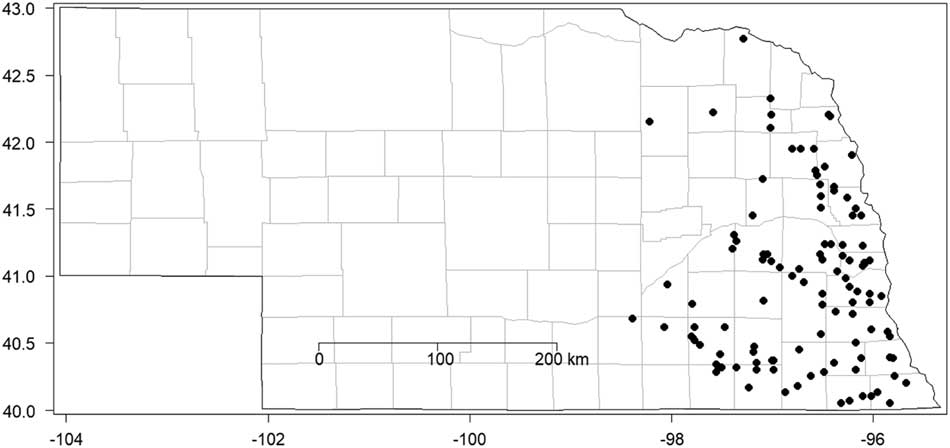
The A. tuberculatus seed samples were collected from 10 to 20 plants in 109 agricultural fields from 32 counties in NE in the fall of 2014 (Figure 1; Vieira et al. Reference Vieira, Samuelson, Alves, Gaines, Werle and Kruger2017). The GPS coordinates for each population were recorded. After collection, seeds were stored at −20 C for a minimum of 3 mo to overcome dormancy. Populations were screened under greenhouse conditions with the objective of evaluating the frequency of resistance to soil-applied PPO (sulfentrazone) and PSII (atrazine and metribuzin) inhibitors. Populations were also screened to evaluate the frequency of resistance to atrazine applied POST.
Distribution of Amaranthus tuberculatus populations collected in Nebraska in 2014 and screened with soil-applied photosystem II- (atrazine and metribuzin) and protoporphyrinogen oxidase- (sulfentrazone) inhibiting herbicides. Seeds from a total of 109 populations from 32 counties were collected.

Screening of Amaranthus tuberculatus with Soil-applied PPO and PSII Inhibitors
The 109 A. tuberculatus populations were screened with soil-applied PPO (sulfentrazone) and PSII inhibitors (atrazine and metribuzin). The experimental units consisted of 9-cm pots (8-cm deep) filled with field soil (loam soil; pH=6.4, 1.7% organic matter). A volume of 0.04 ml of seeds (average of 90 seeds) was placed and slightly incorporated in the top 0.5-cm layer of soil of each experimental unit. Treatments consisted of three herbicides applied at labeled rates, atrazine (1.345 kg ai ha−1; Atrazine 4L, ADAMA, Raleigh, NC), metribuzin (0.56 kg ai ha−1; Sencor®, Bayer Crop Science, Research Triangle Park, NC), and sulfentrazone (0.28 kg ai ha−1; Spartan®, FMC, Philadelphia, PA), and a nontreated control. Herbicide applications were performed immediately after seeds were planted using a three-nozzle research track spray chamber (DeVries, Hollandale, MN) calibrated to deliver 94 L ha−1 of water with AIXR110015 nozzle tips (TeeJet® Technologies, Spraying Systems, Wheaton, IL) at a pressure of 276 kPa and a speed of 7.2 km h−1. After spraying, experimental units were placed in a greenhouse with a controlled environment (30/20 C day/night with a 16-h photoperiod) and watered daily. The study was conducted as a completely randomized design with four replications and was repeated in time (two experimental runs).
At 30 d after treatment (DAT), the total number of established plants per pot was recorded. Plants were then harvested and dried to constant weight at 60 C, and the aboveground biomass per pot was recorded. The percent reduction in total plant density and biomass per experimental unit as compared with the nontreated control average were calculated for each population and treatment. In this experiment, A. tuberculatus populations were considered resistant to the label rate used herein (1X) if the percent reduction in total plant density averaged across both experimental runs was 50% or less.
In an additional study, 106 A. tuberculatus populations were screened with soil-applied atrazine at 3X the label rate (4.035 kg ai ha−1). Nontreated control plots were also included for comparison. Experimental procedures and data collection were the same as described earlier.
Screening of Amaranthus tuberculatus with POST-applied Atrazine
Seeds from 85 A. tuberculatus populations were planted in aluminum trays (22-cm diameter, 4-cm deep), filled with a commercial potting mix (Pro-Mix® BX, Premier Tech Horticulture, Cromwell, Minnesota, USA). Seedlings at the 1- to 2-leaf stage were transplanted into cones (6.5-cm diameter, 25-cm deep) filled with the same commercial potting mix (1 seedling cone−1). Plants were maintained in a greenhouse with a controlled environment (30/20 C day/night with a 16-h photoperiod) and were watered daily. Treatments consisted of atrazine applied at 0X (nontreated control), 1X (1.345 kg ai ha−1+2.34 L ha−1 crop oil concentrate [COC; R.O.C., Wilbur-Ellis, San Francisco, CA]), and 3X (4.035 kg ai ha−1+2.34 L ha−1 COC) the label rate. Treatments were applied when plants reached 6 to 9 cm in height using the aforementioned sprayer equipment and calibration settings. The study was arranged in a completely randomized design with six replications (individual plants), and two runs were conducted in time.
At 21 DAT, visual evaluation (VE) of plant growth was taken on a scale of 1 to 10, with 1 being dead and 10 being completely healthy (adapted from Anderson et al. [Reference Anderson, Roeth and Martin1998] and Werle et al. [Reference Werle, Jhala, Yerka, Dille and Lindquist2016]). Plants with VE ranging from 1 to 3, 4 to 6, and 7 to 10 were considered susceptible (dead plants), intermediate (highly injured but not dead), and resistant (light interveinal chlorosis and plant stunting to no detectable injury), respectively (Anderson et al. Reference Anderson, Roeth and Martin1998; Werle et al. Reference Werle, Jhala, Yerka, Dille and Lindquist2016). After that, plant aboveground biomass was harvested and dried to constant weight at 60 C for 48 h, and the dry weight per experimental unit was recorded. For each population and treatment, the percent of treated plants with VE≥7 was calculated. In this experiment, A. tuberculatus populations were considered resistant to each atrazine rate (1X or 3X) if more than 50% of treated plants across both experimental runs had VE≥7 (plants capable of reproducing).
Assessment of Target-Site (psbA Gene) Mutations in AR Amaranthus tuberculatus Populations
The genomic DNA from leaf tissue collected from 90 AR plants that survived POST application of atrazine (1X and above) from 27 populations and five known atrazine-susceptible (AS) plants from a population collected in Missouri (Jackson-2) were extracted using the Plant DNAzol™ reagent (Invitrogen™, Carlsbad, CA, USA) method according to the manufacturer’s instructions. The quality of DNA was analyzed using 0.8% agarose gel electrophoresis, and quantity was checked using a NanoDrop 1000 (Thermo Scientific, Madison, WI, USA) spectrophotometer. PCR was performed using a T100™ Thermal Cycler (Bio-Rad, Hercules, CA). Each PCR reaction mixture contained 100 ng gDNA (2.5 μl), 0.5 μM (5 μl) of forward (PsbA F: 5′-CTCCTGTTGCAGCTGCTACT-3′) and reverse (PsbA R: 5′-TAGAGGGAAGTTGTGAGC-3′) primers (Mengistu et al. Reference Mengistu, Christoffers and Lym2005), and 25 μl of Taq 2X PCR Master Mix (Promega, Madison, WI), with the final volume made up to 50 μl with nuclease-free water. The psbA gene product (578 bp) that covers all possible mutations known to confer resistance to atrazine was amplified using PCR. The PCR cycling program was set to an initial denaturation at 95 C for 6 min, followed by 32 cycles of denaturation at 94 C for 30 s, an annealing temperature of 55 C for 30 s, and extension at 72 C for 1 min, followed by a final extension of 72 C for 7 min. The amplified PCR product was purified using the Thermo Scientific GeneJET™ PCR purification kit method, and the amplicons were sequenced by Genewiz (South Plainfield, NJ). The alignment of DNA sequences was analyzed using MultAlin software.
Atrazine Metabolism Study
Plant Material and Growth Conditions
Twenty-four plants selected randomly from four AR populations having >90% AR plants (CAS6, GAG16, DOU5, and HAM10) and 10 plants from AS populations (Jackson-2) were used to determine the metabolism of atrazine. The seeds of AR and AS A. tuberculatus were germinated in trays (25 by 15 by 2.5-cm) with commercial potting mixture (Pro-Mix Ultimate, Hummert International, Topeka, KS). Individual seedlings at the 2-leaf (2-cm-tall) stage were transplanted into plastic pots (6.3 by 6.3 by 7.6-cm) and grown in a greenhouse maintained at 25/19 C day/night temperature, 60% relative humidity, and a 15/9-h day/night photoperiod, supplemented with 120 μmol photon m−2 s−1 illumination provided with sodium-vapor lamps. Uniformly growing 5-cm-tall plants were selected and transferred to a growth chamber maintained at 25/15 C day/night, with a light intensity of 550 μmol photon m−2 s−1 photon flux (15/9-h day/night) provided by incandescent and fluorescent bulbs at plant canopy level and 60% relative humidity.
[U-14C]Atrazine Application, Extraction, and Reverse-Phase High-Performance Liquid Chromatography
Metabolism of atrazine was determined as described by Nakka et al. (Reference Nakka, Godar, Thompson, Peterson and Jugulam2017) with minor modifications. The plants (10 to 12-cm) grown in the growth chambers (maintained at the same conditions as described earlier) were used for the metabolism study. The plants were treated with 0.625 mM [U-14C]atrazine (Syngenta Crop Protection, Greensboro, NC, USA). A total volume of 20-μl [U-14C]atrazine consisting of 5 kBq and formulated atrazine (to obtain a final dose of 1.12 kg ha−1) mixture with 1% COC (Agridex) was applied on two fully expanded young leaves of uniformly growing plants as ten 1-μl droplets per each leaf. The treated leaves were harvested at 6 and 24 h after treatment (HAT) and washed with 5 ml of wash solution (10% v/v ethanol and 0.5% v/v Tween 20; Thermo Fisher Scientific) in a 20-ml scintillation vial for 1 min to remove the unabsorbed [U-14C]atrazine. After the treated leaves were washed, the aboveground plant tissue was harvested and pulverized in liquid nitrogen. The [U-14C]atrazine and its metabolites were extracted in 15 ml of 90% acetone (HPLC grade, Thermo Fisher Scientific) by overnight incubation (16 h) at 4 C, after which the samples were centrifuged at room temperature at 7000 rpm for 15 min. The supernatant was collected and evaporated using a rotary evaporator (CentriVap, Labconco, Kansas City, MO, USA) for 2 h at 45 C until it was concentrated to a volume of 500 to 1,000 μl. The concentrated supernatant was centrifuged at 10,000 rpm for 15 min at room temperature to eliminate any plant debris. The amount of radioactivity (14C compounds) was measured in the final extracted samples by liquid scintillation spectrometry and normalized to 15,000 dpm 50 μl−1 (0.25 kBq 50 μl−1) with the 50% HPLC-grade acetonitrile (Thermo Fisher Scientific). Reverse-phase HPLC (Beckman Coulter System Gold, Pasadena, CA, USA) was performed to resolve the [U-14C] atrazine and its conjugated metabolites as described by Nakka et al. (Reference Nakka, Godar, Thompson, Peterson and Jugulam2017). Briefly, the reverse-phase HPLC was performed using a Zorbax SB-C18 column (4.6 by 250 mm, 5-μm particle size; Agilent Technologies, Santa Clara, CA, USA) with a flow rate of 1 ml min−1. Water with 0.1% trifluoroacetic acid (HPLC grade, Thermo Fisher Scientific) was used as eluent A, whereas eluent B was acetonitrile with 0.1% trifluoroacetic acid (HPLC grade, Thermo Fisher Scientific). The 14C compounds were detected with a radio flow detector (EG&G Berthold, LB 509, Bad WildBad, Germany) and Ultima-Flo M cocktail (Perkin-Elmer, Waltham, MA, USA). Parent [14C]atrazine remaining in each sample was determined as a percentage of total extractable radioactivity recorded by the peak areas.
Statistical Analysis
The percent of [U-14C]atrazine remaining in A. tuberculatus was analyzed by one-way ANOVA, and the significance of the differences in means between AR and AS populations was calculated (P<0.05).
Results and Discussion
Greenhouse Screening
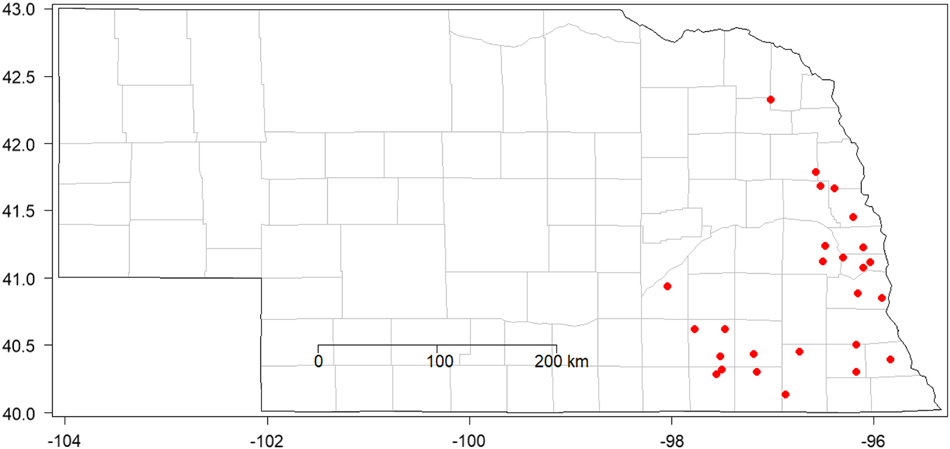
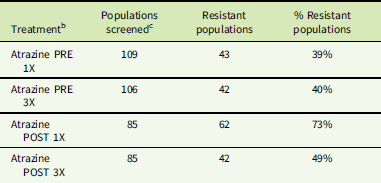
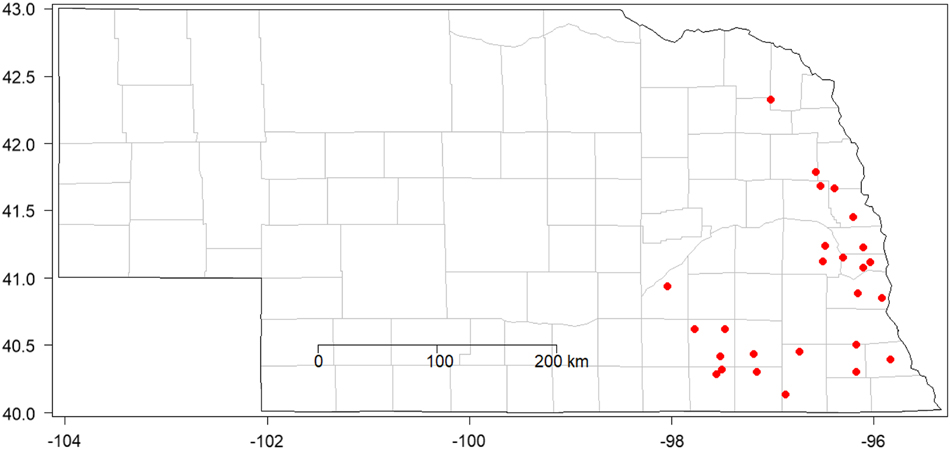
According to the greenhouse screening, PRE- or POST-applied atrazine at 1X rate (1.345 kg ha−1) was not effective on 39% and 73% of populations, respectively (Table 1). Moreover, the 3X rate (4.035 kg ha−1) of atrazine was not effective on 40% and 49% of A. tuberculatus populations screened PRE and POST, respectively (Table 1). Similar to the approach taken by Schultz et al. (Reference Schultz, Chatham, Riggins, Tranel and Bradley2015), our classification of resistance was conservative (e.g., populations with low frequency of resistant individuals may have been classified as susceptible to atrazine). Nonetheless, these results indicate that resistance to PRE- and/or POST-applied atrazine in A. tuberculatus populations is widespread in NE (Figure 2). Consequently, the sole use of atrazine is likely not a viable option for A. tuberculatus control in corn. This corroborates the results reported by Schultz et al. (Reference Schultz, Chatham, Riggins, Tranel and Bradley2015), wherein 51% of 187 A. tuberculatus populations from Missouri were resistant to their 1X rate (1.12 kg ha−1) of atrazine applied POST, whereas 30% of the populations were resistant to their 3X rate (3.37 kg ai ha−1). In the present study, atrazine was more effective (e.g., fewer populations were classified as resistant) when applied PRE versus POST. Similarly, AR A. tuberculatus populations from Illinois were resistant to POST-applied atrazine yet sensitive to PRE-applied atrazine, although the level of sensitivity varied among populations (Ma et al. Reference Ma, Evans and Riechers2016). Likewise, differential response to PRE- versus POST-applied atrazine has been reported in several AR A. tuberculatus populations (Ma et al. Reference Ma, Evans and Riechers2016; Patzoldt et al. 2003, Reference Patzoldt, Tranel and Hager2005).
Distribution of Amaranthus tuberculatus populations collected in Nebraska in 2014 and confirmed resistant to atrazine applied PRE and POST at 3X the label rate (4.035 kg ai ha−1). A total of 85 populations were screened, and 31% were confirmed resistant to both treatment times (PRE and POST at 3X the label rate).
Atrazine resistance frequency of Amaranthus tuberculatus populations from Nebraska to PRE- and POST-applied atrazine.Footnote a

a Populations with less than 50% reduction in plant stand and populations with more than 50% of treated plants with visual evaluation≥7 (healthy plants capable of reproducing) were classified as resistant to the respective PRE and POST atrazine rates.
b 1X=1.345 kg ai ha−1; 3X=4.035 kg ai ha−1.
c Not all 109 populations were evaluated for all treatments because of seed availability.
The 109 A. tuberculatus populations were completely controlled (100% density reduction) by the soil-applied metribuzin and sulfentrazone treatments (unpublished data). Thus, these two herbicides commonly used for PRE weed control in soybean were effective on all A. tuberculatus populations tested in this research. These herbicides can be an effective PRE option to control AR A. tuberculatus populations in soybean. Our initial hypothesis that AR A. tuberculatus populations would also be resistant to metribuzin was rejected. Despite being inhibitors of PSII, atrazine and metribuzin belong to different chemical families (triazine and triazinone, respectively), and the mechanism of atrazine resistance in these populations does not seem to confer cross-resistance, at least not to triazine and triazinone herbicides.
Analysis of Target-Site Mutations in A. tuberculatus
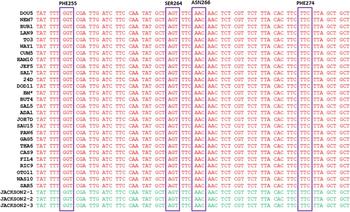
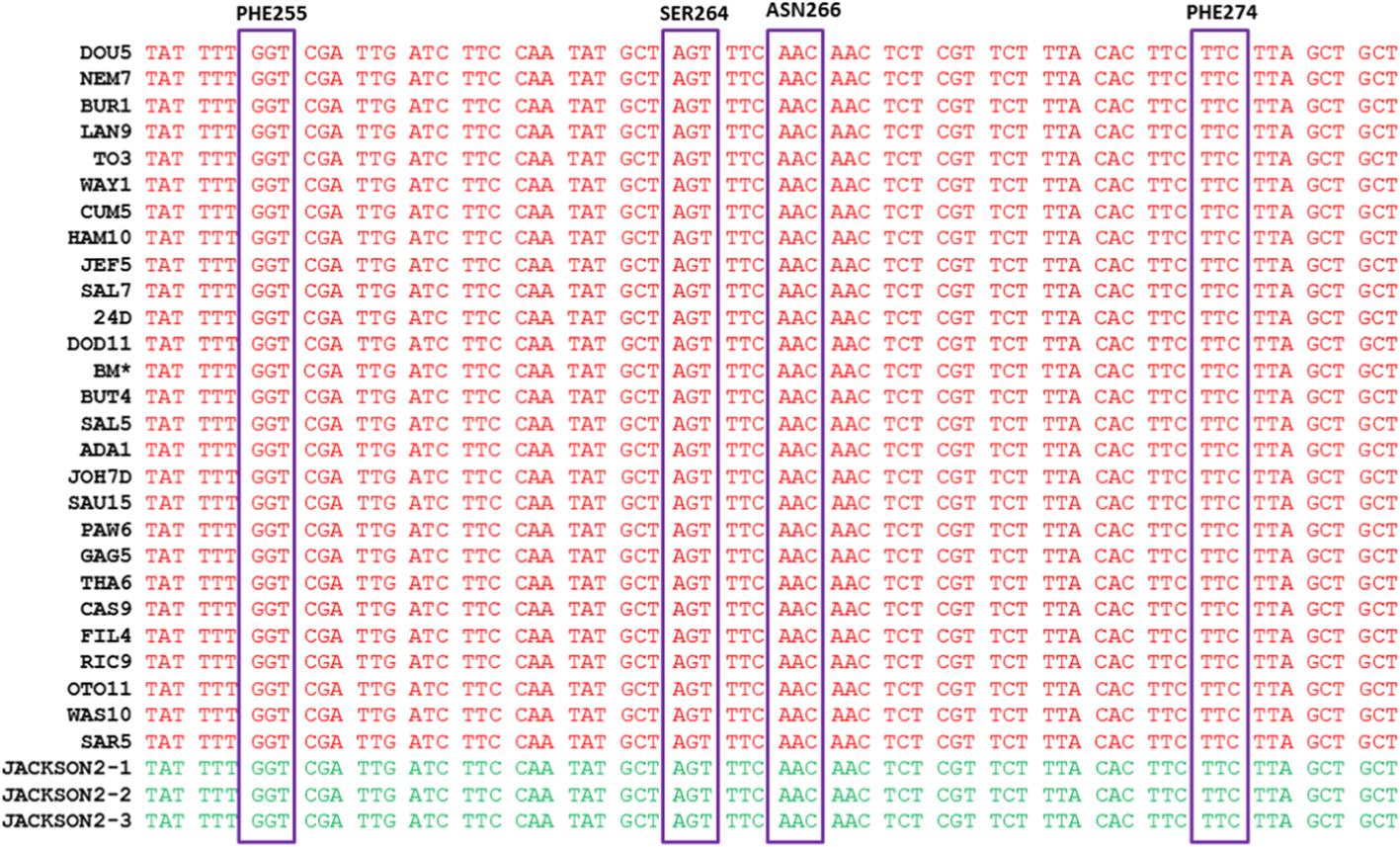
The comparison of the nucleotide sequence of the psbA gene between the AR and AS (Jackson-2) A. tuberculatus did not reveal any mutation resulting in a Ser-264-Gly substitution, which is known to confer resistance to atrazine in the majority of weeds (Foes et al. Reference Foes, Tranel, Wax and Stoller1998; Friesen and Powles Reference Friesen and Powles2007; Gronwald Reference Gronwald1994; Masabni and Zandstra Reference Masabni and Zandstra1999; Varanasi et al. Reference Varanasi, Godar, Currie, Dille, Thompson, Stahlman and Jugulam2015). Also, no other mutations resulting in substitution, that is, phenylalanine-255-isoleucine (Phe-255-Ile), asparagine-266-threonine (Asn-266-Thr), or phenylalanine-274-valine (Phe-274-Val) (Dumont et al. Reference Dumont, Letarte and Tardif2016; Park and Mallory-Smith Reference Park and Mallory-Smith2006a, Reference Park and Mallory‐Smith2006b; Preston and Stewart Reference Preston and Stewart2009; Thiel and Varrelmann Reference Thiel and Varrelmann2014) were found (Figure 3). These results suggest that no psbA gene alteration is responsible for atrazine resistance in A. tuberculatus from NE.
Nucleotide alignment of psbA gene conserved domain sequence from atrazine-susceptible (AS) and atrazine-resistant (AR) Amaranthus tuberculatus populations: the nucleotide/amino acid numbering denotes the Arabidopsis psbA gene sequence. The psbA sequence refers to the DOU5 to SAR5 AR populations and the Jackson 2-1 to 2-3 AS populations. Mutation or nucleotide polymorphism does not exist between AR and AS A. tuberculatus. Abbreviations: ASN, asparagine; PHE, phenylalanine; SER, serine.
Several target-site point mutations resulting in the evolution of triazine resistance have been reported in weed species such as kochia [Bassia scoparia (L.) A. J. Scott] (Mengistu et al. Reference Mengistu, Christoffers and Lym2005; Varanasi et al. Reference Varanasi, Godar, Currie, Dille, Thompson, Stahlman and Jugulam2015), Powell amaranth (Amaranthus powellii S. Watson) (Dumont et al. Reference Dumont, Letarte and Tardif2016), and common lambsquarters (Chenopodium album L.) (Thiel and Varrelmann, Reference Thiel and Varrelmann2014). The most commonly reported mutation conferring atrazine resistance is a serine-to-glycine (AGT-GGT) substitution at amino acid position 264, which was found only in one AR A. tuberculatus population in Illinois (Foes et al. Reference Foes, Tranel, Wax and Stoller1998). Earlier, several AR A. tuberculatus populations did not have a mutation in the psbA gene resulting in a Ser-264-Gly substitution, which is known to confer atrazine resistance (Patzoldt et al. Reference Patzoldt, Dixon and Tranel2003; Schultz et al. Reference Schultz, Chatham, Riggins, Tranel and Bradley2015).
Metabolism of Atrazine
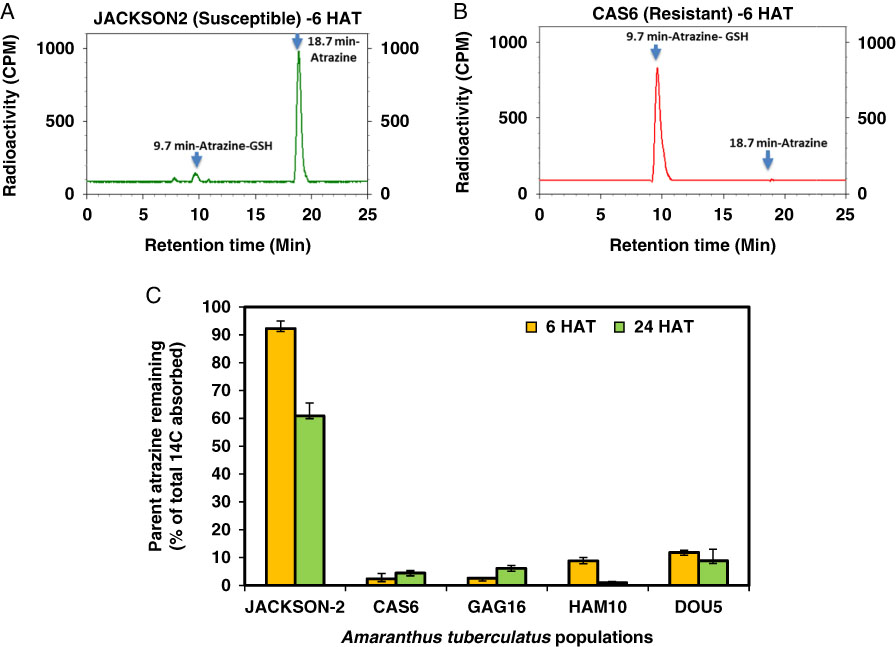
Previous research reported that rapid metabolism of atrazine mediated by GST conjugation confers resistance in A. tuberculatus from Illinois (Ma et al. Reference Ma, Kaundun, Tranel, Riggins, McGinness, Hager, Hawkes, McIndoe and Riechers2013) and A. palmeri from Kansas (Nakka et al. Reference Nakka, Godar, Thompson, Peterson and Jugulam2017). Our results also confirm rapid detoxification of atrazine via GST-mediated conjugation in A. tuberculatus from NE. The parent [U-14C]atrazine and synthetic glutathione (GSH)-[U-14C]atrazine metabolite (used as the standard) resolved with peak retention times of about 18.7 min and 9.7 min, respectively, as shown previously (Nakka et al. Reference Nakka, Godar, Thompson, Peterson and Jugulam2017). The higher accumulation of polar metabolite(s) with a peak retention time of about 9.7 min correlates with the reduction in parent atrazine compound in samples of AR populations, and a smaller peak area was observed in AS populations (Figure 4A and B). Differences in the amount of parent [U-14C] atrazine and its metabolites were detected between AR and AS populations at 6 (P=0.0001<0.05) and 24 (P=0.0001<0.05) HAT. More than 92% and 60% of the parent [U-14C]atrazine remained at 6 and 24 HAT in AS samples, respectively, whereas 92% of [U-14C]atrazine was conjugated by GSH in the AR A. tuberculatus populations within 6 HAT (Figure 4C).
Metabolism of [U-14C]atrazine in atrazine-susceptible (AS) and atrazine-resistant (AR) Amaranthus tuberculatus populations: reverse-phase HPLC chromatograms of plants treated with [U-14C]atrazine and harvested at 6 h after treatment (HAT) from (A) AS and (B) AR A. tuberculatus populations. The peak retention time of around 18.7 min is the parent [U-14C]atrazine (input), and peak retention time of 9.7 min is a metabolite of the glutathione (GSH)-[14C]atrazine conjugate. (C) Metabolism/parent [U-14C]atrazine remains in the treated plants at 6 and 24 HAT.

The rapid detoxification of atrazine in crop plants (e.g., corn and sorghum) mediated by the constitutive expression of glutathione and enhanced GST activity in response to triazine herbicides substantially contributed to tolerance and selectivity (Jachetta and Radosevich Reference Jachetta and Radosevich1981; Timmerman Reference Timmerman1989). GSTs are responsible for detoxification of several herbicides via conjugation in several broadleaf and grass weeds (Anderson and Gronwald Reference Anderson and Gronwald1991; Cummins et al. Reference Cummins, Cole and Edwards1999; Ma et al. Reference Ma, Kaundun, Tranel, Riggins, McGinness, Hager, Hawkes, McIndoe and Riechers2013). The mechanism of overproduction of GSTs and GST activity in triazine metabolism have not been well characterized and remain distinctly underexplored (Kreuz et al. Reference Kreuz, Tommasini and Martinoia1996; Riechers et al. 1996, Reference Riechers, Kreuz and Zhang2010). Recent studies revealed that distinct GSTs were involved in catalyzing atrazine via high GST activity in A. tuberculatus (Evans et al. Reference Evans, O’Brien, Ma, Hager, Riggins, Lambert and Riechers2017; Ma et al. Reference Ma, Kaundun, Tranel, Riggins, McGinness, Hager, Hawkes, McIndoe and Riechers2013). Also, increased expression of a specific AtuGSTF2 correlated with atrazine resistance in this weed (Evans et al. Reference Evans, O’Brien, Ma, Hager, Riggins, Lambert and Riechers2017).
The rapid metabolism of atrazine mediated by GST activity in our AR A. tuberculatus populations could be bestowed by one of several mechanisms, including (1) possible amplification of some of the GST genes, (2) an altered strength of GST gene promoters, (3) changes in untranslated regions of GST genes, or (4) altered expression of regulatory genes (transcription factors) of GST or DNA methylation (Anderson and Gronwald Reference Anderson and Gronwald1991; Evans et al. Reference Evans, O’Brien, Ma, Hager, Riggins, Lambert and Riechers2017; Ma et al. Reference Ma, Kaundun, Tranel, Riggins, McGinness, Hager, Hawkes, McIndoe and Riechers2013). The overproduction of GSTs mediated by one or several of these mechanisms contributing to pesticide resistance in insects has been reported (Enayati et al. Reference Enayati, Ranson and Hemingway2005). Potentially, such mechanisms may also be involved in GST-mediated herbicide resistance. We speculate that other mechanisms, such as an altered catalytic activity of GST through a mutation or insertion in the GST gene, may enhance the herbicide-binding ability (Riveron et al. Reference Riveron, Yunta, Ibrahim, Djouaka, Irving, Menze, Ismail, Hemingway, Ranson and Albert2014). The divergent nature of uneven distribution or clustered duplication of GSTs in the plant genome could be promoting resistance evolution (Chi et al. Reference Chi, Cheng, Vanitha, Kumar, Ramamoorthy, Ramachandran and Jiang2010). Additionally, a mutation in a single TF protein that binds to GST promoters might also trigger the increased GST expression.
The results of this research suggest that herbicides such as metribuzin and sulfentrazone are still effective to manage A. tuberculatus from Nebraska. The control of most NE populations was not satisfactory when atrazine was solely used PRE or POST. Furthermore, rapid metabolism of atrazine via GST conjugation confers resistance in the populations tested. Metabolism-based resistance may trigger the evolution of cross-resistance to other herbicides, which may represent a challenge to effective control of A. tuberculatus in Nebraska and beyond. Integrated weed management strategies and diversified herbicide programs with selective soil-applied herbicides can assist growers to achieve better A. tuberculatus control and ameliorate the issues with herbicide resistance.
Acknowledgements
The authors would like to thank Liberty Butts and Jared Daily for their assistance with the greenhouse screenings. Many students and technicians in the University of Nebraska–Lincoln Pesticide Application Technology Laboratory were invaluable in collecting and processing the weed seed samples from across Nebraska. This manuscript is approved for publication as Kansas Agricultural Experiment Station Contribution no 18-370-J. This research received no specific grant from any funding agency in the commercial or not-for-profit sectors. No conflicts of interest have been declared.