Implications
Protein malnutrition of mink (Neovison vison), a strict carnivore, during late-foetal life, when foetal growth is most rapid, causes metabolic changes that are still detectable after weaning. The persistent changes observed were a lower rate of protein oxidation and a lower relative abundance of fructose-1,6-bisphosphatase (Fru-1,6-P2ase) mRNA in kits whose dams were fed a low-protein diet during late gestation than in kits born to adequately nourished controls. The lower protein oxidation suggested a better ability to conserve protein, which might be useful when protein supply is limited. The effect of lower Fru-1,6-P2ase mRNA might, however, have a limited influence on glucose homeostasis.
Introduction
Strict carnivores, for example, cat and mink (Neovison vison) have higher requirements of dietary protein than other domestic mammals. The higher protein requirement seems to reflect a higher obligatory rate of protein degradation caused by the inability to downregulate the activity of hepatic amino acid-catabolizing enzymes, even when dietary protein provision is low (Rogers et al., Reference Rogers, Morris and Freedland1977). This leads to a constantly higher rate of nitrogen (N) loss compared with other species that can respond to variations in nutritional protein provision by using a variety of adaptive mechanisms, for example, protein oxidation and protein turnover, to maintain the N balance (Waterlow, Reference Waterlow1999). This inability of cats to adapt their obligatory N losses to dietary protein provision has been demonstrated when cats given a protein-free diet had higher endogenous urinary nitrogen (UN) excretion than other mammals (e.g. humans, dogs, rats and pigs; Hendriks et al., Reference Hendriks, Moughan and Tarttelin1997).
This lack of metabolic flexibility within the strict carnivores and thereby their inability to conserve N when dietary protein is low has, over the years, been questioned in a number of studies. Both in vitro (Kettelhut et al., Reference Kettelhut, Foss and Mighorini1980; Silva and Mercer, Reference Silva and Mercer1985) and in vivo studies (Russell et al., Reference Russell, Lobley, Rawlings, Millward and Harper2000) have shown that cats have some ability to adapt to dietary protein provision in terms of changes in ureagenesis and gluconeogenesis. Further, Russell et al. (Reference Russell, Murgatroyd and Batt2002) found that protein oxidation was correlated to some extent to dietary protein intake in cats, but only if the protein requirement was met (Green et al., Reference Green, Ramsey, Villaverde, Asami, Wei and Fascetti2008). Studies in mink have, however, shown that the rates of amino acid decarboxylation (Tauson et al., Reference Tauson, Fink and Chwalibog2001) and protein oxidation are regulated according to the dietary protein supply, even if the level of dietary protein is low (Fink et al., Reference Fink, Tauson, Chwalibog, Hansen, Kristensen and Wamberg2004) or below the requirement (Matthiesen et al., Reference Matthiesen, Blache, Thomsen, Hansen and Tauson2010a). These findings indicate some metabolic flexibility in the strict carnivores.
Maternal protein malnutrition can lead to changes in the offspring, but are not necessarily limited to the F1-generation, but changes can also be found in the F2-generation offspring (Zambrano et al., Reference Zambrano, Martinez-Samayoa, Bautista, Deas, Guillen, Rodriguez-Gonzalez, Guzman, Larrea and Nathanielsz2005; Burdge et al., Reference Burdge, Slater-Jefferies, Torrens, Phillips, Hanson and Lillycrop2007; Pinheiro et al., Reference Pinheiro, Salvucci, Aguila and Mandarim-de-Lacerda2008). Studies in mink have shown that low protein provision to pregnant dams leads to foetal adaptations, resulting in a lower mRNA expression of some key hepatic gluconeogenic and glycolytic enzymes in both F1- (Matthiesen et al., Reference Matthiesen, Blache, Thomsen, Hansen and Tauson2010a) and F2-generation foetuses (Matthiesen et al., Reference Matthiesen, Blache, Thomsen and Tauson2010b). These findings indicate that protein provision to the mother plays an important role for the offspring. Such changes may be of particular importance for strict carnivores because of the central role of gluconeogenesis in their protein metabolism, and the possible importance such changes may have for the animals’ metabolic flexibility. The changes in gene expression demonstrated in foetuses of protein malnourished dams have, however, not been significantly documented in adult females born to mothers fed protein-restricted diets (Matthiesen et al., Reference Matthiesen, Blache, Thomsen and Tauson2010b), and so far, it is not known whether this was caused by age- or gender-specific effects as for instance found in rats (Desai et al., Reference Desai, Byrne, Zhang, Petry, Lucas and Hales1997; Kwong et al., Reference Kwong, Miller, Wilkins, Dear, Wreight, Osmond, Zhang and Fleming2007). It could be speculated that the changes induced during foetal life would remain in young growing individuals, but this has not yet been investigated in growing mink.
Our objectives were therefore to investigate whether foetal life protein provision would affect protein metabolism, especially protein oxidation, in young mink kits during the early post-weaning period of rapid growth. Furthermore, we aimed to study whether foetal life protein provision would affect the response of growing kits to deficient or adequate protein provision, and to investigate whether the lower mRNA expression of some key hepatic gluconeogenic and glycolytic enzymes found in foetal hepatic tissue would also be manifested during post-weaning growth.
Material and methods
The experimental procedures followed the guidelines of the European Convention for the Protection of Vertebrate Animals used for Experimental and Other Scientific Purposes and Danish national legislation (Anonymous, 1986). The experiment was conducted at the small animal laboratory facility, Rørrendegaard Experimental Farm, University of Copenhagen, Taastrup, Denmark.
Diets
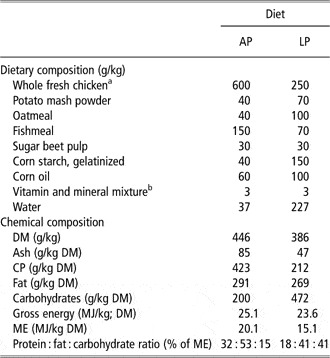
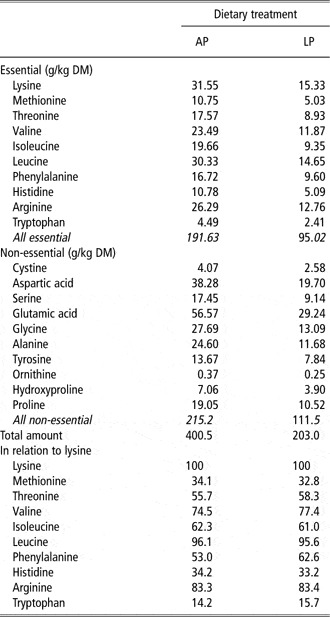
The experimental postnatal diets used in the present study included a control diet containing an adequate amount of protein (AP), that is, 32% of metabolizable energy (ME) from protein, and a low-protein diet (LP), that is, 18% of ME from protein. These diets were prepared on site on one occasion, apportioned by weight in plastic bags and frozen immediately. The ingredients and chemical composition of the two diets are given in Table 1 and the amino acid profile is presented in Table 2. Whole fresh chickens without feathers used in the diets were chopped in a Bizerba mincing machine FW82 (Bizerba GmbH & Co., Hamburg, Germany) and all ingredients were mixed in a Bjørn Varimixer MRM40 (A/S Wodschow, Broendby, Denmark).
Composition of the postnatal diets, containing either AP or LP levels

AP = adequate protein; LP = low protein; DM = dry matter; ME = metabolizable energy.
aChicken prepared for human consumption, that is, without head, feet, feathers and entrails.
bPer kg of supplement: retinol 2.8, cholecalciferol 0.28 mg, α-tocopherol acetate 24 021 mg, thiamine 10 002 mg, riboflavin 4800 mg, nicotinamide 8000 mg, pyridoxine 3200 mg, D-pantothenic acid 3200 mg, biotin 80 012 μg, folic acid 241 mg, choline chloride 60 001 mg, cyanocobalamin 16 008 μg, para-aminobenzoic acid 800 mg, betaine 33 600 mg, Fe (FeSO4) 19712 mg, Cu (CuSO4) 1025 mg, Zn (ZnO) 12561 mg and Mn (MnO) 6238 mg (Trouw Nutrition, Vejen, Denmark).
Amino acid composition of the diets used postnatally containing AP or LP levels

AP = adequate protein; LP = low protein; DM = dry matter.
Experimental animals
A total of 32 male mink kits (N. vison) of the standard black genotype (Nes et al., Reference Nes, Einarsson and Lohi1987) with different foetal life treatments were used. They were born to dams fed either an LP (14% of ME from protein) or an AP (29% of ME from protein) diet for the last 16.3 ± 1.8 days of the gestation. Kits exposed to low protein provision during foetal life (FL) had significantly lower birth weight (10.3 g v. 11.3 g; P = 0.004) than kits given adequate protein provision during foetal life (FA). The FL kits continued to have significantly lower body weight (BW) until 28 days of age, when the BW was found to be similar between the groups (Matthiesen et al., Reference Matthiesen, Blache, Thomsen, Hansen and Tauson2010a). Further information about the late gestation diets and the mothers of the male kits is provided elsewhere (Matthiesen et al., Reference Matthiesen, Blache, Thomsen, Hansen and Tauson2010a). The dams and their offspring were fed conventional feed containing adequate protein from parturition until weaning. At weaning, male kits from each foetal treatment (FL or FA) were randomly assigned to either the postweaning LP or the AP diet from 7 to 9.5 weeks of age (51 ± 1 days to 67 ± 1 days of age), resulting in four treatment groups (i.e. FA-AP, FA-LP, FL-AP and FL-LP).
Energy and N balance
The kits were fed the experimental diets for 7 days before the balance and respiration experiment. They were transferred from the experimental farm to the small animal laboratory and placed in metabolic cages for adaptation 3 days before a 4-day collection period. Owing to the young age and small size of the animals, the experiment was conducted with two male kits in each cage. The animals were fed ad libitum once a day and had free access to drinking water. They were kept under natural daylight conditions (55°N 12°E) and the experiment was conducted from late June to early July. The BW of the male kits was recorded at the start and the end of the collection period and otherwise every Monday and Friday. Feed residues, faeces, urine and citric acid rinse (see below) were quantitatively collected, weighed and recorded daily and then stored at −18°C until the end of the collection period. Urine was collected in vials to which 10 ml of 5% sulphuric acid was added. After each collection of faeces and urine, the collection screens and funnels were rinsed in 1% citric acid to minimize UN losses. Collection and recording was performed every morning between 0900 and 1100 h. At the end of the collection period, the feed residues, faeces, urine and citric acid rinse were thawed and mixed, and samples were taken for subsequent analysis. The gas exchange rate was measured once in the respiration chambers for 22 h by indirect calorimetry in an open-air circulation unit. The principles and procedures used for calibration and gas exchange measurements are described by Chwalibog et al. (Reference Chwalibog, Tauson and Thorbek2004).
Blood and tissue collection
At the end of the balance and respiration experiment, the kits were anaesthetized with 10.0 mg/kg BW Ketaminol (InterVet, Skovlunde, Denmark) and 2.0 mg/kg BW Narcoxyl (InterVet) by an intramuscular injection. As soon as palpebral and toe pinch reflexes were absent, blood was sampled by cardiac puncture and the animals were killed immediately afterwards. The blood was transferred to heparinized tubes and centrifuged for 15 min at 3300 g. Plasma was separated and stored at –18°C until subsequent analysis of hormones, that is, insulin-like growth factor 1 (IGF-1), insulin, leptin, cortisol and growth hormone (GH). The BW and liver weight were recorded. Samples of the liver were collected, flash frozen in liquid N and stored at −80°C until subsequent RNA isolation. The carcasses of 16 kits (four kits from each treatment, i.e. FA-AP, FA-LP, FL-AP and FL-LP) were collected and frozen at −18°C until subsequent analysis of body chemical composition.
Analytical procedures and calculations
Wet samples of diets and faeces were analysed for dry matter (DM) and N. Wet samples of the feed residues were only analysed for DM and ash, assuming the organic matter content of the residues to be similar to that of the diets. The freeze-dried samples of diets and faeces were analysed for DM, ash, fat and gross energy (GE). Urine and citric acid rinse were analysed for the N content. DM was determined by evaporation at 105°C to a constant weight. Ash was determined by incineration at 525°C for 10 h. N was determined by the micro-Kjeldahl technique using a 2020 Digestor (Foss Tecator, Höganäs, Sweden) at 420°C and the Kjeltec 2200 auto distillation unit (Foss Tecator). Crude protein was calculated as N × 6.25. Fat was determined after hydrolysis with 3 M hydrochloric acid in a Soxtec 1047 hydrolysing system (Foss Tecator) and extraction with petroleum ether in a Soxtec HT 1043 extraction system (Foss Tecator). GE was determined using an adiabatic bomb calorimeter c5000 control, c5002 cooling and c5003 control system (IKA GmbH & Co. KG, Staufen, Germany). The amino acids were determined according to the European Commission Directive 98/64/EC (European Community, 1998). The energy in urine was estimated from the N content measured (AH Tauson, unpublished). The heat production was calculated according to Brouwer (Reference Brouwer1965). The equations for ME, retained energy, retained nitrogen (RN) and retained fat are given elsewhere (Chwalibog et al., Reference Chwalibog, Tauson and Thorbek2004).
The oxidation of protein (OXP), carbohydrate (OXCHO) and fat (OXF) was calculated according to the equations given by Chwalibog et al. (Reference Chwalibog, Jakobsen, Henckel and Thorbek1992).
The carcasses were thawed and chopped twice in a Bizerba mincing machine FW82 (Bizerba GmbH & Co.), after which the material was homogenized and samples were taken out for analyses of DM, ash, N, fat and GE.
Hormone analysis
The hormone concentrations in plasma were analysed by radioimmunoassay (RIA) at the University of Western Australia, Perth. Plasma leptin was measured in duplicate using a double-antibody RIA method (Blache et al., Reference Blache, Tellam, Chagas, Blackberry, Vercoe and Martin2000). The measurements were made using human leptin; the first antibody was raised in a rabbit and the second in a donkey. All samples were processed in a single assay and the detection limit was 0.15 ng/ml. The assay included six replicates of three control samples containing 0.56, 1.20 and 2.09 ng/ml, which were used to estimate intra-assay coefficients of variation of 12.5%, 3.6% and 3.7%, respectively. Plasma insulin was assayed in duplicate by a double-antibody RIA (Tindal et al., Reference Tindal, Knaggs, Hart and Blake1978); the measurements were made using bovine insulin. The first antibody was raised in guinea-pigs and the second in goats. All samples were processed in a single assay and the detection limit was 0.098 μg/ml. In all, six replicates of three control samples containing 0.6, 0.9 and 2.2 μg/ml were included in the assay and were used to estimate intra-assay coefficients of variation of 5.7%, 2.8% and 4.2%, respectively. The measurements of insulin were performed with only 75 μl plasma instead of 100 μl due to the small amounts of plasma available, resulting in multiplying the results by 1.33. Plasma IGF-1 was assayed in duplicate by a double-antibody RIA method with human recombinant IGF-1 (ARM4050; Amersham-Pharmacia Biotech, Bucks, UK) using rabbit antiserum and donkey antiserum following the protocol for acid-ethanol extraction and cryoprecipitation (Breier et al., Reference Breier, Gallaher and Gluckman1991) in plasma samples diluted by 1 : 40. The samples were processed in a single assay with a detection limit of 0.04 ng/ml. In all, six replicates of two control samples containing 0.42 and 2.0 ng/ml were included in the assay and were used to estimate intra-assay coefficients of variation of 10.3% and 7.5%, respectively. Plasma cortisol concentrations were measured in duplicate 50-μl aliquots after extraction with 2 ml of dichloromethane using an RIA based on separation with dextran-coated charcoal; the first antibody was raised in a rabbit (Abraham et al., Reference Abraham, Buster and Teller1972). All samples were processed in a single assay as duplicate 50-μl aliquots of plasma and the detection limit was 0.2 ng/ml. The assay included six replicates of three control samples containing 13.64, 6.33 and 3.10 ng/ml, which were used to estimate intra-assay coefficients of variation of 16.6%, 7.0% and 12.4%, respectively. The concentration of GH was measured by double-antibody RIA (Drowning et al., Reference Drowning, Joss, Connell and Scaramuzzi1995); the first antibody was raised in a rabbit and the second in a donkey. All samples were measured in a single assay in duplicate 50-μl aliquots of plasma; the detection limit was 0.48 ng/ml. The assay included six replicates of three control samples containing 16.37, 4.57 and 2.31 ng/ml, which were used to estimate intra-assay coefficients of variation of 6.7%, 5.4% and 7.4%, respectively. All assays were validated for mink: serial dilutions of mink plasma containing high concentrations of the hormones leptin, insulin, IGF-1, cortisol and GH produced curves parallel to the standard curves for the actual hormones.
Assessment of gene expression
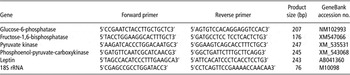
Liver samples (30 to 35 mg) were homogenized using 700 μl of RNA lysis buffer, whereas adipose tissue samples (25 to 30 mg) were homogenized in a Dispomix tube with 650 μl of Trizol using the Dispomix homogenization system (Medic Tools AG, Zug, Switzerland), followed by phase separation performed with 120 μl of chloroform and RNA precipitation with 500 μl isopropanol/600 μl aqueous phase. The RNA was isolated using the RNeasy Mini Kit (Qiagen, Venlo, the Netherlands). The concentration and purity were estimated using a Pharmacia GeneQuant RNA/DNA calculator (Amersham Pharmacia Biotech, Sunnyvale, CA, USA). The RNA (16.3 μl, with a maximum concentration of 2 μg of RNA) was transcribed into cDNA in 8.7 μl of reverse transcriptase (RT) master mix containing 5 μl of M-MLV buffer (Promega, Madison, WI, USA), 1.3 μl of dNTP (10 μM), 0.8 μl of RNasin RNase inhibitor (40 U/μl; Promega), 1 μl of M-MLV RT (200 U/μl; Promega) and 1 μl of a random hexamer primer (2 μg/μl; Amersham Biosciences, Copenhagen, Denmark). The RT reaction was carried out in a G-Storm GS1 cycler (Gene Technologies, Essex, UK) by incubating for 10 min at 25°C, 60 min at 42°C, 5 min at 95°C and 5 min at 4°C. The absence of genomic contamination was confirmed by conventional PCR using intron-spanning β-actin primers. PCR primer oligonucleotides for glucose-6-phosphatase (G-6-Pase), Fru-1,6-P2ase, phosphoenol-pyruvate-carboxykinase (PEPCK) and PKM2 were designed from canine mRNA sequences, whereas PCR primer oligonucleotides for leptin were designed from feline mRNA sequences. The primers were all tested by conventional PCR on mink and canine liver cDNA samples or feline cDNA samples, using canine DNA or feline DNA samples as the control. The chosen reference gene was 18S rRNA; all primers are listed in Table 3. The PCR products of all primer pairs used were sequenced (ABI3130XL, Applied Biosystems, Nærum, Denmark) to confirm product identity. The relative abundance of enzyme mRNA levels was estimated by quantitative real-time PCR using SYBR Green I detection and the LightCycler 480 real-time PCR system (Roche Diagnostics, Copenhagen, Denmark). Reactions were carried out in 20-μl volumes consisting of 2 μl of diluted cDNA (2×), 10 μl of LightCycler 480 SYBR Green I Master, 1 μl (10 μM) of each gene-specific forward and reverse primer, and 6.0 μl of PCR grade H2O. Each run consisted of serial dilutions of a pool of liver cDNA to generate a standard curve (5×). Liver cDNA was generated using the same RNA extraction method as that used for the standards, to ensure the same PCR efficiency in both standards and samples. In each reaction, triplicates of 2-μl samples of (2×) diluted cDNA were amplified. The program of amplification consisted of preincubation for FastStart polymerase activation at 95°C for 5 min, followed by 45 amplification cycles, as follows: 95°C for 10 s (4.4°C/s), 60°C for 10 s (2.2°C/s) and 72°C for 20 s (4.4°C/s). SYBR green fluorescence was acquired at 72°C in each amplification cycle. The melting curve was generated after the last cycle by starting the fluorescence acquisition at 65°C and increasing the temperature 2.2°C/s until it reached 95°C. A diluted (2×) cDNA pool was used as the calibrator in every run and measured in triplicate. Furthermore, the PCR efficiency was calculated for both the target and the reference gene by determining the fitting coefficients of the relative standard curve. The final relative quantification was efficiency corrected.
Sequence of gene-specific RT-PCR primers

RT-PCR = reverse transcriptase polymerase chain reaction.
Statistical analyses
The data were statistically analysed using the mixed procedure in SAS (Littell et al., Reference Littell, Milliken, Stroup, Wolfinger and Schabenberger2006) according to the following model:

where Yijk is the Yijkth observation, μ is the general mean, αi is the fixed effect of foetal protein provision (FA, FL) and βj is the fixed effect of the postnatal diet (AP, LP); (αβ)ij is the interaction between the fixed effects; and εijk is the residual error ∼N(0,σi 2). The normality of the residuals was tested. The results are presented as least square means (LSmeans), whereas the variance of each model is presented as the square root of the residuals (RR). Pairwise comparisons of LSmeans were made using the PDIFF option of SAS, and differences were denoted as significant if P < 0.05 and as a tendency if P < 0.10.
Results
All results regarding nutrient intake and metabolic traits are given in relation to metabolic body size (kg−0.75) to facilitate comparison of the animals on the different dietary treatments. The AP diet (32% of ME from protein) was slightly below the nutrient requirement guidelines, which called for 35% to 40% of ME from protein during early growth (9 to 13 weeks of age; NRC, 1982); the AP diet was nevertheless assumed to be adequate, because the protein sources used were of very high quality, resulting in a better amino acid composition than that of diets based on conventional feedstuffs.
N and energy metabolism
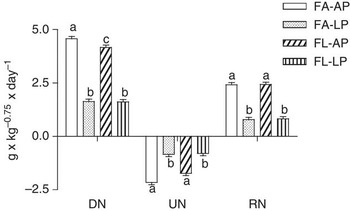
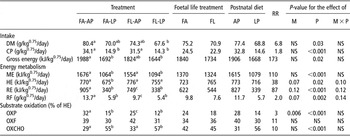
The lower content of dietary protein in the LP diet was clearly reflected in a significantly lower amount of digested nitrogen (DN; P < 0.001), urinary N (P < 0.001) and retained N (P < 0.001) among postnatally LP- than AP-fed kits regardless of foetal protein provision (Figure 1). This led to a tendency (P = 0.07) towards lower utilization of dietary N for retention (49.3% v. 55.7%) in postnatally LP- than AP-fed kits. The utilization of dietary N for retention was not affected by foetal life protein provision. The ME intake was significantly (P < 0.001) lower among postnatally LP- than AP-fed kits due to lower nutrient digestibility among the LP-fed kits. There was a tendency (P = 0.07) towards higher heat production among in utero FL- than FA-treated kits and the LP dietary treatment led to a significantly (P = 0.02) lower heat production among post-weaning LP- than AP-fed kits. Further, a tendency towards interactions between prenatal and post-weaning treatment was found. This resulted in significantly lower heat production among FA-LP than FA-AP-, FL-AP- and FL-LP-treated kits. The energy retention was not affected by foetal nutrition but was significantly (P < 0.001) lower among post-weaning LP- than AP-fed kits. Furthermore, there was a tendency (P = 0.07) towards lower fat retention among in utero FL than FA kits and the post-weaning LP-fed kits had a significantly (P = 0.002) lower fat retention than the AP-fed kits (Table 4).
The nitrogen metabolism of 32 male mink kits exposed to either a low (FL) or an adequate (FA) protein supply during foetal life and fed either low (LP) or adequate (AP) dietary protein post-weaning from 7 to 9.5 weeks of age. The presented data are digested nitrogen, urinary nitrogen and retained nitrogen.
a,b,c The mean values within trait with different lower-case superscript letters were significantly different (P < 0.05).

Feed and nutrient intake and the energy metabolism measured as ME, HE, RE and RF and the OXP, OXF and OXCHO in male mink kits exposed to FA or FL protein levels during foetal life combined with an AP or an LP supply from 7 to 9.5 weeks of age

ME = metabolizable energy; HE = heat production; RE = retained energy; RF = retained fat; OXP = oxidation of protein; OXCHO = oxidation of carbohydrate; OXF = oxidation of fat; FA = foetal adequate; FL = foetal low; AP = adequate protein; LP = low protein; RR = root of residuals; M = maternal diet applied during foetal life; P = postnatal diet fed from 7 to 9.5 weeks of age; DM = dry matter; GE = gross energy.
Values with different superscripts (a, b, c) differ significantly within treatment, foetal life treatment or postnatal diet.
Substrate oxidation
Male kits exposed to foetal life with low protein provision had significantly lower OXP (% of heat production; FA: 24% v. FL: 18%; P = 0.006) than those with adequate protein provision. Further, the postnatal dietary treatment was clearly reflected in a significantly lower OXP (AP: 28% v. LP: 14%; P < 0.001) whereas OXCHO was 25% higher (P < 0.001) that among LP- than AP-fed kits, regardless of in utero protein provision, reflecting the LP dietary composition (Table 4). The OXF was not affected either by foetal or by post-weaning dietary treatment.
BWs, liver weights and body chemical composition
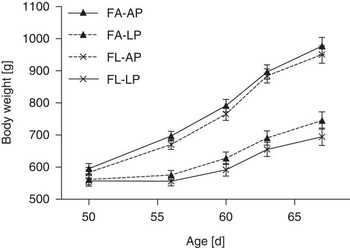
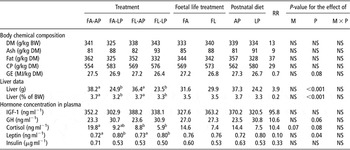
The LP diet led to a significantly lower BW (P < 0.001, Figure 2) and growth rate (P < 0.001) than did the AP diet in kits 7 to 9.5 weeks of age, irrespective of foetal treatment. The liver mass (P < 0.001) and liver as percent of BW (P < 0.001) were significantly lower among post-weaning LP- than AP-fed kits, regardless of foetal treatment. The body chemical composition was not affected by the dietary treatment in foetal life or during post-weaning growth (Table 5).
The BW of 32 male mink kits from 50 to 67 days of age. The kits were exposed to either a low (FL) or an adequate (FA) protein supply during foetal life and fed either low (LP) or adequate (AP) dietary protein post-weaning from 7 to 9.5 weeks of age. BWs were significantly different (P < 0.001) between kits fed AP and LP diets post weaning on all weighing occasions, except at the start of the experiment.

The body chemical composition (n = 16), liver weights and concentration of IGF1, GH, cortisol, leptin and insulin in the plasma (n = 32) of male mink kits exposed to FA or FL levels during foetal life combined with an AP or an LP supply from 7 to 9.5 weeks of age

IGF1 = insulin-like growth factor 1; GH = growth hormone; FA = foetal adequate; FL = foetal low; AP = adequate protein; LP = low protein; RR = root of residuals; M = maternal diet applied during foetal life; P = postnatal diet fed from 7 to 9.5 weeks of age.
Values in a single row with different superscripts (a, b) differ significantly.
Plasma hormone concentration
The plasma concentrations of IGF-1 and insulin were not affected by either foetal or post-weaning dietary treatment. However, a tendency (P = 0.06) towards a higher (31.3%) GH concentration among postnatally LP- than AP-fed kits was found, and a tendency towards an effect of both foetal (P = 0.07) and postnatal (P = 0.08) protein provision on plasma cortisol concentrations. This led to FL- and LP-treated kits having the lowest cortisol concentration. Plasma leptin was only affected by post-weaning dietary treatment, in that its plasma concentration was significantly higher among LP- than AP-treated kits (P = 0.04; Table 5).
Gene expression
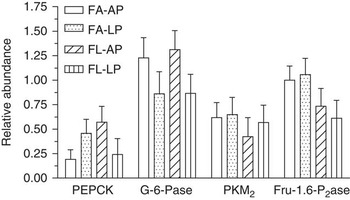
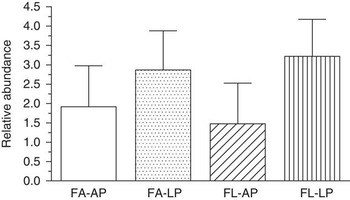
The relative abundances of PKM2, G-6-Pase and PEPCK mRNA were not affected either by foetal or by postnatal protein provision. However, there was a tendency towards lower relative abundance of G-6-Pase mRNA among postnatally LP- than AP-fed kits (P = 0.06). The relative abundance of Fru-1,6-P2ase mRNA was significantly (P < 0.05) lower among FL- than FA-treated kits, which led to a tendency towards a lower relative abundance of Fru-1,6-P2ase mRNA among FL-LP than FA-LP-treated kits (P = 0.08; Figure 3).
The relative mRNA abundance normalized to 18 s rRNA of glucose-6-phophatase, fructose-1,6-bisphosphatase, phosphoenol-pyruvate-carboxykinase and pyruvate kinase in hepatic tissue of 32 male mink kits exposed to either a low (FL) or an adequate (FA) protein supply in the last 16.3 ± 1.8 days of foetal life and fed either low (LP) or adequate (AP) dietary protein post-weaning from 7 to 9.5 weeks of age.

The relative abundance of leptin was not significantly affected by foetal life treatment or post-weaning dietary treatment (Figure 4).
The relative mRNA abundance normalized to 18 s rRNA of leptin in adipose tissue from 32 male mink kits exposed to either a low (FL) or an adequate (FA) protein supply during foetal life and fed either low (LP) or adequate (AP) dietary protein post-weaning from 7 to 9.5 weeks of age.

Discussion
The study investigated whether foetal life protein malnutrition affected post-weaning protein metabolism, especially protein oxidation, and whether a lower expression of key gluconeogenic and glycolytic hepatic enzymes, similar to that found in hepatic tissue of foetuses exposed to maternal low protein provision, could be manifested during post-weaning growth. The study also aimed to investigate whether the response to deficient protein provision post-weaning was affected by foetal life experience.
The overall results showed that post-weaning growth and metabolism were mainly affected by post-weaning feeding, regardless of the prenatal treatment. There were, however, some interesting findings, especially in relation to strict carnivores, showing that adaptations caused by maternal nutrient manipulation were manifested and resulted in changes in the protein metabolism during post-weaning growth. However, because an LP diet had a higher content of carbohydrates and vice versa, it is difficult to discriminate between the effects of protein v. carbohydrate contents in the maternal diet on the kit metabolism during post-weaning growth.
Quantitative metabolic traits
The issue of occurrence of metabolic flexibility or not in strict carnivores has been investigated in a number of studies with cats (e.g. Russell et al., Reference Russell, Murgatroyd and Batt2002; Green et al., Reference Green, Ramsey, Villaverde, Asami, Wei and Fascetti2008). Our findings in another strict carnivore, the mink, indicate that foetal life protein malnutrition leads to a lower protein oxidation, calculated as a percentage of total heat production. Our data thereby suggest that mink kits, which have experienced protein shortage during foetal life, have a lower protein oxidation, and therefore may be better able to conserve available protein than young kits whose mothers have been provided with adequate protein. This was, however, not confirmed by the N balance data, because UN excretion and RN in absolute values were not significantly different among kits with different protein provisions during foetal life. The lower protein oxidation was not caused by better protein utilization, because the utilization of digested N for retention was similar among foetal life treatments. Furthermore, it still needs to be investigated as to whether the low protein oxidation was age-specific or whether it remains at a lower level throughout life. It might be an age- or a gender-specific effect, because in one-year-old mink dams no effect of foetal life protein provision on protein oxidation was found (Matthiesen et al., Reference Matthiesen, Blache, Thomsen and Tauson2010b). The long-term metabolic consequences of the lower protein oxidation and whether this trait can be passed on from the F1 to subsequent generations need to be investigated further. The postweaning dietary protein provision was clearly reflected in the N balance data and supported by the OXP during postweaning growth. This was similar to findings among female dams fed an LP or an AP where the amount of dietary protein was also clearly reflected in both the N metabolism and the level of protein oxidation (Matthiesen et al., Reference Matthiesen, Blache, Thomsen, Hansen and Tauson2010a).
The expectation of a better nutrient utilization or nutritional thrift (Hales and Barker, Reference Hales and Barker1992) and thereby lower energy expenditure was contrary to our findings in the present study, where a tendency towards a higher heat production among FL- than FA-treated kits was found. However, similar findings in 9-week-old maternally protein- and energy-restricted lambs have been obtained (Husted et al., Reference Husted, Nielsen, Tygesen, Kiani, Blache and Ingvartsen2007). This indicates that in utero malnourished offspring of some species, among them the mink, do not develop nutritional thrift. However, these animals were measured at a young age; thus, development of thrift later in life cannot be excluded.
The body chemical composition at 9.5 weeks of age was not affected either by foetal or by post-weaning dietary protein provision. Protein restriction during foetal life in rats may cause higher body fat mass (Pinheiro et al., Reference Pinheiro, Salvucci, Aguila and Mandarim-de-Lacerda2008) and adiposity (Guan et al., Reference Guan, Arany, van Beek, Chamson-Reig, Thyssen, Hill and Yang2005) in adult rats. The male mink kits we studied, however, were still in the early post-weaning growth period; hence, our findings are not comparable to findings in adult rats. Prolonged post-weaning exposure to a low protein supply would likely cause higher body fat mass and adiposity in adult individuals, but whether this would be more pronounced in animals that were protein malnourished during foetal life is not yet known.
Liver weights and gene expression in hepatic tissue
The liver mass, at the end of this study, was not affected by maternal protein supply but only by post-weaning dietary treatment. Regardless of whether the low foetal protein supply had caused any differences in liver weight from birth until weaning or not, the differences were eliminated in the mink kits by 9.5 weeks of age. The findings in rats support this (Desai et al., Reference Desai, Crowther, Lucas and Hales1996). This suggests that any differences in liver mass caused by low protein supply during prenatal life will be eliminated over time as animals are fed an AP diet postnatally. Kits fed LP postnatally had lower liver weights than AP-fed kits, similar to the findings in lactating (P < 0.05; Fink et al., Reference Fink, Thomsen and Tauson2007) and pregnant (P = 0.09; Matthiesen et al., Reference Matthiesen, Blache, Thomsen, Hansen and Tauson2010a) mink dams provided a LP diet. This indicates that the liver mass is related to dietary protein provision and metabolic flexibility reflects liver mass. This could not, however, be confirmed in the present study where the liver mass was similar between the two foetal life treatments post weaning.
The lower relative abundance of Fru-1,6-P2ase mRNA in foetal hepatic tissue (Matthiesen et al., Reference Matthiesen, Blache, Thomsen, Hansen and Tauson2010a) was still evident during post-weaning growth, despite adequate protein provision from parturition until weaning, and regardless of the dietary protein level during post-weaning growth. These differences, however, were not detectable in one-year-old dams, but in their foetal offspring (F2-generation; Matthiesen et al., Reference Matthiesen, Blache, Thomsen and Tauson2010b). The consequence of the lower relative abundance of Fru-1,6-P2ase mRNA for gluconeogenesis and glucose homeostasis has not yet been investigated. The lower relative abundance of PKM2 mRNA found in the foetal hepatic tissue of FL- than FA-treated offspring was not detectable in the 9.5-week-old male kits. The relative abundance of PEPCK mRNA was similar among the two maternal treatments in foetuses (Matthiesen et al., Reference Matthiesen, Blache, Thomsen, Hansen and Tauson2010a) and in 9.5-week-old kits, but this was different from the findings in rats (Desai et al., Reference Desai, Byrne, Zhang, Petry, Lucas and Hales1997; Lillycrop et al., Reference Lillycrop, Slater-Jefferies, Hanson, Godfrey, Jackson and Burdge2007). However, findings in rats have shown that changes in PEPCK are both age and gender specific. It remains to be investigated as to whether this is the case for the mink. Because we did not find any effect of maternal protein provision on the relative abundances of G-6-Pase and PEPCK mRNA, our findings do not suggest that any major changes in glucose homeostasis were induced in kits early post-weaning.
Plasma hormone concentrations
The tendency towards lower plasma concentrations of cortisol in kits experiencing in utero (P = 0.07) or post-weaning (P = 0.08) protein deficiency was in contrast to other findings indicating that a reduced nutrient availability or stressful stimuli during foetal life increased catabolic hormone concentrations (e.g. cortisol). Foetal malnutrition might, however, alter the hypothalamic–pituitary–adrenal (HPA) axis, which can lead to increased basal and stress-induced glucocorticoid secretion postnatally (Fowden and Forhead, Reference Fowden and Forhead2004). Such changes in the HPA axis might be gender specific and species dependent (Seckl, Reference Seckl2004); thus, reduced basal cortisol secretion could also occur as found in male, but not female, guinea-pigs (Lingas and Matthews, Reference Lingas and Matthews2001).
The concentration of IGF-1 was neither affected by foetal life nor post-weaning protein provision. Similar findings have been obtained in rats in which the IGF-1 concentration was lower in foetal life protein-restricted rat pups at 10 and 21 days of age but not affected by foetal life experience at 12 weeks of age regardless of post-weaning dietary treatment (Gosby et al., Reference Gosby, Stanton, Maloney, Thompson, Briody, Baxter, Bryson, Denyer and Caterson2008).
Plasma insulin concentrations were similar between the two foetal life treatments and in agreement with the findings in rats, in which plasma insulin concentrations were similar between treatment groups for both male and female F1-generation offspring of protein-restricted mothers, whereas the fasting glucose levels were increased for both genders (Pinheiro et al., Reference Pinheiro, Salvucci, Aguila and Mandarim-de-Lacerda2008). Others have found that protein restriction during foetal life led to a reduction in pancreatic β-cell mass (Reusens and Remacle, Reference Reusens and Remacle2006) and subsequent insulin secretion (Snoeck et al., Reference Snoeck, Remacle, Reusens and Hoet1990). Furthermore, findings have shown that male rats are better able to recuperate and recover if fed an adequate diet after birth than female rats (Dahri et al., Reference Dahri, Reusens, Remacle and Hoet1995), but changes in the glucose homeostasis caused by low protein provision in utero are both age and gender specific in rats (Ozanne and Hales, Reference Ozanne and Hales2002). Whether similar changes occurred in the mink foetus or neonate before receiving an adequate protein supply, and whether the changes are also gender and age specific have not yet been investigated.
The tendency towards a higher GH concentration among postnatally LP- than AP-fed kits was consistent with the lower ME intake among postnatally LP- than AP-fed kits. The higher concentration of plasma leptin among LP- than AP-fed kits differs from previous findings in adult mink dams, where low protein provision during late gestation resulted in lower plasma leptin concentrations than in adequately fed dams (Matthiesen et al., Reference Matthiesen, Blache, Thomsen, Hansen and Tauson2010a) and plasma leptin normally reflects energy intake and BW changes (Tauson and Forsberg, Reference Tauson and Forsberg2002). The higher content of leptin among the LP-than AP-fed kits, however, did not reflect the feed intake, but the fat retention related to total energy retention was higher in LP-fed kits than the controls, which corresponds to the higher plasma leptin concentrations.
The higher plasma concentration among kits fed the LP diet during post-weaning growth further corresponds to the higher relative abundance of leptin in adipose tissue.
Conclusion
Male mink kits experiencing protein deficiency and high dietary content of carbohydrates during foetal life undergo adaptations that are manifested during early post-weaning growth. Male kits in which foetal life adaptation has occurred due to protein restriction in their mothers may be better able to conserve available protein than adequately treated ones, as indicated by the lower OXP post-weaning, independent of postnatal diet. This suggests that mink kits, to some extent, will adapt their protein metabolism to foetal life experience. Low protein provision during foetal life, however, did not lead to significantly different responses to postnatal dietary treatment, besides heat production, where a tendency towards an interaction between prenatal and post-weaning diet was mainly caused by low heat production among animals treated prenatally and postnatally with adequate and low protein.
The lower expression of Fru-1,6-P2ase mRNA in 9.5-week-old foetal life protein-restricted male mink kits than in the controls confirms that some changes caused by the prenatal environment may lead to detectable changes later in life despite adequate postnatal nutrition. The absence of changes in PEPCK and G-6-pase, however, indicates that the effect on glucose homeostasis is limited during post-weaning growth in mink.
Body fat content was not different among the treatments, but the post-weaning dietary interventions lasted only briefly; hence, any effects of foetal life protein restriction on body fat accumulation were unlikely to be detected.
This study indicates that protein provision during foetal life can modify postnatal protein metabolism in the mink, and these findings can be useful for improving the understanding of the regulation of metabolic flexibility in strict carnivore species.
Acknowledgements
This study was part of the “Interdisciplinary animal research” research programme, Grant no. 5414114.95.304. We gratefully acknowledge the financial support of the Danish Food Industry Agency of the Ministry of Food, Agriculture and Fisheries for this research. We are grateful for the skilful technical assistance with collection routines and chemical analyses provided by Merethe Stubgaard, Lotte Ørbæk and Ebba de Neergaard Harrison, with animal handling by Boye Pedersen, with respiration unit operation by Abdalla Ali, with RIA measurements by Margaret Blackberry and with q PCR by Kristine Vesterdorf and Anne Friis Petersen.