INTRODUCTION
Through processes of cultural transmutation and dialogical conflict, this paper argues that traces of shamanic practice and cosmology can be discerned in the archaeological, antiquarian and mythological records of Wales. Drawing on Stan Mumford’s methodology for identifying cultural strata to show that shamanism coexisted with Buddhist and modern practices,Footnote 1 this study applies the same approach to Welsh history and prehistory, showing how competing traditions including shamanism, paganism and Christianity transformed one another over time. Then, using cross-disciplinary data from prehistoric archaeology and ethnography, it presents the case for a shamanic cultural stratum existing in wider Europe and Wales.
The discussion examines myths and legends in relation to Neolithic monuments such as Trellyffaint and Maen Catwg, then considers folklore – including eagle symbolism in Snowdonia – in comparison with motifs in ethnographic accounts of shamanic traditions. It further surveys the behaviour of the Dyn Hysbys (‘cunning men’) across Wales, whose roles echo those of shamans described ethnographically. It should be noted that nineteenth- and early twentieth-century rural Wales was marked by superstition, including fears of witchcraft, second sight and the Tylwyth Teg.Footnote 2 Conjurers, or Dyn Hysbys, were sought to combat these forces, yet were also feared for their capacity to manipulate them.Footnote 3 Similarly, ethnographic accounts of shamans show them to be both respected and feared for their ability to oppose and command supernatural powers.Footnote 4 Finally, the paper considers antiquarian evidence from historic Montgomeryshire describing a Welsh conjurer or cunning man who performed rituals in ceremonial dress with avian symbolism – paralleling shamanic spirit invocation and symbolic attireFootnote 5 – and a charmer whose inherited powers reflect a belief in ancestral descent,Footnote 6 itself another classic motif.Footnote 7 Together, these practices suggest the survival of a transmuted shamanic stratum in Wales that is possibly prehistoric in origin. These two antiquarian accounts, recorded in chapter vii of ‘Llanrhaiadr-yn-Mochnant’ by Thomas Hancock,Footnote 8 describe two individuals prior to 1873 whose ritual practice and material culture closely resemble the traits of shamans in global ethnography.
What this paper argues is that elements of Welsh magico-religious practice, mythology and folklore display recognisably shamanic themes that can be directly compared with the ethnographic record. While isolated cases of similarity could be attributed to coincidence, the recurrence of such parallels – such as the practice and attire of the conjurer – suggests patterns too significant to dismiss. I recognise the limitations of the archaeological record when set against intangible ethnographic and anthropological data, but within the Welsh tradition there are many intangible forms of evidence that suggest and support a shamanic cultural stratum that at times can arguably be glimpsed in the material evidence of the archaeological record.
In this paper, the term and function of a ‘shaman’ refers to:
an individual who engages in (and is a master of) magico-religious psychobiological experiences (altered states of consciousness/NOMEs [non-ordinary mental expressions, formerly known as ‘ecstasy’Footnote 9 ]) through the culturally informed paradigm/practice of shamanism (the techniques, cosmology and worldview) primarily specific to an indigenous culture based in animistic cosmologies.Footnote 10
‘Shamanism’ refers to:
a culturally informed magico-religious psychobiological practice (technique/set of techniques) often based in animistic cosmologies in mainly indigenous hunter gatherer, pastoralist/nomadic, and sometimes horticulturist settings. The practice (techniques, cosmology, beliefs etc) may differ from culture to culture yet the aims remain the same; to enter into an altered state of consciousness and to gain some form of knowledge, ability, or action from it to help or harm a person or community. This may be traversing spiritual other worlds, or conversing with spirits etc.Footnote 11
The practice of shamanism is a global phenomenon and remains one of the oldest magico-religious practices that is global in scope.Footnote 12
THEORETICAL APPROACHES
The two methodological approaches applied in this study consist of cross-cultural comparative analysis and Mumford’s methodology inspired by Bakhtin’s dialogic interaction.Footnote 13 The first method is used to demonstrate the comparable links between the data and ethnography, drawing on material from selected Welsh myths and legends, as well as Hancock’s accounts in ‘Llanrhaeadr-ym-Mochnant’ in relation to shamanic ethnographic parallels. The second method explores the possible origins of these connections.
In Himalayan Dialogue: Tibetan lamas and Gurung shamans in Nepal, Mumford presents an ethnographic study of the Gyasumudo community in Nepal that adapts Russian philosopher and literary critic Mikhail Bakhtin’s concept of ‘dialogic imagination’ into a methodology to analyse the process of cultural transmutation between Tibetan Buddhism and Gurung shamanism.Footnote 14 This paper argues that the same approach can be applied to any relevant context involving cultural strata regardless of temporal, spatial or cultural differences.Footnote 15 According to Bahktin’s theory, and central to Mumford’s adaptation, is the belief that dialogism regards all language to be relational, arising from listeners and speakers, so that no text (or voice) exists in isolation but is part of a continuous dynamic conversation. In Bakhtin’s view, no ‘single authoritative voice’ exists (like an author) and meaning is constructed through dialogue between various voices. Each voice is shaped by the context, history and social position from which it arises.Footnote 16 This is further developed in Bakhtin’s concept of heteroglossia, which refers to the coexistence of multiple, often contradictory, voices or discourses within a single text or society. It involves the interplay of these voices and their social, political and ideological tensions. They feature a diversity of perspectives, languages and ideologies, giving the reader (or ethnographer) insight into different layers of social reality.Footnote 17 Mumford explains that the culture of Gyasumdo is in a state of ‘becoming’ due to three competing cultural layersFootnote 18 and therefore cannot be treated as static or complete.Footnote 19 Instead, culture is constructed through a dialogue between various voices that are in turn shaped by their own shared and individual history and traditions.
Mumford uses Bakhtin’s concepts of dialogism and heteroglossia to identify the separate cultural layers in dialogue, including older and newer traditions, and then demonstrates how they interact with each other, both at a community level and in internal individual dialogue. He begins with what he terms the ‘Ancient Matrix’, also described as the folkloric chronotope, which encompasses:
the most primal experience of time and space found in the ancient world and in folklore traditions. For our purposes it epitomises the shamanic world view. Personal identity is relational, defined in terms of connections between persons and the landmarks of local space. The sense of time in the individual is in harmony with cycles of nature. Everything in this matrix is ‘equally important’ since ‘everything acts and takes part in the unified life of the whole’.Footnote 20
This concept is comparable to Sir Edward Tylor’s definition of ‘animism’ in which ‘natural objects other than humans have souls, and that life force and will pervades nature’.Footnote 21
The second layer is that of ‘Individual Life Sequences’, which introduces:
a new feeling of interior time, ‘sealed-off’ from other subjectivities. It promotes a directional identity of ‘individual becoming’ that seeks extrication from the world matrix, as in Christian or Buddhist religious destinies and economic individualism. The result is a bifurcation of personal time and world time.Footnote 22
Finally, the third layer is ‘Historical Becoming’, which:
arrives after this vertical, individuated axis is questioned by a ‘Rabelaisian unmasking’[ Footnote 23 ] that celebrates the future of the world rather than a destiny that is separated from the world. This transition unites the personal sense of time with historical consciousness. Images of the ancient matrix return in a reflexive manner, in terms of dialogue between diverse, interpenetrating cultural and ideological voices on a global scale.Footnote 24
Mumford explains that Gyasumdo features all three of these layers and that historic discourse does not disappear but leaves traces in its surviving ‘semantic’ layers, as such practices or beliefs that survive in a new transmuted form into the present.Footnote 25 Likewise, we can see similar layers in Welsh history and mythology, comparative themes to shamanism, paganism, Christianity and then modernity.
The work shows that cultural meaning is not only contained but emerges between people and social groups.Footnote 26 Cultural events, practices or beliefs in the past that were shaped in a specific time and place are constantly re-entering dialogue, both internally and externally as views from within a community and without reshape belief. The current, historic or new beliefs must adapt, and readapt, to survive.
Himalayan Dialogue is an example of how a religion, in this case Buddhism, attempts to outcompete shamanism locally. Buddhists are required to reframe traditional arguments and beliefs in their own religious framework, essentially transmuting the ‘Ancient Matrix’ cultural layer into ‘Individual Life Sequences’. However, the Buddhists also adopt some shamanic traits in their own teachings during this process. This can be seen in Lama Duwang Tendzin’s use of a landslide curse, a power historically wielded by shamans.Footnote 27 This is comparable to some of the Christian Welsh saints such as St Catwg, who is recorded as possessing great supernatural power and caused the land to swallow up his enemies.Footnote 28
While the Gyasumdo case study is not a direct parallel with Welsh history, Mumford’s methodology remains applicable to Christianity, as this too would have entered into dialogic interaction with the existing socio-cultural framework when it was introduced in Wales. Whatever belief systems existed at that time – be it paganism or other local traditions – would likewise have been in dialogue with those that preceded them. This dynamic, layered interaction naturally extends further back through time, with each era leaving behind its own semantic traces. Building on this framework, the archaeological section of this paper establishes a broader precedent for shamanic practice across Europe, drawing on both archaeological and ethnographic evidence. By demonstrating the presence of a shamanic cultural stratum in prehistoric Europe, a more plausible context is established for the existence of similar traditions in prehistoric Britain.
Mumford’s reconstruction of Bakhtin’s dialogic interactions offers us a methodology to understand how shamanism, or traces thereof, survived into nineteenth-century Wales, potentially deriving from prehistory. Naturally, as this methodology suggests, dialogic interaction will have occurred between various belief systems at different times in the past, with shamanism being just one part of a much greater and multifaceted whole.
ARCHAEOLOGY AND ETHNOGRAPHY: SHAMANISM IN PREHISTORY
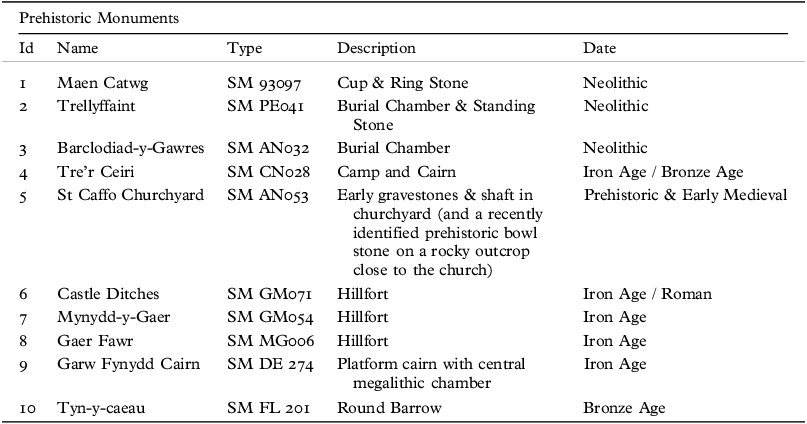
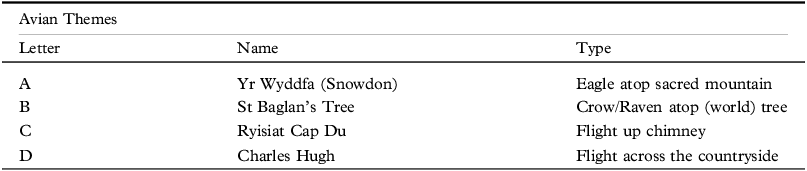
To understand the possibility of shamanism in Wales, it is first necessary to establish the wider archaeological and ethnographic precedent for shamanic practice, particularly in Europe (fig 1; tables 1 and 2). Witzel’s cross-cultural comparative study into the mythological legacies of diverse societies proposes that shamanism, in its most general form, may be as old as 65,000 years.Footnote 29 There is contested evidence suggesting the presence of shamanism at Dolní Věstonice in the Czech Republic around 30,000 bp.Footnote 30 In the southern Levant, more widely accepted archaeological evidence points to shamanic activity as early as 12,000 bp,Footnote 31 while Göbekli Tepe – occupied between 11,500 and 10,000 bp – exhibits a number of symbolic and architectural elements interpreted as shamanic in nature.Footnote 32
Location plan of saints, sites and magico-religious practitioners mentioned in this paper. Archaeological sites and avian themes are numbered or lettered, and their details are given in the tables below. Map: author.

Table referring to archaeological sites numbered on the map in fig 1.

Table referring to avian or aerial themes lettered on the map in fig 1.

Of these examples, the Bad Dürrenberg burial in Germany, dated to around 8000 bp, and believed to be that of a female shaman, provides one of the clearest and earliest pieces of archaeological evidence for shamanism in prehistoric Europe.Footnote 33 To this can be added the Amesbury Archer, dated to 2400 bc, whose origins from what would be modern-day Switzerland, Austria or GermanyFootnote 34 provides evidence for the mobility of people and, by extension, the likely movement of ideas, beliefs and ritual practices during prehistory. Likewise, other cross-disciplinary studies have demonstrated shamanic transmission between Eastern Siberia and North America from at least 5,000 years ago.Footnote 35
Moving into more recent periods, ethnographic records confirm the persistence of shamanic traditions in Europe well into the modern era. The Sámi in northern EuropeFootnote 36 and the Hungarian Táltos traditionFootnote 37 both offer well-documented examples of continued shamanic practice. Of the indigenous cultures studied globally by 1973,Footnote 38 ninety per cent were found to engage in altered states of consciousness,Footnote 39 this being an absolute prerequisite of shamanism.Footnote 40
Such data aligns with a global phylogenetic study, which shows that shamanism is a cross-cultural phenomenon and among the oldest magico-religious practices.Footnote 41 da Silva and Tehrani’s phylogenetic and auto-linguistic analysis of folklore further demonstrates that types 328 (‘The Boy Steals the Ogre’s Treasures’), 330 (‘The Smith and the Devil’), 402 (‘Animal Bride’), and 554 (‘Grateful Animals’) are among the world’s oldest tales, dating back 4,500–6,000 years.Footnote 42 Types 402 and 554 reflect animistic worldviews, consistent with findings that animism is the earliest belief system,Footnote 43 while 328 and 330 exhibit shamanic themes.Footnote 44
Together, this body of archaeological and ethnographic evidence suggests that shamanism had both time depth and geographic breadth in Europe to spread, laying a contextual foundation from which the possibility of shamanic practice in prehistoric Wales can be reasonably considered.
ARCHAEOLOGY AND FOLKLORE: THE EVIDENCE FROM WALES
As part of my earlier research, seven Neolithic monuments, all containing rock art, were studied for evidence of shamanic ritual.Footnote 45 The sites were Bachwen (Cynnog), Barclodiad y Gawres (Anglesey), Bryn Celli Ddu (Anglesey), the Llwydiarth Esgob Stone (Montgomeryshire), the Maen Catwg stone (Glamorgan), Trefael (Pembrokeshire) and Trellyffaint (Pembrokeshire). A comprehensive cross-disciplinary comparative methodology was utilised including place-name research, analysis of site location and the architecture of the site, the archaeological assemblage from the site, local legends surrounding it, visible rock art and its acoustic qualities.Footnote 46
This research concluded that there were varying degrees of potential evidence for shamanism at these sites,Footnote 47 with the most compelling deriving from Barclodiad y Gawres (table 3).Footnote 48 The site produced evidence for a hearth that was deliberately structured. It was covered with stones, beneath which lay shells encasing its contents, and buried underneath was the foreleg of a boar; the excavators described it as resembling ‘the brew of Macbeth’s witches’, but did not speculate on its possible ceremonial significance.Footnote 49 During my doctoral fieldwork research in Mongolia, fourteen shamans were interviewed for their thoughts on the Barclodiad y Gawres site. One was certain it was shamanic, two believed no shamanism was present, seven believed it contained aspects of shamanism, three gave no answer and one shaman was uncertain.Footnote 50 The hearth contents were interpreted by one shaman to be the components for a ritual that was comparable to some Mongolian variants (such as a curse), while another shaman interpreted it as a means to ‘feed’ a spirit.Footnote 51 In the steppe, I came across ritual shaman hearths containing animal bones given in offering to spirits. The Mongolian shamans also expressed an interest in the rock art at Barclodiad y Gawres, interpreting it variously as a spirit or a map.Footnote 52 They also noted its alignment northwards, a direction associated with ancestor spirits in Mongolian tradition, with the axis mundi in many othersFootnote 53 and that its entrance lacks a solar or lunar alignment.
Hearth contents table (Malim Reference Malim2024a, 44).

The engraved Neolithic rock art at some Welsh sites,Footnote 54 including the rocky outcrop near Bryn Celli Ddu, are also candidates for entoptic phenomena of the kinds discussed by Lewis-Williams, potentially indicating the use of altered states of consciousness.Footnote 55 Such sites may also have had acoustic qualities for shamanistic rituals;Footnote 56 however, at Barclodiad y Gawres and Bryn Celli Ddu these cannot be satisfactorily tested due to the reconstruction and historic disturbances that have taken place at the sites.
Other sites demonstrate a long period of (re)use, potentially showing cultural transmutation over millennia. At Trefael, a dolmen was erected in the Neolithic period on a site that had previous evidence of use during the Mesolithic period. The capstone of this dolmen was then repurposed during the Bronze Age by the addition of cup marks ground into it.Footnote 57
Perhaps the most famous Welsh site that has been interpreted as that of a shaman is the Red Lady of Paviland (Gower Peninsula).Footnote 58 This 33,000-year-old partial male skeleton was found dyed in red ochre;Footnote 59 indeed, the use of red ochre in burials is found across prehistoric Europe and beyond,Footnote 60 potentially indicating how ideas and culture migrated through human communication over time.
Using Mumford’s methodology, we can conceive of people of this time (the Mesolithic and Neolithic) within the ‘ancient matrix’, in which communities and their relationships to the cosmos and landscape were integrated in a manner comparable with the cultural layers in which the Nepalese shamans in Gyasumdo operate.Footnote 61
A case study in Pennant Melangell (Powys) demonstrates a Bronze Age population choosing this specific valley to act out their beliefs in the afterlife due to the terrestrial alignment of the Cwm Pennant valley and the head of the Tanat river with the celestial alignment of the Orion group and the Milky Way as they would have been observed from the valley during the Bronze Age, which fits within Mumford’s ‘Ancient Matrix’.Footnote 62
Building on these themes, several Welsh myths and legends display shamanic motifs that can be linked to landscapes and prehistoric monuments, including those of Seisyll Esgairhir (linked to Trellyffaint), St Catwg (Maen Catwg stone) and St Aelhaern (near Tre’r Ceiri hillfort) (see fig 1). It is argued here that these legends and monuments can be conceived as aspects of an ‘ancient matrix’ that emerged within a shamanic cultural stratum. Compared with global ethnographic data, the more unusual elements of these myths gain context: for instance, bodily dismemberment and reconstitution – often repeated elements in folklore – reflect classic shamanic initiation practices.Footnote 63 The three legends are now explored in turn.
The legend of St Aelhaern
The legend of St Aelhaern and St Byno (or St Beuno), from Clynnog Fawr and Llanaelhaearn in North Wales, illustrates how potential shamanic elements were incorporated into Christian belief. Recorded by John Ray in Memorials,Footnote 64 the story recounts St Byno’s nightly journeys to a stone in the river at Llanaelhaearn to pray, a site reportedly preserving his knee prints.
The narrative describes how St Byno’s servant (Aelhaern) secretly followed him to the river, and, upon being discovered, was subjected to a prayer so that ‘if he had any ill design, that some example might be shown upon him’.Footnote 65 Wild beasts were summoned by the saint’s prayer and tore the servant apart. Realising his mistake, St Byno gathered the servant’s bones, prayed and miraculously reconstituted his body, though a portion of the bone beneath the eyebrow remained missing. St Byno repaired the gap using the metal from his pikestaff, inspiring the name ‘Aelhaearn’ (Iron Brow).Footnote 66 However, the story goes on: ‘But for a punishment to his man (after he had given him Llanvil-hayrne) he prayed (and obtained his prayer) that Clenogvaur bell might be heard as far as Llanvil-hayrne churchyard, but upon stepping into the church it was to be heard no longer.’Footnote 67
Analysis
This legend, though framed in a Christian context, preserves elements of far older traditions. The dismemberment–reconstitution motif is not peripheral folklore but a central, near-universal feature of shamanic cosmology.Footnote 68 Across cultures, ritualised dismemberment and reconstruction mark the shaman’s initiation, a symbolic death and rebirth enabling passage between worlds. Here, the variant – where the reconstitution is incomplete – mirrors cases such as ‘Auburn Mary’Footnote 69 and ‘The Bird Nester’, a well-known shamanic story,Footnote 70 reinforcing Aelhaern’s experience as a shamanic, rather than merely folkloric, motif.
Sound and its manipulation also carry shamanic significance. In many traditions, sound bridges altered states of consciousness, facilitating contact with the spirit world. The inability to hear church bells within St Aelhaearn’s church – explicitly described as a punishment – may symbolise a limitation of the saint’s potency. Taken literally, St Aelhaern appears as an individual absent from earlier sources who is dismembered, reassembled, attains sainthood and suffers a curse for a seemingly arbitrary event. It is more plausible that St Aelhaern represents an earlier cult figure revered by the local community, whose status was renegotiated with the arrival of Christianity, reflecting a dialogic renegotiation of earlier beliefs transmuted into Christian frameworks.Footnote 71
The legend further demonstrates syncretism. St Aelhaern, whose name means ‘Iron Brow’, was a seventh-century saint associated with holy wells at Llanaelhaearn and Guilsfield. The use of metal to repair the servant’s brow recalls transformative or crafting motifs in Norse mythology, such as Thor’s journeys to Jotunheim,Footnote 72 suggesting that pre-Christian elements were preserved within a Christian narrative.
Overall, the story of St Aelhaern and St Byno exemplifies how Christian sainthood narratives assimilated and reframed older, sometimes shamanic motifs – including dismemberment, renewal and the power of sound. These elements underscore the layered complexity of Welsh folklore, revealing traces of ancient practices beneath the veneer of Christianisation, and highlight the interplay between folklore, material culture, spiritual traditions and sacred sites in Wales.
St Aelhaern’s site lies close to a Bronze Age cairn enclosed within the Iron Age hillfort of Tre’r Ceiri on the Llⓨn Peninsula.Footnote 73 The cairn, which contained a cremation, was deliberately incorporated into the Iron Age hillfort rather than repurposed, indicating its continued significance to the community, potentially as a marker of ancestral or protective presence.Footnote 74 The nearby Bachwen – a cup-marked megalith – further emphasises the ritual landscape in which these legends are situated. Taken together, these spatial and narrative associations suggest that the legend of St Aelhaern and St Byno may preserve echoes of older cultural strata within the Christianised context of North Wales.
The legend of Seisyll Esgairhir (or Trellyffaint legend)
The legend, as recorded by Gerald of Wales (Giraldus Cambrensis), unfolds in the Cantref of Cemais (in ancient Dyfed), the same small area where another Neolithic megalithic monument, the Trellyffaint dolmen (translated as ‘Toad Hall’), is located. Gerald recounts the story of Seisyll Esgairhir, a young man who falls gravely ill and becomes the target of an inexplicable plague of toads. Despite his caretakers’ attempts to protect him, the toads persist, multiplying relentlessly. Eventually, his friends hoist him into a tree stripped of its branches and leaves, hoping to safeguard him. However, the toads ascend the tree, devouring him completely and leaving behind only his skeleton.Footnote 75
Analysis
The narrative bears striking parallels to archetypal shamanic initiation stories described in ethnographic and mythological accounts.Footnote 76 It begins with Seisyll’s illness: ‘In our own time a young man who was lying ill in bed….’Footnote 77 In many shamanic traditions, prolonged illness signals a potential vocation. Among the Tungus and Buryat, sickness often precedes initiation, marking the individual as chosen by spirits.Footnote 78 This transformative trial motif aligns closely with the Seisyll Esgairhir legend.
The arrival of the toads introduces the second motif, that of animal spirits acting as agents of initiation. Initiates are often tormented by ancestral or animal spirits, testing their resilience and risking death.Footnote 79 The toads’ relentless pursuit of Seisyll, despite his caretakers’ efforts, reflects this archetype: ‘It seemed as if the entire local population of toads had made an agreement to visit him.’Footnote 80
The tale then moves towards the central act of dismemberment and death. Seisyll’s death by dismemberment and consumption is a central shamanic initiation feature. Symbolic or ecstatic death strips away the old self, preparing the candidate for rebirth.Footnote 81 In the legend: ‘The toads crawled up the tree looking for him. They killed him and ate him right up, leaving nothing but his skeleton.’Footnote 82
A further similarity is found in the image of the tree, which functions as an axis mundi, World Tree or Cosmic Tree – a bridge between worlds for the initiate’s journey and potential rebirth.Footnote 83 Birds of prey, often eagles, inhabit the upper branches in some traditions, including the Yakut of SiberiaFootnote 84 and the Gyasumdo community in Nepal.Footnote 85
What the Trellyffaint legend notably lacks, however, is the final stage of reconstitution, resurrection or rebirth phase. Seisyll is left as a skeleton, representing either an incomplete story or a failed initiation. In shamanic traditions, body reassembly and rebirth mark the culmination of transformation, the acquisition of shamanic powers and reintegration into the community.Footnote 86
The Trellyffaint legend shares motifs with myths from diverse cultures. In the Scottish ‘Battle of the Birds’, Auburn Mary ascends a tree, is defleshed and later resurrected through ritual, reflecting the themes of death, dismemberment and ascent found in the Trellyffaint legend.Footnote 87 Similarly, the Egyptian god Osiris undergoes dismemberment and resurrection, exemplifying the archetypal death-and-rebirth schema.Footnote 88 In Central Brazil, the Bororo myth of the ‘Bird Nester’ depicts a protagonist attacked by vultures that consume his buttocks, after which he is carried to safety and magically reconstructs them with dough, illustrating ritualised death and restoration.Footnote 89
Shamanic initiation often involves a symbolic or ecstatic journey to the otherworld, facilitated by spirits or ancestors, culminating in death and subsequent rebirth.Footnote 90 The candidate’s skeleton often symbolises their stripped-down essence, ready for renewal, some shamans must ‘meditate on the skeleton’ to become fully initiated.Footnote 91
The Trellyffiant megalithic monument, located north of the Nevern valley in Pembrokeshire, is a large Neolithic chambered tomb with much of its stone architecture surviving, comprising a large cup-marked capstone, supported by a set of uprights, that delineate a chamber (fig 2). The monument was incorporated into a kidney-shaped mound that has, in recent history, been ploughed away.Footnote 92
Trellyffaint monument. Photo credit: H K Rieder 2018.

Caves, and arguably chamber tombs and cairns, are often viewed as symbolic entry points to the otherworld in pagan and shamanic traditions.Footnote 93 The dolmen would have served as part of a sacred landscape,Footnote 94 and archaeological evidence shows activity there from 3200–2100 bc.Footnote 95 If there is a connection between Seisyll Esgairhir’s story and the dolmen, it may lie in their theme of toads, death, transformation and a symbolic journey to the otherworld. The name Trellyffaint translates as ‘hall or home of the toads’, and Nash considers the morphology of the tomb to resemble a toad in his Neolithic Tombs of Wales.Footnote 96
The legend of Seisyll Esgairhir aligns closely with archetypal shamanic initiation narratives, encompassing sickness, the appearance of spirits, symbolic death/dismemberment/defleshing and ascent via the axis mundi.Footnote 97 While the story lacks the rebirth phase, its alignment with shamanic motifs underscores the persistence of such cosmologies in Welsh folklore.
The association between the legend and the Trellyffaint dolmen suggests the possible ritual or symbolic role of such monuments in shamanic practices. Although direct archaeological evidence for shamanism at Trellyffaint remains lacking,Footnote 98 the legend and the site’s name provide intangible indications of a cosmology in which death and transformation were central. Further study of Welsh legends and sacred sites may reveal the shamanic foundations underlying these cultural narratives.
The legend of St Catwg
St Catwg (also known as Cadog), an abbot born in the fifth or sixth century, is recognised as one of the key figures in the spread of Christianity in Wales. His story, however, retains significant elements that resonate with older religious practices, suggesting a synthesis between early Christian and pre-Christian traditions, potentially including shamanic elements. The name of this Welsh saint is also given to the remnants of a Neolithic megalithic chambered tomb in South Wales,Footnote 99 which survives only as a cup-marked stone called Maen Catwg (translating as ‘Catwg’s Stone’) (fig 3). The stone has fifty cup marks or more.Footnote 100
Maen Catwg stone. Photo credit: G H Nash 2017.

St Catwg was born to Gwynllyw mab Glywys, ruler of Glywysing, and Gwladus merch Brychan, daughter of the ruler of Brycheiniog (Breconshire).Footnote 101 His noble lineage placed him in a position to influence both the spiritual and political landscape of early medieval Wales. His cult became a prominent feature in Celtic South Wales, with the Vale of Glamorgan serving as a focal point. Churches such as the one at Gelligaer exemplify his legacy.Footnote 102 The spread of his name and influence appears to have followed the Roman road network, a factor that may have aided in disseminating his cult.Footnote 103
Although St Catwg is celebrated as a Christian saint, his hagiography contains a series of elements that align closely with shamanic practices, suggesting the continuation or transmutation of pre-Christian traditions. His birth narrative already points in this direction. Catwg’s father abducted his mother after her father refused his proposal, while miraculous lights surrounded Catwg before and after birth, symbolising his connection to the divine and otherworldly origin.Footnote 104 Such motifs resonate with the notion of the shaman as set apart through extraordinary circumstances. Born into a noble household, Catwg’s context parallels the noble Ghale lords of Gyasumdo, who claim divine kingship supported by shamans.Footnote 105
The miracles attributed to Catwg also emphasise imagery and transformations strongly suggestive of shamanic practice. In one account, Catwg transforms 100 ordinary cows into white and red cattle – a colour scheme associated with the Celtic otherworldFootnote 106 and native breeds such as Hereford or Longhorn – before converting them into ferns, which exemplifies his miraculous powers.Footnote 107 In shamanic traditions, symbolic colour coding and shapeshifting represent the shaman’s ability to mediate between material and spiritual realms.Footnote 108
Other episodes highlight a capacity for supernatural justice. Catwg punishes Sawyl and his men, who seized food and drink from his monastery, by cutting their hair and beards, mutilating their horses and causing the earth to swallow them.Footnote 109 While severe for a Christian saint, such acts echo older traditions where shamans could enact justice supernaturally, exemplified by Lama Duwang Tendzin’s landslide curse in Nepal.Footnote 110
Even Catwg’s more unusual possessions recall shamanic regalia. Catwg possessed two wooden horses, reputedly swifter than any other animal, used to bring supplies across the region.Footnote 111 While Henken questions their veracity, a shamanic specialist would recognise them as classic shamanic vehicles, facilitating travel between worlds at great speed.Footnote 112 Among Evanki shamans in southern Siberia and Mongolia, wooden ‘shaman sticks’ shaped as horses form part of their regalia,Footnote 113 and Buryat shamans use iron or wooden horse canes for similar purposes.Footnote 114
Viewed through a shamanic lens, Catwg’s narrative highlights recurring motifs in global shamanic traditions. His miraculous birth underscores divine selection,Footnote 115 the transformation of cattle reinforces a connection to the otherworldFootnote 116 and his retributive acts illustrate the shaman’s role as mediator and enforcer of cosmic balance. Finally, the wooden horses exemplify classic shamanic motifs of rapid travel and spiritual mediation.Footnote 117 Together, these elements suggest that Catwg’s legend preserves shamanic themes transposed into a Christian framework, reflecting the enduring influence of pre-Christian cultural strata in Wales.
The retention of these elements in St Catwg’s Christianised narrative suggests the early Welsh Church incorporated pre-Christian, shamanic motifs to engage local traditions. This blending allowed Christianity to gain traction within a society shaped by older shamanic, pagan or animistic worldviews. Applying Mumford’s methodology, the legend reveals layered cultural strata: older, arguably shamanic themes, interwoven with pagan motifs (the ‘Ancient Matrix’) and overlaid with Christian sainthood (‘Individual Life Sequences’). Each narrative layer underwent dialogical renegotiation and transmutation to align with evolving beliefs. Likewise, the Maen Catwg stone, despite its Neolithic origins, demonstrates continual reinterpretation across successive cultures to reflect prevailing worldviews.
This legend has been analysed in connection with the cup-marked Maen Catwg stone, 1km north-west of Gelligaer in Glamorgan.Footnote 118 Like the Trefael stone described above, Maen Catwg stone was originally a Neolithic burial chamber near Rock Gelligaer that was enhanced through the addition of cup marks during the early Bronze Age, suggesting a cultural transmutation of the earlier monument. Elements of St Catwg’s myth display shamanic themes despite his Christian sainthood, reflecting layered transformations during the Christianisation of Wales. Comparable processes occurred in Gyasumdo, Nepal, in the 1980s, where shamanic motifs were integrated into a Buddhist matrix,Footnote 119 and at Pennant Melangell, where St Melangell likely replaced a lunar deity.Footnote 120 Applying Mumford’s methodology, we can conceive of the legend bridging old and new religious paradigms: St Catwg embodies both the Christian missionary ethos and enduring shamanic influences, demonstrating the dynamic interplay of spiritual and cultural forces in early Wales. This underscores the syncretic nature of cultural transformation, where pre-existing frameworks were reshaped rather than eradicated. St Catwg’s life and legend reveal the rich tapestry of belief in early Wales, spanning the transition from paganism to Christianity.
Legends of saints with mastery and immunity to fire
Another classic theme of shamanism includes a mastery and immunity to the dangerous effects of fire,Footnote 121 and in Wales there are at least three spiritual leaders – St Asaph,Footnote 122 St BaglanFootnote 123 and St CaffoFootnote 124 – each of which carried burning coals without harming themselves or their clothing (see fig 1). Baglan founded a church by a tree with crows at its peak (indicating avian symbolism) and a nearby spring.Footnote 125 In essence, the auspicious tree located where a church should be built, and therefore indicates a sacred space, and the reference to crows bares resemblance to the cosmic tree with birds nesting in its high branches.Footnote 126
Conclusion
Overall, these legends and the saints associated with fire display classic shamanic themes recognised in the ethnographic literature. Three examples are linked to prehistoric sites: St Aelhaern with a Bronze Age/Neolithic hillfort built around a cairn containing a cremation; Seisyll Esgairhir with the Neolithic Trellyffaint monument, associated with toads; and St Catwg with the Neolithic Maen Catwg stone in Gelligaer. The saints associated with fire similarly reflect shamanic motifs documented cross-culturally. Having previously established a potential context for shamanism in Europe via the archaeological and ethnographic record, these Welsh myths and their sites further reinforce the presence of a shamanic cultural stratum. Archaeology, therefore, can be more fully interpreted with reference to mythology and place-name evidence.
ETHNOGRAPHY: TRACING CULTURAL MEMORY
Dyn Hysbys, soothsaying, divination and conjurers in Wales
Wales largely escaped the witch-hunt persecutions that swept medieval and early modern Europe, allowing beliefs in the supernatural and magico-religious practitioners to persist well into the twentieth century.Footnote 127 This continuity suggests that such practices, though transformed, may have survived in Wales more intact than elsewhere in Europe. From Gerald of Wales in the twelfth century to accounts from the 1930s, soothsayers, diviners and conjurers – known locally as Dyn HysbysFootnote 128 – remained part of Welsh societyFootnote 129 (see fig 1 for famous examples and their distribution). Consulting books for esoteric cures against human and animal afflictions, often attributed to witchcraft,Footnote 130 they also acted as guardians of cursing wells, placing or removing names as needed.Footnote 131
An individual could become a Dyn Hysbys through different avenues, family inheritance perhaps being the most common.Footnote 132 Some Dyn Hysbys, such as John Harries, formed a lineage,Footnote 133 and this greatly enhanced the transmission of knowledge and their innate efficacy – common beliefs surrounding the seventh son and their possession of supernatural powers greatly helped.Footnote 134 In Welsh folklore, this importance of lineage is demonstrated by the eagles of Caer Eyri. According to lore, those who devour their flesh, and nine subsequent generations, are said to gain second sight.Footnote 135 Clerical training offered another route into the role of Dyn Hysbys.Footnote 136 Evidently, some clerics engaged in such activities, thus occupying a unique position between Christian faith and the supernatural.Footnote 137 Indeed, a cleric could be considered well-suited to the role, with the understanding that he was combatting witchcraft and malevolent supernatural forces with God and the bible at his side. A further and perhaps more ubiquitous pathway lay in the acquisition of knowledge through books. Learning their craft from esoteric books or grimoires was central to the tradition of cunning men in Wales and England, where literacy conferred respect and provided access to professional authority, making it difficult for the illiterate to excel in such roles.Footnote 138 This emphasis on ‘the books’ is further reflected in the borrowing and adaptation of charms, a practice Rüdiger describes as ‘the charm-copying tradition’.Footnote 139
It appears the threat of witchcraft, particularly against cattle (fig 4), was a constant and regular part of everyday life in Wales until the twentieth century.Footnote 140 Similar fears are expressed in the ethnography of the Azande people (located in South Sudan, north-eastern Democratic Republic of the Congo and south-eastern Central African Republic), who had to consult witchdoctors or oracles in order to combat witchcraft;Footnote 141 likewise the Nuer of South Sudan, the Gambella in EthiopiaFootnote 142 and Mongolians with their shamans.Footnote 143 The presence of these practices continuing into the twentieth century suggests a long tradition that has changed, transmuted and adapted over time. Should they reflect a similar cultural origin, these practices must surely predate the twelfth-century accounts of Gerald of Wales, and – given the aforementioned links to prehistoric monuments – may even go back to the Bronze Age or earlier.
Cattle charm. Image: Davies Reference Davies1938, 162–3.

Following Mumford,Footnote 144 it may be supposed that magico-religious practices in Wales (and the British Isles) have been transmuted and transformed by Christianity and other traditions. Such magico-religious practices are likely to have survived better in some places than others. The cattle charm reproduced in fig 4 displays a number of influences in a way that suggests transmutations having taken place. It makes use of the enigmatic ‘Abracadabra’. This is debated to have originated from Hebrew, Aramaic or Greek, though its first known mention is by the Roman author Serenus Sammonicus.Footnote 145 Alongside this are planetary symbols (astrology), a Christian prayer and a symbol from Reginald Scot’s 1584 ‘Discoverie of Witchcraft’,Footnote 146 but considered an adaptation of the seal from one of the popes in the original publication.Footnote 147 Some of these symbols are contemporary with each other, while others are from different cultures and eras.
Another example of transmutation is provided by John Harris: a Dyn Hysbys who used a range of esoteric practices including Goetica and the lesser key of Solomon.Footnote 148 Those who had second sight also formed part of the fabric of the Welsh magico-religious cultural context; the seventh successive daughter would either be a witch or possess second sight, whereas the seventh successive son would be able to heal others by passing his hands over the afflicted area.Footnote 149
Ancient and historical magicians in Wales, whether they be Dyn Hysbys or conjurers (Consurwyrs), have been associated with the Tylwyth Teg (Faeries or spirits) for several centuries in textual sources, with the earliest known reference being a fifteenth-century poem ‘Y Niwl Hudolus’.Footnote 150 Smith tells us that ‘Y Niwl’ (The Mist) is compared to a magician: ‘Like a magician of a world flying from the dwelling of the Tylwyth Teg.’Footnote 151 Shamans in other cultures are also described as flying to and from various otherworld’s in trance.Footnote 152 In Mansi shamanic practice, a blue mist is described as accompanying the shaman as they enter into trance.Footnote 153
Other similarities exist between Welsh Dyn Hysbys and conjurers, and shamanistic practices elsewhere. Smith tells us that a man named Rhisiart would meet the fairies through a thatched hole in his roof,Footnote 154 which is comparable to shamanic traditions in which the shaman travels through a hole in the roof of the yurt or the ceiling of a ceremonial house to visit other worlds in trance.Footnote 155 Rhisiart also claimed to speak with faeries to gain knowledge,Footnote 156 just as shamans around the world converse with spirits to gain knowledge.Footnote 157 The friend of Dyn Hysbys Charles Hugh, Henry Edmund, was taken away through the sky via invisible hands to a familiar location and then travelled back within a nightFootnote 158 – a tale again comparable with the experiences of shamans entering trance and visiting distant places.Footnote 159
But Welsh conjurers, diviners or Dyn Hysbys, are not shamans; cultural and psychobiological differences make this distinction clear.Footnote 160 For instance, while some Welsh practitioners may exhibit the ‘innate gift’ often associated with shamans, they lack the cultural training, worldview and techniques characteristic of shamanism.Footnote 161 Shamanism, rooted in animistic traditions of indigenous societies, differs from Welsh practitioners, whose cultural context prevents them being classed as shamans.Footnote 162
Llanrhaiadr-yn-Mochnant
The following extract (including the footnote), from Thomas Hancock’s 1873 article entitled ‘Llanrhaiadr-yn-Mochnant: its parochial history and antiquities (chapter vii) folk-lore, miscellaneous, etc’, draws attention to two specific magico-religious practitioners (see fig 1 for location):Footnote 163
CHARMS.- Swyno’r ’ Ryri (Charming the herpes zoster, zona, or ‘shingles’).- This custom was more prevalent in this parish than in any other in Montgomeryshire. A certain amount of penance was to be done by the sufferer, who was to go to the charmer in the morning fasting, who was also to be fasting. The mode of cure was simple; the charmer breathed gently upon the inflamed part, and then followed a series of little spittings upon and around it. A few visits to the charmer, and sometimes even a single one was sufficient to effect a cure.Footnote 164 The power of charming for the ‘Ryri’ is now lost, or in any event has not been practised in this parish for several years past. The possession of this remarkable healing power by the charmer was said to have been derived from the circumstance of either the charmer himself, or one of his ancestors within the ninth degree, having eaten of the flesh of the eagle, the virtue being, it was alleged, transmitted from the person who had so partaken, to his descendants for nine generations. The tradition is that the disorder was introduced into the country by a malevolent eagle. Some charmers before the operation of spitting, muttered to themselves the following incantation :-
‘Yr Eryr Eryres
Mi a’th ddanfonais
Dros naw mor a thros naw mynydd
A thros naw erw o dir anghelfydd
Lle na chyfartho ci, ac na frefo fuwch
Ac na ddelo yr eryr byth yn uwch.’
[Translation]
Male eagle, female eagle,
I send you, [By the operation of blowing we presume ]
Over nine seas and over nine mountains,
And over nine acres of unserviceable land,
Where no dog shall bark, and no cow shall low,
And where no eagle shall ever rise.
T W H
Then the operator sealed the doom of the vicious thing by the spitting, ‘on its head’, (‘ar ei phen’) that is, on the eruption.Footnote 165
Codi Cythrenliard (Raising the devils).- About forty-five years ago there lived in this parish a regular professional medical man, who loved to ‘wave a wand’, call up spirits from the ‘vasty deep’, and put them down again, and act the oracle in divinations. The country people around, called him the ‘devil’s bum bailiff’ (bwm-baili’r cythraul). He was much resorted to by the friends of parties mentally deranged, many of whom he cured. Whenever he assumed to practise the ‘black art’, he put on a most grotesque dress; a cap of sheepskin with a high crown, bearing a plume of pigeons’ feathers, and a coat of unusual pattern, with broad hems and covered with talismanic characters. In his hand he had a whip the thong of which was made of the skin of an eel, and the handle of bone; with this he drew a circle around him, outside of which at a proper distance he kept those persons who came to him, while he went through his mystic sentences and performances.Footnote 166
The quoted sections focus on two distinct yet complementary themes that resonate strongly with shamanism as documented elsewhere. The first, Swyno’r Ryri, highlights motifs widely found in global shamanic practice. Central here is the theme of lineage via ancestors and ancestor spirits, a feature well-attested across cultures.Footnote 167 The cosmological and folkloric significance of the eagle, alongside other avian predators, also emerges with force. Birds of prey occupy a central place in shamanic discourse across the northern hemisphere, where they are often regarded as messengers or as intermediaries between worlds.Footnote 168 Finally, the narrative emphasises the importance of journeying to another land, whether across mountains or seas. Such journeys – sometimes enacted in altered states of consciousness and at other times performed symbolically – form a key element of shamanic initiation and practice.Footnote 169
The second charm, Codi Cythrenliard, centres on the comparable material culture and ritual functions of the professional medicine man. The cap of sheepskin with a high crown, adorned with a plume of pigeon feathers, is directly comparable to many known shamanic headdresses.Footnote 170 Mongolian and Siberian shamans, for example, are particularly renowned for their feathered headgear.Footnote 171 The Hungarian Táltos, an individual of supernatural prowess directly comparable with a shaman, is reputed to change into a pigeon, amongst other animals.Footnote 172 The associated coat of unusual pattern, with broad hems and covered with talismanic characters, likewise recalls the distinctive ritual costumes of shamans in the northern hemisphere.Footnote 173
Beyond material culture, Codi Cythrenliard foregrounds ritual roles that parallel those observed in shamanic practice. Calling up spirits, for example, was a regular part of the repertoire, reflecting the broader shamanic expectation of regular interaction with various spirits.Footnote 174 Acting as an oracle was also central, whether in divining lost objects, predicting the future or offering insight into hidden matters.Footnote 175 Curing – often through supernatural means – formed another crucial responsibility, alongside the performance of mystic sentences and ritualised actions that structured the ceremonial encounter.Footnote 176 The equipment itself, incorporating animal products such as bone handles, eel skin, sheepskin and pigeon feathers, further situates this example within examples of shamanic regalia found in the wider academic literature.Footnote 177
The context of the folklore behind Swyno’r ’ Ryri can be expanded with Trevelyan’s works on Welsh folklore:
The eagle is described in Welsh lore as the king of birds. Sacred eagles screamed and prophesied down from their crag-built nests on the summits of all the great mountains in Wales. In poetical language Snowdon was called Caer Eryri, the stronghold of the eagle. Many superstitions were attached to the eagle, but they are remote and almost lost to oral tradition. A few have survived, and among the most curious of these is the old story that the descendants of a person who had eaten eagles’ flesh to the ninth generation possessed the gift of second sight. They had the power to charm various complaints away, and especially shingles.Footnote 178
The description goes on to say that ‘The eagles of Snowdon were regarded as oracles’, as every movement and action of them was read as a sign, and furthermore their eggs were of significance as stealing them would spell disaster on the robber.Footnote 179 This reverence of the eagle is directly comparable to shamanism elsewhere in the world, especially among northern hemisphere traditions, where eagles occupy a central role.Footnote 180 Caer Eryri, or ‘the stronghold of the eagle’, is the Welsh name for Snowdon, which was arguably conceived as a cosmic mountain.Footnote 181 Consuming the flesh of an eagle to gain second sight accords with various comparable shamanic beliefs, where the eagle grants the shaman their power.Footnote 182 Eagle feathers are used among the Tuvan peoples of Tuva (southern Siberia) in their headdresses,Footnote 183 and the bird itself was considered a means of transport to the upper world.Footnote 184 The Buryat and Yakut shamans of south-eastern Siberia believe that they are descended from the eagle and that the eagle must eat the soul of a prospective shaman as a child and then lay it as an egg so it might hatch.Footnote 185
Though mindful of the intangible nature of such data, evidence that aspects of shamanic practice survived into nineteenth-century Wales is unprecedented, raising questions about its continuity, longevity and origins in the British Isles, as well as its influence on folklore, its links to rock art and entanglement with megalithic structures.
DISCUSSION AND CONCLUSION
Through a long process of cultural transmutation and dialogical conflict, this paper argues that traces of shamanic practice and cosmology can be discerned in the antiquarian and archaeological records, as well as in the myths and legends of Wales. Drawing on Mumford’s work in Nepal, it suggests that the Welsh case studies exhibit comparable evidence for the fragmentation and replacement of shamanic traditions with new religious ones, acknowledging the differences in timescale and cultural context, yet recognising that the underlying processes of transformation are analogous.
In Mumford’s case study, the beliefs of Tibetan Buddhists and the Gurung shamans influenced each other, leading to various cultural layers each embedded in a different type of historico-cultural matrix. Although Buddhism was attempting to replace and outcompete Gurung shamanism, local Buddhism was in turn influenced by shamanism, so that lamas took on the powers and abilities of shamans.Footnote 186 Conceivably similar processes were involved in Wales during the first millennium ad. The question is, what kind of practices and magico-religious beliefs did Christianity go into dialogic competition with? From the evidence presented in this paper, I suggest they were likely to have been shamanic worldviews and cosmologies similar to those in Gyasumdo communities.
It is important to note that folklore was neither static nor impotent, it was dynamic.Footnote 187 Indigenous societies live in relation to the world in ways different from contemporary Western ones. Mumford uses Leehart’s participatory personage analysis to describe the ‘tribal self’ as embedded in socio-mythic relations, each realising himself or herself through the other in a matrix that includes kin members, ancestors, totems, spirits of nature, etc; ‘participation is experienced through mythic images of felt events rather than through bounded classifications’,Footnote 188 thus describing folklore, in the contexts of Nepalese shamans and lamas, as epitomising shamanic world views.Footnote 189 Ethnographic examples of this participation in mythic images can also be seen in Shor folklore of the Kemerovo Oblast region of Russia. In this tradition, the storyteller joins the hero on his journey, and describes their experience as being with the hero; furthermore, they cannot finish the journey until the story is complete or else the hero is abandoned.Footnote 190 This shows a living, breathing matrix founded in consciousness and experiential sensation. Perhaps in keeping with this type of socio-mythic matrix, Wales has a strong bardic tradition, in which specialists are responsible for keeping the stories and traditions of the Welsh people alive.Footnote 191 The Codi Cythrenliard medical man also makes use of performance in much the same way.Footnote 192 Likewise, shamans in the ethnographic literature incorporate mythic figures into a living breathing performance,Footnote 193 with the exploits of shamans themselves sometimes becoming incorporated into folklore.Footnote 194
Mumford’s ‘Ancient Matrix’ is arguably a self-perpetual unbounded and living socio-cultural environment where the activities of its participants (including the deceased) feed back into its mythos and the daily lives of its people. Mumford also demonstrates, with the presence of Buddhism, how such traditions are changed by new influences. What was once unbounded begins to become classified and structured. Parts of the culture, whether it be belief or practice, are kept and integrated into the newer framework of belief, while others are removed.
This paper has argued that we can see evidence for the same kind of processes occurring in Wales. Early documentary evidence for magico-religious practitioners (particularly the charmers and the devil’s bum bailiff of Llanrhaiadr-yn-Mochnant) shows them to have performed roles directly comparable to shamanic practices evidenced by ethnographic studies elsewhere in the world. Elements of Welsh folklore and tradition similarly align with shamanic tropes, and archaeological evidence hints at shamanism in the ritual use of various monuments. Together, these traces suggest that shamanic practices were part of Welsh tradition and magico-religious practice, persisting into relatively modern times. Their prevalence across oral, practical and written traditions indicate that shamanic-derived practices, though transformed, may have survived in Wales more intact than elsewhere in Europe. Drawing on Mumford’s work in Nepal, this persistence can be understood as a process of syncretism and cultural transmutation. New beliefs and practices were renegotiated with older ones, leaving traces of earlier cultural matrices in practices and semiotics – a ‘grammar’ of site, landscape and meaning.
This conclusion is not absolute. It does not claim that Welsh magico-religious practice, or that of the wider British Isles, constitutes shamanism per se, but rather that shamanism was present prehistorically, and fragments of it remain in folklore, antiquarian records and tentatively in the archaeological record. Over millennia, these practices underwent substantial transformation, yet ritual and symbolic elements recorded from relatively recent times retain shamanic characteristics.
As Mumford’s methodology suggests, multiple cultural layers are built upon one another, in this case in folklore and magico-religious practice. Further research into the Dyn Hysbys of Wales and broader Welsh folklore could illuminate how different cultural matrices were interwoven to create contemporary folk narratives. Interdisciplinary approaches will be particularly valuable given the limited data on some subjects.
Identifying shamanism within Welsh magico-religious practice and folklore contributes to the preservation and understanding of the rich cultural heritage of Wales. While issues of intangibility in the archaeological record pose challenges, the evidence cannot be dismissed. This work is an introduction rather than an exhaustive study; many other legends and data remain to be compared with the ethnographic record. In light of the global prehistoric presence of shamanism, this research represents only the beginning of a broader exploration.
ABBREVIATIONS AND BIBLIOGRAPHY
Abbreviations
RCAHMW Royal Commission on the Ancient and Historical Monuments of Wales