Introduction
The ability to control the growth of thin films at the atomic scale afforded by modern physical deposition techniques has enabled the possibility of making new types of materials by alternating the thin-film growth of two or more materials on top of each other and repeating the process a certain number of times. Reference Rijnders and Blank1 When the layers are on the order of a few unit cells in thickness, these structures are classed as superlattices, which refers to the fact that the predominant periodicity in the structure is the artificially produced one. Three motivations to produce these artificial materials are: (1) The possibility to modulate the properties of the two parent compounds by controlling the layer thickness ratio between the two building blocks, (2) to produce a material that has an enhancement of one or more of the initial properties of the parent compounds, and (3) to induce new properties that are completely absent in the parent compounds.
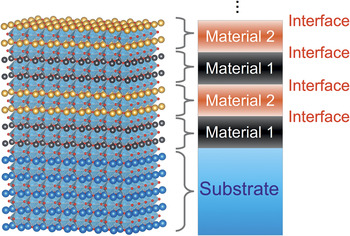
These possibilities have been explored for ferroelectricity (the property where a material develops a spontaneous electrical polarization, the direction of which can be changed by application of an electrical field) mostly in superlattices made from two building blocks, also called bi-color superlattices (see Figure 1 ; the term “color” refers to a distinct parent material within the artificial structure), which are the focus of this article. While, based on principles of electrostatics and mechanical strain, we can expect a modulation of the initial properties of the two bulk parent compounds for large layer thicknesses, present research in superlattices is especially motivated by the appearance of exotic interface effects that would induce new phenomena not present otherwise. In the field of ferroelectric perovskites (FE), several bi-color systems have been studied: FE/dielectric, FE/FE, FE/metal, and FE/incipient-FE (incipient ferroelectrics are materials that are close to being ferroelectric, but the onset of the ferroelectric order is suppressed by an external parameter). Interestingly, these systems can be roughly understood through simple electrostatic models that consider two dielectrics or a dielectric and a metal coupled by electrostatics and strain. However, these models are valid only for large thicknesses of the layers, while for small layer thicknesses, the interface effects can dominate the physics of the superlattices, and new models, explicitly taking into account these new effects, have to be built in order to understand the unexpected observed phenomena. In this article, we discuss interfaces both with and without electronic screening. The first class of interface contains technologically relevant ultrathin ferroelectric capacitors and the more recently studied ferroelectric-metal superlattices. In these systems, the influence of the ferroelectric polarization decreases rapidly with distance from the interface. By contrast, in systems where the materials adjacent to the ferroelectric layers are dielectrics, the polarization of the ferroelectric layer influences the properties of the adjacent layers over a much longer distance, setting the stage for fascinating competition between the properties of the combined materials.
Schematic view of a bi-color superlattice made of two different materials epitaxially grown on a substrate.

Screening of polarization at a ferroelectric interface
The chief defining quantity of any ferroelectric material is the existence of a spontaneous polarization, or that there is some gain in free energy if the material developed aligned dipoles when it is a bulk material. While, in principle, it is favorable for the whole material to be polarized in the same direction, a ferroelectric material will more typically have regions of alternating polarization, termed domains. This is similar to the behavior in ferromagnets; however, ferromagnets and ferroelectrics are quite distinct, with the former having ordering of magnetization and the latter having involved ordering of electrical polarization. Another key difference is that typically in ferroelectrics, the domain walls are much smaller than in ferromagnets, being only one or two unit cells in size. When ferroelectrics exist as ultrathin films, or when they are a very thin layer within a larger heterostructure, many factors come into play in determining the arrangement of electrical polarization at or near the interface of a ferroelectric material with another material.
A useful starting point for considering systems of this kind is to recognize that the electric displacement (defined in Equation 2), rather than the polarization, is frequently the most relevant variable to consider across a polar interface. Reference Stengel, Spaldin and Vanderbilt2 This is because of the relationship between the electric displacement D and free charge ρ:
 $$\nabla \cdot {\bf{D}} = {{\partial {\it D}_{\it x} } \over {\partial {\it x}}} + {{\partial {\it D}_{\it y} } \over {\partial {\it y}}} + {{\partial {\it D}_{\it z} } \over {\partial {\it z}}} = {\rm{\rho }}$$
.
The electric displacement is the combination of electric field E and polarization P:
 $$D = \varepsilon _0 {\rm E} + P$$
and it can be seen that if a polarization exists in the absence of an electric field, there will be an electric displacement. In a ferroelectric material, polarization is energetically favorable, but in other materials, the opposite is true because there is an energy cost associated with polarization. The larger the dielectric constant of the material, the smaller the energy cost associated with polarization. This cost provides a driving force to reduce or exclude the electric displacement from a ferroelectric from an adjoining material. There are a number of ways this can be achieved.
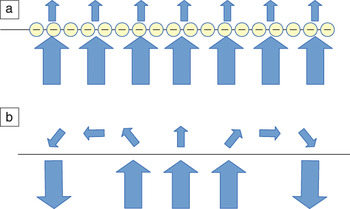
In a conventional metal-ferroelectric-metal capacitor, the metal provides a screening charge, which allows the electric displacement to be reduced across an interface, as shown in
Figure 2
a. If we consider a ferroelectric thin film with an out-of-plane polarization D
z, then the existence of a finite screening charge density allows a finite
 ${{\∂ {D_z}} \over {\∂ z}}$
so that away from the interface, the electrical displacement is zero. For thick ferroelectric films, the amount of charge provided is finite, and therefore a finite screening length in the metal does not have a significant effect on the spontaneous polarization. However, for very thin ferroelectrics with thicknesses on the order of a few nm, the finite screening length results in a depolarization field within the film that acts to reduce or destabilize the polarization. This idea, originating in continuous dielectric models for materials, has been shown to apply down to the unit-cell length scale by the first-principles calculations of Junquera and Ghosez.
Reference Junquera and Ghosez3
In one scenario in which domains do not form, the polarization of the material is reduced in a thin film with realistic electrodes (i.e., those with a finite screening length) as a result of the depolarization field. This was experimentally verified to occur using x-ray diffraction measurements of sample tetragonality in PbTiO3 thin films.
Reference Lichtensteiger, Triscone, Junquera and Ghosez4
Such a measurement is made possible through the strong coupling between strain and polarization in oxide ferroelectrics; though some care must be taken at high polarization values, the relationship between out-of plane strain and polarization weakens.
Reference Lee, Nakhmanson, Chisholm, Christen, Rabe and Vanderbilt5
The two scenarios for reduction of D z at an interface: (a) screening by free charge and (b) reorientation of the polarization.

While one effect of the depolarization field is to reduce the polarization, it can also be seen as a driving force that destabilizes the polarization state of the region where it exists. One effect of this is to make switching to the opposite polarization state easier, reducing the coercive field necessary for switching. Reference Dawber, Chandra, Littlewood and Scott6 Another result of the destabilizing effect of the depolarization field on a uniformly poled ferroelectric is that rather than suffer a reduction in the magnitude of their polarization, ultrathin films often develop an arrangement of very finely spaced stripe domains with opposing polarization directions. Reference Fong, Stephenson, Streiffer, Eastman, Auciello, Fuoss and Thompson7–Reference Streiffer, Eastman, Fong, Thompson, Munkholm, Murty, Auciello, Bai and Stephenson9 The existence of these stripe domains can be inferred from x-ray diffraction measurements, where they appear as satellites in the vicinity of Bragg peaks. Measurement of domain structure by x-ray diffraction is appealing in a number of ways, first because no electrical contacts are required; second, because it allows domain periodicities, which are on the order of only a few nm to be readily identified; and third, because the particular peaks around which satellites are observed gives an indication of the polarization directions within the film. Reference Fong, Stephenson, Streiffer, Eastman, Auciello, Fuoss and Thompson7,Reference Catalan, Janssens, Rispens, Csiszar, Seeck, Rijnders, Blank and Noheda10 Real space visualization of the stripe domains in ultrathin films is more challenging because with a domain size on the order of 10 nm, they are close to the resolution limit of the piezoforce microscopy technique, Reference Gruverman, Auciello and Tokumoto11,Reference Gruverman and Kalinin12 which is a favored method for studies of ferroelectric domain structure in ferroelectric thin films. Under certain conditions, the domains become visible in topographic atomic force microscopy measurements, Reference Thompson, Fong, Wang, Jiang, Streiffer, Latifi, Eastman and Stephenson13 and recently they have been visualized by coherent x-ray Bragg projection ptychography. Reference Hruszkewycz, Highland, Holt, Kim, Folkman, Thompson, Tripathi, Stephenson, Hong and Fuoss14
The polarization state of a ferroelectric thin film without a top electrode is very sensitive to surface adsorbates, and it is likely that ferroelectric surfaces exposed to air will have their polarization at least partially screened by dissociated water molecules on their surface. Reference Fong, Kolpak, Eastman, Streiffer, Fuoss, Stephenson, Thompson, Kim, Choi, Eom, Grinberg and Rappe15 Indeed, it has also been shown that it is possible to control the polarization size and direction through control of the surface chemistry Reference Eastman, Fong, Fuoss, Jiang, Stephenson, Streiffer, Wang, Latifi and Thompson16 or oxygen partial pressure of the environment around a film. Reference Highland, Fister, Fong, Fuoss, Thompson, Eastman, Streiffer and Stephenson17,Reference Highland, Fister, Richard, Fong, Fuoss, Thompson, Eastman, Streiffer and Stephenson18
Whether by free electrons in a metal or surface adsorbates, we have so far discussed the reduction of D z via some sort of free charge present at an interface. However, D z can be reduced across an interface even if there is no free charge if the sum of the in-plane derivatives increases, as in the case where ρ = 0:
 $${{\partial {\it D}_{\it z} } \over {\partial {\it z}}} = - {{\partial {\it D}_{\it x} } \over {\partial {\it x}}} - {{\partial {\it D}_{\it y} } \over {\partial {\it y}}}$$
.
This relationship allows the polarization to effectively turn around, through the development of in-plane polarization at an interface. The resulting polarization arrangement is most frequently stripes of opposite polarization in the ferroelectric material with some in-plane components of polarization at the interface, a so-called closure domain pattern as shown in Figure 2b. Such patterns have been clearly identified in first-principles simulations of PbTiO3 films with SrRuO3 electrodes. Reference Aguado-Puente and Junquera19
Ferroelectric-dielectric superlattices
Having discussed some of the key considerations at a ferroelectric metal interface, we now turn to the ferroelectric-dielectric interface that is at the core of many of the artificially layered ferroelectric materials studied today.
We first consider the case where development of an in-plane polarization component does not occur. In such a case, if there is no free charge at the interface, the electric displacement is continuous across the interface or equivalent if we denote the ferroelectric material with a subscript F and the dielectric material with a subscript D:
 $${\it P}_{\it F}^0 + {\rm{\varepsilon }}_{\rm{0}} {\rm{\varepsilon }}_{\it F} = {\it P}_{\it D}^0 + {\rm{\varepsilon }}_{\rm{0}} {\rm{\varepsilon }}_{\it D}$$
.
Here the electric fields in each layer are denoted by
 ${{\rm{\varepsilon }}_F}{\rm{,}}{{\rm{\varepsilon }}_D}$
, and the zero field polarizations are
 $P_F^0,P_D^0$
. Another condition is that the change in electrostatic potential across each bi-layer in the superlattice structure should be zero, implying that
 $${\it l}_{\it F} {\rm{\varepsilon }}_{\it F} {\rm{ = }} - {\it l}_{\it D} {\rm{\varepsilon }}_{\it D}$$
,
where the thicknesses of the layers are denoted by
 ${l_F},{l_D}$
. The electrostatic energy of a given layer in the presence of a finite electric field is, to leading order in the field, given by
 ${E_{elec}} = - l{\rm{\varepsilon }}{P^{\rm{0}}}$
. When the previous equations are taken into account, one finds that the electrostatic energy of a bi-layer in a superlattice can be expressed as
 $${\it E}_{{\it elec}} \left( {{\it P}_{\it F}^0 ,{\it P}_{\it D}^0 } \right) = {{{\it l}_{\it F} {\it l}_{\it D} } \over {{\rm{\varepsilon }}_0 \left( {{\it l}_{\it f} + {\it l}_{\it D} } \right)}}\left( {{\it P}_{\it D}^0 - {\it P}_{\it F}^0 } \right)^2$$
.
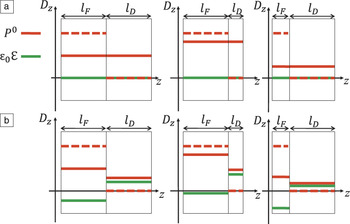
This equation shows that there is an energy cost for a difference in polarization between adjacent layers in a ferroelectric dielectric superlattice. If the dielectric layer is fairly easy to polarize, then the system tends to avoid discontinuities in the polarization (as shown in Figure 3 a). This idea was convincingly shown to be the case in first-principles simulations performed on BaTiO3/SrTiO3 superlattices, Reference Neaton and Rabe22 and formed the basis for a Landau theory approach to describe the properties of PbTiO3/SrTiO3 superlattices, which works well in the limit of a thin dielectric layer. Reference Dawber, Stucki, Lichtensteiger, Gariglio, Ghosez and Triscone20
Diagrammatic representation of the two components of the electrostatic displacement field in a ferroelectric dielectric bi-layer with polarization in the growth direction. The vertical axis represents the electric displacement; the horizontal axis is length in the superlattice growth direction. Red lines show the zero field electric polarization; green lines show the field component of the electric displacement, which comes from an electric field. The dashed lines show the polarization the materials would have if they were stand-alone epitaxially strained films. (a) Ferroelectric-dielectric bilayers with a readily polarizable dielectric. Here it can be seen that the electric field is negligible, and polarization is essentially continuous through the structure. The value of the polarization is determined by the relative volume fractions of the two materials. Reference Dawber, Stucki, Lichtensteiger, Gariglio, Ghosez and Triscone20 (b) Ferroelectric-dielectric bilayers with a dielectric that is not readily polarizable. Here polarization is not continuous, and there is an electric field present in each layer. As it is in the opposite direction to the polarization in the ferroelectric layer, there is an associated energy cost, and the system may opt to reduce the size of the polarization, either by a direct reduction of the polarization in the ferroelectric material, or by forming either stripe domains or an antiferroelectric. Reference Bousquet, Junquera and Ghosez21

Both BaTiO3 and PbTiO3 are under considerable compressive strain when grown on SrTiO3 substrates. This leads to a strong preference for out-of-plane polarization in these materials. If the epitaxial constraint on the in-plane lattice parameter of the superlattices is maintained, then so long as the dielectric layers are kept thin, the previous considerations dominate the evolution of polarization from one layer to the next. However, if the dielectric layer is thicker than a few unit cells and development of an in-plane polarization is not too costly for the material, then the electric displacement in the out-of-plane direction need not be constant throughout the superlattice, rather a domain structure can form where the polarization rotates at the interface between the materials leaving the interior of the ferroelectric materials strongly polarized and the interior of the dielectric material weakly polarized. In this configuration, the layers are described as being weakly coupled. The transition from superlattices, where the layers are strongly electrostatically coupled in the thin layer limit (which applies to thicknesses below a few unit cells), to being weakly coupled in the thick layer limit has been studied in KTaO3/KNbO3 superlattices Reference Specht, Christen, Norton and Boatner23–Reference Stephanovich, Luk’yanchuk and Karkut25 and PbTiO3/SrTiO3 superlattices. Reference Zubko, Jecklin, Torres-Pardo, Aguado-Puente, Gloter, Lichtensteiger, Junquera, Stephan and Triscone26–Reference Aguado-Puente and Junquera28
Going one step beyond the case where an in-plane polarization is possible in the dielectric layer, one can consider superlattices, where one layer has a preference for out-of-plane polarization, and the other has a preference for an in-plane polarization. An example of such a system is PbTiO3/CaTiO3 on a SrTiO3 substrate. While bulk CaTiO3 is not ferroelectric, when grown on SrTiO3, it is under considerable tensile strain, and the competition between its tendency toward in-plane polarization and the desire of PbTiO3 to be out-of-plane polarized allows rotation of the polarization and an enhanced piezoelectric response for particular ratios of the layer thicknesses of the two materials. Reference Sinsheimer, Callori, Bein, Benkara, Daley, Coraor, Su, Stephens and Dawber29
In contrast to the previously discussed materials that involve readily polarizable dielectric layers, superlattices that involve dielectrics that have fairly modest dielectric constants may arrange themselves in such a way as to have no overall polarization rather than suffer the energy cost associated with polarization discontinuity (depicted in Figure 3b). For example, (BaTiO3) m /(BaO) n superlattices made of alternating m unit cell layers of FE perovskite BaTiO3 and n unit cell layers of rock salt BaO have been studied from first principles, Reference Bousquet, Junquera and Ghosez21 and it was found that (1) when m<<n, the superlattice remains an insulator, and (2) when the ratio m/n reaches a critical value, the system prefers to stabilize in an antiferroelectric state, where adjacent unit cells have opposite polarizations that best minimize the electrostatic energy (global anti-polar displacements will not couple with the depolarizing electric field). Antiferroelectric materials are of high interest for energy storage applications, because their double hysteresis loop characteristic results in a larger amount of energy stored for a given polarization value when compared to linear dielectrics. Reference Rabe, Ogale, Venkatesan and Blamire30
Hybrid improper ferroelectricity
So far, the only structural distortions we have considered have been the polar distortions most commonly associated with ferroelectricity. Recently, a significant revival of interest in improper ferroelectrics has occurred, motivated in part by the discovery that it is present in PbTiO3/SrTiO3 superlattices. Reference Bousquet, Dawber, Stucki, Lichtensteiger, Hermet, Gariglio and Triscone31 Levanyuk proposed the concept of improper ferroelectricity in order to describe some ferroelectric phase transitions, where the polarization P is no longer the primary order parameter that governs the phase transition. Reference Levanyuk and Sannikov32 (An order parameter is an artificial variable used in the so-called Landau phenomenological theory. The aim of the Landau theory is to describe the temperature evolution of this order parameter around phase transitions.) In this case, Levanyuk considered a non-polar two-dimensional order parameter Φ = (Φ1, Φ2), for which the symmetry transformations are such that the product Φ1.Φ2 has the same symmetry as P. When this condition is satisfied, the term Φ1.Φ2.P is invariant under all the symmetry operations of the crystal. As a result, when the order parameter Φ condenses (becomes non-zero) at its critical temperature T c, it will induce a spontaneous polarization through the tri-linear term Φ1.Φ2.P, even if P is unstable (i.e., P would not develop if Φ is absent). In crystals, presenting such a tri-linear coupling with P, a spontaneous polarization can be driven by nonpolar distortions. Because of its scarcity in bulk materials and the small reported spontaneous polarization in known compounds, the mechanism of improper ferroelectricity has not historically attracted a lot of attention.
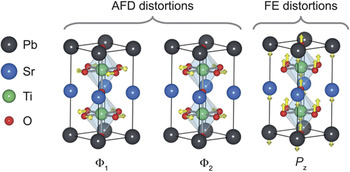
The discovery of a similar mechanism in PbTiO3/SrTiO3 superlattices Reference Bousquet, Dawber, Stucki, Lichtensteiger, Hermet, Gariglio and Triscone31 and work on YMnO3, an important multiferroic (a multiferroic material is defined as a crystal that possess more than one ferroic order parameter, such as ferroelectricity, ferromagnetism, or ferroelasticity) that is an improper ferroelectric, Reference Fennie and Rabe33 refocused attention on improper ferroelectrics. Reference Benedek and Fennie34–Reference Stroppa, Barone, Jain, Perez-Mato and Picozzi39 It has been found that at the interface between two perovskites ABO3 and A’BO3, the order parameters Φ1 and Φ2 related to the out-of-phase antiferrodistortive (AFD) distortion (a0a0c– in the so-called Glazer notation) Reference Glazer40 and in-phase AFD distortion (a0a0c+), respectively, have their product, Φ1.Φ2, that symmetrically transforms with the polarization along the z-direction P z (see Figure 4 for a schematic view of the distortions). This means that the tri-linear term Φ1.Φ2.P z is invariant under all the symmetry transformations of the crystal, and thus if one has both Φ1 and Φ2 condensed in ABO3/A’BO3 superlattices, spontaneous polarization will be induced in a manner similar to the mechanism of improper ferroelectricity. By taking into account such a tri-linear coupling in PbTiO3/SrTiO3 superlattices, it has been possible to explain the anomalous experimental measurements presenting a linear dependence of the polarization with temperature (while it should be a square root dependence for a regular ferroelectric) and a nearly temperature independent dielectric constant (while a divergence around T c should be observed for a regular ferroelectric phase transition). The crucial point is that the tri-linear coupling with P is induced by the interface and cannot be observed in the bulk parent crystals. In PbTiO3/SrTiO3 superlattices, the resulting ferroelectric and dielectric properties are large, and thus of great interest for technological applications. Reference Bousquet, Dawber, Stucki, Lichtensteiger, Hermet, Gariglio and Triscone31
Schematic of the three distortions present in the hybrid improper ferroelectric state observed in PbTiO3/SrTiO3 superlattices. The yellow arrows represent the direction of the atomic displacement related to the distortions. The symmetry breaking of the interface between the two compounds allows these three competing instabilities at the bulk level to be associative in the superlattices through a tri-linear coupling Φ1.Φ2.P z.

We note, however, that in the definition of improper ferroelectricity given by Levanyuk, Reference Levanyuk and Sannikov32 the components of the two-dimensional order parameter will condense together at the same critical temperature T c. This makes a difference for the mechanism reported in PbTiO3/SrTiO3 superlattices, where the two order parameters Φ1 and Φ2 are different and independent, and thus there is no reason to have the condensation of these two order parameters at the same T c. Moreover, in PbTiO3/SrTiO3 superlattices, first-principles calculations show Reference Bousquet, Dawber, Stucki, Lichtensteiger, Hermet, Gariglio and Triscone31 that the polarization can develop alone without the need of the AFD distortions. To distinguish between the two possibilities, the tri-linear coupling inducing polarization with two independent order parameters has been subsequently called “hybrid improper ferroelectricity.” Reference Benedek and Fennie34 Going further, a rationalization of improper ferroelectricity has been proposed in terms of electric displacements. Reference Stengel, Fennie and Ghosez35 From this analysis, it appeared that a regular improper ferroelectric as defined by Levanyuk is nearly unaffected by the electrical boundary condition, a very interesting property for applications. Reference Sai, Fennie and Demkov36
This is, however, not the case in the hybrid improper ferroelectric state present in PbTiO3/SrTiO3 superlattices, where sensitivity to the electrical boundary conditions depends on the interaction strength between the two non-polar AFD modes. If this interaction is not strong (if the two AFD distortions are not in competition) and if the AFD distortions are dominant with respect to P, then we can expect a similar response to the electrical boundary conditions as for a regular improper ferroelectric. This, however, does not explain why experimentally the temperature dependence of the ferroelectric properties of the PbTiO3/SrTiO3 superlattice is observed to be as a regular improper ferroelectric, while first-principles calculations predict an unusual hybrid improper ferroelectric behavior.
Systematic studies have been performed from symmetry analysis and first-principles calculations in order to understand the conditions to reproduce the hybrid improper ferroelectricity in superlattices other than PbTiO3/SrTiO3. Reference Stengel, Fennie and Ghosez35,Reference Rondinelli and Fennie37,Reference Benedek, Mulder and Fennie38,Reference Mulder, Benedek, Rondinelli and Fennie41,Reference Zanolli, Wojdel, Iniguez and Ghosez42 The results are the following: A tri-linear coupling between a0a0c–, a0a0c+, and P z is possible only if the perovskite superlattice is built by alternating A sites (ABO3/A’BO3), and it is completely forbidden if one alternates the B site (ABO3/AB’O3). Another hybrid improper coupling is also possible between the in-plane polarization P xy and the tilt pattern a–a–c+ in ABO3/A’BO3 superlattices. The chemistry choice of the A, A’, and B cation is important since, depending on the composition, they will favor different tilt patterns that can or cannot energetically favor the tri-linear coupling with the polarization. It is possible to tune the two hybrid improper ferroelectric states (the one inducing P z and the one inducing P xy) by playing with epitaxial strain, even when the propensity of the two parent compounds to induce such a state in the superlattice is not high.
The fact that having the tilt pattern a–a–c+ in the parent compounds favors a hybrid improper ferroelectric state in ABO3/A’BO3 superlattices is particularly attractive since the a–a–c+ tilt pattern (Pnma space group) is by far the most common distortion present in bulk perovskites, thus opening up possibilities to numerous superlattice candidates.
Extension to electric control of magnetization
Tuning the direction of magnetic moments with an electric field in magnetic materials is one of the main objectives toward lower energy consumption of electronic memory and spintronic applications. Reference Bibes, Villegas and Barthélémy43,Reference Chappert, Fert and Van Dau44 Current magnetic memories use an electric current to write the information. This process requires much more energy (several order of magnitudes) than if one applies an electric voltage instead. Finding bulk materials exhibiting such a property (the magnetoelectric property) appeared very difficult in view of the rarity of the compounds that are magnetoelectric, but also because the discovered materials doing so often displayed very small magnetizations that only occurred at very low temperatures and were thus useless for technological applications.
One approach proposed to tune the magnetization with an electric field is through a magnetic-metal/ferroelectric interface. Reference Bibes, Villegas and Barthélémy43,Reference Zhuravlev, Jaswal, Tsymbal and Sabirianov45–Reference Duan, Jaswal and Tsymbal47 The idea is to exploit possible magnetoelectric coupling at the interface between a ferromagnetic metal and a regular ferroelectric. Successful experimental evidence of such interfacial coupling has been shown in prototypical Fe/BaTiO3 and Co/BaTiO3 heterostructures, where the magnetization at the interface can be reversed by reversing the spontaneous polarization of the ferroelectric layer. Reference Valencia, Crassous, Bocher, Garcia, Moya, Cherifi, Deranlot, Bouzehouane, Fusil, Zobelli, Gloter, Mathur, Gaupp, Abrudan, Radu, Barthélémy and Bibes48 The interest in such combinations is that the magnetoelectric coupling is observed at room temperature. A similar reversal of the magnetization of a CoFe magnetic alloy grown on top of the multiferroic material BiFeO3 has been observed experimentally at room temperature. Reference Heron, Trassin, Ashraf, Gajek, He, Yang, Nikonov, Chu, Salahuddin and Ramesh49 In this case, the mechanism responsible for electric switching of the magnetization is related to the magnetic coupling between BiFeO3 and CoFe at the interface and thus through the intrinsic magnetoelectric coupling present in BiFeO3. Going further, a similar mechanism has been proposed by means of first-principles calculations in a PbTiO3 layer covered by a Fe/Au/Fe trilayer. Reference Fechner, Zahn, Ostanin, Bibes and Mertig50 In such a system, it is predicted that the amplitude of the magnetization switching of the top Fe layer when reversing the polarization in PbTiO3 can be modulated by the thickness of the Au layer through interlayer exchange coupling in the Fe/Au/Fe trilayer.
Beyond these systems, a different approach to an effective magnetoelectric device is to build artificial magnetoelectric-layered systems, an approach that has already had some success in the context of giant magnetoresistance. Reference Hirota, Sakakima and Inomata51
The hybrid improper ferroelectric mechanism suggests there is high potential for tuning the magnetic properties with an electric field through tri-linear coupling between the polarization and the oxygen octahedral rotation. Magnetic interactions are strongly affected by the binding between the transition-metal cation and the surrounding oxygens. If one induces a distortion of the oxygen octahedra in a magnetic perovskite AMO3 (through the AFD distortions, for example), the strength of the super-exchange interaction between the magnetic action’s M may be modified. Moreover, it is also well established that the spin orientation (linked to single ion anisotropy, which is the spatial orientation anisotropy seen by a magnetic moment on a given atom) and the spin canting (in most cases due to the Dzyaloshinsky–Moriya interaction, which involves the cross product between two spins and tends to favor orthogonal orientation of two successive magnetic moments in a crystal) are strongly affected by the AFD distortions. Reference Weingart, Spaldin and Bousquet52 Then, if one wants to tune the magnetic interactions by an electric field, coupling of the AFD distortion with the electric field is required. This coupling is nevertheless extremely small if the AFD distortions are present alone since they are nonpolar distortions. It is here that the interest in having a direct coupling between AFD and polarization becomes apparent, and this exists in the case of the hybrid improper ferroelectricity phases reported in ABO3/A’BO3 superlattices.
Through the tri-linear coupling Φ1.Φ2.P discussed in the previous section, if one applies an electric field to switch the polarization, one of the two other order parameters Φ1 and Φ2 will have to switch in order to keep the energy invariant. This mechanism has been explored in detail from first-principles calculations, and the preliminary results indicate that the most favorable case is when the P xy orientation of the polarization is coupled with the a–a–c+ tilt pattern. Reference Benedek and Fennie34,Reference Zanolli, Wojdel, Iniguez and Ghosez42,Reference Weingart, Spaldin and Bousquet52 However, the inversion mechanism of the magnetization with P xy is not straightforward. Reference Zanolli, Wojdel, Iniguez and Ghosez42 It appears that the electric field has to reverse the a–a–c0 tilt pattern (Φ1) and not the a0a0c+ tilt pattern (Φ2) because the magnetization is more strongly coupled to the a–a–c0 tilt pattern. Reference Zanolli, Wojdel, Iniguez and Ghosez42,Reference Weingart, Spaldin and Bousquet52 Systems exhibiting such a coupling have not yet been found because in most analyzed magnetic superlattices, it appears to be more energetically favorable to reverse a0a0c+ when P xy is reversed by an electric field rather than reversing a–a–c0.
Ferroelectric metal superlattices
An interesting variation on the ferroelectric-metal interface is the special case of an ultrathin metallic layer within a ferroelectric superlattice. Recently, layered heterostructures combining dielectrics such as SrTiO3 with metallic magnetic perovskite oxides such as SrRuO3, SrFeO3, and SrVO3 have been recognized to be rich in new physics, Reference Niranjan, Burton, Velev, Jaswal and Tsymbal53–Reference Callori, Gabel, Su, Sinsheimer, Fernandez-Serra and Dawber60 particularly as the thickness of the metallic perovskite layer decreases. For example, in SrTiO3/SrRuO3, a single unit cell layer of SrRuO3 embedded within SrTiO3 maintains a metallic character and is expected to behave like a two-dimensional electron gas (2DEG). Reference Verissimo-Alves, Garcia-Fernandez, Bilc, Ghosez and Junquera57 In this system and the related PbTiO3/SrRuO3 system, Reference Callori, Gabel, Su, Sinsheimer, Fernandez-Serra and Dawber60 the fact that SrRuO3 layers retain their metallic character as their thickness is reduced allows the anisotropy of the conductivity of the overall superlattice structure to be tuned, which presents a potential route for enhancing the thermoelectric figure of merit. Reference Garcia-Fernandez, Verissimo-Alves, Bilc, Ghosez and Junquera58 By contrast, in SrTiO3/SrFeO3 Reference Rondinelli and Spaldin54 and SrTiO3/SrVO3, Reference Pardo and Pickett55 a transition from metallic to insulating behavior is observed as the metallic layer is reduced in thickness. The origin of the suppression of metallicity is quite different in the two cases, but in general, systems that have a critical thickness for their metallic layer can be considered to become novel insulators that may have distinctive dielectric properties and/or a tunable bandgap for solar energy conversion applications. Reference Berger and Neaton61
Tri-color superlattices
While in this article we have focused on bi-color superlattices, alternating between the growth of three different materials (tri-color superlattices) has also been explored. Reference Lee, Christen, Chisholm, Rouleau and Lowndes62–Reference Kida, Yamada, Sato, Arima, Kawasaki, Akoh and Tokura67 In such tri-color dielectric systems, the inversion center is broken irrespective of the composition of the layers, and thus the tri-color superlattices will always be polar materials. An appealing aspect of these material systems is that it is possible to control the “amplitude” of the inversion-symmetry breaking by varying the thickness ratio between the different constituents. Reference Nakhmanson, Rabe and Vanderbilt66 Tri-color superlattices also appear to be an extremely promising route to obtain large magnetoelectric responses. Reference Rogdakis, Seo, Viskadourakis, Wang, Ah Qune, Choi, Burton, Tsymbal, Lee and Panagopoulos64,Reference Hatt and Spaldin65 Alternating more than three different compounds has not (yet) been explored, though we might expect very interesting and complex phenomena to appear in these systems due to the increasing number of different interfaces.
Conclusion
The possibilities offered by the complex interplay of structural considerations, electrostatics, and strain at interfaces between ferroelectric oxides and other materials are exciting. A key feature of both past research and future progress in this area is that a combination of computation and cutting edge experimental tools are required to uncover the mechanisms that are active at an interface. The ability to harness nonstructural distortions through hybrid improper ferroelectricity is just one possible route to new materials, but one that appears to have great potential. One issue still to be explored fully is the temperature dependence of this mechanism, and a first-principles investigation of this would be especially welcome. As the understanding of these complex interfaces progresses, we predict we will soon see materials that go beyond two or three component materials, and that in the not too distant future, the lessons learned in these carefully crafted epitaxial structures will make their way into the next generation of high performance dielectric, ferroelectric, piezoelectric, and pyroelectric devices.
Acknowledgments
M.D. acknowledges support from the National Science Foundation through DMR1055413. E.B. thanks the Fonds de la Recherche Scientifique, FNRS, Belgium. The authors thank Philippe Ghosez and Nicholas Bristowe for helpful discussions.