Implications
This study has demonstrated that pig maternal diet supplemented with n-3 polyunsaturated fatty acids, mediates its effects on female piglets’ fatty-acid composition, at least partially, via regulation of expression of the lipogenic enzymes Δ5-desaturase and Δ6-desaturase. Moreover, the response of progeny to manipulations of the maternal dietary composition was tissue-specific. The present paper contributes to understanding of mechanisms by which pig maternal diets regulate the fatty-acid composition of progeny. The results of this study might contribute to designing of pig feeding strategies and improving quality of pork.
Introduction
The type of fatty acids in the diet has a strong impact on human health. Particular attention has been paid to the dietary long-chain n-3 polyunsaturated fatty acid (n-3 PUFA), such as eicosapentaenoic (EPA, 20:5n-3) and docosahexaenoic (DHA, 22:6n-3). These fatty acids are known to be crucial for normal growth and development (reviewed by Ruxton et al., Reference Ruxton, Reed, Simpson and Millington2004). They also reduce risk of cardio-vascular disease (reviewed by Givens and Gibbs, Reference Givens and Gibbs2008), decrease incidence of age-related eye disease (SanGiovanni et al., Reference SanGiovanni, Chew, Agron, Clemons, Ferris, Gensler, Lindblad, Milton, Seddon, Klein and Sperduto2008), positively alter human red blood cell fatty-acid composition (Barcelo-Coblijn et al., Reference Barcelo-Coblijn, Murphy, Othman, Moghadasian, Kashour and Friel2008), decrease risk of cancer and have a number of other health benefits (Berquin et al., Reference Berquin, Edwards and Chen2008; Li et al., Reference Li, Huang and Xie2008; Mozaffarian, Reference Mozaffarian2008).
The current EPA and DHA consumption in many European countries is only about 25% of a recommended daily intake (reviewed by Givens and Gibbs, Reference Givens and Gibbs2008). One way to enhance daily intake of long-chain PUFA is to increase the levels of these fatty acids in animal-derived foods and in meat in particular. Pork is one of the most consumed meats in Europe (Mourot and Hermier, Reference Mourot and Hermier2001). It is well documented, that amounts of EPA and DHA in pork can be increased via inclusion of EPA- and/or DHA- rich oils in animals’ diets (Moghadasian, Reference Moghadasian2008; Wood et al., Reference Wood, Enser, Fisher, Nute, Sheard, Richardson, Hughes and Whittington2008). Moreover, the inclusion of n-3 PUFA in the maternal diet can influence the fatty-acid composition of offspring. It is generally accepted that the effect of the maternal diet on the fatty-acid composition of progeny is due to direct incorporation of the fatty acids (Rigau et al., Reference Rigau, Lindemann, Kornegay, Harper and Watkins1995; Rooke et al., Reference Rooke, Bland and Edwards1998; Lauridsen and Jensen, Reference Lauridsen and Jensen2007). However, animal tissues also have the ability to synthesise long-chain fatty acids from dietary precursors (Brenner, Reference Brenner1974; Sprecher, Reference Sprecher2000; Moghadasian, Reference Moghadasian2008). Thus, 18:2n-6 and 18:3n-3 can be used for tissue biosynthesis of long chain n-6 PUFA and n-3 PUFA, respectively. The key enzymes involved in the formation of long chain PUFA are Δ6-desaturase (Δ6d) and Δ5-desaturase (Δ5d). It is known that the fatty-acid composition of the maternal diet can affect the postnatal expression of Δ6d and Δ5d in human and rats (Neuringer et al., Reference Neuringer, Anderson and Connor1988; Xiang et al., Reference Xiang, Rahman, Ai, Li and Harbige2006). However, whether the maternal diet has effects on these enzymes in piglets remains unclear.
The main objective of this study is to determine whether the effects of n-3 PUFA enriched pig maternal diets on fatty-acid composition of offspring is mediated via regulation of Δ6d and Δ5d protein expression. The study also aims to determine the tissue distribution of Δ6d and Δ5d proteins in piglets, and the tissue-specificity of the dietary effects.
Material and methods
Animals and diets
The animal trials were conducted at two farms of Danis n.v. in Belgium, and were approved by the Ethical Committee of the Faculty of Veterinary Sciences and Bioscience Engineering of Ghent University (approval number EC 2006/119).
Four groups of multiparous sows (50% Landrace × 50% Large White, 64 to 84 animals per group) were used in the experiment with two groups per farm (one group fed the control diet and one group fed an experimental diet). The experiment started at day 45 in gestation. A group of sows was allocated to one of the experimental diets and five sows per group of second or third parity were chosen from which, one piglet per litter was sacrificed for further analysis.
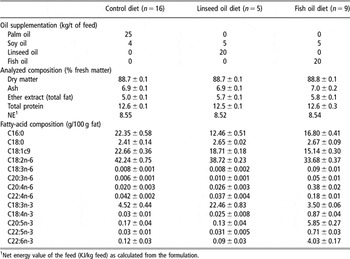
There were three diets in the trial: (1) a control diet (on both farms five sows of parity 2); (2) a diet supplemented with fish oil (INVE n.v., Dendermonde, Belgium; two sows of parity 2 and three of parity 3); and (3) a diet supplemented with linseed oil (three sows of parity 2 and two of parity 3). Diets fed during gestation and lactation slightly differed to meet the specific nutrient requirements of pregnant and lactating sows, respectively. The control diets were formulated to minimise inclusion of n-3 fatty acids by using palm oil. All diets were formulated to contain a similar amount of linoleic acid (13 g/kg), and were supplemented with the antioxidant α-tocopherol acetate (150 mg/kg diet). The dietary oil supplementation, analysed nutrient composition and fatty-acid composition of the gestation diets are given in Table 1. All three diets contained: beet pulp (250 kg/t), barley (215 kg/t), wheat (250 kg/t), maize (200 kg/t), molasses (20 kg/t), soy beans (10 kg/t), chalk (38% Ca; 5.75 kg/t), mono calcium phosphate (10 kg/t), salt (3.5 kg/t) and a vitamin and mineral mix (5 kg/t). The diets were supplemented with following amino acids: l-lysine HCl (1.5 kg/t), choline chloride (75%; 0.7 kg/t) and l-threonine (0.16 kg/t). The sows were fed the control or experimental diets by dump feeder from day 45 of gestation to meet their daily requirements.
Composition of the sow diets fed from day 45 of gestation (means ± s.e.)

1Net energy value of the feed (KJ/kg feed) as calculated from the formulation.
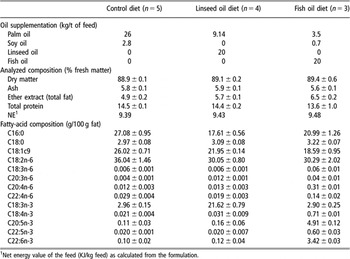
Seven days before the expected farrowing date, each group of pregnant sows was transferred to a room in part-slatted farrowing house accommodation, with 10 farrowing crates per room. The sows then received 2.5 kg/day of the lactation diet until the day of farrowing. The lactation diet composition is given in Table 2. All three lactation diets contained: beet pulp (65 kg/t), barley (300 kg/t), wheat (240 kg/t), maize (195 kg/t), soy beans (134.6 kg/t), chalk (38% Ca; 17.6 kg/t), mono calcium phosphate (6 kg/t), natuphos 5000 FTU/g (0.1 kg/t), salt (3.6 kg/t) and a vitamin and mineral mix (5 kg/t). The diet contained added amino acids: l-lysine HCl (2.5 kg/t), choline chloride (75%; 0.7 kg/t), dl-methionine (0.32 kg/t) and l-threonine (0.74 kg/t). The farrowing was not induced and there was minimal intervention during farrowing. After farrowing, feed allowance of the sows was increased from 2 kg/day by approximately 1 kg/day until ad libitum feed intake was reached. The sows were subsequently offered feed according to appetite.
Composition of the sow diets fed from day 7 before farrowing and throughout lactation (mean ± s.e.)

1Net energy value of the feed (KJ/kg feed) as calculated from the formulation.
On an average age of 5.6 days (±0.3 s.e.), one female piglet from each of the five litters within each experimental group was sacrificed. Piglets were selected with a weight close to the average piglet weight of the litter. Average weights of piglets in groups were similar (P > 0.05) and were 2.3, 2.5, 2.4 and 2.3 kg for control group on farm 1, control group on farm 2, fish oil group and linseed oil group, respectively. Piglets were anaesthesised by inhalation of the halothane analogue Isoflurane (Isoba®; Schering-Plough Animal Health, Middlesex, UK) and immediately killed by bleeding. Samples of the liver, longissimus dorsi (LD; muscle) and subcutaneous fat (SF) were removed immediately after slaughter and divided into two pieces. One piece of each tissue (approximately 10 g) was immediately frozen in liquid nitrogen for further analyses of enzyme expression. These samples were stored at −80°C. The other piece of each tissue (approximately 70 g of liver, 30 g of LD and 5 g of SF) was transported to the laboratory on ice within 1 h and then stored vacuum packed at −20°C for fatty-acid analysis.
Feed and tissue samples analyses
Feed samples were analysed for dry matter, ash (ISO 5984, 2002), crude protein (ISO 5983-1, 2005) and crude fat (ISO 6492, 1999). Lipids were extracted from 5 g of feed and muscle, from 3 g of liver and from 1 g of fat (Folch et al., Reference Folch, Lees and Sloane-Stanley1957). Nonadecanoic acid (C19:0) was added as an internal standard. After methylation of the fatty acids with NaOH/MeOH (0.5 M NaOH in MeOH) followed by HCl/MeOH (1 : 1; v/v), the fatty acid methyl esters (FAME) were analysed by gas-liquid chromatography (HP6890, Agilent, Brussels, Belgium) using a CP Sil88 column for FAME (100 m × 250 μm × 0.25 μm) (Chrompack, Middelburg, The Netherlands) (Raes et al., Reference Raes, De Smet and Demeyer2001). The gas chromatography conditions were: injector: 250°C, detector: 280°C and H2 as carrier gas. Temperature program: 150°C for 2 min followed by an increase by 1.5°C/min up to 200°C. After this the temperature was increase by 5°C/min up to 215°C. Peaks were identified by comparing the retention times with those of the corresponding standards (Sigma, Belgium; Nu-Chek Prep., Mn, USA).
Isolation of microsomes
Δ6d and Δ5d are microsomal enzymes. Samples of pig liver (approximately 3.5 g), LD muscle and subcutaneous adipose tissue (approximately 7.5 g) were homogenised in a Tris-sucrose buffer containing 250 mM sucrose and 10 mM Tris-HCl (pH 7.4), and the microsomal fraction was isolated by differential centrifugation as described earlier (Doran et al., Reference Doran, Moule, Teye, Whittington, Hallett and Wood2006). The microsomal pellets were re-suspended in a Tris-KCl buffer (150 mM KCl and 10 mM Tris-HCl, pH 7.4), supplemented with inhibitors of proteolytic enzymes (1.5 μM pepstatin, 1.5 μM antipain and 2 μM leupeptin). The protein level in isolated microsomes was determined by the Bradford method (Bradford, Reference Bradford1976). The average final concentration of microsomal protein for liver, muscle and SF were 16.3, 11.5 and 5.8 mg/ml, respectively.
Enzyme expression analyses
Expression of Δ6d and Δ5d proteins in isolated microsomes was determined by Western blotting. The microsomal proteins (12 μg) were separated by SDS-PAGE and transferred onto a nitrocellulose membrane at 100 V for 1 h. The membrane was probed with the corresponding primary antibody for 1.5 h. Δ6d and Δ5d antibodies were custom-produced by Sigma Genosys Ltd (Cambridge, UK) in rabbits against the synthetic peptides containing amino-acid sequences from the regions which are conserved in the rat, pig and human (near C-terminus of the corresponding proteins). The synthetic peptides were linked to Keyhole Limpet Haemocyanin. The antibodies were demonstrated to cross-react with the porcine Δ6d and Δ5d proteins. After probing with primary antibody, the nitrocellulose membrane was washed with PBST (phosphate-buffered saline–Tween) and incubated with horseradish peroxide linked donkey anti-rabbit IgG as the secondary antibody (Amersham, Buckinghamshire, UK) for 1 h. The protein bands were visualised with an enhanced chemiluminescence detection system (Amershan). The intensity of the protein bands was quantified using the ImageQuant program (Molecular Dynamics, GE HealthCare UK Ltd, Buckinghamshire, UK). A microsomal preparation from one particular sample was present on all the blots and the intensity of the Δ6d or Δ5d signals of this sample was taken as 100% (reference sample). The optimum of microsomal protein required for Δ6d or Δ5d analyses was detected by calibration.
Statistical analyses
The effect of dietary group (n = 4) on the fatty-acid composition was analysed separately in each tissue by one-way ANOVA. The relative expression of Δ6d and Δ5d proteins was initially analysed by a linear model including the effect of dietary group (n = 4), tissue (n = 3) and the dietary group × tissue interaction term. One-way ANOVA was performed per group to compare the relative expression of Δ6d or Δ5d between tissues. Post-hoc comparison of means was done using the Tukey method. P < 0.05 was considered statistically significant. For all the variables (except small changes in C22:4n-6 and Δ6d in liver, and saturated fatty acids (SFA) in SF) there was no significant difference between control groups on different farms. Therefore, an effect of farm on the parameters studied was considered to be negligible. The statistical program used was S_PLUS 6.1 for Windows (Insightful Corporation, Seattle, WA, USA).
Results
Effect of maternal diet supplemented with fish oil on polyunsaturated fatty acids in piglet’s tissues
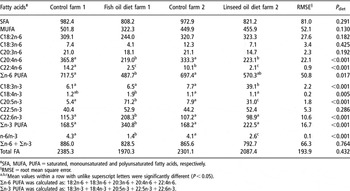
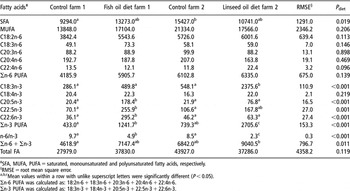
Fish oil supplementation caused a two-fold increase in the content of total hepatic n-3 PUFA, mainly due to an increase in 20:5n-3 and 22:6n-3 (P < 0.001; Table 3). The content of total and individual hepatic n-6 PUFA, such as 20:4n-6 and 22:4n-6 was significantly decreased by the fish-oil diet (P < 0.001 and P < 0.001, respectively). No significant changes were observed in the major n-6 fatty acid, 18:2n-6. As a result of the opposite effect of fish oil on n-3 and n-6 PUFA, the total PUFA content did not change significantly, and the n-6/n-3 ratio was significantly reduced (P < 0.001).
Effects of a maternal diet supplemented with different oils (control, fish or linseed oil) on polyunsaturated fatty acids content (mg/100 g tissue) in liver tissue of piglets (means n = 5)

‡SFA, MUFA, PUFA = saturated, monounsaturated and polyunsaturated fatty acids, respectively.
§RMSE = root mean square error.
a,b,cMean values within a row with unlike superscript letters were significantly different (P < 0.05).
Σn-6 PUFA was calculated as: 18:2n-6 + 18:3n-6 + 20:3n-6 + 20:4n-6 + 22:4n-6.
Σn-3 PUFA was calculated as: 18:3n-3 + 18:4n-3 + 20:5n-3 + 22:5n-3 + 22:6n-3.
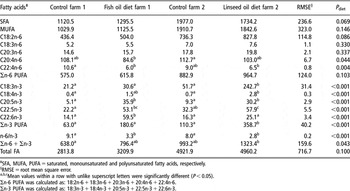
In muscle, as in liver, the fish-oil diet resulted in a significant increase (three-fold) in the content of total n-3 PUFA (P < 0.001; Table 4), mainly on the account of long-chain PUFA (20:5n-3, 22:5n-3 and 22:6n-3). However, the effect of fish-oil diet on muscle n-6 PUFA content was less pronounced when compared to the hepatic n-6 PUFA content. Total n-6 PUFA content in muscle did not change significantly, although there were some significant changes in the content of 22:4n-6 (P < 0.001).
Effects of a maternal diet supplemented with different oils (control, fish or linseed oil) on polyunsaturated fatty acids content (mg/100 g tissue) in muscle tissue of piglets (means n = 5)

‡SFA, MUFA, PUFA = saturated, monounsaturated and polyunsaturated fatty acids, respectively.
§RMSE = root mean square error.
a,b,cMean values within a row with unlike superscript letters were significantly different (P < 0.05).
Σn-6 PUFA was calculated as: 18:2n-6 + 18:3n-6 + 20:3n-6 + 20:4n-6 + 22:4n-6.
Σn-3 PUFA was calculated as: 18:3n-3 + 18:4n-3 + 20:5n-3 + 22:5n-3 + 22:6n-3.
As in liver and muscle, the fish oil-supplemented diet significantly increased individual (18:3n-3, 20:5n-3, 22:5n-3 and 22:6n-3) and total n-3 PUFA content in subcutaneous adipose tissue (P < 0.001; Table 5). The content of total and individual n-6 PUFA in SF was not affected.
Effects of a maternal diet supplemented with different oils (control, fish or linseed oil) on polyunsaturated fatty acids content (mg per 100 g tissue) in subcutaneous adipose tissue of piglets (means n = 5)

‡SFA, MUFA, PUFA = saturated, monounsaturated and polyunsaturated fatty acids, respectively.
§RMSE = root mean square error.
a,b,cMean values within a row with unlike superscript letters were significantly different (P < 0.05).
Σn-6 PUFA was calculated as: 18:2n-6 + 18:3n-6 + 20:3n-6 + 20:4n-6 + 22:4n-6.
Σn-3 PUFA was calculated as: 18:3n-3 + 18:4n-3 + 20:5n-3 + 22:5n-3 + 22:6n-3.
Effect of maternal diet supplemented with linseed oil on polyunsaturated fatty acids in piglet’s tissues
The linseed diet resulted in a significant increase in the content of some individual n-3 PUFA, mainly 18:3n-3 and 20:5n-3, which caused a five- and four-fold increase, respectively, in liver (P < 0.001; Table 3). The total content of n-3 PUFA increased in this tissue (P < 0.001), but there was no effect on the content of 22:6n-3. The total content of the hepatic n-6 PUFA was not affected by the diet. However, there were relatively small but significant decreases in the individual n-6 PUFA contents (20:4n-6 and 22:4n-6, P < 0.01 and P < 0.001, respectively).
In piglets’ muscle, the maternal linseed oil supplemented diet affected all the individual n-3 PUFA (except C22:6n-3), which were significantly increased (Table 4). As a result, the content of the total n-3 PUFA was elevated by more than three-fold (P < 0.05). There was no significant effect of the linseed diet on either individual or total n-6 PUFA in piglets’ tissues.
In adipose tissue, as in liver and muscle, the linseed diet significantly increased the content of total n-3 PUFA (by approximately four-fold, P < 0.001), mainly on the account of 18:3n-3 and 20:5n-3 (Table 5). The diet did not significantly affect the individual and total n-6 PUFA in this tissue.
Effect of the maternal diet supplemented with fish-oil or linseed oil on Δ5d and Δ6d protein expression in piglets’ tissues
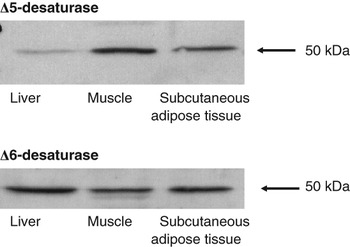
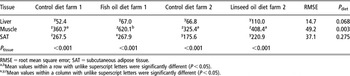
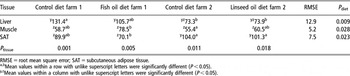
We have detected the presence of Δ5d and Δ6d immunoreactive proteins in piglets’ liver, LD muscle and subcutaneous adipose tissues by Western blot analyses. Examples of the blots are given in Figure 1. The sizes of the immunoreactive bands for both enzymes were approximately 50 kDa, which is consistent with the molecular weights of Δ5d and Δ6d proteins reported in other species (Cho et al., Reference Cho, Nakamura and Clarke1999a and Reference Cho, Nakamura and Clarke1999b). Across diets, the average expression of Δ5d protein was the highest in muscle, followed by subcutaneous adipose tissue, with the lowest level in the liver (Table 6). The picture was different for Δ6d (Table 7). This enzyme was mostly expressed in liver and subcutaneous adipose tissue, with the lowest level in muscle.
Representative blots of Δ5-desaturase and Δ6-desaturase protein expression in liver, muscle and subcutaneous adipose tissue of piglets. Enzyme expression was analysed in cytosol isolated from liver, longissimus dorsi muscle and subcutaneous adipose tissue of piglets from control group. A total of 12 μg of cytosolic protein was used for Western blot analysis in all the cases.

Effect of maternal diet supplemented with different oils (control, fish oil or linseed oils) on the relative expression of Δ5-desaturase in liver, muscle and subcutaneous adipose tissue of the piglets (means n = 5)

RMSE = root mean square error; SAT = subcutaneous adipose tissue.
a,bMean values within a row with unlike superscript letters were significantly different (P < 0.05).
x,y,zMean values within a column with unlike superscript letters were significantly different (P < 0.05).
Effect of maternal diet supplemented with different oils (control, fish oil or linseed oils) on the relative expression of Δ6-desaturase in liver, muscle and subcutaneous adipose tissue of the piglets (means n = 5)

RMSE = root mean square error; SAT = subcutaneous adipose tissue.
a,bMean values within a row with unlike superscript letters were significantly different (P < 0.05).
y,zMean values within a column with unlike superscript letters were significantly different (P < 0.05).
Fish oil supplementation in the diet significantly increased the expression of Δ5d in muscle tissue (P < 0.01; Table 6). The effect was higher in the case of Δ5d when compared to Δ6d (71.9% and 33.7% increase, respectively). In contrast to muscle, the fish-oil diet did not affect Δ6d or Δ5d protein expression in piglets’ liver or subcutaneous adipose tissue.
In the case of linseed diet, there were no significant changes in Δ6d levels in the liver, muscle or subcutaneous adipose tissue. There was a non-significant increase in Δ5d protein expression in all three tissues under these conditions. Lack of statistical significance might be related to large variations between individual animals and a low number of samples per each group.
Discussion
Fish oil and linseed oil are good sources of n-3 PUFA. Fish oil is particularly high in long-chain n-3 PUFA, whilst linseed oil is high in 18:3n-3, which is a precursor for tissue biosynthesis of long-chain n-3 PUFA, such as 20:5n-3 and 22:6n-3 (Cleland et al., Reference Cleland, James and Proudman2003; Leaf et al., Reference Leaf, Xiao, Kang and Billman2003; Vanschoonbeek et al., Reference Vanschoonbeek, de Maat and Heemskerk2003). The tissue biosynthesis of long-chain n-3 PUFA from 18:3n-3 involves a chain of reactions catalysed by Δ6d, Δ5d and elongases, together with the β-oxidation of 24:6n-3 to 22:6n-3 (Sprecher, Reference Sprecher2000). Therefore, in principle, dietary-induced changes in the fatty-acid composition could be the result of not only direct incorporation of the fatty acid into the tissues, but also a result of activation/inhibition of lipogenic enzyme expression.
In the present paper, the fish oil supplementation to the diets of pregnant and lactating sows resulted in a significant increase in long-chain n-3 PUFA in piglets’ liver, muscle and subcutaneous adipose tissue, namely in 20:5n-3, 22:5n-3 and 22:6n-3. The main reason for this increase is likely to be direct incorporation of the maternal dietary fatty acid into the foetal tissue during pregnancy and/or to the piglet’s tissues during lactation. This is consistent with the report that modulation of dietary fatty acids of the sow milk influences the fatty-acid composition of piglets’ liver and adipose tissue (Lauridsen and Jensen, Reference Lauridsen and Jensen2007). In respect to manipulation of the pig diet during gestation, some authors reported that only a small amount of the dietary fatty acids can be transferred to the foetus (Thulin et al., Reference Thulin, Allee, Harmon and Davis1989; Ramsay et al., Reference Ramsay, Karousis, White and Wolverton1991). However, a later study demonstrated that maternal dietary fat has a significant input in the fatty-acid composition of plasma and tissues in the developing foetus (Leskanich and Noble, Reference Leskanich and Noble1999). Interestingly, the present work has established a tissue-specific response to the fish oil-supplemented diet. The degree of the increase in 20:5n-3 and 22:6n-3 varied between piglets’ organs. The maximum increase of 20:5n-3 (13-fold) was observed in the liver, with only 7-fold increase in muscle and 8.7-fold increase in SF. At the same time the liver had minimal increase in 22:6n-3 (only 1.8-fold), when compared to muscle and adipose (4-fold and 8.1-fold, respectively). Our results are consistent with the tissue-specific changes in the piglet’s fatty-acid composition in response to fish oil supplementation in the maternal diet reported by other authors (Arbuckle and Innis, Reference Arbuckle and Innis1993; Fritsche et al., Reference Fritsche, Huang and Cassity1993; Rooke et al., Reference Rooke, Sinclair, Edwards, Cordoba, Pkiyach, Penny, Penny, Finch and Horgan2001; Lauridsen and Jensen, Reference Lauridsen and Jensen2007).
In the present study, the tissue-specific response was observed in not only the amount, but also in the type of fatty acids. Piglets’ liver, SF and muscle responded similarly to the fish-oil diets only in terms of 20:5n-3 and 22:6n-3, which were significantly increased in all three organs. However, muscle and SF also had an elevated level of 22:5n-3, whilst the level of this fatty acid in the liver remained unchanged. In addition, the fish-oil diet led to a significant increase of 18:3n-3 in subcutaneous adipose tissue. An increase in adipose tissue 18:3n-3 is of particular interest, because it cannot be attributed to incorporation of this fatty acid from the maternal diet. The levels of this fatty acid in the fish oil-supplemented diet did not differ significantly from the control diet (Tables 1 and 2). Reasons for the above increase are not clear. An increase in 20:5n-3 and 22:6n-3 in piglets’ muscles under maternal fish oil-supplemented diet might be attributed not only to incorporation of these fatty acids from the diet, but also to possible activation of their tissues biosynthesis. As mentioned above, the key enzymes involved in 20:5n-3 and 22:6n-3 biosynthesis are Δ6d and Δ5d. The present work reports the presence of Δ6d and Δ5d immunoreactive proteins in piglets’ liver, muscle and subcutaneous adipose tissue. Interestingly, in our study, Δ6d and Δ5d expression patterns in the piglets’ tissues follow opposite directions. The highest expression of Δ5d was observed in the muscles, followed by subcutaneous adipose tissue, with the lowest level of this protein in the liver. In contrast to Δ5d, the highest expression of Δ6d was observed in piglets’ liver and the lowest level of this enzyme was in muscles. These results suggest that the mechanisms regulating Δ6d and Δ5d expression in pigs are tissue-specific. The existence of tissue-specific mechanisms is in agreement with another finding of the present study, namely, with tissue-specific responses of Δ5d and Δ6d expression to the oil-supplemented diet. Tissue-specific responses of lipogenic enzymes to nutritional regulation are well known for other species. For example, Girard et al. (Reference Girard, Perdereau, Foufelle, Prip-Buus and Ferre1994) and Iritany et al. (Reference Iritany, Fukusa and Tada1996) established differences in responses of rat hepatic and adipose tissue acetyl-CoA carboxylase, fatty acid synthase, ATP citrate-lyase, malic enzyme and glucose-6-phosphate dehydrogenase to food deprivation and to a high-carbohydrate diet.
Some studies have also been conducted on pigs. However, to our knowledge, research on pigs has been limited to enzymes catalysing SFA and monounsaturated fatty-acid biosynthesis. Thus, Doran et al. (Reference Doran, Moule, Teye, Whittington, Hallett and Wood2006) reported differences in responses of pig muscle and adipose tissue Δ9-desaturase (but not acetyl-CoA carboxylase or fatty acid synthase) to a reduced protein diet.
The activatory effect of fish oil on Δ5d and Δ6d expression in muscle, observed in the present study, is not in agreement with the data of literature on other species, which report repression of lipogenic enzyme-encoding genes by PUFA (Garg et al., Reference Garg, Sebokova, Thomson and Clandinin1988; Clarke and Jump, Reference Clarke and Jump1994). However, we have to keep in mind that the inhibitory effect of PUFA was mainly reported in liver and fat (Shimomura et al., Reference Shimomura, Shimano, Horton, Goldstein and Brown1997) but not in muscle. We hypothesise that the activatory effect of fish oil on Δ5d and Δ6d protein expression in piglets’ muscle might be related to the low expression, or to the lack of sterol-regulatory element binding protein-1 (SREBP-1) in this tissue. This SREBP-1 and the PPARα (peroxisome proliferator-activated receptor-α) play a key role in regulation of the human and mice Δ5d and Δ6d (Matsuzaka et al., Reference Matsuzaka, Shimano, Yahagi, Amemiya-Kudo, Yoshikawa, Hasty, Tamura, Osuga, Okazaki, Iizuka, Takahashi, Sone, Gotoda, Ishibashi and Yamada2002; Wang et al., Reference Wang, Botolin, Xu, Christian, Mitchell, Jayaprakasam, Nair, Peters, Busik, Olson and Jump2006). Interestingly, distribution of SREBP-1 mRNA in mice and human is tissue specific, with the highest level in lipogenic tissues (liver and fat) and a very low level or absence in muscle (Gondret et al., Reference Gondret, Ferre and Dugail2001; Matsuzaka et al., Reference Matsuzaka, Shimano, Yahagi, Amemiya-Kudo, Yoshikawa, Hasty, Tamura, Osuga, Okazaki, Iizuka, Takahashi, Sone, Gotoda, Ishibashi and Yamada2002). It is unknown whether SREBP-1 is present in pig muscles. Moreover, dietary PUFA (mainly DHA and EPA) were demonstrated to downregulate the expression of desaturases via suppression of SREBP-1 (Matsuzaka et al., Reference Matsuzaka, Shimano, Yahagi, Amemiya-Kudo, Yoshikawa, Hasty, Tamura, Osuga, Okazaki, Iizuka, Takahashi, Sone, Gotoda, Ishibashi and Yamada2002).
As in the case with fish oil, supplementation of the maternal diets with linseed oil also resulted in an increase of total n-3 PUFA in piglets’ liver, muscle and subcutaneous adipose tissue. This was mainly due to a significant increase in 18:3n-3 and 20:5n-3 in all three tissues, and an increase in 22:6n-3 in piglets’ muscles. An increase in 18:3n-3 is likely to be the consequence of the direct incorporation of this fatty acid from the maternal diet and it is consistent with data of literature (D’Arrigo et al., Reference D’Arrigo, Hoz, Lopez-Bote, Cambero, Pin and Ordonez2002; Nuernberg et al., Reference Nuernberg, Fischer, Nuernber, Kuechenmeister, Klosowska, Eliminowska-Wenda, Fiedler and Ender2005). However, the elevated 20:5n-3 and 22:6n-3 content in the case of linseed-supplemented diet cannot be explained by dietary incorporation, because the levels of these fatty acids in the control and linseed-supplemented diets were similar. One possible explanation for an increase in the tissue 22:6n-3 and 20:5n-3 could be activation of their biosynthesis in piglets’ tissues. This suggestion is consistent with the fact that the linseed oil diet supplies a high level of substrate, namely 18:3n-3, for 20:5n-3 and 22:6n-3 biosynthesis. Although we did not observe any significant changes in expression of enzymes involved in 20:5n-3 and 22:6n-3 biosynthesis (Δ5d and Δ6d protein levels were similar), we cannot dismiss a possible direct effect of the dietary fatty acids on enzyme activities. It cannot be excluded that dietary-induced fatty-acid conversion takes place in the maternal organism and is passed to the offspring. Including the fish oil or linseed oil to the maternal diet resulted not only in an increase in n-3 PUFA but also in a decline in n-6 PUFA in the tissues of the progeny. A similar pattern in the response of n-3 and n-6 PUFA to the maternal diet supplemented with salmon oil was reported by other authors (Arbuckle and Innis, Reference Arbuckle and Innis1993; Fritsche et al. Reference Fritsche, Huang and Cassity1993; Rooke et al., Reference Rooke, Sinclair, Edwards, Cordoba, Pkiyach, Penny, Penny, Finch and Horgan2001; Lauridsen and Jensen, Reference Lauridsen and Jensen2007).
In conclusion, the main findings of the present study are:
(i) A maternal diet supplemented with fish oil or linseed oil increases the level of n-3 PUFA in muscle, SF and liver of the piglets in a tissue-specific manner.
(ii) The increase in n-3 PUFA level in the offspring under the fish oil-supplemented diet is partially related to the activation of Δ6d and Δ5d protein expression.
(iii) This study is a first communication characterising tissue-specific distribution of Δ6d and Δ5d proteins in pigs.
Acknowledgements
This research was funded by the Institute for the Promotion of Innovation by Science and Technology in Flanders (IWT), Brussels, Belgium (Project IWT 050650) and the Commission Scientific Research (CWO), Faculty of Bioscience Engineering of Ghent University, Ghent, Belgium. The enzyme expression experiments were conducted at the facilities of the Department of Clinical Veterinary Science, University of Bristol.