Introduction
Amino acids and nucleic acid bases play several important roles in the biochemistry of living organisms. For example, amino acids are associated with inhibitory and excitatory neurotransmitters, glucose, hormone and neurotransmitters precursors and peptides and protein subunits. Nucleic acid bases are associated with cellular respiration, cofactors (nicotinamide adenine dinucleotide (NAD) and flavin adenine dinucleotide (FAD)) and chemical components of RNA and DNA. It should be noted that proteins compose 18% (w/w) of mammalian cells (Alberts et al. Reference Alberts, Bray, Lewis, Raff, Roberts and Watson1994). Thus, the study of their synthesis, protection from decomposition and formation of biopolymers is relevant for understanding the origin of life on Earth. Minerals could participate in all these steps (synthesis, protection, etc.), thus the understanding of their structure and reactivity are the major issues for prebiotic chemistry as well as several fields of science (Vaccari Reference Vaccari1999; Boulet et al. Reference Boulet, Greenwell, Stackhouse and Coveney2006; Greenwell & Coveney Reference Greenwell and Coveney2006; Gil et al. Reference Gil, Korili and Vicente2008; Suter et al. Reference Suter, Anderson, Greenwellb and Coveney2009; Swadling et al. Reference Swadling, Coveney and Greenwell2010; Zhou Reference Zhou2011; Yeo et al. Reference Yeo, Tan and Abdullah2012).
The main goal of this paper is to discuss several aspects involved in the adsorption of amino acids and nucleic acid bases onto minerals under aqueous conditions that were likely found on the prebiotic Earth. We also suggest several experiments involving amino acids, nucleic acid bases and minerals that would be useful to clarify the potential role of minerals in the origin of life on the Earth. Previously, other authors have also discussed the role played by minerals in prebiotic chemistry and consequently in the origin of life on Earth (Lahav & Chang Reference Lahav and Chang1976; Lahav Reference Lahav1994; Schoonen et al. Reference Schoonen, Smirnov and Cohn2004; Zaia Reference Zaia2004; Greenwell & Coveney Reference Greenwell and Coveney2006; Hazen et al. Reference Hazen, Papineau, Bleeker, Downs, Ferry, McCoy, Sverjensky and Yang2008; Lambert Reference Lambert2008).
Minerals
Bernal (Reference Bernal1951) was the first to suggest that minerals could play important roles in the origin of life on Earth, as they could have taken part in processes such as the selection and concentration of biomolecules, protection against UV radiation and hydrolysis, as well as their service as catalysts for reactions forming biopolymers. Today there are about 4300 different minerals on Earth and each year 50 new unknown minerals are discovered (Hazen et al. Reference Hazen, Papineau, Bleeker, Downs, Ferry, McCoy, Sverjensky and Yang2008; IMA 2012). Thus, the first question must be answered: which minerals should be used in prebiotic chemistry experiments? Naturally, one should select minerals that were likely widespread before the origin of life on Earth. Some estimates of the first living organisms on Earth date to about 3.46 billion years ago (Schopf Reference Schopf1993) and according to Feng et al. (Reference Feng, Cho and Doolittle1997), the appearance of these organisms could be pushed back to 3.80 billion years ago. Thus, only minerals synthesized more than 3.80 billion years are appropriate for prebiotic chemistry experiments.
As pointed out by Schoonen et al. (Reference Schoonen, Smirnov and Cohn2004), there are several challenges for the use of minerals in prebiotic chemistry studies. Minerals are inherently complex, and natural minerals vary in composition due to dynamic synthesis conditions or the presence of contaminants (metals or other mineral phases). Working with synthetic minerals could minimize the problem of contaminants and variability in structure. However, even when working with synthetic minerals, variations of minerals phases and structure are expected depending on the route of synthesis. We have experienced in our laboratory complications with the synthesis of goethite. Intercomparison studies of goethite synthesis by our group versus that colleague (i.e. Dr da Costa; Maringá State University) using the same methodology have revealed some heterogeneity in both electronic paramagnetic resonance (EPR) and Fourier transform infrared spectroscopy (FTIR) spectra. Differences may arise due to mixtures of phases or structure. The effect of these differences on the adsorption of amino acids and nucleic acid bases is unknown. Thus, further laboratory intercomparison experiments should be performed by different groups around the world using a variety of mineral characterization methods (FTIR, Raman, X-ray, EPR, scanning electron microscopy, etc.). Standardization of mineral synthesis methodologies could provide more homogeneous materials for prebiotic experiments. Furthermore, exchange of minerals among the interested working groups would be very helpful for intercomparison studies and further understanding of the adsorption of biomolecules by minerals.
According to Hazen et al. (Reference Hazen, Papineau, Bleeker, Downs, Ferry, McCoy, Sverjensky and Yang2008), about 500 different minerals existed on Earth 4 billion years ago. Among these 500 minerals, clays have been often used to study the adsorption of amino acids and nucleic acid bases. Clays exhibit several useful properties that promote adsorption of biomolecules, including high surface area and cationic exchange capacity, catalytic properties, intercalation of molecules in mineral interlayers and global distribution. Among the clays, most of the studies of adsorption of amino acids and nucleic acid bases were performed using Na-montmorillonite (Lailach & Brindley Reference Lailach and Brindley1969; Hedges Reference Hedges1977; Rishpon et al. Reference Rishpon, O'Hara, Lahav and Lawless1982; Winter & Zubay Reference Winter and Zubay1995; Franchi et al. Reference Franchi, Ferris and Gallori2003; Parbhakar et al. Reference Parbhakar, Cuadros, Sephton, Dubbin, Coles and Weiss2007; Benetoli et al. Reference Benetoli, de Santana, Zaia and Zaia2008; de Santana et al. Reference de Santana, Paesano Junior, da Costa, di Mauro, de Souza Junior, Ivashita, de Souza, Zaia and Zaia2010; Negrón-Mendoza et al. Reference Negrón-Mendoza, Ramos-Bernal and de Buen2010; Pucci et al. Reference Pucci, Branciamore, Casarosa, D'Acqui and Gallori2010; Carneiro et al. Reference Carneiro, Berndt, de Souza Junior, de Souza, Paesano Junior, da Costa, di Mauro, de Santana, Zaia and Zaia2011a; Sciascia et al. Reference Sciascia, Liveri and Merli2011) and M-(Ca, Mg, Mn, Zn, Cu, Fe, Co, Ni)-montmorillonite (Lailach et al. Reference Lailach, Tompson and Brindley1968; Lailach & Brindley Reference Lailach and Brindley1969; StrašáK Reference StrašáK1991; Hashizume et al. Reference Hashizume, van der Gaast and Theng2010). Other clays such as bentonite (Benetoli et al. Reference Benetoli, de Santana, Zaia and Zaia2008), kaolinite (Hedges Reference Hedges1977; Rishpon et al. Reference Rishpon, O'Hara, Lahav and Lawless1982; Benetoli et al. Reference Benetoli, de Santana, Zaia and Zaia2008), vermiculite (Fraser et al. Reference Fraser, Christopher, Skipper, Smalley, Wilkinson, Demé and Heenanf2011a,Reference Fraser, Fitz, Jakschitz and Rodeb) and saponite (Fu et al. Reference Fu, Weckhuysen, Verberckmoes and Schoonheydt1996; Weckhuysen et al. Reference Weckhuysen, Leeman and Schoonheydt1999) have also been used for adsorption experiments of amino acids and nucleic acid bases.
In addition to experiments of the adsorption of amino acids and nucleic acid bases by clays, other minerals have also been investigated, including: allophone (Hashizume et al. 2002; Hashizume & Theng Reference Hashizume and Theng2007), apatite (Winter & Zubay Reference Winter and Zubay1995), quartz/sand/amorphous silica (Cohn et al. Reference Cohn, Hansson, Larsson, Soweby and Holm2001; Basiuk Reference Basiuk2002; Zaia et al. Reference Zaia, Vieira and Zaia2002; Stievano et al. Reference Stievano, Piao, Lopes, Meng, Costa and Lambert2007; Plekan et al. Reference Plekan, Feyer, Sutara, Skála, Švec, Cháb, Matolín and Prince2007; Lambert et al. Reference Lambert, Stievano, Lopes, Gharsallah and Piao2009; Bouchoucha et al. Reference Bouchoucha, Jaber, Onfroy, Lambert and Xue2011), olivine (Cohn et al. Reference Cohn, Hansson, Larsson, Soweby and Holm2001), pyrite (Bebié & Schoonen Reference Bebié and Schoonen2000; Cohn et al. Reference Cohn, Hansson, Larsson, Soweby and Holm2001; Plekan et al. Reference Plekan, Feyer, Sutara, Skála, Švec, Cháb, Matolín and Prince2007), iron oxides (Holm et al. Reference Holm, Dowler, Wadsten and Arrhenius1983; Cohn et al. Reference Cohn, Hansson, Larsson, Soweby and Holm2001; Norén et al. Reference Norén, Loring and Persson2008; Vieira et al. Reference Vieira, Berndt, de Souza Junior, di Mauro, Paesano Junior, de Santana, da Costa, Zaia and Zaia2011), metal sulphides (Sowerby et al. Reference Sowerby, Edelwirth, Reiter and Heckl1998; Cohn et al. Reference Cohn, Hansson, Larsson, Soweby and Holm2001; Hatton & Rickard Reference Hatton and Rickard2008), zeolites (Weckhuysen et al. Reference Weckhuysen, Verberckmoes, Vannijvel, Pelgrims, Buskens, Jacobs and Schoonheydt1995; Munsch et al. Reference Munsch, Hartmann and Ernst2001; Titus et al. Reference Titus, Kalkar and Gaikar2003; Krohn & Tsapatsis Reference Krohn and Tsapatsis2005, Reference Krohn and Tsapatsis2006; Mesu et al. Reference Mesu, Visser, Beale, Soulimani and Weckhuysen2006; Carneiro et al. Reference Carneiro, Santana, Casado, Coronas and Zaia2011b; Baú et al. Reference Baú2012), graphite (Sowerby et al. Reference Sowerby, Cohn, Heckl and Holm2001a,Reference Sowerby, Mörth and Holmb), calcite (Hazen et al. Reference Hazen, Filley and Goodfriend2001) and rutile (Cleaves et al. Reference Cleaves, Jonsson, Jonsson, Sverjensky and Hazen2010). It should be noted that the main goal of most experiments using zeolites is not prebiotic chemistry, but the development of new catalyst or column for chromatographic separation. Adsorption properties of primary chondrite minerals (e.g. Mg-olivine, pyroxene, FeS, etc.) have been addressed by few studies (Lahav & Chang Reference Lahav and Chang1976; Zaia Reference Zaia2004; Lambert Reference Lambert2008) and warrant further investigation.
Usually electrostatic forces, ion exchange or even weak interactions (van der Waals forces) are involved in the interaction between minerals and amino acids or nucleic acid bases (Soweby et al. 1998; Basiuk Reference Basiuk2002; Zaia Reference Zaia2004; Lambert Reference Lambert2008; Lambert et al. Reference Lambert, Stievano, Lopes, Gharsallah and Piao2009; Carneiro et al. Reference Carneiro, Berndt, de Souza Junior, de Souza, Paesano Junior, da Costa, di Mauro, de Santana, Zaia and Zaia2011a,Reference Carneiro, Santana, Casado, Coronas and Zaiab; Sciascia et al. Reference Sciascia, Liveri and Merli2011; Baú et al. Reference Baú2012). However, it is uncertain if interactions between minerals and amino acids or nucleic acid bases can be simply regarded as physical adsorption, ion exchange or weak interactions. StrašáK (Reference StrašáK1991) reported the formation of hypoxanthine and reduction of Cu2+ when adenine was adsorbed on Cu2+-montmorillonite. However, Weckhuysen et al. (Reference Weckhuysen, Leeman and Schoonheydt1999) studied the intercalation of Cu2+–adenine complex into saponite and they did not report any decomposition of adenine. Experiments performed in our laboratory showed a decrease or even a vanishing of Fe2+ when nucleic acid bases (adenine, cytosine, thymine and uracil) were adsorbed onto Na-montmorillonite (Carneiro et al. Reference Carneiro, Berndt, de Souza Junior, de Souza, Paesano Junior, da Costa, di Mauro, de Santana, Zaia and Zaia2011a). Reports of the formation of cystine from cysteine (Benetoli et al. Reference Benetoli, de Souza, da Silva, de Souza Junior, de Santana, Paesano Junior, da Costa, Zaia and Zaia2007; de Santana et al. Reference de Santana, Paesano Junior, da Costa, di Mauro, de Souza Junior, Ivashita, de Souza, Zaia and Zaia2010) and the formation of β-glycine from α-glycine (Lambert et al. Reference Lambert, Stievano, Lopes, Gharsallah and Piao2009), are the only reports that have investigated the decomposition or reaction of amino acids when adsorbed onto minerals in aqueous solution. Thus, experiments using clays modified with metals (Cu, Fe, Ni, Mo, Zn, etc.) could be a good start to better understand the role played by clays/metals on the adsorption of amino acids and nucleic acid bases. Chromatographic and spectroscopic methods should be heavily used to identify possible products of decomposition.
In general, minerals adsorb much more amino acids with charged R-groups than uncharged R-groups (Lahav & Chang Reference Lahav and Chang1976; Zaia Reference Zaia2004; Lambert Reference Lambert2008). As cytosine and adenine are positively charged in a wide range of pH, they are more favourably adsorbed onto minerals than thymine and uracil (Lailach et al. Reference Lailach, Tompson and Brindley1968; Lailach & Brindley Reference Lailach and Brindley1969; Benetoli et al. Reference Benetoli, de Santana, Zaia and Zaia2008; Cleaves et al. Reference Cleaves, Jonsson, Jonsson, Sverjensky and Hazen2010; Hashizume et al. Reference Hashizume, van der Gaast and Theng2010; Carneiro et al. Reference Carneiro, Berndt, de Souza Junior, de Souza, Paesano Junior, da Costa, di Mauro, de Santana, Zaia and Zaia2011a). The consequence of this preference for charged molecules by minerals is the molecular evolution of charged molecules, as they would be protected from decomposition by UV radiation or hydrolysis by mineral surfaces. As such, one would expect the peptides/proteins of the prebiotic Earth should be comprised of a large number of charged amino acids. However, about 74% of the amino acids in proteins of modern living beings contain amino acids with uncharged R-groups (Klapper Reference Klapper1977). It is possible that prebiotic pair bases were different from that of modern living beings. This preference for charged molecules by minerals has been previously addressed by our group (Zaia et al. Reference Zaia, Vieira and Zaia2002; Zaia Reference Zaia2004; Benetoli et al. Reference Benetoli, de Souza, da Silva, de Souza Junior, de Santana, Paesano Junior, da Costa, Zaia and Zaia2007, Reference Benetoli, de Santana, Zaia and Zaia2008; Carneiro et al. Reference Carneiro, Berndt, de Souza Junior, de Souza, Paesano Junior, da Costa, di Mauro, de Santana, Zaia and Zaia2011a,Reference Carneiro, Santana, Casado, Coronas and Zaiab; Baú et al. Reference Baú2012). Thus, we should look for minerals that selectively adsorb amino acids with uncharged R-groups and uncharged nucleic acid bases. It is well known that zeolites are, in general, organophilic materials, thus, they could contribute to the adsorption of amino acids with uncharged R-groups and uncharged nucleic acid bases. Indeed, experiments carried out in our laboratory showed that this is possible (Carneiro et al. Reference Carneiro, Santana, Casado, Coronas and Zaia2011b; Baú et al. Reference Baú2012). We also should look for additional mechanisms (other than adsorption by minerals) to explain the dominance of peptides containing high amounts of uncharged R-groups (Zaia Reference Zaia2004).
Seawater
The experiments of adsorption of amino acids and nucleic acid bases on minerals were performed in a solution of distilled water and sodium chloride; few experiments using some sort of buffer or artificial seawater also appear to be described in the literature, for example, in distilled water (Lailach & Brindley Reference Lailach and Brindley1969; Hedges Reference Hedges1977; Holm et al. Reference Holm, Dowler, Wadsten and Arrhenius1983; Weckhuysen et al. Reference Weckhuysen, Verberckmoes, Vannijvel, Pelgrims, Buskens, Jacobs and Schoonheydt1995, Reference Weckhuysen, Leeman and Schoonheydt1999; Cohn et al. Reference Cohn, Hansson, Larsson, Soweby and Holm2001; Munsch et al. Reference Munsch, Hartmann and Ernst2001; Sowerby et al. Reference Sowerby, Cohn, Heckl and Holm2001a,Reference Sowerby, Mörth and Holmb; Krohn & Tsapatsis Reference Krohn and Tsapatsis2005, Reference Krohn and Tsapatsis2006; Parbhakar et al. Reference Parbhakar, Cuadros, Sephton, Dubbin, Coles and Weiss2007; Stievano et al. Reference Stievano, Piao, Lopes, Meng, Costa and Lambert2007; Hatton & Rickard Reference Hatton and Rickard2008; Pucci et al. Reference Pucci, Branciamore, Casarosa, D'Acqui and Gallori2010; Sciascia et al. Reference Sciascia, Liveri and Merli2011), sodium chloride solutions (Winter & Zubay Reference Winter and Zubay1995; Fu et al. Reference Fu, Weckhuysen, Verberckmoes and Schoonheydt1996; Bebié & Schoonen Reference Bebié and Schoonen2000; Hashizume et al. Reference Hashizume, Theng and Yamagishi2002; Hashizume & Theng Reference Hashizume and Theng2007; Norén et al. Reference Norén, Loring and Persson2008; Cleaves et al. Reference Cleaves, Jonsson, Jonsson, Sverjensky and Hazen2010), buffer medium (Titus et al. Reference Titus, Kalkar and Gaikar2003; Hashizume et al. Reference Hashizume, van der Gaast and Theng2010) and simulated seawater solutions (Winter & Zubay Reference Winter and Zubay1995; Zaia et al. Reference Zaia, Vieira and Zaia2002; Zaia Reference Zaia2004; Benetoli et al. Reference Benetoli, de Souza, da Silva, de Souza Junior, de Santana, Paesano Junior, da Costa, Zaia and Zaia2007, Reference Benetoli, de Santana, Zaia and Zaia2008; Carneiro et al. Reference Carneiro, Berndt, de Souza Junior, de Souza, Paesano Junior, da Costa, di Mauro, de Santana, Zaia and Zaia2011a,Reference Carneiro, Santana, Casado, Coronas and Zaiab; Baú et al. Reference Baú2012). It should be noted that in several of the experiments performed with distilled water the pH was adjusted with solution of HCl or NaOH.
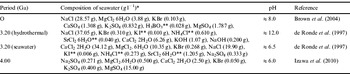
The reliability of the results of such experiments for modelling prebiotic Earth processes depends on accurate identification of the composition of seawater of the prebiotic Earth. Although this information is yet unknown, prebiotic seawater likely consisted of more than distilled water and/or sodium chloride. The adsorption of amino acids and nucleic acid bases by minerals is likely affected by ionic strength and interactions between different salts. The composition of salts and their concentration in seawater of the prebiotic Earth is a controversial issue. The salinity of seawater of the prebiotic Earth could be 1.5–2.0 times higher than that of modern oceans, and sodium and chloride were likely the most abundant cation and anion (Knauth Reference Knauth1998). De Ronde et al. (Reference De Ronde, Channer, Faure, Bray and Spooner1997) concluded that hydrothermal fluid vents of 3.20 billion years ago had a similar chemical composition of modern vents. Izawa et al. (Reference Izawa, Nesbit, MacRae and Hoffman2010) performed several experiments of sequential leaching of meteorite samples from Tagish lake and suggested that the concentrations of Ca and Mg in prebiotic oceans were higher than Na. Thus, the effects of multiple salts found in seawater on the adsorption of amino acids and nucleic acid bases onto minerals should be studied. Based on the work of de Ronde et al. (Reference De Ronde, Channer, Faure, Bray and Spooner1997) and Izawa et al. (Reference Izawa, Nesbit, MacRae and Hoffman2010), Table 1 suggests artificial seawaters recipes that should be used in such experiments. The artificial seawaters suggested in Table 1 should be representative of prebiotic Earth (Izawa et al. Reference Izawa, Nesbit, MacRae and Hoffman2010), Earth at 3.20 billion years ago (de Ronde et al. Reference Cohn, Hansson, Larsson, Soweby and Holm1997) and today (Brown et al. Reference Brown, Colling, Park, Phillips, Rothery and Wright2004). It should be noted that the order of adding the salts should be the same as shown in Table 1, to avoid precipitation reactions. The concentrations of some ions are not the same as those concluded by Izawa et al. (Reference Izawa, Nesbit, MacRae and Hoffman2010) or de Ronde et al. (Reference De Ronde, Channer, Faure, Bray and Spooner1997), as the combination of some minerals results in precipitation. As there is boron in the artificial seawater 0 Ga, but there is no boron in others. In addition, there are KI, NH4Cl and SrCl2 6H2O in the seawater/hydrothermal 3.2 Ga, but not in others. As a suggestion, experiments without these substances should be carried out first and then with these substances. The adsorption of amino acids and nucleic acid bases using these seawaters recipes, containing different concentration of ions (Na+, Ca2+, Mg2+, SO42− and Cl−) could provide a better understanding of prebiotic Earth.
Suggested compositions for artificial seawater

* Each salt should be added in the order as they are shown.
** These substances should be added after experiments without them were carried out.
Amino acids
There were two sources of amino acids for the prebiotic Earth: exogenous, (i.e. those synthesized outside the Earth) and endogenous (i.e. those synthesized on the Earth). The amino acids of exogenous sources could be synthesized in interstellar/interplanetary environments or on the surfaces of meteorites, comets and interplanetary dust particles (IDPs). These exogenous amino acids could be delivered to earth by meteorites, comets and IDPs (Llorca Reference Llorca2005; Brack Reference Brack2007; Elsila et al. Reference Elsila, Dworkin, Bernstein, Martin and Sandford2007; Sephton & Botta Reference Sephton and Botta2008). The endogenous amino acids could be synthesized from several sources on the prebiotic Earth such as submarine hydrothermal vents, aqueous solutions, solid state heated substances by lava from volcanoes or impact bolides or radiation and mixture of gases (Ferris et al. Reference Ferris, Joshi, Edelson and Lawless1978; Basiuk et al. Reference Basiuk, Navarro-Gonzalez and Basiuk1998; Holm & Andersson Reference Holm and Andersson2005; Plankensteiner et al. Reference Plankensteiner, Reiner and Rode2005, Reference Plankensteiner, Reiner and Rode2006).
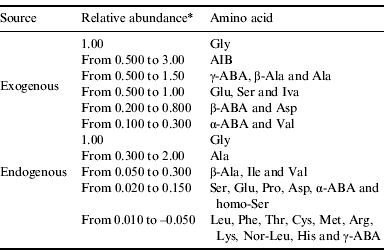
Here, again a first question must be answered: which amino acids should be used in prebiotic chemistry experiments? Naturally, these should include amino acids that existed on the prebiotic Earth, meaning amino acids that were delivered to Earth by exogenous sources or synthesized by endogenous sources. Zaia et al. (Reference Zaia, Zaia and de Santana2008) reviewed amino acids synthesized by all possible exogenous and endogenous sources and their relative abundances (Table 2). Based on this work, Table 2 shows the relative abundances of amino acids synthesized by exogenous and endogenous sources. As pointed by Zaia et al. (Reference Zaia, Zaia and de Santana2008), the mixture of amino acids synthesized by exogenous sources are very different from the composition of amino acids found in modern living beings. Alternatively, the mixture of amino acids synthesized by endogenous sources is more close to the composition of the amino acids of modern living beings. Several non-protein amino acids (AIB, α-ABA, β-ABA, γ-ABA and β-Ala) appear in higher abundances in mixtures of exogenous sources (Table 2). However, only common amino acids are typically used for mineral adsorption experiments (Lahav & Chang Reference Lahav and Chang1976; Zaia Reference Zaia2004; Lambert Reference Lambert2008; Zaia et al. Reference Zaia, Zaia and de Santana2008). There is lack of information about the adsorption of non-protein amino acids onto minerals; thus, experiments using these amino acids (AIB, α-ABA, β-ABA, γ-ABA and β-Ala) should be performed. As non-protein amino acids appear in higher concentrations in exogenous sources, these experiments could be helpful to determine the importance of exogenous sources of amino acids in the origin of life on Earth.
Relative abundances of amino acids synthesized by exogenous (interstellar medium and meteorite analyses) and endogenous (atmospheres, hydrothermal, solid and other environments) sources (Zaia et al. Reference Zaia, Zaia and de Santana2008)
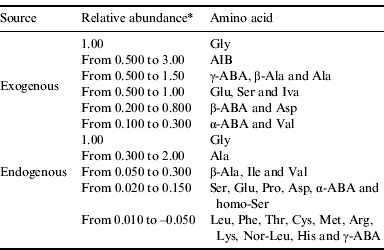
* The concentration of Gly was taken as 1.00. ABA, amino-n-butyric acid; AIB, aminoisobutyric acid; Ala, alanine; Asn, asparagine; Arg, arginine; Asp, aspartic acid; Cys, cysteine; Gln, glutamine; Glu, glutamic acid; Gly, glycine; His, histidine; Ile, isoleucine; Iva, isovaline; Leu, leucine; Lys, lysine; Met, methionine; Phe, phenylalanine; Pro, proline; Ser, serine; Thr, threonine; Trp, tryptophan; Tyr, tyrosine; Val, valine.
Nucleic acid bases
Similar to the amino acids, nucleic acid bases could have been synthesized by exogenous and endogenous sources on the prebiotic Earth (Cleaves II & Lazcano Reference Cleaves, Lazcano, Zaikowski, Friedrich and Russel2001). Thus, nucleic acid bases that existed on the prebiotic Earth, which were delivered to Earth by exogenous sources or synthesized by endogenous sources should be used in prebiotic chemistry experiments. It should be noted that all nucleic acid bases that are components of DNA and/or RNA (adenine, thymine, uracil guanine and cytosine) were synthesized by endogenous sources of the prebiotic Earth or found in meteorites (Ferris & Hagan Jr. Reference Ferris and Hagan1984; Hua et al. Reference Hua, Kobayashi, Ochiai, Gehrke, Gerhardt and Ponnamperuma1986; Levy et al. Reference Levy, Miller, Brinton and Bada2000; Saladino et al. Reference Saladino, Crestini, Costanzo, Negri and Di Mauro2001; LaRowe & Regnier Reference LaRowe and Regnier2008; Martins et al. 2008). Thus, adsorption experiments using these nucleic acid bases are justified. However, other nucleic acid bases were also synthesized including: 2,6-diaminopurine, 2,4-diaminopyrimidine, orotic acid, isoguanine, hypoxanthine and xanthine (Ferris & Hagan Jr. Reference Ferris and Hagan1984; Cleaves II & Lazcano Reference Cleaves, Lazcano, Zaikowski, Friedrich and Russel2001). To this author's knowledge, with one exception (hypoxanthine on graphite) (Sowerby et al. Reference Sowerby, Cohn, Heckl and Holm2001a,Reference Sowerby, Mörth and Holmb) these nucleic acid bases have not been used in adsorption experiments. In general, there are only a few studies that have investigated the abundances or synthesis of nucleic acid bases under prebiotic chemistry conditions, interstellar/interplanetary environments or meteorites. Thus, there is a lack of information about which nucleic acids and amount of them existed on the prebiotic Earth.
Conclusion
Intercomparison experiments should be performed by different groups around the world using minerals that are extensively characterized by several methods, and methods used for mineral synthesis should be standardized.
Experiments using clays modified with metals (Cu, Fe, Ni, Mo, Zn, etc.) and primary chondrite minerals should be performed to better understand their roles in the adsorption of amino acids and nucleic acid bases.
Chromatographic and spectroscopic methods should be used to identify the possible products of decomposition due to interactions of amino acids, nucleic acid bases and minerals.
Minerals with more organophilic characteristics should be included in adsorption experiments to provide a more thorough understanding of the protection of amino acids and nucleic acid bases from decomposition by hydrolysis or UV radiation.
Seawaters with different concentrations of ions (i.e. Na+, Ca2+, Mg2+, SO42− and Cl−) could provide additional evidence of the roles played by minerals in the adsorption of amino acids and nucleic acid bases.
Non-protein amino acids (AIB, α-ABA, β-ABA, γ-ABA and β-Ala) and alternative nucleic acid bases (i.e. in addition to adenine, thymine, uracil and cytosine) should be used in mineral adsorption experiments.
Acknowledgements
The author is grateful to Cristine E. A. Carneiro for the preparation of the seawater shown in Table 2 as well as to the organizing committee of SPASA for the lecture invitation.