In mid-November 1920, police in the working-class district of al-Labban, Alexandria, began unearthing the corpses of seventeen murdered women. Most of the corpses were found underneath rooms that had been subleased to two sisters named Raya and Sakina. Shortly thereafter, twenty-two suspects were detained, among them Raya bint ‘Ali, her sister Sakina, and their ex-husbands, Hasab Allah Sa‘id and Muhammad ‘Abd al-‘Al.Footnote 1 Although Sakina claimed ignorance for weeks into the investigation, Raya cooperated with the authorities, revealing the location of additional corpses and the names of perpetrators.Footnote 2 In mid-December, the sisters confessed that they had been accomplices to the murders, but only because the perpetrators had beaten them and threatened them into silence.Footnote 3
The details of the serial murders give some credence to Raya and Sakina's claims. Many of the murdered women were friends or acquaintances of Raya and Sakina who had joined them in developing a profitable clandestine sex business during the war. While their husbands were serving in the Egyptian Labor Corps, Raya and Sakina opened a lucrative brothel next to a British military camp in Alexandria, attracting soldiers of various nationalities as well as Egyptian men who had been recruited into the Labor Corps. After the war, they continued to operate their clandestine sex business in numerous locations, including their own homes. Unlike traditional brothels, most of the women that Raya and Sakina worked with were independent sex workers who owned the gold and clothing they needed to attract clients. The clients paid the sex workers directly, and the workers in turn paid Raya and Sakina a fee for conducting business at their brothel.Footnote 4 Although this female-run business was highly profitable for both the sisters and the sex workers, the return of working-class men after the war altered the gender dynamics of the clandestine sex industry. These unemployed and precariously employed men began to confiscate the sisters’ earnings and abuse the sex workers, leading to a new structure of gender and sexual violence in Alexandria's sex trade. This structure of violence involved neighboring cities, leading to the murder of sex workers in Tanta at the same time. Raya and Sakina's testimonies indicate that in the midst of this violence, they chose to collaborate for the sake of survival rather than resist and risk death.
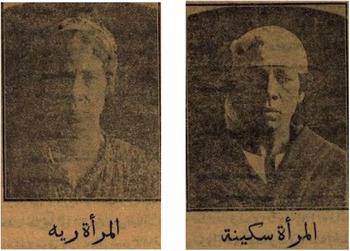
Although the legal evidence suggests that the murders were a product of gender and sexual violence, the Egyptian media presented the motive behind the murders as robbery and painted Raya and Sakina as the primary perpetrators. For over two months, major newspapers across Alexandria and Cairo published daily updates about the investigation in addition to regular editorials denouncing the perpetrators. Most of these newspapers did not disclose that the majority of the victims had been involved in the clandestine sex trade and instead created the impression that Raya and Sakina had deliberately lured unwitting strangers into their homes using a variety of methods, including fortune-telling, the zār, and the sale of cheap goods. The media further sensationalized the sisters’ role in the murders by publishing their police photographs in the early stages of the investigation, largely ignoring the other suspects. By the time the trial began on 10 May 1921, the media had been referring to it as “the Raya and Sakina case” and was calling on the court to “sever these two corrupt members from the nation.”Footnote 5 Although the court determined that the sisters had acted as accomplices rather than perpetrators, the demand for their execution was ultimately heeded.Footnote 6 On 21 December 1921, Raya and Sakina became known as the first women in Egyptian history to receive the death penalty.
The media's sensationalized coverage of the murder case was in part shaped by the Egyptian revolution of the early interwar era. In March 1919, uprisings and demonstrations across the country sought to overthrow British colonial rule, and there was frequent unrest throughout the country until Britain granted Egyptians conditional independence in February 1922. British colonial officials had legitimized their occupation of Egypt by arguing that Egyptians were not yet civilized enough to rule themselves, and they considered gender and sexuality central to the dividing line between the civilized and the barbaric.Footnote 7 Since the early 20th century, Egyptian nationalists had internalized this colonial logic, making the status of women synonymous with the status of the nation.Footnote 8 The project of civilizing women was thus integral to the political goal of national independence.
It was in this context that the media constructed Raya and Sakina as symbols of the barbaric woman. Building on Shaun Lopez's argument that the Raya and Sakina case was “a foundational moment in the formation of a gendered mass culture in Egypt,” this article argues that what made Raya and Sakina forces of barbarity in the minds of Egyptian nationalists was the way in which their transgression of middle-class gender and sexual norms intersected with their racialization as dark-skinned peasant women from the South.Footnote 9 In stark contrast to the educated, domestic, urban middle-class consumer known as the “new Egyptian woman” (al-mar'a al-jadīda al-Misriyya), the barbaric woman was a dark-skinned worker of rural origins who threatened Egyptian capitalist modernity by taking part in the informal economy.Footnote 10 She engaged in subversive religious practices and was a controlling wife and cruel mother. She was overly sexual and aggressive, and she spent too much time in public space. Unlike most backward women who could be civilized, the barbaric woman was a corrupting, degenerative force that posed an existential threat to the modern Egyptian nation. For Egyptian nationalists, the existence of barbaric women like Raya and Sakina was proof that colonialism had not only failed to fulfill its civilizing mission but had caused the nation to move backward along the scale of evolutionary time.
The construction of the barbaric woman through the figures of Raya and Sakina shows that the project of modernizing and civilizing Egyptian women became more explicitly racialized in the interwar era. Although a large body of groundbreaking scholarship has examined the role of gender, sexuality, and class in the making of Egyptian modernity, scholars of modern Egypt have largely overlooked the role of race.Footnote 11 In the early 20th century, some nationalists, such as Qasim Amin, had articulated a conception of “women's liberation” based on a modern/colonial gender system that universalized white bourgeois womanhood as the standard of modernity.Footnote 12 This project of “liberating” and civilizing women by making them simultaneously Westernized yet culturally authentic became globally hegemonic in the interwar era, as evidenced by the growing popularity of the New Woman and the Modern Girl in newspapers around the world.Footnote 13 Studies of the Modern Girl have shown that these media images were racialized both physically and culturally, conflating civilization and modernity with light skin and Westernization. In Egypt, the proliferation of these images in the media coincided with nationalist attempts to dissociate Egypt from Africa and present it as an integral part of the Mediterranean world.Footnote 14 As dark-skinned peasant women from southern Egypt, Raya and Sakina became casualties of a racialized conception of Egyptian modernity that led nationalists to analyze the murder case using racial theories of criminality and racial conceptions of Egyptian peasants.
The media depiction of Raya and Sakina as symbols of the barbaric woman has been so central to Egyptian modernity that it still remains an integral part of Egyptian popular culture one hundred years later, inspiring numerous films, plays, televisions shows, and fiction.Footnote 15 In this article, I will explore how the image of Raya and Sakina was used to construct the dividing line between the civilized and the barbaric at the intersection of race, gender, sexuality, and class. Borrowing from Ann Stoler's analysis of the relationship between race and sexuality in the formation of bourgeois identity and Maria Lugones's concept of the modern/colonial gender system, this article will show that at the moment when middle-class Egyptians sought to assert their power over “the nation,” they enforced a bourgeois colonial gender order that was explicitly racialized and sexualized.Footnote 16 Proximity to white bourgeois femininity was upheld as the symbol of modernity, necessitating the adoption of physical, cultural, and sexual prescriptions on the part of Egyptian women. Even though Egyptian nationalists were attempting to construct a unique national identity, their project of civilizing women was rooted in the same patterns of racial and sexual domination as the British colonial project, leading to the colonization of gender. This adoption of racialized constructions of gender culminated in the demonization and, ultimately, elimination of Raya and Sakina as the quintessential barbaric Egyptian women.
Race and the Peasantry in Interwar Egypt
Within days of the discovery of the first corpse, before the state prosecutor had even compiled a suspect list, Egyptian newspapers began focusing on Raya and Sakina's physical features. The Alexandrian newspaper, Wadi al-Nil (Nile Valley), described Raya as thin, with tattoos on her chin and hand, a sign of rural origins.Footnote 17 Her clothing was worn-out, and she spoke with her head bowed down.Footnote 18 The next day, Wadi al-Nil described Sakina as very thin and dark-skinned, with multiple tattoos on her chin and hands. The reporter dedicated an entire paragraph to a detailed description of the tattoos and noted that Sakina wore no jewelry. Like Raya, she spoke with her head bowed.Footnote 19
The media's emphasis on Raya and Sakina's tattoos, dark complexion, and humble appearance painted them as poor migrant women from the countryside. In anthropological and travel accounts of the Egyptian countryside in the 19th and early 20th centuries, observers noted the prevalence of chin and hand tattoos on peasant women.Footnote 20 Travel accounts also noted the darker complexion of peasant women in the South.Footnote 21 As the investigation unfolded, the media continued to disclose more details about the southern rural origins of both the sisters and their ex-husbands, such as noting that Sakina's ex-husband, Muhammad ‘Abd al-‘Al, was a migrant who traveled back and forth from Asyut.Footnote 22 Given that the majority of migrant workers in early 20th-century Alexandria were impoverished peasants from southern Egypt, readers in northern cities would likely have understood Raya and Sakina to be rural migrants from the South.Footnote 23
Because of their rural origins, Raya, Sakina, and their ex-husbands were profiled in the media as bandits from the start of the investigation. Shortly after the initial media reports, Wadi al-Nil began referring to the sisters and their ex-husbands as ashqiyā’, which was a term for criminality frequently used in reference to rural banditry.Footnote 24 The media's use of the term ashqiyā’ further identified the suspects as southern Egyptian because banditry in the North was often blamed on migrant workers from the South.Footnote 25 Labeling the suspects ashqiyā’ so early in the investigation and painting them as a gang of murderous thieves prematurely foreclosed other possible explanations for the murders. It also indicated that Raya, Sakina, and their ex-husbands were presumed guilty long before anyone had confessed to the murders.
The attempt to relate the murders to the sisters’ southern rural origins was further reinforced by the media's emphasis on their performance of the zār. The zār was a female-led ritual of healing and exorcism that was practiced in many parts of Africa, including southern Egypt. By the early 20th century, the Egyptian middle class had begun to view the zār as a barbaric custom that threatened the well-being of the nation, lumping it into the same category as fortune-telling.Footnote 26 In mid-December, shortly after a media report incorrectly announced that the zār and fortune-telling were the main methods Raya and Sakina had used to lure the victims to their homes, these gendered practices became the focus of editorials about the murder case.Footnote 27 This emphasis on the zār linked the murders to the sisters’ southern rural origins and encapsulated what Egyptian nationalists believed to be female barbarity.
The extent to which Raya and Sakina's identity as southern rural migrants shaped their criminalization in the media is further evident when compared to the coverage of a similar serial murder case in the neighboring city of Tanta. Egyptian newspapers began covering the Tanta murder case in the summer of 1920, and the case went to trial shortly before the discovery of the first corpse in Alexandria.Footnote 28 An interview with Mahmud ‘Allam, the convicted perpetrator in the case, suggests that the Tanta murders were also linked to the clandestine sex industry and involved numerous people, including ‘Allam, his wife, and her friend.Footnote 29 However, despite the similarity between the two serial murder cases, ‘Allam was a shaykh and a native of Tanta, and one of the female suspects was a schoolteacher.Footnote 30 Consequently, Egyptian newspapers did not focus on the appearance of the female suspects, nor did they describe ‘Allam's appearance to the public until long after he had been convicted.Footnote 31 Their status in the community shielded them from significant media attention, and the female suspects were eventually exonerated.Footnote 32 The disparate media coverage and outcome of the Alexandria and Tanta cases suggests that the focus on Raya and Sakina was due not to the nature of the case or their role in it, but rather to their identity as rural migrants from the South.
The condemnation of Raya and Sakina in the media coincided with a shift in Egyptian nationalist discourse about the peasantry. In the early 20th century, Egyptian nationalists had romanticized peasants as symbols of the nation. Such romanticization is evident in Hasan Mar'i's play, Sayd al-Hamam (Hunting for Doves), which presented the peasants of Dinshway as nationalist heroes.Footnote 33 In contrast, peasants in the interwar era became associated with backwardness, while the urban middle class became the representative of the nation. This transformation led to social scientific studies of the relationship between peasant addiction and criminality, and an emphasis on the need to civilize the peasantry.Footnote 34 The shift in nationalist discourse about the peasantry signified the construction of Egyptian capitalist modernity and the peripheralization of the countryside in an urban-dominated nation–state.
The transformation in conceptions of the peasantry in the interwar era intersected with a longstanding discourse about southern Egyptians as an internal Other. This perception was strengthened by a history of southern Egyptian resistance to Mehmet Ali's state-building policies in the early 19th century. Zeinab Abul-Magd calls his attempt to integrate the independent South into a northern-dominated Egyptian state a process of “internal colonialism” that led to constant “separatist revolts and resistance in daily life, championed by peasants, women, laborers, slaves, and, most importantly, ever-ruthless bandits.”Footnote 35 This internal colonialism had both political and economic consequences for the South, leading to the dominance of the cotton-rich Delta region in the North and the peripheralization of southern Egypt within the global capitalist economy. The Sa‘id, which had previously prospered due to its role in the Indian Ocean world economy and its production of grain, sugarcane, and textiles, became increasingly impoverished in the second half of the 19th century, and its inhabitants became exploited migrant laborers in a northern-dominated Egyptian economy.Footnote 36
The economic peripheralization of the Sa‘id was reinforced by a racialized colonial discourse about southern Egyptians as primitive and inferior to northern Egyptians. In the late 19th and early 20th centuries, British officials depicted southern Egyptians as irrational, violent, backward, and lawless, with a natural tendency to engage in crime and brigandage.Footnote 37 Unlike stereotypes about cultural backwaters, these traits were seen as an essential part of the southern Egyptian character that remained unchanged across time and space. The colonial construction of southern Egyptians as both culturally inferior and inimical to modern state-building reinforced their political and economic marginalization in both the global economy and Egypt by criminalizing their acts of resistance and naturalizing their position as an exploited labor force. As Cedric Robinson argues in his seminal work on racial capitalism, “the tendency of European civilization through capitalism was . . . to exaggerate regional, subcultural and dialectical differences into ‘racial’ ones.”Footnote 38 In this sense, colonial discourse about the Sa‘id may be understood as a form of racialism that enshrined the transformation of southern Egyptians into disposable laborers for the North.
Given the Sa‘id's geographic and cultural proximity to sub-Saharan Africa, colonial discourse about southern Egyptians was also rooted in anti-blackness. In the 19th century, European colonizers attempted to de-Africanize Egypt to “deny and erase any contribution of the black race to civilization.”Footnote 39 British colonizers saw southern Egyptians as a liminal people who threatened this attempt to de-Africanize Egypt. The notion of southern Egyptian liminality is evident in the work of British anthropologist Winifred Blackman, who wrote about southern Egyptians as a mixed race population. In her 1927 book, The Fellahin of Upper Egypt, she notes, “What really is beginning to affect the racial purity of the Egyptians is the presence among them of the descendants of negro slaves, who have been imported in large numbers by the Arabs in comparatively recent times. Many of them are now settled in certain of the villages, where they have married among themselves or with the fellahin, the result being that the population of such villages is almost entirely composed of black, or half-black, people.”Footnote 40 Timothy Mitchell noted similar remarks about the mixed race character of southern Egyptian peasants in the work of Father Henry Habib Ayrout, a Jesuit priest in Egypt known for his study of Egyptian peasants.Footnote 41
Although it is not yet clear whether northern Egyptian nationalists saw peasants from the Sa‘id as racially impure, the anxiety about southern Egyptians as an internal Other was manifested in enduring stereotypes of southern Egyptian peasants as naturally disposed to violence and criminality. In the interwar era, the difference between northern and southern peasants thus became the dividing line between the backward and the barbaric. Primitivity was depicted as the essence of the southern Egyptian character as it moved through time and space, making it a permanent regressive force within a modernizing Egyptian nation.Footnote 42 At the moment when middle-class Egyptian nationalists sought to showcase their status as a modern, advanced nation, the perceived barbarity of the southern Egyptian migrant became a sign of degeneracy and a national threat.
The racialization of southern Egyptian migrant women in particular was constructed at the intersection of race, gender, sexuality, and class. With the globalization of the modern/colonial gender system in the 20th century, laboring women in European colonies were racialized differently than elite women. As Maria Lugones has argued, “Historically, the characterization of white European women as fragile and sexually passive opposed them to non-white, colonized women, including women slaves, who were characterized along a gamut of sexual aggression and perversion, and as strong enough to do any sort of labor.”Footnote 43 Just as white women and non-white women were gendered and sexualized in opposite ways, so were lower-class and upper-class women in the colonial context. Although middle- and upper-class women could aspire to white bourgeois femininity, laboring women were racialized as strong, violent, and sexually deviant. The racialization of laboring women like Raya and Sakina was thus tied not only to internal Egyptian developments, but to their role in the global capitalist economy. It was this racialization that led middle-class nationalists to see Raya and Sakina as savage women capable of murder.
The media's depiction of Raya and Sakina as a degenerative force pulling the nation back in time was therefore shaped by both the spread of the modern/colonial gender system and Egyptian nationalist discourse about southern Egyptian peasants. In this context, middle-class nationalists turned to degeneration theories that had originated in Europe in the second half of the 19th century to provide a social scientific framework for their analysis of the case. At the core of these theories was the notion that undesirability—namely, criminality, addiction, and prostitution—was dialectically connected to racial and national degeneration. Crime, addiction, and prostitution were seen as products of decline, signs that civilization was moving backward rather than forward.Footnote 44 Thus, the obsession with progress in late 19th-century Europe was accompanied by an obsession with both racial and sexual purity. Social scientific theories about degeneracy circulated globally in the late 19th and early 20th centuries, producing historically specific discourses that varied across time and space. Degeneration theories also contributed to the growth of transnational movements such as anti-vice activism and eugenics.Footnote 45 In Egypt, in the wake of the mass uprisings and nationalist demonstrations that followed World War I, the Raya and Sakina case became a platform for middle-class Egyptian nationalists to test the applicability of these theories to their social context.
Examining the moral panic around Raya and Sakina as the making of an Egyptian degeneracy discourse highlights how the construction of Egyptian modernity was simultaneously gendered, sexualized, and racialized. As dark-skinned migrant women from the Sa‘id who violated bourgeois gender and sexual norms, Raya and Sakina symbolized the forces of barbarity that Egyptian nationalists had constructed themselves against, and their sexual activities allegedly threatened to pull the nation back to a primitive era. The racialization of Raya and Sakina as southern Egyptian migrants thus underpinned their gender and sexual degeneracy, making race central to the gender and sexual discourse of middle-class modernity. It was for this reason that the Egyptian media constructed Raya and Sakina as forces of degeneration that must be excised from the nation.
The Making of an Egyptian Degeneracy Discourse
In newspapers published in both Alexandria and Cairo, daily reports about the murder case were accompanied by regular editorials that theorized the relationship between crime and degeneration. Some editorials blamed the serial murders on the effects of colonialism, some related it to the spread of drugs, alcohol, and prostitution, and others attributed it to backward social and cultural practices, particularly among women. The editorials reflected a sentiment that the nation was experiencing a social and cultural crisis that had plunged it back down the sliding scale of modernity/rationality into primitivity. Prominent Egyptian intellectuals such as ‘Abbas Mahmud al-‘Aqqad and Salama Musa contributed to this Egyptian degeneracy discourse by critically engaging with Euro-American degeneration theories. Although some of these Egyptian writers considered behavior more important than biology in explanations of degeneracy, they nevertheless adopted the social scientific framework of Euro-American thinkers by reinforcing the connection between criminality, addiction, and prostitution, and naturalizing the relationship between crime and barbarism.
For some writers, the murders were proof that British colonialism had led to the regression of the Egyptian nation. In one of the early editorials published about the serial murders in the Alexandrian newspaper, al-Umma (The Nation), Muhammad al-Hayyawi argued that the “savages” (wuḥūsh) who committed the murders were not born that way but were rather a product of a negligent system that had stripped them of humanity.Footnote 46 By neglecting education, the colonial regime had caused “the disease of ignorance” to spread. By wasting money on useless reforms that had failed to benefit the people, the colonial regime had caused “the disease of poverty” to spread. By licensing prostitution, the colonial regime had allowed the “disease of immorality” to spread. The murders were a sign that these various diseases created by the colonial regime had caused the people to degenerate into savages, and the only solution was to give the nation full control over its own affairs. By critiquing colonialism for failing to fulfill its promise of progress, al-Hayyawi naturalized European conceptions of criminality as a symbol of barbarism and regression, and nationhood as the only path to redemption.
The notion that the murderers were ordinary human beings who had been corrupted by their environment was taken up by Salama Musa two weeks later in an editorial he published in the Cairene newspaper, al-Ahram (The Pyramids). Musa, a Western-educated Copt who was known as a proponent of both socialism and racial science, argued that the primary cause of the murders was insanity stemming from addiction to hashish and alcohol.Footnote 47 Although the criminals had begun their career sound in mind with a desire for money, their growing addiction to hashish and alcohol had produced a madness that led them to kill not simply for money but for pleasure.Footnote 48 Musa attributed the problem to the widespread availability of drugs and to the fact that alcohol imported from England was being sold in Egypt at prices far lower than in London. Arguing that the criminal is a product of his environment, he concluded that all the sellers of alcohol and hashish in Egypt were responsible for the serial murders. The solution was therefore to criminalize alcohol as America had done and to crack down on the sale of hashish.
Although Musa's editorial rejects biological explanations of criminality, the relationship it draws between crime, addiction, and mental illness was typical of hereditary degeneration theorists and eugenicists in Europe and North America. Hereditary degeneration theorists such as Benedict Morel believed that the effects of addiction to alcohol and drugs could produce permanent physical and mental defects that would be passed on to future generations.Footnote 49 This association between crime, addiction, and mental deficiency was also the basis of eugenics thought. Musa's editorial therefore reflects the discourse of hereditary degeneration despite his emphasis on the role of environment rather than biology. Given that Musa was a proponent of eugenics in the 1930s, his rejection of biological explanations of criminality at the height of the Egyptian nationalist movement in 1920 may reflect either the development of his ideas or an attempt to emphasize the negative effects of British colonialism.Footnote 50
The way in which Musa related the murders to addiction became a salient feature of both colonial and nationalist discourse about Egyptian peasants in the interwar era. This period was characterized by the publication of numerous studies about the relationship between crime, addiction, and moral deficiency among the Egyptian peasantry. As Omnia El Shakry notes, “the Central Narcotics Intelligence Bureau began to collect data on the use of addictive substances, such as hashish, opium, and black tea among peasants, and to link this use to criminality and other social ills. The collection of statistics on rural crime, and violent crime in particular, helped cultivate a discourse on peasant character that emphasized the fellah's lack of cultural and moral sense.”Footnote 51 Egyptian social scientists in the interwar era also characterized rural crime as more violent and cruel than urban crime.Footnote 52 The media's emphasis on the rural origins of Raya, Sakina, and their ex-husbands was in this way central to the construction of their criminality.
The focus on addiction and mental deficiency also appears in ‘Abbas Mahmud al-‘Aqqad's analysis of the Alexandria serial murder case. One of the most prolific Egyptian writers of the interwar era, al-‘Aqqad published his reflections on the suspects’ photographs in al-Ahram on 30 November 1920. In his editorial, “Raya and Sakina: From Lombroso to Anatole France,” he engaged with the Italian criminologist Cesare Lombroso's theory about the distinctive facial features of natural-born criminals. Lombroso was well-known for his theory of criminal atavism, which posited that criminals were biologically primitive due to racial inferiority, and that this primitivity could be identified through physiognomy. Lombroso's physiognomy was not based primarily on skin color but on other biological features that tied criminals to “colored races,” such as phenotype and cranial measurements.Footnote 53 After comparing Lombroso's criminal anthropology to a more overtly racist excerpt about criminality written by Anatole France, al-‘Aqqad concluded that there was some truth to Lombroso's claims. Although he argued that Raya, Sakina, and their husbands did not look like the monsters one would expect to see after hearing about their crimes, their faces did show signs of feeblemindedness, and the signs of evil and addiction were particularly visible on Raya and Sakina's faces (Fig. 1).Footnote 54 Like Musa, al-‘Aqqad associated criminality with addiction and mental deficiency. However, unlike both Musa and al-Hayyawi, al-‘Aqqad's reliance on Lombroso's physiognomy placed less responsibility on the colonial regime for the spread of crime and moved instead toward a biological explanation of criminality.
Police photographs of Raya (left) and Sakina (right) published in Wadi al-Nil on 28 November 1920.

By the time al-‘Aqqad was writing this editorial, Lombroso's theories had long been discredited across Europe.Footnote 55 Al-‘Aqqad's decision to apply a debunked racial science to his analysis of the Raya and Sakina case therefore warrants deeper exploration. His attraction to Lombroso's physiognomy may stem from the fact that this was likely the first time a suspect's photograph had been published in the Egyptian press, which may itself have been motivated by racial profiling.Footnote 56 Yet his attraction to Lombroso may also stem from similarities in the historical context in which they were writing. Lombroso began his studies of physiognomy shortly after Italian unification in 1861, when northern Italians envisioned themselves embarking on a civilizing mission against a backward and impoverished Italian South.Footnote 57 These patterns of North–South domination in Italian nation-building were also apparent in Egyptian nation-building.Footnote 58 Like northern Italians, British colonizers and Egyptian nationalists depicted the Egyptian South as a backward and underdeveloped region rife with poverty and brigandage.Footnote 59 Both Lombroso and al-‘Aqqad were therefore writing during moments of nation-building marked by the subordination of a rural south to an industrializing north.
The view of a progressive north versus a regressive south shaped Lombroso's theories about natural-born criminals. His theory of criminal atavism was based on the racial and gender hierarchies of social Darwinism, which presented inferior races as less evolved than superior races and women as less evolved than men. He believed that criminals exhibited physical and mental traits associated with an earlier stage of human evolution, thereby resembling the savages of inferior races.Footnote 60 Building on the popular perception of crime as natural to the South, Lombroso's criminal anthropology effectively racialized southern Italians as primitive people who were closer to Africa both geographically and biologically.Footnote 61 His theory of criminal atavism was based not only on race but also gender, relating criminality in women to deviant sexual behavior such as prostitution.Footnote 62 In the interest of building a strong Italian nation and protecting the white race against forces of degeneration, Lombroso sought to identify and permanently isolate the unreformable, natural-born criminal from the rest of Italian society.Footnote 63 He also believed that criminals of “colored races” deserved harsher punishment, and he advocated the death penalty for “born criminals convicted of a series of bloody crimes and for members of organized gangs who threatened state security.”Footnote 64 In this sense, removing the forces of atavism through imprisonment and capital punishment functioned as a form of eugenics.
Al-‘Aqqad's reliance on Lombroso's racial science to analyze the faces of dark-skinned migrants from the Egyptian South reflects the similarity in North–South patterns of domination in Egyptian and Italian nation-building. By noting that the suspects’ faces showed signs of feeblemindedness, al-‘Aqqad ascribed to them a biological inferiority grounded in scientific racism, which naturalized the association of southern Egyptians with criminality. Furthermore, by noting that Raya and Sakina's faces showed more signs of evil and addiction than the faces of their husbands, al-‘Aqqad upheld the gendered and sexual components of Lombroso's criminal atavism, which naturalized the association of prostitution with criminality. The assumption that feeblemindedness and addiction were signs of immutable criminal deviance was becoming increasingly popular during this period and played an important role in shaping criminal justice reform in early interwar Egypt. As stated in the commentary on the 1919 Egyptian penal code, the state had begun to identify criminals who were “feeble in mind or body, or given to hashish” as being incapable of reform.Footnote 65 Al-‘Aqqad's analysis thus merges Lombroso's physiognomy with the new colonial discourse on criminality in an attempt to present Raya and Sakina as primitive savages and forces of degeneration in Egyptian society.
Degeneracy at the Intersection of Race and Religion
Whereas al-‘Aqqad's editorial relied on theories of degeneration based on scientific racism, other writers based their conception of the murderers’ criminal atavism on cultural racism. For these writers, the serial murders were a product of the existence of culturally backward elements in Egyptian society, particularly with regard to religious beliefs and practices. They subsumed Islam within a modernity/rationality paradigm, associating barbarism with the pre-Islamic era.Footnote 66 Their discourse resembled what scholars have called 19th-century Ottoman Orientalism, which envisioned a modernized imperial center civilizing its backward periphery through the standardization of cultural and religious practices.Footnote 67 Just as the Ottomans had made Islamic orthodoxy the basis of their 19th-century modernization project, these Egyptian writers associated modernity with orthodoxy and backwardness with heterodoxy.Footnote 68 Furthermore, just as the Ottomans had directed their modernization project against their Arab periphery, these Egyptian writers envisioned themselves leading a civilizing mission against the cultural practices of the Egyptian South. To them, the murderers inhabited a cultural space that was stuck in time, much like Lombroso's atavistic criminals had “prematurely disembarked from the train of evolution.”Footnote 69 Their conception of criminality presented a cultural corollary to the scientific racism of criminal anthropology.
The association of the murders with cultural atavism frequently centered on the corruption or neglect of Islamic beliefs and practices in Egyptian society. In an anonymous editorial published in Wadi al-Nil on 25 November 1920, the author attributed the murders to a cruelty and heartlessness that stemmed from barbarism, ignorance, and the spread of vice. He noted that it seemed “as if Egypt was stumbling in the dark ages of the pre-Islamic era” (ḥatta likā’in Miṣr tikhbat fī dhulumāt min ‘usūr al-jāhiliyya al-’ūla) and argued that the solution was to educate the population in “the correct religious doctrines” (al-‘aqā’id al-ṣaḥīḥa).Footnote 70 Criminality was presented as the product of a cultural atavism conceived in Islamic terms, necessitating the spread of Islamic teachings.
The notion that the corruption of religious beliefs was responsible for the murders informed not only editorials but also daily media reports about the investigation. Some of these reports explicitly connected Islamic heterodoxy to race. On 2 December 1920, Wadi al-Nil blamed the murders on the practice of dhikr, noting that none of Raya's neighbors could hear the murders due to all the noise that her Nubian neighbors made during their Sufi rituals.Footnote 71 By presenting Sufism as an obstacle to modern governance, the media connected heterodox religious practices to the spread of criminality. Furthermore, by linking the Sufi rituals to Nubians in particular, the media constructed Raya and Sakina as inhabitants of a racialized space.Footnote 72 Given that both Sufism and Nubians were the main arteries that connected the Egyptian South to sub-Saharan Africa during this period, this discourse posited the Sa‘id as a borderland and southern Egyptian migrants as a liminal people.Footnote 73
In addition to the fact that borderland people were inherently threatening to nationalists, the cultural and geographic liminality of the Sa‘id posed an additional threat to Egyptian nationalist attempts to dissociate Egypt from Africa in the early interwar period. Although Egyptian nationalists at this time sought to emphasize the unity of the Nile Valley and the intimate relationship between Egypt and the Sudan, they simultaneously sought to maintain their longstanding colonial control over the Sudan by emphasizing Egypt's responsibility for civilizing the Sudanese people.Footnote 74 Dissociating Egypt from Africa was integral to maintaining this colonial relationship, which rested on the construction of a racial boundary between a civilized metropole and a backward colony. Southern Egyptians who shared religious and cultural practices with African peoples exposed the fluidity of the boundary between colonizer and colonized, posing a threat to both the nationalist and colonial projects.
Transnational African traditions such as the zār further challenged the imagined boundary between a modern metropole and backward colony. As mentioned above, the zār became the focus of editorials about the murder case after a media report incorrectly announced that it was one of the main methods that Raya and Sakina had used to lure victims to their homes. In one editorial entitled “al-Wahm al-Qatil” (Deadly Delusion), a writer who signed with the initials ‘Ayn. Jīm. attributed the popularity of the zār and fortune-telling to ignorance.Footnote 75 However, unlike the aforementioned anonymous author who believed that education was the solution to the problem of ignorance, ‘Ayn. Jīm. proposed that Egyptian men keep tight control over their women to prevent them from engaging in these barbaric and dangerous customs. He also called on the Grand Shaykh of al-Azhar to renew his previous ban on these practices and demanded that the government enforce the ban. The author's solution to the spread of crime was to bring an end to barbaric customs in Egypt by increasing patriarchal control over women and holding the state responsible for the standardization and modernization of religious practices. It was through the construction and spread of Islamic orthodoxy that middle-class Egyptians sought to dissociate Egypt from Africa in a gendered modernist project of national and racial regeneration.
Degeneracy at the Intersection of Race, Gender, and Sexuality
The anxiety over liminality that manifested in condemnations of the zār was widespread among degeneration theorists. The fear of cultural and biological intermixing between those deemed superior and inferior races was frequently directed at groups that straddled social, cultural, or geographic boundaries. As Ann Stoler has shown, colonial concerns with hybridity shaped the treatment of Europeans who lived in the colonies, and these concerns were directed at both mixed-blood Europeans and poor whites. Race was conceptualized not only biologically but also culturally. Thus, as Stoler argues, “what sustained racial membership was a middle-class morality, nationalist sentiments, bourgeois sensibilities, normalized sexuality, and a carefully circumscribed ‘milieu’ in school and home.”Footnote 76 Fears of racial degeneration frequently manifested in anxiety over sexuality, leading to the development and enforcement of middle-class norms.
The relationship between race and sexuality explains why degeneration theorists were particularly concerned about sex workers. Long before the criminalization of prostitution in the postwar era, sex workers were frequently depicted as the most dangerous of the undesirables and were targeted by both anti-vice activists and eugenicists. In addition to being seen as vectors of disease, their sexuality challenged social and racial boundaries, hence the constant attempts by modern states to segregate them and limit their mobility and visibility. Sex workers who resisted these segregation measures were identified as a major threat to modern governance and one of the primary causes of national and racial degeneration.
For those concerned with liminal spaces and social fluidity, the port city of Alexandria was a hotbed of degeneration. Unlike the contiguous, clearly demarcated brothel quarters in Cairo, Alexandria had several fragmented red light districts spread throughout the city in the early 20th century. This fragmentation made the sex trade a visible, normalized feature of Alexandria's multiethnic urban landscape. Many writers of novels, travel literature, and war biographies have commented on the prominence of brothels and sex workers in their memories of the city.Footnote 77 Red light districts in Alexandria were close to police stations, hospitals, places of worship, and major marketplaces, and were not as geographically isolated from the rest of society as they were in other parts of the country. Furthermore, the lack of contiguity within the licensed quarters of Alexandria led to the creation of numerous unofficial red light zones in the direct vicinity of those quarters. These zones were sites for the private homes of licensed sex workers as well as the private homes and secret brothels of procurers.
The creation of unofficial red light zones was a product of negotiation between those involved in the sex trade and those who sought to marginalize it. To resist the totalizing and essentialist label of “public woman,” some licensed sex workers chose to rent private homes outside of red light districts for the sake of having a “respectable” home to which they could return after work. Yet the social stigma that licensed sex workers faced made it difficult for them to create boundaries between their personal and work identities, pushing their private homes into the liminal spaces between licensed districts and respectable society.Footnote 78 Clandestine brothel owners who were not well-connected and were unable to maintain the secrecy of their business operations were also pushed into these spaces.
The various clandestine brothels that Raya and Sakina established in the working-class district of al-Labban during and after World War I were located in these liminal spaces, which were inhabited by both poor southern Egyptian migrants and petite bourgeois families. Their brothels attracted a diverse clientele, and their popularity rested on Raya's ability to procure women of various ages and social classes. These clandestine sex workers were technically self-employed, meaning that they paid Raya and Sakina half of what they earned as a fee for conducting business at their brothel.Footnote 79 Raya also solicited streetwalkers to bring clients to their brothel, offering them a discounted fee if they agreed to come regularly.Footnote 80 Raya and Sakina's business model enabled petite bourgeois women to maintain their respectability by secretly engaging in clandestine sex work.
Although the investigation records reveal that many of the murder victims were married women who had hid their clandestine sexual activities from their husbands, the Egyptian media maintained the respectability of the victims by creating the impression that Raya and Sakina had deceitfully lured them to their homes.Footnote 81 For example, when telling the story of one of the first murder victims, Nabawiyya bint Jum‘a, the media emphasized that she was a mother of five children who was married to a hajji, ignoring the details that Raya had revealed about her sexual activities.Footnote 82 In addition, the media misreported details of the investigation to create the impression that the murder victims had gone to Raya and Sakina's homes to engage in nonsexual activities such as fortune-telling, the zār, and the purchase of cheap goods.Footnote 83 The attempt to preserve the respectability of the murder victims made it appear that Raya and Sakina were primarily responsible for luring the victims to their deaths.
The notion that Raya and Sakina were responsible for women's entrance into illicit spaces played a primary role in the call to execute them. According to the Alexandria-based newspaper al-Basir (The All-Seeing), the state prosecutor argued that no female criminal had ever received the death penalty in Egypt because they all had been victims of circumstance who merited sympathy. Yet Raya and Sakina had participated in these recent murders “for other reasons” and therefore deserved no mercy.Footnote 84 Furthermore, al-Basir noted that the state prosecutor claimed to have overheard Sakina say that if she received life imprisonment, she would likely get out in fifteen or twenty years and would then return to “roaming the streets of the city.” For this reason, the state prosecutor asked the court to “sever these two corrupt members from the nation.”Footnote 85 Although the journalist did not explain what was meant by “roaming the streets,” the Arabic word used in this context, saraḥa, was the same word used to describe the activities of street peddlers and streetwalkers in the investigation records. Given that Sakina had worked as a streetwalker, this statement suggests that what the state prosecutor (or journalist) feared was not that Sakina would murder again, but that she would return to a particular form of sex work that was leading to the corruption of Egyptian women.
Alexandria's cosmopolitan landscape contributed to the media panic over the corruption of women. This cosmopolitanism was characterized by the fluidity of boundaries not only between different ethnic communities, but also between different social classes. Female sociability in this setting was particularly troubling to the Egyptian middle class, and editorials about the murders frequently identified this as one of the primary causes of the murders. For example, in the anonymous editorial entitled “Ba‘d al-Jara'im al-Akhira” (After the Latest Crimes), the author condemned the prevalence of women socializing in streets and cafes.Footnote 86 The construction of social bonds between women was perceived as one of the main reasons respectable women entered into illicit spaces, and numerous Egyptian newspapers therefore blamed the murder victims for going to the brothels rather than blaming the perpetrators who killed them.Footnote 87 For the Egyptian middle class, the root cause of degeneracy in society was the social fluidity that enabled interaction between undesirables and respectable society.
Concerns about female sociability were closely related to concerns about the presence of women in public space. Some editorials about the murder case argued that women should not enter public space without a man to protect them.Footnote 88 These articles called on men to keep their women at home and shelter them. Women were presented as not only naive and helpless, but also untrustworthy and incapable of restraining themselves. In an anonymous editorial entitled “Ba‘d ‘Uyubna,” (Some of Our Shortcomings), the author argued that one of the main problems highlighted by the murder case was that Egyptian men did not have enough ghayra for their women.Footnote 89 Referring to a strong feeling of jealousy and passion, ghayra is what would drive men to keep their women out of public space and protect them from harm. The concept made increased male control over female mobility and sociability the solution to the spread of vice and crime. Ghayra continues to have a positive connotation in Egyptian society and is upheld as a symbol of bourgeois masculinity.
In addition to blaming men for their lack of control over women, discussions about the murder case in the Egyptian media argued that women themselves needed to change their behavior. The aforementioned anonymous author argued that women must cultivate their chastity and exercise greater self-restraint.Footnote 90 Patriarchal control was insufficient to recreate women as modern national subjects, and turning women into proper wives required education and self-discipline. Women had to be taught how to govern themselves to avoid entering into the liminal spaces that led to national and racial degeneration. The solution to degeneracy was therefore to segregate undesirables from the rest of society by cultivating bourgeois sensibilities in Egyptian women.
Civilizing Egyptian Women
In many ways, the media coverage of the murder case popularized an existing Egyptian nationalist discourse about the backwardness of women and the way in which it had weakened the Egyptian nation. Emerging at the turn of the century, this discourse focused on the need to educate and “civilize” women for the sake of national progress. Although the debate over the status of women began with female writers in the late nineteenth century, Qasim Amin's Tahrir al-Mar'a (The Liberation of Woman), published in 1899, became the most well-known treatise on the subject of civilizing and emancipating women.Footnote 91 As some scholars have argued, Amin's call to "liberate" women through education and social reform was not a feminist intervention but rather a colonialist and nationalist text that saw the status of women as a measure of civilization.Footnote 92 Amin's attempt to link women's emancipation to national liberation reflects the same assumptions that guided nationalist condemnations of women's backwardness as the cause of Egypt's problems. There is thus a strong discursive connection between Tahrir al-Mar'a and another anonymous article published that same year called “Hidden Agents in Society,” which blamed the nation's weakness on the backwardness of women.Footnote 93 Both texts led to the same conclusion: women needed to be educated, civilized, and made into modern subjects to halt the spread of national degeneration.
The discourse about the need to create a “new Egyptian woman” became increasingly popular after World War I. The nationalist struggle after the war was integrally tied to middle-class formation, and nationalists believed that their adherence to bourgeois norms was the key to political and economic emancipation from British colonialism.Footnote 94 For this reason, editorials about the murder case frequently presented the serial murders as an embarrassment to the nation not only because of their brutality, but because of the light they shed on the sexual practices of Egyptian women.Footnote 95 Furthermore, interwar gender politics in many parts of the world were characterized by a renewed emphasis on female domesticity and recreating women as proper wives and mothers for the sake of strengthening the nation.Footnote 96 The historical moment at which Raya and Sakina entered the limelight marked not only a turning point in Egyptian nationalist politics, but also a global turning point in the spread of middle-class modernity and the regulation of women's gender and sexual behavior.
What the Raya and Sakina case especially brings to light is the way in which the project of civilizing Egyptian women became more explicitly racialized in the interwar era. The association of deviant femininity with heterodox beliefs and practices rooted in African traditions increased after the murder trial. In September 1921, a weekly newspaper in Tanta dedicated its front page to a condemnation of the zār as a barbarous custom in an article entitled “Wahshayyat al-Zawjat” (The Barbarity of Wives).Footnote 97 These attacks continued throughout the 1920s. For example, in December 1924, a newspaper in Alexandria called the zār “the social disease” (al-marraḍ al-ijtimā‘ī), arguing that the practice had increased in recent years and had reached a height of absurdity and danger.Footnote 98 The attempt to dissociate Egypt from Africa through claims to cultural and religious superiority transformed heterodox beliefs and practices into symbols of cultural atavism and deviant femininity in modern Egypt. Civilizing Egyptian women was therefore rooted in an anti-black project of de-Africanizing the nation.
Dissociating Egypt from Africa also manifested in an attempt to visually whiten the nation. Whitening the nation through women's bodies resulted in a striking transformation in depictions of Egyptian women in interwar political cartoons and commercial advertisements.Footnote 99 In her study of political cartoons that represented Egypt as a woman, Beth Baron notes that the once-popular depiction of Egypt as a strong, agrarian, dark-skinned woman faded from the popular press in the 1920s and was replaced by the image of a sexualized, urban, fair-skinned woman, the ultimate symbol of interwar modernity.Footnote 100 These images show how modernity was constructed at the intersection of race and sexuality, highlighting the way in which interwar Egyptian nationalism was rooted in a Eurocentric modernity embodied by white bourgeois femininity.
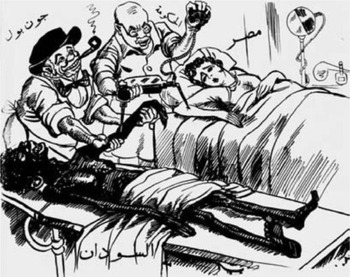
The equation of modernity with whiteness is readily apparent in a political cartoon published in al-Lata'if al-Musawwara (Illustrated Pleasantries) in July 1932. In this cartoon, Egypt is depicted as a thin, white woman giving a blood transfusion to an emaciated Black woman representing the Sudan (Fig. 2). Egypt's humanity and civilizational status is symbolized by her white skin and fully clothed body, whereas Sudan's backwardness is symbolized by her nakedness and dark black skin. With her blanket raised to her breasts, Egypt gazes with maternal concern at her dying African neighbor. Healthy and able-bodied, she shares her life-giving sustenance with the weak nation, visualizing a colonial discourse about Sudan's inability to survive without Egypt's assistance. The transfusion is mediated by England and a semi-colonial Egyptian government, both of whom look remarkably similar to the Egyptian nation. Through a stark divide in skin tone, the image attempts to dissociate Egypt from Africa by presenting Egypt as the white savior of an African colony.
Blood transfusion from Egypt to the Sudan mediated by John Bull. From al-Lata‘if al-Musawwara, 11 July 1932, 24.

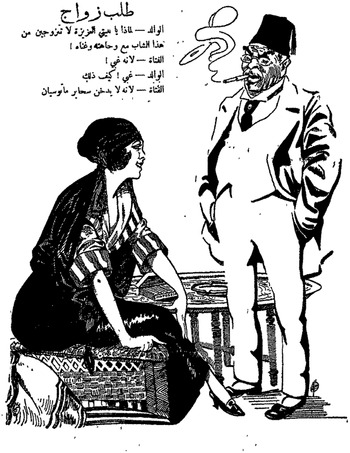
The representation of Egypt as a dainty, urban white woman in political cartoons studied by Baron is strikingly similar to the representation of Egyptian women in commercial advertisements during the same period. Egyptian ads often represented Egyptian men as large in stature and dark-skinned while representing Egyptian women as thin and fair-skinned, indicating that a woman's appearance was one of the primary signifiers of a nation's modernity. For example, in a cigarette advertisement in the popular magazine al-Kashkul (The Scrapbook) in early 1925, a fair-skinned Egyptian woman sits coyly before her dark-skinned father as he asks her why she refuses to marry a particular rich suitor (Fig. 3). She explains that it is because of his foolish failure to smoke Matossian cigarettes, indicating that what defined the modern citizen was not wealth but rather consumption patterns. However, whereas consumption was a defining feature of modernity for both men and women, the tendency to portray Egyptian women as white and Egyptian men as dark-skinned shows that whiteness as a modern beauty standard was only incumbent on women. The modernity of an Egyptian man was defined not by the color of his skin but by his intimate relationship to white bourgeois femininity.Footnote 101
Cigarette Advertisement in al-Kashkul, no. 198, 17 February 1925, 18.

The racialized depiction of Egyptian women in popular media during the interwar period closely resembles images of women in advertisements around the world at the same time. As shown in The Modern Girl around the World: Consumption, Modernity and Globalization, the Modern Girl was depicted in strikingly similar ways in advertisements globally, with fair skin, a slender physique, and short, bobbed hair.Footnote 102 The symbol of modernity was thus not only the adoption of bourgeois sensibilities, but also the physical claim to whiteness through the bodies of women. Civilizing women in the interwar period was a simultaneously nationalist and transnational project that subsumed gender into European racial hierarchies.
Whitening the nation also was predicated on racializing forms of femininity that deviated from a bourgeois cult of domesticity. Strength — particularly physical strength — became the exclusive prerogative of Egyptian men, and this masculinization of the strong body was both visually and discursively mapped onto women's bodies in the interwar period. Prior to the 1920 Alexandria murder case, the image of the strong Egyptian woman was glorified in Egyptian literature and media. In 1909, the feminist Malak Hifni Nasif argued before the nationalist Umma Party that upper-class women needed to work like their agrarian sisters to strengthen their bodies and improve their health.Footnote 103 This glorification of the strong female body was mirrored in popular photographs of the 1919 Revolution depicting women at the forefront of nationalist demonstrations.
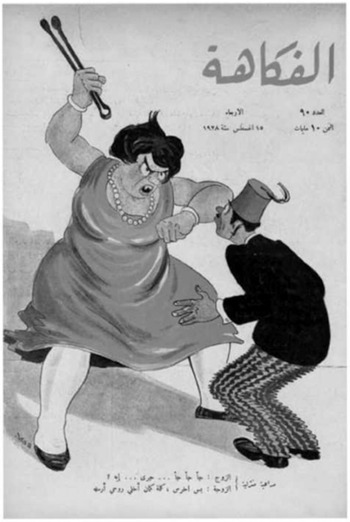
In the years following the 1920 Alexandria murder trial, female strength—both physical and emotional—was racialized in the popular press as a sign of degeneracy and a threat to the Egyptian nation. Satirical cartoons feminized and whitened the thin, frail, submissive female figure while simultaneously masculinizing and darkening the strong, angry woman. These cartoons presented masculinity and femininity in an inverse relationship, with the masculinization of one half resulting in the feminization of the other half. Strong female figures were thus depicted as dark, barbaric, emasculating forces that weakened men, which symbolizes the way in which race and gender are fused in the modern/colonial gender system (Fig. 4).
A barbaric, emasculating woman. From al-Fukaha, no. 90, 15 August 1928.

The shift in media representations of the modern woman highlights the way in which the Raya and Sakina case marked a turning point in the intersection of race, gender, and sexuality in Egyptian society. In the 1920s, the white bourgeois woman became a modern ideal, and the image of the female body was feminized, sexualized, racialized, and classed in unprecedented ways. The fair-skinned female consumer displaced the dark-skinned peasant woman as the symbol of the Egyptian nation, frailty displaced strength as feminine virtue, and urban Islam displaced rural spirituality in the claim to authenticity. Raya and Sakina were therefore casualties of a modern/colonial gender system that equated modernity with proximity to white bourgeois femininity.
Conclusion
The demonization of Raya and Sakina in the Egyptian press was a product of the spread of nationalism in Egypt, which led to the adoption of the modern/colonial gender system. For Egyptian nationalists, building a modern nation entailed rooting out forces of barbarism from society, and this barbarism was constructed at the intersection of race, class, gender, and sexuality. Raya and Sakina were presented as proof that colonialism had failed to fulfill its civilizing mission, and that the only solution was liberation from colonial rule so that Egyptian men could save the nation from degeneracy. The creation of the new Egyptian woman versus the barbaric woman was thus grounded in the same logic and patterns of domination as the colonial project.
The decision to execute Raya and Sakina as accomplices suggests that, for Egyptian women, the 1919 Revolution did not lead to liberation. Despite having struggled alongside their male counterparts, Egyptian women became subjects of a civilizing mission that equated patriarchal gender norms with civilizational advancement and a legal framework that touted equality under the law while stripping women of political rights. After the revolution, the figure of the strong and independent Egyptian woman became a force of barbarism that threatened to corrupt the entire nation, and dark-skinned migrant women like Raya and Sakina became both the symbols and casualties of this discursive shift. The struggle against colonial rule in Egypt thus led to the colonization of gender through the popularization of a colonial racial patriarchy.
Acknowledgments
I would like to thank the Middle East and Middle Eastern American Center at the CUNY Graduate Center for giving me the opportunity to present an earlier version of this article at the Centennial of the 1919 Egyptian Revolution Conference in May 2019. I would also like to thank my colleagues at Manhattan College for giving me the opportunity to present my work at the Dante Seminar in the spring of 2019. In addition, I am grateful to Beth Baron, Ella Shohat, Eve Troutt Powell, Peter Gran, Jeffrey Culang, and Santiago Slabodsky for their feedback on the ideas presented in this article, as well as to Joel Gordon and my anonymous peer reviewers for their insightful comments and helpful suggestions.