Introduction
China's stunning economic growth is now widely recognized around the globe (Wong, Reference Wong2009). Its gross domestic product (GDP) is now the second largest in the world, and, according to the World Bank (2015), in terms of GDP based on purchasing power parity (PPP), it already has the world's largest economy, surpassing that of the United States. It is commonly claimed that China will be the strongest economic power in the near future, and that it will have a concomitantly more potent political and cultural influence on the rest of the world.
It is also predicted by many linguists that Mandarin, China's standard language/dialect, will have a worldwide influence. Indeed, as predicted by both Graddol (Reference Graddol1997) and Ostler (Reference Ostler2008), Mandarin is already one of the major languages for communication and trade purposes. Additionally helpful in raising the status of Mandarin is the fact that it has the largest number of native speakers, and that so many overseas Chinese (hwagyo [華僑]) – around 50 million – live around the globe, often with significant economic power in the regions of their residence.
The influence of Mandarin is, arguably, most strongly felt in South Korea (‘Korea’, hereafter), which is located very near China and has had a long history of being under the latter's economic and cultural influence. Even though a so-called ‘English fever’ (J–K. Park, Reference Park2009) has been observed in Korea for some time, it may be that a new craze, this time involving Mandarin, has begun to take hold among Koreans.
The aims of this article are threefold, First, it will review the past and current status of English in Korea. Second, it will then go on to describe the sharply rising popularity of Mandarin in the nation. Finally, it will discuss the current state of competition between the two languages, and the prospects for both in Korea in the future.
The status of English in Korea
English has been a dominant foreign language in Korea since the nation achieved independence from Japanese rule in 1945. Because of the economic and cultural prestige of English in the world and its role as a global lingua franca, it has been regarded as ‘a language of ultimate importance’ (J. S–Y. Park, Reference Park2009) in Korean society. Coupled with Koreans’ marked enthusiasm toward education (Seth, Reference Seth2002), a so-called ‘English phenomenon’ or ‘English fever’ (Krashen, Reference Krashen2003) has been observed ever since, especially from the beginning of the 1990s, accompanying the nation's trend towards globalization in its economy and culture.
Most young Koreans strive to be proficient in English, because many business firms, which deal with overseas business and trade in English, want to recruit personnel with a high level of English proficiency. Accordingly, to raise the marketability of their graduates, colleges require students to achieve particular TOEIC (Test of English for International Communication) or TOEFL (Test of English as a Foreign Language) scores in order to qualify for graduation.
To improve their English, many students and company workers attend English language institutes (yeongeo hagweon), English camps (yeongeo kaempeu), or English villages (yeongeo maeul), all of which have expanded the private English education market. It has been reported that in 2005, the private English education expenses of Korea amounted to 1.5 billion U.S. dollars (accounting for 2% of Korea's then GDP); by comparison, those of Japan, with more than double the population, were 0.5 billion (Heo, Reference Heo2012). That year, English education accounted for one third of Korea's whole private education market, a figure that reveals the extent of the local population's enthusiasm for and obsession with learning English – a phenomenon that Shim & Park (Reference Shim and Park2008) refers to as ‘English frenzy’.
Officially Korean children start to learn English from the third grade of primary school. But many, in reality, begin to learn the language much earlier, in the kindergarten. English kindergartens (yeongeo yuchiweon), the tuition fees for which are as high as or more expensive than those for college tuition, have been in vogue in affluent districts of Korea's major cities.
A great number of students also have visited English-speaking countries like the United States, Canada, Great Britain, etc., for overseas English training (eohakyeonsu). Moreover, some primary, middle, and high school students have gone to these countries to attend regular schools for one or two years, driven by their parents’ belief that children can more easily master English language skills when exposed to an English-speaking environment at a young age. However, there are now signs that this peak of ‘English fever’ may now have passed, at least in part as a result of the recent economic and cultural resurgence of China, as will be discussed in the next section.
The gradual ascent of China – and Mandarin – worldwide
China's economic development
Economists have established that China had the world's largest economy up until the middle of the 19th century, with its GDP accounting for more than 25% of the world's GDP (Maddison, Reference Maddison1998). Yet incompetent governments, foreign and civil wars, and natural disasters caused its economy to shrink substantially thereafter, and the country was unable to retain its previously potent economic force through much of the 20th century. According to Maddison's (Reference Maddison1998) estimation, by 1978, China's GDP constituted only 5% of the global total.
The country's economy, however, has been on the rise again since 1979, when the government, headed by Deng Xiaoping, introduced economic reforms such as a partial allowance of a free market system and trade liberalization. Through implementing consecutive five-year plans, China's government has facilitated the world's highest economic growth, with the average growth rate higher than 9% from 1979 through 2015.
Today, the nation is second only to the United States in terms of the size of its GDP; it overtook Japan in 2010, and is currently approximately 60% of that of the United States. Specifically as regards its GDP based on PPP, the calculation of which takes living costs and inflation rates into consideration, China is now ranked No. 1 in the world, surpassing the United States in 2014 (World Bank, 2015). Economists have also predicted that, within 15 years, China will overtake the United States with respect to GDP as well. The country additionally already boasts top ranking worldwide in terms of the volume of foreign trade, manufactured goods, foreign direct investment, and foreign exchange reserves.
China undoubtedly faces socio-economic challenges as well. Outstanding among them are inefficiencies of the socialist-market economy, serious environmental pollution caused by the development of heavy industries, the prevalent corruption of government officials, and under-developed financial markets, any one of which could inflict serious damages to the soundness and further advancement of the Chinese economy. Nevertheless, most economic analysts and institutions (e.g., the Economist Intelligence Unit; see Holodny, Reference Holodny2015) believe that China will represent the world's largest GDP by 2030 at the latest, and that it will continue to play a dominant role in the global economy for the foreseeable future. Meanwhile, China's proportion of the world's GDP at the end of 2014 is, according to the World Bank (2015), 13.3% (GDP) – and 16.6 % of GDP when this measure is calculated based on (PPP).
Mandarin's global spread
Given the economic resurgence described above, it is only natural to find that Mandarin, the official language of China, is now realizing a higher status and prestige worldwide. Since the end of the last century, several notable commentators have predicted that this standard language is going to be one of the most important in the world. For example, the economist Nouriel Roubini at New York University advised that ‘Mandarin is going to become a key language of the future’ (Petroff, Reference Petroff2014). David Cameron, the British prime minister, has urged British students to learn Mandarin rather than the traditional French and German because the former is ‘linked to the world's largest economy’ (Watt & Adams, Reference Watt and Adams2013). Jim Rogers, an American businessman and investor, has stated: ‘Mandarin is going to be the most important language in the next generation because the 21st century is going to be China's (Youtube, 2009). Rogers even took his family from New York to Singapore to give his two young daughters a chance to be bilingual in Mandarin and English.
The popularity of Mandarin as a foreign language can be seen worldwide. In the United States, according to Sanchez (Reference Sanchez2015), the number of students learning Mandarin has quadrupled from 50,000 in 2000 to 200,000 in 2015. U.S. President Obama launched an initiative to expand the number of American learners of Mandarin to one million within five years. In Zimbabwe, Africa, the government announced a plan to make Mandarin a compulsory subject in all state-run schools (Caulderwood, Reference Caulderwood2015), while, in parts of Pakistan, Asia, the government is considering Mandarin as a compulsory subject in schools from the fifth grade (Crilly, Reference Crilly2011). Indeed, there have been reports in the media that a sharp increase in the numbers of Mandarin learners is being observed in countries across the globe, including Brunei (Thien, Reference Thien2015), Malaysia (Pak, Reference Pak2012), and South Africa (Kings, Reference Kings2014).
Inminmang (2014), the online version of China's Inmin Daily, reported that the number of Mandarin learners in foreign countries exceeded 100 million in 2013, up from 40 million in 2010 (Lei & Cheng, Reference Lei and Cheng2010). It was also reported, in the same article, that the number of official Mandarin test takers was just 128 in 1991, but reached 30,000 in 2004 – and surpassed 5 million in 2013. These numbers are, obviously, still not comparable to those of English learners and official English test takers, but the pace of increase is unquestionably remarkable.
Korea's linguistic and socioeconomic context
China's influence is naturally felt more strongly in nations that are geographically and culturally closer to it, and there have been reports of a significant increase in the numbers of Mandarin learners in Asian countries such as Korea (Chun, Reference Chun2014), Japan (Inminmang, 2012), and Thailand (Chung, Reference Chung2006), in addition to Pakistan, Brunei, and Malaysia as already mentioned. Among these, Korea has shown an especially fervent Mandarin ‘fever’, unmatched by other countries.
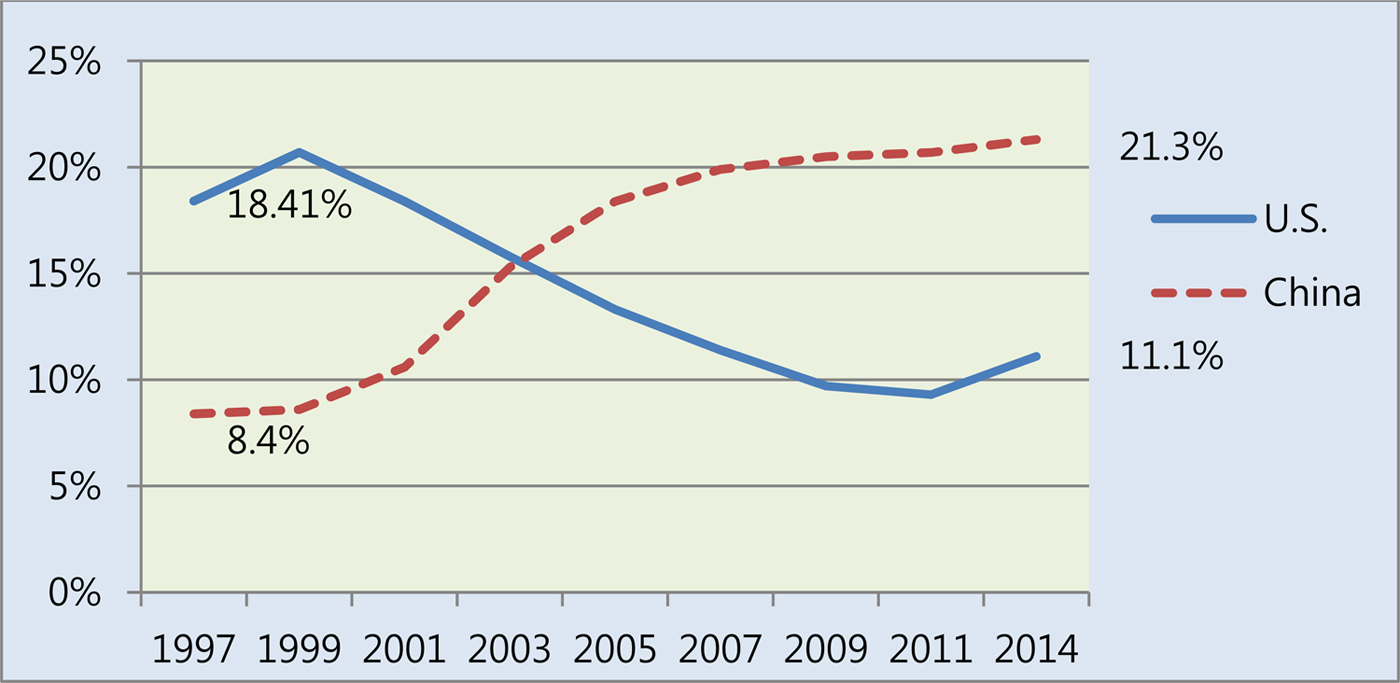
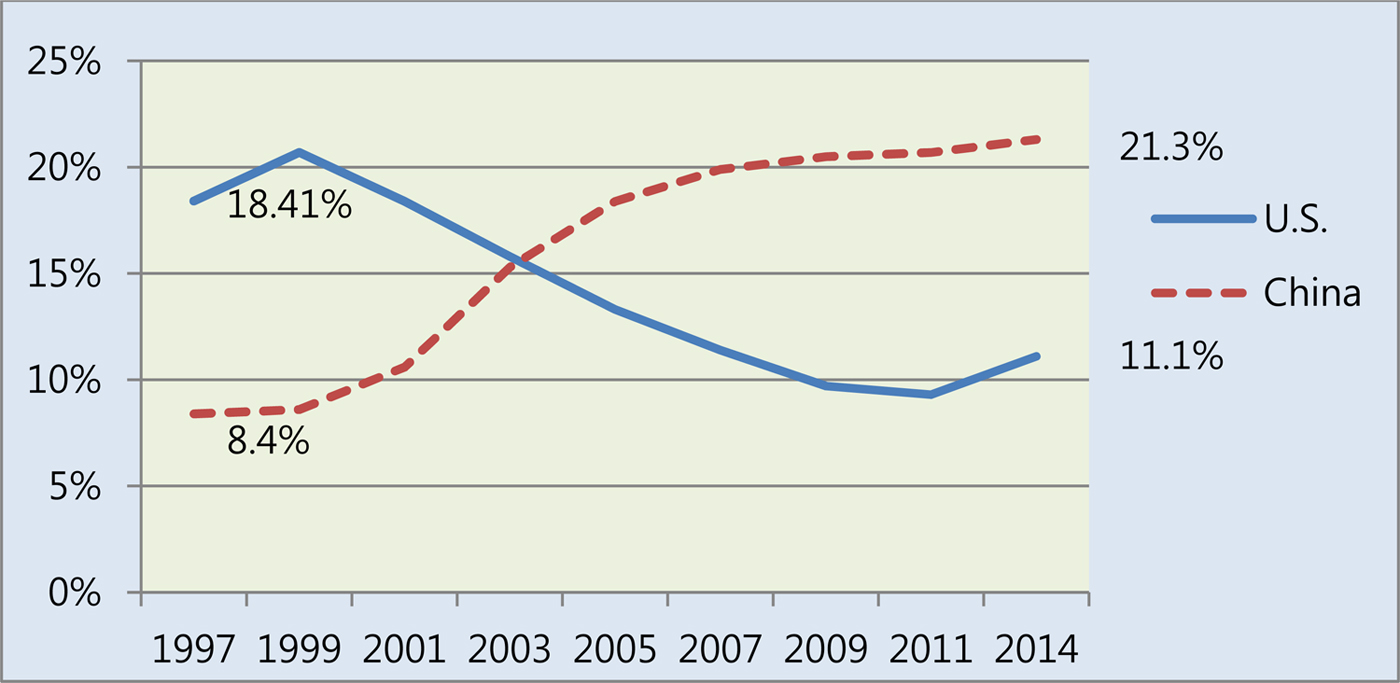
This social phenomenon is primarily due to an ever-growing demand from Korean businesses for personnel proficient in Mandarin. As shown in Figure 1, the trade volumes between Korea and China have drastically increased over the past 27 years. In 1988, Korea's volume of foreign commerce with China was only 1.7% of the total trade volume; it was up to 8.4% in 1997, and as high as 21.3% in 2014. This trend indicates a continuous expansion of business and trade relationships between Korean and Chinese companies, which, in turn, is driving a considerable demand for Mandarin-speaking employees in Korean business enterprises.
Total volume of Korea's foreign trade with the United States and China (Adapted from Korea International Trade Association, 2016)
The number of Chinese tourists visiting Korea has greatly increased as well. The percentage of Chinese citizens among the aggregate foreign tourists was 22.7% in 2011, 25.4% in 2012, 35.5% in 2013, and 43.7% in 2014 (Inchon Development Research Institute, 2016). Consequently, Koreans employed in tourism-related businesses such as hotels, stores and markets, museums and resorts are motivated to learn Mandarin by these rapidly developing commercial opportunities.
Just as happened with the earlier ‘English fever’ in Korea, the more recent upsurge of interest in Mandarin has merged with Koreans’ broader enthusiasm for education to create a new language craze. Moreover, Korean people already possess some understanding of written Chinese, as approximately 65% of the Korean vocabulary is from Chinese and can be written using Chinese characters – a factor that may add further impetus to Koreans’ desire to learn Mandarin.
Mandarin's mounting challenge to English
While the popularity and prestige of Mandarin cannot currently be said to be as high as they are for English in Korea, there are nevertheless signs that Mandarin may come to challenge English in the years ahead. To assess this possibility, I will first describe the recent surge of Mandarin in the nation, then identify phenomena that had previously applied only to English but now can be observed with respect to Mandarin, and, lastly, discuss the relative weakening of Koreans’ eagerness for English and the concurrent strengthening of ‘Mandarin mania’ in Korea.
In 2004, China established the first Confucius Institute in the world in Seoul, Korea; with the ever-increasing popularity of Mandarin learning, the number of the Confucius Institutes in Korea has since reached 24. The rising status of Mandarin is also shown by the increase in the percentage of Korean high schools offering Mandarin classes: 8.8% in 2000, 25.5% in 2005, 36.8% in 2012 (Choi, Reference Choi2015). Moreover, the rate continues to rise steeply. Taking Daegu, Korea's third largest city, as an example, 88.0% (81 out of 92) of the high schools in this district will be offering Chinese by 2017 (K–S. Kim, Reference Kim2015).
Koreans also account for more than half of the overseas takers of the HSK test (S–B. Park, Reference Park2012), the official Mandarin exam for non-native speakers. Moreover, for the past 11 years, Korea has been the country that has sent the world's greatest number of students to China for study, more than half (56.7% in 2010; Choi, Reference Choi2010) of which are there for the purpose of language training (eohakyeonsu).
This enthusiasm for learning Mandarin is bringing about social phenomena in Korea that had previously only been in evidence in relation to English. For example, before children began to receive formal English lessons at public elementary schools in the 1990s, private primary schools would offer English tuition to their pupils in order to give them earlier opportunities to acquire the language. The same phenomenon is now happening with respect to Mandarin, with more than 65% of private elementary schools reportedly offering regular or after-school Mandarin classes (Chosun Ilbo, 2015).
Korean parents are also increasingly exposing their children to Mandarin early in their lives. Mandarin kindergartens are now beginning to be established and a number of English kindergartens are being converted to English/Mandarin kindergartens (see Figure 2 from Y–A. Park, Reference Park2015). Some parents will purposely seek out Mandarin-speaking baby-sitters or nannies (Chosun Ilbo, 2007) or have their children attend ‘overseas Chinese’ (hwagyo) kindergartens or elementary schools, often illegally (Kwak, Reference Kwak2014). Some Koreans are even sending their young children to China to learn Mandarin. In 2012, the number of primary or secondary school students who went to study abroad was 14,040 (National Statistics System, 2016), of which 2,958 went to China, representing 21.1% of the total, and second only to the number bound for the United States (8,857). Moreover, the number of such students is increasing each year (YTN news, 2012), while that of students leaving for the United States has been decreasing sharply (S–H. Kim, Reference Kim2015).
English/Mandarin kindergartens (banban yuchiweon) (Illustrator: C–D. Chung; from Y–A. Park, Reference Park2015)

Other social phenomena that once took place in connection with English but increasingly are seen concerning Mandarin can be observed in the nation's business enterprises and colleges. Job applicants proficient in Mandarin are now awarded bonus points at well-known Korean companies such as Samsung Electronics, LG Display, and S.K. Holdings Co. Those already employed at such companies are given additional points when evaluated for promotion (Paek, Reference Paek2015). Colleges, accordingly, are moving towards making Mandarin classes and credits compulsory and part of their graduation requirements. Hanyang University and Dankook University, for instance, now require all incoming students to earn Mandarin credits in order to qualify for graduation certification (Paek, Reference Paek2015).
Alongside this gradual rise in Mandarin's popularity and prestige, a relative downturn with respect to English is also detectable in Korea, with locals apt to observe, ‘English is a basic and Mandarin is a necessity’ (‘yeongeoneun gibonigo junggugeoneun pilsuda). This observation seems to corroborate the claim that the relative importance and weight of English, which previously had occupied the premier position, is today slipping down the ranks of Korea's foreign language education scales.
This downward trend is also revealed in the diminishing number of students and native English teachers at English institutes and kindergartens around the nation (although it should be stated that another reason for this particular phenomenon is the decrease of the student population overall, due to low birth rates). Some of the ‘English villages’ (yeongeo maul) that had been built to provide students with a convenient and less expensive way of language training in an English-speaking-country-like environment have since been closed, partly because of the excessive number of such villages but also owing to a decline in the number of participants now wishing to visit them (Yim, Reference Yim2015). A sharp reduction in the number of early study-abroad students bound for English-speaking countries is another sign of this downward drift (S–H. Kim, Reference Kim2015).
In some respects, Standard Chinese is already overtaking English. For example, departments of Mandarin or Mandarin education are being created at colleges (H–W. Kim, Reference Kim2015), while English departments are not. The trend regarding admission cut-off points for English and Mandarin departments at major universities has been reversed: The Mandarin departments of Yonsei University and Korea University, for instance, now have higher cut-off points than those used for the English departments in recent years (Chung, Reference Chung2016).
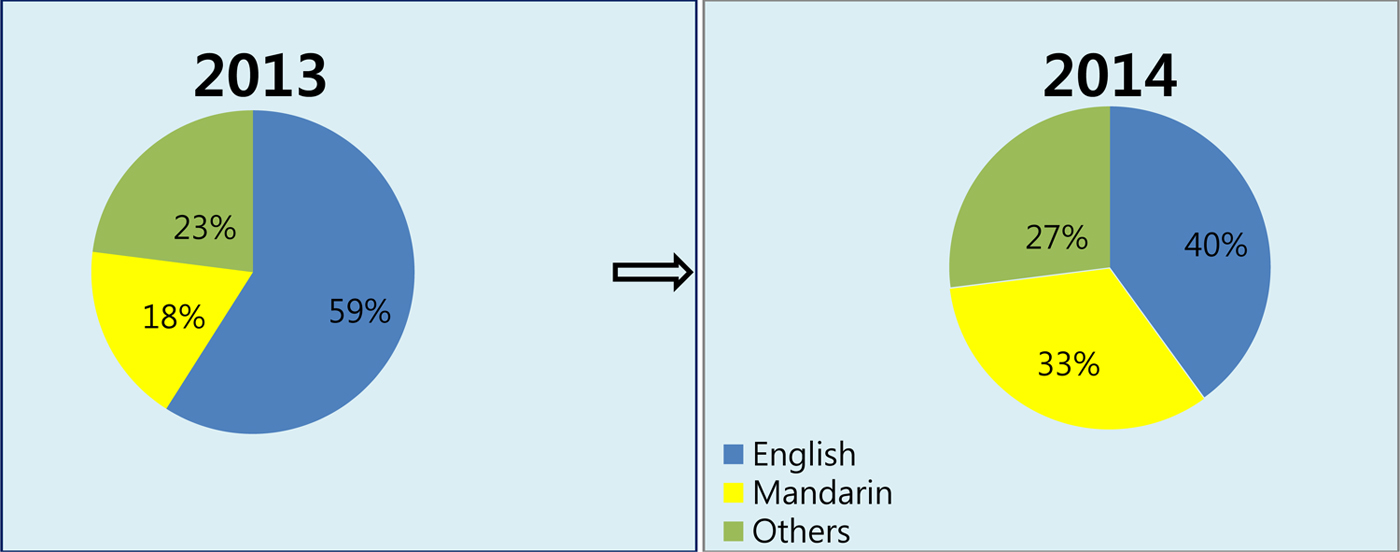
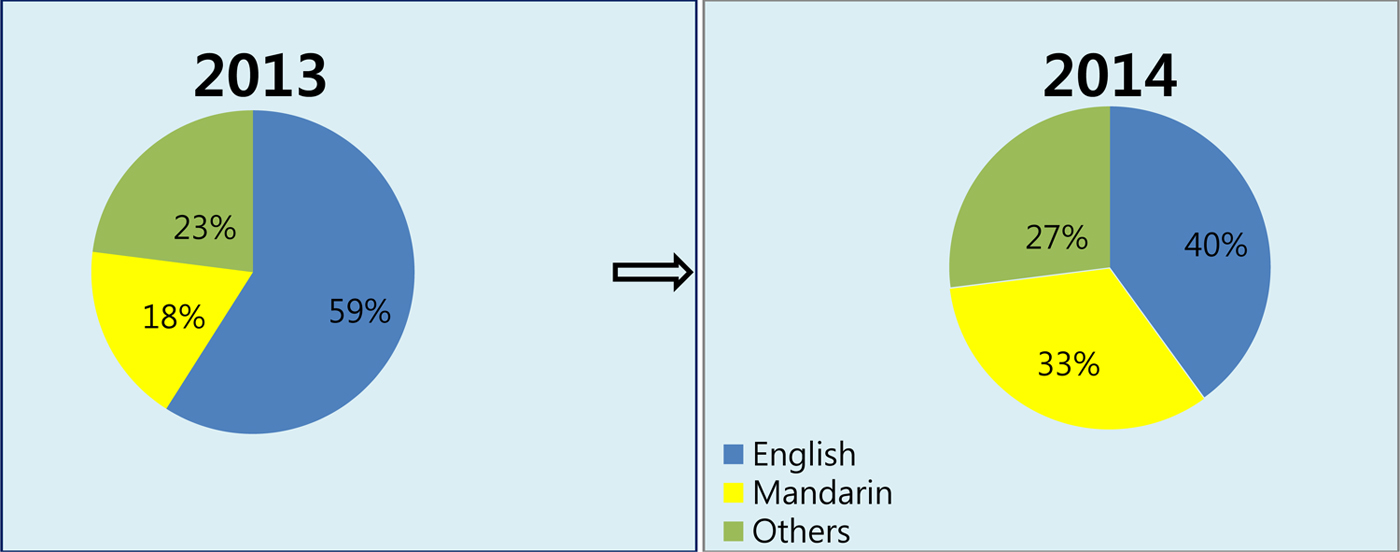
A notable change is also taking place in the market for foreign language learning materials (see Figure 3). English has dominated this market since the mid 1940s (i.e., for more than 65 years), but the size of the market for Mandarin learning materials has grown more than 20% annually over the past 10 years. According to doseo sibilbeonga ‘11th Ave Bookstore’, one of Korea's major online bookstores, the market share of Mandarin reached 33% in 2014 as compared to the 40% share of English (J–H. Park, Reference Park2014). This growth is particularly significant when the previous year's proportional market shares – 18% and 59%, respectively – are taken into consideration. Furthermore, in Jeju Island, which is popular with Chinese tourists, Mandarin already has the dominant share, i.e., more than 50% of the market (Jin, Reference Jin2014).
Shares of English and Mandarin in the Korean market for foreign language learning materials in 2013 and 2014 (Adapted from J–H. Park, Reference Park2014)
Future prospects
China's economy is expected to grow further and become the world's largest by 2030, even according to nominal GDP measures. Correspondingly, Mandarin, as China's standard language, is certain to attract additional prestige and appeal, beyond even the status and popularity it exhibits today. This enhanced standing will be especially evident and strongly felt on the Korean peninsula because of its geographic proximity to and close economic ties with China. It is predicted that the perceptual gap in status between English and Mandarin in Korea will become smaller as time goes by.
A question, though, remains regarding whether Mandarin might surpass English in both popular appeal and practical application. The answer to this is related to the further question of whether Mandarin could replace English as the global lingua franca, as it is unlikely that Mandarin would overtake English in Korea while there remains a significant difference in status between the two on the world stage.
The American businessman Jim Rogers has advanced the possibility of Mandarin becoming the predominant language internationally, but most researchers (e.g., Graddol, Reference Graddol2010) and reporters (e.g., Pak, Reference Pak2012; Moore, Reference Moore2011), including the present paper's author, do not agree with his projection. English was established as the global language through a variety of historical, economical, and cultural factors that alternately cooperated and individually contributed during the process. Thus, as chronicled by Svartvik & Leech (Reference Svartvik and Leech2006), each of the following factors played a crucial role: Britain becoming the world's leading economic and military power; the historical background of imperialism; America's immediate succession to Britain as the supreme global power; the advancement of transportation and telecommunication; the globalization trends of the current age. All these factors combined made it possible for English to become the global language. It is difficult to conceive that China's GDP size and economic power alone can make Mandarin the future international lingua franca. What is more, it is unlikely that Mandarin will become the foremost foreign language of the nation, chiefly because almost 80% of foreign trade (see Figure 1) and more than 50% of foreign tourism business continues to be transacted in English.
In summary, then, it seems clear that the status of Mandarin will continue to rise, and that the language will become an effective rival to English in Korea, but such growth will not be unlimited, and English will continue to play a major role in Korea for the foreseeable future.
 HYEON-SEOK KANG is a professor in the English department at Dankook University in South Korea. He received a Ph.D. in linguistics from the Ohio State University. His research interests include sociolinguistic variations in Korean English and Korean dialects and the language policy of Korea. He served as the president of the Sociolinguistic Society of Korea in 2013 and 2014, and was the main editor of the Sociolinguistics Dictionary published in Korean by the Society. He is currently serving as the dean of the Foreign Languages College at Dankook University. Email: hyeonseok0516@gmail.com