Introduction
Healthy elders with an Apolipoprotein (APOE) ε4 allele are at increased risk for conversion to mild cognitive impairment (MCI) and dementia compared to non-carriers (Corder et al., Reference Corder, Saunders, Strittmatter, Schmechel, Gaskell, Small and Pericak-Vance1993). During the preclinical stage, some studies have demonstrated subtle cognitive and structural brain differences between ε4 carriers and non-carriers, but others have not reported such differences (O’Donoghue, Murphy, Zamboni, Nobre, & Mackay, Reference O’Donoghue, Murphy, Zamboni, Nobre and Mackay2018; Fouquet, Besson, Gonneaud, La Joie, & Chételat, Reference Fouquet, Besson, Gonneaud, La Joie and Chételat2014). O’Donoghue and colleagues (Reference O’Donoghue, Murphy, Zamboni, Nobre and Mackay2018) attribute the mixed findings to several factors, such as age of the samples when examined, sensitivity of the cognitive measures employed, and limited longitudinal follow-up.
Another key factor is the individual variability associated with the penetrance of the ε4 allele. Most studies treat ε4 carriers as a homogenous group, yet epidemiological studies indicate that the lifetime cumulative incidence of MCI and dementia is approximately 21–26% for heterozygotes (ε2/ε4, ε3/ε4) and 37–47% for homozygotes (ε4/ε4), whereas the non-carrier incidence rate is 12–16% (Qian et al., Reference Qian, Wolters, Beiser, Haan, Ikram, Karlawish and Blacker2017). Factors that may influence the ε4 conversion rate include medical comorbidities and lifestyle habits (Baumgart et al., Reference Baumgart, Snyder, Carrillo, Fazio, Kim and Johns2015).
We previously reported the results of a longitudinal study of ε4 carriers and non-carriers (Rao et al., Reference Rao, Bonner-Jackson, Nielson, Seidenberg, Smith, Woodard and Durgerian2015). All participants were healthy and cognitively intact at study entry. Over the course of a 5-year follow-up interval, 11 of 29 ε4 carriers (37.9%) converted to MCI; by comparison, only 1 of 18 non-carriers (5.6%) converted. The purpose of this exploratory study was to determine if there are early and subtle preclinical signs of cognitive dysfunction and medial temporal lobe atrophy in the 11 ε4 carriers who subsequently developed MCI compared to the 18 carriers who did not convert.
Materials and Methods
Participants
Participants included 29 ε4 carriers and 17 non-carriers (excluded one non-carrier who subsequently converted to MCI). The non-carrier group (N = 17) served as a reference for the cognitive and MRI outcome variables. Community-dwelling, cognitively intact, healthy older adults, ages 65–85 years, were recruited from newspaper advertisements and screened via telephone to determine eligibility; details of the inclusion/exclusion criteria are provided in our earlier publications (Rao et al., Reference Rao, Bonner-Jackson, Nielson, Seidenberg, Smith, Woodard and Durgerian2015; Seidenberg et al., Reference Seidenberg, Guidotti, Nielson, Woodard, Durgerian, Antuono and Rao2009). Briefly, potential participants were excluded if they self-reported a diagnosis of MCI/AD, other neurological disease (e.g., multiple sclerosis), head trauma (e.g., loss of consciousness >30 min), chronic medical diseases (e.g., type 1 diabetes, congestive heart failure), a history or evidence of substance abuse, major psychiatric disturbance (e.g., schizophrenia, bipolar disorder, major depression, or generalized anxiety disorder) based on DSM-IV Axis-I criteria, self-reported current depression symptoms [Geriatric Depression Scale (Yesavage et al., Reference Yesavage, Brink, Rose, Lum, Huang, Adey and Leirer1982) score > 11], impaired activities of daily living [Lawton Instrumental Activities of Daily Living (IADL; Lawton & Brody, Reference Lawton and Brody1969) score < 5 (5 indicates intact IADL)], and contraindications to MRI scanning (e.g., physical size limitations, ferrous objects within the body, and claustrophobia).
APOE genotyping was based on a polymerase chain reaction method. DNA was isolated with Gentra Systems Autopure LS for Large Sample Nucleic Acid Purification. All 29 carriers had the ε3/ε4 genotype and all 17 non-carriers had the ε3/ε3 genotype.
Neuropsychological testing and MRI scanning were conducted on the same day at study entry, at 18 months, and 5 years after entry. Participants were asked to refrain from alcohol use for 24 h and caffeine use for 12 h prior to testing. The neuropsychological test battery consisted of the Mini-Mental State Examination (MMSE; Folstein, Folstein, & McHugh, Reference Folstein, Folstein and McHugh1975), Mattis Dementia Rating Scale 2 (DRS-2; Jurica, Leitten, & Mattis, Reference Jurica, Leitten and Mattis2001), and Rey Auditory Verbal Learning Test (RAVLT; Rey, Reference Rey1958). To minimize practice effects, alternate, equivalent test forms were used at each session (Schmidt, Reference Schmidt1996, Reference Schmidt2004).
Written informed consent was obtained from all participants and they were financially compensated for participation. All procedures were approved by the Institutional Review Board of the Medical College of Wisconsin.
Definition of MCI Conversion
Participants were evaluated for the presence of MCI or dementia at the 5-year follow-up session. The diagnosis was based on a multidisciplinary consensus that involved review of medical and social history, cognitive test results, and activities of daily living (Rao et al., Reference Rao, Bonner-Jackson, Nielson, Seidenberg, Smith, Woodard and Durgerian2015). A participant was classified as MCI if one or more subscales on the RAVLT Trials 1–5, and RAVLT Delayed Recall, and DRS-2 Total score were at least 1.5 SD below sex-corrected means based on local norms calculated using an independent sample of 91 healthy controls from Milwaukee. The sex correction was utilized because there was a significant difference in RAVLT performance between men and women. There were no age decade group differences, and education was not significantly correlated with RAVLT indices. Therefore, age decade and education were not used in establishing cutoff scores. The performance advantage of females compared to males on verbal memory tests is well-established (Sundermann et al., Reference Sundermann, Maki, Biegon, Lipton, Mielke, Machulda and Bondi2019). Additional classification of MCI included preserved IADL function Lawton and Brody (Reference Lawton and Brody1969) summary score equal to 5; to meet criteria for dementia, a participant would meet criteria for MCI and have a score <5 on this index.
None of the 29 ε4 carriers met criteria for MCI/dementia at the 18-month follow-up. At the 5-year follow-up, 11 ε4 carriers (37.9%) were diagnosed with MCI and none with dementia. Thus, the 29 ε4 carriers were divided into two groups: 11 MCI converters and 18 non-converters. No group differences were observed in the time interval between study entry and the 5-year follow-up testing (MCI converters = 4.8 years, SD = .4; non-converters = 4.8 years, SD = .5; p = .75, d = .001, 95% CI: −.74 to .76).
MRI Acquisition and Processing
High-resolution, three-dimensional spoiled gradient-recalled at steady-state (SPGR) anatomic images were acquired on a General Electric (Waukesha, WI) Signa Excite 3.0 Tesla short bore scanner equipped with a quad split quadrature transmit/receive head coil (TE = 3.9 ms; TR = 9.5 ms; inversion recovery (IR) preparation time = 450 ms; flip angle = 12°; number of excitations (NEX) = 1; slice thickness = 1.0 mm; FOV = 24 cm; resolution = 256 × 224). Whole brain and regional volumes were derived from T1-weighted SPGR images using Freesurfer v.6.0 software hippocampal subfields algorithm (Iglesias et al., Reference Iglesias, Augustinack, Nguyen, Player, Player, Wright, Roy, Frosch, McKee, Wald, Fischl and Von Leemput2015). Intracranial volume (ICV) was corrected using the Freesurfer estimate of TIV (%TIV). Hippocampal measures as defined by Freesurfer 6.0 subfield segmentation were selected a priori to assess differences in volumes between ε4 + MCI converters and ε4+ non-converters (bilateral whole hippocampus and subiculum).
Statistical Analysis
Using the 17 ε4 non-carriers as a reference group, z-scores based on means and standard deviations were computed for all variables. A one-way ANOVA was utilized to examine demographic characteristics between the three groups.
The focus of this study was to examine differences between the ε4 + MCI converters and ε4+ non-converters on cognitive and MRI variables obtained at study entry. To correct for unequal variances between groups, t-test results using the Welch–Satterthwaite approximation were used for group comparisons. Effect size (Cohen’s d) and 95% confidence intervals were calculated for each variable. MRI structural volumes were corrected for ICV. Post-hoc logistic regression analyses examined the ability of neuropsychological testing and medial temporal lobe brain volumes to predict MCI conversion.
Results
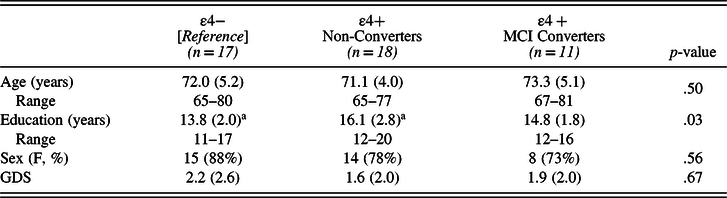
Table 1 summarizes demographic characteristics of the MCI converters, ε4 non-converters, and non-carriers. No significant (p < .05) group differences were observed with regard to age and sex. A significant difference (p = .03) was observed between the three groups on education, but there was no significant group difference between the ε4 converters and ε4 non-converters. The non-carrier group had significantly fewer years of education compared to the ε4 non-converters (p = .01, d = −.91, 95% CI: −1.64–−.24), but there was no significant difference between non-carriers and the ε4 converters. The two ε4 groups did not differ in self-reported family history of dementia [MCI converters: 6 (55%); non-converters: 13 (72%); p = .33]. The non-carrier group was defined by the absence of any self-reported family history. The three groups did not differ in depression scores (converters = 1.9, SD = 2.0; non-converters = 1.6, SD = 2.0; non-carriers = 2.2, SD = 2.6; p = .67; η 2 = .02).
Means (SD) of demographic characteristics

Note. GDS = Geriatric Depression Scale.
a Denotes significant group difference.
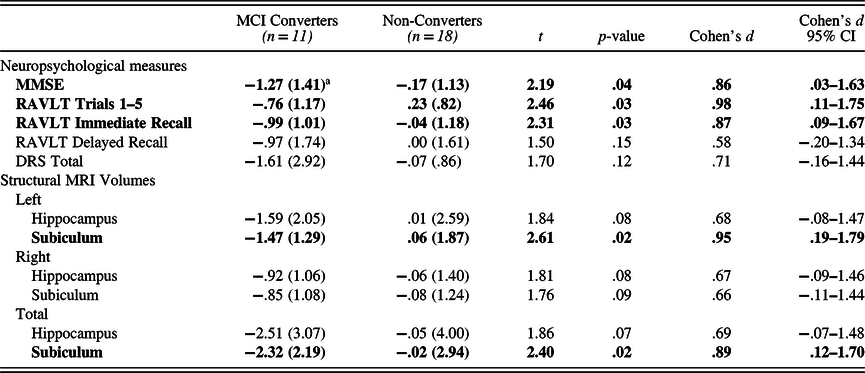
Table 2 summarizes results of comparisons of cognitive measures and medial temporal lobe volumes obtained at study entry between converters and non-converters. Converters showed poorer performance on the MMSE, RAVLT Trials 1–5, and RAVLT Immediate Recall compared to non-converters at study entry, even though all participants performed within normal limits (i.e., above 1.5 SDs below the sex-corrected means on the RAVLT and DRS-2 Total Score greater than 121). There were no group differences at study entry on any DRS-2 Total or subscales. Converters showed significantly smaller volumes in the left subiculum and total subiculum volume compared to the non-converters. Although there were no group differences observed in total hippocampal volume, the scores trended in the same direction.
Comparison of ε4 + converters and ε4 + non-converters at study entry

Notes. CI = confidence interval; MMSE = Mini-Mental State Examination; DRS = Dementia Rating Scale; RAVLT = Rey Auditory Verbal Learning Test.
a z-scores derived from means and standard deviations from the ε4- group. Bold text indicates confidence intervals that do not overlap with zero. Hippocampal volume is derived through Freesurfer 6.0 and includes CA1–CA4, dentate gyrus, and hippocampal tail; volumes are ICV corrected.
Logistic regression was used to examine the effect of left subiculum volume and RAVLT Trials 1–5 on the likelihood of conversion to MCI after 5 years. Left subiculum volume was a statistically significant predictor of MCI conversion (odds ratio = .49; 95% CI: .25–.97; SE = .35; p = .04; AUC = .75), suggesting that as left subiculum volume decreases, the odds of MCI conversion increases. RAVLT Trials 1–5 was also a statistically significant predictor of MCI conversion (odds ratio = .36; 95% CI: .15–.87; SE = .46; p = .02; AUC = .74), suggesting that as RAVLT Trials 1–5 score decreases, the odds of MCI conversion increases.
Discussion
This study demonstrated that APOE ε4 carriers who subsequently convert to MCI exhibit subtle cognitive deficits and medial temporal lobe atrophy up to 5 years prior to diagnosis. Despite scoring within the normal range on all neuropsychological tests at study entry, converters exhibited lower baseline cognitive test scores on the MMSE, RAVLT Trials 1–5, and RAVLT Immediate Recall relative to non-converters. In addition, converters had smaller baseline brain volumes in the hippocampal subfield of the subiculum compared to non-converters. Left subiculum volume and RAVLT Trials 1–5 were statistically significant predictors of MCI conversion. These findings suggest that cognitive and structural brain imaging have the potential to identify ε4 carriers who are in the preclinical stage of AD. It is important to emphasize that none of the ε4 carriers met criteria for MCI at study entry.
Two previous longitudinal studies (Haller et al., Reference Haller, Montandon, Rodriguez, Ackermann, Herrmann and Giannakopoulos2017; Stonnington et al., Reference Stonnington, Chen, Savage, Lee, Bauer, Sharieff, Thiyyagura, Alexander, Caselli, Locke, Reiman and Chen2018) have examined possible baseline differences in cognitive performance between ε4 carriers who subsequently experience a deterioration in cognition and those that do not. Like our study, Stonnington et al. (Reference Stonnington, Chen, Savage, Lee, Bauer, Sharieff, Thiyyagura, Alexander, Caselli, Locke, Reiman and Chen2018) found poorer baseline performance on episodic memory measures in their MCI converters relative to non-converters. This study is remarkable because nearly half of their sample converted from cognitively normal to MCI/dementia after a relatively brief 2-year follow-up interval. However, most of their carriers were homozygotes (ε4/ε4). In contrast, none of our carriers, who were exclusively heterozygotes (ε3/ε4), converted to MCI at 18 months, emphasizing the need for a lengthier follow-up interval in carriers with a single ε4 allele. In contrast, no baseline differences in cognitive performance were observed by Haller et al. (Reference Haller, Montandon, Rodriguez, Ackermann, Herrmann and Giannakopoulos2017). Unlike our study and that of Stonnington et al. (Reference Stonnington, Chen, Savage, Lee, Bauer, Sharieff, Thiyyagura, Alexander, Caselli, Locke, Reiman and Chen2018), the criterion for change in Haller et al. (Reference Haller, Montandon, Rodriguez, Ackermann, Herrmann and Giannakopoulos2017) was not MCI conversion but cognitive decline on neuropsychological test performance. Like our study, the majority of their carriers were heterozygotes.
Recent studies have also found subtle baseline structural brain differences in cognitively intact ε4 carriers who later experienced cognitive decline. Lower gray matter density in the posterior cingulate and parietal lobe was observed in ε4 carriers who declined cognitively over an 18-month follow-up interval (Haller et al., Reference Haller, Montandon, Rodriguez, Ackermann, Herrmann and Giannakopoulos2017). Hippocampal gray matter volume was shown to be the best predictor of MCI progression over a 2-year follow-up (Stonnington et al., Reference Stonnington, Chen, Savage, Lee, Bauer, Sharieff, Thiyyagura, Alexander, Caselli, Locke, Reiman and Chen2018). We extended these findings by focusing our analyses on hippocampus and subiculum, finding that smaller baseline volume is present in the subiculum in ε4+ converters compared to ε4+ non-converters at study entry. Our findings are consistent with literature suggesting that atrophy of the subiculum may be one of the earliest neuroanatomical markers of AD (Carlesimo et al., Reference Carlesimo, Piras, Orfei, Iorio, Caltagirone and Spalletta2015). In a general population of older participants, the volume of the subiculum has been useful in the prediction of MCI conversion (Hanseeuw et al., Reference Hanseeuw, Van Leemput, Kavec, Grandin, Seron and Ivanoiu2011). Another study found that smaller subiculum volumes were associated with increased risk of developing dementia over a 5-year follow-up interval in older adults who were cognitively intact at study entry (Evans et al., Reference Evans, Adams, Licher, Wolters, van der Lugt, Ikram and Ikram2018). The current study suggests that the volume of the subiculum may identify those ε4 carriers who are at greatest risk for developing MCI within 5 years.
This exploratory study has several limitations. Although the statistical analyses were uncorrected for multiple comparisons, the significant group differences had medium to strong effect sizes despite a relatively small sample size. We also did not correct for age and education because the two groups of interest were not significantly different, and these variables were not significantly related with the outcome variables. The small battery of neuropsychological tests used for diagnosis of MCI makes it difficult to identify a clear distinction between single-domain and multiple-domain amnestic MCI, so it is possible that our sample may represent a combination of the two. We did not measure AD-specific biomarkers (e.g., amyloid or tau pathology) with CSF or PET. Only heterozygotes (ε3/ε4) were included in the current study, so we were unable to determine the impact of allele dose. The ε4 non-carrier group had significantly fewer years of education compared to the ε4+ non-converter group. However, when analyzed further, there were no significant Kendall’s tau correlations between education and any neuropsychological measures (r’s = −.10 to .25) or structural MRI volumes (r’s = .06–.15). Importantly, there were no educational differences between the converter and non-converter groups, the key comparison for this study. For this reason, education was not included as a variable in the logistic regression analyses.
Accurate detection of elders in the preclinical stage has strong therapeutic implications for altering the AD disease course. Given evidence that neuropathological changes associated with late onset AD develop at least a decade prior to a diagnosis of MCI/AD (Price & Morris, Reference Price and Morris1999; Jack et al., Reference Jack, Knopman, Jagust, Shaw, Aisen, Weiner, Petersen and Trojanowski2010), interventions administered during the preclinical stage may have greater success in delaying or preventing the onset of MCI/AD. In addition, this information may be useful in selecting high-risk individuals for clinical trials. Results from this exploratory study suggest that APOE genotyping, coupled with cognitive testing and medial temporal lobe volumes, may constitute a relatively low-cost method for detecting elders in the preclinical stage. Future research conducted with larger samples, combined with specific biomarkers for AD pathology, and examination of cognitive domains in addition to episodic memory are needed to examine the utility of subtle cognitive and structural brain differences in predicting which ε4 carriers develop MCI.
ACKNOWLEDGEMENTS
This work was supported by the National Institutes of Health Grants R01AG022304 and M01RR00058. The content is solely the responsibility of the authors and does not necessarily represent the official views of the National Institute on Aging or the National Institutes of Health.
CONFLICT OF INTEREST
The authors have no conflict of interest to report.