


Over the past few years, the field of psychiatric rehabilitation has begun to embrace recovery as a guiding principle for evidence-based mental health research and practice (Corrigan et al., Reference Corrigan, Angell, Davidson, Marcus, Salzer, Kottsieper and Stanhope2012; Gagne et al., Reference Gagne, White and Anthony2007). According to the United States Department of Health and Human Services – Substance Abuse and Mental Health Services Administration (SAMHSA, 2012, p. 3), recovery is ‘a process of change through which individuals improve their health and wellness, live a self-directed life and strive to reach their full potential’. Recovery-oriented services look beyond symptom reduction, focusing on promoting psychological well-being and overall quality of life through hope, empowerment, informed choice and respect (Drapalski et al., Reference Drapalski, Medoff, Unick, Velligan, Dixon and Bellack2012). Individuals with severe mental illness (SMI) who are in recovery often desire increased independence and greater participation in personally meaningful life activities and roles (Gagne et al., Reference Gagne, White and Anthony2007). Therefore, people receiving psychiatric rehabilitation services are encouraged and expected to be active participants in the recovery process, and a strong emphasis is placed on respecting personal choices.
As noted by Corrigan and colleagues (Reference Corrigan, Angell, Davidson, Marcus, Salzer, Kottsieper and Stanhope2012), there are both philosophical and practical reasons for valuing the personal choices of people in recovery. Certainly, a fundamental aspect of self-determination is the right to govern one's own decisions related to work, housing, health and mental health care, social relationship and quality of life. Contemporary psychiatric rehabilitation services honour this autonomy to the greatest extent possible. Beyond ethical considerations, promoting self-determination in psychiatric services has been found to associate with better health and rehabilitation outcomes. Despite the well-documented effectiveness of various evidence-based mental health practices in psychiatric rehabilitation, many people with SMI do not seek out or fully engage in these services (Corrigan et al., Reference Corrigan, Angell, Davidson, Marcus, Salzer, Kottsieper and Stanhope2012; Kreyenbuhl et al., Reference Kreyenbuhl, Nossel and Dixon2009). By emphasizing self-determination within the context of recovery-based practice, people with SMI may increase their engagement in evidence-based psychiatric rehabilitation services, and as a result experience greater benefits. As a result, self-determination theory (SDT) has increasingly been used as a theoretical framework for evaluating key elements of the recovery paradigm in rehabilitation and mental health services research and policy-making for people living with severe mental illnesses (Mancini, Reference Mancini2008; Moran et al., Reference Moran, Russinova, Yim and Sprague2014).
Self-Determination Theory
Self-determination theory provides a framework for understanding human motivation and behavioural self-regulation, along with how these processes influence outcomes such as functioning and psychological well-being (Ryan & Deci, Reference Ryan and Deci2000). The theory recognises the complex nature of motivation and seeks to elucidate the key person–environment factors that influence motivational processes. For instance, people may be motivated to act due to an intrinsic value associated with an activity, or they may be motivated by external factors such as tangible incentives. The various types of motivations are not regarded as equal in SDT. Compared with those who are motivated by external controls, people who are motivated by internal interests and values tend to experience more creativity, enhanced self-esteem, greater goal persistence and better overall well-being (Deci & Ryan, Reference Deci and Ryan2000, Reference Deci and Ryan2008; Ryan & Deci, Reference Ryan and Deci2000).
In order for a person to experience more internally derived motivation for a behaviour or a set of behaviours, SDT suggests that the following three psychological needs must be met: (a) autonomy, (b) relatedness and (c) competence (Deci & Ryan, Reference Deci and Ryan2000, Reference Deci and Ryan2008; Ryan & Deci, Reference Ryan and Deci2000). Autonomy refers to acting volitionally with a sense of choice. According to Ryan et al. (Reference Ryan, Patrick, Deci and Williams2008), change can be a function of controlled motivation (external regulation and introjection) or autonomous motivation (identified regulation and intrinsic regulation). Controlled motivation comprises external regulation and introjection. External regulation is evidenced when people engage in a behaviour to get an external reward, avoid a punishment or to comply with social pressures; whereas introjection is observed when people act to receive approval or praise, or to avoid disapproval or feelings of guilt. Conversely, identified regulation is evidenced when people personally endorse or identify with the value or importance of a behaviour, and integrated regulation is when people not only value a behaviour but have also associated it with their central values and lifestyle patterns (Ryan et al., Reference Ryan, Patrick, Deci and Williams2008). Relatedness involves feeling connected with others and both giving and receiving love and care. Competence refers to the perception of one's self as a causal agent capable of effecting change. According to SDT, satisfaction of these needs not only facilitates intrinsic motivation but also promotes internalization of external regulations such as cultural norms and laws (Deci & Ryan, Reference Deci and Ryan2000). This process leads to increased social integration and psychological growth, which can enhance general well-being.
The SDT research has frequently investigated the effects of need satisfaction, on both intrinsic motivation and various outcomes related to performance and well-being (Deci & Ryan, Reference Deci and Ryan2008). In employment settings, self-determination is associated with increased engagement in work, better performance ratings, higher levels of job satisfaction and greater well-being (Baard et al., Reference Baard, Deci and Ryan2004; Fitzgerald et al., in press; Lynch et al., Reference Lynch, Plant and Ryan2005). In healthcare and rehabilitation settings, self-determined motivation has been linked to positive behavioural health outcomes, such as smoking cessation (Williams et al., Reference Williams, McGregor, Sharp, Levesque, Kouides, Ryan and Deci2006), increased physical activity (Fortier et al., Reference Fortier, Sweet, O’Sullivan and Williams2007), improved diabetes self-management (Williams et al., Reference Williams, McGregor, Zeldman, Freedman and Deci2004) and improved vocational rehabilitation (VR) engagement (Fitzgerald et al., in press; Moran et al., Reference Moran, Russinova, Yim and Sprague2014). This body of research has also demonstrated that environments (e.g., workplaces, schools and clinics) can either support or hinder the satisfaction of psychological needs.
SDT and Psychiatric Rehabilitation
As mentioned, SDT presents an empirically supported framework that corresponds well with the underlying principles of the recovery philosophy (Mancini, Reference Mancini2008) and the self-determination paradigm for psychiatric rehabilitation services advocated by Corrigan and his associates (Reference Corrigan, Angell, Davidson, Marcus, Salzer, Kottsieper and Stanhope2012). Specifically, a key aspect of the recovery movement is greater emphasis on personal choice and autonomous motivation in mental health treatment (Corrigan et al., Reference Corrigan, Angell, Davidson, Marcus, Salzer, Kottsieper and Stanhope2012). Fostering a sense of autonomy may be particularly important for treatment adherence and successful recovery because it is a critical aspect of enduring behaviour change, and the autonomy of mental health consumers has often been undermined by treatment paradigms in the past (Mancini, Reference Mancini2008). Perceived autonomy promotes successful regulation of goal-directed behaviour and leads to enhanced psychological well-being, while perceived external control tends to undermine intrinsically motivated behaviour, creativity and problem-solving (Deci & Ryan, Reference Deci and Ryan2000). The clear implication is that mental health services that actively support autonomy may lead to better treatment adherence and rehabilitation outcomes.
There is some research evidence to support that autonomy is associated with better mental health outcomes. For instance, in one study involving adults enrolled in psychotherapy for depression, the level of autonomous motivation predicted remission of depression across multiple therapeutic modalities (Zuroff et al., Reference Zuroff, Koestner, Moskowitz, McBride, Marshall and Bagby2007). Other research found autonomous motivation to be positively correlated with both perceived vitality and well-being, while externally regulated motivation has been associated with negative effects on mental health (Deci & Ryan, Reference Deci and Ryan2008; Rouse et al., Reference Rouse, Ntoumanis, Duda, Jolly and Williams2011). Some scholars have theorized that autonomy stimulates mindful reflection and reasoned action, and these behaviours are associated with pursuit of valued life goals, an important determinant of psychological well-being (Ryan et al., Reference Ryan, Huta and Deci2006; Ryff & Singer, Reference Ryff and Singer2008). This rationale is highly consistent with the recovery philosophy, which encourages autonomous regulation of personal goals (Mancini, Reference Mancini2008; Ryan & Deci, Reference Ryan and Deci2008).
For individuals with SMI, obtaining and maintaining employment is considered an essential part of recovery (Sowers, Reference Sowers, McQuistion, Sowers, Ranz and Feldman2012). Integrating SDT principles into VR services may enhance outcomes in psychiatric rehabilitation services. In one recent investigation involving people with schizophrenia in a work therapy programme, intrinsic motivation was a key predictor of both hours worked and work performance, as judged by supervisors (Saperstein et al., Reference Saperstein, Fiszdon and Bell2011). Evidence also indicates autonomous motivation can increase over time, and these increases are associated with increased work hours and improved work performance (Choi et al., Reference Choi, Fiszdon and Bell2013).
Purpose of the Study
While preliminary self-determination research findings do indicate that actively fostering informed choice and empowerment may indeed improve VR outcomes, there is a paucity of research that uses the SDT to evaluate the impact of self-determined work motivation on employment for individuals with SMI. However, prior to investigating the hypothesis that SDT constructs can be used to predict employment outcomes of people with SMI, a reliable and valid measure of autonomous motivation for work participation is crucial. The purpose of the present study is to validate the factorial validity of the Behavioral Regulation in Work Questionnaire (BRWQ) in a sample of individuals living with SMI.
Method
Participants
Participants were recruited from eight Clubhouse programmes in Hawaii. The Clubhouse programme is a type of community support programme for individuals with SMI with an emphasis on the work-ordered day, transitional and competitive employment, and voluntary membership of consumers (Corrigan et al., Reference Corrigan, Muser, Bond, Drake and Soloman2008). The inclusion criteria for participation in this study were as follows: (a) age between 18 and 65 years; (b) member of a Clubhouse; (c) able to make decisions independently and (d) able to read up to the sixth grade reading level or above. A psychiatric diagnosis was not part of these criteria, but a diagnosis of SMI is required by Clubhouse programmes to become a member.
One hundred and twenty-four individuals with SMI ranging in age from 18 to 65 years (M = 46.52, SD = 9.28) volunteered to participate in this study. Fifty-six participants (45.2%) were men and 67 participants (54.5%) were women. Most participants identified themselves as Asian American (29.0%), European American (25.8%), Native Hawaiian or other Pacific Islander (23.4%), or persons of mixed race (16.1%). Most of the participants were single (n = 79, 63.7%), 31.5% had less than a high school education, 33.1% had a high school diploma, 16.9% had some post-secondary education (no degree), 6.5% had an associate degree or vocational certificate and 10.5% had a bachelor's degree.
Measures
Autonomy
The Behavioral Regulation in Exercise Questionnaire-2 (BREQ-2; Markland & Tobin, Reference Markland and Tobin2004) was adapted to assess controlled motivation and autonomous motivation to obtain and retain employment among individuals with SMI. The BREQ-2 was modified by changing the referent from ‘exercise’ to ‘work’. The Behavioral Regulation in Work Questionnaire (BRWQ) used to operationalise autonomy comprises 19 items and five subscales: (a) amotivation, (b) external regulation, (c) introjected regulation, (d) identified regulation and (e) intrinsic regulation. Each item is rated on a 5-point Likert-type scale ranging from 1 (not true) to 5 (very true for me). The BREQ-2 has been found to predict motivation to exercise in several studies. Previously reported reliability estimates for the BREQ-2 subscales are intrinsic regulation (0.86), identified regulation (0.73), introjected regulation (0.80), external regulation (0.79) and amotivation (0.83) (Markland & Tobin, Reference Markland and Tobin2004).
Competency
The 15-item Vocational Self-Efficacy Scale (VSES) was adapted from the Life Skills Inventory (LSI) developed by Chan et al. (Reference Chan, Rubin, Lee and Pruett2003) to measure vocational competencies of people with SMI in Clubhouse settings (Fitzgerald, Reference Fitzgerald2013). Each confidence item was rated on a 5-point Likert-type scale ranging from 0 (cannot do) to 4 (do very well). The internal consistency estimate using Cronbach's alpha for the VSES was reported to be 0.94 (Fitzgerald, Reference Fitzgerald2013).
Relatedness
Relatedness was assessed using the relatedness subscale of the Work-Related Basic Needs Satisfaction Scale (W-BNS; Van den Broeck et al., Reference Van den Broeck, Vansteenkiste, De Witte, Soenens and Lens2010). The six-item relatedness subscale was adapted to measure working alliance with Clubhouse staff in this study. Each item is rated on a 5-point Likert-type scale ranging from 1 (totally disagree) to 5 (completely agree). The internal consistency reliability coefficient of the relatedness subscale was reported to be 0.82 (Van den Broeck et al., Reference Van den Broeck, Vansteenkiste, De Witte, Soenens and Lens2010).
Engagement
Engagement was assessed using the Vocational Rehabilitation Engagement Scale (VRES) validated by Fitzgerald and her colleagues (in press) to measure level of VR service engagement of Clubhouse members. It comprises nine items, and the following two subscales: (a) VR behaviour engagement and (b) VR cognitive-affective engagement. Each item is rated on a 5-point Likert-type scale ranging from 1 (strongly disagree) to 5 (strongly agree). Scores are obtained by summing the nine items, and higher scores reflect the highest level of client engagement in vocational services. The internal consistency reliability coefficients for the cognitive-affective engagement and behavioural engagement subscales were reported to be 0.83 and 0.70 respectively.
Statistical analysis
The Statistical Package for the Social Sciences (SPSS, version 18.0) was used for statistical analysis. Factor analysis was used to evaluate the measurement structure of the BRWQ. MacCallum et al. (Reference MacCallum, Widaman, Zhang and Hong1999) recommended that no sample should be less than 100 for exploratory factor analysis. Nunnally and Bernstein (Reference Nunnally and Bernstein1994) suggested that there should be at least 5–10 participants for each item in the instrument being used. Following these guidelines, a sample size of 124 in this study was considered adequate for exploratory factor analysis.
Results
Exploratory factor analysis
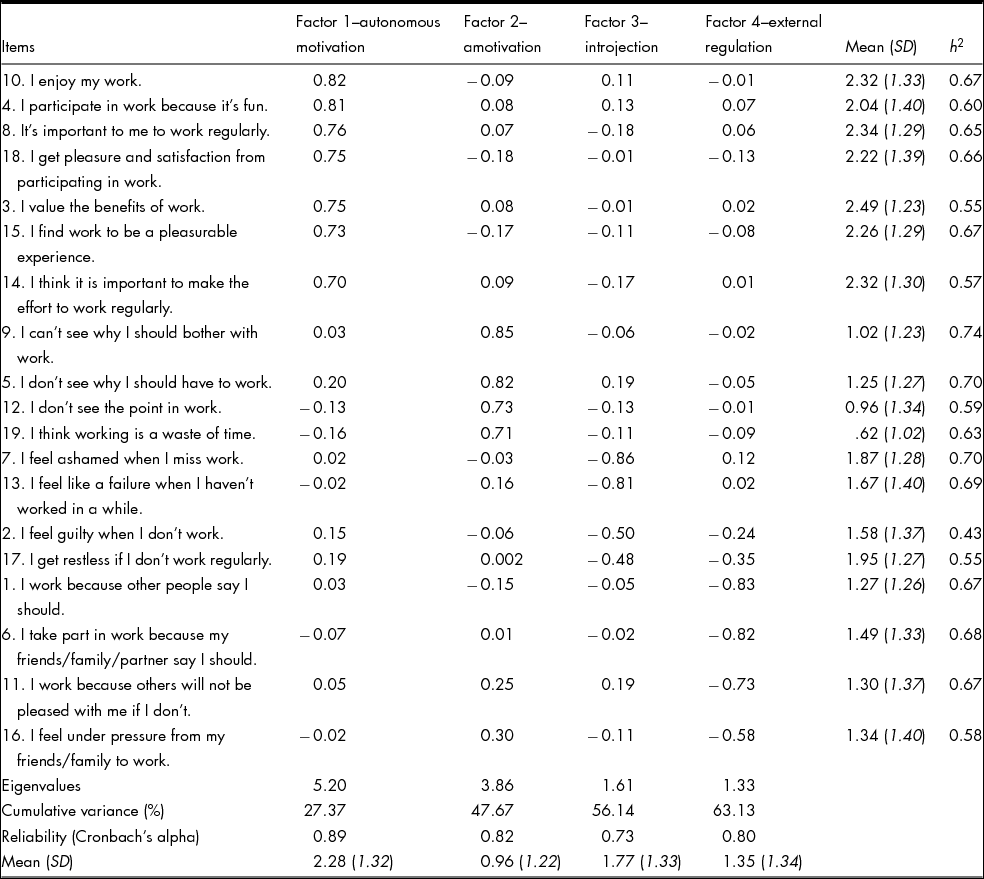
The 19 × 19 correlation matrix of the BRWQ was subjected to a principal components analysis. The Kaiser–Meyer–Olkin measure of sampling adequacy of 0.81 was considered meritorious, and the Bartlett's test of sphericity was significant (χ2 (171, n = 124) = 1061.41, p < .001), indicating that correlations in the data set are appropriate for factor analysis. In determining the number of factors to retain, the Kaiser–Guttman's ‘eigenvalues greater than one’ criterion was first applied, followed by Cattell's scree test. A four-factor solution was retained and rotated using oblique rotation to simplify the structure and enhance interpretation. The final solution accounted for 63% of the total variance, and was found to be parsimonious and psychologically meaningful. All items loaded significantly onto their respective factors (ranging from 0.48 to 0.86). Table 1 presents the mean values and standard deviations of each item on the BRWQ as well as factor loadings, communality (h 2), eigenvalues, percentage of variance explained and reliability coefficients.
Exploratory Factor Analysis Results Using Principal Components Analysis with Oblique Rotation

Factor 1–Autonomous motivation
This factor comprises seven items represented primarily by integrated regulation items (e.g., ‘I get pleasure and satisfaction from participating in work’) and identified regulation items (e.g., ‘I think it is important to make the effort to work regularly’). The coefficient alpha computed was 0.89, indicating relatively high internal consistency of the items constituting this factor. The mean rating on a 5-point Likert scale for this factor was 2.28 (SD = 1.32), indicating participants have moderate levels of identified and integrated regulation for employment.
Factor 2–Amotivation
This factor comprises four items represented primarily by amotivation items (e.g., ‘I think working is a waste of time’). The coefficient alpha computed was 0.82, indicating relatively high internal consistency of the items constituting this factor. The mean rating on a 5-point Likert scale for this factor was 0.96 (SD = 1.22). The low amotivation score indicated that participants in the present study possessed some levels of motivation to work.
Factor 3–Introjection
This factor comprises four items representing primarily by introjected regulation items (e.g., ‘I feel like a failure when I haven't worked in a while’), with the exception of one identified motivation item (‘I get restless if I don't work regularly’). The coefficient alpha computed was 0.73, indicating acceptable level of internal consistency of the items constituting this factor. The mean rating on a 5-point Likert scale for this factor was 1.77 (SD = 1.33), indicating participants have low to moderate introjected motivation for work.
Factor 4 – External regulation
This factor comprises four items represented primarily by external regulation items (e.g., ‘I work because others will not be pleased with me if I don’t’). The coefficient alpha computed was 0.80, indicating relatively high internal consistency of the items constituting this factor. The mean rating on a 5-point Likert scale for this factor was 1.35 (SD = 1.34), indicating participants have relatively low external regulation for work.
External correlates
The autonomous motivation factor of the BRWQ was positively associated with SDT-related constructs, including relatedness (r = 0.24, p < .01), vocational competency (r = 0.48, p < .01), VR outcome expectancy (r = 0.56, p < .01), VR behavioural engagement (r = 0.44, p < .01) and VR cognitive-affective engagement (r = 0.39, p < .01). The amotivation factor was found to have no association with relatedness (r = −0.25, ns), vocational competency (r = −0.07, ns), VR outcome expectancy (r = −0.01, ns), VR behavioural engagement (r = −0.16, ns) and VR cognitive-affective engagement (r = −0.18, ns). The external regulation factor was found to have no association with relatedness (r = −0.19, ns), vocational competency (r = 0.06, ns), VR outcome expectancy (r = 0.16, ns), VR behavioural engagement (r = 0.07, ns) and VR cognitive-affective engagement (r = −0.02, ns). The introjection factor was found to have no association with relatedness (r = 0.05, ns), vocational competency (r = 0.02, ns), VR outcome expectancy (r = 0.17, ns), VR behavioural engagement (r = −0.01, ns) and VR cognitive-affective engagement (r = 0.05, ns). These results support the convergent and divergent validity of BRWQ.
Discussion
In the current study, the 19-item BRWQ (adapted from BREQ-2; Markland & Tobin, Reference Markland and Tobin2004) was validated as a measure of autonomous motivation to work for persons with SMI. The results from the principal components analysis supported a four-factor measurement model for this instrument, rather than the five-factor model from the original BREQ-2. The current study indicated that identified regulation and integrated regulation loaded on a single factor, and consistent with SDT it was labelled as ‘autonomous motivation’. This finding is similar to the validation study of the BREQ-2 with patients with schizophrenia and their motivational process for physical activity (Vancampfort et al., Reference Vancampfort, De Hert, Vansteenkiste, De Herdt, Scheewe, Soundy and Probst2013). This may be due to similarity in concepts and gradual, rather than discrete, change in the degree of internal motivation for identified and integrated regulation. The amotivation, external regulation and introjection factors are identical to the BREQ-2 factors.
In addition, the correlation between the BRWQ subscales and other SDT variables (i.e., competency, relatedness, outcome expectancy and VR engagement) emerged in theoretically expected directions. For example, autonomous motivation had a strong positive relationship with relatedness with other Clubhouse members, and perceived vocational self-efficacy (competence), whereas individuals with high levels of amotivation (total lack of motivation) or controlled motivation (external regulation and introjection) were less likely than individuals with high levels of autonomous motivation to develop close relationship with other members in the social milieu of the Clubhouse, and did not perceive themselves as having the vocational self-efficacy needed to meet the challenges inherent in obtaining and retaining competitive employment in integrated settings. As expected, individuals with high levels of autonomous motivation to work were more likely to expect positive outcomes from obtaining work and were more engaged in their vocational programme at the Clubhouse than their amotivated and externally motivated counterparts. These findings provide strong support for the psychometric properties of the BRWQ as a sound instrument for assessing the SDT autonomy construct, and using this instrument as part of the SDT battery to assess self-determined work motivation of people with SMI in Clubhouse settings and potentially other psychiatric rehabilitation settings is warranted.
Implications for psychiatric rehabilitation counselling practice
The psychiatric rehabilitation field with its recovery philosophy is making a concerted effort to move to a self-determination paradigm in which engagement in mental health and rehabilitation services is sought through collaboration in services, personal control and shared decisions in treatment and programme options (Corrigan et al., Reference Corrigan, Angell, Davidson, Marcus, Salzer, Kottsieper and Stanhope2012). The BRWQ and the application of SDT framework fit well with the paradigm shift and give practitioners the tools to help consumers increase self-determined work motivation and engagement in VR services available to persons with SMI. A variety of empirically supported employment models are currently available in community mental health and psychosocial rehabilitation settings, including but not limited to the Individual Placement and Support Model of Supported Employment (IPS), the Program for Assertive Community Treatment (PACT) and the Clubhouse model (Bond, Reference Bond2004). Linking self-determination as a case conceptualization framework to improve self-determined work motivation has utility in the way vocational services, such as those listed above, are offered.
In addition, according to SDT, motivation can be enhanced when the environment supports the individual's psychological need for relatedness to their peers and competence towards goal pursuits (Deci & Ryan, Reference Deci and Ryan2000). Psychiatric rehabilitation counselling professionals must develop an awareness of consumers’ feelings of social connectedness with their peers (e.g., Clubhouse members, support groups and job clubs), and practitioners can also serve as a vehicle to move individuals along the motivational continuum with the adoption of SDT framework.
It is important to note that the negative perception regarding the lack of work motivation and low service engagement for persons with SMI by mental health case managers, employers and rehabilitation counselors can be a barrier to the use of self-determination as a recovery paradigm (Braitman et al., Reference Braitman, Counts, Davenport and Zurlinden1995; Kasser et al., Reference Kasser, Davey and Ryan1992), affecting the successful employment outcomes of people with SMI. In order to overcome this barrier, service providers must examine their own biases, and develop plans to decrease and eliminate these negative perceptions (Wagner & McMahon, Reference Wagner and McMahon2004). In addition, providing feedback related to employment goals in a manner that places responsibility in the hands of the consumer may foster autonomy and vocational self-efficacy beliefs, which will lead to higher levels of vocational outcome expectancy and VR engagement. Increasing self-efficacy beliefs along with vocational self-efficacy development will enhance the individual's personal motivation towards achieving their vocational goals.
In addition to the importance of working closely with service providers to increase motivation and successful employment outcomes, it is also crucial to promote vocational services for individuals with SMI. Research evidence from a large multisite study on employment models for persons with SMI, the Employment Intervention Demonstration Project (EIDP), found that more time spent on vocational services is associated with better employment outcomes, even after controlling for other factors (e.g., work history, functional impairment and disability income; Cook et al., Reference Cook, Leff, Blyler, Gold, Goldberg, Mueser and Burke-Miller2005, Reference Cook, Blyler, Leff, McFarlane, Goldberg, Gold and Razzano2008). Therefore, the quality of supported employment programmes and sustained engagement in vocational activities should be priorities to improve employment outcomes for persons with SMI, which can be facilitated by the application of SDT as a vocational recovery framework.
Limitations
There are several limitations to this study that warrant consideration when interpreting the results and should be addressed in the future research. Firstly, a convenience sample of individuals with SMI from Hawaii was used, which may limit generalizability. Future investigations should evaluate the BRWQ with additional samples from Mainland United States and other countries. Secondly, there are limitations with the use of self-report surveys with individuals with SMI due to the influence of cognitive impairments, along with recent events, which can introduce error and bias into the results (Atkinson et al., Reference Atkinson, Zibin and Chuang1997). Thirdly, the instrument was only tested with individuals with SMI participating in the Clubhouse model. Future research must consider examining the utility of this instrument with other evidence-based VR models for persons with SMI, including but not limited to IPS and PACT programmes. Finally, the sample size of this study was relatively small for exploratory factor analysis or confirmatory factor analysis. Future studies should consider using a larger sample size appropriate for confirmatory factor analysis to further confirm the measurement structure of the BRWQ.
Conclusions
According to self-determination research, individuals with high levels of autonomous motivation are theorized to be able to sustain setbacks or difficulties related to a goal (Deci & Ryan, Reference Deci and Ryan2000). The job search process after the onset of a catastrophic mental illness and prolonged absence from the workforce, requires substantial persistence because of the psychosocial barriers and setbacks that occur for individuals with mental illness (Cook et al., Reference Cook, Leff, Blyler, Gold, Goldberg, Mueser and Burke-Miller2005; Larson, Reference Larson2008; Manthey et al., Reference Manthey, Jackson and Evans-Brown2011; Wagner & McMahon, Reference Wagner and McMahon2004). Work motivation based on the tenants of self-determination is gravely needed to understand the motivational process for persons with SMI, and SDT parallels the current mental health service mandate to articulate the delivery of self-determined services (Corrigan et al., Reference Corrigan, Angell, Davidson, Marcus, Salzer, Kottsieper and Stanhope2012). Given the lack of research in the extant literature and the need to theory test a work motivational framework for persons with mental illness, a valid instrument is needed to measure an individual's autonomous motivation for work. A battery of psychometrically sound SDT-based vocational recovery measures will also allow practitioners to assess self-determined work motivation of their clients in rehabilitation counselling and psychiatric rehabilitation settings. The current study suggests the BRWQ is a valid measure for use in psychiatric rehabilitation counselling settings and can be incorporated into an SDT battery to assess and promote self-determined VR services.
Acknowledgements
None.
Funding
The contents of this article were developed with support from the Rehabilitation Research and Training Center on Evidence-Based Practice in Vocational Rehabilitation (RRTC-EBP VR) at the University of Wisconsin-Madison and the University of Wisconsin-Stout and with funding provided by the US Department of Health and Human Services, National Institute on Disability, Independent Living and Rehabilitation Research (Grant H133B100034).
Disclosure of Interests
The ideas, opinions and conclusions expressed, however, are those of the authors and do not represent recommendations, endorsements or policies of the US Department of Health and Human Services.