Introduction
Since the late 1990s, intensity-modulated radiation therapy (IMRT) has been established as the standard of care for delivering radiation therapy treatment for early-stage prostate cancer.Reference Kopp, Duff, Catalfamo, Shah, Rajecki and Ahmad1 IMRT can provide a highly conformal-shaped and high-dose treatment to the prostate and/or seminal vesicles, while reducing dose to the surrounding critical organs and healthy tissues, which includes the rectum, bladder and heads of femur.Reference Kopp, Duff, Catalfamo, Shah, Rajecki and Ahmad1, Reference Sze, Lee, Hung, Yau and Lee2
In 2008, OttoReference Otto3 reported a novel form of IMRT called volumetric-modulated arc therapy (VMAT). In VMAT, treatment is delivered using a cone beam that rotates around the patient. The cone beam is modulated by the intertwining of dynamic multileaf collimators (MLCs), variable dose rates and variable gantry speeds to generate IMRT quality dose distributions in a single optimised arc around the patient.4
Based on previous retrospective planning analyses, it is now well established that for the treatment of early-stage prostate cancer VMAT is capable of delivering a treatment plan of similar quality to IMRT, with the distinct advantage of faster treatment times that also require fewer monitor units to deliver.Reference Sze, Lee, Hung, Yau and Lee2, Reference Davidson, Blake, Batchelar, Cheung and Mah5–Reference Yoo, Wu, Lee and Yin13 Some studies have reported that VMAT provides improved conformity to the target volume and increased sparing of nearby rectal tissue.Reference Kopp, Duff, Catalfamo, Shah, Rajecki and Ahmad1, Reference Elith, Dempsey and Warren-Forward7, Reference Jolly, Alahakone and Meyer14–Reference Zhang, Happersett, Hunt, Jackson, Zelefsky and Mageras21 These findings suggest VMAT provides a greater opportunity to use dose escalation or hypo-fractionation to improve disease control, without increasing treatment-related morbidities associated with radiation exposure to surrounding tissues.Reference Dearnaley, Sydes and Graham22–Reference Zietman, DeSilvio and Slater25 Not surprisingly, VMAT has rapidly attained widespread use around the world for the treatment of early-stage prostate cancer.
It is important to recognise the planning studies comparing VMAT to IMRT examine dose modelling that is based on a snapshot of a patient’s positioning based on a single computed tomography (CT) image. In reality, a high dose gradient is actually delivered in a region where organ motion and deformation is likely, meaning the doses intended to be delivered may not always be as predicted from the single CT image. Toxicity studies are a means to monitor morbidities associated with the radiation doses being delivered. To date, few articles are available examining the treatment-related toxicities using VMAT.
In 2010, Pesce et al.,Reference Pesce, Clivio and Cozzi26 reported on early clinical experience using VMAT for radiation therapy treatments of prostate cancer. Their report included analysis of VMAT plan quality and a measure of acute toxicities as scored according to the Common Terminology Criteria for Adverse Events (CTCAE) scale (v3). In a group of 45 patients treated with one arc to a dose of either 76 or 78 Gy in 2 Gy fractions, no patients showed grade 2–3 rectal toxicity, 12% of patients experienced grade 2 dysuria and 44% of patients preserved complete or partial erectile function. Their study concluded VMAT was a safe, qualitative and advantageous treatment for prostate cancer. The same study also commented that the potential implementation of VMAT should be further investigated using more aggressive fractionation regimes with either hypo-fractionation or dose escalation. They also encouraged the investigation into including a simultaneous integrated boost (SIB) to discriminate between the prostate and seminal vesicles when using VMAT to treat prostate cancer.Reference Pesce, Clivio and Cozzi26
In 2012, Alongi et al. examined the acute toxicity profiles for patients treated with SIB in a hypo-fractionated regime that utilised 28 fractions. Their study population of 70 patients included low, intermediate and high risk cases. The study concluded moderate hypo-fractionation with SIB using VMAT was shown to be safe with acceptable acute toxicity.Reference Alongi, Fogliata and Navarria27
A more recent study by Alongi et al. compared acute and late toxicities in postoperative prostate cancer patients treated with either three-dimension conformal radiation therapy (3DCRT) or hypo-fractionated VMAT. The median dose to the prostatic bed was 70 Gy in both groups: 2 Gy/fraction in the 3DCRT group and 2·5 Gy/fraction in the Hypo-RapidArc group. In that study, VMAT was demonstrated to reduce the incidence of acute genitourinary and grade 2 lower gastrointestinal toxicities compared with 3DCRT, demonstrating the feasibility of a hypo-fractionation regime with VMAT in the postoperative setting.Reference Alongi, Cozzi and Fogliata28
The current study is intended to add to the limited body of literature examining VMAT toxicity by comparing the acute toxicities observed in patients during moderate hypo-fractionated radiation therapy treatment for early-stage prostate cancer using either IMRT or VMAT.
Materials and Methods
Ethics approval for this study was provided by the University of Newcastle, Australia, Human Research Ethics Committee (approval number: H-2011-0073), and the British Columbia Cancer Agency (BCCA), Canada, Research Ethics Board (approval number: H13-02127).
A retrospective chart review was performed on a total of 72 patients that had received a moderate hypo-fractionated radiation therapy treatment of 73·68 Gy in 28 fractions using either IMRT (n=40) or VMAT (n=32) for the treatment of early-stage prostate cancer between November 2012 and April 2014. The 40 IMRT cases included in this study had received treatment at the BCCA’s Fraser Valley Centre (FVC) where IMRT is the standard prostate treatment. The 32 VMAT cases included in this study received treatment at the BCCA’s Centre for the North (CN) where VMAT is the standard prostate treatment.
Inclusion criteria
The cases included in the study were patients with stage I or II prostate cancer where the prostate was intact and treatment was to the prostate only with or without fiducial markers. Patients were excluded from the study if they had undergone prostatectomy or if the treatment area extended beyond the prostate (i.e., to include the seminal vesicles or regional nodes).
The number of cases included in this study was limited by strict adherence to the inclusion criteria. No more than 40 IMRT cases could be included as prior to November 2012 FVC utilised a standard treatment fractionation of 74 Gy in 37 fractions. Similarly, the CN first started treating patients with VMAT in November 2012 and eligible cases were further limited by the remote location of the CN where many possible inclusions for the study had elected to have surgery making them ineligible for this study.
IMRT and VMAT planning and treatment
As per protocol at both centres, all patients were positioned supine and instructed to have a full bladder at the time of simulation and treatment, however, no specific bowel preparation to ensure an empty bowel was performed. The planning CT data sets for the IMRT cases were obtained on a Phillips Brilliance Big Bore scanner using 2 mm slices, and the VMAT planning scans were obtained using a GE Optima 580 CT scanner with 2·5 mm slices. For both IMRT and VMAT the pelvis was scanned from the superior aspect of the sacroiliac joint to 4·0 cm below the ischial tuberosities.
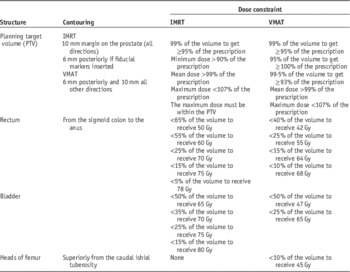
The clinical target volume (CTV) was defined as the entire prostate. At FVC, the IMRT planning target volume (PTV) was generated by expanding the CTV with a 10 mm margin in all directions. If the data set included prostate fiducial markers, the PTV was created using a 6 mm margin to the prostate posteriorly to spare additional rectal tissue from receiving radiation dose. At CN, the VMAT PTV was generated by expanding the CTV posteriorly by 6 and 10 mm in all other directions. The organs at risk (OAR) including the bladder, rectum and the heads of femur were also contoured as described in Table 1.
The critical structures and dose constraints applied during radiation therapy treatment planning

All dosimetric calculations were performed using Varian Medical Systems, Eclipse 3D planning software (version 10·0). Each calculation utilised the anisotropic analytical algorithm with heterogeneity correction on and a 2·5 mm calculation grid.
A five-field sliding window technique was used to treat the IMRT cases. Each treatment beam utilised 6-MV photons with the gantry angles fixed at 0°, 75°, 135°, 225° and 285°. VMAT treatments utilised a single clockwise arc having a start angle of 181° and a stop angle of 179°. The collimator was set to 45° to minimise the MLC tongue and groove effect.Reference Weber, Wang and Cozzi29 Each case was prescribed 73·68 Gy in 28 fractions and planned to meet the dosimetric objectives described in Table 1.
IMRT treatments were performed using either a Varian TrueBeam or Varian IX linear accelerator. All VMAT treatments were delivered using a TrueBeam linear accelerator. Each linear accelerator is equipped with Millennium 120-MLC.
Toxicity assessment
Both the FVC and CN use the National Cancer Institute’s (NCI) CTCAE versus 4·0 to assess symptom toxicity.30 The level of toxicity (0–5) was assessed by a radiation therapist on the 1st day of treatment to establish a baseline and once weekly thereafter. The assessed level of toxicity is recorded shortly after assessment and entered into the patient’s electronic medical record (EMR). All radiation therapists receive the same training on how to use the CTCAE scale as part of their orientation to the department.
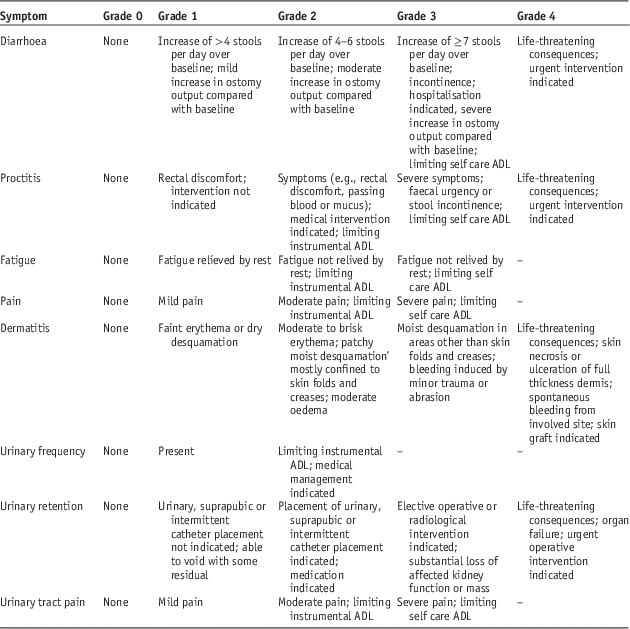
For this study, the outcomes for eight toxicity symptoms were collected and compared; diarrhoea, proctitis, fatigue, pain, dermatitis, urinary frequency, urinary retention and urinary tract pain. The CTCAE scale to grade these symptoms is presented in Table 2. The EMRs of the 40 IMRT and 32 VMAT cases used in this study were reviewed to collect the toxicity grade recorded during treatment. The collected data was grouped into the following categories: baseline measurement, fractions (Fx) 6–10, Fx 11–15, Fx 16–20, Fx 21–25 and Fx 26–28. The data were accessed and collected between January and May 2014. The following assumptions were made when reviewing the data collected. If there was a symptom at baseline, and this continued throughout treatment then it was not added as a symptom during treatment. If the symptom was Grade 1 at baseline and increased to Grade 2 then it was counted as a Grade 1 during treatment. If there was a symptom at baseline, and disappeared during the first, second weeks, etc., and then reappeared, it was counted as a symptom on reappearance.
The National Cancer Institute’s (NCI) Common Terminology Criteria for Adverse Events (CTCAE) v4·0, used to assess symptom toxicity in this study30
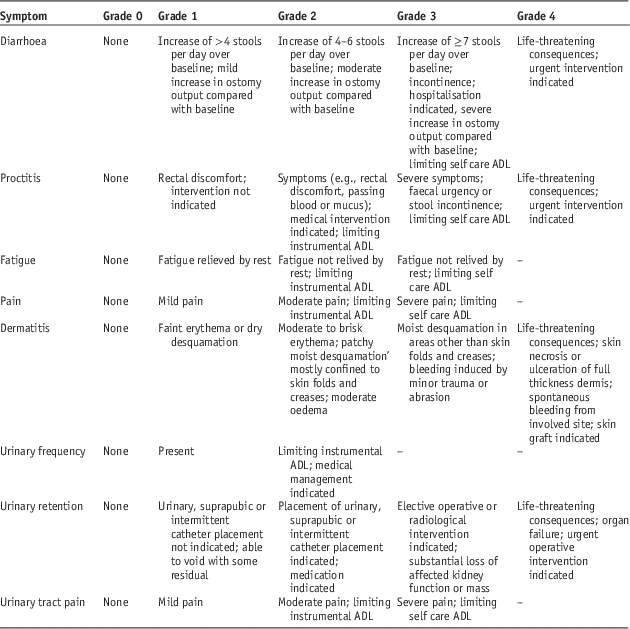
Abbreviation: ADL, activities of daily living.
Statistical analysis
The odds ratio (OR, a measure of the symptom occurring with IMRT compared with VMAT) was calculated for each data collection point and the whole course of treatment. An OR greater than 1·0 indicates the symptom is more likely to occur in IMRT whereas an OR value of less 1·0 demonstrates the symptoms is more likely using VMAT. The data were tested for significance at the 95% level using Fisher’s exact test. All analysis was conducted using GraphPad Instat. A p-value <0·05 means that the difference in symptoms between IMRT and VMAT area attributed to the treatment method.
Results
Of the 40 IMRT cases assessed, one patient did not have any data recorded for fractions 26–28, leaving a total of 199 data entries for consideration. Similarly, of the 32 VMAT cases reviewed, one patient did not have any data recorded for fractions 26–28, leaving a total of 159 data entries for consideration.
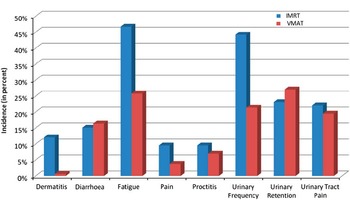
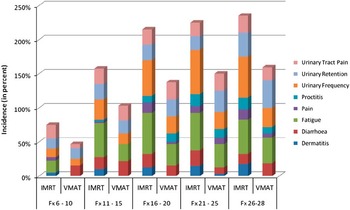
The relative percentage frequency of each assessed symptom reported for the 40 cases treated with IMRT and the 32 cases treated using VMAT for the overall treatment course is presented in Figure 1. The same data broken down into weekly milestones throughout the treatment course is presented in Figure 2. The OR and p-values are presented in Table 3.
The incidence (in per cent) of all eight treatment-related symptoms recorded over the full treatment course during intensity-modulated radiation therapy (IMRT) or volumetric-modulated arc therapy (VMAT).

The incidence (in per cent) of all eight treatment-related symptoms recorded at weekly milestones during intensity-modulated radiation therapy (IMRT) or volumetric-modulated arc therapy (VMAT).

The statistical comparison of all eight treatment-related symptoms recorded during intensity-modulated radiation therapy (IMRT) or volumetric-modulated arc therapy (VMAT) treatments

Note: Recorded toxicities are presented as a percentage of cases where the symptom was observed and at which fraction (Fx) of treatment. The odds ratio (OR) of the symptom occurring with IMRT compared with VMAT, is also presented.
Abbreviations: ns=not significant, *p<0·05, **p<0·01, ***p<0·001.
The OR values demonstrate that over the full course of treatment, the symptoms dermatitis, fatigue, pain, proctitis, urinary frequency and urinary tract pain are reported more frequently with IMRT. These results are statistically significant for the symptoms dermatitis (p<0·001), fatigue (p<0·001), pain (p<0·05) and urinary frequency (p<0·001). Diarrhoea and urinary retention are observed more frequently using VMAT, however, a statistically significant increase is not observed compared with IMRT.
Similarly to the overall treatment course, significant differences were reported at the data collection points during treatment. The following symptoms were reported more often, with statistical significance, during treatment with IMRT; dermatitis (Fx 26–28 (p<0·05)), fatigue (Fx 6–10 (p<0·05) and Fx 16–20 (p<0·05)) and urinary frequency (Fx 16–20 (p<0·05), Fx 21–25 (p<0·05) and Fx 26–28 (p<0·01)). Between fractions 6–10, diarrhoea is reported significantly more frequently in cases treated with VMAT (p<0·05). A statistically significant difference in the reported incidence of diarrhoea at all other stages of the treatment course was not observed between IMRT and VMAT.
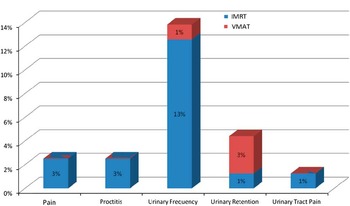
The results presented so far consider the reported frequency of the symptoms only. They do not consider the grade of the symptom being experienced. The frequency at which grade 2 toxicities were observed is presented in Figure 3. No symptoms were scored higher than grade 2. Using IMRT, grade 2 toxicities were reported for the following symptoms proctitis, pain, urinary frequency, urinary retention and urinary tract pain. Using VMAT, grade 2 toxicities were reported only for urinary frequency and urinary retention. Due to the small number of grade 2 toxicity reported, it was not possible to perform statistical analysis. Of note, grade 2 urinary frequency symptoms was reported in 13% of all measured data using compared with 1% using VMAT. This may be considered clinically significant.
The incidence of grade 2 toxicities recorded during a course of treatment using either intensity-modulated radiation therapy (IMRT) or volumetric-modulated arc therapy (VMAT).

Discussion
The study reported in this paper was designed to compare the acute toxicities observed in patients during moderate hypo-fractionated radiation therapy treatment for early-stage prostate cancer using IMRT or VMAT. From the 72 cases reviewed, it has been demonstrated that over the full course of treatment, the symptoms dermatitis, fatigue, pain and urinary frequency are significantly higher in the cases treated with IMRT compared with VMAT.
The higher levels of grade 1 dermatitis observed using the IMRT technique may be attributed to the difference in beam arrangements utilised for IMRT and VMAT. The VMAT techniques delivers dose to the PTV from a full 360° around the patient, whereas the IMRT technique delivers dose from five set angles. The five-field IMRT technique is therefore concentrating a higher intensity of dose via the five treatment angles increasing the chance of developing dermatitis compared with the rotational delivery of VMAT, which creates a more even distribution and a less concentrated dose pattern to the patient’s skin.
Importantly, others have reported using seven or nine field IMRT techniques to treat early prostate cancers.Reference Sze, Lee, Hung, Yau and Lee2, Reference Davidson, Blake, Batchelar, Cheung and Mah5, Reference Rao, Yang and Chen9, Reference Shaffer, Morris and Moiseenko11, Reference Yoo, Wu, Lee and Yin13, Reference Treutwein, Hipp, Koelbl and Dobler31 Increasing the number of IMRT treatment fields would be expected to deliver a more evenly distributed intensity of radiation to the skin tissue. It is therefore reasonable to expect the levels of dermatitis being experienced using seven- or nine-field IMRT would be less than that observed here using a five-field technique. It remains unclear how the 7- or 9-field IMRT techniques would compare to VMAT.
In this study, IMRT is reported to increase both grade 1 and 2 urinary frequency symptoms. Presumably, the increased incidence of urinary frequency observed using IMRT correlates to higher dose being delivered to the bladder. This can likely be attributed to the dose constraints that are applied to the bladder during optimisation being tighter for VMAT compared with IMRT. Previous retrospective studies from the current authors and others have demonstrated that compared with IMRT, VMAT can reduce the dose being delivered to the OAR including the rectum, bladder and heads of femur.Reference Kopp, Duff, Catalfamo, Shah, Rajecki and Ahmad1, Reference Jolly, Alahakone and Meyer14–Reference Zhang, Happersett, Hunt, Jackson, Zelefsky and Mageras21 These studies suggested that the reduction in dose delivered to the OAR using VMAT may translate into a reduction of toxicities associated with that organ. This phenomenon has been observed in this study in that a reduction in dose delivered to the base of the bladder using VMAT has translated into a reduction in reported urinary frequency.
The same phenomenon was not observed in this study when considering rectal tissue. The constraints applied to the rectum in this study are tighter for VMAT compared with IMRT, however, this did not translate into a reduction in rectal toxicities within the VMAT cohort. In fact, as reported by the OR, diarrhoea is reported more frequently in cases treated with VMAT compared with IMRT in fractions 6–10. The early onset of diarrhoea may possibly be attributed to the beam arrangements used in the IMRT and VMAT techniques. IMRT uses a beam arrangement that deliberately avoids delivering dose through the rectal tissue. VMAT uses a 360° rotational arc and some dose is being delivered through the rectum, which could cause an earlier onset of diarrhoea. By fractions 11–15 a similar percentage of cases are reporting diarrhoea for both the IMRT and VMAT group, which is typically managed using an antidiarrheal medication.
It is difficult to find an explanation for the observed increase in pain reported in patients treated with IMRT. However, the increase in both urinary frequency and pain could in-part explain the increase in fatigue reported for the IMRT group. Increased urinary frequency may translate into an increase in nocturia and therefore a disrupted sleep pattern. Likewise an increase in pain may also contribute to disturbed sleep. A reduced or disrupted sleep pattern as a result of pain and or urinary frequency could lead to increased fatigue as observed within the IMRT patient population.
The greatest challenge to this study is that it relies on information gathered from two different radiation therapy departments. Several steps were taken to minimise the effect of using data from two departments on the validity of this study. First, the departments used in this study were deliberately selected to enable comparison of the same moderate hypo-fractionation treatment regime. However, it is recognised there are minor differences in the constraints applied to the OAR during IMRT and VMAT planning, the impact of which on observed toxicity has been discussed here. Second, the BCCA uses standard training guidelines to introduce all radiation therapists to the CTCAE toxicity scale, however, it is possible some individual user variability may still exist.
Another limitation of the present study is that the study population is relatively small. A larger study population would allow a more accurate trend to be established for the frequency of morbidities as well as the grade of toxicities being reported. A larger study cohort would also allow for more meaningful statistical analysis to be performed. Likewise, a longer follow-up would be recommended to examine the late toxicities and clinical outcome for these patients.
Conclusion
This study was designed to compare the acute toxicities experienced by patients treated for early-stage prostate cancer using IMRT or VMAT with moderate hypo-fractionation, and add to a growing body of evidence for the similarities and differences between IMRT and VMAT.
Herein it has been demonstrated that the symptoms dermatitis, fatigue, pain and urinary frequency are significantly higher in cases treated with IMRT compared with VMAT. This is one of the first publications to demonstrate that VMAT is associated with decreased toxicities compared with IMRT for the treatment of early-stage prostate cancer. These results, in association with the findings of others that VMAT reduces treatment beam-on time, demonstrate an advantage for VMAT over IMRT for the treatment of early-stage prostate cancer.
Future long-term studies with a larger study population are recommended to confirm these results for acute toxicities and to investigate late toxicities and clinical outcome for this group of patients. This can be done as the number of cases treated with VMAT continues to grow.
Acknowledgements
The Authors would like to acknowledge the efforts of Bobbie-Sue Clendenning and David Morris to collect patient toxicity data at the BCCA’s Centre for the North.