In August 1946, a year after Japan's defeat ended the Second World War, the first authorized production of Gilbert and Sullivan's The Mikado opened in Tokyo. The play was performed in English at the Ernie Pyle Theater, a magnificent Western-style venue that had been the home of the famous Takarazuka Troupe. Requisitioned and renamed after a popular war correspondent, the Ernie Pyle Theater was exclusively reserved for Occupation personnel. Soon after, a group of Japanese theatre artists involved in the production determined to offer their own version for the Japanese public. Their ‘all-Japanese’ version – to be performed in Japanese, created by Japanese performers and production staff, for a Japanese audience – was scheduled to open in June 1947 at the Tokyo Theater, a large Western-style venue that remained under Japanese control. However, this production was cancelled at the last minute. Undeterred, the group finally offered a smaller-scale version of the production in the multi-purpose auditorium space at the Hibiya Public Hall in January 1948. These productions marked the end of the operetta's sixty-one-year ban in Japan.
In the first months and years following Japan's unconditional surrender on 15 August 1945, the Japanese faced the wreckage of nuclear- and fire-bombed cities, continuing starvation, and shock at defeat. Shorn of its empire, Japan was placed under the American-led Allied Occupation, which began on 28 August 1945 and lasted until 28 April 1952. Occupation authority was concentrated in the figure of General Douglas MacArthur and his General Headquarters (GHQ), which issued directives to the Japanese government. Despite these dismal circumstances, as historian John Dower has shown, many citizens were ready to embrace peace, rebuild and even welcome the American occupiers. Japanese people engaged widely in the work of questioning old institutions and reimagining Japan and Japaneseness, and theatre people eagerly participated in this work.Footnote 2 Pivoting away from the total mobilization that had drawn nearly all Japanese to contribute to the war effort, the artists involved in The Mikado sought to rebuild their lives and professional careers. As theatre artists, this work was focused on developing post-war Japanese theatre; as Japanese, this effort inevitably extended to an endeavour to reimagine new possibilities for the nation. For these theatre-makers, all of whom had backgrounds in Western theatre, The Mikado offered a chance to reclaim a cosmopolitan attitude, both for themselves and for Japan.
The Mikado, with its historically vexed relation to Japan, initially seems an odd vehicle for post-war reconstruction. Written by the British librettist–composer duo William S. Gilbert and Arthur Sullivan, and first produced in 1885, The Mikado satirizes British bureaucracy, but is set in Japan. This ‘Japan’ is an orientalized spectacle of bloodthirsty feudalism, nonsensical laws, quaint manners, and Asian-sounding motifs – a spectacle that reflected common Western images of Japan and Japaneseness. Nanki-Poo, the son of the Mikado, emperor of Japan, flees the Imperial Court disguised as a wandering minstrel, because he has been ordered to marry the elderly Katisha. Nanki-Poo is in love with Yum-Yum, who is, however, engaged to her guardian, Ko-Ko. Ko-Ko, originally a lowly tailor who had been condemned to death for flirting, has instead become the Lord High Executioner of the Town of Titipu, but he must find someone to execute within a month. He and Nanki-Poo come to an agreement: Nanki-Poo and Yum-Yum will be married for a month, after which time, Nanki-Poo will serve as the executioner's victim. But according to the law, since a wife must be killed along with her husband, this arrangement would mean death for Yum-Yum as well. Just in time, Katisha arrives with the Mikado, and after songs of despair, and then courtship, Nanki-Poo and Yum-Yum, and Ko-Ko and Katisha, pair off and the operetta ends with a traditional comedic double marriage. Due to its perceived lampooning of the emperor and mocking portrayal of Japan, The Mikado had been banned in Japan since its premiere. Despite this prohibition, the Japanese public followed with interest news about the operetta abroad. GHQ's revocation of the ban offered the opportunity for Japanese to finally experience The Mikado, an operetta well known everywhere except in the nation it supposedly represented.
Post-war Japanese interest in The Mikado embraced a central contradiction. Commentators emphasized that the operetta was about a fantastical ‘never-ever land’, not-Japan; at the same time, theatre-makers insisted upon the importance of an all-Japanese production of The Mikado. As a journalist wrote more recently in the Yomiuri Shinbun, ‘It is a fictional story but, because it is known as the opera that put Japan on the stage, we are intimate with The Mikado.”’Footnote 3 Simultaneously not-Japan but about Japan, the operetta's ambiguity of setting gave The Mikado in Occupation-era Japan meanings different from those associated with the play in the West. The Mikado's placelessness allowed Japanese theatre artists freedom to substitute their own visions and depictions into the play. At the same time, the operetta's historical status as a play ‘about Japan’ gave these substitutions cultural relevance. In the immediate post-war period, The Mikado offered theatre-makers an opportunity to distance themselves from the war by asserting cosmopolitan identities that emphasized affiliation with the international, while remaining within the nation. The theatrical production process through which they constructed these new identities, in turn, suggested a mode of imaginative performance through which the nation as a whole could rebuild.
The production team and a Japanese cosmopolitanism
A core group of Japanese theatre-makers – choreographer Itō Michio, set designer Itō Kisaku, opera soprano Nagato Miho, and conductor Noboru Kaneko – were involved in all three productions. Prior to the war, all four had built their careers by engaging with the West, and Western cultural forms, constructing identities as cosmopolitan artists. Itō Michio had spent almost thirty years in Europe and the US, until he was interned and repatriated after Pearl Harbor. During Michio's career in the West, he starred in William Butler Yeats's At the Hawk's Well, collaborated in productions at New York City's Neighborhood Playhouse, worked in both Broadway musicals and Hollywood movies, and led his own modern-dance troupe, with a studio and school in New York and then Los Angeles. Michio's younger brother, Itō Kisaku, specialized in shingeki (modern, Western-style theatre) set design and also spent time in New York. Nagato Miho, who played Yum-Yum in the all-Japanese productions, was trained in Western classical opera, which similarly gave her an international-facing orientation. Her repertoire included the classical opera heroines Cio-Cio San of Madama Butterly and Mimi of La Bohème.Footnote 4 The conductor Kaneko Noboru specialized in classical and opera music, leading orchestras at the Yokohama Symphony Orchestra and the Tokyo Philharmonic.
Via their engagement with Western art forms, these artists performed a particular cosmopolitan identity. This became ever more evident as Japan began mobilizing for war in the 1930s, and the international dimensions of these artists’ careers started to conflict with rising nationalism. Another member of the Itō family, director Senda Koreya, wrote about this shift in his 1975 autobiography. Senda described the tension felt when Michio, along with two other family members, Yūji and Teiko, came from America to Japan to celebrate their parents’ fiftieth wedding anniversary in 1940. The siblings joined forces to put on a performance of Nagata Hideo's Daibutsu Kaidan (The Great Buddha's Awakening). As Senda reminisced,
To do work together with Michio, Yūji, and Teiko, gave me a feeling, if not of internationalism, then one could say, of cosmopolitanism, which was entirely enjoyable. Falling deeper into the depths of war had brought along with it a flooding of words such as ‘race,’ ‘nation,’ and ‘Japaneseness’ . . . doing work together with my brothers brought about feelings of freedom and a cosmopolitan atmosphere, which had been sorely missed.
Critics, however, dismissed the Itōs’ production, identifying the directing (done by Michio) as problematic because it was too foreign. Looking back on the event, Senda acknowledged the gap between his family and many Japanese at the time: ‘In that time of rampant nationalism, for us four cosmopolitan brothers . . . to do the work as we wanted, certainly the majority opinion was that this was strange.’Footnote 5
Senda's repeated use of the word ‘cosmopolitan’ offers a distinct understanding of the term for his family and the artists they worked with. For Senda, cosmopolitanism and internationalism are not synonymous; whereas ‘international’ requires the presence of people from different nations, one can be cosmopolitan at home. Therefore travel abroad is necessary for internationalism, while cosmopolitanism is, rather, an international outlook. Drawing a line between his siblings’ work and popular sentiment, Senda asserted cosmopolitanism as in opposition to nationalistic claims of racial or cultural singularity. To be cosmopolitan at home, then, is to be at odds with, and appear ‘strange’ to, one's own society. In Senda's declaratory usage, the cosmopolitan is a performative mode of engagement and self-fashioning that claims an affective affiliation with the cultures and peoples beyond one's own national borders. With its opposition to nationalist sentiment and awareness of outsider status, Senda's use of the word coheres with recent minoritarian articulations of cosmopolitanism offered by theorists such as Carol Breckenridge et al., Gerard Delanty, and Pheng Cheah and Bruce Robbins.Footnote 6 The Mikado production team's post-war efforts, however, rendered Senda's cosmopolitanism as something to be taken up by the nation as a path towards reconstruction.
Ultimately, despite their cosmopolitan stance, all the members of the Mikado production team, like most Japanese artists, contributed to the war effort, adapting their professional expertise to the needs of the nation. After being repatriated to Japan in 1944, Itō Michio founded the Greater East Asia Stage Arts Research Institute, an organization for mobilizing theatre artists across countries under Japan's control.Footnote 7 Itō Kisaku was a leader in the mobile-theatre movement, which organized troupes to travel around Japan performing patriotic plays. Nagato Miho, nicknamed ‘Battleship’ by the troops, became famous for devotedly performing for the army even in dangerous circumstances. Kaneko Noboru continued his work at the Yokohama Symphony Orchestra, giving comfort performances for the Japanese troops.Footnote 8 Though all four were able to maintain their involvement in the performing arts throughout the war, the contours of their professional work changed dramatically in response to the government's strict censorship, attempts to ban Western culture, and the push for propaganda.
The end of the war (and the establishment of the American-led occupation) offered these artists the chance to re-engage openly with Western art forms. In doing so, they were also able to recapture the cosmopolitan elements of their artistic identity that had been restricted by the war. With almost all the theatres in Tokyo burned to the ground, the necessity of rebuilding also carried with it an opportunity to reimagine Japanese theatre. The Mikado, first in the Pyle Theater production, and then in the all-Japanese version, offered a way for critics and theatre-makers to re-envision the possibilities for Japanese theatre, and, through the production process, to work towards the future they envisioned.
The Mikado at the Ernie Pyle Theater
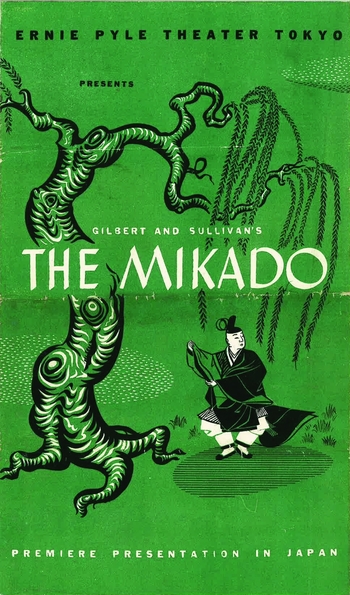
The desire to remake Japanese theatre, and in the process to remake the nation, was activated even in the US Pyle Theater production (Fig. 1). Performed in English, this first authorized production of The Mikado on Japanese soil was a clear sign of US authority.Footnote 9 The production was a Broadway-style spectacle, with a cast of over a hundred, lavish scenery and costumes, and a grand orchestra. Americans played all the lead roles. The men's chorus and orchestra were made up of a mix of Japanese and Allied performers. Apart from two American singers, the female chorus was entirely Japanese. A host of Japanese production staff, only a few of whom are noted on the programme, contributed behind the scenes – including Itō Michio, Itō Kisaku, Nagato Miho and Noboru Kaneko. As with other Pyle Theater productions, this Mikado was intended for Occupation personnel (military and civilian) and their families. But in a surprise move, GHQ invited a handful of Japanese theatre critics and other guests to a dress rehearsal on 11 August. Theatre historians Samuel Leiter and Josephine Lee have interpreted this event as GHQ's attempt to measure the success of democratization efforts via the spectators’ willingness to see their emperor satirized.Footnote 10 The reviews published by the invited critics, however, suggest little interest in the portrayal of the emperor. Instead, for these Japanese spectators, The Mikado was an opportunity not only to finally see the famous operetta, but also to observe American-style theatrical production practices. For theatre professionals, the Pyle Theater Mikado provoked questions about how to rebuild Japanese theatre after the many years of war.
Programme cover for the Ernie Pyle Theater production of The Mikado. In a classic japoniste aesthetic, this illustration continued the practice of linking the operetta to an image of Japan as traditional and quaint. The Mikado, programme, Ernie Pyle Theater, Tokyo, Japan. Dorothy and Hiroshi Kaneko Papers, Japanese American Service Committee Legacy Center, Chicago, Illinois.

For the critic Eguchi Hiroshi, writing at length in the magazine Theatre World, even the simple act of entering the Pyle Theater set off a rush of contradictory feelings, as he contemplated the circumstances of the event. ‘But to say nothing of feeling envious [at the sight of] the splendid stage. The former Tōhō theatre's huge stage filled almost entirely with dazzling decoration, after only seeing the poor stages of defeat, thoroughly delighted my eyes.’Footnote 11 In Eguchi's description, the fact of defeat is referenced as a theatrical mise en scène of war, while the fantasy world inside the theatre manifests the reality of occupation. Oscillating between theatre and reality, delight and envy, the theatre provoked disorientation in Eguchi that suggests both the pain and the opportunities brought by the Occupation. For while the lavishness of the out-of-bounds Pyle Theater was a bitter sight, as a symbol of the Occupation's promise to lead Japan into an era of peace and economic prosperity The Mikado's image of abundance suggested American plenitude might be shared with Japan.
The promise of economic development implied by the extravagant production indicated to Japanese critics concrete possibilities for the future of Japanese theatre. As with the theatre building itself, the critics had to face the material gaps between American and Japanese theatre immediately following the war. Eguchi, once again falling into despair, commented:
The acting of the officers and men of the occupying forces who performed was surprisingly masterful. That this was the acting of boorish soldiers not only made me doubt my own eyes . . . but I would say that Japanese people are the most clumsy on stage – a desolate reflection for whomever would say those words.Footnote 12
In Eguchi's response, the felt inadequacies of a nation in defeat were visible in the body itself; even Allied soldiers dressed up as pseudo-Japanese characters revealed the supposed inability of the Japanese actor, and posited this inability as physically innate. In this production that flaunted American capabilities, however, there were glimmers of hope, represented by the backstage work of fellow Japanese. Prior to the curtain's rise, Itō Michio and Kisaku came out onstage to greet the audience. As one writer commented, ‘That the Itō brothers repeatedly carry out such endeavors, for us, is truly a thing of pride.’Footnote 13 Though the Pyle Theater production was a clear symbol of US power in Japan, the backstage efforts of Japanese theatre artists did not go missed by their countrymen, and suggested a more promising future. The reviews of the Pyle Theater version thus established a framework for Japanese interpretations of The Mikado during the Occupation. While finally experiencing the famous operetta itself was important, just as valuable was the opportunity to re-engage with Western culture more broadly. Via this re-engagement, critics evaluated the state of Japanese theatre in order to envision possibilities for its reconstruction.
Although the critical response to the Pyle Theater version was primarily focused on practical aspects of rebuilding Japanese theatre, reviewers did contemplate what The Mikado might mean for nation-building. A writer for the proletariat magazine The Masses gave a negative verdict, concluding that the operetta did not offer an ideal path for the redevelopment of Japanese culture. He observed that it was only because defeat had caused ‘the curtain of the Emperor's mystification to be drawn aside’ that the operetta could play in Japan. Yet he cautioned, ‘The revocation of the ban seems like tentative progress, but, in the midst of our fight for freedom, we desire to create great art with our own hands.’Footnote 14 To this writer, the Pyle Theater Mikado presented a choice that had implications for the development of the nation as a whole: art-makers could either take up and pursue Western models as a way of rebuilding, or, rejecting those, they could strike out to pursue uniquely Japanese forms. This debate had roots from long before the war, but in the particular case of The Mikado the operetta's ambiguity of setting made it difficult to characterize. Eguchi commented, ‘This show is supposed to hold interest for foreigners for its [depiction of] an oriental foreign country, but even for me watching as a Japanese person, it overflowed with exoticism . . . Seeing it, one must ask, what on earth is the nationality of the operetta “Mikado”? It truly is strange.’Footnote 15 Eguchi's closing question assumes that not only people, but also works of art, have nationalities; however, The Mikado's nationality is undefined. Exotic to everyone, the operetta appeared not to belong to any one nation. Eguchi's characterization of the operetta as ‘strange’ (kimyō) echoes Senda's same use of the word to describe his family's cosmopolitanism.
Exceeding the assumed borders of any one nation, and thus familiar to no one, The Mikado begins to take on some of the characteristics of Senda's cosmopolitanism. The operetta's subject matter and history of production and reception in the West inherently tied it to Japan, and yet to Japanese reviewers such as Eguchi it appeared strange and nationless. The Mikado in Japan, therefore, allowed for an ambiguity of national and international. Writing about, and subsequently performing, The Mikado from within Japan, then, could be seen as an act of cosmopolitanism, a performance of affiliation with the international from within the borders of one's own nation. At the very moment when Japanese were attempting to reimagine post-war possibilities for their nation, for the group of theatre-makers who staged the first all-Japanese Mikado the operetta offered a way of redefining this cosmopolitanism as a characteristic of the nation.
An all-Japanese Mikado
The first ‘all-Japanese’ production – in Japanese, with Japanese performers and staff, for a Japanese audience – was scheduled to open at the Tokyo Theater in June 1947. Lavishly financed by the entertainment conglomerate Shōchiku, it was abruptly cancelled, just days before opening, due to copyright issues.Footnote 16 Finally, in January and February of 1948, the Nagato Miho Opera Company presented a smaller-scale version of this all-Japanese production at the Hibiya Public Hall. Although paying audience members never saw the first, Tokyo Theater, version, the production was already in the stage of full dress rehearsal when cancelled. As a result, photographs of the production and a detailed programme booklet remain, giving us a sense of what might have been. Since this essay understands The Mikado in post-war Japan as an opportunity for imaginative self-representation, the Tokyo Theater version, which gave full range to these imaginative possibilities, will be the focus of my discussion here.
Staging an all-Japanese version of The Mikado served to proclaim Japan's re-engagement with international culture on two levels. First, in performing this foreign operetta, which historically had been tied to Japan's image abroad, the Tokyo Theater production asserted the significance of Japanese self-representation. Second, by asserting this right to self-representation during the immediate post-war period, The Mikado prompted the production staff to consider what image of Japan and Japaneseness would best fit the new era, and to endeavour to embody these aspirations. In the essays and images contained in the Tokyo Theater programme booklet, the production staff shared their experience of the production process and their hopes for their version of the operetta. In doing so, these narratives posited the theatrical process itself as a microcosm of the nation-building in which Japanese were broadly engaged.
Performing the operetta, which had been banned not simply during the war, but for sixty-one years, highlighted Japan's re-entry onto the world cultural stage. The music critic Ōtaguro Moto, who contributed an essay to the programme booklet, observed that, under the ban, he had been prohibited from even mentioning the operetta in his 1917 General Opera Survey:
But now, and in following times, when it is decided to present the youthful hero Nanki Poo and this absurd operetta, we will be able to write about this Japan on stage unreservedly, as according to Japanese people. It is worth counting this as one of the events that most eloquently indicate the major change of the times.Footnote 17
Ōtaguro's declaration not only celebrates the freedom of the new era, but also emphasizes the significance, even necessity, of Japanese interpretations of the operetta. The Mikado, ‘as according to Japanese people’, represented Japanese participation and agency in defining popular images of Japan. In insisting upon the significance of Japanese interpretations, Ōtaguro thus proclaimed Japan's cultural relevance to the international artistic community.
While Ōtaguro saw the production as asserting national capability to those abroad, for Itō Michio the production's value as ‘all-Japanese’ was in the way it offered internationalism to a domestic audience. Thus he declared in his programme essay that although it was his third time working on the operetta, ‘I feel fresh enthusiasm at being able to stage it, precisely because this time it is entirely done at the hands of Japanese, as a work to be shown to Japanese people.’Footnote 18 As if in response to the self-censure of Eguchi's Pyle Theater review, the Tokyo Theater version asserted the capability of Japanese theatre practitioners to take on the famous operetta. Furthermore, in drawing a line between his past experiences and the Tokyo Theater version, Itō echoed Senda Koreya's articulation of the distinction between the international and the cosmopolitan. His previous involvements with The Mikado – in the 1927 Broadway production and the Pyle Theater production – had been explicitly international, a collaboration between individuals from different nations. (Indeed, as the only Japanese involved in the Broadway version, Itō's participation had been featured as a guarantee of the production's authenticity.) The Tokyo Theater production, by contrast, limited in all respects to Japanese people, took a cosmopolitan approach, wherein Itō and the others claimed for themselves leading roles as Western theatre specialists, intermediaries between Japan and foreign culture.
In using the operetta to assert new artistic identities, the production team embraced The Mikado in Japan as a source of post-war fantasy. As Itō wrote, ‘This is not a real Japan; it would not be an exaggeration to say that the meaning of “The Mikado” lies in the extent to which it is a perfect work of entertainment.’Footnote 19 By characterizing The Mikado as ‘a perfect work of entertainment’, Itō calls attention to its status as fantasy, explicitly rejecting the claims to authenticity found throughout the operetta's production history. Yet The Mikado's history of being taken as a representation of Japan by Western audiences made it an appealing vehicle for imagining a vision of Japan, particularly for this group of artists whose identities, now more so than ever, were tied up with Western-facing internationalism. The descriptor ‘entertainment’, then, was not an anti-theatrical indication of shallowness, but rather, by dismissing explicit claims to reality, embraced the theatrical process of imaginative performance. As if calling upon the performative potential of theatre, the Tokyo Theater version used The Mikado to offer a new image of Japan for the post-war era.
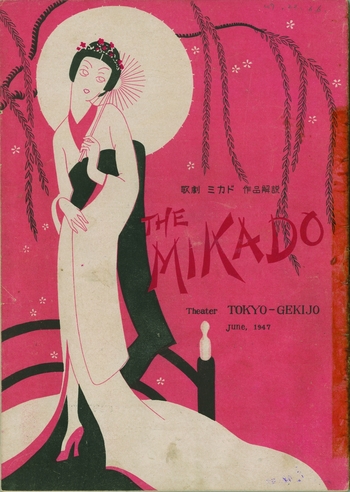
In projecting a set of desires for their image of a new Japan, the production team offered a vision that reflected their own professional and personal aspirations. The programme cover for the Tokyo Theater production articulated this image strongly (Fig. 2). Printed in black, red and white, in an art deco style, the illustration depicts a woman in a white kimono with black obi, standing on a traditional wooden bridge drawn in black. Above her, she holds a white parasol that takes the place of the moon, contrasting against the background of black branches and a red sky. Below, her kimono opens to reveal red high heels.
Programme cover for the Tokyo Theater production of The Mikado. While the illustration retains certain traditional elements, details such as the red high heels suggested the performance of new, multifarious Japanese identities. Courtesy of the Tsubouchi Memorial Theatre Museum, Waseda University.

Less than two years after the war's end, the programme's cover made a strong claim for an image of Japan as no longer isolated, but instead eagerly participating in international culture. The art deco style, recalling the movement's vigour in Japan during the 1920s and 1930s, reminded viewers of their country's history of embracing international art movements. But most significant, after years of being prohibited from wearing Western clothing, the eye-catching red high heels suggest joy at the war's end and signify the very freedom of being able to perform the opera itself. As an article of clothing, they assert the right to self-representation claimed by the 1947 all-Japanese production. The red heels can also be understood as a retort to the Anglo-American production history of The Mikado, which emphasized an ‘authentic’ image of Japan, where ‘authentic’ always meant top-knotted feudal samurai and shuffling musume. The high heels disavow the Western fantasy of traditional Japan, suggesting that this playful image might, in fact, be a far more accurate depiction of the country on which The Mikado was based.
If The Mikado in the West was frequently an attempt to pin down a single, stereotypical image of Japan, the Tokyo Theater version insisted upon the multiplicity of Japanese identity. The programme illustration thus asserted Japan's ability to reinvent itself, performing and embodying different images, and thereby exceeding any singular notion of ‘Japaneseness’. As a sign of this multiplicity, the red heels also communicated the cosmopolitanism at the heart of the Tokyo Theater production. Not only because the heels, paired with the kimono, mashed together Western and Japanese fashion, but also because they represented the performative self-defining acts of the cosmopolitan, a theatrical stance that negotiated the individual's relation to her society.
In her programme essay, Nagato Miho, reflecting upon her experience learning the role of Yum-Yum, gave full voice to the way in which the theatrical production process offered an opportunity to imagine possibilities for reconstructing the nation. As she explained, even on the level of genre and style, the operetta posed technical challenges that required a reshaping of her professional expertise. In preparing her role, she found that her past experience in tragic opera was of limited use:
In the case of tragedy, according to the style of singing and acting, one is dragged by circumstance into historical custom, but I think one does not know the difficulty with comedy, which viewed from outside appears trifling due to its light tone of expression, but gives me extraordinary anxiety. Without risking mere flimsiness in comedy, humorous all the way through, I hope not to lose the sense and feeling of good art.Footnote 20
The Mikado's light comic form seemed to rebuff deeper meaning, and she could not rely upon established tragic patterns to communicate significance to her audience. Yet the appearance of lightness belied the hard work undergirding such a performance. While Nagato's comment is explicitly about the expansion of her repertoire, it is hard not to read it as a meditation upon the broader challenges of the new era. Whereas war, with its predetermined style and gestures, pulled on the individual with inexorable force, the comedy of peace time required individuals to reveal meaning in moments of lightness and humour, and to find significance in an undramatic daily existence. As Eguchi had done in response to the Pyle Theater production, Nagato too understood the war in theatrical terms. Identifying tragic opera as the repertoire of war, which she performed according to established pattern, she called attention to the necessity of moving beyond this repertoire, in order to embrace the possibilities offered by a new genre.
Nagato's description of the challenge of learning to perform a new genre articulated a vision of theatrical process as a model for the reconstruction of Japan. Her essay claimed for The Mikado a role in building ‘a foundation for the establishment of a peaceful culture, on which we can construct a rebirthed Japan’.Footnote 21 Nagato's ambitions for the operetta were not simply about the way in which performing it after the sixty-one-year ban represented new freedoms. Rather, in the demands that the operetta placed upon the performers and production staff, The Mikado represented an opportunity to engage in the kind of imaginative self-making that was essential for reconstructing the nation at large.
Conclusion
In the first years after the war, The Mikado offered an opportunity for reimagining both personal and national identity. The Tokyo Theater production was thus an example of the optimistic planning that Japanese widely engaged in during this period. As the Occupation wore on, and the United States became more concerned with the rising threat of the Cold War, this early sense of promise waned. The Mikado, meanwhile, entered the repertoire of the Nagato Miho Opera Company, which continued to perform it in Tokyo and on tour through the 1970s.Footnote 22
That The Mikado became a site of hopeful projection in Occupation-era Japan points to alternative ways of approaching this and similar culturally vexed texts. In Japan, the ambiguity of the setting of the operetta – simultaneously Japan and not-Japan – served to open up the work for use by the very people whom the operetta (mis)represents. Absent the broader Euro-American cultural landscape, where racialized portrayals of Japanese people have translated into legal oppression, it is understandable that the Tokyo Theater production team saw no reason to feel victimized by The Mikado's fantastical image of Japan.Footnote 23 Instead, they used the operetta's imprecise relation to Japan to assert their own hopes and desires for the new era.
The process of theatre-making, inherently imaginative yet fundamentally tied to social realities, offered the production team a way of envisioning what they wanted for themselves and their nation. These artists, locating themselves within Japan and tying themselves to their country's future, called for a cosmopolitan approach to creating new art for the new era. Always internationally engaged, this was nevertheless a cosmopolitanism performed at home. Rather than exhibiting Japanese internationalism for a foreign audience, by creating a production aimed exclusively at Japanese spectators the artists were focused on reshaping the relation of national and international for a Japanese public. If Senda Koreya understood that in the early years of the war his family's cosmopolitanism had appeared strange, the Mikado production team endeavoured to render this form of internationalism familiar, so that it would not only be characteristic of their personal identities, but also become central to a new post-war Japan. Therefore, while theorizations of cosmopolitanism often understand the term in opposition to the nation, these artists offered cosmopolitanism as a performance to be taken up by the nation.
While even the Pyle Theater Mikado represented a re-engagement with foreign culture, it was the fact of the all-Japanese production that gave the operetta significance in the first years of the Occupation. Up until then, whenever Japanese spectators watched The Mikado, they also felt themselves being watched. As a Japanese journalist who saw a production in Sheffield, England, in 1907 described, ‘When the first act finished, suddenly on one side of the gallery, electric lights came on. Because there was a Japanese person, everyone's eyes fell upon me.’Footnote 24 After the performance, newspapers sought his reaction, eager to prove that the operetta was inoffensive, even to a Japanese person – a custom of proving innocence through Japanese approbation that has become part of Mikado history. Four decades later, a photograph showed the inside of the Ernie Pyle Theater auditorium. Turned away from the stage, the camera focuses on the balcony seats, in which sit the Japanese who were invited to The Mikado dress rehearsal. These spectators gaze at the stage, as the camera scrutinizes their faces, seeking in their reaction proof of the Occupation's successful democratization agenda.
While the Pyle Theater dress rehearsal repeated the old experience, it anticipated a new one. The 1947 Tokyo Theater version was in Japanese, leading the New York Times to declare that these performances were ‘for Japanese only’.Footnote 25 In a production that proclaimed its Japaneseness on every level – production staff, performers, and audience – the exclusivity of language reinforced the idea that this was a Mikado for Japanese alone. The privacy afforded by linguistic barriers created a space for the performance of cosmopolitanism at home, no longer strange, but instead an indication of possibilities for Japan's future.