

INTRODUCTION
The production of sugar in Tanzania is carried out by large-scale, capital-intensive vacuum pan mills. Cane is supplied by both nucleus estates and outgrowers. Nucleus estates are owned and managed by milling companies. Outgrowers are farmers who enter into binding arrangements through which the firms agree to buy and process agricultural products at agreed standards and a pre-determined price. The majority of sugarcane-producing outgrowers in Tanzania are smallholders. Throughout the 1970s and 1980s, the industry was fully under the control of the state, until the late 1990s when all sugar milling companies were privatised as part of economic reform. The sugar industry is important within the agricultural sector, employing between 14,000 and 15,000 people directly in the producing companies and institutions, and about 66,000 people in cane production and secondary activities. As in many other sugar-producing countries, cross-border trade of sugar has operated within a framework of state regulation and international agreements.
The existence of special arrangements and agreements such as the Sugar Protocol under the Lomé Convention and its subsequent variants under the European Union–African Caribbean and Pacific (EU–ACP) framework of cooperation, and the International Sugar Agreements had served to compartmentalise the sugar market between free market sugar on one hand, and protected sugar on the other (World Development Movement 1980; Abbot Reference Abbot1990; Hagelberg & Hannah Reference Hagelberg and Hannah1994; International Sugar Organization 2008). The sugar industry reforms in the EU, which ended the quota-based exports in 2009, will expose Tanzanian sugar producers to more intense competition for markets when they become effective in 2017. While the need for raising productivity and efficiency at various stages of the sugar production value chain emanates from the EU market reforms, domestic market dynamics also reinforce this need. According to the Sugar Board of Tanzania (SBT), current domestic sugar demand is estimated at 590,000 metric tonnes, against domestic production of 299,000 metric tonnes by all local sugar mills. The deficit is covered by sugar imports, sometimes at a cheaper price, exerting more pressure on efficiency by domestic producers. At the same time, sugar milling companies have exported sugar to East African markets as an attempt to compete in regional markets and to ease temporary cash flow problems caused by high volumes of sugar imports. Sugar exports in 2012/13 amounted to 59,000 metric tonnes.
Smallholder production of cane in Tanzania has continued to be significant even after state-run sugar mills were privatised. The nature of production and the strategy of collective action, however, raise some doubts about the potential of the existing production structure to be competitive in the global sugar market. Production at farm level by outgrowers is fragmented, and land ownership is based on traditional customary rights, which grant landholders the right of use of land in accordance to their preferences and needs. The practice of cane husbandry, while organised through the associations, is thus influenced by the growers' individual choices. The majority intercrop cane, paddy and maize, and have the tendency to switch between crops in different periods. These practices prevent growers from engaging in collective cane production systems with potential economies of scale to lower unit costs and also to raise productivity. Application of improved inputs is also generally low, making yields low and cane output uneven within the same geographic areas. This study investigates the organisation of cane production in Tanzania and its influence on productivity and efficiency of outgrowers that is essential for competitiveness of the sugar industry.
The study involved interviews with key institutions, including SBT, milling companies, outgrower intermediary organisations and those providing major services to cane growers in Tanzania. Interviews were also carried out with individual growers and farmer groups, and observations were made on operations in the cane fields and sugar mills. Secondary data were collected from report files made available by sugar milling companies, outgrower intermediary organisations and from SBT. Additional information was sought from the secondary literature, the United Nations Food and Agriculture Organization (FAO) and the International Sugar Organization (ISO). Data were also collected from a field visit in the neighbouring country of Malawi to obtain a contrasting view of the organisational arrangements and their outcomes. The analytical approach combined exploratory and descriptive analysis to explain the institutional factors that drive different outcomes and processes underlying their changes.
The key proposition is that while intermediary organisations of cane outgrowers in Tanzania have played a significant role in promoting effective market linkage, an increase in productivity required for competitiveness is limited by the lack of effective horizontal coordination. While the study finds a crucial role already played by intermediary organisations in reducing transaction cost and uncertainty, it is argued that the existence of these organisations and their transaction-reducing functions are necessary but not sufficient for raising productivity and for enhancing efficiency in the current environment of sugar production. Additional institutional arrangements are needed, particularly with experimentation of horizontal coordination that can pave the way for improved farming practices and to open up opportunities for economies of scale in investments needed to raise productivity at primary production level.
The remainder of this paper is organised as follows: Section two provides theoretical reflections underpinning the framework of analysis and the basis for emerging proposition. Section three discusses the ways in which vertical coordination has enhanced market linkage and how the absence of horizontal coordination limits potential productivity increases for sugarcane outgrowers. It also demonstrates how horizontal coordination has helped to increase the productivity of small cane outgrowers in the neighbouring country. Section four concludes and draws some implications for policy.
SOME THEORETICAL AND CONTEXTUAL REFLECTIONS: WHY INSTITUTIONS MATTER
The contemporary development discourse embraces the functions of institutions in explaining economic changes and innovation dynamics. States and markets are, however, the dominant institutions in this discourse. The link between them and the interplay of intermediary institutional arrangements in relation to economic performance is often ignored or understated. The abstraction of state and markets viewed independently of each other conceptually limits the understanding of the broader institutional settings and essential complementarity of varieties of institutions in stimulating economic change.
The notion of ‘institutions’ in economics and social sciences in general can be traced as far back as the works of Veblen (Reference Veblen1934), Coase (Reference Coase1937) and Commons (Reference Commons1951). Many other scholars have since expanded the discourse on institutions, and have amplified the significance of understanding different types of institutions and their roles in shaping social and market interactions (Polanyi Reference Polanyi1957; Granovetter Reference Granovetter1985; Hodgson Reference Hodgson1988, 2006; Mackintosh Reference Mackintosh, Bernstein, Crow, Mackintosh and Martin1990; Dorward et al. Reference Dorward, Kydd, Morrison and Poulton2005; Rodrick Reference Rodrik2007).
Organisations are special kinds of institutions created consciously with an explicit purpose, structures, criteria and boundaries (Edquist & Johnson Reference Edquist, Johnson and Edquist1997; Hodgson Reference Hodgson2006). Organisations are created to act as intermediaries for coordinating exchange in market or non-market institutional settings, playing distinctive roles in coordinating transactions and organising different actors in a given environment in the process of economic and social change. In this context, the desired economic change is increased productivity and competitiveness of sugar production in Tanzania. Productivity is an essential element in this analysis as it is one of the critical determinants of competitiveness. In business terms, for producers to realise adequate returns to investment while remaining competitive, commodities must be produced efficiently. While productivity is an essential element of competitiveness generally, its context and influence on smallholder production decisions is not straightforward. In countries like Tanzania, many smallholders typically produce for subsistence, although surplus is also important for cash income. Productivity of labour (measured by output per labour hour), therefore, is not a dominant factor influencing farmers' investment decisions. It is often the availability of input or output markets, seasonal finance and subsistence needs that matter most.
Productivity of land, or yield, measured by crop output per unit of land, and assuming market availability, is however commonly used in assessing the benefits of producing different crops and is preferred to agricultural labour productivity due to practical difficulties encountered in measuring the latter. Drivers of productivity at the primary level of production, and efficiency in value chain transformation processes are determined by levels and types of investments and capabilities, which differ by characteristics of crops and of producers. Some crops require economies of scale and efficiency at some stages in their value chain, but not in others. Economies of scale refer to the reduction in average cost when a single product is made in large quantities.
In the case of the sugar production value chain, economies of scale are critical at the stages of primary production of cane and processing. At both stages, large investments are made on specific assets, such as the cane loaders and vacuum-pan sugar mills. The specificity of assets relates to the extent to which investments in particular assets are tailored to support specific activities or transactions, such that their application to any other purpose substantially reduces their value (Williamson Reference Williamson1985; Milgrom and Roberts Reference Milgrom and Roberts1992; Mackintosh Reference Mackintosh, Himmelweit, Simonetti and Trigg2001). It is this unique nature of such assets that make their value dependent on the nature of transactions and the behaviour of parties in the market transactions. The primacy of institutions, therefore, in particular the role of intermediary organisations, relates to the fragmented nature of outgrowers that requires coordination to minimise transaction costs, to promote economies of scale in production and processing, and to optimise the value of investment in specific assets.
Colin Poulton, Andrew Dorward and Jonathan Kydd have extensively examined production organisations involving smallholders in developing countries. A major theme in their work is the indispensability of institutional coordination of smallholders in the current environment of liberalised markets. They argue that specific institutional arrangements are essential to removing constraints for the poor who find themselves in low production equilibrium traps (Dorward et al. Reference Dorward, Kydd, Morrison and Poulton2005). They conclude that the survival of smallholders in the increasingly competitive markets depends crucially on linkages which allow them to access a range of resources and services, information and skills, and output markets (Poulton et al. Reference Poulton, Dorward and Kydd2010). These linkages, however, require a variety of forms of coordination, which must be sensitive to particular features of key assets in different production and market contexts. Institutional design issues are therefore important for effective coordination, especially so in commodity value chains where longer-term contractual relationships tend to prevail over spot transactions.
Although in some agricultural value chains, such as in coffee, production can be undertaken more efficiently in the individual smallholder settings because of the opportunity for intercropping and flexible supply of labour, vertical coordination remains important in linking various stages of the value chain to achieve total chain efficiency. In the case of sugarcane, both vertical and horizontal coordination are important. Here the transportation of cane in bulk and its processing require that large volumes of cane are delivered to the mill at the appropriate time. The character of primary production, therefore, and the interdependence across various nodes in the chain shows the importance of a coordination strategy to deal with what Milgrom & Roberts (Reference Milgrom and Roberts1992) refer to as synchronisation problems.
In a study of cane outgrower models in Africa, Church et al. (Reference Church, Groom and Thomson2008) conclude that management and organisational structures matter for success in outgrower production systems. This is especially the case for consolidated farming that brings advantages of economies of scale, uniform management styles, efficiency in logistics, enhanced purchasing of inputs and improved accountability and control measures. This form of coordination extends beyond its vertical form that is concerned with transactions between growers and the miller, to horizontal coordination that includes mechanisms for managing production at farm level. Webber & Labatse (Reference Webber, Labatse, Webber and Labatse2010) make a similar point, arguing that competitiveness of African agriculture can be strengthened through horizontal coordination that allows farmers to benefit from economies of scale in various activities within upstream chain nodes. Horizontal linkages, therefore, have potentials to increase productivity by enhancing access to key inputs, strengthening the dissemination of information and monitoring of compliance. It also makes it possible to undertake joint investments under appropriate management structure.
Producer organisations are important in fostering coordination and other collective interests of smallholders. Producer organisations are diverse in purpose, mandate and levels at which they operate. They exist in different forms, such as cooperatives, associations, farmer groups or unions, and at different levels, from village or small geographic areas to regional and national levels. In developing countries, organisations engaged in agricultural and rural development tend to be more multipurpose grassroots organisations that combine economic and social functions in different degrees. As Rondot & Collion (Reference Rondot and Collion2001) and Ton & Bijman (Reference Ton and Bijman2006) observe, the multipurpose functions of producer organisations support and reinforce each other. Their economic and technical function is facilitated by their social control within communities in which they are founded. In turn, these organisations promote the collective well-being of their members by mediating economic relations between local constituents and their external environment, primarily markets. It is in this context that others have come to refer to such organisations as hybrid organisations (Rondot & Collion Reference Rondot and Collion2001; Ménard Reference Ménard2004). According to Ménard, hybrid organisations exist to facilitate key investment and operational decisions, since markets cannot bundle needed resources and capabilities, and total hierarchy risks inflexibility and weakened incentives. The discussion that follows in the next section locates these theoretical aspects of institutional coordination and the hybrid nature of producer organisations in the context of outgrowers' schemes for sugarcane.
INTERMEDIARY COORDINATION, TRANSACTION COSTS AND PRODUCTIVITY
Outgrowers have supplied cane to the mills since independence. The poor performance of the sugar mills and financial problems that characterised many parastatals during the economic crisis of 1980s, led to the wave of privatisation in the 1990s. In 1998, 75% of the shares in Kilombero Sugar Company (KCS) were acquired by Ilovo Group.Footnote 1 In 1999, all shares of Mtibwa Sugar Estates (MSE) were acquired by the Super Group of Companies.Footnote 2 Two other sugar mills, the TPC Limited and Kagera Sugar Limited were also privatised, but they depend mainly on estate supplied sugarcane. It is only in recent years that a few smallholders have emerged to supply sugarcane to Kagera Sugar Limited. The SBT was established as a regulatory body following the enactment of the Sugar Industry Act of 2001 (United Republic of Tanzania 2001). Under this Act, the Sugar Development Corporation (SUDECO), a parastatal that controlled the entire value chain in the sugar industry, was disbanded.
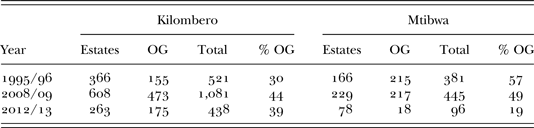
The total area under cane production by outgrowers increased dramatically, from 7,148 hectares to 22,216 hectares in Kilombero and Mtibwa between 1998 and 2006, respectively. As of August 2013, there were 21,678 outgrowers growing cane on a total of 25,371 hectares in the two areas. As Table I shows, between 1995/96 and 2008/09, outgrowers in Kilombero increased their share of cane from 30% to 44% in 2009, declining to about 39% in 2013. In Mtibwa, however, the share of outgrowers' cane had declined from 57% to 49% by 2009, and declined further to 19% by 2013. As will be seen in the subsequent discussion, different elements of institutional arrangements explain the dramatic decline of outgrower shares in Mtibwa.
Share of outgrowers in cane production, 1995, 2009 and 2013 ('000 tonnes)

Source: Sugar Board of Tanzania.
The significance of outgrower production makes it necessary for the milling companies to establish mechanisms for managing transactions between them. Transactions with these thousands of outgrowers under spot-market arrangements are complex and inefficient. They cultivate cane in individual fields of different sizes, located in different areas around the estates. Collection of cane requires a well-synchronised programme to match harvesting and haulage logistics with milling capacity. For the growers, individual bargaining affected their market position and increased individual transaction costs. Outgrower intermediaries emerged from the need for collective bargaining, which became apparent as the number of outgrowers grew over time, and as the services of the ailing state-owned estates deteriorated. Kilombero Cane Growers Association (KCGA) was established in 1991 to serve growers supplying to the first mill (K1), while Ruembe Outgrowers Association (ROA) was formed in 1992 to serve growers supplying to the second mill in Kilombero (K2). Mtibwa Outgrowers Association (MOA) was formed in 1996.
These associations are crucial intermediaries, given the nature of the product and technology in place, with investments in large-scale sugar mills and related equipment that are crop and site-specific. On the one hand, a single large-scale sugar processing plant for an economically feasible cane-growing distance of 40 kilometres effectively creates a monopsony, as a single buyer procures cane from a large number of outgrowers.Footnote 3 On the other hand, outgrowers link with these single buyers through their associations.
The principal activities of these associations are to negotiate the terms of business between outgrowers and millers, and to provide essential agricultural services to their outgrowers. These services have expanded in scope in recent years, which include cane harvesting, loan brokerage and administration, and extension support. Prior to privatisation, millers performed essential agricultural services such as providing seeds, fertilisers and pesticides to outgrowers at costs subsequently deducted from the proceeds of cane supply. This integrated system of service provision minimised problems of credit constraints and input availability. Following privatisation, the new owners of the mills disbanded provision of these services. The rationale behind this move from the view of the mills was to enable them to focus on their core business of producing sugar. This approach, however, neglects the potential consequences of low productivity of outgrowers and its adverse effect on efficiency of sugar production, including cane supply shocks. At best, the intent of millers seems to have more to do with mitigation of risks in cane production. Production risk is increased by two factors. The first is the reliance on rain, and the second is the fragmented structure of cane production. Millers in both Kilombero and Mtibwa retained provision of cane cutting, loading and harvesting until recently when outgrower intermediaries took over some of these tasks, often under passive supervision of millers.
The formation of these intermediary institutions has enabled outgrowers to negotiate and to engage collectively with millers, reducing transaction costs for both parties. Transactions between them are presently governed by the Cane Supply Agreement (CSA). The collective efforts of these intermediary institutions and SBT orchestrated the eventual adoption of CSAs in Kilombero since 2006. In Mtibwa, however, the miller signed the first CSA in 2009, after years of annual cycles of precarious pre-harvest negotiations of prices, quantity and quality of cane. The CSAs provide more stable market relations, detailing the method of price determination that takes into account the relative costs of production between growers and sugar processors. These intermediary institutions have also managed to negotiate and advocate for reduction and removal of multiple taxes and levies assessed at various nodes along the value chain that reduced growers' income. For example, in 2010 the district council levy was reduced to 1·6% of gross revenue, and VAT was removed from cutting and loading of cane. The assessment of income taxes was also exempted for small outgrowers.
An additional example of complementary non-market coordination through intermediary organisations is an experiment to provide seasonal credits to outgrowers using the CSAs as a basis against which financial institutions participate. This experiment was first implemented during the 2007/8 crop season in Kilombero, as growers faced mounting difficulties in tending their fields. This arrangement circumvented traditional barriers of collateral and complex application procedures, aligning certain interests of market and non-market institutions. It is based on a tripartite agreement between KSC, the two associations of KCGA and ROA, and two financial institutions, the National Microfinance Bank (NMB) and CRDB Microfinance Limited.
Under the tripartite agreement, the miller provides market assurance by committing to purchase all cane produced by registered growers, provided certain minimum quality requirements are met. The miller makes payments of cane proceeds through the relevant bank accounts maintained by groups of outgrowers, accompanied by the list of growers, amount of cane procured, and respective entitlements. The outgrower intermediaries scrutinise loan applications from their members, and advise applicants on amounts to be applied consistent with their income levels, measured by a third of the average income from cane over the last three crop seasons. The officials of these organisations are then to ensure that deductions are made for loan repayment as agreed at the time of application. Financial institutions deduct agreed amounts in the process of effecting payments.
The tripartite credit arrangement in Kilombero eliminated problems of information and enforcement inherent in rural credit markets. Outgrowers were able to obtain cash loans to meet their crop maintenance costs and other household needs. This arrangement, however, did not resolve all problems related to agricultural loans. Loan amounts remained inadequate relative to investment requirements at farm level. Interest rates remained high, charged at 15% and 21% for NMB and CRDB banks, respectively, much above the estimated return from cane farming of 10%.Footnote 4 In addition, the financing of common costs such as maintenance of infrastructure remained problematic.
The foregoing discussion shows that outgrower intermediaries are important vehicles for providing vertical and complimentary focal coordination, which reduce transaction costs and broker access to essential agricultural services. This is an important step in promoting investment in processing capacity and associated infrastructure by both parties. This coordination, however, falls short of mediating uncertainty related to the timing and reliability of supply, and sustainability of the current production system given contemporary global market development. A crucial element is the difficulty in transforming the system of primary production by outgrowers to raise productivity through horizontal coordination. The study outlines two factors that limit combination of vertical and horizontal coordination in Tanzania, hence constraining increases in productivity of outgrowers. First, the Tanzanian land tenure regime makes it difficult for outgrowers to pool their land voluntarily into block farms. The majority of growers find it difficult to give up individual decision rights for collective management of production. The customary attachment to land and lack of trust between outgrowers are major obstacles, as growers tended to resist ideas of block farming. Some growers expressed fear of a possible loss of their land in the pooling process. As a result, activities at farm level have continued to remain fragmented. The majority of cane outgrowers in Kilombero and Mtibwa are small, many of them operating on not more than two hectares. There are very few large outgrowers at the other extreme, growing cane on 50 or more hectares, and these represent less than 3% of outgrowers. The distribution of land area under cane by size is presented in Figure 1. It shows that most outgrowers' cane is grown on individual parcels of land not exceeding two hectares, representing 79% and 66% of outgrowers in Kilombero and Mtibwa, respectively.
Distribution of outgrowers' land area under cane by size in 2008
The second constraining factor is the capacity of outgrower associations to provide essential services in their current structure. In the mid-2000s, the associations decided to take over most of the activities related to cane loading and haulage for the outgrowers. With support from the AfDB, these intermediaries procured machinery and equipment including computers, motor vehicles and cane loaders, and started to provide those services to their members. The associations also decided to undertake cane haulage and transport function. This important function had been provided by the mills at a cost that was deducted from cane proceeds. In Kilombero, the milling company had in 2001 contracted UNITRANS Company Limited, a South African-based logistics firm to provide haulage services, following the problems of cheating by private truck drivers it had retained and overloading that caused extreme wear and tear of farm roads. UNITRANS operated more efficiently under strict contractual terms, and so its fleet supervision was tighter and compliance with truck specifications was closely observed. The associations, however, considered the cost of cane transport to be high. These costs ranged from 11% to 27% of cane prices in 2005/06 crop season depending on distance from cane fields to the mill. Distances are grouped in four categories up to 40 kilometres, which is considered the maximum feasible distance.
Within a few years after these changes, however, management of harvesting operations became problematic, attributed to the limits of managerial capacity and conflicts of interests within the associations' management. Some leaders of the associations became providers of transport services contracted by the same associations. In other instances, these officials were intimately associated with the contractors, but no prior and transparent declarations of such interests were made. As a consequence, ineffective contractors continued to operate without recourse. Transport costs continued to rise, ranging between 12% and 33% of cane price in the 2009/10 crop season. Failures by ineffective transporters and poor management of harvesting schedules raised a lot of discontent among growers. They caused problems related to rendement, a measure of sucrose content, expressed as a mass of sugar per tonne of cane and a key variable in the price calculation. The late delivery of harvested cane to the mill led to increasingly low rendement assigned to growers' output, and sometimes the cane was declared completely stale. Cane becomes stale when it remains unprocessed within 24 hours of being cut. Scheduling is also important because rendement tends to be high in the early months of the harvesting cycle, such that many growers preferred to harvest early. In some instances, some outgrower cane remained in the field at the close of the season, causing losses to the growers. For many such outgrowers, the solution was seen in forming of new associations to exercise control of their own cane harvesting and to negotiate with millers.
The spontaneous split of these associations, seen as a response to their failures to adequately provide services to outgrowers, complicated logistics even further, as the new associations were not necessarily formed along defined geographic boundaries. Following the rushed split of the associations, each association individually started to negotiate their CSAs, which undermined the bargaining position of outgrowers. By August 2013, the number of registered associations had grown from two to eleven in Kilombero, and from one to two in Mtibwa. In Mtibwa, each of the two intermediaries signed separate CSAs with the miller under different terms and conditions. In Kilombero, the old associations were reluctant to cooperate formally with the newly formed associations. At the same time the miller was not in favour of dealing with multiple associations to reduce transaction costs. Thus, the newly established associations had no formal CSA. Without the formal agreement, the associations failed to guarantee loans to their members.
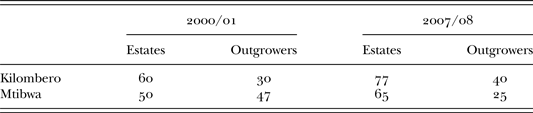
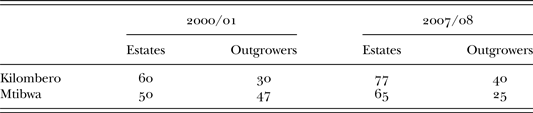
The organisational weaknesses of these grower intermediaries are compounded when sugar milling firms are unwilling to support outgrowers, a problem particularly noted in Mtibwa. Cane output from outgrowers in Mtibwa has declined dramatically, as shown in Table I, yield rates have remained low, and cane fields are deteriorating rapidly. Average yield rates in Mtibwa have also fallen dramatically when compared to levels at the beginning of privatisation, as Table II illustrates. For both cases, productivity is lower for outgrowers than it is for the estates due to differences in farming practices.
Yield differences in TCH by type of producer, 2000/01 and 2007/08
Source: Sugar Board of Tanzania.
In contrast to the current sugarcane production organisation in Tanzania it is helpful to take an example from Dwangwa in Malawi, where vertical and horizontal coordination are combined. In Dwangwa, Dwangwa Cane Growers Trust (DCGT) was formed as an autonomous entity to assume development roles on behalf of outgrowers. The smallholders' land was pooled into blocks of 40 hectares registered under titles held by the Trust. The average land per outgrower is 2·5 hectares. The Dwangwa Cane Growers Limited (DCGL), a professional management company owned by cane growers and employees of the defunct Smallholder Sugarcane Authority, carries out daily management of field operations and manages transactions with the milling company on behalf of the outgrowers. The company provides labour and machinery for activities that benefit from economies of scale, such as land preparation. The subsequent maintenance activities are tended by outgrowers themselves, but the management of DCGL actively ensures that such activities are carried out as scheduled, and may hire labour to carry out such activities where growers are unable to undertake them on a timely basis. The fields are clearly marked with identification tags on each block, so that outgrowers can identify boundaries of their plots. The DCGL keeps detailed operational data for each plot, and provides extension services on a regular basis. These costs are not charged directly to outgrowers on an activity-by-activity basis. They are financed through a management fee of 20% that the company retains against cane proceeds.
The DCGL also purchases inputs, including fertiliser and chemicals, under a special arrangement with the milling company that benefits the growers because of discounts on large volumes – although a small handling fee is charged by the miller. The DCGL also manages all harvesting activities, including scheduling, cutting, loading and hauling. This system of coordination has put productivity of outgrower cane in close range with those of estates, and it also releases labour time for outgrowers that can be spent to produce food on distant plots. These growers are also entitled to dividends from the profit of the company, in addition to cane proceeds.
Under this arrangement, economies of scale were also achieved from massive investment in irrigation infrastructure, both pivot and furrow.Footnote 5 Such an irrigation infrastructure is expensive to develop and to maintain by individual farmers. The DCGT obtained a long-term development loan from the African Development Bank (AfDB) on behalf of outgrowers, with a guarantee from the Government of Malawi. The loan was used to develop block farms, and to procure irrigation infrastructure and farm machinery. Repayment of this loan is effected through a development charge amortised from proceeds of cane to farmers by DCGL and remitted to the Government through the Trust. As of 2009, 85% of 1,073 hectares harvested by outgrowers in Dwangwa were under irrigation. In order to match cane output increase from this irrigation project for outgrowers, the company agreed to upgrade its milling capacity from 140 tonnes per hour to 200 tonnes per hour. This increased output raised the share of outgrowers' supply of cane to the mill to 21% of the total.
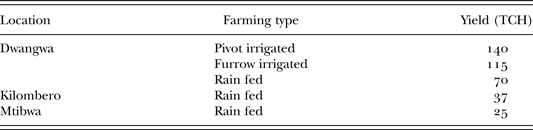
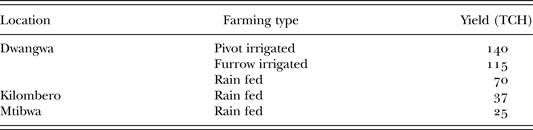
The production organisation in Malawi, therefore, provides a clear contrast of combined vertical and horizontal coordination, unlike that observed in Tanzania. As a result, productivity of outgrowers in Kilombero and Mtibwa as measured by cane yields per hectare lag much below Dwangwa, attributed largely to differences in production management systems. Table III compares average yield rates for outgrowers in tonnes per hectare (TCH), showing that cane yields in Dwangwa are much higher than those from the counterpart outgrowers in Kilombero and Mtibwa. Data from the ISO similarly showed marked differences in land productivity based on indicative yield rates between Malawi and Tanzania outgrowers and estates. Table IV, which is an excerpt from the ISO 2008 study, shows that yield rates from Tanzanian outgrowers were nearly half those for the estates, while they were only less than 10% below estates in Malawi.
Average yield rates by different outgrowers in 2009/10
Sources: MOA, ROA, KCGA & DCGL.
Indicative yield rates in TCH between Malawi and Tanzania by type of producer

Source: International Sugar Organization 2008.
If the central element underlying this marked difference between cane growers in Tanzania and those from Dwangwa revolves around effective intermediary coordination, what has constrained effective organisational innovation and coordination for Tanzanian cane growers? As the preceding discussion has shown, three factors stand out to answer this question. The first is the organisational weaknesses internal to producer organisations. These weaknesses include inadequate managerial capacity and fragile structure of the associations and their field of membership. Second, weak and in some cases hostile partnership between the milling company and outgrower intermediaries have tended to undermine the complementarity of effort and efficient synchronisation of activities within the value chain. Third, the land regime based on customary land ownership and absence of enforceable land use planning have limited the potential for land consolidation that offers opportunities for efficient farming practices such as joint planting, collective investment in irrigation infrastructure and the related benefits of economies of scale.
Both Kilombero and Mtibwa valleys offer great opportunities for irrigated farming from the big rivers that supply irrigation water to the estates, but heavy upfront costs of irrigation infrastructure remains a major constraint. While the block farming arrangement may arguably increase dependency of farmers and reduce their flexibility in production decisions, it is a matter of trade-offs and choices between achieving production efficiency and competitiveness on the one hand, and flexibility of farmers that is customary and a common farming practice on the other.
CONCLUSION AND IMPLICATIONS FOR POLICY
This study has located the Tanzanian sugar industry within a global market context showing that increase in productivity and production efficiency are critically important in the contemporary environment where free markets are replacing preferential market arrangements. The comparative study of production organisation has shown that while vertical coordination of Tanzanian cane growers through intermediary organisations has enhanced market linkages and reduced transaction costs, horizontal coordination remains very weak, and as a result, productivity is very low relative to its potential. Since the majority of these outgrowers are small and fragmented, raising their efficiency and productivity requires effective coordination to bring in economies of scale in the use of equipment, infrastructure, and managerial and technical support, while at the same time keeping transaction costs low. Effective coordination, in turn, is anchored in the existence of an enabling institutional environment created through isomorphism of market and non-market institutions.
Two policy implications are outlined. First, the intricacy with which the existing institutional arrangements were established and the lingering enforcement problems for some sugar mills signals the need to strengthen policy and regulatory frameworks governing agro-processing and contractual relationships between growers and processors. While sugar production efficiency requires investment in capacity to absorb efficiently produced cane, it also requires adequate and stable supply of cane, which in turn can be achieved through predictable and enforceable business relationships between growers and millers. An alternative option might be to explore options for promoting small scale sugar mills by the outgrowers, paying attention to organisational capacity challenges discussed in this paper.
Second, even in situations where intermediary organisations have enhanced market-based solutions to eliminate major constraints, the involvement of the state beyond its regulatory functions may be critical to stimulate sustainable high productivity increases for outgrowers. This is particularly relevant in the provision of agricultural credit facilities or guarantees that can facilitate large investments in key areas such as irrigation, which cannot be undertaken by smallholder farmers under normal market conditions. This is also relevant in the context of the current land regime and land use planning required for promoting block farming. The two policy implications thus raise issues that warrant further studies, in particular on the feasibility of options for small-scale sugar mills, and how the land regime and land use planning might support the consolidation of production.